He Waited Through Every “Five Minutes” Until the Tow Truck Exposed What Both Neighbors Were Hiding
Chapter 1: The Car Was Already Leaving the Ground
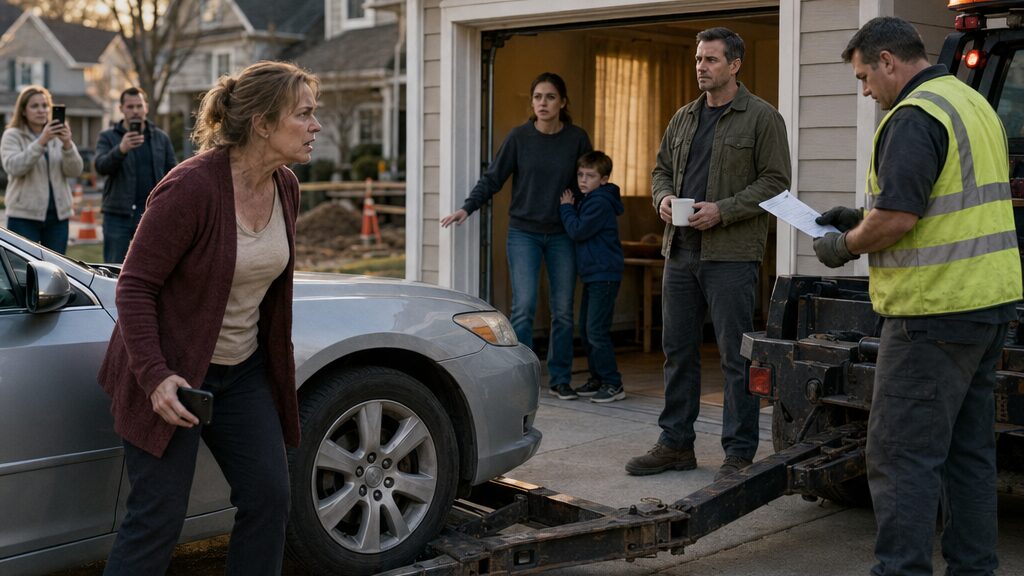
Karen Wilson’s silver sedan was already leaving the ground when she shouted that Andrew Harris had never warned her.
The tow truck’s hydraulic lift groaned beneath the rear axle. One wheel hung inches above the asphalt, turning slowly as if the car itself were reconsidering how it had ended up sideways across Andrew’s driveway.
“You can’t do this,” Karen said, one hand pressed to her phone, the other pointing at Andrew. “Tell him to put it down.”
The tow-truck operator kept working.
Across the street, a neighbor held a phone upright. Another stood at the edge of his lawn with his arms folded. No one spoke loudly enough for Andrew to hear, but he could feel their conclusions forming.
Vindictive.
Petty.
The quiet widower finally lost his temper.
Andrew stood near his garage with a white coffee mug cooling between both hands. Above him, the security camera watched from beneath the eave. Its small red indicator light remained steady.
He had imagined this moment for two days. In those private rehearsals, he had felt relief. Maybe even satisfaction.
Now Karen’s face was flushed, the truck’s warning lights pulsed against the houses, and somebody’s child was crying behind her screen door.
The scene no longer felt simple.
Three days earlier, Andrew had stepped outside at 7:12 on Tuesday morning with his work bag over one shoulder and his travel mug in his hand.
He stopped halfway down the walk.
A silver sedan sat across the mouth of his driveway.
His property had a narrow entrance from the street that widened toward the garage into two parking lanes. The arrangement let him keep his pickup on one side and still back his late wife’s compact car out from the other. He had not driven the compact in months, but he kept both lanes clear. Order made the house easier to live in.
Karen’s sedan blocked all of it.
The vehicle was not touching his property by more than a few feet, but its position made the distinction meaningless. He could not get either car past it.
Andrew checked the time. He was scheduled to lead an inventory review at the distribution center at eight. The drive took thirty-five minutes on a good morning.
He set his bag inside his pickup, crossed the strip of grass between the houses, and knocked on Karen’s front door.
She opened it wearing slippers and a loose gray sweatshirt. Her hair was clipped behind her head. She smiled before he could speak, as though the inconvenience had already been forgiven.
“Morning, Andrew.”
“Morning. Is that your car across my driveway?”
She leaned to look past him, though the sedan was visible from her front window.
“I’m just waiting for somebody to move,” she said. “Five minutes.”
“I need to leave for work.”
“I know. I’m sorry. Five minutes, honestly.”
Her tone was warm enough to make further objection feel excessive. Andrew glanced at his watch.
“Okay,” he said. “But I need the driveway kept open.”
“Of course.”
She closed the door.
Andrew returned to his truck and placed the mug in the cup holder. At 7:18, he started the engine. At 7:22, he shut it off to save gas. At 7:27, he sent his supervisor a message saying he might be late.
At 7:33, he walked to the end of the driveway and looked toward Karen’s house. No movement.
At 7:39, he called the distribution center and listened while his supervisor rearranged the meeting.
At 7:45, a delivery van passed behind the sedan and slowed to avoid it.
At 7:51, Karen finally came outside.
She carried a reusable shopping bag and a set of keys. She did not hurry. She checked something on her phone before unlocking the car.
Andrew stood beside his pickup with his arms at his sides.
“That was almost forty minutes,” he said.
Karen looked at him as though he had commented on the temperature.
“I know. Sorry. Things got complicated.”
“You said five.”
“I thought it would be five.”
She placed the shopping bag in the passenger seat.
“I missed a meeting.”
Her smile tightened. “I moved it as soon as I could.”
The sentence landed oddly. Not as an apology, but as a defense against an accusation Andrew had not yet made.
“I need access to my driveway,” he said.
“And you have it now.”
Karen got into the sedan and drove forward, clearing the entrance. She turned into her own driveway, where a dark SUV already occupied the space nearest the garage.
Andrew watched her park behind it.
The entire maneuver took less than thirty seconds.
He arrived at work twenty-six minutes after the review had begun. His supervisor did not reprimand him, which somehow made the embarrassment worse. Andrew was the man who arrived early, checked the dock schedule twice, and kept spare barcode labels in his desk because other people forgot.
He did not explain that a neighbor had trapped him at home. He said only that his driveway had been blocked.
That evening, he returned to find Karen’s sedan gone. The dark SUV remained in her driveway. Construction barriers stood farther down the street where the homeowners association had begun replacing a drainage line beside the guest spaces.
Andrew noticed the barriers but did not connect them to anything yet.
Inside his house, he placed his keys in the shallow wooden bowl near the door. His wife, Katherine, had bought the bowl at a craft fair years before and teased him for assigning permanent locations to objects.
Keys in the bowl. Mail in the tray. Shoes under the bench.
After she died, the habits stopped feeling like habits. They became supports.
He heated soup, opened his laptop, and searched for exterior security cameras.
The decision felt disproportionate for several minutes. Karen had blocked him once. She had moved eventually. Neighbors were supposed to speak to one another before turning every irritation into surveillance.
Then he remembered her walking toward the car without urgency. He remembered the words: You have it now.
He selected a compact camera with motion alerts and a wide-angle lens. Before completing the order, he hesitated over the payment button.
Katherine would have asked Karen what was going on. She had been able to ask personal questions without making them sound invasive. Andrew preferred questions with measurable answers.
How long?
Whose car?
What rule applies?
He clicked Place Order.
The camera would arrive Tuesday evening.
On Friday, beneath its unwavering red light, Karen’s car rose another foot from the street.
“You planned this,” she said.
Andrew looked at the tow operator’s chains, then at the neighbors’ phones.
“Yes,” he said.
Karen stared at him.
For the first time since the truck arrived, her anger flickered into something else.
Fear, perhaps.
Or the recognition that Andrew had stopped accepting five minutes as an answer.
Chapter 2: The Red Light Above the Garage
At 6:43 Wednesday morning, the new security camera recorded Karen Wilson standing at the edge of Andrew’s driveway and looking directly into its lens.
Andrew watched the clip twice.
Karen had not wandered into view by accident. She stepped off her walkway, tilted her chin toward the eave, and remained still for four seconds. The image was clear enough to catch the narrowing of her eyes.
Then she turned away.
Andrew paused the footage with the small red indicator reflected in one lens of her glasses.
He had mounted the camera the previous evening using a ladder and an electric drill. Its frame covered the driveway entrance, both parking lanes and a narrow section of the street. The far edge included part of Karen’s front lawn, but not her door.
He had been careful about that.
The camera was for access, not intrusion.
At least that was what he told himself when he enabled alerts on his phone.
Nothing happened Wednesday. Karen’s silver sedan remained somewhere else, and Andrew left for work without obstruction. By evening, he had begun to wonder whether the camera itself had ended the problem.
Thursday morning proved otherwise.
Andrew was already inside his pickup when his phone buzzed.
Motion detected.
He looked through the windshield.
Karen’s sedan rolled backward from her driveway and stopped across his entrance. She opened the trunk. Paper grocery bags were stacked inside.
Andrew shut off his engine and stepped out.
“Karen.”
She lifted one bag without looking at him. “I’ll be quick.”
“You’re blocking me again.”
“I have cold things.”
“That doesn’t change where the car is.”
She turned, holding the bag against her chest. “There’s nowhere to park.”
“There’s room farther up the street.”
“Half a block away.”
“Yes.”
“I’m not carrying all of this half a block.”
Andrew glanced at the dark SUV in her driveway.
“Whose SUV is that?”
Karen shifted the bag higher. “Family.”
“Then move one of the vehicles.”
“It’s temporary.”
“So was Tuesday.”
Her mouth tightened.
Andrew heard his own voice becoming sharper and lowered it before continuing.
“I’m asking you not to block my driveway again.”
“I heard you the first time.”
“Then why are we having this conversation?”
Karen looked toward the camera. The red indicator glowed beneath the garage eave.
“You really put that up because of me?”
“I put it up because my driveway was blocked for forty minutes.”
“You could have knocked again.”
“I had already asked you to move.”
“And I did.”
“Forty minutes later.”
Karen let out a short breath through her nose. “The guest parking is torn up. You can see that.”
The drainage project occupied six spaces near the curve of the street. Orange mesh fencing surrounded a trench filled with gravel and lengths of black pipe. Andrew had received the same HOA notices everyone else had, but they had described the disruption as limited.
“There are spaces by the clubhouse,” he said.
“At night, maybe. Not in the morning.”
“Then speak to the HOA.”
“I have.”
The answer came too quickly.
Andrew studied her face. “What did they say?”
“Mark knows the situation.”
“What situation?”
Karen’s fingers tightened around the paper bag. “The parking situation.”
“That isn’t permission to block private access.”
“I didn’t say it was.”
“You’re implying it.”
“I’m telling you I’m not doing this for fun.”
For a second, something unguarded moved across her expression. Fatigue, perhaps. Then the defensiveness returned.
Andrew could have asked why she needed two vehicles so close to the house. He could have asked who was using the SUV or why groceries had to be unloaded from the street instead of her own driveway.
Instead, he looked at his watch.
“How long this time?”
Karen’s gaze hardened. “Five minutes.”
He almost laughed, but there was no humor in it.
“Move it now, please.”
“I have three more bags.”
“Move it, then unload.”
She stood motionless.
The front curtain beside her door shifted. A small hand appeared against the glass and disappeared.
Andrew noticed it but said nothing.
Karen carried the bag inside. She returned thirty seconds later without it, entered the sedan and pulled forward into her own driveway. She stopped close behind the SUV, leaving barely enough room between the vehicles.
Andrew went back to his pickup.
As he reversed, he saw Karen standing at the curb with the remaining groceries. She did not look at him.
At work, Andrew checked the HOA website during lunch. The drainage notice stated that guest spaces would be unavailable for approximately three weeks. Residents with exceptional access needs were instructed to contact property management.
He called the number.
Mark Scott answered on the fourth ring.
“Community management.”
“Mark, this is Andrew Harris on Willow Bend.”
“Andrew. What can I do for you?”
“I’m calling about the guest parking closure.”
“Yeah, I know it’s inconvenient. The contractor is moving faster than expected.”
“My neighbor says she spoke with you about her parking situation.”
Silence lasted just long enough to become noticeable.
“Which neighbor?”
“Karen Wilson.”
Mark cleared his throat. “We’ve had a lot of calls.”
“She has blocked my driveway twice.”
“That shouldn’t happen.”
“She says you know about it.”
“I know about the general shortage.”
“Did you tell her she could use my driveway entrance?”
“No. Absolutely not.”
The denial arrived before Andrew had asked the question.
He leaned back in his office chair.
“I didn’t say she claimed you gave permission.”
“Well, I want to be clear. I can’t authorize anyone to block private property.”
“Then I’d like you to tell her that.”
“I can send a general reminder.”
“A general reminder won’t solve a specific problem.”
Mark’s tone softened into the patient cadence used by people who wanted a conversation to end without appearing dismissive.
“Andrew, the work is temporary. Everybody’s making adjustments.”
“My adjustment has been missing a work meeting.”
“I understand.”
“No, you’re saying you understand.”
Another pause.
“Let me see what I can do,” Mark said.
Andrew returned home at six. The driveway was clear.
A folded HOA notice had been tucked into his front door. It reminded residents not to obstruct fire lanes, sidewalks or marked common areas. It said nothing about private driveways.
Karen stood near her mailbox, sorting envelopes.
“Did Mark contact you?” Andrew asked.
She did not turn around. “He sent everybody that notice.”
“That wasn’t what I requested.”
“Maybe you should take it up with him.”
“You brought him into it.”
Karen faced him. “I told you he knows.”
“That isn’t the same as saying he approved it.”
“I never used the word approved.”
The distinction was precise enough to sound practiced.
Andrew looked toward her driveway. The SUV was backed close to the garage door. A blanket or curtain had been fitted behind one of the garage windows. He had not noticed it before.
Karen followed his gaze and stepped slightly sideways.
“You have your driveway,” she said. “What else do you want?”
“I want to know it’ll be open when I need it.”
“You can’t control every inconvenience, Andrew.”
The words struck deeper than she could have known.
He looked away first.
That evening, while reheating dinner, his phone rang. Mark’s name appeared on the screen.
Andrew answered.
“I spoke with Karen,” Mark said. “She understands the driveway can’t be blocked.”
“Good.”
“But I’m asking everyone affected by the construction to be flexible for a few days.”
Andrew stopped stirring the pot.
“Everyone?”
“You know what I mean.”
“I know you’re asking me to accept the exact thing you just said shouldn’t happen.”
“I’m asking neighbors to work things out without turning this into a formal dispute.”
Andrew looked through the kitchen window at the red point of the camera beneath the eave.
“What exactly did you tell Karen?” he asked.
Mark did not answer immediately.
Chapter 3: The Rule That Was Never Written Down
“I never gave Karen permission to use your driveway,” Mark said before Andrew had described what Karen claimed.
They were seated across from each other Thursday morning in the small HOA office beside the clubhouse. A framed photograph of the subdivision’s entrance hung behind Mark’s desk. In it, the flower beds were symmetrical, the sidewalks empty and every car properly placed.
Andrew set his phone face down between them.
“I haven’t accused you of giving permission.”
“I’m clarifying.”
“You’ve clarified it three times.”
Mark leaned back. He wore a pale blue shirt with the sleeves buttoned despite the warm office. A stack of contractor invoices sat near his elbow.
“The drainage project created an unusual situation,” he said. “I told several residents to use the nearest available access while spaces were closed.”
“Access to what?”
“Temporary parking. Loading areas. Whatever could be worked out neighbor to neighbor.”
“My driveway is not a loading area.”
“No one said it was.”
“Karen thinks someone did.”
Mark rubbed one thumb along the edge of an invoice. “Karen hears what helps Karen.”
The comment was unkind, but not entirely false. Andrew felt a brief pull toward accepting it. One difficult neighbor. One straightforward explanation.
Then he remembered Mark’s request for flexibility.
“Put your guidance in writing,” Andrew said.
Mark looked up. “What guidance?”
“That residents may not block private driveways, regardless of the construction.”
“The covenants already cover interference with property access.”
“Then send a notice citing the section.”
“We try not to weaponize the covenants over temporary disagreements.”
“You sent me a general reminder about fire lanes.”
“That went to everyone.”
“It avoided the actual issue.”
Mark’s patience thinned. “What result are you looking for?”
“My driveway stays open.”
“And if it’s blocked for two minutes while someone unloads groceries?”
“I need it open.”
“You understand how that sounds?”
Andrew did.
Rigid. Unneighborly. A man defending an empty strip of concrete as though it were sacred ground.
He also understood what it felt like to sit in his truck while someone else decided his schedule was negotiable.
“It sounds like I want access to my property,” he said.
Mark folded his hands. “Susan is concerned this is becoming personal.”
“Susan hasn’t spoken to me.”
“She’s seen the messages in the community group.”
Andrew had muted that group months ago. He opened it now.
There were thirty-seven unread posts. Most concerned construction noise and muddy tire tracks. Three referred indirectly to “neighbors filming neighbors.” One resident had written that people should show grace during temporary hardship.
No one had mentioned the blocked driveway.
Andrew locked the screen.
“So Karen can imply I’m unreasonable in public, but you don’t want a specific rule enforced in private.”
“I didn’t say Karen posted anything.”
“You didn’t have to.”
Mark sighed. “I have eight buildings complaining about drainage, a contractor threatening a change order, and residents demanding permits for spaces that do not exist. I’m trying to keep small issues from becoming expensive ones.”
There it was. Not permission, exactly. Incentive.
Andrew stood.
“I’ll handle my driveway myself.”
Mark’s expression changed. “Meaning what?”
“Meaning I’m done asking for informal help.”
The municipal offices occupied a brick building ten minutes away. At the parking clerk’s counter, Andrew explained the driveway layout and showed a photograph from his phone.
The clerk enlarged the image.
“That vehicle is across the curb cut,” she said.
“Yes.”
“City enforcement can cite on public streets, but response times vary. If the driveway is privately owned and access is obstructed, you may be able to authorize a private tow. You’ll need signage or advance documentation depending on the company.”
“Can the HOA prevent it?”
“Not if the tow is lawful, but read your covenants.”
Andrew had already read them twice.
He called three towing companies from the parking lot. The first would not enter HOA property without management approval. The second said an officer had to be present.
The third asked for photographs, proof of ownership and a signed authorization form.
“If the vehicle blocks the curb cut and you’ve documented prior notice, call us while it’s still there,” the dispatcher said. “Driver confirms on arrival.”
Andrew sat behind the wheel with the form open on his phone.
“Can I arrange the paperwork now?”
“That’s better.”
By noon, he had scanned his property record, submitted photographs and signed the authorization. The dispatcher emailed confirmation with a reference number.
The process brought a clean, immediate relief. There were boxes. Dates. Requirements. No one asked whether Karen was tired, whether Mark was overwhelmed or whether Andrew sounded inflexible.
The rule did not care who was sympathetic.
That afternoon Susan Adams called him.
Her voice was measured and cordial.
“Andrew, Mark tells me there’s tension with Karen.”
“My driveway has been blocked twice.”
“I understand that’s frustrating.”
“It prevented me from leaving.”
“Mark also said you contacted towing companies.”
Andrew looked toward his office door before replying. “I researched my legal options.”
“I hope you’ll consider how quickly these things can damage relationships.”
“The relationship is already damaged.”
“Temporary construction creates pressure on everyone.”
“So far, the pressure has been placed on my driveway.”
Susan paused.
“No one is saying you don’t have rights,” she said. “I’m asking whether towing a neighbor’s car would be proportionate.”
“Would repeatedly blocking access be proportionate?”
“I don’t want this conversation to become adversarial.”
Andrew almost told her it had become adversarial when the HOA decided his inconvenience was easier to manage than Karen’s problem.
Instead, he said, “Then give her a legal place to park.”
“We’re exploring options.”
“When?”
“The contractor expects to reopen two spaces next week.”
“And until then?”
“We hope residents can cooperate.”
The same word, reshaped.
Cooperate meant Andrew waiting.
Andrew yielding.
Andrew becoming the easiest problem in the neighborhood.
After the call, he printed the towing authorization and the relevant covenant section. At home, he placed them on the kitchen table beside his laptop.
The camera feed occupied half the screen. His driveway appeared empty beneath the afternoon light. The red recording icon blinked in the corner.
He remembered Katherine standing in that kitchen years earlier after another neighbor’s tree limb had fallen across their fence. Andrew had wanted photographs, estimates and a certified letter before the man finished cutting the branch.
Katherine had taken over a plate of cookies and returned with an apology and a promise to repair the boards.
“You make every problem prove itself before you speak to the person inside it,” she had told him.
At the time, he had laughed.
Now the memory irritated him because it sounded too much like Karen’s accusation about control.
He stacked the papers neatly.
Documentation was not cruelty. Preparation was not revenge. He had asked twice.
At 4:17 Friday afternoon, while Andrew stood at the kitchen counter rinsing his coffee mug, his phone sounded.
Motion detected.
He opened the camera feed.
Karen’s silver sedan entered the frame and stopped across the driveway entrance.
For several seconds, no one got out.
Then Karen opened the driver’s door, looked directly toward the camera and walked back toward her house.
Andrew reached for the printed authorization.
The driveway was blocked.
The violation was recorded.
For the first time, he no longer needed anyone’s permission to decide what happened next.
Chapter 4: Twelve Minutes Before the Whole Street Watched
The towing dispatcher said, “Twelve minutes,” and Andrew looked through the kitchen window at Karen’s silver sedan stretched across both lanes of his driveway.
He had expected hesitation.
Instead, he felt only a clean narrowing of choices.
“The vehicle is still in place?” the dispatcher asked.
“Yes.”
“You have the authorization number?”
Andrew read it from the printed sheet beside the sink.
“Driver will verify the obstruction before hookup. Do not move or confront the owner unless necessary.”
“I understand.”
He ended the call and set his phone face down.
The coffee in the pot had gone bitter from sitting too long. He poured a mug anyway. The ordinary motion steadied his hands: lift the pot, fill to the same dark line, return the pot to the warmer. Through the glass, Karen’s car remained unmoving.
Above the garage, the camera’s red light held steady.
Andrew checked the time.
4:19.
Twelve minutes was not long enough to reconsider everything, but it was long enough to reconsider himself.
He could still walk next door. He could knock a third time. He could tell Karen what he had done and give her one last chance to move the car.
Then he remembered Tuesday’s forty minutes and Thursday’s groceries. He remembered Mark asking for flexibility as though access to Andrew’s own home were a favor the community could redistribute.
Another warning would not be a warning. It would be proof that the earlier ones had never mattered.
At 4:24, a neighbor across the street came outside to retrieve a package. She saw the sedan, then looked toward Andrew’s house. He stepped back from the window.
At 4:27, Karen’s front curtain shifted.
At 4:29, the tow truck turned onto Willow Bend with amber lights rotating above the cab.
Its engine filled the quiet street before the vehicle itself came fully into view. The driver slowed beside the silver sedan, studied its position, then backed into alignment with Andrew’s driveway.
Andrew carried the authorization papers outside.
The operator was a broad-shouldered man in a reflective vest. He glanced at the sedan, the curb cut and Andrew’s property line.
“This yours?” he asked, indicating the driveway.
Andrew handed him the proof of ownership.
“And you’ve notified the owner before?”
“Twice in person.”
“Got documentation?”
Andrew pointed toward the camera.
The operator followed his gesture and saw the red light.
“That’ll do if there’s a dispute. Vehicle is fully obstructing access.”
He said it without drama. Just a conclusion.
Andrew felt something loosen in his chest.
The operator lowered the lift.
Metal scraped lightly against pavement.
The sound brought Karen outside.
She came through her front door fast, phone already in her hand.
“What are you doing?”
The operator did not look up. “Ma’am, step away from the equipment.”
Karen saw Andrew near the garage.
“You called them?”
“Yes.”
“You didn’t even come tell me.”
“I told you twice not to block the driveway.”
“This is not the same thing.”
“It is exactly the same thing.”
Karen moved toward the sedan. The operator stepped between her and the lift.
“Ma’am, once hookup starts, you need to speak with the company.”
“It hasn’t started. Put it down.”
“It is down.”
The operator slid the metal arms beneath the front tires.
Karen turned to Andrew.
“Tell him to stop.”
Andrew wrapped both hands around his mug. He had not taken a sip.
“You parked across my driveway again.”
“For ten minutes.”
“You don’t decide how long I can use my own property.”
“I was handling something.”
“You are always handling something.”
Her face changed at that. Not softer. More exposed.
Across the street, the neighbor who had collected the package now stood on her lawn with her phone raised. Another resident emerged two houses down. The gathering happened quietly, each person pretending to have another reason to be outside.
Karen noticed.
“You wanted this,” she said. “You wanted everybody watching.”
“No.”
“You brought a tow truck into the middle of the street.”
“You put your car across my driveway.”
The operator secured the front wheels.
Karen stepped toward Andrew until only a few feet separated them.
“Mark said this would be handled.”
Andrew lowered the mug slightly.
“What does that mean?”
“You know what it means.”
“No. I don’t.”
“Mark knows the parking situation. He told me to use the nearest available access until the construction was done.”
The phrase was almost identical to what Mark had said in the office.
Nearest available access.
Not parking space. Not legal curb. Access.
Andrew looked at the sedan, then back at Karen.
“Did he say my driveway?”
Karen’s mouth opened, but the operator engaged the lift.
The front of the silver sedan rose with a hydraulic groan.
Karen spun around.
“No. Stop. Stop right now.”
The front tires cleared the pavement. One wheel turned slowly.
The whole street seemed to become still around the movement.
Karen lifted her phone and began speaking to someone, her words fast and clipped. The operator continued attaching the safety chains.
A child started crying inside Karen’s house.
The sound was faint at first, then closer. The screen door opened.
A woman Andrew had seen only at a distance stood in the doorway. She wore jeans and a dark sweatshirt, one hand holding the shoulder of a boy who looked six or seven. The child stared at the raised car.
“Mom?” the woman called.
Karen turned.
“Donna, take him inside.”
“What happened?”
“Go inside.”
The boy began crying harder when the truck’s warning alarm sounded.
Andrew looked toward Karen’s garage. The dark SUV was parked close to the door. Behind one garage window, the curtain shifted.
Donna came down one step, keeping the child beside her.
“Is that your car?” she asked Karen.
“Yes.”
“Why are they taking it?”
Karen glanced at Andrew, then at the neighbors recording.
“Because he couldn’t wait five minutes.”
Donna looked toward Andrew.
He expected accusation.
Instead, she looked confused.
“I thought you said he agreed.”
The words cut through the machinery.
Karen’s face went pale beneath the flush of anger.
“Donna, not now.”
“You said Andrew was letting us use the end of his driveway while the spaces were closed.”
“I said it was being handled.”
“No. You said he agreed.”
The operator pulled the final chain tight.
Andrew looked at Karen. For days, he had wanted proof that her behavior was deliberate. Now he had it, and it did not feel like proof of the thing he had expected.
Karen had not merely minimized his objections. She had rewritten them inside her own house.
The operator handed her a card.
“Vehicle will be at the impound lot on West Broad. Release fee starts at two hundred forty dollars. Daily storage begins after midnight.”
Karen did not take the card at first.
Then she snatched it from his hand.
“You’re paying this,” she told Andrew.
“No.”
“You caused it.”
“You blocked the driveway.”
“You have no idea what you just did.”
Andrew glanced at Donna and the child.
“No,” he said. “I don’t.”
The answer seemed to surprise both of them.
The operator climbed into the cab. The silver sedan, nose raised, followed the truck away from Andrew’s driveway.
One neighbor lowered her phone. Another turned back toward his house. The crowd dissolved as quickly as it had formed, leaving only the scrape marks from the lift and the open stretch of concrete.
Andrew’s driveway was clear.
He had wanted that exact sight.
He looked at it and felt no victory.
Karen stood at the curb with the towing card crumpled in one hand.
Donna remained on the steps.
“Why did you tell me he agreed?” she asked again.
Karen closed her eyes briefly.
Andrew could hear the camera above him recording everything without understanding any of it.
Chapter 5: The Room Behind the Garage Door
Karen arrived at Andrew’s porch that evening with the towing invoice folded into quarters and pressed flat between her fingers.
The porch light sharpened every line in her face.
“Two hundred forty dollars,” she said before he could speak. “And if I can’t get there before they close, another day of storage.”
Andrew kept one hand on the edge of the door.
“I told you I’m not paying it.”
“You didn’t ask one question.”
“I asked you not to block my driveway.”
“That’s not what I mean.”
Behind Karen, the street was dark except for contractor lights near the drainage trench. Her driveway held only the SUV now, backed so close to the garage that no one could pass between the bumper and the door.
“What question should I have asked?” Andrew said.
Karen looked toward her own house.
“Why.”
He almost answered that her reason did not change the obstruction.
The words reached the back of his throat and stopped there.
“Why, then?”
Karen laughed once, without humor.
“Now you ask.”
She held up the invoice.
“My daughter is living with me. Her and her boy. Her husband emptied their checking account and told her not to come back. She got here with two suitcases and nowhere else to go.”
Andrew looked past her toward the garage.
“The SUV is hers.”
“Yes.”
“And the garage?”
Karen’s jaw tightened.
“You don’t need to know everything.”
“You came here because you want me to understand.”
“I came here because you made a bad situation worse.”
“You made my driveway part of your solution.”
“For a few minutes at a time.”
“Forty minutes Tuesday.”
“She had a call with an attorney.”
“You said somebody was moving a car.”
“I said what I had to say.”
The bluntness of it steadied Andrew more than another excuse would have.
“You lied.”
“Yes.”
“And Thursday?”
“Groceries for three people. One of them a child who hasn’t slept through the night in two weeks.”
“That still doesn’t make the driveway yours.”
“I know that.”
It was the first time she had said it.
Andrew opened the door wider but did not invite her inside. Karen noticed.
“The garage has a heater,” she said. “A temporary wall. A bed for Donna and a cot for her son. It’s dry. It’s private. It’s what I can give them.”
“The HOA doesn’t allow that.”
“Exactly.”
Her voice dropped.
“If I request a parking variance, Mark asks why we need a third vehicle space. If he asks why, he has to pretend he doesn’t already know. If it goes to the board, Donna loses the only place she has.”
“You said Mark approved it.”
“I said he knew.”
“Donna thought I approved the driveway.”
Karen looked away.
“That was easier than telling her I was gambling on you staying polite.”
The sentence landed with more force than her anger had.
Andrew stepped out onto the porch and pulled the door mostly closed behind him.
“You knew I objected.”
“I knew you wouldn’t make a scene.”
“So you kept doing it.”
“I thought the construction would end before you did anything.”
“And Mark?”
“He told me to use the nearest available access and keep things low-key.”
“Did he specifically say my driveway?”
“No.”
The answer came quietly.
“He knew what I meant,” she added.
“That’s not the same thing.”
“No. It isn’t.”
Karen unfolded the invoice and smoothed it against her thigh.
“I’ll find the money,” she said. “But don’t stand there acting like the camera told you the whole story.”
“I never said it did.”
“You didn’t have to.”
The garage door across the lawn opened a few inches.
Donna stepped out, lowering it again behind her. Warm light escaped briefly along the concrete. Andrew saw the edge of a rug, a folding table and a child’s backpack hanging from a hook before the door closed.
The converted space was no longer an implication.
Donna crossed the grass.
“Mom, the impound lot closes in twenty minutes.”
“I know.”
“I can drive you.”
Karen looked at the SUV and shook her head. “You need to stay with him.”
Donna turned to Andrew.
“I’m sorry about the driveway.”
Karen’s head snapped toward her. “You don’t need to apologize for me.”
“I’m not.” Donna’s voice remained low. “I’m apologizing because I believed you had permission.”
Andrew said, “From Mark?”
Donna hesitated.
“Mom said Mark approved the parking and the garage until the construction ended.”
Karen pressed her lips together.
“He didn’t use those words,” she said.
“You told me he did.”
“I told you we had an understanding.”
Donna folded her arms. “You told me not to worry.”
“That is what mothers say.”
“That doesn’t make it true.”
The boy called from inside the garage. Donna looked back immediately.
Karen’s anger drained into exhaustion.
Andrew saw then how the secrecy had spread. Mark’s vague instruction became Karen’s permission. Karen’s reassurance became Donna’s certainty. Andrew’s silence became agreement because it was useful for everyone to treat it that way.
Except Andrew.
“I’m not reporting the garage tonight,” he said.
Karen’s eyes sharpened. “Is that a threat?”
“No. It’s a statement.”
“You want credit for not putting a child out?”
“No.”
He heard how cold the answer sounded, but he did not soften it.
“I want my driveway left open. Completely. Every time.”
“It will be.”
“And I want the truth at the HOA meeting if this becomes one.”
Karen looked at the camera above the garage.
“You already have your truth.”
“I have footage.”
Donna watched him carefully.
The distinction seemed to matter to her.
The next morning, Susan Adams called.
“We need to hold an emergency hearing Monday,” she said. “Karen has filed a complaint regarding the tow and alleged harassment.”
“Harassment?”
“She says the camera is directed at her property.”
“It covers my driveway.”
“We’ll review the placement.”
“And the obstruction?”
“We’ll review all relevant conduct.”
Andrew stood at his kitchen table, where the towing authorization remained beside his laptop.
“Is Mark part of the review?”
“Mark will provide a management summary.”
“Good.”
Susan’s tone cooled. “Andrew, this is not a trial.”
“It sounds like I’m the one being summoned.”
“We’re trying to resolve a neighborhood dispute before it creates further liability.”
The word liability told him more than the rest of the sentence.
After the call, Andrew opened the camera footage.
Tuesday: Karen’s sedan across the curb cut.
Thursday: Karen unloading groceries.
Friday: Karen walking away after looking into the lens.
The images were precise. Dates, times, duration.
They proved what happened in the driveway.
They did not show the bed behind the garage door.
They did not show Donna’s son crying at night.
They did not show Mark choosing words that could later mean whatever protected him.
At 9:14, an email arrived from Mark and copied the board.
Andrew opened it.
Mark’s statement was brief. He wrote that he had never authorized Karen Wilson to obstruct Andrew Harris’s property, had never discussed use of Andrew’s driveway with her, and had consistently advised all residents to follow posted parking rules.
Andrew read the second sentence twice.
Never discussed use of Andrew’s driveway.
Karen had lied before. Easily.
But Andrew remembered Mark denying permission before Andrew had mentioned it. He remembered the phrase nearest available access. He remembered the manager’s careful pauses.
Across the lawn, Karen stood beside Donna’s SUV while the boy drew circles in the dust on its door.
Andrew looked back at Mark’s email.
Either Karen had built the entire claim from nothing, or Mark had just placed his version of the story into the official record before anyone else could challenge it.
Chapter 6: The Meeting Where Every Version Failed
Susan Adams began the Monday hearing by saying, “This meeting concerns Andrew Harris’s conduct.”
Andrew sat at the end of the clubhouse table with his folder unopened in front of him.
Karen and Donna sat together on the opposite side. Mark occupied the chair nearest Susan, a legal pad squared precisely with the table’s edge. Two other board members watched with the strained expressions of people who had expected a parking complaint and found themselves in something larger.
Andrew looked toward the wall-mounted screen.
A frozen image from his camera filled it: Karen’s silver sedan across his driveway, the red timestamp glowing in one corner.
Susan continued.
“We will also review the parking obstruction, management communication and any relevant occupancy concerns. But the formal complaint before us alleges improper towing, targeted surveillance and escalation without sufficient notice.”
Andrew glanced at Karen.
She did not look triumphant. She looked tired.
Susan asked him to explain the camera first.
“It was installed after the first obstruction,” Andrew said. “It records my driveway entrance and part of the public street.”
“Does it capture Karen’s property?”
“Part of her lawn. Not her front door.”
Mark said, “The angle appears broader than necessary.”
Andrew turned to him. “You haven’t inspected it.”
“I’ve seen the submitted clips.”
“You’ve seen selected frames.”
Susan lifted one hand.
“One person at a time.”
Andrew opened his folder and placed photographs of the camera angle on the table.
“The red boundary marks the motion zone. It ends before Karen’s walkway.”
One board member leaned forward to examine them.
Susan nodded. “We’ll review the placement separately. Now the tow.”
Andrew described Tuesday, Thursday and Friday. He gave times without consulting his notes. Forty minutes. The grocery unloading. The two verbal requests. The authorization arranged before the third incident.
When he finished, Susan played the footage.
There was no sound.
Karen’s sedan crossed the frame. Andrew appeared from his house. Karen gestured. The car remained. The silent images made each person look more certain than they had been in life.
Susan advanced to Friday.
On the screen, the tow operator secured the sedan. Karen entered the frame quickly. Neighbors gathered. The vehicle lifted.
The camera’s red timestamp glowed above it all.
Mark said, “The imagery demonstrates exactly why management prefers residents not to take unilateral action.”
Andrew looked at him.
“It demonstrates that the driveway was blocked.”
“It also shows a conflict becoming a public spectacle.”
“I didn’t invite the neighbors.”
“You invited the tow truck.”
Karen shifted in her chair.
Susan asked, “Did you give Karen final notice that towing was imminent?”
“No.”
“Why not?”
“Because I had already given two notices that the driveway could not be blocked.”
“That is not the same as warning her of the consequence.”
Andrew knew the answer he was supposed to give. That a warning without consequence was meaningless. That lawful action did not require a final courtesy.
Instead, he said, “No. It isn’t.”
The room quieted.
Susan looked down at her notes.
“Karen, did you understand before Friday that Andrew objected to your parking?”
Karen’s fingers tightened around each other.
“Yes.”
Mark turned slightly toward her.
Susan said, “You understood the driveway was private?”
“Yes.”
“Then why did you continue?”
Karen looked at the frozen image of her raised car.
“Because I thought I could get away with it until the construction ended.”
Donna looked at her.
Karen continued before anyone could interrupt.
“Mark told me to use the nearest available access. He knew my daughter was staying with me. He knew we had two vehicles and the guest spaces were gone.”
Mark said, “That is a misleading characterization.”
Karen faced him.
“You want me to say you told me to block Andrew’s driveway. You didn’t.”
The admission surprised Andrew more than a denial would have.
Karen could have handed the whole conflict to Mark. Instead, she refused.
“You used careful words,” she said. “I used them to justify what I wanted to do. That part is mine.”
Mark’s expression hardened.
“I advised multiple residents that loading and temporary access could be managed informally.”
Donna reached into her bag.
“Is this informal?”
She placed her phone on the table and slid it toward Susan.
A text message was open.
From Mark:
Use the nearest available access until drainage work ends. Keep it brief and don’t create a written parking request unless absolutely necessary.
Susan read it, then passed the phone to the next board member.
Mark said, “That message does not mention Andrew.”
“No,” Andrew said. “It mentions avoiding a written request.”
Mark looked at him. “Because written requests require formal review, and the situation was temporary.”
“Formal review might have found an actual solution.”
“Or delayed the drainage project and increased costs for every homeowner.”
There it was again: the budget behind the language.
Susan asked Donna, “Why was a written request a concern?”
Donna looked at Karen.
Karen stared at the table.
Donna said, “Because my son and I are living in the garage.”
One board member sat back.
Susan’s face remained composed, but her pen stopped moving.
Donna explained the separation in a few clipped sentences. No details about her husband beyond what was necessary. No appeal for pity. She said Karen had told her the arrangement was approved temporarily.
“It wasn’t,” Karen said.
Donna nodded once. “I know that now.”
Susan turned to Mark.
“Were you aware?”
Mark’s pause answered before his words did.
“I was aware there might be extended family staying at the property.”
“In the garage?”
“I did not inspect the interior.”
“You told Karen not to create a written parking request.”
“I was trying to prevent unnecessary enforcement during a family emergency.”
Andrew almost laughed at the inversion. Mark had avoided enforcement by allowing the pressure to move sideways, onto him.
Susan looked at Andrew.
“Did you know Donna and her son were living there before the tow?”
“No.”
“Would it have changed your decision?”
The room waited.
Andrew looked at the screen.
In the frozen frame, his own body stood near the garage, coffee mug in both hands. He appeared calm. Prepared. Almost detached.
He had spent days believing that composure proved fairness.
“It would not have changed my need for the driveway to remain open,” he said.
Karen’s jaw tightened.
Andrew continued.
“But it might have changed how I got there.”
Susan said nothing.
“I asked Karen when she would move the car. I asked who gave permission. I asked what rule applied.” Andrew looked across the table at Karen. “I never asked why she kept risking another confrontation.”
Karen’s expression shifted, but she did not look away.
“That was my mistake,” Andrew said. “It doesn’t make the obstruction acceptable. It means the footage is not the whole truth.”
Mark leaned forward.
“So you acknowledge the towing was excessive.”
“No.”
The answer came cleanly.
“I acknowledge I was incomplete. So were you. So was Karen.”
Susan closed her folder.
For several seconds, no one spoke.
Then Donna said, “Put it on the record.”
Karen turned toward her. “Donna.”
“No more versions.” Donna’s voice trembled, but she kept it level. “I’ll describe the garage, the parking, what Mom told me, what Mark texted and why I stayed quiet.”
Susan looked at her carefully.
“You understand that an official occupancy review may require changes to the living arrangement.”
“Yes.”
Karen reached for Donna’s wrist.
Donna covered her mother’s hand with her own.
“I can’t keep my son somewhere that only works if everybody lies differently,” she said.
The security footage remained frozen above them: a car in the air, a red timestamp, and five people who could no longer pretend the image meant only one thing.
Chapter 7: A Clear Driveway Is Not the Whole Answer
Fresh white parking lines appeared before sunrise where the orange construction barriers had stood for nearly a month.
Andrew noticed them when a striping machine beeped outside his bedroom window. By the time he reached the front porch, two workers were pulling away the last cones. Four temporary spaces now ran along the clubhouse side of Willow Bend, each marked with a small blue permit sign.
Karen stood at the end of her walkway in a robe, watching.
Neither of them spoke.
For two weeks, Andrew’s driveway had remained clear. Karen’s silver sedan had returned from the impound lot with a yellow release sticker in the lower corner of the windshield, but she parked it in the clubhouse lot every night. Donna’s SUV stayed in Karen’s driveway until the morning she began moving out of the garage.
The HOA’s written decision had arrived three days after the hearing.
Andrew received no sanction for the tow. The board found that the vehicle had obstructed private access and that his authorization had complied with local requirements. It also asked him to narrow the camera’s field of view.
Karen received a formal notice regarding the garage conversion, with thirty days to correct it.
Mark was required to submit all parking guidance in writing and stop using informal exceptions that bypassed board review.
The letter described the outcome as a “coordinated resolution.”
No one who had sat in the clubhouse would have used that phrase.
Andrew crossed the lawn to inspect the new spaces. A temporary permit was tucked beneath the windshield wiper of Karen’s sedan.
Susan approached from the clubhouse carrying a folder.
“The contractor could have done this three weeks ago,” Andrew said.
Susan stopped beside him.
“Yes.”
“What changed?”
“The board approved the additional cost.”
“How much?”
“Less than the towing dispute, legal consultation and emergency meeting cost us.”
Andrew looked at the four painted rectangles.
“So the spaces were always possible.”
Susan pressed the folder against her side. “Mark delayed requesting them because the drainage project was already over budget.”
“And you didn’t ask.”
“No.”
There was no defense in her voice.
She handed Andrew a copy of the revised parking procedure. Requests for temporary spaces would now be documented, reviewed within forty-eight hours and answered directly rather than through general community notices.
“Mark is still employed?” Andrew asked.
“For now. He received a formal warning.”
“That sounds easier than replacing him.”
“It is easier.” Susan met his eyes. “That does not necessarily make it wrong.”
Andrew almost argued. Then he remembered how certain every person had sounded before the hearing.
Susan looked toward Karen’s house, where cardboard boxes were stacked inside the open garage.
“Donna accepted a place through a short-term family housing program,” she said. “The board agreed not to assess occupancy fines as long as the garage is restored.”
“Karen told you?”
“Donna did.”
Andrew watched Donna carry a lamp from the garage to the SUV. Her son followed with a pillow clutched against his chest.
“He’ll stay in the same school,” Susan added.
Andrew nodded.
The fact brought relief, but not absolution. The program had existed before the tow. Like the temporary parking, it had required someone to create an official record and ask questions nobody wanted asked.
Later that morning, Andrew found Karen sitting on her front step with the towing invoice on her knee.
He had placed half the release fee in an envelope.
The gesture had seemed reasonable at his kitchen table. Standing before her, it felt uncertain.
“I wanted to offer something,” he said.
Karen looked at the envelope but did not take it.
“What is it?”
“Half the tow.”
Her expression closed.
“I’m not taking your money.”
“I didn’t know about Donna.”
“You knew the car was mine.”
“That isn’t what I mean.”
“I know what you mean.”
She folded the invoice along an existing crease.
Andrew kept the envelope in his hand.
“I could have asked more,” he said.
“You could have.”
“You could have told the truth.”
“I could have.”
The answers were too plain to fight.
Karen looked toward the garage. Donna had stripped the temporary wall down to its framing. A folded child’s blanket sat on the driveway beside a box of kitchen utensils.
“I used you,” Karen said. “I decided your patience was an available space.”
Andrew said nothing.
“I told myself you were fine because you didn’t yell. Then when you finally did something, I acted like it came from nowhere.”
“I never yelled.”
“That was part of the problem.”
He looked at her.
Karen gave a tired half smile.
“You were always calm enough to make me feel like the only unreasonable person in the conversation. Even when you were right.”
Andrew considered defending himself, then slipped the envelope back into his pocket.
“The offer stands.”
“No.”
“You may need time to pay it.”
“I do need time.” She tapped the invoice against her knee. “That is different from needing you to pay it.”
The distinction mattered.
Andrew nodded.
Karen looked toward the new parking spaces.
“Donna wants me to blame Mark,” she said.
“He gave you room to misunderstand.”
“I didn’t misunderstand.”
Andrew waited.
“He gave me words I could hide behind,” Karen continued. “I knew your driveway was private. I knew you had said no. I just thought my emergency was more important.”
“And now?”
“Now I think it was more important to me.”
It was not an apology, but it was closer to truth than anything she had offered before.
By afternoon, Donna’s SUV was loaded. The child sat in the rear seat with his backpack beside him, watching the adults carry the last boxes.
Andrew helped lift a small dresser from the garage. Donna hesitated before allowing him to take one end.
They moved it without conversation.
Inside the garage, the air smelled of space heater dust and laundry detergent. The folding table had been removed. Pale rectangles marked the concrete where rugs had protected it. A child’s drawing remained taped to the temporary wall: two houses beneath an enormous yellow sun.
Andrew looked away before Donna noticed.
At the SUV, she said, “Thank you.”
“For the dresser?”
“For not reporting us that night.”
Andrew rested his hand on the tailgate.
“I don’t know whether that was kindness or delay.”
“It gave me time to choose instead of being removed.”
That answer followed him after the SUV left.
The garage door stayed open while Karen dismantled the remaining frame. Andrew returned to his own house and climbed the ladder beneath the eave.
The security camera came loose with two turns of the mounting screw.
He did not remove it.
He rotated it six degrees toward the driveway, checked the live image on his phone and adjusted it again. Karen’s lawn disappeared from the frame. So did her walkway and the edge of her garage.
Only Andrew’s curb cut, both driveway lanes and a narrow strip of public street remained.
When he tightened the bracket, the red indicator light blinked off, then returned.
It no longer seemed like an eye watching the neighborhood.
It was simply a boundary.
Andrew climbed down.
Karen was carrying a box of broken drywall toward the curb. One flap opened, and several pieces slid onto the grass.
“I’ll get those,” Andrew said.
“I have them.”
She crouched to collect the pieces. Andrew picked up the box before she could object.
“I’ll put it by the trash bins.”
Karen straightened slowly.
“Just give me five minutes,” she said.
The old phrase hung between them.
Karen’s face tightened as soon as she heard it.
“No,” she corrected. “That isn’t fair.”
She took one side of the box.
“I’ll do it now.”
Together, they carried it to the curb, neither pretending the past two weeks had made them friends.
Behind them, Andrew’s driveway remained clear.
Above the garage, the small red light continued to glow, pointed only where it needed to be.
The story has ended.