She Had The Contract In Her Hand While The Contractor Demanded More Money In Her Gutted Kitchen
Chapter 1: The Kitchen Was Already Gone Before He Asked For More
The blue tarp breathed inward when Angela Walker opened the back door, swelling into the kitchen like something trapped inside the walls.
For half a second, she froze with one foot still in the laundry room. The tarp snapped back against the empty window frame, and a stripe of cold rain slid down the inside of the plastic, disappearing behind the temporary plywood that covered the lower half of the opening. Somewhere behind the studs, water ticked into a bucket she had not put there.
Her kitchen had no walls.
That was still the first thing her mind said every time, as if saying it could make the shock smaller. No walls. No cabinets. No sink. No floor except bare subfloor and a sheet of half-cut plywood laid over a gap near where the island used to be. The room smelled of sawdust, wet insulation, and the faint sourness of old coffee from the mug she had forgotten on the card table in the laundry room.
Her sock picked up dust as she stepped in.
“Perfect,” she whispered, not because anything was perfect, but because the word was small enough not to break anything.
Her phone buzzed in her coat pocket.
She knew before she looked that it would be Patrick Martinez. For twelve days, she had been reading his name on her screen with the same tightness in her stomach. First he had texted that the cabinet delivery had been pushed. Then the plumber had the flu. Then his electrician’s mother had taken a fall. Then nothing for three days. Then a message that said, Need to discuss revised material costs before continuing.
This one was longer.
Angela, I’ll come by tomorrow morning with paperwork. Need decision immediately if you want crew back Monday. Additional $8,400 required due to materials increase and schedule hold. Cannot proceed without signed change authorization.
She read it twice.
The tarp slapped the frame again behind her.
On the far wall, where the old cabinets had been, pipes stuck out of the exposed studs like broken ribs. Her husband had once stood in that exact place on Saturday mornings, leaning against the counter while their daughter sat at the table doing math homework. He had made grilled cheese too dark because he always turned the burner too high. He had drunk his last cup of coffee there before leaving for the doctor’s appointment that became the hospital stay that became the phone call she still heard in dreams.
Angela had not renovated the kitchen because she wanted something fancy. She had done it because one cabinet door had hung loose for two years, because the floor near the sink had gone soft, because the old dishwasher leaked, because every time she opened the drawer that stuck she could hear her husband saying, We’ll fix it next spring.
Next spring had passed without him.
Patrick had arrived with clean boots, a bright business card, and a voice that made decisions sound easy. He had stood in her kitchen while it still had yellowed cabinets and worn linoleum and said, “You shouldn’t have to keep patching memories. Let’s make it safe.”
She had liked that he used the word safe.
Angela looked at the text again. $8,400. The number felt unreal in the ruined room, like someone charging admission to a house fire.
She backed out of the kitchen and stepped into the laundry room, where the temporary sink dripped every twenty seconds into a stained basin. A microwave sat on a folding card table beside a loaf of bread, peanut butter, paper plates, and one fork because she kept washing the same fork rather than dig through the boxes stacked in the dining room.
Her phone buzzed again.
Need signature tomorrow. If delayed, price may change again.
Angela closed her eyes.
She should call him. That was what people did when something was wrong. They called. They demanded answers. They said, No, this is unacceptable.
Instead, she stood there holding the phone until the screen went dark.
By the time Susan arrived, Angela had changed socks and put the wet ones over the edge of the laundry sink. Her daughter came through the front door without knocking, carrying a grocery bag in one hand and her laptop bag in the other.
“Mom?” Susan called. “I brought rotisserie chicken because I couldn’t look at another frozen dinner in your freezer.”
“In here.”
Susan stopped at the dining room entrance. She was thirty-two, still wearing her work blazer, her hair pinned up with the same clip Angela had used when Susan was in high school. Her eyes went past Angela into the kitchen, and the softness in her face tightened.
“It’s leaking again?”
“Just the tarp.”
“That’s not supposed to be happening.”
“Most of this isn’t supposed to be happening.”
Susan set the grocery bag on the dining table, already crowded with mail, a flashlight, a roll of blue painter’s tape, and the thick folder labeled KITCHEN in Angela’s careful handwriting.
“Did Patrick answer?”
“He texted.”
Angela handed over the phone.
Susan read it, her mouth flattening with each line. “Another eighty-four hundred?”
“He says materials went up.”
“Did they?”
“I don’t know.”
Susan looked toward the gutted room. “But he already bought them, didn’t he? Isn’t that what that receipt was?”
Angela opened the folder and pulled out the printed receipt Patrick had emailed two weeks earlier. She had printed everything because paper felt harder to lose than messages. At the top was the supplier’s name. Below that were lines for cabinets, flooring, tile, and delivery.
“He said they were delivered to his storage because we didn’t have room here.”
“You had room in the garage.”
“He said it was safer at his storage.”
Susan rubbed her forehead. “Mom.”
Angela heard all the things in that one word. You should have asked. You should have checked. You should have told me sooner.
“I know.”
“I didn’t say anything.”
“You didn’t have to.”
Susan pulled out a chair. “Maybe we should just hear him out.”
Angela stared at her.
“I’m not saying pay him,” Susan said quickly. “I’m saying maybe if it’s the only way to get him back here—”
“That sounds like paying him.”
“It sounds like getting your house functional before the whole thing makes you sick.” Susan looked tired suddenly. Not irritated, not judgmental. Tired in a way that made Angela’s anger slip. “You’re washing dishes in a laundry sink. You’re eating standing up. You have plastic over a window in June. If this goes into some legal fight, how long will it sit like this?”
Angela did not answer.
That was the thought she had been having at three in the morning while the house clicked and settled around her. What if fighting made it worse? What if Patrick walked away completely? What if every other contractor looked at the open walls and shook their head and said they didn’t want to touch someone else’s work? What if she paid the extra money, got the kitchen done, and spent the next five years quietly hating herself but at least had a sink?
Susan reached for her hand. “Dad would tell you not to let some guy bully you.”
Angela almost laughed. “Your father paid the first estimate every time because he hated negotiating.”
“He would complain for six months afterward.”
“That part’s true.”
Susan gave a small smile, but it faded when the tarp snapped again in the next room.
Angela took the original contract from the folder. Four pages, stapled at the corner. She had read it before signing, but she had read it like someone reading medicine instructions at a pharmacy counter, trusting the person waiting behind the register.
Now she read it differently.
Demolition of existing cabinetry, flooring, fixtures.
Electrical updates to code.
Plumbing relocation and sink installation.
Cabinet package, white shaker style.
Flooring, tile backsplash, countertop installation.
Fixed project price: $26,000.
Payments: $13,000 deposit. $13,000 upon start of cabinetry/material order phase.
She had paid both. The second check had cleared five weeks earlier.
Her finger moved down to the bottom of page four.
Contractor signature: Patrick Martinez.
Angela pressed her thumb over the ink.
“Mom?” Susan said.
“He signed fixed price.”
Susan leaned over. “What?”
“Here.” Angela turned the contract. “Fixed project price. Not estimate. Not subject to material changes. Fixed.”
Susan read the line. “Then what is the eighty-four hundred?”
“That’s what I’m going to ask him.”
The words surprised Angela when she said them. They sounded steadier than she felt.
Susan looked relieved and worried at the same time. “Do you want me here tomorrow?”
Angela’s first instinct was yes. She wanted Susan beside her, angry on her behalf, saying the things Angela took too long to say. But just beneath that came another thought, unwelcome and sharp. If Susan was there, Angela might let her do the talking. Patrick might talk to Susan instead. The house was Angela’s. The contract had Angela’s signature. The checks had come from Angela’s savings.
“No,” Angela said. “I need to handle this.”
Susan blinked. “Are you sure?”
“No.”
That made Susan smile, but Angela saw the concern stay in her eyes.
After her daughter left, Angela carried the contract into the kitchen. The work light hanging from a ceiling joist made the room look harsher after dark. Every nail shadow stood out. Every cut edge. Every place where something had been removed and nothing had replaced it.
She stood in the doorway and lifted her phone.
The camera framed the room the way Patrick would see it tomorrow: exposed studs, pipes, plywood, tarp, empty ceiling, dust. She took one photo. Then another from the left corner. Then one of the floor gap. One of the temporary wiring looped near the bare wall. One of the place where the old sink had been.
Back in the dining room, she opened the album she had made without meaning to make it. Photo after photo, all dated. At first they had been for progress. Day one demolition. Day two cabinets gone. Day four floor removed. Day nine no crew. Day fourteen tarp still up.
Angela scrolled until she stopped on a picture from three weeks earlier. Same doorway. Same exposed pipes. Same bare floor. Same blue tarp.
She held her phone up toward the kitchen and looked from the photo to the room.
The bucket had moved. The dust had thickened. A scrap of plastic had curled near the plywood.
Nothing else had changed.
Chapter 2: He Brought An Invoice Into A Room With No Floor
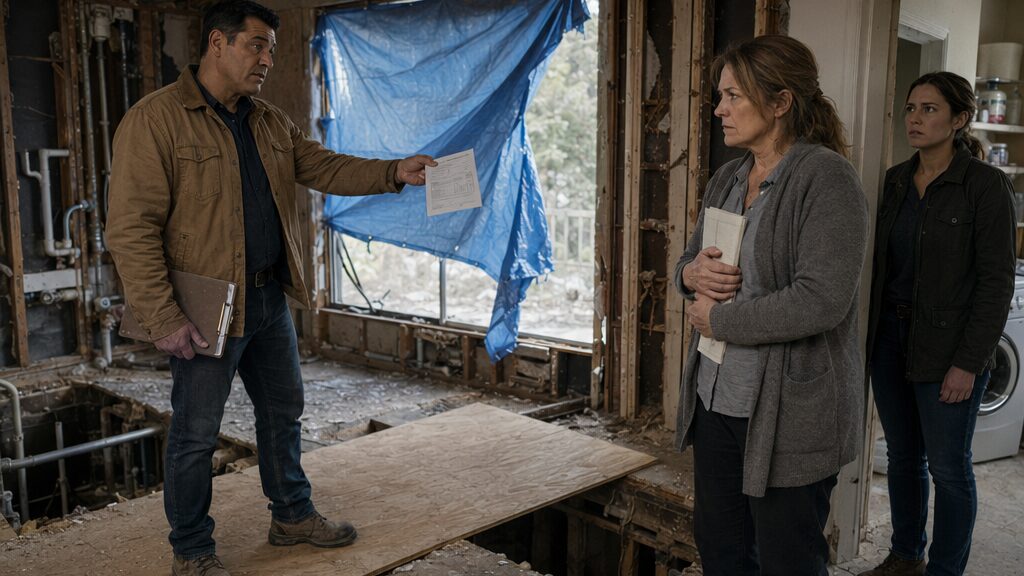
Patrick Martinez arrived carrying a clipboard and a paper cup of coffee, as if he were stepping into a normal job site instead of a kitchen with no floor.
“I need another eighty-four hundred before I bring the crew back,” he said, before Angela had fully opened the door.
She stood in the doorway between the laundry room and the gutted kitchen, the original contract folded once in her hand. Behind Patrick, the tarp lifted and snapped against the empty window frame. He did not glance back at it. He did not step carefully over the plywood. He walked in with the confidence of someone who had already decided where the conversation would end.
“The kitchen has no floor, Patrick.”
He sighed, not loudly, but enough for her to hear it. “Materials went up. That’s construction.”
The sentence landed exactly where he aimed it. On the part of her that did not know what flooring cost by square foot. On the part that could not tell rough electrical from finished wiring. On the part that remembered sitting at this same kitchen table while Patrick explained cabinet lead times and permitting and said, Don’t worry, I deal with this every day.
Angela tightened her hand around the contract but did not unfold it yet.
“I paid you twenty-six thousand dollars for materials already.”
Patrick set his coffee on the half-cut plywood sheet balanced across the subfloor gap. He pulled two stapled papers from his clipboard and held them toward her.
“Then sign the change order.”
Angela took the papers.
At the top, bold letters said CHANGE AUTHORIZATION. Beneath it was a revised project cost line with $8,400 added. That was what her eyes caught first. Then the words beneath blurred together in small print until one phrase snagged.
Owner acknowledges revised timeline and waives all claims related to prior delays, damages, and existing work conditions upon execution of this authorization.
She read it again.
Prior delays.
Damages.
Existing work conditions.
“This waives damages,” she said.
Patrick shifted his weight. “It’s standard language.”
“It says I waive claims for prior work.”
“It keeps everybody from fighting about things that are just part of a remodel.”
Angela looked past him at the kitchen. No cabinets. No window. No sink. The old floor torn out to bare panels. A pipe capped with blue tape. Sawdust gathered in the corners like dirty snow.
“This is part of a remodel?”
Patrick’s jaw moved once. “Angela, you hired me because you wanted someone who knew what they were doing. You can’t stop halfway, question every line, and expect the schedule not to move.”
“You stopped halfway.”
“I paused because material costs changed and your second payment didn’t cover what it needs to cover.”
“My second payment cleared five weeks ago.”
“For the phase we were in.”
Angela unfolded the original contract. Her fingers were clumsy, and she hated that. She hated that he could see the paper tremble slightly before she flattened it on the plywood between them.
“Page four says fixed project price.”
Patrick gave a short laugh without smiling. “Fixed based on available pricing.”
“That’s not what it says.”
“It doesn’t have to say every possible condition. This is what I mean when I say people don’t understand construction. Prices move. Crews move. Suppliers change delivery dates. That doesn’t mean anybody’s cheating you.”
The word cheating came from him first.
Angela noticed that.
She looked at page four. She had marked the line the night before with a yellow sticky note.
“Demolition. Cabinets. Electrical. Plumbing. Flooring. Installation. Fixed project price, twenty-six thousand. Your signature is here.”
Patrick’s face changed only a little, but enough. The patient tiredness thinned. Irritation showed through.
“That got demo started,” he said.
“No,” Angela said. Her voice stayed low. She had practiced that in the bathroom mirror while brushing her teeth. Low. Slower than him. Don’t chase his tone. “That got the project started and materials ordered. That’s what you told me when you asked for the second check.”
“I have crews I have to pay.”
“You haven’t had crews here in almost two weeks.”
“My plumber was out.”
“Then the electrician had a family emergency.”
“He did.”
“And the cabinets were delayed.”
“They were.”
“And the flooring was delivered to storage.”
“That’s right.”
Angela watched him as he said it. No blink. No hesitation. He had the same face he wore when he first told her that dust always looked worse before it looked better.
She opened her phone with her thumb. The album was already waiting because she had opened it before he came. She tapped the photo from three weeks earlier and held the screen beside the room.
“This is from three weeks ago.”
Patrick barely looked. “Okay.”
Angela lifted the phone higher. “Tell me what changed.”
He inhaled through his nose. “You want to play lawyer now?”
“I want my kitchen.”
“That’s what I’m trying to give you.”
“No, Patrick.” She lowered the phone, then raised it again, because she wanted the comparison in his line of sight. “This room looked like this three weeks ago. It looks like this now. You texted me that materials were delayed. Then you texted me that they were delivered. Then you stopped answering for three days. Now you’re asking me to sign away damages.”
He stepped closer to the plywood sheet. Not threatening. Just nearer, as if proximity could make his version heavier.
“Listen. I understand you’re stressed. I know this house has history for you. You told me that. But if you want this finished, we need to work together.”
For a moment, the kitchen was not gutted.
It had a table again. Yellow cabinets. A calendar with Susan’s college graduation circled. Her husband’s blue mug by the sink. Patrick had stood under the old light fixture and said, “You shouldn’t have to keep patching memories.” Angela had thought he understood something. Now she heard the sentence differently. Not sympathy. A way in.
“You don’t get to use that,” she said.
Patrick frowned. “Use what?”
“My house having history.”
Something flickered across his face, almost impatience, almost regret, but it passed too quickly to become anything useful.
“I’m trying to keep this job from becoming a bigger problem,” he said.
“It is already a problem.”
“Then don’t make it worse.”
There it was. Not shouted. Not a threat on paper. Just a door held open to a worse possibility. If she did not sign, the kitchen could stay like this. If she challenged him, the tarp could keep flapping for months. If she made trouble, he could become unreachable again.
Angela looked down at the revised invoice.
“What happens if I don’t sign today?”
Patrick picked up his coffee. “Then I can’t guarantee Monday.”
“You haven’t guaranteed any Monday.”
“I can put you behind other clients.”
“Clients whose materials you do have?”
His eyes narrowed.
Angela heard Susan’s voice from the night before. Maybe if it’s the only way to get him back here. She saw the laundry sink, the paper plates, the dust on her socks. She felt, with painful clarity, the size of the thing she did not know. Construction law. Liens. Permits. Suppliers. Claims. Bonds. Courts. Every word felt like a locked drawer.
Patrick knew that. That was the room he was standing in, more than the kitchen.
Angela picked up the printed receipt from the folder she had placed on the dryer. She unfolded it slowly. The supplier’s logo sat at the top. Underneath were the line items: cabinets, flooring, tile. The delivery notation Patrick had emailed when she asked where the materials were.
“They’re ordered,” Patrick said before she asked.
“This says delivered.”
“To storage, like I told you.”
“To your storage?”
“Yes.”
“Then why doesn’t the delivery address match my house?”
His fingers tightened on the coffee cup.
“It doesn’t have to match your house if it went to holding.”
“The street number is different.”
“My guys use different staging locations.”
“The city is different.”
Patrick said nothing.
Angela could hear the tarp. She could hear the drip into the bucket. She could hear herself breathing too carefully.
She held the receipt out, but he did not take it.
“Your invoice says I need to pay more to order materials,” she said. “Your receipt says the materials were delivered already.”
“That paperwork doesn’t mean what you think it means.”
“Then explain it.”
“You don’t understand what you’re reading.”
“Then explain why your receipt says my cabinets were delivered to someone else’s house.”
For the first time since he walked in, Patrick looked past her toward the dining table, the folder, the contract, the phone in her hand. He seemed to notice the papers not as clutter, but as something arranged.
His face did not show fear.
Not yet.
It showed annoyance at having underestimated the wrong part of her.
“I’ll have my office send clarification,” he said.
“You have an office?”
His mouth tightened. “Angela.”
“The address on your card is a mailbox place.”
“That’s common.”
“Then send me the clarification. In writing.”
He gathered the revised invoice from the plywood, but Angela placed her hand on the edge of it before he could lift it.
“I’ll keep a copy.”
“It’s not signed.”
“I know.”
He stared at her hand. Then he let go.
“You’re making this harder than it has to be.”
“No,” Angela said. “I think it was already hard. I’m just reading it now.”
Patrick took his coffee and stepped toward the laundry room. At the doorway, he paused.
“I can still get the crew back,” he said, and now his voice had softened into something almost reasonable. “But I need cooperation.”
Angela looked at the gutted kitchen behind him.
“I need my materials.”
“They exist.”
“Then show me where.”
His answer came too late.
“I’ll be in touch.”
He left through the laundry room, and she listened to his boots on the porch steps, the truck door, the engine starting. Not fast. Not panicked. He drove away like a man leaving a job site he still controlled.
Angela stood in the kitchen until the truck sound faded.
Then she picked up the revised invoice and saw, near the bottom, a line for owner acknowledgment. Beneath it, a signature space waited for her name.
She took one photo of the invoice on the plywood, with the ripped subfloor visible beneath it.
Then she took another of the receipt beside the old contract.
Then she zoomed in on the delivery address Patrick had not explained.
Chapter 3: The Receipt Number Belonged To Another House
Debra Miller went silent for so long after Angela read the receipt number that Angela checked her phone to make sure the call had not dropped.
“Hello?” Angela said.
“I’m here,” Debra answered.
Angela sat in her car outside the payroll office where she worked, with her lunch untouched on the passenger seat and the printed receipt spread across her steering wheel. Her break was thirty minutes. She had spent twelve of them on hold listening to cheerful music that made her want to scream.
“I just need to confirm delivery,” Angela said. “Patrick Martinez told me the cabinets, flooring, and tile were delivered to storage for my kitchen renovation. The receipt number is right there on the document he emailed me.”
Another pause.
“Can you give me the delivery address again?” Debra asked.
Angela read the address from her own contract first.
“No,” Debra said carefully. “I mean the one printed on the receipt.”
Angela’s fingers tightened on the paper. She read that one too.
Debra exhaled softly, away from the receiver. “Ma’am, I can’t discuss another customer’s order in detail.”
“So it is another customer.”
“I didn’t say that.”
“You asked for the address on the receipt.”
“I’m saying the address you gave me for your home does not match the order record connected to that receipt number.”
Angela stared through the windshield at the office building’s brick wall. Someone from accounting walked by with a salad container and waved. Angela lifted two fingers because her throat had closed.
“No order under my address?” she asked.
“I don’t see one under that address.”
“Cabinets?”
“No.”
“Flooring?”
“No.”
“Tile?”
“I’m sorry.”
Angela shut her eyes.
For six weeks, she had been living around the absence of those things. Cabinets that were late. Flooring that was stored. Tile that had supposedly arrived somewhere safe. Every excuse had built a thin bridge to the next excuse, and she had walked it because turning back meant admitting the kitchen had been torn apart for nothing.
“Can you email me that?” she asked.
“I can’t send you another account’s information.”
“Can you send me something saying there is no order under my address?”
Debra hesitated. “You may need to submit that request formally.”
“To who?”
“If there’s a complaint or claim, the supplier can respond through the proper channel.”
Angela almost laughed. The proper channel. Another door with a label she did not know how to open.
“Is there anything you can tell me?”
Debra’s voice lowered. “I can tell you to keep every document you have. And don’t rely on screenshots only.”
Angela looked at the receipt on her steering wheel.
“Debra?”
“Yes?”
“Does this happen often?”
The silence that followed was different. Not empty. Full.
“I have to get back to the counter,” Debra said.
The call ended.
Angela sat in her car until her phone screen dimmed. Then she wrote in the small notebook she had started that morning.
Tuesday, 12:18 p.m. Called supplier. Debra Miller. No order under my address. Receipt tied to different address. Formal request needed.
Her handwriting looked too calm.
At her desk, numbers blurred on the payroll spreadsheet. Direct deposits, overtime hours, withholding codes. She knew this kind of paperwork. She knew how to find a missing digit in a row of wages. She knew how to spot when someone’s hours had been entered under the wrong department. She had built a career on noticing when totals did not match.
Patrick had counted on her not applying that skill to him.
By three o’clock, the receipt address was still in her head.
By four, she had searched it on her phone.
By five, she was driving across town.
The house sat in a newer subdivision with narrow lawns and stone-trimmed mailboxes. Angela parked two houses down because she suddenly felt ridiculous. What was she going to do? Walk up to a stranger’s garage and accuse him of having her cabinets? Ask to inspect his tile like some woman who had lost her mind in a kitchen remodel?
A man stood in the driveway watering a strip of grass along the walkway. The garage door was open behind him. Angela saw boxes stacked along one wall, a miter saw on a stand, and several cartons of gray tile.
Her gray tile.
Not unusual gray tile. Not unique. She knew that. A thousand people probably picked gray tile. But the label on the box showed the same brand and color name she had circled in Patrick’s sample book at her kitchen table.
She got out before she could talk herself out of it.
“Excuse me,” she called.
The man turned off the hose. He was in his late fifties, wearing work pants and a faded shirt, his expression already guarded in the way people became guarded when a stranger crossed their driveway.
“I’m sorry to bother you,” Angela said. “My name is Angela Walker. I’m trying to understand a delivery receipt I was given by my contractor.”
His expression did not soften. “What contractor?”
“Patrick Martinez.”
The hose slipped a little in his hand. Water spread over the concrete.
“He doing your kitchen too?” the man asked.
Too.
The word rang louder than it should have.
Angela stopped at the edge of the driveway. “He was supposed to.”
The man looked past her toward the street, as if Patrick might appear because someone had said his name. “What did he tell you?”
“That my materials were delivered to storage. But the receipt he sent me has this address.”
The man turned the hose off at the nozzle. “I don’t know anything about that.”
“I’m not accusing you of anything.”
“Good, because I paid for my own materials.”
“I believe you.”
“Do you?”
Angela heard the defensiveness in his voice and understood it too quickly. He was not protecting Patrick. He was protecting the possibility that his own house was not about to become another disaster.
“I have a gutted kitchen,” she said. “No floor, no cabinets, no sink. He came back yesterday asking for another $8,400.”
The man looked toward the boxes in his garage.
“What’s your name?” Angela asked.
“Ronald Hall.”
“Ronald, I don’t want your materials. I want to know why my receipt number points here.”
He rubbed the back of his neck. “My wife said something was off.”
Angela waited.
“He was supposed to finish our guest bath first,” Ronald said. “Then there was a delay. Then these showed up.” He nodded toward the tile. “We didn’t pick those for the guest bath. Patrick said they were for the next phase, discounted, smart to take delivery before prices rose.”
“Did he give you a receipt?”
“Yeah.”
“Can I see it?”
“No.”
The answer was immediate.
Angela nodded, though disappointment spread through her chest. “Okay.”
“I’m not getting in the middle of this.”
“You may already be in the middle.”
“I said no.”
His tone sharpened, and Angela felt her face heat. She had done it wrong. Come too directly. Sounded desperate. Looked like a woman trying to make her problem someone else’s.
“I’m sorry,” she said. “I shouldn’t have come here like this.”
Ronald looked surprised by the apology.
Angela took a folded copy of Patrick’s receipt from her purse and placed it on the edge of the driveway, not stepping farther in.
“This is what he sent me,” she said. “My phone number is written on the back. If anything on your paperwork looks strange, call me. If not, throw it away.”
He did not pick it up.
Angela returned to her car with her shoulders rigid and her eyes burning, furious at herself for feeling humiliated in front of a man watering his lawn.
She drove three blocks before pulling over.
Her phone buzzed. Susan.
Did you call supplier?
Angela typed, No order under my address.
The dots appeared immediately.
What does that mean?
Angela looked at the manicured lawns, the closed garage doors, the houses that from the street looked whole.
I don’t know yet, she wrote.
She did not tell Susan about Ronald. Not yet. Susan would ask what she had been thinking, going to a stranger’s house alone. Susan would be right. Angela was tired of people being right after the damage was already done.
At home, the kitchen smelled wetter than before. The bucket beneath the leak had filled halfway. Angela dragged it to the laundry sink and emptied it, then took another picture of the tarp. The photo looked like all the others. That was the terrible thing about proof. Sometimes it was only powerful after it had repeated itself enough.
She taped the supplier receipt to a sheet of paper and wrote beneath it:
Receipt provided by Patrick Martinez as proof of material delivery. Supplier confirmed no order under my address.
She stopped.
Confirmed was too strong. Debra had been careful. Angela crossed it out and wrote:
Supplier stated no order visible under my address.
The difference mattered. She hated that it mattered. She respected that it mattered.
Near eight o’clock, while she was eating cold chicken over the laundry sink, her phone rang from an unknown number.
“Angela?” Ronald’s voice sounded lower than it had in the driveway.
“Yes.”
“I found the receipt.”
She set the paper plate down.
“I’m not saying Patrick did anything wrong,” he said quickly. “I don’t know how he runs orders. Maybe contractors move stuff around all the time.”
“Okay.”
“But there’s another receipt here with your street name on it.”
Angela gripped the edge of the sink.
“My street name?”
“Not your house number. But your street. And the tile listed on that one isn’t the tile in my garage.”
The laundry sink dripped once.
Ronald continued, quieter now. “My wife kept saying the dates didn’t make sense. I told her construction paperwork is always messy.”
Angela looked toward the dark kitchen, where the tarp shifted in the frame.
“How many receipts do you have?” she asked.
“At least two that don’t match what he told us.”
Angela reached for her notebook with wet fingers and flipped to a clean page.
“Ronald,” she said, “would you be willing to read me the numbers?”
Chapter 4: The License Number Looked Real Until She Typed It In
The first thing Angela saw when she typed Patrick’s license number into the state website was the word expired.
Not pending. Not delayed. Not under review.
Expired.
She sat at the dining room table with her laptop open, the original contract on her left, Patrick’s business card on her right, and three printed photos of the gutted kitchen lined up between them like evidence in a case she had never wanted to build. The house was quiet except for the bucket in the kitchen. Drip. Pause. Drip. The sound had become a clock that measured how long she had let herself believe him.
Angela checked the number again.
She entered it slower this time, one digit at a time from the card Patrick had handed her in the old kitchen when the walls were still yellow and the window had glass in it. The card had a neat logo, a phone number, and a line that said licensed and insured. It had looked official enough then. Everything had looked official enough then.
She pressed search.
Expired.
Angela’s hands hovered over the keyboard.
For a few seconds, she felt embarrassed before she felt angry. That embarrassed feeling came fast, familiar, and unfair. She should have checked. She should have known. She should have asked Susan to look him up. She should have been the kind of homeowner who knew the difference between a license number printed on a card and one that actually meant something.
Then she looked at the kitchen photo closest to her. The blue tarp bulged inward in the frame. The exposed pipes looked like something injured.
Patrick had known she would think that way first.
She printed the license page.
The printer in the corner made a grinding sound and pulled the paper through slowly. Angela picked up the page while the ink was still warm. License status: expired. Business address: not active. Renewal date missed eight months earlier.
Eight months.
Before he ever stood in her kitchen and talked about safety.
Her phone rang. Susan.
“Mom, Ronald called me.”
Angela closed her eyes. “Why would Ronald call you?”
“He said you gave him my number as a backup.”
“I gave him my number and wrote yours on the back in case mine didn’t work.”
“That’s a backup.”
Angela rubbed her forehead. “What did he say?”
“That he has two receipts that don’t match what Patrick told him. He sounded scared, Mom.”
“He’s not the only one.”
“What does that mean?”
Angela looked at the license printout. “It means I found something else.”
Susan came over twenty minutes later, still in her scrubs from the clinic, with a paper bag of takeout neither of them opened. She stood over the dining table while Angela showed her the license record.
Susan read it twice.
“Expired eight months ago?”
“Yes.”
“Can he still do work?”
“I don’t know.”
“Mom.”
“I said I don’t know.”
The sharpness came out before Angela could stop it. Susan stepped back a little.
Angela immediately hated herself for it. “I’m sorry.”
Susan softened but did not sit. “This is what I mean. We don’t know what any of this means. He’s threatening paperwork. There are receipts with other addresses. The kitchen is open. You’re calling suppliers and going to strangers’ houses. What if he files something against the house?”
Angela stacked the papers, unstacked them, then stacked them again. “He hasn’t said that.”
“He might.”
“He already took the money.”
“And what if he can take more?”
That question pushed all the air out of the room.
Angela had been so focused on the missing cabinets that she had not let herself follow the word lien to its worst possible shape. A claim against the house. The house her husband had painted himself one summer because they could not afford a crew. The house with the pencil marks inside Susan’s old closet door showing her height by year. The house Angela had promised herself she would keep steady after everything else changed.
“I’m going to the courthouse tomorrow,” Angela said.
Susan looked startled. “For what?”
“To ask how to file. Small claims, complaint, whatever the right word is.”
“Do you need a lawyer?”
“I can’t afford to start with a lawyer.”
“But you can afford to fight him?”
Angela had no answer that did not sound like a dare.
The next morning, she took half a personal day from work and drove downtown with a folder on the passenger seat and a stomach that felt as if she had swallowed pennies. The courthouse annex had fluorescent lights, scuffed floors, and signs that made every window look like the wrong one. Civil Filing. Records. Payments. Mediation Intake. No Legal Advice.
Angela stood in the center of the lobby holding her folder against her chest until a security guard asked if she needed help finding something.
“I think so,” she said.
At the civil intake window, the clerk did not look impressed by her folder, her photos, or the tremor in her voice. Her nameplate said Sharon Garcia. She wore reading glasses on a chain and had the calm, flattened expression of someone who spent all day watching people arrive after the worst part had already happened.
“I paid a contractor,” Angela began. “He didn’t finish, and now there are materials missing and his license might be expired, and he wants more money.”
Sharon held up one hand. “I can’t give legal advice.”
“I’m not asking for legal advice.”
“Most people are, even when they don’t think they are.”
Angela pressed her lips together.
Sharon looked at her for a moment, then glanced down at the folder. “What are you trying to file?”
“I don’t know the correct name.”
“That answer I can work with.” Sharon slid a small packet through the window. “If you’re seeking money damages within the limit, small claims. If there’s a contractor licensing issue, separate complaint with the licensing board. If there’s unsafe work, inspection documentation helps. If there are missing materials, you need proof of payment and proof they were promised or invoiced.”
Angela’s grip loosened slightly on the folder.
“So I don’t put everything in one place?”
“You can attach related documents, but don’t make one pile and expect someone to untangle it. Contract breach. Missing materials. Unsafe work. License issue. Those are not the same thing.”
Angela looked down at the forms. The boxes were small. The lines were narrow. The language was stiff.
Sharon must have seen her face, because her voice changed by half a degree.
“People quit when the paper makes them feel foolish,” she said. “The paper doesn’t care if you’re embarrassed. It cares if the dates match.”
Angela looked up.
“Dates,” Sharon repeated. “Payments. Messages. Photos. Who said what. Don’t write a novel. Make a timeline.”
“I have photos.”
“Are they dated?”
“On my phone.”
“Print them with dates if you can. Keep originals. Don’t mark up the only copy.”
Angela nodded, writing too fast.
“And if he’s threatening a lien?” Angela asked.
Sharon’s expression became careful again. “I can’t advise you on whether he can or can’t. But if someone threatens one, save the message. If something is filed, you respond. Don’t ignore official mail.”
Official mail. The phrase lodged in Angela’s chest.
She left with a packet, a list of websites, and a new kind of fear. Not the foggy fear of not knowing anything, but the sharper fear of knowing there were steps, deadlines, and wrong ways to do things.
At home that evening, she spread everything across the dining table. Susan came by with a portable scanner from her office and a face that said she was still scared but had chosen not to say it first.
They worked mostly in silence.
Angela made columns: Date. Event. Document. Notes.
Deposit paid.
Demolition started.
Second payment cleared.
Cabinet delay text.
Plumber sick text.
Electrician family emergency text.
Receipt emailed.
No crew.
Patrick demand for $8,400.
Supplier call.
Ronald receipts.
License expired.
Each entry looked small by itself. Together, the page began to feel heavier.
Susan picked up one of the photos. “This one and this one look almost identical.”
“They’re three weeks apart.”
“Then put them next to each other.”
Angela did. The same studs. Same pipe. Same tarp. Same floor gap.
For the first time, the photos did not look like proof of her failure to manage the project. They looked like proof that nothing Patrick said had matched what he did.
Her phone buzzed on the table.
Patrick.
Neither she nor Susan moved.
The voicemail notification appeared a moment later.
Angela pressed play and set the phone between them.
Patrick’s voice filled the dining room, controlled and clipped.
“Angela, I’ve tried to be reasonable, but if you refuse to honor the change authorization and delay the project, I’ll have no choice but to protect my business. That may include filing a lien for unpaid amounts and costs incurred. I suggest you call me before this becomes more expensive for you than it needs to be.”
The message ended.
The house seemed to hold still.
Susan stared at the phone. “Can he really take the house?”
Chapter 5: The Wall Covered The Part That Could Have Burned
Brandon Lee removed the temporary panel from Angela’s kitchen wall and immediately said, “Don’t use that outlet.”
Angela had not touched anything, but she pulled her hand back anyway.
He was kneeling on the bare subfloor with a flashlight between his teeth and a screwdriver in one hand. The temporary covering Patrick’s crew had installed leaned against the exposed studs, its back dusty and streaked. Angela stood near the laundry room doorway, close enough to see but not close enough to understand.
“What outlet?” she asked.
Brandon pointed with the screwdriver toward the wall beside where the stove was supposed to go. “That one. And if anything else on this run still has power, don’t use that either until this is corrected.”
Angela looked at the open wall. Wires looped through bored holes in the studs, some secured, some not. One section had been joined in a plastic box that hung loose, not fastened to anything. Another cable disappeared behind insulation that had been shoved into place like packing material.
Rain tapped the tarp behind them. Soft at first, then harder when the wind shifted.
“I thought he said rough electrical was done,” Angela said.
Brandon took the flashlight from his mouth. “He may have said that.”
“Is it?”
“No.”
The answer was so plain that Angela almost missed how bad it was.
Brandon was not warm. He had arrived in a clean work shirt, looked at her folder without comment, and told her he would inspect visible conditions only unless she authorized further opening. His bluntness had made her defensive at first. She had expected judgment, or pity, or a lecture about hiring the wrong person.
Instead, he treated the kitchen like a problem with edges.
He took photos with a small camera, then with his phone. He dictated notes in short fragments. “Unsecured junction. Improper support. No visible permit documentation. Open wall conditions. Moisture intrusion at rear opening.”
Angela wrote down words she understood only partly.
“Could this have started a fire?” she asked.
He paused, which told her more than a quick answer would have.
“I’m saying it shouldn’t be energized in this condition,” he said. “And it should not be covered until a licensed electrician corrects it and the proper inspection happens.”
Angela looked at the temporary panel on the floor. “That was covering it.”
“Yes.”
“Patrick told me that wall was ready for cabinets.”
Brandon glanced at her, then back at the wires. “Cabinets would have hidden it.”
The room seemed to tilt.
For weeks, Angela had thought of the unfinished kitchen as an absence. Missing cabinets. Missing floor. Missing sink. Missing materials. Now she saw that part of the danger had been presence: work that existed where it should not, hidden just enough to look like progress.
Brandon moved to the area near the old sink line. “Who did the plumbing?”
“Patrick’s plumber.”
“Name?”
“I don’t know.”
“No invoice from a plumbing subcontractor?”
“He said he handled his own crew.”
Brandon made another note.
Angela hated every blank in her knowledge. The missing names. The missing permits. The missing license check. She had a folder full of paper now, but every question opened onto another thing she had not known to ask.
“Should I have known?” she said before she could stop herself.
Brandon looked up from the wall.
“When?”
“When I hired him. When he said things were done. When he said materials were delayed. Any of it.”
He rested his forearm on his knee. “Most homeowners don’t know what to look for inside an open wall.”
“That’s convenient for people who do.”
“Yes,” he said.
No comfort. No softening. Just agreement.
It helped more than comfort would have.
Susan arrived halfway through the inspection, shaking rain from her jacket. She stopped just inside the laundry room and looked at Brandon’s tools, the loose panel, the exposed wiring.
“What happened?”
“Don’t use that outlet,” Angela said.
Susan’s face changed. “What outlet?”
“Apparently any outlet connected to that wall.”
Brandon stood. “I’ll test what’s live before I leave.”
Susan looked from him to Angela. “Patrick did this?”
“Patrick’s crew did.”
“Is this the kind of thing he can say is just unfinished?”
Brandon wiped his hands on a rag. “Unfinished is one thing. Unsafe and concealed is another.”
Susan went quiet.
Angela saw the moment land in her daughter. Until then, Susan had been afraid of cost, delay, stress. All real. All heavy. But unsafe brought the problem out of the realm of inconvenience. Angela could see Susan imagining her mother making toast beside a wall that should not have been powered. The paper plates and laundry sink suddenly mattered less than the possibility that Patrick had left danger inside the house and then asked to be paid more before fixing anything.
Brandon moved through the kitchen with his tester. It beeped near one run of wire, stayed silent near another, beeped again where Angela did not expect it. Each sound made Susan flinch.
At the tarp, Brandon pressed a hand along the edge of the temporary frame. Water had darkened the wood below it.
“This opening needs proper weather protection,” he said. “Soon.”
“It was supposed to be a window,” Angela said.
“Was it ordered?”
Angela laughed once, without humor. “That is becoming a complicated question.”
By the time Brandon finished, the kitchen looked more violated than before. Not because he had damaged it, but because he had named what was wrong. The loose wiring. The open moisture. The unsupported box. The missing permit. The panel that had made a dangerous area look orderly.
He sat at the dining table and wrote the preliminary findings on a form, pressing hard with his pen. Angela and Susan stood on the other side like students waiting for a grade.
“This is not the full report,” he said. “You’ll get that by email. But this notes immediate safety concerns and recommends licensed correction before further finish work.”
Angela accepted the paper.
“How much will correction cost?”
Brandon’s expression did not change. “You’ll need estimates.”
“That bad?”
“I don’t price other people’s work. But removal and correction cost more than doing it right the first time.”
Susan turned away, one hand over her mouth.
Angela looked down at the form. The words were neat and awful. Unsafe. Unpermitted. Do not energize. Further evaluation required.
She thought of Patrick standing in the kitchen with his coffee, saying he was trying to keep this job from becoming a bigger problem.
It had already been a bigger problem. He had just covered part of it with a panel.
After Brandon left, Susan sat at the dining table with both hands flat on the wood. “Mom.”
“I know.”
“No, I don’t think you do. What if you had signed that thing?”
Angela placed the preliminary report beside the unsigned change authorization. The waiver language looked different now. Prior delays, damages, and existing work conditions. She had thought it was broad because Patrick wanted to avoid blame for time. Now she wondered exactly what he had known was behind the wall.
“He needed me to sign before anyone looked,” Angela said.
Susan’s eyes filled, but she blinked the tears back with a kind of anger. “I told you to pay him.”
“You wanted it over.”
“I told you to pay him.”
Angela sat beside her. “I almost did.”
The admission sat between them, painful but honest.
Susan reached for the report. “What now?”
“Now I add this to the complaint.”
“And the kitchen?”
Angela looked toward the room. The tarp moved with the wind. The bucket caught another drop.
“Now I find out how much it costs to make it safe.”
Her phone rang before Susan could answer.
Patrick’s name appeared on the screen.
Angela and Susan stared at it.
The call went to voicemail. Then immediately, he called again.
This time Angela answered. She pressed speaker without thinking, and Patrick’s voice came through warmer than it had any right to be.
“Angela,” he said. “We should talk. I think we can resolve this without making it ugly.”
Chapter 6: He Offered Money Only If She Stayed Quiet
Patrick sounded almost kind while rain tapped the tarp behind Angela like fingers on glass.
She stood in the gutted kitchen with the inspection report in one hand and her phone in the other. Susan stood near the laundry room doorway, arms folded tightly, eyes fixed on the speaker icon as if Patrick might crawl through it.
“Define ugly,” Angela said.
Patrick gave a tired little laugh. “That’s exactly what I mean. We don’t need to talk like enemies.”
The word enemies felt rehearsed. So did the gentleness.
Angela looked at the exposed wall where Brandon had removed the panel. The loose junction box hung slightly forward, now visible, now named. It had been there yesterday too. It had been there when Patrick stood over the plywood with his new invoice. It had been there when he told her she did not understand what she was reading.
“You left unsafe electrical work in my kitchen,” she said.
There was a pause.
“Who told you that?”
“An inspector.”
“What inspector?”
“A licensed one.”
Patrick exhaled. “Angela, you’re going to get all kinds of opinions if you start bringing people in after a job has been paused. That’s how these things spiral.”
“It was covered.”
“It was protected.”
“It was hidden.”
“No. That’s not fair.”
For the first time, there was strain under his voice. Not fear. Strain. Like someone carrying too many boxes and resenting the person who noticed one was leaking.
“Fair?” Angela said.
“I’ve got crews, suppliers, overhead, clients calling me every ten minutes because everyone wants everything perfect and nobody understands what it takes to keep jobs moving. You think I wanted your kitchen sitting? You think that helps me?”
Angela did not answer.
Patrick continued, faster now. “Material pricing is a mess. Labor is a mess. People order one thing and change their minds. Suppliers mislabel deliveries. Then homeowners get online, read three things, and suddenly they think every delay is fraud.”
Susan’s eyes narrowed, but Angela lifted one hand slightly, asking her not to speak.
“That sounds difficult,” Angela said.
“It is.”
“But I paid you for my materials.”
“And I’m trying to resolve that.”
“You told me they were delivered.”
“They were allocated.”
The new word entered the kitchen and seemed to look around for somewhere to hide.
“Allocated,” Angela repeated.
“Yes. Sometimes materials are assigned across jobs before final staging. It’s not unusual.”
“Then why did you ask me for more money to order them?”
Another silence.
Patrick’s voice cooled by a degree. “Because continuing under the current cost structure isn’t feasible.”
“Under the contract you signed?”
“Contracts don’t stop reality.”
Angela looked at Susan. Her daughter’s face had gone pale with anger.
“What are you offering?” Angela asked.
Patrick shifted into a smoother tone so quickly it confirmed he had been waiting for the question. “I can return five thousand as a courtesy credit and release you to bring in someone else.”
Angela almost looked away from the phone.
Five thousand dollars. She hated how fast her mind used it. Electrical correction. A real tarp. Maybe part of the flooring. Maybe enough to get another contractor to step inside without shaking his head.
“As a courtesy,” she said.
“Without admissions. We both sign a mutual release. You withdraw any complaints you’ve started, and we agree not to disparage each other.”
Susan mouthed, No.
Angela looked down at the inspection report. Unsafe. Unpermitted.
“Five thousand doesn’t cover the missing materials.”
“It’s a good-faith number to avoid dragging this out.”
“You took twenty-six thousand.”
“I performed demo and partial rough-in. I have costs.”
“You removed my cabinets, floor, sink, and window. You left a tarp and unsafe wiring.”
“That’s your inspector’s characterization.”
“Do you have a permit?”
Patrick did not answer immediately.
“Angela, you’re trying to turn this into something it doesn’t need to be.”
“Do you have a permit?”
“I’d have to check the file.”
“You said you handled permits.”
“I said we would handle what was required.”
The kitchen seemed to sharpen around her. Every exposed stud. Every nail. Every place language had made a promise and then slid sideways.
“No,” Angela said.
“No what?”
“No to five thousand.”
Patrick’s breath hit the phone. “Then what do you want?”
“My money for materials. The cost to correct unsafe work. Documentation of where my materials went. And I’m not withdrawing the complaint.”
His laugh this time was real, short and hard. “You’re not going to get all that.”
“Then I’ll bring what I have to mediation.”
“You know how long that takes?”
“I’m learning.”
Susan’s mouth parted slightly at the echo. Angela had said the same thing to Patrick in the kitchen, but it sounded different now. Less like a defense. More like a fact.
Patrick lowered his voice. “Nine thousand.”
Angela went still.
“I can do nine,” he said. “But that’s it, and it comes with confidentiality. No licensing complaint. No contacting other clients. No online posts. No supplier calls.”
There it was. Not the amount. The list.
No licensing complaint.
No contacting other clients.
No supplier calls.
He was not only trying to settle a debt. He was trying to close doors.
Angela looked at the tarp. The rain had slowed, leaving beads of water clinging to the plastic. Behind it, the opening where the window belonged was dark.
“I didn’t post anything online,” she said.
“Good. Keep it that way and we can both move on.”
“Who else have you talked to?”
“What?”
“You said other clients. Which ones are you worried I’ll contact?”
“That’s not what I said.”
“It is.”
Patrick’s voice hardened. “Take the nine, Angela. It’s more than you’ll see if you turn this into a circus. And if you keep interfering with active jobs, that creates damages on my end.”
She felt the old fear rise. Lien. Damages. Costs incurred. Words with hooks. Words meant to make her imagine losing before she even understood the game.
Then she looked at the folder on the plywood sheet where his revised invoice had been. Contract. Photos. Receipt. License lookup. Ronald’s numbers. Brandon’s report.
Not enough to win everything.
Enough not to be rushed.
“I’ll see you at mediation,” she said.
“Angela.”
She ended the call.
For several seconds, neither she nor Susan moved.
Then Susan said, “Nine thousand would help.”
Angela closed her eyes.
“I know.”
“I mean, that’s not nothing.”
“I know what you mean.”
Susan pushed her hands into her hair. “I’m not saying he deserves it. I’m saying you need a kitchen. You need safe wiring. You need a window. You need to stop living like this.”
Angela opened her eyes. “And he needs me quiet.”
Susan looked away.
“That doesn’t fix the outlet,” Angela said. “It doesn’t explain the receipts. It doesn’t explain Ronald’s paperwork. It doesn’t explain the expired license.”
“It might pay someone honest to start.”
“Partly.”
“Partly matters when you don’t have enough.”
The words hurt because they were true.
Angela picked up the inspection report and set it beside the original contract. “If I take it and withdraw everything, what happens the next time someone gives him a second check?”
Susan’s eyes shone. “Why does that have to be your responsibility?”
Angela had no clean answer.
Because the kitchen was still open. Because the wall could have burned. Because Ronald’s wife had known something was wrong and Ronald had talked himself out of listening. Because Angela had almost signed away damages in a room with no floor. Because Patrick had said, You don’t understand what you’re reading, and for one terrible moment, she had believed him.
“Maybe it isn’t,” Angela said. “But I’m already here.”
They worked late into the night. Susan scanned the contract, the revised invoice, the receipt, the license lookup, the preliminary inspection report. Angela built the timeline Sharon had suggested, keeping the language plain.
Patrick demanded $8,400 and change authorization.
Change authorization included waiver of claims.
Patrick stated materials ordered/delivered.
Supplier stated no order visible under my address.
Ronald’s receipt numbers mismatched.
Electrical unsafe per Brandon Lee preliminary report.
At 10:43 p.m., Ronald texted.
I talked to two others. They thought they were the only ones too.
Below it came two phone numbers and a photo of three papers laid on a countertop. Angela zoomed in.
At the bottom of each one was Patrick Martinez’s signature.
Chapter 7: The Same Signature Was On All Their Papers
Angela laid three contracts side by side on the dining room table and saw Patrick Martinez’s signature at the bottom of each one.
The signatures were not identical in the way a stamp would be. One slanted harder. One had a longer tail on the z. One pressed darker through the paper. But the shape was the same enough to make Angela’s stomach tighten. Three fixed-price scopes. Three different addresses. Three homeowners who had each been told some version of delay, shortage, wrong shipment, price change.
Three people who had thought they were alone.
Ronald stood at the far end of the table with his arms crossed, looking at the papers as if they might accuse him of being foolish if he looked too long. Susan sat with her laptop open, dragging scanned documents into folders Angela had named by address instead of by person. The two other homeowners had not come in person. One had emailed photographs of a half-finished bathroom with plastic still over the tub. The other had sent receipts and text messages but wrote, Please don’t use my name unless absolutely necessary.
Angela understood that sentence better than she wanted to.
“They’re all fixed price,” Susan said.
Ronald leaned forward. “Mine has the same material clause yours does.”
Angela checked. “Cabinet package, flooring, tile, labor, plumbing, installation.”
“Mine was supposed to be a bath,” Ronald said. “The tile he left me wasn’t the one on my scope. I thought maybe he got a discount and would explain later.”
Susan looked up. “You didn’t ask?”
Ronald’s face hardened.
Angela touched Susan’s wrist before her daughter could continue. “We all asked late.”
Ronald’s expression shifted. He looked at Angela, then away. “My wife asked early. I told her to stop worrying. I said contractors move materials around all the time.”
There was no self-pity in his voice. Only the dull sound of someone setting down a truth he did not like carrying.
Angela turned one of the receipts. “This one has my street name.”
“That came from my folder,” Ronald said. “But the delivery date is two days before your second payment cleared.”
Angela looked at Susan.
Susan opened the timeline file and typed the date in. “So he had paperwork with Mom’s street before he had her second check?”
“Or he reused a receipt after,” Angela said.
“Either way,” Ronald said, “it’s not clean.”
Angela almost smiled at the phrase. Not clean. Plain and exact. Better than fraud, which still felt too large in her mouth.
By noon, the table had become a map. Original contracts. Patrick’s revised invoice. The unsigned waiver. The supplier receipt. Brandon Lee’s preliminary report and final email, which had arrived at dawn with photographs of the loose junction box and the phrase further correction required before any finish work. License lookup printout. Voicemail transcript. Call log. The three-week photo comparison of Angela’s kitchen.
The kitchen itself sat beyond them like the first page of the file.
Angela had cleared the plywood sheet and placed one printed photograph there. In the photo, Patrick’s revised invoice lay on the bare subfloor, the waiver paragraph visible, the exposed pipes blurred behind it. She did not know if anyone official would care about that picture as much as she did. But every time she saw it, the whole argument returned.
He had asked for more money while standing inside the damage.
At two o’clock, they carried the binder to the mediation office.
Patrick was already there.
He sat at the end of a rectangular table in a gray jacket, phone face down near his hand, a folder thinner than Angela expected in front of him. He looked neither ashamed nor surprised. When Angela entered with Susan and Ronald behind her, Patrick’s eyes moved to Ronald first.
“You brought people?” he said.
Angela sat down before answering. “I brought documents.”
A mediator with silver hair and a quiet voice explained the process. No one would shout. No one would interrupt. The goal was resolution, not punishment. Anything agreed would be put in writing. Anything not agreed might proceed elsewhere.
Patrick nodded as if he approved of order.
Angela opened her binder.
Patrick spoke first. “This is a construction dispute that has gotten emotional. Mrs. Walker experienced delays, which I regret. But delays are not abandonment. Materials are allocated across projects all the time. Prices increased beyond the original assumptions, and I offered a reasonable path forward.”
Angela kept her pen still. Mrs. Walker. Emotional. Delays. Assumptions. Each word tried to move the room away from the kitchen.
The mediator turned to her. “Mrs. Walker?”
Angela’s mouth was dry. Susan shifted beside her, but Angela did not look over. If she did, she might borrow strength she needed to prove she had.
She placed the original contract on the table.
“This is the contract Patrick signed. It says fixed project price, twenty-six thousand dollars, for demolition, cabinets, electrical, plumbing, flooring, and installation.”
She placed the bank records beside it.
“These are the two payments that cleared.”
Then the photo.
“This is my kitchen three weeks after he said materials were delayed.”
Then the second photo.
“This is the same kitchen the day he came back asking for $8,400.”
Patrick leaned back. “Photos don’t show ordering, scheduling, or supplier issues.”
“No,” Angela said. “They show the room did not change.”
She placed the revised invoice down.
“This is what he asked me to sign before bringing anyone back. It adds $8,400 and waives claims for prior delays, damages, and existing work conditions.”
The mediator read the paragraph. Patrick looked toward the window.
“It’s standard protection,” he said.
Angela set Brandon’s report beside it.
“This says the electrical work behind the temporary panel was unsafe and unpermitted.”
Patrick’s voice sharpened. “That is one inspector’s opinion after work was paused.”
“Was there a permit?” the mediator asked.
Patrick opened his folder. “I’d have to verify permit status. Sometimes those are handled by subs.”
Angela heard the slide in the words. Handled. Subs. Verify. Not yes. Not no.
She turned to the supplier receipt.
“This is the receipt he sent me when I asked where my cabinets, flooring, and tile were. The supplier told me there was no order visible under my address. The receipt number connects to another delivery address.”
Patrick reached for the paper, then stopped when the mediator was already reading it.
“That was allocated wrong,” Patrick said.
The sentence dropped into the room.
Angela looked at him. “Allocated wrong?”
“Material allocation can be complicated. Suppliers batch orders. Jobs overlap. It happens.”
Ronald made a sound under his breath.
The mediator turned to him. “Sir, you’ll have a chance if needed.”
Ronald’s jaw tightened, but he nodded.
Angela removed the last section from the binder. She did not hand over all of it at once. Sharon Garcia’s voice from the courthouse was in her head. Don’t make one pile and expect someone to untangle it.
“These are two other contracts with Patrick’s signature,” Angela said. “Both fixed price. Both with mismatched receipts or materials he described as delayed, reallocated, or held.”
Patrick sat forward. “Those are separate jobs.”
“They have the same pattern.”
“They’re not parties here.”
“No,” Angela said. “But the licensing board has copies.”
For the first time that day, Patrick’s expression changed enough that even Susan noticed. His eyes moved from Angela to the mediator, then to Ronald.
The mediator folded her hands. “Mr. Martinez, are you currently under review?”
Patrick’s mouth opened, then closed. “Anyone can file a complaint.”
“That wasn’t my question.”
“I received notice that a complaint was opened. I dispute it.”
Angela did not smile. Victory did not feel like she had imagined it might. It felt like standing very still while something heavy shifted in another room.
The mediator looked over the papers for a long moment. “Mrs. Walker, I need to be clear. Recovering all claimed amounts may be difficult. Mediation is not a trial. Even in court, there are limits, defenses, and collection issues.”
Susan’s hand tightened around her pen.
Angela nodded slowly. “I understand.”
She did not, not fully. But she understood enough. No one was going to wave a paper and make twenty-six thousand dollars return. No one was going to hand her back the weeks of waking at night to the tarp moving. No one was going to uncut the floor, unpull the cabinets, unmake the moment she almost believed she was too ignorant to read a waiver.
“What outcome are you seeking today?” the mediator asked.
Patrick watched her.
Angela looked at the photograph of her gutted kitchen. It was no longer only a picture of what he had done. It was a picture of what she had learned to name.
“Money toward missing materials and correction,” she said. “Written cooperation for a bond claim. No confidentiality that stops me from continuing the licensing complaint. And no lien threat tied to the $8,400 change order I did not sign.”
Patrick laughed once. “That’s not reasonable.”
Ronald stepped forward before the mediator could stop him. “Neither was putting her street on my receipt.”
Patrick turned on him. “You don’t understand how supplier paperwork—”
“No,” Ronald said. “I understand my wife was right.”
The room went quiet.
That was the surprise Angela had not expected. Not the document. Not the signature. Ronald. A man who had first refused to show her a receipt because he was afraid of losing his own job, now standing in a mediation room admitting he had talked himself out of seeing what was in front of him.
Patrick looked away first.
The mediator called for a break.
In the hallway, Susan leaned against the wall and breathed out. “Mom, you did good.”
Angela shook her head. “I don’t know if it’s enough.”
“It was clear.”
Clear. The word warmed something in her.
Ronald stood a few feet away, staring at the floor. “I should have listened to my wife.”
Angela said, “I should have called the supplier sooner.”
He looked at her. “He counts on that, doesn’t he?”
“Yes,” Angela said. “I think he does.”
When they returned, Patrick’s folder had more papers in it. He had made calls. His face had lost the lazy confidence Angela remembered from the kitchen.
The mediator spoke carefully. Patrick would agree to a partial settlement paid in installments. He would provide documentation needed for Angela’s bond claim and would not pursue the unsigned change authorization as an unpaid amount. The agreement would not require Angela to withdraw licensing complaints or prevent her from responding to official inquiries. There would be no admission of wrongdoing.
The number was less than Angela wanted.
More than Patrick had first offered.
Not enough to make the kitchen whole by itself.
Enough to make the next step possible.
Patrick signed with the same hand that had signed the contracts.
Angela watched the pen move and felt no triumph. Only the strange, tired relief of keeping one door from closing.
As they stood to leave, Patrick leaned close enough that only she and Susan could hear him.
“You could have saved yourself a lot of trouble taking the nine.”
Angela slid the signed agreement into her binder.
“No,” she said. “I think the trouble was already there.”
Outside the mediation room, her phone buzzed with an email notification. The subject line read: Licensing Board Case Update.
Angela opened it with Susan and Ronald beside her.
The board had opened a connected review based on multiple complaints.
Chapter 8: The Tarp Came Down But The Cost Stayed
The first thing Angela noticed in the finished kitchen was not the cabinets, or the new sink, or the light coming cleanly through the back window.
It was the absence of the tarp.
For months, the blue plastic had moved in her dreams. It had snapped and breathed and bowed inward with rain, a living reminder that her house was open where it should have been closed. Now the window was sealed. Real glass held the afternoon light. The frame was plain white, not custom, not what she had picked the first time, but when Angela touched the sill, it did not shift under her fingers.
That was enough to make her stand still.
The second contractor had not promised beauty. He had promised permits, invoices, staged payments, and photographs of anything hidden before it was covered. The first time he said, “You don’t pay for materials until we verify the order,” Angela had gone into the laundry room and cried quietly into a dish towel because kindness with procedure felt different from charm.
The kitchen was smaller than the one she had imagined when Patrick first laid samples on her old table. The cabinets were stock, not the semi-custom ones on the original contract. The backsplash was simple white tile, not the gray pattern she had chosen before seeing the same boxes in Ronald’s garage. The countertop had a seam near the stove. One cabinet door near the pantry sat slightly uneven, and the floor creaked near the sink if she stepped just right.
But the wiring had been corrected. The permit had passed. The window did not leak. The sink ran hot and cold. The stove turned on without Angela looking toward the wall to wonder what was hidden inside it.
On the counter sat a letter from the licensing board.
Patrick Martinez’s license had been suspended pending further conditions and review. The letter did not use language that satisfied the angriest part of Angela. It did not say he targeted grieving homeowners. It did not say he stood in a kitchen with no floor and asked for more money. It did not say he knew exactly which words would make a tired woman doubt herself.
It said failure to maintain licensing requirements, mishandling of project funds, failure to provide requested records, and pattern of unresolved consumer complaints.
Angela had read it four times.
The settlement payments had not come easily. The first arrived late. The second came after a reminder from the mediator’s office. The bond claim covered part of the documented loss, not all. By the time the legitimate contractor corrected the unsafe work and made the kitchen usable, Angela’s savings account looked wounded.
There were numbers she did not say aloud around Susan.
The total she had paid.
The total recovered.
The total still gone.
What it cost to fix what Patrick had broken before anyone could even begin finishing what he had promised.
Justice, Angela had learned, did not put money back in neat stacks. It arrived in pieces, with forms attached.
Susan came through the back door carrying a small grocery bag and stopped so suddenly that Angela turned.
“What?” Angela asked.
Susan looked around the kitchen. Her eyes moved from the cabinets to the window to the sink, then to the patch of floor where the gap had been.
“It’s quiet,” Susan said.
Angela listened.
No tarp. No bucket. No temporary sink dripping in the laundry room. No loose plastic knocking against plywood.
Just the refrigerator humming and a car passing outside.
“It is,” Angela said.
Susan set the bag on the counter. “I brought tomato soup.”
Angela smiled. “I have cheese.”
“Real plates?”
“Don’t push it.”
Susan laughed, and the sound seemed to find places in the room that had been empty too long.
They moved around each other awkwardly at first, both unused to a kitchen that allowed movement. Angela opened drawers looking for utensils she had unpacked two days before and then forgotten. Susan found a saucepan. Angela found the skillet. The first slice of bread stuck because she buttered the wrong side out of habit, and Susan nudged her aside with exaggerated patience.
“Mom.”
“I used to know how to make grilled cheese.”
“You still do. You’re just supervising the bread too emotionally.”
Angela took the spatula from her. “That is not a recognized cooking problem.”
“It is in this family.”
For a moment, it was almost an ordinary evening.
Then Susan opened the silverware drawer.
She did not reach for a fork. She stood looking down.
Angela turned from the stove.
“What?”
Susan lifted the silverware tray slightly. Beneath it, flat against the bottom of the drawer, was a folded copy of the original contract sealed in a clear plastic sleeve.
Susan looked at her. “Why is this here?”
The sandwich hissed softly in the pan.
Angela turned the burner down before answering. She wiped her hands on a towel and came to stand beside her daughter.
The contract looked smaller there, tucked beneath spoons and forks, stripped of its power to frighten her. Page four was folded outward, the fixed-price line visible through the plastic, Patrick’s signature at the bottom.
“I didn’t want it in the file box,” Angela said.
“Why keep it at all?”
Angela touched the edge of the drawer.
At first, she had kept every paper because Sharon told her dates mattered. Then because the licensing board asked for copies. Then because the bond claim required attachments. For months, the contract had been a weapon, shield, map, and bruise.
But that was not why it belonged here.
“Not because of him,” Angela said.
Susan waited.
Angela looked around the kitchen. The slightly uneven cabinet. The modest tile. The window where the tarp had been. The floor that held under her feet.
“Because this is the room where I almost signed away the right to say what happened,” she said. “And this is the room where I didn’t.”
Susan looked down again, and her face changed in the quiet way it did when she was trying not to cry.
“I told you to take the money,” Susan said.
“You wanted me safe.”
“I wanted it over.”
“So did I.”
The sandwich needed turning. Angela went back to the stove and slid the spatula under it. The bread had browned too much on one edge, not enough on the other. Her husband would have called it perfect and then scraped off the dark part when he thought no one was watching.
Susan set two mismatched plates on the counter. One blue, one white. They had survived the boxes, the dust, the laundry room meals, the weeks when Angela had eaten standing up because sitting down made the house feel too ruined.
“Did Ronald call?” Susan asked.
“This morning. Their bathroom passed inspection.”
“That’s good.”
“He said his wife wants him to apologize again.”
“Is he going to?”
“He said he’s working up to doing it properly.”
Susan smiled. “That sounds like Ronald.”
Angela poured tomato soup into two bowls. The steam rose gently, carrying a smell so simple it hurt.
“What about Patrick?” Susan asked.
Angela turned off the burner.
The name no longer made the room tilt. That surprised her.
“What about him?”
“Do you think he’ll stop?”
Angela thought of the licensing letter, the connected complaints, the settlement agreement, Ronald’s papers, Debra’s careful voice, Brandon’s blunt report, Sharon’s narrow forms. None of it was perfect. None of it was instant. But it existed now in places Patrick could not simply talk over.
“I think it will be harder for him to keep doing it the same way,” Angela said.
Susan nodded slowly. “That’s not as satisfying as I want it to be.”
“No.”
“Are you okay with that?”
Angela carried the bowls to the small table they had put near the window. Not the old table. That one had been damaged during demolition and hauled away with other things Patrick’s crew had removed too roughly. This table was round, secondhand, with one faint scratch across the top.
Angela set down the soup.
“I’m learning to be,” she said.
They ate while the evening settled outside the new window. The grilled cheese was uneven and too crisp at the corner. The tomato soup came from a can. The cabinet door near the pantry sat crooked enough that Angela noticed every time she glanced that way.
But no rain came through the wall.
No bucket waited on the floor.
No man stood in the doorway telling her that she did not understand what she was reading.
After dinner, Susan washed the bowls in the real sink while Angela dried the plates and put them away. When she opened the silverware drawer, the plastic sleeve beneath the tray caught the overhead light.
Angela left it there.
Not hidden exactly. Not displayed.
Kept.
Then she closed the drawer, pressed her palm briefly against the wood, and listened to the soft, ordinary click of a finished kitchen holding together around her.
The story has ended.