My Neighbor Kept Taking My Trash Bins Until I Made His Claim Impossible to Defend
Chapter 1: The Bins Were Gone Before Sunrise
Ryan Davis saw the green lid moving before he saw the man pulling it.
At 11:43 on Tuesday night, one of his trash bins rolled through the yellow pool of the streetlight, wheels rattling over the seam between his driveway and the sidewalk. Robert Hall had both hands on the handle.
Ryan stood behind his kitchen window with a glass of water halfway to his mouth.
Robert crossed the narrow strip of grass between their houses and pulled the bin toward his own side yard as calmly as if he were putting away a lawn mower.
Ryan set the glass down.
By the time he reached the front door, Robert had disappeared behind the wooden fence.
For three seconds Ryan considered going after him.
Instead, he stood barefoot on the porch and looked at the empty patch of curb where two bins had been waiting for Wednesday collection.
Only one remained.
“Unbelievable.”
It was not the first time.
Three Tuesdays earlier, Ryan had assumed he had forgotten to roll the bins out. The next week, he found one twenty feet down the street beside another driveway. The week after that, both had vanished sometime after ten and reappeared Wednesday afternoon near Robert’s fence.
Each time Ryan had created a reasonable explanation.
Wind.
Kids.
A sanitation worker moving them early.
A neighbor making a mistake.
Watching Robert drag one away erased all of those explanations at once.
Ryan slipped on shoes and walked across the grass.
Robert’s side gate was closed. Ryan could see the top of his green bin behind it.
He knocked once on the gate.
“Robert?”
Nothing.
He knocked harder.
A porch light came on at the front of Robert’s house, but no one answered.
Ryan returned home before his irritation became something louder.
At 6:18 the next morning, the sanitation truck’s air brakes woke him.
He sat upright.
“Damn it.”
Ryan ran outside in yesterday’s T-shirt.
The remaining bin stood at the curb. The other one was still missing.
The truck was already three houses away.
Ryan crossed Robert’s lawn, opened the side gate and found his bin beside Robert’s garage.
He grabbed it and ran.
Plastic wheels hammered against the sidewalk while the hydraulic arm on the collection truck lifted a neighbor’s container and dumped it.
Ryan waved.
“Hold up!”
The driver either did not see him or could not stop safely. The truck moved ahead.
Ryan reached the curb just as it turned at the end of the block.
His bin stood beside him, full.
The other had been emptied.
Ryan rested both hands on the lid and stared down the street.
A curtain moved in Robert’s front window.
That afternoon, Ryan opened his garage and smelled three weeks of summer heat trapped inside black garbage bags.
He normally kept overflow bags there until collection day. Missing even one pickup had turned the corner beside his workbench into a mound.
He dragged the full bin inside and began transferring bags.
One split.
Coffee grounds, food packaging and something wet spilled onto the concrete.
Ryan closed his eyes.
He was forty years old. He owned the house. Paid HOA dues. Paid city utility charges. Worked from a home office ten steps away.
And somehow he was crouched in his garage wiping garbage juice from the floor because the retired man next door kept moving his trash cans.
The ridiculousness almost made him laugh.
Almost.
He washed his hands, took his phone outside, and photographed both bins.
He started with the lids, then the wheels, then the molded markings near the handles.
Each bin had a serial number pressed into the plastic.
Ryan wiped dirt from one with his thumb and photographed it again.
He opened the city waste-service app.
His account listed two residential containers but did not display their full identification numbers.
That annoyed him more than it should have.
He saved the photographs anyway.
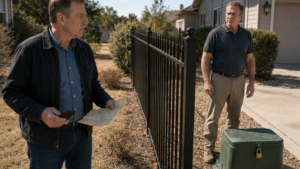
At four that afternoon, Robert was trimming a hedge near his driveway.
Ryan walked over.
“Can I ask you something?”
Robert shut off the trimmer.
He was in his late sixties, broad through the shoulders, with white hair cut close and a face that seemed permanently prepared for disagreement.
“You already are.”
“Why did you move my bin last night?”
Robert looked toward Ryan’s house.
“Your bins were in the wrong place.”
“They were in front of my property.”
“They were blocking the curb.”
“For what?”
Robert set the trimmer down.
“That section stays clear.”
Ryan waited.
Robert did not explain further.
“You took one behind your fence.”
“I moved it.”
“To your yard.”
“Because you keep putting them where they don’t belong.”
Ryan felt his patience narrow.
“They belong at the curb on pickup night.”
“Not there.”
“Then where?”
Robert pointed several yards farther down, near Ryan’s driveway apron.
Ryan stared at him.
“That’s not where the truck picks them up.”
“It used to.”
“That doesn’t answer why you put mine behind your fence.”
Robert’s mouth tightened.
“You’re making this bigger than it is.”
Ryan pulled out his phone.
“I photographed the serial numbers.”
That changed Robert’s expression only slightly.
Ryan noticed.
“These are the bins assigned to my house.”
Robert gave a short, humorless laugh.
“You don’t know that.”
“They came with the service account.”
“Lots of bins move around this neighborhood.”
“So you’re saying they aren’t mine?”
“I’m saying you bought this place a few years ago and you think everything you see started when you got here.”
The remark landed harder than Ryan expected.
Robert had lived on the street much longer. He had mentioned that fact in nearly every disagreement they had ever had, from tree trimming to parking during a neighborhood yard sale.
Ryan hated the implication that ownership came with seniority.
“These bins are on my account.”
“Then prove it.”
“I just told you there are serial numbers.”
“Numbers don’t mean much if you don’t know what they connect to.”
Ryan studied him.
Robert was not bluffing casually. He seemed certain.
That was what unsettled Ryan.
A person caught moving someone else’s trash bin should have been embarrassed, defensive, maybe apologetic.
Robert looked almost offended that Ryan was questioning him.
Ryan slid his phone back into his pocket.
“All right.”
Robert reached for the hedge trimmer.
Ryan walked toward his own driveway, then stopped.
Behind him the machine started again.
Ryan looked at the two green bins beside his garage.
Until that moment, they had been nothing more than plastic containers he rolled down a driveway once a week.
Now he wanted to know exactly where they came from, exactly who they belonged to, and exactly why Robert Hall seemed so confident that Ryan would not like the answer.
Chapter 2: Every Number Led Back to Ryan’s House
The waste-management clerk read the first serial number twice.
Ryan checked the photograph on his phone.
“That’s it.”
The clerk typed again.
“And the second?”
Ryan gave it to her.
She looked at the screen for several seconds longer than he expected.
“Both are assigned to your service address.”
Ryan leaned back slightly.
He had imagined satisfaction.
What he felt instead was irritation sharpened into certainty.
“So there’s no question.”
“About the current account assignment? No.”
The municipal waste office occupied one side of a low brick building near the public works yard. Through the window behind the clerk, Ryan could see rows of replacement containers stacked upside down behind a chain-link fence.
He had taken his lunch break to drive there because the phone representative would only confirm that he had two active bins, not which serial numbers belonged to them.
Ryan placed both photographs on the counter.
“Can I get something showing that?”
The clerk nodded.
“I can print the container history.”
“Perfect.”
She clicked through several screens.
Then stopped.
Her eyebrows drew together.
“What?”
“Nothing. Just give me a second.”
Ryan watched her scroll.
“What are you looking at?”
“These containers have older service notes.”
Ryan’s annoyance shifted.
“How old?”
She printed two pages and turned them around.
Ryan scanned the lines.
His address was there. So were the serial numbers.
Both containers had been issued to the property nearly three years earlier, before Ryan bought the house.
“That’s enough for me,” he said.
The clerk did not let go of the pages.
“There’s another entry.”
She tapped one line.
Eighteen months earlier, one of the bins had been reported missing.
A week later, the second had been entered under a service note using the same code.
Ryan read it twice.
“Reported by who?”
“The account holder at the time, probably.”
“I was the account holder.”
The clerk looked at the date.
“You were already living there?”
“Yes.”
Ryan pulled out his phone calendar.
He did not need to search long.
Eighteen months earlier was around the first time he remembered replacing a bin after it vanished for several days.
At the time, he had called waste services, been told a replacement could take a week, then found the original sitting near Robert’s side fence two days later.
Ryan had canceled the replacement request.
He remembered being relieved.
He had never connected that incident to anything.
Until now.
“Can you see who entered the report?”
The clerk shook her head.
“Not from this screen. It could have been generated from a call, driver note, replacement request. Older records aren’t always detailed.”
“Can someone else access it?”
“Maybe archived service logs.”
“Can I request those?”
“You can, but I don’t know how useful they’ll be.”
Ryan took the printouts.
Useful was becoming a flexible word.
Back home, he spread everything across his desk.
Two photographs.
Two serial numbers.
The municipal account.
The container-history printout.
He created a folder on his computer and named it simply BINS.
The name looked absurd beside folders labeled TAXES and CLIENT CONTRACTS.
He did not care.
Ryan searched old emails.
After twenty minutes, he found the confirmation from the replacement request eighteen months earlier.
Then another email canceling it.
The reason field contained the words container recovered.
Ryan leaned toward the screen.
Recovered where?
He could not remember whether he had told the representative.
He searched his text messages from the same week.
Nothing useful.
Then he found a photograph.
It had been taken casually from his driveway.
A sunset over the roofs.
Ryan zoomed in.
Near the edge of the frame, barely visible behind Robert’s fence, stood a green bin.
He laughed once under his breath.
Not because it was funny.
Because the pattern had apparently been sitting in front of him for a year and a half.
That evening he printed the city record and walked next door.
Robert opened the door only halfway.
Ryan held up the sheet.
“The numbers are registered to my address.”
Robert glanced at the document without taking it.
“So?”
“So you told me to prove it.”
“You proved the city has them on your account.”
“That is ownership as far as the city is concerned.”
Robert’s eyes hardened.
“You still put them where you’re not supposed to.”
Ryan lowered the page.
“We’re talking about two different things.”
“No, you are.”
“What does that mean?”
“It means you keep acting like this is about the cans.”
Ryan stared at him.
“What else would it be about?”
Robert looked beyond him toward the curb.
“That section was kept clear long before you moved here.”
“For what?”
“You should ask your HOA.”
Ryan almost smiled.
“Why would the HOA control my trash bins?”
“They don’t.”
“Then why do you?”
Robert’s hand tightened on the door.
“You think finding a number means you understand everything.”
“That number means you don’t get to take my property.”
Robert opened the door slightly wider.
“I moved them because you keep ignoring how this street works.”
“There’s no rule telling me I can’t put them at my curb.”
“You sure?”
It was the same confidence again.
Not embarrassment.
Not uncertainty.
Ryan felt his certainty become something less comfortable.
“If there is, show me.”
Robert shook his head.
“You’re the one who wants paperwork.”
Then he closed the door.
Ryan stood on the porch holding proof that should have ended the argument.
Instead, Robert had handed him another one.
The next morning Ryan emailed Heather Wright, the HOA community manager, attaching the municipal records and asking whether any rule restricted trash-bin placement along his section of curb.
Heather replied before lunch.
There was no citation, no warning, no accusation.
Only a request.
Could you come by the office next Tuesday? There is an older property-access file connected to those two lots that I think you should see before we respond formally.
Ryan read the message twice.
He looked again at the waste-service history.
The missing-bin report was dated eighteen months earlier.
But if Robert was telling the truth about an older curb rule, then whatever this argument was really about had started long before that.
Chapter 3: The HOA File Made Robert Look Less Wrong
Heather Wright had already unfolded the site diagram when Ryan walked into the HOA office.
“That’s my house,” he said.
“I know.”
“And that’s Robert’s.”
“I know that too.”
The paper was old enough that the white had yellowed near the folds. Two adjacent lots were outlined in black. A hand-drawn shaded section ran along part of the curb between them.
Ryan set his municipal records beside it.
“What is that?”
Heather turned the page so it faced him.
“An access accommodation.”
“For Robert?”
“For the property.”
“That’s not an answer.”
“No,” she said. “It’s the answer the file gives me.”
Heather was in her forties, practical, composed, and irritatingly difficult to rush. Ryan had dealt with her twice before over routine HOA matters and had never seen her raise her voice.
Today he wished she would.
He pointed at the shaded curb.
“Does this say I can’t put trash bins there?”
“No.”
“Then Robert is wrong.”
“I didn’t say Robert was right.”
“He took containers registered to my house and put them behind his fence.”
“I understand that.”
“I sent you proof.”
“And I’m looking at it.”
Heather folded her hands.
“What I’m trying to avoid is giving you a confident answer today and discovering tomorrow that this file changes it.”
Ryan sat back.
The sentence irritated him because it sounded reasonable.
“What exactly was the accommodation?”
Heather checked the folder.
“It appears the association agreed to keep a section of curb unobstructed.”
“By trash cans?”
“By anything, potentially.”
“For how long?”
“That’s one of the problems.”
Ryan waited.
Heather slid a photocopy toward him.
There was an approval date but no clear expiration.
“So Robert was telling the truth.”
“About an accommodation existing? Yes.”
Ryan looked at the diagram again.
The victory he had carried into the office shrank.
“He made it sound like there was a rule.”
“There may have been a practical rule attached to the accommodation.”
“May have been?”
“The file is incomplete.”
Ryan gave a short laugh.
“Of course it is.”
Heather did not react.
“The association changed management companies twice since this was created. Some older documents were scanned. Some weren’t.”
“When was this?”
“Eighteen years ago.”
That number caught him.
“Eighteen?”
“Yes.”
Ryan thought of Robert’s remark: long before you moved here.
He had assumed it was neighborhood posturing.
Apparently not.
Heather tapped the diagram.
“This was already established when Robert lived there.”
“So because something happened eighteen years ago, he gets to steal my bins now?”
“No.”
“Good.”
“But if you’re asking the HOA to enforce something against him, I need to separate the ownership issue from the access issue.”
“They’re already separate.”
“To you.”
Ryan stared at her.
Heather continued.
“Robert’s position, as I understand it, is that he moves the containers because they obstruct an area the association previously agreed would remain clear.”
“He put one behind his garage.”
“I’m not defending that.”
“He told me the bins might not even be mine.”
“I’m not defending that either.”
“Then why does this feel like I’m the one being investigated?”
Heather exhaled quietly.
“Because you came in with a simple question and the file gave me a complicated answer.”
Ryan hated complicated answers when he had photographs.
He left the office with a copy of the diagram and walked home instead of driving. The HOA building sat near the neighborhood entrance, less than half a mile away.
By the time he reached his street, Robert was outside bringing in mail.
Ryan almost crossed over.
Instead, he stopped at his own curb and unfolded the diagram.
The shaded area began near the property line and extended along the street in front of part of Ryan’s lot.
He compared it with where he usually placed the bins.
They overlapped.
Robert noticed.
“So she showed you.”
Ryan looked up.
“You could have shown me this.”
Robert shrugged.
“You didn’t ask until you’d already decided I was stealing from you.”
“You did take my bins.”
“I moved them.”
“Behind your fence.”
“Because you’d just roll them back.”
Ryan stepped off the curb.
“You knew those containers were registered to my house?”
Robert looked away.
“That’s not what we’re discussing.”
“It’s exactly what we’re discussing.”
“No. You keep making it about ownership because that’s the part where you know you’re right.”
The words landed with uncomfortable precision.
Ryan held up the diagram.
“And you keep making it about this because it’s the part where you think you’re right.”
Robert’s jaw tightened.
“That curb was kept clear for years.”
“For what?”
“It doesn’t matter.”
“It matters if you’re using it as an excuse to come onto my property.”
“I didn’t come onto your property.”
“You took something from my curb.”
Robert pointed toward the shaded area.
“That space was never supposed to be blocked.”
“Why?”
Robert turned toward his house.
Ryan followed him two steps.
“Robert.”
Robert stopped.
“For what?”
For the first time since the dispute began, Robert did not answer immediately.
His anger seemed to drain into something more guarded.
“You should read the whole file.”
“Heather says the file is incomplete.”
“Then she should find the rest of it.”
Robert went inside.
Ryan remained beside the curb with the diagram in his hand.
That night he opened his HOA portal and searched old governing documents.
Most references were useless—parking rules, landscaping standards, mailbox specifications.
He searched the address.
Nothing.
He searched Robert’s.
Nothing.
He searched the approval date printed on Heather’s copy.
A board-meeting archive appeared, but the attachment was missing.
Ryan emailed Heather.
Is there a reason for the curb accommodation listed anywhere else?
Her answer arrived forty minutes later.
I’m checking archived records. I also asked Robert to stop moving your containers while we review this.
Ryan stared at the second sentence.
That was what he wanted.
It should have felt like progress.
Instead, he found himself opening the municipal serial-number photographs again, as though they could restore the clean certainty he had felt at the waste office.
On Tuesday evening, he placed both bins farther down his driveway than usual, well outside the shaded section on the old diagram.
At 9:15, he looked outside.
They were untouched.
At 10:30, still there.
At 11:20, still there.
Ryan almost felt foolish.
Then at 6:05 Wednesday morning, one bin was turned sideways in the driveway.
Robert had not taken it.
He had moved it less than six feet.
Ryan went outside.
Robert was already standing near his mailbox.
“You touched it.”
“It was sticking into the access area.”
“It was on my driveway.”
“The handle was over the line.”
Ryan looked down.
There was no painted line. No marker. Nothing except an eighteen-year-old drawing scaled poorly enough that he could not have identified the exact boundary if he tried.
“You’re enforcing an invisible rule.”
“I’m maintaining something this association agreed to maintain.”
“Why do you care this much?”
Robert’s face closed.
Before he could answer, Ryan’s phone buzzed.
Heather.
Ryan opened the message.
I found reference to the original request. I still need the supporting attachment, but one phrase may explain the purpose of the accommodation.
Ryan scrolled.
The phrase was only two words.
Medical access.
He looked across the curb at Robert.
Robert had already turned away.
Chapter 4: A Warning Changed Nothing on Tuesday Night
The patrol officer looked at Ryan’s photographs, then at Ryan.
“Are the bins missing right now?”
“No.”
“Has he damaged them?”
“Not that I can prove.”
“Has he refused to return them?”
“He keeps taking them.”
The officer folded his hands on the desk.
Ryan had already learned that the non-emergency police station was designed to remove urgency from a person. Fluorescent ceiling lights. Gray chairs bolted together. A counter with thick glass. Nothing in the room suggested that anyone’s Tuesday-night trash dispute deserved speed.
Ryan slid the municipal records forward.
“They’re registered to my address.”
“I see that.”
“And he admits moving them.”
“I understand.”
“So what exactly am I missing?”
The officer glanced at the report Ryan had started filling out.
“What you’re describing may be theft, or it may be an ongoing property dispute involving where the containers are being placed. If he takes them intending to keep them, that’s one thing. If he moves them twenty feet and you recover them, that becomes harder to establish from a criminal standpoint.”
Ryan stared at him.
“If I move your lawn mower behind my garage every Tuesday, you’d call that what?”
The officer’s expression tightened slightly.
“I’m not telling you it’s acceptable.”
“That’s not what I asked.”
“No. But it’s the answer I can give you.”
Ryan leaned back.
He had come expecting procedure to feel cleaner than the HOA conversation. Serial numbers. Dates. Photographs. A repeated pattern. He had imagined that once someone neutral looked at the evidence, ambiguity would collapse.
Instead, the officer pointed toward another section of the form.
“Document each incident. Don’t confront him if you think it could escalate. And if there’s an HOA access issue, get clarification on that separately.”
Ryan gave a small, bitter laugh.
“Everybody keeps telling me to ask somebody else.”
“I’m telling you to keep the issues separate.”
“That’s what I’ve been saying.”
The officer did not argue.
Two days later, a patrol car stopped in front of Robert’s house.
Ryan watched through his office blinds.
He told himself he was not waiting for it.
He had been waiting for it.
The officer stood on Robert’s porch for nearly fifteen minutes. Robert spoke with one hand resting on the doorframe. Twice he pointed toward the curb between the houses.
Then both men walked to the street.
Ryan could not hear most of the exchange through the closed window, but when Robert raised his voice, one sentence carried.
“He knows that space is supposed to stay open.”
The officer answered something lower.
Robert pointed toward Ryan’s house.
“He was shown the diagram.”
Ryan stepped away from the window.
There it was.
Not denial anymore.
Justification.
When the officer knocked at Ryan’s door a few minutes later, Ryan already knew there would be no satisfying ending.
“He acknowledges moving the containers,” the officer said.
“And?”
“He says he believed he was enforcing an existing access arrangement.”
“He doesn’t get to enforce HOA rules.”
“I told him that.”
“So what happens?”
“He’s been warned not to move your property.”
Ryan waited.
“That’s it?”
“That’s what happens today.”
Ryan looked past him toward Robert’s house.
“Did he tell you he said the bins weren’t mine?”
“He says that was part of an argument about where they belonged.”
Ryan almost interrupted, but stopped himself.
The officer continued.
“If he takes them again, document it. Call us if they’re being withheld. But I strongly suggest you let the HOA settle the curb question.”
Ryan nodded because he had run out of productive sentences.
The patrol car left.
Robert remained inside.
For three days, nothing happened.
Ryan began to think the warning had worked.
Then Saturday morning, he rolled one empty bin from the garage to wash it. He left it near the end of the driveway while he went inside for a hose nozzle.
When he came back, the bin had been moved.
Not far.
Six feet.
Its wheels rested on the opposite side of the driveway apron.
Ryan stood motionless.
Robert was watering shrubs next door.
“You moved it again.”
Robert kept watering.
“It was over.”
“Over what?”
“The access area.”
“It’s Saturday. There’s no pickup. There’s no car there. There’s nothing being blocked.”
“That doesn’t change where it goes.”
Ryan crossed the lawn.
Robert shut off the nozzle.
“You were warned.”
“I was told not to take your property.”
“You just moved it.”
“I corrected where you left it.”
Ryan felt something in him harden.
“Why do you think you have the right to correct anything on my property?”
Robert looked at the bin, then at Ryan.
“Because you keep pretending the history doesn’t matter.”
“Then tell me the history.”
“You’ve got the HOA digging through it. Let them.”
“Medical access for who?”
That stopped Robert.
Ryan saw it clearly.
The older man’s fingers tightened around the hose nozzle.
“Who needed it?”
Robert looked away.
“That’s not your business.”
“You’re using it to move my things.”
“I said let the HOA handle it.”
For once, Ryan did not press.
Robert’s reaction had answered at least one question.
The phrase mattered.
Personally.
Ryan walked back to his driveway, pulled the bin to the garage, and closed the door harder than necessary.
Inside, he opened the BINS folder.
Photographs.
Municipal records.
The old site diagram.
The police report number.
He arranged them into a timeline.
Then he created an email addressed to Heather, the HOA board president, and two neighbors whose houses faced the curb.
The subject line read: Repeated Unauthorized Removal of Registered Containers.
Ryan attached everything.
His cursor hovered over Send.
He imagined Robert opening the email. Imagined the neighbors seeing the serial numbers. Imagined the argument finally leaving the space between two driveways and becoming something Robert could not control.
Ryan deleted the two neighbors from the recipient line.
Then added them back.
He stared at the screen.
This was no longer only about recovering trash bins. He knew that.
Robert had made sure of it.
The question was whether Ryan was trying to stop him or beat him.
He closed the draft without sending it.
On Monday evening, he drove to a hardware store.
He walked past replacement wheels, outdoor locks, reflective address stickers and security lights.
At the paint aisle he stopped.
Rows of spray cans filled the shelves.
White. Black. Blue.
Then a bright fluorescent orange that looked almost radioactive under the store lights.
Ryan picked up one can.
Then a second.
He stood there holding both of them, thinking about Robert’s sentence.
You keep pretending the history doesn’t matter.
Ryan put two cans of clear waterproof coating into the cart beside the paint.
Whatever the history was, he had decided one thing.
The next time Robert touched those bins, there would be no argument about whose they were.
Chapter 5: Ryan Turned Two Trash Bins Into Evidence
The first fluorescent number was so bright that Ryan immediately knew he had gone too far.
He stared at the orange stencil across the side of the green bin.
Large block characters marked his house number in a color impossible to miss from halfway down the street.
Subtle identification would have worked.
A small weatherproof label would have worked.
Even a permanent marker near the serial number probably would have worked.
Ryan sprayed the second digit anyway.
By the time he finished both bins, each had matching identifiers across the front and sides. He added a thin clear protective coat and set them near the open garage door to dry.
The fumes hung in the warm evening air.
A neighbor walking a dog slowed.
Ryan pretended not to notice.
The neighbor looked from the glowing orange numbers to Ryan, then kept going.
That bothered him more than he expected.
He had told himself the paint was practical.
Looking at the bins now, Ryan had to admit there was something else in it.
They were not merely identifiable.
They were accusatory.
If one appeared in Robert’s yard, nobody would need municipal records to understand the problem.
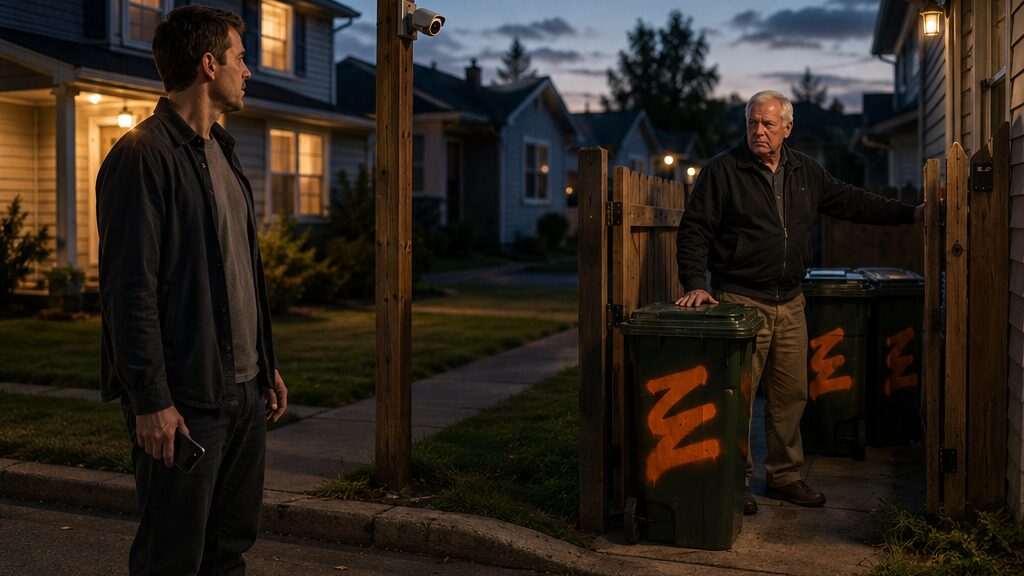
Ryan installed the camera next.
It was small, battery-powered, and mounted beneath the edge of a wooden post near his driveway. The angle covered the curb, both bins, and the strip of sidewalk leading toward Robert’s property.
He tested the motion alert twice.
At 8:47 Monday evening, he rolled the bins into position.
Not inside the disputed shaded zone.
He measured from the driveway edge using the old diagram and placed them several feet beyond even the most generous interpretation of the access area.
Then he took photographs.
One wide shot.
One from the curb.
One showing the location relative to his driveway.
One showing the fluorescent identifiers.
At 9:03, he emailed Heather.
Containers placed outside disputed access area for tomorrow’s collection. Photograph attached.
Heather replied eleven minutes later.
Received.
Nothing else.
Ryan almost appreciated the restraint.
At 10:30, both bins remained untouched.
At 11:15, still there.
He went to bed but left his phone on the nightstand with the volume high.
At 12:37 a.m., it vibrated.
Motion detected.
Ryan was awake before the second alert.
He opened the camera feed.
Robert stood under the streetlight.
For a moment, he did nothing.
He looked down at the fluorescent numbers.
Even through the grainy night image, Ryan could see him reading them.
Robert placed one hand on the nearest handle.
Ryan sat upright.
“Don’t.”
The word came out quietly, although Robert could not hear him.
Robert tilted the bin back onto its wheels.
Then he pulled.
The orange numbers moved across Ryan’s screen.
Across the curb.
Across the sidewalk.
Toward Robert’s property.
Ryan’s thumb hovered over the call button.
He could walk outside.
He could turn on every exterior light.
He could confront Robert while the camera recorded.
Instead, he stayed where he was.
Robert dragged the first bin through his side gate.
Then came back.
Ryan’s heart beat harder.
Robert took the second.
This time he paused near the property line and looked toward Ryan’s dark house.
Then the second fluorescent bin disappeared behind the fence.
Ryan saved the footage.
He saved it again to his computer.
Then to cloud storage.
At 12:51, he opened the neighborhood email draft from Saturday.
He added a new subject line.
THIS IS WHAT HAPPENED TONIGHT.
He attached a still frame showing Robert’s hand on the fluorescent bin.
Ryan began typing.
After weeks of denial, municipal records, HOA review, and a police warning—
He stopped.
The sentence felt good.
Too good.
He imagined the replies.
People choosing sides.
Robert being forced to walk past neighbors who had seen him pulling the bins.
For the first time since the dispute began, Ryan had exactly the kind of proof he had wanted.
And his first instinct was not to solve the problem.
It was to make sure everyone knew he had won.
He left the message open and went back to bed.
He did not sleep much.
At 6:12 Wednesday morning, Ryan walked outside with his phone.
The sanitation truck had not reached their block yet.
Robert’s side gate was closed.
The top of one fluorescent bin was visible above it.
Ryan took a photograph from the sidewalk.
Then another.
A garage door across the street opened. One of the neighbors stepped out, noticed Ryan, then followed his line of sight.
“What happened to your cans?”
Ryan pointed.
The neighbor stared at the bright orange numbers behind Robert’s fence.
“You’ve got to be kidding.”
Ryan felt the dangerous satisfaction again.
The neighbor raised a phone.
“Don’t,” Ryan said.
The neighbor looked at him.
“I’ve got it documented.”
“After all that, he still took them?”
“Yes.”
“Those are pretty hard to mistake.”
“That was the idea.”
Ryan crossed to Robert’s gate and knocked.
No answer.
He called the police non-emergency number and reported that the containers had again been moved and were currently being withheld.
Then he called waste management.
The clerk documented the incident against his account.
By 8:30, Ryan had recovered both bins after an officer spoke briefly with Robert and instructed him to return them to the curb.
The collection truck had already passed.
Again.
Ryan stood beside two full fluorescent bins.
The irony was almost impressive.
He had finally proved everything and still had a week’s garbage sitting in front of him.
At 9:04, Heather called.
“I saw your email and the photographs.”
“I have video too.”
“I assumed you might.”
“He looked directly at the numbers before he moved them.”
“I believe you.”
Ryan fell silent.
It was the first time Heather had said those words without qualification.
“So what happens now?”
“I’m reopening the access file.”
“You already opened it.”
“No. I reviewed the current digital file.”
“What’s the difference?”
“The original request predates our current archive. The board minutes reference an attachment that was never scanned.”
Ryan looked at the bins through his office window.
“And?”
“I found the storage index this morning.”
He sat straighter.
“What are you looking for?”
“The request that created the accommodation.”
“You already know it was for medical access.”
“I know that from the minutes. I don’t know who requested it, what limitations were specified, or whether there was an end condition.”
Ryan rubbed his forehead.
“Robert took my bins after a police warning. Why does any of that change what happened last night?”
“It doesn’t.”
“Then why are we still talking about it?”
“Because you’re asking the HOA for a formal ruling about the curb, and I’m not giving you one based on an incomplete file.”
Ryan looked at the draft email still open on his computer.
“If I sent the video to the board and the neighborhood, would that speed things up?”
Heather was quiet for a moment.
“It would certainly change the situation.”
“That’s not an answer.”
“It is the most accurate answer I have.”
Ryan almost laughed.
Heather continued.
“Ryan, you have strong evidence about what happened last night. Don’t confuse that with having every answer about why this started.”
He stared at the fluorescent numbers.
“I’m getting tired of being told the why matters.”
“It matters if you want the association to correct the underlying issue instead of just documenting the latest incident.”
Ryan said nothing.
Heather lowered her voice.
“Before you send anything publicly, let me find the original attachment.”
“How long?”
“This afternoon.”
Ryan glanced at the unsent message.
“All right.”
Heather paused.
“There’s one more thing.”
“What?”
“The storage index lists the original request under a name I didn’t expect.”
Ryan waited.
Heather said, “It wasn’t filed by Robert.”
Ryan looked toward Robert’s house.
“Who filed it?”
“I want to verify the document before I tell you.”
“Heather.”
“I’ll call you when I have it.”
The line went quiet.
Ryan lowered the phone.
On his computer, the video still showed Robert pulling a fluorescent bin through the darkness.
Ryan had finally made Robert’s claim impossible to defend.
And somehow the question had changed again.
If Robert had not created the rule he kept enforcing, who had?
Chapter 6: The Rule Had Been Written for Carol
Carol Hall’s name appeared at the top of the original request.
Ryan read it once.
Then again.
He looked at Heather.
“Carol.”
“Yes.”
Heather sat across from him in the HOA archive room with a cardboard records box between them. The room smelled faintly of paper dust and old carpet.
Ryan knew the name.
He had seen it once on a sympathy card still taped inside Robert’s garage when the door had been open. He knew Robert had been widowed before Ryan bought his house.
He had never connected Carol to the curb.
Heather slid the document closer.
The request was eighteen years old.
It described temporary unobstructed curb access adjacent to the Hall property because a household member had significant mobility limitations and was being transported regularly by family and medical services.
The language was plain.
No drama.
No permanent easement.
No transfer of property rights.
No authority given to Robert to move objects himself.
Near the bottom, one sentence mattered more than the rest.
Accommodation to remain while medically necessary, subject to periodic association review.
Ryan tapped it.
“Periodic review.”
Heather nodded.
“Which apparently never happened.”
“So the HOA made a mistake.”
“Yes.”
The directness surprised him.
Heather leaned back.
“The management company changed. The accommodation stayed on a site diagram. Nobody closed it.”
“And Robert kept treating it like a permanent rule.”
“That appears to be what happened.”
Ryan looked again at Carol’s name.
“What happened to her?”
Heather did not answer immediately.
“I don’t think that part belongs to the association to explain.”
Ryan understood.
He folded his copy of the document and went home.
For almost an hour he sat at his desk with the neighborhood email open.
The video attachment was ready.
The photographs were arranged beneath it.
He had enough material to make Robert look ridiculous.
The fluorescent numbers made the story understandable in one image.
Ryan could already imagine the reactions.
Then he looked at Carol’s request.
The language about mobility equipment and repeated transport changed the shape of the curb in his mind.
For Robert, it had once been more than empty pavement.
Ryan hated that understanding made the anger less convenient.
At four that afternoon, he walked next door.
Robert opened the door but did not invite him in.
“You found it.”
It was not a question.
Ryan held the photocopy.
“Carol filed the request.”
Robert looked at the page.
“Yes.”
“Why didn’t you just tell me?”
“Would it have mattered?”
“Yes.”
Robert’s expression said he did not believe that.
Ryan continued.
“It says temporary.”
“I know what it says.”
That stopped him.
“You know?”
“I was there when she filled it out.”
“Then you know it wasn’t permanent.”
Robert stepped onto the porch and closed the door behind him.
For a few seconds neither man spoke.
“She used a walker first,” Robert said. “Then a chair. Some mornings my daughter would pull up there. Later we had transport vans. If somebody left a car or a pile of branches or trash cans along that section, getting her in and out became a whole production.”
Ryan listened.
“Neighbors started keeping it clear without us asking. The board put the accommodation in writing.”
“And after she died?”
Robert’s mouth tightened.
“People still knew.”
“That doesn’t answer me.”
“No. It doesn’t.”
Ryan looked toward the curb.
“How long ago?”
“Six years.”
Six years.
Ryan had lived beside Robert for four.
The accommodation had outlived the person who needed it by years before Ryan ever arrived.
“You knew my bins were registered to my house,” Ryan said.
Robert looked at him.
This time he did not dodge.
“Yes.”
Ryan felt anger rise again, cleaner now because there was no ambiguity left.
“You told me they might not be mine.”
“I said the numbers didn’t settle where you were putting them.”
“You knew exactly what I meant.”
“Yes.”
“And after the police warned you, you took them again.”
Robert looked toward Ryan’s driveway.
“You painted them like a billboard.”
“That’s your explanation?”
“No.”
“Then give me one.”
Robert’s shoulders sagged slightly.
Not surrender.
Fatigue.
“You moved in and everything became a question,” he said. “Tree line. Cars at the curb. Collection days. Where people put things. Every answer I gave you, you wanted to see a rule.”
Ryan stared at him.
“Because you kept acting like your preference was a rule.”
“Maybe.”
The word was so unexpected Ryan almost missed it.
Robert looked at the curb again.
“For a long time, if I said that space needed to stay clear, people kept it clear. They knew why. Then Carol was gone, and nobody talked about it anymore. But the space stayed open.”
“And you decided that meant it belonged to you.”
“I didn’t say that.”
“You behaved like it did.”
Robert’s face hardened again.
“You think because you can print a record and paint a number on something, you’ve figured out the whole street.”
“No. I figured out who owns my trash bins.”
Robert gave a tired nod.
“Fine. You own them.”
Ryan had waited weeks to hear it.
It gave him almost no satisfaction.
“Then why take them Tuesday?”
Robert was silent long enough that Ryan thought he would refuse again.
Finally he said, “Because if I stopped after all this, it would mean you were right about all of it.”
Ryan frowned.
“I am right about the bins.”
“I know.”
The admission was quiet.
Robert looked older than he had during any of their arguments.
“That space mattered when Carol was alive. People respected it because they respected what we were dealing with. Then it became a line on a paper nobody remembered. You showed up, put your cans there, and when I told you not to, you wanted documentation.”
“Because you never told me why.”
“I didn’t want to explain my wife to somebody over garbage cans.”
Ryan looked down at the photocopy in his hand.
That, at least, he understood.
But understanding did not erase the footage.
“You could have left them alone.”
“Yes.”
“You could have told Heather.”
“Yes.”
“You could have stopped after the officer warned you.”
Robert’s jaw tightened.
“Yes.”
Ryan waited for an apology.
None came.
Instead Robert said, “And you could have marked them normally.”
Ryan looked at him.
Robert nodded toward the fluorescent bins near Ryan’s garage.
“You didn’t paint them like that because you were afraid I’d confuse them.”
Ryan said nothing.
“You wanted everybody to see what I did.”
Ryan felt heat rise into his face.
Robert had finally admitted knowingly taking the bins, and still he had found the one accusation Ryan could not dismiss.
“I wanted you to stop denying it.”
“You wanted me caught.”
“Yes.”
“At least say it.”
Ryan looked across the street.
One of the neighbors was getting mail.
The fluorescent orange numbers seemed brighter in daylight.
“Yes,” Ryan said. “Part of me wanted you caught.”
Robert nodded once.
“There you go.”
“That does not make what you did acceptable.”
“I didn’t say it did.”
“And Carol needing that curb eighteen years ago does not give you control over it now.”
Robert’s eyes shifted back to Ryan.
For a moment the old argument returned to his face.
Then faded.
“No,” he said.
Ryan left without shaking his hand.
At home, he sat down in front of his computer.
The neighborhood email was still open.
The first paragraph accused Robert of repeated unauthorized removal.
The second listed serial numbers.
The third mentioned police intervention.
Below it sat the video file.
Ryan pictured hitting Send.
The facts would all be true.
That was what made the decision difficult.
He could expose Robert without lying once.
Ryan placed his fingers on the keyboard.
Then he deleted the message.
Not the evidence.
Not the photographs.
Not the video.
Only the public draft.
He opened a new email to Heather.
I want the HOA to make a formal determination on the access area and the container interference. I will provide the footage at a hearing. I am not distributing it to the neighborhood.
He read the message before sending it.
For once, proof did not have to be a weapon.
Heather replied twenty minutes later.
The board can hear the matter next Thursday. Please send me only the materials you want entered into the record.
Ryan attached the municipal records, the site diagram, Carol’s original request and two still photographs.
He paused over the video.
Then attached that too.
Outside, the fluorescent bins waited beside his garage.
They still looked ridiculous.
But for the first time since the dispute started, Ryan no longer needed everyone on the street to look at them.
He only needed the boundary corrected.
And next Thursday, when Heather asked what he wanted done about Robert Hall, Ryan would have to decide exactly how much justice required.
Chapter 7: The Hearing Was About More Than Two Bins
Heather Wright did not begin by asking who was right.
She looked at Ryan across the HOA meeting table and said, “What exactly do you want us to do?”
Ryan had prepared for dates, evidence, accusations, perhaps another argument over the old site diagram.
He had not prepared for that question.
Robert sat three chairs away with his arms folded. The HOA board president was at the far end of the table, a legal pad in front of him. Heather had arranged Ryan’s photographs, the municipal records, Carol’s original accommodation request, and the old curb diagram into four neat stacks.
Ryan looked at the still image on top.
One fluorescent bin stood behind Robert’s side gate.
His house number was impossible to miss.
“I want him to stop touching my property,” Ryan said.
Heather waited.
“And I want the curb issue corrected.”
“Anything else?”
Ryan knew what she was asking.
He had brought the full camera recording on a flash drive.
There were thirty-eight minutes of motion footage from that Tuesday night. Most of it was useless darkness. But the clearest section showed Robert stopping beside the first bin, reading the fluorescent markings, looking toward Ryan’s house, and then deliberately pulling the container through his gate.
It was the closest thing Ryan had to the victory he had imagined for weeks.
“No,” Ryan said. “That’s what I want.”
Robert shifted in his chair.
Heather nodded.
“Then let’s separate those two issues.”
She picked up the municipal record first.
“The containers are assigned to Ryan’s service address. There is no HOA rule transferring ownership or control of those containers to another homeowner.”
Robert did not argue.
Ryan noticed.
Heather moved to the old accommodation request.
“The curb access arrangement was approved eighteen years ago for Carol Hall’s medical transportation needs.”
Robert stared at the table.
“The original language says the accommodation would remain while medically necessary and would be subject to periodic review.”
Heather looked toward the board president.
“That review never occurred.”
The board president nodded once.
“That was an administrative failure.”
Ryan felt something loosen inside him.
For the first time, nobody was speaking in maybes.
Heather continued.
“The accommodation was not an easement. It did not create exclusive use of the curb. It did not authorize any resident to move another resident’s belongings.”
Robert finally looked up.
“That space stayed open for years.”
“Yes,” Heather said.
“Because people understood.”
“Yes.”
“And now suddenly it means nothing?”
Heather’s expression softened without giving ground.
“It meant something important when Carol needed it.”
Robert’s jaw tightened.
“It still meant something after.”
“To you,” Heather said.
The room went quiet.
Robert looked at her for several seconds.
Ryan expected anger.
Instead, Robert said, “That doesn’t make it worthless.”
“No,” Heather replied. “But it does mean the original purpose ended. The association should have updated the record years ago.”
The board president turned the legal pad toward himself.
“We can correct that now.”
Robert leaned back.
Ryan should have felt triumphant.
Instead he kept looking at Carol’s old request.
Her name made the argument smaller and larger at the same time.
Heather reached for the photographs.
“Now the containers.”
She slid the image of the fluorescent bin into the center of the table.
“Robert, did you move these from Ryan’s curb on the night shown here?”
Robert looked at the photograph.
“Yes.”
“Were you aware they belonged to Ryan?”
A pause.
“Yes.”
The board president stopped writing.
Ryan felt his shoulders tense.
Heather asked, “Were you aware the police had previously told you not to move them?”
Robert nodded.
“Yes.”
Ryan had heard the admission on Robert’s porch.
Hearing it in this room was different.
It stripped away every remaining excuse.
Heather looked at Ryan.
“You submitted video.”
“Yes.”
“Do you want it played?”
Ryan looked at Robert.
Robert’s face had gone still.
The easiest answer was yes.
It was evidence.
Accurate evidence.
Ryan could make everyone in the room watch Robert read the bright numbers and pull the bins away anyway.
He pictured the moment Robert looked toward the camera without realizing it was there.
That was the part Ryan had replayed most.
The part that made the whole thing undeniable.
“No,” Ryan said.
Robert looked at him.
Heather did too.
Ryan continued.
“The still image and his admission are enough.”
The board president asked, “You’re sure?”
“Yes.”
Ryan took a breath.
“I’m not withdrawing the video. Keep it in the record if you need it. I just don’t think we need to sit here and watch it.”
Robert’s folded arms loosened.
It was barely a movement, but Ryan saw it.
Heather set the flash drive aside.
“Then we won’t.”
The board president summarized the ruling.
The old curb accommodation would be closed and replaced with a current site clarification stating that neither homeowner had exclusive control over the shared curb area beyond ordinary municipal and HOA restrictions.
Ryan’s trash containers could be placed for collection within the permitted frontage.
Robert was instructed not to move, retain, relocate, alter, or obstruct Ryan’s containers.
The waste-management documentation would also be forwarded with the incident record so any replacement or service fees connected to containers Robert had retained or interfered with could be assigned appropriately.
There was no applause.
No one raised a voice.
The decision took less than four minutes.
Ryan had spent weeks imagining how vindication would feel.
Mostly, it felt administrative.
Heather closed the folder.
“Before we finish, I want one thing clear.”
She looked at both men.
“This association allowed an outdated accommodation to remain ambiguous. That contributed to the dispute.”
Ryan nodded.
Robert did not.
Heather continued.
“But ambiguity did not authorize either of you to create your own enforcement.”
Ryan felt the sentence land on him too.
Robert glanced toward the fluorescent photograph.
Heather said, “Ryan had the right to identify his property. But the way this escalated became increasingly public.”
Ryan could have defended himself.
Instead he said, “I know.”
Robert looked surprised.
The board president put his pen down.
“Mr. Hall?”
Robert kept his eyes on the table.
“I should’ve stopped moving them.”
Ryan waited.
It was not an apology.
But it was the first statement Robert had made in front of another person that contained no justification.
Heather asked, “And the expired accommodation?”
Robert’s mouth tightened.
“I knew Carol didn’t need it anymore.”
The room became very still.
Robert looked toward the old request.
“I just didn’t think that meant it had to disappear.”
Ryan understood the difference now.
Robert had not truly believed the rule was still legally active.
He had believed its disappearance was something he could refuse.
Heather folded Carol’s document and returned it to the file.
“The record can preserve why it existed without pretending it still controls the street.”
Robert gave a small nod.
The hearing ended shortly after.
Ryan gathered his papers.
Robert left first.
In the parking lot, Ryan was putting the flash drive into his pocket when Robert stopped beside his truck.
“Ryan.”
Ryan turned.
Robert looked uncomfortable in a way Ryan had never seen before.
He gestured vaguely toward the street beyond the clubhouse.
“You keeping those orange numbers?”
Ryan almost smiled.
“They bother you?”
“They’re ugly.”
Ryan looked at him.
For a second, neither man seemed certain whether the remark was an insult or an attempt at normal conversation.
Robert added, “Everybody can see them from half a block away.”
“That was the point.”
“I know.”
Ryan slipped the flash drive into his pocket.
Robert opened his truck door, then paused.
“You going to take them off?”
Ryan thought about the weeks of missing pickups, the garage full of trash, the police desk, the old records, Carol’s request, and the video he had chosen not to play.
“Eventually,” he said.
Robert nodded.
Then he got into his truck.
Ryan stood in the parking lot after he drove away.
The ruling had settled who could touch the bins.
It had settled the curb.
It had settled the paperwork.
What it had not settled was whether two people who had spent weeks measuring every inch between them could go back to living fifteen yards apart without measuring anything at all.
Chapter 8: By Wednesday Morning They Were Just Trash Bins Again
At 5:58 on Wednesday morning, Ryan opened his front door and saw both bins exactly where he had left them.
He did not trust the sight immediately.
For weeks, his first thought on collection morning had been location.
Curb.
Driveway.
Robert’s fence.
Side yard.
He stepped onto the porch.
Both containers stood upright near the driveway apron, spaced far enough apart for the sanitation truck’s mechanical arm.
Nothing had been moved.
Ryan checked his phone.
No motion alerts overnight.
He almost opened the camera app anyway.
Instead, he put the phone back in his pocket.
Three weeks had passed since the hearing.
The HOA had sent the written clarification within two days.
The old medical-access accommodation had been formally closed, with a note preserving its historical purpose in the property file.
Waste management had separately confirmed the container serial numbers and applied service charges connected to the documented interference.
Ryan had not asked what Robert paid.
He had decided he did not need to know.
The fluorescent paint was mostly gone now.
The previous weekend, Ryan had spent an hour in the garage sanding the bright orange markings down and repainting the worst areas with a dark outdoor coating close to the original green.
He left only two small weatherproof address labels near the handles.
Large enough to identify.
Small enough that nobody across the street would notice.
When he finished, the bins looked almost boring.
He had been surprised by how much he liked that.
Ryan walked down the driveway and lifted one lid.
Everything was still inside.
A ridiculous inspection.
He closed it.
“You checking whether I stole something?”
Robert’s voice came from next door.
Ryan turned.
Robert was pulling his own bin down the driveway.
For half a second, Ryan’s body reacted before his mind did.
His eyes went to Robert’s hands.
Then to Robert’s bin.
Not his.
Robert noticed.
Neither man mentioned it.
“I was checking the lid,” Ryan said.
“Looks attached.”
“So far.”
Robert rolled his container toward the curb.
When he reached the area that had caused weeks of arguments, he stopped.
Ryan watched.
Robert adjusted his path, pulled his own bin farther toward his side, and set it down.
He did not touch Ryan’s.
Did not point.
Did not mention the old diagram.
The movement was so ordinary that it carried more weight than anything Robert could have said.
Ryan walked to his mailbox.
Robert remained beside his bin.
After a moment he said, “Truck’s been coming earlier.”
“I noticed.”
“About ten minutes.”
“Probably route change.”
Robert nodded.
Silence settled between them.
Not friendly.
Not hostile.
Just silence.
Ryan opened the mailbox.
A utility bill and two advertisements.
When he closed it, Robert was still there.
“I got the charge from waste management,” Robert said.
Ryan looked at him.
“I figured.”
Robert rubbed one hand across the back of his neck.
“They treated one of those old service incidents as an improper container transfer.”
Ryan said nothing.
Robert continued.
“Cost me more than the cans were worth.”
There was an invitation in the sentence.
A chance for Ryan to say good.
A chance to remind him why.
Ryan folded the mail under his arm.
“I didn’t ask them to increase anything.”
“I know.”
Another silence.
Robert looked toward the curb.
“They were Carol’s idea.”
Ryan frowned.
“The accommodation?”
Robert nodded.
“I didn’t want to ask the board. She did.”
Ryan waited.
“She hated having people make room for her,” Robert said. “That’s why she wanted it written down. Said if it was a rule, she wouldn’t have to feel like she was inconveniencing anybody every time someone moved a car.”
The detail struck Ryan harder than the formal request had.
Carol had wanted the accommodation because she did not want to be a burden.
Robert had turned it into something everyone else was required to honor years after she was gone.
“Sounds like she wanted less attention,” Ryan said.
Robert looked at him.
Then, unexpectedly, gave a small laugh.
“Yeah.”
His eyes moved toward Ryan’s repainted bins.
“She would’ve hated that orange.”
Ryan smiled before he could stop himself.
“I hated it by the end.”
“Good.”
That was as close as they came to joking.
The sanitation truck appeared at the far end of the street.
Its brakes sighed at the first house.
Robert reached for his bin, then stopped when he realized the truck was still several doors away.
Ryan stood beside him.
Neither man spoke while the hydraulic arm lifted a neighbor’s container.
The weekly sound no longer felt like a deadline.
Ryan remembered running barefoot down the street while the truck turned the corner.
He remembered garbage leaking across his garage floor.
He remembered how badly he had wanted a piece of paper to make Robert admit he was wrong.
The papers had mattered.
The serial numbers had mattered.
The video had mattered.
But none of them had produced the exact thing Ryan had imagined.
Robert still had not apologized in the clean way Ryan once believed he deserved.
There had been no moment where the whole neighborhood gathered around and agreed Ryan was right.
Instead there was this.
Two men standing beside separate trash bins.
A corrected record.
An intact boundary.
And one of them finally keeping his hands off the other’s property.
The truck reached them.
The mechanical arm grabbed Ryan’s first bin, lifted it, emptied it, and returned it neatly to the pavement.
Then the second.
Robert’s followed.
When the truck moved on, three empty containers stood along the curb.
Robert grabbed his.
Ryan expected him to walk away.
Instead Robert paused.
“For what it’s worth,” he said, “I should’ve told you about Carol before I started moving things.”
Ryan looked at him.
Robert’s eyes stayed on the bin handle.
“That would’ve helped.”
“I know.”
It was not quite an apology.
Ryan no longer needed to force it into one.
“And I shouldn’t have made the whole street part of it,” Ryan said.
Robert glanced at him.
“You almost did.”
“Yeah.”
“Those numbers weren’t exactly private.”
Ryan nodded.
“No.”
Robert pulled his bin up the driveway.
At the garage, he stopped and looked back.
“Next week, keep them where they were today.”
Ryan felt the old irritation flicker.
Robert saw it.
Then he added, “Truck seemed to grab them fine.”
Ryan let out a breath through his nose.
“Yeah. It did.”
Robert went inside.
Ryan stayed at the curb.
He took one bin in each hand and started back toward his garage.
The wheels clicked over the concrete joints.
For weeks, that sound had meant something.
Trespass.
Proof.
Control.
Evidence.
Now it was only plastic rolling over pavement.
Halfway up the driveway, Ryan realized he had not looked toward Robert’s side yard once.
He kept walking.
The story has ended.