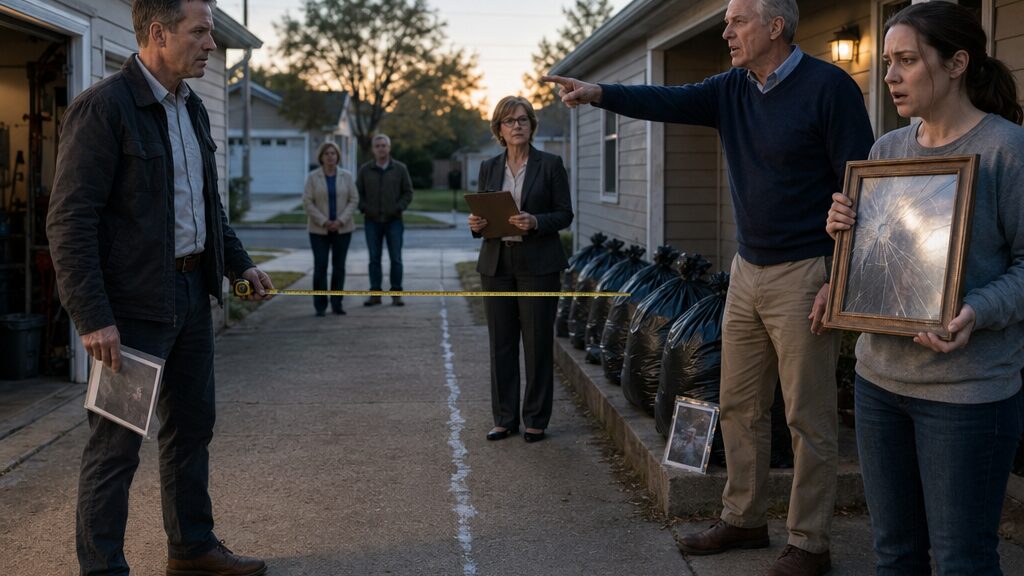
He Kept Leaving His Trash Across My Property Line Until the Rules Threatened Both Our Homes
Chapter 1: The Bags That Returned Every Monday Morning
When Stephen Adams pushed open his side door, it stopped after six inches.
Something wet shifted on the other side. Plastic rasped against brick, followed by the soft collapse of whatever had been leaning against the door.
Stephen held the knob and looked through the narrow opening. Three black trash bags had been wedged into the passage beside his garage. Overnight rain had filled the folds in the plastic, and one bag had split along its seam. Coffee grounds, paper towels, and a grease-stained takeout carton pressed against the threshold.
He stood there in his work clothes, lunch bag in one hand, and watched a line of brown water creep toward the kitchen tile.
The passage ran between his garage and Ronald Scott’s. It was narrow enough that both men had to fold their side mirrors when backing through, but wide enough for access under the easement recorded with the subdivision plat. A faded yellow mark crossed the concrete near Stephen’s foundation. It had once been bright enough to settle arguments. Now it looked like something the sun had nearly erased.
The bags sat entirely on Stephen’s side.
He set down his lunch, put on work gloves, and carried them to Ronald’s porch.
Ronald’s curtains were closed. Stephen did not knock. He lined the bags beside the porch rail, returned home, mopped the threshold, and left for work twelve minutes late.
The next Monday there were two bags.
The Monday after that, four.
Stephen returned each one without a note. He told himself it could be a mistake at first. Collection day had recently changed. The sanitation company had mailed confusing instructions. Ronald was sixty-two, lived alone, and had served on the homeowners association board longer than Stephen had owned his house.
A misunderstanding did not require a confrontation.
By the fourth Monday, Stephen no longer believed it was a misunderstanding.
The bags appeared before dawn, always pressed against his garage wall and never Ronald’s. They were placed beyond the line where collection crews could see them from the street. Someone had chosen the passage because it hid the waste from the curb and kept it out of sight from Ronald’s front windows.
Stephen began writing down the dates on a yellow legal pad at his kitchen table.
September 8: three bags, one torn.
September 15: two bags.
September 22: four bags, returned at 6:40 a.m.
He disliked how quickly the old habits returned. Dates. Locations. Physical condition. Photographs taken from three angles. Eleven years in county code compliance had trained him to turn irritation into records before irritation could turn into argument.
His wife used to say he could make a file out of a dripping faucet.
The thought came to him automatically, though she had been gone from the house for nearly five years. He closed the legal pad and slid it beneath the fruit bowl.
On the fifth Monday, the trash was no longer ordinary.
A broken patio chair lay across the passage with one aluminum leg bent upward. Two black bags had been stacked behind it, along with a cardboard box full of cloudy glass jars. Stephen had to move everything before he could roll out his garbage bin.
He carried the bags to Ronald’s porch, then dragged the chair after them. The bent leg scraped a pale line across the concrete.
Ronald opened the door before Stephen could turn away.
He wore a pressed polo shirt tucked into khaki pants, though it was barely seven in the morning. His silver hair was combed neatly, and his expression held the weary patience of a man interrupted over something trivial.
“What is this?” Ronald asked.
“It was beside my garage.”
Ronald looked at the chair, then at the bags. “People leave things near the alley all the time.”
“This isn’t the alley.”
“It’s shared access.”
Stephen waited for him to say more.
Ronald’s mouth tightened. “I have an HOA call in ten minutes.”
Stephen looked toward the passage. “Then we can talk later.”
Ronald stepped back and closed the door.
It was not an admission. It was not quite a denial either.
Stephen went home with the first clean edge of suspicion lodged under his ribs.
The sixth Monday settled it.
He smelled the paint before he saw the cans.
Three dented gallon containers had been placed behind a stack of black bags. One lid had loosened. Gray paint had leaked down the side, spread beneath the can, and reached the lower course of bricks along Stephen’s garage.
He crouched without touching it.
The paint had mixed with rainwater and formed a thin skin over the concrete. Beneath it, the faded property line disappeared.
For several seconds he remained still, hearing only the hum of an air-conditioning unit and a sprinkler clicking two houses away.
Then he photographed the cans.
He photographed the stain.
He photographed the position of the bags in relation to the garage doors, the passage entrance, and the line beneath the paint.
At work, Stephen coordinated maintenance for three county office buildings. His day involved a failed compressor, a leaking restroom valve, and a contractor who had ordered the wrong ceiling tile. Each problem arrived with a number, a location, and a process. By noon, all three had become manageable.
The bags did not.
During lunch he called the sanitation department and asked about household paint disposal without giving an address. The woman on the line explained that dried latex paint could be collected under certain conditions, but open containers could not be abandoned on private property. Oil-based paint required hazardous-waste handling.
Stephen wrote down her answer.
He did not file a complaint.
That evening, he scrubbed the concrete with absorbent granules and a stiff brush. The stain lightened but did not disappear. A gray crescent remained on the foundation, like a thumbprint left by someone who had no intention of cleaning it.
Ronald came through the passage while Stephen was working.
He carried nothing. He slowed when he saw the open paint can beside Stephen’s gloves.
“You should be careful with that,” Ronald said. “The HOA has rules about chemical storage.”
Stephen straightened.
For a moment, neither man spoke.
Ronald glanced at the stained wall, then toward his own garage. “Just saying.”
He continued to the street.
Stephen watched him go. The comment was too precise to be casual. Ronald knew what had been left there. Whether he had carried it himself or allowed someone else to do it no longer mattered as much as the fact that he was willing to make the damage Stephen’s responsibility.
Inside, Stephen pulled the legal pad from beneath the fruit bowl.
He added the time Ronald had passed through the passage. He wrote down the exact words about chemical storage. Beneath them, he drew a line.
Then he opened a box in the hall closet and removed a small security camera he had purchased months earlier but never installed.
By ten that night, it was mounted beneath the garage eave. The lens faced the narrow passage, the stained foundation, and the nearly erased yellow mark between the two properties.
Stephen adjusted the angle until both garage doors appeared in frame.
On his phone, the passage looked empty.
For the moment.
Chapter 2: The Man in the Passage After Midnight
Stephen’s phone began vibrating across the nightstand at 1:17 a.m.
He woke before the second vibration ended. The screen showed a motion alert from the garage camera and a frozen image of the passage washed in gray infrared light.
A man stood between the garages carrying two black bags.
Stephen sat up and opened the live feed.
The figure moved slowly, not with the uncertainty of someone entering the wrong property, but with the practiced care of someone trying not to make noise. He wore dark pants and a light-colored shirt. One bag hung from each hand.
When he reached the faded line, he stopped.
Then Ronald Scott turned his face toward the camera.
The infrared image flattened his features, but Stephen recognized the square jaw and combed silver hair. Ronald stared upward for a second, as though he had noticed the tiny red indicator beneath the eave.
Stephen held the phone closer.
Ronald did not retreat. He lowered both bags onto Stephen’s side, placed them against the wall, and adjusted one so it would not roll back across the line.
Then he walked home.
Stephen replayed the clip twice.
The first time, he watched Ronald’s hands.
The second time, he watched the pause beneath the camera.
By morning, Stephen had saved the full recording, exported still images with timestamps, and printed the clearest frame. In it, Ronald stood with both bags suspended at his sides, his head angled toward the lens.
Stephen put the print inside a transparent sleeve.
He waited until eight-thirty before walking next door.
Ronald opened the door wearing the same pressed composure he brought to every HOA meeting. Behind him, the foyer was dim. A stack of flattened boxes leaned against the wall, but Ronald shifted his body before Stephen could see farther inside.
“Yes?”
“Two more bags were left by my garage last night.”
Ronald’s expression did not change. “You came over to tell me that?”
“I came to ask whether they’re yours.”
“I don’t know anything about your garbage.”
Stephen removed the sleeved photograph from beneath his arm and held it out.
Ronald looked at it.
His eyes moved first to the timestamp, then to his own face. For the briefest moment, his mouth loosened. Stephen saw the calculation happen: denial had failed, so the shape of the argument would have to change.
“That camera records my access route,” Ronald said.
“It records my wall and my side of the passage.”
“It records a shared easement.”
“It records you placing bags against my garage.”
Ronald handed back the photograph. “Temporary placement in a shared access area isn’t dumping.”
“Whose bags are they?”
“That’s not the issue.”
“It’s the first issue.”
Ronald stepped onto the porch and pulled the door nearly closed behind him. “That strip exists for the use of both properties. It has for decades. Deliveries, maintenance, moving things in and out. You don’t get to redefine it because you bought a camera.”
Stephen kept his voice level. “An access easement allows passage.”
“Your interpretation.”
“The recorded use.”
“You haven’t been on the board as long as I have.”
There it was—not an answer, but rank borrowed from familiarity.
Stephen looked at the polished brass number beside Ronald’s door. At HOA meetings, Ronald spoke often about uniform standards and protecting property values. He corrected residents who left bins visible after collection day. He had once sent a reminder to the entire block because someone parked a trailer in a driveway overnight.
“Did you leave the paint cans too?” Stephen asked.
Ronald’s gaze shifted toward the street.
“They were open,” Stephen continued. “One leaked against my foundation.”
“If you mishandled something left in a common access area, that’s on you.”
Stephen felt the old instinct rise: identify the applicable section, state the violation, provide the consequence. For years, that sequence had kept his voice calm while other people raised theirs.
He forced himself not to use it.
“I’m asking you to stop.”
Ronald gave a short, humorless breath. “And I’m telling you that you’re treating shared space like your private hallway.”
He stepped back.
“Move the bags wherever you want,” he said. “But don’t block my access.”
The door closed.
Stephen remained on the porch with the photograph in his hand.
The conversation should have simplified the problem. Instead, it had sharpened it. Ronald was not confused about where the bags had gone. He was building a defense around the word shared, as if access dissolved ownership.
Stephen returned to the passage and examined the two bags without opening them. They were tied tightly. One was heavy enough to hold books or dishes. The other gave off the sweet, stale smell of old food.
He carried both to Ronald’s porch.
This time Ronald did not open the door.
At his kitchen table, Stephen placed the printed image beside the legal pad. He wrote a summary of the conversation while the wording remained exact.
At 8:37 a.m., Ronald Scott acknowledged shared use but denied dumping; claimed temporary placement permitted under easement; warned against obstruction.
He stopped writing.
Acknowledged was not accurate. Ronald had avoided ownership. Stephen crossed out the word and replaced it with asserted.
The distinction mattered.
That afternoon he searched the county property-records portal. The subdivision plat available online was too blurred to read the measurements, so after work he drove to the county administration building.
The records clerk recognized the subdivision name and retrieved a scanned map from an older archive.
“You need the recorded dimensions or the covenant language?” the clerk asked.
“Dimensions first.”
The plat appeared on the monitor. Stephen leaned closer.
The easement ran twelve feet wide through the adjoining drive area, six feet contributed by each parcel. Its stated purpose was ingress and egress to the rear garages. No storage rights were listed. No shared refuse area appeared anywhere on the map.
The clerk printed a certified copy.
Stephen traced the boundary with one finger. The faded yellow line outside matched the parcel division almost exactly. Ronald had not merely placed the bags in a gray area. He had positioned them beyond the six-foot contribution, against Stephen’s private wall, while preserving his own access lane.
It was deliberate down to the last few inches.
On the drive home, Stephen felt the satisfaction of a question answered. It lasted less than ten minutes.
If Ronald knew enough to invoke the easement, he might also know the recorded dimensions. And if he knew the dimensions, then his argument was not based on confusion.
It was based on the belief that Stephen would not challenge him.
At home, Stephen spread the plat beside the photograph.
The camera had caught the act. The map showed the boundary. The paint stain showed damage. Together they made a clean case—cleaner than most of the cases Stephen had handled for the county.
He opened the municipal solid-waste complaint page and began entering the address.
Before submitting, he stopped at the field asking whether the violation was ongoing.
Through the kitchen window, he could see the dark line of Ronald’s roof. No lights were on except one in the rear of the house.
Stephen selected yes.
Then he opened the HOA portal and attached the same photograph.
The final page asked what resolution he was requesting.
Stephen typed: Removal of waste and confirmation that the shared easement may not be used for storage or disposal.
He did not request a fine.
He submitted both complaints.
Near midnight, unable to sleep, he returned to the certified plat. In the margin beside the easement was a reference to an older maintenance agreement not included in the online file.
Stephen searched the document number.
The agreement loaded one page at a time. It confirmed passage rights, drainage responsibilities, and a minimum clear width that neither owner could obstruct.
Stephen read the measurement twice.
Then he looked toward the two bags now sitting on Ronald’s porch.
The easement was not Ronald’s defense.
It was the proof that Ronald had been careful to leave every burden on Stephen’s side.
Chapter 3: Everything Returned Behind the Faded Line
The first bag contained a framed photograph wrapped in greasy fast-food paper.
Stephen had expected food waste, empty containers, perhaps old mail. Instead, the cracked wooden frame slid into his gloved hands with a soft crunch of glass.
The photograph showed Ronald beside a woman in a blue dress. They stood in front of the Scott house when the trees were younger and the siding had not faded. Ronald had one arm around her waist. Both of them were laughing at something outside the frame.
Stephen knew the woman only from neighborhood Christmas parties years earlier. Ronald’s wife had died the previous winter.
He set the photograph on a folded towel.
For the first time since the bags began appearing, the contents felt less like refuse than evidence of a room being emptied in haste.
He nearly stopped.
Then he looked at the gray stain on his garage foundation.
Understanding why something happened did not make it his responsibility to absorb.
He continued sorting.
Food waste went into one bag. Recyclable glass and metal into another. Dried household material into a third. He separated the paint cans and placed each inside a shallow plastic bin. Old curtains, a cracked lamp, water-damaged books, and two pairs of women’s shoes formed a separate pile.
Several items carried the same faint smell: dust, closed rooms, and something floral that had nearly disappeared.
Stephen worked beneath the garage light until after midnight.
He printed municipal disposal instructions and highlighted the sections on bulk pickup and household hazardous waste. On each sealed bag, he attached a plain sheet:
RETURNED TO OWNER. DISPOSE THROUGH APPROVED COLLECTION.
Beneath the words he added the date, the camera timestamp, and the complaint reference number.
He did not include Ronald’s name.
At dawn, Stephen measured the passage.
The certified plat required a clear lane through the shared access area. He marked the minimum width with blue painter’s tape, then carried the sorted bags to Ronald’s porch and arranged them in a straight row entirely within Ronald’s parcel.
The black plastic looked unnaturally orderly in the early light.
He placed the paint cans in their bin near the garage, safely outside the access lane. The sleeved camera still rested against the first bag. Beside it lay a copy of the plat with the property division marked in yellow.
By seven-thirty, two nearby residents had slowed while walking their dogs.
Neither asked a question. Both looked from the bags to Stephen’s measuring tape.
Stephen kept working.
The HOA compliance walk-through was scheduled for eight. Carolyn Moore had emailed the night before, saying she and two board members would review the shared passage because Ronald had claimed Stephen was obstructing access by returning waste to his porch.
Stephen had read the sentence three times.
Ronald had transformed the act of returning his property into a complaint about obstruction.
At eight-four, Carolyn arrived carrying a clipboard. She was a compact woman in her late fifties who dressed for HOA business as though it might become litigation without warning. Two board members followed several steps behind.
Carolyn stopped when she saw the bags.
“Stephen.”
“Morning.”
“Is all of this from the passage?”
“Yes.”
“And you opened it?”
“I sorted it for lawful disposal. There were open paint containers.”
One board member glanced at the printed labels. “This looks like a display.”
“It’s a return.”
Carolyn’s eyes moved to the blue tape crossing the concrete. “What is that?”
“The minimum clear width under the recorded easement.”
She looked at him over the top of her clipboard. “You measured it?”
“I did.”
Before she could answer, Ronald’s garage door rose.
He stepped into the passage wearing a navy sweater and khakis. His face changed when he saw the row of bags. The surprise lasted only a second before anger covered it.
“What the hell is this?”
Carolyn lifted one hand. “Let’s keep this controlled.”
Ronald ignored her. “You cut open my property?”
Stephen looked at him. “So it is your property.”
A board member shifted his weight.
Ronald’s jaw tightened. “You know what I mean.”
“I know what you said at your door.”
“You’ve blocked my porch and turned this into some neighborhood show.”
“The porch is yours. The access lane is open.”
Ronald pointed toward the paint bin. “That is in the easement.”
Stephen picked up the measuring tape. He hooked it against the garage edge and pulled it across the concrete to the blue line.
“Required clear width is here,” he said. “The bin is eighteen inches beyond it, on your parcel.”
Ronald looked toward Carolyn. “He’s pretending that line is official.”
Stephen handed her the certified plat.
Carolyn studied the seal, then crouched to compare the map with the faded yellow marker beneath the blue tape.
The nearby residents had stopped at the sidewalk now. Stephen could feel their attention, though no one spoke.
Carolyn stood. “The lane is clear.”
Ronald stared at her.
“One question is whether these materials can remain on the porch,” she continued. “That falls under exterior storage.”
“They won’t remain,” Stephen said. “They’re scheduled for enforcement review.”
Ronald turned on him. “You called the city?”
“I asked you to stop.”
“You never asked what was happening.”
The sentence struck more cleanly than the accusation before it.
Stephen glanced at the row of bags. The cracked photograph lay visible beneath the clear sleeve where he had placed it for protection, separate from the camera image.
Ronald saw it.
The color left his face.
He crossed the porch in two steps and snatched up the frame. A loose shard of glass fell onto the concrete.
“You had no right.”
“It was in a bag against my wall.”
“You had no right to go through it.”
“You left paint, food, and broken glass on my property.”
Ronald held the photograph against his chest. For one instant, his anger looked less like defiance than panic.
Then a car door closed at the curb.
A woman hurried up the walk carrying a canvas tote. She had Ronald’s eyes and the same square set to her shoulders. Stephen had seen her visit a few times but had never been introduced.
She stopped at the porch.
Her gaze moved across the bags, the board members, and the photograph in Ronald’s hands.
“Dad,” she said quietly.
Ronald looked away.
The woman stepped closer. “Is that Mom’s?”
No one answered.
She took the frame from him carefully. Her thumb brushed dust from the woman’s blue dress.
“You said you were putting her things in storage.”
“I was.”
“This was in the trash.”
“It shouldn’t have been.”
She looked at the sealed bags. “What else is in these?”
Ronald’s face hardened again, but now the expression seemed assembled rather than natural. “Katherine, this is HOA business.”
“No. This is Mom’s house.”
Carolyn closed her clipboard.
Stephen felt the exact moment the scene changed. The bags had been proof of Ronald’s dishonesty. Now they were also pieces of something private that Stephen had arranged in a visible row while neighbors watched from the sidewalk.
He had followed the line perfectly.
That did not mean he had understood everything placed behind it.
Katherine crouched beside the bag containing fabric and shoes. She did not open it. She only read the disposal label Stephen had attached.
“Returned to owner,” she said.
Her voice held no accusation, which made the words worse.
Stephen coiled the measuring tape. “The hazardous materials couldn’t stay by my foundation.”
“I understand that.” She looked up at him. “I’m not saying he should have put any of it there.”
Ronald made a sharp sound. “You don’t need to explain me to him.”
“I’m not.”
Carolyn asked the two board members to walk the passage and confirm the clearance. It was an obvious attempt to move the meeting away from the porch.
Stephen helped gather the loose glass from the photograph. Katherine held the frame while he placed the shards into a small box.
“Thank you,” she said.
Ronald turned toward the house.
“Dad,” Katherine called.
He stopped but did not face her.
“How much have you thrown out?”
His shoulders rose slightly.
“That’s not anyone’s concern.”
“It became his concern when you put it against his garage.”
For the first time, Ronald had no answer ready.
The city inspector had not yet arrived, and the formal consequences remained uncertain. But the small audience, the opened bags, and Katherine’s question had done what the photograph and plat could not. They had stripped Ronald’s argument down to the choice beneath it.
He had needed somewhere to put what he could not manage.
He had chosen Stephen’s side.
Carolyn returned the plat. “The easement is not obstructed. I’ll note that.”
Ronald looked back sharply. “And the exterior-storage violation?”
“We’ll address the full sequence in writing.”
“You told me this review was about his obstruction.”
“It was based on the information submitted.”
Stephen heard the careful wording. Based on the information submitted. Not false information. Not misuse. Carolyn would protect the board before assigning blame.
Ronald seemed to hear it too.
He stepped inside and closed the door.
Katherine remained on the porch with the photograph.
The board members left first. Carolyn waited beside Stephen’s driveway until the nearby residents finally moved on.
“There’s another matter,” she said.
Stephen looked at her.
Carolyn opened her folder and removed a white envelope with the HOA seal.
“This was submitted yesterday afternoon.”
He took it.
The notice identified his address and cited an unapproved electrical modification inside the detached garage: additional outlets, overhead fixtures, and a hardwired workbench circuit. Photographs were attached—old photographs, taken years earlier when the garage door had been open during a neighborhood cleanup day.
Stephen recognized the angle.
Ronald had taken them from the shared passage.
“The board is required to review credible complaints consistently,” Carolyn said.
“Ronald filed this.”
“I can’t discuss the reporting owner.”
“He’s the treasurer.”
“He did not participate in the initial vote to inspect.”
“Initial vote?”
Carolyn’s grip tightened on her clipboard. “The city waste inspector is coming next week. The board intends to coordinate both property reviews on the same morning.”
Stephen looked from the notice to the stained foundation wall.
For years, he had used the extra outlets without thinking about the permit. The work had been done by a licensed electrician before Stephen left county employment, but the final inspection had never been scheduled. He remembered the unfinished form now, folded into a folder he had stopped opening.
Ronald had found the one weakness that was real.
Katherine came down the porch steps as Carolyn walked away. Her mother’s photograph was wrapped in the canvas tote.
She glanced at the notice in Stephen’s hand but did not ask to see it.
“My father doesn’t do well when people know he needs help,” she said.
“That doesn’t give him the right to use my property.”
“No.” She met his eyes. “But whatever you do next, understand that he’s more afraid of that house being inspected than he is of a trash fine.”
Before Stephen could ask why, she followed Carolyn toward the street.
He stood alone beside the precise blue line he had measured, holding the complaint Ronald had sent back across it.
Chapter 4: The Complaint That Crossed Back Over
The HOA notice was taped to Stephen’s garage before sunrise.
He found it when he stepped into the passage with a mug of coffee and saw the white envelope fixed to the door with two strips of blue painter’s tape. The seal in the upper corner had been stamped crooked. Beneath it, in bold type, were the words NOTICE OF COMPLIANCE REVIEW.
Stephen read the first paragraph standing beneath the camera.
Unapproved electrical modifications. Additional outlets. Overhead fixtures. Hardwired workbench circuit. Possible violation of architectural standards and municipal permit requirements.
The complaint included four photographs.
He knew exactly when they had been taken. Three summers earlier, during the neighborhood cleanup day, he had left the garage open while carrying broken shelving to the curb. One photograph showed the workbench. Another showed the new conduit running beneath the rafters. In the far left corner of the third image, Ronald’s shoulder appeared as a blurred navy shape.
Stephen folded the notice once and carried it inside.
The black bags were gone from Ronald’s porch. Only damp rectangles remained where they had rested. On Stephen’s wall, the gray paint stain had dried into a permanent shadow.
At nine, Carolyn Moore met him in the HOA office above the community pool. Two board members sat at the end of a folding table with copies of the complaint in front of them.
Ronald’s usual chair beside the treasurer’s binder was empty.
Carolyn began carefully. “Ronald recused himself from the initial review.”
“After submitting the complaint?”
“I can’t confirm the reporting owner.”
“You don’t have to.”
One board member cleared his throat. “The issue before us is whether the modification received approval.”
“It didn’t,” Stephen said.
The room went still.
Carolyn’s pen paused over her notes. “You’re acknowledging that?”
“The electrical work was done by a licensed contractor. I pulled a county permit, but the final inspection was never completed. I didn’t submit a separate HOA request.”
The second board member looked almost disappointed. “Then we’ll need verification from the county.”
Stephen nodded. “I’m already getting it.”
Carolyn studied him. “You understand that admitting the violation does not resolve it.”
“I understand.”
He had spent enough years across tables like this to know what they expected: resistance, selective memory, an accusation that someone else had the same thing. Instead, he gave them the defect exactly as it existed.
Carolyn closed the folder. “The board will coordinate its inspection with the city’s visit concerning the waste complaint.”
“When?”
“Next Thursday morning.”
Stephen looked toward Ronald’s empty chair. “Both properties?”
“Both.”
The symmetry was deliberate. Whether it came from Ronald or from the board’s instinct for self-protection, the message was the same: no one would be allowed to stand entirely on the side of enforcement.
At the county records office, the clerk searched Stephen’s address and found the permit within minutes.
“Electrical rough-in approved,” she said. “No final.”
“That’s what I remembered.”
She clicked through scanned notes. “There’s also an unresolved comment.”
Stephen leaned closer.
The note was brief: Final pending verification of exterior disconnect labeling and workbench circuit protection.
The electrician had promised to handle it. Stephen had been leaving county employment at the time, clearing his office, answering questions about a case he did not want to discuss. The garage inspection had slipped from one month into the next until the permit became a piece of paper in a file.
“Can it be reopened?” he asked.
The clerk read the permit date. “Likely. You’ll need a current inspection and possibly a renewal fee. If the installation still meets code, they may close it without requiring removal.”
A small release moved through him. Not victory, but an option.
He scheduled the earliest available inspection.
Outside the records building, his phone showed an email from municipal solid-waste enforcement. An inspector had been assigned to Ronald’s address. The visit was set for Thursday at 9:00 a.m.—the same hour as the HOA review.
Stephen read the confirmation twice.
By coordinating the visits, the board had turned two complaints into a single public reckoning in the shared passage.
That evening, he opened his garage and inspected every outlet. The conduit was straight. The workbench circuit had a ground-fault breaker. The disconnect label had faded but remained legible. Most of the defect could be corrected with a replacement plate and a final inspection.
He should have felt relieved.
Instead, he kept seeing Ronald in the camera footage, lowering the bags by inches until they rested beyond the property line. The same man who had exploited a technical distinction had found one in Stephen’s house and sent it back.
Near eight, someone knocked at the side door.
Katherine stood in the passage. She had tied her hair back and wore an old sweatshirt with dust along both sleeves.
“I need to ask you something,” she said.
Stephen stepped outside but did not invite her in.
She glanced up at the camera. “Do you still have all the footage?”
“Yes.”
“More than the clip you gave the city?”
“Six weeks of alerts. Most are empty. Several show bags appearing.”
“Do they show my father every time?”
“Not every time. Enough.”
Katherine pressed her lips together. “The city asked whether this was repeated conduct.”
“It was.”
“I know.”
The admission came without defense.
Stephen waited.
She looked toward Ronald’s house. The rear windows were dark. “Could you hold back the full archive until after the inspection?”
“Why?”
“I’m not asking you to withdraw the complaint.”
“Then what are you asking?”
“If they classify it as repeated hazardous dumping, it may trigger more than a solid-waste citation.”
Stephen understood the shape of the problem before she named it. Additional municipal review. Property condition. Insurance notification. HOA cross-reporting.
“What’s inside that house?” he asked.
Katherine’s face tightened.
“Your father put open paint beside my foundation,” Stephen said. “Then he filed against my garage. I need more than a warning that the truth might hurt him.”
“He has an insurance inspection the following week.”
“For what?”
“The carrier threatened nonrenewal after the last exterior review.”
Stephen said nothing.
Katherine continued, more quietly. “There are unpaid assessments too. Not one month. More than a year. If the board adds cleanup charges and legal fees, they can move toward a lien.”
“Ronald is the treasurer.”
“He hasn’t been handling his own life as well as he handles everyone else’s paperwork.”
The words sounded practiced, perhaps because she had been refusing to say them for months.
“Why not tell Carolyn?”
“Because my father would rather lose the house than have the board know he can’t manage it.”
Stephen looked at the stained wall.
Katherine followed his gaze. “I’m not asking you to pretend he didn’t do it.”
“You’re asking me to control what the evidence proves.”
“I’m asking you to wait two days before you make the worst version of this official.”
A car turned onto the street. Its headlights slid across the passage, briefly whitening the faded property marker between them.
Stephen held the camera archive on his phone, the city complaint in his email, and the HOA notice folded in his kitchen.
For years he had believed evidence became neutral once submitted.
Katherine stood before him asking him to admit that timing could be a kind of force.
“I’ll speak to him,” Stephen said.
“He may not speak back.”
“Then the footage goes in.”
She nodded once.
Before leaving, she touched the wall near the paint stain without quite placing her fingers on it.
“He knew the city visit was coming before you did,” she said.
Stephen turned. “How?”
Katherine looked toward Ronald’s closed garage.
“Because he asked Carolyn to coordinate both inspections.”
Then she walked home, leaving Stephen with the first clear sign that Ronald’s retaliation was not only anger.
It was preparation.
Chapter 5: What Ronald Was Trying to Remove
The front door opened only halfway because boxes blocked it from behind.
Ronald shoved at them with his shoulder until a narrow gap appeared. Stephen stepped through sideways and stopped.
The living room had become a set of paths.
Cardboard cartons rose to shoulder height along the walls. Plastic storage bins filled the space where a sofa should have been. Newspapers, folded blankets, framed pictures, unopened mail, and grocery bags occupied every flat surface. Black trash bags lay empty and folded beside the staircase, stacked in a neat column as if waiting to be filled.
The house smelled of dust, old paper, and the faint floral scent Stephen had noticed on the clothing in the passage.
Ronald closed the door.
“You wanted to talk,” he said.
Katherine stood near the dining-room entrance with both hands wrapped around a mug. “I wanted you both in the same room.”
“I didn’t.”
“No,” she said. “You wanted the board in the passage.”
Ronald’s eyes moved to Stephen. “If this is about the garage complaint, he admitted the work wasn’t approved.”
Stephen looked down the nearest path. It led around boxes labeled KITCHEN, CHRISTMAS, TAXES, and HER CLOSET. The handwriting changed from box to box. Some labels were sharp and recent. Others had faded.
“You coordinated the inspections,” Stephen said.
“I asked the board to apply the rules evenly.”
“You used old photographs.”
“They showed an existing violation.”
“And the bags showed yours.”
Ronald’s mouth tightened. “Those things were being moved temporarily.”
“Across my property line.”
“Into a shared service area.”
Stephen nearly answered with the plat language. The words were ready. Ingress. Egress. No storage right. He had used them silently for days.
Instead, he asked, “Why were you clearing the house at one in the morning?”
Ronald looked toward Katherine.
She set down the mug. “Tell him.”
“There’s nothing to tell.”
“The insurance inspection is next week.”
“That is not his concern.”
“It became his concern when you used his wall.”
Ronald stepped past a box and pulled open the curtains. Dust rose in the stripe of daylight. Through the glass, Stephen could see the passage between the garages.
“I needed the rear room cleared,” Ronald said. “The contractor was supposed to collect everything.”
“What contractor?”
Ronald did not answer.
Katherine did. “There wasn’t one.”
“I had a number.”
“You had an estimate you couldn’t pay.”
Ronald’s face reddened. “That is enough.”
“No. It stopped being enough when you put Mom’s things in garbage bags and carried them next door.”
The room seemed to contract around the sentence.
Ronald turned away. His hand rested on a carton labeled BLUE DRESSES.
Stephen remembered the photograph in the cracked frame, Ronald laughing beside his wife before grief had turned their house into stacked corridors.
Katherine spoke more quietly. “After Mom died, he didn’t throw anything away. Not food containers, not catalogs, not broken furniture. Then the insurance company sent notice that they were coming inside. He started clearing rooms at night.”
Ronald stared through the window. “Your mother kept too much.”
“She did. Then you kept all of it.”
“I was sorting.”
“You were moving it where no one could see.”
Stephen glanced at the folded black bags. They were no longer anonymous. They were a method—cheap, opaque, easy to carry, capable of turning a room into a burden someone else had to discover.
“How much do you owe the association?” he asked.
Ronald faced him sharply. “You don’t get to ask me that.”
Katherine answered anyway. “Fourteen months, plus late fees.”
Stephen looked at Ronald. “You sign the treasurer reports.”
“The management company handles individual accounts.”
“But you know what happens after notice.”
“I know exactly what happens.”
There was no fear in Ronald’s tone, only humiliation sharpened into hostility.
Katherine moved a box from a chair so Stephen could sit. He remained standing.
“The board hasn’t filed a lien yet,” she said. “But if the city orders cleanup and the HOA hires a contractor, those charges can be added. Legal fees too.”
Stephen understood now why Ronald had coordinated the inspections. If both houses stood under review, then Stephen became less a complainant and more a participant in a mutual dispute. The board might prefer informal resolution. The city might see neighbor conflict instead of repeated dumping. Ronald had not expected innocence. He had expected balance.
“You could have asked me for time,” Stephen said.
Ronald gave a brittle laugh. “And tell you what? That I couldn’t afford a truck? That I had to clear rooms because an insurance company thinks a widower needs permission to live in his own house?”
“You could have asked me not to file.”
“You had already installed a camera.”
“After six Mondays.”
“You watched instead of knocking.”
“I returned your bags every week.”
“You returned them like a warning.”
Stephen felt the accusation land because part of it was true. He had chosen silence not from patience alone, but because direct conversation carried variables. A returned bag was clear. A log was clear. A camera was clear.
People were not.
Katherine looked between them. “He was wrong to dump it. You were wrong to think he would understand silence the way you intended.”
Ronald turned on her. “Do not make this equal.”
“I’m not. He didn’t put paint against your house.”
The room fell quiet.
A refrigerator motor started somewhere beyond the boxes. Stephen heard the slight tremor in Ronald’s breathing.
“What happens if the insurer sees this?” Stephen asked.
“They can require remediation,” Katherine said. “Or decline renewal.”
“And without coverage?”
“The mortgage company can force-place a policy. It would cost more than he can pay.”
Ronald lowered his voice. “You have what you wanted. The trash is gone.”
“The stain isn’t.”
“I’ll clean it.”
“You already said it was my responsibility.”
Ronald looked down the path between the boxes. “I said what I had to say.”
Stephen waited for more.
None came.
That was Ronald’s nearest approach to admission, and he seemed to resent even that much.
Stephen walked to the window. From inside Ronald’s house, the property line was invisible. The passage looked like one narrow strip of concrete between two garages. Only someone standing outside, measuring, would know where access ended and ownership began.
“I can delay the full archive until Thursday,” Stephen said.
Katherine’s shoulders loosened.
Ronald’s did not.
“But I won’t withdraw the complaint. The paint cans stay in it. The repeated dumping stays in it. You arrange lawful removal for everything left inside, and you correct the easement claim with Carolyn.”
Ronald turned. “You don’t set terms in my house.”
“I set terms for my property.”
“And your garage?”
“I’ll correct it.”
“You think admitting one missing inspection makes you noble?”
“No.”
The answer surprised Ronald into silence.
Stephen continued. “It makes it mine.”
For several seconds, the only movement came from dust turning in the window light.
Then Ronald said, “The garage complaint remains.”
Katherine stared at him. “Dad.”
“He filed against me.”
“He filed because you were dumping on him.”
“He brought the city here.”
“You brought the city here when you carried hazardous waste across the line.”
Ronald’s face closed. Whatever shame had surfaced disappeared behind the role he knew better: the man who could still enforce a rule against someone else.
Stephen felt sympathy drain from him, leaving something colder.
“I came because Katherine asked me to understand,” he said. “I do.”
Ronald folded his arms.
“That does not make what you did smaller.”
Stephen walked toward the door. Katherine followed him through the narrow path.
At the threshold, she said, “He wasn’t always like this.”
Stephen looked back at Ronald standing among the boxes.
“No one ever is,” he said.
Outside, evening had settled into the passage. The black bags were gone, but the wall still carried the paint crescent, and small pieces of blue painter’s tape remained where Stephen had marked the easement.
In his kitchen, he placed the city evidence packet on the table. Beside it sat the folder containing his garage permit.
When he opened the folder, an old black notebook slid onto the floor.
Stephen recognized it before he picked it up.
COUNTY CODE COMPLIANCE was stamped across the cover in faded silver letters. Inside were inspection dates, violation numbers, and field notes written in his own compact hand.
The notebook opened to a page he had once tried to remove.
A family’s address appeared at the top. Beneath it, Stephen had written: Unsafe occupancy order posted. Immediate vacancy required.
He remembered the mother standing on the porch with two children and asking for forty-eight hours. He remembered refusing because the electrical hazard was real, because the order was valid, because discretion felt too much like liability.
The county had placed them in a motel for three nights. After that, he never learned where they went.
His supervisor had later found a lawful temporary remedy that Stephen had not considered because he had already chosen the cleanest rule.
He had resigned six weeks later.
Now the old notebook lay beside Ronald’s evidence packet.
Both contained facts.
Only one of them reminded Stephen what facts could do when submitted without judgment.
Chapter 6: The Rule Stephen Refused to Use
The inspector lifted the last black bag and found gray paint spreading beneath it.
The bag had been placed directly over the faded property marker sometime before dawn. One corner had torn against the concrete. Inside, an open paint can lay on its side among rags and paper.
The municipal inspector crouched and touched the edge of the spill with a gloved finger.
“This wasn’t here in the photographs,” she said.
“No,” Stephen replied.
Ronald stood near his garage with Katherine beside him. Carolyn and the two board members waited at the passage entrance. The county electrical inspector had already examined Stephen’s garage and was making notes on a tablet.
Ronald looked at the bag as though it had arrived without his knowledge.
Katherine closed her eyes.
“Did you put this here?” the solid-waste inspector asked Ronald.
“No.”
Stephen’s camera had captured movement at 4:52 a.m. He had not checked the clip yet. He could have opened it in seconds.
Instead, he watched Ronald’s hands. A faint gray smear marked one thumb.
The inspector followed Stephen’s gaze.
Ronald put his hand into his pocket.
Carolyn spoke first. “We need everyone to answer directly.”
Ronald looked at Stephen. “You wanted a spectacle. Here it is.”
“I wanted the dumping to stop.”
“You want me out of this neighborhood.”
Katherine turned toward him. “No one said that.”
“He knows what these fines will do.”
The inspector stood. “The initial complaint supports repeated unlawful disposal and improper placement of liquid paint. Today’s condition may justify an additional citation.”
Ronald’s voice rose. “He has violations too.”
The county inspector looked up from the tablet. “Mr. Adams has an open permit requiring final correction. That matter is separate.”
“It’s always separate when it helps him.”
Stephen felt every person in the passage looking toward him. Ronald had finally made the hidden accusation public: that Stephen knew how to divide rules into useful compartments while other people received the combined weight.
Carolyn held out a folder. “The board must decide whether to refer the full record for enforcement and cost recovery.”
Inside were Stephen’s complaint, the camera stills, Ronald’s exterior-storage violation, the unpaid assessments, and the proposed authority to hire a cleanup contractor if Ronald failed to comply.
Cost recovery meant the charges would be added to Ronald’s account.
Enough charges could accelerate the lien.
Carolyn lowered her voice. “Stephen, as the reporting owner, do you want the complete camera archive included?”
Katherine looked at him.
Ronald did not.
Stephen thought of the notebook on his kitchen table. The mother asking for forty-eight hours. The unsafe wiring had been real. So had the children waiting behind her. He had believed acknowledging one truth required ignoring the other.
He stepped toward the torn bag.
The paint had crossed the faded marker in a thin gray ribbon.
Stephen gripped the tied end, lifted the bag carefully, and moved it onto Ronald’s side. Then he set a plastic tray beneath the leaking corner. The passage remained open.
“The archive proves repeated dumping,” Stephen said. “I will provide enough footage to establish that.”
Ronald gave a harsh laugh. “How generous.”
Stephen turned to Carolyn. “I do not authorize the association to use my complaint as a basis for immediate contractor recovery or lien acceleration.”
Carolyn’s expression tightened. “You don’t control all board remedies.”
“No. But you asked what I was requesting.”
“And what are you requesting?”
“A written compliance agreement. Ten business days. Ronald hires the bulk-waste contractor himself, removes the remaining material lawfully, pays the municipal citation, and states in the HOA record that the easement does not permit storage or disposal.”
Ronald stepped forward. “You don’t get to write my confession.”
“No confession. A correction.”
“And if I refuse?”
“Then I submit the full archive and support ordinary enforcement.”
The inspector looked between them. “The city can allow a corrective period before enhanced penalties, provided the hazardous materials are secured today.”
Carolyn glanced at the board members. One nodded. The other looked relieved to have an option that did not require an immediate legal vote.
Ronald’s face remained rigid. “He is bargaining with my house.”
Stephen looked directly at him. “No. I’m refusing to use your house as leverage.”
The sentence quieted the passage.
Stephen turned to the county electrical inspector. “My garage work never received final approval. I accept that. Tell me what has to be corrected.”
The inspector consulted the tablet. “Replace the faded disconnect label, add protection to the workbench circuit, and open two junction boxes for verification. If those pass, I can close the permit.”
“I’ll do it.”
Ronald shook his head. “You think admitting it now changes what you did?”
“No. It changes what I do next.”
For the first time, Stephen said aloud what he had kept outside the file.
“I spent eleven years enforcing property codes. My last year, I posted an immediate vacancy order on a house with dangerous wiring. The order was valid. The family asked for two days. I refused before I looked for another lawful option.”
No one interrupted.
“The county found temporary safeguards after they were displaced. I could have asked the same question before I posted the order. I didn’t.”
Ronald’s expression shifted, not into sympathy, but attention.
Stephen continued. “I left that job because I stopped trusting myself with discretion. Since then, I’ve treated documentation like it makes choices neutral.”
He looked at the camera under his eave.
“It doesn’t.”
Carolyn opened the proposed agreement. “The board can record a ten-day corrective plan without waiving future enforcement.”
The solid-waste inspector added, “The city citation for the existing violation still stands. Enhanced penalties can be held if cleanup is completed.”
Ronald looked at Katherine.
She did not rescue him. “You did this,” she said. “Take the ten days.”
His gaze moved to the paint stain, the open garages, and the officials waiting for his answer. Pride seemed to hold him upright after everything else had begun to fail.
“What about his complaint?” he asked.
Carolyn answered. “The garage permit will proceed through county correction. The HOA architectural notice can close when final approval is provided.”
“You’re letting him fix it.”
“That is what compliance means,” Stephen said.
Ronald’s eyes snapped toward him.
For a moment Stephen thought he would refuse simply because acceptance came in front of witnesses.
Then Ronald held out his hand for the agreement.
Carolyn placed it on the hood of her car and gave him a pen.
He read every line. When he reached the easement correction, he stopped.
“This wording says I placed material outside the permitted access use.”
“You did,” Stephen said.
Ronald pressed the pen so hard the paper creased.
He signed.
Carolyn turned the document toward Stephen. He signed beneath Ronald’s name.
The inspector secured the paint can inside a larger container and issued the municipal citation. Katherine photographed the contractor deadline. The board members began discussing how the clarification would be added to the association’s records.
The machinery of enforcement resumed, but its direction had changed. It no longer moved toward the largest available consequence. It moved toward a result.
Ronald handed the pen back to Carolyn.
“I’ll remove everything,” he said.
Stephen nodded.
“But I will not apologize.”
Katherine looked at him with tired disbelief.
Stephen folded his copy of the agreement.
An apology would have been easier to display than ten days of work, payment, and public correction. It also would have been easier to fake.
“I didn’t ask you to,” he said.
Ronald walked into his garage and shut the door.
The faded property line remained between the houses, partly covered by gray paint, but for the first time both men had signed something that acknowledged exactly where it was.
Chapter 7: The Porch That Stayed Empty Afterward
The bulk-waste truck stopped in front of Ronald’s house at 6:12 on the tenth business day.
Its reverse alarm broke the morning quiet before the sky had fully brightened. Stephen came to his kitchen window with one sleeve still unbuttoned and watched amber lights flash across the shared passage.
For one uneasy second, he expected the truck to continue past.
Then Katherine stepped into the street and raised one hand.
The driver pulled closer to the curb. A second worker climbed down, unfolded a loading ramp, and studied the pile arranged along Ronald’s driveway: broken chairs, boxed dishes, rolled carpet, two dented filing cabinets, a cracked lamp, bundled newspapers, and sealed containers marked for separate disposal.
Nothing stood on Stephen’s side.
Ronald emerged last.
He wore old work pants and a faded gray shirt instead of the pressed clothes he usually chose when neighbors might see him. He carried a stack of folded black trash bags under one arm and handed them to the contractor before returning inside for another load.
Stephen stepped away from the window.
He did not go outside to supervise.
The signed agreement gave Ronald until five that afternoon to complete the removal and provide receipts. Stephen had already checked the camera once at dawn and disliked the feeling that followed. The lens had protected his property, but watching every movement now would turn compliance into performance.
He finished dressing and opened his garage for the county electrical inspector.
The replacement disconnect label was fixed beside the panel. The workbench circuit had new protection, and both junction boxes were uncovered. The inspector tested the outlets, photographed the corrections, and entered notes on a tablet.
“This should close today,” he said.
Stephen looked at the exposed wiring. “No additional work?”
“Everything else is clean.”
The word landed differently than Stephen expected.
For weeks, clean had meant his wall, his porch, his passage. Now it meant a defect admitted and corrected without excuse.
The inspector replaced the junction-box covers and extended his hand. “You’ll receive the final approval by email.”
When Stephen walked him to the driveway, Ronald was carrying a box labeled HER CLOSET toward the truck.
He paused when he saw Stephen.
Neither man spoke.
Katherine opened the box before it was loaded. She removed a blue dress wrapped in tissue paper, held it against herself for a moment, and placed it in the trunk of her car.
Ronald watched without objecting.
The rest of the box went onto the truck.
By noon, the pile had shrunk to a few metal shelves and the paint containers secured inside a contractor’s bin. The workers moved through Ronald’s house along the narrow paths, carrying out what he had been unable to remove alone.
Nearby residents passed more slowly than usual. Some offered Katherine a wave. No one stopped to ask questions.
Ronald kept working.
He did not hide when the contractor handed him the invoice. He stood at the hood of Katherine’s car, wrote a check, and stared at the amount before signing.
Stephen saw the moment from his driveway while replacing tools in the garage.
It would have been easy to call the sight justice.
It looked more like cost.
At three-forty, Katherine crossed the passage carrying copies of the contractor receipt, the hazardous-waste intake form, and photographs of the cleared rooms.
“My father asked me to give you these.”
Stephen accepted the folder. “Is he finished?”
“The contractor is doing a final sweep.”
“And the insurance inspection?”
“Tomorrow.”
She looked toward Ronald’s house. The front windows were open for the first time Stephen could remember. Sunlight reached the floor inside instead of stopping at closed curtains.
“He sold some of the furniture,” Katherine said. “Not for much. It covered part of today.”
“What about the assessments?”
“He set up a payment plan with the management company.”
Stephen nodded.
Katherine studied his face. “You don’t have to look disappointed that the house didn’t collapse.”
“I’m not disappointed.”
“I know.” She gave a tired half smile. “That was unfair.”
“It was.”
The smile disappeared.
Stephen opened the folder and checked the documents. Every required item was there. Ronald had complied one hour and twelve minutes before the deadline.
At five, Stephen emailed the confirmation to Carolyn and the municipal inspector. He attached no extra footage.
The following Tuesday, the HOA held its monthly meeting in the community room.
Stephen sat in the back row. Ronald occupied his usual chair near the board table, but the treasurer’s binder remained closed in front of him. Carolyn called the compliance matter under old business.
“The waste-removal agreement has been satisfied,” she said. “Municipal corrective requirements have also been completed.”
One board member read the proposed clarification for the minutes: the shared garage easement permitted ingress and egress only and could not be used for storage, refuse placement, or disposal by either owner.
Carolyn looked toward Ronald. “As the owner who raised the initial access objection, do you agree that Mr. Adams did not obstruct the easement?”
The room became very still.
Ronald rested both hands on the closed binder.
Stephen expected qualification. A reference to the returned bags. A complaint about the camera. Some final effort to preserve the argument without openly repeating it.
Ronald looked across the room at him.
“Stephen did not block the access lane,” he said. “My statement to the board was incorrect.”
No apology followed.
Carolyn waited a second, then entered the correction into the minutes.
The board approved it unanimously.
Stephen’s garage matter came next. Carolyn confirmed receipt of the county’s final approval and closed the HOA notice without penalty.
Two cases reduced to two lines in a record.
After the meeting, residents gathered near the door, but no one approached either man. Ronald placed the treasurer’s binder in a cabinet and locked it.
Stephen waited until he finished.
“The city closed the complaint,” Stephen said.
“I received the notice.”
“The paint stain came off.”
Ronald nodded once. “Katherine found someone with the right solvent.”
They stood less than six feet apart, the width each property contributed to the easement.
“I meant what I said,” Ronald added. “I’m not apologizing.”
Stephen looked at the key in Ronald’s hand. “I heard you the first time.”
“You went through my things.”
“You left them against my house.”
Ronald’s jaw tightened, but the old reflex did not become another argument. He looked toward the dark windows of the community room.
“I should not have done that,” he said.
The sentence was quiet enough that Stephen might have mistaken it for an apology if Ronald had allowed the word.
He did not.
Stephen accepted it as stated.
Over the next month, the passage remained empty.
The gray crescent disappeared from Stephen’s foundation, though a slight difference in the brick color remained visible when the light struck from the west. He left the camera installed but disabled the motion notifications after midnight.
Ronald’s insurance inspection passed with conditions. A contractor replaced a damaged railing and removed several remaining boxes from the garage. Katherine visited each weekend, sometimes carrying groceries, sometimes leaving with cartons in her trunk.
Ronald did not wave to Stephen.
Stephen did not force conversation.
On the first Monday after the final HOA meeting, wind lifted an empty black bag from a recycling bin farther down the street. It rolled along the curb, caught against Ronald’s driveway, then slipped into the shared passage.
Stephen saw it from his kitchen.
The bag moved in short, hollow jumps until it crossed the faded property marker and stopped on his side.
Ronald came out of his garage carrying a broom.
He noticed the bag.
For a moment he stood over it, looking at the thin plastic resting across the line that had cost both men more than either had intended.
Then he bent down, picked it up, and carried it back to his own bin.
He pressed the lid closed, checked that it held, and returned to the passage.
His eyes met Stephen’s through the kitchen window.
Ronald did not smile. He did not raise a hand.
He simply stepped back onto his own side and walked into his house.
The porch stayed empty behind him.
The story has ended.