The HOA Board Member Blocked His Barn Gate for Months—Then the Property Line Changed Everything
Chapter 1: The SUV Was Back Before Sunrise
The feed truck stopped twenty feet short of Gary Wilson’s barn gate.
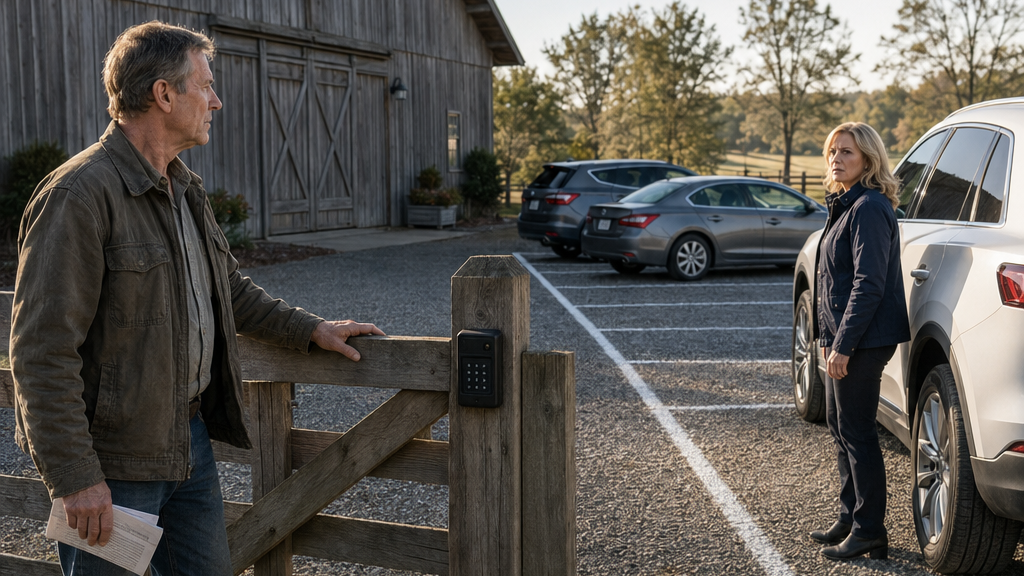
Its diesel engine idled hard enough to shake the chrome mirrors, but the driver could go no farther. A white SUV sat sideways across the gravel entrance, its rear bumper almost touching one gatepost and its front end angled toward the ditch.
Gary stood beside the barn with a pair of work gloves in one hand.
He already knew whose vehicle it was.
The driver lowered his window. “Same one?”
Gary nodded.
“Want me to back down to the road?”
Gary looked at the pallets of feed stacked behind the truck’s cab. Unloading them from the county road would mean moving everything twice.
“Give me a minute.”
He walked toward Cynthia Roberts’s SUV.
For nearly four months, some version of this had happened three or four mornings a week.
At first Cynthia had parked along the edge of the gravel, leaving enough room for Gary’s pickup. Then she began angling closer to the barn gate. By February, she was routinely blocking most of the opening.
Gary had mentioned it casually the first time.
Then politely.
Then directly.
Each time Cynthia had responded as though the inconvenience were temporary.
“I’ll only be there a little while.”
“I didn’t realize you needed the tractor this early.”
“You can text me if it becomes a problem.”
Gary had disliked the last one most.
It was already a problem. He should not have needed permission to use his own gate.
But he had spent years avoiding the reputation he dreaded—the older man on the edge of the subdivision who complained about everything. His property had once stood beyond the neighborhood. Later phases of development had wrapped houses and HOA roads around two sides of his acreage.
Gary had adjusted.
He tolerated joggers cutting near the fence.
He let neighbors turn around beside the barn.
He kept conversations short when people complained about equipment noise at seven-thirty in the morning.
Being reasonable, he told himself, cost less than being right.
Now the feed truck was burning diesel while Cynthia’s SUV sat unattended.
Gary called her.
She answered after five rings.
“Morning, Gary.”
“Your car’s across the gate again.”
A pause.
“I’m at the clubhouse.”
“I have a feed delivery sitting here.”
“I’ll be ten minutes.”
Gary looked back at the truck.
“You said that last Tuesday.”
“I moved it.”
“Forty minutes later.”
Her voice changed slightly. Not angry. Firmer.
“Gary, that gravel section has been used for association access for years.”
“That doesn’t mean you can block my gate.”
“I’m not trying to block anything.”
“You’re blocking it right now.”
Another pause.
“I’ll come move it.”
The call ended.
The driver leaned out his window. “Want me to try squeezing around?”
Gary pictured the rear tire sinking into the soft shoulder.
“No.”
He waited.
Eleven minutes became eighteen.
The driver finally shut off the engine.
At twenty-three minutes, Cynthia appeared from the direction of the clubhouse, walking briskly in a navy jacket with her phone in one hand.
“I told you I was coming.”
Gary held his gloves against his thigh. “And I told you before not to park here.”
Cynthia glanced at the feed truck.
“I didn’t know you had a delivery.”
“That shouldn’t matter.”
Her expression tightened.
“This is association access, Gary. We’ve already gone over that.”
“No. You’ve said it. That isn’t the same thing.”
Cynthia opened her driver’s door but did not get in.
“The board has always treated this strip as common access.”
Gary looked down at the gravel beneath her tires.
It ran from the neighborhood lane along the side of his pasture and widened in front of the barn. He had maintained it for years—grading washouts, buying stone, clearing weeds—but he had never bothered arguing when HOA contractors occasionally used the outer edge.
That habit suddenly felt less harmless.
“Show me where it says that,” he said.
Cynthia gave a short breath through her nose.
“If you have a concern, take it to the board.”
“I’m talking to the person parked across my gate.”
“And I’m telling you there’s an established arrangement.”
She got into the SUV and backed away.
The feed driver watched the vehicle disappear up the lane.
“Established arrangement,” he repeated.
Gary did not answer.
They unloaded the feed.
After the truck left, Gary went inside and sat at the kitchen table with a blank sheet of printer paper.
He wrote Cynthia’s name at the top, then stopped.
He had spent months relying on conversations that left nothing behind.
That was partly his fault.
He rewrote the note twice, taking out the angry sentences.
Please do not park in front of or obstruct the barn gate. This access is required for deliveries and equipment.
He dated it, signed it, slid it into a clear plastic sleeve, and walked back outside.
The white SUV returned just after nine.
Cynthia parked farther from the gate this time, but still on the gravel strip.
Gary placed the notice under her windshield wiper.
She found him near the fence twenty minutes later, holding the paper between two fingers.
“You didn’t need to do this.”
“Apparently I did.”
“You’re making this more formal than it needs to be.”
Gary almost laughed.
“You told me to take it to the board.”
“I said if you had a concern.”
“I do.”
Cynthia folded the notice once.
“You need to understand something. This area isn’t solely yours to control.”
The certainty in her voice unsettled him more than anger would have.
“According to what?”
“The association has maps.”
“So do I.”
She studied him.
“Then I suggest you look at them.”
That afternoon Gary called the HOA office.
The management representative transferred him to Christopher Carter, the board president.
Gary explained the blocked gate, the notice, and Cynthia’s claim.
Christopher listened without interrupting.
When Gary finished, he said, “I understand why you’re frustrated.”
“I’m not asking whether you understand. I’m asking whether she has authority to park there.”
“We need to review the property materials.”
“Good.”
“There’s one complication.”
Gary waited.
“Cynthia is a sitting board member, so I don’t want this handled informally.”
That sounded reasonable until Christopher continued.
“We’ll review it internally first.”
“How long?”
“I can’t promise a timeline.”
Gary looked through the kitchen window toward the barn gate.
The gravel lay empty now.
“You have a meeting Thursday.”
“Yes.”
“Put it on the agenda.”
Christopher hesitated.
“We’ll determine the appropriate process.”
Gary’s grip tightened around the phone.
“So it may not be on the agenda.”
“I said we’ll review it.”
Gary thanked him and ended the call.
For the first time since the parking started, the problem no longer felt like one neighbor being inconsiderate.
Someone had told Cynthia she was entitled to that gravel.
Now the organization responsible for explaining why was promising to examine itself first.
Chapter 2: The Review That Never Reached the Agenda
The board minutes appeared online Friday morning.
Gary opened them before breakfast and searched for his name.
Nothing.
He searched for “parking.”
Nothing.
“Access.”
Nothing.
The Thursday meeting had covered landscaping bids, clubhouse roof repairs, late assessments, pool hours, and replacement mailbox lights.
There was no mention of Cynthia’s SUV, Gary’s barn gate, the gravel strip, or any internal review.
He called the HOA office.
The management representative said Christopher was unavailable.
“Was my property issue discussed last night?”
“I don’t see it in the minutes.”
“That’s why I’m asking.”
“I can send a message to the board.”
Gary leaned back in his chair.
“That’s what I did last week.”
The representative paused.
“I’ll note that it’s a follow-up.”
Gary hung up.
At seven-ten the next morning, Cynthia’s SUV rolled onto the gravel.
She did not block the gate completely. She parked three feet farther over than before, leaving a narrow channel beside the driver’s side.
Gary could probably get his pickup through.
The tractor would not fit.
He watched from the barn doorway until she stepped out.
“You saw the notice,” he said.
Cynthia shut the SUV door.
“And I adjusted where I parked.”
“The gate still isn’t usable.”
“It’s usable for a normal vehicle.”
“That isn’t the point of a barn gate.”
Cynthia looked toward the tractor.
“Gary, this arrangement predates your complaint.”
“My complaint isn’t what determines ownership.”
“No, but longstanding use matters.”
The phrase sounded rehearsed.
Gary crossed his arms.
“Did the board review it?”
“They’re looking at it.”
“It wasn’t on the agenda.”
“Not everything is discussed in open session.”
That answer stayed with him.
“Who told you this was common access?”
Cynthia’s expression changed—not much, but enough.
“I was told years ago that this gravel section was association controlled.”
“By who?”
“I don’t remember exactly.”
“You’re on the board.”
“I wasn’t when I started parking here.”
That was new.
For months Gary had assumed Cynthia used the strip because she felt entitled to convenience. Now there was at least the possibility that someone had explicitly told her she could.
“Then show me the document.”
“I don’t carry property maps in my car.”
“No. But the association does.”
She glanced toward the clubhouse.
“Ask management.”
“I have.”
“Then wait for the review.”
Gary watched her walk away.
He could feel himself doing the old thing again—swallowing the argument because making a scene seemed worse.
Only now he understood the cost.
Every morning he waited made Cynthia’s claim look more normal.
That afternoon he drove to the HOA office.
The management representative printed a site map from the association files.
It was a simplified plan showing roads, common landscaping areas, drainage paths, and property outlines.
Gary placed his finger on the gravel strip.
“What does this shading mean?”
The representative leaned over.
“Association-maintained access.”
“Maintained by who?”
“The HOA, I believe.”
“I buy the gravel.”
She looked uncomfortable.
“I’m just telling you how it’s labeled.”
Gary traced the line toward his barn.
The map’s boundary marking faded near the gate. Instead of a crisp parcel line, there was a broad gray band running along the outer edge of his property.
“Where did this map come from?”
“I don’t know. It’s been in the system for years.”
“Is it recorded with the county?”
“I couldn’t tell you.”
Gary took the copy home.
He laid it on his kitchen table and stared at it for nearly an hour.
Something about the boundary bothered him.
When he bought the property, the closing paperwork had shown the barn, pasture, and gravel lane differently. He remembered the surveyor pointing at an iron pin near the ditch and saying the boundary ran almost straight toward the back fence.
But that had been more than twenty years ago.
Memory was not evidence.
Gary went to the closet in the spare bedroom.
On the upper shelf sat three banker’s boxes filled with tax records, appliance manuals, insurance papers, and closing documents he had not opened in years.
He pulled down the first.
Nothing.
The second contained old mortgage statements.
The third had a manila folder labeled PROPERTY.
Inside were yellowed copies of the purchase agreement, title insurance, an old survey, and the deed packet.
Gary carried them to the table.
The survey was hard to read. Several lines had faded, and handwritten measurements overlapped printed notes.
But the shape was unmistakable.
His western property line ran outside the gravel strip.
He placed the HOA map beside it.
On the association copy, the gravel looked almost absorbed into the common area.
On his survey, it sat inside his parcel.
Gary felt a quick pulse of vindication.
Then caution.
He had spent months complaining without pulling these papers out once.
If he had checked them earlier, the entire dispute might have developed differently.
He called Christopher again.
This time the president answered.
“I found my original survey.”
“Okay.”
“It shows the gravel inside my parcel.”
“That doesn’t necessarily resolve access rights.”
“I didn’t say it did. But why does your map show something else?”
Christopher was quiet.
“What year is your survey?”
Gary told him.
“And the deed?”
“Same closing packet.”
“I’d need to see both.”
“I’ll send them.”
“Do that.”
Gary looked at the association map.
“Christopher, was there actually an internal review?”
Another pause.
“We discussed the issue.”
“Who is ‘we’?”
“A few board members.”
“Was Cynthia one of them?”
“That’s not really the point.”
“It is to me.”
Christopher sighed.
“We were trying not to escalate a neighbor disagreement into a formal proceeding before we understood what we were dealing with.”
“You didn’t understand it because nobody looked at the deed.”
“That may be fair.”
The admission surprised Gary.
Christopher continued.
“Send me what you have.”
Gary scanned the documents that afternoon.
Before emailing them, he read the deed description line by line.
Most of the legal language meant little to him.
Bearings. Distances. Monument references.
Then he found the call corresponding to the western line.
He fetched a ruler and compared it to the survey.
The line ran from the roadside marker past the gravel edge and behind the barn.
Not through the gravel.
Outside it.
Gary sat back.
The gate was his.
The barn was his.
And according to the deed in front of him, the strip Cynthia had been calling association access appeared to be his too.
But that left a harder question.
If the recorded deed said one thing, why had the HOA been behaving for years as though it said another?
Chapter 3: Five White Lines Changed the Argument
The property attorney circled a paragraph in Gary’s deed and slid the paper back across the desk.
“You were right about the ownership line,” she said. “But you missed this.”
Gary leaned forward.
The paragraph was dense, a block of legal description tied to an easement recorded years before his purchase.
He frowned.
“What does it mean?”
“It means owning the gravel doesn’t necessarily mean you can block every form of access across it.”
The small satisfaction Gary had carried into the office thinned immediately.
“So Cynthia can park there?”
“I didn’t say that.”
The attorney tapped the paragraph.
“This appears to grant limited passage related to access serving the adjoining tract as it existed at the time. Passage is not the same thing as parking. And nothing I see gives an individual board member a reserved space in front of your barn.”
Gary sat back.
That distinction mattered.
“So the HOA map is wrong.”
“Possibly incomplete. That’s different.”
He disliked the precision, even though he had paid for it.
The attorney had already reviewed his deed, survey, the HOA map, and photographs of the gate. She had also pulled the referenced easement from county records.
Gary had come expecting confirmation.
Instead he was receiving conditions.
“What can I actually do?”
“You can control your property, subject to valid easement rights and applicable HOA restrictions.”
“That sounds like an answer designed not to be an answer.”
“It’s an answer designed to keep you from replacing one bad assumption with another.”
Gary looked at the circled paragraph again.
For months Cynthia had behaved as though routine created authority.
Now he could see how easily he might make the opposite mistake: ownership did not erase every restriction.
The attorney turned the photographs toward herself.
“Is there any reason this gate needs to remain unlocked at all times?”
“No.”
“Emergency access requirement?”
“Not that I know of.”
“Utility access?”
“Not through the barn gate.”
“Then a controlled lock may be reasonable. But if an easement holder legitimately needs passage, you cannot use the lock to defeat that right.”
Gary nodded.
“And Cynthia?”
“Based on what you gave me, I see no personal parking entitlement.”
That sentence was the first clean answer he had received in four months.
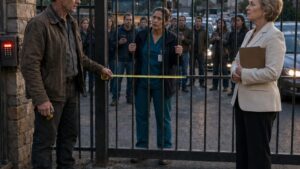
Two days later, Gary installed a keypad on the barn gate.
He did it himself.
The black housing looked almost too modern against the weathered wooden post. He ran the cable cleanly, tested the latch six times, and entered separate access codes for his own use and for deliveries when necessary.
Then he stood back.
For months the gate had represented obstruction.
Now, closed and latched, it represented something else.
A decision.
At 7:04 the next morning, headlights swept across the barn wall.
Cynthia’s white SUV turned onto the gravel.
Gary was already outside.
She slowed when she saw the closed gate.
Then she saw the keypad.
The SUV stopped.
Cynthia lowered the window.
“What is that?”
“A lock.”
“I can see that.”
Gary walked closer but stayed on his side of the gate.
“You can’t lock association access.”
“I can control my gate.”
“You’re interfering with an established use.”
“No. I checked the recorded documents.”
Cynthia opened the door and stepped out.
“Christopher told me there’s still an easement.”
“There is.”
Her eyebrows lifted as if she had won something.
Gary continued.
“It allows passage under certain conditions. It doesn’t give you a parking spot.”
Cynthia looked at him, then at the gravel.
“You paid a lawyer for this?”
“Yes.”
“That seems excessive.”
“So did four months.”
She folded her arms.
“I need somewhere to park in the mornings.”
Gary almost answered the way he would have months earlier.
We can work something out.
Instead he said, “Then you need to arrange somewhere you have permission to park.”
Her face hardened.
“This isn’t over.”
“I didn’t expect it to be.”
She returned to the SUV and backed away.
Gary watched until the vehicle disappeared beyond the hedge.
He should have felt finished.
Instead, he looked at the broad gravel strip beside the gate.
For years neighbors had occasionally asked whether they could leave a vehicle there during clubhouse events, road work, or family gatherings.
Gary had almost always said yes.
That history had probably helped create the ambiguity.
By noon he had another idea.
It began as a practical one.
If people wanted to use the strip, permission should be explicit.
No assumptions.
No informal arrangements.
No one claiming later that years of convenience had become a right.
Gary bought marking paint and a measuring tape.
He spent the afternoon laying out five narrow spaces along the gravel, careful to keep the barn gate itself clear.
White lines appeared one by one.
Straight.
Measured.
Unmistakable.
The transformation was more dramatic than he expected.
The same area Cynthia had treated as vaguely communal now looked deliberately controlled.
Gary made a simple permit sheet. He set a monthly fee high enough, he told himself, to discourage casual use but low enough to cover gravel maintenance.
Eighty-five dollars.
He posted the availability notice on the community bulletin board with a copy of the property description attached.
By evening, Lisa Moore was standing at his gate.
“You’re charging for parking now?”
“For assigned use.”
She looked at the fresh lines.
“You couldn’t just tell Cynthia no?”
“I did.”
Lisa gave him a sideways look.
“This feels like more than telling Cynthia no.”
Gary bristled.
“It’s my property.”
“I didn’t say it wasn’t.”
“Then what are you saying?”
“I’m saying sometimes proving you can do something turns into wanting everyone to know you can.”
The comment irritated him because it landed too close to something he had not wanted to examine.
Still, Lisa asked for one of the spaces.
Her driveway was narrow, and her adult daughter visited several nights a week.
By the next evening, all five spaces had names attached to them.
Gary stared at the permit sheet longer than necessary.
A week earlier Cynthia had acted as if the strip belonged to no one in particular.
Now five neighbors were paying for permission.
At 7:02 the next morning, her SUV returned.
Cynthia slowed when she saw the white lines.
Then the numbered placards.
Then two vehicles already parked inside them.
She stepped out.
“What did you do?”
Gary was unlocking the barn.
“I formalized the parking.”
“You’re running a business?”
“I’m allowing permitted use of my property.”
Cynthia walked to the posted sheet.
Her eyes moved down the names.
“Where’s the open space?”
“There isn’t one.”
She turned.
“You filled all of them?”
“Yes.”
“You knew I park here.”
Gary looked at the white SUV, then at the closed gate.
“You knew I asked you not to.”
For several seconds neither of them spoke.
The old argument had changed shape completely.
Cynthia no longer stood in front of a vague gravel shoulder she claimed the HOA controlled. She stood beside five painted spaces that visibly announced someone had made a decision about who could use them.
Her disbelief hardened into anger.
“You think painting lines changes the governing documents?”
“No.”
“Good.”
She pulled out her phone.
“Because the board is going to treat this as a violation.”
Gary watched her walk back toward the SUV.
The gate stayed closed between them.
For the first time in months, Cynthia could not block it.
But as Gary looked at the five white lines drying against the gravel, Lisa’s warning returned to him.
He had proved the parking was not Cynthia’s to claim.
He had not yet proved that everything he chose to do with it was beyond the HOA’s reach.
Chapter 4: The Parking Victory Came With a Letter
By Tuesday evening, all five parking spaces were taken.
Gary stood beside the bulletin board with the permit sheet in his hand, reading the names again even though he already knew them. Two residents had paid for a month. Three others had asked to start the following week. Lisa Moore had claimed the space nearest the lane because her daughter’s car was easiest to maneuver there.
The arrangement had spread faster than Gary expected.
What surprised him more was how little anyone argued about the fee.
People asked whether the gravel would be maintained, whether overnight parking was allowed, and whether they could transfer a permit temporarily to a visiting relative.
Nobody asked whether the spaces belonged to Gary.
That part suddenly seemed obvious.
By Thursday morning, three vehicles sat neatly between the white lines while the barn gate remained completely clear.
Gary drove the tractor through without stopping.
For the first time in months, there was no SUV to edge around, no phone call to make, no waiting.
He should have enjoyed that more than he did.
Instead, he kept noticing the painted lines.
They were almost too bright against the gray gravel.
At 7:12, Cynthia’s SUV appeared at the end of the lane.
She slowed before turning in.
Gary was unloading tools near the barn when she stepped out and studied the spaces.
“They’re all occupied.”
“They’re assigned.”
“I can see that.”
She looked toward the permit board.
“None of those people ever parked here before.”
“Some did occasionally.”
“Not like this.”
“No.”
Cynthia folded her arms.
“So this was about me.”
Gary set down the tool bag.
“This was about people using my property without clear permission.”
“That’s a very careful way to say yes.”
Gary felt irritation rise.
“You had four months to stop.”
“And you had years to object to people using the strip.”
“That’s not the same thing.”
“It may be more similar than you think.”
She walked closer to the painted spaces.
“You’re collecting money now?”
“Yes.”
“For parking on residential property inside the association.”
Gary recognized the tone.
Not outrage.
Procedure.
“You told me the HOA didn’t own it.”
“I said the deed shows it inside my parcel.”
“That doesn’t make you exempt from the covenants.”
Gary looked at her.
“Is that what the board decided?”
“That’s what they’re going to look at.”
She returned to the SUV.
This time she did not attempt to park.
She drove away.
The absence of the old conflict should have felt like victory.
Instead, Gary spent the next several hours wondering whether he had handed the HOA a new weapon.
That afternoon Lisa came down the lane carrying a grocery bag.
Her daughter’s sedan was parked in Space Four.
“You’re enjoying this,” she said.
Gary was replacing a hinge screw on the gate.
“Enjoying what?”
“Being right.”
“I’m enjoying being able to use the gate.”
Lisa nodded toward the painted spaces.
“Those are different things.”
Gary tightened the screw.
“You paid for one.”
“I needed somewhere for my daughter to park.”
“And now you have it.”
“I’m not complaining about the space.”
“Sounds like you are.”
Lisa set the grocery bag on the hood of her car.
“I’m saying you went from not wanting a fight to building a system around the fight.”
Gary straightened.
“So what was I supposed to do? Keep asking?”
“No.”
“Let Cynthia keep parking?”
“No.”
“Then what?”
Lisa shrugged.
“Tell her no and mean it.”
“I did.”
“After four months.”
The remark landed harder than Gary wanted it to.
Lisa opened the car door.
“For what it’s worth, I think she was wrong.”
Gary waited.
“But I also think eighty-five dollars and five numbered spaces might make your lawyer busier than he needed to be.”
After she left, Gary stared at the white paint again.
The first envelope arrived two days later.
It had the association’s return address.
Gary opened it standing at the kitchen counter.
The first paragraph identified an alleged violation involving commercial activity conducted from residential property.
The second referenced recurring payment in exchange for parking privileges.
The third instructed him to cease the activity pending board review.
Gary read the letter twice.
Then a third time.
There was no claim that the gravel belonged to the HOA.
That language had disappeared.
Instead, the letter focused entirely on use.
Gary called the property attorney.
She read the notice while he waited on the line.
Finally she said, “This argument is better than their first one.”
Gary frowned.
“You mean they’re right?”
“I mean it isn’t nonsense.”
“That’s not what I wanted to hear.”
“You don’t pay me to tell you what you want to hear.”
Gary looked through the window at the parked cars.
“What’s the distinction?”
“Ownership and regulation. You can own property and still be subject to covenants governing how it’s used.”
“They told me this was common access.”
“And that may have been wrong.”
“So now they get to change arguments?”
“They get to make whatever argument the documents support.”
Gary rubbed his forehead.
“I’m not running a parking lot.”
“You are taking recurring payments in exchange for designated spaces.”
“When you say it like that—”
“I’m saying it like a board attorney would.”
Gary said nothing.
The attorney continued.
“Do you want to defend the permit system, or do you want to establish the property boundary?”
“Aren’t those the same fight?”
“No.”
The answer came quickly enough to bother him.
She went on.
“The strongest part of your position is that Cynthia had no personal right to block your gate and that the HOA may have mischaracterized the gravel strip. The paid parking program is a separate issue. Don’t confuse leverage with ownership.”
Gary glanced at the envelope.
That phrase stayed with him after the call.
Leverage with ownership.
He had told himself the painted spaces were about clarity.
Maybe they had started that way.
But there had been satisfaction in telling Cynthia there were no spaces left.
He could admit that much.
He was less willing to admit how much that satisfaction had shaped everything after.
The following morning Cynthia walked down instead of driving.
She stopped outside the gate.
“I assume you received the letter.”
Gary kept his hands on the top rail.
“I did.”
“You should probably take the lines up.”
“They’re paint.”
“You know what I mean.”
“Is the board dropping the claim that this is common property?”
Cynthia looked away for half a second.
“That issue is still being reviewed.”
“Interesting.”
“What?”
“You’re enforcing rules about how I use land you still haven’t admitted is mine.”
“Gary, the covenants apply whether or not the association owns the parcel.”
“So we agree the association doesn’t own it?”
“I didn’t say that.”
“You keep getting close.”
Her jaw tightened.
“This doesn’t have to become personal.”
Gary almost laughed.
“It became personal when you kept blocking my gate after I asked you to stop.”
“I believed I had permission.”
“And after I showed you the deed?”
“You showed me a document. You’re not a surveyor.”
Gary looked at her for a long moment.
That was fair.
Annoyingly fair.
Cynthia took a step back.
“You have ten days.”
“For what?”
“To stop the commercial parking operation.”
Gary looked toward Space Four, where Lisa’s daughter’s car sat inside the bright white lines.
He had won the visible part of the dispute.
Cynthia no longer blocked the gate.
But the letter in his kitchen made something else clear.
If he insisted that every right of ownership included every use he preferred, he might lose the cleanest argument he had.
Chapter 5: The Map Was Wrong Before Either of Them Arrived
The older plat showed a line that did not exist on the HOA’s map.
Gary noticed it because the surveyor had drawn the boundary in heavy black ink, straight past the gravel strip and behind the barn.
On the association copy, that same line disappeared beneath a gray access band.
The property attorney placed both documents side by side.
“There,” she said.
Gary leaned closer.
“Same parcel?”
“Same general area.”
“Then why is the line gone?”
“That’s what we need to find out.”
They were three days into the HOA’s ten-day deadline.
Gary had suspended new parking payments but had not removed the painted spaces. He told the five permit holders they could continue using the strip temporarily while he sorted out the dispute.
The attorney had advised against expanding the arrangement.
Gary disliked every concession.
But he had begun to understand that disliking a concession did not make it weakness.
They spent the morning at the county archive.
The clerk pulled recorded plats, easement documents, and subdivision amendments dating back decades.
The oldest materials described Gary’s parcel before the neighborhood had expanded around it.
The gravel strip was clearly inside the private tract.
Later records added an access easement along part of the same edge.
But the easement language concerned passage.
Not ownership.
Not parking.
The confusion appeared in a later development drawing.
Someone had shaded the access corridor and surrounding maintenance area with the same pattern used for association-controlled spaces.
That drawing was not itself a deed.
But it had been copied into HOA working maps for years.
Gary stared at the progression of documents.
“So nobody stole anything.”
The attorney looked at him.
“That wasn’t really the most likely explanation.”
“You know what I mean.”
“Yes.”
He traced the gray band with one finger.
“They copied a bad map.”
“An incomplete one, at least.”
“And then treated it like the recorded property line.”
“Possibly.”
Gary felt something shift.
For months he had imagined Cynthia seeing someone else’s land and deciding her board position entitled her to it.
The records suggested a less satisfying beginning.
Someone had told her the strip was association controlled because someone else had believed a map that blurred ownership and access.
That did not excuse the parking after he objected.
But it changed the first act of the story.
Later that afternoon, Christopher met Gary at the HOA office.
The board president looked tired.
Gary placed copies of the older plat, the current HOA map, and the deed description on the conference table.
Christopher studied them silently.
Finally he said, “I see the problem.”
“That makes one of us.”
Christopher looked up.
“You think I’m joking?”
“No.”
“I’m saying I don’t know how this happened.”
Gary pointed to the HOA map.
“Someone erased a property line.”
“I doubt anyone literally erased it.”
“They stopped showing it.”
“That may have been a drafting simplification.”
“A simplification that turned my gravel into common access.”
Christopher exhaled.
“You’re right that the maps conflict.”
It was the clearest concession Gary had heard from the HOA.
“Then withdraw the cease-and-desist.”
Christopher shook his head.
“Those are separate issues.”
Gary almost stood.
The attorney had warned him this would happen.
He made himself stay seated.
Christopher continued.
“If the strip is your property, we need to correct our records. But paid parking can still violate residential-use restrictions.”
“So Cynthia can’t park there for free, but I can’t let Lisa pay to park there.”
“That may be exactly the legal result.”
Gary disliked it because it sounded absurd.
He disliked it more because it might also be true.
Christopher pushed the current map aside.
“I want to know how long we’ve been relying on this.”
“Ask Cynthia.”
Christopher’s expression tightened.
“Why?”
“She said someone told her years ago it was association controlled.”
“That could have been management.”
“Could have.”
Christopher studied him.
“What aren’t you saying?”
Gary hesitated.
He had no proof Cynthia knew more than she admitted.
Only her confidence.
Her refusal to stop.
The shift in her wording after he produced the deed.
“I think she knew there was a dispute before the letter went out.”
Christopher leaned back.
“That’s a serious accusation.”
“I said I think.”
“Based on what?”
“Ask her.”
Christopher did.
Not in front of Gary.
Two days later he called.
“I found an email thread.”
Gary put down the wrench he was holding.
“What kind of thread?”
“About the boundary.”
“When?”
“Before the cease-and-desist.”
Gary felt his chest tighten.
“How long before?”
“Several days.”
“And Cynthia was included?”
“Yes.”
“What did it say?”
Christopher paused.
“That an older plat appeared inconsistent with the HOA map and that the property boundary needed verification before the association made any ownership claim.”
Gary looked toward the barn gate.
The difference mattered.
Cynthia had not known the final answer.
But she had known the HOA’s position might be wrong.
“And then she pushed the violation letter anyway.”
Christopher was silent.
“That’s not the same issue,” Gary said, repeating the phrase he had heard from everyone else.
“No,” Christopher said. “But it changes how I view the process.”
Gary waited.
Christopher sounded uncomfortable now, not defensive.
“I approved the letter.”
“Why?”
“Because the paid parking looked like a straightforward covenant issue.”
“Did Cynthia ask you to send it?”
“She argued strongly that we needed to act before the arrangement became established.”
Gary nearly laughed at the irony.
Before it became established.
The exact logic Cynthia had used to defend her own parking.
Christopher continued.
“I should have slowed it down.”
That admission surprised Gary more than any legal document.
“Why didn’t you?”
“Because I wanted this contained.”
Gary understood the answer immediately.
Christopher had not been protecting Cynthia because she was Cynthia.
He had been protecting the board from embarrassment.
A private disagreement looked manageable.
A mapping error affecting private property did not.
“You thought keeping it internal would make it smaller,” Gary said.
“Yes.”
“It made it worse.”
“Yes.”
There was no argument in Christopher’s voice now.
Later that evening, Lisa stopped at the gate.
Gary told her enough to explain the situation.
Not every detail.
Just the old plat, the bad map, the email.
Lisa listened.
“So Cynthia was lied to at first.”
“Maybe not lied to. Told something wrong.”
“And later she found out it might be wrong.”
“Yes.”
“But kept pushing anyway.”
“Yes.”
Lisa looked toward the white lines.
“That’s different.”
Gary nodded.
It was.
That was what bothered him.
If Cynthia had known from the beginning, anger would have been easier.
If she had remained genuinely mistaken, forgiveness would have been easier.
Instead, the truth sat somewhere more uncomfortable.
She had probably started in good faith.
Then pride took over.
The next morning Christopher sent Gary a formal notice of a special board meeting.
Attached was an agenda item titled PROPERTY MAP CORRECTION AND ACCESS REVIEW.
Gary read the words twice.
Then he noticed a second attachment.
It was the internal email Christopher had mentioned.
Cynthia’s reply sat near the bottom.
The older plat may be outdated. We should enforce current community use until ownership is conclusively determined.
Gary stared at that sentence.
She had not known the boundary was his.
But she had known enough to stop pretending there was no question.
And she had chosen enforcement anyway.
Chapter 6: The Board Could No Longer Call It Common Ground
Christopher opened the special meeting with the sentence Gary had waited months to hear.
“The association is withdrawing its position that the gravel strip adjacent to Gary Wilson’s barn is HOA-owned common property.”
Nobody applauded.
Gary was glad.
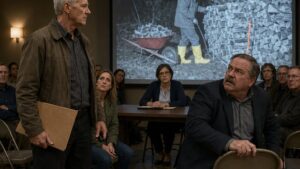
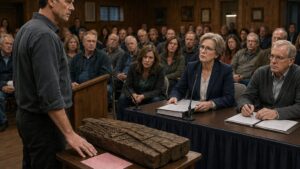
The clubhouse room held fewer than twenty residents, several board members, the management representative, Cynthia, Lisa, and Gary.
Copies of the competing maps lay on the table.
Gary had brought a small folder containing the keypad code log and his deed records.
He had deliberately left the lock itself where it belonged.
On the gate.
Christopher continued.
“The recorded property materials indicate the strip is privately owned, subject to a limited access easement. The association’s internal map is inconsistent with those materials and will be corrected.”
Cynthia sat two chairs away from him.
Her posture remained rigid.
Gary had imagined this moment enough times to know how he thought it would feel.
Vindication.
Relief.
Maybe satisfaction.
Instead, he felt tired.
Christopher looked toward him.
“Gary, the board acknowledges that the earlier characterization of the area as common property was unsupported.”
Gary nodded once.
“Thank you.”
Cynthia turned slightly.
“That does not resolve the parking issue.”
Christopher looked at her.
“We’re getting there.”
Her mouth tightened.
He continued.
“The board’s review also found that recurring paid parking may violate existing restrictions on commercial use.”
Gary expected the sentence.
It still irritated him.
One resident raised a hand.
“So he owns it, but he can’t rent spaces?”
Christopher answered carefully.
“Ownership does not eliminate covenant restrictions.”
Another resident asked, “Then why could Cynthia park there?”
The room changed.
Cynthia spoke before Christopher could.
“I was told the strip was association access.”
Gary watched her.
For the first time, she did not say common property.
Christopher folded his hands.
“That appears to have been based on the incorrect internal map.”
“So she made a mistake,” Lisa said.
Cynthia looked at her.
“Yes.”
Lisa did not look away.
“What about after the old plat came up?”
Silence settled over the table.
Christopher glanced at Cynthia.
Gary could have answered.
He had the email in his folder.
He did not reach for it.
Cynthia took a breath.
“I knew there was a question.”
The room remained still.
She continued.
“I did not know the deed review would support Gary’s interpretation.”
“You knew the map might be wrong,” Gary said.
Her eyes moved to him.
“Yes.”
“And you still pushed for the cease-and-desist.”
Cynthia’s expression tightened.
“For the paid parking.”
“Before the ownership issue was settled.”
“Yes.”
“Why?”
For several seconds she said nothing.
Then her voice lost some of its formality.
“Because by then it looked like you were using the dispute to make a point.”
Gary glanced toward Lisa.
The words were too similar to what she had told him.
Cynthia continued.
“You painted spaces. You charged neighbors. You made sure the one person who had been parking there couldn’t get one.”
Gary felt heat in his face.
“You were blocking my gate.”
“I know.”
“You ignored me.”
“I believed I was entitled to be there.”
“Even after you knew that might not be true.”
“That’s the part I handled badly.”
The admission was so quiet that Gary almost missed it.
Cynthia looked down at the table.
“I thought if the board backed away before the records were final, it would look like I had used my position to claim private property.”
Gary said, “So instead you used your position to keep claiming it.”
Cynthia flinched.
She did not argue.
Christopher stepped in.
“This is exactly why the process failed.”
He turned toward the board members.
“We treated reputation management as dispute resolution.”
Gary leaned back.
There it was.
Not corruption.
Not a secret scheme.
Something more ordinary.
People protecting themselves long enough to make a manageable mistake worse.
Christopher looked at Gary.
“The board will correct the map and adopt a written consent requirement for future parking or informal access on privately owned strips.”
Gary nodded.
“What about the gate?”
“The association has no basis to require it remain unlocked continuously, provided valid easement access is not obstructed.”
Gary had expected to enjoy hearing that.
Instead he found himself thinking about the five painted spaces.
Christopher continued.
“The paid permits are another matter.”
“I know.”
“You can contest that separately if you want.”
Gary looked around the table.
Lisa sat with her arms folded.
Cynthia watched him.
The attorney’s warning returned.
Do you want to defend the permit system, or do you want to establish the property boundary?
He had spent years giving too much ground because he feared being difficult.
Then, once he finally stood his ground, he had gone farther than necessary because retreat felt too much like surrender.
Both habits came from the same place.
Letting someone else define what strength looked like.
Gary opened his folder.
“I’m ending the paid parking.”
Several heads turned.
Cynthia looked surprised.
Christopher said, “Effective when?”
“End of the current month.”
Lisa raised her eyebrows.
Gary continued.
“But I’m not reopening the strip as general parking.”
“No one is asking you to,” Christopher said.
“I want that written.”
“It can be.”
“And the gate stays controlled.”
“Subject to the easement.”
“Yes.”
Gary took out a single sheet of paper.
“I wrote something simpler.”
Christopher reached for it.
Gary kept his hand on the page.
“Authorized access only. Written owner consent for parking. Separate gate codes for anyone who needs legitimate passage. No assumption that maintenance, habit, or previous use creates a permanent parking right.”
Christopher read the first lines.
“This is workable.”
Cynthia said, “What about association events?”
“They can ask.”
“You could say no.”
“Yes.”
Her eyes narrowed.
Gary met them.
“That’s what permission means.”
For a moment the old tension returned.
Then Cynthia looked away.
Christopher read the rest.
“I’d want counsel to review the easement language.”
“Fine.”
“And the board would need to approve any policy referencing privately owned strips.”
“Fine.”
Gary surprised himself with how easy the word felt.
Not surrender.
Not defeat.
Just a condition that belonged in the process.
Christopher set the paper down.
“I’ll support it.”
One of the board members asked, “What happens to Cynthia’s committee assignment?”
Christopher looked toward her.
“That will be discussed separately.”
Cynthia’s face went still.
Gary felt no pleasure in that.
He had wanted his gate back.
Somewhere along the way, he had almost convinced himself he needed Cynthia to lose something equally visible.
Now that possibility sat in the room, and it felt smaller than he expected.
After the meeting, people gathered their papers slowly.
Cynthia stayed seated until most of the room had emptied.
Gary was putting the code log back into his folder when she spoke.
“I should have stopped parking there when you asked.”
He looked at her.
She did not say she was sorry.
He did not expect her to.
“You should have.”
“I really was told it was association controlled.”
“I believe you.”
That seemed to unsettle her more than an accusation would have.
Gary continued.
“But after the plat came up, you knew there was a problem.”
“Yes.”
“And that’s the part I’m not going to pretend didn’t happen.”
Cynthia nodded once.
“Fair enough.”
She left.
Christopher approached the table with Gary’s proposed access plan still in his hand.
“You know you could keep fighting the commercial-use issue.”
“I know.”
“You might even win part of it.”
Gary zipped the folder closed.
“That stopped being the thing I needed.”
Christopher looked toward the door Cynthia had just passed through.
“I should have put this on the first agenda.”
Gary said, “I should have told her no the first month.”
Christopher almost smiled.
“Seems like everybody found the point where being reasonable turned into avoiding something.”
Gary picked up his coat.
“Put the map correction in writing.”
“I will.”
“And the consent rule.”
Christopher lifted Gary’s page.
“I’ll circulate this draft.”
Gary walked out of the clubhouse.
The barn gate was visible in the distance beyond the lane, dark against the pale gravel.
The keypad remained on the post.
The white lines remained on the ground.
Neither meant what it had meant a week earlier.
The gate was no longer proof that Gary could keep someone out.
The lines were no longer proof that he could charge people for what Cynthia had taken for free.
They were evidence of how easily a boundary could become a weapon once everyone started treating control as the same thing as being right.
Gary stopped beside Christopher’s truck and turned back.
“One change.”
Christopher waited.
“In the draft, take out anything that says association approval creates access.”
“What do you want instead?”
Gary answered without hesitation.
“Owner consent creates access.”
Christopher looked down at the page.
Then he nodded.
“I can work with that.”
For the first time since the white SUV had started appearing at sunrise, Gary was no longer waiting for the board to decide whether his boundary mattered.
He had finally put the rule into words himself.
Chapter 7: The Gate Stayed Locked, But Not Against Everyone
Cynthia’s white SUV appeared at 7:06 on a Monday morning.
Gary saw it from the barn doorway and stopped with one hand on the tractor door.
For half a second, his body reacted before his mind did. His shoulders tightened. He expected the familiar turn onto the gravel, the slow angle toward the gate, the quiet assumption that whatever happened next would be his problem to solve.
The SUV passed the entrance.
Cynthia continued another hundred yards and turned into the clubhouse lot.
Gary stayed where he was.
Nothing had been said.
No acknowledgment.
No apology.
But his gate remained clear.
He climbed into the tractor.
Three weeks had passed since the special board meeting. The paid permits were gone. Gary had refunded the unused portions of the monthly fees, and the white parking lines had already begun fading beneath tires, rain, and fresh gravel.
The HOA had sent every homeowner a corrected property map.
The difference was small enough that someone unfamiliar with the dispute might have overlooked it: one dark parcel line now continued cleanly beside Gary’s gravel strip instead of disappearing into a shaded association-access area.
Gary noticed it immediately.
So did Cynthia.
The board had also adopted the new access language.
Association maintenance, previous use, or informal permission did not create a continuing parking right on privately owned property. Any such use required written owner consent.
The paragraph was dry.
Gary liked it that way.
Dry rules were harder to bend around personalities.
The keypad remained on the barn post.
It no longer carried only Gary’s code.
The feed company had one temporary-access number that could be changed as needed. The utility contractor had another for scheduled work. Gary kept a handwritten log in the kitchen drawer with the date each code was issued and when it expired.
He had once thought that kind of recordkeeping belonged to people who liked bureaucracy.
Now he understood the difference between paperwork used to control people and paperwork used to make expectations visible.
Late that morning, Lisa walked down the lane with a folded sheet in her hand.
“Got a minute?”
Gary was repairing a loose board near the gate.
“Depends what you’re selling.”
“Your own idea, apparently.”
She held out the paper.
It was the HOA’s new owner-consent form.
Gary looked at her.
“What do you need?”
“My daughter’s moving some furniture Saturday. Truck’s too long for my driveway if the neighbors are parked across from me.”
“You want to use the gravel?”
“For about three hours.”
Gary looked toward the faded white spaces.
A month earlier Lisa would have simply parked there and assumed he would not mind.
A month earlier Gary probably would have allowed it, then quietly resented being asked after the fact.
Now she was standing at the gate with a form.
“What time?”
“Ten to one, probably.”
“Keep the barn opening clear.”
“I figured.”
“And if they run late, text me.”
Lisa smiled.
“Look at you. Practically civilized.”
Gary took the paper.
“You were one of the people telling me I’d built a parking empire.”
“It was a very small empire.”
“Five spaces.”
“With excellent gravel.”
He laughed despite himself.
Then Lisa became more serious.
“You know, I didn’t think Cynthia was going to accept the map correction.”
“Neither did I.”
“She didn’t vote against it.”
Gary looked up.
He had not known that.
Lisa continued.
“She abstained.”
“That’s not exactly support.”
“No. But it isn’t pretending nothing happened either.”
Gary folded the consent form.
He understood what Lisa was offering him: a reason to soften.
He did not reject it.
He did not fully accept it either.
Cynthia had been wrong initially because someone had given her bad information.
Gary believed that now.
She had become responsible when she learned the information might be wrong and chose enforcement over uncertainty.
That distinction mattered.
It also meant the story could not be reduced to a villain and a victim.
Gary had made choices too.
He had allowed the problem to grow because he feared looking difficult. Then he had painted five white lines and charged money partly because making Cynthia feel excluded had satisfied something in him.
He would not pretend otherwise.
“Saturday’s fine,” he told Lisa.
“You’ll give me a gate code?”
“For the truck driver.”
She nodded.
Gary wrote a temporary number on the form and entered its expiration for one-thirty Saturday afternoon.
Lisa looked at the keypad.
“So that thing stays.”
“Yes.”
“You know Cynthia probably hates it.”
Gary looked down the lane toward the clubhouse.
“That isn’t what it’s for anymore.”
Lisa left without answering.
Saturday morning, the moving truck arrived ten minutes early.
The driver stopped outside the gate instead of pulling forward.
Gary heard the engine from the barn and walked out.
Lisa stood beside the cab with the consent form in one hand.
“See?” she called. “Following procedure.”
Gary entered the temporary code.
The latch clicked.
He swung the gate inward.
The truck rolled through slowly, leaving plenty of room beside the barn.
Gary watched its rear wheels clear the post.
A month earlier, opening the gate for someone else would have felt like giving ground.
Now it felt exactly like what ownership was supposed to mean.
He could say yes.
Which meant his no mattered too.
Around noon, Cynthia appeared on foot.
Gary was sweeping loose gravel away from the gate track when he saw her.
She stopped on the other side.
For a moment neither spoke.
The moving truck was visible farther down the strip.
Cynthia looked at it.
“Lisa?”
“Yes.”
“Furniture?”
“Yes.”
She nodded.
Gary waited for criticism.
None came.
Instead Cynthia looked at the keypad.
“They approved the final policy Friday.”
“I got the email.”
“The map too?”
“Yes.”
Another pause.
“I’m off the access committee.”
Gary rested the broom against the post.
He had heard rumors, but nobody had told him directly.
“Christopher?”
“The board.”
Gary nodded.
Cynthia gave a small, humorless smile.
“I imagine that feels appropriate.”
He considered the question.
“It feels like their decision.”
“You could say you warned everyone.”
“I did warn everyone.”
“That’s not what I meant.”
Gary knew.
She was asking whether he wanted the moment.
The admission.
The satisfaction.
He looked at her.
“I wanted you to stop blocking the gate.”
Cynthia glanced toward the barn.
“I know.”
Gary could have left it there.
Instead he said, “You probably did believe the strip was common access at first.”
She looked back at him.
“I did.”
“I believe that too.”
Her face changed slightly.
“I should have stopped when the plat came up.”
“Yes.”
“You’re not going to make this easy, are you?”
Gary almost smiled.
“I don’t know what easy would look like.”
“Neither do I.”
She looked at the moving truck again.
“For what it’s worth, the corrected map affects two other strips near the back entrance.”
Gary had not heard that.
“Private lots?”
“Partly. Nothing as obvious as yours. But the board is reviewing them before somebody repeats this mess.”
“That’s good.”
“Yes.”
The word came reluctantly but clearly.
Cynthia put her hands in her jacket pockets.
“I’m parking at the clubhouse now.”
“I noticed.”
“It’s farther.”
Gary waited.
She looked at him.
“I’m not asking for sympathy.”
“Good.”
That earned the smallest actual smile he had seen from her in months.
Then she turned and walked back toward the road.
No apology.
No handshake.
No promise that they would become friends.
Gary found that he did not need one.
The old version of him would have wanted the discomfort gone. He would have tried to smooth the conversation, perhaps offering some vague reassurance that everything was fine.
It was not fine.
It was simply settled.
There was a difference.
At one-fifteen, Lisa’s moving truck finished unloading.
The driver approached the keypad and waited while Gary opened the gate from inside.
The truck rolled out.
Lisa followed in her car and stopped beside him.
“Everything okay?”
“Fine.”
She glanced toward the road where Cynthia had disappeared.
“She say anything?”
“Enough.”
Lisa nodded as though that made sense.
Gary waited until both vehicles cleared the entrance.
Then he swung the wooden gate shut.
The latch met the post with a solid click.
For months that sound had meant obstruction.
Then it had meant defiance.
Now it meant neither.
Gary entered his code and checked the latch.
Behind him, the barn aisle remained open. The tractor could move. The next delivery could enter with permission. Neighbors could ask. He could agree, refuse, or set conditions without waiting until resentment made the decision for him.
The faded white lines were still visible if he looked closely.
He decided not to repaint them.
Time and tires could finish removing what was left.
A few days later, the feed truck arrived shortly after seven.
The same driver who had once sat idling behind Cynthia’s SUV stopped outside the closed gate.
Gary’s phone buzzed with the scheduled-delivery message.
He walked out, entered the temporary code, and pulled the gate open.
The driver eased the truck through.
“No traffic jam today,” he called through the window.
Gary looked toward the clubhouse lot.
Cynthia’s white SUV was parked there between two ordinary cars, nowhere near his property.
“No,” Gary said. “Not today.”
The truck continued toward the barn.
Gary closed the gate behind it.
The latch clicked into place, and this time the sound carried no anger at all.
The story has ended.