My Neighbor Said the Street Was Public Until the HOA Used His Own Complaint Against Him
Chapter 1: The Morning Ronald Chased His Own Car Down the Street
The first thing I saw was the Buick floating backward past my kitchen window.
Not driving. Floating.
Its front wheels hung six inches above the pavement on the tow truck’s lift, the rusted hood trembling every time the truck crossed a seam in the street. One flattened rear tire turned reluctantly against the asphalt.
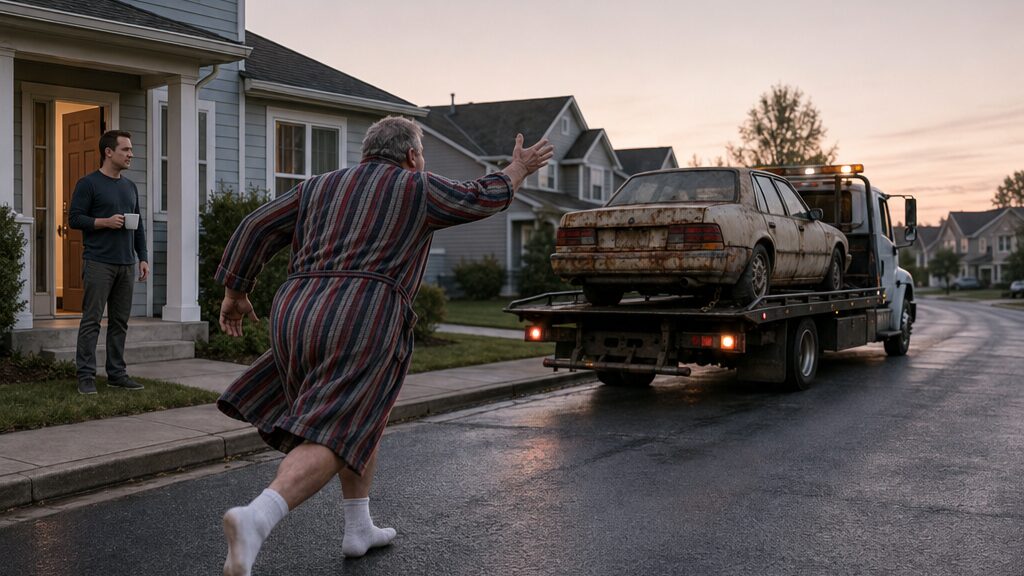
Then Ronald Baker came running after it.
He had on a striped bathrobe, white socks, and no shoes.
“Hey! Stop!”
The tow truck did not stop.
Ronald made it almost to my mailbox before he saw me standing behind the glass with a coffee mug in my hand.
For half a second, his face changed from panic to recognition.
Then to fury.
I lifted the mug.
That was the part I would later feel least proud of.
Three weeks earlier, the Buick had looked almost permanent.
It sat along the curb beside my corner lot, close enough that anyone backing out of the side street had to edge forward to see around it. Beige paint had faded into something between gray and brown. Rust spread across the rear wheel wells. One side mirror hung at an angle, and the passenger-side tire had gone soft enough that the rubber bulged against the pavement.
At first, I assumed Ronald was waiting for a repair.
We had lived beside each other for four years without becoming friends or enemies. We waved. We borrowed nothing. We knew which trash cans belonged to which house. That was about the extent of it.
After a week, I walked around the Buick.
A dead leaf had wedged beneath the windshield wiper. Dirt coated the glass. The registration sticker showed a year that had long passed.
What bothered me most was the tire.
There was a dark crescent beneath it where oil and road grime had stained the pavement. Every morning when I left for work, the tire rested over exactly the same mark.
By the second week, I went over while Ronald was mowing.
He killed the mower when he saw me at the edge of his driveway.
“Can I ask you about the Buick?”
He looked toward the curb without turning his head all the way.
“What about it?”
“It’s been sitting there awhile.”
“So?”
“It blocks the corner.”
“It’s not blocking your driveway.”
“I didn’t say it was.”
Ronald rested both hands on the mower handle.
I tried again. “Are you planning to move it?”
His expression hardened in a way that told me the question had already been asked by somebody else.
“It’s a public street, Chris.”
“I know.”
“Then that’s the answer.”
“It hasn’t moved.”
“There’s no law saying I have to drive my car every day.”
I looked toward the Buick. A small bundle of dried grass had collected behind the broken mirror housing.
“You’ve got a flat tire.”
“I’ve got an air compressor.”
“Expired registration.”
“Are you a cop now?”
“No.”
“Then we’re done.”
He pulled the mower cord.
The engine coughed to life, ending the conversation for him.
I walked home angrier than I expected to be.
What irritated me was not simply the car. People had parked work vans beside my lot during renovations. Teenagers had left cars there overnight. Delivery drivers used the curb every week.
I had never complained.
Being on the corner meant people treated the edge of my property like neutral territory, and most of the time I let them.
Ronald knew that.
Maybe that was why his dismissal landed harder than it should have.
That evening I emailed the HOA management address. I kept the message deliberately boring.
Non-operational vehicle. Public curb. Limited visibility near intersection. Request for guidance.
The reply arrived the following afternoon from Laura Garcia, the community manager.
She said the association generally enforced restrictions on private lots and common property. The road itself was municipally maintained.
In other words, Ronald was right about one thing.
The HOA did not own the street.
I read the email twice.
Then I looked through my office window at the Buick.
Ronald was outside trimming the edge of his lawn. He worked carefully along the concrete, stopping every few feet to make the border straight.
Ten yards away, the Buick sat crooked against the curb with its collapsed tire still pressed into the same dark crescent.
I could have let it go.
Instead, Ronald looked up, saw me at the window, and gave me a short wave that felt less like friendliness than punctuation.
Public street.
That night I opened the city website.
Parking regulations led to traffic ordinances. Traffic ordinances led to vehicle codes. Half the links seemed written for people who already knew where the answers were.
Then I found a page titled abandoned and inoperable vehicles.
I scrolled past definitions, complaint procedures, and jurisdiction notes until one sentence caught me.
A vehicle left continuously on a public right-of-way for more than seventy-two hours under specified conditions could be investigated for removal.
I sat straighter.
Seventy-two hours.
For the first time since talking to Ronald, the question was no longer whether the street belonged to him or me.
The question was whether that Buick had moved at all.
Chapter 2: Seventy-Two Hours Changes Who Controls the Curb
At 7:14 the next morning, I took the first photograph.
I stood at the edge of my driveway and framed the Buick so the rear tire, storm drain, and a crack in the curb were all visible together.
Then I took a closer shot of the flattened tire resting on the dark crescent beneath it.
I did not trust memory anymore.
Memory could be argued with.
A photograph taken from the same place every morning could not.
The city page had been less satisfying than I first thought. Seventy-two hours did not mean a homeowner could count three days and summon a tow truck. The vehicle had to meet specific conditions, and enforcement belonged to the municipality.
I printed the page anyway.
At work, I estimated construction schedules for a living. Dates, measurements, dependencies, documentation. If someone claimed a project was late, I wanted the sequence. If someone said material had been delivered, I wanted the ticket.
It was a useful habit professionally.
At home, it had begun to look suspiciously like a personality defect.
Day two, 7:09 a.m.
Same tire. Same stain.
Day three, 7:18.
Same.
I created a folder on my computer labeled BUICK and immediately disliked how ridiculous it looked.
On the third afternoon, Ronald came outside with his mower.
He spent nearly forty minutes cutting his front lawn in overlapping lines. Then he switched to the trimmer, worked along the driveway, blew grass clippings off the sidewalk, and rolled the mower into his garage.
The Buick remained untouched.
I watched from my upstairs window longer than necessary.
When Ronald glanced toward my house, I stepped away from the glass.
That should have embarrassed me more than it did.
On the fourth morning, I walked closer to the windshield.
The old registration sticker was clearly expired.
I took a picture.
Then another of the broken mirror, where dried stems and feathers had collected behind the plastic casing.
A door opened across the street.
One of the neighbors came out carrying a trash bag. He glanced from me to the Buick to my phone.
“Building a case?”
He smiled when he said it, but I felt heat rise into my face.
“Just documenting it.”
“Uh-huh.”
He kept walking.
That evening, I called the municipal parking office.
The person who answered did not sound impressed by my research.
“Sir, the seventy-two-hour language allows investigation. It doesn’t guarantee removal.”
“I understand.”
“Has the vehicle actually been abandoned?”
“That’s what I’m trying to establish.”
“Do you own it?”
“No.”
“Then you can submit a complaint. An officer determines the rest.”
I looked at the photographs on my monitor.
“What do you need?”
“Location, description, plate if visible. Photos can help, but don’t put yourself in the roadway.”
After hanging up, I reopened Laura Garcia’s HOA email.
The association generally enforced restrictions on private lots and common property.
Something about the wording bothered me.
Not because it was wrong.
Because it was careful.
I sent a follow-up asking whether the HOA had ever issued Ronald a vehicle-related violation.
Laura replied the next day that homeowner enforcement records were not generally shared between residents.
Then Catherine Anderson, the board president, emailed me separately.
Christopher,
The Board is aware of your concern. As previously explained, the street is publicly maintained and is not HOA property. Please direct municipal parking issues to the appropriate city department.
It was polite, correct, and dismissive.
I read it while standing at my kitchen counter.
Through the window, Ronald was carrying two bags of fertilizer from his truck to the garage.
He noticed me.
This time he did not wave.
I should have been satisfied. Catherine had confirmed the correct route. The city would decide. The HOA was out of it.
Instead I felt the old irritation sharpening.
Everybody seemed comfortable with the problem as long as it sat beside my house.
That afternoon I took another photo.
Then another the following morning.
I started noticing details I had previously ignored: the tiny gap between the tire and a pale chip in the curb, a rust flake beneath the rocker panel, the shadow of the valve stem.
The car had not moved an inch.
On the evening of day four, a new email arrived from the HOA portal.
The subject line read: Courtesy Notice.
I opened it expecting another response about Ronald.
It was about me.
A photograph showed my small utility trailer parked along the curb beside my house. I used it for lumber and yard material and had left it there overnight after unloading part of a weekend project.
The notice stated that a complaint had been received regarding prolonged curbside storage and possible obstruction.
I stared at it.
The trailer had been there less than twenty-four hours.
More importantly, Catherine had just told me the public street was outside HOA enforcement.
I called Laura.
She answered after several rings.
“I’m looking at a notice about my trailer.”
“Yes.”
“You told me the street is municipal.”
“It is.”
“Then why am I receiving an HOA courtesy notice?”
There was a brief silence.
“A resident reported it.”
“That doesn’t answer the question.”
“A courtesy notice isn’t a fine, Christopher.”
“Can the HOA regulate the curb or not?”
Another pause.
“I’d have to review the specific rule cited.”
“Who complained?”
“You know I can’t disclose that.”
I looked through the window.
Across the street, Ronald’s garage door was open.
He was standing inside, arms folded, watching my house.
He lifted one hand.
Not a wave this time.
Just two fingers touching his forehead before he turned away.
I looked back at the courtesy notice.
The Buick was still sitting beside my corner.
My trailer had been there one night.
For the first time, the abandoned car stopped looking like the whole problem.
Chapter 3: Eleven Days of Proof and One Dawn Tow
Rain fell hard on the sixth night.
By morning, the street looked scrubbed clean.
Leaves had washed toward the storm drain. Dust disappeared from the asphalt. The darker patches of pavement had blurred into one wet surface.
Except beneath Ronald’s Buick.
When I stepped outside, I could see the outline where the flattened tire had protected the pavement from the rain.
The same tire.
The same position.
The same dark crescent.
I photographed it.
Then I stood there longer than I needed to, feeling a satisfaction that had almost nothing to do with street safety anymore.
That realization did not stop me.
By day eight, the BUICK folder contained photographs from nearly every morning. I had also saved the municipal ordinance page, Catherine’s email, Laura’s responses, and my own courtesy notice.
The trailer was back in my driveway.
Ronald’s car had not moved.
He and I had stopped speaking.
On day nine, I saw him collecting mail and decided to cross the street.
“You’ve still got time to move it.”
He did not look at me.
“Move what?”
“The Buick.”
He sorted envelopes against his palm.
“Thought we covered this.”
“The city can treat an unmoved vehicle as abandoned.”
That made him look up.
“So you went searching.”
“I checked the rules.”
“Of course you did.”
“If you move it, this ends.”
Ronald gave a humorless laugh. “You think this started with you?”
“What’s that supposed to mean?”
“It means mind your own property.”
“It’s beside my property.”
“It’s on a public street.”
There it was again.
I felt something tighten in me.
“Fine.”
Ronald tucked the mail under his arm.
“Fine what?”
“Nothing.”
That was the moment I decided not to warn him again.
Two days later, the municipal parking officer arrived.
He parked behind the Buick and walked around it slowly, writing on a small pad. I came outside carrying a printout of my photographs.
He glanced at the stack.
“You took all these?”
“Eleven days.”
He looked at me, then at the car.
“You know we still make our own determination.”
“I understand.”
I showed him the first photograph and the newest one.
The officer compared the curb crack, tire position, and dark pavement mark.
“Registration’s expired.”
“Yes.”
“Tire’s flat.”
“Yes.”
“Owner live nearby?”
“Across the street.”
“Have you spoken with him?”
“More than once.”
The officer nodded without indicating whether that helped me.
He inspected the windshield, plate, and tires before returning to his vehicle.
“What happens now?” I asked.
“If it qualifies, it gets tagged and processed. Could be removed. Could be owner compliance first.”
“So it qualifies?”
He closed his door halfway.
“It qualifies for action.”
It was not the triumphant sentence I had imagined.
Still, I went inside feeling lighter.
The tow truck came the next morning before seven.
I heard the diesel engine before I saw it.
By the time I reached the kitchen window, the driver had already positioned the lift under the Buick.
I poured coffee.
That detail would bother me later.
Not that I drank coffee every morning. That was ordinary.
It was the fact that I poured it after realizing the tow had arrived, almost as though I had bought myself a seat for the show.
The hydraulic lift whined.
The Buick’s front end rose.
For eleven days, I had watched that car refuse to move.
Now it left the ground in seconds.
I took one photograph from inside.
Then I stopped.
The tow truck started forward.
A front door across the street opened.
Ronald appeared in a striped robe.
He stared at the empty curb first, as if his brain needed an extra second to accept what he was seeing.
Then he saw the Buick.
“Hey!”
The driver continued toward the intersection.
Ronald ran.
White socks slapped against the pavement.
His robe opened at the knees as he chased the truck past my mailbox, one hand raised.
“Stop! That’s my car!”
I almost laughed.
Then Ronald saw me.
Whatever was comic disappeared from his face.
“You!”
He turned toward my house but kept moving, caught between confronting me and chasing the Buick.
I lifted my coffee mug without thinking.
The gesture was small.
Ronald reacted as if I had shouted at him.
“You think this is funny?”
I opened the front door.
“You had eleven days.”
“You called them?”
“I filed a complaint.”
“You smug—”
He stopped himself, breathing hard.
The tow truck was already turning out of the subdivision.
Ronald looked after it.
Then back at me.
“You could’ve told me.”
“I did tell you.”
“No. You told me what you wanted. That’s different.”
“You said it was a public street.”
“It is.”
“And the city removed it.”
For a moment, saying it felt perfect.
Clean.
Logical.
Ronald stepped closer.
“You have no idea what you just involved yourself in.”
“You left a dead car beside my house.”
His expression changed.
Not softer.
More tired.
“You know exactly why that car was out there.”
“No, Ronald. I don’t.”
“Yes, you do. Your precious HOA made sure of it.”
I frowned.
“What are you talking about?”
He looked toward the empty curb. A rectangular patch of darker pavement marked where the Buick had been. The tire crescent remained near the gutter like a stain after furniture had been moved.
Ronald’s phone was already in his hand.
He called someone.
No answer.
He called again.
Then my phone started ringing inside the house.
I looked through the doorway at the screen on the counter.
RONALD BAKER.
I let it ring.
He watched me do it.
The call stopped.
A second later it started again.
“You’re standing ten feet from me,” I said.
“I want a record.”
That caught me.
“A record of what?”
“That you did this.”
“I reported an abandoned vehicle.”
“And now it’s in impound because you couldn’t leave something alone for another week.”
“You had months.”
The anger came back into his face.
“You really don’t know, do you?”
“Know what?”
Ronald stepped off my walkway.
His socks were soaked from the pavement now.
“Ask Catherine.”
“Ask her what?”
He turned toward his house.
“Ask Catherine why that car was on the street in the first place.”
Chapter 4: The Violation Letter That Put the Car There
Laura Garcia laid a single sheet of paper on the conference table and kept one finger over the bottom corner as if she expected me to grab it.
“You didn’t get this from Ronald,” she said.
“No.”
“And he didn’t show it to you?”
“He told me to ask Catherine.”
Laura removed her finger.
The letter was six months old.
At the top was the association logo. Beneath it, in the kind of language designed to sound neutral while telling someone they were in trouble, was a notice concerning an inoperable vehicle stored in a visible driveway.
The address was Ronald’s.
The vehicle description matched the Buick.
I read the paragraph twice.
The association had directed him to remove, repair, or relocate the vehicle because its condition violated the neighborhood’s exterior appearance standards.
At the bottom was Catherine Anderson’s approval.
“So the HOA told him to get it off his driveway.”
Laura folded her hands.
“That’s what the letter says.”
“And then when he moved it to the street, everyone suddenly decided the street wasn’t the HOA’s problem.”
“That isn’t exactly what happened.”
“It’s close.”
She gave me a tired look.
“I’m not here to defend every decision the board made before I had the full file.”
“You manage the association.”
“I manage what the board directs within the governing documents.”
“And if the board gives contradictory directions?”
“Then I try to get clarification.”
I tapped the notice.
“Did anyone?”
Laura did not answer immediately.
That was answer enough.
I left the management office with a copy of the letter in an envelope and drove straight home.
Ronald’s driveway looked different without the Buick near it.
There were two broad stains on the concrete where tires had sat for a long time. Dark semicircles, faint but unmistakable.
The same shape as the mark the Buick had left along the curb.
Ronald was in his garage sorting tools into a red plastic tray.
I stopped at the edge of his driveway.
“I saw the notice.”
He kept sorting.
“Congratulations.”
“You could’ve shown me.”
“You could’ve asked before calling the city.”
“I did ask why the car was there.”
“No. You asked when I was moving it.”
“That’s not the same thing?”
“No.”
He slid a wrench into the tray harder than necessary.
I held up the envelope.
“The HOA told you to get it off your driveway.”
“Three notices.”
“This is one.”
“There were two before it.”
“Why didn’t you fix the car?”
Ronald laughed once.
Not because anything was funny.
“Because fixing things costs money.”
“You kept telling me you had a compressor like the flat tire was nothing.”
“I do have a compressor.”
“That doesn’t fix the rest of it.”
He looked at me then.
“No.”
The garage went quiet.
Against the back wall was a metal shelving unit crowded with old paint cans, extension cords, and cardboard boxes. On the top shelf sat a framed photograph faced slightly toward the wall.
Ronald followed my eyes.
“That was my brother’s car.”
I looked back at him.
“The Buick?”
“He bought it new enough that we still argued about whether beige was a color.”
His mouth moved as if he had almost smiled.
Then it stopped.
“He died two years ago. Daughter didn’t want the car. Nobody did.”
“So you kept it.”
“I kept saying I’d get it running right.”
He picked up a socket, examined it, put it back down.
“Then the transmission started slipping. Registration came due. Tires went bad. One thing became five.”
That explained the attachment.
It did not explain the curb.
“The HOA gave you options.”
“They gave me thirty days.”
“To repair it or move it.”
“To make it disappear.”
“That’s not the same thing.”
“It felt the same.”
His voice had sharpened.
I almost answered in kind, then stopped.
Ronald leaned against the workbench.
“I asked if I could keep it under a cover while I saved up. They said no. I asked if I could push it farther back beside the garage. They said it still counted as visible storage. I asked what I was supposed to do if I couldn’t afford commercial storage.”
“What did Catherine say?”
“That the rules were the rules.”
The phrase landed differently now.
I looked toward the empty curb.
“So you put it on the street.”
“Yes.”
“Knowing it couldn’t stay there forever.”
“Yes.”
“Knowing it blocked the corner.”
“Yes.”
His honesty irritated me more than another denial would have.
“You could’ve moved it every few days.”
“Could have.”
“You could’ve talked to me.”
“So could you.”
“I did.”
“You came over already convinced I was the problem.”
I started to argue.
Then I remembered the BUICK folder on my computer.
The daily photos.
The close-ups.
The way I had poured coffee before watching the tow.
Ronald opened a drawer and pulled out the towing receipt.
He flattened it on the workbench beside the HOA notice I had brought.
Two pieces of paper.
One telling him to remove the car from his property.
The other charging him because it had been removed from the street.
“How much?” I asked.
“More every day.”
“You’re leaving it there?”
“For now.”
“Why?”
He looked at the receipt.
“Because I don’t have enough to get it out and tow it somewhere else just so somebody else can tell me it can’t sit there either.”
I wanted to say that was his responsibility.
It was.
But the sentence felt thinner than it had a week ago.
“The city didn’t know about this letter,” I said.
“The city doesn’t care about this letter. They saw a dead car on a public street.”
“And they weren’t wrong.”
“I didn’t say they were.”
That stopped me.
Ronald folded the tow receipt in half.
“I knew I was pushing it. I knew eventually somebody might report it.”
“Then why keep telling me I couldn’t do anything?”
His eyes moved to the driveway stains.
“Because by then I was tired of being told where I could put something that belonged to me.”
“That doesn’t make what you did fair.”
“No.”
He said it without hesitation.
“No, it doesn’t.”
I walked back toward my house carrying less certainty than I had brought over.
That afternoon Laura called.
Her voice sounded different from the careful tone she usually used.
“I pulled older vehicle notices.”
“And?”
“There’s a problem.”
“What kind?”
“Some owners were told inoperable vehicles had to be removed from driveways. Others were given time extensions. A few were told curbside parking wasn’t within HOA jurisdiction.”
“That’s exactly what happened here.”
“It’s worse than that.”
I sat down at my desk.
Laura continued.
“I found two notices where residents were warned about curbside storage under association rules.”
“But Catherine told me the curb wasn’t ours to enforce.”
“Yes.”
“So which is it?”
“I don’t know yet.”
On my screen was the first photograph I had taken of Ronald’s flattened tire.
Same mark. Same curb. Same car.
Laura exhaled.
“Christopher, these notices were sent under different interpretations of the same rule.”
“How many?”
“Enough that the board needs to see them.”
Chapter 5: The HOA Rule Nobody Wanted to Read Aloud
The new violation notice was waiting on my chair when the board meeting began.
Laura had printed it for me.
Catherine Anderson had signed it that morning.
The complaint concerned my utility trailer.
Again.
This time it was not described as a courtesy issue.
It cited a community rule against prolonged storage visible from the street.
I read the first paragraph, then looked across the meeting room at Catherine.
“A week ago, you told me the street was outside HOA jurisdiction.”
Catherine adjusted the papers in front of her.
“The trailer is associated with your lot.”
“It was parked at the curb.”
“The board is reviewing how that section applies.”
“So while you’re reviewing it, you issued me a violation under it?”
A few homeowners sitting behind me shifted in their chairs.
Catherine’s expression tightened.
“This meeting is not solely about your trailer.”
“No. That’s the problem.”
Laura sat to Catherine’s right with a thick folder open in front of her.
The board treasurer sat on the other side, looking as if he would have preferred to be anywhere else.
Catherine began with the prepared agenda.
Landscaping contract.
Pool repairs.
Budget adjustment.
By the time she reached homeowner compliance, the room had gone still.
I had brought my photographs.
Not just Ronald’s Buick.
After Laura told me about the inconsistent notices, I spent an afternoon walking the neighborhood—not photographing people, just curb positions and the kinds of things the HOA had chosen to notice or ignore.
A work van parked overnight.
A small camper near a cul-de-sac.
A utility trailer much like mine.
Nothing dramatic.
That was the point.
When Catherine opened the floor, I placed four photographs on the table.
“These were all taken on public curb space.”
She did not touch them.
“We are already reviewing individual cases.”
“That’s what you keep saying. Individual cases.”
I placed the next sheet down.
Ronald’s old driveway violation.
Then my current trailer violation.
Then Catherine’s email stating that the public street was municipal and outside HOA enforcement.
Three documents.
Three positions.
Laura watched Catherine rather than me.
Catherine said, “Different facts can produce different outcomes.”
“Then tell me the facts that make these different.”
“Christopher—”
“No. I’m asking seriously.”
The treasurer looked at the papers.
Laura opened her folder.
“I think we should review the older access language before answering.”
Catherine turned toward her.
“Laura.”
“You asked management to review the history.”
“I asked for internal review.”
“And I completed it.”
That changed the room.
Laura removed a yellowed photocopy from the folder.
It was part of the original subdivision documents recorded decades earlier, before most of the current board members had lived there.
The language was dense, but one line mattered.
The roads had been dedicated for public maintenance while certain adjacent easements remained subject to association appearance standards.
Catherine had spent years treating those concepts as though they were interchangeable.
They were not.
I leaned forward.
“So the HOA can regulate my property.”
“Yes,” Laura said.
“But not simply everything visible from a public street.”
“Correct.”
“And not parking on the public road unless some separate municipal rule applies.”
“Generally, yes.”
Catherine intervened.
“We are not giving legal opinions at an open board meeting.”
Laura closed her mouth.
I understood Catherine’s concern. One wrong sentence in a room full of irritated homeowners could become an email chain by midnight.
But I also understood what she was avoiding.
I slid the notices toward her.
“Then explain why the board warned some people about street parking and told others it had no authority.”
Catherine looked at the documents for a long moment.
“When complaints came in, we addressed them based on the information available.”
“That isn’t an answer.”
“It is the answer.”
“No. It’s a reason not to admit there wasn’t one standard.”
A homeowner behind me murmured something.
Catherine’s eyes flicked toward the audience.
There it was.
Not fear of me.
Fear of the room.
“I have served on this board for six years,” she said. “Most homeowners want problems resolved before they become larger disputes. They do not want every enforcement question turned into a legal seminar.”
“I didn’t ask for a seminar.”
“You asked for action on Ronald’s car.”
“I asked what rule applied.”
“And when you did not like the answer, you went to the city.”
“The city was the correct authority.”
“Yes.”
“Then why am I being cited by the HOA for something on the same curb?”
Silence.
Laura lowered her eyes to the file.
Catherine finally said, “Because the board has not always been consistent.”
The sentence was quiet enough that several people in the back leaned forward.
Catherine continued before anyone could respond.
“We have had situations where residents complained about stored vehicles, trailers, commercial vans, and recreational equipment. Sometimes management sent warnings before determining whether the association had direct enforcement authority because the goal was voluntary compliance.”
“Meaning you sent notices you might not have been able to enforce.”
Her jaw tightened.
“Meaning we tried to resolve visible problems without escalating them.”
It was the first time she had said the real thing.
Not greed.
Not power.
Convenience.
The board had preferred vague pressure because vague pressure often worked.
Ronald had been one of the people it did not work on.
I looked down at the photographs.
For days, I had treated them as evidence against him.
Now the same kind of evidence showed something larger: homeowners doing similar things had been treated differently depending on who complained, which board member noticed, and how quickly someone complied.
That did not make Ronald right.
It made the system unreliable.
Laura confirmed what I was thinking.
“These records cannot all be reconciled under one interpretation.”
The treasurer rubbed his forehead.
“So what are we supposed to do?”
“Adopt one interpretation,” I said.
Catherine looked at me.
“It is not that simple.”
“It’s simpler than pretending every contradiction is a separate case.”
Another homeowner spoke from behind me.
“What happens to old violations?”
Catherine’s face tightened again.
There was the cost.
Not money, necessarily.
Admissions.
Rescinded notices.
Homeowners asking why they had complied when others had not.
Years of informal enforcement coming back into the room.
The board recessed for ten minutes.
When they returned, Catherine asked me to stay afterward.
Once the other homeowners had begun leaving, she closed the meeting-room door.
Laura remained.
So did the treasurer.
Catherine placed my trailer notice on the table.
“We can dismiss this.”
I looked at her.
“On what basis?”
“Administrative discretion pending policy review.”
“And Ronald’s old notice?”
“That is separate.”
“Of course it is.”
Catherine ignored the remark.
“If your concern is the violation against your property, we can resolve that tonight.”
Laura looked uncomfortable.
I understood what was being offered.
My problem could disappear.
No hearing.
No fine.
No record.
I could go home technically vindicated.
“What about everyone else?”
Catherine’s expression cooled.
“We are not reopening every historical enforcement decision.”
“I didn’t ask you to.”
“Then what are you asking?”
“For the rule to mean the same thing depending on which house it’s in front of.”
She leaned back.
“And if we dismiss your notice?”
“That fixes mine.”
“Yes.”
“But not the rule.”
The treasurer looked from Catherine to me.
Catherine folded her hands.
“Think carefully before turning a neighbor dispute into an association-wide policy challenge.”
I looked at my dismissed violation sitting under her hand.
For the first time in weeks, I had exactly what I had wanted.
A way out.
The only condition was that I leave everyone else inside.
Chapter 6: Winning His Own Case Would Leave Everyone Else Trapped
The impound bill had reached an amount Ronald could no longer pretend was temporary.
He showed it to me at my kitchen table.
Storage had been added day by day beneath the original tow charge until the total occupied the bottom corner of the page in bold type.
Ronald did not sit.
He stood with both hands on the back of a chair.
“I’m probably leaving it there.”
I lowered the bill.
“You’re abandoning it?”
“That’s apparently the word everybody likes.”
“What happens then?”
“They’ll process it however they process abandoned vehicles.”
“That car mattered to you.”
“It did.”
The past tense was deliberate.
I looked toward my computer on the other side of the room.
The BUICK folder was still open.
Forty-three photographs.
I had taken some from almost identical angles.
There was no practical reason for most of them.
The first three proved the point.
By day eleven, I had no longer been documenting uncertainty.
I had been documenting victory in advance.
Ronald followed my eyes.
“You still got your pictures?”
“Yes.”
“Frame one.”
“I might.”
He gave a tired laugh.
I opened the folder.
Thumbnail after thumbnail showed the same rusted quarter panel, the same flattened tire, the same curb crack.
I selected several.
Delete.
Then several more.
Delete.
Ronald watched without comment.
I stopped at the first photograph.
The tire over the dark crescent.
I kept that one.
“You want money?” I asked.
His face hardened immediately.
“No.”
“I wasn’t offering charity.”
“Sounded like it.”
“I could help with part of the release fee.”
“No.”
“Ronald—”
“I said no.”
He pulled the bill toward himself.
“This part is mine.”
“The HOA helped create the situation.”
“They didn’t make me leave it there for months.”
“They pressured you to remove it from the driveway.”
“And I got angry.”
He folded the bill once.
“I could’ve rented a space farther out. Could’ve sold it for parts. Could’ve called my daughter and admitted I couldn’t deal with it.”
He looked toward the window.
“I didn’t.”
I waited.
His voice dropped.
“Every time Catherine sent another letter, I heard the same thing.”
“What?”
“Get rid of it.”
He rubbed his thumb over the folded edge of the invoice.
“My brother had been dead long enough that everyone else was ready for me to clean up the leftovers. Clothes. Tools. Car. I knew they weren’t saying that. But that’s what I heard.”
The room seemed smaller.
“So you moved it to the street to prove they couldn’t make you get rid of it.”
“Partly.”
“And the rest?”
He looked at me.
“You irritated me.”
Despite myself, I smiled.
He did not.
“You kept coming over with that calm voice like you were giving me a deadline.”
“I probably was.”
“You were.”
He leaned against the counter.
“And once you started taking pictures, I knew what you were doing.”
“You could see me?”
“Chris, you weren’t exactly undercover.”
I looked down.
Ronald continued.
“I could have moved it ten feet. Rolled it forward. Had the tire aired up and pushed it around the block.”
“Then why didn’t you?”
“Because I wanted you to be wrong.”
That answer felt uncomfortably familiar.
He looked at me for a moment.
“You wanted me to be wrong too.”
I did not respond.
There was no useful response.
After Ronald left, I opened Catherine’s email offering to dismiss my trailer violation.
One click and my part of the dispute could disappear.
For ten minutes I drafted a reply accepting it.
Then I deleted the draft.
I wrote another.
Catherine,
Thank you for the offer to dismiss the notice. I cannot agree to resolve my individual citation separately while the same rule remains unclear for other homeowners.
I am requesting that the board place a uniform parking and visible-storage policy on the next meeting agenda, including a recorded vote distinguishing private-lot restrictions from municipal street enforcement.
I read it twice.
The old version of me would have added exhibits.
Dates.
References.
Maybe a sentence noting that contradictory notices could expose the association to challenges.
I removed all of that.
I wanted the request to be clear, not threatening.
Then I sent it.
Laura called twenty minutes later.
“Did you just reject the dismissal?”
“Yes.”
“You understand they were giving you what you asked for.”
“They were giving me what I asked for before I understood the problem.”
There was silence on the line.
Then Laura said, “The board is not going to like a recorded vote.”
“I know.”
“Catherine especially.”
“I know.”
“You could still accept the dismissal and let management revise the procedure quietly.”
“Would everyone get the revised procedure?”
“Eventually.”
“That’s the word I don’t trust anymore.”
Laura exhaled.
“You’ve become difficult.”
“So I’ve been told.”
“I didn’t say wrong.”
That surprised me.
She continued.
“I can prepare draft language. But the board decides whether it gets adopted.”
“Will the draft say clearly that public-street abandonment belongs to municipal enforcement?”
“Yes.”
“And distinguish that from what people store on their own lots?”
“Yes.”
“Then that’s enough.”
“For you?”
“No.”
I looked through the kitchen window.
The curb beside my house was empty.
Rain and tires had already softened the dark rectangle where the Buick had sat, but the crescent under the old rear tire was still visible.
“For the vote.”
The next morning Catherine replied.
Her message was only three sentences.
The board acknowledged my request.
The policy would be placed on the next meeting agenda.
The vote would be recorded in the minutes.
I expected satisfaction.
Instead I thought about Ronald standing in my kitchen saying he had wanted me to be wrong.
I had spent weeks wanting exactly the same thing from him.
Now the car was gone, the bill was real, and neither of us had gotten back what we thought winning would feel like.
At noon, another email arrived from Laura.
Attached was the first draft of the revised policy.
At the bottom was the scheduled board meeting date.
Catherine had not found a way around the vote.
Now she would have to choose a rule in public.
Chapter 7: The Street Stayed Public, but the Rules Finally Became Equal
Catherine Anderson read the sentence twice before she let herself look up.
“Vehicles parked on municipally maintained streets are subject to municipal law and enforcement, not association parking restrictions, except where a separate recorded agreement expressly provides otherwise.”
No one interrupted.
A month earlier, Catherine would have buried that sentence beneath three paragraphs of qualifications. Now it sat on the first page of the proposed policy in plain language.
I had read the draft so many times that I knew what came next.
Private lots remained subject to association appearance standards.
Inoperable vehicles on private property could still trigger a violation.
Trailers and recreational equipment could still be regulated when stored on a homeowner’s lot.
But public curb space would no longer drift in and out of HOA jurisdiction depending on which homeowner complained.
Catherine turned the page.
“The board will also review pending notices issued under prior interpretations and withdraw those that cannot be supported by the governing documents.”
My trailer notice was in the folder in front of Laura Garcia.
So was Ronald’s old Buick violation.
Not because the two were identical.
They were not.
Ronald had kept an inoperable vehicle on his driveway, where the HOA did have authority to regulate appearance. My trailer notice involved a public curb, where the board had stretched that authority beyond what the documents supported.
That distinction had taken weeks to say clearly.
The treasurer looked around the room.
“Any discussion before the vote?”
A chair scraped behind me.
I turned.
Ronald had come in late.
He wore jeans, work boots, and a plain gray shirt. No robe. No soaked socks. Nothing about him suggested the man who had chased a tow truck down the street except the way his shoulders tightened when our eyes met.
He sat two rows behind me.
Catherine noticed him too.
“Mr. Baker, if you have a comment, now would be the time.”
Ronald remained seated.
“I do.”
Several people shifted to look at him.
He seemed to dislike the attention immediately.
“The street part needs to stay.”
Catherine waited.
Ronald rubbed one palm over his knee.
“If it’s a city street, then let the city enforce it. Same for everybody.”
I had expected him to attack the HOA.
Instead he added, “That doesn’t mean what I did was okay.”
The room became quieter.
“My car sat there too long. I knew it. I was angry about the driveway notices and decided nobody was going to tell me what to do next.”
He glanced toward me.
“That didn’t make the corner safer. Didn’t make the car less dead.”
A few people looked at me now.
I kept my hands on the table.
Ronald continued.
“I still think the association handled the original notice badly. I still think Christopher could’ve told me before he filed the city complaint.”
I almost answered.
Then stopped.
This was not a trial.
Ronald looked toward Catherine again.
“But if you fix the rule, fix it straight. Don’t write one version for me and another one for him.”
Catherine gave a small nod.
“Thank you.”
That was all.
No apology.
No applause.
It was better that way.
The vote passed four to one.
Catherine voted in favor.
When Laura reached the pending-enforcement section, she pulled out my trailer notice.
“This one is withdrawn.”
She marked it with a pen.
There was a small satisfaction in seeing the line cross the page.
Not the satisfaction I had imagined when the Buick first disappeared.
Something quieter.
My notice was gone because the rule did not support it, not because I had bargained my way out.
Ronald’s situation was different.
His original HOA violation was reviewed and reduced because some of the instructions he had received about relocation had been inconsistent, but the board did not erase the fact that the Buick had violated the private-lot appearance rule before he moved it.
The municipal tow remained valid.
The impound charges remained his responsibility.
After the meeting, Laura caught me near the door.
“You got your recorded vote.”
“We got one rule.”
“That sounds less triumphant.”
“I’m working on it.”
She smiled.
“Catherine is too.”
Across the room, Catherine was stacking papers.
For weeks I had imagined what it would feel like to watch her forced to admit the board had been wrong.
Now that it had happened, the moment felt less like defeat than accounting.
Some decisions had been careless.
Some had been convenient.
Some had been made because homeowners wanted visible problems gone and board members wanted complaints to stop.
No conspiracy.
Just enough inconsistency to hurt people.
Outside, Ronald was standing beside his truck.
I walked past him.
He said, “Chris.”
I stopped.
He held an envelope.
“Impound place gave me a settlement figure.”
“You getting the Buick back?”
“No.”
The answer came without hesitation.
“I signed it over.”
I waited.
“They reduced some of the storage after I handled the title paperwork. I still owe part of the tow.”
“I’m sorry.”
Ronald looked at me sharply.
“Don’t be.”
“I didn’t mean—”
“I know what you meant.”
He folded the envelope once.
“I should’ve dealt with it before somebody dealt with it for me.”
There was no bitterness in the sentence.
That made it harder to hear.
“What happens to the car?”
“Probably auction if anyone wants it. Parts if they don’t.”
His eyes stayed on the envelope.
“My daughter took the box from the trunk.”
“What box?”
“Some of my brother’s things. Manuals. Old road maps. Couple photographs.”
He gave a faint shrug.
“Turns out that was the part I wanted.”
I thought of the months he had spent defending two thousand pounds of deteriorating metal because admitting that might have been harder.
“You could’ve told me,” I said.
Ronald looked at me.
Then both of us laughed once.
Not because it was especially funny.
Because we had said those exact words to each other from opposite sides of the same argument.
A few days later, I opened the BUICK folder on my computer.
Only six photographs remained.
I deleted five.
The first one stayed.
The flattened tire sat over the dark crescent beside the curb, the crack in the concrete visible just beyond it.
For weeks, I had treated that mark as proof that Ronald refused to move.
Now I saw something else in it.
A person could stay in the same position long after the position stopped helping him.
I closed the folder.
By the end of the month, rain and traffic had nearly erased the mark from the street.
One Saturday morning, I heard an engine outside.
Not a tow truck.
I looked through the kitchen window.
Ronald was backing a dark used pickup into his driveway.
It was nothing special. A little faded around the bed, one wheel cover missing.
But it ran.
He stopped with all four tires behind his property line.
Then he got out and looked toward the curb where the Buick had sat.
I happened to be outside by then, carrying my coffee.
Ronald saw the mug.
His eyes narrowed.
“Don’t start.”
“I didn’t say anything.”
“You were thinking something.”
“Probably.”
He walked around the pickup and checked the distance from the garage.
“You going to photograph the tires?”
“No.”
“You sure?”
“I think I can remember where you parked this one.”
He shook his head.
Then he looked toward the corner.
The old tire mark was barely visible.
“You know,” he said, “street’s still public.”
“It is.”
He waited.
I took a drink of coffee.
“So is the city tow number.”
Ronald stared at me for a second.
Then he laughed.
This time I did too.
He went back to his driveway.
I went back to mine.
The street between us belonged to neither of us.
That turned out to be the point.
The story has ended.