The Giant Chessboard Everyone Called an Eyesore Became the Move That Saved the Neighborhood
Chapter 1: The Question Over the Fence
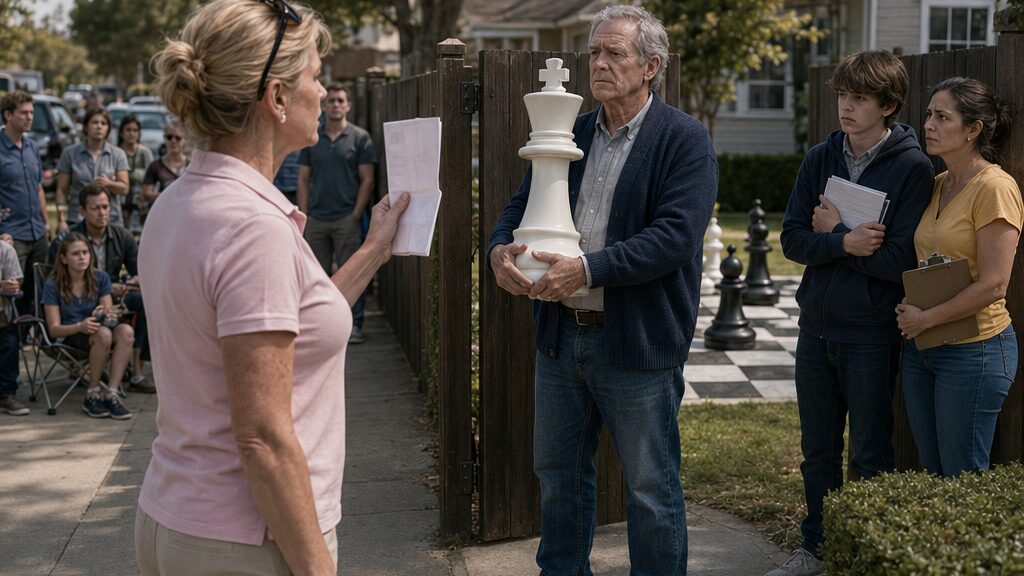
“Why,” Melissa Thompson called over the fence, “is there a giant chessboard in your backyard?”
Robert Miller had the white king in both hands when she said it. He had just lifted it from the grass to wipe a streak of mud from its base, and now he stood there with the piece pressed against his chest like something rescued from a storm.
The board stretched across the back half of his lawn in black and white squares, eight by eight, bright enough that it made the rest of the yard look tired. The black pieces stood near the maple tree. The white ones lined up closer to the patio. From the second-floor windows of the surrounding houses, Robert supposed it must look ridiculous: a retired man, alone except on weekends, arranging pieces nearly as tall as small children.
Melissa did not wait for an answer.
She leaned over the shared fence, sunglasses pushed into her blonde hair though the sun had already dropped behind the roofs. She wore a pink polo with the little embroidered crest of the architectural committee, the kind of shirt that turned a neighbor into an office.
“Robert,” she said, using his name with the careful patience people used when they had already decided not to listen, “you cannot just install something like that.”
“It’s not installed,” Robert said.
“It is on your lawn.”
“It’s sitting on the lawn.”
“That is not the distinction you think it is.”
Robert looked down at the white king. Benjamin had painted the felt underside himself, kneeling on a tarp in the garage with his tongue caught at the corner of his mouth the way he used to do when he was little. He had wanted the pieces to slide without tearing the grass. Robert had said that was smart. Benjamin had pretended not to care, but his ears had gone red.
“It’s temporary,” Robert said.
Melissa’s eyes moved over the board, the painted plywood squares, the thick plastic pieces weighted with sand, the numbered stakes Robert had used to keep the rows straight.
“Temporary for what?”
Robert rubbed at the dried mud with his thumb. “For my grandson.”
Melissa’s expression shifted, but not enough to become sympathy. It was the look of someone meeting an excuse she had prepared for.
“I understand wanting to do things for family,” she said. “But we all live under the same rules.”
The back door slid open behind Robert. He did not turn fully, only enough to see Benjamin in the reflection of the glass. Tall now, too tall for the old school hoodie he still wore, with one hand on the doorframe and the other tucked in his pocket. His hair fell over his forehead. He saw Melissa, then the board, then Robert holding the king.
Robert gave the smallest shake of his head.
Benjamin stayed inside.
Melissa noticed anyway. Her gaze flicked to the door, then back to Robert.
“This is exactly how these things get out of hand,” she said more loudly. “One person puts up something unusual, then someone else decides they want a fountain, or a shed, or a play structure, and before long the neighborhood looks like nobody cares.”
A chair scraped on the patio next door on the other side. Robert saw the top of another neighbor’s head turn. The sound was small, but Melissa heard it too. Her shoulders squared.
“Frankly,” she said, “it’s an eyesore.”
Robert felt Benjamin vanish from behind the glass before he heard the door slide shut.
The word settled across the lawn harder than it should have. Eyesore. It made the squares look suddenly too bright, the pieces too big, the whole thing too exposed. Robert had known people might stare. He had known some would smile politely and some would not. But he had imagined a question asked with curiosity, maybe a joke about grandmasters and yard work, not this clipped little judgment delivered over cedar fencing.
He set the king down carefully on its square.
Melissa watched the care with which he did it. Something in her face tightened.
“Robert, I am trying to be neighborly by speaking to you first.”
“I appreciate that.”
“I’m not sure you do.”
He straightened, slower than he wanted to. His knees had started to object to the long afternoons of measuring and painting, though he would not have admitted it to Benjamin.
“The board will be gone after next Saturday,” he said.
“Next Saturday?” Melissa’s brow lifted. “So more than a week?”
“Nine days.”
“That is not temporary. That is an event.”
Robert did not answer.
“What kind of event?”
He glanced toward the sliding door. Behind the curtain, a shape moved away.
“It’s just for the kids,” he said.
“What kids?”
“Neighborhood kids.”
Melissa let out a short breath. Not a laugh exactly, but the beginning of one.
“Have you cleared this with the association?”
“It’s in my backyard.”
“That is not what I asked.”
Robert looked past her to the row of houses beyond the fence, each one with the same approved roof color, the same approved mailbox post, the same trimmed strips of lawn between driveways. When he and his wife had moved here twenty-six years earlier, the uniformity had comforted them. They had wanted quiet. They had wanted rules that kept people from parking rusted cars on blocks and leaving trash cans at the curb all week. He understood the appeal of order. He had spent thirty-four years as a school custodian, believing that a building stayed decent because someone noticed what others ignored.
But there were rules, and then there were people who used rules to avoid noticing people.
“No,” Robert said.
Melissa’s mouth thinned. “Then I strongly suggest you remove it before someone files a formal complaint.”
Robert looked back at her.
“Someone?”
Her face colored lightly, but she did not look away. “I chair the architectural committee. If I see something that violates our standards, I have an obligation.”
“Of course.”
“You say that as if I’m being unreasonable.”
“I didn’t say anything.”
“That’s part of the problem, Robert. You never say anything until everyone else has to guess.”
The accuracy of it struck too close, and for one second he almost told her.
He almost said that Benjamin had not invited anyone to the house in months after his grandmother died. That he had stopped going to youth group, stopped sitting at the lunch table with the boys he used to talk about, stopped answering texts unless they were about homework. That one afternoon Robert had found him in the garage with an old chess set, replaying openings his grandmother had taught him, and that had been the first time in weeks he had seemed to breathe like the room had air in it.
He almost said that the giant board had not been his idea. It had been Benjamin’s, first as a sketch, then as a joke, then as a plan other kids somehow said yes to. He almost said that next Saturday was not a party, not a stunt, not a rebellion, but the first thing Benjamin had looked forward to since the funeral.
Instead he picked up a black pawn that had tipped slightly sideways.
“It’ll be gone after Saturday,” Robert said.
Melissa stared at him, waiting for more. When he gave her nothing, she stepped back from the fence.
“I hope so,” she said. “Because if this becomes official, it will not be personal.”
Robert nodded once.
That seemed to irritate her more than arguing would have.
“Good evening, Robert.”
“Good evening, Melissa.”
She walked away across her patio, her sneakers silent on the concrete. A moment later, her sliding door shut with a final little snap.
Robert stayed in the yard until the first mosquitoes came out. He adjusted the pawn. He checked the king’s base again though the mud was gone. He bent to pick up the soft cloth from the grass, then stood still when he heard the kitchen door open behind him.
Benjamin came out holding his phone.
His face had gone flat in the way Robert had learned to fear. Not angry. Not crying. Just emptied of expectation.
“Grandpa,” he said.
Robert turned.
Benjamin held up the phone. The neighborhood message group was open. At the top was a photo taken from Melissa’s side yard, angled down over the fence. The chessboard looked harsher from there, black and white squares cutting the lawn into a spectacle. Robert’s back was in the picture. The white king stood beside him.
Under it, Melissa had written: Has anyone else noticed the unauthorized game installation behind Maple Court? I tried speaking privately. Some people seem to think “for family” means the rules don’t apply.
Below that, the first replies had already begun.
Robert looked from the phone to Benjamin’s face.
The boy swallowed once.
“They’re talking about it,” Benjamin said.
Robert reached for an answer and found only the silence he had been using all evening.
Chapter 2: The Notice on the Mailbox
The envelope was clipped to Robert’s mailbox with a black binder clip, as if someone wanted to make sure the whole street saw it before he did.
He found it Friday morning while the sprinklers ticked along the curb and a delivery truck idled two houses down. The paper inside was folded in thirds, heavy HOA letterhead on top, his name printed cleanly beneath the association logo. Someone had circled the response deadline in blue ink.
NOTICE OF ARCHITECTURAL VIOLATION.
Robert stood at the curb in his slippers and read the first paragraph twice before the words arranged themselves into something more than shapes.
Unauthorized recreational structure or installation visible from neighboring properties. Possible alteration to approved lawn use. Possible event activity without prior board approval. Removal required within seven days unless written variance or event-use permission is granted.
Seven days.
The tournament was eight days away.
Across the street, one of the skeptical neighbors slowed while walking a small dog. The neighbor’s eyes dropped to the envelope, then lifted quickly, as if politeness could erase having looked.
“Morning, Robert,” the neighbor said.
“Morning.”
“Everything all right?”
Robert slid the notice back into the envelope. “Just paperwork.”
The neighbor nodded with too much relief and kept walking.
Robert carried the notice inside and placed it on the kitchen table beside his coffee. The house was quiet. Benjamin was still upstairs, though Robert knew he was awake because the floorboards had creaked at six-thirty and the shower had run for exactly four minutes. The boy had developed a way of moving that made the house feel occupied by someone trying not to disturb his own life.
On the refrigerator, the tournament bracket hung under two magnets shaped like apples. Benjamin had drawn it by hand first, then printed a cleaner version from the library computer because Robert’s printer refused to recognize anything after 2018. Sixteen slots. Twelve already filled. Four blank lines where Benjamin hoped late sign-ups would go.
Next to it was a diagram of the backyard board, each square labeled in pencil. A note in Benjamin’s neat handwriting read: Remember: younger kids get white first round. Keep water cooler by patio. Ask Grandpa about extra folding chairs.
Robert touched the edge of the paper.
His wife would have laughed at the exactness of it. She had liked that about Benjamin, the way he organized courage into lists.
The stairs creaked.
Robert pulled his hand back as Benjamin entered the kitchen. The boy saw the envelope immediately.
“What is that?”
“HOA notice.”
Benjamin did not move. “From Melissa?”
“From the association.”
“That means from Melissa.”
Robert did not argue.
Benjamin crossed the room and picked it up. His eyes moved fast, then slower. He read the circled deadline, and Robert watched him do the math.
“It says seven days.”
“I know.”
“The tournament’s next Saturday.”
“I know.”
Benjamin put the notice down with care that looked like restraint and sounded like anger.
“So what happens?”
“We submit a request. There’s a form.”
“Did you already submit one?”
Robert looked toward the backyard, where the top of the white queen was just visible through the kitchen window.
“No.”
Benjamin’s expression shifted. “Why not?”
“I thought because it was in the backyard, and temporary—”
“You told me we were okay.”
“I said I thought we were okay.”
“That’s not the same thing.”
Robert closed his mouth.
Benjamin folded his arms and looked at the refrigerator bracket. There were pencil smudges on one corner from where he had erased and rewritten a child’s last name because the child had asked not to be in the first round against an older sibling. Small things. Careful things. The kind of planning adults called cute until it inconvenienced them.
“Maybe we should cancel,” Benjamin said.
The sentence landed harder than the notice.
“No.”
“Grandpa—”
“No,” Robert said again, too quickly.
Benjamin flinched, not much, but enough.
Robert softened his voice. “We’re not canceling because of one notice.”
“It’s not one notice. Everyone saw the post.”
“Not everyone.”
“Enough.”
Benjamin picked up his phone from the counter and unlocked it. He did not show Robert this time. He just scrolled, his thumb making small angry movements.
“They’re saying you’re being stubborn,” he said. “They’re saying people move here because it doesn’t look like a playground. Someone asked if there’s going to be noise.”
“It’s chess.”
Benjamin gave him a tired look. “People can complain about anything.”
That, Robert could not deny.
He reached for the notice and read the second page. There was a citation number, a bylaw reference, and a line about approved lawn ornamentation and recreational fixtures. Melissa had known exactly where to aim.
“I’ll call James Lewis,” Robert said.
“Will that fix it?”
“It might.”
“Will you tell him about the tournament?”
“Yes.”
“All of it?”
Robert paused.
Benjamin saw it. His face closed further.
“Grandpa.”
“I don’t think everyone needs to know our business.”
“It’s not our business anymore. Melissa put it in the neighborhood chat.”
“She doesn’t know what it is.”
“Because you won’t say.”
Robert felt his grip tighten on the paper. “I’m trying to keep people from talking about you.”
“They already are.”
The refrigerator hummed between them.
Benjamin looked younger suddenly, though he was nearly as tall as Robert. The hoodie sleeves covered his hands. His hair still had a wet line from the shower. He stared at the bracket as if the names on it had betrayed him.
“We can do it at the library,” he said. “Normal boards. Nobody has to come here.”
“You wanted the big board.”
“It was stupid.”
“It wasn’t.”
“It looks stupid now.”
Robert heard Melissa’s word return: eyesore.
He crossed to the refrigerator and gently straightened the bracket though it was not crooked.
“Your grandmother would have said the first rule of chess is not to resign just because you don’t like the position.”
Benjamin’s eyes sharpened. “Don’t do that.”
Robert turned.
“Don’t bring Grandma into it when you’re the one who didn’t fill out the form.”
There it was. The move Robert had not seen because he had been staring at the wrong part of the board.
Benjamin’s anger was not only at Melissa. It was at him.
Robert looked down at the notice. The language was dry, but underneath it was something very simple: he had assumed he could shield the boy by keeping things small and quiet. Instead he had left Benjamin’s work exposed with no protection except an old man’s good intentions.
“I should have filed it,” Robert said.
Benjamin seemed unprepared for the admission. His shoulders lowered an inch.
“Yeah,” he said.
“I’ll try to fix it.”
“How?”
“I’ll ask for the event-use permission. I’ll show them the sign-up sheet.”
Benjamin’s mouth tightened. “Don’t show them the thing about Grandma.”
“I won’t.”
“Promise.”
Robert looked at the bracket, at the four blank spaces still waiting for names.
“I promise.”
The phone in Benjamin’s hand buzzed. He looked down despite himself. Robert watched color rise in his face.
“What?”
Benjamin shook his head.
“Benjamin.”
He turned the screen around.
Melissa had posted again, this time under the same thread, with a photograph of the HOA notice clipped to Robert’s mailbox. The caption read: Official process has begun. Some neighbors think rules do not apply to them, but standards protect all of us.
Underneath, someone had typed: Good. It was starting to look like a carnival setup.
Benjamin took the phone back and pressed it facedown on the table.
Robert stared at the notice, then at the bracket, and felt for the first time that removing the chessboard might not spare Benjamin humiliation at all. It might only teach him that the first person to complain got to decide what everyone else was allowed to love.
Chapter 3: The Meeting Where Nobody Asked Why
Robert walked into the HOA clubhouse Monday night and saw his backyard projected on the wall.
For a moment he did not understand what he was looking at. The image was too large, too bright, too unkindly angled. The giant chessboard filled the screen behind the board table, its white squares glaring under the fluorescent lights. His patio chair sat crooked at one edge. A garden hose he had forgotten to wind properly looped near the fence like evidence of moral failure.
Six people turned when he entered.
Melissa was already seated at the side table with a folder in front of her. She did not smile. James Lewis, the HOA president, sat at the center, glasses low on his nose, fingers resting on a stack of printed bylaws. Anna Garcia sat two rows back, close to the aisle, her purse in her lap and her expression arranged into neutrality.
Robert’s hand moved inside his jacket pocket and closed around the small chess timer Benjamin had given him to bring. It was old, beige plastic, found at a thrift store, with two buttons on top. Benjamin had said maybe it would make them look organized. Robert had not told him that no object could do that if people had already decided you were disorder.
“Mr. Miller,” James said. “Thank you for coming.”
Robert nodded and took the chair facing the board.
The clubhouse smelled faintly of carpet cleaner and coffee. On the wall beside the projector screen hung framed photographs from past association events: fall cleanups, holiday light contests, a summer picnic where Robert’s wife stood in the back row wearing a blue blouse. He did not let himself look at that one for long.
James cleared his throat.
“We’re here to discuss the temporary recreational installation at your property and the associated complaint.”
“Complaints,” Melissa corrected.
James glanced at her.
Melissa opened her folder. “There are multiple written concerns from surrounding residents.”
Robert looked at the projected photograph again. “How many?”
Melissa hesitated just long enough to answer more carefully than she wanted.
“Four.”
“Four surrounding residents?”
“Four residents with reasonable concerns.”
James adjusted the papers in front of him. “The number is less important than the question of compliance.”
“That’s right,” Melissa said. “And compliance is not complicated here.”
Robert waited.
Melissa turned one page. “The architectural standards prohibit visible recreational structures not approved by the committee. They also prohibit alterations to the intended residential appearance of lawns. Mr. Miller’s board is large, highly visible from neighboring second-story windows, and, based on neighborhood discussion, intended for an event.”
The phrase neighborhood discussion had a polished sound. Robert wondered if that was what gossip became when printed.
James looked at him. “Mr. Miller, is the board intended for an event?”
Robert pressed the timer in his pocket until one button clicked softly.
“Yes.”
Melissa’s eyebrows lifted, as if confession had arrived earlier than expected.
James made a note. “What kind of event?”
“A chess tournament.”
One board member shifted in his chair. Another looked up from the papers.
“For whom?” James asked.
“Neighborhood children.”
Melissa leaned forward. “Was this tournament approved by the board?”
“No.”
“Was it submitted to the social committee?”
“No.”
“Was traffic reviewed? Liability? Restroom access? Noise?”
Robert looked at her. “Noise?”
“It is still an event.”
“It’s chess,” he said quietly.
A few eyes moved away. Anna’s hands tightened on her purse strap.
James held up one hand. “Let’s keep this orderly.”
Melissa sat back, but her face said she had made her point.
Robert understood, with a slow sinking clarity, that she was not entirely wrong. Not about everything. He had thought of water, chairs, shade, first aid, the bracket, which child might need help understanding en passant. He had not thought of liability. He had not thought of parking. He had not thought of the fact that a backyard full of children could become, in the language of the association, a risk.
He had mistaken harmlessness for permission.
James turned a page in the bylaw packet. “There is, however, an event-use provision.”
Melissa’s head turned sharply toward him.
“It’s rarely used,” James continued, “but it allows temporary structures or equipment for youth, civic, or community events, provided the board grants permission and the resident submits a written plan in advance.”
Robert felt the first small opening in the room.
“How far in advance?” he asked.
“Generally thirty days.”
The opening narrowed.
Melissa’s pen tapped once against her folder.
James looked at him over his glasses. “Did you submit any written plan?”
“No.”
“Did you contact the board informally?”
“No.”
“Did anyone from the recreation department or county office sign off on this?”
Robert thought of the county recreation coordinator’s email printed at home, the one saying they were happy to list the tournament in the weekend youth bulletin if Robert confirmed the location. He had not confirmed because he had wanted the HOA issue settled first. Every delay had been him waiting for a safer square.
“Not yet,” he said.
Melissa spread her hands. “That is exactly the problem.”
Anna shifted in her seat.
James looked toward her. “Mrs. Garcia, you asked to speak?”
Anna startled slightly. “Only if needed.”
“You’re here as a nearby resident?”
“And parent,” she said.
Melissa’s gaze moved to her, warning or invitation, Robert could not tell.
James nodded. “Do you have concerns?”
Anna looked at Robert, then at the screen. Her face held apology before she spoke.
“I don’t think Mr. Miller meant any harm,” she said. “I want that clear.”
Robert felt himself brace.
“But I also didn’t know there was going to be a larger gathering until the chat started. My youngest plays outside. Parking gets tight. And I think some of us were surprised because it looked like…” She stopped.
“Like what?” James asked.
Anna swallowed. “Like something was happening that nobody had been told about.”
Melissa’s posture eased, almost imperceptibly.
Robert looked down at his hands. His fingernails still held faint white paint from touching up the rook bases. He could not blame Anna for wanting to know what was happening next door. He could blame himself for letting Melissa be the one to explain it first.
James leaned back. “Mr. Miller, why wasn’t this submitted?”
There it was. The question closest to the truth. Not why the board existed, but why Robert had tried to keep something public hidden.
He could have said Benjamin’s name. He could have said grief. He could have said that some children needed an invitation disguised as a game because walking into a room and asking for friends was too hard. He could have said he was afraid that if adults got hold of it, they would turn it into waivers and parking diagrams and opinions until the boy who built the thing disappeared from his own idea.
But Benjamin had made him promise.
“I thought temporary meant no approval was needed,” Robert said.
Melissa gave a faint sigh.
James studied him for a moment. “That may be what you thought. It is not what the rule says.”
“No.”
“And the event is this coming Saturday?”
“Yes.”
James removed his glasses and rubbed the bridge of his nose. For the first time, he looked less like an authority figure and more like a man who had inherited a mess no rule quite wanted.
“I’m not comfortable approving an unsubmitted event from the table tonight,” he said. “But I’m also not comfortable ordering removal before we know whether the event-use provision applies.”
Melissa opened her mouth. James raised one finger.
“Mr. Miller,” he said, “you have forty-eight hours to submit proof of community purpose. Sign-up list, parent permissions, basic parking plan, duration, any correspondence with the county recreation office, and a written statement explaining the temporary nature of the board.”
Robert nodded slowly.
Forty-eight hours.
It was more than nothing. It was also a doorway so narrow he would have to choose what truth to carry through it.
Melissa capped her pen. “And if he does not submit it?”
“Then the removal deadline stands.”
“And if he does?”
“Then the board will review it.”
Melissa looked unsatisfied, but not defeated.
The meeting moved on to mailbox paint colors and a complaint about trash cans left visible from the street. Robert sat through all of it because leaving early felt like another kind of guilt. The chess timer warmed in his pocket. He imagined Benjamin at home, pretending not to wait for the answer.
When the meeting adjourned, Anna approached him near the door.
“Robert,” she said softly, “I didn’t mean—”
“It’s all right.”
“I really didn’t know there were kids signed up.”
He nodded.
She waited for him to say more. When he did not, she looked almost hurt.
“You make it hard to help you,” she said.
Then she walked out into the parking lot.
Robert remained under the clubhouse porch light after everyone else had gone. Through the window, the projected image of his backyard still glowed faintly on the wall. The chessboard looked abandoned there, enlarged and judged by a room that had never asked why it had been built.
His phone buzzed.
A text from Benjamin appeared.
What happened?
Robert looked at the message for a long time before typing.
They gave us 48 hours.
Three dots appeared, vanished, appeared again.
For what?
Robert looked through the glass at the distorted black and white squares on the clubhouse wall.
Proof, he typed.
He did not add what he now understood: the proof they needed was not only papers, and the part that mattered most was the part he had promised not to say.
Chapter 4: The Empty Square in Benjamin’s Plan
Benjamin tore the tournament bracket off the refrigerator so fast that one of the apple magnets snapped against the tile and cracked.
Robert stood at the kitchen counter with James Lewis’s checklist in one hand and a half-filled event-use form in the other. The deadline was the next evening. The form asked for time, purpose, estimated attendance, parking control, restroom access, emergency contact, cleanup plan, and whether any temporary equipment would be visible from neighboring properties.
Every line seemed designed to turn Benjamin’s careful idea into a problem.
“Don’t,” Robert said, but the word came out too late.
Benjamin folded the bracket once, badly, crushing the names in the middle.
“I’m not going to have them vote on me,” he said.
“They’re not voting on you.”
“They are. You just don’t want to call it that.”
Robert set the papers down. “They’re voting on whether we can use the yard.”
Benjamin laughed without humor. “The yard. The pieces. The kids. The thing I asked people to come to. But not me.”
He moved toward the trash can.
Robert crossed the kitchen faster than his knees liked and put a hand on the lid.
“Please don’t throw it away.”
Benjamin’s eyes flashed. “Why? So Melissa can take a picture of that too?”
The name sat between them. Since Thursday, Melissa Thompson had become part of the house without ever entering it. Her words lived in the phone, in the mailbox, in the clubhouse projector, in the way Benjamin now looked at the backyard before stepping outside.
Robert let his hand fall from the trash can. “I didn’t handle this right.”
“You keep saying that like it fixes anything.”
“It doesn’t.”
“Then what does?”
Robert looked at the crushed bracket in Benjamin’s fist. Twelve names, four blank spaces. A week ago, Benjamin had worried the four empty spots would make the tournament look unpopular. Now the empty spaces seemed like the safest part of the page.
“I can give James the forms,” Robert said. “I can show him the parent emails. The county message.”
“And when he asks why we didn’t do this the right way?”
“I’ll say I misunderstood.”
“That’s true.”
“Yes.”
“But it’s not all of it.”
Robert leaned back against the counter. The kitchen suddenly felt too small for all the things he had not said.
Benjamin’s voice dropped. “You always do this.”
“Do what?”
“Make everything quiet until it gets worse.”
Robert flinched, though the boy had not raised his voice.
Benjamin looked toward the backyard. The chessboard lay under a light gray evening, one black square uncovered where a corner of the tarp had pulled loose. The empty square looked like a missing tooth.
“When Grandma got sick,” Benjamin said, “you kept telling me she was resting.”
Robert’s mouth went dry.
“You told me not to worry her. You told me not to ask too many questions. Then one day she was in the hospital and everybody was acting like I should already understand.”
Robert gripped the counter edge.
“I thought I was helping,” he said.
“I know.” Benjamin’s face tightened. “That’s the problem.”
The refrigerator hummed. The cracked apple magnet lay near Robert’s shoe.
He had not expected the conversation to turn there, though maybe every conversation in the house had been turning there for a year. His wife’s absence was not a room they entered. It was the hallway they crossed every day pretending not to hear the floorboards creak.
“She didn’t want you scared,” Robert said.
“I was scared anyway.”
Robert could not argue with that.
Benjamin unfolded the bracket and tried to smooth it against his thigh. The paper had a hard crease through the center, cutting between two first-round matchups.
“She taught me the London System,” Benjamin said.
Robert looked up.
“She said it was boring in a useful way. Like oatmeal.”
Despite himself, Robert almost smiled. His wife had said that about many things: oatmeal, sensible shoes, thank-you notes, opening with pawns.
Benjamin’s eyes stayed on the backyard. “After she died, I kept playing it because it made me feel like there was one thing that still went in the right order.”
Robert swallowed.
“I didn’t start the club because I wanted everybody to know that,” Benjamin said. “I started it because some kids at school were always sitting in the library after lunch, not talking to anyone. I knew what that felt like. So I asked if they played. Then one of them brought his sister. Then somebody said we should have a tournament. Then I said my grandpa could make a board.”
His voice cracked on the last sentence, and he hated it. Robert could see him hate it.
“That’s what I don’t want them voting on,” Benjamin said. “Not Grandma. Not me being sad. Not kids needing somewhere to go. I just wanted it to be chess.”
Robert looked past him at the board outside. He remembered the first afternoon they had measured the lawn, Benjamin holding the tape while Robert pushed stakes into the grass. Benjamin had corrected him when the first row came out crooked. Robert had pretended offense. His wife would have stood on the patio with iced tea and declared them both equally hopeless.
“I should have asked you what you wanted me to say,” Robert said.
Benjamin folded the bracket more carefully this time. “You should have asked me before you decided not to say anything.”
The sentence found its mark.
Robert walked to the back door and opened it. Evening air slipped into the kitchen. The smell of cut grass and plywood paint came with it. He stepped onto the patio, and after a moment Benjamin followed.
They stood side by side looking at the tarp. One corner had blown back fully now, exposing that single empty white square. All the other covered squares formed soft hills beneath the fabric. The uncovered one shone plain and vulnerable.
“Your grandmother used to tell me,” Robert said, “that I treated hard things like spills in a school hallway. Put up cones, keep everyone back, clean it alone.”
Benjamin did not answer.
“She said sometimes people need to see the mess before they understand why the floor is wet.”
“That sounds like her.”
“It annoyed me every time.”
“That also sounds like her.”
Robert bent to pull the tarp back into place, but Benjamin stopped him.
“Leave it.”
Robert looked at him.
Benjamin stared at the empty square. “It looks like the board forgot something.”
Robert nodded slowly. “Maybe it did.”
They stood there until the porch light blinked on.
Inside, Robert’s phone buzzed on the counter. Once. Twice. Then the doorbell rang.
Benjamin stiffened. “Is that Melissa?”
Robert went through the kitchen and toward the front door with a heaviness in his chest. The last time someone had come to his door without calling first, they had left a notice.
But when he opened it, Anna Garcia stood on the porch holding a manila folder against her ribs. Her hair was pulled back messily, and there were pen marks on the side of her hand. She looked both nervous and determined.
“I’m sorry it’s late,” she said.
Robert glanced past her to the street. No one else stood there.
Anna held out the folder. “These are parent permission forms. Nine of them. I found out the kids had already sent them through the school chess group, and Melissa didn’t mention that at the meeting.”
Benjamin appeared behind Robert in the hallway.
Anna saw him and softened. “I didn’t know, Benjamin. I really didn’t.”
Benjamin did not step forward.
Robert took the folder.
Inside were signed forms, printed emails, and a handwritten note from one parent: Thank you for giving them something kind to do.
Anna looked at Robert, then at Benjamin.
“There may be more,” she said. “If you still want them.”
Chapter 5: Cars Along Both Sides of the Street
Robert opened his curtains Saturday morning and found cars parked along both sides of Maple Court.
For three seconds, he thought he was still dreaming. Then a minivan rolled slowly past his mailbox, stopped, backed up awkwardly, and squeezed into the last open stretch of curb between a young oak tree and the fire hydrant. A child climbed out holding a folding chair in one hand and a small chess clock in the other.
Robert let the curtain fall.
Behind him, the house was already awake in quiet fragments: Benjamin moving chairs in the kitchen, the refrigerator door opening and closing, the soft thud of bottled water being loaded into a cooler. The tournament had become real while Robert slept badly beside a stack of approved-looking papers that still had not been approved.
Anna had come back twice after that first night. Once with more permission forms, once with a list of parents willing to help direct parking and clean up afterward. The county recreation coordinator had emailed a short confirmation saying the event could be listed as a neighborhood youth activity if local residential permission was secured. Robert had sent everything to James by the deadline.
James had replied with one sentence: The board will review on site Saturday morning before any event begins.
Nothing about that sentence had helped Robert sleep.
“Grandpa?” Benjamin called from the kitchen. “How bad is it?”
Robert looked through the curtain again. A father was lifting a cooler from a trunk. Two children stood on the sidewalk pointing toward the side gate, whispering as if the house contained a celebrity.
“Depends what we mean by bad,” Robert said.
Benjamin appeared with a stack of printed brackets against his chest. He looked through the window and went still.
“That’s too many cars.”
“It’s a good number of cars.”
“It’s an HOA number of cars.”
Robert almost smiled, but Benjamin’s face was pale.
“We have Anna’s parking plan,” Robert said.
“Melissa won’t care.”
“No.”
Benjamin looked at him.
Robert corrected himself. “She may care. Not in the way we’d like.”
At eight-thirty, Robert carried the white king through the side gate.
The backyard was damp with morning shade. The board waited under the tarp, edges weighted with bricks. He removed the bricks one by one, folded the tarp, and revealed the black and white squares. For a moment, the yard looked as it had before anyone complained: strange, bright, hopeful.
Then voices came from the driveway.
Anna stood near the gate with a clipboard, directing families to sign in. She wore a yellow shirt and the expression of someone who had decided neutrality was no longer useful.
“First round starts after board review,” she told a parent. “Please keep kids out front until Robert gives the okay.”
A child peeked around her hip and saw the chessboard. His mouth opened.
“It’s huge,” he whispered.
Robert heard Benjamin behind him.
The boy was standing just inside the gate, holding the bracket pages. He had dressed in a collared shirt without being asked. His hair still fell over his forehead, but he had tried to comb it. Robert wanted to say something and knew any tenderness might undo him, so he nodded toward the folding table.
“Tournament director should probably check in players.”
Benjamin blinked at the title. Then he crossed the yard.
Robert carried the white king to its square and placed it down with both hands.
The piece clicked faintly against the painted board.
Out front, the tone of voices changed.
Robert looked up.
Melissa Thompson was coming down the sidewalk with the HOA notice in one hand and a folder in the other. Her pink polo was pressed, her sunglasses fixed on top of her head. She looked at the cars first, then the parents, then Anna’s clipboard, then Robert standing beside the giant king.
“This cannot be happening,” she said.
Anna stepped toward her. “Good morning, Melissa.”
“Anna, are you checking people into an unapproved event?”
“I’m helping keep the sidewalk clear.”
“That is not what I asked.”
“It’s what needs doing at the moment.”
Melissa’s eyes narrowed, surprised less by the answer than by who had given it.
Robert walked through the gate to the driveway. He wiped his palms on his jeans before he realized what he was doing.
“Melissa,” he said.
She held up the notice. “The removal deadline is still active.”
“The board is reviewing this morning.”
“The board has not approved anything.”
“No.”
“Then why are there families here?”
Before Robert could answer, a car door slammed nearby. A child called, “Mom, I see the board!” Another child answered, “That is so cool!”
Melissa’s jaw tightened.
“This is exactly what I warned everyone about,” she said, voice low but sharp. “You turned a violation into a spectacle.”
Robert felt the old instinct rise: lower the temperature, say little, take the blame privately. He could almost see the safe move. Apologize. Ask everyone to wait. Tell Benjamin to keep the children out of sight. Give Melissa room to feel in control again.
Then he looked past her.
Benjamin stood behind Anna with the brackets held flat against his chest, watching Robert as if waiting to see whether he would disappear again inside silence.
Robert turned back to Melissa.
“It isn’t a spectacle,” he said. “It’s a tournament.”
“You keep saying that as though naming it changes the rule.”
“No. It changes what you’ve been telling people it is.”
A few parents nearby stopped pretending not to listen.
Melissa’s face flushed. “I have told people there is an unauthorized installation and an unapproved event. Both are true.”
“They’re not the whole truth.”
“Then perhaps you should have provided the whole truth before inviting half the neighborhood to your yard.”
Robert took the hit because part of it was deserved.
“You’re right,” he said.
That stopped her for a beat.
“I should have filed the form,” he continued. “I should have spoken to James before we built it. I should have asked about parking and permission and all the things an association has to ask about. That is on me.”
The parents had gone quiet now. Anna looked down at her clipboard. Benjamin’s face had changed, wary and uncertain.
“But you took a picture over my fence,” Robert said. “You posted it before you asked who was involved. You called it an eyesore where children could read it. You made it sound like I was using my grandson as an excuse.”
Melissa’s mouth opened, but no words came.
Robert’s voice stayed even. That mattered. He did not want to win by becoming louder than her.
“These kids have been planning this for months,” he said. “They made brackets. They sent permission forms. They asked for water stations and timers and extra chairs. Some of them have never joined anything in this neighborhood before. Not because they don’t live here. Because they didn’t think there was a place for them.”
He glanced toward Benjamin, but not long enough to force him into the center.
“The board is big because a regular board only has two chairs,” Robert said. “This one lets people stand around it. Think together. See the same move.”
A child near the mailbox whispered, “That’s true.”
Someone hushed him, but gently.
Melissa looked from Robert to the waiting families. Her grip tightened on the notice.
“You still did not have approval,” she said.
“No,” Robert said. “I did not.”
A dark sedan pulled up behind Melissa’s house. James Lewis stepped out carrying a binder and wearing the expression of a man who had known the morning would be difficult and found it worse than expected.
He looked at the cars, the parents, the children, Anna’s clipboard, Melissa’s notice, and Robert by the gate.
“Mr. Miller,” he said.
“James.”
James closed the car door. “No games have started?”
“No.”
“Good.”
Melissa stepped toward him. “James, you need to shut this down before it becomes impossible.”
A murmur moved through the parents.
Benjamin took one step back.
Robert saw it. The boy’s retreat was small, almost nothing, but to Robert it looked like a piece being removed from the board.
James held up a hand. “Everyone needs to give me a minute.”
“There isn’t a minute,” Melissa said. “Look at the street.”
“I am looking.”
“And?”
“And I’m also looking at a sign-in table, parent permission forms, and children waiting quietly on a Saturday morning to play chess.” James turned to Robert. “That does not mean approval. It means I need to read what was submitted and determine whether the temporary youth event provision can apply.”
Melissa stared at him. “After the fact?”
James’s face hardened slightly. “On site, before the event begins.”
Robert heard the distinction and understood James had chosen it carefully.
Anna brought the clipboard over. “These are the check-ins. Parents have phone numbers listed. We have two volunteers for parking rotation.”
James accepted it.
A boy near the sidewalk raised his hand, then dropped it when his mother gave him a look.
James saw. “Question?”
The boy glanced at Benjamin. “Are we still playing?”
No one answered fast enough.
The question seemed to pass over the adults and land directly on Benjamin.
Robert felt the whole morning balance there. He could speak again. He could protect Benjamin from attention. He could explain, defend, manage, soften, absorb.
Instead he stayed quiet.
Benjamin looked at the boy, then at the white king visible through the open gate.
He stepped forward.
“My grandfather built the board,” Benjamin said, voice thin at first, then steadier. “But the tournament was my idea.”
Chapter 6: The Rule Nobody Had Used Before
James Lewis read the unused rule exception aloud while everyone waited in the driveway like a verdict might fall out of the binder.
“Temporary structures, displays, or equipment may be permitted at board discretion for youth, civic, educational, charitable, or community activities,” he said, one finger following the line, “provided such use is time-limited, supervised, does not create unreasonable obstruction, and is removed or stored at the conclusion of the approved period.”
A crow called from somewhere down the street.
No one laughed. No one moved.
Robert stood beside Benjamin near the gate, close enough to help, far enough not to become his shadow. Benjamin still held the bracket pages, but after saying the tournament was his idea, he had not retreated. His shoulders were tight. His ears were red. Yet he remained where everyone could see him.
Melissa stood opposite James with the violation notice folded lengthwise in her hand. The crease was sharp now from her fingers.
“That provision was meant for block parties and holiday decorations,” she said.
James looked up. “It does not say that.”
“It was never intended to allow someone to build a giant board in a private yard and ask forgiveness after the neighborhood fills with cars.”
Robert said, “She’s right about one part.”
Benjamin turned his head toward him.
Robert took a breath. “I did ask after the fact. That was my mistake.”
Melissa’s expression flickered. She had expected resistance, not agreement.
James closed the binder halfway. “Mr. Miller—”
“No,” Robert said. “It matters. If this causes extra work for the board, that’s because I didn’t ask early enough. Benjamin had plans. The kids had forms. Anna had parents ready to help. I was the one who thought keeping it quiet would keep it simple.”
Benjamin’s hands lowered slightly.
Robert faced James, not the gathered parents. “If the event goes forward, I’ll accept whatever condition you put on me. Storage, cleanup, parking, no amplified sound, no repeat event without written approval. I’m not asking you to pretend I did everything correctly.”
A woman near the curb murmured, “That seems fair.”
Melissa heard it. Her face tightened.
“What about precedent?” she asked.
James turned to her. “What precedent specifically?”
“The precedent that if enough people show up, the board caves.”
“The board is not caving.”
“That’s what it will look like.”
“And if we shut down a children’s chess tournament after receiving parent forms, a parking plan, and an applicable rule exception, what will that look like?”
Melissa did not answer immediately.
Robert saw the strain around her mouth. For the first time that morning, her anger looked less like certainty and more like fear trying to stand upright.
“You weren’t at the last quarterly meeting,” she said to James, though everyone could hear. “You didn’t sit there while people said the committee had let the neighborhood slide. Trash cans left out. Inflatable pools. Painted planters. That ridiculous mailbox on Sycamore. Everyone wants standards until someone has to enforce them, and then suddenly the person enforcing them is the problem.”
A few faces shifted. Not sympathy exactly, but recognition. American neighborhoods had a way of making volunteers into villains and then asking them to keep volunteering.
Melissa looked at Robert. “You think I enjoy being the person people complain about?”
Robert did not know what to say, so he said nothing.
Her voice lowered. “One exception becomes ten. Then everyone says, ‘But Robert had a chessboard.’ And I’m the one standing in someone’s driveway explaining why their son’s batting cage or their cousin’s bounce house is different.”
Benjamin looked down at the brackets.
Robert understood then that Melissa had not only seen an eyesore. She had seen a crack in the wall she was responsible for maintaining. It did not excuse the photo, the post, the word she had used. But it made her smaller and more human than the figure she had become in his kitchen.
James tapped the binder once. “That is why discretion exists. To tell the difference between cases.”
“Discretion is how rules become personal.”
“So is enforcement without context.”
The sentence quieted the driveway.
Anna stepped forward with the clipboard. “We have volunteers for parking every thirty minutes. Kids will use the downstairs bathroom only if Robert allows it. Parents are staying. We can be done by two, cleaned by three.”
James looked at Robert. “Is that accurate?”
“Yes.”
“Will the board remain in place after today?”
Robert glanced at Benjamin. The boy’s face changed, just enough.
“Not as it is,” Robert said. “We can store the pieces in the garage. The painted squares can be covered until review.”
Melissa seized on it. “Covered is still there.”
“It’s plywood panels,” Robert said. “They lift.”
James’s eyebrows rose. “They lift?”
Robert nodded. “Sixteen panels, four squares each. I built it that way.”
Benjamin added quietly, “So it wouldn’t damage the grass.”
James looked at him. “You planned that?”
Benjamin hesitated. “We did.”
A small sound moved through the parents, not applause, not quite approval, but surprise warming into respect.
James walked through the gate.
Robert followed with Benjamin and Melissa close behind. The backyard opened before them, bright and strange and waiting. Children gathered along the fence line but did not step onto the board. The oversized pawns stood in their ranks, black on one side, white on the other. The white king caught the morning light.
James crouched at the edge of the board and gripped one panel. Robert helped him lift. The panel came up cleanly, revealing green grass beneath, pressed but not torn.
Melissa watched.
“It’s still highly visible from neighboring homes,” she said, but the force had gone out of the words.
“For today,” James said.
He lowered the panel back into place and stood.
Robert’s phone buzzed. He ignored it. Then it buzzed again. Anna checked hers and frowned. A parent near the sidewalk looked down and whispered something to another.
Melissa noticed the ripple. “What now?”
Anna stepped toward Robert and showed him her screen.
In the neighborhood group chat, a parent had posted a photo from the street. It showed children waiting with chess clocks and folding chairs while adults stood in a tense half circle near Robert’s gate.
The caption read: HOA may shut down kids’ chess tournament because of “yard standards.” Is this really who we are?
Robert felt his stomach sink.
“That shouldn’t have been posted,” he said.
Anna looked guilty. “I didn’t post it.”
Melissa’s face went pale with anger. “This is exactly what I meant by spectacle.”
James looked from the phone to the street. More neighbors were appearing on porches now, drawn by cars, messages, curiosity, and the irresistible pull of conflict with a clear villain.
Robert could feel the morning changing shape. The danger was no longer only that the tournament would be stopped. It was that the tournament would continue by turning Melissa into the thing everyone gathered to condemn.
Benjamin seemed to understand at the same moment.
“Grandpa,” he said softly.
Robert looked at him.
Benjamin’s eyes moved toward the children waiting by the fence. “Please don’t let this become another fight.”
James closed his binder.
“Here is my decision for today,” he said, loudly enough for the driveway and part of the sidewalk to hear. “The youth chess tournament may proceed as a temporary supervised community activity under the event-use provision. The pieces must be stored after the event. The board panels must be covered or removed pending formal review next week. No future event is approved without written application.”
A breath released through the crowd.
Some children smiled before they were sure they were allowed to.
Melissa stared at James. “Formal review?”
“Yes,” James said. “Next week.”
Robert nodded. “Understood.”
James looked at him carefully. “And Mr. Miller?”
“Yes?”
“Today cannot become a trial of Mrs. Thompson on your lawn.”
Robert felt Benjamin watching him.
Across the board, the first oversized white pawn waited in front of the king.
Robert turned toward the parents and children.
“Tournament starts in ten minutes,” he said. “And before we begin, nobody here is going to make a game out of humiliating a neighbor.”
The children did not fully understand, but the adults did.
Melissa looked away first.
Then one small child, impatient with adult weather, stepped to the edge of the board and put both hands on a white pawn.
“Can I move this one when it starts?” he asked.
Benjamin glanced at Robert, then at James, then at the waiting board.
“Yes,” Benjamin said, his voice finally sounding like his own. “That’s the first move.”
Chapter 7: The Tournament Melissa Could Not Stop Watching
The first round started with more children than chairs.
Robert had counted twenty folding chairs the night before, then counted them again at sunrise, certain he had enough because only sixteen players could sit in a bracket meant for sixteen names. But he had not counted younger siblings who wanted to watch, parents who stayed longer than they meant to, or children who had not signed up but came because someone at school said there would be a chessboard as big as a room.
By ten-thirty, children lined the fence, perched on cooler lids, sat cross-legged on the patio, and stood around the giant board in a loose circle that made Robert’s backyard feel less like private property and more like a town square nobody had known they needed.
Benjamin stood at the folding table with a pencil behind one ear.
“First board, white to move,” he called.
The small child from earlier pushed the oversized white pawn forward with both hands. It scraped softly across the painted square.
A cheer almost began and then stopped, as if the adults remembered chess was supposed to be quiet. The children did not seem to care. They leaned in, whispering moves, correcting each other, arguing in soft bursts over whether a knight could “jump that far” and whether castling counted if the king was taller than the player moving it.
Robert watched from beside the water cooler, holding a stack of paper cups. His job had become smaller, which was both a relief and a strange ache. Benjamin did not need him to announce pairings. He did not need him to explain rules. He moved between children with a focus Robert had not seen since before the hospital bed had been delivered to the living room last year.
“Touch move,” Benjamin told one boy gently. “But since this is your first tournament, you can have one warning.”
The boy nodded solemnly, as if being granted mercy by a judge.
Across the yard, Melissa stood near the open gate with her arms folded.
She had not left.
At first Robert thought she was waiting for something to go wrong. A blocked driveway. A parent complaint. A child stepping into her flower bed. But as the first round settled, her expression changed in small ways. Her shoulders remained stiff, but her eyes followed the pieces. Once, when a little girl considered moving her queen too early and another child shook his head frantically from the sideline, Melissa’s mouth twitched before she caught herself.
Anna noticed too. She came to Robert with a half-empty sign-in sheet and lowered her voice.
“She’s still here.”
“I see that.”
“Should I ask her if she wants water?”
Robert looked at Melissa. “Would that be kind or strategic?”
Anna gave a tired little smile. “In this neighborhood, those are often the same thing.”
“Give her water.”
Anna crossed the yard with a paper cup. Melissa looked surprised, then wary. She accepted it anyway.
Robert turned back as Benjamin announced the next match. Two children stepped onto opposite sides of the board. One was a tall boy with athletic shorts and the restless confidence of someone used to being chosen first. The other was a smaller child wearing a hoodie despite the warmth, hands tucked into the sleeves.
Robert recognized the smaller child from Melissa’s driveway.
The child had visited Melissa’s house several times, usually dropped off in the afternoons by a relative. Robert had seen the child sitting on Melissa’s porch steps with a tablet while adults talked inside. He had never seen him in Robert’s yard before.
Melissa saw him at the same time.
Her hand tightened around the cup.
The child stood uncertainly at the black side of the board, staring at the pieces. Benjamin approached.
“You know how the pieces move?” he asked.
The child shrugged.
“Mostly.”
“You want a practice minute?”
The taller boy said, “That’s not fair.”
Benjamin looked at him. “It’s not a timed round until both players understand the board.”
The taller boy opened his mouth, then looked at the adults and closed it.
Benjamin crouched beside the smaller child and pointed, not touching the pieces. “Big board looks different, but it’s the same game. Pawns move one, except first move can be two. Knights are still weird. Bishops stay on their color.”
The child nodded.
Melissa watched without blinking.
Robert wondered if she had known. Not that the tournament existed, but that the child who sat on her porch had wanted something like this. Maybe she had been so busy guarding the neighborhood from disorder that she had missed the quiet disorder sitting within arm’s reach.
The game began.
It was not a brilliant game. Pawns clogged the center. A bishop got trapped for three turns. The taller boy lost a rook by forgetting the smaller child’s knight could fork two pieces at once. When the smaller child noticed, his face changed first in disbelief, then delight.
Benjamin grinned. “That’s a fork.”
“I did that?”
“You did that.”
The children around the board murmured approval. The smaller child looked toward the gate, not at Robert or Anna or any parent, but at Melissa.
Melissa lifted one hand slightly.
The child smiled, then turned back to the board.
Robert looked away before she could see him seeing it.
By noon, the backyard had warmed. Parents rotated parking duty. A cooler emptied and was refilled. James sat on the patio steps with the rule binder beside him, less like an enforcer now and more like a witness who had discovered that paperwork could not fully measure what was in front of him.
Melissa drifted closer to the board.
She stopped beside Robert while Benjamin reset the pieces for the semifinal. For a while neither of them spoke.
“I didn’t know that child played,” she said.
Robert followed her gaze. “Maybe he didn’t either.”
Melissa’s lips pressed together.
A parent nearby laughed softly when a child tried to lift a rook and found it heavier than expected. The sound loosened the yard.
Melissa said, “You understand why I reacted.”
Robert looked at her. “Some of it.”
“I’m not apologizing for enforcing rules.”
“I didn’t ask you to.”
She turned toward him then, frustrated. “That’s what makes this impossible. You say almost nothing, and then somehow everyone decides what you must mean.”
Robert felt the truth of that land uncomfortably.
“I know,” he said.
Melissa looked down at her cup. “After the last quarterly meeting, three people told me to my face that the committee was useless. One said if I couldn’t enforce standards, I should step down. Then your board appeared. Huge. Visible. No application. No notice. And when I asked, you said it was for your grandson, like that should end the conversation.”
“It was all I could say.”
“Why?”
Robert watched Benjamin call two names for the final match. The smaller child from Melissa’s porch had lost his game, but he had stayed, now helping a younger girl remember whose turn it was.
“Because grief becomes gossip fast,” Robert said.
Melissa’s expression shifted.
He regretted saying even that much, then decided regret had been running too much of his life.
“My wife taught Benjamin chess,” he said. “After she died, he stopped joining things. This was the first idea that brought him back toward people. I thought if I explained too much, people would turn it into a sad story about him instead of letting it be his tournament.”
Melissa stared toward the board.
“I didn’t know,” she said.
“No.”
“You didn’t tell me.”
“No.”
“But I also didn’t ask right.”
Robert did not answer.
She swallowed. “I did push too hard.”
The sentence seemed to cost her. Not enough for a public apology, not enough to undo the posts, but enough to be real.
“People are angry at me now,” she said.
Robert looked toward the street. A few neighbors still lingered near the curb, phones in hand. The morning’s post had traveled faster than any correction could. Melissa was beginning to feel the same machine she had set moving.
“They are,” he said.
“I suppose you think I deserve that.”
Robert thought of Benjamin seeing the photo of the chessboard in the group chat. He thought of the word eyesore. He thought of Melissa’s face when the child in the hoodie smiled at her.
“No,” he said. “Not like that.”
She looked at him sharply.
He nodded toward the board. “That’s not what today is for.”
The final match began with Benjamin standing beside the white king, explaining the rules to a circle of children who already knew them but listened because he was the one saying them. The oversized white king waited near the back rank, bright and awkward and somehow dignified.
The game was close. Two children circled the board, conferring with themselves under their breath. Pieces moved slowly, both hands sometimes needed for a bishop or knight. The crowd leaned in when one player left a rook undefended. Benjamin said nothing, though Robert could see how badly he wanted to.
At last, the girl playing white slid her queen across the board, stopped, frowned, then moved the white king one square aside first. A defensive move, small and quiet. Three turns later, it saved her from losing.
Benjamin saw it before anyone else. His face lit.
Robert felt his throat tighten.
His wife used to say that children revealed themselves not in the pieces they attacked with, but in the pieces they remembered to protect.
When the game ended, there was applause despite nobody planning it. Not loud, not theatrical, just relieved and warm. Melissa clapped too, late and lightly, but she did.
Benjamin handed out printed certificates from the folding table. He did not make a speech. He thanked Anna, the parents, James, and Robert. Then he paused.
“And everybody who came even though it got weird,” he said.
The children laughed.
Robert laughed too, quietly.
As families began packing chairs and collecting water bottles, Benjamin came to Robert near the white king. His face was tired, but not emptied out.
“You did good,” Robert said.
Benjamin looked at the board, then toward the street where Melissa stood alone by the curb.
“Grandpa,” he said, “don’t let the HOA turn this into another fight.”
Robert followed his gaze.
Melissa was reading something on her phone. Whatever it was, it had made her face go still.
Benjamin picked up the white king and held it out to Robert.
“This was supposed to be a place to play,” he said. “Not another place where people pick sides.”
Chapter 8: The Last Move Was Not Checkmate
The tournament photos were already on the table when Robert entered the HOA clubhouse one week later.
Not the harsh photo Melissa had taken over the fence. These were different. A child pushing a pawn with both hands. Benjamin leaning over a bracket with a pencil behind his ear. Parents folding chairs. The giant board seen from the patio steps, children around it in a loose circle, all of them bent toward the same problem.
Robert stopped just inside the door.
For a second, the room looked less like the place where his yard had been judged and more like a memory someone had handled carefully.
James Lewis sat at the center of the board table with the rule binder open. Melissa sat two chairs to his right, not at the side table this time. Her pink polo had been replaced by a pale blue blouse. She looked tired. Anna sat in the front row with the same manila folder, now neatly labeled. Benjamin stood beside Robert, holding the white king against his hip.
“You don’t have to stay,” Robert murmured.
Benjamin looked at the photos on the table. “Yes, I do.”
Robert nodded.
They took the two chairs facing the board.
James called the meeting to order without the usual long throat-clearing. The clubhouse was fuller than before, but quieter. Some parents had come. A few neighbors who had complained sat in the back with stiff expressions. The child from Melissa’s porch sat near the aisle beside an adult, looking down at a paperback book until Benjamin lifted a hand in greeting. The child smiled quickly and hid it.
James began with the facts.
“Last Saturday, the board allowed a supervised youth chess tournament to proceed under temporary event-use discretion. Conditions were met. The event ended on time. Pieces were stored. Panels were covered. No parking complaints were filed during or after the event. Cleanup was completed by three-fifteen.”
Robert kept his hands folded.
The board pieces were in his garage now, lined up along the wall under old sheets. The panels remained in the yard, covered with a neutral tarp James had approved until tonight’s review. The lawn beneath had flattened but not died. The house felt both emptier and calmer.
James turned a page.
“The question tonight is not whether Mr. Miller should be allowed permanent recreational installation rights beyond the governing documents. He should not, and he has not requested that.”
A small murmur moved in the room.
Melissa glanced at Robert.
Robert stood before James could ask him to.
“I’m not asking for special treatment,” he said.
His voice sounded steadier than he felt.
“I should have filed the application before the board went down. I didn’t. I thought because it was temporary and in my yard, it would be simpler not to bring it to anyone. That was wrong.”
He looked at Benjamin, then back to the board.
“But I am asking that we make a clear path for events like this. Not just mine. Any neighborhood youth event that has supervision, time limits, parking plans, and cleanup. Something people can apply for without guessing whether they’ll be treated like they’re trying to damage the neighborhood.”
One of the skeptical neighbors in the back shifted. “What about people abusing it?”
Robert turned slightly. “Then the board says no. Or says yes with limits. That’s what discretion is for.”
James’s mouth almost smiled.
Robert picked up the folded proposal Anna had helped him prepare. He did not read it like a speech. He simply laid it on the table.
“Seasonal use,” he said. “Written application. Neighbor notice. Pieces stored between events. No more than four youth activity days a year without separate approval. Panels removed if grass damage shows. Any event open to neighborhood children, not private parties.”
Melissa looked at the paper but did not touch it.
James asked, “And the chessboard?”
Robert drew in a breath. “If this passes, we’ll use it only on approved days. If it doesn’t, I’ll remove the panels by next weekend.”
Benjamin’s fingers tightened around the white king.
Robert felt it rather than saw it. That small tightening was the cost of saying the right thing in a room that could still say no.
James opened discussion.
There were questions, as Robert expected. Parking. Insurance. Whether “youth activity” included birthday parties. Whether a chessboard was different from a bounce house. Whether the association wanted to become an event venue. Anna answered some. James answered others. Robert answered only what he knew. When he did not know, he said so.
Then Melissa raised her hand.
The room quieted in the particular way it did when everyone pretended they had not been waiting for one person.
James nodded. “Melissa.”
She did not stand. For a moment, she only looked at the tournament photos.
“I treated the board as a symbol before I asked what it meant,” she said.
Robert looked down.
Melissa’s voice remained controlled, but it lacked its old sharp polish.
“That does not mean the rules were irrelevant. They weren’t. Mr. Miller did fail to apply. The board did create visibility and traffic questions. Those concerns were legitimate.”
A few neighbors nodded.
“But,” she continued, “I made a private concern public too quickly. I used language that children saw. I assumed motive from appearance. I would not want that standard applied to me.”
No one moved.
Robert felt Benjamin turn slightly beside him.
Melissa looked at him then, not at Robert.
“I am sorry for calling it an eyesore,” she said. “Not because I now understand everyone liked it. Because I should not have said it that way before I understood who had worked on it.”
Benjamin’s face changed, guarded and uncertain.
He gave one small nod.
Melissa looked back to James. “I support a limited policy. With clear restrictions. And with applications required in advance.”
James wrote something down.
Robert had imagined this moment many times over the past week, usually against his will. In some versions Melissa apologized grandly and everyone saw that Robert had been right. In others, she doubled down and the room turned against her. None of the imagined versions had included this uncomfortable middle: a flawed apology, a necessary rule, a dignity that required nobody to be crushed.
It was less satisfying than revenge.
It was better for Benjamin.
The vote passed with one abstention.
Seasonal youth-use guidelines would be drafted from Robert’s proposal and reviewed by counsel before final adoption. Until then, Robert’s chessboard could be used once more at the end of summer, provided the application was filed by the deadline and the pieces remained stored between events.
James looked at Robert. “Can you live with that?”
Robert glanced at Benjamin.
The boy looked at the white king, then at the photos, then at Melissa.
“Yes,” Robert said. “We can live with that.”
After the meeting, people did not know how to leave. Parents thanked James. A skeptical neighbor told Robert the tournament had been “more organized than expected,” which Robert accepted as the peace offering it was. Anna hugged Benjamin briefly, and he endured it with teenage stiffness and a shy smile.
Melissa approached while Robert was gathering the proposal copies.
“I shouldn’t have taken the picture over the fence,” she said.
“No,” Robert said.
“I deleted the post.”
“That helps.”
“It doesn’t undo it.”
“No.”
She nodded, accepting the answer because there was nowhere else to put it.
Benjamin stood a few feet away, waiting.
Melissa turned to him. “The child from my porch asked if there will be another tournament.”
Benjamin looked surprised. “There can be. If we file the application.”
The corner of Melissa’s mouth moved. “I have extra copies.”
For the first time, Benjamin smiled at her without needing to hide it.
By sunset, Robert and Benjamin were back in the yard.
The tarp lay folded on the patio. Together they uncovered one section of the board, just enough for a regular game played with the oversized pieces. The rest remained covered, a compromise in canvas and grass and rulebook language. It was not the board as Benjamin had first imagined it. It was not gone either.
Robert carried the white king to its square.
Benjamin watched him place it down.
“You know,” Benjamin said, “Grandma would have told you that you played the opening badly.”
Robert huffed. “She would have told me before breakfast.”
“She would also say you recovered in the middle game.”
“That generous?”
“Maybe after coffee.”
They set the pieces slowly. The yard was quiet now. No parents, no clipboards, no binders, no neighbors pretending not to watch. Just the two of them and the board that had been too strange, too visible, too much trouble, and somehow exactly enough.
Benjamin took the white side.
Robert sat on a folding chair at the edge of the board. “Your move.”
Benjamin looked over the pieces. He touched a pawn, then stopped. His hand moved to the king instead, resting briefly on its crown before letting go.
“Not checkmate,” he said.
“No,” Robert said. “Not yet.”
Benjamin moved his first pawn two squares forward.
Robert answered with his own.
The pieces stood between them in the evening light, not as proof that they had won, but as something quieter: a place where silence no longer had to carry everything alone.
The story has ended.