The Night The Downtown Traffic Monitor Turned Against The Law
CHAPTER 1: THE STRIKE ON THE ROOF
The violent crack of a heavy polycarbonate baton against sheet metal sounded like an artillery shell detonating directly over Marcus Bell’s head. Rain spray exploded off the glossy black roof of his sedan, misting through the driver’s side window that Marcus had lowered exactly two inches—just enough to pass documents, not enough to allow an aggressive hand inside.
Marcus did not flinch. His hands remained steady at the ten-and-two position on the leather-wrapped steering wheel, his knuckles relaxed, his breathing deep and slow. At thirty-four, with four years of night-shift legal research behind him before he started driving full-time to support his sister’s physical therapy, Marcus had learned that anger was an expensive luxury working men could never afford on midnight asphalt.
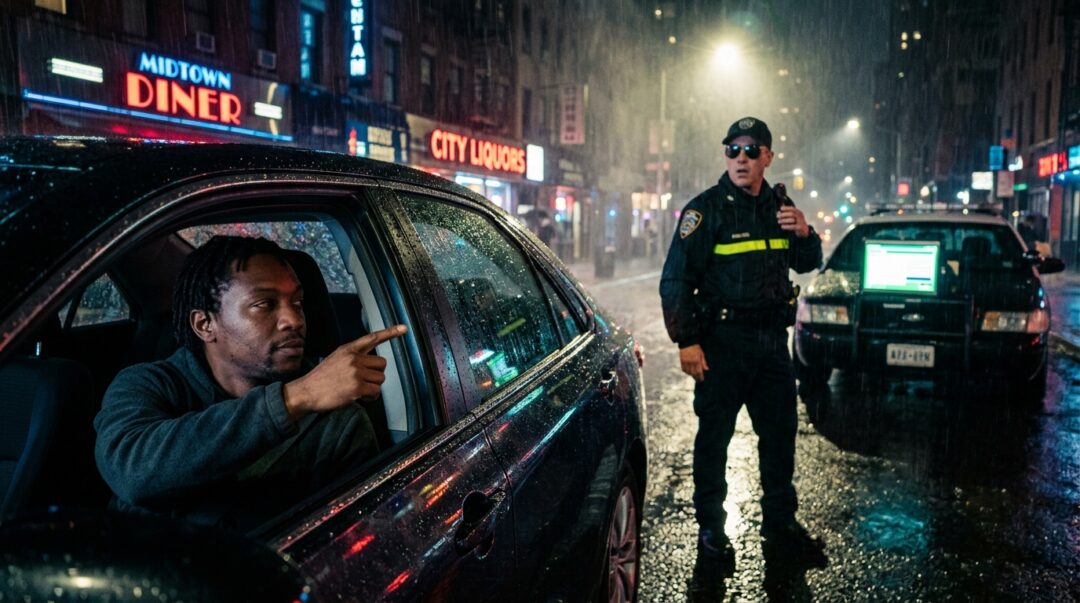
Outside, the rain fell in heavy, rhythmic sheets, turning Woodward Avenue into a black mirror reflecting the amber and crimson glow of distant neon signage. A late-model municipal cruiser was parked bumper-to-bumper behind Marcus’s hybrid, its high-intensity red and blue light bar slicing through the deluge with blinding strobe flashes.
Officer Frank Danvers leaned into the driver’s door frame, water cascading off the stiff brim of his patrol cap. He was a broad-shouldered man with a thick neck, wearing dark polarized sunglasses despite the fact that it was twenty minutes past midnight in the middle of a November thunderstorm. His yellow rain slicker was unbuttoned, exposing a tactical vest burdened with extra magazine pouches, a heavy taser holster, and a steel citation docket tucked into his belt.
“Nice clean hybrid,” Danvers sneered, his breath smelling of stale chewing tobacco and burnt diner coffee. “Real shame your chauffeur license is about to get suspended before dawn.”
Marcus kept his eyes looking straight ahead through the windshield, watching the wipers sweep rhythmic arcs across the glass. “Good evening, Officer. What is the probable cause for the traffic stop?”
Danvers laughed—a short, wet bark of contempt—and slapped the side of his baton against his open palm. “You blew the red light at Woodward and Grand River. Hard red. Full two seconds after the cycle turned. King County Traffic Code Section four-twenty-eight dash B. That is an automatic three-hundred-dollar moving violation, six points on your commercial endorsement, and an immediate vehicle safety impound.”
Marcus turned his head slowly, meeting the dark, opaque lenses of Danvers’ sunglasses. His voice was low, measured, and calm as a pond before rain. “The traffic control signal at Woodward and Grand River has been locked in caution flash mode since six o’clock this evening due to underground cable maintenance on the streetcar line. The signal was flashing yellow, Officer. Yellow means proceed with caution. I slowed to twelve miles per hour, checked the cross-lanes, and proceeded through.”
Danvers’ smile thinned into an ugly, predatory line. He took half a step closer, tapping the driver’s glass with the steel tip of his baton with enough force to make the tempered pane rattle in its tracks. “You want to play road-lawyer with me, boy? My unit carries an automated wide-angle optical enforcement camera calibrated to municipal standards. My screen says you ran a solid red. What my screen says goes into the citation book, and what goes into the citation book goes to the magistrate at eight o’clock in the morning.”
Marcus did not raise his voice. He did not pull out his wallet. Instead, he lifted his right hand from the steering wheel and slowly, deliberate as a chess player touching a rook, extended his index finger toward the rear windshield of his car.
“Officer,” Marcus said quietly, “your mobile data terminal is still active on the dash bracket.”
Danvers frowned, his head tilting back half an inch. “What the hell are you talking about?”
“Your terminal screen,” Marcus repeated, his cadence calm and unshakable. “The display faces right through your front windshield. It is broadcasting the rolling optical loop from your forward dashcam right now. You might want to take a look at what is playing.”
Danvers scowled, turning his head half a turn to look back at his idling cruiser.
Through the rain-streaked windshield of Unit 314, illuminated by the bright blue backlight of the Panasonic Toughbook laptop mounted to the center console, high-definition dashcam video was playing in a continuous, unarchived loop.
The timestamp in the upper corner read 12:14 AM—three minutes before the traffic stop.
On the screen, in vivid color and crystal clarity, Danvers’ own patrol cruiser was seen accelerating through the intersection of Woodward and Grand River at fifty-two miles per hour in a thirty-mile-per-hour zone. The streetcar signal above was plainly visible: a flashing amber arrow, completely unobstructed by rain or fog. The cruiser’s emergency light bar was completely switched off, its siren was silent, and the camera recorded the vehicle nearly clipping the rear bumper of a delivery van as Danvers blew straight through the intersection without even touching his brakes.
Danvers froze.
The blood seemed to drop entirely from the officer’s face, leaving his jaw the color of wet chalk. Rainwater dripped off the tip of his nose, off the edges of his dark glasses, and soaked through his collar, but he stood completely rigid, staring at the monitor that was broadcasting his own reckless driving for anyone on the street to witness.
“That… that is an internal equipment diagnostic,” Danvers stammered, his voice losing every trace of its previous swagger. “That is not public record.”
“It is logged directly to the precinct cloud server, Officer,” Marcus replied, his voice cool and clear beneath the drumming rain. “And your transponder speed telemetry is burned into the bottom corner of every frame. Shall we call the traffic division lieutenant to verify who was operating Unit Three-Fourteen three minutes ago, or would you like to put your baton away?”
Danvers’ chest heaved. His hand tightened around the rubber grip of his nightstick until the knuckles turned white. For three agonizing seconds, the only sound between them was the hiss of the storm.
Then Danvers leaned down, his sunglasses coming within six inches of Marcus’s face, his lips trembling with a terrifying mixture of humiliation and fury.
“You think you have leverage on me, rideshare boy?” Danvers whispered, his voice trembling with venom. “Step out into the rain and take a close look at my front bumper. Look real close at the blue paint scraped across my push-bar.”
Marcus felt the cold air tighten in his throat. Eighteen months ago, his sister Nia had been crippled in a hit-and-run on this exact avenue by a dark municipal cruiser that left metallic blue paint scraped across her door.
CHAPTER 2: THE AMBER FLASH AT WOODWARD
The rain fell harder, beating against the car roofs like muffled drums. Marcus did not move. His hands stayed on the wheel, but every tendon in his forearms locked solid as steel wire.
Eighteen months. For five hundred and forty nights, Marcus had sat beside his sister Nia’s hospital bed, watching orthopedic surgeons rebuild her pelvis and spine with titanium plates and bone grafts. The driver who had plowed into her small blue sedan at seventy miles per hour had blown the light, killed their mother’s last family car, and vanished into the rainy Detroit night without tapping the brakes. The police report filed that morning had been stamped ‘Unsolved Hit-and-Run / Vehicle Unidentified,’ signed off by a Third Precinct shift lieutenant who had closed the file forty-eight hours later.
And now Officer Frank Danvers was standing in the downpour, smiling an ugly, knowing smirk through the driver’s window.
“Step out of the car, Bell,” Danvers said, his voice dropping into a dangerous, low rumble. “Let us have a nice, professional conversation about paint transfer and municipal liability.”
Marcus did not hurry. He shifted the hybrid into park, engaged the emergency brake, and took his key fob from the console. He pushed the heavy door open against the wind, stepping out into three inches of standing slush. The cold rain soaked through his fleece hoodie in seconds, plastering the dark fabric to his shoulders, but he barely felt the chill.
He walked past the rear quarter panel of his car, keeping his hands open and visible at his waist, stopping three paces from the front bumper of Danvers’ cruiser.
Unit 314 sat idling with a low, menacing rumble from its heavy-duty interceptor engine. Mounted to the front frame was a heavy steel push-bar, scarred with old scrapes and scratches. But on the lower right tubular upright, beneath a fresh coat of cheap black rattle-can primer that had begun to flake in the rain, was a three-inch patch of metallic cobalt-blue paint.
The exact color of Nia’s 2018 Honda Civic.
Marcus knelt down on one knee in the wet gravel. He did not touch the bumper. He leaned forward, inspecting the scrape under the glare of his smartphone flashlight. Along the edge of the steel flange, stamped into the metal by the impact, was the unmistakable embossed outline of a miniature Honda emblem.
A dark shadow fell across Marcus. Danvers was standing over him, the heavy polycarbonate baton resting casually on his shoulder, his sunglasses finally pushed up onto the crown of his cap, revealing small, bloodshot eyes rimmed with exhaustion and panic.
“Recognize the handiwork?” Danvers asked softly. “Your sister should have looked both ways before turning onto Cass Avenue. She was in the wrong place at the wrong time.”
Marcus rose slowly to his full height. At five feet eleven inches, he was two inches shorter than the patrolman, but he stood with a rooted, immovable balance that made Danvers instinctively take half a step backward into the rain.
“She was turning on a green arrow, Danvers,” Marcus said, his voice as quiet and cold as river ice. “You were running forty miles over the limit with your lights off, hauling cash from the numbers house on Michigan Avenue.”
Danvers’ breath hitched. His eyes darted toward the empty sidewalks of Woodward Avenue. The street was deserted—no pedestrians, no storefront lights, only the steady hiss of water draining through sewer grates.
“You have a big mouth for a driver with a suspended sister at home,” Danvers hissed. “You think anyone is going to believe a rideshare driver over a decorated fourteen-year veteran? That report is buried six feet under in the municipal archives. The physical evidence was destroyed eighteen months ago.”
“The physical evidence is bolted to your front bumper right now,” Marcus replied, pointing down at the cobalt-blue paint. “And my phone just uploaded six ultra-high-resolution macro photographs directly to a cloud drive synced with the Wayne County Prosecutor’s Public Integrity Unit.”
Danvers reached for the radio handset on his shoulder with lightning speed. “Unit Three-Fourteen to dispatch. I have an uncooperative driver at Woodward and Grand River. Subject is refusing lawful orders and attempting to tamper with department property. Send a secondary unit for immediate vehicle search and narcotics interdiction.”
The radio speaker crackled, but before dispatch could acknowledge the call, a sharp mechanical click sounded from the shadows of an adjacent alleyway.
A second marked cruiser, its headlights off, rolled quietly out of the alley behind Marcus’s hybrid, blocking any possibility of reversing away from the curb.
The cruiser’s door swung open, and Officer Terry Briggs—a younger, nervous patrolman with a rookie badge and a tight, anxious grip on his holster—stepped out into the storm.
“Danvers?” Briggs called out, his voice trembling slightly over the wind. “What is going on here? Dispatch said you called for narcotics backup, but you have been on this stop for twelve minutes.”
Danvers did not take his eyes off Marcus. “Briggs, grab the pry bar from your trunk. We are opening this hybrid’s quarter panels. This driver is carrying contraband. I can smell it from here.”
Marcus looked between the two officers, the rain dripping from his dreadlocks. He knew what was coming. In sixty seconds, Danvers would ‘discover’ a baggie of white powder in the trunk lining, cuff Marcus to the bumper, and impound both cars before morning light.
Marcus reached into his pocket, his thumb finding the volume toggle on his phone.
“Officer Briggs,” Marcus spoke clearly, projecting his voice over the storm. “Before you touch my vehicle, you should know that Officer Danvers’ cruiser is Unit Three-Fourteen. The hit-and-run vehicle from eighteen months ago. And this stop is currently broadcasting live to twenty-two thousand followers on the Detroit Rideshare Drivers Alliance network.”
Briggs stopped in his tracks, his hand freezing on his duty belt.
CHAPTER 3: THE NEON ALLEYWAY
The silence that fell over the rain-swept intersection was heavier than the storm. Officer Terry Briggs stared at Marcus, his face pale under the brim of his wet cap. His gaze drifted slowly down to the front bumper of Unit 314, where the cobalt-blue paint transfer gleamed beneath the streetlamp.
“Danvers…” Briggs muttered, his voice barely audible beneath the roar of the wind. “Is that… is that true? Is this the car from the Cass Avenue collision?”
“Shut your mouth and search the trunk, Briggs!” Danvers roared, his voice cracking with hysteria. “Do not listen to this street hustler! He is bluffing! He does not have twenty thousand people watching anything!”
Marcus calmly turned his phone toward Briggs. The screen displayed a live streaming dashboard: a real-time chat feed was scrolling at blinding speed, comments pouring in from off-duty taxi drivers, delivery couriers, and civil rights advocates across Detroit. The viewer counter read twenty-four thousand one hundred and eighty. At the top of the screen, an active recording badge indicated that every word spoken on the sidewalk was being mirrored to three secure cloud servers.
Briggs took two steps backward, putting his hands up with his palms open toward Marcus. “I am not touching that vehicle, Frank. No way. I am not getting dragged into an internal affairs indictment for you.”
“You coward!” Danvers snarled, spitting a wad of tobacco onto the wet asphalt. “I got you onto this shift! I covered for you when you failed your firearms recertification last winter! You owe me, Briggs!”
“I owe you a cup of coffee, Frank, not ten years at Jackson State Prison,” Briggs said, backing toward his own cruiser. He keyed his shoulder microphone, his voice shaking. “Dispatch, this is Unit Three-Eighteen. Cancel the secondary backup request at Woodward. I am clearing the scene and returning to precinct headquarters.”
“Briggs, get back here!” Danvers yelled, but the rookie had already climbed into his squad car, thrown it into reverse, and sped away down Grand River Avenue, leaving Danvers alone on the curb with Marcus.
Danvers stood in the downpour, his yellow slicker soaked through, looking like a man who had stepped onto a frozen lake and heard the ice spiderweb beneath his boots.
He looked at Marcus’s phone, then down at his own nightstick. The arrogance was gone, replaced by a desperate, rat-like cunning.
“You think you won something, Bell?” Danvers whispered, stepping within inches of Marcus. “You think twenty thousand clicks on a smartphone can protect you? Let me tell you how this city works. My shift captain, Thomas Vance, is the one who approved the hit-and-run report. He is the one who took five thousand dollars from the towing company to lose the traffic camera tapes. You take this video to internal affairs, and Captain Vance will have four squad cars outside your apartment on Michigan Avenue within thirty minutes.”
Marcus did not blink. Rain washed down his cheeks, cold and clean. “Nia is not at the apartment.”
Danvers froze. His small eyes darted to the empty passenger seat of Marcus’s car.
“She hasn’t been at the apartment since nine o’clock,” Marcus continued, his voice calm, deliberate, and merciless. “She is at the municipal archives building on Fort Street. The building where public records requests are processed under the Michigan Freedom of Information Act.”
Danvers’ mouth fell open. “The archives are locked at night. The public entrance closed at five.”
“The public entrance is closed,” Marcus agreed. “But the basement terminal is open to licensed municipal paralegals who possess valid court research badges. Nia has had a research badge since before you ran her down on Cass Avenue, Danvers. And right now, she is printing the original fleet maintenance work order for Unit Three-Fourteen—the work order that Captain Vance forgot to shred.”
A strangled gasp tore from Danvers’ throat. He didn’t say another word. He turned on his heel, lunged into the driver’s seat of his cruiser, and slammed the heavy door.
The interceptor’s engine screamed as Danvers slammed the throttle down, the rear tires spinning against the wet asphalt before catching traction and rocketing away toward the downtown district, its siren howling like a wounded animal.
Marcus ran back to his hybrid, climbed inside, and keyed his hands-free cellular dialer.
The phone rang twice before Nia’s voice came through the car’s speakers—crisp, breathless, and tight with adrenaline.
“Marcus? I have it,” Nia said, the sound of an industrial high-speed laser printer whirring in the background. “I have the complete maintenance dispatch. Work order number eight-eight-four-two, dated May fourteenth of last year. Repair order: replace front push-bar and right-side quarter panel following unlogged vehicle collision on Cass Avenue. Authorizing signature: Captain Thomas Vance.”
“Nia, listen to me,” Marcus said, throwing the hybrid into drive and pulling away from the curb. “Danvers knows. He is driving toward Fort Street right now. He is running code three with his sirens hot. He will be at the archive building in less than four minutes.”
“The doors are magnetic-locked from the inside, Marcus,” Nia said, but her voice wavered. “He can’t get in without a master keycard.”
“Danvers has a master keycard for every municipal building in the Third Precinct, Nia,” Marcus said, pressing his foot flat against the floor. “Get out of the basement right now. Take the freight elevator to the loading dock on Congress Street. Do not wait for me. Run.”
“Marcus… the freight elevator is out of service,” Nia whispered, the terror finally breaking through her professional facade. “The maintenance sign is hanging on the gate. I am in a wheelchair, Marcus. I can’t take the stairs.”
Marcus gripped the steering wheel until his knuckles cracked. Ahead, through the driving rain, the neon signs of downtown Detroit blurred into streaks of fire as he raced south toward the river.
CHAPTER 4: THE ARCHIVE IN THE BASEMENT
The basement of the Wayne County Municipal Archives smelled of mildew, century-old paper pulp, and industrial floor wax. It was a subterranean cavern stretching beneath two city blocks, filled with towering rows of steel shelving that reached eighteen feet to the concrete ceiling. Overhead, ancient fluorescent light fixtures hummed with a low, sickening buzz, flickering erratically as the storm raged above.
Nia Bell sat in her lightweight aluminum wheelchair beside the primary research terminal, her fingers flying across the mechanical keyboard with practiced precision. Her breath came in short, cold puffs that misted in the unheated air. On the desk beside her lay three certified copies of Fleet Maintenance Work Order 8842, each bearing the official blue embossed stamp of the county records keeper.
Beside the documents was an eight-by-ten glossy photograph of Unit 314 taken in the police motor pool twenty-four hours after the crash. In the photograph, the cruiser’s push-bar was bent at a forty-five-degree angle, its lower flange coated in the unmistakable cobalt-blue paint of Nia’s crushed Civic.
A heavy, metallic thud echoed from the top of the stairwell sixty yards away.
Nia’s hands froze above the keyboard.
A master electronic keycard beeped with a shrill, double-toned chirp. The heavy steel fire door at the landing swung open, groaning on rusted hinges, followed by the heavy, measured crunch of combat boots descending the concrete steps.
“Nia!” Danvers’ voice echoed down the endless rows of file boxes, wet, harsh, and echoing like footsteps in a mausoleum. “You and your brother have caused a whole lot of unnecessary paperwork tonight! Why don’t you save us both the trouble and bring those files over here?”
Nia listened to the steady drip of condensation falling from the overhead steam pipes into the galvanized floor gutters. The subterranean humidity smelled of yellowed legal briefs and decades of forgotten municipal corruption. She kept her fingers tight around the armrests of her chair, recalling how her mother had worked two custodial jobs in this very building to put Marcus through paralegal school. The family had given twenty years of honest labor to this city, and she refused to let a crooked patrolman turn their sacrifices into ash.
Nia didn’t answer. She quickly reached down, slid the certified documents into a waterproof nylon messenger bag across her chest, and backed her wheelchair into the narrow shadows of Row 14, behind a twenty-foot rack of probate court ledgers.
The sound of Danvers’ boots grew louder. He was walking slowly, his flashlight beam slicing through the gloom between the metal shelves like a sword.
“You think you’re smart, little girl,” Danvers called out, his voice bouncing off the concrete ceiling. “You think an old work order proves anything? Captain Vance signed that as a training exercise collision. It’s categorized as internal department property damage. It’s privileged administrative data. It doesn’t even qualify for civil discovery.”
He paused. The beam of his flashlight hit the edge of the research terminal desk, illuminating the empty chair and the humming monitor where Nia had left the search query on screen.
Danvers reached the desk. He leaned over, looking at the display, and let out a low, guttural curse.
“You sent it,” Danvers snarled, realizing the files had already been transmitted via encrypted email. “Who did you send it to, you little cripple?”
From behind the probate shelf, Nia gripped the rubber hand-rims of her wheelchair, her heart hammering against her ribs like a trapped bird. She kept her breathing shallow, but the chrome spoke of her right wheel caught the edge of Danvers’ flashlight beam.
Danvers spun around. The bright halogen circle pinned Nia against the metal shelving.
A cold, dead smile spread across the officer’s face. He pulled the heavy polycarbonate baton from his belt with his right hand, slapping the ribbed handle against his thigh.
“There you are,” Danvers whispered, stepping into the narrow aisle between Row 14 and Row 15. “You should have stayed in the hospital, sweetheart. At least in the hospital, you had an insurance company paying for your meals.”
“You were driving forty miles over the limit with eighty thousand dollars of illegal numbers money in your trunk,” Nia said, her chin lifting with fierce, unyielding pride. “You left me to bleed out in the intersection while you drove back to the precinct to wash your bumper.”
Danvers took two long strides forward, his shadow looming over her like a wall. “And nobody cared. Nobody gave a damn about a girl in a ten-year-old Civic. And nobody is going to care about what happens in this basement tonight.”
He raised the heavy nightstick with both hands, aiming directly at Nia’s shoulder.
A deafening crash shattered the silence of the basement.
The heavy steel security roll-up gate at the delivery ramp thirty yards away was ripped entirely from its track with a scream of tearing concrete and shearing anchor bolts.
The black hybrid sedan came roaring down the forty-degree concrete ramp, its front tires smoking as Marcus locked the brakes on the polished concrete floor, sliding the vehicle sideways across the aisle, plowing through three rolling carts of tax records, slamming the car’s heavy steel passenger side directly into the base of Row 14’s shelving unit.
The massive steel rack groaned under the sixty-mile-per-hour impact, swaying violently before tipping sideways like a row of steel dominoes.
Danvers looked up in sheer horror as ten tons of bound leather ledgers, steel shelving, and dust came crashing down directly toward his head.
CHAPTER 5: THE GLASS IN THE GUTTER
The collapsing steel shelving came down with the roar of an avalanche. Hundreds of five-pound legal ledgers poured off the metal tiers like falling masonry, crashing around Officer Frank Danvers in a blizzard of yellowed paper, dust, and twisted structural iron.
Danvers dove backward with a panicked yell, throwing his arms over his head as a three-tier steel shelf flattened the concrete where he had stood half a second earlier. A heavy corner ledger clipped his left shoulder, spinning him into the concrete wall with a breath-stealing impact that sent his nightstick skittering across the floor into the gloom.
Marcus was out of the hybrid before the dust even settled.
He didn’t check the damage to his car. He vaulted over the crumpled hood, landing on the slick floor with both boots planted firmly between Danvers and his sister.
“Nia! Are you hit?” Marcus demanded, his eyes sweeping over her in an instant.
“I am fine! Marcus, I am fine!” Nia called out, shielding her face from the floating paper dust. “The shelf fell the other way!”
Marcus turned his gaze down upon Danvers.
The officer was scrambling on his hands and knees among the scattered court records, coughing violently in the paper haze. His cap was gone, his yellow slicker was torn from collar to hem, and blood was trickling from a split across his forehead. But his right hand was reaching frantically down to the retention strap of his duty holster.
“Do not touch that sidearm, Danvers,” Marcus said, his voice dropping into a register so cold and commanding it sounded like an iron grate slamming shut.
Danvers looked up through the dust, his bloodshot eyes wild with terror and venom. His fingers closed around the checkered polymer grip of his Glock 22. “You tried to kill me, Bell! That is vehicular assault on a peace officer! That is attempted murder one!”
Danvers ripped the pistol from its holster, bringing the muzzle up toward Marcus’s chest.
Marcus didn’t try to dodge. He stepped forward into the weapon’s arc, swinging his heavy steel-toed work boot in a short, explosive kick that caught Danvers directly on the wrist.
The Glock flew from the officer’s hand, clattering across the floorboards before plunging through the iron grating of a floor drain, splashing down into the municipal sewer main twelve feet below.
Danvers screamed in agony, clutching his broken wrist against his ribs.
Marcus reached down, seized the lapels of Danvers’ torn slicker with both hands, and lifted the two-hundred-pound patrolman off the floor, slamming him backward against the surviving concrete pillar with an impact that made the dust shower from the ceiling.
“Listen to me, Danvers,” Marcus spoke with his face inches from the officer’s, his dreadlocks dripping rainwater onto Danvers’ bloody forehead. “My mother spent her whole life teaching me that vengeance is a poison you drink hoping the other man dies. I am not going to kill you in this basement. That would be too easy for you.”
Marcus reached into his pocket, pulled out his smartphone, and held the screen two inches from Danvers’ eyes.
The screen displayed a live teleconference call with the Michigan State Police Special Investigation Division in Lansing. On the screen was Captain Robert Vance—no relation to the precinct commander—surrounded by three state prosecutors and two federal marshals.
“Officer Frank Danvers,” Captain Robert Vance’s voice boomed through the phone’s speaker with icy federal authority. “This is Michigan State Police Internal Affairs. We have your GPS coordinates, your dispatch logs, and the transmission of Work Order Eight-Eight-Four-Two. Do not resist the civilian. A tactical interdiction unit is thirty seconds from your location.”
Danvers’ knees gave out. Marcus let go of his collar, letting the officer slide down the concrete pillar into the pile of scattered court records, weeping openly in the dark.
From the top of the delivery ramp, the shrill wail of multiple sirens echoed through the rainy night air. Six unmarked dark sedans and two State Police cruisers came tearing down the concrete approach, their searchlights turning the gloom of the basement into high noon.
Troopers in tactical body armor spilled into the archive bay, their weapons held at low ready, their boots splashing through the water that had begun to pour down the ramp.
A tall, silver-haired state investigator walked straight to Marcus, held up his gold badge, and placed a hand on Marcus’s shoulder.
“Mr. Bell?” the investigator asked.
“I am Marcus Bell,” Marcus replied, letting out a long, slow breath that had been held for eighteen months. “This is my sister, Nia.”
The investigator nodded slowly, his eyes taking in the crushed hybrid, the pile of certified ledgers, and the broken officer huddled in the corner. “You did good, son. You did something our department should have handled a year and a half ago.”
“We are not finished yet, Captain,” Nia spoke up from her wheelchair, her voice steady and clear. “Danvers was not acting alone. The shift commander who ordered this hit-and-run buried is Captain Thomas Vance. And he is sitting inside the Third Precinct headquarters on Mack Avenue right now, burning the dispatch tapes.”
The state investigator’s face hardened into stone. He keyed his shoulder radio, his voice cutting through the sirens:
“All units, this is Team Leader One. Roll the convoy to Third Precinct headquarters immediately. Seal all exits, secure the command suite, and place Captain Thomas Vance in administrative custody. We are taking the whole house down.
CHAPTER 6: MIDNIGHT AT THE THIRD PRECINCT
The rain fell in unrelenting, deafening sheets as the convoy of State Police and federal vehicles roared across the city toward the Third Precinct station on Mack Avenue. The precinct was a squat, fortress-like concrete structure built in the late 1970s, surrounded by eight-foot security fencing and rows of idling patrol cruisers.
Inside the second-floor executive suite, Captain Thomas Vance was not drinking coffee.
He stood before an industrial cross-cut paper shredder in the corner of his private office, his tie loosened, his gold signet ring clicking nervously against the plastic feed tray as he shoved thick sheaves of dispatch logs into the whirring blades. On the mahogany desk sat an open leather briefcase packed with fifty-thousand dollars in banded hundred-dollar bills—the monthly kickback pool collected from the illicit traffic shakedowns across the Midtown corridor.
The office door burst open without a knock.
Lieutenant Miller, Vance’s administrative aide, rushed in, his uniform drenched and his eyes wide with terror. “Captain! We have a problem on the main gate! State Police cruisers just blocked the sally port! They have federal marshals with them!”
Vance didn’t stop feeding paper into the shredder. “Tell them it is an internal municipal jurisdiction issue. Tell them to wait in the lobby until the shift briefing at eight o’clock.”
“Captain, you don’t understand,” Miller stammered, backing toward the hallway. “They aren’t asking for a briefing. They have Marcus Bell with them. And Danvers is in the back of their lead van in transport cuffs.”
Vance’s hands froze above the shredder.
A cold bead of sweat rolled down his neck, soaking into his starched white collar. He slowly turned around, his gaze dropping to the leather briefcase on his desk. For fourteen years, Vance had ruled the Third Precinct like a personal feudal estate. He had survived three mayoral administrations, two grand jury inquiries, and dozens of civilian complaints by making sure every dirty dollar left an untraceable paper trail.
He reached into his desk drawer, retrieved a compact nine-millimeter pistol, slipped it into his jacket pocket, and grabbed the handle of the briefcase.
“Miller,” Vance said, his voice dropping into a harsh whisper. “Kill the power to the administrative wing. Take the service stairs to the basement firing range. My personal car is parked in the secure underground bay.”
Before Miller could move, the heavy glass double doors of the precinct lobby on the floor below shattered with a thunderous crash.
Heavy boots pounded up the marble staircase. The sounds of barking commands, steel doors being kicked open, and shouted administrative warrants echoed through the hallways.
Vance bolted toward the private rear executive exit, throwing the deadbolt back with trembling fingers.
He pushed the door open into the dimly lit rear corridor—and stopped dead in his tracks.
Standing in the center of the hallway, blocking the exit toward the service stairs, was Marcus Bell.
Marcus had changed out of his torn hoodie into a dry flannel jacket provided by a state trooper. He stood alone in the corridor, his arms folded across his broad chest, his dreadlocks pulled back neatly, his eyes as cold and unforgiving as the November night.
“Good evening, Captain Vance,” Marcus said quietly.
Vance’s face twisted into an ugly, patrician sneer. He reached into his coat, his hand closing around the grip of his pistol. “Get out of my way, rideshare driver. You have no legal authority in this building. You are trespassing on municipal law enforcement property.”
“The State Police executed a Section Two-Eighteen emergency warrant on this facility three minutes ago, Captain,” Marcus replied, his voice calm and unhurried. “You are officially stripped of command authority under the Michigan Public Integrity Act. The building is surrounded.”
Vance pulled the pistol halfway from his pocket, his knuckles whitening. “You think you can stop me, Bell? I have fifty thousand dollars in this bag and a private airstrip waiting in Oakland County. Step aside, or I will leave you in this hallway and tell the state investigators you were an armed intruder who breached the command suite.”
Marcus did not flinch. He did not take a step backward. He looked down at the briefcase in Vance’s hand, then raised his gaze directly into the corrupt commander’s eyes.
“You took forty thousand dollars from the insurance settlement that was supposed to pay for my sister’s spinal surgery,” Marcus said, each word landing like an anvil. “You signed the work order that wiped Danvers’ bumper clean. You thought because we lived on the east side and drove ten-year-old cars, we didn’t have the endurance to fight you.”
Marcus took one step forward.
“Shoot if you are going to shoot, Captain,” Marcus said, his voice flat as granite. “Because if you don’t pull that trigger right now, you are going to walk down those stairs in front of every honest cop in this city and answer for what you did to Nia.”
Vance stared at the young man. He saw no fear in Marcus’s eyes—only an absolute, immovable wall of human dignity and moral certainty that no amount of municipal power or stolen cash could ever break.
Vance’s hand began to tremble violently. The pistol felt impossibly heavy in his pocket.
From the end of the corridor, four State Police tactical officers rounded the corner, their carbines coming up in unison.
“State Police! Drop the weapon and put your hands on the wall! Drop it now!”
The pistol slipped from Vance’s nerveless fingers, clattering onto the linoleum floor. The leather briefcase followed, popping open on impact, scattering thick stacks of hundred-dollar bills across the corridor floorboards.
Vance slumped against the wall, his head hanging, as two state troopers pinned his arms behind his back and clicked the heavy steel handcuffs around his wrists.
CHAPTER 7: THE CLEAR LIGHT OF DAWN
The storm that had battered Detroit for fourteen hours finally spent its fury as the first gray light of dawn broke over the horizon. The low, heavy clouds tore open, revealing pale slivers of amber and rose across the calm surface of the Detroit River.
Outside the Third Precinct on Mack Avenue, the scene looked like the aftermath of a quiet revolution.
Half a dozen state police transport vans and unmarked sedans lined the curb, their emergency strobes pulsing against the wet pavement. City workers were already sweeping up the broken glass in the lobby, while federal forensic auditors carried out box after box of encrypted hard drives, dispatch ledgers, and seized cash containers.
Officer Frank Danvers and Captain Thomas Vance were escorted through the front doors in full view of three television news crews that had gathered along the perimeter fence. Both men kept their heads bowed, their faces pale and drawn, as federal marshals loaded them into the rear of an armored transport van destined for the federal courthouse on Fort Street.
Marcus Bell stood on the wide concrete plaza outside the station, holding a paper cup of hot black coffee. The morning air was cold, crisp, and clean, carrying the scent of damp leaves and autumn frost.
A lightweight aluminum wheelchair rolled quietly across the concrete behind him.
Marcus turned around. Nia was wearing a clean wool coat, her face bright and clear despite twenty-four hours without sleep. On her lap rested a certified blue folder bearing the official gold seal of the Wayne County Prosecutor’s Office.
“Marcus,” she said softly, holding the folder out to him.
Marcus took the folder, flipping the heavy parchment open.
It was an emergency judicial restitution order signed by the Chief Judge of the Michigan Third Judicial Circuit. The order immediately unfroze the escrow accounts controlled by Captain Vance, releasing two million four hundred thousand dollars in direct medical restitution, punitive damages, and retroactive living assistance to Nia Bell. Attached to the order was a formal letter of exoneration for Marcus, along with a full dismissal of all citations issued by Unit 314 over the preceding eighteen months.
“The State Attorney General called twenty minutes ago,” Nia said, her eyes shining with tears that she did not try to blink away. “The entire Third Precinct traffic interdiction division is being dismantled. Over four hundred fraudulent citations issued to independent drivers are being thrown out this morning.”
Marcus knelt beside her wheelchair, taking her small, cold hand between his calloused palms. He looked at the paper, then looked into his sister’s face—the face that had endured months of grueling physical therapy, sleepless nights, and the crushing weight of systemic indifference without ever surrendering its kindness.
“It is over, Nia,” Marcus whispered, his voice thick with an emotion he had kept locked behind iron doors for a year and a half. “They can’t touch us anymore. The debt is paid.”
Nia reached out, wrapping her arms around her brother’s neck, burying her face into his shoulder. They stayed like that on the precinct steps as the city woke around them—the streetcars beginning their morning runs along Woodward, the delivery trucks humming through the intersections, the ordinary working people of Detroit stepping out into the fresh, rain-washed dawn.
Three months later, the early spring sun warmed the red-brick facade of a newly renovated storefront on Grand River Avenue.
Above the clean glass windows, painted in elegant gold leaf lettering, was a new sign: Bell Community Legal Clinic & Driver Advocacy Center.
Inside, the hardwood floors gleamed beneath warm recessed lights. Two paralegal interns were sorting through public records requests at the front desk, while a dozen independent rideshare operators and commercial couriers sat in comfortable leather armchairs, attending a seminar on municipal traffic rights and digital telematics defense.
In the back office, Nia sat behind a custom mahogany desk, reviewing a state appellate brief on an oversized high-resolution monitor. Her wheelchair was positioned beside a wide picture window that looked out over the bustling avenue.
Marcus walked into the office, carrying a toolbag containing several ruggedized dashcam units and a box of fresh wiring harnesses. He wore clean denim jeans and an embroidered dark blue polo shirt that read Bell Advocacy – Fleet Technical Director.
He set a fresh cup of coffee on Nia’s desk and looked out the window at the intersection of Woodward and Grand River.
The traffic signal hung suspended above the streetcar tracks, its green light glowing clear, steady, and bright against the morning sky. Cars moved through the intersection in an orderly, peaceful rhythm, free of fear, free of predatory sirens, moving forward into the light of an honest day.
Nia looked up from her screen, smiling warmly at her brother. “You installing the cameras on the east-side taxi cooperative fleet today?”
The morning sunlight reflected off the wet streetcar rails, casting bands of golden warmth across the facade of the old brick buildings along Grand River. The neighborhood was shaking off the chill of the storm, with shopkeepers rolling up canvas awnings and early commuters gathering at the bus shelters. The city had carried the scars of predatory municipal enforcement for far too long, but this morning, the air felt different—lighter, cleaner, and filled with the steady promise of renewal.
Marcus picked up his toolbag, his calloused knuckles sure and steady, his heart lighter than it had been in years.
“Every single one of them, little sister,” Marcus said with a quiet, enduring smile. “Because around here, the camera belongs to the people now.”