He Called the Rusty Overland Truck Trash Before Learning What Its Silence Was Worth
Chapter 1: The Rusty Truck at the Polished Meet
The conversations died one by one as Matthew Clark eased the scarred overland truck into the line of polished cars.
It did not arrive loudly. It did not roar or crackle or announce itself with tuned exhaust pops like the bright coupes angled along the curb. It rolled in low and steady, its military-green paint faded almost gray in places, its hood crossed by old scratches and sun-bleached patches that had never been polished out. The tires were tall, the stance square, the body heavy with age. Beside the glassy new machines parked near the gas station, it looked like something that had wandered out of a forgotten convoy and taken a wrong turn into a showroom.
A man in a black shirt lowered his drink. A teenager stopped filming a blue sports sedan and turned his camera toward Matthew. Two women near the air pump leaned closer to each other and whispered.
Matthew felt the attention before he saw it. He kept both hands light on the wheel and guided the truck to the open space beside a silver luxury car with a roofline low enough to make his own vehicle look like a bunker. The old engine settled into a heavy idle. Not rough. Not tired. Just deep, like something turning slowly under a mountain.
He shut it off.
The silence afterward seemed to belong to everyone but him.
Across the street, the weekly car meet had spilled from the gas station lot onto the quiet residential road. It had started as a few neighbors showing up after work, then become a parade of wrapped hoods, shining wheels, lowered suspensions, and phones held at chest height. The gas station clerk had stopped arguing with them weeks ago. The neighbors had learned which evenings not to park near the corner.
Matthew had not come for the meet. At least, that was what he told himself as he opened the truck door and stepped down.
He had taken the overland truck out because it needed to run under load after the fuel line work. He had come back through his own neighborhood because it was the shortest route home. The only open space near his driveway happened to be here, half a block from the crowd and too close to all those phones.
A few people stared at the old truck’s dull panels.
A few stared at him.
Matthew wore a plain work shirt, dark jeans, and boots with a crescent of grease along one sole. He did not look like someone who had meant to put himself on display. That made the staring worse. He could feel the silent question passing from face to face: who brings that here?
He closed the door carefully, not slamming it, and moved toward the rear quarter.
“Man,” someone muttered, not quite quietly enough, “that thing legal?”
A thin laugh followed.
Matthew did not turn. He crouched near the passenger-side rear, where the custom exhaust tucked high and close under the body. The pipe was darkened with heat coloring near the bend, the welds nearly invisible unless a person knew where to look. He ran his fingers close to the mount but did not touch the hottest metal. He watched the faint vibration settle. Good. No rattle. No shift.
Behind him, a phone camera made a tiny chirp as it started recording.
The sound slid under his skin.
He took a clean cloth from his back pocket and wiped a place near the bracket, more out of habit than need. A ritual, his hands finding the same motions they had found for years. Check the weld. Check the clamp. Check the spacing against the old frame. Never rush. Never assume because something survived yesterday it would survive today.
The truck had taught him that.
So had the man who had given it to him.
“Is this part of the meet?” a woman asked.
“Hope not,” another voice answered.
Matthew folded the cloth once and stood.
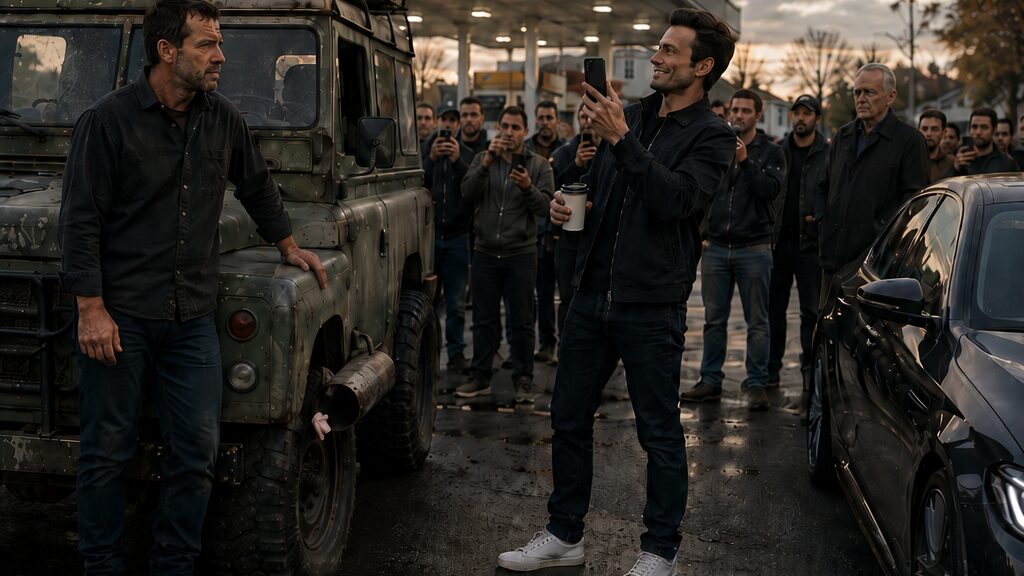
At the far end of the line, Joshua Walker leaned against his silver luxury car like the street had been arranged around him. His hair was shaped perfectly, his sneakers too white for pavement, his wrist flashing whenever he lifted his latest-model smartphone. He was talking to three younger club members, but his eyes had drifted past them. They were fixed on Matthew’s truck.
Joshua’s expression changed slowly, as if insult had to travel through several layers of disbelief before reaching his face.
Kevin Jones, standing near him with a camera grip in one hand, said something Matthew could not hear. Joshua did not answer. He looked from the old truck to the cluster of onlookers studying it, then back to his own silver car, which had been drawing attention all afternoon.
Matthew recognized that kind of look. Not confusion. Possession.
Joshua pushed away from his car.
“Who owns the army shed?” he called.
A few people laughed, relieved to have a cue.
Matthew turned just enough to acknowledge he had heard, then reached into the cab for a small notebook from the seat. He had written down fuel pressure numbers after the test drive. He wanted to look at them before the heat left the engine bay. He wanted to get home, open the garage, and put the truck behind a locked door.
Joshua walked closer, phone now loose in his hand.
“You with somebody?” Joshua asked. His smile was polished for an audience. “Or did this thing break down and roll into the wrong crowd?”
Matthew looked at him. “It’s parked legally.”
“That wasn’t the question.”
“It’s the answer you need.”
A murmur moved through the group. Not loud, but interested.
Joshua glanced around as if checking whether the line had landed. Then he looked back at the truck. “This is a curated meet. People bring cars they actually take care of.”
Matthew’s jaw tightened once, then released. “Then you’ve got nothing to worry about.”
Joshua smiled wider, but his eyes had gone flat.
Behind him, Kevin shifted his weight. He looked at the overland truck again, not with the open mockery the others wore. His gaze followed the high clearance, the reinforced points beneath the body, the strange purposeful geometry of the front bumper. For half a second, his curiosity broke through.
Joshua saw it.
“You like it?” he asked Kevin, voice light and sharp.
Kevin blinked. “No, I mean—it’s just kind of—”
“Kind of what?”
Kevin looked at Joshua’s phone, then at the people waiting to laugh. “Old.”
Joshua nodded as though a junior member had passed a test. “Exactly.”
Matthew closed the notebook.
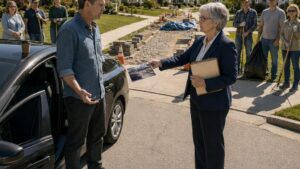
Amy Miller stood near the edge of her lawn, arms folded, a set of house keys hooked around one finger. She lived two doors down and had complained twice about the meets, once to the gas station, once to Joshua directly. She gave Matthew a look that was not unkind, but tired.
Not tonight, it seemed to say. Please not tonight.
Matthew understood. He had spent years making himself easy for other people to ignore. Quiet garage. Quiet driveway. Quiet truck under a fitted cover when he was not working on it. No revving, no signs, no explanations.
He glanced at the truck’s hood. The patina there caught the late sun, old dull green under thin scratches and tiny islands of surface wear. Most people saw decay. He saw a map.
Joshua saw an opportunity.
The car club president lifted his phone chest-high and tapped the screen. His posture changed immediately. Chin up, shoulders loose, smile sharpened for people who were not even there.
“All right,” he said, turning so the phone captured the truck behind him. “Since apparently we’re letting anything park at the meet now, the club is going to do a little public service.”
Matthew did not move.
Joshua aimed the camera directly at the weathered overland truck.
“Tonight,” he said, “we teach people what real cars are.”
Chapter 2: Joshua Walker Starts Recording the Wrong Man
Joshua framed the truck like evidence at a trial.
He took two steps backward, checking himself on the phone screen, making sure the faded hood, high fenders, and dull military panels filled the background behind his shoulder. His face brightened in the way faces did when they stopped belonging to the person and started belonging to an audience.
“See this?” he said into the phone. “This is what happens when people confuse rust with character.”
A few laughs rose behind him. Somebody repeated the line under his breath. Matthew stood near the passenger side of the truck, the notebook still in his hand, and felt the old instinct to go quiet settle over him like a coat.
Let him talk. Words did not scratch metal. Words did not change welds. Words did not matter if the person speaking them did not know what he was looking at.
That was what Matthew told himself.
Joshua panned the camera down the length of the truck. “We’ve got dents, oxidation, mystery stains, probably three different decades of bad decisions. And look, no badges worth mentioning, no carbon, no digital cockpit, nothing built in this century.”
“It runs,” Matthew said.
Joshua turned the phone toward him. “So does a lawn mower.”
The crowd gave him a louder laugh this time.
Matthew slipped the notebook into his back pocket. He should have gone home. The driveway was less than fifty yards away. He could climb in, start the engine, let them laugh at the taillights. That would be the clean thing. The dignified thing.
But Joshua had stepped closer to the truck, and the phone was moving over details he had no right to turn into entertainment.
“Don’t touch it,” Matthew said.
Joshua lowered the phone just enough to look over it. “Relax. Nobody wants to touch it.”
The tone was worse than the words. It made restraint feel like fear.
Kevin Jones hovered behind Joshua, his own phone halfway raised. He was younger than most of the others, with the nervous energy of someone trying to stand in the right place. His eyes kept returning to the front end of the overland truck.
“That bumper’s not a kit, is it?” Kevin said before he could stop himself.
Joshua’s head turned slowly.
Kevin swallowed. “I just mean, it looks fabricated.”
“It looks homemade,” Joshua said.
Matthew looked at Kevin, just for a second. The young man looked away as though caught stealing.
Joshua smiled at the camera again. “You hear that? My guys are trying to be polite. That’s why I’m president. Somebody has to protect the standard.”
His silver luxury car sat behind him, clean enough to reflect the gas station lights coming on under the canopy. A temporary registration card was tucked inside the windshield. Matthew noticed the dealer plate frame, the spotless tires, the absence of any real wear in the driver’s seat visible through the glass. A car not lived with, not known. A car borrowed from the future and billed monthly.
Joshua noticed Matthew looking.
“What?” he said. “Never seen paint that shines?”
Matthew’s answer stayed behind his teeth.
Amy Miller stepped off the curb and came closer, careful not to place herself between them. “Joshua, maybe don’t film people who didn’t agree to it.”
“I’m filming a car,” Joshua said. “Public street.”
“It’s his car.”
“It’s an object in public, Amy.”
“It’s also his property.”
Joshua tilted his phone toward her, smiling. “You want to be in this too?”
Amy’s mouth tightened. She had dealt with him before; everyone on the block had. The meets always came with the same defense. Public street. Public space. Good for business. Harmless fun. Then came tire marks, wrappers in gutters, engines revved at red lights, neighbors watching their own curbs become someone else’s stage.
Matthew appreciated her stepping in. He also hated it. Her involvement made him feel like a problem she had to manage.
“It’s fine,” he said.
Amy looked at him. “Matthew.”
“It’s fine,” he repeated.
Joshua caught the softness of that exchange and mistook it for surrender. “See? Matthew gets it. He knows this thing isn’t exactly a museum piece.”
The words found a place they should not have reached.
Matthew’s eyes moved to the hood, to the long sun-faded mark near the center ridge. Not a scratch from neglect. Not abuse. A branch had dragged across it years before the truck became his, somewhere far from suburban pavement. He knew the story because he had heard it at midnight in a garage that smelled of oil and old canvas, from a man whose hands shook by then but still knew every bolt by touch.
Do not make it pretty, that man had told him. Pretty is easy. Honest is harder.
Matthew had kept that promise longer than he had kept some friendships.
Joshua circled toward the front quarter. “I mean, this is what people don’t understand. Cars evolve. Tech evolves. Materials evolve. If it wasn’t built in the last three years, it’s already behind.”
Someone in the crowd agreed. Someone else said, “Facts.”
Kevin did not. He stared at the old truck’s side vent, then down at the underbody protection visible beneath the rocker. His lips parted slightly. He almost said something again.
Joshua snapped his fingers near Kevin’s shoulder without looking at him. “Get this angle.”
Kevin lifted his phone.
Matthew took one step forward. “I said don’t touch it.”
Joshua stopped just outside arm’s reach of the fender. “And I said nobody wants to.”
“You’re close enough.”
Joshua looked into his own camera, letting his eyebrows rise. “Close enough. You hear that? We have a perimeter now.”
The laugh that followed was thinner. A few people seemed less sure. But phones were up now, and phones changed people. They made bystanders feel like witnesses before they had decided what they were witnessing.
Joshua lowered his voice, not enough to be private. “Here’s the thing, Matthew. This meet brings people in. The station gets business. The neighborhood gets energy. Then you park this here, and suddenly it looks like a salvage yard.”
“It’s my street too.”
“Sure. And I’m saying maybe have some respect for what the rest of us are building.”
That was the first honest thing Joshua had said, though he did not know it. Not respect for cars. Respect for the image. For the club. For the hierarchy that put his silver car at the top and Matthew’s truck in the dirt.
Matthew could have told him then. He could have named the chassis, the build history, the impossible parts, the private collectors who would have crossed state lines to see it. He could have watched Joshua’s expression change.
Instead he said, “Move away from it.”
Joshua’s smile cooled.
There it was again: Matthew’s mistake. A warning without the explanation that made it matter. A boundary offered to someone who measured boundaries by whether they came with consequences.
Joshua turned toward his phone audience and slid a fresh piece of gum from a packet. He placed it on his tongue slowly, theatrically, eyes never leaving Matthew.
“You know what?” he said, chewing. “Let’s ask the people.”
He stepped closer, close enough that Matthew could smell mint over gasoline and hot pavement.
Joshua angled his phone toward the crowd, then back toward the truck.
“Should rust buckets like this be banned from the meet?”
Chapter 3: The Gum on the Rare Exhaust Pipe
The gum hit the exhaust with a wet, soft snap, and Matthew went completely still.
For a second, no one laughed. The sound had been too intimate, too ugly, too clearly not a joke landing in the air but a thing sticking to another thing. Pale gum clung to the dark heat-colored curve of the custom pipe, stretching once before settling against the metal Joshua had no right to touch.
Matthew did not look at Joshua.
He looked at the gum.
The pipe had been built in three sections, each bend measured around old frame constraints that no modern shop database would understand. The alloy had been chosen for heat, clearance, and a note in the engine’s voice that took months to tune out of harshness. The welds had been dressed only enough to protect them, not enough to erase the hand that made them.
A smear of chewing gum sat across one of those welds.
Joshua’s phone hovered near Matthew’s face.
“Oh,” Joshua said softly, delighted by the silence. “That one hurt.”
Kevin gave a laugh that came too late and died too quickly.
Matthew reached into the cab through the open window. His movements were slow, deliberate. He took out a folded cloth and a small metal scraper wrapped in leather. The crowd shifted closer, not because they understood, but because they sensed that a line had been crossed and wanted to see whether it would hold.
“Matthew,” Amy said from somewhere behind him. “Don’t. He wants a reaction.”
Matthew crouched by the exhaust.
The gum had begun to soften further from the residual heat. He could smell mint and sugar burning faintly into the metal. He set the cloth beneath it so no residue would fall deeper into the joint. The scraper touched down with the delicacy of a surgeon’s instrument.
Joshua leaned over him. “Look at this. He brought tools for it.”
“Back up,” Matthew said.
“He brought a whole little cleaning kit for the trash pipe.”
Matthew did not answer. He slid the scraper under the edge of the gum and lifted a thin strand away.
Amy came closer, lowering her voice. “Please don’t make this bigger. Everyone’s filming.”
The words landed badly, though she meant them well.
Everyone’s filming.
As if the danger was not what Joshua had done, but what Matthew might look like while responding. As if dignity meant becoming smaller when enough lenses appeared. Matthew kept his eyes on the exhaust, but his hand tightened around the scraper.
“I’m not making it bigger,” he said.
Joshua laughed. “You’re on your knees cleaning gum off a beater in front of thirty people.”
Matthew’s ears filled with a low pressure, not quite anger yet. Something older. He remembered another garage, another hand guiding his wrist away from a stubborn bolt before frustration stripped it.
Never punish the machine because a person made you angry.
That sentence had stayed with him longer than most advice. It was why he breathed once before lifting another thread of gum away. It was why he did not stand too quickly. It was why Joshua still had all his teeth behind that smirk.
Kevin had lowered his phone slightly. His gaze was fixed on the exposed weld.
“That’s not factory,” he murmured.
Joshua snapped toward him. “What?”
Kevin flinched. “Nothing.”
“No, say it. You’re the expert now?”
“I just said it’s not factory.”
“Of course it’s not factory. Half this thing probably came from a farm.”
Matthew folded the ruined gum into the cloth. He did not throw it down. He did not flick it at Joshua’s shoes. He wrapped it carefully, because the pipe mattered more than the insult.
The act made Joshua bolder.
He leaned toward the phone. “This is the problem with nostalgia builds. People get emotionally attached to junk and then act like everybody else has to worship it.”
“It isn’t a build for you,” Matthew said.
Joshua blinked, hearing the edge now.
Matthew stood. The cloth was in one hand, the scraper in the other. He looked taller than he had a moment before, though he had not changed. Something in his stillness had shifted. He was not withdrawing anymore.
Joshua noticed. So did Amy.
“Then why bring it here?” Joshua asked. “Why park it in the middle of my meet?”
“Your meet is on my street.”
That drew a murmur from the neighbors and a few uncomfortable looks from the club members. Joshua’s face tightened, not much, but enough.
“My meet,” he said, “is the only reason anyone comes down this block except to complain.”
“The block was here before your camera.”
The crowd made a small sound, half laugh, half warning.
Joshua glanced toward his silver car. The reflection of the group warped across its hood. For the first time, Matthew saw the calculation behind his eyes: if the crowd laughed at Matthew, Joshua held the room; if they laughed at Joshua, the room vanished.
So Joshua reached for more.
He walked to the hood of Matthew’s truck. A plastic cup of coffee sat in his other hand, fresh from the gas station, lid beaded with steam. He had been carrying it all along, using it as a prop between gestures. Now he held it over the faded hood.
Matthew’s voice dropped. “Don’t set that down.”
Joshua looked into the phone, not at him. “Listen to the tone. You’d think I was about to scratch a museum car.”
“Joshua,” Amy said sharply.
Kevin’s phone lowered another inch.
Joshua placed the cup on the hood.
The plastic base made a small hollow sound against the old metal. A ring of heat and moisture began to form around it almost immediately, darkening the dust on the surface.
Matthew stared at the cup.
The hood beneath it was not shiny. It was not smooth. But under the steam and cheap plastic sat the long faded scar he knew by heart, the one he had been told never to erase. Pretty is easy. Honest is harder.
Joshua smiled into his phone.
“Relax,” he said. “It’s not like it can get uglier.”
Chapter 4: The Coffee Cup Crushes in Matthew’s Hand
Matthew’s hand closed around the scalding cup before anyone saw him decide to move.
One moment the coffee sat on the hood, steaming against the faded military-green paint. The next, Matthew had it in his fist, the thin plastic collapsing with a sharp crackle. Hot coffee burst through the lid seam and spilled over his knuckles. The crowd inhaled as one body.
Joshua jerked back half a step. His phone stayed up.
Matthew did not flinch.
The heat was bright and immediate, running between his fingers, down the heel of his palm, under the cuff of his sleeve. He felt it. He accepted it. What he did not accept was the pale ring of moisture Joshua had left around the old scar on the hood.
“Move,” Matthew said.
Joshua stared at the crushed cup in Matthew’s hand. “Are you out of your mind?”
Matthew stepped forward.
Joshua’s shoulder bumped the truck’s fender as he tried to hold his ground. Matthew put one palm flat against Joshua’s chest and shoved him back—not hard enough to throw him, hard enough to remove him. Joshua stumbled into the space between the two vehicles, sneakers scraping pavement, phone arm windmilling for balance.
“Hey!” Kevin shouted, but he did not step in.
Joshua caught himself beside his silver luxury car, his face flushed with outrage and something close to fear. “You put your hands on me.”
Matthew looked from Joshua to the leased car’s mirror-gloss hood. The crushed cup steamed in his grip. Sticky coffee dripped onto the street in small brown dots.
For one terrible second, Matthew wanted to throw the whole mess at Joshua himself.
The thought came fast, ugly, and familiar enough to frighten him.
He turned his wrist instead.
The crushed cup struck the silver hood with a wet slap. Coffee spread across the polished paint in a dark fan. The lid bounced once and slid toward the windshield. Drops ran over the reflected image of Joshua’s face, breaking it into pieces.
The crowd erupted—not laughing, not yet, but shouting in disbelief.
Joshua lunged toward the car. “That’s leased!”
The words cut through everything.
Even the people who had been laughing at Matthew heard them. They hung in the air with the steam, revealing more than Joshua meant to reveal. Not my car. Not my paint. Not my pride, fully paid for. Leased.
Matthew stood between Joshua and the overland truck, coffee burning his hand, breathing once through his nose. His pulse hammered so hard he could feel it in his teeth.
Joshua touched the stain with two fingers, then stared at them like blood might be there. “Do you know what this costs? Do you have any idea what you just did?”
Matthew said nothing.
That was his old mistake returning, already tightening around him. Silence gave Joshua room.
Joshua spun toward the crowd. “You all saw that, right? He assaulted me. He damaged my car. Everybody got that?”
Phones lifted higher.
Amy had both hands over her mouth. Kevin’s phone shook slightly in his grip. A few of Joshua’s club members looked uncertain now, their eyes flicking between Matthew’s burned hand, the coffee on the silver hood, and the old truck with its faint wet ring where the cup had sat.
Joshua noticed the uncertainty and fed it immediately.
“This is what I’m talking about,” he said, voice rising. “This guy parks junk in the middle of the meet, acts crazy when someone jokes about it, then attacks people. You don’t get to do that because you’re attached to scrap metal.”
Matthew’s fingers tightened around empty air. The cup was gone, but his hand still remembered crushing it.
Amy stepped closer. “Joshua, you put the coffee on his hood.”
“It’s already ruined.”
“You still put it there.”
Joshua pointed at his stained car. “And he did that.”
Matthew looked at the coffee spreading over the silver paint. He had made a mark on something Joshua loved only because Joshua had made a mark on something he could not understand. It was not justice. Not exactly. It was a warning. It was also a mistake, because it let Joshua change the subject.
The old man from the garage would have hated that part.
Never punish the machine because a person made you angry.
Matthew swallowed. The taste in his mouth was metal.
Joshua was pacing now, phone up again. “Say something, Matthew. Say it on camera. Tell everyone why you think you can put your hands on people and damage a car worth more than your house.”
A small sound moved through the crowd. Not agreement. Not laughter. Discomfort.
Matthew saw Kevin glance at the temporary registration card inside Joshua’s windshield, then look away.
“That car doesn’t belong to you,” Matthew said quietly.
Joshua froze.
The silence changed shape.
Matthew wished he had not said it, not because it was wrong, but because he had said it to wound. He could feel the old anger wanting to justify itself, to keep going now that it had found an opening.
Joshua’s jaw shifted. “It belongs to me enough for you to pay for the damage.”
“Then send the bill.”
“Oh, I will.” Joshua jabbed a finger toward him. “And I’ll send the video too. To everyone. The club page, the neighborhood board, the police if I have to. We’ll see how dignified you look when all they see is you losing it over a rusted toy.”
Matthew looked at the phones. So many small black rectangles. Joshua’s, Kevin’s, strangers’, neighbors’. They made the street feel narrower, each lens trimming away context.
He had spent years avoiding this exact thing: the flattening of truth into a clip.
Amy said, “Everybody needs to step back.”
No one did.
Joshua took one step toward Matthew again, emboldened by the phones and his own voice. “What is it even worth? Five grand? Ten if somebody’s drunk? You want to act like a museum guard, bring a museum piece.”
Matthew’s burned hand throbbed. He opened and closed his fingers once. The skin across his knuckles had reddened. Coffee dripped from his sleeve.
Behind the crowd, someone laughed.
It was not like the earlier laughter. It was lower, older, almost incredulous.
People turned.
An older man stepped out from behind a dark SUV parked near the gas station entrance. He was dressed plainly, but nothing about him seemed ordinary. His white hair was cut close, his shoes were dusty but expensive, and his eyes had the alert brightness of someone who noticed details before other people noticed objects.
He was not looking at Joshua’s stained luxury car.
He was looking at Matthew’s overland truck.
“Five grand,” the man said, and laughed again. “That’s what he thinks?”
Joshua snapped, “Who are you?”
The older man ignored him. He walked toward the truck slowly, stopping well short of touching it. His gaze moved from the hood scar to the windshield angle, then down to the front suspension, then toward the rear where Matthew had cleaned the gum from the exhaust.
Matthew’s throat tightened.
The man knew how to look.
Not admire. Not consume. Look.
Joshua raised his phone. “Great, another expert.”
The older man crouched slightly, careful of his knees, and studied the frame line beneath the passenger door. The crowd grew quieter with each second he did not speak.
Kevin whispered, “Mr. Harris?”
The name moved through two or three people. George Harris. Someone repeated it in a tone that carried recognition.
Joshua heard it too. His face changed, though he tried to hide it.
George Harris stood and turned toward Matthew, no longer amused. “Where,” he asked very quietly, “did you find that exact overland chassis?”
Chapter 5: The Collector Laughs at the Price of Ignorance
George Harris laughed only once when Joshua called the truck a rust bucket, and that single laugh did more damage than all the crowd’s earlier noise.
It was not loud. It was not cruel in the simple way Joshua had been cruel. It was the sound of a man hearing someone mispronounce a word in a language he had spent his life mastering.
Joshua looked around, searching for support. “What’s funny?”
George did not answer him. He kept his attention on Matthew, waiting.
Matthew wiped his burned hand against his jeans and regretted it immediately. The skin stung. He looked at George, then at the truck, then at the cluster of phones rising again.
“Private acquisition,” Matthew said.
George’s eyebrows lifted a fraction. “From the northern restoration line?”
Matthew said nothing.
That was answer enough.
George took a slow step along the side of the truck, hands clasped behind his back, as though keeping them there was a discipline. He did not touch the paint. He did not lean. He did not breathe too closely over the old metal. The care of it changed the way the crowd watched him.
“This,” George said, “is not a backyard relic.”
Joshua scoffed. “Here we go.”
George pointed—not touching—to a dull patch near the lower door. “That finish is original field coating under later preservation. Not neglect. Preserved oxidation, stabilized properly.” His eyes shifted toward the rear. “And that exhaust is not decorative. Whoever built it understood clearance, heat, and old military geometry better than most modern fabricators understand their own catalogs.”
Kevin’s mouth opened slightly.
Joshua laughed too hard. “You can say anything if you make it sound technical.”
George finally looked at him. “Young man, you filmed yourself spitting gum onto a part you could not afford to have assessed.”
The crowd stirred.
Joshua’s face reddened. “I can afford gum.”
“And coffee, apparently,” George said, glancing at the silver hood.
Someone in the crowd snorted before swallowing the rest.
Joshua swung his phone toward George. “So what, you’re saying this thing is expensive because it’s old?”
“No,” George said. “Old is common. Surviving correctly is rare.”
Matthew looked at him then.
The words found the exact place inside him that Joshua’s insults had scraped raw. Surviving correctly. That was closer than value. Closer than restoration. Closer than anything he had expected a stranger to say on this street.
George circled the truck with slow respect. “Do you see the front recovery points? Those are not aftermarket copies. Look at the angle. Look at the reinforcement under the bumper. And the windshield frame—most of these were altered badly when people tried to civilianize them. This one wasn’t. Someone knew what not to change.”
Matthew felt the crowd’s attention shifting like weight in a boat.
Phones that had been aimed at him now wavered toward Joshua, then George, then the truck. The vehicle itself seemed to grow larger in the street, not physically but in meaning, as if people were only now making room for what had been there all along.
Joshua fought the shift. “It still looks like it was dragged out of a ditch.”
George smiled without warmth. “That is because you mistake polish for care.”
Kevin lowered his phone until it pointed at the pavement. Then, almost involuntarily, he raised it again—not toward Matthew, but toward Joshua.
Joshua caught the movement. “Kevin.”
Kevin’s eyes flicked to George. “He’s George Harris.”
“So?”
Kevin’s voice dropped. “He owns the Harris collection.”
The crowd understood before Joshua wanted them to. A few people murmured. Someone near the gas pump whispered that George’s private collection had cars people only saw in auction articles and locked museum storage. Joshua’s expression sharpened with calculation, then resistance.
“Fine,” Joshua said. “Collector guy likes old junk. Doesn’t make it worth what he says.”
“I have not said what it is worth,” George replied.
He turned to Matthew again. “May I ask who preserved it?”
Matthew’s hand had begun to throb harder. He flexed it once, then stopped. The question was simple. The answer was not.
“A man who knew it better than I did,” he said.
“Did he leave the hood scar?”
Matthew’s eyes went to the long mark under the fading coffee ring. “Yes.”
“Good.”
That one word unsettled him more than Joshua’s insults. Good. Not buff it out. Not repair. Not restore. George had seen the scar and understood that it belonged.
Joshua stepped between George and the truck’s front corner, trying to reclaim the center. “This is insane. Everybody’s acting like a scratched-up truck is sacred because one rich guy wants to sound deep.”
George’s eyes cooled. “Move away from the vehicle.”
Joshua barked a laugh. “You too?”
“I am asking more politely than he did.”
The crowd heard that. Joshua did too.
His grip on the phone tightened. “I don’t care who you are. He damaged my car.”
“You put scalding coffee on his hood.”
“It’s already damaged!”
George turned to the crowd. “That sentence is why people like him should not stand near preservation work.”
The laughter that followed was small but real.
Joshua’s jaw clenched. “Preservation work? It looks like rust.”
“It looks like history,” George said. “History you tried to turn into a punchline because you did not recognize it.”
Matthew wanted to feel relief. Some part of him did. But another part recoiled from the way George’s voice commanded the street, from the way Joshua’s humiliation was beginning to replace Matthew’s. The crowd did not understand yet. They only knew that power had moved. First Joshua had held it through mockery. Now George held it through money and knowledge.
Matthew did not want either man owning the truck’s meaning.
George faced him fully. “I have looked for this configuration for twelve years.”
The street fell still.
Joshua’s phone remained up, but his wrist had lowered.
George continued, “If the provenance is what I think it is, and from your reaction I suspect it may be, I will offer you two and a half million in cash.”
No one spoke.
Even the gas station seemed to quiet, the pump screens blinking silently under the canopy.
Joshua gave a strained laugh. “No, you won’t.”
George did not look at him. “I just did.”
Kevin’s phone turned completely toward Joshua now. So did two others.
Joshua saw the lenses. The same crowd that had laughed when he called the truck trash now stared at him as if he had walked into a glass door on purpose.
“Two and a half million,” someone whispered.
“For that?”
“For that,” George said.
Matthew looked at the truck’s hood. The coffee ring. The scar beneath it. The patched paint, the old dents, the preserved oxidation everyone suddenly wanted to admire because a wealthy man had translated it into a number.
His burned hand pulsed at his side.
George’s offer hung there, enormous and clean and dangerous.
Matthew did not answer.
Chapter 6: The Promise Hidden Beneath the Patina
Matthew touched the scar on the hood instead of looking at George Harris’s money.
His fingertips rested just behind the damp ring left by Joshua’s coffee cup. The old mark ran pale under the fading green, a long uneven line that disappeared near the center ridge and returned closer to the windshield. He knew where it widened. He knew where the paint had lifted at the edge and been sealed instead of sanded. He knew because he had been told to know it.
George waited.
Joshua did not.
“You’re not seriously thinking about this like it’s a hard decision,” Joshua said. “Take the money and pay for my hood.”
No one laughed with him.
That made his voice sharper. “I’m not joking. Look at my car.”
Matthew did not look. “I saw it.”
“You caused that.”
“You placed coffee on mine first.”
“Mine has actual paint.”
The word mine scraped across the street.
Matthew turned then. Joshua stood beside the silver car with coffee drying in streaks over the hood, his phone still clutched in one hand, his face caught between anger and panic. The temporary registration card showed through the windshield like a secret he could not hide anymore.
Amy Miller stepped closer to Matthew, but not too close. Her eyes were on the truck now, especially the hood scar beneath his hand. “I thought,” she said carefully, “you were just letting it sit like that.”
Matthew looked at her.
She seemed embarrassed by her own honesty. “I mean, I see it under the cover sometimes. I thought maybe you were working on it slowly because it needed too much.”
“It needs exactly what it needs,” Matthew said.
Amy nodded, accepting the rebuke. “I see that now.”
George’s expression shifted with interest, but he stayed quiet.
Matthew drew his hand from the hood. The burn across his knuckles was darkening. He wrapped his fingers around the cloth he had used on the gum, then remembered what was inside it and stopped. The small bundle, ruined and ridiculous, suddenly felt heavier than it should.
He walked toward the rear of the truck and set the cloth on the open tailgate. The crowd parted without being asked.
“This finish is not unfinished,” he said.
His voice did not carry like Joshua’s. People leaned in anyway.
“The coating was stabilized in layers. Bare spots sealed. Corrosion stopped where it needed stopping. Left alone where it told the truth.” He touched a dull patch near the rear quarter. “That dent was from a recovery in rock. That line on the hood was from a branch on a trail before I ever had it. The man who built the later expedition setup could have made it smooth. He refused.”
George’s eyes narrowed slightly, not in doubt, but recognition.
Matthew heard the man’s voice again, older and thinner than it had once been. Do not make it pretty. Pretty is easy. Honest is harder.
“He told me polishing it would erase the part that survived,” Matthew said.
The sentence cost him more than he expected. Not because it revealed technical information, but because it opened a door he had kept shut in front of strangers.
Joshua seized on the vulnerability. “That’s touching. Still doesn’t change what you did to my lease.”
Amy turned on him. “You spit gum on the exhaust.”
“After he brought a junkyard military truck to a public meet!”
“It’s his street,” she said.
“It’s my event.”
“No,” Matthew said.
The word cut cleaner than he expected.
Joshua stared at him.
Matthew stepped away from the truck, into the space between both vehicles. “It’s a public street. You don’t own it because people watch you here.”
Joshua’s face twisted. “Careful. You already look unstable.”
There it was again: the phone as weapon, the threat of a cut clip, the promise that the worst three seconds could be made to stand in for the whole truth.
Joshua lifted his device. “Actually, let’s be smart. I’ve got enough right here. You putting hands on me. You dumping coffee on my car. You admitting you did it. That’ll do fine.”
Matthew looked at the phone.
For years, silence had protected him from explaining grief to people who wanted trivia, craft to people who wanted shine, restraint to people who confused it with weakness. Silence had been a wall. Now Joshua was using that wall as a screen.
Amy said, “Joshua, don’t edit this.”
Joshua smiled. “Edit? I’m going to show what happened.”
“From where?” Kevin asked.
Everyone looked at him.
Kevin swallowed. His phone was lowered, but his thumb hovered near the screen. He seemed surprised by his own voice. “I mean… from where are you starting it?”
Joshua’s eyes narrowed. “Stay out of it.”
Kevin looked at the truck, then at Matthew’s burned hand. “I was just asking.”
“You’re my guy,” Joshua said under his breath, but everyone close enough heard it.
Kevin’s face reddened.
George glanced from Kevin to Joshua and said nothing. He did not need to.
Matthew felt the street holding its breath again. It would be easy to let George handle this. Easy to let the collector’s name, money, and calm authority crush Joshua flat. Easy to stay silent while someone stronger in public terms explained worth on his behalf.
But that would be another kind of hiding.
Matthew turned to Joshua. “Play the whole thing.”
Joshua laughed once. “No.”
“From the beginning.”
“I don’t take orders from you.”
“Play the part where you walked up recording. Play the part where I told you not to touch it. Play the gum hitting the exhaust. Play the coffee on the hood.”
Joshua’s grip tightened around the phone. “You don’t get to decide what goes online.”
“No,” Matthew said. “But you don’t get to call a cut version the truth while everyone standing here watched the full one.”
The crowd shifted. Phones lifted again, but now more cautiously. Not hunting for Matthew’s explosion. Waiting to see what Joshua would hide.
Joshua looked around and found fewer friendly faces than before. Amy’s was steady. Kevin’s was troubled. George’s was almost bored, as if Joshua had become predictable.
The silver car’s hood steamed faintly as the coffee cooled into sticky streaks.
Matthew held Joshua’s gaze. His voice stayed low, but this time he made sure every person nearby could hear it.
“Play the recording from the beginning,” he said, “including the gum.”
Chapter 7: The Phones Turn Toward the President
Joshua hid the phone against his chest as if it had suddenly become private property.
The motion was small, but everyone saw it. All afternoon he had held the device like a badge, an eye, a judge he controlled with his thumb. Now his fingers curled over the screen, and the crowd understood something before anyone said it aloud.
He did not want them to see the beginning.
Matthew stood with his burned hand loose at his side. The skin pulled when he flexed his fingers, but he kept them open. He did not want his fists doing any more speaking for him.
“Play it,” Matthew said.
Joshua’s laugh came out dry. “You don’t get to demand my phone.”
“No one asked for your phone. Play the clip.”
“You think I’m going to hand over evidence after you assaulted me?”
George Harris shifted his weight near the truck’s front corner. “If it is evidence, it should help you.”
Joshua’s eyes flashed toward him. “Stay out of this.”
George did not respond. He only looked at the silver car, at the coffee drying into a sticky brown fan across the hood, then back at Joshua’s hand covering the screen.
The crowd had changed shape. Earlier, they had leaned toward Matthew’s truck as if it were an accident blocking traffic. Now they stood in a loose ring around Joshua, not closing in, but no longer giving him the center by default. Phones rose from different angles. Some belonged to people Joshua had greeted by name less than an hour ago.
Joshua noticed. His breathing quickened.
“This is pathetic,” he said. “You all know what happened. He lost it. He shoved me. He threw coffee on my car.”
“You put it on his hood first,” Amy said.
“I set a cup down.”
“After he told you not to touch it.”
“It’s a hood, Amy.”
“It’s his hood.”
Joshua spun toward the others. “Are we really doing this? We’re pretending the issue is a coffee cup and not some guy going violent in the street?”
Kevin stood just behind him, face pale, phone still in his hand. His thumb hovered over the screen as if the device were hot.
Joshua saw him. “Kevin. Tell them.”
Kevin swallowed. “Tell them what?”
“That he pushed me.”
“He did.”
Joshua pointed at Matthew. “There. Thank you.”
Kevin’s voice came smaller. “After the gum.”
Joshua’s face tightened.
The words did not land loudly, but they landed clean.
A few heads turned toward Kevin. The young man’s shoulders drew in. He looked like he wanted to disappear into the pavement, but he kept speaking, eyes down.
“I had it recording,” Kevin said. “Not because I was trying to help anybody. I was filming Joshua for the page.”
Joshua took one fast step toward him. “Don’t.”
Kevin flinched, and that flinch exposed more than defiance would have. He looked at Joshua not like a friend but like someone remembering every time he had laughed at the wrong joke to keep his place.
George’s mouth tightened, almost imperceptibly.
Matthew felt the temptation rise then—not to hit, not this time, but to let the street do its work. Let every phone turn. Let every embarrassed laugh cut Joshua down to the size he had earned. Let the same public machine he had built chew him up.
Kevin unlocked his phone.
Joshua reached for it. “Give me that.”
Matthew moved before Joshua could touch him, stepping between them without contact. “No.”
Joshua froze with his hand in the air.
Matthew did not shove him this time. He did not need to. He simply stood close enough that Joshua had to look up a fraction.
“No more touching,” Matthew said.
The words were plain. They struck harder because of it.
Kevin exhaled shakily and tapped his screen. The video opened with Joshua’s voice, bright and performative, mocking the “army shed” and circling the truck. There was laughter. Matthew’s warning came through clearly: Don’t touch it.
Then Joshua’s voice, careless and pleased: Nobody wants to touch it.
The crowd watched itself become evidence.
Kevin scrubbed forward with his thumb. The angle jumped. Joshua chewing gum. Joshua asking whether rust buckets should be banned from the meet. Joshua leaning toward the exhaust.
The phone speaker caught the wet snap.
No one spoke.
On the small screen, Matthew crouched with the cloth and scraper. The video shook slightly, then caught Joshua laughing over him. It caught Amy saying everyone was filming. It caught Matthew saying he was not making it bigger. It caught Joshua walking to the hood with the coffee.
Don’t set that down.
Joshua’s recorded face smiled.
Relax. It’s not like it can get uglier.
Kevin stopped the video there.
The silence afterward was worse than shouting.
Joshua looked at the ring of faces and tried to find anger he could use. “So? That doesn’t change what he did.”
“No,” Matthew said. “It shows what you did first.”
George stepped closer to the overland truck. “It also shows intent.”
Joshua gave him a bitter look. “Intent? You people are ridiculous. It’s gum. It’s coffee. Everybody’s acting like I smashed a window.”
“You damaged trust before you damaged anything else,” Amy said.
That seemed to surprise her as much as him. She looked at Matthew briefly, apology and discomfort mixed in her face.
The first laugh came from somewhere near Joshua’s silver car. It was short, disbelieving. Someone muttered, “He really said real cars were built after 2023.” Another voice answered, “Then screamed about a lease.”
More laughter followed—not the easy laughter Joshua had directed earlier, but the uncontrolled kind that starts when a crowd realizes a man has staged his own embarrassment.
Joshua’s face changed. His mouth hardened, but his eyes went bright with panic.
“Turn those off,” he snapped.
Nobody did.
The phones were aimed at him now. That was the reversal he had not prepared for: not Matthew shouting, not George lecturing, but the small black rectangles reflecting Joshua’s own performance back at him.
Kevin lowered his phone again, but this time he did not hide it. “I’m sorry,” he said, not quite to Matthew, not quite to the crowd.
Joshua stared at him. “You’re sorry?”
Kevin’s jaw worked. “You told us it was about standards.”
“It is.”
“No,” Kevin said quietly. “It’s about you needing everybody to look at your car.”
Joshua flinched as if Kevin had struck the silver hood harder than Matthew had.
The laughter swelled, then sharpened. A few people pointed at the coffee stain. Someone zoomed in on Joshua’s face. The humiliation became a current in the street, and Matthew felt how easy it would be to step aside and let it carry Joshua away.
Joshua tried to turn his back, but another phone was there. He lifted one hand to block his face. That only made the crowd react more.
Matthew watched him for three seconds too long.
In those three seconds, he saw not a monster, not a cartoon villain, but a frightened man with a leased car, a borrowed image, and no idea who he was when people stopped admiring the surface. It did not excuse the gum. It did not erase the coffee. But it made revenge feel smaller than it had a moment before.
“Enough,” Matthew said.
The word did not stop everyone, but it cut the laughter down.
Joshua looked at him, breathing hard. His pride had nowhere left to stand.
Matthew pointed to the exhaust. “You’re going to clean what you put there.”
Joshua blinked. “What?”
“You asked what I want.”
The crowd quieted further.
Matthew held up the ruined cloth bundle, still folded around the gum residue. “You’re going to clean the rest of it under my direction. You’re going to say on camera that you touched what I warned you not to touch. Then you’re going to take your meet off this block tonight.”
Joshua stared at him as if money would have been easier.
His voice came out thin. “That’s it?”
Matthew looked at the coffee-stained lease, the phones, the old truck, the scar under the fading ring on the hood.
“No,” he said. “Then you’re going to stop pretending respect is something only new paint deserves.”
Joshua swallowed. For once, he had no line ready.
“What do you want from me?” he asked, but the question had already changed. It no longer sounded like defiance. It sounded like someone cornered by the truth and unsure whether the truth would be kinder than the crowd.
Chapter 8: Matthew Clark Refuses to Sell the Scarred Machine
George Harris repeated the offer at sunset, quieter this time, with the crowd no longer leaning in for spectacle.
“Two and a half million,” he said. “Cash purchase. Clean transfer. I can have counsel draw up terms tonight, if you want to review them.”
The words were still enormous, but now they landed differently. Not like a thunderclap meant to crush Joshua. More like a key placed gently on a table.
Matthew stood beside the rear of the overland truck, watching Joshua crouch near the custom exhaust with a clean cloth wrapped around two fingers. The gum residue had softened again under Matthew’s careful instruction. Joshua worked slowly, jaw tight, face turned away from the remaining phones.
“Not that angle,” Matthew said.
Joshua stopped.
“The weld runs under the lip. Don’t scrape across it.”
Joshua’s shoulders stiffened, but he adjusted his hand.
Kevin stood nearby, recording only because Matthew had told him to. Not a performance clip. Not a humiliation reel. A record. The distinction mattered to Matthew, even if half the crowd did not understand it.
Joshua glanced back once. “Do we have to film this?”
“Yes,” Matthew said. “Say it first.”
Joshua’s nostrils flared. He looked at Kevin’s phone, then at the exhaust, then at the silver car behind him with dried coffee dulling the hood.
“I touched the vehicle after being told not to,” he said.
Matthew waited.
Joshua’s lips pressed together. “I put gum on the exhaust. I set coffee on the hood. He warned me before both.”
The crowd stayed quiet. That was the first decent thing it had done all evening.
“Keep cleaning,” Matthew said.
Joshua turned back to the pipe. His hand was awkward, but gentler now. Whether from respect or fear of making the recording worse, Matthew did not know. He accepted the result.
Amy came to stand beside him. For a while she said nothing.
“I’m sorry,” she said finally.
Matthew looked at her.
“I kept thinking about the street,” she said. “The noise, the mess, everybody filming. I thought if you just let it pass, it would be over faster.”
“That’s usually what I think too.”
Amy gave him a small, sad smile. “Didn’t work tonight.”
“No.”
Her eyes moved over the truck’s side, the faded panels and sealed scars. “I really did think it was unfinished.”
“So do most people.”
“But it isn’t.”
Matthew shook his head.
George walked closer, careful to stay outside the space where Joshua worked. “May I ask whether the former owner was William Taylor?”
Matthew’s hand stilled.
George did not smile at being right. “I thought so.”
Joshua’s cloth stopped moving for a fraction of a second, then resumed.
Matthew looked at the hood scar. “He hated collectors.”
George gave a soft laugh. “He hated bad ones.”
“He said they wanted trophies, not machines.”
“He was often correct.”
Matthew felt the evening settle around the truck: the gas station lights, the cooling engines, the neighbors at the edges of their lawns, the club members suddenly interested in their shoes. The meet was already breaking apart. A few cars had left quietly. The silver car remained because Joshua could not leave until Matthew said the exhaust was clean.
George looked at the overland vehicle not hungrily now, but with something closer to humility. “I knew William through correspondence. He refused to sell me parts twice.”
“That sounds like him.”
“He wrote me once that a scar earned honestly had more value than a panel restored for applause.”
Matthew looked at him then.
For a moment, the street disappeared, and he was back in the garage with William Taylor sitting on a stool under weak fluorescent light, one hand on the fender, his breath short but his voice steady. Promise me you won’t pretty it up for people who don’t know where it’s been.
Matthew had promised because it had seemed easy then. A simple vow to a dying man. Keep the truck alive. Keep the scars honest. Do not turn survival into decoration.
He had not understood that the harder part would be speaking for it.
Joshua stood slowly. “It’s clean.”
Matthew crouched and inspected the exhaust. There was still a faint smear near the lower edge. He took the cloth himself, folded it around one finger, and lifted the last trace without pressure. Joshua watched him do it, and for once his expression did not mock the care.
“It’s clean now,” Matthew said.
Joshua nodded once.
“You’ll move the meet off this block tonight.”
Joshua looked toward his remaining club members. Most avoided his eyes. Kevin did not.
“Yeah,” Joshua said. “Tonight.”
“And the video?”
Joshua swallowed. “I won’t post the cut one.”
Matthew looked at Kevin.
Kevin held up his phone slightly. “I’ll send you the record.”
“No posting,” Matthew said.
Kevin blinked. “None?”
“Not from me. Not from you.”
A disappointed murmur moved through two onlookers. Matthew turned toward them, and it died.
Joshua stared at him, confused. “You’re not going to post it?”
“No.”
“Why?”
Matthew looked at the silver car, then at Joshua’s face. “Because I’m not you.”
The words were not loud. They did not need to be.
Joshua looked away first.
George stepped closer again. “And my offer?”
Matthew ran his unburned hand along the truck’s rear corner, not touching the paint so much as acknowledging it. He thought of what two and a half million dollars could change. Repairs. Security. A better garage. Freedom from certain worries that had sat in the corners of his life so long he no longer noticed their weight.
He also thought of an empty space under a cover that was no longer needed. A promise converted into paperwork. The world calling it a smart decision because the number was large enough to drown out the loss.
“Not tonight,” Matthew said.
George studied him. “That is not a no.”
“It isn’t a yes.”
A small smile touched George’s face. “Fair.”
Matthew looked at him fully. “If I ever sell it, it goes to someone who understands it still has to be driven.”
George’s smile faded into respect. “Then I would need to earn that conversation.”
“Yes,” Matthew said.
The last of Joshua’s club members began starting their cars, not with the sharp revving they had arrived with, but carefully, almost sheepishly. Engines pulled away from the curb one by one. The street widened as they left.
Joshua remained by his silver car, wiping the dried coffee from the hood with fast, embarrassed strokes. Without the crowd arranged around him, the car looked different. Still expensive. Still sleek. But somehow temporary, a polished thing waiting to be returned.
Matthew climbed into the overland truck.
The old seat gave under him with familiar resistance. His burned hand protested when he turned the key, so he used his left. The engine caught after one deep crank, settling into its steady idle. People who had laughed at it an hour ago now stood silent as the sound filled the street.
Matthew looked through the windshield at the scar on the hood, visible from inside as a faint raised memory beneath the glass line.
Pretty is easy. Honest is harder.
He eased the truck forward. No roar, no show, no victory lap. Just a slow roll toward his driveway, past Amy standing with her keys in her hand, past Kevin lowering his phone, past George Harris watching like a man who knew enough not to clap.
In the side mirror, Matthew saw Joshua still bent over the leased car, wiping coffee from a hood that had never truly belonged to him.
Then Matthew turned into his driveway, guided the scarred machine home, and let the garage swallow it gently out of sight.
The story has ended.