The HOA Said They Owned His Porch, Until The Ramp They Removed Exposed Why It Was Built
Chapter 1: The Ramp Was Already Coming Apart
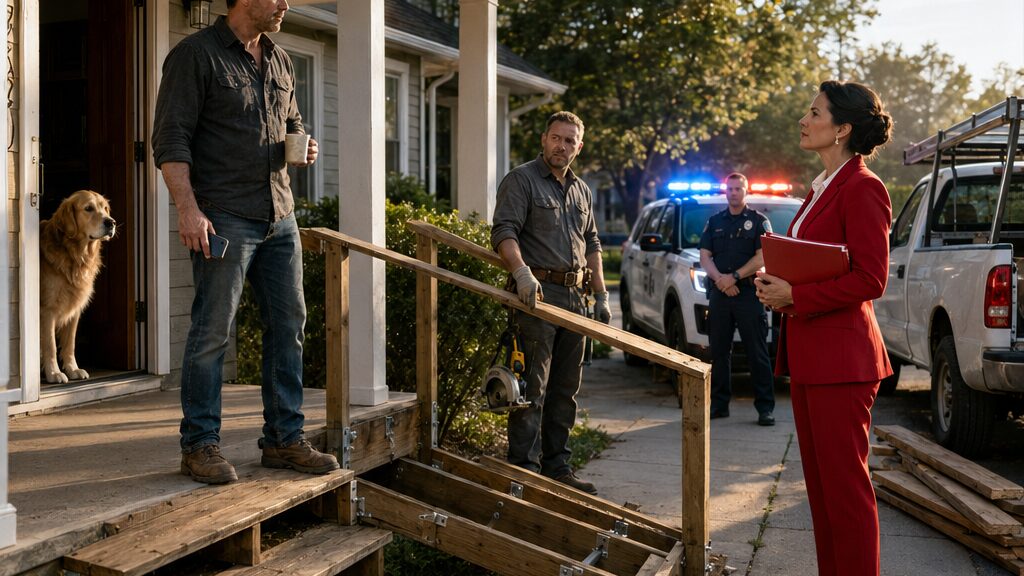
The saw was already eating into the ramp when Michael Walker opened the front door with a coffee mug in his hand.
For half a second, he did not understand the sound. It was too early for lawn crews, too sharp for a leaf blower, too close to the house. Then a strip of pale wood jerked loose from the left side rail, and one of the workers in orange gloves stepped backward with it tucked under his arm.
Michael stood still in the doorway.
The golden retriever beside him lifted his head, ears forward, body tense but silent.
At the bottom of the ramp, two men had parked a white utility truck across the driveway. The back gate hung open. Boards from the lower landing were already stacked against the rear tire. A cordless saw lay running down in the grass until one worker nudged it with his boot and killed the whining blade.
Near the mailbox, a police SUV flashed red and blue against the damp morning street.
And between all of it stood Donna Clark in a red suit, holding a thick folder like it was the deed to the world.
“Mr. Walker,” she called, as if she had knocked politely and waited. “You need to stay clear of the work area.”
Michael looked at the missing rail. Then at the steps beneath the porch, which had been covered for three weeks by the temporary ramp Patrick Garcia had built in a single afternoon. The ramp had not been pretty. It was unfinished wood, clean lines, steel brackets, rubber grip strips, nothing ornamental. But it had changed the front door from a drop into a path.
A worker bent to remove another screw.
Michael stepped out.
The retriever moved with him, shoulder brushing his leg.
“Stop,” Michael said.
The word was not loud. It carried anyway.
The worker froze and glanced toward Donna.
Donna took three quick steps across the walkway, papers pressed to her chest. “This is an authorized enforcement action by the Oak Valley Homeowners Association. You received notice.”
“No,” Michael said. “I didn’t.”
“The notice was served.”
“When?”
Donna’s mouth tightened. Her hair was pinned perfectly, her lipstick the same strong red as her jacket. She had dressed for a meeting, not a porch. “Mr. Walker, this structure was installed without final approval and is in violation of the exterior uniformity standards.”
Michael held up the mug without meaning to. Coffee trembled against the rim.
The police officer near the SUV shifted his weight but did not come closer.
Michael looked at him. “Are you here to remove my property?”
The officer raised both hands slightly. “Civil standby. We’re here to keep the peace.”
“Good,” Michael said. He turned his phone camera on with his thumb. “Then everyone can stay peaceful while no one touches anything else.”
Donna noticed the phone and lifted the folder higher. “Recording will not change the facts. The association controls exterior modifications.”
“The association can send letters,” Michael said. “It cannot cut apart my ramp before I’ve even been served.”
“The ramp is non-compliant.”
“It’s temporary.”
“It is visible from the street.”
“So is your truck.”
One of the workers looked down. The other pretended to examine the remaining screws.
Donna’s face sharpened. “This is not a debate about trucks. You submitted an incomplete request, you proceeded without approval, and after multiple attempts to resolve the matter, the board authorized removal.”
Michael kept the camera steady. “Multiple attempts?”
“You were given an opportunity to cure.”
“You sent one portal message asking for more details. I responded.”
“With insufficient medical documentation.”
His thumb tightened around the phone. The retriever leaned against his thigh.
Donna saw the change, or thought she did. She stepped closer, lowering her voice just enough to make it sound official. “You may not like the process, Mr. Walker, but when you bought in Oak Valley, you accepted the governing documents. For enforcement purposes, the HOA controls exterior access points and attached structures. That includes this porch. That includes this house.”
Michael’s camera caught her red folder, the flashing police lights, the worker still holding the strip of rail.
He asked, “Say that again.”
Donna blinked. “Excuse me?”
“You said the HOA controls this house.”
“For enforcement purposes,” she said, louder now, as if volume could become precision. “The HOA owns the right to enforce standards on this house.”
Michael stared at her for a long beat.
The neighborhood had gone quiet around them. Across the street, a curtain moved. The police lights painted blue across the white columns of his porch, then red across the empty brackets where the side rail had been.
Michael lowered his coffee mug to the porch step.
The small ceramic sound seemed to steady him.
He walked down until he stood between the workers and the remaining half of the ramp.
“Do you have a court order?” he asked.
Donna opened the folder. “We have an HOA enforcement order.”
“That is not the same thing.”
“It gives us authority to remove a violation.”
“It gives you authority to fine me. Maybe to hold a hearing. Maybe to send more paper. It does not give you authority to enter my property, remove my materials, and block my front door.”
Donna turned toward the officer. “He is obstructing an authorized action.”
The officer looked at Michael. “Sir, I’m going to ask you not to interfere physically.”
“I’m standing on my ramp,” Michael said. “On my property. Recording people who showed up with a saw before I got notice.”
Donna flipped open the folder, exposing a stack of forms clipped with red tabs. “This is exactly why we requested civil standby. The board anticipated noncompliance.”
Michael almost smiled, not because it was funny, but because the alternative was anger, and anger would give them the scene they wanted.
“You anticipated me objecting to you tearing out access to my front door,” he said.
“You installed it without final approval.”
“I installed it because waiting was not safe.”
Donna looked toward the porch. Her eyes flicked to the open door, then the retriever, then back to Michael. “There are proper channels for hardship requests.”
“I used them.”
“You did not complete them.”
“I completed what I was required to complete.”
“You refused to provide adequate detail.”
His jaw set.
There it was. The one door he had kept closed.
From inside the house came a faint sound: the scrape of a chair leg against the floor.
The retriever turned at once.
Michael did not.
Donna did not miss it. “Mr. Walker, if there is some additional circumstance, the time to disclose it was during review.”
“You don’t get to demand private medical information on my driveway.”
“Nobody is demanding anything private. We are enforcing the rules you agreed to.”
One of the workers shifted the removed rail into the truck bed. The hollow clatter made the dog step backward.
Michael raised his hand without looking at him. “Put that down.”
The worker stopped again.
Donna snapped, “Continue.”
“Put it down,” Michael repeated. “Those are my materials.”
The worker looked from Michael to Donna to the officer.
The officer took one step forward. “Everybody pause.”
For a moment, no one moved except the police lights crossing the porch.
Donna inhaled through her nose, then rearranged her papers into a neat stack. “Fine. We’ll document your refusal. But the remaining anchors must be removed, and the board will assess daily fines until compliance is complete.”
“You already removed the rail.”
“Because removal was authorized.”
“No,” Michael said, keeping the phone on her. “Because you started before you thought anyone would stop you.”
Something changed in her face then. Not doubt exactly. Calculation.
She looked past him toward the house. “Mr. Walker, I strongly suggest you think about what you are doing. You are creating a record.”
“I know.”
“And records include noncompliance.”
“They also include timing.”
Donna closed the folder.
The crew supervisor muttered to the workers, and they backed away from the ramp. One of them gathered the saw. Another left the lower board where it lay, half unscrewed, crooked like a broken step.
The retriever moved toward the doorway and whined once.
Michael heard it then: a voice from inside, thin with effort.
“Michael?”
He turned.
His mother stood somewhere beyond the entry hall, out of sight from the driveway.
“Why is the front door blocked?”
Chapter 2: The Notice Left After The Work Began
The notice was tucked into the screen door after the truck pulled away.
Michael found it when he came back from covering the exposed ramp edge with two pieces of plywood and a strip of yellow painter’s tape. The paper had been folded twice and slid between the mesh and frame, low enough that he would not have seen it from inside, high enough that someone could later say it had been served.
He stood on the porch with the paper in his hand while the police SUV rolled slowly down the street, lights off now, as if the morning had become ordinary again.
The retriever sat at the doorway, blocking the opening with his broad body.
“Not yet,” Michael told him.
Inside, Shirley Walker had gone quiet. That was worse than complaint.
The notice was printed on Oak Valley Homeowners Association letterhead. The top line read: FINAL ENFORCEMENT ACTION — UNAPPROVED EXTERIOR STRUCTURE. Beneath it was the address, his name, a citation to Section 7.4, and a paragraph saying the association had the right to remove unapproved exterior modifications after reasonable notice.
Michael looked at the date.
That morning.
He checked the time printed near the bottom.
8:12 a.m.
The saw had started at 8:05.
For a while he did nothing but stand there with the paper flattening in his fingers.
Then he took a photo of it.
He took another photo of the missing rail.
Another of the board stacked beside the driveway tire marks.
Another of the coffee mug still sitting on the porch step, cold now, exactly where he had set it down before he stepped in front of the crew.
He did not know why he photographed the mug. Maybe because it showed how little warning there had been. Maybe because no one planned an argument with cold coffee left in the open.
The home health nurse was scheduled for noon. Shirley had insisted she could manage the back door until then. She could not. The back door opened onto a narrow stoop with two uneven brick steps, built long before anyone in the house thought about walkers, stroke recovery, or what one inch too much drop could do to a person afraid of falling twice.
Michael went to the small desk in the corner of the kitchen, opened his laptop, and pulled up the door camera.
The video loaded in gray blocks, then cleared.
At 8:03, the white utility truck stopped in front of the driveway.
At 8:04, Donna’s car parked behind it.
At 8:05, the crew unloaded tools.
At 8:06, the saw started.
At 8:13, Donna walked up the porch steps, leaned toward the screen door, and tucked the folded notice into the mesh.
Michael replayed it twice.
Then he sat back.
The dog rested his chin on Michael’s knee. His name had never mattered in the way official papers mattered; he answered to a low whistle, to Shirley’s fingers tapping twice on the arm of her chair, to the quiet work of being needed. Michael put one hand on his head and kept the other on the mouse.
His inbox showed three new emails from the HOA portal.
He opened the oldest thread first.
Four weeks earlier, he had submitted the request: TEMPORARY ACCESS RAMP — FRONT PORCH. He had attached Patrick Garcia’s sketch, measurements, material list, and a note from the clinic stating that a resident required temporary safe entry access during recovery.
Resident.
That had been the word Michael chose.
Not mother. Not stroke. Not left-side weakness. Not cannot step down safely without assistance. Not may need emergency exit without being carried.
Just resident.
He could still hear Shirley when he typed it.
“I don’t want them discussing me like a problem at one of those meetings.”
“They won’t,” he had said.
“They will. People always find a way.”
He had promised her he would keep it narrow. Medical necessity, not medical history. Access, not gossip. A request, not a story.
Now the portal showed a yellow banner across the top: STATUS — INSUFFICIENT MEDICAL DETAIL.
Michael clicked the message history.
Donna Clark, Compliance Chair: Please provide full supporting documentation identifying the nature, expected duration, and exterior necessity of the modification, including why existing rear access cannot be used.
Michael’s reply: The requested details include private medical information. A licensed provider has confirmed temporary safe entry access is required. The rear access is not safe for the resident. Ramp is temporary and removable.
Donna’s reply: Request remains incomplete. Installation prior to approval may result in enforcement action.
Michael had not answered after that.
He had called the management office twice and left messages. He had emailed the general board address asking for emergency review. He had heard nothing until the saw.
He saved the portal page as a PDF, then downloaded the door camera clip. He made a folder on his desktop and named it Ramp Removal.
His phone buzzed.
A message from Patrick Garcia appeared.
Heard they came out. You okay?
Michael typed, They removed one rail and part of landing. I stopped the rest.
The reply came quickly.
I told them that thing was safe. Temporary but safe. They said it didn’t matter because it wasn’t approved.
Who said that?
Crew supervisor. Donna was on phone before they started.
Michael stared at the screen.
Before they started, he typed.
Yeah. She told them not to wait if no one answered door.
Michael closed his eyes.
From the living room came Shirley’s voice. “Michael?”
He got up at once.
She sat in her chair near the window, one hand resting on the folded blanket across her lap. She had dressed herself that morning in a pale blue blouse because she knew the nurse was coming and did not like being seen in anything that looked like illness. The left side of her mouth moved slower than the right when she spoke, but strangers did not notice unless she was tired.
He noticed everything.
“Did they leave?” she asked.
“For now.”
“How much did they take?”
He hesitated too long.
Her eyes narrowed. “Michael.”
“One rail. Part of the lower landing. I covered the edge.”
She turned toward the window, but the porch was out of view. “I told you they’d make trouble.”
“They didn’t have the right to do it this way.”
“That’s not what I said.”
He looked down.
She tapped the blanket once with her good hand. “You didn’t tell them enough, did you?”
“I told them what they needed to know.”
“You told them what I let you tell them.”
He had no answer for that.
Her face softened, which was somehow harder than anger. “I know why you did it.”
“I should have pushed harder.”
“You pushed plenty.”
“Not enough to stop a saw.”
She looked toward the dog, then toward the entry hall. “Can you fix it before the nurse comes?”
“I can make it safer. Not fixed.”
The phone buzzed again before she could answer.
This time it was an email.
Donna Clark had sent it directly, not through the portal.
Subject: Remaining Ramp Anchors and Continuing Violation.
Michael opened it standing in the living room, Shirley watching his face instead of the screen.
Mr. Walker,
Due to your refusal to permit completion of today’s authorized removal, the remaining ramp anchors, partial landing elements, and all visible hardware must be removed within forty-eight hours. Failure to cure will result in daily fines beginning Wednesday at 5:00 p.m. Continued obstruction may require further enforcement action.
Regards,
Donna Clark
Compliance Chair
Oak Valley HOA
Michael read it twice.
Shirley said, “What is it?”
He turned the phone face down in his palm.
But the dog, hearing something in his silence, stood and went to the front door again, stopping at the threshold where the ramp no longer met the porch cleanly.
Michael watched him plant himself there like a warning.
Then he said, “They want the rest gone by Wednesday.”
Chapter 3: The Clause She Called Ownership
Donna Clark would not meet Michael in the HOA office unless he signed a statement admitting the ramp had been installed in violation of the governing documents.
The receptionist slid the paper across the counter with an apologetic look that did not quite reach the level of courage.
“She said it’s only temporary,” the receptionist murmured. “Just so the discussion can move forward.”
Michael read the first line.
I acknowledge that the exterior structure placed at my residence was installed without approval and constituted a violation of Oak Valley HOA standards.
He folded it once and placed it back on the counter.
“No.”
The receptionist looked toward the closed glass door behind her. Through the blinds, Michael could see the red shape of Donna’s jacket moving from one side of the office to the other.
“She said she has a full schedule.”
“I’ll wait.”
“Mr. Walker—”
“I’ll wait without signing something false.”
The canvas bag in his right hand bumped lightly against his knee. Inside it was one of the steel brackets from the lower ramp section, still marked with pencil lines from Patrick’s installation. Michael had removed it himself before dawn so no one could claim the exposed edge was unsafe because he had left it half-finished. He had wrapped the bracket in a dish towel because Shirley hated when tools scratched the kitchen table.
Now he stood in a management office decorated with framed photographs of identical mailboxes, carrying a piece of the ramp like evidence from a place where common sense had failed.
The glass door opened.
Donna did not invite him in. She stood in the doorway with a tablet tucked under one arm and a folder under the other.
“Mr. Walker, if you are unwilling to acknowledge the basic facts, I’m not sure this conversation will be productive.”
“The basic fact is that your crew started cutting before your notice was served.”
Her eyes moved toward the receptionist.
Michael saw it. So did she.
Donna stepped aside. “Five minutes.”
The office smelled like printer toner and new carpet. A binder labeled ARCHITECTURAL REVIEW sat open on her desk. Beside it was the same red folder from the porch, now squared neatly with the edge of her keyboard.
Michael placed the folded statement on the desk.
“I’m not signing that.”
“No one can resolve a compliance matter when the homeowner refuses to recognize the violation.”
“I submitted an emergency accommodation request four weeks ago.”
“You submitted an incomplete request.”
“I submitted a provider note, measurements, material specs, and a temporary-removal plan.”
“You refused to identify the nature of the hardship.”
“The resident’s diagnosis is private.”
“And the exterior appearance of homes in this association is governed by documents you agreed to when you purchased.”
Michael set the canvas bag on the chair beside him. “Let’s talk about what you said yesterday.”
Donna looked down at the tablet. “I said many things yesterday while attempting to complete an enforcement action you obstructed.”
“You said the HOA owns this house for enforcement purposes.”
Her jaw tightened. “That is not a quote in context.”
“I have the video.”
“It was shorthand.”
“It was wrong.”
Donna opened the binder and turned it toward him. Her finger landed on a paragraph highlighted in yellow. “Section 11.2. Association access rights. The association may enter onto exterior portions of a lot as reasonably necessary to maintain standards, correct violations, protect common interests, and preserve property values after notice.”
Michael leaned over the page. “Exterior portions. After notice.”
“You were notified through the portal that installation before approval could result in enforcement.”
“That is not notice of entry with a removal crew.”
She moved her finger to another paragraph. “Unpaid assessments and enforcement costs may become a continuing lien against the property.”
“That does not mean you own the house.”
“I did not mean literal ownership.”
“You said it in front of police.”
“I was explaining enforcement authority.”
“You were making yourself bigger than you were.”
The room went quiet.
Donna’s face changed, not with embarrassment, but with the effort of not showing any.
“You think this is personal,” she said. “It is not. We have an insurance review in twelve days. Three unapproved exterior modifications. Two drainage complaints. One fall claim from a homeowner who tripped on an owner-built walkway last year and sued everyone whose name appeared in the minutes. The carrier has made it very clear that inconsistent enforcement will affect renewal.”
Michael had not expected the details. He did not soften, but he listened.
Donna continued, “If I allow one homeowner to install a structure first and explain later, every homeowner with a weekend project will call it an emergency.”
“My mother’s front door is not a weekend project.”
Donna stilled.
Michael realized what he had said only after the word mother was in the air.
For three weeks, he had kept the request bloodless. Resident. Access. Temporary. Safe entry. He had not meant to give Donna even that much.
Her gaze sharpened. “Your mother lives with you?”
Michael picked up the unsigned statement. “This meeting is over.”
“Mr. Walker, if your mother is the resident referenced in the request, that information should have been included.”
“Why? So it could sit in a portal for four weeks?”
“So it could be properly reviewed.”
“Donna, you sent a crew before breakfast.”
She looked toward the glass door again. “Because you installed without approval.”
“Because she needed to get into her own house.”
For the first time, Donna did not answer immediately.
Then the office door opened wider, and Barbara Smith stepped in holding a thin laptop and a paper cup of tea.
“I’m sorry,” Barbara said, though her eyes were on Donna. “The receptionist said Mr. Walker was here. I thought this was the ten o’clock compliance review.”
“It is not,” Donna said.
Barbara looked at Michael, then at the canvas bag. “What’s in there?”
“A bracket from the ramp your crew started removing before I was served notice.”
Barbara’s eyebrows drew together. “Before?”
Donna closed the binder. “The timing is disputed.”
“No,” Michael said. “It’s recorded.”
Barbara’s attention shifted to him fully now. She was older than Donna, less polished, with reading glasses hanging from a chain at her collar. She had the strained expression of someone who had spent too many nights looking at numbers that would not improve by morning.
“Mr. Walker,” she said, “I understand you feel harmed by the process, but the board is dealing with serious exposure. If our insurance renews at the projected rate, everyone’s assessment may increase. We cannot have owners building structures and asking permission afterward.”
Michael nodded once. “Then answer one question.”
Barbara waited.
“If your insurance carrier asks whether the association served notice before sending a removal crew onto private property, what will you tell them?”
Donna’s chair creaked.
Barbara looked at her.
Michael saw the first real crack then. Not a reversal. Not support. Just a board treasurer realizing a sentence might cost more than a ramp.
Donna stood. “This is why we need an emergency hearing. The board should address the violation formally and determine next steps.”
“I’ll attend,” Michael said.
“You will receive notice.”
“I’ll check the screen door after the saw starts.”
Barbara’s lips pressed together, almost a flinch.
Donna gathered the binder against her chest. “Tomorrow evening. Seven o’clock. Clubhouse.”
Michael picked up the canvas bag.
At the doorway, Donna said, “Bring whatever documentation you believe is relevant.”
He turned back. “I already did.”
Her face hardened again. “Then bring what you withheld.”
The words followed him outside into the bright sidewalk heat.
He was halfway home when his phone buzzed.
Patrick Garcia had sent a photo.
It showed the ramp on the day it was finished: clean slope, temporary rails, rubber tread strips, no gaps at the threshold. In the corner of the frame, Michael could see his mother’s hand resting on the doorframe, just visible, waiting to try it for the first time.
Below the photo, Patrick had written:
Built to code. I’ll say that if I have to. But Donna told me this morning I’ll never work in Oak Valley again if I get involved.
Chapter 4: The Door She Could Not Reach
Shirley had one hand on the doorframe and one foot over the threshold when Michael came through the hallway and saw what she was trying to do.
“Don’t,” he said.
She did not look back. Her left shoulder had lifted with the effort of keeping balance, and her right hand gripped the trim so hard her knuckles had gone pale. The front door stood open to the broken place where the ramp no longer met the porch. Yellow painter’s tape fluttered across Michael’s temporary plywood cover, and beyond it the first step dropped too sharply into empty air.
“I can manage one step,” Shirley said.
The golden retriever stood between her and the threshold, broad body planted sideways, refusing to move.
“Move,” she told him, tapping his shoulder with the back of her hand.
He did not move.
Michael set his phone on the entry table and came closer, slowly enough not to startle her. “Mom.”
“I said I can manage.”
“I know what you said.”
Her chin tightened. “Then stop looking at me like that.”
He stopped two feet away. Close enough to catch her if she shifted wrong. Far enough not to make the decision for her.
The house behind them was quiet except for the soft click of the dog’s nails against the floor as he adjusted his stance. The porch beyond the door looked smaller without the ramp rail, like someone had cut away the part that made the house willing to receive her.
Shirley lifted her left foot a fraction, then froze.
Michael saw the tremor begin in her calf. It traveled upward through her hip, into her fingers, into the line of her mouth she always tried to control when she was tired.
“Just give me a second,” she whispered.
The dog leaned against her good leg.
She looked down at him, anger flashing through the fear. “You too?”
Michael reached for her elbow.
She flinched before he touched her.
He drew his hand back.
That was the part she hated most: not help, but the moment before help, when everyone in the room became aware she might need it.
“I’m not going outside,” she said. “I just wanted to see.”
“I should have told you how much they took.”
“You should have let me see it when I asked.”
He looked at the exposed brackets, the plywood, the scraped marks where the crew had dragged the lower rail toward the truck. “I was trying to make it safer first.”
“You were trying to keep me from being upset.”
“That too.”
Her mouth twitched, almost a smile, but her foot still hovered above the drop.
Then the tremor worsened.
Michael moved without asking. He stepped in, put one hand under her elbow and the other behind her shoulder, and guided her back over the threshold. She resisted for half a breath, then let him. Not because she wanted to. Because her body had already voted.
He helped her into the chair near the entry table.
She sat with her back straight, face turned away from him.
The dog settled at her feet and laid his head across her shoes.
For a long moment, she stared at the open doorway.
“That ramp made me lazy,” she said.
“No, it made the house usable.”
“I was walking before they put it in.”
“You were walking from the living room to the kitchen.”
“That counts.”
“It does,” Michael said. “It doesn’t make that step safe.”
She rubbed the edge of the chair arm with her thumb. “I hate that word.”
“Safe?”
“Usable.”
He closed the door partway but left enough light in so she would not feel shut inside. The space where the ramp had been was still visible through the glass, a broken shape across the porch boards.
“When your father built this house,” she said, “he said the front door mattered because people should come in the honest way. No side door. No back door. Front door.”
Michael had heard the sentence before. Usually when she was trying to convince him not to put packages in the garage.
“He didn’t build it for this,” she added.
“No,” Michael said. “But he would have added a ramp.”
“He would have made it ugly.”
“Probably.”
“He would have painted it the wrong color.”
“Definitely.”
This time she did smile, but it lasted only a second.
Her eyes shifted to the dog. “He knew.”
“Who?”
She tapped the dog’s head with two fingers. “He knew I shouldn’t try it.”
“He’s trained to block when you’re unstable.”
“I know what he’s trained to do.” She looked up at Michael. “I’m not talking about training. I’m talking about knowing.”
Michael pulled a dining chair close and sat facing her. “The nurse will be here soon.”
“I don’t want her involved.”
“She’s already involved.”
“She comes to check my exercises and ask if I’m eating enough. She doesn’t come to tell the neighborhood board about my body.”
“I’m not asking her to tell the neighborhood board about your body.”
Shirley’s eyes sharpened. “But you’re thinking about it.”
He did not answer quickly enough.
She turned her face back to the door.
Michael looked at the phone on the entry table. Patrick’s photo still waited on the screen. He had not shown Shirley yet. In the corner of the image, her hand rested on the doorframe the first day the ramp was finished, before she trusted it, before she let the dog go down first, before she took those slow first steps and pretended not to be relieved.
He had thought keeping her out of the record protected that moment.
Now the record showed only wood and rules.
The nurse arrived twenty minutes later with a canvas medical bag, sensible shoes, and a careful look at the porch before she even knocked. Michael opened the door before she could step onto the damaged edge.
“Use the garage,” he said. “Please.”
Her eyes moved from the missing rail to the tape to Shirley in the chair behind him.
“That wasn’t like this last week.”
“No.”
“Who removed it?”
“The HOA.”
The nurse stopped with one foot still outside. She looked as if she had misheard him.
Shirley said from behind him, “Come in before he tells the whole street.”
The nurse came in through the garage and did her visit with more silence than usual. She checked Shirley’s gait belt. She watched her stand, shift weight, take five assisted steps, sit again. She asked about dizziness. Shirley answered cleanly, almost briskly, as if every answer were a test of character.
At the end, the nurse closed her bag but did not leave.
“Can I speak plainly?” she asked.
Shirley sighed. “People usually do after asking that.”
The nurse glanced at Michael. “The front entry is no longer safe for independent use. The back entry is worse. If there were a fire, or if emergency services needed to move you out quickly, this would be a serious problem.”
Michael felt the words land exactly where he had been refusing to put them.
Shirley’s fingers tightened on the chair arm. “We’re not having a fire.”
“No,” the nurse said gently. “But discharge plans and home-care clearances aren’t built on hope. They’re built on access.”
Michael looked at his mother. She looked smaller than she had that morning, and furious because of it.
“What happens,” he asked, “if safe access isn’t restored?”
The nurse hesitated.
Shirley said, “Don’t you dare soften it.”
The nurse nodded once. “If this remains unresolved, I would have to document that the home environment is not currently appropriate for your recovery plan.”
Michael heard the hidden consequence inside the careful sentence.
Shirley heard it too.
“They’d make me leave?” she asked.
“Not immediately. Not automatically. But it could trigger review. More services. A different setting. At minimum, restrictions.”
Shirley looked toward the front door again.
Michael remembered her first night back from rehab, sitting in the passenger seat in the driveway, refusing to cry because she could see the porch light. She had said, very quietly, “I made it back.” Not home. Back. As if the house had been waiting and she had kept a promise to it.
After the nurse left, Shirley stayed in the chair.
Michael stood near the entry table with the old medical note in his hand. It suddenly looked thin. Too thin. A single paragraph trying to carry a life.
“I can ask for a stronger letter,” he said.
“No.”
“Mom.”
“No.”
“They’re using what I didn’t say.”
“I know.”
“They’re going to keep using it.”
“I know that too.”
“Then let me say enough.”
She looked at him then, and the pride in her face was not vanity. It was fear wearing good posture.
“I was a teacher in this neighborhood for thirty-one years,” she said. “I taught some of the people who now whisper over fences. I bought raffle tickets from their children. I went to funerals. I sent casseroles. I will not have them passing around my stroke like a newsletter item.”
“I’m not going to let them do that.”
“You can’t control what people do with a story once you hand it to them.”
Michael folded the note once, then unfolded it. “I can control whether they get to pretend there’s no story at all.”
Her face changed.
He regretted it as soon as he said it, not because it was false, but because truth could bruise too.
She looked away. “You promised me.”
“I promised I wouldn’t make you the neighborhood’s sad story.”
“And?”
“And I’m trying to figure out how to keep that promise without letting them trap you inside.”
The dog stood suddenly and went to the door again. He sniffed the gap beneath it, then looked back at Shirley, waiting for the familiar routine that could no longer happen.
Shirley watched him for a long time.
When she spoke, her voice was low. “Ask the nurse what she can write without using the word stroke.”
Michael’s chest loosened a little.
Then his phone rang on the table.
The caller ID showed the nurse.
He answered at once.
“I forgot to say one thing,” she said. “Until there’s safe entry access again, I have to mark today’s visit with an environmental safety concern. I’m sorry, Michael, but if it isn’t corrected quickly, someone may question whether your mother can safely remain in the home under the current plan.”
Michael looked at Shirley.
She read it in his face before he said anything.
Chapter 5: The Private Deal That Would Leave Others Trapped
Donna Clark slid the agreement across the clubhouse side-room table before Michael had even taken off his jacket.
The room was too small for the size of the problem. A round table, four chairs, a coffee station in the corner, framed community pool rules on one wall. Through the closed door, Michael could hear the low murmur of people gathering for the emergency board meeting in the larger room.
Donna had chosen the chair facing the door. Barbara Smith sat beside her with a laptop open, fingers resting above the keyboard but not typing. The red folder lay between them, now bristling with sticky notes.
“This is not an admission of wrongdoing by the association,” Donna said.
Michael remained standing.
The paper was titled TEMPORARY COMPLIANCE RESOLUTION AGREEMENT.
He read the first line, then the second.
Donna waited with practiced patience.
“Sit down, Mr. Walker,” she said. “This is the fastest way to get what you claim you need.”
“What I claim I need?”
Barbara’s eyes lifted briefly from the laptop.
Donna corrected herself without changing tone. “What your household needs.”
Michael pulled out the chair and sat, not because she asked, but because he wanted his hands steady when he read the rest.
The agreement allowed installation of a replacement temporary ramp for ninety days, subject to color stain, rail adjustment, and a post-installation inspection. It suspended daily fines if work was completed by an approved contractor. It required Michael to remove all complaints regarding prior enforcement activity, acknowledge the original ramp had been installed without final approval, and agree not to publish, distribute, or present recordings of the removal “in any public or quasi-public setting likely to damage the association’s interests.”
He read that line twice.
Then he looked at Donna. “You want silence.”
“I want resolution.”
“You want me to agree the removal was proper.”
“I want you to acknowledge the ramp was installed before final approval. That is factual.”
“Your crew started before notice.”
Donna’s hand moved to the folder, not opening it, just touching it. “The board can debate timeline. In the meantime, your mother needs access, yes?”
Michael felt Barbara look at him.
That was the first time Donna had said mother in the room.
He kept his face still. “Don’t use her as leverage.”
“I am acknowledging the urgency you raised.”
“No. You’re offering access in exchange for me pretending you didn’t do what you did.”
Donna leaned forward. “Mr. Walker, you are not the only homeowner in this association. If every difficult situation becomes an exception, the rules collapse. Then the association gets sued when someone falls on an unsafe structure, insurance costs rise, and every family here pays for one person’s decision to bypass approval.”
“One person’s decision to bypass approval?” Michael took his phone from his pocket, opened the photo Patrick had sent, and placed it face up on the table. “This was the ramp before your crew touched it. Built to code. Temporary. Safe.”
Donna glanced at it. “I am not disputing whether it appears sturdy.”
“It didn’t just appear sturdy.”
“Appearance is not approval.”
Barbara spoke for the first time. “Who built it?”
“Patrick Garcia.”
Barbara’s fingers finally touched the keys. “Licensed?”
“Yes.”
“Insured?”
“Yes.”
Donna gave Barbara a quick look. “The contractor’s credentials don’t cure the process issue.”
“No,” Barbara said slowly, “but they matter for the insurance question.”
Donna’s mouth flattened. “So does unauthorized installation.”
Michael watched the exchange. There was no kindness in Barbara’s face, not exactly. There was math. Risk shifting into a new column.
He tapped the agreement. “Did you know the crew started cutting before the notice was placed?”
Barbara’s fingers stopped.
Donna answered first. “That characterization is disputed.”
“I didn’t ask you.”
Barbara looked down at the document on her laptop, then toward Donna’s red folder. “I knew enforcement was scheduled for Monday morning. I understood notice had been served.”
“It was served Monday morning,” Donna said.
“After the saw started,” Michael said.
Barbara’s eyes stayed on Donna.
For one second, Donna looked tired. Not defeated. Tired in the way people look when the rule they have been holding up begins to reveal the hand behind it.
“The notice was placed during the enforcement window,” Donna said. “The portal warnings preceded it.”
Barbara exhaled quietly.
Michael caught it.
Donna did too.
The door to the larger room opened a crack, and a board member leaned in. “We’re almost ready.”
“Five minutes,” Donna said.
The door closed.
Donna turned back to Michael. “This offer will not be available once the hearing begins.”
“There it is.”
“There what is?”
“The part where getting my mother safely through her front door depends on whether I protect you from your own record.”
Donna’s face colored.
Barbara closed the laptop halfway. “Mr. Walker, may I ask something?”
He waited.
“If the ramp was that urgent, why didn’t you provide the additional medical detail when Donna requested it?”
Donna looked relieved, as if the room had returned to familiar ground.
Michael picked up the agreement but did not read it. He looked at the paper until the words blurred into blocks.
“Because my mother asked me not to,” he said.
The room changed. Not dramatically. The pool rules did not tremble on the wall. The coffee machine did not stop humming. But Barbara’s face softened by one degree, and Donna’s posture became more careful.
“She had a stroke,” Michael said. The word came out quieter than he expected. “She is recovering. She is proud. She taught half this neighborhood’s children at one time or another, and she did not want people discussing whether she could step off her own porch.”
Donna looked down at the folder.
Michael continued before he could lose the nerve. “So I submitted the note. I used the word resident. I kept it narrow because I thought the process would be narrow. That was my mistake.”
Barbara did not type.
Donna said, “No one asked for gossip.”
“No,” Michael said. “You asked for enough private detail that she felt exposed before she even knew who would read it. Then when I didn’t give it, you treated the ramp like decoration.”
Donna’s voice sharpened again. “You installed it before approval.”
“Because she was coming home.”
“You could have requested an emergency board session.”
“I did.”
“There is no record of that in the compliance file.”
Michael looked at Barbara. “Check the general board inbox. Four weeks ago. Subject line: Emergency Access Review Request.”
Barbara opened the laptop fully.
Donna said, “Barbara, this is outside the scope of—”
Barbara held up one finger, eyes on the screen.
Michael waited. He could hear chairs scraping in the main room. People were ready. The hearing was supposed to begin. A room of homeowners would decide whether his porch looked wrong before they understood who had been trapped behind it.
Barbara’s eyes narrowed. She clicked once. Again.
Then she said, “I see an email.”
Donna’s face went still.
Barbara read silently, then looked up. “It was forwarded to compliance.”
Donna opened the red folder, flipping too fast. “I receive a high volume of messages. If the request lacked required detail—”
“It asked for emergency review because the resident was being discharged home,” Barbara said.
Michael did not feel victory. He felt the floor tilt.
Donna closed the folder slowly.
“That still does not authorize installation,” she said.
“No,” Michael said. “But it does change what you knew.”
The door opened again. “They’re waiting.”
Donna gathered the agreement and pushed it toward Michael one last time. “You can still choose the practical path.”
Michael looked at the signature line.
If he signed, the ramp could go back. Maybe by Friday. Shirley could cross her threshold without being carried. Patrick could rebuild it and perhaps not lose more work. The board could save face. Donna could call it resolution. Barbara could close the line item.
The house would become usable again.
And the next person with an emergency would learn the same lesson: say too little and they cut; say too much and they own the story.
Michael folded the agreement once.
Donna’s eyes followed the crease.
He folded it again, not tearing it, not crumpling it, just making it smaller than the thing it wanted him to surrender.
“I’m not signing this.”
“Then the board will proceed.”
“Good.” He stood and placed the folded paper back on the table. “And I want the hearing recorded.”
Chapter 6: The Papers Looked Different On The Screen
Donna opened the meeting by calling the ramp “a non-compliant structure already removed.”
Michael stood at the back of the room with his laptop bag in one hand and the canvas bag with the steel bracket in the other. Every chair in the clubhouse meeting room was full. Some people turned to look at him. Some turned away quickly, as if eye contact might count as taking a side.
On the wall behind the board table, someone had set up a projector screen. It showed the Oak Valley logo above the words EMERGENCY COMPLIANCE HEARING.
Donna sat at the center of the table now, not in the red jacket from the porch but in a dark blazer, as though the color itself had become evidence. Barbara sat two seats away, laptop open, reading glasses low on her nose.
“Mr. Walker installed an exterior ramp without approval,” Donna continued. “The association initiated removal pursuant to governing documents after repeated opportunities to cure. Mr. Walker obstructed completion, leaving partial hardware visible and creating an ongoing compliance issue.”
Michael’s hand tightened around the bracket through the canvas.
Donna looked toward him. “Mr. Walker has requested to present materials. The board has agreed to hear them, though I want to be clear that emotional circumstances do not nullify procedure.”
Michael walked to the front.
He set the canvas bag on the table but did not open it yet.
The projector cable waited beside the lectern. His fingers took one extra second to fit it into the laptop port. He could feel people watching that too, measuring steadiness, looking for anger, maybe hoping for it.
The screen changed to his desktop folder.
Ramp Removal.
A murmur went through the room.
Michael opened the first image: the ramp before removal. Clean slope, rails, rubber tread strips, tight threshold plate.
“This was built by Patrick Garcia,” he said. “Licensed, insured, temporary construction. It was installed because a resident in my home required safe front entry access during recovery.”
Donna’s pen moved on her notepad.
Michael did not look at her.
He clicked to the next image: the ramp after the crew left. One rail gone. Lower landing crooked. Yellow tape across the exposed edge.
“This was after the HOA-hired crew began removal Monday morning.”
A board member leaned toward Donna. She whispered something without taking her eyes off the screen.
Michael opened the door-camera clip.
At first the room saw only his empty porch in bluish morning light. Then the utility truck rolled into frame.
He let it play.
The time stamp showed 8:03.
The workers unloaded tools.
8:05.
The saw started.
A few people shifted in their chairs when the sound came through the room speakers. It was harsher indoors, too close, a mechanical tearing that made the ramp look less like a disputed structure and more like something living being opened.
At 8:13, Donna stepped onto the porch and tucked the folded notice into the screen door.
Michael paused the video.
The room was quiet.
Barbara looked at Donna. “That is the notice?”
Donna’s jaw moved once. “That appears to be the physical notice, yes. The portal communications preceded it.”
Barbara’s voice stayed calm. “The removal began before physical service.”
“The homeowner had prior knowledge of noncompliance.”
Michael clicked to the email thread.
“This is the portal message requesting more detail,” he said. “This is my response. This is my emergency review request to the general board address, sent four weeks ago, after the clinic confirmed safe entry access was required before discharge home.”
The screen showed the email.
No one spoke while he highlighted the forwarding line Barbara had found.
Donna adjusted the microphone in front of her. “The request still lacked required supporting detail. The association cannot approve exterior structures based on vague claims.”
Michael opened the nurse’s statement.
He had read it three times before leaving the house. Shirley had sat beside him and crossed out two sentences with a shaking hand. Not those. Not that. The final version did not say stroke. It did not say weakness. It did not say the private things Shirley had kept from neighbors for months.
It said: The resident requires safe, stable, step-free entry access during medical recovery. Existing rear entry is not appropriate for independent or emergency access. Removal of temporary front ramp creates an environmental safety concern affecting ability to remain safely in the home under current care plan.
Michael let the room read it.
Donna said, “This document is dated today.”
“Yes,” Michael said. “Because before your crew came, I thought the first document was enough.”
“Exactly,” Donna said. “The original submission was incomplete.”
Michael turned from the screen and faced the board table.
“It was incomplete because I was trying to protect someone’s privacy. That was my mistake.”
The room shifted again, but he did not let the murmurs grow.
“My mother lives with me. She is recovering from a medical event. She asked me not to make her condition neighborhood business. So I gave the association what I believed it needed: provider confirmation, measurements, contractor specs, temporary status. I thought that would be treated as an emergency access request.”
He looked at Donna then.
“Instead, it was treated like I built a deck for fun.”
Donna’s face remained composed, but her pen had stopped moving.
Michael clicked to the next file.
The porch video filled the screen.
Donna’s red suit appeared in the frame, bright against the police SUV behind her. The crew stood near the half-dismantled ramp. Michael’s own voice came through the speaker, lower than he remembered.
Do you have a court order?
Donna’s recorded voice answered.
We have an HOA enforcement order.
That is not the same thing.
A few people turned toward Donna.
Michael let it run.
Then came the line.
For enforcement purposes, the HOA controls exterior access points and attached structures. That includes this porch. That includes this house.
He paused the video on the frame where Donna held the red folder high, police lights flashing across the missing rail, his coffee mug small and white on the porch step.
The room did not breathe for a moment.
Donna leaned toward her microphone. “That statement has been taken out of context. I was describing enforcement rights under Section 11.2.”
Michael opened the governing document and showed the highlighted clause.
“Section 11.2 allows exterior entry as reasonably necessary after notice to correct violations. It does not say the HOA owns my house. It does not say notice can be served after cutting starts. It does not say a medical access structure can be removed without emergency review.”
Donna’s voice tightened. “Mr. Walker is not an attorney.”
“No,” Michael said. “I’m the person whose mother could not get through the front door after you left.”
He heard the sentence land. He had not raised his voice. That made it worse somehow.
Barbara removed her glasses.
Donna turned toward the board. “If the association reverses every enforcement action because a homeowner later produces more sympathetic documentation, we create liability. We admit the process was flawed. We invite every resident to bypass review and dare us to act.”
Michael reached into the canvas bag and took out the steel bracket. He set it on the table. It made a hard, small sound.
“You keep calling it bypassing review,” he said. “I called, emailed, submitted plans, submitted medical confirmation, and waited until the day she came home. You keep calling it an exterior structure. It was the only safe way through the front door. You called it a rule. It became a wall.”
No one interrupted.
Barbara turned her laptop slightly toward herself and scrolled. “Donna, when exactly did you authorize the crew to begin physical removal?”
Donna looked at the screen rather than at Barbara. “The removal was scheduled for Monday morning after noncompliance continued.”
“That isn’t what I asked.”
“The crew had instructions to proceed if no one answered.”
A murmur broke loose.
Barbara’s voice cut through it, still quiet but now unmistakably firm. “Were they instructed to serve the notice before beginning work?”
Donna’s hand closed over her pen.
Michael saw, for the first time, that she did not have a clean answer ready.
A board member beside Barbara leaned toward the microphone. “Donna?”
Donna looked down at the red folder, then at the frozen image on the screen: her own hand holding the papers, the police lights behind her, the ramp already coming apart.
Barbara asked again, each word separate.
“Did the crew begin work before the notice was officially served?”
Chapter 7: The First Board Back Under Her Feet
The board returned from closed session with Donna no longer holding the red folder.
That was the first thing Michael noticed.
She entered behind the others, shoulders set, hands empty except for a legal pad folded against her side. The red folder was on the board table now, closed and pushed away from the center, as if no one wanted to be seen owning it. Barbara walked in last, laptop tucked beneath one arm, face drawn but steady.
The room quieted without anyone asking.
Michael stood near the lectern, the steel bracket still on the table where he had left it. The projector screen had gone dark during the closed session, but the frozen image of Donna in the red suit seemed to remain in everyone’s mind: police lights, raised papers, saw-cut wood, his coffee mug on the porch step.
Donna did not look at him.
Barbara sat, adjusted the microphone, and waited until the board members settled. When she spoke, her voice carried less like an announcement than a correction long overdue.
“The board has reviewed the materials presented tonight, including the door-camera footage, email records, contractor information, and the updated healthcare provider statement.”
Michael felt his phone buzz in his pocket. He did not check it. Shirley was waiting at home with the nurse’s number beside her chair and the dog stretched across the entry rug. Before he left, she had said, “Do not let them turn me into a paragraph.” He had promised he would not.
Barbara looked toward the other board members, then back at the room.
“We are withdrawing the continuing daily fine notice pending formal revision. The prior removal action will be reviewed separately. Mr. Walker will be permitted to install a temporary front-entry ramp under emergency accommodation procedures.”
A breath moved through the room. Not applause. Not victory. Just people shifting around the fact that the story had changed.
Donna leaned toward her microphone. “With conditions.”
Barbara nodded. “With conditions. The replacement ramp must include side rails on both sides, a stained finish compatible with the porch within thirty days, and a post-installation safety inspection. Those conditions are based on exterior standards and safety concerns, not denial of access.”
Michael held still.
The practical part of him began counting. Rails both sides—already planned. Stain—annoying but possible. Inspection—fine, if it was real. Thirty days—enough.
Barbara continued, “The board will also schedule a review of emergency accommodation procedures so requests involving safe access are not treated as ordinary architectural changes.”
Donna’s jaw tightened at that, but she said nothing.
A board member beside her cleared his throat. “For clarity, the violation for the original ramp?”
Barbara glanced down at her notes. “Withdrawn without prejudice to inspection of the replacement structure.”
Donna finally spoke. “I want the minutes to reflect that the initial installation was made before final approval.”
Michael looked at her.
Barbara said, “The minutes will reflect the full sequence, including the emergency request and the timing of service.”
The room went still again, sharper this time.
Donna’s fingers pressed flat against the table.
Michael saw the cost of that sentence land on her. Not humiliation exactly. Exposure. The difference mattered. She was not being shouted down. She was being held to the record she had tried to control.
Barbara turned to him. “Mr. Walker, do you accept these conditions as a temporary resolution?”
Every face in the room seemed to wait for him to perform anger.
He thought of the private agreement folded on the side-room table, the one that would have given him almost the same ramp in exchange for silence. He thought of Shirley’s hand hovering above the threshold. He thought of the dog refusing to move.
“I accept the ramp conditions,” he said. “I do not accept that the removal was proper.”
Barbara nodded once. “That distinction will be noted.”
Donna looked down.
The meeting ended in the unsatisfying way real meetings often did: chairs scraping, papers stacking, people avoiding each other’s eyes. A neighbor near the back came up to Michael and started to say something about not knowing, then stopped when the words began to sound like pity. Michael spared him by nodding and turning away.
At the door, Barbara caught up with him.
“Mr. Walker.”
He stopped in the hallway beneath a framed photo of the clubhouse pool.
Barbara held out a printed copy of the board’s temporary resolution. “You’ll need this for your contractor.”
He took it. “Thank you.”
She looked as if she wanted to say more and had not decided what would help. “I believed Donna had followed the process.”
“I know.”
“That doesn’t excuse my vote.”
“No.”
She accepted that without defense. “I’m going to ask that emergency access requests go to the full board within forty-eight hours from now on. Not compliance alone.”
“That would matter.”
Barbara glanced back toward the meeting room. “I wish it had mattered before your porch was cut apart.”
Michael folded the resolution carefully and put it in his bag beside the steel bracket.
“So do I,” he said.
Outside, Donna stood near her car under the parking lot light. For a moment Michael thought she would leave without speaking. Then she turned.
“The insurance audit is real,” she said.
“I believed you.”
That seemed to surprise her more than anger would have.
“Then you understand why consistency matters.”
“I understand why fear of inconsistency can make people cruel in consistent ways.”
Her face tightened, but she did not snap back.
“They’ll expect me to step down from compliance,” she said.
Michael looked at her empty hands. “Will you?”
She looked toward the clubhouse windows, where board members still moved behind the blinds. “Yes.”
The answer was not an apology. It was not enough to repair the ramp or erase the sound of the saw. But it was the first thing she had said all week that did not try to enlarge her authority.
Michael walked past her to his truck.
Two days later, Patrick Garcia arrived before breakfast with lumber, rails, rubber tread strips, and a printed copy of the temporary resolution clipped to his work order. He stood at the foot of the damaged porch and looked at the old screw marks.
“They really did a number on it,” he said.
“They stopped before finishing.”
“That’s something.”
“Not enough.”
Patrick nodded. “No. Not enough.”
He worked steadily through the morning. This time, Michael helped. He held boards. He measured twice. He sanded the rail ends while the dog watched from inside the doorway, restless every time the drill started. Patrick did not mention Donna’s threat about Oak Valley work until the lower landing was framed.
“She called yesterday,” Patrick said.
Michael looked up.
“Said the board approved emergency replacement. Said future work has to be inspected.”
“That all?”
Patrick smiled faintly. “She also said my insurance certificate should be updated in their vendor file.”
Michael almost laughed. “Sounds like an apology in Donna.”
“Sounds like paperwork in Donna.”
By afternoon, the first new board ran from the porch to the landing, clean and level. Michael stood at the top and pressed one boot against it. It did not shift.
Behind him, Shirley’s voice came from the doorway.
“Is it ugly?”
Michael turned.
She stood with one hand on the inside rail he had temporarily clamped near the threshold. The dog was at her side, quivering with the effort of waiting.
“Less ugly than Dad would have made it,” Michael said.
“That’s not saying much.”
Patrick looked down and pretended to sort screws.
Michael stepped closer. “We don’t have to try it today.”
Shirley gave him the look she used to give students who claimed they had forgotten homework when the paper was plainly sticking out of their books.
“Move aside.”
He did, but not far.
The dog went first, one careful step onto the new board, then another. He stopped halfway down and looked back.
Shirley placed her right hand on the rail.
For a second, Michael saw the fear pass over her face. Not the fear of falling. The fear of being watched while trying not to fall.
So he looked at the board beneath her feet instead of her face.
She stepped forward.
The ramp held.
Another step. Then another.
At the landing, she stopped and breathed through her nose, chin lifted toward the street. A car passed slowly, then continued. No one came out with a phone. No one clapped. No one made her moment smaller by turning it into a scene.
Michael stood at the top of the ramp with his untouched coffee cooling on the porch rail.
Shirley looked back at him. “Well?”
“Well what?”
“Are you coming or guarding the house from your own coffee?”
He came down after her, one hand near but not touching her elbow.
Two weeks later, the ramp had rails on both sides and a warm stain close enough to the porch color that even Barbara said it would pass inspection. The old boards Patrick had salvaged were stacked in Michael’s garage. The bent bracket sat on his workbench for three days before he finally knew what to do with it.
He took the red notice from the kitchen drawer, the one Donna had tucked into the screen door after the saw started. He placed it in a plain folder. Behind it he added the board resolution, the nurse’s statement, Patrick’s photo, the door-camera timeline, and a copy of the revised emergency access procedure Barbara had emailed that morning.
On the folder tab, he wrote: Access Requests.
Shirley watched from the table. “You keeping score?”
“No,” Michael said.
He closed the folder and set it upright on the shelf beside the house records.
“I’m keeping the door open.”
The story has ended.