He Paid for the Locked Courts for Twenty-Seven Years, Then Refused the Key That Would Save Only Him
Chapter 1: The Fee Was Equal but the Gate Stayed Locked
The keypad flashed red before Christopher Martin had finished entering the last digit.
He tried again, slower this time.
Four numbers. The same four printed on the temporary access sheet the management office had emailed him that afternoon. He pressed each rubber button with the edge of his thumb, listening to the thin electronic chirp.
Red again.
Beyond the chain-link fence, two men in white shirts traded lazy shots beneath the court lights. A ball struck the service line with a clean pop. One of them glanced toward Christopher, then looked away.
Christopher held the gate handle and entered the code a third time.
The latch did not move.
A laminated notice had been zip-tied beside the keypad.
COURT ACCESS LIMITED TO ELIGIBLE PROPERTIES.
No definition of eligible. No covenant section. No board resolution.
He took out his phone and photographed the sign, the keypad, and the four lit courts behind them. Then he photographed the annual statement folded in his jacket pocket. Under “Community Amenities,” the association had charged him five hundred four dollars for the year.
Forty-two dollars a month.
The same as every year before it.
Christopher had lived on Cedar Ridge Lane since 1998. He had paid for the resurfacing of those courts twice, the replacement lights once, the wind screens, the benches, the drainage repair, and whatever “recreational asset review” meant on the previous spring’s special notice.
He had never once stepped through the gate.
For years, that had seemed smaller than the argument required to change it.
Mary had disagreed.
He could still hear her saying, “They count on people deciding it isn’t worth the trouble.”
He let go of the handle.
The monthly board meeting began in twenty minutes.
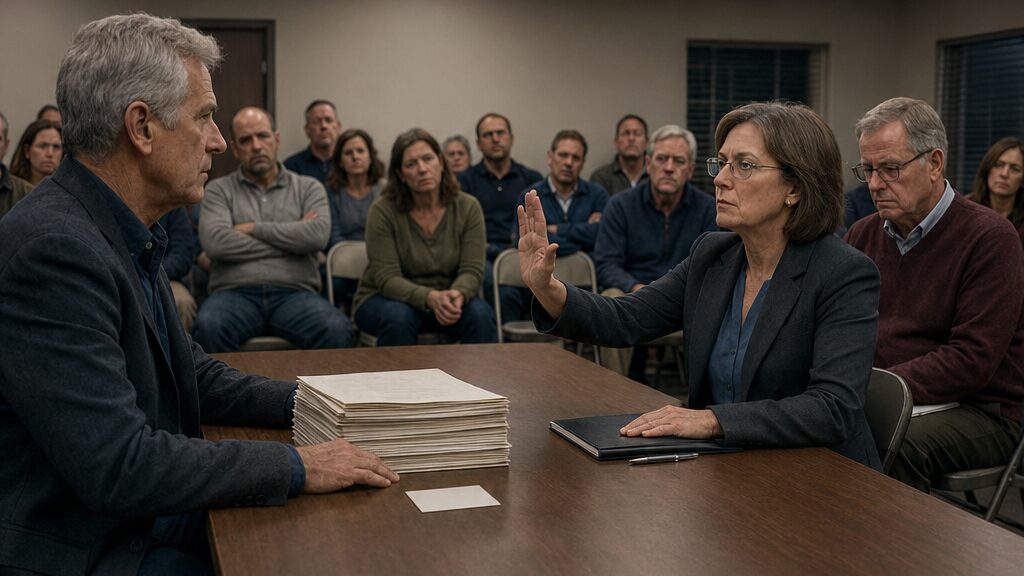
Inside the clubhouse, folding chairs had been set in four uneven rows behind a long laminate table. Susan Campbell sat in the center beneath a framed photograph of the original development entrance. Her papers were squared in front of her. A silver pen rested exactly parallel to the table’s edge.
Michael Davis, the treasurer, occupied the chair to her right. He had been in the neighborhood longer than Christopher and wore the comfortable expression of a man who had never needed to ask which doors opened for him.
Christopher took a seat in the front row.
On his lap rested a narrow file box containing twenty-seven annual account summaries. Beside them lay a blank key-card application Mary had brought home years earlier and never submitted.
The meeting moved through landscaping bids, roof-replacement estimates, and a complaint about trash containers remaining visible after eight in the morning. Christopher waited until Susan asked for resident comments.
He carried the file box to the table.
Susan’s expression tightened before he spoke.
“My access code failed at the tennis courts tonight.”
“The temporary codes are not guaranteed to work for every address,” she said.
“Why not?”
Susan glanced at the management representative seated near the wall. “Because access depends on property classification.”
Christopher placed the current annual statement on the table.
“My property paid the full amenity charge.”
“That is not the same issue.”
“It seems like the same issue.”
A few chairs creaked behind him.
Susan drew the statement closer without touching it. “Your home is in the later phase of the development. Those properties do not carry court privileges.”
Christopher placed another annual summary beside the first. Then another.
He continued until the documents formed a line across the table.
Michael shifted in his chair.
Susan said, “Mr. Martin, we are not going to review decades of billing records during resident comments.”
“I’m not asking you to review them. I’m asking three questions.”
She looked toward the clock on the wall. “You have two minutes.”
“Did my property pay the same monthly amenity fee as the properties with court access?”
“The fee supports multiple shared services.”
“That wasn’t my question.”
A woman in the second row whispered something to the person beside her.
Susan folded her hands. “The base amenity assessment is uniform.”
“So the fee is equal.”
“The assessment is equal.”
“But access is not.”
“Tier B properties do not receive tennis-court access.”
The room went still enough that Christopher heard the air conditioner start.
There it was. Not an implication. Not a gate code that happened to fail. A classification spoken aloud before witnesses.
He placed Mary’s unused application beside the statements.
“Where is that restriction written in the recorded declaration?”
Susan looked at Michael.
Michael looked down at his agenda.
“The classification has existed since the later phase was built,” Susan said.
“That tells me how long you’ve used it. It doesn’t tell me where it is written.”
“It is a long-standing community policy.”
“Policy adopted by what vote?”
Susan’s face lost some of its practiced calm. “This is becoming disruptive.”
Christopher remained seated. He had learned in procurement meetings that the person who stood first often looked like the person who had lost control.
“I’m asking you to show me the authority for collecting equal fees and providing unequal access.”
“You are repeating yourself.”
“Because you have not answered.”
Susan picked up her silver pen. “The board will review your concern and respond through management.”
“I’d like the denial in writing.”
Her pen stopped.
“On association letterhead,” Christopher continued. “State that my property pays the same amenity assessment but is denied court access because it is Tier B. Cite the governing section and sign it.”
A man in the back row gave a short, uncomfortable laugh.
Susan looked past Christopher. “We will not be dictated to during a public meeting.”
“I’m not dictating. I’m documenting.”
“You have made your position clear.”
“So have you.”
Her voice sharpened. “Your comment period is over.”
Christopher gathered none of the papers. He left the annual summaries spread before the board, a paper history of charges no one wanted to discuss.
“I’ll pick these up after you attach the written response.”
Susan pushed back from the table. “Mr. Martin, remove your documents.”
“Why?”
“Because this is association property.”
“The documents are mine.”
“Then take them with you.”
“Do you dispute the amounts?”
“I am asking you to stop interfering with the meeting.”
A management representative approached from the wall but stopped when Christopher calmly returned the papers to the file box. He left Mary’s application on top.
As he turned, he saw Sarah Johnson in the third row. He knew her only by sight. She lived three streets over in the newer section and often walked home from the bus stop with a child carrying a purple backpack.
She was staring at the statements.
Outside, Christopher stood beneath the clubhouse awning and wrote down Susan’s exact language before memory could soften it.
Tier B properties do not receive tennis-court access.
The clubhouse door opened behind him.
Michael stepped out, holding his car keys loosely at his side.
“You made your point,” he said.
“I asked a question.”
“You knew the answer.”
“I knew the practice. I didn’t know the authority.”
Michael glanced back through the glass door. Susan was still speaking, though no one appeared to be listening.
“You’re going to stir up people who don’t understand how the phases were sold.”
“Then explain it.”
“The original buyers paid more.”
Christopher waited.
Michael frowned, as if silence were an accusation.
“The courts were part of the first phase,” he said. “Founding owners understood they had certain rights.”
“Were those rights recorded?”
“It was in the sales structure.”
“Where?”
Michael rubbed his thumb over the edge of his keys.
Christopher said, “Susan called it policy.”
“It’s tradition.”
“Tradition isn’t a bylaw.”
Michael’s eyes lifted to his.
For the first time that evening, Christopher saw uncertainty rather than annoyance.
Michael lowered his voice.
“You won’t find it in the handbook.”
Chapter 2: Tradition Had a Gate Code but No Recorded Rule
“The newer section was cheaper because it came with less.”
Michael said it the next morning from behind a sweating glass of iced tea, as if he were explaining why one grocery brand cost less than another.
Christopher sat across from him on a screened patio overlooking a narrow strip of lawn. From there, the clubhouse roof was visible above the trees.
“Less what?” Christopher asked.
“Less entitlement to the original facilities.”
“My closing documents don’t say that.”
“Most people understood.”
“Mary and I didn’t.”
Michael looked toward the kitchen door. “You bought during the expansion. Prices were different.”
“Prices are always different.”
“The founding homes carried the development.”
“And the later homes paid the same monthly amenity fee.”
Michael’s mouth tightened. “You keep saying that like it settles everything.”
“It settles whether the board charged us.”
“It doesn’t settle what you purchased.”
Christopher opened a notebook. “Which recorded amendment established founding rights?”
Michael leaned back.
“I don’t have section numbers memorized.”
“Which board voted on the tier list?”
“That was before my time as treasurer.”
“You’ve been treasurer for fourteen years.”
“And the system was already in place.”
Christopher closed the notebook.
Michael exhaled. “Look, nobody sat in a room and decided to cheat you. The original owners had keys. The later owners didn’t. Management kept the lists. Dues were standardized because separating every expense would have cost more than it saved.”
“So convenience became authority.”
“You make everything sound worse than it was.”
“No. I’m asking how it was.”
Michael’s face reddened, but his voice remained quiet. “People bought what they bought.”
Christopher stood.
As he reached the patio door, Michael said, “If you pull on this, you may not like what comes loose.”
Christopher looked back.
“Is that advice?”
“It’s experience.”
At home, the file box sat open across the dining table. Christopher had arranged the annual statements by year, oldest to newest. The repetition unsettled him more than any single charge.
Forty-two dollars now.
Thirty-eight before that.
Twenty-nine in the early years.
Each amount small enough to ignore. Together, they formed an accusation against his own silence.
He searched the cabinet where Mary had kept closing papers, appliance warranties, and tax receipts. Her labels remained on the folders in narrow blue handwriting.
House—Original.
House—Improvements.
Association.
He had opened the last folder only twice since her death.
Inside were newsletters, meeting notices, and a faded brochure showing the tennis courts before the trees around them had matured. Near the bottom, he found a key-card application folded in half.
Mary had filled in their address and phone number. She had not signed it.
On the back she had written: Ask why we pay if they say no.
Christopher sat down.
He remembered the night she brought it home. She had wanted to attend the meeting. He had been tired from work and told her they should not make enemies over tennis courts they rarely used.
She had said it was not about tennis.
He had answered that everything became about something else if a person let it.
A month later, her diagnosis changed the scale of every argument in their house. The application disappeared into the folder, and he had been relieved to let it.
Now relief looked too much like surrender.
The county records office occupied the first floor of an annex behind the courthouse. Amy Thompson met him at a service counter separated by thick glass.
Christopher slid a sheet of parcel information through the opening.
“I need the recorded declaration for this development and every amendment affecting common amenities.”
Amy read the address. “Do you know the recording year?”
“Nineteen ninety-seven or ninety-eight.”
“That narrows it to two crowded years.”
“I also need anything establishing property tiers.”
“Recorded tiers?”
“That’s what I’m trying to determine.”
Amy studied him for a moment, then entered the parcel number into her terminal.
“You understand I can locate records,” she said. “I can’t tell you what they legally mean.”
“I understand.”
“And board handbooks are usually not recorded here.”
“I’m beginning to understand that too.”
She printed an index and circled four entries. “Original declaration, first amendment, annexation instrument for the later phase, and a maintenance easement.”
“What about a tier classification?”
“Nothing titled that way.”
An hour later, Christopher sat at a public table beneath fluorescent lights with scanned copies spread before him.
The annexation instrument added the newer streets—including Cedar Ridge Lane—to the association. It assigned the same voting obligations and assessment responsibilities as the original phase.
No mention of reduced amenities.
He turned to the declaration.
Section Four covered common property. Paragraph Two was only three sentences long.
Every owner and lawful resident shall have equal rights of use and enjoyment in the common amenities, subject to reasonable rules uniformly applied.
Christopher read it twice.
Then a third time.
The word equal did not change.
Amy passed behind him carrying a stack of folders. He raised one hand.
“This says equal access.”
She stopped but did not look at the page.
“It says what it says.”
“Could an internal policy override it?”
“That is a legal question.”
“Could an amendment?”
“If properly adopted and recorded, you would normally find it in the chain.”
“And there isn’t one.”
“I did not find one under the parcel or association name. That does not prove no lawyer has another document.”
It was not victory. Amy would not let him pretend it was.
But it was enough to make Susan’s certainty look manufactured.
He requested copies of the board minutes retained by the association through the state’s homeowner-records procedure. Management delayed, then produced digital files covering twenty-seven years.
Christopher spent two nights searching them.
The board approved court resurfacing.
Approved new lighting.
Approved uniform amenity charges.
Approved gate-system replacements.
Not once did the minutes show a vote creating Tier A or Tier B access.
The earliest reference appeared in a property manager’s report from 2003: “Existing access classifications carried forward.”
Carried forward from where, it did not say.
Late on the third night, Christopher opened a folder of recent invoices. Most concerned landscaping, insurance, and legal review.
One legal invoice from six months earlier contained a brief description beneath the billed hours.
Review of governing authority concerning amenity classification exposure.
Christopher stared at the line.
The amount was modest. One point eight hours.
Enough time for someone to ask.
Enough time for someone to receive an answer.
He placed the invoice beside the recorded declaration and Mary’s unsigned application.
The board had not merely failed to know.
Someone had already wondered.
Chapter 3: The Demand Letter Turned Neighbors Against One Another
Susan received the demand at 9:12 on a Monday morning.
By noon, a copy of its first page had circulated through three neighborhood email chains, stripped of its legal explanation but not its largest number.
NINETEEN THOUSAND DOLLARS PER AFFECTED HOUSEHOLD.
Christopher had not written those words in capital letters. Someone else had.
His attorney had calculated the figure using historical amenity charges, estimated interest, and the longest possible payment period. The letter demanded an audit, suspension of the tier restriction, preservation of all records, and restitution for every excluded property.
Christopher had read it twice before authorizing delivery.
He had not spoken to Sarah Johnson.
He had not spoken to any Tier B household except one retired couple who confirmed they had never received court cards.
The mistake did not become visible until Sarah knocked on his door that evening.
She stood on the porch in work clothes, her phone clenched in one hand.
“Did you demand nineteen thousand dollars for my house?”
“For your house, not from it.”
“That isn’t what the board says.”
Christopher stepped aside. “Come in.”
“I don’t have time to come in. I have a child finishing homework and an email saying we could be assessed eight thousand dollars if you sue.”
“That email is designed to frighten you.”
“It worked.”
“The association collected money it wasn’t authorized to collect under unequal terms.”
“I know what they did.”
Her answer stopped him.
Sarah held up her phone. “I applied for a card two years ago. They told me my address wasn’t eligible. I thought the courts were funded by the original section.”
“They weren’t.”
“I understand that now.”
“Then you understand the claim.”
“No. I understand the unfairness. I don’t understand how taking nineteen thousand dollars from an association we all own gives me nineteen thousand dollars.”
Christopher looked toward the dining table, where the annual statements remained arranged in columns.
“The board has reserves.”
“For roofs and drainage.”
“They have insurance.”
“The email says insurance may not cover this.”
“The board is presenting assumptions as facts.”
“And you presented a demand as if everyone affected had agreed.”
Christopher felt the criticism before he accepted its accuracy.
Sarah lowered her voice. “Do you expect me to pay a special assessment so the association can refund money to me?”
“No.”
“Then where does it come from?”
“From the people responsible.”
“Which people? Susan personally? Michael? The board from twenty years ago? Some management company that doesn’t exist anymore?”
He had answers about authority, records, and procedure.
He did not have one for that.
Sarah glanced past him and saw Mary’s application on the table.
“My daughter asked why we can’t use the courts,” she said. “I told her it was because our house came with different rules. I hate that I told her that. But I’m more afraid of losing this house than I am of a locked gate.”
She left before Christopher could defend himself.
The emergency board meeting was held two nights later. Every chair was occupied. Residents stood against the walls and clustered near the doors.
Susan did not use the silver pen.
She held a typed statement in both hands.
“The association has received a demand alleging improper amenity classifications,” she began. “The board disputes several legal and financial assumptions in that demand. However, we must advise residents that defending or resolving the matter may require temporary amenity closures, postponed capital projects, increased assessments, or all three.”
Voices rose immediately.
A man near the back asked whether the pool would close.
Someone else demanded to know who had filed the claim.
Susan did not look at Christopher when she answered.
“The demand was submitted by counsel for Christopher Martin and purports to include all Tier B properties.”
Purports.
The word positioned him as someone claiming authority he had not been given.
Several heads turned.
Michael presented a reserve summary. If the association paid the maximum estimate for every affected property, the reserves would be exhausted several times over. Even a partial settlement could delay roof work and drainage repairs.
A Tier A resident stood. “I didn’t know they paid the same amount.”
Another said, “That doesn’t mean the rest of us should lose our property values.”
Sarah was seated across the aisle from Christopher. She did not look at him.
Susan invited questions.
Christopher rose.
“Will the board suspend the unequal access policy while this is reviewed?”
“The board has been advised not to alter disputed conditions.”
“By whom?”
“Counsel.”
“Did counsel advise you six months ago about amenity classification exposure?”
The room changed.
Michael’s hand moved toward the legal pad in front of him.
Susan’s face remained controlled. “Legal invoices do not disclose privileged advice.”
“I didn’t ask what the advice said. I asked whether the board received it.”
“This meeting is about current financial risk.”
“It is also about when you learned the policy might not be valid.”
A woman by the door said, “Answer him.”
Susan set down the statement. “The board periodically reviews many issues. No final determination was made.”
Christopher opened his folder.
“I have account summaries from six other Tier B households. Same amenity charge. No cards.”
He placed copies on the front table.
It was a small payoff, but an important one. The board could no longer describe him as a singular billing anomaly.
Susan looked at the papers.
“Collecting private account information does not authorize you to represent those residents.”
“They provided the records voluntarily.”
“Did they authorize your demand?”
Christopher hesitated.
Only for verification, not representation.
Susan saw the answer.
“That is precisely the problem,” she said. “Mr. Martin has placed every household at financial risk without first asking whether those households wanted his remedy.”
The accusation landed because part of it was true.
Sarah stood.
“Can I ask him something?”
Susan nodded.
Sarah faced Christopher across the aisle.
“If the court awards the full amount, and insurance refuses coverage, will you agree that no Tier B household should be assessed to fund its own refund?”
Christopher said, “Yes.”
“Can you guarantee that?”
The room waited.
“No,” he said.
Sarah’s expression hardened, though not with triumph.
“Then you don’t have a remedy yet. You have a number.”
By the end of the meeting, the board had voted to freeze discretionary spending, postpone the playground replacement, and obtain an insurance coverage opinion. The tennis courts remained open—to Tier A properties.
Christopher walked home alone.
At 10:47, his phone rang.
Susan.
He considered letting it go to voicemail, then answered.
Her voice was quieter than it had been in the clubhouse.
“I can activate a court card for your address tomorrow.”
Christopher said nothing.
“We can also discuss reimbursing your documented charges,” she continued. “Confidentially. No admission by the association.”
“What happens to the other Tier B properties?”
“This would resolve your claim.”
“That wasn’t my question.”
“You have made the larger issue impossible to manage responsibly.”
“And a private key makes it responsible?”
“It gives you what you originally asked for.”
Christopher looked through the dark dining room toward Mary’s application.
Susan said, “Take the card, Christopher. Take the reimbursement. Let the board correct the rest without destroying the association.”
For twenty-seven years, the gate had remained closed.
Now Susan was offering to open it only wide enough for him.
Chapter 4: The Key Card Offered in Silence Cost More Than Money
Christopher met Susan at the clubhouse office the next morning.
She had placed the key card in the center of the desk before he arrived.
It was plain white, unmarked except for a small black number printed in one corner. For twenty-seven years, access had existed as something abstract—a code that failed, a gate that stayed shut, a benefit listed on statements but withheld in practice.
Now it fit between two fingers.
Susan pushed it toward him.
“It’s active,” she said. “Your address has been added.”
Christopher picked it up.
The plastic was still warm from the laminating machine.
“This is the first one ever issued to my property.”
“Yes.”
“And the others?”
Susan’s eyes moved to the closed office door. “We are discussing your claim.”
“You said that on the phone.”
“Because it matters. You filed through counsel. I am responding to the person who filed.”
Christopher turned the card over. Nothing on it identified the courts, the association, or the classification that had kept him outside.
“What reimbursement are you offering?”
Susan opened a folder. “Documented amenity charges attributable to the courts, calculated over the allowable period. We would include reasonable interest.”
“Allowable according to whom?”
“Association counsel.”
“The same counsel who reviewed amenity classification exposure six months ago?”
Her face changed only slightly, but the change was enough.
Susan drew the folder closer. “This discussion is confidential settlement communication.”
“That doesn’t answer the question.”
“You keep treating every incomplete answer as proof of misconduct.”
“You keep treating every direct question as a threat.”
She looked tired. Not frightened, exactly. Tired in the way of someone who had spent too long holding a door closed and now blamed the pressure on the other side.
“We cannot refund twenty-seven years to every later-phase property,” she said. “You know that.”
“I know you collected the money.”
“The association collected it.”
“You were president.”
“For four years. Not twenty-seven.”
“And during those four years?”
Susan’s fingers rested on the folder.
Christopher set the card down between them.
“I want the fee ledgers for every property classification. I want the access lists. I want the board’s communications with management about the gate. And I want the insurance notice.”
“You are not entitled to privileged communications.”
“Then provide what isn’t privileged.”
“This offer expires Friday.”
Christopher slid the card back across the desk.
Susan did not touch it.
“You wanted access,” she said.
“I wanted equal access.”
“You have it.”
“No. I have an exception.”
Her voice hardened. “You are refusing a practical solution.”
“For me.”
“Yes, for you. Because you are the claimant.”
Christopher stood.
The card remained on the desk, a white rectangle between two people describing fairness in incompatible ways.
At the door, Susan said, “If this becomes a full lawsuit, the reserves will be spent before anyone receives a refund.”
He looked back.
“Then why didn’t the board fix it when counsel raised the issue?”
Susan’s expression closed.
“That is not what happened.”
“What happened?”
She gathered the folder and placed it in a drawer.
“Your attorney can communicate with ours.”
By afternoon, Christopher’s attorney had scheduled a conference call with the association’s insurance carrier. The insurer’s representative spoke in careful phrases that committed to nothing.
Coverage was under review.
The policy contained exclusions for knowing violations.
Defense costs might be advanced under reservation.
Indemnity depended on when the board became aware of the potential governance conflict and what actions followed.
Christopher sat at his dining table with the call on speaker. Mary’s application lay beneath his notepad.
His attorney muted the line.
“This is the part you need to hear,” the attorney said. “If coverage is denied, every dollar spent defending this comes out of association funds.”
“Because the board kept enforcing the policy.”
“Possibly. But proving that could require discovery, depositions, motions, and a year or more.”
“They should have thought about that.”
“They should have. That doesn’t refill the reserve account.”
Christopher looked toward the back window. Through bare branches he could see the clubhouse roof.
“What happens if we pursue the full amount?”
“The association may seek a special assessment. It may close amenities. It may defer maintenance. It could challenge standing household by household. Some owners may opt out. Others may file separate claims.”
“And if I settle?”
“You receive access and some reimbursement. The broader policy survives unless the board changes it voluntarily.”
“That isn’t acceptable.”
His attorney paused.
“There is a third question.”
“What?”
“Whether the maximum legal demand is the same thing as the best remedy.”
Christopher felt irritation rise before he had considered the words.
“The board created this.”
“Yes.”
“They concealed it.”
“We do not yet know that.”
“They received legal advice.”
“We know they received an invoice describing a review. We do not know the advice.”
Christopher unmuted the line before the conversation could move any further into uncertainty.
The insurance representative was saying that a formal coverage determination would be issued within thirty days.
Thirty days in which the board would spend money defending a practice it would not explain.
That evening, Christopher walked past the courts.
The same two men were playing beneath the lights. One raised a hand in greeting. Christopher returned it automatically.
The gate was locked.
He could have opened it now. Susan had not taken back the card. It had been included in the settlement folder his attorney received electronically, marked as temporary individual accommodation.
Christopher stood with his hand inside his jacket pocket, touching the edge of the card.
No one nearby would have known the difference between equal access and a private exception.
That was what made the offer dangerous.
A car slowed beside the curb.
Michael stepped out carrying a large manila envelope.
He looked toward the courts, then at Christopher’s hand in his pocket.
“Did she give you one?”
Christopher withdrew the card but did not display it.
“Yes.”
Michael gave a small nod. “I told her she should.”
“You told her to settle with me?”
“I told her to stop this before it got larger.”
“It was already larger.”
Michael shifted the envelope under his arm. “You don’t understand the reserve situation.”
“Sarah explained it better than the board did.”
“That isn’t what I mean.”
“Then say what you mean.”
Michael looked older than he had on the patio. His shoulders sagged beneath his jacket.
“If this goes to judgment, people will blame you even if you’re right.”
“They should blame the people who made the rule.”
“They won’t. Those people are gone. Some are dead. The management company changed twice. The developer dissolved. The only people left to pay are the ones living here now.”
“Including the people who were excluded.”
“Yes.”
The answer held no satisfaction.
Michael handed him the envelope.
“What is this?”
“A copy. Not the original.”
Christopher read the return address printed in the corner. The association’s law firm.
Michael lowered his voice.
“Susan told us it was preliminary and shouldn’t be attached to the minutes.”
“What was preliminary?”
“The warning.”
Christopher opened the envelope.
Inside was a memorandum dated seven months earlier. The first page bore a bold heading:
PRIVILEGED AND CONFIDENTIAL—AMENITY ACCESS CLASSIFICATIONS.
Michael said, “I should have objected when she kept it out of the record.”
Christopher looked up.
“Why didn’t you?”
“Because she showed us the reserve projections.”
“And?”
“And I was afraid she was right.”
Chapter 5: The Warning Susan Buried Did Not Make Her Fear Imaginary
The memorandum did not use the word mistake.
It used worse words.
Potentially unenforceable.
Unequal treatment.
Restitution exposure.
Knowing continuation.
Christopher read the final paragraph three times before the mediation session began.
If the association continued collecting uniform amenity assessments while maintaining access distinctions unsupported by recorded governing documents, such conduct could be characterized as knowing rather than inadvertent, increasing the risk of uncovered liability.
Susan entered the mediator’s conference room carrying a narrow leather binder. Her attorney followed. She sat across from Christopher without looking at the envelope beside his hand.
The mediator asked whether both sides were prepared to discuss resolution.
Christopher slid a copy of the memorandum across the table.
Susan’s attorney reached for it first.
“Where did you obtain this?”
“From a board member.”
Susan looked at Christopher then.
Not surprised. Angry.
“That document is privileged.”
“The association’s privilege,” Christopher said. “Not yours personally.”
Her attorney said, “We are not waiving any objection to its use.”
Christopher’s attorney placed a hand over his notepad, a quiet signal not to argue the law himself.
The mediator read the first page.
“This changes the posture,” she said.
Susan opened her binder. “It does not change the financial reality.”
“It changes the timeline,” Christopher said.
Her eyes settled on him. “You think I ignored it because I wanted people kept out of the courts.”
“I think you received a warning and continued collecting the fees.”
“I received an analysis identifying uncertainty.”
“It says the classifications are unsupported.”
“It says potentially unsupported.”
“You ordered management to keep the same access list.”
“I ordered management not to make an abrupt change without a funding plan.”
Christopher leaned forward. “Opening a gate requires a funding plan?”
“Equalizing access was not the only issue.”
Susan pulled a reserve projection from her binder and placed copies on the table.
The numbers were worse than the ones shown at the emergency meeting.
Roof replacements for twelve attached units.
Drainage failure along the lower streets.
Pool equipment near the end of its useful life.
The original court lights drawing more power than budgeted.
A complete repayment reserve did not exist. It never had.
“We were eight months from the board election,” Susan said. “I wanted counsel to draft a uniform-access amendment, change the card system, and create credits over several years.”
“Quietly.”
“Carefully.”
“Without telling the people who had been overcharged.”
“With telling them once we had a plan that did not send half the neighborhood into panic.”
“You kept collecting.”
“Because suspending the amenity charge for one classification would have been an admission before we knew the scope.”
Christopher almost laughed, but nothing about the room invited it.
“So you avoided an admission by continuing the conduct counsel warned you about.”
Susan’s jaw tightened.
“Yes,” she said.
The admission landed without drama.
Even her attorney stopped writing.
Susan continued before anyone could use the silence against her.
“I made the wrong choice. I am not pretending otherwise. But I did not invent the tiers. I inherited a system no one had challenged for decades. The moment we changed it, every owner would ask what they were owed. The association did not have the money.”
“You could have stopped the unequal access.”
“And then what? Open four courts to twice the users without changing scheduling, maintenance, insurance, or gate controls? Announce that the board may have collected improper fees for twenty-seven years with no estimate of liability? Watch owners list their homes before we had answers?”
“You decided they couldn’t handle the truth.”
“I decided uncertainty could do more damage than delay.”
“And when did delay become concealment?”
Susan’s gaze dropped to the memorandum.
“When Michael told me three board members would resign if I disclosed it before the election.”
Christopher turned toward Michael’s empty chair against the wall, though he was not part of the mediation.
Susan said, “They believed opening access would erase founding-owner value. Michael said the original section would revolt. The others were afraid of an assessment. I thought if I held the system together long enough, I could replace it without litigation.”
“You thought you could make it disappear.”
“I thought I could fix it before people like you demanded every dollar at once.”
The words struck harder because they were not entirely wrong.
Christopher’s attorney shifted beside him.
The mediator asked Susan what she was willing to offer now.
“Uniform access beginning immediately,” Susan said. “A credit for affected owners over five years. Independent review of the last six years of assessments. No admission of intentional misconduct.”
“Why six years?” Christopher asked.
“Limitations period.”
“You collected from me for twenty-seven.”
“And you accepted the statements for twenty-seven.”
There it was: her justification and her accusation joined together.
Christopher thought of Mary’s application folded in the association file. He had not signed it either.
The mediator called for a break.
Christopher walked outside to the empty tennis courts behind the building. The gates had been left unlocked for maintenance, but no one was playing. Leaves had collected along the fence.
Susan joined him several minutes later.
“You wanted to know why,” she said.
“I know why.”
“No. You know the board version.”
He waited.
She stood on the other side of the open gate.
“My mother owns one of the attached units,” she said. “Fixed income. She can manage a modest dues increase. She cannot manage an eight-thousand-dollar assessment.”
Christopher had seen Susan’s mother at meetings, though he had not known the relationship. A small woman who always sat near the aisle and left before resident comments.
“She’s Tier A,” he said.
“Yes.”
“So she had access.”
“She hasn’t held a racket in fifteen years.”
“That isn’t the point.”
“I know.”
Susan looked toward the nearest court.
“When counsel gave us the memorandum, I did the calculation for her unit before I did it for anyone else. Then I did it for the retired couple across from her. Then Sarah’s street. I saw who would lose savings, who would borrow, who might sell.”
“And that gave you the right to decide for them?”
“No.”
The answer came too quickly to be strategic.
“It gave me a reason,” she said. “Not a right.”
Christopher studied her. The distinction did not absolve her. It made the harm more believable.
Back inside, Susan refused to resign.
She also refused any settlement that required personal admission of knowing misconduct.
“If the complaint continues in its current form,” her attorney said, “the association will challenge every historical calculation, every claimant’s standing, and every asserted interest amount.”
“That could take years,” the mediator said.
“We understand.”
Christopher’s attorney wrote a figure on the corner of his pad: projected defense cost after eighteen months.
It was enough to replace the clubhouse roof.
Susan closed her binder.
“You can expose me,” she said to Christopher. “You can probably remove me. But if your remedy empties the same account that repairs Sarah’s drainage line, you have not protected her. You have only changed the explanation for why the work was not done.”
The session ended without agreement.
Outside the building, Christopher found Sarah waiting beside her car. She held a stapled packet against her chest.
“I heard mediation failed,” she said.
“It didn’t resolve.”
“Same thing, for people getting board emails.”
Christopher glanced at the packet. “What is that?”
“A proposal.”
“From the board?”
“From residents.”
She handed it to him.
The first page called for immediate abolition of all access tiers, equal cards for every property, an independent audit, restitution credits prioritized by years of payment and financial hardship, and a cap on any single-year assessment.
Christopher turned the page.
The cash refund was far lower than his demand.
“This doesn’t make people whole,” he said.
“No,” Sarah replied. “It keeps them in their homes.”
Chapter 6: Justice Needed a Plan the Whole Neighborhood Could Survive
“I want the gate opened, not another gate built between us.”
Christopher found Mary’s sentence in the margin of a newsletter he had nearly thrown away.
Her handwriting ran beside an article announcing the court-lighting upgrade fourteen years earlier. Beneath the sentence, she had drawn a line toward the printed reminder that amenity costs were shared by all homeowners.
He sat alone at the dining table with Sarah’s proposal on one side and his attorney’s damages schedule on the other.
Mary’s old application lay between them.
For months after her diagnosis, they had reduced their lives to appointments, medication times, and which foods she could tolerate. The courts had become absurdly unimportant. That was how he had explained their silence to himself.
But the note showed something different.
Mary had not wanted a larger fight. She had wanted a smaller division.
Christopher had turned her unfinished request into proof that he should never compromise. He had remembered her courage and forgotten her fear.
Sarah arrived that evening with two Tier B residents and one Tier A homeowner who had not known the fees were uniform. They remained role-only in Christopher’s mind at first—people with spreadsheets, reserve concerns, and questions about interest.
By the third meeting, they had become a working group.
They met around his dining table because the clubhouse charged a room fee for non-board gatherings.
The first disagreement came over restitution.
Christopher wanted each household credited for every documented year of unequal payment.
A Tier A homeowner said the association could not return money it had already spent maintaining common property.
Sarah said that was not entirely true.
“The courts were maintained with everyone’s money,” she said. “We were denied use, but the expense happened. The harm isn’t the full fee. It’s paying the same while receiving less.”
Christopher tapped the statements. “That distinction benefits the board.”
“It also makes the calculation honest.”
He looked at her.
She did not retreat.
The independent accountant they consulted proposed separating direct court costs from general amenity costs, then applying restitution based on years excluded. Insurance recovery would fund cash payments first. Remaining amounts would become dues credits spread over time.
No owner would receive a large check immediately.
No owner would face a one-year assessment above a fixed cap.
Capital projects not related to safety would be postponed.
Board members who had received the legal warning would be barred from controlling the restitution account.
Michael attended the fourth meeting.
He stood near the dining-room doorway until Christopher pointed to an empty chair.
“I’m not here for forgiveness,” Michael said.
“No one offered it.”
Michael sat.
He admitted that he had threatened to resign if Susan disclosed the memorandum before the election.
“I thought she was exaggerating the legal risk,” he said. “I thought she wanted to take something away from the original section because the newer streets had more votes.”
Sarah asked, “Did you know we paid the same fee?”
Michael stared at the table.
“I knew dues were uniform.”
“That isn’t what I asked.”
“No,” he said. “I never asked what portion funded the courts.”
The answer carried more shame than any apology would have.
Michael brought updated reserve figures and confirmed that several planned projects could be delayed without creating immediate safety risks. He also identified an old claim against a former management company whose contract required accurate access administration. Recovery was uncertain, but not impossible.
The proposal grew less satisfying and more workable.
Christopher resisted every reduction to the historical claim.
At one meeting, Sarah closed the folder in front of him.
“You keep asking everyone else to accept the facts,” she said. “You won’t accept this one.”
“Which fact?”
“There is no version where every person gets everything back and no innocent person pays.”
“The board should pay.”
“The board is an organization. The money still comes from somewhere.”
“Susan’s decisions increased the loss.”
“Yes. Hold her responsible. Remove her from control. Pursue uncovered costs where the law allows. But stop pretending the largest number is the only honest number.”
Christopher looked around the table.
No one contradicted her.
He went into the kitchen and returned with the original damages schedule. His own estimated claim sat at the top.
He crossed out the interest before the filing date.
Then he reduced the recoverable period to match the longest span the fund could support without breaching the assessment cap.
His attorney had warned him never to negotiate against himself.
But Christopher was not negotiating only for himself anymore.
“If I reduce mine first,” he said, “the hardship households keep priority.”
Sarah studied the new figure.
“Yes.”
“And equal access begins before the first credit is issued.”
“Yes.”
“Independent audit. Public quarterly reports.”
“Yes.”
“Anyone who received the memorandum cannot administer the fund.”
Michael nodded slowly. “That includes me.”
Christopher looked at him. “It should.”
Michael accepted the words without argument.
Sarah turned Mary’s application over and read the note Christopher had copied onto the back.
“I want this on the cover,” she said.
“It isn’t evidence.”
“No. It explains the plan.”
Christopher hesitated, then placed the application on top of the proposal.
At the public board workshop, every seat was filled again.
This time, Christopher and Sarah sat together at the long table where Susan had once ordered him to remove his statements.
Sarah presented the financial safeguards. Christopher presented the access and oversight terms. Michael explained the reserve schedule and acknowledged his role in delaying disclosure.
There was no applause.
Some Tier A owners called the plan punitive. Some Tier B owners called it weak. One resident asked why Christopher should receive anything when he had never used the courts.
Christopher answered, “Because access was withheld, not because I failed to play.”
Susan listened with her binder closed.
When Sarah finished, Susan asked whether the pending complaint against her personally would be dismissed.
Christopher said, “The claim against the association can be resolved under this plan.”
“That was not my question.”
“No.”
Susan’s composure tightened.
“You are asking me to support a proposal that preserves an accusation of knowing misconduct.”
“The memorandum preserves that accusation.”
“You said this was about protecting residents.”
“It is also about accountability.”
“Then you are not compromising.”
Christopher glanced at Mary’s application.
“I reduced my claim before asking anyone else to reduce theirs. I accepted credits instead of immediate payment. I agreed to cap assessments. I did not agree to erase what happened.”
Susan pushed back her chair.
“Then the board rejects the proposal.”
Several residents protested at once, but she raised her hand.
“The court can decide.”
The final hearing began three weeks later.
Christopher’s attorney placed the prepared damages request before him at counsel table. It asked for the maximum recoverable amount, broad interest, immediate injunctive relief, and fees.
Across the aisle, Susan sat beside the association attorney. Michael occupied the public bench behind her, no longer at the board table.
Sarah held a copy of the resident proposal in both hands.
The judge entered and asked whether the parties had reached agreement.
The attorneys rose.
Christopher looked down at the first line of the prepared request.
Maximum restitution.
He thought of the key card in the evidence envelope, Mary’s note on the application, and Sarah asking whether she would have to pay an assessment to refund herself.
Before his attorney could speak, Christopher touched his sleeve.
“I don’t want to ask for this.”
His attorney lowered his voice. “We discussed preserving leverage.”
“I know.”
“The judge may not let you revise after argument begins.”
Christopher slid the damages request aside.
Then he stood.
“Your Honor,” he said, “I would like to address the remedy.”
Chapter 7: The Gate Opened Without Pretending the Damage Was Gone
Christopher remained standing while his attorney gathered the abandoned damages request into a neat stack.
The judge looked over the rim of her glasses.
“You understand that your counsel is here to speak for you?”
“Yes, Your Honor.”
“And you understand that changing the requested relief now may limit what the court can award?”
“Yes.”
Across the aisle, Susan’s attorney rose. “We object to any new proposal that has not been properly briefed.”
Christopher’s attorney stood beside him. “The resident plan was produced during mediation and submitted with our supplemental filing. Mr. Martin is asking to address why he supports it.”
The judge glanced toward the thick binder near her right hand.
“I have read it. Mr. Martin, keep your remarks to the remedy.”
Christopher placed both hands on the edge of the lectern.
“I could ask for every dollar my attorney calculated,” he said. “Some of it may be recoverable. Some of it may not. But winning the largest number would not repair the community I intend to keep living in.”
A faint movement passed through the benches behind him.
He did not turn toward it.
“The association charged later-phase homes the same amenity assessment while denying them equal use. That should be corrected. The people who continued the policy after receiving legal advice should not control the correction. But the money belongs to an association funded by the same homeowners who were misled.”
Susan watched him without expression.
Christopher continued.
“We are asking for immediate equal access, an independent audit, restitution based on documented years of exclusion, and limits that keep one assessment from forcing residents out of their homes. Insurance recovery should fund cash payments first. Nonessential projects can be delayed. Remaining amounts can be provided through credits over time.”
The judge looked toward Sarah, who sat behind counsel holding the proposal.
“And the affected residents support this?”
“Not all of them,” Christopher said. “Some want more. Some want nothing changed. But residents from both classifications helped prepare it.”
Susan’s attorney stepped forward.
“The association disputes that the access classifications violated the declaration. The original development structure created different expectations for different phases.”
The judge opened the recorded declaration.
“Show me the language.”
The attorney approached with a document from the association handbook.
“This policy has governed access for decades.”
“I asked for the recorded language.”
“The handbook reflects the historic sales structure.”
“The declaration controls common-property rights, does it not?”
The attorney paused. “Generally.”
The judge turned several pages.
“Section Four, Paragraph Two states that every owner and lawful resident shall have equal rights of use and enjoyment in the common amenities, subject to reasonable rules uniformly applied.”
She looked at Susan.
“Where is the recorded exception for Tier B properties?”
Susan’s attorney answered. “The association contends that the courts were reserved to the first phase through longstanding practice.”
“Tradition is not an amendment.”
Christopher heard the sentence settle through the room.
The judge removed her glasses.
“Your governing document is clear. Your policy is not in it.”
No one applauded.
Susan lowered her eyes to the binder in front of her. Michael, seated behind her, pressed his hands together between his knees.
The judge continued.
“The remaining question is not whether the classification can continue. It cannot. The question is how to remedy unequal collection without producing unnecessary harm to homeowners who did not create the policy.”
The association’s insurer had filed its coverage determination that morning. The judge permitted Christopher’s attorney to summarize it.
Defense costs incurred before formal notice would be reviewed separately. The carrier would cover part of the restitution tied to negligent administration, but it reserved the right to deny amounts caused by knowing continuation after the legal memorandum.
Susan’s attorney argued that individual board members were protected by the association’s indemnification rules.
Christopher’s attorney answered that indemnification did not necessarily extend to deliberate concealment or actions outside good-faith governance.
The judge did not decide personal liability that day.
She did decide who would control the money.
Susan and Michael were removed from oversight of the restitution process. An independent accountant would audit twenty-seven years of amenity charges and access records. A court-appointed administrator would issue quarterly reports. Safety-related reserves would remain protected, while postponed cosmetic projects and any insurance recovery would fund the first payments.
No single-year special assessment could exceed the cap proposed by the residents without further court approval.
Equal access was effective immediately.
Susan’s face remained composed until the judge addressed the memorandum.
“The court is particularly concerned that the board received advice identifying this precise risk and chose not to disclose or correct the practice.”
Susan stood when instructed.
“I believed delay would prevent financial panic,” she said.
“You may have believed that,” the judge replied. “But stability achieved by withholding material information is not the same as responsible governance.”
Susan nodded once.
The order did not remove her from the board automatically. It required disclosure, restricted her financial authority, and referred the indemnification question to a later proceeding.
It was accountability without spectacle.
Outside the courtroom, reporters were absent. No cameras waited on the courthouse steps. Residents gathered in small groups, speaking in low voices about credits, assessments, and the postponed playground.
One man passed Christopher without acknowledging him.
A woman from the original section stopped long enough to say, “My roof work is delayed because of this.”
Christopher did not tell her that the policy had caused the delay.
He said, “I know.”
Sarah joined him near the elevators.
“You gave up more than I expected,” she said.
“So did you.”
“I didn’t have nineteen thousand dollars on the table.”
“Neither did I. I had a calculation.”
The elevator doors opened.
Susan stood inside alone.
Sarah waited for the next one.
Christopher stepped in.
For several floors, neither he nor Susan spoke.
When the doors opened at the lobby, Susan said, “My mother will manage the assessment cap.”
“I’m glad.”
“She still thinks you tried to bankrupt us.”
Christopher looked toward the courthouse exit.
“Do you?”
Susan considered the question.
“I think you started by wanting someone to feel the cost.”
He could have denied it.
He did not.
“And now?” he asked.
“Now I think you want us to remember it.”
The doors began to close between them as she remained inside.
“That too,” Christopher said.
Six months later, the amended equal-access declaration was recorded at the county office. Amy Thompson stamped the final page and returned a certified copy through the service opening.
“This one is easier to find,” she said.
“That was the idea.”
At the clubhouse, the old Tier A and Tier B lists had been removed from the management system. Every household received the same plain white card.
Christopher still had Susan’s private settlement card sealed in the evidence envelope.
At the first meeting under the new policy, he placed it on the table beside a pair of scissors.
Susan attended from the second row rather than the president’s chair. Michael sat near the aisle.
Christopher cut the card into four pieces.
No one applauded.
The management representative handed him an ordinary replacement card bearing the same number format as every other household’s. He slipped it into his wallet behind his driver’s license.
The restitution audit remained incomplete. The pool renovation had been delayed. Several residents still avoided him at the mailbox. Someone had left a typed note on his door saying fairness should not require ruining everyone else’s neighborhood.
He kept the note because part of it was a question worth remembering.
On the anniversary of the date Mary had written on her old application, the association held its first open-court afternoon. No reservations were required for the first two hours. Loaner rackets rested in a plastic bin beside the gate.
Christopher arrived early.
He entered the new code.
The keypad flashed green.
The latch released with a soft mechanical click, smaller than the sound he had imagined for twenty-seven years.
Sarah came along the path with her daughter, who carried the same purple backpack Christopher had seen at the board meeting months earlier. A racket handle stuck out of the top.
Her daughter stopped at the gate.
“Do we need somebody to let us in?”
Sarah looked at Christopher.
He pulled the gate fully open and stepped aside.
“No,” he said. “You live here.”
The child ran toward the nearest empty court.
Sarah paused before following.
“Are you going to play?”
Christopher looked through the fence at the painted lines and the afternoon light across the surface. Mary had never cared whether they became good at tennis. She had wanted them to stop asking permission to belong.
“Not today,” he said. “Maybe next week.”
Sarah nodded and went inside.
Christopher kept one hand on the gate as other residents approached from both sections of the neighborhood. Some greeted him. Some did not. The court lights still needed replacement. The audit still had numbers to settle. Susan’s choices would return to court, and the credits would take years.
Nothing had been erased.
But the gate no longer measured who deserved to enter.
Christopher held it open until everyone waiting had passed through.
The story has ended.