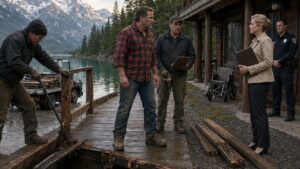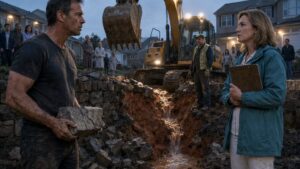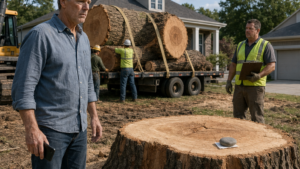
The Contractor Tried To Tow The Old General’s RV From The Land He Secretly Protected
Chapter 1: The Old RV Beneath The Golf Course Oak
The golf ball struck the side of George Martin’s RV with a sharp crack that made his coffee tremble in its tin cup.
He did not flinch.
Outside, beyond the thin wall of faded beige metal, someone laughed from the trimmed green slope of the private golf course. A cart hummed to a stop. A man’s voice floated through the morning air, polished with money and annoyance.
“Don’t worry about it. Thing’s probably held together with duct tape anyway.”
George looked at the brown splash that had jumped onto the rim of his cup. Then he looked through the small side window, past the curtain he had stitched himself, toward the massive oak that shaded the dirt pull-off. Its roots rose out of the ground like old knuckles. One root curled near a half-buried metal marker no bigger than a playing card, greened by age, nearly swallowed by grass.
The golf ball lay in the dust beneath the RV.
No one came to pick it up.
George opened the door and stepped down carefully, one hand on the frame, the other holding his coffee. He wore a faded work shirt tucked into trousers that had been patched at the knee. His boots were clean but old. His white hair was cropped close, his face lined by years that had not softened his eyes.
The golfers looked at him from the edge of the fairway.
One of them raised a hand, not in apology, but in a vague gesture that meant the old man should understand his place in the order of things. George bent, picked up the ball, wiped it once on his sleeve, and tossed it underhand toward the grass.
It landed three feet short of the nearest golfer.
The man stared at it as if George had insulted him by failing to throw farther.
George returned to his step and sat beneath the oak. The tree shaded the roof of the old RV, the folding chair beside it, the small pot of coffee resting on a camp stove, and the line of dust where manicured property became something older and less obedient.
Golf carts passed on the path beyond the fence. Their passengers looked without looking. A woman in white gloves leaned toward another woman and whispered. A man slowed long enough to take a photo with his phone.
George lifted his cup.
He had learned, over a lifetime, that people revealed themselves fastest when they believed you had no power to answer.
A small electric cart rolled down from the clubhouse road and stopped near the pull-off. Christine Baker stepped out in a pale blazer that seemed designed never to touch dirt. She carried a clipboard against her chest like a shield. Her smile was practiced, not cruel exactly, but carefully measured for a man she had already sorted into a category.
“Good morning,” she said.
George nodded. “Morning.”
“I’m Christine Baker. Member relations for the club.”
“I know who you are.”
Her smile tightened. She looked at the RV, then at the oak, then at the uneven dirt where George had set out a small mat to keep from tracking dust inside.
“We’ve had more complaints.”
“I assumed.”
“Mr. Martin, this has gone on longer than anyone expected.”
He took another sip of coffee. “Has it?”
Christine glanced toward the fairway. The golfers were pretending not to listen.
“We’re trying to be respectful,” she said, lowering her voice. “But the members are uncomfortable. They see an older vehicle parked here day after day. They see smoke from your stove. They see…” She paused, searching for a clean word. “Activity.”
“Coffee is activity.”
“That’s not what I mean.”
“No,” George said. “It usually isn’t.”
Her eyes moved to the small stack of books visible through the RV door. Military history. Soil conservation. A worn field guide to native trees. On top of them sat a folded map, its edges softened from use.
“The police came yesterday,” Christine said. “And the day before.”
“They did.”
“They didn’t remove you.”
“No.”
She waited for him to explain. George let the silence sit between them until it began to irritate her.
“This would all be easier,” she finally said, “if you could prove you belong here.”
George’s gaze dropped, not to his RV, not to the club road, but to the old metal boundary marker near the oak root. It had been placed when the golf course was still an idea on paper and the oak was already too large for any reasonable man to cut down.
Christine followed his glance but saw only weeds and dirt.
“I’m not trying to embarrass you,” she added.
“That’s generous.”
“Mr. Martin, please. There are liability concerns. Property value concerns. Safety concerns.”
George set his cup down on the step. “Whose safety?”
She did not answer quickly enough.
Behind her, a black pickup rolled into the pull-off and stopped hard enough to make dust leap around the tires. The truck was clean, oversized, and loud even after the engine died. Gold lettering on the door read Roberts Custom Builds. A second truck slowed behind it, then continued toward the maintenance entrance.
The driver stepped out with a phone pressed to his ear.
Anthony Roberts was broad in the shoulders and dressed as if every job site were a stage. Polished boots. Expensive sunglasses. A white shirt open at the collar. A watch that flashed when he gestured. His eyes passed over George with the quick dismissal of a man pricing debris.
“No, I’m looking at it right now,” Anthony said into the phone. “Yeah. Right by the oak. Worse in person.”
Christine straightened. “Anthony.”
He ended the call without saying goodbye. “This is the obstruction?”
George remained seated.
Anthony looked from the RV to the dirt pull-off, then to the golf course fence, then to the oak canopy. He did not look at the tree as a living thing. He looked at it like a problem that required equipment.
“Lot’s tighter than it looked on the survey mockup,” he said.
Christine stepped closer to him. “We haven’t finalized anything.”
“Not if investors drive past a homeless camp on the way in.”
George’s hand rested on the coffee cup. It did not tighten, but it stopped moving.
Christine lowered her voice. “We don’t use that language.”
Anthony gave a short laugh. “Fine. Unpermitted mobile residence. Is that better?”
George said nothing.
Anthony took two steps toward the RV. He stopped just outside the shade line, as if the oak’s shadow were something he did not want on his boots.
“You got a name?” he asked.
“George.”
“George what?”
George looked up at him. “George is enough for this conversation.”
Anthony smiled with his teeth. “That right?”
Christine shifted uncomfortably. “Mr. Martin has been cooperative in his own way.”
“In his own way?” Anthony pointed at the RV. “That thing is sitting where access needs to be clean. You’ve got members complaining, investors asking questions, and a building schedule with my name on it. Cooperation would look like him moving.”
George glanced at the oak. A breeze moved through the leaves, scattering light over the RV’s dull roof.
“Access to what?” George asked.
Anthony’s smile thinned. “Progress.”
The word landed harder than the golf ball had.
George looked at the contractor then, really looked at him: the restless jaw, the expensive watch, the truck washed clean of work, the way he stood with his chest angled toward the clubhouse even while speaking to the man he meant to remove.
Christine tried to soften the moment. “There’s a proposed hospitality structure near the course entrance. Nothing is final.”
Anthony snorted. “It will be final when the site stops looking abandoned.”
George stood. He moved slowly, but not weakly. Anthony’s sunglasses followed the motion. For the first time, something like caution flickered through him, then vanished beneath impatience.
“This ground isn’t abandoned,” George said.
Anthony spread his hands. “Then show us paperwork. Lease. Permit. Anything.”
George’s eyes went again to the old marker by the root.
He could have opened the drawer beneath his narrow bed. He could have taken out the deed folder, heavy with stamped pages and survey lines older than Anthony’s company. He could have ended the conversation in less than a minute.
Instead, he picked up the golf ball from where it had rolled against his step and held it out.
“You forgot this.”
Anthony stared at the ball. “You think this is cute?”
“No.”
“Then listen carefully, George.” Anthony leaned closer. “I don’t care what story you’ve been telling the cops. I don’t care what loophole you found. You are not going to sit here and cost me a contract because you like the shade.”
George dropped the ball gently into the dust between them.
Christine said, “Anthony—”
“No. Enough.” He pulled out his phone and turned away, already dialing. “Eric, tomorrow morning. Pull-off by the east entrance. Bring stakes, chains, and the sledge.”
George heard Christine inhale sharply.
Anthony looked back at the RV, then at George, and his voice grew loud enough for the listening golfers to hear.
“We’re going to make this simple.”
George stood beneath the oak without answering.
Above him, the leaves moved in the light, and the old metal marker near the root caught one brief flash of sun before the dust settled over it again.
Chapter 2: The Contractor Who Mistook Silence For Weakness
Anthony Roberts opened the contract folder on the hood of his truck, and the first thing that slid out was not a blueprint.
It was a missed-payment notice.
He snatched it before Christine could see the red lettering, folded it once, and shoved it beneath the top sheet. His palm stayed flat on the folder a second too long. Across the patio, men in golf shirts laughed over iced drinks, their voices carrying the comfort of people who believed deadlines existed for other people.
Christine had followed him from the pull-off with her clipboard tucked hard against her ribs.
“You can’t just bring equipment and drag someone away,” she said.
Anthony arranged the papers with unnecessary force. “I’m not dragging anyone. I’m clearing an obstruction.”
“That obstruction is a person.”
“That person is blocking a site line, an access point, and a contract that puts local men to work.”
Christine glanced toward the old oak beyond the fence. From the patio, George’s RV looked smaller and uglier, half-hidden by shade, its faded side panel still marked where the golf ball had struck it. A few members had gathered near the railing, pretending to admire the course.
“You told me this was preliminary,” she said.
“It was preliminary before the investors moved the walkthrough up to Friday.”
“It’s Tuesday.”
“Exactly.”
Christine’s mouth tightened. She wanted the RV gone. Anthony knew that. She had said enough, in careful words and member-relations phrases, to make that plain. But she wanted it done without fingerprints. Without a scene. Without anyone being able to say the club had pushed an old man out of the shade because wealthy members found him unpleasant to look at.
That was the difference between people like Christine and people like Anthony, he thought. She wanted the result wrapped in policy. He knew results came from pressure.
“My crew can clean that pull-off in an hour,” he said. “We place temporary boundary signage, attach a chain, call it abandoned property removal.”
“You heard yourself say temporary signage, right?”
“People believe signs.”
“They also believe lawsuits.”
Anthony slammed the folder shut. A golfer at the railing turned.
“Do you know what happens if those investors drive in and see him sitting there making coffee like the entrance belongs to him?” Anthony asked. “They ask why we haven’t solved a simple problem. They ask if I can manage a site. They ask if this contract should go to someone else.”
Christine softened a fraction. “Anthony, is the contract really that tight?”
He gave a laugh that came out too sharp. “Every contract is tight.”
His phone buzzed. Sandra’s name lit the screen. He ignored it.
Down by the pull-off, George had returned to his chair. He sat with a book open on his lap, the RV door behind him, the oak over him, the golf course moving around him as if he were a stone in a stream. The sight irritated Anthony more than shouting would have.
Silence looked like defiance when it came from a man Anthony had already decided should be grateful for being tolerated.
A patrol car rolled slowly along the course road and stopped near the dirt pull-off. Anthony’s jaw set.
Officer Raymond Moore stepped out. He was not in a hurry. That bothered Anthony too. Men who moved slowly often had the luxury of not needing anything.
George rose from his chair as the officer approached. They spoke briefly. George did not point, wave papers, or plead. He listened. Officer Raymond glanced toward the oak, then toward the club entrance, then back at George.
Anthony strode down before Christine could stop him.
“Officer,” he called. “Good. Maybe we can finally settle this.”
Raymond turned. His expression did not change, but his eyes cooled a little. “Mr. Roberts.”
“You know my name. Great. Then you know why I’m here.”
“I know we’ve received several complaints.”
“And yet he’s still here.”
Raymond looked at George. “Mr. Martin has been advised of the complaints.”
“Advised?” Anthony stepped closer. “He’s parked illegally beside a private course.”
“That is not established.”
Anthony stared. “Excuse me?”
Raymond rested one hand on his belt. “No tow can happen without clear authority. No private removal. No damage to the vehicle. No intimidation. If there is a civil property dispute, you handle it through proper channels.”
“It’s not a dispute. Look at it.”
“I am looking.”
Anthony laughed, but there was no humor in it. “So the law says anybody can roll up in a junk RV and camp wherever they want?”
“The law says you don’t get to decide ownership by appearance.”
George’s eyes shifted to the oak. He said nothing.
Anthony noticed. The old man could have spoken then. Could have explained whatever trick he was using. Instead he stood there with his hands at his sides, letting the officer do the talking, as if Anthony were noise that would pass.
It burned.
Raymond stepped closer, lowering his voice. “I’m telling you plainly. Do not take matters into your own hands.”
Anthony’s smile returned, hard and empty. “Wouldn’t dream of it.”
When the patrol car left, dust trailing behind it, Anthony remained facing George.
“You enjoy this?” he asked.
George picked up his coffee pot from the step. “Enjoy what?”
“Making people work around you.”
“I’m not in your way.”
“You’re exactly in my way.”
George looked at him for a long moment. “That may be your problem.”
Anthony’s face flushed.
Before he could answer, a silver SUV pulled off the clubhouse road. Sandra Roberts stepped out, sunglasses in one hand, a leather bag over her shoulder. She had the composed look of a woman who knew exactly how many people were watching.
“Anthony,” she said. “I’ve been calling.”
“Busy.”
“I can see that.”
Her gaze moved to George and the RV. It did not hold the open contempt of the golfers, but it carried discomfort, embarrassment, and something almost like pity. George had seen that expression before. Pity was often just judgment wearing gloves.
Sandra lowered her voice. “Why are you obsessing over one old man in one ugly RV?”
Anthony stiffened, aware of Christine behind him, the golfers on the patio, the old man in front of him.
“I’m not obsessing. I’m handling a problem.”
“You look like the problem is handling you.”
The words struck harder because she had not meant them cruelly. Or perhaps because she had.
Anthony leaned close to her. “That contract matters.”
“I know it does.”
“No, Sandra, you know the version where everything is already fine. You don’t know the part where one delay gives them an excuse to walk.”
Her expression changed. Not sympathy exactly. Recognition.
“What didn’t you tell me?”
He looked away. That was answer enough.
Behind them, Eric Hill arrived in a work truck with two crewmen. He stepped out, wiping his hands on his jeans. His eyes moved from Anthony to the officer’s fading tire tracks, then to George.
“You still want us here tomorrow?” Eric asked.
Anthony turned on him, grateful for a target. “Yes.”
Eric lowered his voice. “Police say anything?”
“They said we need to make the boundary clear.”
George looked at Anthony then.
It was the first time all afternoon that the old man’s face showed something sharper than patience.
Anthony saw it and mistook it for fear.
He walked back to his truck, opened the cab, and pulled out a stack of blank sign boards. From behind the seat he took a thick marker, the kind used on job sites. He wrote in heavy black letters until the ink bled into the grain.
NO TRESPASSING.
He made another. Then another.
Eric watched uneasily. “Those official?”
“They’ll be visible.”
“That’s not what I asked.”
Anthony looked up. “You want this week’s check?”
Eric’s mouth closed.
Christine said, “Anthony, this is not club authorization.”
“No,” Anthony said, writing the next sign harder than the last. “This is common sense.”
Sandra stood by her SUV, arms folded, the wind moving a strand of hair across her cheek. She looked at George, who had retreated to the shade of the oak and was carefully rinsing his cup with water from a dented metal jug. He did not look defeated. That, more than anything, seemed to enrage her husband.
Anthony shoved the signs into Eric’s arms.
“Tomorrow morning,” he said. “We make the law visible.”
Eric looked past him at the half-buried marker near the oak root, then at George’s old RV, then down at the signs he was now holding.
He did not say yes.
But he did not put them down.
Chapter 3: Wooden Signs Hammered Inches From The Tires
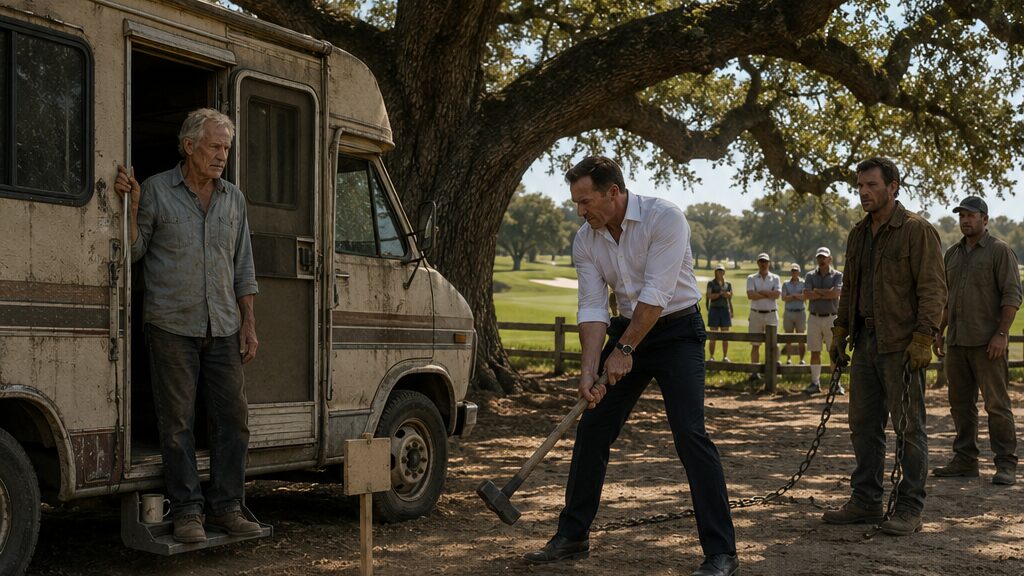
The first wooden stake slammed into the dirt so close to George’s front tire that the RV rocked on its tired suspension.
Anthony Roberts lifted the sledgehammer again.
The second blow drove the stake deeper, splitting the top. The sign nailed to it shook with each strike, the black letters still wet enough to shine.
NO TRESPASSING.
George stood in the doorway of the RV, one hand on the frame, watching the dust rise around his boot mat. His coffee sat untouched on the step. The oak above him scattered shade over Anthony’s shoulders, over Eric Hill’s lowered eyes, over the coil of tow chain lying beside the contractor’s truck like a sleeping snake.
“Morning, George,” Anthony said, breathing hard from the hammer swing. “Figured you might need help understanding boundaries.”
George looked at the sign, then at the tire, then at the ground beneath it.
“You’re close to my wheel.”
Anthony smiled. “Then move it.”
Behind him, two crewmen unloaded another stake and a box of chain hooks. Christine Baker stood near a golf cart at the edge of the paved road, her face tight with the panic of someone watching a thing she wanted happen in a way she could not control. A few golfers had stopped near the fence. One had already taken out his phone.
Eric stepped near Anthony. “Boss, maybe we give him room to pull out if he wants to.”
Anthony kept his eyes on George. “He had room yesterday. He had room last week. Now we help him decide.”
George stepped down from the RV.
The neighbor with the phone moved closer, angling for a better shot. From where he stood, George’s movement would look like aggression: the old man leaving the vehicle, the contractor standing by a sign, the crew backing away. George noticed the angle. He noticed everything. He had survived too many rooms, roads, and fields by reading what people wanted others to see.
He stopped beside his coffee cup and did not come closer.
“Mr. Roberts,” he said quietly. “Do not hammer another stake into this ground.”
The crew went still.
Anthony blinked, then laughed. “There it is. The command voice.”
George’s face did not change. “That was a warning.”
“No, this is a warning.” Anthony turned, took another stake from Eric, and planted it near the rear tire. “You are on land that does not belong to you, in a vehicle that should have been scrapped fifteen years ago, blocking work that feeds families.”
The sledgehammer rose.
George’s eyes flicked toward the base of the oak. The second stake was not near a tire this time. It was near the roots.
The hammer came down.
The sound moved through the dirt, dull and deep. Leaves trembled above them, though there was no wind.
Inside the RV, beneath the narrow bed, a drawer sat closed. In that drawer lay a heavy folder wrapped in oilcloth. George had checked it that morning, not because he needed to read what was inside, but because old habits made him verify the things he might have to carry. Deed. Survey. Conservation restriction. Military identification. Copies of letters he had not shown anyone in years.
He had held the folder in both hands.
Then he had put it back.
Paper should not need performance. Ownership should not need theater. A man should not have to parade rank to keep his own shade.
But the third hammer strike landed so close to the oak that a small piece of bark dropped from one of the raised roots.
Eric saw it too. He crouched to pick up a chain hook and froze.
Half-buried near the root, almost hidden by dust and dry grass, was a metal boundary tag. Its edges were green with age. A faint stamped line of numbers ran across it, worn but visible. Eric brushed it with his thumb.
“Anthony,” he said.
“What?”
Eric pointed. “There’s some kind of marker here.”
Anthony did not look. “Then don’t trip on it.”
“I mean maybe we should—”
“Hook the chain.”
Eric stayed crouched.
Anthony turned on him. “Hook. The chain.”
The words cracked across the pull-off. Eric stood, jaw working, and picked up the chain. He dragged it toward the RV’s rear hitch, the links scraping dirt and stone. The sound carried up the oak, across the fence, into the clean morning of the golf course where carts had stopped pretending to pass by.
Christine stepped forward. “Anthony, I really think we should pause.”
He swung the sledge down again. “You wanted this handled.”
“Not like this.”
“No, you wanted it invisible.” He pointed the hammer toward George without taking his eyes off Christine. “He’s been invisible long enough.”
George’s hand moved once toward the RV door.
Not to shut it. Not to retreat.
To the cabinet just inside, where the drawer beneath the bed could be reached if he leaned in.
His fingers stopped on the doorframe.
Anthony saw the movement and grinned. “What’s in there, old man? Your permit? Your lawyer? Your last clean shirt?”
A few golfers chuckled before realizing the sound was too loud.
George’s face remained calm, but something in his eyes hardened. He looked at Eric struggling with the chain, at the sign blocking the front tire, at the stake near the oak root, at the neighbor’s phone capturing him from the wrong side.
Then he looked at Anthony.
“You’re making a record,” George said.
Anthony spread his arms. “Good. Let everyone see I gave you every chance.”
“No,” George said. “Let them see you were told.”
Anthony’s grin faded.
The neighbor filming whispered to someone, “He just threatened him,” and George heard it clearly.
So did Anthony.
“There,” Anthony said, turning toward the watching phones. “You hear that? This is what I’ve been saying. Unstable. Belligerent. Camped out beside a family club.”
Sandra’s SUV was not there, but Anthony glanced toward the road as if imagining her arrival, imagining investors, imagining men in linen shirts asking why one old man had been allowed to make him look powerless.
He tossed the sledgehammer to the ground and walked to the back of his truck.
Eric straightened. “Boss?”
Anthony opened the tool compartment and pulled out an iron crowbar. It was dark, thick, and scarred from years of prying boards loose from places they had once belonged.
Christine said, “Anthony, stop.”
George stepped fully away from the RV now.
The movement was small, but the crew felt it. Eric stopped with the chain in his hands. One of the crewmen lowered his phone. Even the golfers behind the fence quieted.
Anthony slapped the crowbar against his palm. “I’m done negotiating with a squatter.”
George’s voice dropped. “Do not touch the vehicle.”
“You mean this trash?”
Anthony walked toward the RV bumper, the crowbar hanging at his side.
The neighbor’s phone followed George’s face, not Anthony’s hand.
George saw the whole scene arranging itself against him: the signs, the chain, the phones, the rich grass beyond the fence, the old RV under the oak, the contractor with a tool, and himself standing in the dust like the angry man they had already decided he was.
He could still step inside.
He could still open the drawer.
He could still let paper speak before metal did.
Anthony raised the crowbar.
The oak leaves shivered above them as George took one quiet step forward.
Chapter 4: The Crowbar Bent Beneath The Old Man’s Knee
The crowbar came down toward the RV bumper, and George Martin’s hand rose to meet it.
He did not swing back. He did not duck. He stepped inside the arc of Anthony’s anger and caught the iron bar just above the hooked end, his fingers closing around it with a sound that was almost lost beneath Christine’s gasp.
For half a second, nothing moved.
Anthony’s arm was still raised, his mouth slightly open, his sunglasses sliding down the bridge of his nose. The crowbar should have kept going. It should have struck old metal, shattered a tail light, left a dent that would prove to every watching phone that the RV was only junk waiting to be removed.
Instead, it stopped in George’s bare hand.
The dust seemed to hang still beneath the oak.
George looked not at the crowbar, but at Anthony.
“I told you,” he said, his voice low, “not to touch the vehicle.”
Anthony jerked backward, trying to rip the tool free. It did not move.
His boots slipped in the dirt.
“Let go,” Anthony snapped.
George’s fingers tightened.
Eric Hill took one step back, the tow chain hanging loose from his hand. The crewman closest to the truck muttered something under his breath and backed away too. Behind the fence, the golfers were no longer pretending this was a nuisance. Every face had turned toward the pull-off.
The neighbor’s phone stayed fixed on George.
Anthony pulled again, harder this time, the tendons in his neck standing out. “I said let go.”
George released the crowbar with one hand and caught it with the other before Anthony could recover. The movement was fast, clean, almost too efficient to understand. The tool was suddenly no longer between them. It was in George’s possession, angled downward, its hooked end resting in the dust.
Anthony stumbled back two steps.
“Did you see that?” he shouted, turning toward the onlookers. “He grabbed it out of my hands.”
“You swung it,” Eric said quietly.
Anthony spun on him. “Shut up.”
George did not look at Eric. His attention stayed on the iron bar. It was a heavy thing, dark with use, made for prying boards, tearing nails loose, forcing gaps where none were offered.
He turned it once in his hands.
For a moment, his face altered. Not with rage. Something older moved through it, brief as a shadow crossing water. His fingers found balance points without searching. His shoulders settled. His feet adjusted in the dirt. The old man in the patched shirt disappeared just enough for every person watching to sense that they had been looking at the wrong part of him.
Anthony felt it too. His voice lowered, uncertain. “What the hell are you?”
George said nothing.
He set one end of the crowbar against his thigh, lowered the middle across his knee, and bent.
At first it seemed impossible. The iron resisted. A faint metallic groan crept out, thin and ugly. George’s jaw tightened, but he did not grunt, did not roar, did not perform for the phones. He simply applied pressure with a controlled violence that made the crewmen look away before looking back.
The crowbar bowed.
Christine put a hand over her mouth.
Anthony’s sunglasses slipped all the way down and hung from one ear.
The metal gave with a rough, complaining sound. George forced the bend deeper, until the straight bar had become a warped, useless curve. Then he lifted it from his knee and dropped it at Anthony’s feet.
It struck the dirt with a dead, final thud.
The tow chain in Eric’s hand stopped rattling because Eric had stopped breathing.
George’s right hand trembled once at his side.
He closed it into a fist, then opened it slowly. A thin red line had appeared across his palm where the iron had bitten him. He looked at it without surprise, as if the cost had been expected and accepted. Then he wiped the blood against his trouser seam.
Anthony saw the tremor. It seemed to give him back a little courage.
“You saw that,” he shouted, pointing at George and then at the golfers. “You all saw that. He attacked me.”
No one answered.
The neighbor with the phone shifted position. The screen was still aimed mostly at George, catching his bloodied hand, the bent crowbar at Anthony’s feet, the crew stepping backward. It had not caught the full swing clearly. George noticed the angle again and felt, with a tired clarity, how easily truth could be trimmed.
Christine’s face had gone pale. “Anthony, stop talking.”
“No,” Anthony barked. “No, this is exactly what I told everyone. He’s dangerous. He’s unstable. He just ripped a tool out of my hand.”
“You raised it at his RV,” Eric said.
Anthony rounded on him. “Are you my foreman or his lawyer?”
Eric’s mouth closed, but his eyes moved to the chain still lying beside the bumper, then to the stakes Anthony had driven into the dirt, then to the boundary tag near the oak root.
George followed the same line of sight.
The tag was no longer hidden. Eric’s thumb had cleared enough dust that the old stamped numbers caught the light. Not enough for a stranger to read, perhaps. Enough for George to know exactly where they were standing.
He had placed his silence on the ground like a bet, and Anthony had kept stepping on it.
George turned toward the RV.
Anthony seized on the movement. “Where are you going? You don’t get to run inside and come out with something worse.”
George stopped.
He could have ended it then. The deed folder was within reach. The identification was wrapped inside it. One minute. Less than one minute. But the thought of opening that drawer in front of Anthony, Christine, golfers, phones, and dust made something tighten beneath his ribs.
He did not want the salute.
He did not want his name spoken in that tone.
He did not want the old life dragged out under the oak like another tool.
So he stayed silent too long again.
Anthony pulled out his phone. “I’m calling the police.”
Christine said, “They already warned you.”
“Good. Then they can come arrest him for assault.”
George turned back. “Be careful what statement you make.”
Anthony laughed, too loud. “Another threat?”
“No,” George said. “A correction.”
The word struck Anthony wrong. His face darkened.
“You think you’re smarter than everyone because you sit there reading old books and staring at a tree? You think that makes this yours?” He kicked one of the stakes. The sign shook. “This is not how the world works anymore. People build. People improve things. People don’t get to squat in the dirt and hold progress hostage.”
At the word progress, George’s gaze moved to the oak again.
One root bore the fresh scar from Anthony’s hammering. Not deep, but visible.
George stepped toward it.
Anthony flinched before he could stop himself.
That small involuntary movement changed the air. The crew saw it. Christine saw it. Anthony saw them seeing it. His humiliation arrived before the police did.
So he made his voice louder.
“Yes, I need officers at the east entrance of the golf course,” Anthony said into his phone. “There’s an aggressive vagrant here. He just attacked me with a crowbar.”
Eric looked up sharply. “That’s not what happened.”
Anthony covered the phone. “Say one more word and you’re done.”
Eric’s face flushed. He looked at the other crewmen, but they stared at the ground.
George crouched near the oak root. The motion was careful; his knee clicked audibly in the quiet. He brushed dust from the boundary tag with two fingers, then touched the scar where the stake had grazed bark.
The pain in his palm pulsed now.
He welcomed it. Pain was simple. Pain told the truth without needing anyone’s permission.
Christine stepped closer, her voice low. “Mr. Martin, do you have something you can show them when they arrive?”
George did not answer.
“Please,” she said, and the word sounded different from her now. Not polished. Afraid.
George looked at her. “You wanted proof when it was convenient for you.”
Her face tightened as if he had slapped her, though his voice had stayed calm.
“I didn’t want this,” she said.
“No,” George replied. “You wanted it quiet.”
She looked away.
The first siren rose from beyond the trees, faint but clear, cutting through the golf-course morning. A few carts retreated toward the clubhouse. Others came closer. There was no clean way to stop people from watching now.
Anthony stood taller when he heard the siren. He shoved his phone into his pocket and pointed at the bent crowbar.
“Do not touch that,” he said to no one in particular. “That is evidence.”
George almost smiled.
Then a silver SUV turned off the clubhouse road so sharply its tires spat gravel. It stopped near Christine’s golf cart.
Sandra Roberts stepped out before the engine had fully gone quiet. She took in the scene in pieces: the signs around the RV, the chain near the bumper, the bent crowbar at Anthony’s feet, George’s bleeding hand, the line of golfers pretending their curiosity was concern.
Then she looked at her husband.
“Anthony,” she said, and there was no softness in it now. “What did you do?”
The police sirens grew louder, flashing blue between the trees as George stood beneath the oak with his hand bleeding at his side and the warped crowbar lying in the dust between him and the man who had called him dangerous.
Chapter 5: The Officer Saluted The Man They Called A Vagrant
“That man is dangerous,” Anthony shouted before Officer Raymond Moore had both feet out of the patrol car.
He pointed at George with one hand and at the bent crowbar with the other, shaping the scene before anyone else could speak. His voice carried across the pull-off, past the stakes, past the golf carts, past Sandra standing rigid beside her SUV.
“He attacked me. He took my tool and bent it like some kind of maniac.”
Officer Raymond looked at the crowbar on the ground.
Then he looked at the ring of wooden signs hammered around the RV.
Then at the tow chain near the rear hitch.
Then at George’s right hand, where blood had started to gather again along the torn line in his palm.
“Everyone stay where you are,” Raymond said.
A second patrol car pulled in behind him. Another officer stepped out and began moving the spectators back from the dirt. The neighbor with the phone protested until Raymond gave him a look that made him lower his voice, though not his camera.
Anthony stepped toward Raymond. “I want him arrested.”
Raymond held up one hand. “Step back.”
“You don’t understand. I called about this before. You knew he was a problem.”
“I said step back, Mr. Roberts.”
Anthony stopped, but only because Sandra said his name under her breath.
George stood near the RV door. He had not gone inside. The deed folder remained in the drawer beneath the narrow bed, exactly where his stubbornness had left it. His palm stung. His knee ached from bending the iron. More than either, he felt the old pressure of attention gathering on his shoulders.
He had spent years avoiding that weight.
Officer Raymond approached him slowly, not with fear, but with caution sharpened by uncertainty.
“Mr. Martin,” he said. “I need to see identification.”
George nodded once.
He turned toward the RV.
Anthony lunged a step forward. “Watch him. He could have a weapon in there.”
George stopped with one boot on the step.
A flicker passed across his face—not anger, exactly. Weariness.
Raymond turned. “Mr. Roberts, if you interfere again, you will wait in the back of my vehicle.”
Anthony’s jaw worked. Sandra stared at him as if she were seeing a stranger who had borrowed her husband’s voice.
George stepped inside the RV.
The interior was narrow and clean. A pot sat strapped beside the small stove. Books were stacked with their spines aligned. A folded blanket lay at the foot of the bed. On the wall above it hung no medals, no photographs in uniform, no framed certificates. Only a small black-and-white picture of the oak from decades earlier, when the fence had not yet been built and the surrounding field rolled wild toward the road.
George stood a moment before the drawer.
He could hear Anthony outside.
“Look at this place. Look at these signs. We were establishing a boundary, and he came at me.”
George closed his eyes.
He had once believed that the less a man displayed, the less the world could take from him. He had learned to live with little visible evidence. A cup. A book. A bed. A tree. The rest he had folded away.
But silence had not protected the oak. It had invited men like Anthony to fill the quiet with their own version of the truth.
George opened the drawer and took out the oilcloth-wrapped folder.
It felt heavier than paper.
When he stepped back outside, the crowd quieted further. Anthony stared at the folder with sudden suspicion.
George handed Raymond his driver’s license first. Then, after a brief hesitation, he gave him the military identification card tucked behind it.
Raymond glanced at the card.
His posture changed immediately, not dramatically, but with the trained recognition of a man whose body understood before his voice did. His shoulders squared. His chin lifted.
He looked from the card to George’s face.
“Sir,” Raymond said.
George’s mouth tightened. “Please run it.”
Raymond nodded. He walked back to the patrol car with the identification in hand.
Anthony laughed once. “What, he has a veteran card? That doesn’t make this his land.”
No one joined him.
Sandra looked from George to the patrol car. Her expression had shifted from anger at the scene to something more uncertain, more private. She seemed to be measuring every word Anthony had said against the old man now standing quietly by the RV.
Christine stood near the golf cart, both hands clasped around her clipboard. “Mr. Martin,” she began, then stopped because she did not seem to know which apology would not sound like self-defense.
George held the folder against his side and looked at the oak. The scar near the root was visible from where he stood.
Raymond returned from the patrol car slower than he had gone.
He stopped in front of George.
Then he saluted.
Not a casual gesture. Not theater. A clean, formal salute that made the dirt pull-off seem, for one strange second, like a parade ground only two men recognized.
The golf-course crowd went silent.
George did not return it immediately. His hand with the cut twitched, then lowered. He used his left hand instead. The salute was brief, restrained, almost reluctant.
Raymond dropped his hand. “Retired Major General George Martin.”
Anthony’s face emptied.
Raymond turned so his voice carried. “Two-star General. Verified.”
Sandra’s lips parted. Christine’s clipboard lowered an inch.
Anthony recovered with the desperation of a man grabbing at a falling ladder. “Fine. Fine, he served. I respect service. Everybody respects service. That has nothing to do with him camping here.”
George opened the folder.
The paper inside was old but carefully preserved. Survey maps. Recorded deed. Conservation covenant. Estate boundary record. The documents had stamps, seals, signatures, and the patient authority of things filed long before anyone standing there had decided the land looked available.
Raymond took the top pages and examined them on the hood of his patrol car.
Christine moved closer despite herself. “That can’t include the pull-off.”
George looked at her.
She flushed. “I mean— I thought the club boundary—”
“Runs along the fence,” George said. “Not the tree.”
Raymond checked the survey. His finger traced a line from the road to the oak, then around the dirt pull-off, then beyond it toward the wooded slope behind the course.
He looked at Anthony.
“This pull-off is part of the Martin protected estate.”
Anthony shook his head. “No. That deed has to be outdated.”
“It is current.”
“You don’t know that from looking.”
“I ran the parcel note last time complaints came in,” Raymond said. “The ownership record was restricted enough that I wasn’t comfortable discussing it without Mr. Martin’s consent. But I told you not to take private action.”
Anthony’s eyes darted toward the watching golfers, then Christine, then Sandra.
“This is insane,” he said. “If he owns it, why is he living in that?”
The word that hung after that was thing, though he did not say it.
George closed the folder slowly.
Raymond’s voice sharpened. “Mr. Roberts, at this point the signs, chain, and attempted removal appear to be on private property without authorization.”
Anthony pointed at Eric. “Tell him what happened. Tell him he came at me.”
Eric’s face went pale.
Anthony stepped closer. “You were right there. Tell him I was defending the crew.”
Eric looked at George’s bleeding hand. Then at the crowbar. Then at the nearest sign, its stake splitting from the sledge blows. The eyes of the crewmen were on him now, not with loyalty, but warning. They had seen Anthony turn blame before. They knew the shape of it.
Eric swallowed. “You told us to hook the chain.”
Anthony’s face hardened. “Careful.”
“You told us to bring signs.”
“Because we had to mark the area.”
“You told me the police said to make the boundary clear,” Eric said, voice low but steadier now. “They didn’t.”
Anthony took one step toward him. “You want to keep your job?”
Raymond moved between them. “Do not threaten him.”
Anthony jabbed a finger around Raymond toward Eric. “He works for me. He knows what happens when equipment gets mishandled. He knows how this looks if he lies.”
Eric’s fear changed then. It did not disappear, but it found a different object. He was no longer only afraid of losing work. He was afraid of being dragged under Anthony’s version of events and left there.
Sandra saw it happen. Her face tightened.
“Eric,” she said quietly. “Tell the truth.”
Anthony turned on her. “Stay out of this.”
She did not move.
Eric reached into his pocket.
Anthony’s eyes narrowed. “What are you doing?”
Eric pulled out his phone. His hand shook as he lifted it.
“I filmed from the truck,” he said.
The sentence landed harder than the salute.
Anthony stared at the phone as if it had appeared out of the dirt itself.
Eric looked at Raymond, not at his boss. “From before the first stake.”
George stood beneath the oak with the deed folder closed against his side, watching the man who had tried to make the law visible suddenly go still before the one record he had not controlled.
Chapter 6: The Video That Broke Anthony’s Clean Image
Eric’s video began with Anthony laughing.
The sound came thin and ugly through the phone speaker as Officer Raymond placed the device on the hood of the patrol car. Everyone close enough leaned in despite themselves: Sandra, Christine, the second officer, two crewmen, even the neighbor who had been filming from the wrong angle.
On the screen, Anthony stood beneath the oak with the sledgehammer over one shoulder.
“Morning, George,” recorded Anthony said. “Figured you might need help understanding boundaries.”
Then the hammer came down.
The stake slammed into the dirt inches from the RV’s front tire. The phone shook slightly in Eric’s hand, but the image held. There was George in the doorway, still and empty-handed. There was the tire. There was the sign. There was Anthony smiling as if cruelty were a job skill.
Sandra’s face lost color.
Anthony reached for the phone. “That’s out of context.”
Raymond blocked his hand without looking away from the screen. “Do not touch it.”
“It’s my employee’s phone.”
“It is potential evidence.”
Eric stood behind Raymond, shoulders rounded, as if he expected Anthony’s anger to hit him physically.
The video continued. Anthony’s voice filled the roadside.
“You are on land that does not belong to you, in a vehicle that should have been scrapped fifteen years ago, blocking work that feeds families.”
George’s voice came next, quieter but clear.
“Mr. Roberts. Do not hammer another stake into this ground.”
Anthony on the screen lifted the sledgehammer again.
Sandra looked at the real Anthony. “You said he threatened you.”
“He did.”
“He asked you to stop.”
Anthony’s jaw moved, but nothing came out.
On the phone, Eric’s camera dipped as he crouched near the chain. For a moment the image showed dust, metal links, boot soles. Then it caught his hand brushing the old boundary tag near the oak root.
“Anthony,” Eric’s recorded voice said. “There’s some kind of marker here.”
“Then don’t trip on it,” recorded Anthony snapped. “Hook the chain.”
Christine closed her eyes.
The words seemed to remove the last thin layer of distance she had kept between wanting the RV gone and causing what had happened. She opened her eyes and looked toward the clubhouse, where a cluster of members stood behind glass doors pretending not to press close.
“This was not authorized by the club,” she said.
Anthony turned on her. “Don’t you dare.”
Christine’s voice shook, but she kept going. “You were told to wait. You were told there were legal questions.”
“You fed me the problem for two weeks.”
“I raised member concerns. I did not authorize trespass, forged signage, or a tow attempt.”
Anthony laughed once in disbelief. “Forged?”
Raymond glanced at the signs. “Who prepared them?”
Anthony looked at Eric.
Eric looked back this time.
Raymond did not need more answer than that.
The video reached the moment near the RV bumper. Anthony’s body moved into frame, crowbar hanging from his hand. The neighbor’s recording had made George look like the one stepping forward. Eric’s video showed why.
“I’m done negotiating with a squatter,” Anthony said on the screen.
George’s recorded voice: “Do not touch the vehicle.”
“You mean this trash?”
The crowbar lifted.
Sandra made a small sound—not a sob, not quite. More like a breath catching on something sharp. She had seen Anthony angry before. She had seen him bully subcontractors, snap at servers, charm investors with one hand while squeezing someone powerless with the other. She had filed those moments away as stress, ambition, pressure.
But the video did not show stress.
It showed pleasure.
He had enjoyed making the old man stand there while signs boxed in his wheels. He had enjoyed saying trash. He had enjoyed having an audience.
The crowbar came down on the screen.
George caught it.
Even through the phone, the motion changed everyone’s breathing. The second officer muttered under his breath. One of the crewmen stepped back from the patrol car as if the moment might repeat itself in real life.
The video captured Anthony pulling, failing, stumbling. It captured George taking the crowbar away. It captured the bend, too—the iron groaning over George’s knee while Anthony’s face shifted from rage to disbelief.
Then came the part Anthony had been shouting about.
“You saw that,” recorded Anthony yelled. “He attacked me.”
But the video had already shown the swing.
Raymond stopped playback.
For a few seconds, the only sound was leaves moving overhead and a golf cart reversing somewhere too far away.
Anthony spoke first because he could not stand silence unless he owned it.
“He bent a steel crowbar in front of people. You’re all acting like that’s normal.”
George stood beside the RV, the oilcloth folder tucked under his arm, his wounded hand now wrapped in a clean cloth Christine had wordlessly fetched from her cart. He had not asked for it. She had offered it without meeting his eyes. He had accepted after a long moment, and the acceptance seemed to hurt her more than refusal would have.
Raymond looked at Anthony. “The video shows you initiated the physical threat.”
“I was protecting a contract.”
“You were on his land.”
“I didn’t know that.”
“You were told not to take action.”
Anthony’s eyes flashed toward Sandra. “You see what this is? They’re turning this into some moral performance. I was trying to save everything we worked for.”
Sandra stared at him. “Everything who worked for?”
His expression faltered.
She looked at the signs, the chain, the crowbar, the old RV, then George beneath the tree. When she spoke again, her voice was lower.
“You told me he was harassing members.”
“He was.”
“He was drinking coffee.”
Anthony’s face reddened. “Don’t make me the villain because I’m the only one willing to handle ugly things.”
Sandra stepped back as if the word ugly had reached out and touched her.
Christine turned toward Raymond. “The club will cooperate with whatever statement you need. Mr. Roberts was not authorized to act on our behalf.”
Anthony stared at her. “You’re killing the contract.”
“No,” Christine said, and now there was steel in the polished voice. “You did that when you brought chains to land you didn’t own.”
The words moved through the onlookers. Not applause. Something colder. Recalculation.
Anthony heard it. His clean image, the builder who solved problems, the man investors trusted because he never hesitated, began coming apart in the faces around him. He reached for authority and found only people taking one step away.
“Eric,” he said.
Eric stiffened.
“Tell them we had reason to believe—”
“No,” Eric said.
Anthony blinked.
It was one small word, but it cracked through years of job-site obedience.
Eric slid his phone back into his pocket. “I’ll give a copy to Officer Raymond. But I’m not saying it was right.”
Anthony’s mouth opened. Closed.
Sandra turned and walked toward her SUV.
For one second Anthony looked relieved, as if he thought she was removing herself from the embarrassment. Then she opened the rear hatch.
Inside were two suitcases.
The silence changed shape.
Anthony stared. “Sandra.”
She lifted the first suitcase out and set it on the gravel beside her. Then the second. Her movements were controlled, but her hands shook when she reached for the handle.
“You packed?” he said.
“Last night.”
His voice dropped. “What?”
She looked back at him across the dirt pull-off, across the signs, across the bent crowbar lying near his boots.
“I packed last night in case this was who you really were.”
“Sandra, don’t do this here.”
“That’s what you’re upset about?” Her laugh was small and bitter. “Here?”
He took a step toward her. Raymond shifted just enough to make him stop.
Sandra opened the driver’s door, then paused. Her face was pale, but her eyes were clear now.
“You lost the contract,” she said. “And you lost me.”
Anthony looked around, as if someone might tell him the correct move, the winning line, the way to turn the crowd back. No one did.
Sandra put the suitcases into the back seat instead of the trunk, as if she wanted everyone to see they were not props. Then she closed the door and stood with one hand on the handle, not yet inside, waiting for whatever would come next.
George looked from Anthony to the wounded oak root, to the signs in the dirt, to the deed folder beneath his arm.
For the first time that morning, the power to decide the shape of punishment rested plainly with him.
Chapter 7: The Land He Protected Without Needing Praise
Sandra’s car door slammed so hard the closest wooden sign trembled in the dirt.
Anthony stood beside the warped crowbar as her SUV rolled away from the pull-off, its tires crunching over gravel, its rear window flashing once with the reflection of the oak before the road curved toward the clubhouse. He watched it go with his mouth open, as if the departure were a mistake someone would correct if he waited long enough.
No one corrected it.
The golf carts had drawn back. The members who had gathered by the fence were quieter now, their curiosity thinned into discomfort. Christine stood near the patrol car with her clipboard hanging loose at her side. Eric kept his eyes on the ground, his phone already handed over for the evidence copy. The two crewmen waited by Anthony’s truck, no longer touching the chains.
George Martin stood beneath the oak with the deed folder under one arm and a white cloth wrapped around his right palm.
Officer Raymond Moore stepped toward him carefully.
“Sir,” he said, then caught himself when George’s eyes shifted. “Mr. Martin. I need to ask how far you want to pursue this.”
Anthony turned quickly. “Pursue what?”
Raymond did not look at him. “Trespass. Attempted unauthorized removal of property. Damage to protected ground. Threatening conduct. False statement, depending on how he chooses to report your call.”
Anthony gave a short laugh that broke halfway through. “This is insane. I came here to do a job.”
George looked at the signs around his RV.
One had been driven so close to the tire that its split top leaned against the rubber. Another stood near the rear hitch beside the dropped chain. The third was planted near the oak root, its shadow falling across the scar Anthony’s hammer had left in the bark.
George walked to that one.
The crowd watched him because there was nothing else left to watch.
He crouched slowly, favoring one knee. The white cloth around his palm darkened at the center as his fingers closed around the wooden stake. For a moment it did not move. Then he shifted his grip lower, worked it once side to side, and pulled it from the dirt.
The hole it left was narrow, ugly, and close to the root.
George set the sign flat on the ground.
Anthony swallowed. “Look, maybe that one was too close. I can pay for a landscaper.”
George brushed loose dust away from the exposed root with the back of his uninjured hand. “A landscaper.”
Anthony heard the tone and stepped closer, palms open now. “I’m trying to make this right.”
Raymond moved subtly, placing himself where he could stop Anthony if he moved too fast.
Anthony noticed and flushed. “I’m not going to do anything.”
“You’ve said that before,” Eric murmured.
Anthony turned, but there was no force left in it. “You already got what you wanted.”
Eric looked up then. “No. I wanted to get paid and go home.”
The words were quiet, but they landed. They were not heroic. They were not clean. That made them harder to dismiss.
George stood with the sign in one hand.
“You’ll get paid,” Anthony snapped. “All of you will.”
Christine’s face tightened. “With what contract?”
Anthony looked at her.
She straightened, forcing herself into the role she should have taken earlier. “The club will not recommend Roberts Custom Builds for the east entrance project. Not after this.”
“You don’t have that authority.”
“No,” she said. “But the board will ask for my report, and I will not lie in it.”
Anthony’s jaw shifted. Behind his anger, fear moved plainly now. Not fear of George. Not even fear of Raymond. Fear of the invisible things collapsing: loans, reputation, dinners where people stopped inviting him, work that went to other men, Sandra’s empty side of the closet.
He turned back to George with the expression of a man trying to locate the one person who could still halt the fall.
“Mr. Martin,” he said.
The formality sounded unnatural in his mouth.
George waited.
Anthony inhaled, looked briefly at the watching crowd, then lowered his voice. “I didn’t know who you were.”
George’s eyes stayed on him.
Anthony took that as permission to continue. “If I’d known about your service, or the deed, or whatever this land is—”
“That is not an apology,” George said.
Anthony stopped.
The oak leaves moved above them, scattering light across the bent crowbar, the signs, the chain, the polished truck with its gold lettering. Somewhere beyond the fence a mower started and then quickly shut off, as if even the course machinery had realized it was intruding.
Anthony tried again. “I’m sorry this got out of hand.”
George looked at the hole near the root. “This did not get out of hand. You carried it here.”
Anthony’s face tightened. “You could have shown the paperwork yesterday.”
A faint sound moved through the crowd. Christine looked down. Eric closed his eyes.
George accepted the blow because it had a piece of truth in it.
“Yes,” he said.
Anthony blinked, thrown by the admission.
George walked to the RV step and set the sign beside it. His coffee cup lay on its side where it had fallen during the confrontation, a dark stain dried into the dust below. He picked it up, turned it over in his hands, and placed it upright on the step.
“I could have shown it yesterday,” he said. “Or last week. Or the first time someone decided an old vehicle meant an old man had no claim.”
No one spoke.
“I thought silence was enough,” George said. “I thought land records were enough. I thought if I did not ask anyone for anything, I would not owe anyone an explanation.”
His eyes moved to the oak.
“I was wrong about that.”
Raymond’s expression changed slightly, but he said nothing.
George touched the edge of the folder under his arm. “Not because you were entitled to my history. You were not. Not because rank should make a man more worthy of being left in peace. It should not.”
Anthony looked away first.
George’s voice remained level. “I was wrong because silence leaves room. And some men fill room with signs, chains, and excuses.”
The words did not rise. They did not need to.
Christine stepped forward, her face pale. “Mr. Martin, I owe you an apology too.”
George looked at her.
She swallowed. “I kept calling it member concern because that sounded better than what it was. I saw the RV before I saw you.”
George studied her long enough that she lowered her eyes.
“Then write that in your report,” he said.
She nodded once.
Raymond opened his notebook. “For the record, what would you like done?”
Anthony’s breathing sharpened.
George looked at him. The contractor seemed smaller now, though his body had not changed. His boots were still polished. His truck still shone. His watch still flashed at his wrist. But all of it looked like decoration on a structure whose beams had cracked.
George had known men who mistook humiliation for death. They became dangerous in that moment. But Anthony only looked cornered by the consequences of being seen.
“I want the signs removed,” George said. “By hand. Not with machinery.”
Raymond wrote.
“I want the chain off my property.”
Eric stepped forward immediately, then stopped to wait for permission. George nodded. Eric moved to the rear of the RV and began gathering the links carefully, as if noise itself might cause further damage.
“I want the damaged root examined by an arborist familiar with protected trees,” George continued. “Mr. Roberts can pay the cost.”
Anthony started to speak, then saw Raymond’s pen moving and closed his mouth.
“I want a formal trespass notice issued to Mr. Roberts and his company.”
Raymond nodded.
George looked at Christine. “And I want the club’s board reminded in writing where its boundary ends.”
Christine’s nod was smaller this time. “They will be.”
Raymond looked up. “And charges?”
The question remained in the air.
Anthony’s face had gone gray around the mouth.
George looked at the bent crowbar. It lay in the dirt like a question whose answer had cost him blood. The crowd seemed to lean toward him without moving. They wanted punishment now, or mercy, or a dramatic sentence they could repeat later.
George gave them none of that.
“I’ll make a full statement,” he said. “You will document everything. If Mr. Roberts comes onto this estate again, or sends anyone here, I will press every charge available.”
Anthony exhaled, almost collapsing with relief.
George turned to him before that relief could become victory.
“That is not forgiveness,” he said. “It is a boundary.”
Anthony’s eyes flicked to the fallen signs.
For the first time all day, he did not answer.
Eric finished coiling the chain and carried it to the truck. The other crewmen began pulling the remaining stakes under Raymond’s supervision. They worked without jokes, without music, without the careless rhythm of men clearing debris. Each stake came out with a dry gasp from the dirt. Each hole remained visible.
When Eric reached the sign nearest the front tire, he paused. “Mr. Martin?”
George looked over.
Eric held up the stake. “This one split. Might leave pieces.”
George walked over and crouched beside him. Together, without speaking, they picked splinters from the dirt near the tire. Eric’s hands were rough, younger, nervous. George’s were slower, one wrapped, one steady.
“I should’ve said something earlier,” Eric said.
“Yes,” George replied.
Eric winced.
After a moment, George added, “You said something when it counted.”
Eric looked at him, surprised by how little comfort and how much weight the words carried.
Anthony watched from beside his truck, isolated now even among his own crew.
When the last sign was removed, Raymond took photographs of the holes, the root, the crowbar, the tire marks, the boundary tag. George knelt by the old metal marker and cleared it fully with his thumb. The stamped numbers emerged from beneath the dirt, worn but legible. Raymond photographed that too.
Christine saw it and pressed one hand to her mouth.
“It was there the whole time,” she said.
George rose slowly. “Most things are.”
Late afternoon settled over the pull-off. The crowd thinned at last, pulled away by discomfort, obligation, and the fading novelty of another man’s disgrace. Christine returned to the clubhouse with her clipboard clutched against her chest, no longer armor but burden. Eric drove the crew truck out first. Anthony’s truck followed only after Raymond handed him the formal trespass notice and watched him read it.
Anthony did not look at George as he left.
His tires rolled over the dirt carefully, avoiding the roots now, though care after harm was a thin kind of respect.
When the road quieted, Raymond stood with George beneath the oak.
“You sure about the charges?” Raymond asked.
“No,” George said.
Raymond looked at him.
George almost smiled. “But I’m sure about the boundary.”
Raymond nodded. “That I believe.”
He picked up the bent crowbar with gloved hands and tagged it as evidence. The iron curve caught the low sun, dull and dark, no longer a tool and not quite a weapon. Just proof that force had met something stronger than itself.
Raymond carried it to the patrol car.
George stood alone beside the RV.
The old vehicle looked exactly as it had that morning: faded, patched, too small under the enormous oak. But the ground around it had changed. The holes remained. The dust showed boot prints, tire marks, places where people had stood to judge, threaten, record, retreat.
George set his coffee cup upright on the RV step.
Then he walked to the oak root and rested his uninjured hand against the bark. He did not speak aloud. He had never needed witnesses for the promises that mattered.
After a while, he returned to the step, lowered himself into the folding chair, and opened his book. The page blurred once before his eyes. He blinked until it cleared.
Across the fence, no carts stopped. No one called out. No one laughed.
The patrol car pulled away with the bent crowbar in its trunk.
George looked up as it passed, then back at the oak, its branches spread wide over the dirt pull-off, the old RV, the exposed boundary marker, and the quiet ground he had protected without needing praise.
The story has ended.