The Table Where Everyone Learned What She Had Been Carrying
Part I — The Cream Dress
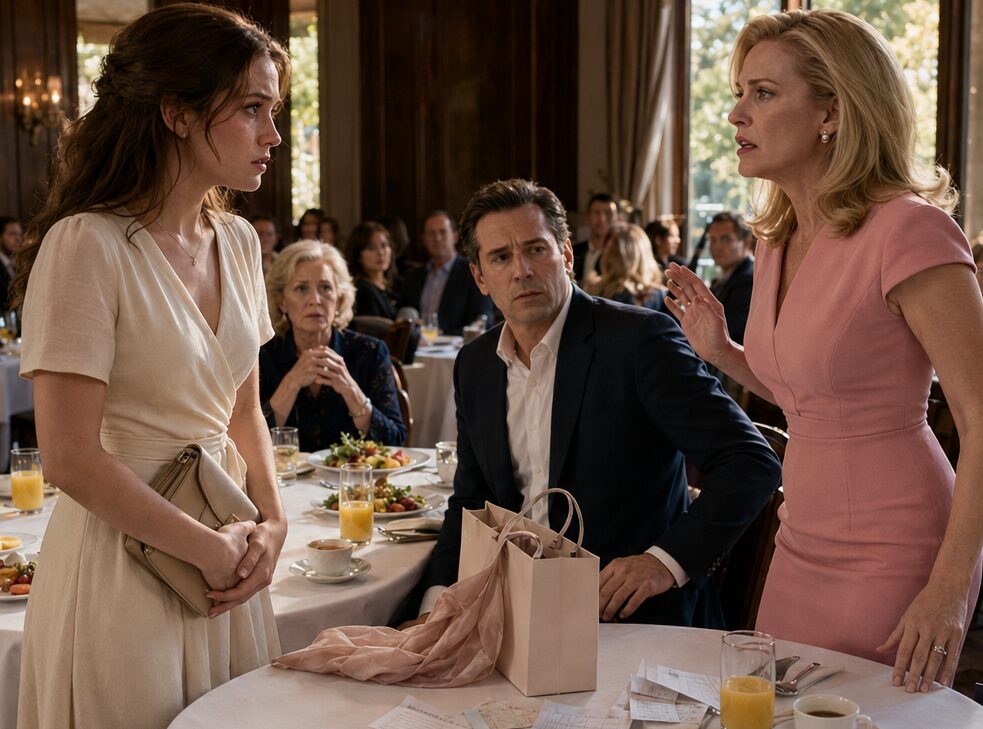
Amy stood beside the table at The Gilded Fork with both hands wrapped around her small beige purse, as if the purse had bones and could hold her upright.
The restaurant kept moving around her.
Forks clicked against white plates. A child in patent shoes asked for more syrup. Sunlight came through the tall windows and made every glass of orange juice look expensive. At the table in front of her, Debra’s face had gone pale beneath her perfect makeup.
“Take it back,” Debra said.
She said it softly, but everyone at the table heard.
Paul sat frozen beside his wife, one hand still near his coffee cup. Barbara’s napkin had slid halfway off her lap. Jonathan stared down at the table like he wished the linen would open and let him disappear.
Amy’s cheek was already hot with shame before Debra even stood.
“I can’t,” Amy said.
Debra rose so quickly her chair scraped the polished floor. Her pink dress was smooth, her hair was smooth, her smile was gone.
Then her hand came across the table.
The sound was small.
That was the worst part. It was not dramatic enough for what it did.
Amy’s head turned with the force of it. Her palm flew to her cheek. The restaurant went quiet in pieces, table by table, as if silence had to be passed around before everyone understood they were allowed to stare.
Paul pushed back from his seat.
“Debra—”
“Don’t you dare,” Debra snapped.
He stopped.
That hurt more than Amy wanted it to.
Barbara looked at Amy with wet eyes and a stiff mouth. “This is why,” she whispered, not quite to anyone, “girls like her should not be brought into family things.”
Jonathan’s voice broke through, low and embarrassed. “Mom, stop.”
Debra was breathing hard now. Her hand shook at her side, but she lifted her chin as though Amy had struck her first.
The manager hovered near the host stand, uncertain whether rich people having a family moment counted as a problem.
Amy looked around at the faces turned toward her. The old couple by the window. The mother covering her son’s ears too late. The server holding a tray of mimosas like an offering nobody wanted now.
She wanted to apologize.
Not because she was sorry.
Because apology was the door she knew how to open. Apology made people soften. Apology made rooms safe again. Apology had saved her from so many sharp silences that her body reached for it before her mind could stop her.
But this time, she kept her mouth closed.
Her cheek burned. Her throat closed. Her purse dug into her fingers.
Debra leaned toward her. “Say you misunderstood.”
Amy stared at the white tablecloth.
On it lay the scarf Debra had given her in a boutique bag. The little card that said, For all your little errands. The folded pharmacy receipts. The calendar pages. One note in Barbara’s thin handwriting.
Amy had not meant to bring proof.
At least, that was what she had told herself when she packed it.
She had meant to bring courage, but courage was harder to hold, so she brought paper instead.
“I didn’t come here to ruin brunch,” Amy said.
Debra’s eyes flashed.
Amy lifted her head.
“I came because you invited me to carry it.”
No one moved.
And for the first time since she had stepped into Debra’s bright kitchen six weeks earlier, Amy understood exactly what she had been carrying.
Part II — Our Lifesaver
The first favor had been small enough to feel like grace.
Barbara had slipped on the porch steps in late March, not badly, but badly enough that the neighborhood group chat bloomed with concern. Debra posted a photo of Barbara’s ankle wrapped in ice and wrote, Mom is fine, thank goodness. Just shaken. We’re covered.
They were not covered.
Amy found that out two hours later when Barbara called from the number Debra had given her at the block party.
“I hate to bother you, honey,” Barbara said, breathy and embarrassed. “But Debra is at a committee lunch, and the pharmacy says my prescription is ready.”
Amy had been halfway through entering invoices for the dental office where she did evening bookkeeping. The spreadsheet blinked on her laptop. Rent was due in eight days. Her preschool shift started at seven the next morning.
Still, Barbara sounded so much like Amy’s mother had near the end—trying to sound casual while afraid of being a burden—that Amy closed the laptop.
“It’s no trouble,” she said.
It was a little trouble.
But only a little.
That was how it began.
She picked up the prescription. Then she stayed to make tea because Barbara looked pale. Then Debra came home in white jeans and sunglasses, smelling faintly of lemon and expensive perfume.
“Amy,” Debra said, both hands to her heart. “You are an angel.”
The word warmed Amy before she could distrust it.
Debra’s house was the kind of house Amy slowed down to look at when she walked home from work. Blue shutters. Copper lanterns. Hydrangeas lined under the windows like they had been personally trained to bloom in good taste. Inside, everything was bright and busy. There were framed vacation photos, fresh flowers, a bowl of lemons no one seemed to eat, and a kitchen island large enough to make a small apartment jealous.
Amy lived four houses down in half of a duplex with a sagging mailbox and a landlord who fixed things only after the second reminder. Her own mother had died the year before, and the quiet in Amy’s kitchen still startled her.
Debra’s kitchen had noise.
Barbara asked for honey. Jonathan wandered in looking for his charger. Paul came through in shirtsleeves, loosened tie, and thanked Amy like he meant it.
“Really,” he said, meeting her eyes. “That was kind of you.”
Amy carried that sentence home like a bouquet.
The second favor came two days later.
The third came before the week ended.
At first, Debra always asked like she was giving Amy an easy chance to be good.
Could you sit with Mom for half an hour while I run to the store?
Would you mind taking her to the clinic? I would, but I have a donor meeting I can’t miss.
Jonathan’s essay is due Friday, and you’re so good with little kids, you probably know how to make young people sound human.
Amy laughed at that one. Jonathan did too, blushing across the kitchen table while she helped him untangle a college essay that began with, Throughout my life, I have encountered many experiences.
“No one talks like this,” Amy told him gently.
“I know,” he said. “But I panicked.”
They worked until he wrote one honest paragraph about his grandmother teaching him to make pancakes after his grandfather died. When he read it aloud, Barbara cried into a napkin and pretended it was allergies.
That night, Debra sent Amy home with leftover quiche and a mason jar of tulips from the kitchen island.
“Our lifesaver,” she said when a neighbor passed by the driveway. “I honestly don’t know what we’d do without her.”
Amy smiled because the neighbor smiled.
She did not notice yet how the sentence had a hook in it.
I don’t know what we’d do without her.
That sounded like love until it became a schedule.
By the third week, Debra was texting during Amy’s preschool shift.
Mom says she’s dizzy. Can you check on her?
Amy waited until snack time to answer. Is it urgent?
Debra replied with three dots, then: I wouldn’t ask if it wasn’t.
Amy got permission to leave early. She lost two hours of pay. Barbara was not dizzy when Amy arrived. She was lonely and annoyed that Debra had gone to Pilates.
“I told her not to make a fuss,” Barbara said, but she let Amy take her blood pressure anyway.
Amy found the cuff in the hall closet, beside monogrammed towels that looked too soft to use. She found the pill organizer on the bathroom counter, half-filled wrong. She fixed it while Barbara watched.
“You’re good at this,” Barbara said.
“My mom was sick for a while.”
Barbara’s expression softened. “I’m sorry, honey.”
Amy nodded and looked down at the pills.
That was the first time she felt it—the dangerous comfort of being useful in a house that was not hers.
Debra came home three hours later with a smoothie and a flushed face.
“Oh good, you’re still here,” she said. “Could you help me get Mom’s sheets changed before you go?”
Amy almost said she needed to get back to work.
Instead she said, “Sure.”
Debra kissed the air near her cheek.
“You really are part of this family now.”
Amy folded the fitted sheet twice before she got the corners right. Debra refolded it after her.
“Just so it doesn’t wrinkle,” Debra said lightly.
Then she smiled.
And somehow Amy felt grateful for being corrected.
Part III — Little Errands
The receipts began by accident.
Amy kept them because she kept everything. Gas receipts. Grocery receipts. Parking slips from the clinic garage. The pharmacy printouts with Barbara’s name folded inward for privacy.
Money had a way of leaving Amy’s life quietly, so she tracked it carefully.
Six dollars for parking.
Twenty-three for soup, crackers, ginger ale, and the kind of tea Barbara liked.
Forty-seven at the pharmacy when Barbara had forgotten her wallet and said, “Debra will get you, dear.”
Debra never did.
Not because she refused.
Because Amy never asked.
Asking turned a favor into a transaction, and Debra had a talent for making transaction sound ugly.
“We don’t want this to feel transactional,” she said once when Amy mentioned missing a bookkeeping shift.
She said it while opening a bottle of sparkling water.
Amy was standing beside the refrigerator with Barbara’s appointment card in one hand. The word landed so sharply she could feel it later.
Transactional.
As if wanting not to lose money while caring for someone else’s mother was a failure of spirit.
After that, Amy wrote things down in the back of an old planner and said nothing.
Wednesday: clinic, 1:30–3:15. Missed dental office call.
Friday: groceries, $31.62.
Sunday: stayed overnight. Barbara afraid after dizzy spell. Slept in recliner.
The recliner was green velvet and beautiful until you tried to sleep in it.
That night, Debra had a charity dinner in Charleston. “It’s been on the calendar for months,” she told Amy, lowering her voice as if duty itself had trapped her. “Mom doesn’t want a stranger.”
Barbara sat in the living room pretending not to listen.
“I can stay until ten,” Amy said.
Debra touched Amy’s wrist. “You know how she gets after dark.”
Amy did know.
Barbara became smaller after dark. She heard noises. She worried about falling. She asked the same question three times and then apologized so sweetly that Amy answered each time like it was new.
At midnight, Barbara called from the bedroom.
“Amy?”
Amy unfolded herself from the recliner. “I’m here.”
“Don’t let Debra put me somewhere.”
“She won’t.”
Barbara looked away. “You don’t know that.”
Amy sat on the edge of the bed until Barbara slept.
The next morning, Debra returned with a garment bag over one arm and a paper bag of pastries in the other.
“You survived,” she sang.
Paul followed her in, tired-eyed, carrying luggage. He saw Amy standing in the same clothes from the night before.
His smile faded.
“You were here all night?”
Amy shrugged. “Barbara was nervous.”
“Debra,” he said.
Debra set the pastries on the island. “Mom asked for her.”
Paul looked as if he wanted to say more. Then Jonathan came down asking if anyone had seen his laptop charger, and the moment slipped away.
That was Paul’s gift: he noticed.
That was also his failure.
He noticed and let the house continue.
Barbara could be kind when Debra was not watching. She told Amy stories about raising Debra alone after her husband started traveling for work and never quite came home emotionally. She showed Amy the silver bracelet she had worn to Debra’s wedding. She asked about Amy’s mother, then cried when Amy said the last thing her mother had wanted was peach yogurt and a clean nightgown.
But Barbara could cut too.
One afternoon, while Amy changed the sheets, Barbara said, “Debra has always taken in strays. Cats, girls from church, people who need a little polish.”
Amy paused with a pillowcase in her hands.
Barbara looked ashamed almost immediately. “I didn’t mean that the way it sounded.”
But she had.
That was the strange thing about Barbara. She could see the wound and still press it.
At the next neighborhood wine-and-cheese night, Debra introduced Amy to two women by the buffet.
“This is Amy,” she said. “She’s been helping with Mom. Honestly, she’s our angel.”
One of the women said, “How sweet. Are you a nurse?”
“No,” Amy said. “I work at the preschool.”
Debra laughed. “Same patience, less paperwork.”
Everyone smiled.
Amy smiled too.
Later that night, she cried in her car for seven minutes before driving the four houses home.
She could not explain why.
Nothing terrible had happened.
That was how the worst things stayed hidden. They arrived dressed as compliments.
Part IV — The Invitation
Debra invited Amy to brunch on a Thursday morning, with a text full of little gold sparkle emojis.
Sunday at The Gilded Fork. We want to thank you properly. Family brunch. You must come.
Amy read it twice while sitting in the preschool supply closet, surrounded by glue sticks and construction paper.
Thank you properly.
The words reached for the softest part of her.
Then another text appeared.
Wear something simple. Maybe that cream dress from Easter? It looked so lovely on you.
Amy stared at the screen.
The cream dress was hanging on the back of her closet door, the nicest thing she owned that still made her feel like herself. She had worn it once to church, and Debra had said, “That color makes you look so gentle.”
At the time, Amy thought it was a compliment.
Now she was not sure.
A third text arrived.
Also, please don’t worry about bringing up expenses or anything awkward. We don’t want it to feel transactional. This is about gratitude.
Amy turned the phone facedown.
The supply closet smelled like crayons and floor cleaner. Somewhere down the hall, a child was crying because someone else had used the blue cup.
Amy almost laughed.
Children were honest about wanting the blue cup. Adults built entire brunches to avoid saying what they wanted.
That afternoon, she took Barbara to the library because Barbara wanted large-print mysteries and a cookbook she would never use. Barbara moved slowly between the shelves, one hand on her cane, one hand occasionally reaching for Amy’s sleeve.
At checkout, a folded paper slipped from one of the returned books and fluttered to the floor.
Amy bent to pick it up.
The handwriting was Barbara’s.
Please don’t let Debra make you disappear too.
Amy stood there with the note in her hand while Barbara pretended to inspect a shelf of DVDs.
“What does this mean?” Amy asked.
Barbara’s face changed.
Only for a second.
Then she reached for the note with trembling fingers. “Nothing. Old woman nonsense.”
“Barbara.”
“I said it’s nothing.”
Amy gave it back because Barbara looked frightened, not of Amy, but of the sentence itself.
On the drive home, Barbara watched the houses pass.
“I loved being useful once,” she said.
Amy kept her eyes on the road.
Barbara’s voice went thin. “Then one day nobody asked what it cost. They just admired how well I carried it.”
Neither of them spoke after that.
At home, Amy opened her planner and looked at the receipts tucked into the back pocket. They had become thick enough to make the cover bulge.
She took out a blank page and wrote three things.
No requests during work unless emergency.
Reimbursement for groceries, parking, pharmacy.
A weekly care schedule with actual help.
The words looked cold.
They looked cruel.
They looked reasonable.
Amy practiced them in the bathroom mirror that night.
“I need to set some boundaries.”
Too harsh.
“I’m happy to help, but I can’t keep missing work.”
Too apologetic.
“I care about Barbara, but I can’t be the plan.”
That one made her cry.
Not because it was unkind.
Because it was true.
On Saturday afternoon, Debra asked Amy to stop by and pick up a sweater Barbara wanted mended before brunch. Amy almost said no. Then she imagined Barbara worrying over a loose button and went anyway.
Paul was in the hallway when she arrived.
Debra’s car was gone. Barbara was napping. The house was quiet in a way it never was when Debra was home.
Paul held an envelope.
“Amy,” he said, low. “Can I give you something?”
She looked at the envelope and knew before he explained.
“It’s for the gas,” he said. “And groceries. And everything you’ve been doing.”
Heat rose into her face.
“No.”
“Amy—”
“No, Paul.”
“It isn’t enough. I know that. But you shouldn’t have to keep proving you’re a good person.”
The sentence struck too close.
For one moment, she felt seen so clearly that she could not move.
Then the stairs creaked.
Debra stood at the top, one hand on the railing, her face unreadable.
Paul lowered the envelope.
Amy stepped back.
Nobody said anything.
But Debra saw enough to make a story out of it.
Her smile arrived slowly.
“There you are,” she said. “I was wondering where everyone had gone.”
Amy left with the sweater button and the feeling that Sunday had already begun.
Part V — The Toast
The Gilded Fork was full when Amy arrived.
She wore the cream dress because not wearing it would have become a statement, and she was not ready to make one before she sat down. She carried her beige purse with the planner inside. She told herself she would wait until after brunch. She would speak privately. Calmly. Kindly.
Debra waved from the table like nothing had happened in the hallway.
She wore pink.
Of course she did.
Paul stood when Amy approached. Jonathan gave her a small, apologetic smile. Barbara reached for her hand, then let it go quickly when Debra looked over.
“We saved you a seat,” Debra said.
The empty chair was at the end, not quite part of either side.
Amy sat.
For twenty minutes, everyone behaved beautifully.
They discussed Jonathan’s college visits. Barbara complained about the coffee being weaker than last time. Paul asked Amy about work, and Debra answered for her.
“She’s wonderful with children,” Debra said. “So patient. That’s why Mom adores her.”
Amy folded her napkin in her lap.
When the food came, Debra lifted her mimosa.
“Before we eat,” she said, “I just want to say something.”
Amy felt the room tilt.
Debra’s smile brightened. “As you all know, these last few weeks have been a little challenging with Mom needing more support.”
Barbara looked down.
“And Amy has been such a sweet help,” Debra continued. “Almost like hired family, except we could never insult her by paying her.”
Jonathan’s fork stopped halfway to his plate.
Paul’s jaw tightened.
Barbara gave a tiny nervous laugh, because Barbara always laughed when silence might ask something of her.
Amy felt her face go still.
There were sentences that took things from you while sounding generous.
Debra turned and lifted a boutique bag from the chair beside her.
“We wanted to give you a little something.”
Amy did not reach for it.
Debra pushed it closer.
Inside was a pale scarf, folded in tissue paper so thin it whispered when Amy touched it. The scarf was lovely. Soft, expensive, useless.
The card was worse.
For all your little errands.
Little.
The clinic garage at night. The pharmacy line. The groceries. The pill organizer. The green recliner. Barbara calling in the dark. Amy’s missed hours. Amy’s aching back. Amy’s mother’s absence opening every time Barbara said honey.
Little errands.
Amy set the card down.
“Thank you,” she said, because the old reflex still lived in her.
Debra looked satisfied.
That was what finally broke something.
Amy stood. “I should go.”
Barbara caught her wrist. Her fingers were cold.
“Please don’t go yet.”
Debra laughed, too bright. “Amy, don’t be dramatic. Sit down.”
Jonathan looked at his mother. “Mom, that was rude.”
The table changed.
It was subtle, but Amy felt it. The first crack in the polished surface.
Debra’s eyes sharpened. “Excuse me?”
Jonathan swallowed. “I said it was rude.”
“He’s tired,” Debra said to Amy, as if Jonathan were five. “College stress. You know how teenagers are.”
Paul said, “Debra, stop.”
Debra turned to him, and for one second Amy saw fear pass under the anger.
Then Debra chose Amy.
“You know,” she said, still smiling, “I have tried very hard to be kind about this.”
Amy’s hand tightened on the purse strap.
Debra leaned forward. “But I think you may have gotten confused about your place in our family.”
The restaurant sound thinned.
Barbara whispered, “Debra.”
“No, Mom. It needs to be said.” Debra’s voice stayed elegant. That made it uglier. “Some people enjoy being needed a little too much. They insert themselves, and then they act wounded when boundaries are clarified.”
Amy heard her pulse.
Debra’s gaze flicked toward Paul. “And when certain people encourage that confusion, it becomes unfair to everyone.”
Paul went pale. “That’s enough.”
But it was not enough.
Not for Debra.
Not for the weeks Amy had swallowed.
Not for the part of Amy that had mistaken crumbs of belonging for bread.
Amy opened her purse.
Her hands were shaking, but not badly enough to stop her. She took out the folded receipts first. Then the calendar pages. Then the parking slips. Then the list she had written in the bathroom. Last, she placed Barbara’s note on the white tablecloth.
Barbara made a sound like a small door closing.
Debra stared at the papers.
Amy did not raise her voice.
“I’m not confused,” she said. “I’m tired.”
Debra’s mouth opened, but nothing came out.
Amy touched the receipts. “These are the groceries I bought. The pharmacy co-pays. Parking at the clinic. The days I missed work. The nights I stayed because Barbara was afraid.”
She looked at Barbara then, not cruelly.
Barbara covered her mouth.
“I didn’t bring them to embarrass you,” Amy said. “I brought them because I knew if I only brought my word, you’d make me feel ashamed for using it.”
That was when Debra stood.
Her chair scraped the floor.
“Take it back.”
Amy looked at her.
All her life, she had been good at making rooms easier for other people.
She had apologized when teachers misunderstood her. She had smiled when customers talked down to her. She had told her dying mother not to worry about the bills because worry was one more thing the sick could not carry.
She had made herself light enough for everyone else to hold.
But no one at this table had held her.
“No,” Amy said.
Debra slapped her.
The sound was small.
The silence after it was not.
Amy’s cheek burned. Her eyes filled, but she did not let the tears fall yet. She kept one hand on her face and looked at each of them.
Barbara was crying now.
Jonathan pushed back from the table. “She stayed with Grandma when you went to Charleston.”
Several nearby tables heard him.
Debra turned on him. “Jonathan.”
“No,” he said, voice shaking. “You don’t get to do that.”
Paul stood.
For once, he did not look at Amy with private apology.
He looked at his wife.
“Debra,” he said, loud enough for the table, the server, and the people pretending not to listen. “Sit down.”
Debra’s face changed.
Not into regret.
Not yet.
Into the shock of someone discovering that the room she controlled had a door.
Amy picked up her purse.
She left the scarf. She left the card. She left the receipts spread across the white cloth like a life finally made visible.
The manager approached carefully. “Ma’am, do you need anything?”
Amy looked once more at the table.
At Barbara’s trembling hands.
At Jonathan’s red face.
At Paul standing too late.
At Debra in her pink dress, still beautiful, still furious, but no longer untouched by what she had done.
“Yes,” Amy said.
The manager leaned closer.
“Just the door.”
Part VI — The Mailbox
Amy did not cry until she got home.
She made it through the restaurant doors. Across the parking lot. Into her car. Down the street with the hydrangeas and the clean sidewalks and the houses that always looked ready for guests.
Inside her duplex, she locked the door and stood in the small entryway.
Then she cried with one hand still on her cheek.
The cream dress looked wrong in her own living room. Too soft. Too obedient. Too much like the girl Debra had asked her to be.
Amy went to her bedroom and took it off.
She did not throw it away. That would have given the dress too much blame. She hung it in the back of the closet behind her winter coat and put on jeans and an old gray T-shirt from the preschool.
Her phone began buzzing before sunset.
First came a text from a neighbor named Karen, who was not close enough to ask but did.
Heard there was a misunderstanding at brunch. Are you okay?
Then another.
Just want you to know people are talking. Thought you should hear it from a friend.
Then:
Debra must be mortified. What happened?
Amy placed the phone facedown on the kitchen counter.
For a few minutes, she watched it pulse against the laminate.
Once, that attention would have felt like proof that she mattered.
Now it looked like hunger.
She turned the phone off.
The quiet that followed was not warm. It was not triumphant. It was simply hers.
At eight, someone opened her mailbox.
Amy froze.
Through the front window, she saw Jonathan walking away, shoulders hunched, hands in the pockets of his navy hoodie. He did not look back.
She waited until he was gone before stepping outside.
Inside the mailbox was an envelope.
No name on the front.
Her hands knew what it was before her mind let her open it.
The receipts were inside, folded neatly, along with cash. More than the total. Not enough for the hours, but enough to say someone had counted.
There was a note too, written in careful, uneven handwriting.
I’m sorry we let you be the adult.
Amy sat on the front step with the envelope in her lap.
She read the sentence three times.
Then she put the money and receipts back inside and carried it into the house.
She did not text Jonathan.
Not that night.
Some apologies needed somewhere to land. That did not mean she had to become the ground.
A week passed.
Amy went to work. She helped children find their coats and open applesauce pouches and survive the tragedy of broken crayons. She entered invoices at night. She bought her own groceries and kept the receipts for herself.
Nobody from Debra’s house asked her for anything.
The silence had a shape.
On Saturday morning, Amy walked to the corner store for milk. She took the long way back without meaning to.
Debra’s house came into view between two maple trees.
Barbara sat on the porch in a pale blue cardigan, a blanket over her knees. Beside her sat a woman in navy scrubs, reading from a paperback while Barbara dozed.
A professional aide.
The sight struck Amy in a place she did not expect.
Not victory.
Not satisfaction.
Something quieter and sadder.
It had always been possible.
Debra stood inside the storm door, speaking to someone on the phone. She saw Amy on the sidewalk.
For a second, neither woman moved.
Debra did not wave.
Amy did not either.
Then Paul stepped into the hallway behind his wife. He saw Amy and lifted one hand, small and uncertain.
Amy gave him the smallest nod.
Barbara woke and turned her head, but the aide adjusted the blanket, and Barbara settled again.
Amy kept walking.
The sidewalk was uneven near the old oak. She had tripped there once carrying Barbara’s library books and a bag of pharmacy items, laughing at herself while trying not to drop anything.
This time her hands were empty except for a carton of milk.
The air smelled like cut grass. A dog barked behind a fence. Somewhere nearby, a family was setting out plates for lunch, the private machinery of another house turning without her.
Amy reached her duplex and paused at the mailbox.
For months, she had thought belonging meant being called when someone needed help.
Now she wondered if belonging might begin with not answering every call.
Inside, her kitchen was quiet.
Amy put the milk in the refrigerator. She took the envelope from Jonathan out of the drawer, removed the note, and placed it under a magnet shaped like a lemon that Debra had once sent home with leftover quiche.
The old Amy would have thrown the magnet away.
The new one let it stay.
Not as a keepsake.
As a reminder.
Some things looked bright in other people’s kitchens.
That did not mean they could feed you.