The Farm Was Sold From A Clipboard Before He Learned His Name Was Gone From The Will
Chapter 1: The Clipboard Was Already On The Sale Table
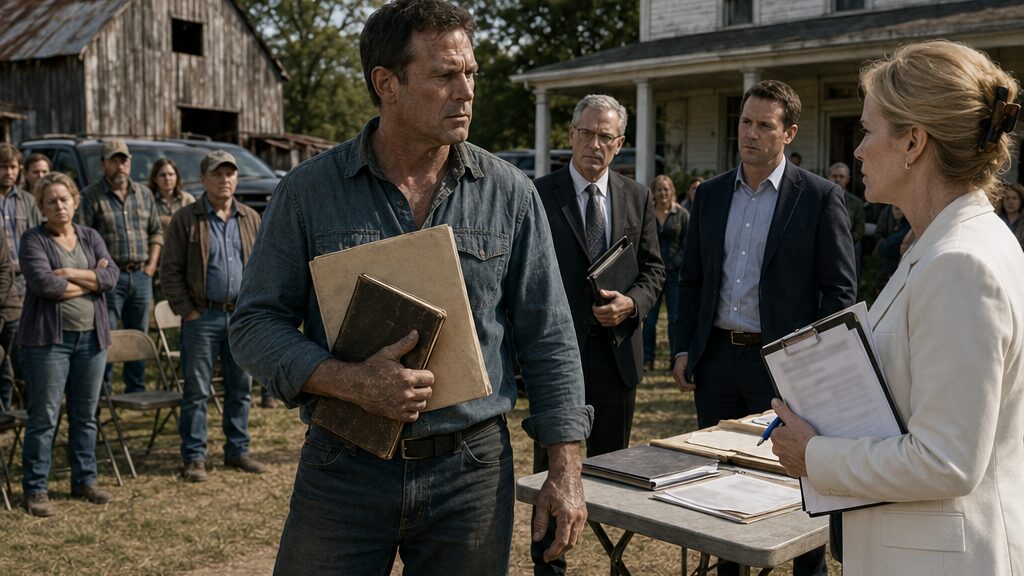
The sign-in sheet was clipped to a board on the folding table beside the barn before Mark Harris knew anyone had been invited.
FINAL ESTATE SALE SIGN-IN.
He stood with a feed bucket in one hand and a bent gate latch in the other, staring at the words as if they had been nailed there in the night. Three pickup trucks he did not recognize were parked along the gravel drive. Two cars sat by the old maple where his mother used to hang bird feeders. Folding chairs had been opened in uneven rows on the flat patch between the farmhouse and the equipment shed.
Someone had set a blue pen on the clipboard.
Mark looked toward the house.
The white porch door was propped open. Voices moved inside and out, low and businesslike. A man in a sport coat was speaking near the steps, one hand raised toward the hayfield as if he were describing acreage. A pair of neighbors stood by the fence, not meeting Mark’s eyes when he looked their way.
He set the feed bucket down slowly.
No one had told him.
Not Katherine. Not Joseph Roberts, who had sent polite letters after Virginia’s funeral. Not the county clerk who had stamped things. Not the bank. Nobody.
A woman near the table reached for the clipboard, but Mark stepped forward and put his hand over it.
“Don’t sign that.”
She froze, pen lifted.
The man in the sport coat turned. “Sir?”
Mark did not answer him. He looked past him to the porch, where Katherine Lee stood in a white blazer and skirt, a leather estate folder tucked under her arm. Her blonde hair was clipped back neatly, and even from twenty feet away Mark could see she had come dressed for control.
She saw his hand on the clipboard.
Her mouth tightened.
“Mark,” she called, already walking down the steps. “Please don’t start this in front of people.”
He almost laughed. It came out as air through his nose.
“In front of people?” He lifted the clipboard. “You put a sale sheet next to Mom’s barn and you’re worried I’m starting something?”
The yard quieted. The woman with the pen stepped back. A neighbor whispered something to another neighbor. Somewhere behind the barn, a cow knocked against a metal gate.
Katherine came to the table and reached for the board. “This is a preliminary access list. Andrew is organizing interested parties. Nothing is final today.”
“Final Estate Sale Sign-In,” Mark read aloud, loud enough for the rows of chairs to hear. “You want to try that again?”
The man in the sport coat came forward with a practiced smile that did not reach his eyes. “Andrew Hill. I’m coordinating the property showing on behalf of the executor. I understand this is emotional.”
Mark turned on him. “You understand this is private land?”
Andrew glanced at Katherine, not at the barn, not at the house, not at the man who had fixed the north fence three times since Christmas. “The executor has approved access.”
“The executor,” Mark repeated.
Katherine lowered her voice. “I am the executor.”
“You’re my sister.”
“Half-sister,” she said, then regretted it; he saw it pass through her face and vanish under the polished calm.
A few heads turned. The word had always been there between them, but Katherine rarely said it in front of others. Virginia had hated it. She used to say a child did not come in halves just because adults failed at marriage.
Mark looked at the old porch swing hanging still beside the door. His mother had sat there wrapped in a quilt the last fall she was well enough to come outside. She had pointed toward the barn roof and told him, “Keep that place standing, Mark. Even when I’m gone, don’t let it sag.”
He had said he would.
He had not asked her to write that down.
Katherine slid the clipboard from under his fingers. “This farm has estate expenses. Taxes. Insurance. Repairs. The will gives me the authority to evaluate sale options.”
“The will gives you authority to invite strangers to walk through the barn without telling me?”
“It gives me authority to manage the estate.”
“That barn is full of Mom’s things.”
“That barn is full of depreciating equipment and structural hazards.”
He looked at her then, really looked. She was holding the estate folder pressed against her ribs like a shield. Her nails were pale, smooth. He remembered those hands sorting envelopes at the kitchen table while he changed Virginia’s sheets in the back bedroom. He remembered Katherine saying she had it handled, always that: handled.
Andrew cleared his throat. “Mr. Harris, if you could step away from the table, we can continue without interfering with your personal items.”
“Personal items?” Mark pointed toward the barn. “My father’s vise is bolted to that bench. Mom’s winter feed records are in the office. My tools are in there. I live here.”
Katherine’s eyes flickered. “You stayed here.”
The yard became quieter than before.
Mark felt the gate latch bite into his palm. He had forgotten he was still holding it. Rust had marked the crease below his thumb.
“I stayed,” he said. “While Mom needed help getting from the bed to the bathroom. While you drove in on Sundays with folders and left before supper.”
Katherine’s jaw worked once. “And while I paid bills you wouldn’t open.”
“I never saw them.”
“You didn’t want to see them.”
Andrew stepped between them just enough to look official, not enough to look brave. “This isn’t the place.”
Mark stared at him. “It became the place when you put a clipboard in my yard.”
A couple of the attendees shifted back toward their cars. The woman who had first reached for the pen whispered that maybe they should wait. Andrew’s smile thinned.
Katherine took the blue pen from the clip and snapped it into place with a sharp click.
“Everyone was notified through proper channels,” she said.
“I wasn’t.”
“You received the estate notice.”
“A notice is not a phone call saying you’re selling the farm.”
“It is not your farm to approve or stop.”
The words struck harder because she did not shout them. She said them cleanly, like a line she had practiced until it lost blood.
Mark looked at the farmhouse windows. The curtains were still the yellow ones Virginia had washed until the fabric went soft as old paper. A stranger in a dark jacket stood inside the dining room, examining the built-in cabinet. Mark started toward the porch.
Katherine moved in front of him.
“Do not make a scene.”
“There’s a man in Mom’s dining room.”
“He is with Andrew.”
“He’s touching her cabinet.”
“He’s assessing fixtures.”
Mark’s hand rose before he meant it to, palm out, stopping her. Not touching. Never touching. But the motion cut through the yard like a slammed door.
“No one goes through that house until I know what this is.”
Andrew’s face hardened. “Mr. Harris, the executor has legal authority.”
“There it is again.”
“Because it matters.”
Mark turned back to Katherine. “Show me.”
She blinked. “What?”
“The paper. The one that says you get to do this without telling me.”
Katherine held the estate folder closer. “You’ll have a chance to review the will with Joseph this afternoon.”
“This afternoon? After the sign-in sheet fills?”
“That sheet is administrative.”
“Then tear it up.”
She did not move.
That was the moment Mark understood this was not a misunderstanding. Not a missed voicemail. Not a bad time. Katherine had known exactly how the morning would unfold. She had known he would be in the barn or feed room, because that was where he always was. She had known people would arrive before he could ask enough questions to slow them down.
He reached again for the clipboard.
Katherine pulled it back. “Mark.”
“Give me the list.”
“No.”
He looked at the people in the yard. Neighbors, strangers, buyers, maybe one bank man. Faces arranged in that careful rural expression that meant they wanted every detail but did not want to be named as witnesses.
Virginia would have hated this. Her life laid out as acreage, fixtures, sale access.
Mark lowered his voice. “You don’t get to turn Mom into paperwork and call me emotional for noticing.”
For the first time, Katherine’s composure cracked enough to show something raw beneath it. Anger, yes, but also fatigue. Maybe fear.
“You think I wanted this?” she said. “You think I enjoyed going through her accounts while you hid in the barn?”
“I was keeping the farm running.”
“You were keeping yourself from hearing what she signed.”
The sentence landed strangely.
Mark frowned. “What does that mean?”
Katherine looked down at the clipboard, then toward the porch. Joseph Roberts had appeared in the doorway, gray-suited, holding a slim folder. He had the expression of a man arriving late to a mess he had expected but hoped to avoid.
“Katherine,” Joseph said carefully, “perhaps we should move this inside.”
Mark did not take his eyes off her.
“What did she sign?”
Katherine’s lips pressed together. The crowd waited. The barn doors stood open behind Mark, the dark interior smelling of hay dust and oil and the old wood Virginia had asked him to keep standing.
Finally, Katherine lifted the estate folder.
“The controlling document,” she said, “is not the one you think it is.”
Mark felt the yard tilt slightly.
Joseph came down one porch step. “Mark, let’s discuss this privately.”
But Katherine had already gone too far to retreat. She looked at him with the clean, terrible certainty of someone who had carried a sentence for weeks and now wanted it out of her mouth.
“Your name,” she said, “isn’t on the controlling document anymore.”
Chapter 2: The Name Missing From His Mother’s Will
Joseph Roberts read the will as if skipping Mark’s name was no different from skipping a blank line.
The farmhouse dining room had not held this many people since Virginia’s last birthday, when she had slept through half the cake and woken to apologize for being poor company. Now the table was cleared except for Joseph’s folder, Katherine’s clipboard, a glass pitcher no one had filled, and the blue pen from outside.
Mark stood instead of sitting.
He had taken the chair closest to the window at first, the one where Virginia used to fold seed catalogs, but the moment Joseph began reading, Mark’s knees had locked. He moved to the wall near the cabinet, arms at his sides, afraid that if he crossed them he would look exactly as Andrew had decided he was: angry, difficult, unstable.
Katherine sat opposite Joseph with her hands folded over the clipboard.
Andrew remained near the doorway, present but silent, like a man trying not to be part of a family moment while making a living from it.
Joseph adjusted his glasses. “The document dated March eighteenth names Katherine Lee as personal representative and sole residuary beneficiary of the estate, with authority to liquidate real property as needed to satisfy debts, administrative expenses, and distribution.”
The room held still.
Mark waited for the next clause. A correction. A parcel exception. A line about the barn. A line about him staying until winter. A line about the promise.
Joseph turned the page.
There was no line.
Mark’s throat tightened, but his voice came out flat. “Read it again.”
Joseph looked up. “Mark—”
“Read the part where she forgot she had a son.”
Katherine flinched. “Don’t.”
“You brought buyers to her yard.”
“This is not helping.”
“No. Reading it like I’m dead isn’t helping.”
Joseph set one palm lightly on the paper. “The document is legally executed. I understand this is painful.”
“Do you?”
“I handled your mother’s estate planning.”
“Then you knew her?”
Joseph paused. “I met with her regarding the document.”
“How many times?”
Katherine leaned forward. “That’s not relevant.”
Mark looked at her. “It got relevant when my name disappeared.”
She held his gaze. “Mom changed her mind. That was her right.”
He heard the line exactly as if she had rehearsed it in a mirror. Calm. Legal. Final.
“When?” he asked.
Joseph glanced down.
Mark stepped closer to the table. “You said March eighteenth.”
“That is the execution date,” Joseph said.
“Six weeks before she died.”
“Approximately.”
“Not approximately. Six weeks.”
Katherine’s eyes narrowed. “You’re making this sound like something it wasn’t.”
“What was it?”
“A sick woman deciding she needed the responsible child to handle what was left.”
He almost answered too fast. Almost gave her the fight she wanted. The one about who fed Virginia soup, who slept on the couch during the bad nights, who cleaned the back bedroom carpet after the oxygen hose caught on the bedframe. But the date was sitting on the table now, black ink on white paper.
March eighteenth.
He saw that week as a blur of pill bottles, damp towels, and Virginia staring at the television without knowing it was off.
Mark pointed to the paper. “Show me the signature page.”
Joseph hesitated.
“Please,” Mark said, and the word cost him more than shouting would have.
Joseph turned the final page and slid it across the table.
Virginia Harris appeared in a shaky line at the bottom.
Mark looked at the signature until the letters stopped being letters. His mother had always signed with a hard V, a strong downward stroke like she was starting a fence post. This V wavered. The H in Harris ran low, almost into the witness line.
“She wasn’t managing her own medicine by then,” Mark said.
Katherine’s hand tightened over the clipboard. “That doesn’t mean she couldn’t sign.”
“She forgot the stove was electric.”
“She had good days.”
“She called me by Dad’s name twice that week.”
Katherine’s face changed, not softening, exactly, but closing around something. “She called me by my mother’s name for ten years when she was angry. That doesn’t prove anything.”
Joseph picked up the page before Mark could touch it. “Capacity is not determined by isolated confusion. At the time of signing, the witnesses and notary attested that she understood the nature of the document.”
“Who witnessed it?”
Joseph placed the page back in the folder. “Two office witnesses and a notary.”
“Your office?”
“Yes.”
“Who brought her?”
Katherine looked at the window.
There. Small, fast, almost nothing.
Mark saw it.
Joseph said, “I would need to review the file for the transportation details.”
“The transportation details?” Mark repeated. “She couldn’t get into a truck without someone lifting her left foot. Somebody took her to you.”
Katherine stood. Her chair scraped the floor.
“She wanted it done.”
“Who said?”
“She did.”
“To you.”
“Yes, to me.”
“And not to me.”
“You made it impossible.”
That stopped him.
Katherine’s voice had sharpened, but the anger in it sounded older than the will. “Every time she tried to talk about money, you walked out. Every time she said the taxes were behind, you said you’d fix the fence first. Every time she asked what would happen after, you told her not to talk like that.”
Mark remembered the kitchen in January. Virginia in her robe, hands trembling around coffee she barely drank. “There are things we should put in order,” she had said.
He had kissed her forehead and told her spring would come.
He had gone to the barn because the roof was leaking.
The memory hit with such force that he looked down.
Katherine saw it and pressed forward. “You don’t get to act like the only love that counted was the kind with mud on its boots.”
Mark raised his head slowly. “And you don’t get to act like bills explain everything.”
Joseph inserted himself with professional gentleness. “This is why estate conversations are difficult. Grief can make—”
“Don’t say grief,” Mark said.
Joseph stopped.
“Don’t use grief to make a date disappear.”
No one spoke.
Outside, a truck door slammed. The sound came through the dining room wall like a reminder that people were still out there, waiting to decide what Virginia’s life was worth by the acre.
Mark tapped the table beside the folder.
“March eighteenth. Where was I?”
Katherine looked away.
He searched his own memory. That month was broken into tasks. Feed delivery. Medicine pickup. A leak under the sink. Virginia refusing broth. Katherine arriving twice one week instead of Sunday only. He remembered because he had been grateful. He had thought she was finally helping without needing to be asked.
“You were in the barn,” Katherine said.
“That day?”
“You were always in the barn.”
“Don’t generalize. That day.”
Joseph closed the folder halfway. “Mark, if you intend to challenge the document, you need counsel. I cannot advise you. I represent the estate.”
“The estate,” Mark said. “Not her.”
Joseph’s expression tightened, but he did not argue.
Andrew shifted near the doorway. “For what it’s worth, the showing can be rescheduled if the family needs—”
“No,” Katherine said quickly.
Mark looked at her.
Too quickly.
She noticed he noticed.
“The estate has deadlines,” she said. “Insurance, taxes, creditor notices. We cannot freeze everything because Mark refuses to accept what’s in writing.”
“In writing,” he said.
He reached for the blue pen on the table. Katherine moved, but he only turned it between his fingers once and set it down again.
“Mom hated blue ink,” he said.
Katherine blinked. “What?”
“She said it looked like bank trouble. She signed everything in black.”
Joseph glanced at the folder despite himself. “The pen color is not legally meaningful.”
“No,” Mark said. “But dates are. Who was there is. Whether she knew she was cutting me out is.”
Katherine laughed once, without humor. “Cutting you out? You lived here rent-free for years.”
“I lived here because she was dying.”
“You lived here because this place gave you an excuse not to choose anything else.”
The room went still again, but this time the silence had teeth.
Mark felt the old shame move under his ribs. He had never married. Never bought his own place. Never held a job that did not bend around the farm. There were reasons and excuses, and some days he could not tell them apart.
He looked at Katherine and saw not just the executor, not just the woman with the clipboard, but the girl who used to arrive summers with a suitcase and a guarded face, waiting to see whether Virginia would treat her like company or daughter. Virginia had tried. Mark had not always tried with her.
But none of that answered March eighteenth.
He pushed himself away from the wall.
“I’m not asking for a speech about my life.”
“You’re asking to undo hers.”
“No. I’m asking when she signed them, who drove her, and what she understood when she did.”
Joseph stood, gathering the folder. “I will provide the public filings and a copy of the will through proper request. Until then, the estate remains under Katherine’s authority.”
Katherine picked up her clipboard. “The sale process continues.”
Mark nodded once, not because he agreed, but because something inside him had settled into a shape colder than anger.
He looked at Joseph.
“Tell me who drove her to your office that day.”
Joseph did not answer.
Katherine did.
“She wanted me there,” she said.
Mark turned toward her.
“That’s not what I asked.”
Chapter 3: The Barn Ledger Remembered What Mark Did Not
Mark found March eighteenth under a grease smear and two feed receipts, written in his own hand as if some other man had known enough to leave a warning.
Bad morning. Mom asked where the stairs went. No stairs in house.
He sat in the barn office with the ledger open beneath the hanging bulb, his elbows on the scarred desk his father had built from leftover stall boards. Dust moved in the light. Outside, the farm was finally empty of strangers, but their tire tracks remained in the drive like fresh insults.
Bad morning.
Below the line, he had written: K came 10:20. Blue folder. Mom slept after.
He stared at the K until it seemed too small to hold what it meant.
Katherine.
Blue folder.
He did not remember writing it. That frightened him more than if he had remembered clearly. The final months had become a room he avoided entering. He could recall the smell of crushed pills, the hum of the oxygen machine, Virginia’s hand searching the blanket for something that was not there. But dates had blurred. Weeks folded over each other.
The ledger had not blurred.
He turned back through the pages.
February: fixed water line behind pump house. Mom clear at lunch. Asked about seed order.
February again: K brought bank papers. Mom tired. Said ask Mark after supper.
March first: Mom confused with checkbook. Hid bills in flour drawer.
March tenth: Joseph called? K took message.
Mark stopped.
Joseph called?
There was no detail after it. No number. No time. Just the question mark.
He had been proud of this ledger once because it was practical. Feed counts. vet visits. fence repairs. diesel deliveries. Weather notes when weather mattered. During Virginia’s illness, it had become something else without his permission: a record of what he had noticed while refusing to call it evidence.
He pulled the estate folder copy Joseph had given him from the workbench. The will had been emailed and printed from the farmhouse computer after everyone left. Katherine had watched him print it, as if the machine might hand him a different truth.
The date was still there.
March eighteenth.
He laid the signature page beside the ledger entry.
Bad morning.
K came 10:20.
Blue folder.
Mom slept after.
Mark rubbed his thumb over the old ink. His hand smelled like rust from the gate latch.
“You should have asked her,” he said into the empty office.
The barn did not answer.
By morning, he had made copies at the feed store and driven to the county records office wearing the same denim shirt because he had not gone upstairs to change. The clerk behind the glass looked at his papers, then at him, then back at the papers with the patient caution of someone who had seen families come apart in public buildings.
“I need any prior estate filings for Virginia Harris,” Mark said.
The clerk typed. “Probate or land records?”
“Both, I guess.”
“That’s not really how it works.”
“I’m learning that.”
Her expression softened just a little. “Are you an interested party?”
“I’m her son.”
“Are you named in the current probate filing?”
The question landed harder than she intended. Mark took a breath. “No.”
She looked down again. “Then some records are public, some require a formal request, and some may need attorney authorization.”
“There was an earlier will.”
The clerk’s fingers paused over the keyboard.
Mark leaned closer to the glass. “There was, wasn’t there?”
“I can confirm an estate planning memorandum was referenced in a prior filing index. I can’t release the underlying document from here.”
“Who can?”
“Proper petition. Attorney request. Sometimes the drafting office, if you’re entitled.”
“If I’m entitled,” he repeated.
She gave him a look that was not unkind. “Mr. Harris, families use that word differently than courts do.”
He looked away before she could see what that did to him.
A printer hummed behind her. She handed him a page through the slot. It was not the will. It was an index record, thin as air and still enough to make his heart kick once.
Virginia Harris. Estate planning memorandum. Prior distribution reference. Two children.
Two children.
For one clean second, Mark saw his mother at the kitchen table with her reading glasses low on her nose, saying, “I won’t have either of you left guessing.” He had believed her because she was his mother and because believing had been easier than sitting down.
“What do I do next?” he asked.
The clerk lowered her voice. “File a written request. But you should know something.”
Mark looked up.
“This file has a note. Any request related to prior testamentary documents is to be referred to counsel for the estate.”
“Katherine’s attorney.”
“Joseph Roberts is listed.”
“He knows I’m asking?”
“If he checks, yes.”
Mark folded the index page carefully, though his fingers wanted to crush it.
When he got back to the farm, Katherine’s car was in the driveway.
She was waiting in the kitchen with her clipboard, the blue pen, and an envelope placed exactly in the center of the table. She had changed out of the white blazer into a pale sweater, but she still looked like she had brought the office with her.
“You went to records,” she said.
Mark set his copied ledger pages on the counter. “You went through Mom’s file before I knew there was a file.”
“I handled what needed handling.”
“You keep saying that.”
“Because it’s true.”
He nodded toward the envelope. “What’s that?”
“A way to stop embarrassing all of us.”
There it was. Not anger first. Shame.
Mark did not touch the envelope.
Katherine pushed it toward him. “A settlement. Not because you have a claim. Because dragging this out hurts the estate. It gives you enough to relocate, settle your personal items, and leave before the sale.”
“Relocate.”
“You cannot stay here indefinitely.”
“I live here.”
“You stayed here,” she said again, but this time it sounded tired rather than sharp. “Mark, the farm cannot carry you. It barely carried Mom.”
He opened the envelope. The number inside was not nothing. That almost made it worse. It was the kind of number meant to sound generous to people who did not know what a barn roof cost, what winter feed cost, what forty years of belonging cost.
“When is the sale?” he asked.
Katherine’s mouth tightened.
“Katherine.”
“Public sale date is being finalized.”
“When?”
“Soon.”
He laughed once, quietly. “You brought a settlement before telling me the date.”
“I’m trying to prevent you from making this uglier.”
“No. You’re trying to get me gone before the prior will request comes back.”
Her face changed.
Only slightly. But he saw it.
Mark picked up the envelope and held it out to her.
“I’m not signing.”
“You don’t even know what refusing costs.”
“I know what signing would say.”
“It would say you’re realistic.”
“It would say Mom meant to erase me.”
Katherine stood, anger returning because it was safer than whatever had flashed across her face. “Maybe she meant to stop pretending the farm was a reward for avoiding the rest of your life.”
He placed the envelope on the table between them.
“And maybe you needed her confused enough to agree with you.”
Katherine’s hand moved before he expected it. She slapped him across the face, not hard enough to injure, but hard enough to stun them both.
The kitchen went silent.
Her eyes filled, but she did not apologize.
Mark touched his cheek once. “That the executor talking?”
She gathered her clipboard, but her fingers fumbled on the clip. A paper slipped loose and fell to the floor. He saw the heading before she snatched it up.
SALE ACCESS SCHEDULE.
There was a date at the top.
Ten days away.
She shoved it into the folder and headed for the door.
Mark followed only as far as the porch. Pride wanted him to shout after her. Grief wanted him to ask when she had started hating him. Instead he watched her car throw gravel down the drive.
The county clerk called before he went back inside.
He almost did not answer, thinking it was Katherine. But the number was unfamiliar, and some part of him had learned, too late, not to ignore records.
“Mr. Harris?” the clerk said. “I wanted to clarify something before you file that request.”
“Yes.”
“The prior document inquiry has already been flagged.”
“You told me.”
“No,” she said. “I mean before today. There’s a note from last month asking that any request from you specifically be routed through estate counsel.”
Mark stood on the porch with the phone against his ear, looking at the barn Virginia had asked him to keep standing.
“From me specifically?”
“Yes, sir.”
He looked toward the tire tracks in the drive, then down at the copied ledger pages in his hand.
“What is she trying to keep me from seeing?”
Chapter 4: Katherine Said The Debt Would Swallow Everything
Katherine dropped the tax notices on the kitchen table so hard the saltshaker jumped.
Mark had been standing at the sink with the copied ledger pages spread in front of him, trying to line up March eighteenth with the county clerk’s warning, when the back door opened without a knock. Katherine came in carrying a brown accordion folder under one arm and her clipboard under the other, her face pale with the kind of anger that had already decided it was righteous.
“Since you want records,” she said, “look at all of them.”
The folder hit the table and spilled open.
Past-due notices. Insurance warnings. A creditor letter from the feed supplier. A tax bill stamped in red. Another envelope with the bank’s name across the top. Mark knew the names on some of them. He had seen the return addresses before, stacked near the flour drawer or half-hidden under grocery coupons. He had assumed Virginia had moved them because she did not want clutter on the counter.
He had assumed too much.
Katherine pulled out a chair but did not sit. “That’s what I was handling while you were writing down fence repairs like they were scripture.”
Mark wiped his hands on his jeans. “You flagged my records request.”
“I asked Joseph to route legal documents through counsel. That’s standard.”
“You asked him to route anything from me.”
“Because I knew you’d do exactly this. Go into town half-informed and make people think I stole something.”
He picked up the top tax notice. The amount was worse than he expected. Not impossible, maybe, but close enough to impossible that his stomach tightened.
“When did this come?”
“January.”
He looked at her. “Mom was alive in January.”
“Yes.”
“Why didn’t she tell me?”
Katherine laughed softly, bitterly. “Because when she tried to talk to you about money, you told her not to worry.”
Mark looked down.
“She did worry,” Katherine said. “Every day. She worried about the tax bill, the insurance, the medical balance, the lien threat. She worried you would work yourself into the ground trying to save a place that was already swallowing her.”
“She asked me to keep the barn standing.”
“She asked me to keep the bank from taking the house.”
The sentence cut across the room and stayed there.
Mark reached for another page. Bank correspondence. Late fees. A warning about review of collateral. The farm’s legal description appeared in clean typed lines, reducing the house, barn, and fields to parcel numbers.
“You could’ve told me,” he said.
Katherine’s eyes flashed. “I tried.”
“No. You said you had it handled.”
“Because you heard anything else as an attack.”
He wanted to deny it. Then he saw Virginia again, thin in her robe at the kitchen table, sliding an envelope toward him. He had glanced at it, seen the bank logo, and said, “Let me fix the pump first. We’ll talk after supper.”
After supper, she had been asleep.
The next morning, he had put the envelope under a stack of seed catalogs because he could not bear seeing fear in his mother’s handwriting.
Katherine tapped the pile. “You think the will was some neat little scheme I drew up over coffee. It wasn’t. It was bills. Calls. People asking when decisions would be made. Mom crying because she didn’t want the farm sold but didn’t know how to keep it.”
“Then why leave me nothing?”
“Because she knew you would never sell. Not a tractor. Not a field edge. Not a broken hay rake. You would let the whole estate rot for the sake of proving loyalty.”
He stared at her.
Katherine’s voice lowered. “And maybe because she was tired of being protected from reality by the son who loved her most.”
That one hurt because it sounded like Virginia. Not the words, but the shape of them. His mother had been gentle until she was cornered, and then she became honest enough to bruise.
Mark picked up the creditor letter. “This doesn’t explain March eighteenth.”
“No,” Katherine said. “It explains why March eighteenth happened.”
He folded the paper once, then unfolded it because it was not his to damage. “Who drove her?”
Katherine looked toward the window. Beyond it, the barn roof showed through the glass, one repaired strip brighter than the rest.
“I did.”
There it was. Not a document. Not a suspicion. Her voice.
Mark waited.
Katherine sat down at last, as if the admission had taken something from her legs. “She wanted to go.”
“She understood what she was signing?”
“She understood enough.”
“That’s not an answer.”
“It’s the only answer there is.”
“No. It’s the one that lets you sleep.”
She looked at him then, and for the first time since the sign-in sheet, he saw exhaustion without polish. “You think I sleep?”
The kitchen quieted.
Katherine pushed one of the bank letters toward him. “Come with me.”
“Where?”
“You want to know whether I invented the debt? Ask them.”
He almost refused because refusal had become the only ground he felt sure of. But the papers on the table were real, and if he ignored them, he was no better than the man she kept accusing him of being.
The bank office smelled like carpet cleaner and burnt coffee. The bank representative spoke in a careful voice and never said foreclosure as a threat, only as a procedure that could “become available to the lender” if the estate stalled, insurance lapsed, or taxes continued unresolved.
Mark sat with his cap in both hands while Katherine answered questions with dates and amounts. She knew which invoices had been negotiated. She knew which medical balance had been reduced. She knew the insurance premium due before the sale date. She knew what Mark had not known because she had been carrying it, and that truth did not make the other truth vanish.
“So if the estate sale is delayed?” Mark asked.
The bank representative folded her hands. “Delay alone is not fatal. Delay without a repayment plan creates risk.”
“How much risk?”
“Enough that your attorney should respond quickly.”
“Her attorney,” Mark said.
The bank representative looked from him to Katherine and chose silence.
Outside, beside Katherine’s car, Mark leaned against the door and looked over the small town roofs toward where the farm lay beyond the road. The anger in him had not left. It had changed weight.
“You should have told me,” he said.
Katherine unlocked the car but did not open it. “You should have listened.”
The answer was too clean, but not false.
He hated that.
“I’m still asking Joseph for the signing file.”
“I know.”
“I’m still asking for the prior will.”
“I know.”
“And I’m still not leaving before the sale.”
Her hand tightened around the keys. “Then you may be the reason there’s nothing left to save.”
Mark looked at her. “Or you rushed the sale because you knew the date wouldn’t hold up.”
Her mouth opened, then closed.
He thought she would deny it. Instead, she looked past him at the bank’s front window, where both their reflections stood side by side and separate.
“You want to know who was there?” she said. “Ask the hospice aide who kept coming after you left.”
Mark frowned. “Karen?”
Katherine opened the car door.
“She saw more than you think,” she said. “And maybe less than you hope.”
Chapter 5: The Hospice Calendar Had A Different Story
Karen Perez opened the apartment door three inches, saw Mark, and said, “If this is about the will, I should’ve said no the first time.”
Then she tried to close the door.
Mark put one hand against the frame, not pushing hard, just enough to stop the click. The old Mark, the one from the yard with his palm raised and jaw tight, would have forced the moment. This time he took his hand away.
“I’m not here to trap you,” he said.
Karen looked through the gap. Her hair was pulled back with a clip, and there were shadows under her eyes that made him remember the night shifts she used to take when Virginia’s breathing got bad. He had brought her coffee twice. Maybe three times. He could not remember ever asking how she was.
“That’s what people say before paperwork shows up,” she said.
“I don’t have paperwork for you.”
“You have questions.”
“Yes.”
She looked past him to the parking lot, then opened the door wider. “Ten minutes.”
Her apartment was small and neat, with a folded blanket over the couch and a stack of nursing textbooks on a side table. Mark stood near the doorway until she pointed to a chair.
“Sit before you make me nervous.”
He sat.
Karen did not offer coffee. She sat opposite him with both feet flat on the floor, hands clasped like she was waiting for an interview she had already failed.
“Katherine said you were there around the signing,” Mark said.
Karen’s eyes went sharp. “Katherine says a lot when she wants someone else standing in front of her.”
“Were you?”
“I was there that morning. Not at the lawyer’s office.”
“What morning?”
Karen looked toward the small kitchen. A calendar hung there, the kind with wide squares and flower pictures, though this one was from the current year. “I don’t remember dates like family members do.”
“I have March eighteenth.”
Her face changed before she controlled it.
Mark leaned forward. “You remember that?”
“I remember your mother.”
The answer was careful. Mark could hear the door closing inside it.
He took the copied ledger page from his folder and set it on the coffee table. “I wrote ‘bad morning.’ I wrote that Katherine came at 10:20. Blue folder. Mom slept after.”
Karen did not touch the page.
“She asked for you,” she said.
The words struck softer than he expected and deeper because of it.
“When?”
“That morning.”
He waited.
Karen rubbed her thumb against the side of her hand. “She woke up confused. Not wild. Not like people think. Just… displaced. She asked where the stairs went.”
“There are no stairs in the house.”
“I know.”
Mark looked down at his own handwriting.
“She asked for you twice,” Karen said. “Once when Katherine was in the room, once after Katherine stepped out to make a call.”
“What did Katherine say?”
“That you were busy.”
Mark closed his eyes. He had been in the barn. Or the pump shed. Or standing ten yards away fixing something that could have waited.
Karen’s voice lowered. “Your mother said, ‘He knows the barn.’ Then she said a name I didn’t know.”
“What name?”
“Marky.”
He opened his eyes.
No one had called him that since he was twelve, except Virginia in flashes of tenderness or confusion. He could not decide which hurt more.
Karen stood abruptly and went into the kitchen. She pulled a drawer open, then another. When she came back, she held a small paper calendar, its cover bent and soft from use.
“I shouldn’t still have this,” she said.
“Why do you?”
“Because sometimes agencies lose notes, and sometimes families ask questions later, and sometimes I don’t trust my memory when people with better clothes tell me I’m wrong.”
She opened to March.
The boxes were filled with abbreviations. Med times. Mood notes. Initials. Short lines that looked harmless until he saw them beside his ledger.
March eighteenth: V confused a.m. Asked M x2. Repeating childhood name. K present. Blue folder. Left 10:47.
Mark did not speak.
Karen’s finger rested beside the line but not on it. “This is not a medical record. It’s my personal calendar. It does not prove incapacity.”
“It proves she asked for me.”
“It proves I wrote that she did.”
“And Katherine told her I was busy.”
Karen looked at him. “Were you?”
The question had no cruelty in it. That made it worse.
“I don’t know.”
Karen nodded as if she had expected that. “Families think illness makes one clear story. It doesn’t. Your mother had good hours. Bad hours. Sometimes both in the same morning.”
“Was that a good hour?”
Karen looked at the calendar. “Not when I was there.”
Mark’s throat worked. “Would you tell Joseph?”
“No.”
He looked up.
Karen shut the calendar. “Not like that. Not because you walked in here with hurt eyes and a copied page. I could lose work. I could get accused of violating privacy. Katherine already warned me this family was turning ugly.”
“Katherine warned you?”
“She called after the funeral. Said if anyone asked about your mother’s last weeks, I should direct them to the attorney.”
Mark felt heat rise in his face. “She knew.”
“Katherine knew people might ask. That’s not the same as knowing she did wrong.”
“You sound like you’re defending her.”
“I’m defending the truth from becoming whatever your anger needs.”
He sat back, stung.
Karen did not soften. “You came here wanting me to say your sister dragged a helpless woman to sign papers. I can’t say that. I wasn’t in the car. I wasn’t in Joseph’s office. I didn’t watch the signing.”
“But you saw that morning.”
“Yes.”
“And Mom was confused.”
“Yes.”
“And she asked for me.”
Karen’s eyes moved to the ledger page. “Yes.”
That was the first thing anyone had given him that was not wrapped in Katherine’s authority or Joseph’s caution. It was not enough. It did not fix anything. But it was something solid enough to hold.
He bowed his head, then forced himself to lift it. “I’m sorry I didn’t ask you then.”
Karen studied him. “Ask me what?”
“How she was when I wasn’t in the room.”
For the first time, her face changed.
“She was scared,” Karen said. “Not every minute. But enough.”
Mark put one hand over his mouth and looked toward the apartment window.
Karen let the silence stand. Then she reopened the calendar, took a photo with her phone, and printed a copy from a small machine on the shelf. The page came out slowly, whining, the ink still warm when she handed it to him.
“I won’t testify unless Joseph formally requests a statement,” she said. “I need it official. I need a reason that isn’t family pressure.”
“I understand.”
“I’m not sure you do.”
“I’m trying.”
She looked at him a long moment, then nodded once.
At the door, as he slipped the copied calendar page into his estate folder, Karen touched the edge of it.
“One more thing.”
Mark stopped.
“That blue folder.”
“What about it?”
Karen glanced down the hall as if Katherine might be standing there. “Your mother kept it in the drawer by her bed. I saw it a few times. Blue cardboard, rubber band around it. She called it her ‘both of them’ folder.”
“Both of who?”
Karen gave him a sad look. “You and Katherine, I think.”
“What was in it?”
“I don’t know. But on March eighteenth, Katherine took it when she left the bedroom. I wrote it because your mother got upset after.”
Mark felt the estate folder grow heavier in his hand.
Karen went back into the apartment and returned with the copied calendar page again. She had written one more line across the bottom in neat block letters.
Katherine took blue folder.
“She may have had a reason,” Karen said.
Mark stared at the note.
“Then she can tell me what it was.”
Chapter 6: Nobody Signs Until The Date Is Read
Buyers were already lined up beside the barn when Mark came over the rise with the estate folder under one arm and the barn ledger pressed flat against his chest.
For one second, he stopped walking.
There were more cars than before. Trucks along the fence. A black SUV near the farmhouse. Folding chairs set in straighter rows this time, as if Andrew Hill had decided order could make the day look inevitable. A portable speaker sat on the sale table. Katherine stood beside it with her clipboard in hand, white blazer back on, hair clipped tight, expression fixed around the kind of calm people used when they knew they were being watched.
Andrew was talking to two men near the barn door.
Joseph Roberts stood at the porch steps, phone to his ear.
Mark felt the first surge of rage so sharply that his hand tightened around the ledger until the cover bent.
Then he saw the blue pen clipped to Katherine’s board.
He breathed once.
Not rage. Date.
He walked into the yard.
A neighbor saw him first and stopped mid-sentence. Then another face turned, then another. The crowd shifted around him without moving away. People always made room for a man they thought might break.
Katherine saw him and lowered the clipboard slightly.
“Mark,” she said. “Not today.”
He kept walking.
Andrew stepped toward him. “Mr. Harris, this is a scheduled sale event. If you intend to interfere, I’ll have to ask—”
“No one signs anything until Joseph reads the date aloud.”
Andrew blinked. “Excuse me?”
Mark stopped beside the folding table. The sign-in sheet was there again, but now several lines had names written on them. He set his palm flat over the page.
“No one signs.”
A few people murmured. The portable speaker gave a low hum.
Katherine crossed the space quickly. “Take your hand off that clipboard.”
He looked at her board, then at his own folder. “Which one?”
Her eyes flashed.
Andrew’s voice hardened. “This is not your decision.”
Mark turned toward the crowd. He did not raise his voice much. He did not need to. “This sale is based on a will signed March eighteenth. Six weeks before Virginia Harris died.”
Katherine said, “Everyone here has been informed that the estate has authority to sell.”
“No,” Mark said. “They’ve been informed that you have authority. They haven’t been informed that Mom asked for me the morning you took her to sign.”
The yard went quiet enough that the speaker hum sounded loud.
Katherine’s face tightened. “You are not doing this.”
“I am already doing it.”
Joseph had ended his call. He came down the steps with a controlled pace, the way he had walked into the dining room the first day. “Mark, if you have materials, we can review them in a proper setting.”
“This is the proper setting now,” Mark said. “Because this is where you brought the buyers.”
Andrew looked to Joseph. “Can we proceed?”
Joseph did not answer immediately.
Katherine lifted her chin. “The documents are legal. The signatures are verified.”
Mark opened his estate folder and pulled out the copied calendar page, but he did not hand it to the crowd. He held it against the ledger, close enough for Joseph to see the date, not close enough for strangers to feed on it.
“When exactly were they signed?” he asked. “Because Karen Perez wrote that Mom was confused that morning. My ledger says the same. And Katherine took a blue folder from Mom’s room before she left.”
A ripple passed through the onlookers.
Katherine’s face went white with anger. “That is private.”
“So was selling her farm.”
“You’re going to tear this family apart over dirt.”
There it was, the line she had sharpened for him.
Mark looked past her to the barn doors. He saw the dark interior, the hanging tools, the patched roof strip, the place he had hidden from every conversation that might have saved him from this one.
“No,” he said. “I’m asking who put the pen in her hand.”
Katherine swallowed.
Andrew stepped in again, less certain now but still attached to procedure. “Mr. Roberts, unless there is a court order or formal contest, my understanding is that the executor can proceed. We have people here prepared to make earnest commitments.”
“Earnest commitments,” Mark said. “For my mother’s bedroom walls?”
Andrew’s face tightened. “This is a real property transaction.”
“This is a family estate with an open question.”
“There is no open question unless counsel recognizes one.”
All eyes turned to Joseph.
Joseph looked deeply uncomfortable. He held his slim folder in one hand. Mark saw him take in the crowd, the sale table, the buyers, Katherine’s clipboard, then the copied calendar page in Mark’s hand.
“Katherine,” Joseph said quietly, “did you bring Mrs. Harris to my office on March eighteenth?”
Katherine’s mouth opened.
She looked at him as if he had betrayed a rule they had agreed on without speaking.
“You know I did,” she said.
Joseph’s expression changed almost imperceptibly. “I know you were present. I’m asking for the sequence.”
“This is absurd.”
“Did she come from the house?”
Katherine gripped the clipboard. “Yes.”
“Was any caregiver present before you left?”
Katherine glanced at Mark, then toward the crowd. “Karen was there earlier.”
Mark held up the calendar page. “Earlier says confused. Earlier says she asked for me twice.”
“You were in the barn,” Katherine snapped.
“Then why didn’t you get me?”
“Because she wanted the appointment kept calm.”
“Or because she wanted me and you didn’t.”
Katherine’s composure split. “You think every time she asked for you, it meant she wanted your permission? She asked for you when the soup was too hot. She asked for you when the light hurt her eyes. She asked for you because you were the safe one, Mark. That didn’t make you the responsible one.”
The yard absorbed the words.
Mark did too.
They hit an old wound and found some truth there. He had been the safe one. The present one. The one who lifted, fixed, soothed, avoided. But safety was not the same as responsibility. Katherine had been carrying that accusation for years, and part of him knew why.
Still, March eighteenth remained.
“Maybe not,” he said. “But if she was scared and confused and asking for me, you don’t get to use that morning like a clean signature.”
Joseph stepped closer. “Let me see the calendar page.”
Mark hesitated only a second before handing it over.
Joseph read it. Then he looked at the ledger. “May I?”
Mark gave him that too, though letting go of the ledger felt like handing over a rib.
Joseph placed both documents on the sale table beside Katherine’s clipboard. Three records lay there now: the official board, the private ledger, the copied calendar.
Andrew frowned. “Are those admissible?”
Joseph gave him a sharp look. “This is not a courtroom.”
“No, it’s a sale.”
“For the moment,” Joseph said, “it is an estate matter with a credible capacity and circumstances question.”
Katherine’s voice dropped. “Credible? From his chicken-scratch ledger and a hospice aide’s personal calendar?”
Joseph turned to her. “You told me there were no contemporaneous concerns about capacity that morning.”
“I said she had good days.”
“Was March eighteenth one of them?”
Katherine stared at him.
The crowd no longer looked at Mark as if he were about to break. They looked at Katherine. Some with suspicion, some with discomfort, some with the hungry attention of people who would repeat every word at supper.
Mark hated that part. Even now. Even after everything.
He lowered his voice. “Katherine. Where is the blue folder?”
Her eyes flicked to the clipboard.
It was fast.
Joseph saw it.
Mark saw Joseph see it.
Katherine noticed both of them and looked away.
Andrew cleared his throat, too loudly. “I have buyers waiting.”
Joseph gathered the calendar page and ledger with care. “No signatures.”
Andrew stared. “What?”
Joseph looked directly at him. “Do not collect another signature until I review the signing file.”
Chapter 7: The Paper Still Stood, But So Did The Truth
Joseph Roberts placed both wills on the mediation table and said, “Neither paper tells the whole story alone.”
Mark looked first at the new will, the one with Virginia’s wavering signature and Katherine’s authority running through it like wire. Then he looked at the older document, copied from Joseph’s archived file after the sale was paused and every phone call around the estate changed tone.
The old will was not beautiful. It did not sound like his mother’s voice. Legal documents never did. But there it was in plain language: the farm divided between both children, with Katherine to receive liquid assets first if debts required sale of equipment, and Mark to hold a right of first refusal on the house, barn, and working acreage.
Two children.
Across the table, Katherine sat with her hands folded so tightly her knuckles had gone pale. Her clipboard was beside her, but for once it was closed.
The probate mediator sat at the head of the table with a yellow pad. Joseph stood near the window, not quite on anyone’s side, a man who had learned too late that clean files could still leave dirty questions.
Mark did not touch either will.
He had imagined this moment too many times in the two weeks since the yard. In some versions, Katherine broke. In others, Joseph apologized. In the worst ones, the new will stood untouched and everyone told him the law had no room for what Karen had written in a calendar square.
The real room was smaller than his imagination. The table rocked when someone leaned too hard. The coffee was weak. The blinds clicked softly against the window frame whenever the air conditioner started.
Joseph opened a thin folder. “The March eighteenth signing file confirms Mrs. Harris was brought by Katherine. The file contains standard witness statements but no detailed capacity notes beyond the attestation. Given the calendar entry, Mr. Harris’s contemporaneous ledger, the prior distribution plan, and the circumstances of access, there is enough concern here that a formal challenge would not be frivolous.”
Katherine closed her eyes.
Not long. Just enough for Mark to see the sentence land.
The mediator turned to her. “Ms. Lee, do you want to respond?”
Katherine looked at the new will. “I did not force Mom to sign.”
Mark’s jaw tightened, but he said nothing.
“I didn’t,” she said again, this time to him. “She knew the farm was in trouble. She knew you would never agree to sell enough to save anything. She told me you would patch a roof while the whole house burned down.”
Mark looked away.
It sounded too much like Virginia to dismiss.
Katherine’s voice roughened. “I arranged the appointment. Yes. I brought the blue folder. Yes. I told Karen you were busy because you were always busy with something that let you avoid the room.”
His hand moved under the table, curling into his palm.
“But I didn’t tell Mom to forget you,” Katherine said. “I told her someone had to be able to act. I told her the bank wouldn’t wait for grief. I told her if she divided everything evenly, we’d fight until there was nothing left.”
Mark looked at her then.
“And when she asked for me?”
Katherine’s mouth trembled once before she steadied it. “I thought if you came in, she’d stop. Not because she didn’t want it. Because she couldn’t stand disappointing you.”
The room went still.
That was the first answer that did not sound like a defense prepared for court. It was worse than a confession in some ways. Smaller. More human. More selfish.
Mark said, “You let her sign something that made her afraid to ask for me.”
Katherine looked down.
“I let her sign something I thought would save the estate,” she said. “And yes. I let it save me from having to argue with you after.”
Joseph’s eyes dropped to the file.
The mediator made a note. “The question now is whether the parties want a legal contest or a mediated correction.”
Mark almost laughed at that phrase. Mediated correction. As if there were a neat form for what had happened in that bedroom, that car, that office, that yard.
“What correction?” he asked.
Joseph slid another document forward. “A proposed agreement. Sale paused for ninety days. Partial holdback from any future proceeds. Farm-use option granted to you on the barn, house, and working acreage if financing or debt restructuring can be arranged. Katherine remains personal representative, but major real property decisions require written notice and mediator review while the challenge period remains open.”
Mark read the lines. They were practical. Imperfect. Legal language trying to build a fence around damage already done.
“And the old will?”
“It does not automatically control,” Joseph said. “But it establishes prior intent.”
“Prior intent,” Mark repeated.
Katherine reached down beside her chair and lifted a blue cardboard folder with a stretched rubber band around it.
Mark stopped breathing for a second.
The folder was faded at the corners. Virginia had written on the tab in black ink: BOTH.
Katherine placed it on the table between them but did not push it all the way to him. “I found it after she died.”
“You took it before she signed.”
“I brought it because she asked for it.”
“What was in it?”
Katherine slipped off the rubber band.
Inside were old tax notes, a copy of the earlier estate memorandum, a handwritten list of equipment, and one sheet of lined paper folded in half. Katherine unfolded it and stared at it for a long moment before handing it across.
Mark took it carefully.
Virginia’s handwriting slanted downward near the end, but it was hers.
Mark gets the barn if he can keep it working. Katherine gets enough first so she never has to beg the bank or him. Don’t let them punish each other for loving different parts of the same place.
He read it twice before the words became too blurred to follow.
It was not a magic letter. It did not explain March eighteenth. It did not overturn the new will. It did not make Katherine innocent or Mark blameless. It was just Virginia, trying in one tired paragraph to hold two children apart from the fight she had feared and helped create by not forcing the conversation while she still could.
Mark set the paper down.
“You had this,” he said.
Katherine nodded.
“And you still let everyone think she meant to leave me nothing.”
Katherine’s eyes shone, but the tears did not fall. “I told myself the new will mattered more.”
“No,” Mark said. “You told yourself it was easier.”
She flinched because it was true.
The mediator asked if they wanted time alone. Neither answered.
Mark looked at the agreement. He thought of fighting until every dollar went to attorneys and every neighbor had a version of the story. He thought of signing nothing and losing the farm anyway. He thought of Virginia asking where the stairs went in a house without stairs. He thought of her writing BOTH on a blue folder, as if a label could do what courage had not.
He picked up the pen Joseph offered.
Not blue. Black.
“I’ll sign the pause and the farm-use option,” Mark said. “I’m not signing forgiveness.”
Katherine’s face folded slightly, but she nodded. “I know.”
“I’m not saying the paper was right.”
“No.”
“And if you hide another notice from me, another buyer, another account—”
“I won’t.”
He looked at her until she added, quieter, “I won’t.”
They signed in a silence that did not heal anything. Joseph signed as witness. The mediator gathered the pages. Katherine slid the blue folder fully across the table.
Mark placed his hand on it and left it there.
That evening, he returned to the barn alone.
The sale chairs were gone from the yard. The tire tracks remained, but the grass had started to lift again at the edges. In the barn office, he set the blue folder on the desk and opened the ledger to March eighteenth.
Bad morning. Mom asked where the stairs went. No stairs in house.
He did not tear the page out. He did not cover it. He added one line beneath it in black ink.
She meant both.
Then he closed the ledger and slid it back onto the shelf where he could see it from the doorway.
Before he locked up, he stood under the patched strip of roof and listened to the barn settle around him. The farm was not saved. Not yet. Maybe not forever. The law had not become kind just because the truth had been spoken in a room with bad coffee and blinds that clicked.
But the sale had stopped.
The blue folder was home.
And the next time someone brought a clipboard into Virginia Harris’s yard, Mark would not be standing there with only anger in his hands.
The story has ended.