They Stamped His Fence as a Violation While the Cattle Pushed Toward the Road
Chapter 1: The Saw Started Before The Notice Arrived
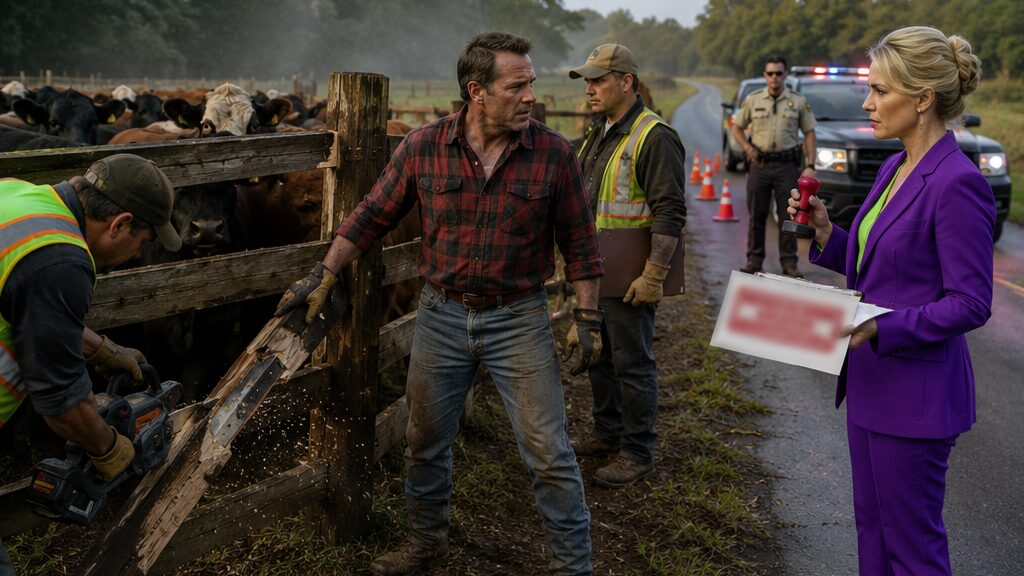
The saw was already biting into the second brace when Mark Campbell came out of the barn.
For one stupid half second, he thought the high whine belonged to his own tools. Then he saw the orange cones along the road, the white pickup backed into his grass, and a man in a reflective vest leaning his weight into a saw blade where Mark’s new steel-reinforced brace met the old cedar rail.
Behind the fence, thirty head of cattle pressed shoulder to shoulder against the corner.
“Hey!” Mark shouted.
The worker jerked the saw up. The blade spun in the air, whining down.
Mark crossed the yard fast enough that the mud pulled at his boots. The front pasture gate sat twenty yards from the county road, close to the blind curve where drivers came in too hot before they saw the Campbell place. Two mornings earlier, after the storm had shoved half the old fence sideways, Mark had rebuilt the corner with steel posts behind cedar facing, ugly by neighborhood standards and necessary by any standard that involved a full-grown cow leaning on wood.
The man with the saw glanced toward a second man near the truck.
“Stop cutting,” Mark said.
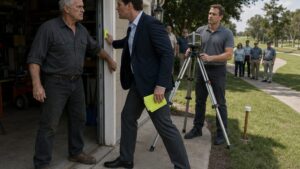
The second man stepped forward, clipboard in hand, jaw tight under a dusty cap. “You Mark Campbell?”
“I’m the man whose fence you’re cutting.”
“Scott Rivera,” the man said, not offering his hand. “We’re contracted for removal of noncompliant exterior structure under the association order.”
Mark looked past him at the half-cut brace. Fresh pale wood showed where the blade had chewed through the cedar facing. Beneath it, the steel angle was exposed like bone.
“That brace holds the gate.”
Scott’s face flickered, but he kept his voice flat. “The order says all unauthorized reinforcement added to the front livestock enclosure has to be removed.”
“Show me the order.”
Scott tapped the clipboard against his thigh. “HOA has it.”
“Then you don’t.”
One of the crew workers shifted near the truck. The saw still ticked as it cooled. On the other side of the fence, the cattle moved again, not panicked yet, but restless from strangers, noise, and the bright cones crowding the ditch. A red cow shoved her head over the rail and blew hard through her nose.
Mark stepped between Scott and the fence. He did not raise his hands. He did not touch anyone. He put his body exactly where the next cut would have to happen.
“You cut another inch,” Mark said, “and that gate won’t hold if they push.”
Scott’s eyes moved to the hinge side. He saw it, Mark thought. Maybe not all of it, not the weight of the herd or the way pressure traveled through a gate, but enough to hesitate.
Then the deputy’s vehicle rolled up behind the cones.
Mark turned his head. The deputy stepped out slowly, one hand near his belt but not on it. Behind him, a dark SUV stopped in the lane, and Janet Roberts got out like she had been waiting for her entrance.
She wore a purple pantsuit so bright it looked wrong against the brown ditch and green pasture. A neon blouse flashed beneath the jacket. In one arm she carried folders; in the other hand, angled high like a prop in a school play, she held a red rubber stamp the size of a hammer.
Mark had seen that stamp once before at an HOA meeting, when she pressed it onto a blown-up photo of somebody’s unapproved shed and the room laughed uneasily. VIOLATION, it said in block letters.
Nobody laughed now.
“Mr. Campbell,” Janet called, walking toward him across the grass. “Please step away from the structure.”
“The structure is my fence.”
“The unauthorized modification to your fence,” she corrected, breathing hard but smiling as if the distinction mattered more than the sawdust on his boots. “You were notified.”
Mark looked at the deputy, then at Scott. “Notified when?”
Janet opened the top folder and pulled out a white envelope. “A notice has been placed at your residence.”
Mark looked toward the house. From where he stood, he could see the front door across the yard. A white paper had been tucked under the brass clip beside the porch light. It had not been there when he went out to feed before sunrise.
“What time?”
Janet’s smile thinned. “This morning.”
“The crew was here before the notice.”
“The association has authority to correct visible violations when a resident refuses compliance.”
Mark felt heat move up his neck. He swallowed it. Anger did not hold gates. Anger did not help when a deputy stood ten feet away and a crew had power tools in hand.
“I submitted emergency repair documents,” he said. “Photos. Receipts. Description of the storm damage.”
Janet turned a page without looking at him. “Your application for an exterior fence alteration was denied. The materials do not conform to Riverbend Rural Estates standards. Metal reinforcement is not permitted on roadside-facing enclosures.”
“It’s faced in cedar.”
“The metal is visible.”
“It’s visible because your crew cut the cedar off.”
Scott looked down.
Janet ignored him. She stepped closer to the fence, lifted the red stamp, and pressed it onto the top sheet of her folder with a hard, theatrical thump. The sound snapped across the yard.
VIOLATION.
The cattle shifted again. A black heifer bumped the rail. The half-cut brace gave a faint wooden crack.
The deputy heard it. His head turned.
Mark pointed to the gate. “That brace keeps the gate from swinging toward the road. That old post split in the storm. I told the board that. I sent pictures.”
“Mr. Campbell,” Janet said, “this neighborhood has standards. You moved into an HOA community with livestock allowances, not an unrestricted farm.”
“My cattle don’t care what you call the community.”
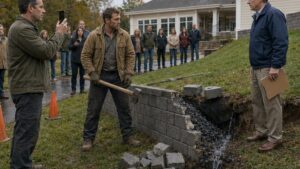
Patrick White had appeared at the road by then, standing beyond the cones with his arms folded. Two neighbors had slowed their cars near the curve, pretending to check mailboxes. Mark could feel the little audience forming around the humiliation of his own fence.
Janet’s voice lowered, which somehow made it worse. “This is exactly the kind of attitude that created the enforcement action.”
Mark turned back to Scott. “You have a court order?”
Scott hesitated. “I have an HOA work authorization.”
“That’s not the same thing.”
Janet snapped the folder closed. “The association does not need a court order to remedy common-view violations after proper notice.”
“You gave notice after the blade touched the fence.”
The deputy cleared his throat. “Everybody keep it calm.”
Mark looked at him. “Deputy, if they cut that brace, and that gate swings open, those cattle go straight toward the curve. You see the road.”
The deputy glanced at the road. A delivery truck took the bend too fast, tires whispering over gravel at the shoulder. The cattle lifted their heads at the sound.
Janet exhaled through her nose. “We are not debating livestock behavior in the ditch.”
“That’s exactly what we’re debating.”
“No,” she said. “We are enforcing a written standard. You were denied. You built anyway.”
Mark had no clean answer to that, and the silence cost him. He had built because the storm had shoved the old gate sideways and Katherine had stood in the mud with a flashlight while he chained it closed until morning. He had built because waiting two weeks for a committee vote would have been foolish. He had built because everybody who had ever worked an animal fence knew a weak corner was not a theory.
But he had not gone to the first meeting. He had not stood in front of the board with the photographs. He had sent the packet and gone back to work, trusting danger to be obvious.
Janet saw the pause and took it as surrender.
“Mr. Rivera,” she said, “continue with the removal.”
Scott did not move.
Janet turned sharply. “The association is paying for a contracted corrective action.”
Scott looked at Mark. “I need you to step clear.”
“No.”
The deputy straightened. “Mr. Campbell.”
Mark kept his eyes on the fence. The red cow shoved again, harder this time, irritated by the bodies and machines clustered near the gate. The half-cut brace bowed. A low groan ran through the wood.
“Just watch the hinge,” Mark said.
The cow hit the gate.
The sound was not loud like a crash. It was worse: a deep, twisting knock, followed by the scrape of metal under strain. The weakened corner jumped several inches toward the road. The deputy stepped back without meaning to. Scott grabbed the nearest post with both hands.
Janet’s red stamp slipped in her grip.
The cattle crowded tighter behind the rails, and the gate trembled as if one more push could teach everyone what the word violation really meant.
Chapter 2: The Application Was Filed Under Appearance
The HOA receipt was in Mark’s inbox, but the word safety did not appear anywhere on it.
He stood in the barn office with his wet boots planted on the concrete and read the email three times, each time slower, as if the missing word might rise out of the screen if he stared hard enough.
Application received: exterior appearance modification.
Not emergency repair. Not storm damage. Not livestock containment. Not road hazard.
Appearance.
The office smelled of dust, printer toner, and the leather gloves drying beside the small space heater. Outside, the cattle had settled, but every few minutes one of them nudged the weakened gate, and the sound carried through the barn wall like a question Mark could not answer.
Katherine stood behind him with the violation notice in both hands.
“They called it decorative,” she said.
“They called it appearance.”
“That’s worse.”
Mark clicked open the attachment he had sent with the application. Storm photos. Fence photos. A close shot of the split gatepost. Another of the blind curve, taken from the ditch, showing how little time a driver had to react. Receipts for cedar boards, steel brackets, concrete mix. A paragraph he had written late that night with mud still on his jeans: emergency reinforcement required to prevent livestock escape toward county road.
He remembered typing that sentence. He remembered thinking it was enough.
Katherine leaned over his shoulder. “Open the denial.”
Mark did.
The denial letter came on Riverbend Rural Estates letterhead, all green borders and tidy serif font.
Request for roadside fence alteration denied. Materials visible from association roadway do not conform to section 7.4: exterior harmony and approved rustic presentation. Resident must remove nonconforming additions and restore approved cedar-only appearance.
Katherine tapped the page with one finger. “This notice from today cites section 9.2.”
Mark reached for the paper in her hand.
She did not let go right away. “You see it?”
He looked. The paper Janet had left on the door ordered immediate corrective removal under section 9.2: safety and liability exposure.
For a moment, neither of them spoke.
The same fence, Mark thought. Two different reasons. Appearance when they denied him. Safety when they wanted to cut it out.
Katherine released the notice. “They changed the ground under you.”
Mark folded the paper once, then unfolded it, smoothing the crease with his thumb. He had hands made for wire, wood, and animals, not for chasing words that changed shape after they were printed.
“I should’ve gone to the meeting,” he said.
Katherine looked at him.
He kept his eyes on the page. “When they sent the reminder. I saw it. I thought, they have the packet. Anybody with eyes can see the post was split.”
“Mark.”
“I didn’t want to sit in that room and listen to Patrick White talk about resale values like my fence is a lawn ornament.”
“You didn’t want to ask permission for something you knew had to be done.”
He turned from the desk. “Would you have waited?”
“No.” Her answer came fast. “But I would have made them say no to my face.”
That landed harder than Janet’s stamp.
Mark glanced through the small barn window. Across the yard, the gate leaned a little wrong. He had chained it after the crew left, adding a temporary line from the corner post to the tractor hitch. It would hold for the afternoon if the herd stayed calm. It was not a solution. It was a bandage tied around somebody else’s cut.
Katherine set the notice beside the keyboard and reached for the folder he had used for the original application. “Print everything.”
“I have it.”
“Print it anyway.”
“I said I have it.”
“And Janet has a stamp,” Katherine said. “Print it.”
He almost argued. The old habit rose in him: handle the thing, fix the thing, don’t turn it into theater. But the saw mark on the brace kept flashing in his mind, pale wood torn open because a form had labeled danger as appearance.
He printed the receipt, the denial, the photos, the material list, the email timestamp, and the notice from the door. Katherine arranged them across the workbench in neat rows. She had worked school office jobs for twenty years before they bought the edge property; she could read a paper trail the way Mark read hoof marks in mud.
“They acknowledged your application the morning after the storm,” she said.
“Yes.”
“They denied it six days later.”
“Yes.”
“And the photo attachment shows unopened on their portal.”
Mark came around the desk. “What?”
Katherine pointed at the printed status page. Beside the file names, in tiny gray text, was a line he had never noticed: attachment pending review.
The storm photos. The split post. The blind curve. All pending review.
Mark stared until the letters blurred.
A phone buzzed on the desk. His, face down beside the printer. The screen showed a new email from Riverbend Compliance.
Katherine read his expression before he touched it. “Open it.”
The email was short.
Emergency compliance review scheduled for 7:00 p.m. tomorrow. Daily fines will begin pending corrective action unless removal is completed or variance approved by board vote. Resident may appear and provide statement. Continued obstruction of association-authorized work may result in additional enforcement costs.
Mark read the last sentence twice.
Katherine’s mouth tightened. “Obstruction.”
“They came before notice.”
“Doesn’t matter if their version gets written first.”
Mark pushed away from the desk and walked to the barn doors. He needed air that did not smell like hot printer paper. Outside, the cattle moved in the late light, big bodies shifting behind the fence he had built with tired arms and common sense. Beyond them, a car came around the curve, its tires clipping the white line before the driver corrected.
He saw again the deputy stepping back when the gate jumped. He saw Scott’s hands grab the post. He saw Janet’s stamp hovering above the folder as if the word on it could hold back the herd.
Katherine came up beside him, holding the printed packet against her chest.
“You can’t just stand there tomorrow and expect them to understand,” she said.
“I know.”
“Do you?”
Mark looked at the road. “I thought if I kept the cattle in and the fence standing, that would be the argument.”
“It should be,” she said. “But it isn’t.”
The quiet between them was not gentle. It had years inside it: years of Mark fixing things before anyone asked, absorbing worry as if silence were a kind of strength, letting Katherine handle the letters and appointments until paperwork became her second fence around their lives.
He took the packet from her.
“I’ll go,” he said.
“To the review?”
“To everything.”
She watched him, not softened yet. “And you’ll talk before they cut?”
He nodded.
The printer behind them clicked once more. Another page slid into the tray. Katherine turned, picked it up, and went still.
“What?”
She carried the page to the doorway. It was the denial letter again, but this time the footer had printed cleanly, a line at the bottom cut off on the first copy.
Reviewed by Architectural Appearance Subcommittee. Safety documentation not considered under this request type.
Mark read it once.
Then he read it again.
The board had rejected his fence before anyone had opened the photographs that showed why he had built it.
Chapter 3: Janet Roberts Measured The Wrong Risk
Janet Roberts stood beside the weakened gate the next morning with a measuring wheel, a clipboard, and the red violation stamp tucked under her arm like she had brought a judge’s gavel to a cattle pen.
She rolled the wheel along the fence line while the cattle watched her through the rails.
“Forty-two inches above approved height at this point,” she said to Barbara Lee, who wrote it down without looking at Mark. “Visible galvanized edge along the lower reinforcement. Nonconforming fasteners. Inconsistent board spacing.”
Mark stood on the pasture side of the gate with one hand resting on the top rail. He had added a chain overnight and wedged a temporary block behind the hinge post. It would not survive a herd push. It only made the danger look less urgent to people who wanted not to see it.
“You’re measuring the wrong side,” he said.
Janet stopped the wheel with her foot. “The roadway-facing side is the side subject to community standards.”
“The cattle-facing side is the side keeping them off the roadway.”
Barbara’s pen paused.
Janet’s eyes moved to the chain, then back to the clipboard. “The association recognizes your concern, Mr. Campbell. That does not retroactively approve unpermitted materials.”
“Concern doesn’t weigh twelve hundred pounds.”
A few feet away, Patrick White stood near the ditch in a pressed jacket that did not belong near mud. He had brought coffee in a paper cup and the expression of a man attending a problem he had predicted.
“Some of us have concerns too,” Patrick said. “Every person driving into Riverbend sees this corner first. It used to look like a rural community. Now it looks like a stockyard repair lane.”
Mark looked at him. “It is a stockyard repair lane. There are cattle behind it.”
“That’s exactly the issue,” Patrick said. “The livestock allowance was supposed to preserve character, not turn the entrance road into a working feedlot.”
Mark almost laughed. The sound would have come out wrong, so he held it in.
The Campbell property had been here before Riverbend put a stone sign at the entrance and sold five-acre “rural lifestyle” parcels to people who wanted sunrise views without manure, fences without pressure, and fields that behaved like landscaping. The HOA documents allowed livestock because the original landowners had insisted on it. Then, year by year, the board had narrowed the spirit of that allowance with words like presentation, harmony, and visibility.
Janet resumed measuring.
Mark stepped closer. “You cited section 9.2 yesterday.”
Janet did not look up. “Safety and liability exposure.”
“The denial cites 7.4.”
“Exterior harmony.”
“Which is it?”
Barbara’s pen stopped again.
Janet straightened. “It can be both. An unapproved structure visible from the roadway creates compliance exposure. Compliance exposure creates insurance exposure.”
“That brace reduces exposure.”
“Not if it was installed outside process.”
There it was, neat as a snapped chalk line: process mattered before purpose. Mark felt the old anger move again, but this time he kept it cold.
“Did you see the storm photos?”
Barbara shifted her weight.
Janet answered too quickly. “I reviewed the application summary.”
“The photos?”
“The subcommittee reviewed the relevant materials.”
“Barbara?” Mark asked.
Barbara looked up then. She was older than Janet, quieter, with reading glasses hanging from a chain. Mark had seen her at annual meetings, always taking minutes, rarely speaking unless asked to confirm exact wording. She looked at Janet first.
“I don’t have the portal in front of me,” Barbara said.
“But you can tell if attachments were reviewed.”
“Not from here.”
Mark pulled a folded page from his back pocket. Katherine had made him bring three copies. He handed one across the fence.
Barbara took it before Janet could s
Chapter 4: The Road Explained The Fence
The truck came around the blind curve with one tire over the white line, and Mark Campbell felt the wind of it push against his shirt before the driver ever saw him.
He stood in the ditch with a tape measure hooked to the bent fence post, one boot braced in mud, his phone held low in his other hand recording the road. The truck corrected late, gravel snapping under its wheels. Behind Mark, the cattle lifted their heads at the engine and moved as one dark mass toward the weakened corner.
The temporary chain tightened with a metallic pop.
Mark did not move until the truck disappeared past the Riverbend stone sign.
Only then did he stop the recording.
From the far side of the gate, Katherine called, “You got it?”
“I got the truck,” he said. “Not the gate movement.”
“You’ll get another.”
That was the trouble. There would always be another.
The county road had never been built for the kind of traffic Riverbend brought in after the last phase of houses went up. Delivery vans, school buses, landscaper trailers, pickup trucks pulling boats toward the lake road on weekends. They came around the bend past the Campbells’ place with the lazy confidence of people who believed fences existed in the background.
Mark walked to the hinge post and crouched.
The saw cut from yesterday had not gone all the way through, but it had weakened the brace enough that pressure had started to travel wrong through the corner. He put two fingers against the hinge plate and pushed. The gate shifted outward, not much, but enough that the bottom edge scraped a new crescent into the dirt.
Katherine saw it.
“That wasn’t there this morning,” she said.
“No.”
“Can you shore it up again?”
“Yes.”
“Can you shore it up if they cut the second brace?”
Mark did not answer because both of them knew the answer.
He took photos from three angles: the hinge plate, the crescent mark in the dirt, the blind curve beyond the gate. Then he walked out into the road when it cleared and filmed from the driver’s line of sight. From there, the cattle were not visible until a vehicle was almost on top of the entrance. The fence corner looked ordinary for two seconds, then suddenly close.
A sedan came over the rise. Katherine called his name sharply. Mark stepped back into the ditch.
The sedan passed, the driver frowning as if Mark were the hazard.
By late afternoon, the folder Katherine had made him carry was thick enough that the clasp would not hold. Photos. Receipts. The original application. The denial. The notice. Screenshots of the portal. A still frame from his road video showing the delivery truck’s tire past the line. He had spent half his life fixing things by touch and sound, and now he was trying to make paper show weight.
His phone buzzed while he was taking another measurement.
Unknown number.
He almost ignored it, then thought of Scott’s warning.
“Campbell,” he answered.
A woman’s voice said, “Mr. Campbell, this is Barbara Lee.”
Mark straightened. Katherine turned from the gate.
“I don’t have long,” Barbara said.
“Then say the important part.”
A silence came through the line, thin and uncomfortable. “The board packet for your emergency review does not include your storm photographs.”
Mark closed his eyes.
Katherine saw his face and came closer.
Barbara continued, lower now. “It includes Janet’s inspection photos, the denial letter, the enforcement notice, and the complaint summary.”
“Whose complaint?”
“I can’t discuss resident complaints outside the meeting.”
“Patrick White?”
“I can’t discuss resident complaints,” she repeated, but her voice made it clear enough.
Mark looked down the road toward Patrick’s clean white fence and trimmed ditch. “Does the packet include my material receipts?”
“No.”
“The split post photo?”
“No.”
“The road curve?”
“No.”
Barbara breathed out. He could hear papers moving near her. “It lists attachments as pending review. The system shows they were never moved into the board packet because the request type was architectural appearance.”
“Katherine said that.”
“She was right.”
Mark felt no triumph in it. Only a heavier kind of anger. The kind that came when somebody did not even bother to see what they were destroying.
“Who chose the request type?” he asked.
“The portal defaults to exterior appearance if the repair affects a visible structure.”
“I wrote emergency in the description.”
“I saw that.”
“Did Janet?”
Another silence.
“Barbara.”
“She saw the summary screen,” Barbara said. “Not the attachments.”
“Then she didn’t review the request.”
“She reviewed what was in the workflow.”
The phrase sounded like a door being closed gently in his face.
Katherine held out her hand for the phone. Mark put it on speaker.
Barbara’s voice became careful. “There is something else. The notice Janet issued cites the insurance memo from last quarter.”
“The liability memo.”
“Yes. But the quote in the notice is not the full sentence.”
Mark looked at Katherine.
Barbara said, “I’m not saying it changes everything. The board still has authority over materials. But the memo was not about removing reinforcement.”
“What was it about?”
“I shouldn’t be telling you this before the meeting.”
“Barbara, there’s a crew coming at sunrise.”
“I know.”
The words came too fast, and for the first time Mark heard fear in her voice.
He gripped the phone. “Then what did the memo say?”
“I’m sending you the public portion. It was included in prior minutes, so it’s not confidential.” A pause. “Bring it tonight if you come.”
“There is no meeting tonight.”
“The emergency review was moved.”
Mark went still.
Katherine’s eyes narrowed. “Moved to when?”
Barbara heard her. “Seven tonight. Janet sent a revised notice through the portal.”
Mark checked his email. Nothing.
“It isn’t in my inbox,” he said.
“It may still be processing.”
“The meeting is in two hours.”
“I know,” Barbara said again, softer. “I’m sorry.”
The line clicked dead.
For a few seconds, the only sound was cattle breathing through the rails and the distant whine of a mower from one of the newer houses. Mark stared at his phone until the email arrived.
Emergency compliance review rescheduled to 7:00 p.m. today due to enforcement timetable.
Katherine read it over his shoulder. “Enforcement timetable,” she said, like the words tasted bitter.
Mark turned toward the barn. “Print the memo.”
They worked without talking. Katherine at the computer, Mark at the printer, both of them moving around each other with the clipped rhythm of a storm night. The first pages came out: meeting minutes, insurance discussion, roadside livestock exposure, recommendations. The memo itself appeared on the last page in small type beneath a carrier logo.
Katherine picked it up before he did.
Her face changed.
“What?” Mark asked.
She held the page against her chest for one moment, not in fear, but in recognition of how badly a sentence could be used if someone cut it in half.
Then she turned it around.
Highlighted near the bottom was the full line Janet’s notice had carved into something else.
Reinforced containment required near public roadway where livestock pressure and vehicle exposure overlap.
Mark read the sentence once standing beside the printer, then again with his thumb pressed to the paper as if the words might move.
Katherine looked toward the fence, where the gate still leaned against the chain.
“That memo doesn’t tell them to remove your repair,” she said. “It tells them why you had to build it.”
Chapter 5: The Board Called Safety A Violation
The red stamp was already on the table when Mark walked into the meeting room.
Janet Roberts had placed it beside her folder, angled toward the folding chairs as if everyone needed to see the word before anyone heard the facts. VIOLATION faced outward in black block letters along the rubber base. The same stamp that had hovered over Mark’s fence now sat under fluorescent lights next to a pitcher of water and a stack of agendas.
Mark stopped just inside the door.
Katherine touched his elbow. Not to calm him. To remind him to move.
The community room smelled like floor wax and old coffee. About a dozen residents sat scattered across rows of metal chairs. Patrick White occupied the front row with his arms folded and a folder on his lap. Barbara Lee sat at the side table with minutes open in front of her, reading glasses low on her nose. She did not look at Mark right away.
Janet did.
“Mr. Campbell,” she said. “You’re late.”
Mark glanced at the clock. “The meeting was moved with two hours’ notice.”
“You received notice through the portal.”
“I received it after Barbara called me.”
The room shifted. Patrick turned his head toward Barbara.
Janet’s hand moved to the folder. “We are not here to discuss notification preferences.”
“No,” Mark said. “We’re here because you sent a saw to my fence before the notice reached my door.”
Katherine’s fingers tightened once against his elbow, then let go.
Janet sat straighter. “We are here to determine whether continued enforcement action is necessary regarding unapproved exterior modifications on a roadside livestock enclosure.”
Mark heard the shape of it. Long enough to sound official. Narrow enough to miss the gate.
The board member beside Janet asked him to sit. Mark did, but he kept the folder on his knees, not on the floor. He had learned that much already. Paper left out of reach became somebody else’s version.
Janet began with photographs from the inspection. The screen at the front showed his fence in pieces: visible steel, uneven cedar, the half-cut brace. Cropped tightly, the photos made the repair look rough and careless. They did not show the road curve. They did not show the split old post. They did not show the cattle pushing the gate while Scott held the rail with both hands.
“As you can see,” Janet said, “the modification materially changes the appearance of the roadside boundary and introduces exposed metal components not permitted under association standards.”
Patrick raised his hand before she finished. “And it affects the entrance. That matters. Every buyer, delivery driver, and visitor sees that corner first.”
Mark opened his folder.
Janet looked at him. “You’ll have time for a statement.”
“I’m correcting the picture.”
“You’ll have time.”
He closed the folder slowly.
Patrick continued. “Some of us bought into Riverbend because it had standards. If one owner decides a metal-reinforced enclosure is fine because he has livestock, then what stops the next owner from putting up whatever they want?”
Katherine leaned close enough that only Mark could hear. “Breathe.”
He did.
Janet nodded as if Patrick had made a neutral point rather than one sharpened for him. “The association also has liability concerns. Livestock near a public roadway must be managed according to approved structures.”
Mark looked at Barbara. She was writing, but her pen had slowed.
When Janet finally allowed him to speak, Mark stood with the folder in both hands. He had planned words in the barn. Most of them left him under the fluorescent lights. What remained was simpler.
“I built before written approval,” he said.
Patrick made a small sound, almost satisfaction.
Mark let it pass. “I did. I submitted notice the next morning, but I did not wait for a vote before reinforcing the corner. That’s on me.”
Janet’s expression did not change, but the room did. People expected denial. Admission made them listen differently.
Mark set the first photo on the table and turned it toward the board. “This was the old post after the storm.”
Barbara leaned forward.
He set down the second photo. “This is the gate line. This is the blind curve. This is a truck crossing the white line yesterday at 5:14 p.m.”
Janet reached for the photo. Mark did not release it until she looked at him.
“That curve has no shoulder,” he said. “If the gate swings out under herd pressure, the cattle don’t go into my back pasture. They go there.”
He pointed toward the projected image of his fence, cropped clean of the road.
“They go into traffic.”
Patrick leaned back. “Nobody is saying you can’t maintain a fence. We’re saying you can’t make the entrance look like a salvage yard.”
Katherine’s head turned sharply, but Mark answered first.
“You want cedar facing, I can do cedar facing. I already did cedar facing. Your crew cut it off.”
A murmur passed through the room.
Janet tapped her pen. “The association did not authorize the steel reinforcement behind it.”
Mark placed the insurance memo on the table. “Your carrier recommended reinforced containment near public roadway where livestock pressure and vehicle exposure overlap.”
Barbara looked up fully then.
Janet’s face hardened. “That memo does not override architectural standards.”
“No. But it explains why treating this as decoration is wrong.”
Barbara cleared her throat.
Janet did not look at her. “Barbara, record that the resident acknowledges proceeding without approval.”
Barbara’s pen hovered. “I’ll record his full statement.”
Janet turned slowly.
The room tightened.
Barbara adjusted her glasses. “The application was entered under Architectural Appearance. The attachments were not included in the board packet at the time of denial. The storm damage photos and road exposure documentation were not reviewed.”
Patrick’s chair creaked. “That sounds like a clerical issue, not permission to ignore rules.”
“It is a procedural issue,” Barbara said, voice thin but steady. “And it affects what the board considered.”
Janet folded her hands. For the first time, Mark saw the pressure under her polish. Not regret. Not softness. Pressure. She was being pulled between the rule she had enforced and the record Barbara was now making public.
“The board can acknowledge incomplete documentation,” Janet said, “without accepting an unapproved structure as compliant.”
“Then inspect it as a safety repair,” Mark said.
“We are not county engineers.”
“No,” he said. “But you hired a crew to remove a brace beside a public road.”
The board member at the end of the table shifted. “Could removal be paused pending inspection?”
Janet’s answer came immediately. “A pause leaves the violation in place.”
“A pause leaves the fence in place,” Katherine said.
Janet looked at her as if spouses were not part of the agenda. “Mrs. Campbell, this is a board proceeding.”
“It’s also my home.”
The words landed quietly, but Mark felt them. My home. Not his fence. Not his fight. The farm was not just where he fixed things until the next thing broke. It was the place he had promised would stay livable for both of them.
Patrick raised his hand again. “If the board lets this stand, even temporarily, the message to every resident is build first, explain later.”
Mark turned toward him. “If the board removes it, the message is a form matters more than whether the gate holds.”
Janet closed her folder. “Enough. The chair proposes the following: daily fines are paused for forty-eight hours while the resident submits a compliant redesign. However, the unauthorized reinforcement facing the roadway must be temporarily removed by contracted crew beginning tomorrow morning, unless and until approved materials are installed.”
For a second, Mark thought he had misheard.
Katherine said, “Temporary removal means the unsafe condition comes back.”
“Temporary removal means enforcement of current standards while a compliant solution is reviewed,” Janet said.
Barbara looked down at her minutes.
The board voted. Not unanimously, but enough.
Fines paused. Removal continued. Redesign required.
It sounded like a compromise if you did not know what the gate would do when the second brace came off.
Mark gathered his papers. His hands did not shake. That almost scared him more than if they had.
At the door, Barbara stepped into his path. “I’ll add your photos to the official record tonight.”
“Will that stop the crew?”
She looked past him toward Janet. “Not by itself.”
Katherine walked ahead into the parking lot, her shoulders stiff beneath her coat.
Mark paused by the doorway and turned back.
Janet had opened her folder again. The red stamp sat beside her right hand. She did not press it onto anything this time. She only signed the continuation order, tore off the top copy, and handed it to Scott Rivera, who had been waiting at the back of the room in silence.
Mark saw the time written under the work authorization.
7:00 a.m.
Chapter 6: The Gate Moved Before The Vote
The saw restarted before the sun cleared the barn roof.
Mark was already at the fence.
He had not slept much, and what little sleep came had been full of the same sound: blade on wood, chain snapping tight, cattle hooves hitting pavement beyond the curve. Now the real saw cut through the cold morning air, and the cattle crowded toward the weakened corner as if the machine had called them.
Scott Rivera stood with one hand raised to his worker, not yet giving the final signal.
Janet Roberts waited near her SUV in the same purple jacket, though today the neon blouse was hidden under a coat. The red stamp was not in her hand. It was tucked inside the open folder against her chest, bright enough for Mark to see whenever the folder shifted.
The deputy’s vehicle idled behind the cones.
Mark walked to the gate and stood in front of the second brace.
Scott lowered his hand. The saw went quiet.
“Mark,” Scott said, voice low.
“Watch the hinge before you cut.”
Janet came forward at once. “Mr. Campbell, the board has authorized temporary removal. Do not obstruct the crew.”
Mark did not look at her. He kept his eyes on Scott. “You saw it yesterday.”
“I saw movement,” Scott said.
“You saw enough.”
Janet’s heels sank slightly into the damp ground as she stopped beside the cones. “The board considered your claims last night and issued a continuation order. Mr. Rivera is obligated to complete the contracted work.”
Scott’s jaw tightened at the word obligated.
Mark stepped aside, but only one pace. “Then check it.”
Janet made an impatient sound. “We are not conducting another inspection in the field.”
“No,” Mark said. “We’re preventing one from becoming a report after cattle hit a minivan.”
The deputy looked toward the road.
Scott walked to the hinge post.
Janet snapped, “Mr. Rivera.”
He did not answer. He crouched, put his gloved hand on the lower hinge plate, and nodded toward the nearest crew worker. “Ease pressure on the chain.”
The worker looked at Janet first.
Scott’s voice hardened. “I said ease it.”
The worker loosened the temporary chain Mark had added. Not all the way. Just enough for the gate to carry its own load.
The change was immediate.
The top of the gate shifted outward an inch. Then another. The cattle pressed behind it, unsettled by bodies at the fence line. A black cow shoved through the crowd, shoulder rubbing the rail. The gate gave a low, ugly groan.
Scott rose slowly.
Mark pointed to the second brace. “That’s with one cut started and the chain half loose. If you remove the second brace, the hinge takes all of it.”
Janet’s face had gone pale around the mouth, but her voice stayed clipped. “Speculation.”
Scott looked at her. “No, ma’am.”
The word ma’am did not soften it.
Janet turned toward him. “The order specifies removal of nonconforming reinforcement.”
“The order doesn’t say make the gate unsafe.”
“The board voted.”
“I don’t work for the board if the work creates a road hazard.”
Patrick White arrived then, pulling his car onto the shoulder behind the deputy. He got out fast, jacket unbuttoned, phone already in hand. “Is he blocking the work again?”
“No one is blocking,” Mark said.
Patrick aimed his phone toward the fence. “Looks like blocking.”
Mark almost stepped toward him. He stopped himself. Phones loved movement. Janet loved process. Patrick loved a picture without the road in it.
Instead, Mark took out his own phone and began recording.
“For the record,” he said, “Scott Rivera is inspecting the gate movement before cutting the second brace. The gate is under livestock pressure and faces the county road.”
Janet’s eyes flashed. “You do not have consent to record me.”
“We’re outside on my property, beside the fence you ordered cut.”
The deputy cleared his throat but did not tell Mark to stop.
Patrick said, “This is exactly why people are tired of dealing with livestock lots. Everything becomes a scene.”
Katherine’s voice came from behind Mark. “It became a scene when you sent tools before the facts.”
He turned. She had come from the house carrying the folder, his folder, the thick one with the photos and memo. She wore work boots and her old barn coat, hair pulled back, face drawn from the same sleepless night. She handed him the folder without stepping in front of him.
“Barbara emailed at six,” she said. “The photos are now in the record.”
Janet heard that. “The record does not alter the active order.”
“No,” Katherine said. “But it alters who can say they didn’t know.”
For the first time, Mark saw Scott look at Janet not as a customer, not as a board president, but as the person asking him to put his name on the wrong side of an obvious thing.
The cattle pushed again.
This time the chain jumped off the temporary notch Mark had cut into the tractor hitch. The gate swung outward six inches before the remaining brace caught with a cracking snap.
The deputy stepped forward. “Everybody back from the gate.”
A crew worker grabbed the rail. Scott moved faster, planting both hands against the post to steady it. Mark went to the hinge side and shoved his shoulder against the gate, boots sliding in mud. Weight pressed back through the wood, alive and heavy.
“Close the road,” Katherine called.
The deputy looked at her.
“If that gate comes open, close the road.”
The deputy reached for his radio.
Janet’s voice rose. “That is unnecessary.”
The deputy looked at the gate, at Scott bracing the post, at Mark’s shoulder against the rail, at the cattle crowding behind it.
Then he spoke into the radio.
Patrick lowered his phone.
For a moment, nobody used the word appearance.
Scott got the chain back into place and signaled his worker to tighten it. The gate settled, still wrong, but held.
Mark stepped back, breathing hard. Mud streaked one sleeve. He looked at Janet.
“Put that in your minutes.”
Janet’s folder was clutched so tightly the red edge of the stamp pressed a mark against the paper. “This does not approve the structure.”
“No,” Mark said. “It proves what happens when you remove it.”
Scott pulled off one glove. “I’m not cutting that brace.”
Janet stared at him. “You are under contract.”
“And I’m telling you the work condition changed.”
“The condition did not change.”
Scott pointed to the gate. His voice was not loud, but every person there could hear it. “If I cut that, the gate goes into the road.”
The deputy’s radio crackled. A car slowed near the cones, then another behind it. The county road, for the first time since Janet’s order began, was paying attention.
Chapter 7: The Stamp Stayed Inside The Folder
Janet Roberts had the red stamp in front of her again, but this time she did not touch it.
It sat on the HOA office table between her folder and Mark Campbell’s revised fence plan, bright and useless under the clean white lights. Outside the office window, the Riverbend entrance road curved past the stone sign and disappeared toward the Campbell place. Inside, the air smelled of copier heat and the stale coffee someone had made before sunrise.
Mark stood instead of sitting.
Katherine stood beside him with the folder tucked under one arm. She had not let it out of her sight since Scott lowered the saw. Across the table, Barbara Lee had three stacks of paper arranged with painful care: the original application, the misfiled denial, and the emergency exception policy that everyone in the room now seemed to wish had stayed buried in the guidelines.
Scott Rivera waited near the door, cap in both hands. The deputy stood outside the glass wall speaking quietly into his radio, not part of the meeting but close enough that no one could pretend the road had not been nearly closed because of a fence removal order.
Janet looked at the revised plan without expression.
“Steel core remains,” she said.
Mark nodded. “Behind cedar facing.”
“Cedar facing installed to approved roadside appearance within seven days.”
“If the brace stays in place while I do it.”
Barbara wrote that down.
Janet turned a page. “Drainage correction at the hinge post.”
“I’ll cut a shallow swale and set gravel so runoff doesn’t soften the post again.”
“And all future livestock enclosure work requires notice before construction unless emergency conditions apply.”
Mark held her gaze. “Then put the emergency conditions in writing where people can find them.”
Janet’s fingers tightened near the stamp.
Katherine shifted beside him, but Mark did not look away. He had spent too many years believing a thing became true because he had done it right. That morning, with the gate shoving toward the road and Scott’s voice cutting through everybody’s argument, he had understood the cost of silence. A fence could hold cattle, but it could not hold the story if someone else wrote it first.
Barbara cleared her throat. “The emergency repair exception is already written.”
“It’s hidden in the back of the guidelines,” Mark said. “And apparently not tied to the application portal.”
Barbara lowered her eyes to the policy. “That is accurate.”
Janet looked at her.
Barbara did not apologize this time. She lifted the page and read aloud, her voice thin but steady. “Temporary emergency repairs necessary to preserve safety, access, structural integrity, livestock containment, or habitability may be undertaken prior to approval, provided notice is submitted within forty-eight hours. Final materials and visible appearance remain subject to later review when the emergency has passed.”
For a moment, the only sound in the office was the copier warming up in the next room.
Mark said, “I notified the next morning.”
Barbara nodded. “The portal record confirms receipt.”
Janet sat back. “The notice was misrouted.”
“No,” Katherine said quietly. “The notice was routed to the wrong category after he wrote emergency on it.”
Janet’s mouth tightened, but she did not correct her.
Patrick White was not at the table. He had sent an email instead, copied to the board, warning that approving Mark’s fence would “set a dangerous precedent for owner-defined emergencies.” Barbara had printed it and placed it in Janet’s folder. Mark had read it once and pushed it aside.
The precedent already existed. It was the road. It was the gate. It was the cattle hitting the rail hard enough to make a deputy call in traffic control.
Janet picked up Patrick’s email now, read one line, and put it down.
“The board has to consider community appearance,” she said.
“Yes,” Mark said. “Consider it after the gate holds.”
Scott looked at the floor, but Mark saw the corner of his mouth move. Not a smile exactly. More like agreement kept private out of habit.
Janet turned to him. “Mr. Rivera, for the record, your company is declining completion of the prior work order?”
Scott lifted his head. “I’m declining to remove a brace I believe is currently preventing a road hazard. I’ll install cedar facing over the reinforcement if Mr. Campbell hires us for that job.”
Janet’s eyes narrowed. “That is a separate matter.”
“Yes, ma’am.”
Mark looked at Scott. “I’ll pay for the facing. Not the removal.”
Scott nodded once.
Barbara slid a form from the third stack to the center of the table. “The proposed action is withdrawal of the violation notice, cancellation of pending fines, conversion of the application to emergency safety repair status, and conditional approval of the revised plan.”
Janet did not pick up the pen.
Mark felt Katherine become still beside him.
There it was, the narrow place where authority either opened or doubled down. Janet’s face gave away little, but Mark could see the fight in her hands. The red stamp was closer to her right hand than the pen. For two days she had carried that stamp like certainty. Now the office had no audience except the people who knew too much about the hinge.
“You understand,” Janet said, “that the board cannot simply allow every resident to decide what counts as an emergency.”
Mark nodded. “I understand.”
“You understand that if livestock enter that road, the association will be named in the claim.”
“I understand that too.”
“And you understand that building first put the board in a position where it had to respond.”
Mark heard Katherine inhale. He answered before she could.
“Yes,” he said. “I should have made someone answer the emergency request before I picked up the tools. I should have called, emailed, shown up, kept calling. But if I had waited to pour concrete until your portal put my photos in the right folder, that gate would have failed in the storm week.”
Janet watched him.
“I’m not asking you to pretend I followed every step,” he said. “I’m asking you to stop pretending the step mattered more than the hazard.”
Barbara’s pen stopped again, not from hesitation this time, but because there was nothing to write that would be cleaner than what he had just said.
Janet looked toward the window. A car slowed on the road beyond the stone sign, then continued. Morning traffic had returned to normal because the gate had held. That was the kind of evidence nobody noticed unless it failed.
At last, Janet picked up the pen.
Not the stamp.
She signed the withdrawal first. Then the conditional approval. Then the instruction to update the portal category from Architectural Appearance to Emergency Safety Repair. Her signature was sharp, almost angry, but it landed in the correct boxes.
Barbara released a breath.
Katherine did not.
Janet pushed the papers toward Mark. “Seven days for cedar-facing completion. Thirty days for drainage correction. Any further alteration comes through the proper channel.”
Mark took the papers but did not leave.
Janet looked up. “Is there something else?”
“The removal cost,” he said.
Janet’s face closed. “The association incurred expenses due to unauthorized work.”
“The association sent a crew before proper review. Your contractor stopped because the work order was unsafe.”
Scott shifted by the door.
Barbara looked from Mark to Janet, then pulled another sheet from the stack. “There is a provision allowing the board to absorb enforcement costs when the underlying notice is withdrawn due to administrative error.”
Janet stared at the page.
Katherine spoke then. “You don’t have to call it an apology.”
Janet’s eyes moved to her.
Katherine’s voice stayed even. “Just don’t charge us for the saw that almost opened the gate.”
The words struck the room softly and stayed there.
Janet signed the cost withdrawal without looking up.
One week later, Scott’s crew came back without cones, without a deputy, without the red stamp. This time the saw cut cedar to fit over steel, not steel out from under cedar. Mark worked beside them, measuring twice, holding boards while Scott fastened them clean along the roadside face. The fence still looked stronger than the old one, because it was. But from the road, it carried the same cedar line Riverbend wanted, with something harder hidden where the cattle leaned.
Patrick White drove by once and slowed. He did not stop.
Katherine brought coffee out in a thermos and stood by the gate while Mark checked the hinge. The gravel swale caught the runoff where mud had softened the post. The new brace held straight. Behind the rails, the red cow pushed her head forward and huffed at the fresh cedar.
“Don’t start,” Mark told her.
Katherine handed him a cup. “She’s reviewing the appearance.”
He almost smiled. It came slowly, but it came.
A car rounded the blind curve, then a school bus behind it, yellow body flashing through the morning light. Both passed without slowing, without knowing how close the road had come to being part of a board decision.
Mark watched until the bus cleared the entrance.
In the HOA office, the red stamp stayed in Janet’s folder. Mark knew because Barbara sent the final scanned packet that afternoon. The stamp appeared only in the background of one document photo, half hidden under the withdrawn notice, unused.
He printed the approval anyway and put it in a plastic sleeve inside the barn office, above the workbench where he kept gate chains, spare hinges, and the receipts Katherine insisted he never throw away.
Then he walked back to the fence.
The cattle stood behind the reinforced rails, contained and calm. Traffic moved beyond them on the road. The cedar facing caught the afternoon sun, ordinary enough for the community and strong enough for the truth underneath.
Mark rested one hand on the top rail and felt the pressure in it, not as defiance now, but as a promise made visible before anyone else could rename it.
The story has ended.