The HOA Tried to Take His Service Dog, but the Hill Was Built on His Permission
Chapter 1: The Day They Tore the Tag from His Dog
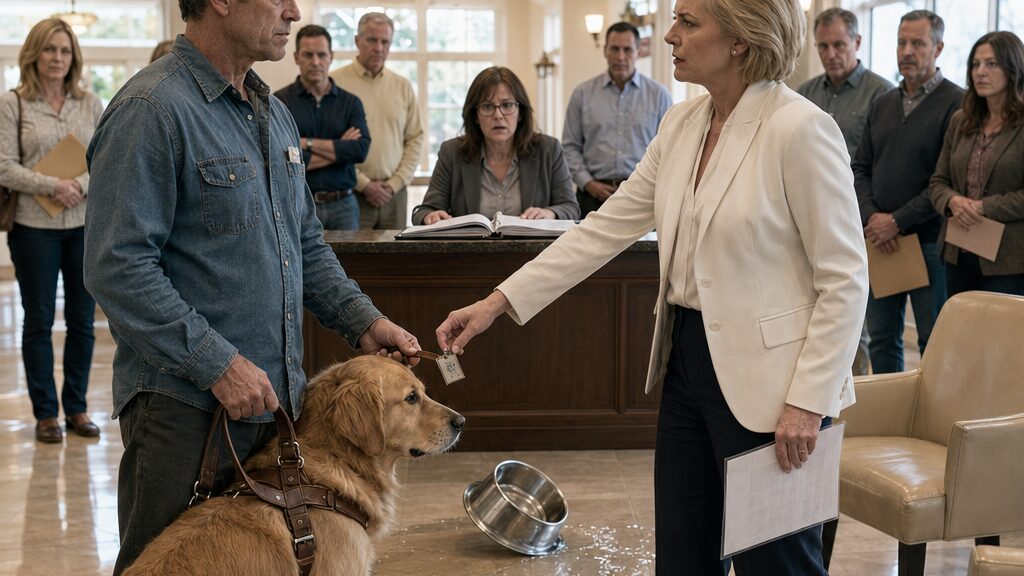
Kathleen Roberts kicked the stainless-steel water bowl before Benjamin Carter reached the registration desk.
It struck the baseboard with a hard metallic crack, spun twice across the clubhouse tile, and emptied beneath a row of cream upholstered chairs. Ranger flinched but did not move from Benjamin’s left leg. The leather handle of his harness pressed against Benjamin’s palm.
“No animals inside during compliance registration,” Kathleen said.
Her white jacket was buttoned despite the heat gathering in the crowded lobby. Behind her, homeowners stood with envelopes, checkbooks, and architectural-review forms. Several had turned at the sound of the bowl. None looked away quickly enough to pretend they had not seen.
Benjamin stopped three paces from the desk.
“He’s working.”
The words came out flatter than he intended. Ranger shifted his weight against Benjamin’s knee, a small trained pressure that told him his breathing had changed before he noticed it himself.
Kathleen’s gaze dropped to the brown leather harness. A rectangular tag hung from its side: SERVICE DOG—DO NOT DISTRACT.
“We’ve discussed this.”
“No,” Benjamin said. “You sent notices. That isn’t a discussion.”
A few people lowered their eyes. Gregory Lee, standing near the coffee urn, folded his arms but said nothing. Laura Miller sat behind the registration desk with the association binder open before her. Her pen remained suspended above a signature line.
Kathleen picked up a laminated sheet.
“The board adopted an animal-control clarification Thursday evening. Dogs are prohibited in all common facilities unless temporarily authorized by management.”
Benjamin held out the accommodation letter he had already submitted twice.
“Federal housing protections aren’t temporary.”
Kathleen did not take it.
“This is not a hospital, Mr. Carter.”
Ranger’s ears moved at the sharpness in her voice. Benjamin felt the lobby narrowing around him: the brightness of the windows, the smell of lemon cleaner, the scrape of somebody’s shoe. His thumb found the seam in the harness handle. Four stitches across, four back. Something solid to count.
Kathleen stepped closer.
“You have made no effort to fit the standards of this community since you arrived.”
“I’ve lived here nine years.”
“And in nine years, your door has remained yellow, your truck has remained visible from the street, and now you expect every resident to accept an animal wherever you choose to take it.”
The yellow door had been his wife’s choice. Kathleen knew that. Most of the hill knew it.
Benjamin said nothing.
Kathleen mistook his silence for surrender. She reached down, pinched the service tag between two manicured fingers, and pulled.
The leather tab tore at the rivet.
Ranger recoiled half a step. Benjamin caught the harness before it twisted against the dog’s shoulder. The tag fell faceup between Kathleen’s shoes.
A sound moved through the lobby—not a gasp exactly, but the collective intake of people who understood a line had been crossed and were already calculating the cost of acknowledging it.
Benjamin bent slowly and picked up the tag.
Kathleen placed the laminated violation against his chest.
“Your fine begins today. Four hundred dollars, with an additional charge for every day the violation remains uncured. You have thirty days to remove the animal from the property or face further enforcement against your home.”
Laura’s pen touched the desk but did not write.
Benjamin looked at the notice. It cited nuisance-animal provisions, sanitation provisions, and a clause concerning unauthorized occupants. None applied to Ranger. Someone had highlighted the amount in yellow.
“Did the board attorney approve this?” he asked.
Kathleen’s expression tightened.
“The board has authority to interpret its own rules.”
“That wasn’t my question.”
“You may appeal at next month’s hearing.”
“After the fines compound.”
“That is the process.”
Ranger leaned into his leg again. Benjamin could feel the tremor beginning in his right hand. He placed the torn tag in his shirt pocket before anyone could see his fingers fail.
The old version of him would have left immediately. He had spent years learning how to leave rooms before they closed around him. He had told himself that withdrawal was discipline, that silence prevented damage.
But Kathleen had put her hand on the one living thing trained to keep him present.
Benjamin walked to the desk.
Laura looked up. Her face had gone pale.
“I need to sign for receipt?” he asked.
She slid a form toward him. “Acknowledgment only. Signing doesn’t mean you agree.”
Kathleen gave her a hard glance.
Benjamin read every line. Then he crossed out the sentence stating that he had received a copy of the revised animal policy. He had not. He initialed the change and signed only the acknowledgment of the violation notice.
The brass key on his ring struck the desk as he returned Laura’s pen.
Laura’s eyes dropped to it.
The key opened the chain gate behind the thirty-six houses on the east and lower slopes. It was old, heavy, and stamped with the number of the original development parcel.
Benjamin saw recognition flicker across her face.
He could have left then. Instead, he rested one hand on Ranger’s shoulders and asked, “Laura, when did the association last renew the rear utility-corridor license?”
The room changed.
It was not dramatic. No one spoke. The coffee urn continued to click. A child outside shouted near the pool. Yet every board member within hearing distance became suddenly still.
Kathleen answered first.
“That has nothing to do with this.”
“I asked the secretary.”
Laura glanced at Kathleen, then down at the thick binder. “I’d have to check.”
“The renewals are filed under permanent access agreements,” Benjamin said. “Blue divider.”
Laura turned several sections. Her fingers moved too quickly at first, skipping pages. Then she slowed.
Kathleen stepped beside her. “This is an animal-compliance event.”
Benjamin waited.
Laura reached the blue divider. Inside were annual authorizations bearing Benjamin’s signature, each permitting association contractors to enter the strip for inspection, maintenance, and nonemergency repairs. The most recent form was clipped to the front.
Its signature line was blank.
Laura looked at the date in the upper corner.
Kathleen closed the binder.
“That matter will be handled separately.”
“You were supposed to send the renewal in December,” Benjamin said.
“It is administrative housekeeping.”
“It’s permission to enter private land.”
A man near the door asked, “What land?”
Kathleen lifted her voice. “There is no interruption to any service. Mr. Carter is attempting to disrupt a routine meeting because he refuses to follow rules that apply to everyone.”
Benjamin studied her. Beneath the polished control, he saw something he had missed before—not uncertainty, but fear disciplined into irritation.
He clipped Ranger’s torn tag through an intact loop so it would not drag. Then he folded the violation notice and placed it beside the tag in his pocket.
“I’m not disrupting anything,” he said. “I asked for a date.”
He turned toward the door.
Nobody blocked him. Nobody apologized, either.
Outside, the midday sun flashed off brass mailboxes and windshields lined with fresh dealership wax. Ranger guided him down the front steps. Benjamin kept one hand on the harness and counted each concrete joint until the pressure behind his ribs loosened.
He had reached the sidewalk when the clubhouse door opened behind him.
“Benjamin.”
Laura hurried down the steps, clutching a photocopied page. She stopped several feet away, as if distance might protect them both from what she was about to say.
“I checked the correspondence log,” she said quietly. “The board received the renewal packet. Kathleen marked it for executive review.”
“When?”
Laura swallowed.
“Six weeks ago.”
Chapter 2: Thirty-Six Houses Behind One Unsigned Line
One red line crossed the back of every property on the hill.
Benjamin stood over the plat spread across his kitchen table while Ranger’s torn harness lay beside it. The line began behind his yellow-doored house, followed the curve of the eastern slope, and narrowed along the lower retaining basin before disappearing beneath the clubhouse parcel.
Thirty-six homes faced the street as separate kingdoms of stucco and stone. On the county map, their private fences and landscaped boundaries meant less than the strip threading behind them all.
Benjamin placed brass survey weights on the corners of the paper.
He had drafted maps like this for the county before retirement. He trusted bearings, monuments, and recorded language more than memory. Memory altered itself under pressure. A deed either reserved access or it did not.
His deed did.
The developer had conveyed him Parcel 14-B two summers earlier: a narrow, irregular tract containing the old drainage route and utility corridor. The price had been low because the land could not support a house. Its value lay in what crossed it.
A twelve-inch irrigation main.
Fiber conduit.
Storm drainage.
Several sewer laterals serving the lower row of homes.
The association held no permanent easement. It had relied on an annually renewed license signed by the landowner.
By Benjamin.
Ranger rested beneath the table with his chin across Benjamin’s boot. Every time Benjamin shifted toward the drawer where he kept the annual forms, the dog opened one eye.
The unsigned renewal sat on top.
Benjamin read the indemnity clause, then the maintenance provision, then the cancellation language. The association could request emergency access at any time. Routine access required written permission. Expiration did not shut down utilities; it ended the HOA’s right to send crews across the land without asking.
That distinction mattered.
It did not erase the satisfaction he felt.
Kathleen had threatened to use rules until he could no longer afford his own home. Now her contractors could not legally cross ten feet of weeds without his signature.
The thought steadied him for several seconds.
Then Ranger pushed his nose against Benjamin’s knee.
“I know,” Benjamin said.
He called Catherine Hill before he could change his mind.
She listened without interrupting while he described the lobby, the torn tag, the fine, and the expired corridor license. When he finished, she asked him to photograph every page and send the original violation by courier.
“What about the corridor?” he asked.
“What about it?”
“They need my authorization.”
“That is a property question.”
“You handle housing cases.”
“I handle discrimination. Owning the land does not make every use of it wise.”
Benjamin leaned against the counter. “I’m not shutting anything off.”
“Good, because intentionally interfering with essential services would complicate your position and possibly endanger people who had nothing to do with what happened.”
“They can request emergency entry.”
“Then state that clearly. In writing.”
He looked at the blank renewal.
“And routine access?”
“You may decline it if the deed and license say what you believe they say. But do not confuse legal leverage with moral innocence.”
Her tone was calm enough to irritate him.
“Kathleen didn’t worry about moral innocence.”
“You called me because you don’t want to become Kathleen.”
The kitchen went quiet.
Catherine continued. “File the accommodation complaint. Preserve the tag. Preserve the bowl incident if the clubhouse has cameras. Give written notice that emergency access remains available. Then decide what you want the ordinary license to accomplish.”
“I want them to leave Ranger alone.”
“That is not a contract term. What else?”
Benjamin looked down at the dog.
“I want them to stop doing this to people who can’t fight them.”
“Then write for that outcome, not for revenge.”
On Monday morning, Benjamin took the plat and deed to the county recorder’s office. The clerk retrieved the original subdivision documents and set them beneath a weighted glass frame.
The old survey showed the same narrow strip, once retained by the developer for construction access. Later amendments referenced temporary licenses but no recorded permanent easement.
Benjamin checked the instrument numbers twice.
The corridor was his.
So were its obligations.
Behind the lower houses that afternoon, he walked the parcel with Ranger and a metal survey rod. Brass monuments marked the turns beneath ornamental grasses and creeping ivy. Several fences had been built within inches of the boundary. At one location, fresh tire tracks crossed the mud near a green utility cabinet.
Someone had been entering without notice.
Benjamin photographed the tracks.
Near the retaining basin, he found orange paint on a drainage cover and a zip tie bearing the logo of Samuel Harris’s maintenance company. The cover’s bolts were rusted. One had been replaced with a mismatched fastener.
He crouched to examine it, and the damp mineral smell carried him backward—to another slope, another season, his wife standing beside a flooded ditch with mud on her shoes and anger in her voice.
He rose too quickly. The edges of his vision tightened.
Ranger pressed across his shins until Benjamin gripped the harness handle and named the things he could see: green cabinet, white fence, red maple, brass marker, brown leather.
The present returned by degrees.
At home, Benjamin drafted two letters.
The first went to the HOA. It stated that the annual license had expired and would not renew automatically. All routine-entry requests must be submitted in writing. Emergency access for threats to life, safety, sanitation, or essential service would remain available through his direct number.
The second went to every affected homeowner.
He explained none of the clubhouse confrontation. He did not mention Ranger. He did not mention Kathleen.
He simply wrote that the association’s access authorization had expired and that revised terms would be proposed within thirty days.
It was accurate.
It was also, he knew, incomplete.
He attached estimated rerouting costs obtained two years earlier. The lowest exceeded fifty thousand dollars per property. He told himself the figures ensured residents would take the notice seriously.
He did not tell himself how the numbers would frighten them.
By sunset, the certified envelopes covered half the kitchen table. Ranger’s repaired temporary tag rested beside the postage strips.
Benjamin mailed every letter.
The first response came before noon the next day. Not from Kathleen. Not from an attorney.
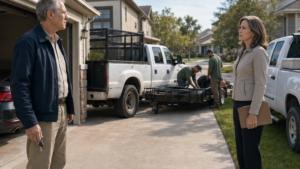
A fiber crew supervisor called from a service truck parked at the upper entrance.
“We have a damaged conduit handhole behind Lot Twenty-One,” the man said. “The association gave us the old access letter, but our legal department says it expired.”
“Is service down?”
“Intermittent to six houses. Not an emergency yet.”
“Submit the location and scope by email.”
“We’re already here.”
“I understand.”
There was a pause.
“So you’re denying access?”
“I’m requiring a written request.”
Another pause, sharper this time. “Mr. Carter, if that conduit fails completely, those customers lose internet and phone service.”
Benjamin looked at the brass key on the table.
Then he looked at Ranger’s torn tag.
“Send the request,” he said.
Chapter 3: The Perfect Lawns Began Failing First
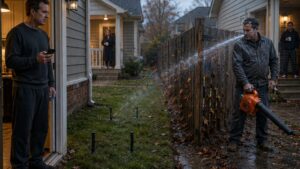
The sprinklers stopped in straight, synchronized rows.
At six on Tuesday morning, Benjamin stood at the end of his driveway while dry rotor heads clicked uselessly across the east slope. One after another, they rose from the turf, coughed air, and sank again. The lawns remained dark with dew for another hour, disguising the failure.
By noon, the grass had begun to show pale seams.
A handwritten sign appeared beside Benjamin’s mailbox before lunch.
TURN THE WATER BACK ON.
Ranger sniffed the wooden stake, then looked up at him.
Benjamin photographed the sign and removed it. He did not know who had placed it there. That uncertainty disturbed him more than a signature would have.
He had not turned off the water. No valve on the corridor belonged to him. The irrigation system had lost pressure after the association’s pump contractor postponed a repair that required crossing his parcel.
Kathleen knew that.
At two, she sent a neighborhood-wide email stating that “a private landowner’s unexpected access restrictions” had delayed essential maintenance.
Benjamin read it twice. The sentence contained no direct lie. It also avoided every truth that mattered.
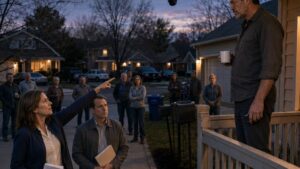
By evening, three homeowners stood across from his yellow door. Gregory Lee occupied the center, hands in the pockets of a windbreaker despite the warmth.
“My lower beds are dry,” Gregory said.
“The irrigation contractor needs to submit an entry request.”
“They did.”
“They submitted a blank work order with no route, no insurance certificate, and no description of excavation.”
Gregory’s mouth tightened. “You know where the pump is.”
“I also know the last crew drove over a drainage cover and never reported it.”
One of the other homeowners lifted a phone. Its camera pointed toward Benjamin and Ranger.
“Is that necessary?” Benjamin asked.
“We’re documenting,” she said.
The lens lowered to Ranger’s harness. The temporary repair left the torn service tag slightly crooked. Benjamin felt the dog move closer to his leg.
Gregory noticed.
“Put the phone down,” he told the woman.
She did, but not before the image had been captured.
By Wednesday morning, it circulated through the neighborhood message board beneath a caption: MAN HOLDING UTILITIES HOSTAGE USES DOG AS SHIELD.
Benjamin stared at the photograph until Catherine called.
“Do not respond online,” she said.
“I wasn’t going to.”
“You were thinking about it.”
“I was thinking about correcting it.”
“That forum is not a hearing.”
“It’s where my neighbors have decided what happened.”
“Then give them evidence through a channel that requires them to confront it.”
Benjamin looked through the front window. The sign had been replaced with another.
THIRTY-SIX FAMILIES LIVE HERE TOO.
That one he left in place.
The fiber crew returned shortly before noon. Their supervisor carried a printed request containing the work area, insurance coverage, and estimated time on the parcel.
Benjamin read it at the corridor gate.
Kathleen arrived in a black SUV before he finished.
“You do not have authority to supervise association contractors,” she said as she crossed the gravel.
“I have authority to decide who enters my land for nonemergency work.”
“The board has granted access.”
“The board doesn’t own the parcel.”
She turned to the supervisor. “Proceed.”
The man did not move.
Kathleen’s face hardened. “You have written authorization from the association.”
“Our legal office reviewed the title documents,” he said. “We need the landowner’s consent.”
For the first time since the clubhouse, Kathleen’s certainty failed in public.
Benjamin signed the request.
“Hand excavation only within six feet of the drainage cover,” he told the supervisor. “Photograph the conduit before backfill.”
Kathleen watched him unlock the gate.
“You are enjoying this.”
Benjamin met her eyes. He wanted to deny it.
Instead he said, “Part of me is.”
The honesty surprised them both.
He stepped aside for the crew. “That’s why everything goes in writing.”
The repair restored stable service to the six houses by late afternoon. Gregory came to the gate while the crew packed its tools.
“You let them in,” he said.
“They submitted a proper request.”
Gregory examined the open cabinet, the fresh gravel, and the signed work sheet clipped to Benjamin’s board.
“So you didn’t cut anything.”
“No.”
“You didn’t stop the irrigation pump either?”
“No.”
Gregory looked toward the clubhouse, where Kathleen stood speaking into her phone.
“People think you did.”
“I know.”
“You could have told us before sending those letters.”
Benjamin closed the gate. “The HOA could have told you six weeks ago.”
“That doesn’t answer what I said.”
Benjamin slid the key into his pocket.
“No,” he said. “It doesn’t.”
On Thursday, the shared koi pond turned cloudy.
The filtration pump had been making a grinding sound for months, according to a homeowner who fed the fish each morning. Samuel Harris’s maintenance crew had planned to replace a buried electrical feed during the same access window as the irrigation work. No detailed request had been filed.
By afternoon, the pump stopped completely.
A sour green film gathered along the rocks. Children were kept away from the edge. Two homeowners carried the largest fish into plastic storage tubs with battery aerators.
At the clubhouse pool, the ventilation system shut down within the same hour. Warm chemical air collected beneath the enclosed roof. The receptionist complained of burning eyes.
Kathleen called the fire department after someone threatened to do it for her.
The fire marshal arrived with an inspector and red adhesive notices.
Benjamin watched from the far side of the parking lot as one notice was pressed across the clubhouse entrance:
UNSAFE FOR OCCUPANCY.
The bright paper covered part of the brass association seal.
Several residents turned toward Benjamin as if he had placed it there himself.
A man near the pool fence shouted, “Satisfied now?”
Benjamin felt Ranger’s harness pull gently as the dog moved between him and the gathering crowd.
He could have walked away. That was what he knew how to do.
Instead, he said, “The fire marshal is here because two systems failed together. Ask why.”
No one answered.
Gregory did.
He approached the inspector and identified himself as a retired civil engineer. For twenty minutes, he followed the inspection from the mechanical room to the exterior service trench. Then he returned carrying photographs on his phone.
“The ventilation feed and pond pump share a junction near the lower corridor,” he told the residents. “That junction is corroded.”
Kathleen stepped forward. “Because maintenance access was withheld.”
Gregory shook his head.
“This corrosion didn’t happen this week.”
The fire marshal emerged from the mechanical room holding a flaked section of conduit. Rust had eaten through one side, leaving a jagged opening darkened by moisture.
He looked toward Kathleen, then Samuel, who had arrived in a maintenance truck and remained near the curb.
“Who holds the service records for this line?” the marshal asked.
“The association,” Kathleen said.
Samuel looked down.
The marshal scraped the conduit with a gloved thumb. A piece broke free.
“This should have been replaced at least two years ago,” he said. “Probably earlier.”
The crowd went quiet again, but this silence no longer pointed only at Benjamin.
Kathleen turned toward her son.
Samuel did not meet her eyes.
Chapter 4: The Records Kathleen Would Not Put on the Table
Samuel Harris arrived at Benjamin’s house carrying a trench map that contradicted the county record in three places.
He held the rolled sheet beneath one arm and stood outside the yellow door without knocking again after Ranger barked once from inside. His maintenance truck idled at the curb, its side panel marked with the company name Kathleen had helped place on the HOA vendor list five years earlier.
Benjamin opened the door but did not invite him in.
Samuel looked past him toward the kitchen table, where deeds and work requests remained stacked beneath brass survey weights.
“We need to talk about the lower line.”
“Submit it in writing.”
“I did.”
“You submitted a request for electrical work at the pond.”
Samuel lifted the roll. “This is bigger than the pond.”
Benjamin stepped onto the porch and closed the door behind him. Ranger came through the dog flap a moment later, settling at his left side.
Samuel unrolled the map across the porch railing. It showed the subdivision’s buried systems in faded blue, red, and green lines. Several routes had been redrawn by hand. The drainage culvert near the lower basin appeared twenty feet east of its location on the county plat.
Benjamin placed one finger on the discrepancy.
“Who moved this?”
“Nobody moved the pipe.”
“Then the map is wrong.”
“It’s the map we’ve always used.”
“That isn’t an answer.”
Samuel’s jaw tightened. He was younger than Benjamin had expected, perhaps thirty-five, with deep fatigue beneath his eyes and dried sealant on the cuff of his work shirt.
“My crews followed the as-built drawings the association gave us.”
“Those aren’t as-built drawings. They’re marked-up sales plans.”
“They worked well enough.”
“Until they didn’t.”
Samuel rolled the sheet halfway, then stopped.
“The junction failed because your access notice delayed the replacement.”
“The fire marshal said it should have been replaced two years ago.”
“I recommended replacement.”
“To whom?”
Samuel looked toward the street.
“Your mother?”
“She’s the board president.”
“That wasn’t my question either.”
The muscles in Samuel’s face shifted. For a moment he looked less defensive than trapped.
“We were supposed to do it in phases,” he said. “Pump first, then junction, then the lower drain.”
“But?”
“The reserve account was short.”
Benjamin studied him. “The HOA statements show a maintenance surplus.”
“That money was committed.”
“To what?”
Samuel rolled the map tightly. “Ask the board.”
He started toward the steps.
Benjamin said, “Your zip ties are on the drainage cover.”
Samuel stopped.
“The fresh tire tracks too,” Benjamin continued. “You’ve been entering the corridor without authorization.”
“We’ve been maintaining the system.”
“You’ve been using an expired license.”
“I didn’t know it expired.”
“Your mother did.”
Samuel turned. “You don’t know what she knew.”
“Then tell me.”
For several seconds, the only sound was Ranger’s breathing and the low engine at the curb.
Samuel lowered his voice. “If we lose this contract, six people lose work.”
“That does not give you permission to conceal failures.”
“We didn’t conceal anything.”
“You just brought me a false map.”
“It’s not false. It’s incomplete.”
Benjamin almost laughed, but there was nothing amusing in the distinction.
Samuel climbed down one step, then looked back.
“The lower basin isn’t part of the clubhouse problem.”
“What is it part of?”
Samuel held the rolled map against his thigh.
“Something the developer never fixed.”
Before Benjamin could ask more, Samuel walked to his truck and drove away.
That afternoon, Laura called from the HOA office.
“I found the executive-session minutes,” she said.
Benjamin stood beside the kitchen window. Ranger’s temporary tag clicked faintly against the harness as the dog moved beneath the table.
“What minutes?”
“December and January. Kathleen told us the corridor renewal was under legal review.”
“Was it?”
“No.”
Benjamin closed his eyes.
Laura continued quickly, as if she had to finish before fear stopped her. “The board attorney never received it. Kathleen asked that it stay off the regular agenda because she was negotiating vendor costs.”
“Samuel’s contract.”
“Yes.”
“And the expired access?”
“She said you had always signed before and would sign again.”
Benjamin looked at the certified-mail receipts lined along the counter.
“You signed the violation notice.”
The silence on the phone changed.
“I recorded it,” Laura said. “As secretary.”
“You could have refused.”
“I know.”
“Did you know Ranger was a service dog?”
“I saw the letter.”
Benjamin’s hand tightened around the phone.
Laura’s voice dropped. “Kathleen said accepting it without a formal hearing would create a precedent. She said other owners would start calling pets emotional-support animals to get around the rules.”
“Ranger is not an emotional-support animal.”
“I know that now.”
“You knew it then.”
Laura did not defend herself.
That hurt more than an excuse would have.
“I’m sending you the minutes,” she said. “But if the board discovers I released executive records—”
“You’re afraid of losing your position.”
“I’m afraid they’ll make me the only person responsible.”
Benjamin looked down at Ranger. The torn tag had been reattached with a narrow leather loop Catherine recommended preserving rather than replacing. Its ragged edge remained visible.
“Send everything,” he said.
The documents arrived twenty minutes later.
The minutes showed that the board had discussed the expired corridor agreement twice. Kathleen had described the renewal as routine and instructed Samuel’s crews to continue under “historical access practice” until Benjamin signed.
A later entry referenced an estimated eighty-four thousand dollars in deferred maintenance. The motion to authorize repairs had failed after Kathleen argued that a special assessment would damage sales during the spring listing season.
Benjamin read that line three times.
Near sunset, Kathleen came to the porch carrying a clear evidence envelope.
Inside was the original service-dog tag.
“We found it beneath the registration desk,” she said.
Benjamin did not reach for it.
“You tore it off.”
“I removed an unauthorized placard.”
“You pulled it from his harness.”
Her eyes moved to Ranger but did not remain there.
“I should not have handled the animal.”
“That is not the same as saying you knew better.”
Kathleen placed the envelope on the railing.
“The board is prepared to suspend your fines if you execute the corridor renewal immediately.”
“Blank terms?”
“The same terms as last year.”
“The terms your son’s company ignored.”
Her posture stiffened. “Samuel maintained this neighborhood through staffing shortages, supply increases, and years of owners refusing assessments.”
“He used the wrong maps.”
“He used the records provided by the developer.”
“He deferred a corroded junction.”
“Because the board would not fund replacement.”
“You chaired the board.”
Kathleen’s composure thinned.
“You think every decision is clean when you sit outside the room,” she said. “Residents demand perfect lawns, low dues, rising values, and no inconvenience. Then they act shocked when something is postponed.”
“You postponed safety to protect listings.”
“I postponed an assessment during a weak market.”
“And targeted my dog because you needed everyone to see the rules still worked.”
Her face changed at that—not guilt, exactly, but recognition that he had found the shape of her reasoning.
“The community was becoming unmanageable,” she said. “Paint colors, rental complaints, unapproved sheds, barking dogs. Every exception became the reason for another exception.”
“Ranger is not an exception to a paint rule.”
“I understand that now.”
“No. You understood it when you read the letter.”
Kathleen looked toward the street. Two residents slowed while walking past, pretending to examine a hedge.
“Yes,” she said.
The admission was so quiet Benjamin almost missed it.
She turned back to him. “I knew the license had expired. I believed you would sign it. I believed the accommodation could be delayed until the board hearing. Those were my decisions.”
“And Samuel?”
“He recommended repairs. I asked him to keep costs contained until the sales quarter closed.”
There it was: not innocence, not conspiracy, but a chain of ordinary choices made by people who expected someone else to absorb the risk.
Benjamin picked up the evidence envelope.
“An unconditional renewal is not happening.”
“Then what do you want?”
“Accurate maps. Independent inspections. Emergency access in writing. No retaliation against Laura. A hearing on the accommodation complaint.”
Kathleen’s mouth tightened. “You are using the corridor to dictate governance.”
“I am using ownership to stop you from pretending governance has no limits.”
A weather alert sounded from both their phones.
Kathleen glanced at the screen. Severe storms were expected overnight, with heavy rainfall along the county.
Her face lost color.
“What?” Benjamin asked.
She did not answer.
A truck door slammed at the curb. Samuel crossed the lawn without waiting for permission, the false map in one hand and a new sheet in the other.
“The lower basin is already holding too much water,” he said. “If the forecast is right, the old culvert may not carry the runoff.”
Benjamin looked from him to Kathleen.
“How long have you known?”
Samuel spread the second sheet across the railing. A red circle marked the retaining basin below the clubhouse.
“I inspected it this afternoon,” he said. “There’s a partial collapse near the corridor gate.”
“What happens if it fails?”
Samuel met Benjamin’s eyes at last.
“The basin overtops. Water runs through the lower yards and into the clubhouse basement.”
Kathleen gripped the porch rail.
Samuel pointed to the approaching storm band on his phone.
“If the rain comes down as fast as they’re saying, we may have until midnight.”
Chapter 5: Emergency Access Was Not the Same as Forgiveness
Stormwater reached the first brass survey marker at eleven forty-three.
Benjamin saw it in the beam of his flashlight: brown water curling around the circular cap, carrying leaves and pale mulch down the corridor. Rain struck the hood of Samuel’s maintenance truck hard enough to flatten conversation.
The lower gate stood locked.
Beyond it, the access road descended toward the retaining basin, where a county pump crew waited with equipment and no legal authority to enter.
Kathleen stood beneath an umbrella beside the gate. Her white jacket had been replaced by a dark raincoat, but she still held herself as if presentation could control weather.
“Open it,” she said.
Benjamin looked at the written request Samuel had handed him. It authorized unrestricted access for the HOA, its contractors, and future designees. No time limit. No defined emergency scope. A renewal disguised as a crisis form.
“This grants permanent access.”
“We can revise it later.”
“No.”
Water moved over the toes of Benjamin’s boots.
Samuel stepped closer. “The basin is rising.”
“Then give me an emergency-entry request limited to the culvert, pump route, and drainage inspection.”
“We don’t have time for this,” Kathleen said.
“You had six weeks.”
Ranger pressed against Benjamin’s thigh. Thunder rolled across the hill, and for one disorienting second Benjamin smelled wet carpet instead of mud.
A basement stairwell.
His wife’s voice on the phone.
Water where water was never supposed to be.
He tightened his grip on the harness handle until the leather edge bit his palm.
Green gate. Red taillight. White lettering on the pump truck. Brown fur beneath his hand.
The corridor returned.
Catherine had sent him a one-page emergency form that afternoon. Benjamin pulled it from a waterproof folder and held it beneath the truck’s open rear hatch.
“This allows immediate entry for the current safety threat,” he said. “No waiver of ownership. No automatic renewal. All work photographed and logged.”
Kathleen did not take the pen.
Instead, she moved close enough that Samuel could not hear.
“I’ll resign,” she said.
Rain ran from her hairline.
“What?”
“I will submit my resignation tonight. I will withdraw the violation. I will tell the board the corridor failure was mine. Sign the old agreement and this ends.”
Benjamin stared at her.
“You’re offering yourself to protect the contract.”
“I am offering accountability.”
“Privately.”
“The neighborhood needs functioning infrastructure, not a public spectacle.”
“And Samuel keeps exclusive access.”
Her eyes sharpened. “His company has six employees with families.”
“So do other contractors.”
“You want to punish him because he is my son.”
“No. I want inspections because he brought me a map that placed a culvert twenty feet from where it actually is.”
“He inherited those records.”
“He also inherited your protection.”
Kathleen’s face folded for a moment—not into tears, but exhaustion.
“You think I don’t know what people say?” she asked. “That I handed him the contract. That every failure is proof he never earned it. If he loses the HOA work, his business closes.”
“Then he should have told the truth sooner.”
“So should you.”
The words landed cleanly.
Benjamin looked at her.
Kathleen pointed toward the dark houses above them.
“You mailed thirty-six families a rerouting estimate without telling them why. You let them believe their sewer lines might be cut off. You knew what fear would do.”
A fresh surge of water crossed the road.
Benjamin could not deny it. He had used accuracy as cover for silence, the same way Kathleen had used procedure.
Samuel shouted from the basin side of the gate. “We’re out of time.”
Benjamin signed the emergency form and handed the pen to Kathleen.
“Witness it.”
She signed.
Samuel added his name and company. Benjamin unlocked the chain.
The pump truck entered first, followed by Samuel’s vehicle and a small excavator. Benjamin walked behind them with Ranger, keeping to the raised edge of the access road.
At the culvert, water had swallowed half the inlet. The pipe beneath the road had collapsed inward, leaving only a narrow channel. Debris formed a shifting mat against it.
The crew positioned the pump near the basin, but the intake hose could not reach stable ground.
“We need the excavator across,” the supervisor called.
Samuel pointed to a gravel section beyond the culvert. “There’s a service crossing.”
Benjamin swept his flashlight over the ground.
“No. The old map shows one. The county plat doesn’t.”
“It has to be there.”
“Probe it first.”
Samuel hesitated.
That hesitation answered him.
The excavator operator tested the surface with the bucket. Gravel collapsed into a hidden void. One track slid sideways, and the machine settled at an angle with its rear half blocking the narrow road.
The pump truck was now trapped beyond it.
Kathleen shouted Samuel’s name.
He jumped clear and landed knee-deep in runoff. The supervisor killed the excavator engine.
For several seconds, everyone stood in the rain watching the water rise.
Benjamin moved to the culvert edge.
The original developer file had shown an abandoned construction track west of the basin. It was overgrown now, but the grade might still hold.
He handed Ranger’s lead to Kathleen.
Her expression changed. “What are you doing?”
“Finding another route.”
“You can’t go down there alone.”
“I know the parcel.”
Ranger resisted when Benjamin stepped away. The dog’s paws dug into the mud, body angled toward him.
Benjamin returned, took the harness handle, and said, “Come.”
Together they moved through shoulder-high wet grass. Benjamin found the second brass marker beneath a thorn branch, then followed the old bearing west. Each lightning flash revealed pieces of the land: a broken concrete headwall, rusted fencing, a shallow depression where machines had once passed.
The abandoned track remained.
He radioed the pump supervisor. Within minutes, the smaller equipment reversed and approached from the upper service road. The crew cleared brush, laid temporary mats, and carried the intake line to the basin.
The pump started at twelve twenty-eight.
Water roared through the discharge hose toward the county drainage channel. The basin level stopped climbing, then lowered inch by inch.
By two in the morning, the immediate danger had passed.
Benjamin stood beneath the clubhouse awning while crews documented the damaged culvert. Kathleen returned Ranger’s lead without speaking. Her hand lingered near the torn tag but did not touch it.
Samuel sat on the curb, mud to his waist.
“The culvert wasn’t on my inspection schedule,” he said.
“Why not?” Benjamin asked.
“It wasn’t listed as association property.”
“It carries association runoff.”
“The developer’s records called it temporary.”
Benjamin looked toward the lower basin. “Temporary for how long?”
Samuel rubbed both hands over his face.
“My mother asked me not to reopen the original drainage file.”
Kathleen turned sharply. “Samuel.”
“You said it would trigger liability.”
“It would have triggered litigation against the association.”
“Maybe it should have.”
The surprise was not that he contradicted her. It was the weariness with which he did it, as though he had rehearsed the sentence for years and hated himself for waiting.
At dawn, Benjamin entered the HOA office with Laura and the fire marshal present. Emergency procedure allowed them to retrieve the original developer maintenance file.
The folder was thicker than expected.
Inside were engineering notes, rejected repair bids, and homeowner complaints dating back almost a decade. Benjamin turned pages until he saw handwriting he knew.
The letters leaned slightly right. The capital R had a narrow upper loop.
His wife’s name appeared at the bottom.
She had reported water entering the rear drainage path three months before the accident that killed her. She had attached photographs, dates, and a request for inspection.
A yellow routing slip had been stapled to her complaint.
REFERRED TO DEVELOPER. NO BOARD ACTION REQUIRED.
Beneath that, in different ink, someone had written:
Hold pending property transfer.
Benjamin read the note twice.
The property transfer had been the sale of the corridor to him, years later, after the developer dissolved.
Laura stood beside him.
“I’ve never seen this,” she said.
Benjamin lifted the complaint. The page trembled in his hand despite Ranger’s weight against his leg.
“Who wrote the instruction?”
Laura examined the initials.
Her face tightened.
“I don’t know,” she said. “But Kathleen will.”
Chapter 6: The Meeting Where Silence Changed Sides
The first motion asked residents to authorize a lawsuit against Benjamin Carter.
It appeared on the projector screen before anyone in the school cafeteria had taken a seat.
The clubhouse remained closed, so folding tables had been arranged beneath basketball hoops. Homeowners filled the metal chairs in damp coats, talking in low, angry bursts. Along the front table sat Kathleen, Laura, three board members, Samuel, and the association attorney.
Benjamin entered through the side doors with Ranger.
The room quieted in sections.
On the projector, the motion accused him of obstructing essential services, interfering with association contracts, and using property rights to coerce policy changes.
Catherine walked beside him carrying a slim legal case. She had told him she would speak only if a legal issue required correction.
“This is your meeting,” she had said outside. “Not mine.”
Benjamin chose a chair in the second row rather than the front table. Ranger settled beneath his knees.
Gregory sat across the aisle. He gave Benjamin a brief nod but did not smile.
Kathleen opened the meeting without mentioning the storm.
“We are here to address an unprecedented threat to the stability of our community.”
Her voice filled the cafeteria through a portable microphone. She described failed irrigation, interrupted fiber service, pond contamination, clubhouse closure, emergency expenses, and falling property confidence.
Each consequence was real.
Each had been arranged to point in one direction.
When she finished, a board member moved to authorize litigation. Another seconded.
Laura sat with a prepared statement in front of her.
Kathleen turned. “The secretary will summarize the association’s access history.”
Laura picked up the pages.
Benjamin saw her fingers shake.
She read the first sentence: “For more than a decade, the association has maintained continuous and uncontested access to the rear utility corridor—”
Then she stopped.
Kathleen leaned toward her. “Continue.”
Laura looked at the residents.
“No.”
A chair scraped in the back.
Kathleen lowered her voice. “This is not the time.”
“It is exactly the time.”
Laura set the prepared statement aside and placed a flash drive on the table.
“The access was not continuous in law. It was renewed annually by the landowner. The board received notice six weeks ago that the current license was unsigned.”
Murmurs spread through the room.
Kathleen reached for the microphone, but Laura kept speaking.
“The board discussed the expiration in executive session. We did not disclose it to homeowners. We also discussed deferred infrastructure repairs and the cost of independent inspection.”
The projector changed.
Minutes appeared on the screen, followed by dated maintenance recommendations and the failed motion to fund repairs.
A man in the third row stood.
“Why weren’t we told?”
Kathleen lifted one hand. “Executive sessions contain privileged material.”
Catherine rose just enough to speak.
“Routine notice of an expired land-access agreement is not made privileged by discussing it privately.”
The association attorney did not contradict her.
Laura displayed the December minutes. Kathleen’s statement appeared in plain text: renewal expected without modification; no immediate disclosure necessary.
Then came the January entry directing Samuel’s company to continue under historical practice.
Samuel stared at the table.
A homeowner called out, “Were they trespassing?”
The attorney answered carefully. “Unauthorized routine entry may have occurred after expiration.”
Kathleen’s control began to fracture—not visibly at first, but through smaller failures. She shuffled papers that did not require shuffling. She asked for order twice when the room was already listening.
Benjamin did not feel triumph.
He felt the dangerous pull of it.
Gregory stood.
“I accused Mr. Carter of shutting down our water,” he said. “He did not. I reviewed the work logs and the valve records. The pump failure preceded his access notice.”
Several faces turned toward Benjamin.
Gregory continued. “That does not mean his letters were responsible. They frightened people. Mine included a rerouting estimate that looked like a threat.”
Benjamin held Gregory’s gaze.
“Yes,” he said.
The microphone was offered to him. He did not take it.
“I should have explained more,” he said from his seat. “I was angry. I used the facts I had and left out the reason because I did not want to discuss Ranger in public.”
The room shifted again. The admission did not clear him. It made the truth harder to divide into clean sides.
A woman near the aisle asked, “Why were you fined in the first place?”
Benjamin removed the repaired tag from Ranger’s harness. He placed it on the empty chair beside him, ragged leather visible beneath the fluorescent lights.
“Because the board treated him as a prohibited pet after receiving my accommodation documents.”
Laura projected the animal-policy correspondence.
The dates showed Kathleen had received Benjamin’s letter before the clubhouse confrontation.
A disability-services complaint number appeared beneath it.
Kathleen closed her eyes briefly.
The board member who had introduced the lawsuit leaned toward Samuel.
“Your company failed to replace the corroded junction and the culvert. This is contractor negligence. The association should terminate the contract and seek damages.”
Samuel lifted his head, but Kathleen spoke first.
“No.”
The board member turned to her.
“No?”
“You will not place this entirely on him.”
“Kathleen, his company—”
“Used maps the association provided. Deferred work after I rejected the assessment schedule. Continued access because I told him the renewal was administrative.”
Samuel looked at her as if he had not expected protection to sound like confession.
Kathleen faced the room.
“My son made mistakes. He should have documented the condition of the lower basin and refused informal instructions. But I chaired the meetings. I withheld the expiration notice. I delayed the repairs because I believed a special assessment and visible infrastructure dispute would damage spring sales.”
The room became still.
She looked at Benjamin.
“I also read his accommodation documentation and chose to force a hearing because I wanted the board’s authority demonstrated publicly.”
No one applauded. No one moved to comfort her.
The absence of spectacle gave the admission weight.
Benjamin opened the developer folder on his lap.
“What about this?” he asked.
He held up his wife’s complaint.
Kathleen’s face changed before he mentioned the handwriting.
“You saw it,” he said.
“Yes.”
“Did you write ‘hold pending property transfer’?”
“No.”
“Who did?”
“The developer’s property manager.”
“Why was it in the HOA file?”
“Because the drainage responsibility was disputed. The developer wanted the corridor transferred before accepting further repair costs.”
“And the board allowed it.”
“The board at that time believed the transfer would place maintenance responsibility with the new owner.”
“My wife was warning about runoff from association land.”
Kathleen’s hands flattened against the table.
“I was not president then, but I was on the board. I voted to refer the complaint back to the developer.”
Benjamin felt Ranger rise beneath his knees and press against his legs.
He had imagined this answer for years without knowing he was imagining it. In those versions, the responsible person was careless, corrupt, or indifferent enough to hate cleanly.
Kathleen looked tired, not monstrous.
That did not lessen what she had done.
“You knew when I bought the corridor,” he said.
“I knew the file existed. I did not know the full circumstances of your wife’s death.”
“You never asked.”
“No.”
The lawsuit motion remained on the screen above them.
The association attorney cleared his throat. “Given the disclosures tonight, I recommend withdrawing the motion and entering immediate mediation.”
The board member beside Kathleen removed his name from the proposal. The seconder followed.
Kathleen did not ask them to remain loyal.
Benjamin rose.
Catherine opened her case, but he shook his head. He carried one sheet to the front table and placed the repaired harness tag beside the executive minutes.
“I will not sign the old renewal,” he said.
A wave of protest began, quieter than before.
He raised the sheet.
“I will sign an agreement with seven conditions.”
He read them without embellishment: permanent emergency access for genuine threats; independent mapping and inspection; public annual maintenance reports; competitive contracting; no retaliation against Laura or other record keepers; independent review of disputed HOA fines; and enforceable service-animal accommodation procedures.
The seventh condition required that any ordinary corridor renewal be approved at an open meeting after homeowners received the full terms.
A resident asked, “What will it cost?”
“Less than rerouting,” Benjamin said. “More than pretending the system maintains itself.”
Another asked whether he would charge market access fees.
“Yes,” he said. “Routine use has value. Emergency access will not be used for profit.”
Kathleen looked at the proposal.
“This removes unilateral authority from the board.”
“That is the point.”
“And gives you control of annual renewal.”
“It gives homeowners public notice before I sign.”
Gregory approached the front table and read the conditions. Then he turned toward the residents.
“We demanded low dues and perfect services,” he said. “Someone always paid the difference. Sometimes it was deferred maintenance. Sometimes it was a man we decided not to defend.”
No one answered him.
Benjamin looked around the cafeteria at the same faces that had watched Kathleen tear the tag from Ranger’s harness. Some appeared ashamed. Others remained angry. A few studied the seven conditions as if responsibility were a new assessment they had not budgeted for.
He left the proposal on the table.
The association attorney picked it up.
Kathleen read the first condition, then the second. By the time she reached the seventh, the room had begun arguing—not over whether Benjamin had power, but over whether everyone else was willing to accept limits on their own.
Chapter 7: The Contract That Protected More Than Property
The mediator removed the confidentiality clause before anyone had finished sitting down.
She drew a line through the paragraph, initialed the margin, and slid the draft back across the conference table.
“No private settlement governing shared infrastructure,” she said. “If thirty-six households are expected to fund it, thirty-six households get to read it.”
Two board members exchanged looks. The association attorney capped his pen without comment.
Benjamin sat with Catherine on one side of the county mediation room. Gregory occupied a chair between the residents’ representatives and the temporary board. Kathleen sat at the far end, no longer at the center. Her resignation had taken effect the morning after the school meeting, though the state review of her real-estate license remained open.
Samuel was not present. His company had been suspended from new HOA work pending an independent audit.
Ranger rested beneath Benjamin’s chair, harness against the toe of his boot.
Three weeks had passed since the storm. The lower basin had been stabilized with temporary shoring. The clubhouse remained partly closed, but the red unsafe notice had been replaced by a limited-occupancy order. Irrigation had returned in sections. The koi pond water was clear enough to see the fish again.
The hill looked repaired from the street.
The documents on the table showed how much remained broken.
The mediator turned to Benjamin. “Your proposed corridor fee is below the independent appraisal.”
“Yes.”
One resident representative leaned forward. “Below by how much?”
Catherine answered. “Approximately forty percent.”
The man frowned as if lower cost concealed a larger trap.
“And he still controls renewal every year.”
Benjamin opened the draft to the marked section.
“Annual review,” he said. “Not arbitrary cancellation. The agreement requires public notice, maintenance records, proof of insurance, and a vote on routine terms.”
“Which means one man can still hold up access.”
“Routine access,” Benjamin said. “Emergency access is separate.”
He placed a second document on the table.
The permanent covenant was shorter than the ordinary license. It granted firefighters, utility crews, public-safety personnel, and qualified emergency contractors immediate entry when delay threatened life, sanitation, structural safety, or essential service. It would bind future owners of the corridor.
The fee was one dollar.
Gregory read the first page twice.
“You’re making emergency access permanent?”
“Yes.”
“No annual signature?”
“No.”
A board member said, “Then why didn’t you offer that from the beginning?”
Benjamin looked at him.
“Because from the beginning, I was angry.”
The room went still in the uncomfortable way it did whenever he refused to defend himself more than the truth allowed.
He continued. “I knew I would never block a real emergency. But I also knew everyone else didn’t know that. I let uncertainty do work for me.”
Kathleen lowered her eyes.
Catherine had warned him that the admission might weaken his negotiating position. Benjamin had decided there were positions not worth preserving.
The mediator reviewed the covenant.
“This eliminates the most profitable leverage attached to the parcel.”
“That leverage should not exist during an emergency.”
The resident representative tapped the longer contract. “But you still charge for ordinary entry.”
“Because ordinary use creates risk, wear, and responsibility. Crews have crossed without logs, damaged drainage structures, and relied on maps that were never verified.”
Gregory nodded. “That part is standard.”
“Nothing about these fees feels standard,” another resident said. “Our dues are already increasing.”
The independent inspection had identified more than two hundred thousand dollars in deferred work. No contract could make that disappear.
Benjamin folded his hands.
“You can pay for maintenance in the open,” he said, “or pay for failure when it becomes an emergency. Those are the available choices.”
The woman beside the representative said, “Easy for you to say. You’re receiving the access fees.”
Benjamin turned to Catherine.
She slid an amendment across the table.
Under it, net corridor payments beyond documented ownership costs would be deposited into a restricted infrastructure fund. Benjamin would receive reimbursement for taxes, insurance, legal compliance, and verified land restoration. The remainder would pay for independent inspections and emergency reserves.
The woman read the amendment and looked up.
“So you don’t profit?”
“I’m compensated for use of my land,” Benjamin said. “I’m not building an income stream from the neighborhood’s dependence.”
The board members began whispering.
Kathleen spoke for the first time.
“Accept it.”
Everyone turned toward her.
She sat with both hands around a paper cup she had not touched.
“The association spent years treating access as free because Benjamin signed without demanding accountability,” she said. “We called that cooperation when it benefited us. Then we called the same ownership coercion when it stopped being convenient.”
One of the former board members shifted impatiently. “You are no longer authorized to negotiate.”
“No,” Kathleen said. “I am authorized to tell the truth about decisions I made.”
The mediator allowed the silence to stand.
The revised agreement took six hours.
They argued over competitive bids, inspection frequency, data privacy, contractor qualifications, appeal deadlines, and the maximum fine the HOA could impose before independent review. Catherine insisted that service-animal accommodations be decided by documented need and applicable law, not by aesthetic committees. The association attorney insisted that fraudulent requests still required a process.
Benjamin accepted that.
A just rule had to survive misuse without treating everyone as dishonest.
By late afternoon, the harness appeared in the accommodation policy—not as proof of disability, but as an example of equipment the HOA could not remove, alter, photograph for ridicule, or treat as common property.
Benjamin read that provision twice.
The ragged tag rested against Ranger’s side beneath the table.
When the residents’ representatives finally approved the framework, nobody celebrated. They initialed pages and calculated future assessments. Gregory volunteered to chair the temporary infrastructure committee only after requiring that his position expire in one year.
Kathleen signed a statement acknowledging the board’s concealment of the expired license. Her signature did not halt the state review. It did not restore her brokerage standing or remove her name from the complaint.
Cooperation was not immunity.
Outside the county building, evening traffic moved along wet pavement. Catherine handed Benjamin his copy of the covenant.
“You gave away the strongest part,” she said.
“The dangerous part.”
“They may never understand the difference.”
“I do.”
Ranger stepped down from the curb and waited for him.
Gregory joined them near the parking lot. “The vote will pass,” he said. “Not unanimously.”
“It shouldn’t need to.”
Gregory studied him. “You could have made far more money.”
Benjamin slipped the covenant into his folder.
“I nearly made something worse than money.”
Across the lot, Kathleen stood alone beside her car. When Catherine and Gregory walked away, she approached but stopped several feet from Benjamin.
“I need to speak with you,” she said.
“You just did for six hours.”
“Not as part of the agreement.”
Benjamin waited.
Kathleen glanced toward Ranger, then toward the yellow service tag visible against the harness.
“No attorneys,” she said. “No board members. I want to come to your house.”
His first instinct was refusal.
His second was to ask what she wanted, though he suspected they both knew.
“When?” he said.
“Tomorrow morning.”
Benjamin looked down at Ranger. The dog watched Kathleen without fear or invitation.
“Ten,” Benjamin said. “On the porch.”
Chapter 8: Ranger Slept While the Hill Learned Its Limits
Kathleen arrived carrying the water bowl she had kicked across the clubhouse floor.
A shallow dent marked one side. Someone had washed it, but scratches remained around the base where it had spun across the tile.
Benjamin opened the yellow door before she could knock twice.
Ranger stood beside him without his working harness. The repaired leather hung from a brass hook inside the doorway, the torn tag resting against it.
Kathleen noticed.
“I thought this belonged to you,” she said, holding out the bowl.
“It belongs to him.”
Her hand lowered.
“May I put it down?”
Benjamin nodded toward the porch boards.
She set the bowl near the swing, not close enough for Ranger to mistake it for an instruction. Then she sat in the chair Benjamin indicated.
No attorneys. No folders. No polished white jacket.
Kathleen wore dark slacks and a plain gray sweater. Without the armor of office, she looked older than she had in the clubhouse, but not smaller.
Ranger circled once on the porch swing cushion and lay down.
Kathleen watched him.
“I saw your documentation before the hearing,” she said.
Benjamin remained standing.
“I know.”
“I understood what it meant.”
“I know that too.”
She folded her hands.
“I kept telling myself the board needed a consistent process. That if I accepted one request outside a hearing, every disputed animal case would become harder.”
“You were worried about control.”
“Yes.”
“And listings.”
“Yes.”
“And Samuel.”
Her fingers tightened. “Yes.”
Benjamin sat in the chair opposite her.
Kathleen looked at the bowl.
“I made all of that more important than what was directly in front of me.”
Ranger opened one eye, then closed it again.
“When you tore the tag,” Benjamin said, “you weren’t confused.”
“No.”
“You wanted the room to see you do it.”
Kathleen took a breath.
“Yes.”
The answer did not bring relief. It gave the harm its proper shape.
A utility truck moved slowly along the rear service road beyond the houses. Through the trees, Benjamin could hear workers calling measurements to one another. Every entry had been logged that morning. The new survey stakes were visible from the porch.
Kathleen said, “I am sorry.”
Benjamin looked toward the corridor.
“I believe you regret it.”
“That is not the same thing.”
“No.”
She accepted the distinction.
After a moment, she asked, “Why did you buy the strip?”
Benjamin had avoided that question in public. He had given the meeting enough of the truth to explain the drainage file, but not the part that lived beneath it.
He rubbed his thumb along the edge of the porch chair.
“My wife reported runoff before the accident,” he said. “I told her the developer would handle it. I knew the drainage plans were poor. I knew the lower grade had been changed during construction.”
Kathleen did not interrupt.
“She wanted me to go to the county. I didn’t. I had spent my career fighting over maps and permits. I was tired. I told her paperwork moved slowly and there was no immediate danger.”
Ranger shifted in his sleep.
“Three months later, water covered the lower road during a storm. Her car left the pavement near the basin.”
Kathleen looked down.
“The drainage did not cause every part of what happened,” Benjamin continued. “But it should have carried more water than it did. And I should have made noise when she asked me to.”
“You bought the corridor because of her complaint.”
“When the developer dissolved, nobody wanted responsibility for it. I bought it because I could not stand the thought of another owner treating that ground as useless.”
His gaze moved to the harness by the door.
“I told myself ownership meant I could protect it. After what you did to Ranger, I came close to using it to make everyone afraid.”
“But you did not block the emergency.”
“No.”
“You could have.”
“That would not have made me right.”
Kathleen looked toward the rear road. “I spent years believing authority was proof that I had prevented disorder. I did not notice how much disorder I was hiding.”
Benjamin leaned back.
“Not all of it was yours.”
“Enough was.”
A truck reverse alarm sounded beyond the trees. Then came the clean strike of a survey hammer against a new marker.
Kathleen reached into her handbag and removed an envelope.
Benjamin did not take it.
“What is that?”
“My resignation from the brokerage advisory committee. They asked me to step aside temporarily. I made it permanent.”
“That is your decision.”
“I know.”
“The license review will make its own decision.”
“I know that too.”
She returned the envelope to her bag.
“I am not telling you so you will forgive me.”
“Good.”
A small expression crossed her face—pain without offense.
Ranger lifted his head. Benjamin tapped the swing cushion, and the dog settled again.
Kathleen looked at the bowl.
“Can I replace it?”
“No.”
She nodded.
“The dent stays,” Benjamin said. “Not because I need a reminder of you. Because damage does not disappear when people become reasonable.”
Kathleen stood.
At the porch steps, she paused beside the yellow door.
“The board used to call that color noncompliant.”
“My wife called it sunlight.”
Kathleen looked at it for a long moment.
“She was right.”
Benjamin did not answer.
Kathleen walked down the path without asking whether she could return. That restraint was the closest thing to understanding she could offer.
Later that afternoon, Catherine brought the final covenant for signature. Gregory came as witness, carrying the first public maintenance schedule. The document placed emergency access permanently on the land while requiring annual open review for ordinary use.
Benjamin signed at the kitchen table.
The brass key lay beside his hand. He no longer needed it to make the hill listen. Its purpose had narrowed to what a key should do: open a gate when entry was justified and keep it closed when it was not.
Gregory signed beneath him.
Outside, the crew replaced the old drainage cover and photographed each stage before backfill. Their voices carried through the open yellow door.
Benjamin rehung Ranger’s harness on the brass hook. The repaired tag remained uneven. He could have replaced it with a clean one, but the torn edge no longer looked like defeat.
It looked like evidence of what had been tested and what had held.
Ranger climbed onto the porch swing, turned twice, and fell asleep with his head near the dented water bowl.
Benjamin sat beside him.
Beyond the yard, workers crossed the corridor openly, their route marked, their purpose recorded, their permission no longer assumed.
The hill had not become kinder all at once. Assessments would rise. Some neighbors still avoided Benjamin at the mailbox. Kathleen’s apology had not restored trust, and the signed agreement would require people to practice the limits they had approved.
But no one could remove Ranger’s harness to prove a point.
No board could hide the corridor behind a closed binder.
And no emergency would depend on whether one frightened man felt generous enough to turn a key.
The story has ended.