He Blocked the Only Road to My Workshop Until the Receipts Exposed What We Both Had Hidden
Chapter 1: The Trailer Arrived Before the Morning Service Call
The trailer chains snapped tight across the gravel lane just as Michael Carter reached for the handle of his work van.
He stopped with his coffee halfway to his mouth.
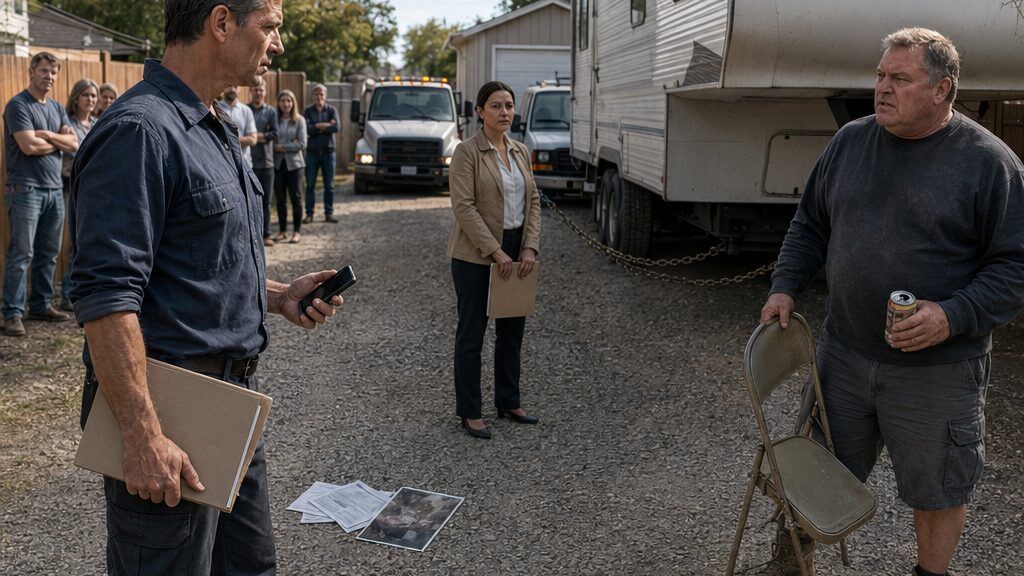
A fifth-wheel trailer stood angled between Dennis Hill’s side yard and the narrow strip of gravel that ran behind both properties. Its rear wheels had sunk into the loose stone. One stabilizer jack hovered inches above the center of the lane, and the safety chains had been dropped in a dark loop directly across Michael’s only exit.
The diesel pickup pulling it growled once, then went quiet.
Michael looked at the time on his phone.
6:42 a.m.
His service window opened at seven fifteen. The customer lived twenty-eight minutes away, assuming the county road stayed clear. A restaurant owner had called the night before because half the kitchen had lost power. If Michael arrived before breakfast prep, he could isolate the failed circuit before the cooks came in. If he arrived after, the job became slower, messier, and easier to lose to the larger electrical company already waiting for him to stumble.
Dennis climbed down from the pickup.
He was broad through the shoulders, wearing shorts, work boots, and a faded college sweatshirt despite the warm morning. He took one look at Michael’s van and smiled as though he had only just noticed it.
“Morning.”
Michael set his coffee on the hood.
“You need to pull forward about twelve feet.”
Dennis glanced behind him. “We’re almost set.”
“You’re across the lane.”
“It’ll be a few minutes.”
Michael pointed at the stabilizer jack. “Once that comes down, it won’t be.”
Dennis rested one forearm on the truck bed. “You can get around.”
Michael looked past him at the space between the trailer and the split-rail fence. It was wide enough for a person carrying groceries, not a loaded work van with ladder racks.
“No,” he said. “I can’t.”
Dennis gave the lane another theatrical inspection, as if Michael had hidden a second driveway somewhere. “You hardly use the back anyway.”
Michael felt the first hard pulse behind his ribs. He kept his voice level.
“My workshop is back there.”
“I know where your workshop is.”
“And my van is inside it every night.”
Dennis’s smile thinned. “This is temporary.”
Michael had heard that word from inspectors, contractors, customers, and family members. Temporary panel. Temporary extension cord. Temporary payment delay. Temporary arrangement. It usually meant the speaker expected someone else to absorb the inconvenience.
“How temporary?”
Dennis shrugged. “Couple weekends.”
The pickup’s passenger door opened. Dennis’s adult daughter stepped down and carried a bag toward the trailer without looking at Michael. Her eyes were swollen, and she wore the same clothes she had worn the previous afternoon when Michael saw her unloading boxes from a sedan.
He noticed that. He also noticed Dennis watching him notice it.
Neither man said anything about her.
Michael took out his phone.
Dennis straightened. “What are you doing?”
“Documenting the obstruction.”
“For what?”
Michael photographed the trailer from the workshop side, then from the street entrance. He included the lane markers, his van, and the stabilizer jack. On the third photograph, Dennis stepped into the frame with his arms crossed.
“You calling the HOA over this?”
“I’m trying to leave for work.”
“You always turn everything into paperwork.”
Michael lowered the phone. “Move the trailer.”
Dennis stared at him, then laughed once through his nose.
“You sound just like your old man.”
The words landed more sharply than Michael expected.
Before he could answer, Dennis reached into the pickup bed, pulled out a folding chair, and opened it with a metallic snap. He placed it in the exact space Michael would have needed to swing the van around the trailer.
Then he sat.
Michael looked at the chair. Looked at Dennis. Looked again at the time.
6:49.
“You’re doing that on purpose.”
Dennis leaned back and crossed one ankle over the other. “I’m staying out of the way.”
Michael’s fingers tightened around the phone.
For one reckless second, he pictured dragging the chair aside, raising the stabilizer jack himself, and backing the pickup forward before Dennis understood what was happening. He knew enough about trailers to do it. He knew enough about men like Dennis to know where it would lead.
Instead, he picked up his coffee.
“I’m asking you once more.”
“And I’m telling you,” Dennis said, “this strip has always been used by both houses.”
“The recorded easement serves my parcel.”
“That’s not what your father said.”
Michael’s eyes moved to Dennis’s face.
Dennis saw the reaction and settled deeper into the chair.
“There it is,” he said. “Maybe read more than the page that helps you.”
Michael did not answer. He turned toward the workshop.
Behind him, Dennis called, “Where are you going?”
“To get my truck.”
The old pickup was parked nose-first beside the workshop, boxed in by stacked conduit and a pallet of fixtures. It had not been used for service work in months. Michael unloaded the bed, moved the conduit by hand, and backed through the grass on the far side of his property. The tires cut two deep tracks along the edge of the vegetable patch.
By the time he reached the street, it was 7:21.
The restaurant owner answered on the second ring.
“You still coming?”
“Yes.”
“We had to call somebody else.”
Michael closed his eyes.
“I understand.”
“I’m sorry, Mike. I couldn’t wait with the kitchen down.”
“I understand.”
The call ended.
Through the windshield, Michael could see Dennis still sitting beside the trailer, drinking from a can now. His daughter had disappeared inside. One of the blinds moved, then went still.
Michael drove past without looking at him.
The lost service call stayed with him all morning. He handled two smaller jobs, replaced a burned disconnect, and rewired a bathroom fan, but every invoice he wrote seemed to carry the missing number from the restaurant contract underneath it.
At three, he returned home.
The trailer remained in place.
Two more chairs had appeared. A cooler sat where the lane widened beside the maple tree. Dennis was talking with another neighbor as though the gravel strip were a campsite.
Michael parked at the curb and walked past them.
Dennis lifted his drink. “See? You got out.”
Michael stopped.
“That isn’t the point.”
“It seems like exactly the point.”
The neighbor looked away, suddenly interested in the label on his bottle.
Michael went inside without responding.
He took the subdivision map from the file drawer in his office and spread it across the kitchen table. The copy had come with the closing documents six years earlier. The easement was marked as a narrow hatched strip running from the public road to his rear parcel. The HOA’s maintenance map showed the same line, but in lighter ink, almost faded.
He compared it with the deed.
Then he noticed a tiny break near the back corner of Dennis’s lot.
There was enough pressure from a pen to leave an impression in the paper, but the words themselves were missing, as though someone had copied over an older document without carrying the notation forward.
Michael angled the page beneath the kitchen light.
Three faint words emerged along the edge of the gravel strip.
Shared use by permission.
He read them twice.
Outside, the trailer’s stabilizer jack struck the ground with a dull metallic thud.
Chapter 2: The County Record Did Not Tell the Whole Story
The county records clerk slid the survey across the counter with one line circled in red.
Michael did not touch it immediately.
The courthouse annex smelled of dust, toner, and old carpet adhesive. Behind the clerk, metal shelves held rolled plats in cardboard sleeves and binders thick enough to stop a door. The survey between them had been filed twenty-seven years earlier, when both parcels still belonged to Michael’s father and Dennis’s father.
“What does the circle mean?” Michael asked.
“It means I found the reference you described.”
The clerk tapped the narrow gravel strip with one fingernail.
The easement was clearly marked. Twelve feet wide. Continuous access from the public road to the rear workshop parcel. No permanent obstruction. No storage.
Michael felt some tension leave his shoulders.
Then the clerk moved her finger to a notation near the bottom.
Subject to private use agreement dated May fourteenth.
“Where’s the agreement?”
“Not recorded with the deed.”
“Then it doesn’t control the easement.”
“I didn’t say it did.”
Michael looked at her.
She had the careful expression of someone accustomed to being quoted later.
“What are you saying?”
“I’m saying this survey references another document. Whether that document matters is a question for an attorney, the parties, or a judge. I can only tell you what was filed.”
Michael finally lifted the survey.
The red circle looked accusatory against the pale copy.
“Can you print the current parcel history?”
She did. The current record still listed the easement in Michael’s favor. The dimensions matched his deed. The workshop access designation had never been released or amended.
That was the part he needed.
He paid for certified copies and carried them to his truck.
Elizabeth Moore called before he pulled out of the parking lot.
He considered letting it ring. Instead, he answered.
“What?”
“That’s a warm welcome.”
“I’m at the county office.”
“I know. The clerk called me.”
Michael stared through the windshield. “Why would she call you?”
“Because Dad’s old business records listed both of us, and because I still answer my phone like a civilized person.”
“What do you want?”
“I want you not to do something stupid because Dennis got under your skin.”
“He blocked the only access to the shop.”
“I heard.”
“He cost me the restaurant job.”
“I heard that too.”
Michael gripped the steering wheel. “From who?”
“Your apprentice called. He was worried you’d blame him for not moving the conduit.”
“I didn’t.”
“Good. That means you still have some judgment left.”
Michael looked down at the certified survey on the passenger seat.
“The easement is valid.”
“I never said it wasn’t.”
“There’s no permanent parking. No storage.”
“Michael.”
“What?”
“Dad let them use it.”
The words hung between them.
“For what?”
“Cookouts. Loading the camper. Holiday overflow. Whatever people used it for before every patch of ground needed a policy.”
“He let them block the workshop?”
“No.”
“Then it doesn’t matter.”
“It matters if you’re telling the HOA there was never shared use.”
Michael said nothing.
Elizabeth exhaled.
“You knew there was.”
“I knew Dad sometimes looked the other way.”
“He wrote it down.”
Michael’s eyes moved to the circled line.
“You’ve seen the agreement?”
“I’ve seen a letter. Years ago.”
“Where?”
“In the old company files.”
“You kept those?”
“I kept everything you called clutter.”
He heard the resentment beneath the sentence. It was old and familiar, sharpened by years of invoices, missed payroll conversations, and a partnership dissolved without either of them admitting who had ended it first.
“What did the letter say?”
“That Dennis’s father could use the lane when it didn’t interfere with shop access.”
“So I’m right.”
“You’re legally right about the obstruction.”
“That’s what matters.”
“No,” Elizabeth said. “That’s what you want to be the only thing that matters.”
Michael ended the call.
He sat for another minute, then opened the HOA complaint form on his phone.
The form asked whether the disputed area had ever been used jointly or by permission.
Michael looked at the certified deed. Then at the survey. Then at the red circle.
He selected no known shared rights.
By Tuesday afternoon, he had assembled the rest.
Timestamped photographs showed the trailer’s angle, the blocked turning radius, and the folding chair placed in the lane. He measured the gravel width with a steel tape and marked the twelve-foot easement line using small fluorescent flags. He photographed every flag from two directions.
A licensed tow operator met him at the property Wednesday morning.
The operator was a lean man in a reflective shirt who spoke only after studying the documents.
“You own the dominant parcel?”
“Yes.”
“This is private property?”
“The easement crosses both lots. My deed guarantees access.”
The operator read the certified survey again.
“You understand I don’t decide property disputes.”
“I understand.”
“I remove vehicles after notice if the authorization meets county and state requirements.”
“That’s what I’m asking.”
The operator pointed toward the street entrance.
“Sign needs to be visible from the point of entry. Lettering has to meet size requirements. Company name and phone number must be listed. You photograph the installation and keep the delivery confirmation for any written notice.”
Michael wrote down every detail.
“What about the HOA?”
“If they own or control the lane, that changes things.”
“They don’t.”
“You have that in writing?”
Michael showed him the plat.
The operator nodded once. “Then do it clean.”
Michael bought a steel sign and two bags of concrete. He dug the posthole beside the lane by hand. The soil below the gravel was dense clay. By noon, his shirt was dark between the shoulders, and the post stood level beside the fluorescent boundary flags.
AUTHORIZED ACCESS ONLY
NO PARKING OR STORAGE
VEHICLES WILL BE TOWED AT OWNER’S EXPENSE
The towing company’s number appeared below.
Michael photographed the sign before the concrete dried, after it set, and again from the street at dusk. He mailed Dennis a written notice with signature confirmation and slid a copy beneath his front door.
Dennis returned it the next morning, folded in half.
“You planning to tow my daughter’s home?” he asked.
Michael stood beside the van, tightening a ladder clamp.
“I’m planning to keep the lane open.”
“She isn’t hurting you.”
“The trailer blocked my vehicle.”
“For one morning.”
“It cost me a contract.”
Dennis’s face changed slightly. “That restaurant job?”
Michael stopped tightening the clamp.
Dennis nodded as if something had been confirmed.
“So this is about money.”
“This is about access.”
“You could have talked to me.”
“I did.”
“You ordered me.”
“I asked you to move.”
“After acting like I had no right to be there.”
Michael closed the ladder clamp.
“You don’t have the right to block the lane.”
Dennis stepped closer.
“My father helped lay that gravel. Your father told us we could use it.”
“When it didn’t interfere.”
“You don’t know what he said.”
“Neither do you.”
For the first time, Dennis’s anger looked less like performance and more like fear.
Then it hardened again.
“You tow that trailer, and this stops being between us.”
Michael looked toward the sign.
“It stopped being between us when you blocked my business.”
Dennis walked away with the folded notice in his hand.
On Friday, the HOA property manager emailed Michael to confirm receipt of his complaint. The message stated that the board would review the easement at its next meeting and encouraged voluntary mediation.
Elizabeth called again that evening.
“Take the mediation.”
“No.”
“Why?”
“Because I don’t need permission to use my own access.”
“That isn’t what mediation means.”
“It means Dennis gets another room to explain why the rules shouldn’t apply to him.”
“It also means you have to explain why you checked no known shared use.”
Michael went still.
“How did you see the form?”
“I didn’t. I know you.”
He hung up.
Saturday morning, he woke to the low pulse of a diesel engine.
Through the front window, the fifth-wheel trailer rolled slowly past his mailbox.
Dennis guided it backward along the gravel strip until the wheels settled directly beneath the steel towing sign.
Then he unfolded the same chair, placed a cooler beside it, and sat down facing Michael’s house.
Chapter 3: The Tow Truck Came While Everyone Was Watching
Dennis opened the cooler directly beneath the towing sign and held up a can as Michael stepped onto the porch.
The trailer filled nearly the entire width of the gravel lane. Its safety chains lay across the stone. One wheel rested just inside the fluorescent flags Michael had placed along the recorded boundary.
Two neighbors stood near the street pretending to discuss a hedge trimmer.
Dennis lifted the can toward the sign.
“Nice workmanship.”
Michael checked his watch.
11:57 a.m.
The written warning period had expired the previous evening.
“Move it now,” Michael said.
Dennis took a drink. “Thought you weren’t giving orders anymore.”
“This is the final notice.”
“You already mailed me one.”
“And you returned it.”
“I disagreed with it.”
“That doesn’t cancel it.”
Dennis smiled toward the neighbors.
“You hear that? He thinks he’s the county now.”
Michael took out his phone and began recording.
Dennis’s smile vanished.
“Don’t point that at me.”
“I’m documenting the lane.”
“You’re documenting me.”
“You parked in the frame.”
Dennis stood. The chair scraped across the gravel.
For a moment, Michael thought he might come forward. Instead, Dennis moved beside the trailer and placed one hand on its fiberglass wall.
“This has been parked here for thirty years.”
“Not this trailer.”
“You know what I mean.”
“I know the easement has never allowed permanent obstruction.”
“You keep saying permanent like a weekend is forever.”
Michael tilted the phone toward the stabilizer jack.
“You lowered the supports.”
“So it won’t roll.”
“You connected power.”
“So the lights work.”
“You put out chairs.”
Dennis spread his hands. “People sit.”
One of the neighbors looked down.
Michael stopped recording and called the towing company.
Dennis stared at him through the entire conversation.
When Michael ended the call, Dennis said, “You won’t do it.”
Michael put the phone in his pocket.
The certainty in Dennis’s voice bothered him more than the insult.
Not because Dennis believed Michael was weak. Because Dennis believed there was still some unspoken agreement between their families that Michael would honor even while denying it existed.
At 12:19, Michelle Ramirez pulled up in a compact SUV with an HOA placard on the dashboard.
She stepped out carrying a folder and looked from the trailer to the sign.
“I was told there might be an active dispute.”
“There is no dispute,” Michael said. “There is an obstruction.”
Dennis laughed. “See what I deal with?”
Michelle raised one hand.
“I’m not deciding this on the roadside.”
“The board has the documents,” Michael said.
“The board has your documents.”
Dennis stepped in. “Because he left out the old agreement.”
Michelle looked at Michael.
“What agreement?”
“A family story,” Michael said.
Dennis’s face reddened. “A written agreement.”
“Do you have it?”
“Not here.”
“Then don’t use it to justify blocking an active easement.”
Michelle looked again at the trailer.
“Michael, the board requested mediation.”
“The request was voluntary.”
“It was intended to prevent exactly this.”
“I completed the legal notice requirements.”
“That may be true,” she said, “but if you tow before the board reviews the historical use, you could make this much harder.”
“For who?”
“For everyone.”
Michael heard the familiar administrative softness in the word. Everyone usually meant the person who had followed the rule would be asked to wait while the person ignoring it was given time to become reasonable.
“My van is trapped again.”
Michelle looked toward the workshop.
“Can you use the front drive?”
“There is no front drive to the workshop.”
Dennis said, “He got out last time.”
Michael turned to him. “Through my yard. After unloading equipment by hand.”
“You survived.”
The tow truck appeared at the end of the street.
Conversation stopped.
It was a flatbed, white cab, amber lights pulsing silently. The operator slowed beside the mailbox, studied the sign, and turned into the lane.
The two neighbors by the hedge trimmer moved closer without pretending now.
Dennis stepped into the truck’s path.
“You touch that trailer, I’ll sue every person standing here.”
The operator stopped and lowered his window.
“Sir, move away from the vehicle.”
“You have no authority.”
The operator looked at Michael. “You the authorizing property holder?”
“Yes.”
“Documents?”
Michael handed him the folder he had prepared.
The operator reviewed the certified deed, survey, photographs, mailed notice, delivery record, and towing authorization. He compared the sign to the required wording. Then he walked the width of the lane with a measuring wheel.
Dennis followed him.
“This is shared property.”
The operator did not answer.
“My family has used this lane since before that man owned his house.”
The operator returned to Michael.
“I need you to confirm on video that you are requesting removal of this vehicle from the posted access area.”
Michael felt every eye turn toward him.
Michelle stepped closer. “Michael, think about whether you want to do this before the hearing.”
He looked at the van trapped behind the trailer. He thought of the restaurant kitchen. The apologetic owner. The larger company’s truck pulling into a job Michael had spent years earning the reputation to receive.
He thought of Elizabeth saying, You want that to be the only thing that matters.
The operator held up a small body camera.
“State your name and authorization.”
Michael looked at Dennis.
Dennis’s expression had changed. The amusement was gone. Beneath the anger was something close to pleading, though his posture refused to admit it.
Michael could have stopped.
He could have demanded the trailer be moved immediately and allowed one final chance.
Instead, he faced the camera.
“My name is Michael Carter. I am the owner of the dominant parcel served by the recorded access easement. The vehicle has been posted, noticed, and remains in obstruction. I authorize removal.”
The operator nodded.
Dennis turned away sharply.
The process took forty-three minutes.
The operator retracted the stabilizers, disconnected the power cable, secured the loose items, and positioned the flatbed. The trailer chains rose from the gravel one link at a time, clattering against the hitch assembly.
That sound carried farther than Michael expected.
People emerged from three more houses.
Dennis stood beside Michelle with his arms locked across his chest. He said nothing as the trailer climbed the tilted bed. His daughter appeared at the edge of his yard, holding a cardboard file box against her stomach.
Michael had not known she was inside.
Her face was pale.
“Dad,” she said.
Dennis did not look at her.
The file box slipped against her hands. A folder fell open onto the gravel. Papers scattered beneath the trailer’s shadow.
Michael moved automatically to gather them before the tires rolled.
Most were utility bills, campground receipts, and printed emails. One faded photograph landed face up beside his boot.
Two younger men stood in the gravel lane, each holding a shovel.
Michael recognized his father immediately.
The other man had Dennis’s heavy shoulders and narrow eyes.
Between them was a wooden stake with a hand-painted sign.
CARTER-HILL ACCESS
KEEP CLEAR FOR SHOP
SHARED USE BY PERMISSION
Michael stared at the words.
In the photograph, both men were smiling.
“Give me that,” Dennis said.
Michael handed it over.
Dennis snatched the other papers from the ground and shoved them into the box.
“You knew,” he said quietly.
Michael looked at the photograph now trembling in Dennis’s hand.
“I knew there had been permission.”
“You knew there was an agreement.”
“I knew it never transferred ownership.”
“That isn’t what I asked.”
The operator approached with a printed form.
“Tow and initial storage comes to eight hundred ninety dollars. Additional storage accrues daily after the grace period.”
Dennis took the paper without looking at it.
The amount was printed in bold near the bottom.
$890.00.
A murmur moved through the watching neighbors.
For one brief second, Michael felt the clean satisfaction he had expected. The lane was clearing. The warning had meant something. Dennis had finally encountered a consequence he could not talk over.
Then Dennis’s daughter began collecting a blanket and two grocery bags from the trailer steps before the operator secured the door.
The satisfaction drained away.
Michelle took the photograph from Dennis and studied it.
“This should have been included in the complaint.”
“The permission was conditional,” Michael said.
“That is not the same as saying it didn’t exist.”
“The easement is still valid.”
“I didn’t say it wasn’t.”
Her words echoed the county clerk’s.
The flatbed leveled. Amber lights reflected across the windows of both houses.
Dennis signed the tow receipt with a hand so tight the pen tore the paper.
As the truck pulled away, the trailer chains rattled once more, no longer across Michael’s exit but above the flatbed’s steel deck.
The gravel lane stood open.
No one congratulated him.
Michelle closed her folder.
“The board will meet Monday evening.”
“I’ll bring the certified record.”
“Bring everything,” she said.
At 4:36 p.m., an email arrived from the HOA property manager.
Pending formal review of the easement’s historical use, Michael Carter was ordered to suspend all further private towing activity from the disputed lane. Failure to comply could result in association penalties and referral to the HOA’s insurer.
Michael read the notice twice.
Then a second attachment opened beneath it.
It was Dennis’s written complaint.
Near the bottom, one sentence had been highlighted.
Mr. Carter knowingly concealed the long-standing shared-use agreement in order to create a private towing trap.
Michael sat alone at the kitchen table with the certified deed on one side and the old HOA map on the other.
The lane outside was finally clear.
For the first time, he was no longer certain that clearing it had improved his position.
Chapter 4: The Old Permission Became a New Accusation
Dennis placed the faded photograph beside Michael’s certified deed before anyone had finished sitting down.
The HOA meeting room was little more than a converted clubhouse lounge with stackable chairs, a folding table, and fluorescent lights that made every sheet of paper look harsher than it was. Michelle Ramirez sat at the center with two board members. The property manager had arranged Michael’s complaint, Dennis’s response, the towing invoice, and the suspension notice into separate piles.
The photograph lay between them all.
Michael’s father and Dennis’s father stood shoulder to shoulder in the gravel lane, smiling beside the hand-painted sign.
KEEP CLEAR FOR SHOP
SHARED USE BY PERMISSION
Dennis tapped the photograph.
“He knew.”
Michelle looked at Michael. “Did you?”
“I knew my father occasionally allowed them to use the lane.”
“That isn’t what you wrote.”
“I wrote that there were no shared rights.”
Dennis leaned back. “Listen to the wording.”
Michael turned toward him. “Permission is not a property right.”
“It was an agreement.”
“An agreement with conditions.”
“Conditions you didn’t bother mentioning.”
Michelle raised her hand before Michael could answer.
“We’re not deciding who can win an argument over vocabulary. We’re deciding whether the complaint gave the board enough information to act responsibly.”
Michael slid the certified survey forward.
“The recorded easement guarantees continuous access to my workshop. That is the controlling document.”
One board member adjusted his glasses and traced the marked lane with a fingertip.
“The easement appears valid.”
Dennis looked at him. “Then why does the old survey reference a private-use agreement?”
“Because it existed,” Michael said. “Not because it overruled the easement.”
The property manager opened a scanned letter on a tablet and turned the screen toward the board.
Dennis’s father had written it. Michael recognized the square handwriting before he read the words.
Use of the lane for family parking, recreation, and camper loading shall continue by consent so long as access to the Carter shop remains open and unobstructed.
Below that, Michael’s father had signed his name.
Michelle read the sentence aloud.
Then she looked at Michael.
“You had seen this letter before?”
He felt the room become smaller.
“Years ago.”
Dennis gave a low laugh without humor. “There it is.”
“I had not reviewed it recently.”
“That isn’t what she asked.”
Michael kept his eyes on Michelle. “I knew there had been informal permission. I did not believe it created a current right to block the shop.”
“Your belief may be legally reasonable,” Michelle said, “but your complaint stated there was no known shared use.”
“Because shared use was never guaranteed.”
“Michael.”
The single word stopped him.
Michelle’s voice remained calm, which made it harder to resist.
“You answered a factual question as though it were a legal conclusion.”
The door at the back of the room opened.
Elizabeth Moore entered carrying a gray storage box.
Michael’s first reaction was anger. His second was recognition. The box had belonged to their father. A strip of masking tape still crossed the lid with CARTER ELECTRIC—PROPERTY written in black marker.
Elizabeth set it on the end of the table.
Dennis looked from her to Michael.
Michelle said, “Ms. Moore, thank you for coming.”
Michael’s jaw tightened. “You invited her?”
“The board requested records from anyone identified in the business documents.”
Elizabeth pulled out a folder.
“I brought what I had.”
Michael stared at her. “You could have called me.”
“I did.”
“That isn’t the same thing.”
“No,” she said. “It usually isn’t with you.”
Michelle asked Elizabeth to sit.
Inside the folder were maintenance receipts, survey copies, photographs, and several pages of notes written by their father. One showed the gravel lane after a fresh load of stone had been spread. Another showed both families gathered near the workshop with folding tables and coolers.
Dennis pointed at it.
“That’s what I’ve been saying. We all used it.”
Elizabeth did not look at him.
“And every photograph shows the workshop doors clear.”
The room went quiet.
She placed another page beside the first. It was a note in their father’s handwriting.
Hill camper may stand near maple for loading only. Never block van turn. Ask first.
Dennis’s mouth tightened.
Michael felt a brief, guilty surge of relief.
Michelle read the note twice.
“So the historical use supports both positions in part. Dennis’s family was allowed to use the lane. Michael’s workshop access remained the priority.”
“That’s all I’ve said,” Michael replied.
“No,” Elizabeth said. “You said the first part didn’t exist.”
He turned toward her.
She held his gaze.
“You knew Dad let them use it. You also knew he got angry when they left things in the turning area. Both are true.”
Dennis folded his arms. “He left out the part that made him look unreasonable.”
Michael looked at the $890 tow invoice in Dennis’s pile.
“And you left out the part saying ask first and keep the shop clear.”
Dennis did not answer.
Michelle gathered the documents into a single line.
“The board’s preliminary position is that the recorded easement remains enforceable. Nothing presented today creates a permanent parking or storage right for Dennis’s parcel.”
Michael heard the small payoff in the sentence and held onto it.
Then Michelle continued.
“However, the board cannot rely on Michael’s original complaint as complete. The suspension on further towing will remain until we adopt an interim access procedure.”
Michael leaned forward. “You cannot suspend my easement.”
“We are not suspending the easement.”
“You are preventing me from enforcing it.”
“We are preventing another tow during an active historical-use review.”
“And if he blocks me again?”
“You call the property manager.”
Michael looked at the property manager, who avoided his eyes.
Dennis said, “That’s reasonable.”
Michael turned sharply. “Of course you think so.”
Michelle closed the deed folder.
“There is another issue.”
The property manager slid a letter across the table.
Michael recognized the logo of his business insurer.
The letter requested an inspection of the rear workshop after the HOA’s submission described commercial vehicles, material storage, and customer equipment moving through a residential parcel. Until the inspection was completed, coverage relating to third-party access and unauthorized commercial storage could be limited.
Michael read the sentence again.
“What did the HOA tell them?”
Michelle’s expression shifted.
“We notified our carrier of a disputed commercial access route. Their counsel contacted your insurer.”
“You turned a parking complaint into a business investigation.”
“We reported potential liability.”
“My workshop has operated there for years.”
“Under a home-occupation approval,” the property manager said. “The insurer is asking whether your present use still matches it.”
Michael looked at Dennis.
Dennis’s satisfaction faded slightly. He had wanted pressure, but perhaps not this particular kind.
Elizabeth reached for the letter.
Michael moved it away.
“I can read.”
“I know.”
The words came out softer than the rest of the meeting, and that made them worse.
Michelle scheduled an on-site review for the end of the week. No vehicles were to be stored in the easement. No towing was to occur without board authorization. Both parties were ordered to maintain emergency access.
The meeting ended without anyone appearing satisfied.
Outside, the chairs scraped across the floor as residents filed away. Dennis gathered his photographs. Elizabeth closed the storage box.
Michael waited until Michelle had left before speaking.
“You had no right to bring those files.”
Elizabeth lifted the box.
“They were business records.”
“They were Dad’s.”
“They were ours.”
“You handed Dennis exactly what he needed.”
“I handed the board the truth.”
“He blocked my van.”
“Yes.”
“He cost us work.”
Her face changed at the word us.
“There hasn’t been an us in four years.”
Michael looked away.
“That restaurant job could have led to the full renovation.”
“And that is Dennis’s fault.”
“It started with his trailer.”
“No,” Elizabeth said. “It started when you decided every problem had to be handled alone.”
She carried the box toward the door.
Michael followed her into the parking lot.
“You think I should have just let him keep blocking it?”
“I think you should have disclosed the whole history and still enforced the easement.”
“That would have given him an argument.”
“He already had one.”
She placed the box in her trunk.
“You don’t lose the truth by saying all of it, Michael.”
He almost told her that she had not been the one standing beside the trapped van, watching a contract disappear. He almost reminded her that she had left the business after a year of late payments and arguments about expansion.
Instead, he said, “You always make this sound simple.”
Elizabeth shut the trunk.
“No. You make it sound simple. That’s the problem.”
She drove away.
Michael returned home after dark.
The gravel lane was empty. The steel towing sign reflected in his headlights. For a few seconds, it seemed almost absurdly official standing beside the old maple tree.
He parked near the house and walked toward the workshop.
Headlights flared at the street entrance.
A dark SUV turned sharply into the lane.
It advanced ten yards, then stopped crosswise between the towing sign and the workshop gate. Its front tires crushed two of Michael’s fluorescent boundary flags. The rear bumper nearly touched Dennis’s fence.
Kevin Williams stepped out.
Michael recognized him from family gatherings across the property line. Dennis’s brother-in-law. Thick arms, baseball cap, phone already recording.
Kevin shut the driver’s door and leaned against it.
“Dennis said you’re not allowed to tow anybody now.”
Michael looked at the SUV blocking the entire lane.
Kevin smiled.
“So let’s see how much that sign is worth.”
Chapter 5: The Second Obstruction Forced a Different Choice
The SUV sat sideways under the floodlights, its tires cutting black arcs through the pale gravel.
Michael stood ten feet away with the HOA suspension email open on his phone.
Kevin kept recording.
“Go ahead,” he said. “Call your tow buddy.”
Michael looked at the crushed boundary flags beneath the SUV’s front tire.
“Move the vehicle.”
“Not until Dennis gets his trailer back without paying your little fee.”
“I don’t control the tow yard.”
“Convenient.”
“The invoice came from the towing company.”
Kevin swung the phone toward the steel sign.
“Dennis says you get a cut.”
Michael almost laughed.
Instead, he took out his own phone and photographed the license plate, the vehicle’s position, and the blocked gate.
Kevin stepped forward.
“You filming me now?”
“I’m documenting the obstruction.”
“That your favorite sentence?”
“It keeps being necessary.”
The workshop gate stood directly behind the SUV. Michael’s work van was inside, along with spools of copper wire, customer panels, and the apprentice’s tool chest. The HOA had ordered emergency access maintained, yet the same order prevented Michael from using the enforcement process he had established.
He called the property manager.
The call went to voicemail.
He called again.
Kevin watched with growing amusement.
“No answer?”
Michael ended the call.
“Move the SUV.”
“Call Michelle.”
“It’s after nine.”
“Guess you should have thought of that before towing somebody’s house.”
The words caught Michael.
“Dennis told you the trailer was his daughter’s home?”
Kevin lowered the phone slightly.
“He told me you knew she was staying in it.”
“I knew she was moving things into it. I did not know the arrangement.”
“You didn’t ask.”
“Dennis didn’t ask permission to block the lane.”
Kevin’s expression hardened again.
“She lost her apartment. He was trying to help.”
“So he put the trailer across my only business access.”
“It was temporary.”
“That word doesn’t change the width of the lane.”
Kevin lifted the phone.
“Say that again.”
Michael heard the trap in the invitation. One clipped sentence, stripped of everything around it, would travel through the neighborhood by morning.
He stepped back.
“I’m not arguing for your recording.”
Kevin smiled. “Smart.”
Michael walked to the workshop along the grass, unlocked the side door, and checked the alarm. Everything inside was secure. The insurer’s inspection letter lay on the workbench where he had left it.
He could call the police and report the obstruction. He could request enforcement of emergency access. He could photograph enough to protect himself.
What he could not do was tow the SUV without violating the HOA order and handing Dennis exactly the retaliation claim he wanted.
Michael returned to the lane.
“You can leave it tonight,” he said. “But it will be part of the record.”
Kevin’s smile widened as though he had won.
“That’s what I thought.”
Michael went inside.
At 6:18 the next morning, a delivery van’s horn sounded from the street.
Michael was already awake.
He looked through the kitchen window.
A white medical-supply vehicle waited behind Kevin’s SUV. The driver stepped out, examined the blocked lane, then checked the address on a handheld device.
Dennis came from his house in slippers and a sweatshirt.
He spoke to the driver, pointing toward his porch. The driver pointed at the large silver cylinders secured upright inside the van.
Michael crossed the yard.
“What’s happening?”
Dennis turned.
“Nothing involving you.”
The driver said, “I have an oxygen delivery that requires a signature and direct placement. I can’t carry these over loose ground that far.”
Michael looked from the cylinders to the lane.
“Whose delivery?”
Dennis’s jaw worked.
“My daughter’s.”
Michael looked toward the trailer’s former parking place, now empty except for depressed gravel and an electrical cord coiled beside the fence.
“She uses oxygen?”
“Temporary support after a respiratory infection.”
“You never said.”
Dennis stepped closer.
“You never asked.”
The words struck with the same force as Kevin’s accusation the night before.
Michael glanced at the SUV.
“Where is Kevin?”
“Not answering.”
“Do you have the key?”
“No.”
The driver checked the time.
“I can wait ten minutes. After that I have three more deliveries.”
Dennis pulled out his phone and called again.
No answer.
Michael’s workshop gate was blocked, but a narrower service gate opened from the far side of his yard. Beyond it, a strip of compacted ground ran along the workshop wall and rejoined Dennis’s property behind the obstruction. He used it only for moving equipment by hand. A van could fit if the gate was opened fully and two stacked pallets were moved.
It would mean allowing a third-party vehicle through the insured workshop area the carrier was already questioning.
Dennis saw him looking.
“No,” he said.
Michael turned. “No what?”
“I’m not asking you.”
“Your daughter needs the delivery.”
“We’ll carry it.”
The driver shook his head. “Company policy. I place and secure the cylinders.”
Dennis looked at the SUV, then at Michael’s side gate.
His face tightened with the effort of not saying the words.
Michael understood then that the lane had become more than access for either of them. It had become the place where each man proved he did not need the other.
He walked to the workshop.
Dennis followed several steps behind.
“What are you doing?”
“Opening the service gate.”
“I said we’ll handle it.”
“You don’t have a route.”
“I’ll get Kevin.”
“The driver is leaving.”
Michael dragged the first pallet aside. Dennis took hold of the second without being asked. Together they shifted it against the wall.
The gate hinges complained when Michael pulled them wide.
The medical driver walked the route and nodded.
“It’s tight, but I can make it.”
Michael guided the van through, one hand raised near the passenger mirror. The tires passed inches from the workshop threshold. The driver turned carefully behind the SUV and stopped beside Dennis’s house.
A curtain moved in the front window.
Dennis’s daughter appeared briefly, one hand pressed to her chest. When she saw Michael, she lowered her eyes.
The driver carried the first cylinder inside.
Dennis stood beside the van.
“Thank you,” he said, so quietly Michael almost missed it.
Michael looked at the SUV blocking the lane.
“Kevin needs to move that.”
“He will.”
“Today.”
Dennis nodded.
Michael photographed the temporary route, the open gate, and the delivery van. Not for leverage this time, but because the insurer would ask why a commercial vehicle had crossed the workshop property.
Dennis watched him.
“You really do photograph everything.”
“Usually after somebody gives me a reason.”
Dennis did not respond.
The oxygen van left through the same gate. Michael closed it and returned the pallets to their original places.
At eight, Kevin arrived on foot with a set of keys.
He looked from the SUV to the tire tracks through Michael’s property.
“Dennis said you let the delivery through.”
“Yes.”
Kevin’s confidence had weakened.
“He told me the HOA said you had no right to the lane.”
“The HOA said I could not tow during review.”
“That isn’t how he explained it.”
Dennis came down the driveway.
“I explained enough.”
Kevin turned toward him. “You said Michael invented the restriction to make money.”
“I said he used the restriction to punish us.”
“You said the lane was yours too.”
“It was used by both families.”
Michael held up the original survey copy.
“Use by permission. Shop access stays open.”
Kevin read the marked section.
His mouth flattened.
“You knew this?”
Dennis did not answer.
Kevin looked at the $890 invoice Dennis had brought outside.
“You told me he got paid from this.”
Dennis folded the invoice.
“I said the tow company charged us because of him.”
“That isn’t the same thing.”
“No,” Michael said. “It isn’t.”
Kevin stared at Dennis for a long moment, then unlocked the SUV.
“I came over here because you said he was stealing part of your property.”
“He is changing what we’ve always had.”
“He’s keeping a road open.”
Dennis’s face darkened. “Get your car out.”
Kevin did.
The SUV rolled forward and straightened. Gravel popped beneath the tires as it passed the towing sign and returned to the street.
For the first time since the dispute began, Dennis stood in the middle of the open lane without claiming it.
He looked toward the house where his daughter rested, then toward Michael’s workshop.
“She had mold in her apartment,” he said. “The landlord gave them three days after the city posted the building. She couldn’t find anything she could afford.”
Michael waited.
“The trailer was supposed to give her a month. Maybe two.”
“You could have asked.”
Dennis laughed once, but there was no humor in it.
“Asked you?”
“Yes.”
“You barely speak to me unless something is wrong.”
“That doesn’t make the lane yours.”
“No. It doesn’t.”
The admission was so direct that Michael did not know what to do with it.
Dennis rubbed gravel dust from the toe of his shoe.
“Come by the workshop tomorrow afternoon.”
Michael studied him.
“Why?”
“No board. No phones. No neighbors.”
“That sounds like a bad idea.”
“I found the original letter.”
Michael felt the old tension return.
Dennis looked toward the open lane.
“If we keep letting other people tell pieces of this, neither one of us is going to like the story they decide is true.”
Chapter 6: Neither Man Had Told the Necessary Truth
Dennis entered the workshop carrying the original permission letter inside a cracked plastic sleeve.
He stopped just beyond the threshold and looked around.
The workshop had once held three vans, two full-time crews, and a wall of labeled job boxes. Now one van occupied the center bay. Empty hooks marked the places where Elizabeth’s accounting cabinet and the second crew’s tools had been.
Dennis noticed the gaps.
Michael noticed him noticing.
“Put it on the bench.”
Dennis laid the sleeve beside the insurer’s inspection notice.
The paper inside was yellowed and creased into thirds. Both fathers had signed the bottom. The language matched the copy from Elizabeth’s files, but an additional paragraph appeared on the reverse.
Permission may be withdrawn whenever commercial access, safety, or shop operation requires. Families agree to speak directly before changing use.
Michael read the last sentence twice.
Dennis leaned against the workbench.
“They put that part on the back.”
“Convenient.”
“I didn’t write it.”
“You brought copies to the HOA without it.”
“I brought what I found first.”
Michael looked up.
Dennis held his gaze for a second, then glanced away.
“All right,” he said. “I brought what helped me.”
The workshop settled around them. A fluorescent fixture buzzed above the tool wall. Outside, a vehicle passed along the county road, but no tires entered the gravel lane.
Michael turned the letter over.
“You knew the permission could be withdrawn.”
“I knew Dad never thought your father would use it against us.”
“Keeping the shop open isn’t using it against you.”
“Towing the trailer without telling the board the whole history was.”
“I told you to move it.”
“You told me like the history didn’t exist.”
Michael slid the letter back across the bench.
“And you parked like the conditions didn’t exist.”
Dennis nodded once.
Neither man appeared relieved by the balance.
Michael picked up the restaurant’s canceled service order from a clipboard. He had printed it after losing the call, intending to attach it to the HOA complaint as proof of damages. He had not done so because the owner had not wanted to become involved.
“This was a forty-eight-hundred-dollar repair,” he said. “Possible panel replacement afterward.”
Dennis read the amount.
“I didn’t know.”
“You knew I was trying to leave.”
“I thought you were making a point.”
“I was trying to work.”
Dennis set the paper down carefully.
“My daughter had called me at two that morning. Her building had been posted unsafe. She was coughing so badly she could barely finish a sentence. I drove the trailer over before sunrise because she had nowhere else to sleep.”
“You could have placed it on your driveway.”
“The grade is too steep for the stabilizers.”
“Then you ask me for temporary use.”
Dennis’s hands closed around the edge of the bench.
“I wasn’t going to come over here and ask you for something after the way your father talked about mine.”
Michael’s eyes narrowed.
“What way?”
“Like he was doing us a favor every time we crossed the gravel.”
“He was doing you a favor.”
Dennis gave a sharp look.
“That. Exactly that.”
Michael felt the conversation tilt toward the old pattern again.
He forced himself to wait.
Dennis continued.
“My father helped build this shop. He hauled stone for the lane. He repaired the drainage ditch. Then every time there was a disagreement, your father held the deed up like none of that counted.”
“Work on someone’s property doesn’t create ownership.”
“No. But being reminded you own nothing every time you need room does something to a man.”
Michael looked at the letter between them.
“And being blocked from your own business does something too.”
Dennis nodded.
“I know that now.”
The simplicity of it disarmed Michael more than an apology would have.
Dennis pointed toward the empty wall hooks.
“What happened to the second crew?”
Michael’s first instinct was to tell him it was none of his business.
Instead, he said, “We lost a municipal maintenance contract four years ago.”
“Because of the lane?”
“No.”
The answer came too quickly.
Dennis waited.
Michael looked at the old company logo painted above the cabinets.
“The contract required two crews and guaranteed response times. We were already stretched. Elizabeth wanted to slow down and rebuild cash reserves. I wanted the contract because I thought it would prove we were finally bigger than Dad’s shop.”
Dennis said nothing.
“I signed equipment leases before the award was final. Then we lost the bid. Elizabeth found out after the first payment came due.”
“She left?”
“I told her if she didn’t trust my decisions, she shouldn’t be my partner.”
Dennis’s eyebrows lifted slightly.
“She took you seriously.”
“Yes.”
Michael folded the canceled restaurant order.
“When your trailer cost me that call, it felt like the same thing happening again. Another job slipping away while somebody stood in the lane telling me I was overreacting.”
“So you wanted the trailer gone.”
“I needed it gone.”
“That isn’t the same answer.”
Michael looked at him.
Dennis’s face held no triumph. Only recognition.
Michael leaned against the opposite side of the bench.
“When the tow truck came, I knew you could still move it yourself.”
Dennis’s jaw tightened.
“I authorized the tow anyway.”
“You had the right.”
“I wanted you to feel what it was like to have no option.”
The fluorescent buzz seemed louder.
Dennis looked down at the dust on his boots.
“There it is,” he said.
Michael did not defend himself.
Dennis rubbed one hand over his face.
“I put Kevin’s SUV there because I wanted the same thing.”
“To make me powerless.”
“To make that sign mean nothing.”
They stood with the letter, the insurance notice, and the canceled work order between them. None of the papers changed what either man had done. They only removed the excuses.
Dennis reached into his jacket and placed the $890 invoice on the bench.
“I can pay this, but it will hurt.”
Michael looked at the total.
“The tow company charged it. Not me.”
“I know.”
“Storage too?”
“I got the trailer released Monday morning. My daughter borrowed money.”
Michael’s mouth tightened.
Dennis saw it.
“Don’t turn that into a reason to forgive yourself. She borrowed because I made the decision.”
Michael nodded.
“What are you asking for now?”
“Thirty days.”
“For the trailer?”
“Parked near the maple, parallel to the fence. No chairs. No stabilizer in the turning area. No vehicle in the lane. We move it whenever you need full width.”
“That still puts it inside part of the easement.”
“Yes.”
“And the HOA would need a written exception.”
“Yes.”
“Insurance too.”
“Yes.”
Dennis looked uncomfortable with each agreement, but he kept making them.
“My daughter is looking for another place. She needs time.”
Michael thought of her carrying blankets from the trailer while the neighborhood watched. He thought of the oxygen cylinders passing through his workshop gate.
Then he thought of the restaurant owner telling him another electrician was already on the way.
“Temporary permission has caused enough trouble.”
Dennis looked at the old letter.
“Then write a better one.”
Michael almost refused on instinct.
Instead, he pulled a clean legal pad from the drawer.
“Any permission must state it creates no ownership interest.”
“Fine.”
“Continuous shop and emergency access.”
“Fine.”
“Immediate removal for safety, work needs, or insurance requirements.”
Dennis nodded.
“And you pay the towing and any damage to the gravel.”
“I expected that.”
Michael wrote the headings but stopped before drafting the terms.
“There’s still the HOA hearing.”
Dennis’s expression darkened. “Michelle scheduled a final enforcement vote for Thursday.”
Michael had not received the notice yet.
“What are they voting on?”
“Whether to authorize fines against me and whether to restrict your commercial use until the insurance review is finished.”
Michael stared at him.
Dennis added, “They want one clean version of the history.”
“There isn’t one.”
“No.”
A phone buzzed on the workbench.
Michael checked the screen.
An email from Michelle confirmed the Thursday hearing. Attached were the incomplete complaint, Dennis’s partial letter, Elizabeth’s full records, the insurer’s questions, and a proposed resolution that could limit Michael’s workshop access to daytime hours until the dispute was settled.
Michael read the restriction twice.
Daytime access would make emergency service work nearly impossible.
Dennis watched his face.
“You can still defend the deed,” he said.
“I will.”
“And leave out why you towed me?”
Michael looked at the original letter, then at the sentence on the back.
Families agree to speak directly before changing use.
He had read that principle as weakness when Elizabeth voiced it. Now it looked less like surrender and more like the thing both fathers had understood would fail if their sons inherited only the boundary.
Michael closed the draft permission pad.
“Thursday, I’m correcting my complaint.”
Dennis straightened.
“You’ll give them what they need to restrict the shop.”
“Maybe.”
“And fine you.”
“Maybe.”
Dennis studied him as if searching for another tactic beneath the answer.
Michael gathered the full letter, the canceled service order, the towing invoice, and the insurer’s notice into one folder.
“I’m not giving up the easement.”
“I didn’t ask you to.”
“I’m not pretending the trailer didn’t block me.”
“It did.”
“And I’m not letting the board treat your daughter’s situation as a permanent property right.”
Dennis nodded.
Michael closed the folder.
“But I’m not letting them decide this from two incomplete stories either.”
On Thursday, he would stand in front of the HOA and challenge the accuracy of the complaint he himself had filed. Whether the truth preserved his workshop or cost him the only leverage he had left was no longer something he could control.
Chapter 7: The Hearing Changed When Michael Corrected Himself
Michael began by telling the board that his complaint was incomplete.
The room went still before he reached the second sentence.
Michelle Ramirez sat behind the folding table with the same two board members, the property manager, and a county mediator invited to observe. On the wall behind them, a projector displayed the current subdivision map. The gravel lane appeared as a narrow gray strip between Michael’s workshop parcel and Dennis’s house.
Residents filled nearly every chair.
Michael stood at the front holding one folder.
“My deed is valid,” he said. “The recorded easement is valid. Dennis blocked it more than once, and the tow met the notice requirements.”
Dennis sat in the first row with the original permission letter resting on his knee.
Michael opened the folder.
“But when I filed my complaint, I answered a question about historical shared use as though the board had asked me a different question. I knew our families had allowed limited use of the lane. I did not disclose that.”
A whisper passed through the back row.
One board member leaned toward his microphone.
“Are you withdrawing your complaint?”
“No.”
Dennis looked up.
Michael placed the full permission letter beside the current deed.
“I am correcting it.”
Michelle studied him for several seconds.
“Why now?”
Michael could have said because the full letter had been found. Because Elizabeth had confirmed the history. Because Dennis had also withheld documents. Each answer would have shifted part of the burden elsewhere.
Instead, he said, “Because I used accurate documents to tell an incomplete story.”
The mediator stopped writing.
Michael continued.
“The lane was shared by permission for loading, family parking, and temporary recreation. That permission was conditioned on keeping the workshop access open. It did not transfer ownership. It did not authorize permanent storage. It did not permit anyone to block the turning area.”
He turned the old letter over so the final paragraph faced the board.
“It could be withdrawn whenever shop operation or safety required.”
Michelle read the paragraph on the projector after the property manager scanned it.
Dennis’s attorney was not present. Neither man had hired one. That had seemed risky earlier. Now Michael was glad there was no one beside him whispering which truth to omit.
One of the board members addressed Dennis.
“Do you dispute this document?”
Dennis stood slowly.
“No.”
Several people shifted in their seats.
Michelle said, “Do you dispute that the trailer obstructed the workshop access?”
Dennis looked toward Michael.
“No.”
The answer carried more weight than Michael expected.
The board member asked, “Then why did you state in your complaint that the lane had always been shared equally?”
Dennis rubbed his thumb along the edge of the plastic sleeve.
“Because that was the part I wanted you to believe.”
No one whispered this time.
Dennis placed the letter on the table.
“My father helped build the lane. My family used it for years. I grew up treating that use like something we had earned. When Michael put up the towing sign, I saw it as him erasing all of that.”
He paused.
“But the shop doors were always kept clear. My father knew that. I knew it too.”
Michelle glanced at the mediator, then back at Dennis.
“And the SUV?”
“I asked Kevin to block the lane.”
Kevin sat two rows behind him. His face tightened, but he did not object.
“Why?”
Dennis looked down at the floor.
“To prove Michael’s sign did not control us.”
The board member removed his glasses.
“That was after you had received written notice?”
“Yes.”
“And after the tow?”
“Yes.”
Michelle folded her hands.
“Then we are not dealing with a misunderstanding alone.”
“No,” Dennis said. “We aren’t.”
Michael felt no satisfaction. The admission did not return the restaurant contract, erase the towing bill, or undo the sight of Dennis’s daughter gathering blankets while strangers watched.
But it changed the room.
Until then, every document had been used to force the board toward one man’s version. Now both men had placed something damaging to themselves into the official record.
The property manager displayed the proposed resolution.
It recommended confirming Michael’s easement, prohibiting parking and storage within the twelve-foot access strip, requiring board approval for temporary exceptions, and establishing an emergency-access procedure.
A second section addressed Michael’s workshop. The insurer’s preliminary inspection had found no major violation, but the current home-occupation approval lacked clear language for after-hours service access. The proposed resolution would restrict workshop vehicle movement between nine at night and six in the morning until the approval was updated.
Michael stared at the screen.
“That restriction would prevent emergency calls.”
The property manager said, “It is temporary.”
Michael almost laughed at the word.
Instead, he opened a second document.
“I submitted an amended operating plan this morning.”
Michelle accepted the copies.
The plan designated a single service van, prohibited customer parking at the workshop, limited material deliveries, preserved emergency vehicle access, and included photographs of secured storage. It also proposed reflective lane markers and a written log for any temporary use.
The county mediator examined the diagram.
“This is more specific than the current HOA proposal.”
“It has to be,” Michael said. “The problem started because everyone relied on an arrangement that was understood but never defined well enough to survive the people who made it.”
Dennis looked at the diagram.
Near the maple tree, a rectangular area had been marked as possible temporary trailer placement. It stopped short of the turning radius and left the full twelve-foot access open.
Dennis’s eyes moved to Michael.
Michael said, “Thirty days. Written permission only. Subject to insurance approval. No stabilizers or vehicles in the access line. Immediate removal for shop or emergency use.”
A murmur moved through the room.
Michelle asked, “You are willing to grant temporary use after the obstruction and towing?”
“I am willing to grant limited use because the daughter’s housing problem is real.”
He looked at Dennis.
“That does not make the obstruction acceptable.”
Dennis nodded.
“And it does not erase the towing charge,” Michael added.
“I know.”
The board went into closed discussion for twenty minutes.
Michael waited at the side wall. Elizabeth stood near the rear door with the gray storage box at her feet.
“You did better than Dad would have,” she said.
Michael looked at her.
“That might be the first time you’ve said that.”
“It might be the first time it was true.”
He almost smiled.
“Are you staying?”
“For the decision.”
“That isn’t what I meant.”
Elizabeth understood. Her expression softened but did not become easy.
“We’ll talk after.”
The board returned.
Michelle read the decision carefully.
The HOA confirmed the recorded easement as the controlling property access. Dennis’s claim of equal or permanent use was rejected. The suspension on Michael’s towing authority was voided, though future removals would require compliance with the new association procedure.
Dennis received a formal violation for deliberate obstruction and was ordered to repair the damaged lane flags. Kevin’s SUV incident was included in the record but not separately fined because it had been removed without towing and no repeat violation occurred.
Michael’s original complaint was amended rather than dismissed. No fine was issued for the incomplete answer, but the board recorded a finding that material history had been omitted.
The proposed nighttime restriction on the workshop was rejected. Michael’s amended operating plan would be submitted to the insurer and county for final approval.
The towing charge remained Dennis’s responsibility.
No one won everything.
That made the decision feel more real.
After the meeting, residents gathered in small groups, but no one approached Michael to congratulate him. He was grateful for that.
Outside, Dennis walked beside him toward the gravel lane.
The folding chairs still sat beneath the maple where they had been stacked after the trailer was removed.
Dennis stopped, picked up the first one, and folded its legs inward.
“I’ll clear the rest tonight,” he said.
Michael looked at the open workshop path.
“Tomorrow morning is fine.”
Dennis carried the chair toward his garage.
At the towing sign, he paused.
“I should have asked.”
Michael held the folder against his side.
“I should have answered the question they actually asked.”
Dennis nodded and continued walking.
The lane remained marked by crushed flags and tire cuts, but for the first time since the trailer arrived, nothing stood in the middle of it.
Chapter 8: The Gravel Line Stayed Clear Without Becoming a Wall
Another trailer approached the lane three weeks later, and Michael stepped out of the workshop before it reached the mailbox.
The diesel pickup slowed.
His body reacted before his mind did. Shoulders tight. Hand moving toward his phone. Eyes measuring the angle of the trailer against the new reflective boundary posts.
Then the driver stopped on the paved shoulder.
Dennis climbed from the passenger side holding a clipboard.
He did not wave the truck forward.
Michael crossed the gravel.
“What is this?”
“The temporary permit.”
Dennis handed him the clipboard.
The document carried Michelle’s signature, the property manager’s approval, and a certificate from Michael’s insurer acknowledging the designated parking area. A diagram matched the one Michael had submitted at the hearing. The trailer would sit parallel to Dennis’s fence, outside the twelve-foot access line. Its electrical connection would cross no part of the lane, and the permit expired in thirty days.
Michael read every line.
Dennis waited without comment.
“Where are the wheel stops?”
“In the truck.”
“Reflective cones?”
“Also in the truck.”
“No stabilizer past the painted mark.”
“I know.”
Michael handed the clipboard back.
Dennis looked toward the driver and raised one hand.
The pickup eased forward.
Michael stood beside the turning radius as the trailer passed. Its wheels remained beyond the reflective posts. The rear cleared the workshop gate by six feet. Dennis’s daughter watched from the porch with a portable oxygen unit beside her chair.
When the driver began backing toward the designated area, Michael lifted two fingers.
“Passenger side needs another foot.”
Dennis relayed the instruction.
The trailer moved.
Another six inches.
Michael lowered his hand.
“That’s good.”
The engine shut off.
No chains crossed the lane. No chairs appeared beneath the towing sign. No one told Michael to loosen up.
Dennis’s daughter walked over after the trailer was leveled.
“I wanted to thank you for the permit,” she said.
Michael glanced toward Dennis.
“He followed the process.”
“I know.”
Her voice was steady, though she still paused between longer breaths.
“I also wanted to apologize for that first morning. I knew you were trying to leave. I told Dad not to move it because I had nowhere else to go.”
Michael had not expected that.
“You were in a difficult position.”
“That doesn’t mean you weren’t.”
She looked toward the workshop.
“Did you lose the job?”
“Yes.”
“I’m sorry.”
He nodded.
There was nothing useful to add.
A week earlier, the restaurant owner had called him back for a smaller repair after the larger company delayed the panel work. Michael had taken the job without mentioning the lost contract. It did not restore what had happened, but it kept the door from closing entirely.
The gravel lane had been regraded after the hearing. Dennis paid for half the stone and all the damaged markers. Michael paid the other half because years of drainage had contributed to the ruts. The HOA reimbursed neither of them.
New posts marked the access line from the public road to the workshop. They were low enough not to look like a fence and bright enough to guide an emergency vehicle at night.
The steel towing sign remained.
Michael had considered removing it. He decided against it.
The sign was not the problem. The way both men had used the boundary was.
Inside the workshop, the insurer approved Michael’s amended operating plan. He posted it beside the breaker panel and began keeping a simple vehicle log. The extra paperwork irritated him for the first few days. Then he noticed that the apprentice stopped asking which deliveries were expected and where to stage them. Clear rules helped when they were written for use rather than advantage.
Elizabeth arrived on a Tuesday afternoon carrying a laptop bag.
She placed it on the workbench where the original permission letter had once rested.
“I reviewed the last two quarters.”
Michael looked at her.
“You still have access?”
“You never removed it.”
“I assumed you stopped checking.”
“I did. Then the restaurant invoice appeared.”
He wiped his hands on a rag.
“That was a smaller job.”
“It was still revenue.”
Elizabeth opened the laptop.
“You’re carrying too much outstanding inventory.”
“I know.”
“You always say that when you don’t want to discuss it.”
Michael leaned against the bench.
“Are you coming back?”
“No.”
The answer hurt less because she gave it quickly.
She turned the screen toward him.
“I’ll handle bookkeeping two afternoons a month for ninety days. Paid. No ownership. No promises beyond that.”
Michael studied the proposed agreement.
“You wrote a contract.”
“I learned from the neighborhood.”
He smiled despite himself.
Elizabeth did not.
“I mean it, Michael. This is not us pretending the last four years didn’t happen.”
“I know.”
“And you do not make equipment purchases without telling me if you expect me to reconcile the accounts.”
“I know.”
She raised an eyebrow.
He corrected himself.
“I agree.”
That earned the smallest movement at the corner of her mouth.
Outside, Dennis’s daughter opened one of the trailer windows. The curtain lifted in the breeze but did not face the lane. The designated space gave her privacy without occupying Michael’s access.
The thirty-day permit did not solve her housing problem. It gave her time. With the county mediator’s help, she found an apartment in a newer building that accepted her assistance voucher. Dennis paid the towing debt in installments. Michael never asked how much remained.
The HOA adopted the new easement policy at its next monthly meeting.
Every recorded access strip in the subdivision would be mapped. Temporary use required written permission. Emergency routes could not be blocked. Private towing required visible notice, current documentation, and an attempt to contact the vehicle owner unless immediate access or safety made delay unreasonable.
Michelle sent Michael a copy and asked him to confirm the lane dimensions.
He did.
Her email ended with a single sentence.
We should have had this policy years ago.
Michael did not reply that their fathers had tried to create one with a handwritten letter and a painted sign. He simply confirmed the measurements.
On the final Saturday of the permit, Dennis moved the trailer before nine in the morning.
The new apartment would not be ready until Monday, so the trailer went to a campground for two nights. Dennis asked Michael in writing whether the pickup could pause in the access lane for fifteen minutes during loading.
Michael approved twenty.
The entire move took fourteen.
After the truck left, the designated area beside the maple looked strangely empty. Four shallow impressions remained where the wheel stops had rested.
Dennis came across the lane carrying a metal rake.
“Stone delivery should be here soon.”
Michael checked the time.
The gravel truck arrived at ten and tilted its bed near the road entrance. Fresh stone poured out in a gray stream, filling the old ruts left by the fifth-wheel and Kevin’s SUV.
The driver pulled away.
Michael took one rake. Dennis took another.
They started at opposite ends.
For a while, the only sound was steel teeth dragging through gravel.
Michael worked from the workshop toward the center, leveling the turning radius and filling the place where the trailer chains had once lain. Dennis spread stone from the street, careful not to bury the reflective markers.
They met beneath the towing sign.
Dennis leaned on the rake.
“My father would have said we were doing this backward.”
Michael looked at the fresh lane behind them.
“He would have wanted the gravel down before the argument.”
Dennis nodded.
“Mine would have argued about who paid for the truck.”
“They did argue about that.”
“You remember?”
“I remember hearing them through the shop wall.”
Dennis looked toward the maple tree.
“All those years, I thought they settled things because they agreed.”
“They settled things because they kept coming back outside.”
Dennis considered that.
Then he began raking again.
Michael did the same.
Neither man apologized a second time. Neither promised the conflict would never return. The towing sign stayed in place, the temporary permit expired, and the receipts remained filed where they belonged.
But the gravel line stayed open.
By noon, the last ridge had been leveled. Michael stood at the workshop end while Dennis stood near the road, both of them looking down the same clear strip of stone.
Then they walked toward the middle and finished the final patch together.
The story has ended.