The HOA President Crossed Frank’s Survey Line and Lost the Authority He Never Had
Chapter 1: The Men Who Came Through the Golf Course
The scrape of aluminum across concrete reached Frank Harris before the voices did.
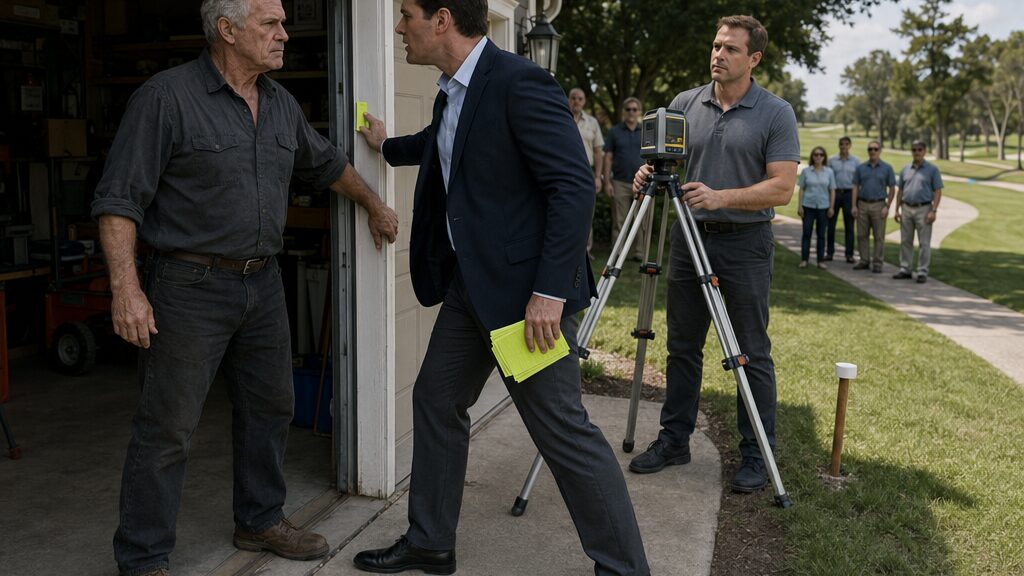
He set down the wrench in his hand and stepped out of the open garage. At the far edge of his driveway, Gary Miller was spreading the legs of a black tripod over the pale seam where concrete met grass. One foot stood on Frank’s driveway. Another pressed into the narrow strip of lawn beyond the white-topped survey pin Frank had repainted three days earlier.
Donald Walker followed from the golf-course path carrying a roll of neon-orange stickers beneath one arm.
Neither man had come from the street.
Frank looked past them toward the green. Two golfers had stopped beside their cart. A maintenance worker stood farther down the path with a rake balanced across his shoulder. Donald had chosen the route with no doorbell, no front walk, and no view from the camera above Frank’s porch.
Frank wiped his hands on a rag.
“Take one more step,” he said, “and you’ll regret what you brought.”
Gary straightened slowly. His company shirt was tucked tight enough to show the rectangular shape of a phone at his belt. He rested one hand on the tripod as though it were a flag he had planted.
“This is monitoring equipment,” he said. “Don’t interfere with it.”
“You’re already interfering with my property.”
Donald smiled as he crossed the clipped edge of the golf-course grass. He had always smiled most when he believed witnesses were present.
“We received multiple complaints,” he said. “Excess light after permitted hours. Mechanical noise. Unapproved storage visible from common property.”
Frank glanced into the garage. A workbench stood beneath pegboard hooks. Shelves held labeled bins, paint cans, folded tarps, and an old steel document box beneath the back counter. Nothing inside had changed in years except the small camera Frank had mounted near the rafters, angled toward the driveway after seeing two association workers pause at his boundary the previous week.
“You received complaints about a garage you can’t regulate,” Frank said.
Donald gave Gary a small nod.
Gary adjusted the digital meter on top of the tripod. Its screen blinked awake.
“Site inspection began at eleven fourteen,” he said toward his phone. “Owner present and refusing cooperation.”
Frank’s eyes moved to the papers clipped beneath Gary’s arm. The top sheet carried Frank’s address. Below it, a line marked HOA PARCEL was hidden under a pad of orange violation stickers.
“Show me the parcel number,” Frank said.
Gary looked down as though surprised Frank could read from that distance.
“The work order has been authorized.”
“That isn’t what I asked.”
Donald stepped between them.
“You’ve spent years pretending your lot is some private kingdom. Meanwhile, everyone else pays dues, follows appearance rules, and keeps the community from sliding.”
Frank’s attention returned to the survey pin. Donald’s polished shoe had stopped inches from it.
“The line is marked,” Frank said. “Gary’s equipment is over it. Remove it.”
Donald looked down, then scraped his sole across the painted cap.
“That old pin doesn’t control board jurisdiction.”
“It controls where my land begins.”
A few more people were gathering along the path now. Saturday walkers, golfers, and homeowners headed toward the maintenance forum scheduled near the clubhouse service gate. Donald noticed them. His shoulders widened.
“We tried courtesy,” he said. “You ignored three requests for an appointment.”
“You sent demands, not requests.”
“We are done debating vocabulary.”
Donald tore one orange sticker from the roll. The adhesive made a dry ripping sound that seemed louder than it should have.
He walked to the garage frame and slapped the sticker against the painted wood at eye level.
UNAUTHORIZED CONDITION—INSPECTION REQUIRED.
Frank watched Donald smooth the corners with his thumb.
“That frame is part of my house,” Frank said.
“And that notice remains until compliance.”
Gary turned the meter toward the open garage. “We’ll need photographs of all stored materials and any powered equipment capable of exceeding community limits.”
“No.”
Donald pointed past Frank. “The inspection is immediate.”
Frank shifted half a step, placing himself squarely in the opening.
Behind him, the garage smelled of cut wood, machine oil, and warm concrete. In front of him, the neon sticker glared against the gray frame like a wound someone had applied deliberately.
Gary lifted his phone higher.
Donald said, “If you refuse, the board can initiate emergency enforcement. Daily fines. Legal costs. A lien review if necessary.”
Several people on the path began whispering.
Frank knew the effect of those words. He had seen them empty color from another homeowner’s face. Seen a fence moved inward, not because a map required it, but because threats became more expensive than surrender.
His hand tightened around the rag.
“You crossed from common property onto an exempt parcel,” he said. “You installed equipment after being told to remove it. You attached material to my house. Step back across the line.”
Donald’s smile thinned.
“Exempt from dues does not mean exempt from safety inspection.”
“That isn’t what your records say.”
For the first time, Gary looked at Donald instead of Frank.
Donald did not return the glance.
Frank saw it and said nothing.
That was the part Donald misunderstood. Silence was not ignorance. Frank had spent thirty-two years reading plats drawn badly, deeds written worse, and boundaries people remembered incorrectly because memory was easier than measurement. He knew how long to let a false claim stand before it became useful evidence.
Donald reached toward the garage.
“Gary, document the interior.”
Frank lifted one hand.
“This is your final warning.”
Donald gave a small laugh for the people watching.
“Warning me on association-adjacent property?”
“My driveway is not association-adjacent. It is mine.”
Donald stepped over the narrow expansion seam that ran across the entrance. His toe landed inside the garage shadow.
Then he placed his palm against Frank’s shoulder.
It was not a shove yet. It was the pressure before one—the testing weight of a man certain the other would move to avoid a scene.
Frank did not move.
Donald leaned closer.
“Record everything inside,” he told Gary.
Chapter 2: The Only Warning Frank Intended to Give
Donald drove his shoulder forward.
Frank braced one hand against the garage frame and held his ground. The movement stopped Donald so abruptly that the board president’s shoe squeaked against the concrete.
For a moment, neither man spoke.
Gary’s phone remained raised. Beyond him, the people on the path had gone still.
Donald pushed again, harder this time.
Frank turned his body just enough to absorb the force without striking back. Then he took Donald’s wrist, removed the hand from his shoulder, and placed it deliberately at Donald’s side.
“You don’t touch me,” Frank said.
Donald’s face reddened.
“You are obstructing an authorized inspection.”
Frank pointed toward the driveway seam. “Back across it.”
Donald glanced at the witnesses. Retreat would look like uncertainty, and uncertainty was the one thing he never permitted himself in public.
“This property impacts the entire community,” he said. “Your lights face the course. Your garage faces common land. Rules exist because one resident’s choices affect everyone else.”
Frank understood the argument. He had used versions of it himself when surveying drainage easements and access roads. Lines did not erase responsibility.
But responsibility did not create rights that documents denied.
“Concern is not jurisdiction,” Frank said.
Gary moved closer to the tripod and angled the meter toward the garage opening.
“Do not interfere with association equipment,” he said. “The device is collecting ambient readings from a lawful position.”
“It is standing on my driveway.”
“The board authorized placement.”
“The board received written notice three months ago that no equipment, employee, or contractor was permitted beyond the marked boundary.”
Gary’s expression changed by a fraction.
“What notice?”
“Certified. Signed for by your office.”
Donald answered before Gary could. “A resident cannot cancel enforcement authority by mailing a letter.”
Frank looked at Gary. “Ask whoever signed the receipt.”
Gary’s jaw tightened. “That’s irrelevant to today’s assignment.”
“No. It’s inconvenient to today’s assignment.”
One of the golfers shifted near the cart. A woman on the path took out her phone. Donald noticed and raised his voice.
“This is exactly why uniform enforcement matters. Everyone else follows the process. Mr. Harris believes preparation gives him special treatment.”
Frank almost looked toward the steel box beneath the workbench.
He stopped himself.
The charter inside would prove the lot’s exemption. The parcel map would show the line. But Donald had already entered. Gary had already planted the meter. The sticker was already fixed to the house.
Frank had waited because he wanted the full act visible.
Now Donald was giving him more than he expected.
Donald reached around him and pointed into the garage.
“That shelving appears permanent. It may violate setback and storage provisions.”
Frank caught his forearm before his hand crossed the plane of the doorway.
“No part of you goes farther.”
Donald pulled free.
“Gary, continue.”
Gary touched the meter housing. A small red indicator pulsed beside the screen.
“Recording is active,” he said. “Tampering with this device will be documented as destruction of association property.”
Frank looked at the tripod.
Its nearest leg was six inches inside his driveway. The rubber foot rested beside a chalk mark he had made while checking the boundary alignment that morning.
“Remove it,” he said.
“No.”
“Move it behind the pin.”
Gary’s confidence returned now that the issue sounded procedural. “The equipment remains until the inspection is complete.”
Frank nodded once.
He stepped past Donald.
Gary shifted as though to block him, then hesitated. Frank did not reach for the phone or the papers. He gripped the tripod beneath the mounting head and lifted it cleanly from the concrete.
The meter chirped.
Gary lunged forward. “Put that down.”
Frank carried it to the exact edge of the driveway.
For one second, Gary seemed relieved.
Then Frank drove the aluminum legs across his knee.
The first leg folded with a sharp metallic crack.
Someone on the path gasped.
Frank rotated the tripod and bent the second leg until the joint tore free. The meter swung from its mounting plate. He brought the housing down against the driveway once.
The plastic split.
A second strike shattered the display.
The red indicator vanished.
Frank dropped the broken frame, placed the sole of his work shoe against the meter, and shoved the pieces beyond the concrete onto the strip beside the street.
The sound died at once.
Even the golfers had stopped whispering.
Gary stared at the debris. His face had lost its practiced contempt.
“That unit costs four thousand dollars.”
Frank turned to him.
“It was unauthorized equipment on exempt property after written notice and repeated verbal warning.”
“You destroyed it.”
“Yes.”
Donald’s shock lasted only a heartbeat. Then opportunity hardened his features.
He lifted his phone.
“You all saw that,” he said to the witnesses. “A deliberate attack on association personnel and property.”
“I did not touch either of you.”
“You threatened us.”
“I warned you to remove your property.”
Donald tapped the screen. “We’ll let law enforcement decide the distinction.”
Frank looked toward the path. Some faces held satisfaction. Others held fear. He recognized the second expression more clearly.
It was the look people wore when they believed resistance had become too expensive to support.
Donald began speaking into the phone.
“Yes, I’m reporting a violent resident at the golf-course boundary. He destroyed equipment during an official inspection and threatened two authorized representatives.”
Frank’s mouth tightened.
Gary bent toward the broken meter, but did not pick it up. The pieces lay beyond the driveway edge, exactly where Frank had kicked them.
Donald turned away slightly.
“Yes,” he said into the phone. “He has tools. The garage is open. We don’t know what else he has inside.”
Frank took one step toward him.
Donald retreated at once, lifting a hand as though shielding himself from a blow that had never been offered.
“There,” he told the dispatcher. “He’s advancing again.”
Frank stopped.
Behind Donald, a child’s golf ball rolled from the path and came to rest beside the white survey pin.
The father hurried forward, then hesitated at the line.
Frank bent, picked up the ball, and held it out across the boundary without stepping over.
The father took it silently.
Donald watched the exchange with irritation.
Then he spoke more loudly into the phone, making sure everyone could hear.
“The resident is unstable,” he said. “Possibly armed. Send officers now.”
Chapter 3: A Broken Meter Becomes Donald’s Best Evidence
Donald crouched beside the shattered meter and framed his photograph so the survey pin remained outside the shot.
He took three pictures from the same angle: broken screen, twisted legs, Frank’s open garage behind them.
“The inspection device was destroyed without provocation,” he announced.
Twenty minutes had passed since the call. No officers had arrived yet. The crowd along the golf-course path had doubled as residents heading toward the scheduled maintenance forum stopped at Frank’s lawn instead.
Donald stood among them like a man already presenting a case.
Gary had recovered enough to gather the broken pieces, though he left them where they had landed. He held his work order against his chest. The neon stickers remained attached to the top page.
Frank stood at the garage entrance with his arms at his sides.
He had not explained the charter.
That silence now worked against him.
A woman near the path asked, “Did he really smash it?”
Donald turned toward her. “In front of witnesses.”
“You were on his driveway,” someone else said.
“We were conducting a lawful inspection.”
“Of what?”
“Potential safety and nuisance violations.”
The answers came quickly, each one polished by repetition. Donald had chaired enough meetings to understand that the first coherent version of an event often became the accepted one.
Rebecca Green pushed through the gathered residents carrying a canvas document bag and a thick binder pressed against her ribs.
She looked first at the broken meter, then at the sticker on Frank’s garage frame.
“What notice authorized this?” she asked.
Donald’s posture changed. He respected Rebecca only in the way a man respected a locked cabinet he had not yet opened.
“This is an enforcement matter.”
“It became a membership matter when you conducted it during a noticed community meeting.”
“The maintenance forum has not begun.”
“The forum was scheduled for eleven thirty at the course gate. Half the quorum is standing on Frank’s grass because you brought them here.”
Donald glanced around and seemed to realize how many homeowners were present.
Rebecca walked to the driveway edge and stopped beside the survey pin.
“Frank,” she said, “do you still have the developer’s charter?”
A murmur moved through the group.
Frank met her eyes.
“Donald needs to answer something first.”
Her brows drew together. “This isn’t the time to be stubborn.”
“It is exactly the time.”
Donald laughed. “He has nothing. If he did, he would have produced it before committing property damage.”
Frank looked at him.
“State your claim.”
“My claim?”
“Under witnesses. Does the HOA have full enforcement and inspection authority over this parcel?”
Rebecca understood before Donald did.
“Frank,” she said quietly.
He did not look away from Donald.
Donald spread his hands toward the crowd.
“Yes. The association has authority over properties affecting common areas, including this lot. Mr. Harris has spent years exploiting an outdated dues arrangement as though it exempts him from community standards.”
“Full authority?” Frank asked.
“Inspection, nuisance control, appearance enforcement, and emergency entry when conditions justify it.”
Gary shifted his weight.
Frank said, “And you authorized Gary to enter from the course side?”
Donald’s gaze sharpened. “I authorized a lawful site visit.”
“Say yes or no.”
“I won’t submit to your interrogation.”
Rebecca opened her binder.
“You just stated the board has full authority. That is enough for the record.”
Donald’s face tightened. “You are not taking minutes.”
“I have been taking minutes since the first member arrived for the noticed meeting.”
She showed the top page. The date, time, and location were written across the header. Below them were several lines of notes.
Donald looked toward the residents.
“This is theater.”
Rebecca turned to Frank. “Now get the charter.”
“Not yet.”
A flush rose in her cheeks. “You have people standing here wondering whether the board lied or whether you lost control and destroyed expensive equipment. Every minute you delay helps him.”
Frank heard the frustration beneath her words. She had spent months gathering complaints that people later withdrew. Residents would speak privately, then go silent when asked to sign their names.
He knew that pattern.
He had once helped create it.
Gary stepped forward.
“I have the work authorization,” he said. “Whatever private document Mr. Harris claims to possess, this address appears on an approved enforcement list.”
He held the paper outward.
Several residents leaned closer.
Rebecca crossed to him. “May I see it?”
“No.”
“You just offered it as proof.”
“I stated what it contains.”
Frank pointed to the upper right corner. “Move the sticker sheet.”
Gary looked down.
The pad of orange notices overlapped the parcel field.
“That is office inventory.”
“Then move it.”
Donald stepped between them. “The address is what matters.”
“No,” Frank said. “The parcel number is what matters.”
A man near the path muttered that an address should be enough. Another agreed. Doubt moved through the group with the quickness Donald depended on.
Gary lifted the work order higher.
“Frank Harris. Correct address. Light and noise evaluation. Garage storage inspection. Authorized by the board president.”
There it was: paper, title, equipment, procedure. The visible machinery of authority.
The broken meter at the edge of the driveway seemed suddenly larger.
Rebecca lowered her voice.
“Frank, please.”
He looked past her toward the line of residents. A few had begun stepping backward. Not leaving, but separating themselves from the conflict.
The same distance had formed around Sharon Wilson the day Donald told her the fines would double.
Frank remembered standing near his mailbox with a copy of the county plat folded in his pocket. He had suspected Donald’s line was false. He had told himself suspicion was not proof. Told himself Sharon should request a formal survey. Told himself it was not his fight.
She had moved the fence six feet inward before the month ended.
Frank looked at the sticker on his garage.
His plan had been to let Donald commit the trespass, then bury him under the charter and the camera footage. Clean proof. Clean reversal.
But the people watching did not know what he knew. His silence was not making them patient. It was making them afraid.
Rebecca opened her canvas bag and removed a thin file with a faded label.
“I brought the old boundary complaints,” she said. “There’s something you need to see.”
She placed the file on the hood of a parked golf cart and opened it.
Inside was a photograph of Sharon’s former fence line. A violation notice was clipped behind it.
Frank saw the parcel notation in the lower corner.
Not Sharon’s parcel number.
A shortened sequence, partly overwritten in blue ink.
He turned toward Gary’s work order.
The same shortened sequence was visible above the edge of the sticker pad.
Rebecca put one finger beneath it.
“This notation appeared on Sharon Wilson’s enforcement file before she surrendered part of her yard,” she said.
Donald took a step closer. “Those records are unrelated.”
Rebecca looked at Frank.
“No,” she said. “I don’t think they are.”
She held Sharon’s file beside Gary’s work order.
The altered parcel marks matched.
Chapter 4: The Fence Frank Did Not Help Save
Frank unlocked the steel document box, and Sharon Wilson’s photograph slid across the workbench before he could catch it.
It stopped beneath Rebecca’s hand.
The picture had faded around the edges, but the old fence line remained clear. White posts ran straight from Sharon’s back corner toward the golf course, aligned with three survey caps that formed the same clean angle as the markers on Frank’s parcel.
Rebecca lifted the photograph and looked through the open garage toward Donald.
He stood on the lawn speaking to several residents, one hand raised as though calming a disorder he had not created. Gary remained by the driveway, watching the broken meter and his paperwork with equal unease.
“This was before she moved it?” Rebecca asked.
“Six years ago.”
“And you had this?”
“I took it the morning the contractor started pulling posts.”
Rebecca set the photograph down carefully.
“You knew the line was probably right.”
“I knew Donald’s map didn’t match the county plat.”
“That is not the same thing as probably.”
“No.”
Frank removed a worn folder from the box. Beneath it lay a yellowed booklet stamped with the developer’s name and the year 1985. A folded parcel map was tucked inside the back cover.
Rebecca stared at it.
“You had the original charter all this time.”
“My closing attorney gave it to me. Most owners got photocopies. Mine came from the developer’s file.”
“Then why didn’t you show this outside?”
“Because exemption isn’t the only issue.”
“It would stop him from claiming authority over your lot.”
“It proves he has none. It does not prove he knew that when he sent Gary.”
Rebecca’s voice lowered. “You let him enter your garage so you could catch him doing it knowingly.”
“I stopped him at the opening.”
“You know what I mean.”
Frank unfolded the parcel map. His lot was marked with a heavy black outline and an exclusion notation tied to the developer’s charter. The survey points corresponded to the pins outside, including the one Donald had scraped with his shoe.
“The charter answers my case,” Frank said. “It does not answer Sharon’s.”
Rebecca looked again at the photograph.
“No. Your silence answers part of hers.”
The words landed without volume.
Frank turned toward the open garage door. Donald was showing someone the photographs of the meter. The neon notice still clung to the frame above his shoulder.
“I told Sharon to request an independent survey.”
“She told me that.”
“She said she could not afford one.”
“She told me that too.”
Frank’s hand rested on the edge of the box.
“I should have paid for it.”
Rebecca shook her head. “That is not what she needed first.”
Outside, Donald’s voice rose.
“This is why residents should never take enforcement into their own hands.”
Frank shut the document box halfway, then opened it again.
Rebecca watched him.
“She thought you agreed with him,” she said.
Frank looked at her.
“What?”
“When she asked why you hadn’t objected, I told her you were careful. That you would not accuse anyone without records. She said you had lived beside that line longer than anyone and that if Donald was wrong, you would have said so.”
The garage seemed suddenly narrower.
Frank remembered Sharon standing beside the first loosened fence post. She had worn gardening gloves and held the violation letter folded into quarters. Donald had told her the fines would increase daily. He had mentioned legal fees, a lien, and the possibility that future buyers would see an unresolved enforcement action.
Frank had stood at his mailbox with the county plat in his pocket.
He had believed caution distinguished him from men like Donald.
What caution had looked like from Sharon’s side was absence.
“I did not know enough,” Frank said.
“You knew enough to stand next to her while she asked questions.”
He folded the parcel map along its old creases.
A car door slammed somewhere near the course gate. Several residents looked toward the sound, but no police vehicle appeared. The gathering remained held in place by uncertainty.
Rebecca turned a page in Sharon’s violation file.
“The parcel notation on her notice was overwritten. Gary’s work order carries the same shortened number. That could be clerical copying, or it could be deliberate. We need more than resemblance.”
Frank took the photograph from her.
The image showed Sharon near the fence, one hand on a post. He had cropped himself out when he printed it, but his shadow stretched across the lower corner.
“I kept the charter because I knew Donald would eventually try this here,” he said.
Rebecca’s expression hardened. “You expected him.”
“Yes.”
“And you let the board continue while you prepared only for your own lot.”
Frank returned the photograph to the workbench.
“That was the arrangement I made with myself.”
“Was it a good one?”
“No.”
It was the first answer he gave without defending it.
Rebecca opened the charter to the exemption page. “Even with this, Donald can claim an honest mistake. He can say the document was archived, misunderstood, or superseded.”
“It was never superseded.”
“You know that. He will say he did not.”
Frank glanced at Gary. “Then we need proof of what Donald gave him.”
“Gary will protect his contract.”
“Until protecting Donald becomes more expensive.”
Rebecca closed the charter but kept one hand on it.
“There is another issue. The recall petition is close, but not complete. People will sign if they believe this is intentional abuse. They will not sign if they think it is one angry homeowner and one confused records file.”
Frank reached for his phone.
Rebecca said, “What are you doing?”
“Calling Sharon.”
“You have not spoken to her in years.”
“Not properly.”
He found the number in an old contact list. His thumb remained above the screen.
He could ask about the fence. He could ask what Donald had shown her. He could turn her memory into evidence and leave the rest untouched.
That would be efficient.
It would also be another version of using silence to avoid the part that belonged to him.
He pressed the call button.
Sharon answered after five rings.
“Frank?”
Her voice carried surprise but not warmth.
“Yes.”
“Is something wrong?”
“Donald entered my property today.”
A pause.
“I heard there was trouble near the golf course.”
“He sent a management agent with monitoring equipment. They tried to inspect my garage.”
“Did you let them?”
“No.”
Rebecca looked toward the broken meter.
Frank continued before Sharon could ask.
“I need to tell you something first. When Donald forced you to move your fence, I believed his boundary map was wrong.”
The silence on the line changed.
“You never said that.”
“I know.”
“I asked you.”
“Yes.”
“You told me to order a survey.”
“I should have stood beside you and challenged his notice before you spent anything.”
Sharon breathed out slowly.
“Why are you calling now?”
“Because he used a parcel notation today that matches the one in your file. Rebecca believes the cases are connected. We need permission to use your records.”
“You need my records.”
“Yes.”
“And the apology?”
“That was owed whether you help or not.”
Rebecca lowered her eyes.
For several seconds, the only sound in the garage was the faint buzz of the ceiling light.
Then Sharon said, “Donald had another paper.”
Frank straightened.
“What paper?”
“The day he came to mark the fence. He showed me a page from an old developer document. I saw your parcel number on it because I recognized the last four digits from your mailbox paperwork.”
Frank looked at the charter.
“What did the page say?”
“I did not get to read all of it. There was a heading about excluded tracts. When I asked why your lot was on the page, Donald took it back.”
“Did he explain?”
“He said your exemption was a special error that the board intended to correct. Then he told me not to discuss it with you because you would use it to obstruct enforcement.”
Frank’s grip tightened around the phone.
“Would you provide a written statement?”
Another pause.
“Yes. But not because of your fence.”
“My fence is still where it belongs.”
“That is exactly why.”
Frank closed his eyes briefly.
“Thank you.”
“Do not thank me yet,” Sharon said. “Find the copy he had. Otherwise he will say I misunderstood what I saw.”
The call ended.
Rebecca turned toward the driveway, where Gary still held the work order Donald had given him.
Frank folded the charter beneath his arm.
“Donald had the exemption page six years ago,” he said.
Rebecca nodded toward Gary’s packet.
“Then the question is whether he brought it here today.”
Chapter 5: The Missing Page Inside Gary’s Work Order
Gary had one hand beneath the largest piece of the meter when Rebecca raised her phone and photographed its serial plate.
He froze.
“What are you doing?”
“Preserving the inventory number.”
“This equipment belongs to my company.”
“So does the work order that sent it onto an exempt parcel.”
Gary straightened and placed the meter housing on the seat of his management vehicle. It was parked near the service gate, just beyond the crowd. The twisted tripod legs rested on the pavement beside his shoe.
“You have no authority to detain company property,” he said.
Rebecca took another photograph of the work-order cover sheet.
“I am not detaining anything.”
Donald pushed through the residents toward them.
“Stop engaging with her,” he told Gary. “Collect your equipment. The police can review the rest.”
Gary looked toward the course entrance. “They should have been here by now.”
“They are coming.”
Frank approached carrying the charter and parcel map.
Donald pointed at the yellowed booklet. “Now he manufactures a document after destroying the meter.”
Frank ignored him and looked at Gary.
“Who signed for my certified letter?”
Gary kept his face still. “I would need to check office records.”
“It was delivered three months ago.”
“I said I would need to check.”
“Donald told you the exemption expired, didn’t he?”
Gary’s gaze moved toward Donald before returning to Frank.
Donald answered. “Any prior exemption was limited by later community restrictions.”
Frank opened the charter to the exclusion clause.
“Show me the amendment.”
“This is not a roadside hearing.”
“No. It is my driveway.”
Gary wiped his hands on his trousers and pulled the sticker pad from the top of the work order.
As the adhesive lifted, the parcel field appeared.
The number matched the one printed on Frank’s charter.
Rebecca photographed both pages side by side.
Gary stared at the digits.
“That number was in the assignment system,” he said.
“And marked excluded,” Frank replied.
“Not in my authorization.”
Donald stepped closer. “The system contains legacy codes that have no current effect.”
Gary flipped through the packet.
The first page was the enforcement authorization. The second listed the alleged complaints. The fourth was a site map.
He stopped.
“Where is attachment three?”
Donald’s voice sharpened. “What?”
“The pages are numbered.” Gary tapped the corners. “One, two, four, five.”
“Office packets lose pages all the time.”
“Not after I print them.”
“You printed this at your office?”
“This morning.”
Donald’s jaw moved once.
Gary looked at the authorization again. At the bottom, beside Donald’s electronic approval, a route note instructed the agent to access the property through the golf-course service path.
Frank said, “Why not the street?”
Gary did not answer.
Donald did. “Parking was restricted for the maintenance meeting.”
“There are six open spaces in front of my house.”
“The route is irrelevant.”
Gary turned the packet over. “You told me the resident had disabled the front access camera.”
Donald’s face hardened.
Frank looked up at the small lens mounted inside the garage.
“My porch camera works.”
Gary stared at Donald. “You said entry from the street would compromise the inspection.”
“It would have caused confrontation before the readings began.”
“You knew there would be confrontation.”
Donald lowered his voice. “Do not confuse preparation with wrongdoing.”
Gary gave a short, humorless laugh.
His confidence had not disappeared. It had changed direction.
“You gave me a parcel number marked with a legacy exemption. You told me it had expired. You routed me through the course. You did not include the supporting amendment.”
“Because none was required.”
“Then where is attachment three?”
Donald reached for the packet.
Gary pulled it back.
The movement was small, but several residents saw it.
Donald’s expression cooled.
“Your company works for the association.”
“My company works under written authorization.”
“And you had it.”
Gary looked at the broken meter inside the vehicle.
“If this authorization is defective, the equipment claim lands on me.”
Frank said, “You ignored two warnings.”
Gary turned on him. “You destroyed four thousand dollars of calibrated equipment.”
“Yes.”
“You could have shown the charter first.”
“Yes.”
The answer seemed to unsettle Gary more than an argument would have.
Frank continued, “I may owe for the device. That does not give you the right to enter my land.”
Donald spread his hands toward the crowd. “There. Even he admits liability. This is a property-damage case, not a board issue.”
Rebecca held up her phone.
“The parcel number, route instruction, missing attachment, and Sharon’s statement make it a board issue.”
“Sharon is not here.”
“She is preparing a signed statement.”
Donald turned to Gary.
“We need an incident report before officers arrive. Use the standard form.”
Gary retrieved a tablet from the passenger seat. Donald moved beside him, speaking too quietly for the crowd but not for Frank, who stood only a few feet away.
“State that Harris invited you onto the driveway to discuss the inspection,” Donald said. “Then became aggressive after seeing the device.”
Gary looked up.
“He ordered me off before I planted it.”
“You misunderstood.”
“No.”
“He waved you forward.”
“No.”
Donald’s mouth tightened. “Your contract renewal is before the board next month.”
Gary’s thumb stopped above the screen.
There was the pressure beneath everything: accounts, payroll, insurance, the fragile appearance of a professional operation. Frank could see Gary calculating the cost of truth against the cost of obedience.
Donald lowered his voice further.
“You protect the association, and the association protects its vendors.”
Gary looked at the damaged meter again.
Then at the missing page number.
“You are not protecting me,” he said. “You are building a report that makes me the trespasser and him the unstable owner.”
“You were the field agent.”
“Under your instruction.”
“And you remain responsible for field judgment.”
Gary locked the tablet and placed it on the seat.
“I am not signing that version.”
Donald’s face emptied of expression.
Rebecca stepped closer to the open vehicle.
“Search the packet envelope.”
Gary checked the glove compartment, then the center console. Nothing.
He lifted the floor mat.
Donald said, “This is absurd.”
Gary opened the rear door and searched beneath a stack of inspection folders. One folder had split along the seam, but the missing page was not inside.
He stood, breathing hard.
“The packet was complete when I left.”
“Then you misplaced it,” Donald said.
Gary looked through the windshield.
A pale corner protruded from beneath the passenger seat.
He opened the front door and reached down.
The page came free with a scrape.
It was a photocopy of Frank’s 1985 exemption clause. His parcel number had been circled in blue ink. At the top right, beside Donald’s initials, was a handwritten instruction.
Gary read it once.
Then again.
Rebecca raised her phone, but he held up a hand.
“Wait.”
His eyes moved across the words as if he needed to understand the full shape of what had been done to him.
Donald stepped forward.
“That is privileged board material.”
Gary turned the page so the residents nearest him could see.
The handwriting read: Do not show owner—board jurisdiction supersedes.
Frank looked at Donald.
“Show us where,” he said.
Donald did not answer.
Chapter 6: The Parcel Number Beneath the President’s Shoe
Donald planted his polished shoe over the survey pin and declared that no rusty marker could overrule an elected board.
The crowd had shifted from the course path onto Frank’s lawn, forming an uneven half circle around Rebecca’s folding table. The maintenance forum materials had been replaced by the charter, Gary’s work packet, Sharon’s file, and a legal pad covered in names.
Frank stood opposite Donald with the parcel map unfolded between them.
Rebecca faced the residents.
“This meeting was noticed for today at eleven thirty,” she said. “A quorum of members signed in before the maintenance discussion was interrupted. The recall petition already meets the bylaw threshold for consideration.”
Donald gave a sharp laugh.
“You cannot turn a grounds forum into a removal hearing because Frank Harris broke a meter.”
Rebecca opened the bylaws.
“The notice included board conduct and enforcement procedures under unfinished business. The recall petition was filed yesterday morning. Members present may hear the misconduct charge and vote.”
“You buried it in a general agenda.”
“I followed the procedure your board adopted.”
Several residents exchanged glances.
Donald looked toward Gary. “Tell them the equipment was destroyed during an authorized inspection.”
Gary held the missing attachment separately from the rest of the packet.
“The inspection was authorized by the president.”
“And lawful.”
“I cannot confirm that.”
Donald’s voice hardened. “You confirmed it when you arrived.”
“I relied on what you told me.”
“You are changing your position because you fear a damage claim.”
Gary’s face flushed, but he did not look away.
“I should have verified jurisdiction myself. I did not. That is my responsibility.”
Donald turned toward Frank.
“And his responsibility?”
Frank stepped to the edge of the driveway.
“I destroyed the meter.”
A murmur passed through the group.
Donald seized it immediately.
“At last.”
Frank looked at Gary. “If I am legally required to reimburse your company, I will.”
Gary blinked.
Donald stared at him as though Frank had removed the weapon from his hand.
Frank continued, “The value of the meter does not decide whether Donald had jurisdiction. My choice does not create authority after the fact.”
A resident near the table said, “But you could have shown the charter before you smashed it.”
“Yes.”
The admission quieted the lawn.
Frank placed the yellowed booklet beside Rebecca’s binder.
“I wanted the trespass completed and witnessed. I did not trust the board to act on a warning. I trusted evidence more than people.”
Donald spread his arms. “He staged this.”
“No,” Frank said. “You chose the route. You ordered the inspection. You concealed the exemption. I allowed you to show how far you intended to go.”
“That is entrapment.”
“I am not law enforcement. This is my property. I told you to leave.”
Donald shifted his weight, grinding his heel against the survey cap beneath his shoe.
“The board has a duty to enforce standards consistently. Residents have complained for years that some owners receive exceptions while everyone else pays. Property values depend on order.”
A few people nodded.
Donald saw them and pressed on.
“We have a budget shortfall, deferred maintenance, and contracts that require stable leadership. Remove me today and you jeopardize insurance reviews, landscaping agreements, and the management contract. All because one homeowner refuses accountability.”
The argument changed the air.
Until then, the choice had seemed simple: Donald against Frank. Now residents looked toward the golf-course grass, the service gate, and the clubhouse roofs beyond the trees. Those things required money, signatures, and continuity.
A woman near the back asked, “What happens to current contracts if the president is removed?”
Rebecca answered. “The vice president and remaining board continue operations until an interim appointment or election.”
“And the legal costs?”
“They may increase if we ignore documented misconduct.”
“Or if we accuse the president wrongly,” another resident said.
Donald nodded. “Exactly.”
Frank looked around the lawn.
He saw people who disliked Donald but feared disorder more. People who had accepted fines they questioned because resistance required time. People who had told themselves that one neighbor’s problem was not theirs.
He had told himself the same thing.
Donald pointed down at the marker beneath his shoe.
“This is what the entire accusation rests on. A buried piece of metal and an old document no current board approved.”
Frank stepped forward.
“Move your foot.”
Donald smiled faintly. “No.”
Frank bent and gripped Donald’s ankle.
A shock moved through the crowd, but Frank did not yank or strike. He lifted the shoe just enough to slide it aside, then released it beyond the grass edge.
Donald stumbled one step.
Frank knelt beside the marker.
Its white cap had been pressed below the torn grass. He dug around it with his fingers until the metal head was visible, then wiped away soil with the same rag he had used in the garage.
Stamped into the cap was the parcel sequence.
Frank read the digits aloud.
Rebecca held the charter open. Gary placed the work order beside it.
The numbers matched.
Not an address. Not a neighborhood name. Not a board interpretation.
The same parcel.
Frank stood.
“This pin was set when the tract was divided. The charter excludes the tract by number. Gary’s order targets it by the same number. Donald’s handwritten note acknowledges the exemption page and instructs Gary not to show it to me.”
Donald said, “The note says jurisdiction supersedes.”
“By what?”
“Subsequent amendments.”
“Produce one.”
“The association archive is not on this lawn.”
“You had enough archive to bring the exemption.”
Donald turned to Rebecca. “This document chain is incomplete. You cannot remove an elected officer on incomplete records.”
Rebecca looked at Gary.
“Did Donald tell you the exemption had expired?”
“Yes.”
“Did he provide an amendment?”
“No.”
“Did he tell you to approach through the golf-course path?”
“Yes.”
“Did he say the front camera was disabled?”
“Yes.”
Frank looked at the residents.
“I have something else to say.”
Rebecca waited.
Frank picked up Sharon’s photograph.
“Six years ago, Donald told Sharon Wilson that her fence crossed association land. She asked me whether his map was right.”
Donald interrupted. “That matter was resolved.”
“No. It was surrendered.”
Frank held the photograph so the nearest residents could see the original fence line.
“I believed Donald’s map was wrong. I had a county plat in my mailbox. I told Sharon to order a survey because I did not want to accuse the board without complete proof.”
He looked at the shadow of himself in the corner of the photograph.
“She moved the fence because she could not afford the daily fines he threatened. I watched the contractor pull the posts.”
The lawn remained still.
“I called that caution. From her side, it was silence.”
Donald’s face tightened. “You are trying to turn personal regret into evidence.”
“No. Your page is evidence. Gary’s order is evidence. The marker is evidence. My regret explains why evidence stayed locked in my garage while you learned that people would stand alone.”
Rebecca’s eyes met his.
Frank placed the photograph beside the charter.
“I prepared for the day you crossed my line. I should have prepared for the day you crossed anyone’s.”
A man near the back, who had defended Donald at previous meetings, folded his arms.
“What about the shortfall?” he asked. “What about the contracts?”
Frank answered without turning the moment into a speech.
“Those problems remain whether Donald stays or goes. Keeping him does not solve them. It only teaches the next president that fear is an acceptable tool.”
Donald looked toward Gary.
“This association can terminate your company today.”
Gary held up the exemption page.
“You already tried to make me responsible for your instruction.”
“I asked you to file an accurate report.”
“You asked me to say Frank invited us onto the driveway.”
Several residents spoke at once.
Rebecca raised one hand.
“Gary, did Donald conceal this page from you before the inspection?”
Gary looked down at the note.
The choice was visible in his face. The management contract mattered. So did the equipment, his employees, and the reputation attached to every future account.
“Yes,” he said. “The page was missing from my packet when I reviewed it. His note was on the copy found under my seat. He told me the exemption had expired but supplied no supporting amendment.”
Donald took a step toward him.
“You have no idea how that page got there.”
Gary did not retreat.
“It came from the packet you prepared.”
Rebecca turned to the legal pad.
“The misconduct question is whether Donald Walker knowingly authorized enforcement on an excluded parcel, concealed relevant records, and directed a vendor to avoid normal access in order to conduct the inspection.”
Donald faced the crowd.
“You are being asked to destabilize the entire association over a boundary argument engineered by a man who destroyed property.”
No one answered immediately.
Rebecca read the bylaw provision governing removal. Her voice remained level. There was no triumph in it, only procedure.
“Eligible members in favor of removing Donald Walker from the office of president, raise a hand.”
For one suspended second, the lawn did not move.
Then the man who had asked about the contracts lifted his hand.
He had defended Donald at two annual meetings and once argued that stricter fines were necessary.
Donald stared
Chapter 7: The Line Remained After the Authority Was Gone
The final count removed Donald Walker from office, and no one applauded.
Rebecca read the number twice from the legal pad. The result was not close. Enough hands had risen to satisfy the bylaws, and several residents who had defended Donald in past meetings now stood with their arms lowered, staring at the grass.
The silence carried more weight than celebration would have.
Donald remained beside the folding table. Without the meeting under his control, he seemed smaller, but not defeated enough to disappear. His phone was still in his hand. The neon stickers lay on the table beside Gary’s packet, their bright color out of place among the faded charter pages.
“This vote will be challenged,” Donald said.
Rebecca closed the bylaws.
“You may challenge it through the same procedure used to conduct it.”
“You cannot manage the contracts without me.”
“The remaining board can manage them.”
“They do not understand the obligations.”
“Then the records will explain them.”
Donald looked around for support. No one stepped forward.
A golf cart rolled slowly past on the path. The driver glanced toward the lawn, then continued without stopping. The ordinary sound of its tires seemed to return the afternoon to the world beyond Frank’s property.
Rebecca removed the orange notice from the garage frame.
The adhesive resisted. She pulled carefully until the paper came free in one piece, leaving a pale rectangle of residue on the paint.
“Do you want this?” she asked Frank.
“No.”
She folded it once and placed it with the meeting records.
Gary stood near his vehicle, separating the exemption page from the rest of the work order. He had already photographed every sheet and emailed copies to his office. The damaged meter remained on the passenger seat, its broken display facing upward.
“I will preserve the original packet,” he said. “The route instructions, inventory numbers, and all correspondence connected to this assignment.”
Rebecca nodded. “The association will request copies formally.”
Gary looked at Frank.
“I should have verified the parcel before I crossed the line.”
“You should have.”
“I relied on the authorization.”
“You also ignored the marker.”
Gary accepted that without argument.
Donald gave a short, bitter laugh. “Remarkable. Everyone has discovered principles now that they are safe.”
Frank turned toward him.
Donald stepped away from the group and motioned toward the driveway. “A private word.”
Frank did not follow at first.
Then he walked to the edge of the garage, far enough from the table that the others could not hear clearly, but not far enough to be hidden.
Donald kept his voice low.
“You think this ends with a vote on a lawn?”
“No.”
“The association will need counsel. Gary will make a claim for the meter. There may be insurance consequences. Every past enforcement action could be challenged.”
“Yes.”
“And you caused that exposure.”
“I uncovered it.”
“You could have shown me the charter privately.”
“You had a copy.”
Donald’s jaw tightened.
“I could reimburse the meter from discretionary funds before the transition. I could issue a written acknowledgment that your parcel is exempt. We resolve your matter and avoid years of legal review.”
“In exchange for what?”
Donald glanced toward Gary’s vehicle.
“The handwritten page does not need to become part of any permanent complaint.”
Frank watched him for a moment.
There was no apology in the offer. Only another boundary Donald hoped could be moved quietly enough that no one would notice.
“You are no longer authorized to spend association money,” Frank said.
“The removal is disputed.”
“The vote was counted.”
“Then consider it personal reimbursement.”
“For equipment you ordered onto my property?”
“For ending this before it damages everyone.”
Frank looked toward the residents gathered around Rebecca. Some were signing statements. Others were comparing old notices and asking whether their own parcel records should be reviewed.
“The damage was done before today,” he said.
Donald’s expression hardened. “You wanted this.”
“I wanted you off my land.”
“You waited until there was an audience.”
“I waited too long before there was one.”
Donald studied him, perhaps searching for satisfaction and finding none.
“Do you expect me to apologize?”
“No.”
“Then what do you want?”
Frank looked toward the white survey cap, still pressed below the torn grass.
“The record left intact.”
Donald’s shoulders dropped by a fraction.
He slipped his phone into his pocket and walked toward the golf-course path. The residents gave him room, but no one followed. He passed the stack of neon stickers without taking them.
Rebecca watched until he reached the service gate.
Then she turned to the group.
“All disputed boundary and enforcement actions are suspended pending review,” she said. “The remaining board will arrange independent examination of the association records, financial authorizations, and active contracts. Anyone with a prior parcel dispute should submit copies, not originals.”
Questions came immediately.
Who would lead the review? How far back would it go? What happened to current fines? Would liens be paused?
Rebecca answered only what the documents allowed her to answer.
Frank began gathering the broken tripod pieces from beside the driveway.
Gary moved to help, but Frank shook his head.
“I put them there.”
Gary stopped.
“The equipment claim will go through my insurer,” he said. “I will report the warnings you gave and the defective authorization.”
“I will report what I did.”
Gary nodded. “That is more than most people would.”
“It does not make it less broken.”
“No.”
For the first time, they stood on opposite sides of the line without pretending it did not exist.
Gary carried the meter housing to his vehicle and closed the door.
Rebecca approached Frank with the canvas bag against her hip.
“We need someone on the temporary records-review committee who understands plats.”
“No.”
She did not seem surprised.
“You have not heard the full request.”
“I know what a committee is.”
“You also know what a parcel number is. That already puts you ahead of most of us.”
Frank collected the last twisted aluminum leg.
“I am not joining the board.”
“I did not ask you to.”
“You were about to.”
“I was about to ask you to review the boundary files.”
Frank placed the metal beside Gary’s tire.
Rebecca continued, “Sharon’s case will not be the only one. Some claims may be valid. Some may not. We need someone who will say which is which, even when the answer is unpopular.”
Frank looked toward his garage.
The steel document box remained open on the workbench. For years, he had treated it as protection: proof kept dry, ordered, and unavailable to anyone who might distort it.
The box had protected the paper.
It had not protected Sharon’s fence.
“I will not hold office,” he said.
“Fine.”
“I will not attend meetings where people argue for an hour over flower colors.”
“Also fine.”
“I will map the disputed parcels. I will explain the records to the owners. The decisions remain with the board.”
Rebecca extended her hand.
Frank looked at it, then shook it once.
“That is all I was asking.”
“No, it wasn’t.”
A tired smile touched her face. “It is all I am getting.”
The residents began leaving in small groups as the light lowered across the golf course. Some stopped to give Rebecca contact information. One man placed his old violation letters on the table. A woman asked Frank whether he could check a drainage easement next week.
“Bring the deed,” he said.
When the lawn had nearly emptied, Frank returned to the survey pin.
He knelt and cleared the torn grass from around the cap. The metal had been driven too low by Donald’s shoe. Frank used a narrow tool from the garage to lift it until the stamped number sat level with the soil.
Rebecca stood nearby holding the charter copies.
“Do you want the originals back in the box?” she asked.
“Yes.”
He brushed soil from his fingers.
“After you make two complete sets.”
She waited.
Frank went to the workbench, removed Sharon’s photograph, the parcel map, the certified-mail receipt, and every related page from the steel box. He aligned them into a clean stack and handed them to her.
“All of it?” she asked.
“All of it that concerns the association.”
Rebecca placed the records inside her canvas bag.
Frank took a broom from the garage wall and swept the remaining plastic fragments beyond the driveway edge, where Gary could collect them. Then he trimmed the ragged grass around the marker with a small pair of shears.
He did not cover the cap.
He left the number visible.
Rebecca stepped onto the golf-course path with the records secured beneath her arm.
Frank stood inside the garage and looked once toward the restored line. Nothing about the lawn appeared dramatic now. Concrete ended. Grass began. The marker sat where it had always belonged.
He reached for the wall control.
The garage door descended slowly, stopping for one second above the pale rectangle where the sticker had been.
Then it closed.
The story has ended.