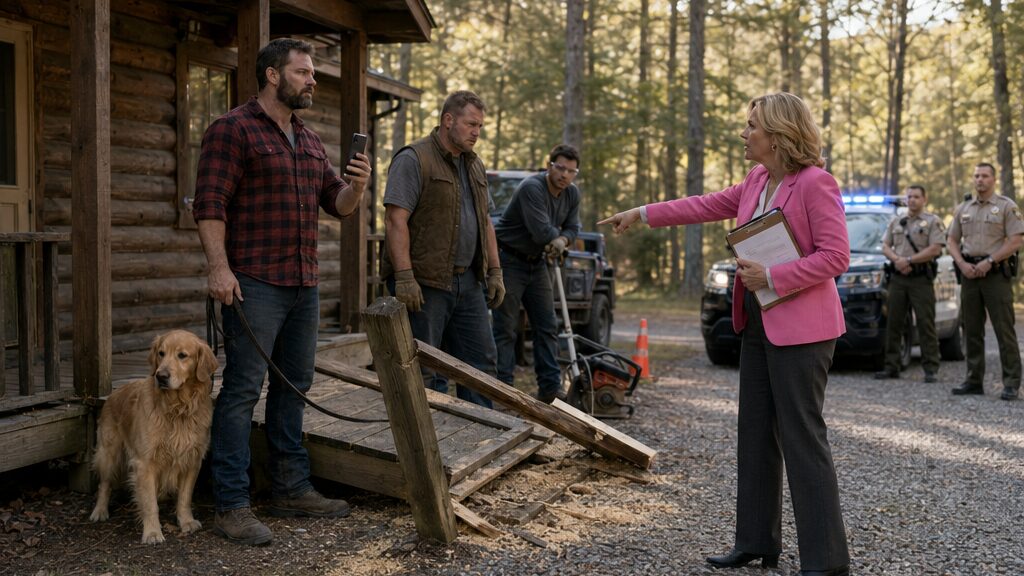
They Tore Out His Cabin Ramp Then Gave Him Seventy-Two Hours To Sell
Chapter 1: The Crew Was Already Pulling Out The Ramp
The saw started before Edward Carter reached the porch.
Its scream cut through the morning air, sharp enough to pull the golden retriever hard against the leash. Edward had one boot on the gravel and one hand still on the cabin door when he saw the first board of the ramp jerk loose under a worker’s pry bar.
“Hey!” His voice came out lower than he expected. “Stop.”
The worker looked up, not at Edward, but past him.
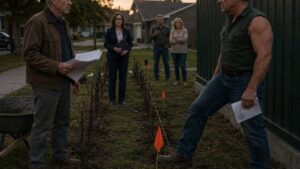
A white pickup sat sideways in the driveway, blocking the turn toward the road. Two men in work gloves stood near the porch, one crouched beside the ramp posts, the other feeding an extension cord from a generator that coughed beside the truck. Orange cones had been placed along the gravel like this was a job site, not Edward’s front yard.
Behind the pickup, blue lights flashed silently from a sheriff’s vehicle parked at the edge of the trees.
Edward tightened his grip on the leash. The retriever pressed against his leg, nervous but obedient, his tail low.
“Put the board down,” Edward said.
The crouched worker froze again, then straightened slowly. “You need to speak to the supervisor.”
“I’m speaking to the man holding the tool.”
A woman’s voice came from the driveway. “Mr. Carter, you were notified.”
Edward turned.
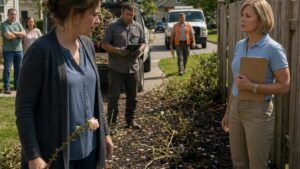
Christine Allen walked toward him in a bright pink blazer that looked absurdly clean against the damp gravel and sawdust. Her blonde hair was smooth, her mouth set in the hard line of someone who had rehearsed being reasonable and arrived ready to be offended. In one hand she held a clipboard. In the other, a folded paper.
Behind her stood Robert Brown, broad-shouldered, work vest zipped to the neck, his eyes moving between Edward and the crew like he was measuring the distance to a problem. Two sheriff’s deputies remained near their cruiser, arms loose, faces blank.
Edward looked from Christine to the torn board, then to the ramp posts he had set himself three weeks earlier. The wood still showed fresh cuts where he had trimmed it in the driveway. He could remember Virginia watching through the front window, telling him he was making it too nice, that she only needed something steady under her feet.
“Notified of what?” Edward asked.
Christine held out the paper without stepping close enough for him to take it. “Enforcement of the association’s exterior modification rules. Section nine. Unapproved structure. Improper materials. Liability exposure.”
“It’s a ramp.”
“It is an exterior structure.”
“It is attached to my home.”
“That is exactly the problem.”
Edward felt the leash twist around his wrist as the dog shifted at the saw’s smell and noise. He unwound it carefully, buying himself one second before his temper could do something stupid with his mouth.
“This ramp is not decorative,” he said.
Christine’s gaze flicked toward the porch, then back to his face. “That should have been explained in a complete application before installation.”
“I submitted the application.”
“You submitted an incomplete request.”
“You never answered it.”
“We are answering it now.” She turned her head slightly. “Mr. Brown, continue.”
Robert did not move. One of his workers looked down at the tool, then at Edward, then at Robert.
Edward stepped forward, putting himself between the crew and the remaining rail. The retriever came with him, shoulder pressed against his knee.
“You touch another board,” Edward said, “and I want the order in writing first.”
Christine’s face tightened. “You are holding it.”
“I want the order that says you can come onto my property and tear out a medical accommodation while someone is still living behind that door.”
The word medical landed harder than he intended.
Christine’s eyes sharpened. One deputy shifted near the cruiser. Robert looked at the ramp again, this time more carefully.
“Mr. Carter,” Christine said, “do not introduce new claims after enforcement has begun.”
“New to you is not the same as new.”
“You were instructed not to install until approval.”
“My aunt needed a way in and out of the cabin.”
Christine lifted the clipboard like a shield. “The board cannot evaluate private claims that were not properly documented.”
“Then pause the work and evaluate them.”
“That is not how this process works.”
Edward let go of the porch post only long enough to pull his phone from his shirt pocket. He opened the camera and raised it, not close to Christine’s face, not dramatically, just high enough to catch the ramp, the crew, the police lights, and her pink blazer in the same frame.
Christine’s expression changed. Not fear. Calculation.
“Are you recording me?” she asked.
“I’m recording the removal of my property.”
“You do not have permission to record association enforcement.”
“I’m standing on my land.”
“This community has rules.”
“This ramp kept someone from falling down those steps.”
A worker shifted his weight behind Robert, and the loose board scraped against the ramp frame. The sound made Edward’s jaw lock. He did not look back. If he looked at the missing piece too long, he would think about Virginia’s hand gripping the rail, her breath stopping halfway down the porch, the way she hated being watched when her legs refused to trust her.
Christine pointed at him then, one sharp finger out from the clipboard.
“This is not about feelings, Mr. Carter. It is about compliance. You installed a visible exterior modification without approval. You ignored the first violation letter. You refused access to inspect the full structure. You created potential liability for the association.”
“I refused to let three people walk through my house.”
“We requested access to verify the condition.”
“You requested access after you had already decided it was coming down.”
“That is false.”
“Say it on camera.”
Her lips parted.
Edward held the phone steady. “Say you did not send a crew here today to remove this ramp before giving me a chance to appeal.”
Christine glanced toward the deputies. One of them raised a hand slightly, not intervening, just signaling that he did not want to be dragged into the sentence.
“This is a civil matter,” the deputy said. “We’re only here to keep the peace.”
Edward did not lower the phone. “Then keep it by making them stop.”
The deputy’s face held no cruelty. That almost made it worse. “We can’t adjudicate association rules on site.”
Christine seized the opening. “Exactly. The association has documented authority. Mr. Brown’s crew is authorized to remove the noncompliant structure. If you obstruct them, you may create additional liability for yourself.”
Robert cleared his throat. “Ms. Allen, maybe we should pause until—”
“No,” Christine said.
The word snapped across the driveway.
Edward turned his phone slightly so Robert was still in frame. “You heard her.”
Robert looked away.
Christine stepped closer, close enough now that the paper in her hand trembled with her movement. “Mr. Carter, I am going to make this very clear. The partial removal today is enforcement. You will remove the remainder of the structure, submit a compliant correction plan, and pay the initial cost of remediation.”
“I’m not removing a ramp that someone needs to leave this cabin.”
“Then the association will proceed.”
“With what?”
“With fines, lien filing, and referral for forced compliance. Given the condition and your refusal, Mr. Clark has advised that voluntary sale may be the least damaging path for you.”
Edward almost laughed, but nothing about the moment had room for it.
“Brandon Clark advised me to sell my home?”
“He advised the board regarding risk exposure.”
“He’s a real estate broker.”
“He is the treasurer.”
“He wants listings.”
Christine’s eyes flashed. “You have seventy-two hours to remove the rest or sell before the lien filing starts.”
The retriever gave a low whine.
Edward’s hand tightened around the leash until the nylon cut into his palm. He kept the phone up. He kept his feet planted in front of the broken ramp. He kept his voice quiet enough that everyone in the driveway had to listen.
“Say that again,” he said.
Christine stared at him, then at the phone, then at the half-dismantled ramp between them.
“You heard me.”
Chapter 2: The Empty Porch Step Nobody Could Cross
Virginia Carter stood inside the open doorway, staring at the place where the ramp no longer met the porch.
Edward saw her before she saw him. One hand braced against the inside wall, the other on the doorframe, her body held in that careful stillness people use when one wrong step can turn a room into a trap. Beyond her, the cabin smelled of coffee gone cold and the lavender soap she kept by the kitchen sink. Outside, sawdust clung to the damp boards like pale dirt.
“Don’t come closer,” Edward said.
Virginia’s eyes moved from the broken ramp to his face. “I can see that.”
The crew had left an hour earlier after Robert decided, against Christine’s tight-lipped objection, that the remaining section would require “additional equipment.” The deputies had driven away without looking back. Christine had handed Edward another copy of the notice before leaving, as if paper could make the ripped-out boards less real.
Now the first three feet of the ramp were gone. What remained was an awkward drop from the porch to the gravel, with metal brackets exposed and splinters lifted where workers had pried boards loose. The rail leaned at an angle, still bolted to the upper landing, useless without the section below.
Edward moved toward the doorway. “I’ll carry you down.”
“No.”
“It’s your appointment.”
“I said no.”
Her voice was steady, but he could see the frustration under it. She hated being carried. She hated needing the ramp. She hated, most of all, anyone watching her decide which humiliation was smaller.
The golden retriever nudged her knee from inside the doorway, then looked back at Edward as if waiting for a command that would make humans reasonable again.
Edward rubbed his thumb against the raw mark the leash had left in his palm. “They should never have touched it.”
Virginia looked past him to the orange cone lying on its side near the gravel. “Did they know?”
He did not answer quickly enough.
Her mouth tightened. “Edward.”
“I told them it was medical.”
“Today?”
He stepped onto the porch, careful not to bump the damaged rail. “I put it in the application.”
“You put what in the application?”
“That it was for access. Safety access.”
Virginia closed her eyes.
“I promised you,” he said. “I promised I wouldn’t make your private business into some neighborhood file.”
“You also promised I’d be able to get out the front door.”
That landed worse because she did not raise her voice.
Edward looked down at the torn brackets. Three weeks earlier, he had measured the slope twice, then built it after dark when the heat dropped and Virginia had gone to bed. He had told himself he was not breaking rules. He was preventing a fall. He was letting his aunt stay in the cabin she had helped him keep after his parents were gone. He had sent the request. He had waited ten days. Then she had nearly missed the bottom step, and waiting had become impossible.
“I’ll reschedule the appointment,” he said.
Virginia laughed once, soft and bitter. “You can reschedule the appointment. Can you reschedule needing to leave?”
He went inside and closed the door most of the way, leaving enough space for light. The cabin seemed smaller with the ramp broken. The front room still held the same things: the plaid blanket over Virginia’s chair, the basket of dog toys, the old framed photograph of the cabin before the porch was widened. But the doorway had changed. It was no longer an entrance. It was an edge.
Edward set the violation packet on the kitchen table. Christine’s words sat at the top in bold type: UNAPPROVED EXTERIOR STRUCTURE — REMOVAL ENFORCEMENT INITIATED.
Virginia lowered herself into the chair by the window. She did it slowly, pretending the effort was routine. “What did the deputies say?”
“That it was civil.”
“Everything’s civil when it isn’t happening to them.”
Edward opened his laptop. “I have the email.”
“Which email?”
“The one from the HOA. They received the request.”
He searched his inbox with fingers that hit the keys too hard. Ramp. Modification. Access. HOA. Nothing. Then he remembered the subject line had not used any of those words. It had been something empty and cheerful, the kind Patricia Flores always sent from the HOA office.
Community Design Submission Received.
“There,” he said.
Virginia leaned forward despite herself.
Edward opened it. The email was dated four weeks earlier. Patricia’s signature was at the bottom, polite and automatic.
Your exterior change request has been received and routed for initial review. Incomplete applications may be returned for additional documentation.
Edward read it twice. The first time, it felt like proof. The second time, the last sentence grew teeth.
Virginia saw it too.
“Incomplete,” she said.
“That’s standard language.”
“Is it?”
He opened the attachment he had sent. A one-page request form. A sketch of the ramp. Measurements. Lumber type. A brief description: temporary access ramp and stabilizing rail for family safety.
No medical letter.
No diagnosis.
No physician recommendation.
No note saying Virginia could not safely use stairs.
He felt heat crawl up his neck. “I thought if I wrote medical, they’d ask for everything.”
“They probably would have.”
“You told me not to.”
“I told you I didn’t want people discussing me over coffee.”
“I was trying to respect that.”
She looked at him for a long moment. “I know.”
That made it harder.
He wanted her to be angry. Anger would let him stand against something. Instead, she sat by the window looking tired, and the broken ramp outside made both of them guilty in different directions.
The dog rested his chin on Virginia’s knee. She laid a hand on his head without looking away from the screen.
Edward opened the notice again. “Emergency board hearing tonight.”
Virginia’s hand stopped moving. “Tonight?”
“It was delivered after they left.” He turned the page toward her. “Seven-thirty. Community lodge. Final compliance review.”
“That’s not much time.”
“That’s the point.”
She looked toward the doorway. “What will you tell them?”
He held the paper in both hands. Christine’s neat signature sat above the printed deadline. Seventy-two hours. Remove or face escalation. The words looked official because they were aligned properly.
“I’ll tell them the ramp is necessary.”
“And when they ask why?”
Edward folded the paper once, then flattened it again. “I’ll say enough.”
Virginia’s face changed in a way he knew too well: not fear exactly, but the old reflex of being reduced to the thing she could no longer do. “Enough for who?”
Before he could answer, tires crunched outside.
Edward stood so quickly the chair legs scraped the floor. Through the front window, he saw a neighbor’s car slow by the driveway, then another behind it. Not stopping. Looking. The broken ramp had become something to drive past.
Then a white envelope slid under the front door.
Edward crossed the room and picked it up.
No stamp. No mailing address. Just his name written across the front in block letters.
Inside was a second notice, printed on HOA letterhead, marked in red at the top.
EMERGENCY BOARD HEARING — ATTENDANCE STRONGLY ADVISED.
Virginia read it over his shoulder.
Edward felt the silence between them shift from private shame into something larger, something with chairs and fluorescent lights and neighbors waiting to decide whether their front door mattered.
Chapter 3: The Pink Blazer Called It A Structure
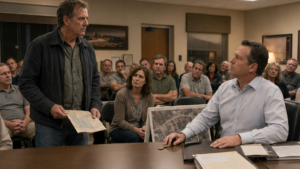
Edward walked into the lodge and saw his cabin already on the wall.
The projector showed a blown-up photograph of his front porch, the ramp circled in red, the image bright enough that every scraped board and uneven gravel patch looked worse than it was. Someone had taken the picture from low in the driveway, angling upward, making the ramp seem larger, heavier, almost aggressive. In the bottom corner of the image, the golden retriever’s tail was a blurred streak near the door.
Chairs had been arranged in rows facing the long board table. Neighbors filled most of them, jackets folded over laps, phones glowing low in hands. A few turned when Edward entered. Most pretended not to.
Christine Allen sat at the center of the table in the same pink blazer, as if the morning had not left sawdust on anyone. Patricia Flores sat near the end with a laptop open and a stack of folders beside her. Brandon Clark leaned back in his chair, hands folded over his belt, wearing the calm expression of a man prepared to sound practical.
Edward stood at the back for one second too long.
Then Christine looked up. “Mr. Carter. We were just reviewing the violation history.”
“You started without me.”
“This is an emergency review, not a trial.”
He walked down the center aisle with the packet tucked under his arm. His boots sounded too loud on the wood floor. He had left Virginia at home with the dog and the side phone line open in case she needed him. She had insisted he go alone. Not because she trusted the board, but because she knew the sight of her struggling into that room would turn her into the argument before she agreed to be one.
Edward took the empty chair facing the board.
Christine clicked a remote. The next slide appeared: a close-up of the ramp rail, then another of the posts, then another of the torn board from that morning.
“Let the record show Mr. Carter is present,” Christine said.
Patricia’s fingers moved on the keyboard. “Present,” she said softly.
Christine turned to the room. “We are here because an exterior structure was installed without complete approval, after repeated community reminders that modifications visible from common roads must be submitted and approved prior to construction.”
Edward looked at the projected photograph. “It’s a ramp.”
Christine did not look at him. “The structure includes a sloped platform, railing, post supports, and attached hardware.”
“A ramp.”
Brandon leaned forward. “No one disputes what you call it, Edward. The issue is whether it was approved.”
A murmur moved through the room. Edward recognized some faces from mailboxes and winter road meetings. People who had waved at him for years now looked at the photograph like it had arrived from a stranger’s property.
Christine opened a folder. “Mr. Carter submitted a design request. That request did not include required material samples, engineering confirmation, contractor information, or documentation for any claimed exception. The board did not approve it. Nevertheless, installation proceeded.”
“I waited,” Edward said.
“For approval?”
“For an answer.”
“You cannot treat silence as approval.”
“You can’t treat a needed repair as trespassing.”
Christine’s mouth tightened. “Please do not mischaracterize enforcement.”
Edward took out the printed email and set it on the table. “Your office received my request four weeks ago.”
Patricia looked up at once.
Christine glanced toward her. “Received does not mean approved.”
“I didn’t say it did. I said you received it.”
Patricia’s hands hovered over the keyboard.
Edward saw it. A pause so small no one else seemed to notice, but it was there. Her eyes dropped to the folder stack, then to Christine, then back to the laptop.
Christine continued. “The request was incomplete.”
“Who told me that?”
“The process states incomplete requests may be returned.”
“Was mine returned?”
Patricia swallowed.
Christine turned one page. “Mr. Carter, the burden is on the homeowner to submit a compliant application.”
Edward looked at Patricia. “Was it returned?”
The room shifted. Someone in the second row whispered. Patricia touched the edge of a folder but did not open it.
Christine’s voice cooled. “This is not an interrogation of staff.”
“It’s my porch on the wall.”
“It is a violation under review.”
“It is where someone has to get in and out of the house.”
Brandon exhaled, audible enough to draw attention. “Edward, nobody wants anyone unsafe. But there are ways to handle these things. There are temporary facilities. There are professional contractors. There are other housing options if the property can’t be brought into compliance economically.”
Edward turned to him. “Other housing options.”
Brandon held up both hands. “I’m saying, as treasurer, that fines and remediation can stack quickly. Sometimes voluntary sale is better than letting a property get buried under enforcement costs.”
There it was again, dressed more politely than Christine had said it in the driveway.
Edward felt every face in the room watching him decide whether to explode.
He did not.
“My cabin is not failing because I built a ramp,” he said.
“No one said failing,” Brandon replied.
“You just priced me out of it in front of the room.”
Brandon’s expression stayed smooth. “I’m being realistic.”
Christine tapped the table once. “Let us return to the issue. Mr. Carter, are you prepared tonight to provide complete documentation showing this structure was medically required and properly constructed?”
Edward thought of Virginia in her chair by the window. Her voice from that afternoon: Enough for who?
He had brought the email. He had brought the sketch. He had brought the form with the blank space where the medical letter should have been. In his truck, inside the glove compartment, he had the sealed envelope from the clinic because Virginia had made him take it “just in case.” He had promised he would not open it unless she said so.
The whole room waited.
He could feel his pride trying to disguise itself as loyalty.
“It is for family access,” he said.
Christine’s eyebrows lifted slightly. “That is not documentation.”
“It is a necessary safety modification.”
“Again, that is a claim.”
A man in the back row muttered, “Rules are rules,” not loudly, but not quietly enough.
Edward turned halfway in his chair. The man looked away.
Christine clicked to another slide. The ramp photograph appeared again, circled red. “The association cannot operate on unverified private claims. If we make exceptions because someone says a structure is needed, then exterior standards become meaningless.”
Patricia’s fingers moved, then stopped.
Edward saw her look at a folder marked with his lot number.
“You have something,” he said.
Patricia froze.
Christine’s head snapped toward him. “Mr. Carter.”
He kept his eyes on Patricia. “You have a file.”
Patricia opened her mouth, closed it, then said, “There is an intake record.”
Christine’s hand flattened on the table. “The intake record is not before the board tonight.”
“Why not?” Edward asked.
“Because the review concerns the installed structure.”
“The application is about the structure.”
Christine’s voice lowered. “The application was incomplete.”
“But it existed.”
The room shifted again, this time more openly. A neighbor in the front row leaned toward another. Brandon’s jaw tightened.
Patricia looked down at her laptop. “The request was received. It was flagged for missing documentation.”
Edward waited.
She added, quieter, “I do not see a return notice in the sent log.”
For the first time all evening, Christine said nothing.
Edward should have felt victory. Instead he felt the floor tilt. The board had received the request. The office had flagged it. No one had returned it. And because he had stayed quiet, because he had tried to protect Virginia by saying almost nothing, Christine still had enough room to call the ramp unauthorized and the room still had enough doubt to let her.
Brandon leaned forward again. “That may be an administrative gap, but it does not approve construction.”
Christine found her voice. “Correct. The absence of a return notice does not grant permission. The board has to consider risk to the association, consistency of enforcement, and exterior standards.”
Edward looked at the projected ramp. In the photograph, the rail caught morning light. It had looked solid then. It had looked like an answer.
Christine gathered the papers into a neat stack. “I move that the violation be upheld pending final compliance review, with removal requirements remaining in effect.”
Patricia stared at her laptop.
Brandon seconded.
The vote moved quickly after that. Too quickly for the size of what it did. A few board members hesitated. One asked whether the medical issue should be reviewed first. Christine answered that no complete documentation had been submitted. Brandon added that delay increased liability. Patricia recorded each response in a voice gone small.
The motion passed.
Edward did not move when Christine announced it. He watched his cabin remain on the wall, bright and circled and judged.
“Mr. Carter,” Christine said, “you may submit additional documentation before final review.”
“When?”
“Before the enforcement deadline.”
“Seventy-two hours.”
“Less now.”
He stood, gathering his papers with hands that wanted to shake and refused.
At the door, Patricia called his name.
He turned.
She was still seated, but her face had lost the careful blankness she had worn all evening. One hand rested on the folder with his lot number.
“I’m sorry,” she said, too quietly for the room to own it.
Edward looked at the folder, then at Christine, then at the red circle around his ramp still glowing on the wall behind them.
“Don’t be sorry,” he said. “Find out where my application we
Chapter 4: The Application Was Not Missing After All
Robert Brown’s crew truck was parked at the entrance road before Edward finished his first cup of coffee.
He saw it through the trees when he stepped onto the damaged porch, white cab half-hidden behind the cedar sign for the community, trailer hitched behind it, lumber racks empty except for a coil of orange cord. It was too far away to be working at his cabin. Too close to be coincidence.
The golden retriever pressed his nose against Edward’s thigh and gave a quiet, uncertain huff.
“I see it,” Edward said.
Inside, Virginia called from the kitchen table, “See what?”
“Nothing yet.”
He hated the lie the instant it left his mouth. Not because it was large. Because it was the kind of small protection he kept mistaking for kindness.
He took a photograph of the truck from the porch, then another of the missing ramp section, then another of the metal brackets left exposed where Virginia’s foot would have needed to pass. The morning air smelled like damp pine and old sawdust. The porch still looked wounded, not broken by weather or age, but interrupted.
His phone buzzed.
Unknown number.
He answered without speaking.
“Mr. Carter?” Robert Brown’s voice sounded rougher without Christine beside him. “This is Robert. From yesterday.”
Edward looked toward the entrance road. “You waiting down there for a reason?”
There was a pause. “We were told not to approach until further notice.”
“Whose notice?”
“Ms. Allen’s.”
“Then why are you here?”
Another pause. “Because the job order still says removal pending.”
Edward closed his eyes once, opened them. “Don’t come onto my property today.”
“I’m not planning to. I wanted you to know the truck’s not meant to scare anybody.”
“It’s doing a poor job of that.”
Robert exhaled. “Yeah. I figured.”
The call ended without either of them saying goodbye.
Edward drove to the HOA office with the violation packet on the passenger seat and the dog leash coiled beside it. Virginia had wanted him to bring the retriever, then changed her mind at the door.
“If you bring him,” she said, “they’ll think you’re trying to look harmless.”
“I am harmless.”
“No,” she said. “You’re angry. Bring papers.”
The HOA office occupied the side wing of the community lodge, a room with a glass door, a fake plant, and framed photographs of seasonal clean-up days. Patricia Flores sat behind a desk with three file boxes stacked on the floor beside her. When she saw Edward through the glass, she stood too quickly, bumping her knee against the desk.
He opened the door. “I need my file.”
“Edward—”
“My full file. Not the slides. Not Christine’s packet. Everything your office has.”
Patricia looked toward the closed interior door behind her. “Christine isn’t here.”
“I didn’t ask for Christine.”
Her hands folded, then unfolded. “I can provide homeowner records through a formal request.”
“I’m making one.”
“It has to be in writing.”
He took a blank sheet from the printer tray and wrote: Request for all records concerning Lot 18 exterior modification application, ramp, enforcement, inspection, removal, and board review. He dated it, signed it, and slid it across the desk.
Patricia looked at the page as if it might burn her if she touched it.
“Please,” Edward said. “Don’t make me guess what happened to my own request.”
That did what anger had not. Her shoulders lowered a fraction.
She took the paper and opened a drawer. “I can show you the intake log. Copies have to be approved.”
“By Christine?”
“By the records policy.”
“Patricia.”
She stopped with her fingers on a folder tab.
He kept his voice low. “Last night you said there was no return notice in the sent log.”
“I said I didn’t see one.”
“Was the application logged before they cited me?”
Patricia pulled one folder from the drawer. His lot number was printed on the label. Under it, in smaller handwriting, someone had written: porch/ramp access.
She opened it just wide enough for him to see the top page.
There was his application, stamped RECEIVED. Four weeks earlier. Below the stamp, a yellow note had been attached.
Missing: medical documentation, contractor license, material sample. Hold for additional information.
Edward leaned closer. “Who wrote that?”
“I did.”
“Why didn’t you send it back?”
“I thought Christine was going to review whether it qualified for expedited accommodation first.”
“Did she?”
Patricia’s eyes moved to the interior door again, though no one was behind it. “She took the folder after the insurance call.”
“What insurance call?”
“The board’s renewal review. There were concerns about unapproved structures. Decks, sheds, short-term rental stairs. Yours got pulled into the same discussion.”
“It isn’t a rental stair.”
“I know.”
“Did you know yesterday?”
Her face flushed. “I knew it said access.”
“That’s not what I asked.”
Patricia closed the folder slowly. “I did not know who it was for.”
Edward almost said, Because I didn’t tell you. He swallowed it because it was true and because the truth did not let her off the hook.
“You marked it incomplete,” he said. “Then nobody told me.”
“I should have followed up.”
“Why didn’t you?”
Patricia looked down at the folder. “Because Christine said she would handle it.”
There was the small payoff, if proof of neglect could be called that. He had not imagined the submission. He had not built first and lied later. The file existed. The stamp existed. The silence existed too.
“Can I have a copy of that log?”
“I can’t give copies without approval.”
“Can I take a picture?”
“No.”
“Patricia.”
Her voice dropped. “I can read you the entry.”
He took out his phone and typed as she read the date, time, lot number, application type, and the note: received, incomplete, pending review.
When he finished, she added, “There’s something else.”
Edward looked up.
“The removal order was created after the hearing notice, but before the final hearing.”
“Before last night?”
She nodded.
“So last night was theater.”
“I’m not saying that.”
“But the order already existed.”
“I’m saying the draft existed.”
He put his phone away. “That distinction must be comforting in meetings.”
He left before she could answer.
At the county records desk, the clerk listened with the blank patience of someone who had heard every version of property panic. Edward showed the application, the photos, the violation, the medical wording he had used. The clerk did not react to Christine’s letterhead or Brandon’s sale language. He reacted to the word accommodation.
“HOA design approval and accessibility accommodation review aren’t the same thing,” the clerk said, tapping the counter once. “They can have exterior standards. They cannot use those standards to ignore a legitimate accommodation request.”
“They say I didn’t submit enough.”
“Maybe you didn’t. But if they had notice of a possible accommodation, they should have told you exactly what was needed before enforcement. Especially before tearing out anything that affects access.”
Edward stared at the counter. “What do I need now?”
“A complete packet. Medical necessity letter, description of the functional need, construction plan, safety measurements. Ask for emergency reconsideration in writing. Not a general appeal. Use the word accommodation.”
Edward wrote every word down.
When he returned to the cabin, the crew truck was gone from the entrance road. For one breath, the driveway looked almost normal, except for the broken ramp and the scrape marks in the gravel where the trailer had turned around.
Virginia was at the table, the sealed clinic envelope beside her hand.
“Did they have it?” she asked.
“They had it.”
She closed her eyes.
“They marked it incomplete and never sent it back.”
“That helps?”
“It helps enough to prove I wasn’t lying. Not enough to stop them by itself.”
Her fingers rested on the clinic envelope but did not push it toward him.
His phone buzzed.
This time the number was Christine’s.
He did not answer. A text appeared instead.
Full removal resumes tomorrow at 7:00 a.m. Failure to comply will be documented for lien review.
Edward read it twice. Then he turned the screen toward Virginia.
The sealed envelope sat between them like a door neither of them had opened.
Chapter 5: The Compromise Still Left Her Trapped
Robert arrived at 6:43 the next morning with replacement materials Edward had never approved.
The truck eased into the driveway without the trailer this time, carrying two narrow railing sections, a stack of short boards, and a bundle of posts too small to support anything more than a decorative step. Robert stepped out alone and kept both hands visible, as if approaching a dog that might bite. The golden retriever stood beside Edward on the porch, leash loose but ready.
“I’m not here to remove anything yet,” Robert said.
Edward looked at the boards in the truck bed. “Then what are those?”
“Proposed correction materials.”
“Proposed by who?”
Robert reached into the cab and took out a rolled sheet. “Board call at eight. Ms. Allen asked me to bring this so you could see the compliant option.”
Edward did not step down. There was still no safe way to do it without using the side path through the mud. “Bring it here.”
Robert glanced at the broken gap, then climbed carefully onto the porch from the side, avoiding the torn brackets. He unrolled the paper against the cabin wall.
The sketch showed a tidy front step with a short rail on one side, stained dark brown to match the porch. It looked neat. It looked normal. It also ended in two steps.
Edward stared at it.
Robert said nothing.
“You know this doesn’t work,” Edward said.
“I build what they approve.”
“That wasn’t my question.”
Robert rubbed the back of his neck. “No. It doesn’t work as a ramp.”
“It doesn’t work as access.”
“No.”
Edward rolled the paper back with more care than it deserved. “Then why bring it?”
“Because they’ll say they offered a compromise.”
A car door shut behind them.
Christine Allen walked up the gravel in her pink blazer, a phone pressed to one ear, Brandon Clark beside her with a folder tucked under his arm. No deputies this time. No flashing lights. Somehow that made the morning feel less official and more dangerous, as if they were trying to make what happened next look routine.
Christine lowered the phone. “Mr. Carter, thank you for being available.”
“I live here.”
“This is a temporary board consultation. We are attempting to avoid further escalation.”
“You sent a sketch for a step rail.”
“A compliant step rail.”
“I asked for a ramp.”
“You installed a ramp without approval.”
“I submitted an accommodation request.”
Christine’s jaw tightened at the word accommodation. “You submitted an incomplete design request with vague language.”
“Because no one told me what was missing.”
Brandon opened his folder. “Edward, let’s talk practically. The board is trying to give you a way to cure the violation without full cost exposure.”
“By replacing access with decoration.”
“That’s an unfair way to phrase it.”
“It has steps.”
“Most homes do,” Brandon said.
Edward looked at him until Brandon’s expression shifted.
Christine lifted the sketch. “This rail matches the community standard. It reduces visual impact and limits liability. If a permanent ramp is later approved through proper channels, that can be reviewed.”
“Later,” Edward said.
“Yes.”
“What does the person inside do until later?”
Christine’s face flickered. “Again, you keep referencing an unnamed person and an unspecified condition. We cannot govern by hints.”
Edward almost reached for the clinic envelope in his back pocket.
Almost.
Virginia’s voice from the night before stopped him: Don’t turn me into a sob story because you’re cornered.
He held his hand still.
“I can submit the complete packet today,” he said.
“Then do so.”
“And the removal?”
“The violation remains active.”
“So you’ll tear out the rest before reviewing the packet.”
“We will enforce the current violation while reviewing any new material.”
“That’s not review. That’s punishment with paperwork.”
Christine’s eyes hardened. “Mr. Carter, the board has been more patient than many associations would be. You installed first. You avoided inspection. You withheld documentation. Now you object to every correction offered.”
Robert looked away.
Brandon stepped closer, lowering his voice into something almost friendly. “There’s another option. I know you don’t want to hear it, but it may be time to consider whether this property still fits your situation.”
Edward slowly turned toward him. “My situation.”
“You’re facing fines, removal costs, possible contractor charges, and if the structure issue opens broader inspection, there may be porch compliance problems too. I can connect you with buyers who’d take it as-is before this gets more expensive.”
Christine said, “Brandon.”
He held up a hand. “As treasurer, I’m talking about exposure.”
“As a broker, you’re talking about a listing,” Edward said.
Brandon’s polite mask thinned. “I’m talking about not letting pride bury you.”
The word pride hit too close to miss.
Edward looked past him, through the front window, and saw Virginia in her chair. She could not hear every word, but she could see the sketch in Christine’s hand. She could see the men standing on the porch. She could see the boards in the truck that would make her doorway look acceptable to everyone except her.
Edward took the sketch from Christine and laid it across the broken ramp gap.
It fit the space on paper. It failed the house in every other way.
“No,” he said.
Christine inhaled. “Then you are refusing a reasonable correction.”
“I’m refusing a correction that traps someone inside.”
“That is your characterization.”
“It is the measurement.”
He took the tape measure from the porch shelf where he had left it after building the ramp and extended it down the gap, marking the rise from porch to gravel. “Here. This drop. These steps. This turning radius. A rail doesn’t change any of that.”
Brandon looked bored. Christine looked annoyed. Robert looked at the measurement.
Edward handed the tape measure to him. “Tell them.”
Robert froze.
Christine’s voice sharpened. “Mr. Brown is not the design committee.”
“No,” Robert said quietly. “But he’s right. This doesn’t replace a ramp.”
The driveway went still.
Christine stared at Robert as if he had dropped a tool through a window. “Your job is to execute approved work.”
“And that drawing is approved work,” Robert said. “But it’s not access.”
Brandon closed his folder. “This is becoming unproductive.”
“No,” Edward said. “This is the first useful thing anyone’s said.”
Christine rolled up the sketch. “The offer remains available until five o’clock. If you decline, enforcement proceeds.”
They left with the replacement materials still in the truck.
Inside, Virginia was waiting with the clinic envelope on the table.
“You heard?” Edward asked.
“Enough.”
“I didn’t open it.”
“I know.”
He sat across from her. The house felt too quiet after the driveway voices. Even the dog lay down without a sound, chin on his paws, leash trailing beside him.
Virginia pushed the sealed envelope an inch toward Edward, then stopped.
“If you use that,” she said, “they’ll all know.”
“Only what they need.”
“That isn’t how people work.”
“No.”
She looked toward the door. “I moved here because I wanted to still be a person in a house, not a condition in a room.”
“I know.”
“Do you?” Her eyes came back to him, sharper than her voice. “Because every time you say you’re protecting me, you make decisions around me. You built the ramp at night. You sent the form your way. You stood in that room and tried to talk about me without saying me.”
Edward had no defense that did not sound like the thing she had accused him of.
“I was trying to keep my promise,” he said.
“You were trying to keep me invisible.”
The words were not cruel. They were worse. They were accurate.
Outside, gravel crunched as a car slowed near the driveway, then moved on.
Virginia looked at the envelope. “I don’t want them pitying me.”
“I won’t ask for pity.”
“I don’t want whispers.”
“I can’t promise there won’t be any.”
“I don’t want to be the reason you lose this cabin.”
Edward leaned back, the chair creaking under him. “This cabin is not worth keeping if the front door becomes something you apologize for.”
Her face tightened, but she did not look away.
He picked up the envelope and held it between them, unopened.
“I need your permission,” he said. “Not because I need a better argument. Because if I do this without you, I’m no better than the people deciding around us.”
Virginia stared at the envelope for a long time.
Then she put her hand over his, not pushing it open, not taking it back.
“Ask me again after you find out who wants you to sell,” she said.
Chapter 6: The Sale Pressure Had A Name
Brandon Clark’s name was printed at the bottom of a draft buyout estimate Edward found tucked behind the wrong tab.
It should not have been in the HOA records box at all. The folder Patricia had let him review that afternoon was labeled insurance correspondence, and most of it was exactly that: renewal notices, photographs of decks, notes about loose stairs and rental cabins, pages of concerns written in language so dull it made risk sound like weather.
Then Edward turned one page and saw his address.
Lot 18 — potential voluntary disposition before enforcement escalation.
Beneath it was a rough value range for the cabin, lower than any honest estimate Edward had seen in years. Below that, a note: buyer interest possible if owner avoids lien complications.
The initials at the bottom were B.C.
Edward looked up from the records table.
Patricia stood beside the copy machine, arms folded tight. “That was not supposed to be in that box.”
“No,” Edward said. “I imagine not.”
“It may have been attached to the treasurer’s insurance notes by mistake.”
“Brandon’s notes.”
She did not answer.
Edward took out his phone. Patricia stepped forward.
“I can’t let you photograph internal financial drafts.”
“You can let my house be discussed as a distressed listing?”
“That is not what I said.”
“It’s what the paper says.”
Her face had gone pale. “Edward, if I lose this job—”
He stopped. The anger in him wanted to run straight over that sentence. The better part of him, the part Virginia still trusted on good days, made him wait.
“I’m not trying to get you fired,” he said. “But I’m done being the only person expected to absorb consequences quietly.”
Patricia looked down at the draft. “I kept thinking someone else would slow it down.”
“Who?”
“Christine. The board. Brandon if he realized how bad it looked.” She gave a small, humorless breath. “That sounds ridiculous when I say it.”
“It sounded ridiculous before.”
She pulled the page from the folder and placed it face down. “I can’t give you that.”
“Then give me what I can have.”
“The intake log. The notice timeline. The meeting minutes after they’re approved.”
“I need them before the deadline.”
“I can print the intake log.”
It was not enough. It was also more than she had offered the night before.
Edward nodded once.
While the printer warmed, his phone buzzed. Robert.
He answered in the hallway outside the records room.
“You alone?” Robert asked.
“Close enough.”
“I’m at the hardware lot. I just got tomorrow’s revised work order.”
Edward’s hand tightened around the phone. “For my place?”
“Full removal. Seven sharp. It says notice served prior to arrival.”
“It wasn’t.”
“I know.”
Edward went still.
Robert’s voice dropped. “Yesterday, we were told to be on-site by eight. Ms. Allen handed you the notice after we had already started loosening boards.”
“Will you say that?”
Silence.
Through the glass wall, Edward could see Patricia watching him. The printer clicked behind her.
Robert said, “I’ve got a business, Edward.”
“I’ve got someone who can’t use her front door.”
“I know that now.”
“You knew it yesterday when I said medical accommodation.”
“I knew what you said. I didn’t know what was true.”
Edward closed his eyes. He thought of Robert’s face when he had looked at the compliant rail sketch. Not heroic. Not eager. Just a man who had built enough things to know when a thing would not work.
“What changed?” Edward asked.
“My sister used a ramp after surgery,” Robert said. “Temporary, six months. If somebody had torn it out because the stain didn’t match, my father would have lost his mind.”
“Will you say the crew started before notice?”
Another long pause.
“I’ll say it if I’m asked in a formal review,” Robert said. “I won’t go on some neighborhood warpath.”
“That’s enough.”
“It may not be.”
“No,” Edward said. “But it’s something.”
When he returned to the records room, Patricia had placed three pages on the table: the intake log, the communication summary, and a copy of the hearing notice timestamp. Not the buyout draft. Not the internal notes. But on the communication summary, beside Brandon’s name, was a line that read: discussed financial exposure, possible voluntary sale path if owner noncompliant.
Patricia tapped it once. “That is part of the official summary.”
Edward folded the pages carefully.
On the drive home, he passed the community bulletin board near the mailboxes and hit the brakes.
A small real estate notice was pinned under the glass, not a listing, not exactly. Brandon’s brokerage logo sat in the corner above a line about discreet consultations for owners facing compliance costs. Someone had written in marker on the bottom: Ask before liens limit your options.
Edward sat in the truck with the engine running, looking at the sign until a neighbor behind him tapped the horn.
He drove on.
At the cabin, Virginia was at the kitchen table with the golden retriever lying beside her chair. The leash hung from the hook by the door, still dusty from the driveway confrontation. The clinic envelope sat unopened in front of her.
Edward placed the records beside it.
“Brandon,” he said.
She read the communication summary without speaking. Her finger stopped at voluntary sale path.
“He’s making it sound like help,” she said.
“Yes.”
“And Christine?”
“Still dangerous. Maybe not the same way.”
Virginia looked up. “Explain.”
Edward sat across from her. “I think Christine wants control. Brandon wants an outcome.”
“And you?”
He almost answered too quickly. Instead he looked at the leash by the door, the way it hung looped and ready, a small everyday thing made heavy by the last two days.
“I wanted to fix the problem without making you part of the fight,” he said.
“I was always part of it.”
“I know that now.”
Her expression softened, not enough to absolve him, enough to let him keep talking.
He slid the county clerk’s notes across the table. “The request has to be specific. Medical necessity. Functional need. Construction plan. Emergency reconsideration. If I submit it without the letter, Christine says it’s incomplete again. If I submit it with the letter, they can’t pretend they don’t know.”
Virginia touched the envelope. “And everyone in that room hears?”
“Not everyone needs details. The board needs enough to make the decision. I can ask for private handling.”
She laughed softly. “You trust them with private?”
“No.” He met her eyes. “But I trust silence less than I did yesterday.”
That stayed between them.
Outside, the late light caught the torn edge of the ramp. The missing section turned the porch shadow uneven, like part of the cabin had been erased.
Virginia picked up the envelope.
“My doctor wrote that I require no-step access and stable rail support,” she said. “She did not write that I am helpless. She did not write that I am a burden. She did not write that I should be discussed like a problem.”
“I won’t let them say that.”
“You may not be able to stop them.”
“No,” he said. “But I can stop helping them.”
She opened the envelope.
The sound was small, just paper separating from glue, but Edward felt it in his chest.
Virginia removed the letter and read it first herself. Her mouth tightened once. Then she turned it around and pushed it toward him.
“Use what protects the ramp,” she said. “Not what invites pity.”
He read the letter carefully. It was plain, clinical, and stronger than anything he had allowed himself to ask for. It stated what the doorway required. It stated the risk created by steps. It stated that delay in restoring access could limit Virginia’s ability to attend medical care and safely exit the home.
Edward set it beside the intake log, the county notes, the ramp sketch, and the photographs of the broken porch.
For the first time since the saw had started, the papers on the table did not feel like a pile of explanations. They felt like a path.
He spent the next hour building the packet. He wrote the request by hand first because typing made him too careful. Then he typed it anyway, keeping the words plain.
Emergency accommodation request. Restoration of no-step access. Premature enforcement. Removal began before notice was served. Pending appeal. Medical necessity documentation attached.
At the bottom, he added one sentence, then deleted it, then wrote it again.
The front entrance cannot remain unusable while the board debates exterior appearance.
Virginia read it and nodded.
At 6:18 p.m., Edward emailed the packet to the board, to Patricia, to Christine, and to the general HOA records address. Then he printed two copies, signed both, and drove one to the lodge.
The office was closed, but the drop slot beside the door was still there.
He slid the envelope in and listened as it fell inside.
When he returned to the truck, his phone buzzed with an automatic receipt from the HOA system.
Then another email came in, this one from Christine.
Received. Final enforcement deadline remains pending board authority.
Edward stood in the empty parking lot, the lodge windows dark behind him, and forwarded the entire packet again with three words added above the attachment.
Emergency reconsideration requested.
Chapter 7: The Order In Writing Changed The Room
Edward carried the torn ramp post into the meeting room like evidence from a place nobody had bothered to visit.
The board table went quiet before he reached it. Conversations stopped in pieces: a whisper near the coffee urn, a chair leg scraping, Christine Allen’s pen tapping once and then going still. The post was three feet long, heavy with old screws and fresh splinters, the end scarred where Robert’s crew had pried it loose. A strip of gravel dust clung to one side.
Edward set it on the table between Christine’s folder and Brandon Clark’s folded hands.
“This is what your order removed before notice was served,” he said.
Christine’s eyes moved from the wood to his face. “Mr. Carter, this is not appropriate.”
“No,” Edward said. “It isn’t.”
Patricia Flores sat at the end of the table with a different look than she had worn two nights earlier. There were folders beside her again, but this time one was already open. The intake log lay on top, marked with a yellow tab.
Brandon leaned back. “Edward, bringing construction debris into a board meeting doesn’t change the rules.”
Edward put his packet beside the post. “Then the rules can sit beside what they did.”
A few neighbors had come, fewer than before, but the ones who had were alert in a way that made the room feel smaller. The sheriff’s deputies were not there. No blue lights, no truck, no saw. Just the torn wood and the people who had authorized its removal.
Christine adjusted the microphone in front of her. “This is an emergency reconsideration. It is not a public grievance hearing.”
“It became public when you put my porch on the wall.”
A board member near the center cleared his throat. “Let’s proceed with the packet.”
Christine opened the folder Edward had delivered the night before. Her posture stayed straight, but he saw the delay in her fingers when she reached the medical letter. She read only the first page, then placed it under the construction plan as if lowering it could reduce its weight.
Edward did not ask her to read it aloud.
Virginia had been clear. Enough to protect the ramp. Not enough to invite pity.
Patricia spoke before Christine could frame the packet her way. “The emergency accommodation request was received last night at 6:18 p.m. It includes medical necessity documentation, functional access explanation, ramp measurements, photographs of the current access condition, and a request to suspend removal pending review.”
Christine looked at her. “Thank you, Patricia.”
Patricia did not look away. “The original design request was received four weeks ago and logged as incomplete.”
The room changed.
Not dramatically. No one gasped. But Edward saw heads lift.
Christine’s voice sharpened by half an inch. “That has been established.”
Patricia turned a page. “The log shows it was flagged for additional documentation. I do not have a sent return notice. I do not have a request for clarification. I do not have a denial letter before the enforcement notice.”
Brandon’s hands unfolded. “Administrative gaps happen. They don’t equal approval.”
“No,” Edward said. “But they do equal knowledge.”
Christine turned toward him. “You installed without written approval.”
“I installed after your office received a request for access and never told me what else you needed.”
“You did not provide enough information to classify it as a medical accommodation.”
“I provided enough for you to ask.”
One of the board members shifted in his chair. “Ms. Allen, was the removal order issued before the final hearing?”
Christine drew in a controlled breath. “A draft order was prepared in anticipation of likely enforcement.”
Edward took out his phone, opened the audio file, and placed it on the table without playing it. “Robert Brown will state, if formally asked, that his crew was told to arrive before the notice was served.”
Christine’s face went still.
Brandon said, “That’s hearsay.”
Edward looked at him. “Then ask him.”
A silence followed, long enough for someone in the second row to cough.
The board member leaned toward Patricia. “Do we have the notice timestamp?”
Patricia slid a page forward. “Yes. The written notice was recorded as delivered after crew arrival.”
Christine’s pen tapped once, then stopped again.
Edward felt no triumph. The torn ramp post lay between them, and the only thing it proved was that everyone had arrived too late to the obvious.
Christine folded her hands. “The board acted to protect the association from unauthorized structures. We were facing renewal concerns and repeated disregard for design rules. If homeowners install first and justify later, the association loses the ability to govern fairly.”
For the first time, Edward heard the fear under her control. Not kindness. Not remorse. Fear of being the person who let one exception become a hundred accusations. Fear of losing authority and calling it fairness.
He could have used it against her. Instead he opened Virginia’s letter to the first page and kept his palm over the private details.
“I am not asking for permission to decorate,” he said. “I am asking you to stop making my front door a wall.”
No one moved.
He continued before his throat could close. “You don’t need to know everything about Virginia. You need to know the entrance requires no-step access and stable rail support. That letter says it. The measurements say it. The county guidance says your design process cannot remove access while you review accommodation.”
Christine looked at the covered part of the letter. “Had that documentation been provided initially, the process could have been different.”
Edward nodded once. “Yes.”
The room seemed to lean toward him.
He made himself say the rest. “And I should have provided more. I was trying to keep her private. I made it easier for you to pretend the need wasn’t there.”
Christine blinked. She had expected accusation. He had given her one, but not only against her.
Brandon seized the opening. “Then we all agree this was incomplete from the start.”
“No,” the board member said.
Brandon turned.
The board member tapped the intake log. “We agree the request was mishandled once received.”
Patricia looked down, but she did not shrink from it.
Christine’s jaw tightened. “Even if the process could have been cleaner, approving this as-is creates risk. It invites every homeowner to claim emergency need after bypassing review.”
Edward picked up the torn post, then set it down again with the cut end facing the board.
“This is your risk,” he said. “Not the idea that someone might ask for access. This. Removing first, asking later. Sending a crew before you served notice. Telling a homeowner he had seventy-two hours to remove a medical ramp or consider selling.”
Brandon’s face hardened. “I advised that sale could be a less damaging financial path.”
“You advised it while preparing buyer interest in noncompliant cabins.”
Christine turned toward Brandon. “What does that mean?”
The room sharpened.
Brandon gave a small laugh. “This is getting absurd.”
Edward slid the communication summary forward, not the hidden draft, not the paper Patricia could not give him, but the official line she had printed. “Your own summary says you discussed financial exposure and voluntary sale path.”
“As treasurer.”
“As a broker too?”
His smile disappeared.
Christine looked at the page, then at Brandon. Something in her expression shifted, not enough to make her an ally, enough to show she had not known how far he had taken the sale language.
The board member spoke first. “I move to suspend enforcement immediately, require restoration of safe temporary access pending review, and refer the treasurer’s involvement for conflict review before final approval.”
Brandon sat forward. “Absolutely not. You cannot suspend based on emotion.”
“It is based on the record,” Patricia said.
Her voice was quiet, but this time it did not disappear.
Christine looked at her, and Patricia met her eyes.
The vote was not unanimous. Christine voted to suspend only after adding language about final design review. Brandon voted no. Others hesitated, asked about liability, asked about standards, asked about temporary approval. In the end, the motion passed.
Edward let out a breath he had not meant to hold.
Suspended was not approved. Temporary was not restored. Conflict review was not a rebuilt ramp.
But the crew could not return at seven.
Christine gathered her papers slowly. “Mr. Carter, this does not mean the ramp is approved in final form.”
“I heard the motion.”
“You will still need to comply with safety and design review.”
“I intend to.”
Brandon stood, chair legs scraping hard against the floor. “Then the conflict review should be completed before any final accommodation is granted.”
Edward looked at the torn post on the table, then at the man who had tried to make his home sound like a failing asset.
Christine did not defend Brandon. She did not defend Edward either.
The board member nodded. “The suspension stands. Final approval waits on emergency design review and conflict findings.”
Edward picked up the torn post with both hands.
At the door, Patricia spoke behind him. “Edward.”
He turned.
She held up the timestamped intake log. “I’ll enter this into the record tonight.”
Brandon looked at her sharply.
Patricia did not lower the page.
Edward carried the post out into the morning, knowing the board had stopped the saw, but not yet given back the door.
Chapter 8: The Ramp Went Back Before The Sign Came Down
Robert Brown returned to the cabin with approval papers clipped to a board and replacement lumber strapped cleanly in his truck bed.
Edward saw him from the porch and did not move at first. The last time that truck had entered the driveway, it had brought sawdust, cones, and the sound of something necessary being taken apart. This time, Robert parked lower on the gravel, killed the engine, and waited beside the open door until Edward gave a single nod.
The golden retriever stood at Edward’s side, leash slack between them.
Robert lifted the clipboard. “Emergency restoration authorization. Temporary access first. Final stained rail after inspection.”
Edward stepped down by the side path and took the papers. The top page carried the HOA letterhead, Patricia’s timestamp, the board member’s signature, and Christine Allen’s initials beside the words enforcement withdrawn pending accommodation completion.
Not apology. Not absolution.
Enough to build.
“You doing the work?” Edward asked.
“If you’ll let me.”
Edward looked at the lumber. “You taking anything else out?”
“No.”
The answer came fast and plain.
Virginia watched from the window while the first boards went back over the scarred gap. She had refused to sit in the front room at first. Then the hammering started, and she moved closer, one careful step at a time, until she stood where she could see without being seen from the driveway.
By noon, two neighbors had slowed their cars. By one, one of them parked near the mailbox and walked halfway up the drive before thinking better of it. Edward kept working beside Robert when he could and stepping back when he needed to. There were no speeches across the gravel. No one clapped. The only rhythm was drill, measure, bolt, check.
At two, Patricia arrived with a folder and a face that looked like she had slept badly.
“I’m not here officially,” she said.
Edward wiped sawdust from his hand before taking the papers.
“Then what are those?”
“Copies of the recorded motion. The updated procedure draft. Christine is still reviewing it, but the board voted to remove unilateral removal authority for accommodation-related structures.”
Edward looked toward the porch, where Robert was tightening the upper rail. “She agreed to that?”
“She agreed to the version that said emergency removals require full board review unless there is immediate danger.”
“Did she mean it?”
Patricia looked down the driveway. “I think she means not to be exposed like that again.”
It was not the same as understanding. It was still a guardrail.
Edward nodded. “Thank you.”
Patricia shifted the folder under her arm. “Brandon’s conflict review is still open.”
“Meaning?”
“Meaning he is not permitted to advise on your property, enforcement costs, or any sale-related matter while it’s pending.”
Edward almost asked whether he would be removed as treasurer. He stopped himself. That was not the thing the ramp needed.
“Good,” he said.
Patricia looked toward the window. “How is Virginia?”
“Waiting to see if we built what we said we built.”
A faint smile came and went. “That seems fair.”
Later, when Robert was cutting the last rail board, Edward drove to the mailboxes for screws the delivery driver had left in the parcel box. He nearly missed the bulletin board at first.
The real estate notice was gone.
In its place was a plain community announcement about review procedures. No logo. No discreet consultations. No marker line about liens limiting options.
Edward sat in the truck and looked at the empty space where Brandon’s sign had been. The absence did not repair the porch. It did not undo Christine’s finger pointing in the driveway or the blue lights washing across the cabin wall. But it removed one more hand from his door.
When he returned, Robert was sweeping sawdust off the new boards.
“Want to test it?” Robert asked.
Edward looked toward the window.
Virginia had already moved away from it.
He found her in the front room, seated straight-backed in her chair, both hands on the arms as if preparing for an argument with her own body. The dog stood beside her, tail moving slowly.
“It’s ready,” Edward said.
She looked at the doorway. “Are people watching?”
“Some.”
“How many?”
“Enough to make you irritated. Not enough to matter.”
That earned him the smallest smile.
He brought her walking stick, then stopped before placing it in her hand. “Do you want the dog?”
“I want the leash.”
Edward took it from the hook by the door. For two days it had felt like something he used to hold himself still. Now he laid the loop across Virginia’s palm and clipped the other end to the retriever’s collar.
The dog stepped forward once, then waited, somehow understanding that this was not a walk.
Edward opened the door.
The afternoon light fell across the rebuilt ramp. New boards covered the raw places where the first ones had been torn away, but the marks were still visible along the old porch edge. The rail was plain, strong, and unfinished, its color not yet matched to anything except need.
Virginia stood.
Edward did not reach for her elbow until she looked at him. When she nodded, he offered his arm but did not pull. She stepped to the threshold, paused at the place where the gap had been, and looked down.
Robert had moved to the side of the driveway. Patricia stood near her car. A neighbor at the mailbox pretended to sort envelopes.
Virginia’s fingers tightened once on the leash.
“Slow,” Edward said.
“I know how to enter my own yard.”
He almost apologized. Then he heard the edge under her words, the dignity in it, and held quiet.
She took the first step onto the ramp.
The golden retriever moved with her, shoulder even with her knee. Edward kept his hand near but not on her back. The board did not shift. The rail held firm under her left hand. Halfway down, she stopped and looked toward the trees, breathing in as if the woods had been farther away for days than they really were.
At the bottom, her shoes touched gravel.
No one clapped.
Robert lowered his eyes to the swept boards. Patricia wiped at the corner of one folder. The neighbor at the mailbox finally stopped pretending and simply watched.
Virginia turned back toward the cabin. “Again.”
Edward blinked. “You want to go back up?”
“I want to know it works both ways.”
So they went up. Then down again. The dog followed each time, patient and solemn, leash loose in Virginia’s hand.
Near the truck, Robert cleared his throat. “I’ll come back after the inspector signs off. Finish the stain.”
Virginia looked at him. “Make it match if you can. But don’t make it useless.”
Robert nodded. “Yes, ma’am.”
Christine did not come to the cabin that day.
Three days later, the final approval arrived by email with conditions Edward could live with: certified rail height, weather-sealed boards, annual inspection if modified. At the bottom, Christine’s name appeared under the board’s, not above it. He read it once, printed it, and placed it in the folder with the intake log, the medical letter, and the photograph of the torn-out post.
He did not frame it.
He did not need a trophy from people who had finally stopped doing harm.
That evening, Virginia stood at the open front door while the retriever waited on the ramp, leash hanging from his collar but not held. Edward came up behind her, close enough to help, far enough not to decide.
“You going out?” he asked.
She looked at the boards, the rail, the gravel, the pines beyond.
“In a minute.”
He waited.
After a while, she reached for the rail and stepped forward on her own.
Edward watched the cabin door remain open behind her, no notice taped to it, no crew in the drive, no one pointing from the gravel, no one asking whether the entrance had permission to exist.
The story has ended.