The Neighbor Who Called My Telescope Surveillance Stayed Until Saturn Disappeared Behind the Trees
Chapter 1: The Telescope Pointed Between Two Houses
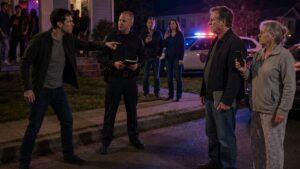
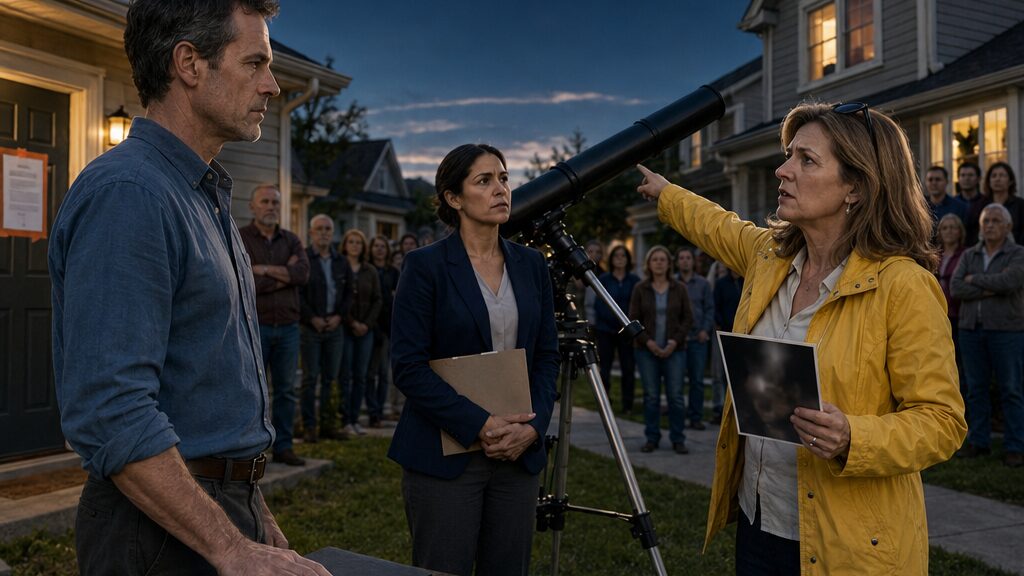
Brenda Mitchell’s finger entered Benjamin Hill’s field of view before Saturn did.
“What is that thing pointed at?”
Benjamin kept one hand on the telescope’s focusing knob and looked past the black barrel toward the narrow strip of pale sky between Brenda’s roof and the Nelson house. The planet would not be visible for hours, but the alignment had to be checked before the trees swallowed the gap.
“It’s a telescope,” he said.
Brenda stood on the sidewalk in a bright pink running jacket, dark glasses hiding her eyes. She was not dressed for running. Her phone was already in her other hand.
“I know what a telescope looks like.”
“Then I’m not sure what you’re asking.”
She stepped off the sidewalk and pointed along the barrel. From where she stood, the telescope appeared aimed at the second floor of her house.
“Are you spying on people?”
The question carried farther than it needed to. A garage door across the street stopped halfway down. Someone walking a terrier slowed without pretending not to.
Benjamin straightened. The telescope rose nearly to his shoulder on its silver tripod, heavy enough that moving it required both hands and enough care to avoid knocking the mirrors out of alignment. A black cloth covered the small table beside it. Beneath the cloth lay his eyepieces, a folded star chart, and the observation notebook he had not allowed anyone else to touch in eleven months.
“No,” he said. “I’m tracking where Saturn will clear the trees.”
Brenda lowered her glasses.
“That’s exactly what someone would say if they didn’t want people asking questions.”
Benjamin felt the quick heat of anger, then the familiar instinct to shut every door inside himself. Facts were enough. They had always been enough in his work. A technical drawing either matched the measurements or it did not. A line did not need to explain its childhood.
He turned back to the telescope.
Brenda moved closer. “Do not point that at my bedroom.”
“It isn’t pointed at your bedroom.”
“I can stand here and see that it is.”
“You can stand there and see the outside of a tube.”
Her mouth tightened.
Benjamin regretted the sentence as soon as it left him, not because it was false, but because it sounded like contempt. Brenda raised her phone and took three photographs in quick succession.
The shutter sounds were small, but each one seemed to change the air.
“What are you doing?”
“Documenting it.”
“For what?”
“For the association.”
Benjamin removed his hand from the focus knob. “You could wait until dark and look through it.”
Brenda gave a short laugh. “I am not putting my eye against something you’ve been aiming at my house.”
“It doesn’t work that way.”
“You keep saying that.”
A message tone sounded from her phone. She began typing while standing beside him.
Benjamin looked toward the open garage. On the workbench, his laptop displayed the evening’s coordinates. Beside it sat a red flashlight, a small level, and a printed chart showing Saturn’s path above the western roofs. He could have carried the chart outside. He could have shown her the azimuth line, the elevation marks, the predicted viewing window.
Instead, he glanced at the black cloth covering the notebook and said, “I’m done discussing this.”
Brenda’s thumbs stopped.
“You’re done?”
“Yes.”
“That’s convenient.”
She stepped back onto the sidewalk and lifted the phone to her ear.
Benjamin adjusted the tripod leg nearest the property line. The bubble in the level slid into place. He tried to concentrate on the measurements, but Brenda’s voice remained clear.
“Yes, I need to file a complaint about surveillance equipment.”
He looked at her then.
She turned slightly away, though not enough to hide the satisfaction in her posture.
“It’s a large black device on a tripod,” she continued. “It has been positioned facing residential windows more than once.”
More than once.
That part was true. The same narrow opening offered the cleanest southern view from his yard. The telescope had stood within a few feet of that spot on six nights since early summer. Some nights he had only tested alignment before clouds moved in. On others, he had watched Saturn rise, its rings thin and bright, while the houses around him went dark.
He had never once looked at Brenda’s windows.
He also had no photograph proving where the instrument had been aimed through the eyepiece. The telescope recorded nothing. It had no attached camera, no storage, no network connection. Only glass, mirrors, metal, and the person looking through it.
Brenda ended the call and immediately began typing again.
Benjamin’s own phone vibrated on the small table.
An email notification from the neighborhood mailing list appeared across the screen.
Possible privacy concern on Willow Bend.
He opened it despite himself.
Brenda had sent the message to twenty-three addresses.
Several residents, she wrote, had expressed concern about a device being aimed at homes after dark. No one else had expressed any such concern to Benjamin. She asked parents to remain aware and requested that the association investigate whether the equipment violated community privacy standards.
There was no direct accusation in the final sentence. The earlier lines had already done the work.
A reply appeared before he finished reading.
Thank you for letting us know.
Then another.
Has anyone contacted management?
The man with the terrier crossed to the opposite sidewalk.
Benjamin locked his phone and slid it into his pocket.
Brenda watched him. “People deserve to know.”
“Know what?”
“That there may be an issue.”
“You created the issue.”
“No. I noticed it.”
For a moment neither spoke. The telescope stood between them, its capped eyepiece angled toward Benjamin’s chest like a dark, closed eye.
He reached beneath the cloth and pulled out the folded star chart. The paper had softened along the creases. Several dates were marked in blue ink, each in handwriting smaller and rounder than his own.
Brenda leaned forward. “What is that?”
“A chart.”
“May I see it?”
His fingers closed around the paper.
“No.”
Her expression changed—not triumph exactly, but confirmation.
“That tells me everything.”
“It tells you it’s mine.”
She lifted her phone again. “Then I’ll let management decide.”
Benjamin folded the chart once more and returned it beneath the cloth.
By sunset, five more responses had appeared on the neighborhood thread. One resident suggested privacy screens. Another asked whether the equipment could record video. Someone else wrote that Benjamin had always seemed quiet, as though quietness itself had become evidence.
At 7:14 p.m., the community association manager emailed him directly.
Laura Sanchez wrote that the association had received a formal complaint concerning exterior equipment, possible nuisance use, and residential privacy. She requested access to inspect the telescope and its placement.
The inspection was scheduled for Thursday at four.
Two days away.
Benjamin read the message in the darkening garage while the telescope waited outside. Saturn would rise into the gap in less than an hour.
He looked from the email to the covered notebook.
For the first time since placing the tripod on the lawn, he considered carrying everything back inside before the planet appeared.
Chapter 2: The Complaint Became an Official Record
Laura Sanchez arrived holding a violation form that already had Benjamin’s address printed across the top.
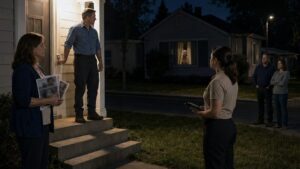
She came up the driveway at exactly four, dressed in gray slacks and a navy blazer despite the heat. Brenda followed several steps behind in a yellow rain jacket, though the afternoon sky was clear.
Benjamin noticed the form before Laura introduced herself.
“Is that the result of the inspection?” he asked.
Laura glanced down. “It’s a notice template.”
“With my lot number on it.”
“We prepare paperwork in advance so we can document the visit accurately.”
“That sounds like the decision was prepared in advance.”
Laura’s polite expression tightened by a degree. “Nothing has been decided.”
Brenda stopped beside the telescope. “It’s in the same place.”
It was not exactly in the same place. Benjamin had moved the tripod fourteen inches west to avoid a sprinkler head. The barrel still crossed the visual line between the Nelson roof and Brenda’s upper windows.
The eyepiece was capped. Benjamin had covered it before they arrived, partly to protect the glass from dust and partly because he did not want Brenda touching it while the telescope was warm from the sun.
Laura walked around the tripod without approaching the eyepiece.
“Does this equipment take photographs?”
“No.”
“Can it record video?”
“No.”
“Does it connect to a phone or computer?”
“No.”
Brenda folded her arms. “How would anyone know?”
Benjamin pointed toward the open side panel where the focus assembly and simple mounting hardware were visible. “Because there is no camera.”
“That doesn’t mean one can’t be attached.”
“A camera can be attached to binoculars too. That doesn’t make every pair of binoculars surveillance equipment.”
Laura raised one hand before Brenda answered. “Let’s stay with what is currently installed.”
She examined the tripod feet, then measured the distance to the property line with a retractable tape. Benjamin watched her write the number on the form.
“What rule am I alleged to have violated?” he asked.
Laura opened a binder. Colored tabs divided architectural standards, use restrictions, landscaping, nuisances, and enforcement procedures.
“The complaint cites Section Eight regarding conduct that interferes with another owner’s reasonable enjoyment and Section Eleven regarding exterior structures or devices.”
“A telescope is not a structure.”
“I didn’t say it was.”
“Then Section Eleven does not apply.”
“It may apply to equipment maintained outside.”
“May?”
Laura looked at him directly. “The documents do not specifically address telescopes.”
Brenda made a sharp sound. “Because no one thought they needed to write a rule saying you can’t aim one into a bedroom.”
Benjamin’s jaw tightened.
Laura turned to her. “Do you have evidence that it was used to view the interior of your home?”
“I have this.”
Brenda removed a glossy photograph from a clear sleeve.
The image had been taken from near her front walkway. In it, Benjamin stood with one hand on the telescope. The barrel seemed to end directly below Brenda’s second-floor window. The angle compressed the distance so completely that the telescope looked less like an astronomical instrument than a device trained on the glass.
Laura studied it.
Benjamin knew the exact moment captured. He had been rotating the mount toward the initial coordinate, before raising the barrel to the correct elevation.
“That was taken during setup,” he said.
Brenda tapped the photograph. “It was pointed at my house.”
“For perhaps twenty seconds while I was moving it.”
“So you admit it.”
“I admit a telescope passes across many things while being aligned.”
Laura placed the photograph on the hood of her car and compared it with the current position. “Do you maintain observation records?”
Benjamin looked toward the black notebook resting on the small table under the garage overhang.
Brenda followed his gaze.
“Yes,” he said.
“Those records might resolve this,” Laura said. “Dates, times, targets, orientation.”
“They’re private.”
Brenda laughed once. “Of course they are.”
Laura’s voice remained even. “You are not required to surrender personal materials without board authorization. But if you want management to consider them as evidence, I would need to review the relevant portions.”
“No.”
“Benjamin.”
“No.”
The refusal came too quickly and too hard. Laura glanced at him with something closer to concern than suspicion, but Brenda’s face settled into certainty.
Benjamin could have opened the notebook to any recent page. The entries included time, temperature, cloud cover, magnification, and the target observed. They also included blue notes in the margins.
Invite the Mitchell boy if he’s here. He asked about the moon.
Scott will pretend not to care. Make him come anyway.
Next good Saturn window—everyone. No excuses.
The handwriting stopped eleven months earlier.
Benjamin placed one hand over the notebook.
Laura closed the binder. “Then I have to base my report on what can be independently observed.”
“Observe it tonight.”
Brenda stared at him.
Benjamin looked at her rather than Laura. “Come back after dark. Look through it.”
“I’m not interested in participating in whatever this is.”
“You said you wanted proof.”
“I want it removed.”
“That isn’t the same thing.”
Two garage doors across the street were open. A couple stood near one of them, pretending to organize recycling bins. The terrier walker had stopped at the corner. Brenda noticed them too.
“This is exactly the problem,” she said louder. “He acts as though I’m unreasonable for not putting my face against a device aimed toward my bedroom.”
Benjamin released the notebook and stepped to the telescope.
He loosened the mount, turned the barrel several degrees, then raised it according to the printed coordinates clipped beneath the table. The movement was controlled and exact.
“At eight forty tonight, Saturn will cross that opening,” he said. “The telescope will point between your roofline and Scott’s chimney. From the sidewalk, it may appear to point at your house. Through the eyepiece, it will show Saturn.”
Laura studied the gap.
Brenda shook her head. “That proves nothing about what you look at when no one is watching.”
The sentence struck more deeply than Benjamin expected. Not because it was persuasive, but because there was no answer that would satisfy someone who treated privacy itself as concealment.
Laura picked up the prewritten form.
“I am imposing a temporary restriction while the complaint is reviewed.”
Benjamin looked at the paper.
“No telescope use after dusk,” she said. “No placement within fifteen feet of the shared property line. This is not a final finding.”
“The only clear sightline is within fifteen feet.”
“Then use another part of your property.”
“The trees block it.”
“I understand that creates inconvenience.”
“It makes the telescope useless for this target.”
Laura pressed her lips together. “The board can consider that at the hearing.”
Brenda watched as Laura attached the orange-edged notice beside Benjamin’s front door. The telescope stood in the foreground, its black barrel pointing past the paper toward the strip of sky.
Benjamin felt the humiliation not as heat but as cold precision. His home, his equipment, his silence—each had been entered into a record built around someone else’s assumption.
“When is the hearing?” he asked.
“Tuesday evening.”
He lifted the notice from the door and read the final paragraph.
The telescope had to be removed from exterior view before the hearing. Failure to comply could lead to enforcement action.
Laura lowered her voice. “Store it indoors for a few days. Bring whatever documentation you are comfortable sharing. This can still be resolved.”
Benjamin looked at the notebook under his hand.
Then he looked at Brenda.
“No,” he said. “It stays where it is.”
Laura’s expression changed. “That choice may result in fines.”
“Then put that in the record too.”
Chapter 3: The Photograph Looked Worse Than Truth
The photograph had been enlarged until the telescope looked like a weapon.
It stood on an easel beside the HOA board table, three feet high and sharply printed. Benjamin’s profile appeared at one edge. The black barrel crossed the center and seemed to terminate at Brenda’s upstairs window.
No one in the meeting room could see the narrow sky beyond the roof.
Benjamin set his folded star chart on the table and took the chair facing the board. Brenda sat two seats away from Laura, a clear sleeve of additional photographs arranged in front of her.
The board president called the hearing to order.
“We are addressing a complaint involving possible privacy interference and nonapproved exterior equipment.”
“Possible,” Benjamin said.
The president looked over his glasses. “You’ll have an opportunity to speak.”
Laura summarized the inspection. Her account was careful. She noted that the telescope had no camera attached, that association rules did not specifically prohibit telescopes, and that the governing documents contained broad nuisance language rather than a precise standard.
For several minutes, Benjamin believed the weakness of the case might matter.
Then Brenda held up the photograph.
“This is what I see from my home.”
A board member leaned forward. “Was that position confirmed during inspection?”
“The equipment remained in approximately the same area,” Laura said. “The precise angle varies during setup.”
Brenda slid another photograph from the sleeve. It showed the telescope on a different evening, again near the property line.
“And this was three weeks earlier.”
Benjamin recognized the date from the color of the western sky. He had observed the moon that night, not Saturn.
“You’ve placed it there repeatedly,” the president said.
“Yes.”
“Why that location?”
“It provides the only usable opening between the roofs and mature trees.”
“Toward the Mitchell residence.”
“Past it.”
Brenda’s chair moved against the floor. “That distinction is convenient for the person looking through it.”
Benjamin unfolded the star chart halfway. A printed arc showed Saturn’s movement across the southern sky. Blue handwritten dates remained hidden beneath the lower fold.
“The sightline changes,” he said. “The telescope tracks an object moving across the sky. A photograph of the exterior cannot prove what appears in the eyepiece.”
One of the board members studied the enlarged image. “Have you ever viewed the Mitchell house through this telescope?”
The room became still.
Benjamin could have answered no and left it there. Instead, the technical part of his mind rejected the absolute wording.
“During alignment, the field of view may cross a roof, tree, chimney, or window for a fraction of a second.”
Brenda turned toward the board. “So yes.”
“No. Not in the sense you mean.”
The member persisted. “Have you ever seen any portion of her house through the telescope?”
Benjamin looked at the photograph. He remembered a blurred rectangle passing through the eyepiece while he adjusted elevation weeks earlier. It had been too close to focus, nothing more than color and light.
“Yes,” he said. “Briefly, while moving the instrument.”
Brenda exhaled as though he had confessed.
The president wrote something on the complaint form.
Benjamin forced himself not to reach for the notebook in his satchel. The observation entries could establish the targets for every evening Brenda had photographed him. But the notebook was not merely a record. To submit it would turn the margins into exhibits and the promises into evidence to be discussed under fluorescent lights.
He unfolded the printed portion of the chart fully.
“This photograph was taken at six twenty-three,” he said. “The timestamp is visible in the metadata Brenda submitted.”
Laura checked the file on her laptop. “That’s correct.”
“Sunset that day was after seven. I was performing initial alignment. The final elevation for Saturn would have been more than twenty degrees higher.”
He placed a ruler across the photograph, using the roofline as reference.
“At this angle, the telescope could not have shown the interior of the second floor. The neighbor’s roof itself would block the field.”
The architectural review volunteer moved closer to the easel. “He’s right about the elevation.”
Brenda looked from the volunteer to Laura.
“For the final observing position,” the volunteer added. “The tube would need to be raised.”
The president asked, “So the photograph does not show active viewing?”
“It shows setup,” Benjamin said.
Laura nodded slowly. “That is consistent with what he told us during inspection.”
For one brief moment, the room shifted. The enlarged photograph lost some of its force. It still looked alarming, but it no longer looked conclusive.
Brenda’s face colored. “Then what stops him from lowering it again after dark?”
Nothing, Benjamin thought. Nothing except the truth.
The board president folded his hands. “That is the difficulty. We may not have evidence of surveillance, but we do have a recurring placement that creates a reasonable perception of intrusion.”
“A perception created by a misleading photograph,” Benjamin said.
“A perception experienced by an adjacent owner.”
“You cannot regulate an object according to where someone imagines it is looking.”
“We can regulate nuisance conditions.”
Laura glanced toward Benjamin. He saw the warning in her expression before the president spoke.
“The board is not making a finding that Mr. Hill conducted surveillance.”
Brenda stiffened.
“However, we find that nighttime use of the telescope in its current location may interfere with neighboring residents’ reasonable expectation of privacy.”
Benjamin stared at him. “You just accepted that the photograph does not show what she claimed.”
“We accepted that it does not prove surveillance.”
“So I am cleared of the accusation and punished for causing it to be imagined.”
The president’s voice cooled. “You were offered a temporary accommodation.”
“An accommodation that prevents me from using the telescope.”
“You may relocate it or store it indoors.”
“The alternate locations are blocked.”
“That is a property limitation, not an association obligation.”
Benjamin looked at Laura. She did not look pleased, but she did not interrupt.
The false relief of disproving the photograph vanished. The accusation had changed shape instead of dying. Surveillance had become nuisance. Evidence had become perception. The telescope remained guilty of appearing capable of harm.
The president read the decision.
Until further review, the telescope could not be used outdoors after dusk and had to be stored inside when not attended. Any violation would result in a daily fine beginning the next morning.
Benjamin folded the star chart. The blue writing remained hidden.
Outside the meeting room, Laura caught up with him.
“You proved the photograph was incomplete,” she said.
“And it changed nothing.”
“It changed the finding.”
“Not the result.”
She lowered her voice. “The notebook could still help.”
He stopped.
“You keep asking for something that is not theirs.”
“I’m asking because the board responds to records.”
“There are things in that record they have no right to read.”
Laura studied him. “Then redact them.”
The suggestion was reasonable. That made him resent it more.
He placed the chart inside his satchel. “No.”
When he reached home, the telescope was visible through the front window, standing where he had left it in the garage.
An email from the association arrived before he removed his coat.
Enforcement begins at 8:00 a.m. tomorrow. Fine: fifty dollars per day until compliance is verified.
Benjamin read the message twice.
Then he opened the garage door, stepped inside, and put both hands on the tripod.
For several seconds he could not tell whether he intended to carry it into the house or back onto the lawn.
Chapter 4: The Dates Written in Another Hand
Benjamin dismantled the tripod one leg at a time.
The first clamp released with a metallic snap that echoed through the garage. He folded the leg inward and held it there, waiting for the relief he had expected.
None came.
The telescope stood shorter now, tilted slightly toward the workbench. Without the tripod fully extended, it looked less like an accusation and more like an injured machine.
At eight the next morning, the association portal showed the first fifty-dollar fine.
Benjamin opened the notice, read it, and closed the page without downloading it. The telescope was technically indoors, but the garage door had remained open while he worked. A compliance photograph taken from the street showed the black tube visible behind him.
He could appeal the charge.
Instead, he tightened the cap over the eyepiece and placed it beside the folded star chart.
The chart opened beneath his palm. Saturn’s path crossed the paper in a clean printed arc. Around it, blue notes crowded the margins.
Saturday should be best. Ask before assuming people aren’t interested.
Below that, in the same rounded handwriting:
Brenda’s grandson likes space. Remember his cardboard rocket.
Benjamin folded the paper over the words.
A shadow crossed the garage entrance.
Scott Nelson stood at the end of the driveway holding two mugs. His gray hair had been flattened on one side, as if he had put on a hat and changed his mind.
“I brought coffee,” Scott said. “Then I remembered you make coffee that tastes like punishment, so I brought two.”
Benjamin returned to the tripod. “I’m working.”
“So I see.”
Scott stepped inside without waiting to be invited. He set one mug on the workbench and looked at the half-collapsed telescope.
“You taking it somewhere?”
“Inside.”
“That far?”
Benjamin released the second clamp.
Scott picked up the folded chart before Benjamin could stop him.
“Put that down.”
Scott froze.
Benjamin reached for it, but the page had already slipped open.
The blue handwriting faced upward.
Scott’s expression changed first in the eyes, then in the way his shoulders settled.
“That’s Angela’s.”
Benjamin took the chart from him.
Scott looked toward the notebook. “Those dates too?”
“Don’t.”
“I’m not asking to read it.”
“You already did.”
“I read one line.”
“One was enough.”
Scott picked up his coffee but did not drink. “She talked about this.”
Benjamin folded the chart carefully. “She talked about everything.”
“No. I mean the night.”
The garage seemed to contract around them.
Scott leaned against the workbench. “She came by my porch last spring. Asked whether I thought people here would show up if you put the telescope on the green.”
Benjamin said nothing.
“She said you kept assuming they wouldn’t.”
“She was sick.”
“She was also right.”
Benjamin lifted the telescope tube from the mount and cradled it against his chest. The weight was familiar, solid, manageable.
Scott continued. “She wanted one night where the whole neighborhood looked at the same thing and stopped talking about fences and trash cans and whose tree dropped leaves in whose yard.”
“You’re making it sound sentimental.”
“It was sentimental.”
“She knew you’d hate that.”
“She did.”
Benjamin set the telescope in its padded case harder than necessary.
Scott looked at the chart again. “You scheduled it?”
“Last fall.”
“And canceled.”
Benjamin closed the case.
The click of the latch was sharper than he intended.
Scott did not retreat. “I came over that evening. You never opened the door.”
“I had buried my wife four days earlier.”
“I know.”
“Then don’t stand there and make it sound like I missed a committee meeting.”
Scott lowered his gaze. “I should have come back.”
Benjamin’s anger faltered.
Scott rubbed a thumb along the cardboard sleeve of his cup. “I told myself you wanted space. Then a week became a month. After a while, leaving you alone became easier than admitting I had left you alone.”
Benjamin looked toward the open garage door. Across the street, a sprinkler clicked in slow, even arcs. Brenda’s blinds were closed.
Scott said, “This isn’t only about a telescope.”
“It is to the board.”
“It isn’t to you.”
Benjamin picked up the observation notebook.
Scott watched his hand close around it. “You could show them the target entries and cover the rest.”
“I know.”
“Then why don’t you?”
Because the notes were not annotations. They were the last ordinary conversation he had with Angela, scattered across pages of temperatures and magnification settings. Because strangers at a folding table had already turned the angle of a telescope into evidence. He could not let them turn her handwriting into a defense exhibit.
He carried the notebook to a cabinet and locked it inside.
Scott exhaled. “You’re proving Brenda right about one thing.”
Benjamin turned.
“You are hiding something.”
The words landed without accusation, which made them harder to reject.
“I’m hiding something that belongs to me.”
“Yes.”
“And that doesn’t make her claim true.”
“No.”
“Then what is your point?”
Scott looked at the telescope case. “My point is that being entitled to silence doesn’t make silence harmless.”
Benjamin’s hand remained on the cabinet key.
Scott picked up his coffee. “The best viewing window is Saturday.”
“I know.”
“After that, Saturn drops behind the trees earlier each night. You’ll get another chance next year, but not the one Angela marked.”
Benjamin said nothing.
Scott walked to the driveway, then stopped.
“I can tell the board what she planned.”
“They’ll call it irrelevant.”
“Maybe.”
“It does not prove where the telescope was aimed.”
“No. It proves why you kept putting it there.”
Benjamin looked at the folded tripod, the locked cabinet, and the orange-edged violation notice visible through the kitchen window where he had left it on the counter.
Scott lifted his mug slightly.
“Saturday,” he said. “After that, the opening closes.”
Chapter 5: Brenda Was Afraid Before She Was Angry
Rebecca Young set her car keys on Brenda’s kitchen counter and asked, “Did you ever look through it?”
Brenda kept her back to her daughter.
Outside the window above the sink, Benjamin’s garage door stood open. The telescope was no longer on the lawn, but its black case rested near the workbench.
“I don’t need to look through something to know where it was pointed.”
“That wasn’t my question.”
Brenda dried an already dry plate and placed it in the cabinet.
Rebecca had brought her son over after school, but he was in the living room building a tower from wooden blocks. His voice drifted through the doorway as he counted floors.
Brenda lowered her own voice. “He admitted the telescope crossed the house.”
“While he was moving it.”
“He keeps records he won’t show anyone.”
“Private records.”
“That’s what he calls them.”
Rebecca folded her arms. “And what do you call the photographs from the pool?”
Brenda stopped moving.
The kitchen faucet dripped once.
“That was different.”
“A man took pictures of my son without permission.”
“At the community pool. In his swimsuit.”
“I remember.”
“You weren’t there when we found them online.”
Rebecca’s face tightened. “I was the one who found them.”
Brenda set the towel down. “Then you know why I’m not interested in giving people the benefit of the doubt when cameras are involved.”
“It doesn’t have a camera.”
“You don’t know that.”
“The manager inspected it.”
“She said one could be attached.”
Rebecca leaned against the counter. “Mom, are you afraid Benjamin watched the house, or are you afraid you’ll look foolish if he didn’t?”
The question struck with humiliating accuracy.
Brenda glanced toward the living room. Her grandson’s tower collapsed, followed by his delighted laugh.
Months earlier, she had watched Rebecca enlarge a stranger’s social media photograph until her son’s face became a blur of pixels. The image had been taken from outside the pool fence. No crime had been charged. The account disappeared. The association posted a reminder about photography in common areas and moved on.
Brenda had not moved on.
The first evening she saw Benjamin beside the telescope, the black barrel had lined up with the room where her grandson sometimes slept. Fear had arrived before reason and dressed itself as certainty.
That did not mean she had imagined the angle.
“I saw what I saw,” she said.
Rebecca softened, but only slightly. “You saw the outside of a telescope.”
Brenda looked through the blinds. “Why won’t he just explain?”
“Maybe he doesn’t owe everyone his personal life.”
“He owes an explanation if his equipment points at other people’s homes.”
“And if it doesn’t?”
Brenda did not answer.
Her phone rang on the counter.
Laura Sanchez.
Brenda waited until the third ring before picking up.
“Hello?”
“Brenda, I need you to come by the management office.”
“Is this about the hearing?”
“It’s about the email you sent.”
Rebecca’s eyes stayed on her.
An hour later, Brenda sat across from Laura in the small association office. The same binder used during the inspection lay open between them.
Laura turned a printed copy of the neighborhood email thread around.
“You stated that several residents had expressed concern before you filed the complaint.”
“They responded afterward.”
“That is not the same thing.”
“They were concerned.”
“After receiving your description of possible surveillance.”
Brenda sat straighter. “Are you accusing me of lying?”
“I am telling you the wording may have amplified an unverified allegation.”
“The board agreed there was a privacy issue.”
“The board agreed there was a reasonable perception of intrusion. It did not find surveillance.”
“That’s a distinction without much difference.”
“It is a very important distinction if Mr. Hill claims reputational harm.”
Brenda’s stomach tightened.
Laura closed the binder. “I am not threatening you. I am trying to prevent this from becoming more damaging.”
“What do you want me to do?”
“Clarify the email. State that surveillance was not established.”
Brenda looked at the paper. “And tell everyone I overreacted.”
“Tell them the finding.”
“He still won’t show the notebook.”
Laura’s expression sharpened. “You are not entitled to his notebook.”
“Then how do we know?”
“We inspect the equipment. We verify the sightline. We observe its use.”
Brenda looked toward the office window. The parking lot reflected the white afternoon sky.
“Meaning what?”
“Benjamin has requested a controlled demonstration Saturday evening.”
Brenda turned back. “He requested it?”
“Through Scott Nelson. Benjamin has not withdrawn his objection to the restriction, but he is willing to demonstrate the viewing path.”
“With everyone standing there?”
“The board president, one member, me, and any adjacent owner directly affected.”
“No.”
Laura waited.
Brenda heard how quickly she had answered.
“I don’t want a crowd,” she said.
“Neither does he.”
“Then why involve Scott?”
“Because Scott provided context.”
“What context?”
Laura hesitated. “Personal context that Benjamin has not authorized me to discuss.”
There it was again: another private fact, another closed door.
But this time Brenda did not feel confirmed. She felt excluded from a truth everyone else might soon understand.
“If the demonstration proves the telescope is viewing Saturn,” Laura said, “will you withdraw the surveillance allegation?”
Brenda looked down at her hands.
The answer should have been immediate.
Instead she saw the neighborhood email thread, the photographs, the hearing, and the faces of people who had thanked her for warning them.
“If it proves it publicly,” she said.
Laura frowned. “Publicly?”
“I will not withdraw anything based on a private demonstration that can be described differently afterward.”
“You asked us to limit the audience.”
“I asked you not to turn it into a spectacle.”
“Those positions may not be compatible.”
Brenda stood.
Laura remained seated. “This is a chance to verify the facts.”
Brenda picked up her purse. “Then verify them where everyone can see.”
She reached the door before Laura answered.
“All right,” Laura said. “But if the demonstration clears him, the correction will be just as public as the accusation.”
Brenda’s hand tightened around the handle.
“Fine,” she said.
The word sounded less like confidence than a door closing behind her.
Chapter 6: The Board Approved a Test It Feared
By noon on Saturday, clouds had covered the entire southern sky.
Benjamin stood on the community green while Laura measured the distance between the proposed telescope location and the nearest house. A board member held a printed list of conditions as if preparing for a hazardous equipment inspection.
“No extension cords across the walkway,” the member said.
“The mount is manual,” Benjamin replied.
“No amplified sound.”
“There is no sound.”
“No photography of residents.”
“There is no camera.”
Laura gave him a brief look that asked him not to turn every condition into an argument.
Benjamin looked toward his own yard. From the green, three mature maples blocked the southern horizon. Even if the clouds cleared, Saturn would remain hidden until it dropped behind the houses.
“This location will not work,” he said.
The board member consulted the page. “It satisfies the fifteen-foot buffer.”
“It does not satisfy the sky.”
Scott, carrying two folding chairs, stopped beside them. “That tends to matter in astronomy.”
The board member ignored him.
Benjamin set the tripod down and attached the telescope anyway. He aligned the finder scope with the gap between two branches and checked the elevation. Leaves filled the eyepiece.
He stepped aside.
Laura bent to look.
For several seconds she saw nothing but green blur.
“This is the alternate site the board approved,” Benjamin said.
She straightened. “Can the telescope be raised?”
“Not above the trees.”
“Moved farther east?”
“The clubhouse blocks the view.”
Scott placed the chairs beside the path. “We could relocate the trees.”
Laura almost smiled. The board member did not.
A low rumble came from the clouds.
Benjamin checked his phone. The satellite map showed the cloud band thinning after sunset, but only for perhaps forty minutes. Saturn would emerge above Brenda’s roofline at eight thirty-seven and disappear behind the trees shortly after ten.
Laura walked toward Benjamin’s property and studied the original viewing corridor.
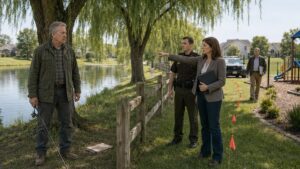
From the lawn, the gap was obvious if a person looked for sky rather than windows. Brenda’s second floor sat below and to the right of the projected line. Scott’s chimney marked the left edge. Beyond both roofs, the southern sky opened like a narrow vertical channel.
Laura sighed.
“The original position is necessary.”
The board member looked uncomfortable. “Necessary for this target.”
“Yes,” Benjamin said. “That has been my point.”
The member lowered the condition sheet. “We can authorize a one-time exception.”
Benjamin looked at him. “An exception to a rule that does not mention telescopes.”
Laura stepped between the sentence and its likely response.
“One evening,” she said. “Then the board reviews the result.”
Benjamin wanted to refuse the framing. He wanted the association to admit the restriction had been issued without enough information. But the clouds were moving, Saturday was passing, and Angela’s blue note waited inside the locked cabinet.
“One evening,” he said.
By seven, people had begun arriving.
Brenda had insisted the test be public, but the email Laura sent described it as a limited compliance demonstration. That phrase did nothing to discourage curiosity. Residents gathered along the sidewalk with folding chairs and travel mugs. Two families brought children. The terrier walker came without the dog.
Benjamin carried the telescope onto the lawn.
The neighbors grew quiet as he extended the silver tripod and locked each leg into place. He removed the cap from the eyepiece and cleaned the glass with a soft cloth. Under the porch light, the lens reflected a small circle of gold.
Scott set up a red-shaded flashlight near the star chart.
“Too many people?” he asked.
Benjamin tightened the mount. “Yes.”
“Good.”
Benjamin looked at him.
Scott shrugged. “Angela expected more.”
The name made Benjamin’s hand pause.
Across the lawn, Brenda stood beside Rebecca and her grandson. She wore a dark jacket despite the warm evening. When Benjamin looked toward her, she turned to Laura.
“I thought this was the inspection group.”
Laura glanced at the neighbors. “The notice was sent to the same distribution list used for the complaint.”
“That was not an invitation.”
“No,” Laura said. “But it was public.”
Brenda’s grandson pulled at Rebecca’s sleeve and pointed toward the telescope.
“Can I see the moon?”
“Not tonight,” Rebecca said.
“Saturn,” Scott corrected gently. “If the clouds cooperate.”
Brenda looked at the crowd, then at the darkening sky.
“This is becoming a performance.”
Benjamin heard her from the tripod.
He could have answered. Instead he opened the garage cabinet and removed the observation notebook.
The black cover seemed heavier outdoors.
He placed it on the small table beside the folded chart.
Laura noticed. “You brought it.”
“I brought it.”
“May I review the relevant entries?”
“Not yet.”
Brenda gave a bitter laugh. “So we’re still doing this on his terms.”
Benjamin faced her. “You asked for a demonstration.”
“I asked for proof.”
“The proof is through the eyepiece.”
“And the notebook?”
“Mine.”
The old anger moved between them, but it no longer felt clean. Benjamin could see the strain around Brenda’s mouth and the way she kept checking whether her grandson had wandered closer to the equipment.
He lowered his voice.
“No one will photograph him.”
Brenda went still.
Rebecca looked at her mother.
Benjamin had guessed only from Laura’s careful wording and Scott’s mention that something else might be driving the complaint. Brenda’s reaction confirmed enough.
“That isn’t your concern,” she said.
“No. But I understand why you would want certainty.”
Her expression hardened as if understanding were another form of exposure.
The first break appeared in the clouds at eight twenty.
A pale strip of sky opened above the western roofs. Benjamin checked the finder scope, adjusted the azimuth, then raised the barrel.
From the sidewalk, it looked exactly as Brenda had described: a black tube aimed toward the line of her house.
Whispers passed through the crowd.
Benjamin followed the coordinates with slow precision. The telescope crossed the apparent window line and continued upward.
Laura stood behind him, watching the angle change.
“There,” he said.
He checked the eyepiece.
Clouds.
He waited.
The gap widened, revealing one bright point low over the trees.
Benjamin adjusted focus until the light sharpened and the rings separated from the planet’s body.
His breath caught.
For eleven months, Saturn had belonged to the notebook, the dark lawn, and the voice he could no longer hear. Now chairs scraped behind him. A child whispered. Scott stood close enough that their sleeves nearly touched.
Benjamin stepped away from the telescope.
“It’s visible.”
Laura looked toward Brenda.
Brenda took one step backward.
“I don’t need to—”
“You required a public demonstration,” Laura said.
“I can see where it’s pointed.”
“That was never enough,” Rebecca said quietly.
Brenda turned toward her daughter. Around them, the neighbors waited without speaking.
Benjamin opened the notebook to the evening’s page and set it beside the eyepiece. He did not reveal the earlier entries. He did not explain the handwriting.
He simply left both objects uncovered.
The clouds thinned farther. Saturn cleared the dark line of trees.
Brenda looked at the telescope, then at the people watching her.
Before anyone could stop her, she stepped away from the lawn.
Chapter 7: She Looked Through the Same Lens
“Brenda.”
Benjamin did not raise his voice.
She stopped at the edge of the sidewalk but did not turn around. The neighbors remained silent behind him. Even the children seemed to understand that movement would break something fragile.
Benjamin stepped away from the telescope.
“You asked for proof,” he said. “It’s there.”
Brenda faced him slowly. “You already have your audience.”
“This isn’t for them.”
Her eyes moved across the gathered residents. “Everything about tonight is for them.”
“No. Tonight was supposed to be for them long before the complaint.”
The words came out before Benjamin could pull them back.
Scott looked toward the notebook on the table.
Brenda noticed.
“What does that mean?”
Benjamin rested one hand beside the open page. The lines he had written that evening were neat and technical: time, cloud cover, magnification, position. Across from them, on an older page, blue ink showed at the edge.
He had spent months guarding those words as though privacy meant keeping them untouched by other people’s understanding.
Now the telescope stood beneath an open sky, surrounded by the very neighbors Angela had wanted there.
Benjamin turned the notebook so Brenda could see only the current entry.
“It means this was never about your house.”
“That is what you keep saying.”
“Then look.”
Brenda’s jaw tightened.
Rebecca stepped closer to her mother. “I’ll go with you.”
“I don’t need help.”
“Then prove it.”
Brenda looked at her daughter, wounded more by the gentleness than she might have been by anger.
Benjamin adjusted the focus one final fraction. Saturn remained clear, its rings pale against the darkness. He lowered the eyepiece slightly to Brenda’s height, then moved away far enough that she would not feel crowded.
No one urged her forward.
That silence did what argument had failed to do.
Brenda crossed the lawn.
Her steps were slow and stiff. At the telescope, she kept both hands at her sides.
“Where do I put my eye?”
“Close to the lens. Don’t press against it.”
She leaned in, then immediately drew back.
“I don’t see anything.”
“You’re too far to the left.”
Benjamin lifted one hand, stopped before touching her shoulder, and pointed instead.
“Move half an inch.”
Brenda adjusted.
Her breathing changed.
For several seconds she said nothing.
Benjamin watched the tension leave her face in small stages: first the narrowed eyes, then the rigid mouth, then the line between her brows. Wonder did not erase suspicion all at once. It interrupted it.
“What is that?” she whispered.
Scott answered from behind them. “Let her say it.”
Brenda leaned closer.
The bright planet hung in the eyepiece with its rings tilted like a delicate handle.
“Is that Saturn?”
“Yes,” Benjamin said.
She lifted her head and looked toward the place where the telescope appeared to meet the roofline of her house.
Then she looked again through the eyepiece.
“It’s not near the window.”
“No.”
“But from the street—”
“I know what it looks like from the street.”
She straightened. Her face had lost its certainty, but not yet found an expression to replace it.
Laura approached the telescope. “May I verify?”
Benjamin nodded.
She looked through, then checked the barrel’s exterior direction and the angle gauge attached to the mount.
“The field is well above the residence,” she said. “The sightline crosses the roofline visually from ground level, but not optically at this elevation.”
The board member repeated the inspection and reached the same conclusion.
A murmur moved through the neighbors. It was not applause. Benjamin was grateful for that.
Brenda looked at the people along the sidewalk and seemed to realize that the correction was now as public as the accusation.
“I saw it pointed there,” she said.
“You did,” Benjamin replied.
Her eyes snapped to him, expecting triumph.
He gave her none.
“You saw something real,” he continued. “You understood it wrong.”
Brenda glanced toward her grandson. He stood beside Rebecca, staring at the telescope with open impatience.
“And you refused to explain,” Brenda said.
Benjamin looked down at the notebook.
“Yes.”
The admission quieted the lawn again.
“I told myself I shouldn’t have to,” he said. “The telescope didn’t have a camera. The chart showed the path. The photograph showed setup, not viewing. I thought the facts should be enough.”
“They should have been.”
“They weren’t.”
Brenda looked surprised.
Benjamin opened the notebook to the marked pages.
Blue handwriting filled the margins around months of observations. He did not pass the book around. He held it where Brenda and Laura could see.
“My wife wrote those notes.”
Scott lowered his head.
Benjamin continued before he could retreat into silence.
“She wanted a neighborhood viewing night. She said people here spent too much time looking at one another’s fences, cars, and mistakes. She thought it might help if everyone looked farther away for once.”
Brenda read the nearest line.
Next good Saturn window—everyone. No excuses.
Her lips parted.
“When did she write this?”
“Before she died.”
Rebecca put a hand on her son’s shoulder.
Benjamin turned another page. The final dated note was written more faintly than the others.
Don’t let this become another thing you keep only because you’re afraid to share it.
He had not intended to reveal that line. Once visible, it seemed less like a private possession and more like a judgment he had postponed.
“I canceled the first night,” he said. “Then I kept the telescope out here and told myself I was preparing for the next chance. Mostly I was using it alone.”
Brenda looked from the notebook to the eyepiece.
“I didn’t know.”
“You didn’t ask.”
“I did ask.”
“You accused.”
The words were quiet, but she flinched.
Benjamin closed the notebook halfway.
“And I answered like being technically right was the same as being open.”
Laura examined the final handwritten line.
“This was intended as a community event?”
Benjamin nodded.
“Before the complaint?”
“Months before.”
The board member looked toward the residents waiting on the sidewalk. “Then perhaps the demonstration should continue.”
Benjamin turned to Brenda’s grandson.
“Do you want to see Saturn?”
The child looked first at Rebecca, then at Brenda.
Brenda moved aside from the telescope.
“Yes,” she said for him, her voice unsteady. “He does.”
Chapter 8: The Last Neighbor Left After Midnight
The board president read Brenda’s original accusation into the record before withdrawing it.
The words sounded harsher in the meeting room than they had in the email.
“Possible surveillance equipment directed toward neighboring homes,” he said. “Following physical inspection and a controlled nighttime demonstration, the association finds no evidence that Mr. Hill used the telescope for surveillance.”
Benjamin sat with the closed notebook on his lap.
Brenda occupied the chair two places to his right. She did not look at him while the president continued.
“The prior nuisance determination was based on an incomplete understanding of the equipment’s viewing angle and operation. That determination is rescinded.”
Laura slid a revised account statement across the table.
“The fines have been removed,” she said. “The violation notice will not remain in your owner history.”
Benjamin looked at the zero balance.
He had expected relief. What he felt was smaller and more cautious. A corrected record could not recall the neighbors’ emails or make the terrier walker return to his side of the street.
“Thank you,” he said.
Laura opened a new document.
“I am also recommending a policy that distinguishes optical hobby equipment from recording devices. Telescopes and binoculars would be permitted without architectural approval if they are attended, not permanently installed, and not used to deliberately observe private interiors.”
The board president nodded. “Complaints would require verification before community-wide notice.”
Brenda shifted in her chair.
Laura added, “Mass distribution of an unconfirmed privacy allegation would be discouraged until management completes an initial review.”
The wording was careful. Its target was not.
The president turned to Brenda. “You submitted a written correction.”
She placed one hand on the table.
“I did.”
“Would you like it read into the record?”
“No. The written version is enough.”
Benjamin looked at her then.
Brenda met his eyes.
“I withdraw the claim that he was spying,” she said. “I was wrong about what the telescope showed.”
The room held the sentence without softening it.
Then she added, “But he knew how it looked and chose not to explain why he kept placing it there.”
The board president started to interrupt, but Benjamin spoke first.
“She’s right.”
Brenda’s expression changed.
“I was not obligated to show her my notebook,” he said. “I was obligated not to treat every question as an intrusion. I failed at that before she failed more loudly.”
Laura closed the policy draft.
No one applauded. No one demanded that Brenda apologize again. The board voted to erase the fines, remove the violation, and approve a community stargazing event under the new temporary guidelines.
Outside the meeting room, Brenda caught up with Benjamin.
“I am not asking you to forgive the email.”
“Good.”
She gave him a tired look. “You make every conversation difficult.”
“So do you.”
For the first time, the corner of her mouth moved without becoming a smile.
“I told Rebecca I would bring my grandson Friday.”
“Saturn will be visible after eight thirty.”
“I know.”
“You looked it up?”
“I can use the internet.”
Benjamin nodded and walked toward the parking lot.
“Benjamin.”
He stopped.
Brenda stood beneath the bright hallway light, holding her purse against her side.
“I am sorry I called you a spy.”
He waited.
She did not decorate the apology or ask him to make it easier for her.
“I accept that,” he said. “I’m not ready to say the rest didn’t matter.”
“I didn’t ask you to.”
Friday evening, the telescope stood in the same place on Benjamin’s lawn.
This time no violation notice hung from his door.
Scott arranged folding chairs while a local astronomy-club volunteer placed red covers over two flashlights. Rebecca arrived with her son, who carried a cardboard tube painted silver. Laura came without a binder.
Families formed a loose line across the grass.
Benjamin showed each person how to approach the eyepiece without touching the telescope. Children gasped loudly. Adults tried not to. Scott looked through twice and denied it when Benjamin noticed.
The notebook remained open on the small table.
Benjamin had covered the most personal pages with the folded star chart, but he no longer locked either object away. Beside Angela’s final note, he had written a new line in his own hand.
First neighborhood viewing completed. More people came than expected.
Near eleven, the families began leaving.
Rebecca guided her sleepy son toward the car. Laura thanked Benjamin and promised to send the final policy after legal review. Scott stacked the empty chairs but left two beside the telescope.
Brenda stayed.
She looked through the eyepiece, stepped away, then returned after Benjamin adjusted the focus.
“You can see the rings better now,” she said.
“The air is steadier.”
A porch light clicked off across the street.
Brenda sat in one of the remaining chairs. “How long until it disappears?”
“Behind the trees? Maybe twenty minutes.”
She folded her hands in her lap.
Benjamin sat in the other chair.
They did not discuss the complaint. They did not discuss Angela. The silence between them was no longer evidence of concealment. It was simply silence shared beneath a narrow opening in the roofs.
When Saturn reached the edge of the trees, Benjamin stood and looked through the telescope one last time.
The planet trembled above a dark branch.
He stepped aside.
Brenda bent to the eyepiece.
For several minutes she remained there, following the rings until leaves divided them, dimmed them, and finally took them from view.
By then, every other neighbor had gone home.
The story has ended.