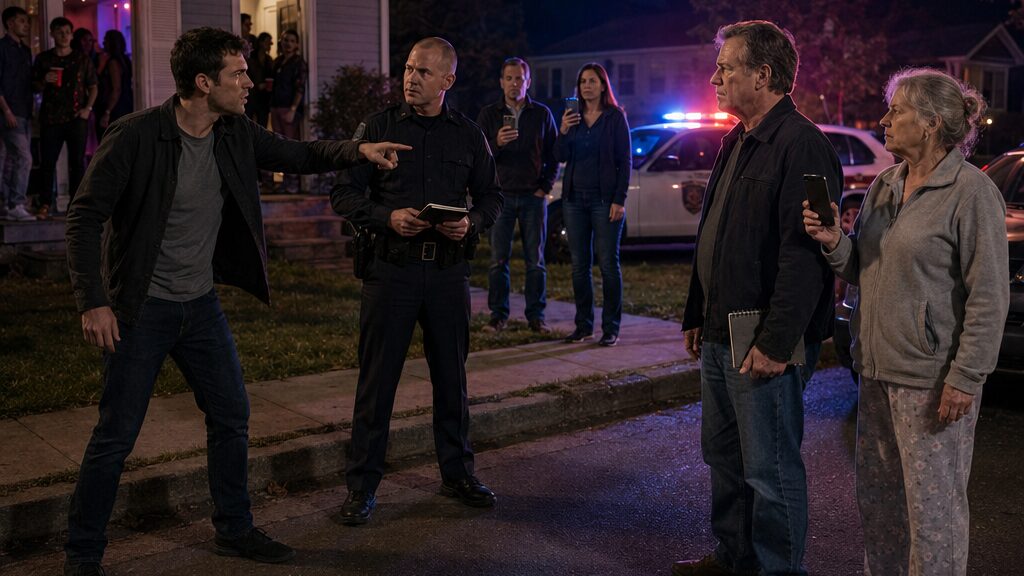
The Weekends Next Door Kept Getting Louder Until One Quiet Homeowner Changed the Entire Block
Chapter 1: The Blue Lights Returned Before Raymond Had Fallen Asleep
The blue lights reached Raymond Harris’s bedroom before sleep did.
They slid across the ceiling in slow pulses, vanished, then returned brighter through the blinds. Red followed blue. Blue followed red. For a few seconds his room looked less like the back corner of a quiet suburban house and more like the inside of an ambulance.
Raymond stared up at the shifting colors and listened to the bass coming through the wall.
Not music. Not really.
At this distance, it was mostly impact.
Thump.
A pause.
Thump-thump.
The glass in the bedroom window gave a faint metallic tremor inside its frame.
He looked at the clock.
12:47 a.m.
His alarm was set for 4:35.
Raymond sat up, rubbed both hands over his face, and heard someone outside shout something followed by a burst of laughter. A car door slammed. Another voice answered from somewhere near the sidewalk.
The house next door had been a rental for years. Before Eric Moore and the others moved in, the worst Raymond had dealt with was an overflowing trash can after a holiday weekend and one tenant who parked a motorcycle too close to his mailbox.
This was different.
It had started four weekends earlier with maybe twelve people and music loud enough to hear from his kitchen.
Then twenty people.
Then cars lining both sides of the street.
Tonight, someone had parked partly on the grass across from Raymond’s driveway, and people had been moving between the front door and backyard since ten.
The police cruiser outside was not there because Raymond had called. At least, he did not think so.
He pulled on jeans and walked into the hall.
From the front window, he could see a uniformed officer standing near a sedan while a young man gestured with both hands. The front yard of the rental was scattered with people holding red cups. Colored bulbs glowed through the open doorway.
The officer spoke for less than two minutes, then returned to the cruiser.
A warning, Raymond guessed.
The patrol car rolled away.
The party did not stop.
Ten minutes later, the bass grew louder.
Raymond stood in his kitchen with his work shirt hanging over the back of a chair. He had been a maintenance supervisor at a packaging plant for fourteen years. Sunday mornings were normally light, but the first shift still started before six. If a conveyor locked, a motor overheated, or someone ignored a machine guard, being half-awake was not an inconvenience. It was dangerous.
He poured water, not coffee. Coffee would mean admitting the night was already lost.
Another cheer rose next door.
Raymond set the glass down harder than he intended.
His father would have gone over there twenty minutes ago.
That thought irritated him almost as much as the music.
His father had spent the last decade of his life noticing everything—cars left too long at curbs, garbage cans left out after pickup, branches leaning over fences. Raymond used to tell him to let people live.
“You don’t own the whole street,” he had once said.
His father had not spoken to him for the rest of that afternoon.
Raymond still remembered it because he had been right.
At least he had thought so.
He took his jacket from the hook and stepped outside.
The air smelled faintly of beer, cut grass, and someone’s charcoal grill. Two young women passed him on the sidewalk without looking up. A man he did not recognize stood beside Raymond’s mailbox typing on his phone.
Raymond crossed the strip of lawn between the properties.
Eric opened the door after the second knock.
He was in his late twenties, maybe early thirties, wearing a gray T-shirt and holding a plastic cup. He did not look drunk. That almost made Raymond more hopeful.
“Hey,” Eric said.
“Sorry to bother you.”
Eric glanced back at the room behind him.
Raymond could see people packed shoulder to shoulder near the kitchen. Someone had dragged a speaker close to the hallway.
“I have to be up in about three hours,” Raymond said. “Could you turn it down?”
Eric gave a quick nod that looked polite enough.
“Yeah. Sure.”
“Especially the bass.”
“Got it.”
Raymond waited.
Eric smiled.
It was not exactly mocking. That would have been easier.
It was the smile of someone agreeing because agreeing was faster than arguing.
“Appreciate it,” Raymond said.
He turned toward home.
Behind him, the door closed.
The bass dropped for perhaps thirty seconds.
Then it rose again.
Raymond stopped halfway across his yard.
For one sharp moment he imagined walking back, knocking harder, telling Eric exactly what he thought of being lied to.
Instead he kept walking.
At 1:23, he heard voices beside his house.
Raymond went to the kitchen window.
A young man and woman were cutting through the narrow strip between Raymond’s garage and the fence, using his side yard as a shortcut from the street to the rental’s backyard.
Raymond opened the side door.
“Hey.”
They froze.
“That’s private property.”
The man lifted one hand.
“Sorry, man. We’re just going through.”
“That’s what I’m asking you not to do.”
The woman looked embarrassed. The man looked annoyed.
They backed out toward the sidewalk.
Raymond shut the door.
Then he noticed Eric standing near the neighboring driveway.
Their eyes met.
Eric lifted his cup in a small shrug, as if to say Raymond was making too much of nothing.
Raymond went inside.
At 2:05, he took a spiral notebook from the junk drawer.
On the first clean page he wrote the date.
Then:
12:47 a.m. — police vehicle outside rental.
1:03 a.m. — music increased after police left.
1:23 a.m. — two guests entered side yard after direct request to lower noise.
He stopped.
The page looked absurd.
He could hear his father in it.
Times. Details. Little violations carefully lined up as though the world could be corrected with handwriting.
Raymond closed the notebook.
At 2:18, a car horn sounded three times outside.
He opened it again.
By four, the music had finally weakened into scattered voices and doors shutting.
Raymond showered, dressed, and made coffee strong enough to hurt his stomach.
When he stepped into the driveway at 5:02, the sky was beginning to pale.
That was when he saw the tracks.
Two fresh tire marks curved over the corner of his front lawn, flattening a strip of damp grass before returning to the street.
Raymond stood with his work bag in one hand.
He looked next door.
The rental house was finally dark.
Then he looked at the notebook visible through his kitchen window where he had left it on the counter.
The problem, he realized, had moved past noise.
Chapter 2: A Polite Note Disappeared and the Weekends Kept Expanding
Raymond watched the note disappear at 11:16 Saturday morning.
He had taped it to the rental’s front door less than an hour earlier.
Nothing dramatic. No threats. No mention of police.
Please keep the music down after quiet hours and ask guests not to cross the neighboring yards. I work early weekends. Thank you.
He had rewritten it twice before leaving the house because the first version sounded angry and the second sounded like his father.
Now, from behind his front blinds, Raymond saw Eric come outside wearing gym shorts and sunglasses.
Eric read the note.
He looked toward Raymond’s house.
Then he folded the paper once, dropped it into the recycling bin beside the garage, and went back inside.
Raymond stepped away from the window before Eric could see him.
He told himself that disposing of the note did not mean ignoring it.
For most of Saturday, the rental stayed quiet.
At 8:40 that night, the first cars arrived.
By ten, Raymond counted nine.
At 10:32, he stopped counting because he disliked the fact that he had started.
He opened his notebook instead.
The entries were getting cleaner.
Dates on the left.
Times underneath.
Short descriptions with no adjectives.
He had decided that words like ridiculous, disrespectful, and insane did not belong in evidence.
10:41 p.m. — amplified music audible inside rear bedroom with windows closed.
11:08 p.m. — sedan partially blocking mailbox.
11:31 p.m. — four guests standing in street.
At midnight, Raymond called the city’s non-emergency line, then canceled before the call connected.
He could still handle it himself.
That was the thought he kept returning to.
Other people had families. Jobs. Their own problems. He was not going to walk door to door collecting allies like a man running for neighborhood office.
By Sunday morning, he had slept two hours.
On Monday, the plant nearly collected the bill.
Raymond was standing beside Conveyor Four when a jam developed near the labeler. A mechanic had already shut down the line, but the indicator lights were still active.
Raymond leaned in to inspect a guide rail.
His hand moved toward the housing.
“Raymond.”
The mechanic’s voice snapped him back.
Raymond stopped.
The lockout tag was hanging from the wrong switch.
The line had not been fully isolated.
He withdrew his hand.
For a second neither man said anything.
Then the mechanic corrected the lockout.
“You all right?”
Raymond looked at his own fingers.
“Yeah.”
“You sure?”
“Didn’t sleep much.”
The mechanic nodded toward the machine.
“Get coffee before you try not sleeping with moving equipment.”
Raymond forced a smile.
The comment followed him for the rest of the shift.
That evening he opened the notebook at his kitchen table.
Until then, the problem had remained irritating enough to catalog and manageable enough to endure.
The conveyor changed that.
He added a line beneath the weekend entries.
Sleep disruption affecting work safety.
Then he stared at it.
It sounded melodramatic.
He crossed it out.
The next Friday, the party started before nine.
Raymond did not go over.
At 10:56, he opened the city’s non-emergency reporting app and submitted the address, time, and type of complaint.
At 11:38, a patrol car arrived.
Raymond watched from the darkened living room.
Two officers approached the rental.
Eric came outside.
This time the conversation lasted longer.
One officer pointed toward the street, then toward the house. Eric folded his arms. A second renter joined him.
Eventually the music dropped.
Not vanished.
Dropped.
Raymond could still hear it, but his window stopped trembling.
For the first time in a month, something he had done produced a measurable result.
He closed the notebook and went to bed.
At 12:26, the music rose again.
Raymond lay still for several seconds.
Then he laughed once under his breath.
It was not amusement.
He got up, wrote the time, and returned to bed.
The following weekend, he filed another complaint at 11:14.
He hated how automatic it had become.
Open app.
Address.
Noise.
Crowd.
Submit.
The officers arrived shortly before midnight.
Raymond stepped onto his porch while they spoke with Eric.
A neighbor across the street had also come outside, though Raymond did not know whether she was curious or angry.
One officer eventually handed Eric a paper.
Eric looked down at it, then toward Raymond.
The officer said something Raymond could not hear.
Eric nodded.
The patrol car left.
For several minutes the street stayed quiet.
Raymond should have gone inside.
Instead, he remained on the porch.
Eric crossed the lawn between the houses.
He stopped at the property line.
“You happy?”
Raymond kept his voice low.
“I asked you first.”
“You call the cops every time people come over?”
“No.”
“Could’ve fooled me.”
“You know that’s not what’s happening.”
Eric exhaled through his nose and looked back at his house.
“You ever rent with four people?”
Raymond said nothing.
“Everybody works different schedules. Nobody has money to go downtown every weekend. We have people over. That’s not a crime.”
“I never said it was.”
“You act like it is.”
Raymond felt the old temptation to list every incident. The yard. The horn. The tire tracks. The window.
He resisted it.
“I asked you to keep it down late. That’s all.”
Eric’s expression changed slightly.
For half a second he looked tired instead of defiant.
Then someone inside the house shouted his name.
Eric stepped backward.
“Officer gave us a warning.”
Raymond nodded.
“So take the warning.”
Eric smiled.
This time Raymond understood the smile perfectly.
“You think this means the weekend’s over?”
He turned and walked back toward the rental.
Ten minutes later, the music returned.
Raymond went inside, sat at the kitchen table, and opened the notebook.
For the first time, he did not feel ridiculous writing in it.
Chapter 3: Three Phones Changed Who the Problem Belonged To
“He’s the only one with a problem.”
Eric said it loudly enough that Raymond heard him from across the hood of the patrol car.
It was 11:52 on another Saturday night, two weekends after the warning.
The rental’s front door stood open behind Eric. Colored light spilled over the porch. Someone had lowered the music, but the bass still pulsed beneath the voices.
One officer held a small notepad.
Eric pointed toward Raymond.
“He calls every weekend. Ask anybody.”
Raymond felt something tighten in his chest.
He had brought his spiral notebook outside tucked under one arm. He had not planned to display it. He only wanted the incident number written correctly.
Now the notebook felt like proof of exactly what Eric was accusing him of being.
A man keeping score.
The officer looked at Raymond.
“How many times have you personally reported the address?”
Raymond knew the number.
That bothered him.
“Three formal reports.”
Eric gave a short laugh.
“Exactly.”
Raymond started to answer.
A woman’s voice came from behind him.
“Four.”
Everyone turned.
Ruth Johnson stood near the curb in slippers and a zip-up sweatshirt over her nightclothes. Her gray hair was pulled back carelessly. She held her phone in one hand.
The officer frowned.
“Ma’am?”
“Four complaints from my house.”
Eric stared at her.
Ruth lived two houses down. She had never once spoken to Raymond about the parties.
She tapped her phone.
“Two through the city app. Two calls.”
Another porch light came on across the street.
A homeowner Raymond knew only well enough to wave at walked toward them holding his own phone.
“My wife reported twice.”
Eric looked from one face to another.
The officer shifted his attention away from Raymond.
“Same property?”
“Yes.”
The man gave the address.
A second neighbor joined them from farther down the sidewalk.
Within a minute, three glowing phone screens were visible in the blue-red wash from the patrol lights.
Raymond’s notebook suddenly seemed less important.
Eric recovered quickly.
“Okay, people are annoyed. I get it. But this is getting ridiculous.”
Ruth looked at him.
“No. Ridiculous was Thursday.”
Eric blinked.
“There wasn’t a party Thursday.”
“No. There was a truck sitting outside your place with music on for an hour and a half.”
“That wasn’t mine.”
“It was your guest.”
“You don’t know that.”
Ruth raised her phone but did not move closer.
“I know I reported it.”
Raymond could feel the argument trying to widen.
Whose guest.
Whose car.
Whose fault.
He had spent weeks doing the same thing privately, only with cleaner handwriting.
The officer looked toward him again.
“You said you have records?”
Raymond opened the notebook halfway.
Then stopped.
He looked at the three neighbors.
“Talk to them first.”
Eric frowned.
“What?”
Raymond closed the notebook.
“They didn’t get their dates from me.”
The officer nodded and turned to Ruth.
Raymond stepped back.
For the next several minutes he listened.
One neighbor described a car blocking a fire hydrant.
Another described shouting after two in the morning.
Ruth mentioned a hospital employee in her household who had been late for a shift after being kept awake.
At that, Eric’s expression changed.
“Hospital?”
Ruth looked at him.
“Yes.”
Eric glanced toward the rental house.
“I didn’t know that.”
“You didn’t ask.”
For once, he had no quick answer.
Raymond saw something uncomfortable pass across Eric’s face.
Not fear of a citation.
Shame.
It lasted only a moment.
Then one of the renters stepped onto the porch and called, “Eric, are they making us shut it down again?”
Eric’s jaw tightened.
He turned toward the house.
“Inside.”
The renter disappeared.
The officer began writing.
Raymond stood with his closed notebook pressed against his leg.
He had expected satisfaction.
Instead he felt exposed in a different way.
For weeks he had assumed nobody else was saying anything because nobody else cared enough.
It had not occurred to him that they might have been complaining separately for the same reason he had: each believing the problem was theirs to manage alone.
The officer finished taking information.
“This gives us a broader pattern,” he said. “That matters.”
Eric looked at Raymond.
“You went around collecting people?”
“No.”
“Come on.”
“I didn’t.”
Ruth cut in.
“He didn’t even know I’d filed anything.”
Eric looked at her, then back at Raymond.
The argument had nowhere easy to go.
The officer handed Eric another document and explained that repeated violations could lead to additional municipal penalties and property-owner notification.
Eric took the paper.
No grin this time.
The music stayed low after the officers left.
The neighbors lingered near the curb.
Raymond expected them to scatter without speaking.
Instead Ruth looked at the notebook under his arm.
“That the famous file?”
He almost smiled.
“It’s a notebook.”
“Same difference.”
“I write down times.”
“I know.”
“You know?”
She gave him a look.
“Raymond, you stand in your kitchen window with a pen.”
He felt heat rise in his face.
Ruth softened.
“I thought you were getting obsessed with it.”
“Maybe I was.”
“Maybe you still are.”
The words landed harder because she had just defended him.
He looked toward the darkened upper windows of the rental.
“You complained too.”
“Yes.”
“Why didn’t you tell me?”
“Why didn’t you tell me?”
Raymond had no answer.
Ruth unlocked her phone and scrolled through an email thread.
“I sent this one to property management three weeks ago.”
Raymond leaned closer.
The message contained the rental address, a short description of the disturbance, and a copied contact for the property owner.
Sandra Clark.
Raymond recognized the name. He had obtained it only recently through county property records but had not contacted her yet.
Ruth scrolled again.
“There’s another one.”
The timestamp was older.
Sandra had been copied there too.
Raymond looked at Ruth.
“She knew?”
“Knew there were complaints, yes.”
“From more than me.”
“At least mine.”
Raymond felt the night reorganize itself in his head.
Until that moment, the obvious obstacle had been Eric.
Eric was loud. Eric was dismissive. Eric opened the door and smiled. Eric made the problem visible.
But Sandra owned the house.
If she had known weeks ago that more than one household was complaining, then Eric’s behavior was only part of the story.
“Did she answer?”
Ruth shook her head.
“Property management did. Said they’d contact the owner.”
“And that was it?”
“That was it.”
Raymond opened his notebook.
For a second Ruth looked disappointed.
Then he turned past his own entries to a clean page.
“Give me the dates.”
She studied him.
“What are you going to do?”
“I don’t know yet.”
“That’s the right answer.”
They compared only the major incidents.
Raymond resisted the urge to include everything.
The late horn.
The mailbox.
The people standing too close to his hedge.
Ruth rejected one immediately.
“That’s annoying,” she said. “It isn’t the case.”
“The car was blocking half the box.”
“Did it stop delivery?”
“No.”
“Then leave it out.”
Raymond stared at the line.
He crossed it through.
The action bothered him more than he expected.
But the page looked stronger afterward.
By 1:00 a.m., the street was nearly empty.
Raymond went inside, set the notebook on his dining table, and turned off the kitchen light.
At 8:17 the next morning, his phone rang.
Unknown number.
He almost let it go.
Then he answered.
“Raymond Harris?”
“Yes.”
“This is Sandra Clark. I own the property next door.”
Raymond straightened.
“I understand you’ve been having some issues with my tenants.”
“Not just me.”
There was a pause.
“I’m aware other people have made comments.”
“Complaints.”
Another pause.
Then Sandra said, “Mr. Harris, I think you and I have heard very different versions of what’s been happening over there.”
Raymond looked at the notebook on his table.
For the first time, he wondered exactly how different Sandra’s version had been allowed to become.
Chapter 4: The Landlord Had More Warnings Than She Admitted
Sandra Clark mentioned the Thursday truck before Raymond did.
“That was the one where someone sat outside with music running for over an hour, right?”
Raymond stopped with his pen above the notebook.
He had never told her about Thursday.
Ruth had.
For a second Sandra seemed not to realize what she had revealed.
“You already knew about that incident,” Raymond said.
A pause opened on the phone.
“I received an email.”
“From Ruth.”
“I receive a lot of messages about the property.”
“That wasn’t what you said yesterday.”
Sandra’s voice sharpened slightly.
“What I said was that I had heard a different version of events.”
Raymond looked across his dining table. His notebook was open beside three sheets where he had started combining his dates with the information Ruth and the other neighbors had shared.
“What version?”
“That my tenants occasionally have people over, that you object to parking near your house, and that there have been disagreements about normal neighborhood noise.”
Raymond leaned back.
“Normal neighborhood noise doesn’t bring patrol cars three weekends.”
“I’m not saying there haven’t been problems.”
“You just called them disagreements.”
“I’m trying not to turn this into something bigger than it needs to be.”
Raymond nearly answered too quickly.
That phrase—bigger than it needs to be—felt like a hand pressing down on everything he had documented.
Instead he asked, “How many complaints have you received?”
Sandra did not answer directly.
“Some went through property management.”
“How many?”
“I would have to check.”
“Please check.”
He heard her inhale.
“Mr. Harris, I am trying to work with you.”
“So am I.”
The sentence surprised him by sounding calm.
When the call ended, Raymond remained at the table.
His first instinct was to build the largest possible packet.
He pulled the notebook closer.
Tire tracks.
Car horn.
Blocked mailbox.
People standing in the street.
Side-yard shortcut.
Music.
Shouting.
Every irritation had acquired a date.
By afternoon, Ruth was sitting across from him with reading glasses low on her nose.
She turned one page.
“This goes.”
Raymond looked at the line.
“Why?”
“Because someone parked six inches over the curb line for twenty minutes.”
“It was in front of my mailbox.”
“Did your mail not come?”
“That isn’t the point.”
“It is exactly the point.”
Raymond folded his arms.
Ruth moved to another entry.
“And this.”
“That horn woke me up.”
“One horn.”
“Three times.”
Ruth looked up.
“You want Sandra to understand there’s a serious pattern, or do you want her to know every time you were irritated?”
Raymond felt himself stiffen.
“I wrote what happened.”
“I know.”
“That’s what records are for.”
“No. Records are for remembering what matters.”
The words landed somewhere uncomfortable.
Raymond glanced at his father’s old pen sitting near the notebook. He had found it years ago in a drawer after clearing the old man’s house. Cheap black plastic, teeth marks near the cap.
His father had documented things too.
Not in notebooks. In complaints, calls, conversations repeated until everyone around him knew the offense by heart.
Raymond had spent weeks insisting he was different.
The thickness of his notebook suggested otherwise.
He picked up the pen.
“What stays?”
Ruth pushed the pages back toward him.
“Things that affected sleep after quiet hours. Property access. Trespass. Police responses. Anything multiple households independently reported.”
“The truck?”
“Yes.”
“The mailbox?”
“No.”
Raymond crossed it out.
The line disappeared beneath black ink.
He disliked the feeling.
Then he crossed out the horn.
Then the car that had been parked legally but too close to his driveway for his taste.
By evening, the chronology was shorter by nearly a third.
It was also harder to dismiss.
Three nights with music after midnight.
Two instances of guests entering neighboring property.
Four independent complaints from other households.
Three police responses.
One citation.
One Thursday vehicle with amplified music.
Raymond looked at the cleaned-up pages.
The notebook had stopped being a private accumulation of grievances.
It had become something else.
A pattern.
The next morning, he brought copies to the HOA management office.
The representative behind the counter reviewed the dates but made clear that the HOA could not enforce the city noise ordinance or terminate a private lease.
“What we can document,” the representative said, “is repeated interference with access, common-area rules if applicable, and owner notification.”
“Has the owner been notified before?”
The representative hesitated.
“I can confirm notices were forwarded.”
“How many?”
“I can’t discuss another owner’s account history in detail.”
Raymond nodded.
He did not push.
He no longer needed every detail.
That afternoon Sandra called again.
Her tone had changed.
“I reviewed the messages.”
Raymond waited.
“There were more than I realized.”
“More than you realized, or more than you remembered?”
Sandra was silent.
“That’s fair,” she said finally.
Raymond looked toward the rental through his dining-room window.
“So what happens now?”
“I speak to the tenants.”
“You’ve done that before.”
“Yes.”
“And?”
Another pause.
Then Sandra said, “You want me to tell you the truth?”
“Yes.”
“The truth is I can’t afford to turn that house over again.”
Raymond said nothing.
Sandra continued before he could respond.
“The tenants before them left after eleven months. Flooring, paint, cleaning, two months vacant. I refinanced when rates were bad. These tenants pay on time. Every month.”
The admission took some of the heat out of Raymond’s anger.
Not all of it.
“You’re saying you knew there were complaints because losing them would cost you money.”
“I’m saying I convinced myself the complaints were manageable.”
“By who?”
Sandra did not answer.
Raymond looked at the edited timeline.
He suddenly understood why each message had been treated separately.
One complaint was a conversation.
Two were friction.
Three were unfortunate.
A pattern required action.
Sandra had kept refusing to name the pattern.
“My job starts before six,” Raymond said. “One of Ruth’s people works at the hospital. Other people live here too.”
“I know.”
“You know now.”
“No.” Sandra’s voice lowered. “I knew before. I just thought warnings would be enough.”
There it was.
No conspiracy.
No secret arrangement.
Just a person with a mortgage choosing the explanation that cost her least.
Raymond found that harder to hate.
It did not make the consequences smaller.
“What are you going to do?” he asked.
“I’m going to issue a formal lease warning tied to the documented disturbances.”
“And if it happens again?”
“If there is another material violation that I can substantiate, I begin termination under the lease terms.”
Raymond rubbed one thumb along the edge of the notebook.
“That’s your decision.”
“It is.”
“I’m not asking you to throw anybody out tonight.”
“I understand.”
“But I’m done pretending this is just between me and Eric.”
Sandra exhaled softly.
“So am I.”
The formal notice went out two days later.
Raymond did not see the wording. Sandra only confirmed that it had been delivered and that the next documented material violation could trigger termination proceedings.
Friday evening passed quietly.
Saturday did too.
At 10:30, Raymond stood in his kitchen, listening to nothing.
He should have felt victorious.
Instead he found himself looking at the notebook.
Waiting for a reason to open it.
Chapter 5: One Quiet Weekend Looked Too Much Like an Ending
Raymond woke at 3:18 Sunday morning because the house was silent.
For several seconds he lay completely still, confused by what had disturbed him.
No bass.
No shouting.
No doors slamming in the street.
The bedroom window did not tremble.
He turned his head toward the clock, then toward the blinds.
Darkness.
Ordinary darkness.
Raymond sat up.
His body had apparently learned the schedule even if the neighborhood had stopped following it.
He walked into the kitchen and opened the refrigerator mostly to have something to do.
The notebook sat in the drawer where he had put it Friday evening.
Blank weekend.
That should have been enough.
By nine, he was trimming a hedge near the driveway when Eric came outside next door carrying a trash bag.
For the first time in weeks, neither man had an immediate reason to speak.
Eric walked to the bin.
Raymond kept clipping branches.
Eric closed the lid.
“Quiet enough?”
Raymond lowered the trimmer.
“It was quiet.”
Eric nodded.
“Good.”
There was no grin.
Raymond almost said thank you.
The words felt strange in his mouth, so he settled for, “I appreciate it.”
Eric looked mildly surprised.
Then he went inside.
The next weekend was quieter too.
A few cars came over Saturday afternoon. Someone grilled in the backyard. Raymond heard music through an open window around seven, but it disappeared before ten.
At 10:15 he walked through the kitchen and glanced automatically toward the neighboring driveway.
At 10:40 he checked again.
At 11:05 he opened the blinds because a car door had shut.
The vehicle drove away.
Nothing else happened.
On Sunday morning, Ruth caught him taking his trash bin to the curb.
“You look tired,” she said.
“I’m fine.”
“You still waking up?”
Raymond stopped pushing the bin.
“How do you know?”
“Because your kitchen light comes on at three in the morning.”
He looked toward his house.
“I’ve always gotten up early.”
“Not that early.”
Raymond gripped the plastic handle.
Ruth studied him.
“You got the quiet.”
“I know.”
“You haven’t stopped fighting.”
“There’s nothing to fight.”
“Exactly.”
He almost dismissed her.
Instead he looked toward the rental.
“You think I should pretend the last two months didn’t happen?”
“No.”
“Then what?”
“I think you should stop waiting for the next thing so you can prove you were right about the last thing.”
The sentence irritated him because it was close enough to something he had not wanted to name.
“I wasn’t wrong.”
“I didn’t say you were.”
“That house kept half the block awake.”
“I know. I filed complaints too.”
Raymond released the trash-bin handle.
Ruth’s expression softened.
“You did what you had to do. But if they’re quiet, let quiet count.”
Raymond went inside without answering.
He opened the kitchen drawer.
The notebook was there beneath takeout menus and spare batteries.
He picked it up.
For a moment he considered writing:
Two consecutive weekends—no significant disturbance.
It would have been accurate.
Instead he put the notebook back.
Then he closed the drawer.
That afternoon, Eric was standing beside his car when Raymond returned from the hardware store.
“Hey.”
Raymond paused.
Eric rubbed the back of his neck.
“You got a minute?”
Raymond set the small shopping bag on his porch step.
“What’s up?”
Eric looked toward the house as if checking whether anyone inside was listening.
“That woman who owns the place sent us a formal notice.”
“Sandra.”
“Yeah.”
Raymond waited.
Eric shoved his hands into his pockets.
“She made it sound like one more thing and we’re out.”
“I didn’t write the lease.”
“I know.”
The answer came faster than Raymond expected.
Eric looked down at the driveway.
“I talked to one of the guys about that hospital thing.”
Raymond remembered Ruth standing under the patrol lights.
“You didn’t know.”
“No.”
Eric’s jaw moved.
“Look, I’m not saying we weren’t loud.”
That was the closest thing to an admission Raymond had heard from him.
“We were loud.”
Raymond said nothing.
Eric continued.
“I just thought you were… I don’t know. Watching us.”
“I was.”
Eric glanced up.
Raymond did not soften it.
“I was watching by the end.”
“Exactly.”
“That doesn’t mean you weren’t waking people up.”
“No.”
For once, the two facts sat between them without one canceling the other.
Eric kicked lightly at a pebble.
“You know why everybody comes here?”
“Because you have a house.”
“Because none of us can afford places where people actually want you hanging around. Bars charge eight bucks a drink. Half the guys are sharing apartments. Couple of them live with family.”
“That makes sense.”
Eric seemed surprised again.
“It doesn’t make four in the morning okay,” Raymond added.
“I know.”
The words were quiet.
Raymond believed him.
That was what made the next sentence matter.
“But Sandra’s not kicking us out.”
Raymond frowned.
Eric gave a humorless smile.
“She can’t.”
“You seem pretty sure.”
“She told us what turnover cost her last time. She needs the rent.”
Raymond felt something cold settle beneath his ribs.
Not because Sandra had lied exactly.
Because Eric had heard the same financial fear Raymond had heard and drawn the opposite conclusion.
Sandra heard risk.
Eric heard permission.
“She sent you a formal warning,” Raymond said.
“Paper is paper.”
“You want to test that?”
Eric shrugged.
“Not trying to. I’m just saying everybody knows how this works.”
Raymond looked at him for a long moment.
Eric had shown shame about the hospital shift. He had kept the house quiet for two weekends.
He understood.
That removed one excuse.
Raymond picked up his hardware-store bag.
“Then keep doing what you’ve been doing.”
Eric nodded.
“Plan to.”
Raymond went inside.
He did not retrieve the notebook.
For six days, the drawer stayed closed.
Early the following Sunday, Raymond backed out of his garage at 5:07 a.m.
His headlights washed over the driveway.
He hit the brake.
A dark sedan sat across the apron at an angle, its rear bumper extending directly across his only exit.
Raymond stared through the windshield.
Then he looked at the time.
His shift started in fifty-three minutes.
Chapter 6: The Blocked Driveway Forced Everyone to Choose a Side
Raymond’s headlights illuminated the sedan like evidence placed on a table.
He shifted into park and stepped out.
The street was nearly empty. No music came from next door. No crowd filled the yard.
The car alone was enough.
Its front tires were near the curb, but the rear half angled across Raymond’s driveway apron. He could not clear it without driving over his lawn and risking the drainage edge.
He checked the windshield.
No note.
No phone number.
Raymond walked next door and knocked.
Nothing.
He knocked harder.
A light came on upstairs.
After another minute, Eric opened the door wearing sweatpants and a T-shirt.
“What?”
“There’s a car across my driveway.”
Eric squinted toward the street.
“Oh.”
“I need to leave.”
Eric stepped onto the porch.
He recognized the sedan immediately. Raymond saw it in his face.
“Whose is it?”
“One of the guys’ friends.”
“Wake them up.”
Eric rubbed both hands over his face.
“I don’t know where he crashed.”
Raymond glanced at his watch.
“Find him.”
“Raymond, it’s five in the morning.”
“Yes.”
Eric looked at him.
Raymond let the absurdity sit there.
Eric sighed and went inside.
Five minutes passed.
Then ten.
Raymond called his supervisor and said he might be late.
It was the first time in years he could remember making that call for a reason that sounded so avoidable.
Eric returned.
“Can’t find him.”
“You’ve checked the house?”
“There are people sleeping everywhere.”
“Then wake them.”
Eric’s expression hardened.
“You want me to tear through rooms because a bumper is in your driveway?”
“A bumper isn’t in my driveway. Half the car is.”
“You could probably get around.”
Raymond looked toward the narrow strip of grass.
“No.”
“You haven’t even tried.”
“And I’m not going to damage my yard or my truck to solve your guest’s parking.”
Eric stepped down from the porch.
For a moment, Raymond saw the old argument trying to return.
One difficult homeowner.
One small inconvenience.
One man making too much of something.
Raymond felt the notebook almost physically, though it was still inside his kitchen drawer.
He did not need it yet.
“I’m giving you ten more minutes,” he said.
“For what?”
“To move the car.”
“And then?”
“I call for removal.”
Eric stared at him.
“You’d tow somebody over this?”
“I need access to my property.”
“It’s five in the morning.”
“So move it.”
Raymond turned away.
Eric followed two steps.
“You know Sandra’s warning doesn’t mean what you think it means.”
Raymond stopped.
“What does that mean?”
Eric folded his arms.
“She’s not throwing us out.”
“You told me that already.”
“Because she can’t afford to.”
“You want to bet your lease on that?”
Eric gave a tired laugh.
“She was trying to scare us.”
The certainty in his voice settled something for Raymond.
Sandra had warned him.
Ruth had explained the hospital shift.
The police had come repeatedly.
Eric had even admitted they had crossed the line.
This was no longer ignorance.
“What did you tell whoever parked there?” Raymond asked.
Eric looked toward the sedan.
“Nothing.”
Raymond waited.
Eric looked away.
“What?”
“You recognized the car before you got off the porch.”
“So?”
“So you knew it was there.”
Eric’s jaw tightened.
“I saw him park.”
“And?”
“I told him to pull up.”
“Did he?”
“He said there wasn’t room.”
“There was room down the block.”
Eric said nothing.
Raymond felt his pulse in his neck.
“What did you tell him?”
“It doesn’t matter.”
“It matters to me.”
Eric exhaled.
“I said it was close enough.”
The words arrived almost casually.
Raymond looked at the sedan.
Close enough.
His driveway. His shift. His grass if he tried to squeeze around.
Close enough.
“And you knew about the warning.”
Eric’s face changed.
“Don’t make this into something.”
Raymond nodded once.
“I’m not.”
That surprised Eric.
Raymond took out his phone.
He photographed the position of the car from the street, then from inside his driveway.
Two photographs.
No commentary.
No pictures of Eric.
No list of everything else that had ever happened.
Then he opened the notebook for the first time in a week.
5:07 a.m. — vehicle obstructing driveway access.
5:22 a.m. — tenant unable to locate owner.
5:26 a.m. — Eric stated he saw vehicle parked and told driver location was “close enough.”
He stopped writing.
There were a dozen things he could have added.
He added none of them.
Eric watched.
“That all going in the file?”
“This is.”
“And everything else?”
Raymond closed the notebook.
“Everything else already happened.”
The answer seemed to unsettle Eric more than anger would have.
At 5:31, Raymond called the appropriate non-emergency number and reported the blocked access.
He also sent Sandra a short message with the photograph and time.
Then he waited.
A responding officer arrived first and confirmed that the vehicle obstructed usable access.
The officer attempted to identify the owner through the rental occupants.
No one came out to claim it.
By six, Raymond’s shift had started without him.
His supervisor texted asking whether he would make the second hour.
Raymond answered yes, if the driveway cleared.
Eric stood on his porch now fully dressed, arms crossed.
When a tow truck turned onto the street, he walked toward Raymond.
“You really did it.”
“I gave you time.”
“You could’ve waited.”
“I already did.”
The tow operator positioned the truck.
Metal clicked beneath the sedan.
Raymond expected satisfaction.
What he felt instead was fatigue.
The car rose.
One rear wheel left the pavement.
A young man finally stumbled from the rental barefoot, shouting that the car was his.
The officer spoke with him.
The tow operator paused.
Whatever conversation followed had nothing to do with Raymond anymore. Access had been blocked. The process was already in motion.
Raymond went inside for his work bag.
His phone rang.
Sandra.
“I got your message.”
“The officer is here.”
“I’m on my way.”
Raymond stopped.
“You don’t have to come.”
“Yes,” Sandra said. “I do.”
He drove out as soon as the driveway was clear, nearly an hour and a half late.
At the end of the street he looked once in the mirror.
Eric stood beside the curb watching the tow truck.
Raymond could not tell whether he looked angry or afraid.
Raymond finished only half his shift before another message from Sandra appeared.
Please call me when you can.
He waited until his lunch break.
“What happened after I left?” he asked.
Sandra’s voice sounded exhausted.
“I spoke to Eric.”
“And?”
“He told me what he told you. That he thought the warning was mostly leverage.”
Raymond leaned against the break-room wall.
“Was it?”
“No.”
He closed his eyes briefly.
Sandra continued.
“I should never have discussed my financial situation with them the way I did. I thought if they understood I needed stable tenants, they’d understand I needed them to behave.”
“They heard something else.”
“Yes.”
Raymond looked through the small break-room window at the plant floor.
“What happens now?”
“I’m starting the termination process allowed under the lease.”
There was no triumph in her voice.
Only consequence.
When Raymond returned home that afternoon, Sandra’s car was parked next door.
The rental looked unusually still.
No one stood in the yard.
No music.
No doors opening and shutting.
Raymond carried his work bag toward his porch.
Sandra came out of the neighboring house holding a folder.
Eric followed her.
His face was pale with anger, but he said nothing to Raymond.
Sandra stopped beside the walkway.
She looked at Eric.
Then she held out her hand.
“House keys.”
Eric stared at her.
Raymond stopped walking.
For the first time since the parties had begun, nobody on the street seemed certain what would happen next.
Chapter 7: Raymond Won the Quiet Only After He Stopped Needing to Win
The moving truck arrived three weeks later without music, police lights, or anyone standing on the sidewalk to watch.
Raymond noticed it because the backup alarm sounded twice while he was making coffee.
He looked through the kitchen window.
Two workers were carrying boxes from the rental house. Eric stood near the garage with his hands in his pockets, watching a mattress disappear into the truck.
There was no crowd.
No final party.
No dramatic confrontation.
Just cardboard boxes, furniture pads, and the hollow sound of an almost-empty house.
Raymond stayed inside.
For weeks he had imagined what the end of the conflict might feel like.
Relief, certainly.
Maybe satisfaction.
He had not expected embarrassment.
Not because the lease termination was wrong. The record was clear enough even after he and Ruth had stripped away everything petty. Repeated late-night disturbances. Multiple independent complaints. Police responses. A formal lease warning. Then the blocked driveway after Eric already understood what was at stake.
Still, watching another man carry his life into a truck did not feel like winning.
Raymond poured coffee.
The notebook remained in the kitchen drawer.
He had not opened it since the morning of the tow.
At ten, Sandra knocked on his door.
She looked more tired than the last time he had seen her. She carried a thin folder rather than the thick stack Raymond had come to associate with the dispute.
“Do you have a minute?”
Raymond stepped onto the porch.
Sandra glanced toward the moving truck.
“They should be finished by early afternoon.”
Raymond nodded.
“How did everything go?”
“Not cleanly.”
“I didn’t expect it would.”
Sandra gave a small, humorless smile.
“There were arguments. Then there were deadlines. Then lawyers explained things more calmly than any of us managed to.”
Raymond leaned against the porch rail.
“Is Eric fighting it?”
“Not anymore.”
A worker passed carrying a lamp.
Sandra lowered her voice.
“I wanted to ask you something before I close out the file.”
Raymond waited.
“There are several costs associated with the complaints. Citations. The tow. Some landscaping damage. Administrative fees.”
“The tow belongs to whoever owned the car.”
“Yes.”
“And the citations?”
“Those are already handled separately.”
Sandra looked at the folder.
“The property-management company says I can document other losses and potentially pursue reimbursement from the tenants where the lease allows.”
Raymond knew what was coming before she asked.
“Do you want me to include everything you reported?”
The question might once have pleased him.
Everything.
The tire tracks.
The side yard.
The horn.
The mailbox.
Every sleepless hour translated into a line item.
He looked across the lawn.
The marks from the tires in Chapter One were long gone. The grass had grown back weeks earlier.
“No.”
Sandra looked up.
“No?”
“Include actual damage.”
She waited.
“And documented access costs if there were any.”
“What about the rest?”
“The rest is why the tenancy ended.”
“You’re not asking me to pursue it?”
Raymond shook his head.
Sandra closed the folder.
“I thought you would.”
“So did I.”
A laugh escaped her before she could stop it.
Raymond smiled faintly.
Then Sandra’s expression became serious.
“I owe you an apology.”
He looked away toward the truck.
“You don’t have to.”
“Yes, I do.”
She took a breath.
“I kept treating each complaint as if it existed by itself because that was easier for me.”
Raymond said nothing.
“I told myself I was being fair to the tenants. Part of that was true. I didn’t want to overreact because one neighbor was angry.”
“I understand that.”
“But once Ruth’s complaint came in, and then another one, I should have changed how I looked at it.”
“You didn’t.”
“No.”
Sandra’s fingers tightened around the folder.
“I was afraid of the vacancy.”
There was no defensiveness in the admission now.
“After the last tenants left, I lost money for months. Repairs. Mortgage. Utilities. I kept thinking if I could just get Eric to dial it back, I wouldn’t have to face another turnover.”
Raymond nodded.
“And instead you passed the cost somewhere else.”
“To all of you.”
“Yes.”
Sandra looked toward the house.
“I changed the management process.”
“How?”
“Future complaints won’t sit separately under individual emails. Same address, same category, they get linked. If more than one household reports the same issue, the owner gets notified that there’s a pattern.”
Raymond considered that.
“Sounds obvious.”
“It does now.”
They stood quietly for a moment.
Then the rental’s front door opened.
Eric came out carrying a small box.
He saw Sandra first.
Then Raymond.
His steps slowed.
Raymond expected him to keep walking.
Instead Eric set the box on the hood of his car.
“You two talking about me?”
Sandra answered first.
“We were discussing the closeout.”
Eric nodded.
He looked thinner than Raymond remembered.
“Can I say something?”
Neither stopped him.
Eric looked at Raymond.
“I knew.”
Raymond waited.
“Not everything,” Eric said. “I didn’t know about all the other complaints at first. But after that night with the cops and Ruth talking about the hospital shift… I knew we’d gone too far.”
Raymond felt the old version of himself rise—the one who wanted to ask why, then, Eric had continued.
Eric answered before he could.
“I was embarrassed.”
Raymond said nothing.
Eric looked toward the moving truck.
“I’d spent weeks telling everybody you were the problem. Uptight neighbor. Guy with the notebook. Once I admitted you weren’t making it up, then I had to admit I’d been wrong in front of everyone living with me.”
Sandra watched him carefully.
“So you kept pushing.”
Eric nodded.
“Pretty much.”
“And the driveway?” Raymond asked.
Eric grimaced.
“That was stupid.”
“You told him it was close enough.”
“I did.”
“Why?”
Eric rubbed one hand over his jaw.
“Because I thought Sandra wouldn’t actually do anything.”
Sandra looked down.
Eric gave her a brief glance.
“She told us how much the last turnover cost. I figured that meant we had room.”
“I meant the opposite,” Sandra said.
“I know that now.”
His voice held no sarcasm.
Raymond studied him.
For months he had wanted Eric to admit that he understood.
Now that admission carried less pleasure than Raymond had expected.
Understanding meant the harm had eventually become a choice.
But it also meant Eric was capable of recognizing what he had done.
“You could have just moved the car,” Raymond said.
“I know.”
“You could’ve kept the parties like the two quiet weekends.”
“I know.”
Eric looked toward the house.
“I thought backing down meant you won.”
Raymond almost answered immediately.
Then Ruth’s words returned to him.
You got the quiet. You haven’t stopped fighting.
Raymond looked at the moving truck, then at the notebook he knew was inside his kitchen.
“That’s what I thought too,” he said.
Eric frowned slightly.
Raymond continued.
“For a while.”
Neither man had anything useful to add.
Eric picked up the box.
“I’m not asking you to feel bad for me.”
“I don’t.”
A trace of a smile crossed Eric’s face.
“Fair.”
“But I don’t need you ruined either.”
Eric looked at him longer this time.
Then he nodded once and carried the box to his car.
Sandra left shortly afterward.
By early afternoon, the moving truck was gone.
The rental stood empty.
Raymond expected the emptiness to feel strange.
Instead it simply felt like a house again.
That evening Ruth came by carrying an envelope.
“I made copies,” she said.
“Of what?”
“The final timeline.”
Raymond looked at her.
“You kept it?”
“Of course I kept it.”
He laughed.
She handed him one copy.
Raymond took it inside and returned with the original notebook.
The cover was bent now. Several pages had been folded, crossed out, rewritten, and marked with Ruth’s handwriting in the margins.
She looked at it.
“You finally throwing that away?”
“No.”
“Good.”
Raymond handed her the copy of the shared chronology he had kept inside.
“This part belongs with you.”
Ruth accepted it.
“What are you doing with the notebook?”
Raymond considered the question.
Then he walked back into the kitchen.
Ruth followed him to the doorway.
He opened the drawer beneath the counter.
Takeout menus.
Batteries.
A screwdriver.
His father’s old black pen.
Raymond placed the notebook underneath them.
Not on top this time.
He closed the drawer.
Ruth leaned against the doorframe.
“That it?”
“That’s it.”
She nodded toward the rental house.
“You hear they’re putting new language in the lease?”
“What language?”
“Occupancy. Gatherings. Parking. Something about repeated nuisance complaints.”
Raymond shook his head.
“You know more than I do.”
“Because I talk to people.”
There was enough teasing in her voice that Raymond smiled.
“That a criticism?”
“An observation.”
He poured two glasses of iced tea.
They sat on the porch while evening settled over the block.
A dog barked three houses away.
Someone dragged a trash bin toward a garage.
A child rode a bicycle through the circle and was called home before dark.
None of it was silence.
Raymond realized that mattered.
He had never wanted silence.
He had wanted his home to remain part of a neighborhood instead of becoming collateral space for somebody else’s weekend.
Weeks passed.
New tenants eventually moved into Sandra’s house—a couple Raymond saw mostly in the mornings.
He did not introduce himself with rules.
He did not mention the old parties.
He waved.
They waved back.
One Friday evening, Raymond came home from work and found three cars parked next door.
His eyes went automatically to the curb.
All three were legal.
He caught himself checking.
Then he went inside.
Music began around seven.
Low enough that he could recognize a drumbeat only when he stood near the kitchen window.
His hand almost moved toward the drawer.
He laughed softly at himself instead.
At nine, the music stopped.
No notebook.
No phone app.
No problem.
Later that night, Raymond was reading in bed when heavy bass rolled through the darkness.
His shoulders tightened before he could stop them.
The sound grew louder.
Closer.
For one instant his attention went straight to the bedroom window.
The glass remained still.
Headlights moved across the wall.
A car passed on the main road beyond the subdivision, music thudding through open windows.
Then it faded.
Raymond waited.
Nothing followed.
No second car.
No shouting.
No footsteps in his yard.
The bedroom remained dark.
His window remained still.
Raymond lowered his book.
For months he had thought the end of the story would be the moment someone finally proved he had been right.
Police.
Neighbors.
Sandra.
A lease.
A tow truck.
But none of those had given him what he wanted as completely as this ordinary moment did.
The sound had passed.
He had not needed to chase it.
He had not needed to record it.
He had not needed to win.
Raymond turned off the lamp.
The window stayed quiet.
The story has ended.