The Will Was Changed Before She Died, And The Man In The Rain Wasn’t Invited To Hear It
Chapter 1: The Man In The Rain Was Told He Had No Place There
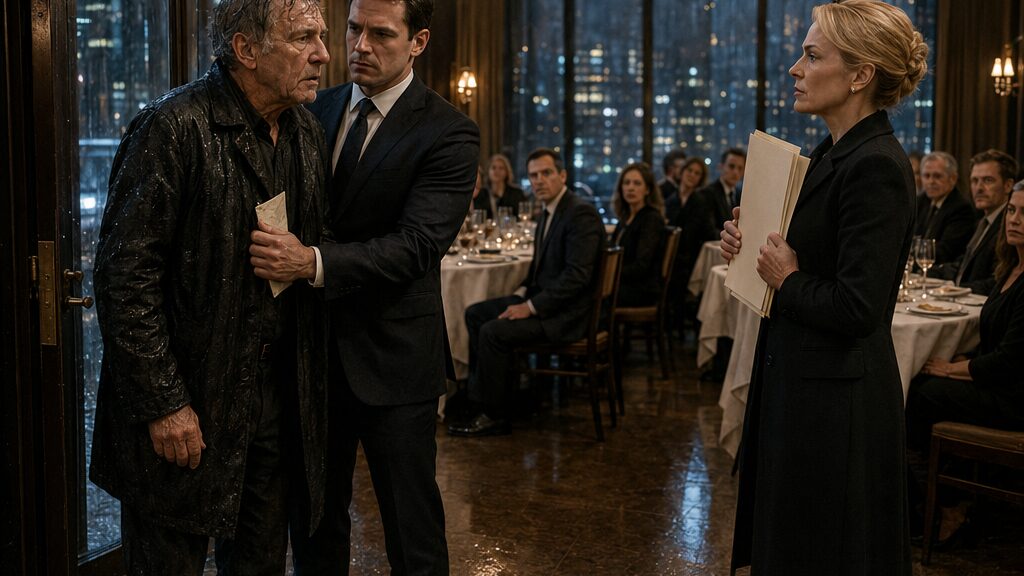
Ryan Scott’s hand closed around Robert Campbell’s arm before Robert could say Katherine’s name.
It was not a hard grip at first. It was the kind meant to look polite from a distance, four fingers pressed into the wet sleeve of Robert’s coat, a thumb locking just above the elbow. But Robert knew control when he felt it. He had spent three years lifting Katherine from beds and chairs with hands gentle enough not to bruise. Ryan’s grip was not care. It was removal.
“Sir,” Ryan said quietly, “this is a private event.”
Robert looked past him.
The dining room glowed above the city like it had been sealed away from the storm. White tablecloths. Crystal glasses. Silverware aligned with the kind of precision Katherine used to laugh at when restaurants tried too hard. Rain streaked down the tall windows behind the guests, turning the traffic lights below into soft red and yellow smears.
At the nearest table, a woman with pearls stopped with her fork halfway to her mouth. Two men in dark suits turned together. A server froze beside a tray of untouched wine.
And at the far end of the room, Rebecca Williams stood beside a long table with a cream-colored packet in her hand.
She wore black, but not the kind of black people wore when grief had hollowed them out. Her dress was fitted. Her hair was smooth. Her mouth had tightened into the look she used whenever Robert entered a room Katherine had not first prepared for him.
Robert’s coat dripped on the polished floor.
“I came for Katherine,” he said.
Rebecca’s eyes flicked to the wet mark spreading beneath his shoes. “Katherine is gone.”
The words landed too cleanly. Too rehearsed. The room heard them and accepted them as permission to look at him differently.
Robert did not pull away from Ryan. He did not raise his voice. He had imagined this room on the elevator ride up, though not this exact shape of humiliation. He had imagined maybe a small gathering after the formal reading, maybe people telling stories, maybe someone saying his name without apology. Katherine had said once, with her hand resting over his, “No matter what happens, you come. You hear it from the room, not from a stranger.”
He had come.
No one had told him the time had changed.
No one had answered when he called.
By the time a restaurant employee downstairs took pity and said the Williams party was already upstairs, Robert had been standing outside in the rain for twenty minutes, holding a folded invitation card Katherine herself had written months before her last fever took hold.
Rebecca stepped toward him. The packet in her hand looked dry and official, its edges clean, its clipped pages held together by a black binder clip.
“You were not invited,” she said.
“I have Katherine’s card.”
Rebecca’s face moved at that, not much, but enough. A tightening beneath one eye. She extended her hand.
Robert reached inside his coat slowly. Ryan’s fingers tensed around his arm as if he expected a scene. Robert took out the small cream card, softened at the corners from the rain that had worked its way through his pocket.
Rebecca did not take it. She looked at it as if it were something that had already expired.
“That was before,” she said.
“Before what?”
Before anyone answered, a man at the table cleared his throat. A woman whispered, “Is that him?” Another voice, lower, said, “I thought they handled that.”
Robert heard all of it. He felt the room making him smaller one look at a time.
Rebecca turned slightly, not fully giving him her back, but enough to show the guests she had control. “The estate matters have been read and settled. There is no reason for you to be here.”
Settled.
The word found something cold inside him.
Robert looked at the packet. “I was supposed to be at the reading.”
“No,” Rebecca said. “You were not.”
Ryan leaned closer. “Sir, let’s step outside.”
Robert kept his eyes on Rebecca. “Katherine wanted me there.”
For the first time, grief cracked the mask on Rebecca’s face, but what came through was not softness. “My mother wanted a lot of things when she was sick.”
The room went still in a new way.
Robert’s breath slowed. He remembered Katherine in the blue chair by the window, blanket over her knees, insisting she did not want anyone fighting after she died. He remembered her fingers fumbling with the cap of a pen, laughing in embarrassment, saying, “My hands don’t do what I tell them anymore.” He remembered Rebecca arriving late with grocery bags and a sharp glance at the mug on Robert’s side of the table.
Rebecca lifted the packet.
“This is the revised will,” she said. “It was read this afternoon. Everything has been done properly.”
Robert looked from the packet to her face. “Revised?”
“You weren’t named.”
It was not loud. She did not need to make it loud.
The sentence traveled anyway. Around the tables. Across the glasses. Through the clean white room where he had walked in wet and unprepared.
Robert felt Ryan’s grip again, harder now, perhaps because his body had shifted without him knowing it. Not forward. Not toward Rebecca. Just toward the sound of those words, as if some part of him had stepped ahead of the rest to meet the blow.
Not named.
Katherine’s house had not mattered most. He had never wanted the house in the way Rebecca thought. The accounts, the furniture, the china with the thin gold rim—none of that rose first in him. What came first was the small cedar box Katherine kept in the bedroom drawer, the one with her mother’s watch and the folded photographs from before Rebecca was born. Then the note Katherine once made him read aloud because her eyes were tired: Robert is to be kept safe.
He had told her not to worry about that.
He had said, “We’ll talk about paperwork when you feel stronger.”
He had thought kindness could wait.
Rebecca came closer. The packet was now between them, as if the paper itself had more right to stand in the room than he did.
“Mom changed her mind,” she said. “That was her right.”
Robert looked at her hands. Her nails were pale, perfect, curved around the document that had cut him out of the last promise Katherine had made. “When?”
Rebecca blinked. “What?”
“When did she sign it?”
A murmur moved behind her. Someone shifted a chair leg against the floor. Ryan’s hand tightened once more, but Robert did not pull back.
Rebecca’s chin lifted. “Six weeks before she passed.”
The room changed again.
Six weeks.
Robert counted without meaning to. Six weeks before Katherine died was the period when Rebecca had told him Katherine was too tired for visitors. Six weeks before Katherine died was when his calls started going to voicemail. Six weeks before Katherine died was when Donna Lee had said, gently and too quickly, “Maybe let the family have a few days.”
A few days had become ten. Ten had become three weeks. When he finally saw Katherine again, she had looked at him with damp confusion and whispered, “I thought you were angry.”
Robert swallowed once.
Rebecca saw something in his face and mistook it. “This is exactly why I didn’t want this tonight. You’re grieving. We all are. But this is not the place.”
“No,” Robert said quietly. “This is exactly the place.”
Her mouth tightened. “Ryan.”
Ryan pulled, just enough to turn Robert’s shoulder.
Robert let the movement happen, then stopped. Not by force. By weight. By planting his old black shoes on the polished floor where rainwater had gathered around them. The room was watching his sleeve in Ryan’s hand. Good. Let them watch the grip. Let them remember who needed holding back and who needed someone else’s hand to do it.
He looked at Rebecca, then at the cream-colored packet.
Katherine had been frightened of conflict. So had he, though he had called it peace. He had let Rebecca close doors because he did not want Katherine to hear raised voices. He had accepted silence because he thought love did not need witnesses.
Now a room full of witnesses was seeing what silence had bought him.
Robert’s voice stayed low.
“Who was in the room when she signed it?”
Chapter 2: The Date On The Paper Did Not Match The Woman He Knew
The damp coat still hung over the back of Robert’s kitchen chair the next morning, smelling of rain, wool, and the expensive restaurant smoke that had clung to it after he was led downstairs.
He had not slept in the bedroom.
He had sat at the kitchen table until dawn with Katherine’s cream invitation card beside an empty mug. At some point in the night, he had taken out a pad of paper and written the date Rebecca gave him.
Six weeks before she died.
Then he wrote what he remembered from that week.
No visit Monday.
Call unanswered Tuesday.
Rebecca text: Mom is exhausted.
Donna said wait.
Katherine’s voice on Saturday: I thought you were angry.
The list did not prove anything. Robert knew that. It was memory, and memory had no letterhead. But as the sky grayed beyond the apartment window, he folded the page and put it in his coat pocket beside Katherine’s card.
Frank Martinez’s office was on the sixth floor of a building that smelled of copier toner and polished wood. The receptionist looked at Robert’s coat, now dry but puckered at the seams, and asked whether he had an appointment.
“No,” Robert said. “But he knows why I’m here.”
She made a call. Her voice became softer after she said his name.
Frank came out himself ten minutes later, a compact man in a charcoal suit with rimless glasses and a professional sadness that seemed ready for use.
“Mr. Campbell,” he said. “I’m sorry for your loss.”
Robert stood. “Then help me understand it.”
Frank’s expression held. “Come in.”
The office had two guest chairs, a wall of certificates, and a framed photograph of a sailboat. On the desk sat a sealed copy of the packet Rebecca had held the night before. Robert recognized the black binder clip.
Frank did not offer coffee. Robert was glad. He did not want anything in his hands.
“I understand last night was difficult,” Frank began.
“Were you at the dinner?”
“No.”
“Then you don’t understand last night.”
Frank paused, accepting the correction with a lawyer’s patience. “I understand the reading was emotional.”
“I wasn’t allowed into the reading.”
“You were not listed as an interested party under the revised documents.”
There it was again. Not anger. Not accusation. Just a door closing with correct terminology.
Robert leaned forward. “Katherine asked me to be there.”
Frank folded his hands. “I can only speak to the documents.”
“That seems to be what everyone keeps saying.”
“The documents are legal,” Frank said. “The signatures are verified. The witnesses signed. The notary completed the acknowledgment. Whether you were expected socially is separate from the estate.”
Robert’s face warmed. Not from embarrassment alone. From the old habit rising in him, the one that told him to thank the man and leave before he looked greedy. He could almost hear Katherine saying, Don’t let them make you disappear, Robert.
He reached into his pocket and unfolded the page he had written on.
“I want the date.”
Frank glanced at the paper but did not touch it. “Rebecca told you the date.”
“I want it from the document.”
“I can provide a copy of the relevant page, but I need to be clear. You may not have standing to challenge—”
“I didn’t ask you to tell me what I can challenge. I asked for the date.”
For the first time, Frank looked at him without the prepared sympathy.
Robert held the look. His hands were steady, though his throat was not. He had bathed Katherine when she could no longer stand safely. He had learned to crush pills into applesauce. He had stood in drugstore aisles comparing absorbent pads because Katherine cried when he brought home the wrong kind. If he could do those things without looking away, he could sit in an office and ask for a date.
Frank opened the packet.
The pages made a small, dry sound.
“March 14,” he said.
Robert closed his eyes briefly.
March 14 was a Thursday. He knew because that was the first week Rebecca had stopped leaving the side gate unlocked for him. Katherine’s hydrangeas had been cut back too far, and he had stood outside with a grocery bag of soup containers, calling Rebecca twice before driving home.
“Who brought her here?”
Frank looked down. “I don’t know that this is useful.”
“Who brought her here?”
Frank turned a page. “The appointment note says Rebecca Williams transported her.”
“Transported,” Robert repeated.
“It is standard notation.”
“She couldn’t get in and out of a car without help by then.”
“That doesn’t make her incapable of signing.”
“No,” Robert said. “It doesn’t. But it means someone decided where she went.”
Frank removed his glasses and set them on the desk. He no longer looked annoyed, exactly. He looked as if Robert had brought mud onto a clean floor and the mud had turned out to have a shape.
“Mr. Campbell, capacity is not the same as illness. People can be seriously ill and still understand estate decisions.”
“Did she understand this one?”
“I met with her.”
“Alone?”
Frank did not answer quickly enough.
Robert noticed. So did Frank.
“For part of the meeting,” Frank said.
“Which part?”
“The signing portion included required witnesses.”
“And before that?”
Frank’s voice hardened slightly. “Rebecca was present initially to help explain the purpose of the visit.”
Robert stared at the packet. “Katherine needed Rebecca to explain why she was changing a will she never told me she was changing?”
“She expressed a desire to provide for her daughter.”
“She always wanted to provide for Rebecca.”
“That appears consistent, then.”
Robert looked up. “She also wanted me protected.”
Frank’s expression did not shift, but something in the room did. The sailboat photograph. The clean desk. The packet between them. All of it seemed suddenly built to hold one version of the truth and reject anything that came in wet, late, and unfiled.
“Is there an earlier will?” Robert asked.
“There were prior documents.”
“Was I named?”
Frank placed his hand on the packet, not defensively, but close. “I cannot disclose all prior estate details without authorization.”
Robert almost laughed. It came out as air through his nose. “She’s dead, and everyone who kept me from her can authorize things I can’t.”
Frank did not respond.
Robert pointed to the page. “I want the witness names.”
“I can provide the execution page.”
“Then provide it.”
Frank studied him. “You understand that having witness names does not invalidate a will.”
“I understand that not having them keeps me blind.”
The copy came from the printer warm and faintly curled. Frank slid it across the desk. Robert did not pick it up immediately. He looked first at the date, printed cleanly above Katherine’s signature.
The signature was hers, or close enough to hurt. The K leaned the way it always had, but the rest drifted downward, as if the hand had grown tired before the name was finished.
Below it were two witness lines.
One belonged to a staff member from Frank’s office.
The other name made Robert’s mouth go dry.
Laura Rivera.
He saw her at the dinner in the back of the room, not turning away fast enough when he looked for a friendly face. Laura, who used to sit with Katherine at the kitchen table every December, sorting receipts and teasing Robert for labeling freezer containers by date. Laura, who had hugged him at the funeral and whispered, “She loved you. Don’t let anyone tell you different.”
Robert folded the execution page slowly.
Frank said, “Mr. Campbell, I would advise you not to turn grief into suspicion.”
Robert stood, the paper in his hand.
“I’m starting to think grief is what everyone counted on.”
Chapter 3: The Friend Who Signed Her Name Would Not Look At Him
Laura Rivera locked the office door when she saw Robert through the glass.
It was a small movement, almost hidden by the reflection of traffic passing behind him, but Robert heard the click. Laura heard him hear it. Her hand stayed on the lock for one second too long before she lowered it and looked down at the papers spread across her desk.
Robert did not knock right away.
Her accounting office sat between a dry cleaner and a closed travel agency, with a faded blue awning and a plastic sign that said walk-ins welcome. Katherine had liked coming here because Laura kept peppermint candies in a bowl and never rushed older clients who forgot which folder held which form.
Robert looked at the sign, then at Laura.
At last he tapped the glass.
Laura’s shoulders rose. She did not turn.
He waited. A younger version of him might have left. A kinder version, or maybe just a more frightened one, would have told himself she was busy and that pushing people only made things worse. That was the version who had let Rebecca’s texts stand between him and Katherine for too many days.
He knocked again.
Laura came to the door.
“Robert,” she said through the narrow opening.
“You locked it.”
“It sticks sometimes.”
“No, it doesn’t.”
Her eyes filled immediately, which angered him more than if she had looked cold. Tears made a claim on mercy. He did not want to spend his anger carefully just because she had brought hers out first.
She stepped back. “Come in.”
The office smelled of paper, dust, and peppermint. A calculator tape curled over the edge of her desk. On the wall hung a photo of Laura and Katherine at some charity luncheon years earlier, both of them younger, Katherine’s head tipped back in laughter.
Robert stopped in front of it.
“She trusted you,” he said.
Laura closed the door. This time she did not lock it. “I know.”
“You signed as witness.”
“I did.”
“Why?”
Laura moved behind the desk, then seemed to realize the desk gave her too much protection. She came back around and stood by the filing cabinet instead.
“Rebecca called me,” she said. “She said Katherine needed someone she knew.”
“Katherine called you?”
Laura shook her head.
That small answer took the air from him.
“Did Katherine know what she was signing?”
Laura wrapped her arms around herself. “Sometimes.”
Robert stared at her.
Laura swallowed. “She was clear for moments, Robert. Not for hours. Not the way Rebecca made it sound. She would come back to herself and then drift. You know that.”
“I know what she was like when I was allowed to see her.”
Laura flinched.
Good, he thought, then hated himself for thinking it.
He placed the copied execution page on her desk. “This says you witnessed her signature.”
“I witnessed her sign.”
“That is not what I asked.”
Laura looked toward the street. A bus passed, briefly darkening the glass. “Frank asked her if she understood she was signing her will. She said yes.”
“And did she understand the change?”
Laura pressed a hand to her mouth.
Robert waited.
“She knew Rebecca was afraid,” Laura said.
“Afraid of what?”
“Losing the house. Losing everything that felt like her mother. Losing her place.”
“Rebecca has a place.”
“Not the one she thought she had.” Laura’s voice sharpened, then softened again. “You have to understand. Katherine talked about you constantly. At the end, it was Robert knows where that is, Robert handles that, Robert will remember. Rebecca would walk in and feel like a visitor in her own mother’s life.”
Robert looked at the photo on the wall. Katherine smiling, Laura laughing beside her. “That doesn’t answer why my name disappeared.”
Laura closed her eyes.
“It wasn’t supposed to disappear like that.”
The sentence held.
Robert turned back.
Laura went to a drawer, unlocked it with a small key from her bracelet, and removed a thin folder. She did not hand it to him. She opened it herself on the desk.
Inside was a spreadsheet printed months earlier. Katherine’s name appeared at the top. Beneath it were columns: house, savings, personal items, medical reserve, Robert, Rebecca.
Robert saw his name before he meant to.
Not large. Not greedy. Not the house.
A modest amount. A line about continued living expenses. Another line referencing “cedar box contents as discussed.”
His chest tightened.
Laura touched the page with two fingers. “This was not a will. It was planning. Katherine asked me to help her think through what was fair.”
“Fair,” Robert said.
“She wanted Rebecca to keep the house.”
“I never asked for the house.”
“I know.”
“Did she know?”
Laura’s silence answered too slowly.
Robert stepped back from the desk. “What did Rebecca tell her?”
“I don’t know everything.”
“But you know something.”
Laura looked at him then, really looked, and he saw that her guilt had weight. It had been living with her, not as heavy as his grief, maybe, but heavy enough to leave marks.
“Rebecca believed you would challenge anything that didn’t include you,” Laura said. “She believed you and Katherine had made plans behind her back.”
“Katherine tried to get us all in the same room.”
“Rebecca wouldn’t come if you were there.”
Robert remembered that. Katherine pretending it did not hurt. Robert saying, “Don’t push her. She’ll come around.” He had thought patience was generosity. Maybe it had only given Rebecca more room to tell her own story.
Laura turned another page in the folder. “Katherine asked me not to stir things up while she was alive. She said Rebecca was brittle. That was her word. Brittle. She thought if she could keep peace until the papers were done, everyone would calm down later.”
A bitter sound escaped Robert. “Later.”
Laura nodded, tears spilling now. “I should have called you.”
“Yes.”
“I thought I was honoring her.”
“No,” Robert said. “You were avoiding Rebecca.”
Laura accepted that without defense. It made him angrier for a moment, then sadder.
He looked again at the spreadsheet. The paper was not proof of fraud. It did not undo the will. It did not even carry Katherine’s signature. But it changed the shape of the lie. Katherine had not chosen Rebecca over him in one clean line. She had been trying to hold two people in the same failing hands.
“What happened the day before she signed?” Robert asked.
Laura’s face changed.
There it was. Not fear exactly. Recognition.
“What?” he said.
Laura closed the folder halfway. “You need to ask Donna Lee.”
“Why?”
“Because Donna was there more than I was.”
“Laura.”
She gripped the folder. “The day before the signing, Katherine had a bad spell. Not just forgetting a word. Not just getting tired. She was upset because she thought you hadn’t come in weeks.”
Robert felt the room tilt slightly.
Laura’s voice dropped.
“Ask Donna what Katherine said when Rebecca came in with the blue folder.”
Chapter 4: The Visiting Log Showed Who Was Allowed Through The Door
Robert’s name was not on the hospice log for the last twenty-three days of Katherine’s life.
He stood at the counter in the small hospice office and stared at the printed sheet while the office assistant waited with one hand resting on the copier lid. The paper was simple: dates, times, visitor names, staff initials. It should not have felt like an accusation.
Rebecca Williams appeared again and again.
Laura Rivera appeared twice.
A minister appeared once.
Robert Campbell did not appear at all.
He touched the page with one finger, stopping at March 14, the day of the signing. Rebecca’s name was there at 8:10 a.m. and again at 2:45 p.m. No note beside either entry. No explanation. Just her name, cleanly typed, as if presence alone told the story.
“I was there before this,” Robert said.
The assistant looked uncomfortable. “This printout only covers the final month. I can request older records, but for anything involving care notes, you’ll need authorization or a formal request.”
“I brought her soup that first week of March. Chicken and rice. She couldn’t keep down the tomato.”
The assistant’s face softened, but her voice stayed careful. “I’m not saying you weren’t there, Mr. Campbell.”
The problem was no one had to say it. The paper said enough.
Robert folded the log and put it into the same folder as the execution page. The revised will packet had made him look erased. The hospice log made it look as if he had disappeared by choice.
“Is Donna Lee here?” he asked.
The assistant glanced toward the hallway. “She’s finishing with a family.”
“I’ll wait.”
He sat beneath a wall clock with a silent second hand and listened to the office sounds: a phone ringing once, lowered voices behind doors, the squeak of rubber soles in the hallway. He had spent months around those sounds. Hospice had its own hush, not peaceful exactly, but practiced. People entered carrying casseroles, paperwork, fear. They left carrying less.
Donna came out after nearly half an hour.
She stopped when she saw him.
“Robert.”
The way she said his name told him she already knew something had shifted.
He stood, holding the folder at his side. “Laura said I should ask you about the day before Katherine signed.”
Donna looked toward the assistant, then back to him. “Not here.”
They went outside to the narrow strip of sidewalk beside the parking lot. The air smelled of cut grass and exhaust. Donna wore navy scrubs under a cardigan, her hair pulled back too tightly, as if neatness could hold difficult days in place.
Robert took out the log. “My name isn’t there.”
Donna did not reach for it.
“Why?”
She looked down. “Rebecca asked that visits be limited.”
Robert waited.
Donna pressed her lips together. “She said Katherine was overwhelmed. She said you upset her.”
“I upset her?”
“That’s what she said.”
“And you believed her?”
Donna’s eyes flashed with hurt, but she did not defend herself immediately. That restraint made the anger in Robert falter.
“I believed Katherine was declining,” Donna said. “I believed the family had the right to manage visits. I believed, at the time, that maybe fewer people in and out would help.”
“I wasn’t people.”
“I know.”
“Did Katherine ask for me?”
Donna looked toward the parking lot, where a delivery driver was unloading boxes from a van. “Yes.”
Robert felt the word enter him like cold water.
“When?”
“More than once.”
He gripped the folder. “What did you tell her?”
“At first, that you’d called. That you loved her. That she needed rest.”
“At first.”
Donna’s face tightened. “Later, Rebecca asked us not to mention you unless Katherine brought you up.”
Robert looked away. Across the street, a small tree had been tied to a stake to keep it growing straight. The rope had rubbed a mark into the bark.
“She thought I was angry,” he said.
Donna’s eyes filled. “One afternoon, she woke up from a nap and asked why you hadn’t come. Rebecca was in the kitchen. Katherine got agitated. She kept trying to sit up. She said she needed to tell you where the cedar box was.”
Robert closed his eyes.
He knew where the cedar box was. Second drawer on the left, under the winter scarves Rebecca never wore. Katherine had told him a dozen times, but when she got frightened, she repeated the things she needed to trust.
“What did Rebecca do?”
Donna took a breath. “She came in with a blue folder.”
Robert opened his eyes.
“A blue folder.”
“Yes.”
“What was in it?”
“I didn’t see everything. Papers. A yellow sticky note. Maybe an old list. Rebecca sat beside the bed and told Katherine they needed to make sure the house was safe. She kept saying that word. Safe.”
Robert remembered Laura’s spreadsheet. Rebecca must never lose the house.
“Was Katherine clear?”
Donna’s answer did not come quickly.
“She knew Rebecca,” Donna said. “She knew she was at home. But she was mixing days together. She asked if you were outside fixing the porch light.”
Robert had fixed the porch light the previous winter.
“She thought it was January?”
“I don’t know what she thought. I only know she wasn’t steady. She would answer one question clearly and then ask another that made no sense with the first.”
“And the next day she signed a revised will.”
Donna’s mouth trembled. “I didn’t know that until later.”
The folder felt heavier in Robert’s hand. He wanted to ask why no one stopped it, but he already knew how easily things happened when every person in the room had a reason to look away. A daughter with fear. A nurse with boundaries. A friend with guilt. A lawyer with procedure. A man outside trying not to cause trouble.
His phone buzzed.
The screen showed Rebecca’s name.
For one absurd second, he thought she might be calling to explain. But it was a text.
Stop contacting hospice staff. If you keep harassing people who cared for my mother, I’ll have Frank handle it formally.
Robert showed the message to Donna.
She read it and looked stricken. “I didn’t call her.”
“I know.”
But his voice sounded tired even to himself.
Donna handed the phone back. “Robert, I can’t give you private medical notes without the right request. But I can tell the truth if I’m asked properly.”
“Properly,” he repeated.
“I’m sorry.”
He believed her. That almost made it worse.
He put the phone away. “What did Katherine say when Rebecca came in with that folder?”
Donna’s gaze lowered to the concrete between them.
“She said, ‘Not without Robert.’”
Robert did not move.
Donna wiped beneath one eye quickly, as if angry at herself for letting the memory show. “Rebecca told her you were tired. That you didn’t want more paperwork. Katherine started crying. Not loudly. Just… tears. Then Rebecca told me to give them privacy.”
The office door opened behind them, and the assistant called Donna’s name.
Donna stepped back, but before she went inside, she said, “There was something else. The folder had a label.”
“What label?”
Donna looked toward the door, then back at him.
“House protection plan.”
Chapter 5: The Daughter Said It Was Protection, Not Betrayal
Rebecca opened Katherine’s front door with the chain still latched.
The gap showed only one blue eye, a strip of pale cheek, and the black collar of her blouse. Behind her, the entryway lamp glowed over the same wallpaper Katherine had wanted to replace for ten years but never did because Rebecca said it reminded her of childhood.
Robert stood on the porch with his dry raincoat folded over one arm.
“Take the chain off,” he said.
“You shouldn’t be here.”
“It’s your mother’s house, not a bank vault.”
Her eye narrowed. “It’s my house now.”
The words should have cut cleanly, but they snagged on something older. Robert had painted the porch railing. He had changed the locks after Katherine lost a key in the grocery store. He had sat on the bottom step at three in the morning waiting for an ambulance while Rebecca drove in from across town and arrived furious that no one had called her sooner.
He looked past the gap. On the hallway table sat a vase of white flowers already browning at the edges.
“I want to talk about the blue folder.”
Rebecca’s hand left the door. For a moment he saw only the chain, bright and taut.
Then she shut the door.
The lock turned.
Robert stood there, heat rising through his neck. He had told himself he would not pound on the wood. He would not be the man she described to other people. He would not give her a scene she could use.
The door opened again without the chain.
Rebecca stepped back. “Ten minutes.”
Inside, the house had been straightened into a version of itself. Katherine’s cardigan was gone from the chair. The stack of library books by the stairs had vanished. The living room smelled like lemon polish instead of the lavender soap Katherine kept in every bathroom.
Robert laid his raincoat over the arm of the chair, then thought better of it and picked it up again.
Rebecca noticed. “You can sit.”
“I’m fine.”
“That’s what you always say.”
It came out with more bitterness than accusation.
They faced each other across Katherine’s coffee table. On it sat a blue folder.
Robert looked at it.
Rebecca followed his gaze. “Donna shouldn’t have discussed private family matters with you.”
“She discussed Katherine.”
“You mean my mother.”
“I mean Katherine.”
Rebecca’s jaw tightened. “That’s always how you did it. You said her name like you were the only person who knew her.”
Robert felt the old caution rise again, the habit of stepping around Rebecca’s pain as if it were a sleeping dog. “I never wanted to take her from you.”
“No,” Rebecca said. “You just became necessary to everything. Her appointments. Her pills. Her groceries. Her moods. Her memories. Every time I came here, there was another system you had made. Another label. Another note. Another way I was doing it wrong.”
“You lived forty minutes away.”
“I had a job.”
“I know.”
“Do you?” She laughed once, without humor. “Because you and everyone else made me feel like I was visiting my own mother’s life.”
Robert looked toward the mantel. Katherine’s photograph from the memorial stood there in a silver frame. The house seemed to lean around it.
“Rebecca,” he said, “what was in the folder?”
She sat slowly and opened it just enough to remove a check.
She placed it on the table between them.
Robert did not look at the amount at first. He looked at the memo line.
Settlement and release.
“You sign a release,” Rebecca said, “and this ends. No more calls to Laura. No more cornering hospice staff. No more implying my mother didn’t know her own mind.”
Robert picked up the check.
Ten thousand dollars.
He placed it back down.
“That’s what you think this is worth?”
“That’s more than you were entitled to.”
“I didn’t ask what I was entitled to. I asked what you think this is worth.”
Rebecca’s face reddened. “Mom changed her mind. That was her right.”
“She changed her mind six weeks before she died, when she thought I was outside fixing a porch light in January.”
Rebecca stood so fast the folder shifted. “You don’t get to use her illness when it suits you. She had clear days. She had choices. And one of those choices was making sure I didn’t lose this house to a man who never married her.”
The words hung there.
Robert absorbed them. Slowly. Carefully. If he answered the wrong part, they would never reach the right one.
“I never asked Katherine for the house.”
“You didn’t have to. She would have handed you everything because you were there every day making yourself look selfless.”
His face tightened.
Rebecca saw it and pressed harder, as if pain in him proved something. “Everyone thought you were a saint. Robert knows how she takes her tea. Robert knows where the insurance cards are. Robert knows what calms her down. Do you know what that felt like for me?”
“No,” he said.
The answer stopped her.
He stepped closer to the table. “No, I don’t. Because you never told me. You spoke through doors. You sent texts. You complained to Katherine when she was too tired to answer. And I let you, because I thought keeping quiet was keeping peace.”
Rebecca looked away first.
There it was: not guilt, not yet, but a crack in the version where he alone had built the wall.
Robert touched the blue folder. “Did Katherine write the note?”
Rebecca’s hand moved to cover it.
“Did she?”
“She wanted me protected.”
“I know.”
“No, you don’t. You think this is all manipulation because that makes you the injured one.”
“I am injured.”
“So am I.”
The sentence came out small and furious.
For a moment, Robert saw her not at the dinner in the black dress, not at the door with the chain, but younger in Katherine’s kitchen years ago, standing stiffly while Katherine laughed at something Robert had said. A daughter watching herself become a guest. It did not excuse her. But it explained the shape of the wound she had used as a weapon.
Rebecca opened the folder and drew out a single page, keeping it angled toward herself.
“My mother wrote this,” she said. “In her handwriting. She said I should never lose the house. She said that because she knew what you were doing.”
“What was I doing?”
“Becoming permanent.”
Robert almost smiled, but there was no room for humor in it. “I was already permanent to her.”
Rebecca’s eyes shone. “You don’t get to say that to me in her house.”
He looked down at the folder.
The page she held had Katherine’s handwriting across the top. Even upside down, he knew the slant, the long tail on the y. Rebecca saw him looking and pulled it back, but not fast enough.
There was another line beneath the one about the house.
Robert could not read all of it. Only two words.
Robert safe.
His heart struck once, hard.
Rebecca saw his face and shut the folder.
“Sign the release,” she said. Her voice had changed, hurried now. “Take the check. Let my mother rest.”
Robert picked up the check again, folded it once, and set it beside the blue folder.
“No.”
Rebecca stared at him.
“I let too many things pass because I didn’t want to fight in front of Katherine,” he said. “I won’t sign a paper saying silence is peace.”
He picked up his raincoat.
Rebecca’s hand remained on the folder, white at the knuckles.
As Robert reached the door, a draft from the hallway lifted the top page just slightly. This time he saw the line more clearly, written below Rebecca must never lose the house.
And Robert must be kept safe.
Chapter 6: The Note Was Real, But It Did Not Say What Rebecca Claimed
Robert read the words “Rebecca must never lose the house” on a photocopy at the probate records office, and for one long second he understood exactly how Rebecca had built her defense.
The line stood alone near the top of Katherine’s handwritten page, dark against white, unmistakably hers. Anyone could have read it and believed the revised will followed her wishes. Anyone who had not seen the line below it. Anyone who had not stood in Rebecca’s living room and watched her close the folder too fast.
The probate clerk slid the copy across the counter. “This is the attachment referenced in the drafting notes. We don’t have the original, only the scanned exhibit.”
Robert kept his finger away from the ink, as if touching it would change what it could still say.
“Is there a second page?”
The clerk checked the screen. “Not in this file.”
“Can attachments be incomplete?”
The clerk’s look became careful. “Files contain what was submitted.”
That was not an answer, but it was the kind of sentence official places used when they did not want to be responsible for the shape of the truth.
Robert paid for the copy and walked out with the paper inside his folder, beside the will execution page, the hospice log, and his own handwritten timeline. The folder was no longer neat. Its corners had softened. He had carried it from office to office, counter to counter, person to person, as if enough paper might finally make visible what Katherine had tried to say when her voice was failing.
Laura Rivera was waiting in her accounting office when he arrived.
This time, the door was unlocked.
She stood behind her desk, but not defensively. The peppermint bowl had been moved aside. In its place was the thin folder she had shown him before.
“You found the attachment,” she said.
“I found the part Rebecca wanted found.”
Laura lowered her eyes.
Robert laid the probate copy on the desk. “Is there more?”
Laura opened Katherine’s planning folder and removed a page sealed in a clear sleeve. She handled it with both hands.
“I made a copy months ago,” she said. “For my records. Katherine asked me to draft numbers from it later.”
“Why didn’t you show me all of it before?”
“Because I was scared of what it would start.”
“It already started.”
“I know.”
She handed him the page.
Robert looked first at the top line.
Rebecca must never lose the house.
Below it, in Katherine’s uneven but certain hand, was the sentence he had seen only in fragments.
Robert must be kept safe too. Not rich. Safe.
He sat down before his knees could decide for him.
Not rich. Safe.
That was Katherine. The plainness. The small correction built into the sentence because she knew how words could be twisted if left too wide. He could almost hear her saying it, impatient with anyone who turned care into greed.
Laura sat across from him. “She wrote it after you took her to the cardiologist in February. She was upset because Rebecca had called that morning about property taxes. Katherine said she didn’t want Rebecca frightened. Then she said she didn’t want you left scrambling either.”
Robert could not take his eyes off the line.
“It’s not a will,” Laura said softly.
“I know.”
“It doesn’t undo the revised document.”
“I know that too.”
But the page did something the will packet had not. It sounded like Katherine.
The revised will spoke in clean clauses, distributions, residue, personal representative, revocation of prior instruments. Katherine’s note spoke in fear and balance. House for Rebecca. Safety for Robert. No one made rich. No one thrown away.
Robert placed the probate copy beside Laura’s full copy. The missing line was not a legal victory. It was a hole in Rebecca’s story.
“Did Frank see the whole note?”
Laura hesitated.
“Laura.”
“I don’t know. I thought he did.”
“You witnessed the will.”
“I was called for the signing, not the drafting conversation. Rebecca had already met with him. When I got there, the documents were printed.”
“Did Katherine read them?”
Laura’s fingers tightened around a tissue. “Frank summarized. Rebecca helped. Katherine nodded. She was tired.”
“Did anyone read the part about me?”
Laura did not answer.
Robert folded his hands and looked at the desk because if he kept looking at her, he would ask the question cruelly.
Laura said, “There was a moment when Katherine asked, ‘Robert too?’ Rebecca told her, ‘It’s handled.’ Frank said the document reflected the instructions he had received.”
Received from whom, Robert thought.
He took the full note and the probate copy to Frank Martinez’s office that afternoon. He expected resistance. He expected the receptionist’s soft professional voice, the delay, the closed door. He got all of that.
Then Frank came out with his jacket off and his tie loosened.
“Mr. Campbell,” he said. “This is not a good time.”
Robert held up the two pages. “It’s the right time.”
Frank looked at the papers, then at the receptionist. “Come in.”
Inside the office, Robert placed both pages on the desk. He did not sit.
Frank read the probate copy first, then Laura’s full copy. The change in his expression was small, but Robert had spent years reading Katherine’s smallest signs: the shift before pain, the blink before confusion, the breath before she pretended she was fine. Frank had the look of a man finding a crack in a wall he had leaned on.
“Where did you get this?”
“Laura kept it.”
“This is not part of the estate file.”
“That’s the problem.”
Frank reread the second line.
Robert must be kept safe too. Not rich. Safe.
Frank removed his glasses. “I was provided a summary of Katherine’s concerns.”
“By Rebecca.”
Frank did not answer.
“Did you ever ask Katherine what safe meant?”
Frank rubbed the bridge of his nose. “Mr. Campbell, I am not going to discuss attorney-client communications in broad terms with someone who may be adverse to the estate.”
Robert laughed once, quietly. “You keep calling me adverse. I fed her when she couldn’t hold a spoon.”
Frank’s eyes lifted.
Robert heard the edge in his own voice and pulled it back. “I’m not asking you to hand me the estate. I’m asking whether the woman who signed that document was given the whole choice.”
“The document provides the house to Rebecca.”
“Katherine wanted Rebecca to keep the house.”
“It does not provide for you.”
“Katherine wrote that I was to be kept safe.”
Frank looked back at the page.
For the first time since Robert had met him, the lawyer looked less certain of his own clean lines. “There may be an issue with the completeness of the drafting record.”
“Say that in English.”
Frank leaned back. “The file note I have says Katherine wanted to ensure Rebecca retained the residence. It does not mention this second sentence.”
“Because Rebecca didn’t mention it.”
“That is an inference.”
“It’s also the only version that fits.”
Frank’s jaw shifted. “I will not accuse a beneficiary based on an inference.”
“Then put her in the room with the page.”
Frank stood and walked to the window. The sailboat photograph behind his desk suddenly looked ridiculous to Robert, all that smooth water in a room where everyone was trying not to drown.
“If I agree to a meeting,” Frank said, “Rebecca must attend. Laura should attend. If Donna Lee has relevant observations, she may provide a written statement or appear if properly released.”
“Good.”
“This will not be a trial.”
“I’m not asking for one.”
“And I will not allow you to ambush her.”
Robert picked up Katherine’s full note and slid it carefully back into its sleeve.
“Frank,” he said, and the lawyer seemed startled by the use of his first name, “she ambushed me in a room full of people with a will packet and a man holding my arm. I’m asking for a table.”
Frank looked at him for a long moment.
Then he reached for his phone.
“I’ll schedule it,” he said. “But only if Rebecca is there.”
Chapter 7: The Lawyer Had The Signatures, Robert Had The Timeline
Rebecca arrived wearing the same black coat she had worn at the estate dinner.
Robert noticed it before he noticed her face. The coat was smooth and dry, the collar folded neatly, the buttons shining under Frank Martinez’s conference room lights. Two weeks earlier, she had stood in that coat while his own dripped onto the restaurant floor and Ryan Scott held his arm. Now she entered with her chin lifted, carrying nothing visible except a leather handbag and the certainty of someone who still believed rooms could be arranged in her favor.
Frank stood behind the conference table. Laura sat near the window, hands folded around a tissue she had not used. Donna Lee sat at the opposite end in plain clothes, a sealed envelope on the table in front of her.
Rebecca stopped when she saw Donna.
“What is she doing here?”
Donna looked down.
Frank said, “Ms. Lee has provided a statement regarding Katherine’s condition and visitor access during the period in question.”
Rebecca’s eyes moved to Robert. “You brought hospice into this.”
Robert laid his folder on the table. “You did that when you used her final weeks to change the paperwork.”
Laura flinched at the sharpness of it. Frank’s mouth tightened, but he did not correct Robert.
Rebecca removed her gloves slowly. “I’m not staying if this is going to be an ambush.”
Robert pulled out a chair and sat. “Then don’t let it be one. Answer the questions.”
She stared at him, then sat across from him with careful control. The same careful control she had shown in the dining room, only thinner now.
Frank opened the meeting with legal language. He said the revised will had been executed with signatures, witnesses, and notarization. He said no court had made any finding against it. He said the purpose of the meeting was not to litigate but to review concerns about the completeness of the drafting record.
Rebecca folded her hands. “In other words, Robert is unhappy with what my mother decided.”
Robert did not answer immediately. He opened his folder and removed three documents.
The revised will execution page.
The hospice visiting log.
Katherine’s full handwritten note.
He placed them in a row.
Frank looked at the documents. Laura looked at Robert. Donna closed her eyes for a moment.
Rebecca’s gaze fixed on the handwritten note.
“That is private,” she said.
“It was used to make a public document,” Robert said.
“You had no right to take it.”
“I didn’t take it. Laura kept a copy.”
Rebecca turned toward Laura. “Of course.”
Laura’s face colored. “Katherine asked me to help her make sense of things.”
“She asked you to help with numbers,” Rebecca said. “Not to feed him ammunition.”
Robert touched the execution page. “March 14.”
No one spoke.
“You told me at the dinner she signed six weeks before she died,” he said. “That was the first true thing you said to me that night.”
Rebecca’s jaw tightened.
He touched the hospice log. “My name is missing for the final three weeks before that. Not because I stopped coming. Because I was told she was too tired. Because calls went unanswered. Because every door had someone else between me and her.”
Rebecca leaned forward. “She was dying. I was trying to keep her calm.”
Donna lifted her head. “She asked for him.”
Rebecca looked at her. “She asked for a lot of things. She asked for her father one night. She asked for a dog we had when I was twelve. That doesn’t mean—”
“She asked why Robert was angry with her,” Donna said quietly.
That stopped Rebecca.
Donna opened the envelope and removed a typed statement, but she did not read from it. “She was distressed because she believed he had chosen not to come.”
Robert kept his eyes on the table. Hearing it again in this room was worse than hearing it on the sidewalk. In the hospice parking lot, grief had room to move. Here, under fluorescent lights, the sentence became evidence.
Rebecca’s mouth parted, then closed.
Frank took the statement from Donna and scanned it. His expression changed in small increments.
“The documents are legal,” he said at last, as if reminding himself as much as the room. “But legality is not the only issue being raised.”
Rebecca seized on the first part. “Exactly. The documents are legal.”
Robert looked at Frank. “When exactly did she understand them?”
Frank’s eyes lifted.
Robert kept his voice steady. “Not when did she sign. Not did she say yes when asked if she knew she was signing a will. When did she understand that the note saying Rebecca should keep the house was being used without the line saying I should be kept safe?”
Rebecca pushed back her chair halfway. “That’s not fair.”
“No,” Robert said. “It isn’t.”
Her face flushed. “You’re acting like I tricked her with a pen in her hand. You weren’t there. You don’t know what those days were like.”
“I know I wasn’t there.”
The room went quiet.
Robert had not meant to say it that way. Not as accusation, but admission. The words left him with the old guilt attached.
“I know I wasn’t there,” he repeated. “Because I let your texts decide when I could see the woman I lived beside for years. Because I thought if I pushed, Katherine would suffer for it. Because I was afraid you would make her choose in a room where she was already losing enough.”
Rebecca’s eyes shone, but she kept her face hard. “She was my mother.”
“Yes.”
“You say that like it’s a detail.”
“No. I say it because it matters. It mattered to her. She wanted you to have the house.”
Rebecca’s mouth trembled once.
Robert touched Katherine’s note. “And she wanted me safe. Not rich. Safe. That was her word.”
Frank reached for the document. “May I?”
Robert nodded.
Frank read the full note again, slower this time. “This second sentence was not in my drafting summary.”
Rebecca looked away.
Frank’s voice cooled. “Rebecca.”
She did not answer.
“Did you provide me with the full note?”
“I told you what mattered.”
Laura drew in a breath.
Rebecca turned on her. “Don’t look at me like that. You weren’t the one who had to watch him take over every part of her life.”
“He cared for her,” Laura said.
“So did I.”
“No one said you didn’t,” Robert said.
Rebecca’s eyes snapped back to him. “You all act like caring means being there the most. I had bills. A job. A life that didn’t stop just because my mother got sick. Every time I walked into that house, she was asking where you put things. She trusted you with passwords, medicine, appointments. Do you know what that does to a daughter?”
Robert let the question sit. There was truth in it, but not enough truth to carry what she had done.
Frank tapped the drafting summary. “You told me Katherine wanted to ensure you retained the residence. You told me Robert had been provided for separately.”
Rebecca’s face went still.
Robert looked at her.
Frank looked over his glasses. “Was that accurate?”
Rebecca’s hands moved in her lap, fingers twisting together. “She always said Robert would manage. He always managed.”
“That is not the same thing,” Frank said.
Rebecca swallowed. “She didn’t want conflict.”
Laura’s voice broke in softly. “No. She didn’t.”
Donna added, “She also didn’t want Robert kept away.”
Rebecca’s eyes filled now, fully, but she blinked the tears back with visible effort. “You think I wanted her confused? You think I wanted any of this? She was slipping away and every time she came back, she asked for him. I was standing right there, and she asked for him.”
Robert felt the sentence strike the room differently. It was not confession. It was not apology. It was the wound underneath the method.
Rebecca looked at him. “I wanted one thing that was still mine.”
Robert’s voice softened despite himself. “So you made sure the papers said I had nothing.”
She looked down.
Frank leaned back in his chair. “The file is incomplete. At minimum, there are questions about whether the drafting instructions accurately reflected the full written note and whether Katherine’s condition at the time of execution was adequately assessed.”
Rebecca looked up sharply. “What does that mean?”
“It means,” Frank said, “that if Robert pursues a formal undue influence review, the estate may face delay, expense, and scrutiny.”
Rebecca’s face drained of color.
Robert closed his folder, but kept Katherine’s note on the table.
“I don’t want the house,” he said.
Rebecca did not look at him.
“I never wanted the house. I wanted to know why Katherine’s last paper made me a stranger.”
Laura pressed the tissue to her mouth.
Robert looked at Rebecca’s black coat, at the polished buttons, at the woman inside it who had turned grief into control because she thought there was only one kind of losing.
“I’m not trying to take Katherine from you,” he said. “You already lost her. So did I.”
Rebecca covered her face with one hand.
Frank gathered the pages carefully, no longer treating them as loose complaints from an excluded man. He placed the will, the log, and the note side by side once more.
“If this proceeds formally,” he said, “the court may not overturn the will. I want everyone clear about that. But the review could examine access, capacity, drafting instructions, and whether Rebecca’s role affected the final document.”
Rebecca dropped her hand.
Robert looked at her across the table.
For the first time since the dining room, she did not look certain that the paper could protect her from the truth.
Chapter 8: What Katherine Meant To Leave Behind Was Not Just Money
Rebecca placed Katherine’s cedar box on the kitchen table without meeting Robert’s eyes.
It was smaller than he remembered. Grief had enlarged it in his mind until it seemed impossible that something so ordinary could have held so much of Katherine’s private world. The wood was worn at the corners, darker where her hands had touched it over the years. A brass latch, slightly crooked, caught the morning light from the window above the sink.
Robert stood in the doorway of Katherine’s kitchen and did not step farther in until Rebecca moved away from the table.
“No chain today,” she said.
It was not quite an apology.
“No,” Robert said. “No chain.”
A month had passed since Frank’s conference room. Not peaceful weeks. There had been letters, revised proposals, one cold call from a bank representative, and a formal notice that the estate review could move forward if no resolution was reached. Frank had used careful phrases. Rebecca had used fewer words each time. Laura had stopped apologizing and started answering what she knew. Donna’s written statement had become part of the packet Robert carried, though he no longer slept with it on the kitchen table.
Now the folder sat beside the cedar box.
Rebecca had asked him to come in person.
He had almost refused. Then Frank’s email had said Rebecca was prepared to discuss a partial correction: Katherine’s personal keepsake, a modest distribution from the liquid account, and a written acknowledgment that the revised will did not include all of Katherine’s expressed wishes.
Not rich. Safe.
Robert stepped into the kitchen.
The room had changed less than the rest of the house. The same chipped blue bowl sat near the stove, though it had been moved from its usual shelf. The tea canister was still dented on one side. Rebecca had cleaned too much elsewhere, but here, perhaps by accident or fatigue, Katherine remained.
Rebecca touched the lid of the cedar box. “She told me once this was junk.”
“She said that when she thought someone might make a fuss over it.”
“She did that.”
“Yes.”
Rebecca’s mouth moved, not quite a smile.
Frank’s papers were stacked beside the box. Robert noticed the top page first: Settlement of Personal Intent and Limited Estate Distribution. Legal language trying to name something smaller and harder.
Rebecca followed his gaze. “Frank says this doesn’t mean I admit the will was invalid.”
“I know.”
“It doesn’t mean I admit I forced her.”
Robert looked at her.
Her face tightened. “I didn’t drag her there, Robert.”
“I didn’t say you did.”
“You keep looking at me like—”
“I’m looking at you like someone who kept me from her.”
The sentence landed quietly, but Rebecca’s shoulders drew in as if he had raised his voice.
Outside the kitchen window, the hydrangeas were beginning to recover from being cut too far back. Small green leaves had appeared along the stripped stems. Robert had not expected that. He had thought Rebecca had killed them.
She sat at the table. “I thought if you came, she’d change her mind.”
“About the house?”
“About me.” Rebecca’s hand rested near the box, not touching it now. “That’s what I couldn’t say in Frank’s office. I thought if she saw you, she would remember all the ways you had been there and forget every reason to protect me.”
Robert pulled out a chair and sat across from her. The wood creaked under him the same way it always had.
“She never forgot you.”
Rebecca looked toward the sink. “She asked for you.”
“Yes.”
“I hated you for that.”
“I know.”
“No,” she said, turning back. “You don’t know. I would be sitting right there. I’d be holding her water glass, helping her take medicine, doing the things everyone says daughters are supposed to do, and she would open her eyes and say your name.”
Robert looked down at his hands.
“It made me feel like I had already lost before she died,” Rebecca said.
Robert did not soften the answer. “So you made sure I lost after.”
Her eyes filled, but she did not look away this time. “Yes.”
There it was. Not the whole confession. Not a clean one. But the truth had finally come without a lawyer translating it.
She opened the cedar box.
Inside lay the things Katherine had kept: her mother’s small gold watch, a stack of old photographs bound with a ribbon, a silver thimble, two folded notes, a hospital bracelet from years earlier, and a key Robert recognized immediately. Not a house key. The key to the old desk drawer where Katherine had kept stamps, birthday cards, and the emergency cash she insisted was not emergency cash.
Rebecca lifted the watch first, then stopped. “She wanted you to have this.”
Robert stared at it.
“No,” he said.
Rebecca’s hand froze.
“That was her mother’s.”
“She wrote your name on the envelope.”
Rebecca took out one of the folded notes. On the front, in Katherine’s hand, was Robert.
His throat closed.
He did not reach for it at once. He had imagined a letter too many times over the past month and then scolded himself for wanting one. He had not wanted a miracle from paper. He had not wanted Katherine to solve from the grave what none of them had been brave enough to face while she was alive.
But this was not a solution. It was her handwriting on a small envelope in a cedar box.
Rebecca slid it across the table.
Robert opened it carefully.
Inside was not a long message. Only a few lines, written before the shaky final weeks, when her hand had still held its old confidence.
Robert, if I forget where I put this, remind Rebecca that love is not a contest. Keep the watch if she lets you. If she cannot, keep the photographs. Either way, do not let yourself be put outside.
He read it twice.
The kitchen blurred.
Rebecca whispered, “I didn’t read it until last week.”
Robert folded the note along the same crease.
“She knew us,” he said.
Rebecca gave a small, broken laugh. “Better than we knew ourselves.”
The papers beside the box waited with their signatures and clauses. Rebecca had agreed to distribute enough from Katherine’s liquid account to cover two years of Robert’s rent and medical premiums, not as charity, not as a payoff, but as a correction tied to Katherine’s written phrase. Frank had insisted the wording remain careful. Robert had insisted one sentence be plain: Katherine Williams expressed in writing that Robert Campbell was to be kept safe.
It would not undo the dinner. It would not return the final weeks. It would not make the will honest from the beginning. But it placed one true sentence into the official record.
Rebecca turned the top page toward him. Her signature was already there.
“I can’t give you what she would have done if everything had been different,” she said.
“No.”
“I can’t make myself better than I was.”
“No.”
Her face tightened. “Do you have to agree so fast?”
For the first time in months, something almost gentle moved through the room.
Robert picked up the pen.
Before he signed, he looked at the cedar box. “You keep the house.”
Rebecca nodded.
“You keep most of what she meant for you to keep.”
“Yes.”
“I take the watch only if you mean it.”
Rebecca looked down at the small gold watch in her palm. Her thumb moved over its face once.
“I don’t mean it cleanly,” she said. “But I mean it.”
That was the truest apology she had.
Robert signed.
The pen scratched across the paper, smaller than he expected. Afterward, the room did not change. No one entered to declare anything finished. No old wound sealed itself. Rebecca still looked tired and guarded. Robert still felt the ache of Katherine asking for him while he stayed away because someone told him peace required silence.
But the folder was no longer only a weapon.
Rebecca wrapped the watch in a soft cloth and handed it to him. Then, after a moment, she added the small stack of photographs.
“She said either way,” Rebecca said. “I’m trying not to make everything either way.”
Robert accepted them.
At the door, he put on his coat. It was the same coat he had worn in the rain, cleaned now but still shaped by age, the cuffs faintly puckered. Rebecca opened the door fully and stepped aside.
No chain. No hand on his arm. No room full of people deciding whether he belonged.
On the porch, the air smelled like wet soil, but the rain had stopped. Sunlight broke weakly through the clouds, touching the railing he had painted for Katherine two summers before. The hydrangeas beside the steps showed their small new leaves.
Robert placed the cedar box items carefully against his chest beneath the coat.
Behind him, Rebecca remained in the doorway of her mother’s house.
“Robert,” she said.
He turned.
Her mouth trembled around words she still could not quite make generous. “She didn’t leave you out.”
Robert held her gaze.
“No,” he said. “The paper did.”
Then he stepped down from the porch, carrying the one thing Katherine had meant him to have, and no one reached out to stop him.
The story has ended.