The HOA Told Him His Sign Was Illegal, Then He Found Who Really Owned the Entrance
Chapter 1: The Sign Karen Took Down Before Breakfast
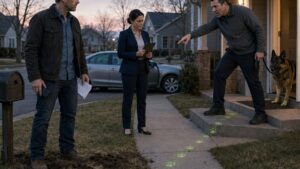
Richard Anderson was halfway through pouring coffee when he saw Karen Hill walking past his kitchen window with Margaret Lewis’s handmade sign tucked beneath one arm.
He set the pot down without filling his cup.
The sign was easy to recognize. Margaret had painted it two days earlier on a square of white plywood: SLOW DOWN—GRANDKIDS PLAYING. She had planted it beside her driveway after a delivery van came around the curve fast enough to send her youngest grandson scrambling onto the lawn.
Now Karen was carrying it toward her SUV as if she had collected trash from the roadside.
Richard stepped onto his porch.
“Morning, Karen.”
She stopped but did not look embarrassed.
“This was installed without approval.”
“That’s Margaret’s property.”
“The governing documents prohibit unapproved roadside signage.”
Karen slid the plywood into the back of the SUV.
Richard looked across the street. Margaret stood behind her screen door in a robe, one hand holding the frame. She looked less angry than tired.
That bothered him more.
For six years Richard had treated the association’s rules the way he treated speed limits in an empty parking lot: occasionally irritating, usually survivable. He kept his hedges trimmed, his trash cans behind the fence, and his mailbox the approved shade of black.
Karen’s presidency had gradually changed the temperature of the neighborhood.
A neighbor two houses down had paid $250 because the bottom of his wind chime hung two inches below the decorative limit. A family near the cul-de-sac had been cited $400 after leaving a large ceramic planter beyond the approved porch footprint.
Every violation arrived in the same cream-colored envelope.
No raised voices. No public scenes.
Just a photograph, a paragraph quoting the rules, and a deadline.
Richard crossed to Margaret’s house after Karen drove away.
She had already made coffee.
“I told her I’d move it closer to the porch,” Margaret said. “She said that wouldn’t matter unless I submitted an architectural request.”
“For a safety sign?”
Margaret gave a small shrug.
“I don’t want trouble.”
Richard looked toward the curve where the sign had stood.
“What did the letter say?”
“It wasn’t a letter yet.”
Her eyes moved toward the kitchen counter.
A cream envelope rested beside a bowl of apples.
Richard frowned.
“That came today?”
“About twenty minutes ago.”
Inside was a formal notice assessing a $300 violation for unauthorized exterior signage and warning that additional daily penalties could follow if the violation remained.
Richard read it twice.
Karen had removed the sign herself before breakfast, and the fine had apparently already been prepared.
Margaret watched him.
“Please don’t make this into something.”
“I’m reading it.”
“You get that look when you’re reading something you don’t like.”
Richard folded the paper along its existing crease.
Years earlier, clients had paid him specifically for that look. Commercial developers, landlords, lenders—people who wanted to know exactly where an easement ended, which covenant controlled, or whether a restriction had been drafted broadly enough to survive a challenge.
Twelve years of property-rights consulting had taught him that most disputes were not won by indignation.
They were won by definitions.
He handed the notice back.
“I won’t do anything without knowing what I’m looking at.”
Margaret smiled faintly.
“That does not sound reassuring.”
On his walk home, Richard passed the association entrance.
Two stone columns framed the road, joined visually by low landscaping beds and a decorative arch set farther back on Karen’s corner lot. Her arch was substantial—stacked stone, permanent footings, electrical lighting embedded beneath the cap.
Richard stopped.
He had seen it hundreds of times.
That morning he actually looked at it.
The association rules allowed limited ornamental structures within front setbacks. Height was restricted. Permanent lighting required approval. Certain masonry features were prohibited within a defined sight triangle near intersections.
Richard knew enough of the restrictions to feel the first small click in his mind.
Karen’s arch appeared to violate more than one.
He took out his phone and photographed it from the public sidewalk.
Then he photographed the entrance.
Then Margaret’s bare patch of grass.
He spent the afternoon pulling old HOA notices from emails. The pattern was worse when viewed together.
Wind chime.
Planter.
Trash bin visible for a few hours after collection.
Replacement shutters installed before final color confirmation.
Each one individually defensible under some paragraph in the declarations.
Together they felt different.
At four thirty, a neighborhood email arrived from the board.
The association would begin a “renewed compliance initiative” the following month. Exterior inspections would increase. Repeat violations would move more quickly into escalating penalties.
Richard reread that phrase.
Renewed compliance initiative.
He printed the email and placed it beside Margaret’s violation notice.
Then he opened the thick file cabinet in his home office.
He had bought his house eleven years earlier. Unlike most buyers, he had kept nearly everything from closing: title commitment, survey, subdivision plat, easement schedules, amendments, even photocopies of older county filings.
He pulled out the survey.
His property sat near the entrance, its side boundary running toward the landscaped monument. On the document, however, the line did something he did not remember.
It continued beyond his fence.
Richard leaned closer.
The grass strip between the fence and the entrance landscaping was narrow, perhaps six or seven feet at its widest point. Everyone treated it as common property. The association’s landscapers mowed it. Irrigation spray reached it. Karen had once ordered seasonal flowers planted along part of it.
But the survey line appeared to place the strip inside Richard’s parcel.
He went outside before sunset with the old survey in his hand.
Near the monument, he pushed aside several inches of thick grass with the toe of his shoe.
Something dull showed underneath.
Richard crouched.
A small metal survey marker sat almost level with the soil.
The mark was stained, neglected, nearly swallowed by the lawn.
He looked from it to his fence.
Then to the stone entrance.
The landscaping suggested one boundary.
The metal in the ground suggested another.
Back in his office, Richard unfolded the original parcel map across his desk and traced the printed line with one finger.
It did not follow the fence.
It did not stop where everyone assumed his yard stopped.
It ran straight through the strip beside the entrance.
For the first time that day, Margaret’s missing sign was no longer the question Richard was thinking about.
The question was who, exactly, owned the ground where Karen believed her authority began.
Chapter 2: The Line Nobody Had Looked At in Years
The county plat on Richard’s computer screen put the line exactly where the old paper survey had put it.
Beyond his fence.
He zoomed in until the property numbers blurred.
Then he zoomed back out.
There was no obvious reason for the strange shape. His parcel looked normal from the street, but one narrow extension followed the entrance frontage before tapering beside the association monument.
Richard knew enough not to celebrate a line on a map.
Plats conflicted. Legal descriptions controlled. Easements could burden land without transferring ownership. Later deeds sometimes corrected drafting mistakes that older drawings preserved.
By nine fifteen the next morning, he was standing at the county recorder’s counter.
The clerk brought up the subdivision records and helped him locate the original filing.
Richard began with the current deed.
Then the prior deed.
Then the deed before that.
The description stayed consistent.
He requested the original subdivision declaration filed decades earlier.
A scanned page appeared on the monitor, its lettering uneven from age.
Richard followed the boundary calls one by one.
Distance.
Bearing.
Marker.
Distance.
The strip remained attached to what eventually became his lot.
The association had rights relating to landscaping and entrance maintenance, but he could find no transfer of ownership.
That distinction mattered.
An easement could let someone mow your land.
It did not necessarily make the land theirs.
He spent another hour searching amendments.
Nothing severed the strip.
By lunchtime, satisfaction had begun to push aside caution.
Richard recognized the feeling.
It was the same one he had felt years ago when a commercial client wanted access through an alley behind a small family business. Richard had found the controlling easement. His interpretation had been technically correct. The developer had used it aggressively, construction barriers had made the shop nearly inaccessible, and months later Richard had driven past to find its windows papered over.
Nobody had broken the law.
That had been the part he disliked remembering.
He copied the relevant records and left.
That afternoon he called an attorney he had used for his house closing and explained the boundary issue without mentioning Karen.
After reviewing the documents, the attorney called him back.
“You appear to own it,” he said.
“Appear?”
“I’m a lawyer. You’re paying me for expensive verbs.”
Richard smiled despite himself.
“What about HOA architectural authority?”
“Ownership and covenant control are two separate questions. Your lot is subject to the declaration. But this particular strip is complicated by the entrance easement and later municipal zoning.”
“So they control it?”
“I didn’t say that either.”
The attorney advised him to obtain an updated survey and check municipal restrictions before doing anything.
“Don’t make the mistake of thinking ‘mine’ means ‘anything I want.’”
“I know.”
There was a pause.
“You sounded very confident when you said that.”
Richard did not answer.
Two days later, a survey crew located the old pins.
Richard met them near the entrance before work.
One worker drove a temporary stake beside the neglected marker. Another measured from the rear corner of Richard’s parcel toward the road.
A bright line stretched through the morning air.
It passed outside Richard’s fence.
Across the grass everyone called association property.
And then ran within inches of the landscaped edge maintained by the HOA.
A passing neighbor slowed.
“Something wrong with your fence?”
“Checking an old boundary.”
The neighbor looked at the line, then at the entrance monument.
“Huh.”
That single sound captured the problem better than anything Richard could have said.
The neighborhood had accepted the landscaping as fact for so long that the legal boundary looked wrong when made visible.
Richard photographed every stake.
At home he compared the updated survey with the older plat. They aligned.
The odd strip had not been created by a recent mistake. It had been there all along.
He finally understood something that had bothered him since buying the property. His closing survey showed dimensions that never seemed to match the fence line cleanly. He had assumed the discrepancy came from setback measurements or drafting conventions.
It was simpler.
The fence had never marked the parcel boundary.
That evening Karen emailed him.
The message was short.
The board had noticed survey activity near common landscaping and wanted assurance that no unauthorized alterations were planned.
Richard read the message twice and did not respond immediately.
He could have sent her the deed.
He could have explained everything.
Instead he saved the email.
That was his first real mistake.
At the time it felt like discipline.
He wanted facts before confrontation. He wanted to understand every possible use of the strip before Karen knew he had discovered it.
But there was another motive beneath the careful language he used with himself.
He wanted to know something she did not.
The next morning Richard went to the municipal planning office.
He brought the survey, parcel information, HOA declaration, and photographs.
The permit clerk looked through them, then called over a planner.
Richard explained that he was considering a freestanding sign.
“Residential yard sign?” the planner asked.
“Possibly something larger.”
“How large?”
“I’m determining what’s permitted.”
The planner studied the parcel map.
“This frontage is unusual.”
“Yes.”
“Any easements?”
“Landscape and entrance maintenance.”
“That could affect placement.”
“But not ownership.”
“No.”
Richard felt the old professional rhythm returning. Ask narrowly. Never assume. Separate private covenants from municipal rules.
The planner opened the zoning map.
Richard’s property sat at an edge condition created when the subdivision was developed. Most of his lot was plainly residential, but the frontage near the collector road fell within an overlay where certain freestanding signage could be permitted subject to setbacks, height limits, illumination standards, and sight-line review.
Richard leaned closer.
“What kind of sign?”
“Depends on the dimensions and use.”
“Would the HOA have to approve it?”
The planner looked at him.
“The city doesn’t enforce private covenants. We decide whether it complies with municipal code. Your association can make its own argument separately.”
Richard nodded.
“What would I need to file?”
The planner handed him an application packet.
Site plan. Engineering details. Setback measurements. Lighting specification. Fee.
No loophole.
No magic sentence.
Just a process.
Richard left the building with the packet folded beneath his arm.
At the entrance that evening, the survey stake still stood beside the stone monument.
Karen’s landscaping crew had mowed carefully around it.
Someone clearly understood that removing a survey marker would create a different kind of problem.
Richard stood on his side of the line and looked toward the entrance.
For years Karen had controlled the neighborhood through small pieces of paper telling people where the rules stopped them.
Now a city planner had given Richard a different piece of paper.
And for the first time, he had a credible way to discover where Karen’s rules stopped.
Chapter 3: The Morning the HOA Found the Property Line
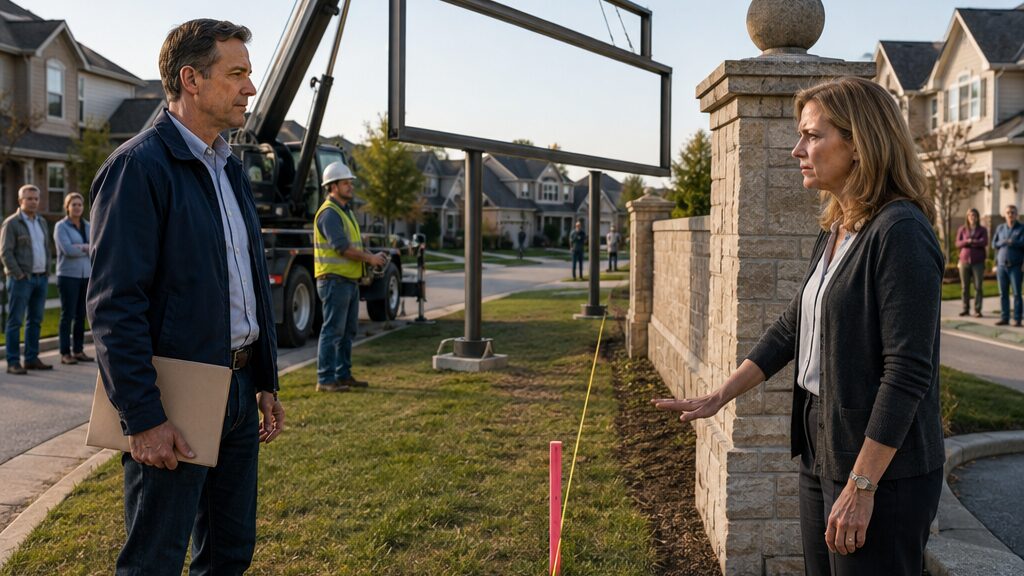
At seven that Thursday morning, a crane lifted a steel billboard frame above the entrance to the subdivision.
Richard stood beside the curb with a travel mug in one hand and a folder under the other arm.
Across the road, garage doors had begun opening.
The contractor guided the suspended frame toward two prepared supports on the narrow strip beside the HOA monument.
It was impossible to ignore.
That was the point.
Three weeks had passed since Richard submitted the application. The city had required engineering drawings, setback confirmation, illumination limits, and a sight-distance review. He had paid the filing fee, answered two rounds of questions, and waited twenty-one business days.
The approval had arrived Tuesday.
He scheduled installation for Thursday morning.
At 7:08, Karen Hill’s SUV stopped crookedly beside the entrance.
She stepped out before fully closing the door.
“What is this?”
The contractor glanced at Richard.
Richard said, “Hold for a minute.”
The crane stopped with the frame hanging several feet above the ground.
Karen crossed the grass.
“You cannot install a commercial sign in this community.”
Richard opened the folder.
“It isn’t in the community’s common property.”
“It is at our entrance.”
“It’s beside the entrance.”
“Richard, this is not a word game.”
“No.”
He handed her the permit.
“This is a property-line issue.”
Karen barely glanced at the first page.
“The declaration prohibits signs of this size.”
“On property under the association’s architectural jurisdiction.”
“Your property is in the association.”
“Most of it.”
That finally made her look at him.
Richard pointed toward the ground.
A bright survey string ran between temporary stakes, following the updated boundary. One side held Richard’s narrow strip.
The other contained the association landscaping.
The line passed so close to the stone monument that a person could stand with one foot under each set of rules.
Karen stared at it.
“What exactly are you claiming?”
“I’m not claiming anything. The survey is recorded, and the city reviewed the site plan.”
She looked again at the permit.
A few residents had gathered on sidewalks now. Nobody came close, but Richard could feel their attention.
Karen lowered her voice.
“You deliberately kept this from the board.”
“You asked if I was making unauthorized alterations to common landscaping. I didn’t alter common landscaping.”
“That is evasive.”
Richard knew she was right.
Not legally.
But personally.
He had enjoyed letting her arrive unprepared.
The realization did not stop him.
Karen took out her phone.
“The board will fine you for every day this remains.”
“You can send whatever notice you think is appropriate.”
“I intend to.”
She called someone and walked several yards away.
Richard heard fragments.
Permit.
Entrance.
Immediate.
Jurisdiction.
The contractor waited.
“Want us to keep holding?”
Richard looked at Karen.
Then at the steel frame hanging against the pale morning sky.
“Give her five minutes.”
Karen returned.
“The city is checking.”
“They already checked.”
“We’ll see.”
At 7:19 her phone rang.
She listened.
Her expression changed almost imperceptibly.
Not shock.
Adjustment.
Richard recognized it because he had seen clients make the same face when a legal position they had treated as obvious suddenly became uncertain.
Karen asked two questions.
Then ended the call.
Richard did not smile.
“What did they say?”
She looked at him.
“You know what they said.”
He nodded toward the contractor.
“Continue.”
The crane moved again.
Steel descended slowly toward the supports.
Karen stood beside the survey line while the crew bolted the frame into place.
The association president had spent years sending residents photographs of boundaries they had crossed—a trash can too visible, a planter too far forward, a decoration hanging too low.
Now she was watching a boundary become physical in front of her.
The HOA’s authority ended in the grass.
That should have been enough for Richard.
For several minutes, it was.
Then the printed face of the sign arrived.
Karen saw it before most of the neighbors did.
Her posture stiffened.
“Richard.”
He said nothing.
Workers raised the first panel.
The message was simple enough to read from the road.
ASK YOUR HOA BOARD WHERE $31,000 IN MAINTENANCE FUNDS WENT.
Below it, in smaller lettering, Richard had added that supporting records were available to homeowners upon request.
A neighbor across the street lowered his coffee cup.
Someone farther down the sidewalk said, “Thirty-one thousand?”
Karen turned toward Richard.
“You are accusing this board of stealing money.”
“No.”
“You put that number on a billboard at the front entrance.”
“I’m asking why the disclosed totals don’t reconcile.”
“You know exactly how residents will interpret that.”
Richard did.
That was the second thing she was right about that morning.
For four years he had downloaded the association’s annual disclosures almost automatically. His old professional habits made him notice numbers. Maintenance totals moved oddly between categories. Several invoice amounts he had later obtained through homeowner record requests did not align cleanly with the summaries.
He had constructed his own spreadsheet.
The unresolved difference was a little over $31,000.
Not proof of theft.
Not proof of fraud.
A discrepancy.
But twelve-foot lettering did not preserve distinctions as carefully as spreadsheets did.
Karen stepped closer.
“If you have a question about the accounts, you bring it to the board.”
“I did.”
“You sent broad record requests.”
“And received incomplete responses.”
“That does not give you the right to imply criminal behavior.”
“I didn’t use the word criminal.”
Her jaw tightened.
Richard heard how technical his answer sounded.
It reminded him of his consulting years.
A statement could be accurate and still be designed to produce an effect larger than its wording.
Karen looked past him at the completed billboard.
“You think this makes you accountable?”
“No.”
“I think it makes the board accountable.”
For the first time, her anger slipped.
Something else appeared beneath it.
Fear.
Not fear of the sign itself.
Fear of the number.
Karen walked back to her SUV and called her attorney.
The neighbors remained.
Some photographed the billboard.
Others looked uncomfortable.
Margaret arrived slowly from down the street.
She stopped beside Richard and read the message.
“You found thirty-one thousand dollars missing?”
“I found thirty-one thousand I can’t reconcile.”
“That isn’t quite the same sentence.”
Richard looked at her.
“No.”
Margaret nodded toward the billboard.
“But that’s the sentence people will hear.”
The satisfaction he had felt when the city confirmed his permit thinned.
The sign was legal.
The boundary was real.
Karen had been wrong about both.
Yet Richard could already see the next dispute forming, and this one would not be decided by a survey stake.
At 8:02 the contractor shut down the crane.
The illuminated panel stood directly in the entrance sight line.
Richard signed the completion form.
As the crew packed equipment, a man crossed from the opposite sidewalk.
Eric Brown, the HOA treasurer, usually avoided neighborhood disputes with impressive consistency. At board meetings he spoke mostly when presenting balances, and even then he seemed eager to finish.
Now he came directly toward Richard.
He glanced at Karen, who was still on the phone near her SUV.
Then at the billboard.
Then back at Richard.
“Where did you get that number?”
Richard studied him.
“From the association’s disclosures and the invoices I was able to obtain.”
Eric’s expression did not show outrage.
It showed calculation.
“You added the reserve expenditures?”
“The ones disclosed.”
“What about the emergency maintenance account?”
Richard paused.
“What emergency maintenance account?”
Eric looked toward Karen again.
That tiny movement changed the morning more than the crane had.
Richard lowered his voice.
“It isn’t in the annual summaries.”
“I know.”
“Then where is it?”
Eric rubbed one hand across his mouth.
“I didn’t say the discrepancy isn’t real.”
Richard waited.
Eric’s eyes returned to the enormous number hanging over the entrance.
“I’m saying you don’t know what it means yet.”
For the first time since the billboard permit had been approved, Richard wished he had waited one more day.
Chapter 4: The Number on the Billboard Was Not the Whole Truth
By Friday evening, a photograph of Richard’s billboard filled the projection screen at the front of the HOA meeting room.
Karen Hill stood beneath it.
The number—$31,000—hovered over her shoulder in twelve-foot lettering.
“This emergency meeting is not about whether Mr. Anderson’s sign permit is valid,” she said. “The city has already answered that question.”
Richard sat three rows back with Margaret on one side and an empty chair on the other.
“It is about a public statement that strongly suggests this board cannot account for homeowner funds.”
A few people turned toward him.
He kept his hands folded over a folder containing four years of financial summaries, copies of invoices, and his own reconciliation spreadsheet.
Karen had sent the meeting notice less than six hours after the billboard went up.
She had also sent Richard a letter from the HOA attorney demanding that he preserve all documents supporting the statement displayed at the entrance.
The letter used the phrase potentially defamatory twice.
Karen clicked to the next slide.
A list of annual maintenance totals appeared.
“The association has never reported thirty-one thousand dollars stolen, missing, or misappropriated.”
“I didn’t say stolen,” Richard said.
Karen looked directly at him.
“No. You simply put ‘where did it go’ on a billboard large enough for every delivery truck on the county road to read.”
A murmur moved through the room.
Richard felt the answer form automatically.
The wording is accurate.
The records do not reconcile.
He had spent years making those kinds of distinctions.
Instead he opened his folder.
“The annual summaries and the supporting invoices I received differ by thirty-one thousand four hundred and sixty dollars over four years.”
Eric Brown sat at the board table with his eyes lowered.
Karen said, “Because you do not have every underlying transaction.”
“I requested them.”
“You requested selected categories.”
“I requested the records supporting the published totals.”
“And you assumed anything you did not understand was missing.”
Richard felt the room shift slightly.
Not toward Karen.
Away from certainty.
That was worse.
A homeowner near the aisle asked, “So is the money there or not?”
Karen turned toward Eric.
“Treasurer?”
Eric cleared his throat.
“There are reserve expenditures that are not reflected the way Richard is reading the annual summaries.”
Richard looked at him.
“Which reserve expenditures?”
Eric hesitated.
Karen answered first.
“Emergency repairs.”
“What repairs?”
“Common infrastructure.”
“That’s not a category in the summaries.”
“It appears under reserve transfers.”
Richard pulled out a page.
“Not consistently.”
Eric finally looked up.
“He’s right about that.”
Karen’s face hardened.
“Eric.”
“I’m saying the reporting changed. It did.”
The room became quieter.
Richard leaned forward.
“Does the discrepancy exist?”
Eric rubbed his thumb along the edge of a legal pad.
“Yes.”
The word landed heavily.
Then Eric added, “But your interpretation is incomplete.”
Several people spoke at once.
Richard ignored them.
“How incomplete?”
“Some invoices were paid directly from reserve accounts. Some were reimbursed later. Some were booked in different fiscal periods.”
“And some aren’t in the packet I received.”
“Yes.”
“Why?”
Eric glanced at Karen.
That glance mattered more than the answer.
Karen stepped away from the screen.
“This association manages real property. Emergencies do not always wait for clean accounting cycles.”
“No one expects them to.”
“You seem to.”
Richard felt irritation rise.
“What I expect is that if homeowners are fined for being two inches outside a rule, the board can account for thirty-one thousand dollars without asking everyone to trust a bookkeeping explanation nobody has seen.”
A few heads nodded.
Karen’s voice cooled.
“And I expect someone with your professional background to know the difference between an accounting inconsistency and an accusation of theft.”
Richard looked up at the billboard photograph.
Margaret’s words from the morning returned to him.
That isn’t quite the same sentence.
The sign was technically careful.
Its effect was not.
After the meeting, Margaret caught him at the door.
“You looked less happy at the end.”
“I learned something.”
“That usually does it.”
Outside, Richard found a cream-colored envelope tucked under his windshield wiper.
For one absurd second he thought it was another violation notice.
It was from the HOA attorney.
The letter demanded that Richard remove or revise the billboard within forty-eight hours or face possible legal action for reputational harm to the association and its officers.
Margaret read over his shoulder.
“Can they make you?”
“Not through the sign rules.”
“That wasn’t my question.”
Richard folded the letter.
“No. Not yet.”
At home, he spread everything across his kitchen table.
Violation envelopes sat beside financial statements.
Margaret’s $300 notice.
The wind-chime citation.
The planter citation.
Four annual budget summaries.
Invoices.
His spreadsheet.
He moved one invoice into a different fiscal year.
The discrepancy dropped.
He found another payment routed through reserves.
It dropped again.
Not enough.
But enough to bother him.
The number on the billboard had felt solid because subtraction was solid.
Now the categories underneath it were moving.
His phone rang shortly before ten.
Eric.
“I shouldn’t be calling you.”
“Then why are you?”
“Because if this turns into a lawsuit, everybody loses.”
Richard looked toward the dark window. From his kitchen he could not see the billboard, but he could picture it.
“Tell me what I’m missing.”
Eric was quiet.
“There was a separate maintenance account.”
Richard stopped writing.
“What separate account?”
“Not separate legally. Separate in practice.”
“That is not reassuring.”
“It was used for urgent work. Pump failures. Drainage. Electrical. Things Karen didn’t want hitting the operating budget all at once.”
“Was it disclosed?”
“In the full financials.”
“Not in the homeowner summaries.”
“No.”
“Why not?”
Another silence.
Richard could hear Eric breathing.
“Because once people saw how much we were spending, they would ask what was failing.”
“They should ask.”
“I know.”
“Then why didn’t you tell them?”
“Because Karen said we needed time.”
Richard leaned back.
“For what?”
“To stabilize it.”
“And did you?”
“No.”
Richard looked down at the attorney’s letter.
Eric continued.
“I’m not defending how it was handled.”
“You signed the reports.”
“Yes.”
“So you were part of it.”
“Yes.”
There was no excuse in the answer.
That made it harder to dismiss him.
Richard said, “How much of the thirty-one thousand is in that account?”
“I don’t know from memory.”
“You’re the treasurer.”
“I know exactly how bad that sounds.”
Richard said nothing.
Eric lowered his voice.
“There’s one account Karen never included in the homeowner summaries.”
Richard stared at his spreadsheet.
“Send me the records.”
“I can’t.”
“Won’t?”
“Can’t. Not without board authorization.”
“Then authorize it.”
“I’m one vote.”
Richard closed his eyes.
“What’s the account called?”
Eric told him.
Richard wrote the name in the empty margin beside the $31,460 figure.
The number on the billboard had not disappeared.
But it no longer meant what Richard had wanted it to mean.
And somewhere inside the HOA’s records was an account Karen had decided homeowners did not need to see.
Chapter 5: What Karen Had Been Trying to Keep Looking Normal
The pump enclosure looked as if someone had built a decorative hedge around a machine they were ashamed of.
Richard stood behind the common-area landscaping the following Tuesday while Eric struggled with a rusted latch.
“You wanted to know where some of the money went,” Eric said.
The metal door opened with a scraping sound.
Inside, the equipment was anything but decorative.
A pump housing had been patched twice with newer fittings. One control box was stained beneath the conduit. Sections of pipe did not match. A portable dehumidifier stood on a concrete block beside a stack of empty sealant tubes.
Richard looked toward the immaculate entrance road fifty yards away.
Fresh mulch.
Trimmed shrubs.
No weeds.
“You’ve been repairing this?”
“For three years.”
“How many times?”
Eric gave him a tired look.
“Depends what you count as a repair.”
Richard crouched beside the pump.
One contractor sticker carried a date from the previous summer.
Another was eighteen months older.
“What does it serve?”
“Entrance irrigation, part of the stormwater system, and pressure for two common landscaping zones.”
“This should have been replaced.”
“Yes.”
“Why wasn’t it?”
“Because replacement bids started around sixty thousand.”
Richard straightened.
“And the reserve fund?”
“Not where it should have been.”
That afternoon they went through archive boxes in the HOA office.
Eric had obtained authorization from one of the other board members to let Richard inspect records already available to homeowners, including detailed reserve transactions.
The hidden account was not hidden in the legal sense.
That distinction irritated Richard immediately.
It existed in full accounting records.
It had simply vanished from the simplified annual summaries sent to owners.
Invoice by invoice, the mystery became less exciting and more troubling.
Emergency pump work.
Drainage clearing.
Temporary electrical repair.
A failed irrigation controller.
A contractor called twice within eight months for the same underground leak.
Richard entered each item into his spreadsheet.
The unexplained total fell from $31,460 to $22,810.
Then to $16,200.
Then below ten thousand.
He should have felt relief.
Instead he felt exposed.
He had put the larger number on a billboard.
Eric pushed another invoice toward him.
“That one was paid late. It appears the next fiscal year.”
Richard entered it.
Another portion disappeared.
“So there’s no missing money.”
“I didn’t say that.”
Richard looked up.
Eric pointed toward several payments.
“There are still unsupported transfers. A few approvals are missing. Some invoices don’t match the minutes.”
“How much?”
“I don’t know yet.”
“You keep saying that.”
“And you keep wanting a clean answer before we have one.”
Richard sat back.
He deserved that.
The office door opened.
Karen entered carrying a binder.
She stopped when she saw the spreadsheets spread across the table.
“I suppose privacy is finished.”
“They’re association records,” Richard said.
“That wasn’t what I meant.”
She put the binder down.
For once she was not wearing the expression Richard had come to associate with enforcement meetings. She looked exhausted.
Eric said, “He’s seen the maintenance account.”
Karen glanced at him.
“So much for waiting.”
“Waiting for what?” Richard asked.
Karen pulled out a chair.
“For a year when something else didn’t break.”
Richard almost laughed.
She did not.
Karen opened the binder.
Inside were photographs.
Water pooled beside a sidewalk.
A washed-out drainage bed.
A corroded electrical cabinet.
The pump enclosure before one of its temporary repairs.
“We started getting failure reports three years ago,” she said. “The reserve study assumed several systems had more life left than they did.”
“So you told homeowners?”
“We tried to price replacements first.”
“And?”
“The numbers were terrible.”
Eric said quietly, “Special assessment territory.”
Karen looked at Richard.
“Do you know what happens when you tell one hundred and forty homeowners they may owe several thousand dollars each because prior boards underfunded reserves?”
“Yes.”
“No, you know what happens in commercial property. Here you know who has a new baby. Who is retired. Who just lost a job. Who bought six months ago believing the dues were stable.”
Richard let that sit.
It was the first thing Karen had said that did not sound like a defense of authority.
Then she ruined it.
“So we bought time.”
“By hiding the extent of the problem.”
“By managing it.”
“Those are not the same.”
“I know that now.”
Richard studied her.
“You knew it then.”
Karen’s expression tightened.
“We disclosed total reserves.”
“You did not disclose how much emergency work was consuming them.”
“We did not lie about the balance.”
“You made the neighborhood look healthier than it was.”
“Yes.”
The direct answer surprised him.
Karen closed the binder.
“I thought if we could keep the common areas stable for another year, we could phase repairs into normal increases instead of dropping a special assessment on people.”
“And the fines?”
“What about them?”
Richard pointed toward the window.
“While all of this was happening, you increased exterior inspections.”
“Those are separate responsibilities.”
“No. That’s the part you want to be separate.”
Karen’s eyes sharpened.
“Property values matter when an association may need financing.”
“So Margaret’s safety sign threatened financing?”
“No.”
“The wind chime?”
“No.”
“The planter?”
“No.”
“Then what were you doing?”
Karen did not answer immediately.
Eric looked down at the table.
Finally she said, “Keeping things normal.”
Richard almost missed the admission because of how softly she said it.
Karen looked toward the archive shelves.
“When people see weeds at the entrance, broken lighting, inconsistent enforcement, they start asking whether anything is being managed. Then they attend meetings. Then they demand every number. Then the problem becomes the only thing anyone talks about before you have a solution.”
“So you made sure everyone saw perfect lawns and violation notices.”
“I made sure the association looked controlled.”
Richard felt his anger return, but it was different now.
Not the satisfying anger of catching hypocrisy.
This was heavier.
“You punished people so they wouldn’t notice you were losing control.”
Karen’s mouth tightened.
“I enforced rules that existed.”
“Selectively.”
“Consistently.”
“Your stone arch violates the same architectural standards you cited against other people.”
Karen looked at him.
“I filed an approval request four years ago.”
“Was it approved?”
“The committee never issued a decision.”
“And you treated silence as approval.”
“I treated it the same way prior boards treated dozens of applications.”
Richard nodded slowly.
There it was.
Not innocence.
Not theft.
A culture of exceptions disguised as precision.
Karen stood.
“If you want me to say I handled this perfectly, I won’t.”
“I don’t.”
“If you want me to say I stole thirty-one thousand dollars, I won’t say that either.”
“I don’t have evidence you did.”
Her eyes moved toward him.
The room became very still.
It was the first time Richard had said it aloud.
Karen picked up the binder.
“Then your billboard needs to change.”
“Maybe.”
“Maybe?”
Richard looked at the spreadsheet.
Most of the dramatic number now had explanations attached.
But beside those explanations were missing approvals, delayed disclosures, and repeated decisions to conceal the condition of infrastructure while tightening enforcement on homeowners.
The truth was smaller than the accusation people imagined.
It was also broader.
Eric slid a stack of meeting minutes across the table.
Richard opened them.
One margin note referred to postponing owner notification about infrastructure deterioration until after “compliance conditions improve.”
He read the sentence twice.
“When was this?”
“Last spring,” Eric said.
Richard looked at Karen.
“You knew the systems were failing before the renewed compliance initiative.”
Karen said nothing.
“And you still sent Margaret a $300 notice over a safety sign.”
“The rule applied.”
Richard closed the folder.
That answer settled something.
The $31,000 might not prove theft.
But Karen had knowingly used cosmetic order as cover while postponing a problem homeowners had a right to understand.
Richard no longer had to decide whether to expose everything.
He had to decide exactly what the truth could support—and whether he was willing to stop where the evidence stopped.
Chapter 6: The Meeting Where Richard Refused the Easier Victory
“Did Karen Hill steal the thirty-one thousand dollars?”
The question came before Richard had even reached the front table.
The HOA meeting room was standing-room only.
Folding chairs filled the aisles. Homeowners lined the back wall. Someone had printed a photograph of Richard’s billboard and left copies near the sign-in sheet.
Karen sat at the board table with Eric two seats away.
Neither looked at Richard.
The homeowner who had asked the question stood near the center aisle.
“Well?”
Richard set his folder down.
Two weeks earlier he would have answered differently.
Not falsely.
Carefully.
He might have said the board could not account for the money.
He might have let the room decide what that implied.
Tonight he looked at the man and said, “I have no evidence Karen stole thirty-one thousand dollars.”
The room changed.
Not dramatically.
No shouting.
Just the unmistakable sound of expectation collapsing into murmurs.
Someone near the back said, “Then why is that sign still up?”
Richard felt heat rise in his face.
Karen finally looked at him.
He opened the folder.
“Because when I installed it, I had four years of disclosures and invoices that left $31,460 unreconciled. That discrepancy was real.”
“Was?” another homeowner asked.
“Most of it can now be traced.”
A louder murmur moved through the room.
Richard saw Margaret sitting near the aisle.
She did not smile or nod.
She simply watched him.
He continued.
“Emergency pump repairs. Drainage work. Electrical repairs. Reserve payments booked in later periods. Expenditures that were not clear in the simplified summaries homeowners received.”
A woman in the second row crossed her arms.
“So this whole thing was nothing?”
“No.”
Richard placed two pages on the document camera.
The $31,460 figure appeared on the screen.
Beside it was a reconciliation column.
Payments.
Invoices.
Dates.
Accounts.
“What changed is what the number means.”
He drew a line beneath the remaining unsupported transactions.
“The evidence does not show thirty-one thousand dollars stolen. It shows financial reporting that was incomplete, approvals that were bypassed or poorly documented, and significant maintenance problems that were not clearly disclosed to homeowners.”
Someone behind him said, “That sounds like splitting hairs.”
Richard looked toward the voice.
“It is splitting hairs.”
A few people stared.
“And when you accuse someone of taking money, you should split every hair available.”
The room quieted.
Richard looked at Karen.
For the first time since the dispute began, he understood exactly where the relevant boundary lay.
The survey line outside had separated his property from association control.
This line separated what he suspected from what he could prove.
Years earlier, he had watched a technically correct property interpretation become a weapon because nobody had cared what happened beyond the document.
He had promised himself afterward that precision would never excuse consequence again.
Then he had put $31,000 on a billboard because he knew exactly what people would assume.
Richard faced the room.
“I should have made the wording more precise.”
Karen’s eyebrows rose slightly.
Richard continued before anyone could interrupt.
“But precision cuts both ways.”
He changed the displayed page.
Meeting minutes appeared.
“Last spring, the board discussed deteriorating common infrastructure.”
Another page.
“Emergency spending was already increasing.”
Another.
“The board postponed broader homeowner notification.”
Karen leaned toward her microphone.
“We were gathering replacement estimates.”
Richard nodded.
“That’s true.”
A few people seemed surprised he had agreed with her.
He displayed the next line.
“At the same time, the board approved a renewed compliance initiative.”
The room went still again.
Richard did not raise his voice.
“Exterior inspections increased while homeowners were being given the impression that the association’s financial and maintenance condition was routine.”
Karen spoke.
“Enforcing architectural standards did not cause the pump failures.”
“No.”
“Nor did it reduce reserve balances.”
“No.”
“Then stop connecting unrelated functions.”
Richard looked at her.
“Why increase cosmetic enforcement while delaying disclosure?”
Karen’s fingers remained on the microphone.
Nobody spoke for several seconds.
Then she said, “Because the neighborhood was already starting to look unmanaged.”
A homeowner laughed once, without humor.
Karen ignored it.
“Property values depend partly on visible conditions. We had infrastructure problems we could not solve quickly. We had owners already angry about dues. The board was facing the possibility of a special assessment.”
Eric shifted in his seat.
Karen looked around the room now, not only at Richard.
“I believed that if we maintained visible standards while we stabilized the repairs, we could avoid panic.”
Margaret raised her hand.
Karen recognized her.
Margaret stood slowly.
“My sign asked people to drive carefully because my grandchildren were visiting.”
Karen’s face changed.
“I remember.”
“You fined me three hundred dollars.”
“The sign did not meet the policy.”
“I know.”
Margaret’s voice remained gentle.
“That’s the problem.”
Nothing followed.
No applause.
Richard was grateful for that.
The silence was enough.
Eric turned on his microphone.
“I signed financial reports I knew were not giving homeowners the clearest picture.”
Karen looked at him.
Eric continued.
“I told myself the full records existed if anyone requested them. That was technically true.”
Richard almost smiled at the phrase.
Eric did not.
“It was also an excuse.”
One of the board members asked, “What exactly are you proposing?”
Richard closed the evidence folder.
“Independent accounting review. Full reconciliation of reserve expenditures. Publication of major repair obligations. Review of fines issued under the renewed compliance program. Clearer approval deadlines so silence cannot become approval for one owner and a violation for another.”
Karen said, “And your billboard?”
There it was.
Richard had known the question would come.
“If the board authorizes an independent review and makes the supporting records available, I’ll revise the sign immediately.”
“Remove it,” Karen said.
Richard looked toward the windows.
From the meeting room they could not see the entrance, but everyone knew the billboard was there.
“I’ll remove it when there is a process in place that makes it unnecessary.”
The homeowner who had first asked about theft spoke again.
“So Karen gets away with it?”
Richard turned.
“With what?”
“With all of this.”
“That depends what you mean by ‘gets away.’”
Richard saw frustration in several faces.
They wanted a villain.
For a while, so had he.
He pointed toward the documents.
“If an audit finds theft, then we deal with theft. If it finds procedural violations, we deal with those. If it finds bad judgment, we don’t pretend bad judgment is a felony because it feels better.”
The room was less excited now.
But people were listening more carefully.
Karen sat with both hands flat on the table.
She looked at Eric.
Then at the other board members.
Finally she turned back to Richard.
“You’ve made it impossible for me to lead this association.”
Richard did not answer.
Karen inhaled slowly.
“Maybe I did that before you put up the sign.”
Eric looked at her.
Karen pushed her chair back.
“If this board votes tonight to authorize a fully independent audit and release its findings to the membership, I will submit my resignation as president when the review begins.”
A board member leaned toward her.
“Karen—”
“No.”
She kept her eyes on Richard.
“I won’t preside over an investigation into decisions I made.”
The room became completely quiet.
Richard had imagined many versions of this moment while filling out the sign permit.
In none of them had Karen sounded tired.
In none of them had winning felt so little like victory.
The board called for a vote.
Richard returned to his seat beside Margaret.
She leaned toward him.
“You didn’t give them the answer they wanted.”
“No.”
“Was it the true one?”
Richard looked toward the screen, where the original $31,460 figure remained beside the reconciled records.
“It’s closer.”
Margaret folded her hands in her lap.
“That will have to do.”
At the front of the room, the final board member raised a hand.
The independent audit was authorized.
Karen looked down at the table for several seconds.
Then she removed the president’s nameplate from in front of her and placed it beside the microphone.
Chapter 7: The Rules After Everyone Had to Read Them
The independent report cleared Karen of theft on its first page.
By the second page, it had confirmed nearly everything else Richard had argued mattered.
He stood at the back of the community meeting room six weeks after the vote, reading the printed findings while homeowners filed into folding chairs.
No evidence of personal misappropriation.
No evidence that Karen or Eric had diverted association funds for private use.
But the report also documented incomplete homeowner summaries, inconsistent reserve accounting, emergency expenditures approved outside normal procedures, delayed disclosure of infrastructure failures, and enforcement practices applied without clear standards.
Richard read that section twice.
Karen had resigned as president when the audit began, exactly as she had promised.
She had not moved away.
Her SUV still appeared in the same driveway every morning. Her stone arch still stood beside the road, though its lighting remained switched off while its approval status was reconsidered.
That detail had become oddly important to Richard.
For years, Karen had treated uncertainty as something other residents had to resolve immediately.
Now her own structure sat in administrative limbo.
The temporary board chair called the meeting to order.
“We have two jobs tonight,” the chair said. “Accept the independent report, and decide what changes follow from it.”
Richard sat beside Margaret.
Eric sat at the board table but no longer held the treasurer’s materials alone. Two other owners had been added to the finance committee.
The chair summarized the audit findings.
Several homeowners interrupted.
“So nobody stole anything?”
“Then why did we spend all this money on an audit?”
“Are we getting the fines back?”
“What happens to the pump?”
The questions came faster than answers.
Richard understood the frustration.
A clean villain would have made the meeting easier.
Instead, the neighborhood had inherited something less satisfying and more useful: a documented record of small decisions that had accumulated into a broken system.
The board moved to the proposed policy changes.
Financial reports would include reserve expenditures in the same summaries distributed to homeowners.
Emergency spending above a defined threshold would require written explanation within thirty days.
Architectural requests would receive an explicit approval or denial by deadline; silence could no longer become whichever answer benefited the board later.
Then came enforcement.
The proposed policy eliminated several subjective appearance standards and required written notice before most fines could begin.
Margaret leaned toward Richard.
“About time.”
He smiled.
Then the chair reached the sign policy.
Richard stopped smiling.
The revised rule allowed temporary safety, political, real estate, and event signage under consistent size and placement standards. Larger freestanding signs near subdivision entrances would face strict limits after a transition period.
The language did not directly order Richard to remove his billboard.
It did something more uncomfortable.
It created a fair rule that would eventually make his billboard noncompliant if he remained subject to the association’s covenant restrictions.
A homeowner across the room raised a hand.
“Does this mean Richard’s sign comes down?”
Several people turned.
Richard looked at the proposed text.
His first instinct was immediate.
My strip is different.
The municipal permit is still valid.
The HOA’s authority is limited.
Every sentence was potentially true.
He also knew exactly how he would sound saying them.
The board chair said, “Richard’s property situation is unusual. The association attorney believes we could spend months arguing about which restrictions apply to that strip.”
A few people laughed softly.
Richard stood.
“You don’t need to.”
The room quieted.
He held up the policy.
“If this passes as written and applies the same way to everyone, I’ll remove the billboard at the end of the transition period.”
Margaret turned toward him.
Across the aisle, someone said, “Why?”
Richard looked toward the windows.
The billboard was not visible from the meeting room, but he could picture every bolt in its frame.
“Because I spent months arguing that rules have to apply consistently.”
He placed the policy back on the table.
“I don’t get to ask for that only when the rule helps me.”
No one applauded.
Richard was relieved again.
The vote passed.
The next matter concerned past fines.
The board agreed to review penalties issued under the renewed compliance initiative, beginning with cases where the cited condition posed no safety, maintenance, or property-impact concern.
Margaret’s $300 citation was among the first voided.
The wind-chime fine was refunded.
The planter case was reduced to a warning and closed.
Margaret received a new approval form for a smaller roadside safety sign positioned outside the sight triangle.
Two days later Richard found her measuring beside the driveway with a tape measure.
“You’re actually checking the dimensions?” he asked.
She glanced up.
“I intend to become unbearable about compliance.”
He laughed.
The new sign was smaller than the old one.
It still asked drivers to slow down.
This time the board had approved it in writing.
Richard helped Margaret press the stakes into the soil.
When they finished, she stepped back.
“Not as dramatic as your billboard.”
“Better message.”
“Cheaper too.”
They stood quietly for a moment as a car slowed around the curve.
That evening Richard walked toward the subdivision entrance.
The survey stakes from the original installation were gone, but the old metal marker remained near the grass.
The legal boundary had not moved.
Everything around it had.
The association had scheduled replacement of the failing pump system. Dues would rise modestly, and a smaller special assessment would still be necessary.
People were unhappy.
But they knew why.
Richard had underestimated how different anger felt when nobody was trying to hide the number causing it.
Karen was near her mailbox when he approached.
They had spoken only in meetings since the audit began.
She waited until he was almost past.
“I heard you agreed to remove the billboard.”
“When the transition period ends.”
“I’m surprised.”
“I’m not sure that’s flattering.”
“It wasn’t meant to be.”
Richard stopped.
Karen looked toward the entrance.
Her stone arch was visible from where they stood.
“The committee says I need to file again.”
“For the arch?”
“Yes.”
“What are you going to do?”
“File again.”
Richard nodded.
Karen almost smiled.
“Apparently that’s what rules are for.”
There was enough irony in her voice to make the sentence honest.
Richard started walking again.
“Richard.”
He turned.
Karen’s expression had changed.
Not defensive.
Not friendly either.
Just tired.
“Did you ever intend to take that billboard down?”
He looked toward the enormous sign rising above the entrance landscaping.
For weeks he had treated its removal as a policy question.
Karen’s question made it personal.
Richard considered giving her the easy answer.
Of course.
It had always been temporary.
Instead he said nothing.
Karen watched his face long enough to understand that the truthful answer was more complicated.
Then she nodded once and walked back toward her house.
Richard remained beside the road, looking at the billboard and wondering whether he had built it to expose a broken system—or because he had wanted everyone to see that he had beaten Karen.
Chapter 8: The Empty Strip Beside the Entrance
The crane returned on a Monday morning.
This time it came to take Richard’s billboard down.
The same contractor parked beside the entrance, placed cones along the shoulder, and began loosening the frame that had dominated the neighborhood for months.
Richard stood on the narrow grass strip holding a copy of the removal permit.
The contractor looked at the billboard.
“Funny. Last time everybody came outside to watch us put this thing up.”
Richard looked toward the houses.
A few curtains moved.
Nobody had gathered.
“That’s probably progress.”
The contractor laughed.
The illuminated face had already been disconnected.
Without its message, the structure looked different.
Less like a declaration.
More like steel.
The crane cable tightened.
Bolts came free.
The frame rose slowly away from the supports.
Richard remembered the morning Karen had arrived insisting the HOA could stop him.
He remembered the city call.
The survey string.
The first moment the $31,000 figure faced the road.
At the time, he had believed the visible boundary was the important discovery.
Now he understood that the harder boundary had come later.
The difference between missing and stolen.
Between legal and fair.
Between forcing transparency and enjoying humiliation.
The contractor lowered the frame onto the truck.
“You keeping the posts?”
“No.”
“Could use them for another sign.”
“I’m done with signs.”
By noon the strip was empty.
Two capped foundations remained temporarily below grade, waiting for restoration work.
Richard stood over the old metal survey marker.
It was still there.
Small.
Rust-stained.
Unimpressive.
The piece of metal that had started everything looked incapable of carrying the weight people had placed on it.
A familiar voice came from behind him.
“You’re staring at dirt.”
Margaret stood near the curb holding her approved safety sign under one arm.
“You’re carrying a sign,” Richard said.
“Mine is legal.”
“So was mine.”
“Yes, but mine annoys fewer people.”
They walked together toward her house.
The smaller sign had finally arrived from the local print shop. The board had approved the dimensions, position, and reflective material.
Richard helped her place it at the measured location.
Margaret stepped back.
“Looks almost disappointingly ordinary.”
“That’s what functioning rules usually look like.”
“Maybe that’s why nobody makes videos about them.”
Richard pushed the final stake deeper.
A delivery van approached the curve.
The driver slowed.
Margaret noticed.
She did not say anything.
Neither did Richard.
The revised HOA procedures had been in effect for several weeks.
The independent audit remained available to every homeowner through the association portal.
Reserve balances appeared clearly on monthly financial reports.
The pump replacement contract had been signed.
The special assessment passed after an unpleasant meeting in which nobody pretended the cost was welcome.
Karen attended that meeting from the third row.
She spoke once.
She supported the assessment.
The vote passed narrowly.
Afterward, two homeowners thanked her for admitting the repair could not wait.
Another told her she should have said so three years earlier.
Karen accepted both comments without arguing.
Eric remained on the finance committee but had refused another term as treasurer.
When Richard asked why, Eric said, “I’ve learned I’m too good at telling myself silence is temporary.”
Richard understood.
One afternoon, the temporary board chair came to Richard’s house.
Richard saw the folder before the chair reached the porch.
“No.”
The chair stopped.
“I haven’t asked yet.”
“You brought a board packet.”
“We have a vacancy.”
“No.”
“You know the documents better than anyone.”
“That is not always a qualification.”
The chair frowned.
“We could use someone who knows where the limits are.”
Richard looked toward the entrance.
“That sounds flattering until you know me.”
“I do know you.”
“Then you should be more careful.”
The chair laughed.
Richard did not change his answer.
He would attend meetings.
He would read records.
He would speak when necessary.
But he no longer wanted authority simply because he believed he could exercise it better than someone else.
That assumption had been Karen’s mistake.
It had nearly become his.
Several months after the audit, Richard encountered Karen beside the entrance while both were collecting mail.
Her stone arch was still there.
The committee had approved it after requiring one lighting modification and documenting an exception for its original dimensions.
Karen held the approval letter.
She lifted it slightly.
“Official now.”
“Congratulations.”
“I considered framing it.”
“You should.”
She looked toward the empty grass strip where the billboard had stood.
“You could put something smaller there.”
“I could.”
“You own it.”
“I do.”
Karen studied him.
“That used to sound important when you said it.”
“It still is.”
“What changed?”
Richard considered the question.
Cars moved quietly through the entrance.
Margaret’s safety sign was visible farther down the road.
The repaired landscaping around the new pump system had not fully grown back yet. One strip of fresh sod showed where underground work had crossed the common area.
For years the neighborhood had hidden every imperfection as quickly as possible.
Now that unfinished patch did not seem dangerous.
“It matters that I own it,” Richard said. “It just doesn’t mean I need to prove it every morning.”
Karen looked at him for a moment.
Then she nodded.
“I probably could have learned that earlier.”
“So could I.”
That was as close as either of them came to an apology.
It was enough.
Later that week, Richard removed the last temporary construction stake from the strip.
He considered planting something.
A tree would interfere with visibility.
Flowers would require irrigation.
A bench would invite another argument about permitted structures.
In the end, he did nothing.
Grass slowly covered the marks left by the billboard supports.
The survey marker remained visible because Richard trimmed around it himself.
Not as a warning.
Not as a trophy.
Just because boundaries mattered.
They told people what belonged to them.
They also told people where to stop.
One Saturday afternoon, Margaret’s grandchildren rode bicycles past the entrance while she watched from her driveway.
A car approached the curve.
The driver saw the small approved sign and slowed.
Richard was standing near his mailbox.
Margaret caught his eye from across the street and lifted one hand.
Richard returned the gesture.
Behind him, the subdivision entrance looked almost exactly as it had before the dispute.
Stonework.
Trimmed shrubs.
Clean pavement.
But the similarity was only on the surface.
The financial reports were open.
The repairs were funded.
Violation notices required explanation before penalties.
No board president could quietly treat uncertainty as authority.
And the narrow strip beside the entrance no longer carried a billboard telling everyone to ask where the line was.
The line was still there.
Richard could see the old survey pin shining faintly through the grass.
He left it exactly where it had always been.
The story has ended.