The HOA Tore Down His Horse Fence—Then the Boundary They Wanted Hidden Became Impossible to Ignore
Chapter 1: The Morning the Fence Was Gone
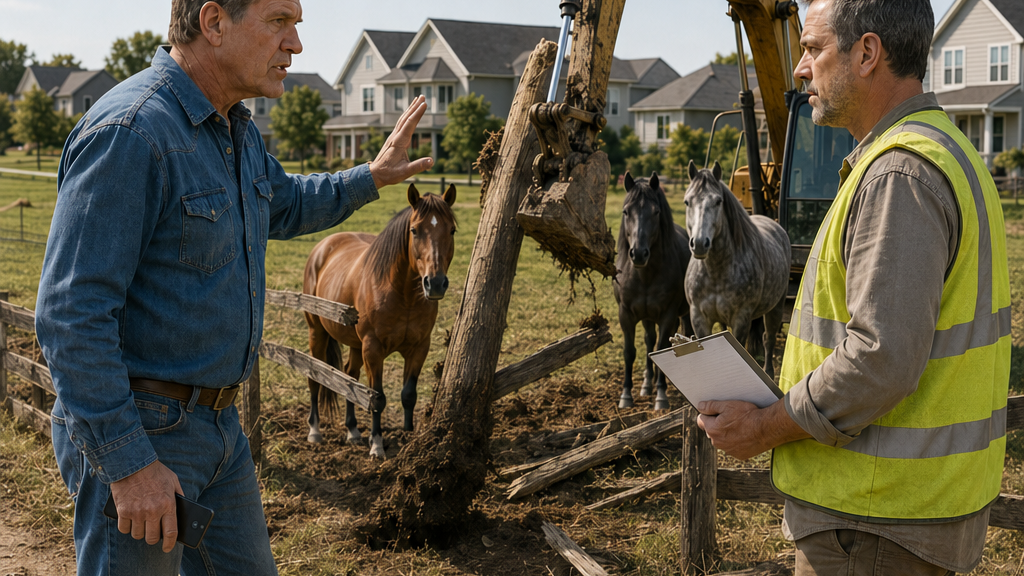
The excavator bucket rose with one of Jack Harris’s fence posts clenched between its steel teeth.
Twenty feet behind the opening, Bella stood with her ears forward.
Jack hit the brakes so hard that a bucket on the floor of his pickup rolled under the dashboard.
For a second he could not make sense of what he was seeing. The eastern fence had run along that pasture longer than half the houses across from it had existed. Weather had silvered the rails. Horses had rubbed their necks against the posts. Jack had replaced boards one at a time for years, but the line itself had never moved.
Now nearly half of it was on the ground.
An excavator sat in the narrow strip between his pasture and the subdivision. Fresh holes marked where posts had been pulled. Rails lay in crooked piles on the manicured side of the boundary.
Jack left the truck running and crossed the grass.
“Stop.”
The excavator operator did not hear him.
Jack stepped farther into view and raised both arms.
“Stop the machine.”
The bucket froze.
A man in a reflective vest walked toward him from beside a utility trailer. “Can I help you?”
“You can tell him to put that post down.”
The man looked from Jack to the excavator.
“We have authorization.”
“You have authorization to tear down my fence?”
The contractor’s expression changed slightly. Not fear. Calculation.
“This is the perimeter fence.”
“It’s my livestock fence.”
“We were told it’s association-controlled.”
Jack glanced past him.
Three sections were already gone completely. Another hundred feet had been stripped down to posts. Farther south, the last intact rails still separated his pasture from the subdivision’s rear lawns.
Bella took two slow steps toward the opening.
Jack pointed at her.
“That fence holds horses.”
The contractor turned.
Only then did he seem to notice how close the animals were.
“Shut the machine down,” Jack said.
The operator killed the engine.
Silence settled abruptly over the pasture.
Jack pulled out his phone.
He photographed the excavator. The piles of rails. The empty post holes. The trailer. The contractor’s truck.
Then he photographed the man.
“Hey.”
“I’m documenting who’s here.”
“You don’t need my picture.”
“You’re standing on my property taking down my fence. I need a lot more than your picture.”
The contractor exhaled and reached into the cab of his truck.
He returned with several clipped pages.
“There’s the authorization.”
Jack took them.
At the top was the name of the subdivision association. Beneath it was a work description referring to perimeter hazard removal and replacement preparation.
At the bottom was an approval signature.
Gregory Wilson.
Jack knew the name.
For three months, envelopes carrying it had arrived in his mailbox.
He had thrown most of them into a drawer without opening them.
“This doesn’t say you own my fence,” Jack said.
“We don’t determine ownership. We do the job we’re contracted to do.”
“Who showed you the property line?”
The contractor hesitated.
“Association representative.”
“Who?”
“I dealt with the management office.”
“Did anybody show you a survey?”
Another hesitation.
“No.”
Jack looked at the pages again.
The longer he studied them, the hotter his anger became, but anger was no longer the most urgent thing in front of him.
Bella had moved closer.
So had the other two horses.
“Get your people out of the pasture,” Jack said. “Now.”
“We’re already shut down.”
“Out.”
The contractor signaled to his crew.
Jack walked toward the opening, calling the horses in the low voice they knew. Bella stopped. The youngest gelding did not.
He stepped through the gap.
“Damn it.”
The second horse followed.
Jack dropped the paperwork and moved fast.
The geldings trotted across the torn ground toward the rear lawns of the subdivision, excited by freedom more than frightened by it.
A woman behind one of the houses shouted.
Jack cut across the field and got between the horses and the nearest open street. One veered toward a landscaped drainage swale. The other kept going.
“Gate!” Jack yelled toward the contractor. “Get me a panel. Anything.”
The crew scrambled toward the trailer.
Jack caught the first gelding near a row of young trees and looped his belt through the halter ring because he had no lead rope with him.
When he turned, Bella was walking through the opening.
“Bella!”
She stopped.
For one hopeful second, she looked back at him.
Then a landscaping mower started somewhere beyond the houses.
Bella startled.
She turned away from the sound and broke into a trot.
The loose gelding followed.
Jack released the one he had caught rather than risk being dragged and ran.
By the time he reached the torn fence again, two workers were wrestling temporary metal panels off the trailer.
“Block this,” Jack said. “All of it.”
He grabbed one end.
Together they dragged the first panel across the largest gap. Jack’s arms shook with effort and anger. The contractor tried to speak to him.
“I didn’t know there were horses turned out.”
Jack slammed the panel against a surviving post.
“What did you think a horse fence was for?”
The contractor said nothing.
They secured the second opening.
Then someone shouted from the subdivision side.
“Horse in the street!”
Jack dropped the wire he was holding.
Bella had passed between two houses.
He could see her chestnut back moving beyond the yards.
He ran toward the street.
A woman stood at the corner waving both arms at an approaching car.
The driver swerved.
Tires screamed.
Bella spun sideways onto the shoulder.
Jack heard the impact before he could see exactly what had happened—a hard, hollow sound, followed by the mare stumbling.
The car stopped crooked across the lane.
Bella stayed on her feet.
But when she tried to step forward, her left rear leg buckled.
Jack crossed the last stretch at a run.
Everything he had wanted to say to Gregory Wilson disappeared.
There was only the horse trembling beside the road and blood beginning to darken the hair above her hoof.
Chapter 2: The Letters Jack Never Answered
The veterinarian cut through the temporary wrap on Bella’s leg, and a dark red line appeared beneath it.
Jack looked away only once.
“The good news,” the veterinarian said, “is that I don’t think anything’s broken.”
Bella shifted in the stocks.
Jack put his palm against her neck.
She was twenty-one years old and ordinarily patient enough to stand through almost anything. Now the skin under his hand trembled.
“How deep?”
“Deep enough for stitches. Not into the joint.”
Jack breathed out.
The veterinarian cleaned the wound while an assistant steadied Bella’s hindquarters.
“She was clipped by the bumper?”
“That’s what the driver said.”
“You were lucky.”
Jack stared at the concrete floor.
He did not feel lucky.
The sheriff’s deputy had taken photographs at the road. Animal control had come out because livestock had entered a public street. The driver had stayed and cooperated. No citation had been issued yet.
None of that changed the sight of Bella stumbling.
“How long before she’s sound?”
“If it stays clean, couple of weeks before I want her moving normally. Longer before I’d ride her.”
“I don’t ride her much anymore.”
The veterinarian glanced at him.
“Then she’ll have a good excuse to enjoy retirement.”
That was the first thing anyone had said all day that eased the pressure in Jack’s chest.
By late afternoon, Bella was back in the barn with a white bandage wrapped around her lower leg.
The contractor had erected temporary livestock panels along the damaged eastern boundary. They looked flimsy beside the piles of old rails, but they held.
Jack took another round of photographs.
He photographed every pulled post.
Every hole.
Every length of broken wood.
He laid the contractor’s authorization on the hood of his truck and photographed that too.
Then he went inside.
The kitchen table became a workbench for everything he had ignored.
Jack emptied the drawer beside the refrigerator.
Envelopes spilled across the wood.
Association letterhead.
Certified-mail slips.
A notice he remembered refusing at the post office because he had already decided he knew what it said.
He sat down.
Three months earlier, the first letter had complained that portions of his eastern fence were deteriorated and inconsistent with the subdivision’s perimeter appearance.
Jack had laughed.
The subdivision had been there six years.
His fence had been there more than thirty.
He had folded the letter in half and dropped it in the drawer.
The second notice was firmer. It referred to loose rails and height variations. It asked him to coordinate with the community-management office.
He had ignored that one too.
The third said the association intended to inspect what it called “shared perimeter conditions.”
Jack remembered seeing those words.
Shared perimeter.
That had been enough for him.
Nothing about the eastern line was shared.
He owned the field.
He paid taxes on it.
His deed predated the subdivision.
So he had stopped reading.
Now he opened the certified envelope he had never accepted.
A duplicate copy had apparently been delivered by regular mail.
He unfolded it carefully.
The letter still demanded corrective action.
But halfway down the page was a paragraph he had never seen.
The association requested a joint site inspection “to reconcile existing fence placement with the approved perimeter screening exhibit recorded during development review.”
Jack read the sentence twice.
Then a third time.
The anger remained, but it no longer felt clean.
His phone rang.
It was the animal-control officer.
“Just checking on your mare.”
“She’ll be all right.”
“Glad to hear it.”
Jack looked at the letters.
“Can I ask you something?”
“Sure.”
“If someone takes down a livestock fence without the owner’s permission, does it matter that the owner ignored their letters?”
A pause.
“For whether they had permission? That’s not my call.”
“I know.”
“For whether it was smart to ignore them?”
Jack almost smiled.
“No. I guess that part is obvious.”
The officer did not take the bait.
“We documented the condition when we arrived. That’s what I can tell you.”
After the call, Jack drove back to the barn.
Bella stood with one hind leg resting.
He opened the stall and stepped inside.
“I should’ve answered them.”
The mare lowered her head toward his shoulder.
Jack rubbed between her eyes.
“I didn’t have to agree. Just had to answer.”
The words were harder to say than he expected.
For years, the HOA had seemed like an intrusion carried on paper. Complaints about weeds along the road. Questions about fencing. A request that he not park a trailer where subdivision residents could see it.
Jack had treated every envelope as another attempt to make him behave as though his farm belonged to their neighborhood.
Refusing to answer had felt like defending the line.
Now Bella was wearing a bandage because the line had disappeared.
That evening Jack spread everything across the kitchen table again.
Fence photographs on the left.
Certified notices on the right.
The contractor’s work order in the middle.
At the bottom of the unopened letter was a reference number.
Perimeter Screening Exhibit—Phase One.
Jack searched through a folder of subdivision materials he had saved from years earlier, mostly because a county planner had mailed them when development first began.
Nothing.
He called the association office.
A woman answered.
“Community management.”
“I’m looking for Sandra Mitchell.”
“This is Sandra.”
“This is Jack Harris.”
The pause was brief but noticeable.
“Mr. Harris.”
“I need the exhibit your notices keep referring to.”
“I can send you a copy.”
“Tonight?”
“I can email it.”
“And I want the document that says your association owns my fence.”
Another pause.
“I’m not sure that’s what the exhibit says.”
Jack straightened.
“Then why did your contractor tear it down?”
“I said I’m not sure what the exhibit says. I need to review the file.”
“You do that.”
“I will.”
Twenty minutes later, an email arrived.
Jack printed the attachment because he trusted paper more than a glowing screen.
It was an old development plan.
Most of the subdivision was drawn in neat black lines—lots, streets, drainage areas.
Along the western edge ran a heavy dashed line.
Beside it were three words:
PERIMETER SCREENING LIMIT.
Jack followed the line with his finger.
It ran almost exactly where his old fence stood.
For the first time all day, his certainty faltered for a reason that had nothing to do with Bella.
If the association had been wrong, the drawing made their mistake easy to understand.
If they had been right, then Jack had spent three months ignoring the one document that might prove it.
Chapter 3: A Line Drawn Before the Houses
The county planning clerk placed Jack’s survey beside the subdivision exhibit and tapped the two boundary lines with the end of a pencil.
“They are not the same thing.”
Jack leaned closer.
On the developer’s exhibit, the heavy dashed line labeled perimeter screening followed the western edge of the subdivision.
On Jack’s recorded survey, the actual property boundary sat several feet east of most of his old fence.
“So my fence is on my land.”
“That’s what this survey shows.”
“And this?”
Jack tapped the developer exhibit.
“That’s a planning exhibit.”
“It has my fence line on it.”
“It has a screening limit on it.”
“What’s the difference?”
The clerk rotated the papers toward herself.
“A planning condition can show where screening is supposed to occur. It doesn’t necessarily establish ownership.”
“Does it give the HOA the right to remove what’s there?”
“I can’t give you legal advice.”
Jack’s jaw tightened.
The clerk continued before he could object.
“But if you’re asking whether I see an easement or conveyance on these two pages, no.”
That was enough to make his pulse jump.
Not because it solved everything.
Because it confirmed the first thing he had been saying from the beginning.
His land was not part of the subdivision.
His fence had not somehow become theirs because houses were built beside it.
Still, the clerk pointed to another notation.
“The developer was required to maintain perimeter screening during initial buildout. There may have been separate agreements.”
“Where?”
“Recorded property documents, possibly. Or association files.”
Jack left with certified copies of the survey and development exhibit tucked under his arm.
On the drive home he called Barbara Garcia.
She agreed to meet him that afternoon.
Her office was small and practical, with land plats rolled into tubes in one corner.
She read the work order first.
Then the notices.
Then Jack’s survey.
“You’re not in the association,” she said.
“I know.”
“That isn’t the same as saying they have no rights affecting the boundary.”
Jack sat back.
“There’s always another sentence with lawyers.”
“There’s usually another sentence with property.”
She placed the developer exhibit beside the survey.
“This notation tells me the developer had a screening obligation. It does not tell me your fence belonged to the association.”
“So they had no right to tear it down.”
“Maybe. Probably, based on what I have. But I want the title records and any easement documents before I say it as confidently as you are.”
Jack looked toward the window.
“They hurt my horse.”
“Their contractor removed the fence. That is serious.”
“They did it because I wouldn’t replace it.”
Barbara watched him.
“And you didn’t answer the inspection requests.”
Jack looked back at her.
“That doesn’t give them ownership.”
“No.”
“Then why do you keep mentioning it?”
“Because if this becomes a dispute about reasonableness, notice, mitigation, or damages, somebody is going to mention it.”
He said nothing.
Barbara pushed the unopened certified notice toward him.
“You can be right about the boundary and still have handled the problem badly.”
Jack disliked her immediately for saying exactly what he had already begun telling himself.
By late afternoon, he was standing beside what remained of the eastern fence.
The survey indicated that much of the old line sat several feet inside his parcel. That had made sense when his father first installed it. You did not build livestock fencing directly on a surveyed boundary if you could avoid the argument.
Across the temporary panels, Amy Brown stood in her backyard watching him.
Jack recognized her from subdivision meetings he had never attended but had seen posted online. She had complained more than once about the “farm-side appearance.”
She lifted a hand.
Jack did not return the gesture.
His phone rang.
Sandra Mitchell.
“I’ve been reviewing our files,” she said.
“And?”
“I can’t find a recorded easement from you or the prior owner granting the association rights over the fence.”
Jack closed his eyes briefly.
“So you sent a contractor anyway.”
“I didn’t authorize the contractor.”
“Your office issued the paperwork.”
“Based on board approval.”
“Gregory Wilson.”
“Yes.”
Jack looked at the empty post holes.
“Did you believe the HOA owned it?”
Sandra was quiet.
“I believed the board had confirmed the issue before voting.”
“That isn’t what I asked.”
“No. I did not personally verify ownership.”
“Who did?”
“I’m trying to determine that.”
Jack let out a slow breath.
“Then determine it quickly.”
“There’s something else.”
He waited.
“The board’s file includes correspondence from the developer’s closing period. Some of the language treats your fence as existing perimeter screening.”
“Treats it how?”
“As something the subdivision relied on visually.”
“That’s not ownership.”
“I understand that now.”
“Did Gregory?”
“I don’t know yet.”
The answer stayed with Jack.
The next morning he drove to the association office carrying copies of his survey.
Sandra met him in a conference room.
She was younger than Jack had expected, perhaps in her forties, dressed like someone accustomed to meetings that went badly but had to remain polite anyway.
She opened a thick binder.
“No deed.”
She turned a page.
“No fence-maintenance agreement.”
Another page.
“No easement signed by you.”
Jack rested his hands on the table.
“So why were you sending me violation notices?”
“Because the board treated the developer exhibit as authority to manage perimeter conditions.”
“Without checking what it actually granted.”
Sandra did not defend it.
“That appears to be the problem.”
Jack should have felt satisfaction.
Instead he noticed the exhaustion in her face.
“How long have you managed this place?”
“Four years.”
“The houses have been here six.”
“The original management company transferred files when we took over.”
“Badly?”
Sandra gave him the faintest look of agreement.
“Not as completely as anyone would like.”
She opened a folder of printed emails.
“I found this this morning.”
The message was from Gregory Wilson, sent two days before the contractor had begun work.
The subject concerned the eastern perimeter.
Sandra slid it across the table.
Jack read Gregory’s question first.
Have we confirmed whether association authority extends to removal of the existing fence, or only to screening installed on HOA property?
Jack looked up.
“He asked.”
“Yes.”
“Which means he knew there was a question.”
Sandra nodded once.
Jack looked back down.
Below Gregory’s message was Sandra’s reply.
Not yet. I am checking archived records. Recommend postponing physical work until ownership or access authority is confirmed.
Jack’s hand tightened around the page.
“When did he approve the contractor?”
Sandra closed the binder.
“The next afternoon.”
Chapter 4: The Safety Argument Nobody Finished
Gregory Wilson stood at the front of the clubhouse meeting room with a photograph of Jack’s old fence projected behind him.
“This was not an aesthetic raid on Mr. Harris’s property,” he said. “It was a safety intervention.”
Jack sat in the second row with Barbara Garcia beside him and said nothing.
The photograph showed the eastern fence before the removal. One rail sagged near the center. Another had been patched with newer lumber. Behind it, the pasture was green and uneven. Beyond that, Bella’s chestnut body was barely visible.
Gregory pointed toward the image.
“We had residents reporting loose rails, leaning posts, and livestock close to residential lots. We also had an insurance inquiry concerning perimeter hazards. The board had an obligation to respond.”
A murmur moved through the room.
Jack recognized the tone. It was the same tone the notices had used: calm enough to make disagreement sound unreasonable.
Barbara touched the folder on Jack’s knee.
Not yet.
He understood.
Sandra Mitchell sat at the end of the board table with two binders open in front of her. Amy Brown was three chairs from the aisle.
Gregory continued.
“We attempted repeatedly to contact Mr. Harris. We requested inspection access. We asked for cooperation. Those requests were ignored.”
That part landed differently.
Several residents turned toward Jack.
Gregory looked directly at him.
“Had Mr. Harris responded, this could likely have been resolved without physical work.”
Jack’s first instinct was to stand.
Barbara’s hand stayed on the folder.
Jack remained seated.
Gregory had just said something true.
Not enough to justify what happened. But true.
A board member asked, “Was the fence actually cited by the insurer?”
Gregory picked up a sheet.
“The carrier requested that perimeter risks be documented.”
“That wasn’t the question,” Sandra said.
The room went quieter.
Gregory looked toward her.
Sandra pulled a paper from her binder.
“The insurer’s correspondence asked the association to identify conditions that could expose residents or association property to claims. It did not direct removal of Mr. Harris’s fence.”
Gregory’s expression tightened.
“I didn’t say they ordered removal.”
“You said the board had an insurance obligation to respond.”
“We did.”
“To document,” Sandra said. “Not to remove.”
Jack noticed Amy staring at the projected photograph.
Gregory set the paper down.
“The fence was deteriorating.”
Jack finally spoke.
“Then why didn’t you repair your side of it?”
Gregory looked at him.
“Because the board believed it was part of the perimeter system.”
“Believed.”
Barbara shifted beside Jack, but did not stop him.
Jack kept his voice low.
“Did you own it?”
Gregory did not answer immediately.
“We relied on development records.”
“That wasn’t my question.”
The board member nearest Sandra looked down at the binder.
Gregory’s voice hardened.
“You refused every request to meet us at the line.”
Jack nodded once.
“Yes.”
The answer seemed to surprise half the room.
“I did.”
Gregory paused.
Jack continued.
“I saw your logo. I saw the word violation. I decided the rest didn’t matter because I’m not in your association.”
Amy looked up.
Jack could feel Barbara watching him, but this time there was no warning in her posture.
“That was my mistake,” Jack said. “I should have answered. I should have put my objection in writing and made you prove whatever authority you claimed.”
Gregory leaned forward slightly.
“Exactly.”
“No.”
Jack’s eyes stayed on him.
“That explains why you didn’t get cooperation. It does not explain why you sent machinery onto my land.”
The room went still again.
Gregory looked toward Sandra.
She did not rescue him.
Amy raised her hand.
One of the board members recognized her.
“Yes?”
Amy stood.
“I complained about the fence.”
Jack turned toward her.
She looked uncomfortable but continued.
“I emailed twice. Maybe three times. I said it looked bad from the back of our property. I asked whether the HOA planned to do something.”
Gregory nodded.
“There were multiple complaints.”
Amy glanced at him.
“I never asked you to tear it down.”
“No one is suggesting you did.”
“You keep saying residents were pressuring the board.”
“They were.”
“For repairs. Screening. Something.”
She pointed at the projected image.
“That is not the same as pulling four hundred feet of livestock fence while the horses were in the field.”
The room shifted.
Not dramatically. No one applauded.
But Jack felt the direction of attention change.
Gregory did too.
He straightened the papers in front of him.
“We authorized hazard removal in limited sections.”
Sandra looked down.
Jack caught it.
“What does that mean?”
Gregory faced him.
“The intent was to remove unstable portions so replacement could proceed.”
“Replacement by who?”
“The association was prepared to install compliant screening.”
“On my property?”
“Along the perimeter.”
Barbara spoke for the first time.
“Mr. Wilson, was a survey completed before that authorization?”
Gregory’s eyes moved to her.
“No formal survey was commissioned.”
“Was ownership confirmed?”
“We had the recorded development exhibit.”
“That does not answer the question.”
Gregory’s patience slipped.
“We had six months of resident complaints, repeated nonresponse from Mr. Harris, an aging fence beside residential lots, and a risk-management inquiry. The board had to make a decision.”
Jack heard something in the sentence that he had not heard before.
Not certainty.
Pressure.
Gregory was still wrong. But he had not woken one morning wanting to destroy a horse fence. He had wanted the complaints to stop. He had wanted an answer that looked decisive.
That did not make Bella’s bandage any smaller.
Sandra opened another folder.
“I need to correct one point.”
Gregory looked at her sharply.
Sandra continued.
“The board did not have confirmation that removal authority extended onto Mr. Harris’s parcel.”
A board member asked, “Did we know that before work started?”
Sandra’s gaze moved briefly to Gregory.
“Yes.”
The room changed again.
Gregory folded his arms.
“That’s not a fair characterization.”
Sandra slid a printed email across the table.
“I recommended postponement until ownership or access authority could be confirmed.”
Jack knew the message. He had read it in her office.
Amy had not.
Neither had most of the board.
Gregory’s jaw tightened.
“You also said archived records were incomplete.”
“I did.”
“So the question remained open.”
Sandra nodded.
“Yes.”
“Meanwhile the fence remained a concern.”
“Yes.”
“We had no response from Mr. Harris.”
“Yes.”
Gregory spread his hands.
“That is the context.”
Sandra did not raise her voice.
“And the context does not change the sequence. You asked whether authority had been confirmed. I told you it had not. You approved physical work the next afternoon.”
The projected photograph still glowed behind Gregory.
Jack looked at it differently now.
The old fence had flaws. One post leaned. Two rails needed replacement. If Gregory had asked him face-to-face whether he would repair them, Jack probably would have told him to get off the property before Gregory finished the sentence.
That truth was unpleasant.
But the larger truth remained.
Gregory had known there was a boundary question.
He had acted anyway.
After the meeting, residents gathered in small clusters outside the clubhouse. Jack avoided them.
Amy caught him near the sidewalk.
“Mr. Harris.”
He stopped.
“I’m sorry about your horse.”
Jack said nothing.
“I know that doesn’t fix anything.”
“No.”
She looked toward the dark line of his pasture beyond the subdivision roofs.
“I thought the fence was ugly.”
Jack almost laughed.
“Still is.”
Amy gave a brief, embarrassed smile.
“I also thought it was theirs to deal with.”
“That seems to be a popular theory.”
“I was wrong.”
Jack nodded once.
Then Sandra came through the clubhouse doors carrying the same binder.
“Jack.”
He turned.
She looked tired.
“I reviewed the approval log while the board recessed.”
Gregory appeared in the doorway behind her but did not come closer.
Sandra lowered her voice.
“The contractor’s work authorization was entered at 3:14 the afternoon after I advised postponement.”
Jack looked past her toward Gregory.
“So he knew.”
Sandra followed his gaze.
“He knew ownership had not been confirmed.”
Gregory stood under the clubhouse light, watching them.
For the first time since Jack had found the excavator in his pasture, the argument was no longer about what the HOA believed.
It was about why Gregory Wilson had decided that uncertainty was close enough to permission.
Chapter 5: What Bella Changed Across the Line
Amy Brown was holding Bella’s lead rope when Jack came around the barn.
He stopped so abruptly that the bucket in his hand bumped his knee.
Bella stood on the other side of the temporary panel, ears relaxed, while Amy rubbed the white marking on her forehead.
Amy saw Jack and released the rope immediately.
“She reached over.”
“I can see that.”
“I wasn’t inside your pasture.”
“I can see that too.”
Jack set the bucket down.
Bella’s bandage had been removed after the veterinary follow-up that morning. The wound looked ugly but clean, a thin row of healing stitches visible beneath clipped hair.
Amy glanced at the leg.
“How is she?”
“Better.”
“The vet cleared her?”
“For light turnout.”
Amy nodded.
Neither of them seemed to know what to do next.
Finally she said, “I was there when she came through the houses.”
Jack looked at her.
“What?”
“The day the fence came down.”
“I saw a woman waving at traffic.”
“That was me.”
Jack remembered the figure at the corner. Arms raised. A car swerving.
Amy looked toward Bella.
“She came between my house and the one next door. I thought she’d stop in the grass.”
“She doesn’t like mowers.”
“I know that now.”
Jack waited.
Amy swallowed.
“When she reached the street, I ran out. After the car stopped, I helped keep traffic back until you got there.”
Jack had been so focused on Bella’s leg that most of the people around him had dissolved into shapes and noise.
“I didn’t know.”
“I didn’t exactly introduce myself.”
“No.”
She rested one hand on the top rail of the temporary panel.
“I need to tell you something else.”
Jack felt himself brace.
“My complaints were part of the pressure.”
“I know you complained.”
“I complained more than once.”
“I know.”
“I told Gregory the fence looked neglected. I said buyers had been promised a maintained perimeter.”
Jack looked toward the subdivision houses.
“Promised by who?”
“The sales people. The materials. I don’t know anymore.”
“That’s the problem.”
“Yes.”
The answer came quickly enough that Jack looked back at her.
Amy continued.
“I thought the HOA controlled it because everybody talked like they did. Gregory talked like they did. The management company sent updates about perimeter improvements. I never stopped to ask whose property it was.”
Bella nudged Amy’s shoulder.
Amy smiled despite herself.
“Then I watched this horse limping beside the road.”
Jack’s anger softened in a way he did not welcome.
“I’m not asking you to forgive the board,” Amy said.
“Good.”
“I’m asking you not to think all of us wanted what happened.”
Jack stared at the temporary panels.
Some were already beginning to tilt where the ground softened after rain. They were a reminder every time he looked east: temporary, inadequate, waiting.
“I was ready to sue everybody whose name was on a piece of paper,” he said.
Amy did not answer.
“Board. Contractor. Management company.”
“You probably have the right.”
“Barbara says I have claims.”
“Then why are you telling me?”
Jack picked up the bucket again.
“I don’t know.”
He did know.
Because Amy had admitted something without being cornered by a document.
Because she had stood in the road for Bella.
Because the subdivision had started to feel like one large face to Jack, and Amy was making that harder.
Later that afternoon Barbara sat across from him at the farmhouse table while he reviewed a draft demand letter.
Property damage.
Veterinary expenses.
Temporary fencing.
Survey costs.
Legal fees.
Potential claims arising from unauthorized entry and negligence.
Barbara tapped one paragraph.
“I would leave the emotional-distress language out for now.”
“Why?”
“Because the cleaner claims are already strong.”
Jack looked at the total estimate.
It was enough to hurt the association.
Maybe enough to raise dues.
“Can we force them to correct the boundary records?”
“We can demand that any settlement address future authority claims.”
“I don’t want them doing this again in five years after everybody forgets.”
“Then that needs to matter more than making the number as large as possible.”
Jack leaned back.
There it was again.
The choice between correction and punishment.
His phone buzzed.
An email from Sandra.
Gregory had rejected the proposed voluntary settlement conference.
Barbara read over his shoulder.
“What’s the condition?”
Jack opened the attached response.
He read it once, then handed her the phone.
Gregory would discuss reimbursement for verified physical damages and veterinary expenses, but only if Jack agreed to withdraw his demand that the board formally disclaim authority over his fence line.
Barbara’s face gave away almost nothing.
Jack’s did.
“He still wants the boundary.”
“He wants to avoid a written admission that the association overreached.”
“Same thing.”
“Not exactly.”
“Feels exactly the same.”
Barbara returned the phone.
“What do you want?”
“To make him put in writing that he can’t touch my fence.”
“That is specific.”
“And I want the board to stop pretending their development map gives them control over my land.”
“Also specific.”
Jack looked again at the demand letter.
A week earlier, he would have wanted Gregory embarrassed in front of every homeowner.
Now that seemed less useful than one recorded correction.
That evening Jack walked the eastern line with a tape measure.
The old post holes were still visible.
His fence had not sat directly on the surveyed boundary. In places, it was nearly five feet inside his parcel.
His father had done that deliberately.
“Never give a fence the job of being a survey marker,” he had once told Jack.
Jack had forgotten the lesson even while preserving the fence.
Across the panels, Amy stood in her yard but did not approach.
Jack measured from the surviving survey pin to the nearest old post hole.
Four feet, three inches.
Enough room to rebuild entirely inside his property.
He could put up something ugly.
Tall solid panels.
Metal.
A barrier that would erase every subdivision view of the pasture.
For two days he had pictured exactly that.
Gregory wanted a clean perimeter?
Jack could give him one he would never stop seeing.
Then Bella walked over.
She stopped beside Jack and lowered her head toward the tape measure.
He rubbed her nose.
A solid wall would block sightlines near the road if extended carelessly. It could create wind pressure. It would change how he monitored the horses from the drive.
He found himself thinking about function instead of revenge.
The fence had one job before any argument began.
Keep the horses safe.
The next morning Jack called the county planning office.
“I need a boundary staking and a zoning review for agricultural livestock fencing.”
The clerk asked whether there was an HOA.
“Next door.”
“Does it govern your parcel?”
“No.”
The word felt good.
Then Jack added, “But I want everything in writing anyway.”
There was a short pause.
“All right.”
Jack looked through the kitchen window toward the temporary panels.
“Everything.”
Two days later, a survey crew placed bright stakes along the eastern line.
Jack stood beside the first one while the surveyor checked the instrument.
“Your proposed fence goes here?”
“A few inches inside.”
“Not on the boundary?”
“No.”
The surveyor nodded approvingly.
Jack looked toward the subdivision.
Amy was watching from her back porch.
Farther down, another homeowner had stepped outside.
No one knew yet what Jack intended to build.
That was fine.
For once, neither did the HOA.
Chapter 6: The Fence They Could Not Approve
The first survey stake appeared three inches inside Jack Harris’s property line before sunrise.
By eight o’clock there were twenty-seven of them.
Bright flags ran along the eastern pasture like a sentence the subdivision could finally read.
Jack stood beside the county planning counter with a rolled site plan under one arm while the clerk reviewed his application.
“Open livestock fence,” she said.
“Yes.”
“Posts set back inside the surveyed line.”
“Yes.”
“Roadside section reduced to maintain the required sight triangle.”
Jack hesitated.
“That part wasn’t on my first sketch.”
“No.”
He looked at the plan.
The first version had carried the taller fence all the way toward the road.
Barbara had not objected. The code might even have allowed much of it.
But Jack had stood at that corner and pictured Bella running toward traffic again.
“Keep the reduced section.”
The clerk marked the revision.
“This is an agricultural-use fence, not residential screening. The county review is concerned with setbacks, sight distance, drainage, and any applicable height provisions.”
“And the HOA?”
“If they do not govern your parcel, architectural approval is not a county requirement.”
Jack almost asked her to repeat it.
Instead he said, “Put that in the approval notes.”
She looked at him over her glasses.
“Expecting trouble?”
“I’m trying something new.”
“What’s that?”
“Answering questions before they become trouble.”
The clerk smiled faintly and stamped the plan.
Two weeks later, the first new posts went into the ground.
Jack had chosen heavy treated posts with woven livestock wire and a top rail high enough to discourage leaning. It was taller and stronger than the old fence, but it was still recognizably a working farm boundary.
Near the barn, he planned to reuse several surviving wooden rails.
Not because he needed them.
Because he wanted something from the old line to remain.
The contractor—Jack’s contractor this time—was setting the sixth post when a gray SUV stopped along the subdivision service lane.
Gregory Wilson got out.
Jack saw him coming and kept holding the level against the post.
Gregory stopped on the other side of the survey stakes.
“What are you building?”
“A fence.”
“I can see that.”
“Then we’re off to a good start.”
Gregory looked down the line.
“How tall?”
Jack handed the level to the contractor and walked to his truck.
He returned with a plastic sleeve.
Inside was the county-reviewed plan.
Gregory took it reluctantly.
His eyes moved over the first page.
“You submitted this without notifying the association.”
Jack looked at him.
“I’m notifying you now.”
“That isn’t what I mean.”
“I know.”
Gregory turned another page.
“The board has architectural requirements for perimeter screening.”
“On subdivision property.”
“This faces the subdivision.”
“So does my barn.”
Gregory lowered the plan.
“Jack.”
It was the first time he had used his first name.
Jack waited.
“I’m trying to keep this from becoming worse.”
“You approved machinery on my land after being told ownership wasn’t confirmed.”
“I approved limited hazard work.”
“The contractor took down four hundred feet.”
“That was not what I intended.”
“But you gave him the order he used.”
Gregory’s gaze moved toward the new posts.
“I made a decision under pressure.”
Jack almost answered sharply.
Instead he remembered the clubhouse.
Residents complaining. Insurance questions. Sandra waiting on records. Jack himself refusing every envelope because he had decided answering meant surrender.
Pressure explained things.
It did not erase them.
“You made the wrong one,” Jack said.
Gregory handed back the plan.
“This fence will be visible from twelve homes.”
“The old one was visible from twelve homes.”
“The old one was shorter.”
“The old one also kept my horses in until your contractor removed it.”
Gregory looked away.
Jack slid the plan back into its sleeve.
“I could have built something solid.”
Gregory looked back at him.
“What?”
“County rules would have allowed more screening in parts of this line than I’m using. I checked.”
Gregory’s expression tightened.
“Is that supposed to be a threat?”
“No.”
Jack pointed toward the road.
“I lowered that section.”
Gregory followed his finger.
The posts nearest the road were visibly shorter.
“Why?”
“Sightline.”
“For drivers?”
“For everybody.”
Gregory studied him.
Jack said, “I’m not building this to punish your homeowners.”
Something shifted in Gregory’s face.
Small, but real.
“Some of them think you are.”
“Some of them thought you owned my fence.”
“That isn’t fair.”
“It’s accurate.”
The contractor called Jack over to confirm the next post spacing.
Gregory stayed where he was.
For the next two hours the fence grew, one post at a time.
No speeches.
No confrontation.
Just measurements, concrete, wire, and the bright survey stakes remaining untouched outside the new line.
By noon Amy appeared in her backyard.
She watched the crew stretch the first section of woven wire.
When Jack looked over, she raised one hand.
This time he returned the gesture.
The replacement fence continued south.
At the old section nearest the barn, Jack sorted through the rails that had survived removal. Several were split. Two were too warped to reuse.
One remained straight despite thirty years of weather.
Jack ran his palm over the worn wood.
His father had probably installed it.
The thought came without sentimentality.
Jack marked the rail for reuse.
Later, Sandra arrived carrying a folder.
She stayed on the subdivision side of the surveyed line.
“I brought the board’s formal objection.”
Jack took the paper.
“Of course you did.”
“It objects to construction pending architectural review.”
“Does it identify any covenant that applies to my parcel?”
“No.”
“Any easement?”
“No.”
“Any county violation?”
“No.”
Sandra almost smiled.
“I told the board the same thing.”
“Then why bring it?”
“Because they voted to send it.”
Jack folded the notice once.
Three months earlier he would have thrown it into the bed of his truck.
Instead he opened it completely.
He read every paragraph.
Sandra noticed.
“Anything interesting?”
“They’re requesting a response within ten days.”
“Yes.”
“I’ll answer tomorrow.”
Sandra nodded.
“That would help.”
Jack gave her a look.
She did smile then.
By the end of the week, the new fence stood nearly complete.
It was not beautiful in the subdivision sense.
It did not match decorative aluminum rails or stone entry monuments.
It looked like what it was: livestock fencing on agricultural land.
At the roadside corner, the lowered section preserved a clear view toward approaching traffic.
At the barn end, several weathered rails from the old fence had been incorporated into a short transition section.
Bella stood behind them, healed enough now to move without favoring the leg.
Jack was tightening a gate latch when Gregory appeared again.
No SUV this time.
He had walked from the clubhouse path.
Jack did not stop working.
Gregory stood a few feet from the survey stake.
“The board meets Thursday.”
“I know.”
“I’d like to talk before then.”
“You’re talking.”
“Privately.”
Jack tested the latch.
“About what?”
Gregory looked toward the new fence, then toward Bella.
“The authorization.”
Jack stopped.
Gregory’s voice was lower now.
“And why I signed it.”
Jack straightened.
For weeks, Gregory had defended the decision, narrowed it, explained it, blamed pressure, blamed nonresponse, blamed an incomplete archive.
He had never volunteered to explain the one thing Jack still wanted answered.
Jack closed the gate.
“Thursday morning.”
Gregory nodded.
“At the clubhouse?”
“No.”
Jack pointed to the fence line between them.
“Here.”
Gregory looked at the survey stake separating his shoes from Jack’s pasture.
After a moment, he said, “All right.”
Chapter 7: The Boundary After Everyone Was Wrong
Gregory Wilson placed the removal authorization on the folding table between them.
“I signed it knowing Sandra had not confirmed ownership.”
No one in the clubhouse moved.
Jack Harris sat across the aisle with Barbara Garcia beside him. Sandra Mitchell was at the end of the board table, the same binders from the earlier meeting stacked in front of her. Amy Brown sat against the wall with several other homeowners.
Gregory kept one hand on the paper.
“I believed waiting would make the board look incapable of acting.”
Jack had expected another explanation about safety, insurance, resident complaints, or the condition of the fence.
Instead Gregory had finally said the thing beneath all of them.
“You were worried about looking weak,” Jack said.
Gregory’s mouth tightened.
“Yes.”
The answer unsettled Jack more than another denial would have.
Gregory looked around the room.
“We had complaints for months. People were asking what their dues paid for if the board couldn’t deal with a deteriorating perimeter. We had an insurance inquiry. We had no cooperation from Mr. Harris. Every meeting ended with somebody asking why nothing had been done.”
“So you did something you weren’t sure you had the right to do,” Barbara said.
Gregory nodded once.
“I convinced myself the development exhibit was enough.”
Sandra opened one of the binders.
“You were advised it might not be.”
“I know.”
Jack watched him carefully.
There was no performance in Gregory now. No projection screen behind him. No phrases about risk management.
Just a man admitting that uncertainty had become intolerable because other people were watching.
Gregory continued.
“I authorized removal of the sections identified as unstable. The contractor went farther than I intended.”
Jack felt the old anger stir.
“You keep saying that like it separates you from what happened.”
“It doesn’t.”
That stopped him.
Gregory looked at the paper.
“I gave the contractor an authorization broad enough for him to believe he could proceed along the line. I should not have signed it.”
No one applauded.
Jack was grateful for that.
This was not a victory that needed an audience.
Barbara slid a settlement draft onto the table.
“The current proposal reimburses the physical fence damage, veterinary expenses, temporary panels, survey costs, and a portion of legal fees.”
A board member leaned forward.
“And the insurer agreed?”
Sandra answered.
“Conditionally.”
That word brought the room back to attention.
“What condition?”
“The carrier will fund the covered portion only if the association adopts a formal process for verifying ownership, easements, and access rights before authorizing work at an exterior boundary.”
Gregory gave a humorless smile.
“They would like us not to repeat this.”
Amy spoke from the wall.
“That seems reasonable.”
A few people glanced toward her.
Jack did too.
She no longer looked away when the room noticed her.
Sandra continued.
“The proposed procedure requires a recorded document, survey confirmation where necessary, written notice to the adjoining owner, and management signoff before physical work can occur outside clearly association-owned property.”
Jack looked at Barbara.
“That stays?”
“Yes.”
“And the fence?”
Sandra turned to another page.
“The association will formally state that it claims no ownership or maintenance authority over the livestock fence located inside your surveyed parcel.”
There it was.
The sentence Jack had wanted more than the money.
Not revenge.
Not an apology printed in the newsletter.
A line the association would no longer pretend was theirs.
Gregory said, “The board will vote tonight.”
Jack glanced at him.
“You support it?”
“I do.”
“Even the disclaimer?”
“Yes.”
Jack sat back.
Barbara leaned closer.
“You still have the option to reject the settlement and pursue the remaining claims.”
Jack knew.
They had discussed it twice.
There was a path forward that might produce more money. Depositions. Discovery. Months of bills. Arguments over damages and responsibility. Gregory answering questions under oath. Contractors being pulled into the dispute.
A month earlier, the prospect would have satisfied something in Jack.
Now he pictured Bella at the roadside.
Then Amy standing with both arms raised to slow traffic.
Then the unopened envelopes on his kitchen table.
He looked at the board.
“There’s one thing I need in the record.”
Gregory’s shoulders stiffened.
Jack stood.
“I ignored your notices.”
Several residents shifted.
Barbara said nothing.
Jack continued.
“I saw HOA letterhead and decided I already knew what every page said. I wasn’t required to obey your covenants. I was not required to let you control my property.”
He paused.
“But I should have answered.”
Gregory watched him.
Jack looked toward Amy, then Sandra.
“If I had responded to the inspection request, maybe this dispute would have reached a survey before it reached an excavator.”
A board member said quietly, “That doesn’t excuse the removal.”
“No.”
Jack looked at Gregory.
“It doesn’t.”
Gregory lowered his eyes.
Jack continued.
“My mistake was treating silence like a boundary. It isn’t one.”
He sat again.
Barbara placed a pen beside the settlement.
The board recessed for fifteen minutes.
Jack went outside.
The clubhouse path ended near the eastern pasture.
His new fence ran beyond the houses, posts straight, woven wire tight. Near the barn, the salvaged rails from the old fence formed a short wooden section that looked almost too weathered beside the new construction.
Jack liked it that way.
Amy came out behind him.
“You going to sign?”
“If they vote yes.”
“You could probably get more.”
“So Barbara keeps reminding me.”
Amy smiled.
“She seems good at that.”
Jack looked toward her backyard.
“You still think the fence is ugly?”
Amy considered it.
“Yes.”
Jack laughed.
It surprised both of them.
Then she added, “But I finally understand that it wasn’t built for me to look at.”
Bella approached from the pasture.
Her leg had healed cleanly. Only a small patch of shorter hair remained where the veterinarian had clipped it.
Amy stepped toward the fence and stopped before touching it.
Jack opened the gate.
“You can come through.”
She hesitated.
“You sure?”
“I’m learning to answer questions.”
Amy entered.
Bella walked over and pushed her nose toward Amy’s shoulder.
From the clubhouse door, Sandra called them back.
The vote was unanimous.
Gregory signed first.
Then Sandra.
Jack read the settlement once more before signing his name.
He did not rush.
When he finished, Gregory extended his hand.
Jack looked at it.
For a second, both men seemed aware of everyone watching.
Jack stood.
He shook it.
Not warmly.
Not angrily.
Just once.
Gregory said, “I’m sorry about Bella.”
Jack nodded.
“I know.”
That was as close to reconciliation as either of them needed.
By late afternoon the clubhouse was empty.
Jack walked the eastern line alone.
Small metal boundary markers had been installed beyond the new fence where the survey required them. They were plain and almost invisible unless someone knew to look.
One stood across from the salvaged wooden rails.
Jack stopped there.
For years he had thought the fence itself was the boundary.
Gregory had made the same mistake in another direction.
One man had treated it as proof that nobody could tell him anything.
The other had treated it as proof that his association could.
It had never been either.
It was wood and wire meant to keep horses safe.
The legal boundary was the surveyed line beneath their arguments.
The human boundary had required something harder: asking, answering, verifying, and stopping before certainty became permission.
Bella wandered toward him through the pasture grass.
She lowered her head beside the new fence and began grazing.
Beyond her, the subdivision lawns were trimmed and quiet.
Jack rested one hand on the old rail incorporated into the new line.
The wood was rough beneath his palm.
It carried nail holes from an earlier fence, weather cracks from decades outside, and one fresh cut where the contractor had removed it.
Jack had considered replacing every damaged piece.
Instead he had kept this one.
Not as evidence.
Not as a warning.
As a reminder.
A few feet beyond it, one of the new boundary markers caught the afternoon light.
Bella grazed between them without knowing the difference.
Jack did.
The story has ended.