When The HOA Sent A Crew To Remove The Red Valve That Kept The Lake Homes Safe
Chapter 1: The Red Valve Was Already Being Unbolted
The dock hoist was running before John Wilson reached the marina gate.
That was the first wrong thing.
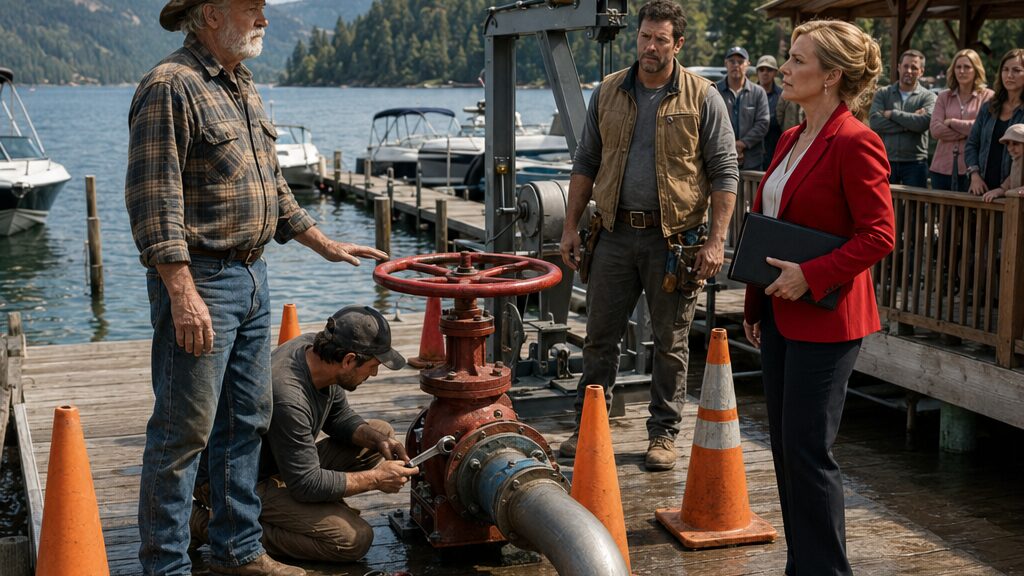
The second was the pile of orange cones set around the red valve assembly like it was a hazard instead of the only reason the dock line had stopped bucking in the pipes. The third was the man with a socket wrench crouched over the flange bolts John had tightened two nights earlier, turning them loose one careful quarter-turn at a time.
John stopped at the gate with one hand still on the latch.
Beyond the fence, boats rocked against their slips under a clean morning sun. Vendors were setting up white tents near the pavilion for the weekend lake festival. A stack of folding chairs sat beside the bait shop. A delivery driver pushed crates toward the snack stand. It would have looked like the beginning of a good summer weekend if not for the steel hook hanging from the dock hoist and the red valve wheel trembling under a worker’s hand.
“Hold it,” John called.
The worker looked up. The wrench stayed on the bolt.
A man in a tan work vest stepped from behind the hoist. John recognized him from town, though not well. Jerry Allen. Contractor. Good with decks. Better with staying out of arguments.
“Morning, John,” Jerry said, and there was enough apology in his voice to make John’s stomach sink. “You need to stay outside the cones.”
John unlatched the gate and walked through.
Jerry raised a hand. “John.”
“That valve doesn’t come off.”
One of the dock workers straightened, glancing past John toward the parking lot. John followed his eyes and saw Patricia Hill walking down the ramp from the HOA office with a folder tucked beneath her arm.
She wore a red blazer bright enough to cut through the marina glare. Her hair was pinned back, her sunglasses in one hand, her mouth already set in the shape of a decision. Joshua Scott, the HOA treasurer, trailed a few steps behind her with a phone pressed to his ear.
Patricia did not greet John.
“You were notified,” she said.
“No,” John said. “I found your notice tied to the marina gate after your crew was already here.”
“The board authorized removal of an unapproved alteration to common property.”
John looked past her to the valve. The red wheel was still fixed to the bypass line, a temporary run of pipe he had installed beside the corroded intake housing. It was ugly. He knew that. It was also braced correctly, pressure-rated, and marked with two tags that nobody had bothered to read.
“That is a safety bypass,” he said.
“It is an unauthorized modification.”
“It is keeping pressure from slamming that line.”
Patricia’s eyes flicked to the worker kneeling by the bolt, then back to John. “You do not get to make unilateral changes to shared marina infrastructure because you dislike the board’s timeline.”
John felt the words touch an old bruise inside him, but he kept his voice low. “I submitted readings. I submitted photos. I asked for an emergency review.”
“And the board reviewed the matter.”
“When?”
“At our discretion.”
“That’s not a date.”
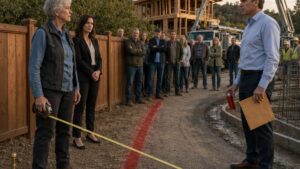
A few residents had begun to stop near the pavilion. Nobody came closer. Phones appeared low in hands, not obvious enough to be rude, not hidden enough to be innocent.
Jerry shifted beside the hoist. “Patricia, maybe we should give him a minute to clear his tools and—”
“No,” Patricia said, without looking at him. “Proceed according to the work order.”
John stepped over the first orange cone.
Jerry moved quickly, not touching him, only placing himself between John and the crew. “Don’t make this hard.”
“I’m trying to keep it from getting hard,” John said.
The worker with the wrench stood. He held it against his thigh, waiting.
Patricia opened her folder and removed a paper with the HOA seal printed at the top. “This is the enforcement authorization.”
John took out his reading glasses from his shirt pocket, put them on, and accepted the page. The paper shook slightly in the breeze, not in his hands.
He read the first line. Then the second.
“Violation of exterior modification policy,” he said. “Visual nonconformity. Unauthorized installation. Removal to restore approved marina appearance.”
“That is correct.”
“Where’s the court order?”
Patricia blinked once. “Excuse me?”
“Where is the court order allowing your contractor to remove equipment I installed and paid for before an inspection?”
“This is common property.”
“And that line feeds eight lake homes, the dock standpipes, and the fire pump connection at the south end.” John folded the notice once and held it back to her. “So show me the order that says you can remove a temporary safety valve from a pressurized shared line before it’s inspected.”
Patricia did not take the paper. “You are not a lawyer, John.”
“No,” he said. “I used to maintain this marina.”
“And you no longer do.”
That landed harder than she knew.
Behind her, a woman near the chairs whispered something to the person beside her. John heard his name but not the rest. He had lived beside this lake for thirty-one years. He had fixed frozen spigots in January, pulled a child’s bicycle from the shallows in May, replaced dock cleats when nobody wanted to wait for the maintenance contract. He had done enough quiet work that people had stopped seeing the work and started seeing only the old man who still thought he knew where every pipe ran.
Patricia pointed toward the valve. “That thing is visible from the visitor slips. It looks like industrial scrap.”
“It looks like a valve.”
“It looks like a liability.”
“It is the thing keeping your liability from becoming real.”
Her jaw tightened. “You cannot stop us.”
The words carried across the dock.
The worker with the phone lifted it a little higher. A boat owner at the fuel pump turned around. Even Jerry looked at Patricia, as if he wished she had chosen another sentence.
John turned slowly toward the red wheel. Its paint was chipped where his wrench had scraped it. He had wrapped the lower joint in yellow marking tape and written PRESSURE BYPASS — DO NOT REMOVE in block letters. A tag hung below it with the date, his initials, and the pressure reading from the night it had first screamed through the line.
He walked to the valve and placed one hand on the wheel.
Not gripping. Not threatening. Just there.
“This is not a decoration,” he said.
Patricia’s face reddened beneath the marina sun. “Jerry, continue.”
Jerry did not move.
“Jerry,” she repeated.
He looked at John. “I’ve got a signed work order.”
“Signed by who?”
“The association.”
“Not by an inspector.”
“No.”
“Not by the city.”
“No.”
“Not by the manufacturer.”
Jerry looked away.
Patricia stepped closer. “The board has authority over common property. If you have concerns, you can attend tomorrow’s open meeting.”
“If this comes off today, tomorrow’s meeting may be about more than property appearance.”
“Enough,” Patricia said.
She gave the slightest nod to the worker.
The worker crouched again.
John did not step back.
Jerry said, quieter, “John, I can’t have you inside the work area.”
“Then don’t work.”
“That’s not your call.”
“It became my call when your man put a wrench on a live safety bypass.”
The worker hesitated with the socket set against the bolt.
Patricia’s voice sharpened. “The system has been turned off.”
John looked at Jerry.
Jerry looked at the worker.
The worker looked at the bypass line.
“It’s isolated at the dock,” Jerry said. “That’s what we were told.”
John pointed toward the old housing under the weathered planks. “That isolation valve leaks through. It has for years.”
Patricia let out a disbelieving breath. “Convenient.”
“No,” John said. “Rust usually isn’t.”
Joshua had ended his phone call and come up beside her. “John, we’re trying to keep the marina open. The festival starts tonight. Vendors are already asking whether the dock access is safe.”
“Then inspect it.”
“We can’t inspect every resident’s unauthorized project on demand.”
John looked at the red valve again. He remembered the needle jumping at midnight, remembered the way the pipe had hit its bracket like a fist against a door. He remembered Shirley standing in the kitchen in her robe, one hand on the counter, asking if the noise came from their house.
He had told her no. He had told her he had it handled.
That was what he always said.
Patricia touched the paper in his hand. “Move away from the valve or the association will add obstruction costs to the violation.”
John folded the notice again, cleaner this time, and tucked it into his shirt pocket.
“Put that in writing too.”
“I just handed it to you.”
“No. Put in writing that you were warned this was a safety bypass tied to a live pressure problem, and you ordered removal anyway.”
A silence opened around them.
The marina sounds rushed into it: halyards tapping masts, a cooler lid slamming, the low idle of the hoist, water sucking gently under the dock.
Jerry’s crewman swallowed. “Boss?”
Patricia looked at Jerry. “Proceed.”
Jerry shut his eyes for half a second, then opened them. “Loosen the lower bracket first.”
The worker knelt. John did not move, but he took his hand off the wheel and stepped just far enough aside that no one could claim he touched the man. His boots remained inside the cones.
The socket clicked.
Once.
Twice.
The third turn came with a short metallic squeal.
Then the wrench slipped.
The worker cursed and jerked his hand back as the pipe beneath the red valve kicked so hard the whole dock line shuddered. A hollow thump rolled under the planks, traveled beneath John’s boots, and knocked against the boats in their slips like something waking up below the water.
Chapter 2: The Request Nobody Answered For Four Weeks
The first repair request was still clipped under the fish-shaped magnet by John’s kitchen phone when he came in from the dock with Patricia’s notice in his pocket.
He stood in front of it, breathing through his nose, his shirt still smelling faintly of lake water and machine oil. The request was dated four weeks earlier. He had printed it because he trusted paper more than portals. He had also submitted it through the HOA website, emailed the board office, and left a voicemail after the first pressure spike rattled the pipe beneath the east slips.
No response.
Not one that mattered.
The house was quiet except for the dishwasher humming through its rinse cycle and the soft tap of Shirley’s cane in the hallway.
“You’re back too soon,” she said before she reached the kitchen.
John pulled Patricia’s enforcement notice from his pocket and smoothed it on the table.
Shirley stopped at the doorway.
She had dressed for the day in a pale blue blouse and dark slacks, her hair pinned carefully though she was not going out. One hand rested on the cane; the other settled against the doorframe, light but necessary. Since the last surgery, she moved as though the house had narrowed around her. She hated when John noticed.
“They started removing it,” he said.
“The valve?”
He nodded.
Her eyes went not to the notice but to the paper under the magnet. “And you showed them that?”
“I told them.”
“That isn’t what I asked.”
John took off his hat and set it on the empty chair. “I told them enough.”
Shirley came to the table slowly. She did not sit right away. She looked down at the HOA notice, then at his marked-up pressure readings stacked beside the salt shaker. “Enough for you and enough for them are not the same thing.”
John looked toward the window. From the kitchen, he could see the lake between two pines, bright and falsely calm. The marina roof showed beyond the trees. People who did not know pipes thought water was simple because it lay flat on sunny days.
“I sent the readings,” he said.
“To Patricia?”
“To the board office.”
“With the photos?”
“Yes.”
“With the note about the south standpipe?”
“Yes.”
Shirley tapped the request under the magnet. “With the part about this house?”
John did not answer.
Her silence changed. It got colder.
“John.”
“The house isn’t the issue.”
“It is one of the houses on the line.”
“It’s not just us.”
“I know that.” She lowered herself into the chair and kept her cane across her knees. “But you always leave out the part that sounds like asking.”
He picked up the pressure log, though he knew every number on it. “This isn’t about asking.”
“It is when other people hold the stamp.”
His jaw worked once. He had built the bypass because the numbers made the choice for him. The old intake valve beneath the marina had been crusting for years, but last month the pressure spikes had turned irregular. At first, they came after the irrigation cycle. Then when the dock washdown pump ran. Then once in the middle of the night with nothing scheduled at all.
He had taken photos of the red-brown scale around the old housing. He had measured the surge near the south line. He had submitted the first request: emergency inspection recommended before festival demand increases.
No answer.
The second request included photos.
The third included pressure readings.
The fourth, sent after midnight with shaking hands and a flashlight between his teeth, said temporary bypass installed to reduce surge risk pending formal inspection.
That one got answered.
Violation notice.
Shirley reached for the top sheet. “Read me what you sent.”
“You’ve seen it.”
“Read me the part where you tell them what happens if the line fails.”
John stayed standing.
Shirley waited.
He looked at the request again. His own words stared up at him: pressure instability, corrosion, bypass, recommend inspection, potential system damage. Clean words. Maintenance words. Words that let him hide inside the problem.
“I wrote that failure could interrupt dock utility water and affect connected residences,” he said.
“Connected residences,” Shirley repeated.
“That’s accurate.”
“It’s bloodless.”
“It’s a repair request, Shirley.”
“It is a warning about whether people can get water pressure, whether the fire connection works, whether I can safely stay here if the system goes down and the road is blocked with festival traffic.” Her voice did not rise. That made it worse. “Did you tell them any of that?”
John set the paper down.
The dishwasher clicked off. Water drained through the wall with a sound that made him turn his head before he could stop himself.
Shirley noticed.
“You hear it even in here,” she said.
“It’s fine right now.”
“John.”
He rubbed the bridge of his nose. “I didn’t want them using you.”
“Using me how?”
“As the reason. As the sad example. As the old man’s wife who can’t manage steps and needs everyone to bend the rules.”
Her face softened for half a second, then closed again. “You don’t get to protect my dignity by hiding the truth.”
“I didn’t hide it.”
“You translated it until nobody had to feel responsible.”
That one stayed in the room.
John gathered the sheets into a neat stack because his hands needed a job. He placed the first request on top, then the photos: the corroded valve body, the damp stain beneath the dock boards, the pressure gauge caught at a high reading. In one photo, the red replacement wheel sat on his workbench before installation, paint too bright and almost foolish-looking against the old tools.
“They called it visual nonconformity,” he said.
Shirley gave a small, humorless laugh. “Of course they did. A red valve is easier to look at than a dangerous one.”
His phone buzzed on the table.
He looked at the screen. HOA Compliance Portal.
Shirley saw his face. “Open it.”
He tapped the email.
Dear Mr. Wilson,
Following today’s enforcement action at Marina Dock B, the association confirms that removal expenses for the unauthorized alteration will be assessed to your owner account. Continued interference with authorized contractors may result in additional fees, suspension of marina privileges, and referral to counsel.
He scrolled.
The words blurred at the edges, but one sentence sharpened as if it had been cut into the glass.
The Board reviewed your submitted materials and determined there is no urgent safety concern requiring emergency modification.
John read it twice.
Shirley leaned forward. “Who reviewed it?”
The email was signed only by Lakeview Ridge Homeowners Association Compliance Committee.
“No name,” John said.
“Patricia?”
“Maybe.”
“Joshua?”
“Maybe.”
He scrolled further. Attached were two files: the enforcement notice and an invoice estimate for removal. No inspection report. No response to his readings. No acknowledgment of the leak-through in the old isolation valve. No mention of the way the dock line had shuddered when the worker’s wrench slipped.
John set the phone down carefully.
Shirley watched him with the wary patience she used when he was close to doing something stubborn and calling it practical.
“What are you going to do?”
“Print everything.”
“And then?”
“Go to the meeting tomorrow.”
“With the part you left out?”
He did not answer quickly enough.
Her expression did not change, but disappointment moved through it like a shadow across the lake.
John looked at the request under the magnet again. Four weeks of clean technical language. Four weeks of believing the facts would stand up straight by themselves if anyone bothered to read them.
Outside, faintly, the marina hoist shut off.
The sudden quiet felt less like relief than preparation.
John’s phone buzzed again. This time it was a forwarded copy of the formal violation packet. The subject line read: Board Review Complete — No Urgent Safety Concern.
Chapter 3: The Board Called It An Appearance Problem
Patricia Hill saw the video of herself yelling before she made it back to the HOA office.
It had already been posted in the Lakeview Ridge residents’ message group by someone who had filmed from behind the folding chairs. The angle was unflattering. Her red blazer looked brighter than it had in the mirror that morning. Her arm was extended toward John Wilson. His white beard and old hat made him look steadier than any man had a right to look while standing inside orange cones.
The caption read: Is the board seriously tearing out John’s repair before the festival?
Patricia stopped halfway up the office steps.
The video played without sound until she tapped it.
“You cannot stop us,” her own voice snapped from the phone.
She closed it immediately.
Inside the office, the air-conditioning rattled over stacks of event permits, vendor forms, and marina access maps. Through the window, she could see Dock B and the bright spot of the red valve still in place. Jerry’s crew had stopped after the pipe jumped. That was the word he used when he called her from the dock.
Jumped.
Pipes did not jump, in Patricia’s experience. Men like John Wilson described them that way so ordinary residents would get nervous and let them win.
Joshua Scott was already at the conference table with his laptop open and a calculator beside it, though Patricia had never once seen him use the calculator instead of the spreadsheet. He liked props when money was bad.
“Tell me that isn’t spreading,” she said.
He turned the laptop toward her.
The message group had seventy-three comments.
Patricia did not read them. “We need a statement.”
“We need to decide if removal continues.”
“It continues.”
Joshua leaned back. He was younger than most of the board, old enough to have gray at the temples, young enough to believe a spreadsheet could discipline human behavior. “Jerry’s crew stopped for a reason.”
“Because John stood in the work zone.”
“Because the pipe moved.”
“According to Jerry.”
“And the worker.”
Patricia dropped the folder onto the table. “The old system makes noise. It’s a marina. Everything makes noise.”
Joshua did not argue. That concerned her more than argument would have.
She opened the disputed file. The label on top read Unauthorized Dock Alteration — Wilson. Under it were printed photos of the red valve bypass, John’s requests, the violation draft, and the work order she had signed after three board members replied yes by email.
The first photo irritated her every time she saw it. The valve wheel was bright industrial red, bolted onto a raw-looking pipe beside weathered dock boards and visitor slips. It looked temporary. It looked like something installed by a man who still believed old competence outranked current rules.
Residents did not understand the board’s position. They never did until something went wrong and they wanted to know why policies had not been enforced.
“If we let him keep it,” Patricia said, “we tell every owner they can alter common property if they call it urgent.”
Joshua looked at the spreadsheet instead of her. “If we remove it and something happens, we tell every owner we ignored a warning.”
“We did not ignore it.”
He clicked the file. “We acknowledged it.”
“That is not the same as ignoring it.”
“No,” he said. “But it may not be the same as reviewing it either.”
Patricia stared at him.
He turned the laptop back. “John submitted four requests. The first three were routed to maintenance review. The fourth triggered compliance because he admitted he installed the bypass.”
“Exactly.”
“Patricia.”
“He performed unauthorized work on a shared system.”
“He says the system was surging.”
“He says a lot of things. He also bypassed approval.”
Joshua rubbed his forehead. “The insurance representative called this morning. If there is unapproved equipment on the dock during a public event, coverage questions get ugly.”
“That is what I am trying to prevent.”
“And if there is a known defect in the dock utility line during a public event, coverage questions get uglier.”
Patricia’s stomach tightened. “Known by whom?”
He did not answer right away.
She sat.
The office beyond the conference room was empty except for the part-time clerk’s desk and the display board of cheerful lake rules: quiet hours, boat decals, guest passes, dock etiquette. She had helped rewrite those rules two years earlier after a resident sued over a slip assignment dispute and everyone blamed the board for being too casual. Since then, Patricia had promised herself casual would not happen under her watch.
“Joshua,” she said.
He opened a drawer in his file case and removed a thin yellowed sheet that had been folded twice. Not yellowed from age exactly, but from living in places paperwork should not live: truck dashboards, maintenance sheds, pockets.
“I found this scanned into the old maintenance folder,” he said. “It’s from last season.”
Patricia did not touch it. “What is it?”
“Inspection note. Not a formal report. More like a maintenance recommendation.”
“From who?”
“Contracted inspector.”
She picked up the sheet.
The handwriting was hard to read in places, but several phrases came through clearly enough.
Corrosion at old intake valve housing.
Pressure fluctuation under high demand.
Recommend replacement before next peak season.
Patricia read the last line again.
Before next peak season.
“This was not in the current packet,” she said.
“No.”
“Why?”
“Because it was archived under marina maintenance, not compliance. And because the replacement cost estimate attached to it was forty-eight thousand dollars.”
The number sat between them.
Outside the window, a vendor carrying a box of paper cups laughed at something near the pavilion. The sound came through the glass too bright and ordinary.
Patricia set the note down. “We do not have forty-eight thousand dollars in unrestricted reserves.”
“No,” Joshua said. “We have twenty-one thousand if we don’t touch the road fund.”
“The road fund is already short.”
“I know.”
“And canceling the festival means vendor penalties, refunds, and every lakefront owner demanding to know why assessments keep going up.”
“I know that too.”
Patricia stood and went to the window. John was no longer at the dock. Jerry’s crew had moved back from the cones. The red valve remained where it was, offensive and vivid, as if daring her to admit it had become more than an appearance problem.
She heard her own voice again from the video.
You cannot stop us.
It sounded worse now. Not because she thought John was right. Because she had said “us” when she meant the board, the rules, the people who emailed at midnight about property values and then vanished when decisions cost money.
Joshua said, “We could postpone removal pending an emergency inspection.”
“And announce what? That the marina may not be safe on the first day of the festival?”
“We could say we are reviewing resident concerns.”
“That will become ‘board ignored danger.’”
“It might already be that.”
Patricia turned back. “John installed that bypass without final approval.”
“Yes.”
“He did not wait.”
“No.”
“He made us choose between rewarding unauthorized work and looking heartless.”
Joshua’s eyes lifted. “He also may have kept the line stable.”
She hated that he said it quietly. Quietly made it harder to dismiss.
Patricia returned to the table and put the inspection note under the file, not inside it. “For tomorrow’s meeting, we address the violation. We do not speculate on unverified safety claims.”
“Patricia.”
“We offer to pause additional fines if he allows removal and submits through the standard emergency review.”
“That process takes ten business days.”
“Then we expedite it.”
“To how long?”
“As long as it takes.”
Joshua gave a tired laugh without humor. “That’s not a number.”
“Neither is panic.”
She closed the file and pressed her palm flat on it. The gesture steadied her. Rules were not cruel by themselves. Rules were the only reason a community of people with docks, boats, money, grudges, and opinions could function at all.
John Wilson might have been right about the pipe. He might also have been wrong in the most expensive way possible.
Either way, she could not let the first public answer be that any resident with a wrench could override the board.
Joshua slid the old inspection note out from beneath her palm and held it between two fingers.
“At least attach this to the board packet,” he said.
Patricia looked at the note.
Then at the window.
Then at the comments still blooming on Joshua’s laptop.
“Not yet,” she said.
Joshua hesitated, then placed the note back in his folder instead of hers.
When he stood to leave, he paused at the door and looked over his shoulder.
“Don’t attach this to the board packet yet,” he said softly, as if repeating her decision back to her might make her hear it differently.
Chapter 4: The Marina Meeting Turned The Repair Into A Trial
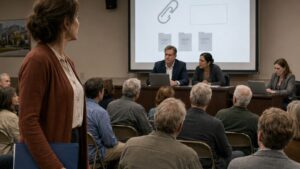
John recognized the photo on the pavilion screen before he recognized himself in it.
The red valve filled half the frame. His own body stood between it and Jerry’s crew, one hand lifted, hat brim shadowing his face. Someone had caught him at the worst possible angle, shoulders squared, boots inside the orange cones, looking less like a man asking for caution than a man daring everyone else to try him.
Behind him, Patricia’s printed title slide read: Unauthorized Dock Alteration Review.
The folding chairs were nearly full.
John stood at the back of the marina pavilion with his folder under one arm and felt the weight of every turned head. Shirley had wanted to come. He had told her the walkway would be crowded and the morning too long. She had watched him say it, then nodded once, the way she did when she knew he was partly lying.
Patricia stood beside the screen in a cream blouse and dark slacks, the red blazer folded over a chair behind her. Without it, she looked less like the woman from the video and more like a person trying to repair the shape of her authority.
“This meeting was scheduled before yesterday’s incident,” she said. “However, due to community concern, the board has added Mr. Wilson’s unauthorized installation to the agenda.”
A murmur passed through the chairs.
John saw Sandra Garcia in the second row, arms folded, her nurse’s badge still clipped to her purse strap as if she had come straight from a shift. She glanced back at him with a look that was not hostile, not friendly. Measuring.
Patricia clicked to the next slide.
There was the red valve again. Raw pipe, bright wheel, yellow tape, John’s block letters: PRESSURE BYPASS — DO NOT REMOVE.
“As you can see,” Patricia said, “this alteration was installed without final written approval on shared marina infrastructure.”
John gripped his folder.
A resident near the aisle muttered, “But why did he install it?”
Patricia heard and answered smoothly. “Mr. Wilson has expressed concerns about pressure fluctuation. The board reviewed the submitted materials and determined that standard review, not unilateral modification, was the proper path.”
John stepped forward. “You didn’t review them.”
Patricia’s eyes found him. “Mr. Wilson, there will be a period for comments.”
“You sent a crew first.”
“And you entered an active work zone.”
“You put the work zone around the thing I asked you to inspect.”
The room shifted. Someone whispered. Someone else said, “Let him talk.”
Joshua sat at the table with the other board members, the file in front of him, hands folded too tightly. He did not look at John.
Patricia pressed her lips together. “Fine. Mr. Wilson, you may address the board.”
John walked down the center aisle. The pavilion boards creaked beneath him. He placed his folder on the small table set aside for residents and opened it with hands he wished were steadier.
“These are the pressure readings from the last four weeks,” he said. “These are photos of the intake housing under Dock B. This is the first request I submitted.”
Patricia said, “No one disputes you submitted materials.”
“You said there was no urgent safety concern.”
“That was the determination based on available information.”
John looked at the screen behind her. His own photo looked back, stubborn and incomplete.
“The available information included pressure spikes above normal operating range.”
“According to your gauge.”
“My gauge is calibrated.”
“Not association equipment.”
A few people nodded at that. John saw it happen and hated how quickly a small technical doubt could make danger look like opinion.
He pulled out the photo of the corroded housing. “That old isolation valve leaks through. When demand rises, the line hammers. The bypass reduces surge until the housing can be replaced.”
Joshua finally spoke. “Did you receive written approval before installing it?”
John turned to him.
The question was clean. Almost gentle. Also fatal.
“No,” John said.
A stronger murmur moved through the pavilion.
Patricia’s posture changed, not much, but enough. The room had given her something solid.
John added, “Because I requested emergency review and got no answer.”
“But you installed it,” Joshua said.
“Yes.”
“On common property.”
“Yes.”
“With materials not approved by the architectural committee.”
John stared at him. “It’s a valve, Joshua.”
“That is not an answer.”
“It’s the answer that matters.”
Patricia stepped forward. “This is precisely the issue. Mr. Wilson believes his personal judgment exempts him from the process every other homeowner must follow.”
“That process didn’t answer.”
“It does not disappear because you are impatient.”
The word struck.
Impatient.
John thought of four weeks of readings. Four weeks of nights with a flashlight under the dock. Four weeks of Shirley turning her head toward the wall whenever the pipes knocked.
He could have said all of that. He should have.
Instead he said, “I know that system.”
Patricia’s expression hardened. “Knowing the system years ago does not give you authority over it now.”
Sandra raised her hand.
Patricia looked relieved to turn away from John. “Mrs. Garcia?”
Sandra stood. “I have a question for Mr. Wilson.”
John faced her.
Sandra did not smile. “Why didn’t you wait? If it was dangerous, why not call the city, or the utility, or whoever had authority? Why put yourself in this position?”
The room went quiet in a different way.
Not against him. Waiting.
John opened his mouth.
Because nobody answered.
Because the spike hit at midnight.
Because if the line failed during the festival, emergency access would be blocked by cars and tents and people carrying coolers.
Because Shirley’s cane had slipped once when the kitchen pressure dropped and the floor pump coughed brown water into the sink.
Because years ago, he had waited.
He looked down at the folder. The paper edges were aligned. Safe. Technical. Useless.
“I should have called more people,” he said.
Patricia’s chin lifted slightly.
John heard the concession after it left his mouth. He heard what she could do with it.
“But I didn’t install it because I was impatient,” he continued. “I installed it because the line was surging and the old valve leaks through.”
Sandra watched him. “What happens if it fails?”
John’s hand rested on the folder containing the answer he had not wanted to give.
“Dock water goes first,” he said. “Then the connected residences see pressure loss or contamination risk depending on the break. South standpipe may not hold pressure.”
“Fire connection?” Sandra asked.
“Yes.”
A stir went through the chairs.
Patricia cut in. “That is speculative.”
“It is pressure behavior,” John said.
“It is your interpretation.”
“It is the reason you don’t remove a bypass before testing.”
Patricia reached for another sheet. “The board is prepared to offer a temporary pause on additional fines. Mr. Wilson may remove the unauthorized installation, or permit the contractor to remove it, and submit a corrected application for emergency review. We will expedite that review.”
“How long?” John asked.
“We will move as quickly as possible.”
“How long?”
Patricia glanced at Joshua.
Joshua looked down.
“Ten business days under standard policy,” Patricia said. “Potentially less.”
A resident near the front said, “The festival is tonight.”
John looked at Patricia. For one brief second he felt the temptation. Let them pause the fines. Let them own the delay. Let him take the folder home and sit at the kitchen table with Shirley and say he had done what he could.
Then the pavilion pipes knocked.
It was not loud at first. A hollow tap above the utility closet. Then another, harder. Several heads turned toward the wall. Someone laughed nervously, as people did when buildings made sounds they did not understand.
John did not move.
The third knock snapped through the pavilion pipes and trembled the metal coffee urn on the refreshment table.
Sandra looked from the wall to John.
Patricia looked too, but only for a moment.
“Old buildings make noise,” she said.
John closed his folder.
“No,” he said. “Warnings do.”
Chapter 5: The Old Inspection Note Changed The Whole Argument
Sandra found Jerry Allen staring at the removed valve bolts as if they had said something he did not want to repeat.
The marina maintenance shed sat behind the bait shop, half hidden by stacked life rings and a faded sign about fuel safety. The door was open, and the afternoon light fell across a workbench littered with washers, brackets, and two sections of pipe that had been wiped clean but still carried red-brown streaks at the threads.
Jerry stood with his hands on his hips, his work gloves tucked under one arm. The crew truck was backed near the shed, tailgate down. No one was loading anything.
Sandra stopped outside the doorway. “You’re supposed to be done by now, aren’t you?”
Jerry turned fast. “Residents aren’t allowed back here.”
“I’m a resident when I pay dues. I’m a nurse when something looks unsafe. Pick whichever one makes you answer faster.”
He exhaled through his nose. “I don’t have answers.”
“That’s not usually what contractors say when they’re billing by the hour.”
His mouth twitched, then flattened. “What do you want?”
Sandra stepped inside. The shed smelled like damp wood, fuel, and old metal. On the bench lay four long bolts from the valve bracket. One was scarred at the head where the wrench had slipped. Beside it, a crescent of rust had flaked onto the plywood like dried blood.
“I want to know why you stopped.”
“Patricia told us to pause.”
“That was after the pipe jumped.”
Jerry glanced toward the open door. “You heard about that?”
“Half the marina heard about that.”
He picked up the damaged bolt and rolled it between his fingers. “Pipe moved when we loosened the lower bracket.”
“Moved how?”
“Enough.”
“That’s not an answer.”
He gave her the look men gave women they thought were pushing past the proper edge of a conversation. Sandra had seen that look from surgeons, patients, husbands, and board members. It had never improved her mood.
“I’ve changed dressings on men who said a wound was nothing until I could see bone,” she said. “Try again.”
Jerry set the bolt down.
“It jumped,” he said. “Not like normal vibration. Like pressure hit against a partially closed point and kicked back. I asked whether the line was isolated. They told me it was.”
“Was it?”
“I’m not convinced.”
Sandra looked at the pipe sections. “Did John tell you it leaked through?”
“He did.”
“And did that sound crazy?”
Jerry rubbed one hand over his jaw. “John Wilson knows more about this marina than most people who have keys to it.”
That surprised her.
At the meeting, John had looked stubborn and cornered. He had also looked like a man refusing to say something important because saying it would cost him. Sandra had gone to the shed because the pipe knock in the pavilion had settled into her nerves. Nurses learned the difference between ordinary noise and a warning. Not always with machines. Sometimes with people.
“Then why did you start removing it?” she asked.
Jerry looked toward the truck. “Because I had a signed work order.”
“That simple?”
“No. That necessary.”
There it was. Not cruelty. A smaller thing. Work. Mortgage. Crew wages. The kind of pressure that let everybody say they were only doing their part.
On a shelf above the bench, Sandra noticed a clipboard with old inspection forms clipped beneath a fuel log. She reached for it.
Jerry caught the clipboard first. “That’s not mine to show.”
“Then don’t show me. Read it.”
He hesitated.
From outside came the sound of festival setup continuing as if no one had heard the pipes knock: tent poles clinking, coolers rolling, someone testing a microphone with cheerful bursts of static.
Jerry looked at the clipboard. “It’s just old maintenance paperwork.”
“Old like irrelevant, or old like inconvenient?”
He flipped two pages. His thumb stopped.
Sandra saw the change in his face before he spoke.
“What?” she asked.
“It says corrosion at old intake valve housing.”
“From when?”
“Last season.”
“Who wrote it?”
“Inspector, looks like. Not a full report.”
“Read the rest.”
Jerry kept his eyes on the page. “Pressure fluctuation under high demand. Recommend replacement before next peak season.”
The shed seemed to tighten around those words.
Sandra held out her hand. “Let me see.”
“I said—”
“Jerry.”
He looked at her.
She lowered her voice. “If someone gets hurt because everybody kept treating a warning like paperwork, you don’t get to say later that it wasn’t yours to show.”
His face changed again, less defensive now. More tired.
He handed her the clipboard.
The note was a scan copy tucked behind newer fuel logs, its handwriting uneven but legible enough. Not a formal condemnation. Not a dramatic red stamp. Just practical maintenance language, the kind that could be ignored by anyone who wanted a cleaner sentence.
Recommend replacement before next peak season.
Sandra took a photo of it with her phone.
Jerry did not stop her.
“This doesn’t prove Patricia saw it,” he said.
“No,” Sandra said. “But someone filed it.”
“And someone didn’t pay for it.”
She looked at the cost estimate stapled behind the note. The number at the bottom made her understand, immediately and unwillingly, why nobody had wanted to say the word emergency out loud.
Forty-eight thousand dollars.
She thought of the comments that morning. Residents angry about fines. Residents angry about dues. Residents angry about the color of dock lights, the parking map, the festival wristbands. Everyone wanted safety. Nobody wanted the assessment that paid for it.
Jerry leaned back against the bench. “You know what happens if I tell Patricia I’m not touching it?”
“She hires someone else?”
“Maybe. Or I lose association work for the rest of the year.”
“And if you keep touching it?”
He did not answer.
That was answer enough.
Sandra walked to the doorway and looked toward Dock B. The red valve was still visible through gaps between people and tent poles, bright against the gray boards. It no longer looked ugly to her. It looked like the only honest thing in sight.
John was near the dock gate, speaking to no one, his folder tucked under his arm. Residents passed him with the sideways glances people gave to a problem they had not decided whether to thank or blame.
Sandra headed toward him with the photo open on her phone.
Halfway there, something on the lower edge of the clipboard page caught her eye. A maintenance tag had been copied along with the note, probably by accident, its corner visible beneath the scan.
She stopped walking and enlarged the image.
Three faded initials were written beside an old date.
J.W.
Sandra looked up at John across the dock, then back at the tag.
This was not the first time John Wilson had marked that valve.
Chapter 6: John Finally Said What The Valve Was Really For
Shirley found John cleaning the red valve handle in the kitchen sink as if it were something he could make innocent with enough soap.
The wheel lay on an old towel across the counter, its chipped paint wet and dark under the faucet light. John had removed it from the temporary assembly before Jerry’s crew could load the loose hardware into the truck. He had wrapped it in a cloth and brought it home without telling anyone, like a man carrying a piece of evidence or a piece of himself.
Shirley stood in the doorway for a long moment before he heard her cane.
“You stole your own valve?” she asked.
John shut off the water.
“They removed the handle. Not the full assembly.”
“That was not an answer.”
He dried his hands on the towel. “It was mine.”
“John.”
He did not turn.
The house had the late-evening stillness that came before summer noise from the lake drifted uphill. Music from festival testing thumped faintly through the windows. Somewhere beyond the trees, people were preparing to enjoy the marina that he was being accused of endangering.
Shirley came closer. Her steps were slower at night. He hated that he counted them without meaning to.
On the counter beside the sink lay the old maintenance tag Sandra had texted him an hour earlier. A copied corner of paper. A date from years ago. His initials.
Shirley saw it.
“I wondered when that would come back,” she said.
John picked up the valve handle and rubbed at a patch of rust near the center. “It’s not the same incident.”
“No. But it’s the same face you make when you’re trying to outwork a memory.”
He set the handle down harder than he meant to.
The sound rang against the sink.
Shirley did not flinch. That was one of the things he loved and feared about her. She did not move away from him when he became difficult. She only waited until difficulty had nowhere to hide.
“The tag was from a routine check,” he said.
“It was from the year the south line failed.”
He looked at her then.
Her eyes were tired, but clear.
“You think I don’t remember?” she asked. “You came home soaked to the waist. You sat right there at the table and didn’t take your boots off until I told you twice.”
John pressed both hands against the counter.
Years fell open with the smell of wet wood and old mud.
Back then, the marina had still paid him part-time after he retired from full maintenance. He knew the pipes by sound. He knew which dock boards creaked, which slip owners forgot to shut off hose bibs, which valves needed a firm hand and which needed patience. That spring, he had heard a faint knock in the south line during high demand. He had marked it. J.W. Routine check. Monitor next cycle.
Monitor.
The word had felt reasonable. The budget had been tight. The old board had been arguing over dock resurfacing. Replacement could wait until fall.
Then the Fourth of July crowd came in, the pumps ran hard, and the line failed under pressure behind the marina shed. Nobody died. Nobody even went to the hospital. But water service dropped to several homes, the fire standpipe lost pressure for two hours, and a dock worker slipped in the flooded service path and broke a wrist.
John had fixed it. Everyone said he had saved the day.
He had never believed them.
“I should have pushed harder,” he said.
Shirley moved beside him and rested one hand on the counter, close to his but not touching. “You told them what you saw.”
“I told them like I told Patricia. Like if I wrote the right words, somebody else would feel the weight.”
“You were not the board.”
“I was the one who knew.”
The music from the marina cut off abruptly, leaving the house too quiet.
Shirley looked at the red handle. “So this time you decided nobody would get the chance to ignore you.”
He laughed once, without humor. “Worked well.”
“You installed a bypass without approval.”
“I installed a bypass because the line was talking.”
“And then you refused to tell people what you were really afraid of.”
He looked toward the window. In the dark glass, he saw his own outline: hat off, shoulders bent, white beard untrimmed at the edges. He looked older than he felt when he was working, younger than he felt when people told him to step aside.
“I didn’t want to make it about us,” he said.
“You mean me.”
His throat tightened.
“I mean I didn’t want you discussed at a board meeting like a problem with a doctor’s note attached.”
Shirley’s expression changed, but not into gratitude.
“You keep trying to fix things without letting anyone see what broke you.”
He turned away.
She let him have the silence for three breaths.
Then she said, “That is not protection, John. It is loneliness with tools.”
The words entered him quietly and found the place anger could not reach.
His phone buzzed on the table.
He did not move.
Shirley picked it up, read the screen, and held it out. “Patricia.”
The message was short.
Dock B will reopen tomorrow at 9:00 a.m. Pending further review, unauthorized equipment will remain out of service. Additional interference will be referred to counsel.
John read it once. Then again.
Tomorrow at nine.
Festival crowds. Vendor water demand. Boats filling coolers. Dock washdown. The old line under load without the bypass handle installed and without a proper test.
He set the phone down.
Shirley watched him. “What are you thinking?”
“That I made it too easy for her to call this a fight about rules.”
“Then stop making it only about rules.”
He looked at the valve handle on the towel. The red paint was worn at the grips where hands had turned it before his. Not pretty. Not approved. Not the kind of thing anyone put on a brochure.
He picked up his phone and searched for the city after-hours inspection line. His thumb hovered.
For years he had told himself not to make trouble unless he could solve it alone. But the line was no longer beneath his hands. The board had the work order. Patricia had the meeting. Joshua had the old note. Jerry had the bolts. Sandra had the photo. Shirley had the part he had left out.
The truth was already scattered among them.
He called.
The automated message clicked through two options before a tired voice answered.
John gave his name, the marina address, the valve location, and the words he should have used four weeks earlier: shared pressure line, failed isolation, festival reopening, fire standpipe risk.
The voice changed after that.
“Can you be on site in the morning?” the city inspector asked.
“I’ll be there before the vendors,” John said.
After he hung up, he wrapped the red valve handle in the cloth again.
Shirley touched his wrist.
This time he did not pull away into a task.
At the edge of the counter, his phone lit with the confirmation message from the city inspection office.
Requested site review: Dock B utility pressure concern. Arrival estimated before 9:00 a.m.
Chapter 7: The Pressure Test Nobody Wanted To Watch
The first vendor was carrying a crate of bottled lemonade across Dock B when John set the orange cone directly in his path.
The man stopped with the crate against his hip. “Are we closed here?”
“Not if the line passes inspection,” John said.
The vendor looked at the cone, then at the red valve handle wrapped in cloth under John’s arm. “That sounds like a yes dressed up nicer.”
John moved the second cone to the edge of the valve access hatch.
It was not even eight-thirty, and the marina was already trying to become a festival. Folding tables had appeared under the pavilion. Balloons were tied to the rail near the boat ramp. Someone had taped a banner between two posts without noticing the utility closet behind it was shivering faintly every time the dock washdown pump cycled.
John heard it.
He had heard it from the parking lot.
The red valve assembly stood incomplete beside the old intake housing, its wheel removed, its lower bracket still loose from Jerry’s aborted work. The temporary bypass had not been fully dismantled, but it had been disabled enough to make John’s skin tighten. The handle belonged back on. The line needed to be tested. The dock needed to stay empty until someone with authority watched the gauge climb with their own eyes.
A white city truck rolled into the marina lot at 8:38.
John watched the inspector get out, carrying a hard case and a clipboard. Patricia arrived from the HOA office almost at the same time, walking quickly enough that her blazer swung open behind her. Joshua followed with a folder clamped to his side.
Patricia saw the cones first.
Then John.
“What are you doing?” she demanded.
“Marking the danger zone.”
“There is no danger zone.”
“The inspector can decide that.”
Her eyes cut toward the city truck. “You called the city?”
“Yes.”
“On festival morning?”
“Before reopening.”
She stopped close enough for him to see how little sleep she had gotten. The neat control was still there, but stress had worn around the edges of it. “You do understand what happens if this dock is closed today?”
“Yes.”
“Vendors lose money. Residents lose access. The association may face refund claims. All because you refuse to follow process.”
John set the wrapped valve handle on the dock box and untied the cloth. The red wheel caught the morning sun.
“This is process,” he said. “The one we should have started with.”
The city inspector came through the gate. He looked at the cones, the exposed piping, the valve handle, then at Patricia and John as if he had already been in this conversation too many times in other places.
“Who requested site review?”
“I did,” John said.
“Who represents the association?”
Patricia lifted her hand. “Patricia Hill, board president. This is an internal HOA compliance matter involving an unauthorized installation.”
The inspector looked back at the line. “Not if it affects utility pressure or fire standpipe function.”
Joshua’s face tightened.
Patricia said, “We have not established that it does.”
“That’s why I’m here.”
Jerry’s truck rolled in next. He parked near the shed and stayed beside the tailgate until John looked at him. Then he came down the dock without his crew, carrying the scarred bolt in one hand.
“I’m not touching anything,” Jerry said before Patricia could speak. “Not until somebody tests it.”
Patricia stared at him. “You have a work order.”
“I also have a pipe that jumped when we loosened it.”
The inspector held out his hand. “Show me.”
John moved before anyone else could. He knelt by the access hatch and removed the cover. His knees complained, but the sound beneath the boards mattered more. He pointed to the old isolation housing, the bypass line, the pressure gauge he had installed, and the bracket Jerry’s worker had loosened.
He kept his explanation short.
For once, he did not hide the plain meaning inside maintenance language.
“This line feeds the dock utility water, connected lake homes along the south run, and the fire standpipe. The old isolation leaks through. Under high demand, pressure slams the housing. The bypass reduces the surge. Without it, you’ll see the spike.”
The inspector crouched beside him. “Can the system be tested without public access on the dock?”
“Yes.”
Patricia said, “Is that necessary? We have a scheduled opening.”
The inspector did not look up. “If this line is tied to the standpipe, yes.”
Patricia’s mouth closed.
Sandra arrived while John reattached the red wheel. She stopped outside the cones, phone in hand, watching but not filming. Shirley was not with her. John had told Shirley not to come until he knew whether the dock would be safe. This time, when he said it, he also told her why.
The inspector connected his own gauge beside John’s.
“Start with low demand,” he said.
Jerry opened the first dock tap.
The needle moved, then settled.
Patricia exhaled audibly. “That looks normal.”
John did not answer.
The inspector nodded. “Add washdown pump.”
Jerry signaled to a worker near the utility closet. The pump kicked on with a hard mechanical hum. Water moved under the dock. The gauge needle lifted, trembled, then steadied high but still within range.
A resident behind Sandra whispered, “So what are we looking for?”
John heard him.
He wished, suddenly, that the needle would misbehave now and spare them all the waiting.
The inspector said, “Simulate event demand.”
Patricia stepped forward. “What does that mean?”
“Dock washdown, two vendor hookups, south line draw, and standpipe check without discharge.”
“That is excessive.”
John looked at her. “That is tonight.”
The inspector glanced at Patricia. “He’s right.”
Joshua lowered his folder against his thigh.
One by one, the demands came on.
The first vendor line hissed open. Then the second. A worker at the south tap called out. The pump changed pitch.
For three seconds, nothing happened.
Patricia’s shoulders began to lower.
Then the pipe knocked.
Not the little tapping from the pavilion. A deeper sound. A hard, hollow strike that came from beneath the boards and traveled through everyone’s feet.
The gauge needle jumped.
Sandra stepped back despite herself.
Jerry said, “There.”
The needle dropped, then snapped higher. The inspector leaned in. “Shut one draw.”
John reached for the red wheel, but did not turn it yet. “Watch the old housing.”
The pipe knocked again, harder. The lower bracket shifted against the bolt hole. A thin spray of water appeared at the seam of the old isolation valve and vanished, then appeared again.
Patricia’s face changed.
Not fear exactly. Recognition fighting with refusal.
The inspector pointed. “Reduce demand now.”
John turned the red wheel a quarter turn.
The needle fell.
Not all the way. Enough.
The dock stopped shuddering.
The sudden quiet felt like proof.
Nobody spoke until the inspector stood. He looked at John first, then at Patricia.
“This dock does not reopen under full demand until that line is stabilized and the old housing is repaired or replaced.”
Patricia swallowed. “Can the temporary bypass remain?”
“If installed and secured properly under emergency repair conditions, yes. I want a licensed review, pressure documentation, and restricted access until then.”
Joshua closed his eyes for one second.
Patricia looked toward the tents, the vendors, the residents gathering near the gate. The festival had not even started, and already the story had moved beyond her control.
“The association needs time to discuss funding,” she said.
The inspector picked up his clipboard. “Discuss quickly.”
Patricia drew herself upright, as if posture could still hold the day together. “And if we don’t approve his modification?”
The inspector looked down at the exposed line, then back at her.
“If that valve comes out today,” he said, “I’m closing the dock.”
Chapter 8: The Rule Changed After The Dock Went Quiet
The lake festival did not begin with music.
It began with the sound of folding tables being carried back to trucks and vendors asking who would pay for melted ice.
By noon, Dock B was roped off, the orange cones had been moved from John’s warning line into an official city boundary, and the marina felt strange in the bright sun: boats tied in place, banners hanging unused, water glittering beside a dock nobody was allowed to crowd.
John stood near the gate with the red valve handle reattached and secured under the inspector’s temporary approval tag.
He did not feel triumphant.
He felt tired in the specific way that came after preventing something people would resent him for preventing.
Sandra stood nearby, speaking quietly to two residents who had been loud in the message group the day before. Jerry was by the shed, writing a revised work estimate on the hood of his truck. Joshua was at the pavilion with a phone to his ear, his face gray with calculations.
Patricia came down the dock at 12:20 carrying no folder.
That worried John more than if she had brought three.
“We need to talk,” she said.
“We just did.”
“Privately.”
John looked past her to the roped-off dock, the inspector tag, the exposed old housing. “That’s been part of the problem.”
Her mouth tightened. “Fine. Here.”
She stopped beside the gate, where anyone could see them but not easily hear.
“The board will pause all fines related to your installation,” she said. “We will absorb today’s removal costs and revisit the repair at an emergency session this week.”
“Pause,” John said.
“It is the word I am authorized to use right now.”
“And the violation?”
“We can hold it pending review.”
“No.”
Patricia’s eyes sharpened. “John, I am trying to give you a path that avoids legal fees for everyone.”
“The violation gets withdrawn. The emergency repair gets approved. The old housing gets replaced.”
“That requires a vote.”
“Then vote.”
“And the money?” she asked, the question breaking through her control for the first time. “Do you think there is a drawer in the office marked emergency valve money? We have residents already furious about dues. We have roads behind schedule. We have insurance asking questions. We have vendors wanting reimbursement. You forced a decision in public without knowing what it costs.”
John took that in.
Not because she was right to remove the valve. She was not. But because the fear underneath her voice was real.
“I know what it costs to wait,” he said.
Patricia looked away.
The lake moved against the pilings below them. Soft. Patient. Not safe just because it sounded gentle.
After a moment, she said, “Joshua found the old inspection note.”
“I know.”
Her gaze came back to him. “Of course you do.”
“Sandra sent me the tag.”
Patricia’s shoulders lowered a fraction. “I should have attached the note to the packet.”
“Yes.”
“I thought if we called it an emergency, the whole weekend would collapse.”
“It did anyway.”
Her face tightened, but she did not argue.
John looked toward the pavilion, where residents had begun gathering without being asked. Not a crowd waiting to cheer. A community waiting for someone to tell them how much the truth would cost.
“When that south line failed years ago,” he said, “people thanked me because I fixed it fast. I let them. But I had heard the warning before it broke. I marked it, wrote monitor, and let the budget decide the rest.”
Patricia listened.
“I did not install this valve because I wanted to beat your board,” he said. “I installed it because I knew what that sound meant and I was too late once before.”
For the first time all weekend, Patricia did not answer with policy.
She looked at the red wheel.
“What do you want from me?” she asked.
“Not private relief.”
“I can waive your fees.”
“That helps me.”
“Isn’t that what you want?”
“No.” John looked toward the lake homes beyond the trees, his own among them, Shirley waiting where the kitchen window caught a slice of marina roof. “I want the next person who says a repair is necessary to be heard before somebody calls it ugly.”
The emergency board meeting happened in the HOA office because the pavilion was still full of unused festival supplies.
Residents stood along the walls. The city inspector stayed only long enough to repeat his written restriction. Jerry gave a careful statement about the pipe movement and the corrosion he saw when his crew loosened the bracket. Sandra read the line from the old note aloud: recommend replacement before next peak season.
No one clapped.
The number came next.
Forty-eight thousand had become more after emergency labor, temporary stabilization, and inspection. Joshua explained the reserve shortage without looking up much. The room did what rooms did when money became communal: it shifted, blamed, calculated, grew defensive.
Patricia let it happen for less than a minute.
Then she stood.
“The board delayed classifying this as an emergency,” she said. “That was my recommendation.”
Joshua looked at her quickly.
Patricia kept her eyes on the residents. “I believed I was protecting the association from liability and unnecessary cost. I also chose to proceed with enforcement before independent inspection. That was wrong.”
The words were not warm. They were not graceful. They cost her something anyway.
She placed three papers on the table.
“First: withdrawal of the violation against John Wilson. Second: emergency approval for temporary stabilization of the Dock B pressure line pending permanent replacement. Third: a proposed emergency repair exception requiring board review of safety-related resident submissions within forty-eight hours, with written reasons if denied.”
Joshua added, quietly, “And a limited emergency assessment to fund the permanent repair.”
That part hurt the room.
It had to.
A week later, the permanent valve was installed under a gray morning sky, a deeper red wheel mounted cleanly beside new pipe and bracing that no one could call scrap. Jerry’s crew did the work. This time, Patricia signed the access form before they unloaded tools. The city inspector placed the final approval tag himself.
John stood at the edge of the dock with Shirley beside him.
She had insisted on coming. He had not argued. Sandra walked with her over the uneven boards, and John watched without trying to help until Shirley gave him the look that meant she had noticed him noticing.
Patricia came down from the office carrying the signed policy change in a clear folder. She handed it to John.
“For your records,” she said.
He accepted it, glanced at the signature line, then handed it back.
“You keep it in the packet,” he said. “Where people can find it next time.”
She nodded once.
There was no apology beyond what had already been said. No public ceremony. No sudden affection. The residents still had an assessment coming. Vendors were still arguing about partial refunds. The message group had moved on to whether the fall dock lights were too bright.
Trust did not return because a valve did.
But pressure did.
John walked to the new red wheel and rested his fingers on one spoke. The metal was cool. Solid. Properly mounted. He checked the gauge, waited through one pump cycle, then another.
The needle rose and settled exactly where it should.
Patricia stood a few feet away. “You really weren’t trying to stop us, were you?”
John looked out over the boats, the still water, the homes tucked into the trees beyond the marina.
“No,” he said. “I was trying to stop the water.”
Then he stepped back from the valve and walked toward Shirley without looking to see who had heard him.
The story has ended.