
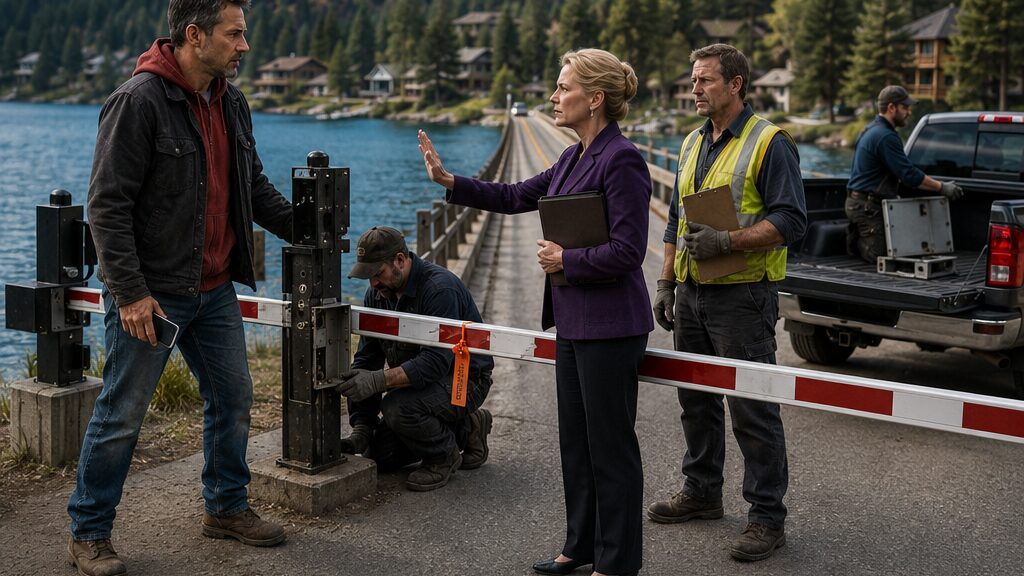
The HOA Tore Out His Emergency Gate Repair, Then Their Own Ambulance Couldn’t Cross The Bridge
Chapter 1: The Barrier Arm Was Already Coming Down
The crew had the release box open before Daniel Wilson reached the bridge.
One worker knelt at the base of the red-and-white barrier arm with a cordless driver in his hand. Another stood beside a pickup with the tailgate down, stacking Daniel’s stainless mounting plates like scrap. The orange HOA seal tag had already been looped around the gate arm, bright as a warning flag against the gray metal.
Daniel stopped his truck crooked in the gravel turnout and got out with his phone already recording.
“Stop,” he said.
The driver kept whining.
Daniel walked closer, not fast enough to look like he was charging, not slow enough to look uncertain. The bridge stretched behind the gate in one narrow lane over blue water, the kind of view the community newsletter liked to print under the words private lakeside living. The houses on the far side clung to the slope under pines. His was third from the end, the one with the old cedar siding Carol refused to paint white.
“Stop the work,” Daniel said again.
The kneeling worker looked up first. His eyes moved past Daniel to a man in a reflective vest holding a clipboard near the truck.
“Robert?” the worker asked.
Robert Johnson did not answer right away. He looked like a man who had been told the job would be simple and had just realized someone had left out the part where the owner came home. His vest was clean. His boots were not. The clipboard stayed against his chest.
“We have authorization,” Robert said.
“From who?”
Robert glanced toward the black SUV parked near the mail kiosk. Its door opened before he could answer.
Catherine Miller stepped out in a fitted purple jacket, one hand holding a folder, the other already lifted as if Daniel had interrupted a meeting instead of a demolition. Her blond hair was pinned tight. She crossed the gravel in low heels that clicked on the bridge approach.
“Mr. Wilson,” she said. “Please step away from the gate.”
Daniel kept his phone down at chest height, camera pointed at the release box. “Is this your crew?”
“This is an HOA enforcement action.”
“That wasn’t my question.”
Her expression tightened, not with surprise but with offense. She looked at the open release box, at the worker with the driver, then at Daniel’s phone. “You were notified.”
“I was notified of a hearing next Thursday.”
“You were notified that unapproved alterations to common access infrastructure are subject to removal.”
“The appeal period hasn’t passed.”
Catherine opened her folder. Daniel saw the top sheet only long enough to catch the HOA letterhead and the blocky paragraph spacing of a violation notice. She did not hand it to him.
“The board voted to classify this as a community safety issue,” she said. “That allows immediate correction.”
Daniel looked past her at the bridge. The old barrier arm hung halfway lowered, its motor housing still intact, the manual release box he had installed bolted beside it with two of the four anchors already removed. A loose instruction card, laminated and weatherproofed, fluttered from the inside of the box: EMERGENCY RELEASE — TURN KEY, LIFT ARM MANUALLY.
A month ago, he had stood in the same place with his contractor, measuring twice because the county fire-access diagram required clearance that the original gate housing didn’t leave. He had paid extra to make the box match the gate post, powder-coated dark bronze, no bigger than it needed to be. Not pretty. Not ugly. Just useful.
Now it was hanging open like someone had broken into it.
“Community safety,” Daniel repeated.
“That is correct.”
“You’re removing the emergency release.”
“We’re removing an unauthorized mechanism attached to shared HOA equipment.”
“It opens the gate when the motor fails.”
“It bypasses the approved access control system.”
“It lets an ambulance through.”
Catherine’s mouth pressed into a thin line. “Emergency services have existing gate codes.”
Daniel turned the camera slightly toward the exposed wires in the old motor housing. “Codes don’t lift a dead arm.”
Robert shifted his weight.
Catherine noticed. “Mr. Johnson, please continue.”
Daniel stepped once, placing himself between the worker and the open box. Not touching the worker, not touching the tools. Just standing there, boots on gravel, phone in one hand.
Robert raised a palm. “Sir, I don’t want anybody hurt.”
“Neither do I,” Daniel said. “That’s why I installed the release.”
Catherine moved closer. The scent of her perfume cut strangely through the lake air and metal dust. “You do not get to install equipment on HOA property because you personally decide it is needed.”
“I submitted the request.”
“You submitted an incomplete request.”
“It was complete.”
“That will be reviewed at the hearing.”
“Then why is your crew here before the hearing?”
For the first time, Catherine looked away from him. It lasted less than a second. Her eyes moved to the worker, then to the orange seal tag, then back to Daniel.
“Because you created an immediate liability,” she said.
Daniel almost laughed, but the sound stopped in his throat. He thought of Carol’s hand gripping the passenger door three weeks earlier while the old gate remote clicked and clicked and the barrier arm stayed down. He thought of how she had said, quietly, “Don’t call anyone. It’ll pass.” He thought of the nine minutes it had taken him to get the arm up manually with a wrench while she pretended she was only annoyed.
He kept the camera steady.
“I want the work order number,” he said.
Catherine’s eyes narrowed. “You can request documents through the management portal.”
“I want the work order number from the person removing my installed materials from the gate right now.”
Robert lowered his clipboard a fraction. “It’s on the top right.”
Catherine turned. “Robert.”
He hesitated, then read from the paper. “Removal authorization, gate structure alteration, work order seven-four-two-six.”
Daniel repeated it into his phone. “Work order seven-four-two-six. Crew on site before appeal hearing. Manual emergency release partially removed.”
“Do not narrate this like evidence,” Catherine said.
“It is evidence.”
“It is a violation.”
“It’s a repair.”
“It is an unapproved modification.”
Daniel looked down at the loosened box. One more bolt and it would hang from the wiring. Two more and the whole unit would be in the truck with the mounting plates. The bridge would go back to depending on the old gate motor, the one that jammed whenever the temperature dropped or the power flickered. The HOA had known it was unreliable for years. Everyone had known, in the way communities knew things they did not want to pay for.
A woman from the nearest townhouse stood at her porch, arms folded. Another neighbor slowed his golf cart near the mail kiosk, then kept driving when Catherine looked his way. People liked a view until the view asked them to take a side.
Daniel lowered his voice. “Catherine, you need to stop this. That release is not decorative.”
“And you need to understand that private residents cannot alter shared infrastructure based on personal preference.”
“My mother lives across that bridge.”
Catherine’s expression changed just enough to show she had heard the word mother and chosen not to take the road it offered. “Then she benefits from the same orderly access system as every resident.”
“No,” Daniel said. “She depends on it working.”
“That is exactly why unauthorized tampering cannot be tolerated.”
The worker still kneeling by the box stared at the gravel.
Daniel could feel anger rising in his neck, hot and useless. He swallowed it. Losing control would help Catherine. Raising his voice would become the story she wanted: unreasonable resident blocks safety crew. He stepped back one pace, enough to show he was not threatening anyone, not enough to surrender the box.
“Put in writing that you are removing a manual emergency release before the hearing,” he said. “Put in writing that the gate will be sealed after you remove it.”
Catherine closed her folder.
“The gate will be sealed until the board determines a compliant solution,” she said. “You will not interfere with the arm, the motor, the gate housing, or any temporary seal. Violation of that seal will result in fines and possible legal action.”
Daniel looked at the orange tag again. It was not heavy. A child could tear it loose. That was the trick. The thing itself had no strength. Its power came from what it threatened.
Robert cleared his throat. “Ma’am, if there’s a medical—”
“This is not a medical discussion,” Catherine said. “It is an access-control violation.”
Daniel’s phone captured her face when she said it. He hated that he was relieved. He hated that he needed her on record more than he needed her to understand.
From the far side of the bridge, a delivery van rolled slowly toward the lowered arm and stopped. The driver waited, then honked once. The sound bounced off the lake and came back thin.
Catherine did not turn around.
“Open it long enough for him to cross,” Daniel said.
“We are not cycling the gate during removal.”
“So he’s trapped on that side?”
“He can wait.”
Daniel stared at her. The word was so small, so easy for her.
Wait.
Carol had waited in the passenger seat. Daniel had waited for the management company to respond. The request had waited on a desk, then become incomplete after the fact. Now a stranger in a van could wait on a bridge because the HOA had a folder and a seal tag.
Catherine pointed toward the side of the road.
“Step away, Mr. Wilson.”
Daniel looked at Robert. “You heard her say the appeal hasn’t happened.”
Robert’s jaw worked once. “I heard enough to know I’m not the board.”
“That doesn’t make this clean.”
“No,” Robert said quietly. “It just makes it my job.”
Catherine’s head snapped toward him.
Daniel lowered his phone slightly. For one second, he thought Robert might refuse. Then the worker picked up the driver again, because people with hourly crews and signed work orders rarely became heroes in gravel turnouts.
The tool whined back to life.
Daniel stepped away from the box, but he did not leave. He kept recording as the third bolt came out, as the release sagged, as the worker caught it with both hands and carried it toward the truck.
Catherine watched Daniel instead of the repair.
“Finish the removal,” she told Robert, “before he finds another excuse.”
Chapter 2: The Form That Came Back Incomplete
The word INCOMPLETE was stamped across Daniel’s application in red, crooked enough that he knew it had been done by hand.
He stood in his kitchen with the printed denial under one palm and his laptop open under the other, comparing the HOA’s copy against the email he had sent four weeks earlier. The lake glittered through the window behind him, bright and indifferent. On the table lay the gate repair invoice, the contractor’s diagram, and the laminated instruction card he had retrieved from the gravel after the crew left.
The application on Catherine’s letterhead showed three attachments listed.
Daniel’s sent email showed four.
He leaned closer to the screen.
Attachment 1: Gate motor housing photo.
Attachment 2: Emergency release diagram.
Attachment 3: Contractor insurance certificate.
Attachment 4: Medical access note.
The HOA copy had no fourth line.
Daniel clicked the original sent message, then the tiny arrow for full details. It had gone to the management portal address, Catherine’s board email, and the general architectural review inbox. Same timestamp. Same subject line. Same attachments. Four of them.
He took a screenshot before he let himself breathe.
From the living room, Carol called, “You’re making that chair squeak again.”
Daniel looked down. He was rocking one foot against the table leg, a habit she hated because his father used to do it when bills were due. He stilled it.
“I’m not in a chair,” he said.
“Then the house is haunted.”
He smiled despite himself, but it did not last. The orange seal tag had followed him home in his mind, brighter than the lake, brighter than the taillights of Robert’s truck as it carried away the release box.
He gathered the papers into a folder and drove to the HOA office before he could decide not to.
The office sat beside the clubhouse, all river stone and dark timber, built to look older than it was. A sign near the door read: WILLOW RIDGE LAKES COMMUNITY ASSOCIATION — PRESERVING ACCESS, VALUE, AND BEAUTY. Someone had placed a pot of artificial lavender under it.
Catherine was not at the front desk. A clerk told Daniel she was “in a call,” though Catherine’s purple jacket was visible through the glass wall of the conference room. Daniel waited without sitting.
After twelve minutes, Catherine came out holding a tablet.
“Mr. Wilson,” she said, as if surprised to find the man whose gate she had just sealed. “You should make an appointment.”
“I have the complete application.”
“You may upload any additional materials through the portal.”
“I already uploaded them.”
“That is not reflected in the official file.”
Daniel opened the folder on the counter. He placed the printed sent email on top, then the screenshot, then the contractor diagram. “It’s reflected here.”
Catherine did not touch the papers. “The portal record is the official record.”
“The portal received the email.”
“The architectural review packet was incomplete at the time of review.”
“Who reviewed it?”
“The committee.”
“Which members?”
She gave him the patient look of someone trying to make impatience appear professional. “Committee deliberations are internal.”
“You removed the repair before the appeal date based on a file that’s missing an attachment.”
“Mr. Wilson, this is exactly why residents should not begin modifications before final approval.”
“The gate failed before approval.”
“Then you should have requested emergency authorization.”
“I did.”
“The board did not receive a complete request for emergency authorization.”
Daniel tapped the screenshot. “It’s right there.”
Catherine finally looked down. Not long. Just enough.
“That is not a board-stamped copy,” she said.
He stared at her.
She folded her hands in front of the tablet. “For records purposes, only documents accepted into the management system and stamped by the board secretary are considered part of the application packet.”
“So if your system drops an attachment, the resident becomes noncompliant?”
“If a resident cannot verify acceptance through the proper channel, the request remains incomplete.”
“I copied you.”
“And I receive a high volume of correspondence.”
The clerk at the desk had become very busy aligning pens.
Daniel felt the old impulse to say too much, too sharply. To tell Catherine exactly where Carol had been sitting when the gate failed, how her fingers had trembled, how she had laughed afterward because humiliation was easier to manage when it sounded like a joke. But the medical letter on the table had Carol’s name on it. Not Catherine’s. Not the board’s. Carol had already said, “Use what you need, not what they want.”
Daniel slid out only the contractor diagram.
“This is the release box you removed,” he said. “It matches the fire access clearance shown here. It does not change the bridge width. It does not block the lane. It does not change the gate arm.”
“It changes the exterior profile of the gate assembly.”
“It lets the arm lift when the motor fails.”
“Which is exactly why installation must be controlled.”
“Controlled by who?”
“The association.”
“The same association whose gate motor failed twice this month?”
Catherine’s face went still. “Do you have documentation of those failures?”
“Yes.”
“Were they reported through the maintenance portal?”
Daniel stopped.
He had called the gate company directly the first time because Carol was in the car and because he knew the owner from three winters of emergency repairs. The second time, he had fixed it himself with a wrench, then ordered the release box because he was tired of begging a failing motor to act like infrastructure.
Catherine saw the pause and stepped into it.
“So you performed unreported work on shared equipment before submitting an incomplete application.”
“I freed a stuck gate arm.”
“You interfered with access equipment.”
“I got my mother home.”
The words came out before he could stop them.
Catherine heard them. Again, she chose the narrowest possible meaning. “I understand family concerns can make these matters feel urgent. But the board cannot govern based on individual emotional circumstances.”
Daniel gathered the papers slowly. “This isn’t emotional.”
“Of course it is,” Catherine said, softer now, almost kind. “You are upset. I understand that. But I have an obligation to every homeowner here, not only yours.”
That was the first time he saw the reason behind her posture. Not compassion. Not exactly fear. Pressure. Something pushing from behind her eyes, making every concession look like a crack in a dam. She believed one exception would become ten. She believed the community would blame her if anything went wrong.
She was still wrong.
“I want the full file,” Daniel said. “Including metadata, review notes, and the emergency classification that allowed removal before appeal.”
“You may submit a records request.”
“I will.”
“And until the hearing, you are not to alter, repair, bypass, unseal, or otherwise interfere with the gate.”
Daniel’s phone buzzed in his pocket. He ignored it.
Catherine continued, “If you damage the seal, fines begin immediately.”
“Even if the gate fails?”
“The gate is operational.”
“The manual release is gone.”
“The approved electronic access system remains in place.”
His phone buzzed again. This time he looked. A text from Carol.
Gate remote didn’t work when delivery tried to leave. He backed all the way to the bend. Did you know?
Daniel read it twice.
Catherine was watching him. “Is there something else?”
He turned the phone screen off. “No.”
The lie was small, but it had weight.
He left the office with the folder pressed under his arm. In the truck, he checked the sent email again, enlarging the attachment list until the words Medical access note filled the screen. It existed. It had existed the whole time. But in Catherine’s file, it had vanished, and in its place stood a red stamp that made him look careless.
When he got home, Carol was at the kitchen table with a cup of tea gone cold beside her. She had the gate remote in front of her like evidence.
“Daniel,” she said quietly, “if something happens, can an ambulance still get through?”
Chapter 3: Carol Refused To Become The Reason
Carol pressed the gate remote twice from the kitchen table, though the gate was half a mile away and both of them knew it would not answer from inside the house.
The first click was sharp. The second sounded smaller, swallowed by her hand.
Daniel stood by the back door with the folder still under his arm. Through the glass, the lake spread blue between the pines, the bridge hidden by the curve of the road. The house was quiet except for the old refrigerator and Carol’s careful breathing.
“Mom,” he said.
“I wanted to hear the sound,” she said. “That’s all.”
“You don’t have to test it from here.”
“I know where the gate is.”
She set the remote down. Her fingers lingered on it a moment too long.
Daniel put the folder on the table, but not the full stack. He had removed the medical letter in the truck and slid it into the inside pocket of his jacket, where it now felt hotter than paper should. Carol saw the movement. She always saw the movement he hoped she would miss.
“Did you show her?” she asked.
“The diagram.”
“That isn’t what I asked.”
He pulled out the chair across from her. “I didn’t show the letter.”
Carol nodded once, as if he had confirmed something disappointing and expected. “Good.”
“It may not be good.”
“It’s my letter.”
“It’s about access to your house.”
“It’s about my body, Daniel.”
He looked down at the table. The wood was scarred where his father had once dropped a cast-iron pan and refused to admit it had dented anything. Carol had left the mark because, she said, a house that hid every scar started lying to itself.
Daniel touched the edge of the folder. “They’re saying I altered shared equipment for personal preference.”
“Let them say it.”
“They removed the release.”
“I saw the truck.”
“The old motor is still unreliable.”
“I know.”
“If something happens—”
“Something is always happening once you get old enough,” Carol said.
He looked at her then. She was not as fragile as the board would imagine if he gave them the letter, and not as fine as she pretended when neighbors asked. Her hair was silver and cut short because she said long hair belonged to women with patience. The cane beside her chair had a rubber tip Daniel replaced every few months. She used it inside only when she thought he was not watching.
“This isn’t about age,” he said.
“No. It’s about privacy.”
“It’s about safety.”
“It can be both.”
That was the trouble with Carol. She had taught him to fix things by naming them correctly. A leak was not a plumbing mood. A gate was not stubborn. A weak step was not charming. But now she wanted him to call a medical access issue a private matter, and he could not tell whether that was dignity or fear.
He opened the folder and laid out the contractor’s diagram, the invoice, the screenshot of the sent attachments. Then he placed the laminated instruction card beside them. It looked absurdly simple on the table: TURN KEY, LIFT ARM MANUALLY.
Carol picked it up.
“You made the letters big.”
“So responders could read it fast.”
“You always did hate tiny instructions.”
“You always said tiny instructions were written by people who never needed them.”
She smiled a little. Then she turned the card over, and the smile thinned.
Three weeks earlier, the gate had failed while Daniel was driving her back from an appointment two towns over. It had been a clear day, no storm, no downed line, no dramatic reason. The barrier arm had simply stayed down. Daniel had punched the code twice. Carol had joked that the gate had better manners than some people because at least it refused quietly.
Then her breathing had changed.
Not enough for a stranger to panic. Enough for Daniel to hear the shift in the air. She had waved him off when he reached for his phone.
“Don’t make it a scene,” she had said.
He had run to the housing, opened the side panel with the multitool he kept in the console, and forced the arm up by hand while she sat in the truck with the windows down, pretending the view was worth stopping for. When he got back in, she had said, “See? Handy son. No emergency.”
That night, he ordered the release box.
Now Carol set the instruction card down. “You didn’t tell me you were scared.”
“You told me not to make it a scene.”
“I was talking about then.”
“I wasn’t only scared then.”
She looked away first. That was rare.
A knock sounded at the front door.
Daniel stood. For one second, he expected Catherine, folder in hand, ready to turn even the porch into a hearing. Instead there was no figure in the side window. Only a white envelope taped at eye level.
He opened the door.
The envelope bore the HOA logo and a strip of blue painter’s tape. Whoever had delivered it had not rung the bell. Daniel peeled it off slowly, because tearing it felt like giving someone the satisfaction of urgency.
Inside was a violation notice.
The first page listed removal costs for unauthorized gate alteration. The second warned of daily fines if Daniel interfered with the temporary seal. The third scheduled the matter for the next board meeting under the heading: DAMAGE TO COMMON ACCESS STRUCTURE.
Damage.
He stood in the doorway until Carol called his name.
“What is it?”
He brought the pages to the table. He did not hand them to her. He placed them beside the instruction card, and her eyes moved down the numbers before he could cover them.
“They’re charging you for taking it out?”
“For removing unauthorized materials,” he said.
Carol sat back. “That’s polished.”
“It’s not final.”
“Daniel.”
“I’ll fight it.”
“With what?”
“The application. The diagram. The email record.”
“And if they say that isn’t enough?”
He did not answer.
Carol reached for the cane and pulled it closer, not because she needed to stand but because she needed something in her hand. “They want me to be the reason.”
“They don’t know enough to want that.”
“They will if you give them the letter.”
He sat down again. “They don’t need your full history. Just the access note.”
“My name is on it.”
“I can redact parts.”
“Redacted people still become stories in places like this.”
He knew she was right. Willow Ridge could turn a half-heard fact into a full biography before garbage pickup. A neighbor would say medical necessity in a concerned voice. Another would ask whether Daniel was overwhelmed. Someone would bring soup, and someone else would ask Catherine whether exceptions were now policy. Carol would become a reason discussed by people who had never sat with her at two in the morning when stairs became mountains.
Still, the gate would remain sealed.
Daniel took the medical letter from his jacket and placed it facedown between them.
Carol stared at it as if it might speak first.
“I promised you,” he said, “I’d help you stay here.”
“You promised not to make me a project.”
“I’m trying not to.”
“You built a box on a gate.”
“I built a way in.”
Her eyes lifted.
The words had come out rougher than he meant, but he did not take them back. The room seemed to hold them. Not a ramp, not a gadget, not an alteration. A way in. For her. For responders. For him on the day he could not lift the arm with panic in his hands.
Carol turned the letter over. Her doctor’s name was at the top. Below it, the careful language Daniel hated: mobility limitation, respiratory vulnerability, reliable emergency vehicle access recommended.
She covered the middle of the page with her palm.
“You may use this line,” she said.
Daniel leaned forward.
She tapped the recommendation sentence. “This line. Not the diagnosis. Not the medication. Not the specialist. Not the part where it says progressive.”
“Mom—”
“This line, Daniel.”
He looked at her hand on the paper. The knuckles were swollen. Her wedding ring hung loose now, turned inward as if even it had become private.
“All right,” he said.
“And you don’t apologize for me.”
“I wouldn’t.”
“You do, sometimes. Not out loud.”
That landed harder than he expected.
He wanted to argue, but the truth had already moved in before he could block it. He apologized for her every time he softened a request, every time he said it was just a small accommodation, every time he tried to make need sound temporary so other people would not look too long.
Carol slid the letter toward him. “Tell them enough. Not everything.”
Daniel nodded.
Outside, an engine slowed near the driveway, then continued toward the bridge. Both of them turned their heads at the sound. The old gate arm was too far away to see, but Daniel pictured the orange tag trembling in the lake wind.
Then a second sound came, closer.
Tape pulling loose from the front door.
Daniel stood so fast the chair scraped hard against the floor. He reached the entry in three strides and opened the door again.
Another notice had been placed over the first strip of tape residue while they sat in the kitchen.
This one was larger, with red lettering across the top.
FINAL DEMAND FOR REMOVAL COSTS AND TEMPORARY ACCESS SEAL COMPLIANCE.
At the bottom, in Catherine’s precise signature, was a new line:
Failure to comply may result in suspension of resident gate privileges pending board review.
Chapter 4: The Board Called It Aesthetic Damage
Daniel’s gate was already on the screen when he walked into the clubhouse.
Not the bridge, not the whole assembly, not the spot where the release box had been cut loose before the appeal deadline. Just a close photo of the exposed mounting holes beside the barrier post, enlarged until they looked like damage. The orange seal tag hung in the corner of the image, small and official.
A few residents turned when Daniel entered. Most looked away too quickly.
Catherine sat at the center of the board table with her folder stacked neatly in front of her. Susan Adams was two seats down, reading from a packet with a pen held between her fingers. The other board members kept their nameplates angled toward the room like shields.
Daniel took the chair closest to the aisle. He placed his folder on his lap and kept one hand flat on it. Carol had wanted to come. She had stood by the coat closet with her cane and said, “I can sit in a room, Daniel.” He had told her he knew that. Then he had left before she could see he did not trust himself to watch strangers look at her.
Catherine tapped the microphone.
“Next item,” she said, though there had been no previous item discussed in public. “Review of unauthorized alteration to common access structure at the east bridge gate.”
The screen changed to another photo. This one showed the emergency release box before removal, clean and square beside the gate post.
Daniel heard a whisper behind him.
“That’s what he added?”
“It looks like a lockbox.”
Catherine’s eyes moved across the room. “For clarity, the issue before us is not whether Mr. Wilson had personal reasons for concern. The issue is whether a resident may attach unapproved hardware to HOA-maintained infrastructure, alter the exterior appearance of a community access point, and bypass the standard architectural review process.”
Daniel stood before she invited him.
Catherine paused. “You’ll have a chance to speak.”
“I’m speaking because you just said bypass.”
“Please sit until resident comment.”
“No,” Daniel said, and the word came out calm enough that the room quieted. “You can say I installed before final approval. That’s true. You can say you object to the appearance. But you don’t get to say I bypassed the process when I submitted the request four weeks ago.”
Catherine smiled without warmth. “Then please provide your statement during your allotted time.”
Daniel took the printed email from his folder and held it up. “This was sent to the management portal, the architectural review inbox, and your board email. Four attachments.”
One of the board members shifted. Susan looked up.
Catherine said, “The official packet received by the board was incomplete.”
“Because the medical access note disappeared from your version.”
A murmur moved through the room, low but immediate. Catherine’s jaw tightened at the word medical. Daniel felt the mistake as soon as he said it. Not because it was untrue. Because he had given them just enough to start imagining and not enough to understand.
He pulled back. “The attachment list is in the email record.”
Catherine folded her hands. “Mr. Wilson, the association cannot review private claims made outside the accepted portal process.”
“It was sent through the portal.”
“The stamped packet is the accepted record.”
Susan leaned closer to her copy. “Catherine, what date was the packet stamped?”
Catherine did not turn her head. “The secretary processed it after receipt.”
“What date?” Susan asked.
A small silence opened.
Catherine slid a page from the folder and read, “The packet was stamped incomplete on the fifteenth.”
Daniel looked at his own papers. “The fifteenth was two weeks after I sent it.”
“It was processed on the fifteenth,” Catherine said.
Susan’s pen stopped moving. “And the removal order?”
Catherine’s eyes cut toward her. “The emergency classification was issued after review.”
“When?”
“Yesterday morning.”
Daniel opened the violation notice. “My hearing was scheduled for next Thursday.”
“The board has emergency authority where common access infrastructure is compromised.”
Daniel looked at the photo on the screen. The release box had been mounted cleanly, the instruction card visible through the open weather cover. It did not look like damage. That was why Catherine had opened with the photo of the holes.
“You’re calling it damage because your crew removed it,” he said.
Catherine’s fingers tightened around the edge of her folder. “The damage is the unauthorized alteration itself.”
“It was a manual release.”
“It was a private mechanism attached to a shared gate.”
“The key was for emergency responders.”
“Then why was it installed by you instead of the association?”
There it was. The question that sounded reasonable if no one asked what had happened before. Daniel saw heads turn toward him, waiting. He could say the gate failed. He could say Carol had been in the truck. He could say he had submitted the request because waiting had already become dangerous.
But Carol’s letter sat in the folder with one permitted line marked in blue.
Reliable emergency vehicle access recommended.
He had promised.
“The gate motor failed twice,” Daniel said. “I documented it. The release matched the clearance diagram. The contractor was insured. I submitted everything.”
“But you installed before approval.”
“Yes.”
Catherine let the word sit. She did not need to push. The room did it for her.
A man near the back whispered, “So he did.”
Daniel felt heat climb up his neck. He forced himself to look at the board instead of the residents.
“Because the gate failed before approval,” he said.
Catherine switched the slide again. Now the screen showed a close-up of the release box from the side, where the added housing projected a few inches beyond the old post.
“This bridge gate is one of the most visible shared features in Willow Ridge,” she said. “Its design was approved as part of the lakefront access plan. If individual owners add hardware at will, we create not only aesthetic inconsistency but insurance ambiguity. Who is responsible if the mechanism fails? Who holds the key? Who decides which emergency is real?”
“Emergency responders decide,” Daniel said.
“Emergency responders already have gate codes.”
“Codes don’t lift a dead arm.”
A few residents murmured again, but this time the sound was different.
Catherine noticed. “That claim has not been verified through maintenance.”
“I called the gate company.”
“Not the association.”
“Because I needed the gate open.”
“For yourself.”
Daniel stopped.
Catherine did not raise her voice. She did not have to. “That is the concern, Mr. Wilson. Residents are hearing that you installed a private override on a shared gate because you personally felt inconvenienced by the existing system.”
Daniel looked at Susan. She was looking at him, not Catherine, and her expression was not hostile. It was searching.
He took the marked page from Carol’s letter. His thumb covered the header, then moved. He did not lift it high enough for the room to read.
“I have a medical access recommendation for the home across that bridge,” he said. “I am willing to provide the relevant line to the board under privacy limits.”
Catherine said, “If this was medical, it should have been submitted in the original application.”
“It was.”
“Not in the official packet.”
“Then find out why.”
Her face hardened. “Do not imply misconduct because your paperwork was not accepted properly.”
“I’m implying your record is incomplete.”
Susan spoke again, carefully. “Can we acknowledge receipt of the original request tonight?”
Catherine turned to her now. “We can acknowledge Mr. Wilson sent an email. We cannot acknowledge its contents as accepted application materials without management verification.”
“But the request existed,” Susan said.
Catherine hesitated one beat too long. “A communication existed.”
Daniel almost smiled, but there was nothing funny in it.
Susan looked down at her packet and turned a page. “The agenda says this is a confirmation of violation and assessment of removal costs. If the appeal date hasn’t occurred, why are we confirming it now?”
Catherine’s tone stayed even. “Because the emergency action has already occurred, and cost recovery is automatic.”
“Even if the appeal changes the outcome?”
“That is unlikely.”
“Is that a board determination or your expectation?”
The room shifted again. Someone coughed. Catherine closed her folder softly, but the sound carried.
“My expectation is based on our governing documents,” she said.
Daniel saw it then: Catherine was not only defending the gate. She was defending the fact that she had already acted. If the board slowed down now, every bolt removed that morning became a question with her signature under it.
The president of the association looked at the screen, then at Daniel. “The temporary access seal remains in place. Mr. Wilson is responsible for removal costs pending final review. Any interference with the seal or gate mechanism will be treated as a separate violation.”
Daniel’s hand closed around the folder.
“I want the minutes to show I object,” he said.
“They will show you spoke,” Catherine said.
“No. I want the minutes to show I object to the removal before appeal, the missing attachment, the medical access issue, and the seal remaining in place without a working manual override.”
Catherine’s eyes flicked toward the secretary. “The minutes will summarize.”
Susan’s pen moved again. This time she wrote in the margin of her own packet, not on the official sheet.
The meeting moved on, because meetings always did. Landscaping. Dock lights. Short-term rental complaints. Daniel sat through all of it because leaving would have looked like anger, and anger would have been easier to dismiss than endurance.
When the room finally broke, residents avoided him in polite arcs. One woman gave him a sympathetic look but said nothing. Another man glanced at his folder and turned away.
Susan remained at the board table, collecting papers more slowly than necessary.
Daniel stepped toward her. “You saw the date.”
“I saw enough to ask for the file,” she said.
“Will you get it?”
“I can ask.”
“That’s not what I asked.”
She met his eyes then. “I’m one vote. And I should have asked earlier.”
It was not an apology. It was almost more useful.
Catherine appeared at the edge of the table. “Susan, executive materials are not to be discussed with residents after adjournment.”
Susan’s mouth tightened. “I’m aware.”
Daniel gathered his folder. “Then discuss them before the next time a crew shows up.”
Catherine’s expression did not change, but her voice lowered. “Mr. Wilson, I strongly advise you not to make this more public than it needs to be.”
He looked at the screen, where the frozen image of his removed release box still glowed behind them. “You put it on a projector.”
He left before she could answer.
Outside, the clubhouse lights reflected in the lake like broken lines. Daniel was halfway to his truck when Susan called after him.
She stood in the doorway holding a thin binder with a cracked blue spine.
“I went looking for the architectural guidelines,” she said. “This was on the shelf behind them.”
Daniel walked back.
Susan opened the binder to a page marked with an old yellow sticky note. Her finger rested under a typed line from meeting minutes dated six years earlier.
Fire access gate override unresolved; east bridge manual release recommendation pending.
Daniel read the line twice.
Susan looked past him toward the dark road leading to the bridge. “What old board knew about that gate?”
Chapter 5: The Ambulance Stopped At Her Seal
The ambulance lights were already flashing behind the lowered gate when Daniel reached the bridge the next morning.
Red washed over the white barrier arm, over the orange HOA seal tag, over Catherine’s black SUV parked crooked near the mail kiosk. A second emergency vehicle idled behind the ambulance, boxed in by the narrow lane and the drop to the lake. On the far side, a paramedic stood beside the driver’s door with one hand on his radio and the other pressed against his hip.
Daniel stopped his truck on the near side and got out slowly.
The gate arm was down.
The seal was intact.
The release box was gone.
Catherine turned before he had shut the truck door. She was not wearing purple now but a pale jacket over dark slacks, as if she had dressed for an ordinary morning and walked into the consequence by mistake. Her face changed when she saw him, relief and anger arriving together.
“Open the gate,” she said.
Daniel looked past her. The ambulance driver leaned out the window. Behind him, Matthew Clark, the paramedic Daniel had seen at community safety drills, watched the gate with the flat focus of someone measuring seconds.
“What happened?” Daniel asked.
Catherine stepped closer. “There is an emergency call on the far side. Open the gate.”
“With what?”
“Your remote. Your code. Whatever you used before.”
Daniel kept his hands visible. “The code won’t cycle a failed arm.”
“The motor is not failed.”
From the gate housing came a low click, then nothing. The barrier arm trembled once and stayed down.
Matthew called from the other side, “It’s not lifting.”
Catherine turned and shouted, “Try it again.”
The driver punched the code. The keypad beeped. The motor clicked. The arm stayed still.
Daniel saw the delivery van from yesterday pulled off near the bend on the far side, trapped behind the emergency vehicles now. A resident stood near it in a robe, phone pressed to ear, eyes wide. The lake beneath the bridge was calm enough to mirror the flashing lights.
Catherine faced Daniel again. “You installed something. Use it.”
“You removed it.”
“You said it was a manual release.”
“It was.”
“Then manually release it.”
Daniel looked at the empty spot beside the gate post. Four raw holes marked where the box had been. A strip of torn weatherproofing fluttered against the metal. Robert’s crew had capped the wires, but not cleanly.
“The manual release was in the box your crew removed,” he said.
Catherine’s mouth opened, then closed.
Matthew jogged halfway across the bridge toward the gate, stopping at the arm. “Who has physical override access?”
Catherine lifted her folder, though Daniel doubted there was anything useful inside it. “The association manages access.”
“Can you raise the arm?”
“We are trying.”
Matthew looked at Daniel. “Can you raise it?”
Daniel felt every eye turn with him: Catherine, the driver, the resident in the robe, a police officer arriving on the near side, two neighbors drawn from porches by the lights.
“I can’t touch the seal,” Daniel said.
Catherine stared. “Are you serious?”
“You put me under written notice. Fines and possible legal action if I interfere with the gate or temporary seal.”
“There is an ambulance behind it.”
“I know.”
“Then break it.”
Daniel’s jaw tightened. “Put that order in writing.”
“This is not the time for your paperwork games.”
“Yesterday it was the only time for yours.”
The police officer stepped closer, hand resting near his belt but not on it. “Let’s keep voices down. Who authorized the seal?”
Catherine pointed toward Daniel. “He created this situation by installing an unauthorized device.”
Daniel turned to the officer. “The HOA removed the manual emergency release yesterday. They sealed the gate after removal. I have the notice.”
He took the folded page from his back pocket. He had carried it since the meeting, not out of foresight but because he could not stand leaving it on the kitchen table with Carol. He handed it to the officer.
Catherine reached as if to intercept it, then stopped.
The officer read the top half. His eyes moved to the orange tag. “This says resident is not to interfere with the seal.”
“That’s correct,” Daniel said.
Catherine’s voice sharpened. “The association can authorize access.”
“Then authorize it,” Daniel said. “In writing.”
Matthew had crouched near the gate housing. He looked at the capped wires, then at the empty mount. “This had a manual pull?”
“A keyed release,” Daniel said. “Turn key, disengage gear, lift arm.”
“Where is it?”
“In the truck that removed it, unless they dumped it.”
Catherine said, “It was not an approved emergency device.”
Matthew stood. “Approved or not, is there another way to disengage the arm without damaging the motor?”
No one answered.
The ambulance radio crackled. The driver listened, then looked back at Matthew. The look was brief but enough.
Daniel’s phone vibrated in his pocket.
Carol.
He did not answer.
It vibrated again.
He kept his eyes on the gate.
Catherine stepped close enough that only he and the officer could hear her. “Mr. Wilson, if you obstruct emergency services, I will make sure that is documented.”
Daniel looked at her. For the first time since the crew arrived the day before, he let her see the anger. Not loud. Not wild. Just there.
“You are documenting the wrong person.”
Her face flushed. “Open the gate.”
“You sealed it.”
“You installed unauthorized equipment.”
“You removed the only working override.”
“You forced the board’s hand.”
“No,” Daniel said. “I gave the board four weeks, a diagram, an insured contractor, and a medical access note you say never reached your official file. You gave Robert Johnson a work order before my appeal. Then you tied that orange tag on the arm and told me not to touch it.”
The officer looked from Daniel to Catherine. “Ma’am, are you the person with authority over this seal?”
Catherine’s eyes moved toward the ambulance.
For one second, Daniel thought she would say yes. One word would do it. The officer could cut the tag. Matthew could direct the driver. The arm might still require tools, but at least responsibility would move where it belonged.
Instead Catherine said, “The board authorized temporary compliance measures.”
The officer’s eyebrows lifted slightly. “Are you the board representative on site?”
“I am the president.”
“Then can you authorize removal of the seal?”
Catherine looked at the residents watching from the road. Susan was not there. No board majority. No minutes. No controlled room. Just the gate and the ambulance and the tag she had ordered.
“Any damage to the gate mechanism could create liability,” she said.
Matthew spoke before Daniel could. “Delayed access creates liability too.”
The words landed cleanly.
Catherine turned on him. “We are not delaying. We are resolving a technical issue.”
Matthew gestured to the ambulance. “We’re stopped.”
The driver tried the code again. Beep. Click. Nothing.
Daniel’s phone stopped vibrating. Then a text appeared.
From Carol: I hear sirens. Is it our gate?
His throat tightened.
He typed one word.
Yes.
Before he could send more, Carol replied.
Don’t you dare break that seal for her.
Daniel closed his hand around the phone.
Catherine saw his expression and misread it. “If this is about your mother, then surely you understand the urgency.”
He almost told her then. Not the line from the medical letter. Not the careful version. The whole thing. He almost said his mother had been in a truck behind this gate with her breath shortening while the approved system clicked like a toy. He almost said Catherine had not trapped him; she had trapped anyone who needed the road to be more than attractive.
But the officer was holding the notice. Matthew was examining the housing. The residents were watching. If Daniel broke the tag now, Catherine would survive it. She would call it his action, his damage, his interference.
He stepped away from the gate arm.
“No,” Catherine said, mistaking distance for refusal of help. “You don’t get to stand there.”
“I’m not standing in the way.”
“You are refusing to assist.”
“I’m refusing to take responsibility for your order.”
Matthew walked to the near side, passing under the frozen arm only after ducking carefully. “We can get a tool kit from the second unit, but if the gear is locked, forcing it may bend the arm.”
The officer asked, “How long?”
“Too long,” Matthew said.
Catherine looked at Daniel again, and for the first time, something like uncertainty moved across her face.
Daniel held out his phone, camera open, recording again. Not pointed aggressively. Just steady.
“State your name,” he said, “and say you authorize me to break the HOA seal and force the gate.”
Catherine stared at the lens.
The ambulance lights kept pulsing across her jacket. The orange tag flicked in the wind.
“You’re enjoying this,” she said quietly.
Daniel felt the accusation like a slap because some furious part of him did want her to feel the trap she had built. He hated that part. He pushed it down.
“No,” he said. “I’m making sure it doesn’t become mine.”
Matthew stepped between them, voice low but firm. “We need a decision.”
Catherine looked at the officer. The officer looked at the notice in his hand.
Daniel did not move.
The bridge, the lake, the waiting ambulance, the residents with their phones, the empty bolt holes where his release box had been—all of it narrowed to Catherine’s face as she realized that the rule she had used to stop him now required her name to undo it.
Daniel held the phone steady.
“Put your order to break your seal in writing,” he said.
Chapter 6: The Warning Hidden In Old Minutes
Susan Adams found Daniel at the bridge with a copied page folded in half and her thumb pressed over the line as if it might vanish.
By then the ambulance had crossed. Not because Catherine wrote the order. She hadn’t. The police officer had called the county access desk, Matthew had found a mechanical release point inside the old housing, and two responders had lifted the arm while the officer cut the orange tag himself under emergency authority. The arm now leaned upright at an awkward angle, half-working and half-wounded. The cut seal lay on the gravel like a shed skin.
Catherine had left in her SUV ten minutes after the ambulance passed.
Daniel had stayed.
He was kneeling near the empty mount, photographing the capped wires when Susan’s shadow crossed the gravel.
“This was in the old board minutes,” she said.
He looked up. Her face was pale in the hard morning light. She wore the same cardigan from the meeting, but one sleeve was pushed up, as if she had been digging through boxes.
Daniel stood. “What does it say?”
She unfolded the page. “I think you should read it yourself.”
The copy was faint, the old type uneven, but the line was clear enough.
Fire access gate override unresolved; east bridge manual release recommendation pending.
Below that, another sentence had been circled in pen.
Management to obtain estimate for compliant manual override before renewal of community access policy.
Daniel read it twice, then a third time. The words did not feel like victory. They felt like finding out the floor had been weak long before anyone blamed him for stepping through it.
“What year?” he asked.
“Six years ago.”
“Before Catherine?”
“Before her presidency,” Susan said. “Not before her board service. She was architectural chair the following year.”
Daniel looked toward the curve where Catherine’s SUV had disappeared. “Did she know?”
Susan’s lips pressed together. “I don’t know.”
“Do you think she knew?”
“I think she knew enough not to want this page on the table last night.”
That was not the answer of a neighbor choosing a side. It was the answer of someone realizing she had been sitting on the wrong side because it was easier to face forward than look down.
Matthew came from the bridge, wiping his hands on a towel from the ambulance. The vehicle was gone now, across the lake road toward the far houses. The second unit remained idling.
“That arm’s not reliable,” he said. “We got it up, but it shouldn’t be your plan.”
“It wasn’t,” Daniel said.
Susan handed him the page. “His plan matched an old recommendation.”
Matthew read the circled line. His expression did not change much, but his eyes sharpened. “Who received this?”
“The association,” Susan said. “It’s in the minutes.”
Daniel took out his phone. “I need to verify it with the county.”
Susan nodded toward her car. “I already called the access desk. They said someone can pull the notice if we come before noon.”
Daniel looked at her, surprised.
She flushed. “I should have asked more questions yesterday.”
“Yes,” he said.
She accepted it without flinching. That made it harder to dislike her.
At the county access desk, the clerk worked behind a scratched counter under fluorescent lights that made every document look older than it was. Daniel stood with Susan to his left and the copied minutes between them. His phone held photos of the cut seal, the empty mount, the violation notice, the removed release before it vanished, and the ambulance stopped behind the gate.
The clerk took the old minutes and disappeared into a back room.
Susan exhaled slowly. “Catherine will say old recommendations aren’t binding.”
“Were they?”
“I don’t know.”
Daniel looked at her. “You’re on the board.”
“I joined to stop people fighting about dock lights,” she said. “That’s not an excuse. It’s just the truth.”
The clerk returned with a file folder and a printed scan. “East bridge private access review,” the clerk said. “The county flagged the motorized gate because emergency responders needed a non-electronic override in case of power loss or motor failure. The association acknowledged receipt.”
Daniel’s hand tightened around the counter edge. “Who signed?”
The clerk turned the page. “Management company representative. Board secretary at the time. There’s also a notation that follow-up was deferred pending budget review.”
Susan closed her eyes briefly.
Daniel asked, “Was the recommendation closed?”
“No closure letter in the file.”
“So it remained unresolved.”
“That’s what the record shows.”
The clerk slid a copy across the counter. Daniel saw the diagram attached to the notice: a keyed manual release box mounted beside the gate post, with clearance arrows and responder instructions.
It was not identical to his contractor’s drawing.
It was close enough that his throat went dry.
Susan touched the edge of the diagram. “Daniel.”
“I know.”
He pulled his own folded diagram from the folder and placed it beside the county scan. The box location matched. The clearance matched. The instruction language was nearly the same.
He had not invented a threat. He had unknowingly built what the county had already asked the HOA to install.
For a moment, no one spoke.
Then Susan said, “Catherine is going to argue you still didn’t have final approval.”
Daniel looked at the two diagrams side by side. “She won’t be wrong.”
Susan stared at him.
He hated that this was true. He could feel how easily anger wanted to flatten the facts into something simpler. Catherine had removed the release. Catherine had sealed the gate. Catherine had watched the ambulance wait. But Daniel had installed before final approval, and he had done it because he had decided the risk of waiting was worse than the risk of breaking process.
He would make the same choice again.
That did not make the process disappear.
The clerk, perhaps sensing the air had thickened, said, “You can request a certified copy. Takes a day.”
“I’ll request it,” Daniel said. “And an emailed copy today if possible.”
Outside the county office, Susan stopped beside her car. “There’s something else.”
Daniel waited.
“The insurance review Catherine mentioned last night. It’s real. The association received a warning this spring. Not cancellation, but a list of concerns. Gate access was one of them.”
“Then why remove the override?”
“Because if she admits the association needed one, she admits the board ignored it. If she frames yours as unauthorized, the problem is you.”
Daniel looked at the road, the traffic moving cleanly in both directions, no gate, no seal, no one deciding whether access looked nice enough. “That’s why she moved before appeal.”
“I think she wanted it gone before anyone asked why it looked familiar.”
His phone rang.
Catherine.
Daniel let it ring twice before answering. “Yes.”
Her voice was controlled, but thinner than usual. “Mr. Wilson, the board is prepared to resolve this matter quickly.”
Susan watched him.
“What matter?”
“The gate alteration, removal assessment, and temporary access misunderstanding.”
“Misunderstanding?”
“There were operational complications this morning.”
“An ambulance was blocked.”
“And access was restored.”
“After the police cut your seal.”
A pause.
“I’m calling to offer a practical solution,” Catherine said. “The association will withdraw the immediate fine and consider a compliant emergency access proposal if you agree not to circulate video, photographs, or claims regarding today’s incident while the board reviews the matter.”
Daniel looked at Susan. She had heard enough from his face.
“Put that in writing,” he said.
“I can have a settlement draft sent this afternoon.”
“Not a settlement. Your offer.”
“It would be a resolution agreement.”
“With confidentiality?”
“That protects everyone from unnecessary escalation.”
Daniel thought of Carol telling him not to make her a project. He thought of the residents filming the bridge, of Catherine’s face lit red by ambulance strobes, of the county diagram that looked like his own. Privacy had weight. So did silence.
“What about the seal?” he asked.
“The seal issue is moot.”
“No. It’s cut, not moot.”
“The board can authorize a temporary repair.”
“Can authorize?”
“Daniel,” Catherine said, using his first name for the first time, “you got what you wanted. Don’t turn a fixable compliance issue into a public fight.”
There it was again: the soft voice that made surrender sound mature.
He looked down at the copied county warning in his hand. Six years old. Ignored. Reborn as his violation.
“This was public the moment you put my gate on a projector,” he said.
Her voice cooled. “Then you should be aware that any unauthorized disclosure of board materials may expose you to additional claims.”
“I’m not on the board.”
“Susan is.”
Susan’s face changed. Not fear exactly. Recognition.
Daniel turned away from her, lowering his voice. “Are you threatening her?”
“I am reminding all involved parties of their duties.”
“You removed the repair before appeal, sealed the gate, blocked emergency access, and now you want confidentiality.”
“I want to prevent misinformation.”
“Then release the full record.”
“That is not how association governance works.”
“No,” Daniel said. “I’m starting to understand how it works.”
He ended the call.
Susan stared at the phone in his hand. “She knows.”
“About the county warning?”
“About me.”
Daniel folded the copy carefully and slid it into his folder with his diagram. The two pages touched at the corners, old warning and new repair, like a problem trying to close its own loop.
His phone buzzed with an incoming email before he reached the truck.
The subject line read: Proposed Resolution Agreement — Wilson Gate Matter.
He opened the attachment.
The first paragraph withdrew the immediate fine. The second allowed Daniel to submit a revised emergency release proposal. The third required him not to share recordings, photographs, documents, claims, or statements concerning the gate removal, seal, ambulance delay, board proceedings, or association access records.
At the bottom, a signature line waited under his name.
Susan read over his shoulder and went still.
Daniel scrolled once more.
A final sentence had been added in bold.
Failure to accept this resolution may result in reinstatement of all fines and further enforcement review.
Chapter 7: Daniel Chose The Public Record
Daniel placed the cut orange seal tag on the board table before anyone had finished sitting down.
It made almost no sound. A thin strip of plastic, sliced through by a police officer’s utility knife, curled beside the copied county warning and his contractor’s diagram. Still, every board member looked at it as if it had been heavier.
Catherine stood at the far end of the community clubhouse with the proposed resolution agreement in her hand. She had arrived early enough to arrange the chairs in straight rows and late enough to avoid speaking to Daniel outside. The screen behind her was blank tonight. No enlarged photo of his gate. No mounting holes made to look like damage.
Susan sat two seats from Catherine, a certified copy request receipt tucked under her notebook.
Daniel remained standing.
“You received our offer,” Catherine said.
“I received an agreement asking me not to talk about the removal, the seal, the ambulance delay, the board meeting, or the access records.”
“It is a standard resolution document.”
“No,” Daniel said. “A standard resolution fixes the problem. This one buys silence.”
The room tightened. More residents had come than the night before. Not a crowd looking for entertainment, exactly. Something colder and more uncomfortable. People had heard sirens. People had seen the ambulance stopped on the bridge. People had watched the video clips travel from phone to phone until even the ones who claimed not to like drama knew the shape of the story.
Catherine put the agreement down. “We are here to discuss emergency temporary access measures and the pending violation.”
“Then discuss them in that order.”
A board member cleared his throat. “Mr. Wilson, the president controls the agenda.”
Susan looked up. “The agenda changed when emergency services were blocked.”
Catherine’s eyes moved to her. “Susan.”
“No,” Susan said, not loudly. “We can’t start with fines after this morning.”
Daniel glanced at her. She did not look back. Her pen was aligned with the edge of her notebook, her hands still on either side of it like she was keeping herself from retreating.
Catherine took her seat. “Fine. Temporary access first. The association is prepared to permit a compliant emergency release once reviewed by an approved vendor.”
“Permit,” Daniel repeated.
“Yes.”
“After removing the one that matched the county recommendation.”
“That is a characterization.”
Daniel slid the copied county warning across the table. “It is a record.”
Catherine did not touch it. “An old recommendation is not the same as approval for your installation.”
“That’s true.”
Several faces turned to him, surprised by the concession.
Daniel kept going before Catherine could use it. “I installed before final approval. I did it because the gate failed, because I had submitted the request, because the county had already recommended this kind of override, and because the person in my house depends on emergency access. You can call that impatient. You can call it a violation if you need the word. But you cannot call the repair unnecessary.”
Catherine leaned back. “This is exactly why the board cannot govern from personal stories.”
Daniel reached into his folder and pulled out the single page Carol had allowed him to use. The rest of the letter remained at home under a ceramic fruit bowl, because Carol had insisted that if he was going to carry her need into the room, he would not carry all of her.
He placed the page on the table with the recommendation line visible and everything else blacked out.
“I am not giving you her diagnosis,” he said. “I am not giving you her medications. I am not giving you a story to repeat in driveways. This line is all you need.”
Catherine looked at the page, then at the residents behind Daniel. “Mr. Wilson, I would caution you against using a family member’s medical situation to excuse unauthorized work.”
The words landed poorly. Daniel heard it in the room before he saw it. A chair creaked. Someone whispered, not softly enough. Susan’s head lifted with a sharpness that made Catherine’s face change.
Daniel did not raise his voice. “I have spent this whole week trying not to use her. That was my mistake.”
Catherine’s mouth tightened. “Your mistake was installing equipment without approval.”
“My mistake was believing a diagram and a form could explain what a sealed gate means to a person who may not have time to wait for a board stamp.”
Silence moved in and stayed.
Daniel looked at the seal tag. The cut edge was clean, almost neat. “Yesterday you told me not to interfere with the gate or the seal. This morning you demanded I break it. If I had done that, the damage would have been mine. The violation would have been mine. The story would have been simple again.”
Catherine’s eyes flashed. “No one was trying to trap you.”
“The gate trapped the ambulance.”
“That was an operational failure.”
“It was a predictable failure.”
Susan opened her notebook. “The county record says the same thing. Manual override recommended. No closure letter. No completed installation by the association.”
Catherine turned toward her. “That issue predates my presidency.”
“But not your removal order,” Susan said.
The board member beside Susan shifted. “Do we know the old recommendation was still active?”
Susan slid the county receipt forward. “We know it wasn’t closed. We know Daniel’s diagram matched it. And we know the gate failed the morning after the override was removed.”
Catherine’s fingers pressed flat against the table. “We also know Mr. Wilson installed first and asked permission later.”
Daniel nodded. “Yes.”
The admission had a strange effect. It gave Catherine less to chase.
He looked directly at the board. “I’m not asking you to pretend I followed every rule. I’m asking you to admit the rule, as used, made the road unsafe.”
A resident in the back said, “My house is across that bridge.”
Another voice, lower: “Mine too.”
Catherine picked up the agreement. “If this board admits fault without legal review, the association may face insurance consequences that affect every homeowner here. Premiums. Coverage limits. Future claims. That is not fearmongering. That is responsibility.”
For the first time, Daniel saw the room hear her. Not forgive her, but hear her. It mattered. The problem was not only pride; it was money, liability, the ugly shared cost of decisions everyone preferred to assign to one person until the bill arrived.
Susan looked down at the seal tag. “Insurance consequences are not solved by hiding records.”
“They are managed by process,” Catherine said.
“Process didn’t lift the gate.”
Catherine’s face reddened.
The board moved to motions because there was nowhere else to hide. Susan proposed immediate reinstatement of a manual emergency override, withdrawal of the temporary seal restrictions, suspension of removal costs, and release of the gate access records for full board review. Catherine tried to separate the motion into smaller pieces. Daniel watched the maneuvering with a cold patience he had learned from waiting rooms and repair counters and every place where urgency had to take a number.
The first vote passed on temporary access.
The second, on suspending Daniel’s fines, passed by one.
The third, on public correction of the record and withdrawal of the violation, tied.
Catherine did not look at Daniel when the secretary counted. She looked at the residents. At Susan. At the blank screen behind her. At the agreement lying useless by her elbow.
“As president,” the secretary said carefully, “Catherine casts the deciding vote.”
Daniel did not move.
Catherine’s hand rested beside the cut seal tag, close enough to touch it but not touching. For the first time since this began, she had no folder open in front of her.
Chapter 8: The Gate Opened Without An Apology
Robert Johnson returned with the same truck, but this time the release box was wrapped in clean packing cloth instead of lying loose in the bed.
Daniel stood beside the bridge gate with his hands in his jacket pockets and watched two workers unload the stainless plates they had taken away a week earlier. The red-and-white barrier arm was propped upright for installation. A temporary sign hung from the motor housing: EMERGENCY ACCESS WORK IN PROGRESS.
Catherine’s signature was on the authorization sheet clipped to Robert’s board.
Not an apology. Not a confession. A signature.
It had taken three hours after the tied vote for her to cast it. She had not looked at Daniel when she said, “The association will withdraw the violation pending installation of a compliant emergency override.” She had added conditions immediately: approved vendor inspection, painted housing, logged responder access, annual maintenance review. Daniel had agreed to the ones that made the system safer and refused the ones that made access depend on board discretion.
By the time they finished, no one clapped. No one cheered. Residents filed out quietly, carrying the uncomfortable knowledge that safety had nearly been negotiated into silence.
Now Robert knelt where his worker had knelt before, lining up the release box with the old bolt holes.
“Same mount?” Daniel asked.
“Same mount,” Robert said. “New anchors.”
He spoke without looking up. There was less clipboard in him today.
Daniel watched the box settle against the post. It was small, dark, and plain, matching the gate more closely than before because that had been one of Catherine’s conditions. The instruction card had been reprinted in the association’s preferred font. Daniel found that almost funny and not funny at all.
Robert tightened the first bolt by hand before using the driver.
After a while, he said, “The removal order came through before the appeal deadline.”
Daniel looked at him.
Robert kept working. “Timestamp was early morning. Crew was scheduled before noon. I didn’t see the hearing date until you said it.”
“Why tell me now?”
“Because I should have stopped long enough to read the whole packet.”
Daniel watched his hands on the bolt. “Would you have refused?”
Robert gave a small, tired laugh. “I don’t know. I’d like to say yes.”
“That’s not the same thing.”
“No,” Robert said. “It’s not.”
A county access inspector arrived before noon, followed by Matthew Clark in a responder vehicle. Catherine came last, parking near the mail kiosk and stepping out with no folder visible this time. She wore a gray jacket. It made her look less certain, or maybe Daniel only wanted that to be true.
Matthew tested the release after Robert finished wiring the housing. Key in. Quarter turn. Internal latch disengaged. Two hands on the barrier arm. Lift.
The gate rose smoothly.
The movement was simple enough to make the whole week feel absurd.
Matthew lowered it, reset the mechanism, and nodded. “This works.”
The inspector signed the temporary approval sheet. “Annual test required. Keep the responder key log updated. Don’t let the motor maintenance lapse.”
Daniel looked at Catherine.
She took the sheet and signed under association representative. Her pen moved quickly, the way someone signs a receipt.
“The board will adopt the revised access policy at the next regular session,” she said.
“Public session?” Daniel asked.
Her jaw tightened. “Yes.”
“And the violation?”
“Withdrawn.”
“Removal costs?”
“Withdrawn.”
“The record?”
Susan, who had arrived quietly during the test, answered from behind Catherine. “Corrected minutes will show the request existed, the attachment record was disputed, the county warning was reviewed, and the violation was withdrawn.”
Catherine did not turn around. “The minutes will be accurate.”
Daniel accepted that because it was what he had fought for, and because wanting more from her would only keep her in the center of something that was no longer about her.
Matthew tested the release one more time. The arm lifted, paused against the lake sky, then lowered gently back into place.
Daniel drove home afterward with the copy of the signed access authorization on the passenger seat. Carol was waiting on the porch, cane across her lap, a blanket over her knees though the afternoon was warm.
“Well?” she asked.
“It opens.”
“For you or for everyone?”
“For emergency responders. For the association. For the houses across the bridge.”
She nodded, satisfied by the practical answer. “Good.”
Daniel sat on the porch step below her. For a while they watched the lake through the trees. A vehicle crossed the bridge in the distance, slowed at the gate, entered a code, and passed through. Ordinary motion. That was all he had wanted, and it felt smaller than victory should feel.
“Catherine didn’t apologize,” he said.
Carol made a soft sound. “Were you waiting for her to?”
“No.”
She looked at him until he admitted the rest.
“Maybe a little.”
“That’s allowed.”
“I thought it would feel different.”
“Fixing things usually feels like that,” Carol said. “You spend all that time imagining the broken part, then when it works, it just works.”
He leaned his elbows on his knees.
“I should have told them sooner,” he said. “Enough of it.”
“You told them when I let you.”
“I hid behind that.”
“Yes,” she said.
He looked back at her.
Carol’s face was gentle, but she did not soften the truth. “You were protecting me. And protecting yourself from watching people know.”
Daniel looked toward the road. “I didn’t want them turning you into a subject.”
“I know.”
“I still don’t.”
“Then don’t let them. But don’t make me invisible to keep me safe.”
The words settled between them with the weight of something built to last longer than an argument.
A week ago, the orange seal tag had made him feel trapped by someone else’s authority. Now the signed authorization lay in his truck, and the gate worked, and the choice left in front of him was quieter: whether to keep living in a place where a necessary repair had required proof, pressure, and an ambulance before it became obvious.
Carol followed his gaze.
“You thinking of selling?”
“Maybe.”
“You hate moving.”
“You hate being discussed.”
“I hate bad paint colors more.”
He laughed, surprised by how rough it sounded.
Down at the bridge, the red-and-white arm rose again for another car. The new release box sat beside it, barely noticeable unless someone knew where to look. That seemed right. The best safety features were not supposed to be dramatic. They were supposed to be there before anyone needed them.
Carol reached down and touched his shoulder.
“Daniel,” she said.
He looked up.
“Now it opens for everyone who needs it.”
The story has ended.




great extension