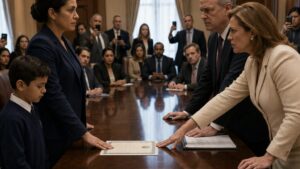
They Gave Him Seventy-Two Hours To Sell The Cabin His Mother Promised Him
Chapter 1: The Pink Blazer At The Cabin Gate
The first thing George Harris saw through the kitchen window was red and blue light breaking over his mother’s pine trees.
For one second, he thought there had been an accident on the county road. Then the lights rolled closer, flashing against the cabin windows, catching on the brass wind chime Sarah Harris had hung beside the porch and turning the glass blue, then red, then blue again.
The golden dog lifted its head from the rug.
George set down the coffee mug he had not yet drunk from. The mug was still warm against his palm, Sarah’s old chipped one with the painted trout worn almost white. He had been standing at the sink in his red flannel, rinsing the bowl he used for oatmeal, trying to decide whether today was the day he would finally clear the last stack of his mother’s mail from the corner table.
The second police car stopped behind the first.
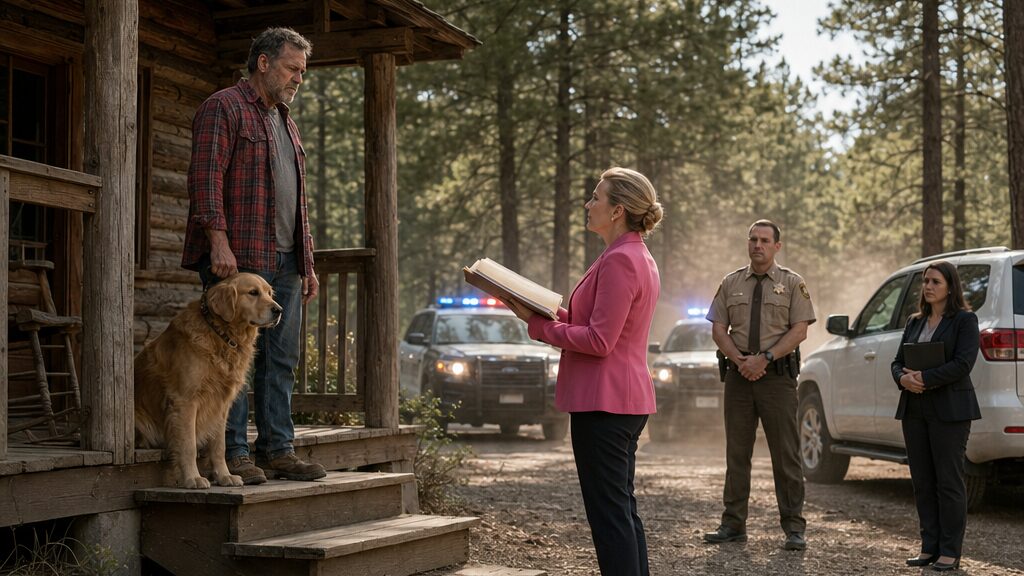
A white SUV pulled in after them and braked too hard on the gravel. Dust rose around the tires. The driver’s door opened, and Melissa Baker stepped out in a bright pink blazer that had no business being on a cabin road before nine in the morning.
George did not move.
The dog stood and pressed against his knee.
Melissa crossed the driveway fast, one hand gripping a manila estate folder, the other lifting as if she had been pointing at him before she even got out of the car. Behind her, a county deputy stepped from one of the cruisers. A real estate agent lingered near the SUV, holding a tablet against her chest and looking anywhere but at George.
He opened the door before Melissa reached the porch.
“What’s all this?” George asked.
Melissa stopped at the bottom step. She looked up at him like the question offended her. Her hair was fixed tight, her shoes too clean, her mouth set in the same line she used when their mother had refused to move into assisted living the first time.
“You need to come outside,” she said.
“I’m outside enough.”
“George.”
The deputy cleared his throat. “Sir, I’m here for civil standby only. Nobody’s being arrested. We’re just making sure everybody keeps calm.”
George looked from the deputy to Melissa.
“Civil standby for what?”
Melissa climbed one step, then seemed to think better of it. She stayed below him, holding the folder where he could see the clipped paper on the front.
NOTICE OF ESTATE PROPERTY SALE COOPERATION
RESPONSE REQUIRED WITHIN 72 HOURS
The words were printed in black, official and bloodless.
George looked past them to the cabin roof, where he had patched a leak in April while Sarah sat wrapped in a quilt below, calling up instructions he didn’t need. He had split the wood stacked beside the shed. He had changed the filters, cleared the gutters, driven Sarah to every appointment until she stopped letting him talk to the doctors alone.
“Where did that come from?” he asked.
“From the estate attorney,” Melissa said. “You would know that if you answered your mail.”
“I answer what needs answering.”
“That’s been your problem for years.”
The dog let out a low sound. George rested two fingers on its collar without looking down.
Melissa opened the folder. Her hands were steady, which made something cold settle behind George’s ribs.
“Under the revised last will and testament of Sarah Harris,” she read, “the real property located at—” She gave the cabin’s address like it belonged to a stranger. “—passes in full to Melissa Baker, nominated executor and sole beneficiary of the real property asset.”
George heard the deputy shift his weight on the gravel. The real estate agent’s tablet screen went dark.
Melissa looked up.
“There’s more,” she said, softer now, as if soft made it kinder. “The estate needs to be settled. The cabin needs to be listed. Nicholas Young’s office requires your cooperation in vacating and preparing the property for sale. You have seventy-two hours to sign the access and listing cooperation forms.”
For a moment, George thought she had skipped a page.
He looked at the folder, waiting for his own name to appear somewhere. Life estate. Occupancy. Caregiver provision. Cabin to George. Proceeds split. Something. Anything that sounded like the kitchen table promise Sarah had made with her thin hands wrapped around a cup of tea.
“You’re missing a page,” he said.
Melissa’s face hardened. “No.”
“Mom said—”
“Mom changed her mind.”
The words landed flat in the dust between them.
George looked at the porch boards beneath his boots. He had replaced the third one from the left the year Sarah fell carrying a laundry basket and cursed the old warped plank as if it had insulted her personally. After that, he had replaced six more just to be safe. Sarah had stood in the doorway with her walker, shaking her head at him.
You always fix what everyone else steps over.
He could hear her voice so clearly that Melissa’s next words took a second to reach him.
“This is not me being cruel,” Melissa said. “This is paperwork. It’s done. Nicholas has the signed will, the notarized witness page, everything required.”
George lifted his eyes. “When was it signed?”
Melissa glanced down at the folder. Too quickly.
“The revision was executed legally.”
“That wasn’t what I asked.”
The deputy took a small step forward. “Sir, you can discuss the details with the attorney.”
George did not look at him. He kept his fingers in the dog’s collar and his voice level.
“When did she sign that?”
Melissa slid a page up from the folder. He saw Sarah’s name printed in the center of it, the letters clean and final, then a date typed underneath.
Six weeks before Sarah died.
The driveway narrowed around him.
Six weeks before she died, Sarah had forgotten the stove was on and asked why George’s father had not come in for supper, though George’s father had been gone fourteen years. Six weeks before she died, she had called him Stephen twice and cried because she thought the dog belonged to a neighbor from a house she had not lived in since 1978. Six weeks before she died, George had learned to answer questions without correcting her unless the correction mattered.
“She couldn’t remember what year it was,” he said.
Melissa’s nostrils flared. “Don’t start.”
“Did Nicholas see her that day?”
“He drafted the document.”
“That’s not what I asked.”
“George, you are not going to stand here in front of a deputy and suggest I did something to Mom.”
“I’m asking when she signed it.”
“And I’m telling you she signed it when she was allowed to make her own decisions.”
The deputy looked uncomfortable now. He glanced toward the folder, then toward the porch, then back down the road as if hoping another call would pull him away.
George took one step down. The dog came with him, shoulder brushing his leg.
Melissa lifted her chin.
“You have lived here rent-free for years,” she said. “I handled the bills. I handled the insurance. I handled the calls when the care facility wanted answers. You got to be the good son in the woods while I dealt with everything real.”
George swallowed once. “I was here.”
“You were here when it suited you.”
That made him look at her fully.
She had put on lipstick the color of cranberries. Sarah used to say Melissa painted courage on her mouth before difficult conversations. George had thought that was funny once.
The real estate agent took one step back toward the SUV.
Melissa pulled the top sheet free from the clip and held it out.
“Sign the acknowledgment. It doesn’t mean you agree to everything. It means you received notice. Nicholas will expect you at his office tomorrow morning.”
George did not take the paper.
The deputy said, “Sir, I’d advise you to receive it. Refusing doesn’t make it go away.”
George looked at the deputy. “Can you make me leave today?”
“No, sir. Not today.”
Melissa made a sharp sound. “That is not the point.”
“It’s the only point I needed from him.”
Her cheeks colored.
George reached out then, not for the acknowledgment sheet, but for the estate folder itself. Melissa pulled it back.
“This is not yours.”
“This cabin wasn’t supposed to be yours either,” he said.
For the first time, her certainty flickered. It was gone almost immediately, replaced by anger.
“You always do this,” she said. “You turn everything into some quiet little injury only you understand. Mom knew exactly what she was doing.”
“Then I’ll ask Nicholas how he knew that.”
“You do that.”
“I will.”
Melissa snapped the folder shut. “Fine. Tomorrow. Ten o’clock. But don’t walk in there pretending this is some mystery. She changed it after you stopped coming.”
The dog’s ears lifted.
George felt something inside him go very still.
“I never stopped coming,” he said.
Melissa was already turning toward her SUV, but she looked back over her shoulder. The police lights flashed across her pink blazer, red then blue, making her look for an instant like someone standing inside two different versions of herself.
“The day after you stopped visiting,” she said. “That’s when she signed it.”
Then she got in the SUV, and the deputy followed her dust down the drive, leaving George on the porch with the dog, the cabin, and the first sentence of a story he knew was a lie.
Chapter 2: The Week The Calendar Went Blank
The nail where Sarah’s calendar had always hung was empty.
George noticed it before he closed the front door. The police dust had barely settled beyond the pines, Melissa’s tire tracks still cut fresh through the gravel, and there it was: one small silver nail above the kitchen phone, holding nothing.
For three years, Sarah’s calendar had hung there with its square boxes full of appointments, birthdays, grocery lists, and reminders written in a hand that grew smaller as her world did. The last one had pictures of covered bridges. George remembered because Sarah had complained every month that none of the bridges looked sturdy enough.
Now the wall showed only a pale rectangle where the paper had protected the pine paneling from smoke, sun, and years of bacon grease.
George stood beneath it, the estate folder Melissa had finally left on the porch tucked under his arm. Not the original, of course. A copy packet. Cold pages. Clean staples. Nicholas Young’s letterhead. Seventy-two hours printed on the top sheet like a dare.
The dog nosed his hand.
“Yeah,” George said quietly. “I see it.”
He put the folder on the kitchen table beside Sarah’s mug.
The cabin was too quiet after official voices. He could hear the refrigerator ticking. A pinecone dropped somewhere near the woodshed and rolled off the metal roof with a hollow clatter. Sarah used to hear things like that from the bedroom and call, What was that? even after George told her for the tenth time.
He pulled a chair from the table and stood on it to check the wall, as if the calendar might have slipped behind the phone cord or fallen between the cabinet and the paneling. Nothing. Only the nail, bent slightly upward from years of weight.
George stepped down and opened the top drawer beneath the phone.
Old pens. Rubber bands. A flashlight without batteries. A stack of grocery receipts held by a clothespin. No calendar.
He opened the second drawer. Dish towels, a packet of birthday candles, Sarah’s reading glasses with one arm taped. He almost closed it, then stopped.
At the back was a legal-size envelope, cream-colored and soft at the corners.
His name was written across it.
GEORGE
Not mailed. Not sealed by glue anymore, just tucked closed.
He knew that envelope.
Sarah had given it to him one evening in late winter when she was still living at home but already afraid of the stairs. He had been changing the bulb above the sink, and she had sat at the table with a blanket over her knees, watching him like she was memorizing a task she might need to describe later.
Put that somewhere safe, she had said.
What is it?
Something for when I’m not around to argue.
He had made a face. Don’t talk like that.
Then don’t make me repeat myself.
He had taken it and put it in the drawer because opening it while she was alive had felt indecent, like checking the pockets of someone still wearing the coat. Then the ambulance came. Then the care facility. Then the calls, the medication lists, the funeral home, the casseroles from people who did not stay long enough to wash their dishes.
He had never opened it.
George sat down slowly.
The dog came to rest beside his chair, pressing its chin on his boot.
He slid one finger under the flap.
Inside was a photograph and a folded note.
The photograph was old, taken before the porch rail went gray. Sarah stood on the cabin steps with George on one side and Melissa on the other. George had a hammer in his hand. Melissa wore sunglasses and held car keys, one foot angled away as if she had been ready to leave even then. Sarah stood between them, smaller than both her children, smiling like the house itself had made a joke only she understood.
George turned the note over.
Sarah’s handwriting crossed the paper in uneven lines.
George,
Don’t let them rush you. A house can make people forget what they promised inside it.
Love, Mom
That was all.
He read it again.
Then once more.
The sentence did not name Melissa. It did not name a will. It did not say cabin to George, or protect my son, or anything a court would care about. It was a mother’s warning written in a mother’s hand, and George felt both grateful for it and ashamed of how little it could do.
He set it beside the estate folder.
Two pieces of paper sat on the table now. One had a lawyer’s letterhead and a deadline. One had Sarah’s slanted handwriting and love. The official one had power. The true one, if truth was measured by voice, had none.
He pushed back from the table too hard. The chair legs scraped.
“No,” he said, though no one had spoken.
He went into Sarah’s room.
It was still too much hers and not enough. The bed was made with the quilt she never let anyone wash too often because “soap thins memory.” Her robe hung behind the door. The dresser held a dish of pennies, a comb, and a dried pine twig she had once insisted looked like a tiny deer.
George opened the top drawer. Socks, handkerchiefs, a tin of buttons. He opened the second. Sweaters. A cedar block. Under the sweaters, a blank space where something rectangular had once been. Dust had outlined it.
Calendar-size.
He knelt and checked beneath the dresser. Nothing but a slipper and a dead moth.
The closet gave him old coats, a shoebox of greeting cards, and three empty pharmacy bags. On the shelf above the hanging clothes, he found last year’s calendar, then the one before that, bound with twine. Sarah had kept them all. Every doctor appointment, every furnace service, every day George came to change bandages after her knee surgery, every day Melissa called from town but did not drive out because of work, rain, traffic, or some version of being too tired.
This year’s calendar was gone.
George carried the old calendars to the kitchen and set them beside the folder. The dog followed, watching him with worried eyes.
He should have opened the envelope months ago. He should have asked Sarah what she meant. He should have called Melissa the first time he noticed Sarah repeating things after Melissa’s visits instead of pretending confusion came in harmless waves.
But he had not wanted to be that son.
The one counting assets while his mother’s hands shook.
The one asking about papers when she still laughed at bad game shows.
The one making death stand in the room before it had to.
He had chosen silence because it felt decent. Now Melissa was using silence like a signed statement.
George went back to Sarah’s dresser.
This time, he pulled the drawers all the way out.
The bottom drawer stuck. He tugged harder, and something crackled behind it. He froze, then reached into the narrow gap between the drawer back and the dresser frame.
His fingers closed on a torn piece of paper.
He worked it free carefully.
It was a calendar page, ripped along the binding. The top showed the month. The squares were crowded with Sarah’s handwriting at first, then suddenly sparse. Two weeks near the middle were scratched over. One date had been circled in blue ink.
Beside it, in handwriting that was not Sarah’s, were two initials.
M.B.
George sat back on his heels, holding the missing week in both hands.
Chapter 3: She Changed Her Mind, That Was Her Right
“Mom changed her mind,” Melissa said before George had fully stepped into the attorney’s office. “That was her right.”
Nicholas Young looked up from behind his desk with the strained expression of a man who had hoped everyone would sit before anyone accused anyone else. He was younger than George expected, maybe early forties, with careful hair, a gray tie, and a desk so clear that the estate folder placed in the center of it looked staged.
Melissa sat to the left, pink blazer replaced by a navy one, though the effect was the same. Polished. Ready. Certain.
George remained standing.
The dog was not with him. Leaving it at the cabin had felt like leaving a witness behind.
Nicholas rose halfway. “Mr. Harris. Thank you for coming in.”
George took the chair across from the desk but did not remove his coat. The folded calendar page was in the inside pocket, along with Sarah’s note. He had spent half the night deciding whether to bring them out immediately. By morning, he knew he would not.
Not yet.
He had come to hear how their story sounded when told by someone who believed paper made it complete.
Nicholas folded his hands. “I understand yesterday was difficult.”
Melissa made a small noise. “It was unnecessary.”
George looked at Nicholas. “You prepared the will?”
“I prepared a revised estate plan for Mrs. Harris, yes.”
“You knew her?”
“I met with her at execution.”
“That wasn’t what I asked.”
Nicholas paused.
Melissa leaned forward. “George.”
He did not look at her.
Nicholas adjusted a pen that did not need adjusting. “Prior to that appointment, communication went through the family member coordinating her affairs.”
“Melissa.”
“Yes.”
George nodded once. “So before the day she signed, you had never spoken with my mother alone.”
Nicholas’s caution sharpened. “I spoke with her during the appointment.”
“For how long?”
“I would have to consult my notes for the exact timing.”
“Was Melissa in the room?”
Melissa crossed her arms. “This is ridiculous.”
Nicholas held up a hand, not quite stopping her, not quite supporting George. “Some portions of the appointment may have included family present. Some questions were asked privately. That is standard.”
George watched his face.
May have. Some. Standard.
“Did my mother tell you she wanted me out of the cabin?”
Melissa’s chair creaked. “The will says what she wanted.”
“The will says what got typed.”
Nicholas’s eyes flicked toward her, then back to George. “Mr. Harris, I understand your frustration. But the revised will was signed, witnessed, and notarized. Your mother had the legal right to change her estate plan.”
“Six weeks before she died.”
“Yes.”
“When she couldn’t remember what month it was.”
Melissa slapped her palm lightly against the chair arm. “You don’t get to say that.”
George finally turned to her. “I was there in November when she asked if Dad had fed the horses.”
“We never had horses,” Melissa said.
“That’s my point.”
Her mouth tightened.
Nicholas opened the estate folder. “Capacity is not the same as perfect memory. Many people have moments of confusion and still retain testamentary capacity. The legal question is whether she understood the nature of her assets, the natural objects of her bounty, and the disposition she was making at the time.”
George had expected words like that. He had even written down capacity from a late-night search on his phone, then crossed it out because he hated himself for searching it.
“Then tell me what she understood,” he said.
Nicholas turned a page. “The document states she wished to leave the cabin property to Melissa Baker, with authority to sell as executor if necessary to settle estate obligations.”
“And nothing for me.”
“The will does not name you as a beneficiary of that property.”
“That’s a careful way to say nothing.”
“It is an accurate way to say it.”
Melissa leaned toward him. “You had the cabin for years.”
“I took care of the cabin.”
“You lived in it.”
“I lived where Mom asked me to live.”
“She asked you to help. She did not ask you to make a shrine and trap the rest of us in it.”
The words touched something old and sore. George almost answered from that place. Almost told her about the nights Sarah woke terrified and the mornings he changed sheets before Melissa’s calls because he did not want Sarah embarrassed. Almost told her about the bills he paid in cash, the gutters, the medicines, the winter he slept in the chair outside Sarah’s room because she tried to walk to the porch at two in the morning.
Instead, he looked at Nicholas.
“Who scheduled the appointment?”
Nicholas checked a page. “The initial call came from Ms. Baker.”
“What did she say?”
“George,” Melissa warned.
Nicholas hesitated. “She indicated Mrs. Harris wanted to revise her documents because her care needs and property circumstances had changed.”
“Did she say I stopped visiting?”
Melissa went still.
There it was. Not anger. Not yet. A stillness that arrived too fast.
Nicholas looked between them. “I don’t recall that exact phrase.”
“But she talked about me.”
“The notes reference concerns about occupancy, maintenance, and whether the current informal arrangement was sustainable.”
George let the words settle.
Occupancy. Informal arrangement. Sustainable.
That was what his life with Sarah had become once Melissa translated it.
He reached into his coat, then stopped himself. If he showed the torn calendar page now, Melissa would explain it before he understood it. If he showed Sarah’s note, Nicholas would be gentle and useless. Emotional but not dispositive. He could already hear it.
“What date did she sign?” he asked.
Nicholas slid a copy across the desk.
George looked at Sarah’s signature.
It was hers and not hers. The S began strong, then thinned. The H tilted downward. He had seen that same slant on grocery lists in the months when she pressed too hard at the start of words and lost strength before finishing them.
The notary stamp sat below it.
A witness signature followed.
George touched the page with one finger, not on the signature, just beside it.
“Did she read the whole will?”
Nicholas’s shoulders lifted slightly. “I reviewed the provisions with her.”
“Did she ask questions?”
“She indicated understanding.”
“That wasn’t what I asked.”
Melissa stood. “No. I’m not sitting here while you accuse everyone because Mom finally stopped letting you use her guilt against her.”
Nicholas said, “Ms. Baker, please.”
George looked up at her. “Her guilt?”
Melissa’s face flushed, but she did not sit. “She worried about you constantly. She worried you’d never leave that cabin, never have anything else, never forgive her if she sold it. So yes, maybe she made a decision you don’t like. Maybe she decided I was the one who could actually handle things.”
George’s hand closed slowly over the edge of the copied page.
There was a truth inside Melissa’s anger. Not the whole truth. But enough of one to make it dangerous.
Sarah had worried about him. He knew that. She had once told him the cabin could be both a roof and a trap. He had laughed it away because laughing was easier than admitting she might be right.
Nicholas lowered his voice. “No one is asking you to agree today, Mr. Harris. But the estate has obligations. Insurance, taxes, outstanding care expenses. Cooperation will reduce conflict.”
“And if I don’t cooperate?”
Melissa answered before Nicholas could.
“Then we proceed without you.”
Nicholas gave her a look, then chose his words. “There are legal steps available. They are not immediate, but they are real.”
George stood. He took the copy of the signature page Nicholas had slid toward him.
“I want your appointment notes.”
“That may require formal request.”
“I’ll make one.”
“And the care facility records.”
“You’ll need proper authorization or a permissible basis.”
“I’ll find out what that is.”
Melissa laughed once, without humor. “Now you care about paperwork.”
George looked at her then. “I should have cared sooner.”
That quieted her for half a second.
He turned back to Nicholas. “You said the initial call came from the family member coordinating her affairs.”
“Yes.”
“Your notes say that?”
Nicholas’s fingers rested on the estate folder. He glanced down, and George saw the moment he considered closing it.
Instead, Nicholas turned one page.
“The intake note says, ‘Daughter handling all communication reports mother wishes to update cabin disposition and remove informal occupant uncertainty.’”
The office went silent.
George read the sentence upside down from across the desk. Daughter handling all communication.
Melissa looked away.
Chapter 4: The Neighbor Who Heard The Promise
“I heard what your sister told the deputy.”
Betty Campbell did not invite George onto the porch when she said it. She stood behind the screen door with one hand on the latch and one hand pressed flat against the mesh, as if the thin wire between them could keep the whole Harris family from spilling into her house.
George had stopped halfway up her steps with the estate folder tucked under his arm. The dog sat at the bottom, watching Betty’s porch cat stare from beneath a rocking chair.
“What did you hear?” George asked.
Betty looked past him toward the cabin road. Her place sat on the bend below the ridge, close enough that sound carried when the wind moved downhill. She had known Sarah for thirty years, long enough to bring soup without being asked and long enough to pretend not to see when Sarah was too proud to need it.
“I heard enough,” Betty said. “Police lights make people look out windows.”
“They weren’t there to arrest anybody.”
“I know that. I also know Melissa wanted it to look like they were.”
George glanced at the folder. “She says Mom changed the will.”
Betty opened the door then, not wide, but enough.
“Come sit before you say more on my steps.”
The porch smelled like dust, sun-warmed wood, and the strong tea Betty drank from a glass jar. She moved slowly but with purpose, clearing a stack of seed catalogs from the second chair. George sat, placing the folder on the small table between them. It looked wrong beside her tea glass, too clean for that porch, too official for a place where people had once traded tomatoes in paper bags.
Betty looked at the folder as if it might speak first.
“I don’t want family court on my porch,” she said.
“I’m not asking for court.”
“That’s what everybody says before a lawyer calls.”
George rubbed his thumb over the folder’s edge. “I’m asking what you remember.”
Betty sat back. The screen door tapped softly behind her in the breeze.
“I remember your mother saying she wanted you safe.”
George waited.
Betty’s eyes moved to the road, then to the pines behind it. “It was late summer. Maybe early fall. I brought over peach preserves. Sarah was in that green chair by the window, the one she hated because it made her feel like a patient. You were outside fixing the pump.”
“I remember the pump.”
“She said, ‘George keeps this place breathing.’ Those were her words.” Betty’s mouth tightened. “I remember because I told her houses don’t breathe, and she said, ‘This one does when he’s here.’”
George looked down.
The porch boards blurred for half a second, then cleared. He hated that the sentence comforted him. He hated even more that comfort was not proof.
“Did she say anything about the will?”
Betty’s face closed slightly. “Not in a way I’d swear to.”
“Betty.”
“Don’t use that voice. I’m trying to be fair to a dead woman and two living children who both think grief belongs to them.”
The words stung because they were not untrue.
George leaned back and let the folder rest against his knee. “I don’t want Melissa erased. Mom didn’t either.”
“No. She didn’t.”
That answer came too quickly.
George looked at her. “What do you mean?”
Betty lifted her tea and did not drink. “Sarah worried about Melissa. More than Melissa would believe, if you told her. She said Melissa carried everything like a ledger. Every call, every missed birthday, every bill, every time she drove up here and felt like a guest in her own mother’s house.”
George’s jaw tightened. “She was a guest because she acted like one.”
Betty’s eyebrows rose. “And there it is.”
He looked away.
Across the road, wind moved through the pine tops with a sound like water. The dog shifted at the steps, tags clicking.
Betty set the tea down. “Your mother loved you, George. That doesn’t mean she wasn’t afraid for you. She worried you’d disappear up there after she was gone. She worried the cabin would become the only place you knew how to talk to anybody.”
He stared at the porch railing.
Sarah had said something like that once, after he refused an invitation to a town breakfast because she had been unsteady that morning. You don’t have to bury yourself before I’m gone. He had laughed it off, told her not to be dramatic, and changed the subject to the loose hinge on the pantry door.
He had been good at repairing everything except conversations.
“What did she want?” he asked.
Betty’s face softened, but not enough to become certainty. “She wanted you in the cabin. I know that much. She said you should keep it breathing. But she also said Melissa should not be punished for living her own life.”
“That’s not what the will says.”
“No,” Betty said. “It sounds like the will chose one child’s fear and wrote it over the other child’s promise.”
George opened the folder and took out the copied signature page. He did not hand it to Betty. He placed it on the table where she could see the date.
“Six weeks before she died.”
Betty’s eyes lowered to it. “That late?”
“She was confused by then.”
“She had good hours.”
“I know.”
“She also had bad days.”
“I know that too.”
Betty studied him for a long moment. “Knowing both is what makes it hard.”
George slid the page back into the folder. “Melissa says Mom signed it the day after I stopped visiting.”
Betty frowned. “You stopped?”
“No.”
“Then why would she say it?”
“That’s what I’m trying to find out.”
Betty looked toward the cabin road again. “There was a stretch when I didn’t see your truck go down to the care place.”
George’s stomach tightened. “When?”
“I can’t give you dates. I’m old, not a filing cabinet.”
“Try.”
Betty closed her eyes briefly. “After that cold snap. Before Thanksgiving. You were splitting wood like a man mad at a tree. I remember because I asked if Sarah was worse, and you said they’d told you she needed rest.”
“They told me she needed less stimulation,” George said slowly. “The nurse said family visits were upsetting her.”
“Which nurse?”
“I don’t remember. It was a call. Facility number.”
Betty opened her eyes.
“What?”
“Sarah called me once around then,” Betty said. “Middle of the afternoon. She sounded clear for about two minutes, then not. She asked if George was angry with her.”
George went still.
Betty’s hand moved toward the tea glass, then stopped. “I told her no. I told her you were probably fixing something. She said Melissa told her you needed space.”
George did not speak.
There it was again: a sentence that did not prove anything, but changed the air around everything.
“Why didn’t you tell me?” he asked.
Betty’s mouth tightened. “Because by the next day Sarah didn’t remember calling, and Melissa said the doctors wanted less confusion around her. Because I didn’t know what was true. Because old women are very easily made to feel like busybodies.”
The dog stood at the steps.
George closed the folder.
Betty reached across the table and put her fingers on it, stopping him before he could rise.
“There was a nurse aide,” she said. “Not one of the office people. She used to help Sarah with her sweater because Sarah hated being cold. Brown ponytail. Quiet. I don’t know her name.”
George waited.
“But I saw her at the pharmacy last month,” Betty continued. “She remembered Sarah. Said she was sorry. Said final weeks were always hard when families didn’t agree.”
“Did she say that?”
“She said enough that I remembered it.”
“How do I find her?”
Betty hesitated. Then she stood, went inside, and came back with a pharmacy receipt. On the back, in small careful letters, she had written a phone number.
“I took it in case Sarah’s things ever needed someone who saw her near the end,” Betty said.
George accepted the receipt.
Betty kept hold of one corner for a second before letting go.
“Ask her what she saw,” she said. “But George—ask like you want the truth, not just a weapon.”
He folded the receipt and placed it inside the estate folder.
At the bottom of the steps, the dog looked up as if it had understood the road had just turned.
Chapter 5: The Visit Log With One Name Repeated
“Your sister already requested these records.”
The clerk at the care facility said it without accusation, but George felt the sentence close around his wrist like a cuff. She stood behind a beige counter beneath a sign asking visitors to speak gently, while a printer hummed somewhere behind her and a television murmured from the common room down the hall.
George kept his hand flat on the counter.
“When?”
The clerk glanced at the folder under his arm. “I can’t discuss another requester’s file access.”
“She requested records about my mother.”
“I understand.”
“Sarah Harris. Room twelve.”
“I remember Mrs. Harris.”
That softened her voice, but not the rule in it.
George had called ahead. He had brought a death certificate copy, his driver’s license, and the estate packet, though the packet did him no favors. Melissa was executor. Melissa was beneficiary. Melissa was, on paper, the person with authority.
He was the son without a line in the document.
“I’m not asking for medical judgment,” he said. “I need visit logs. Dates I came. Dates my sister came. Sign-out records.”
The clerk glanced behind her toward a half-open office door. “Those can still involve privacy.”
A woman in scrubs passed with a laundry cart. The smell of bleach and warmed soup came with her, and George had to look away from the hallway. He had walked this floor too many times with a paper cup of coffee going cold in his hand, measuring Sarah’s condition by whether she complained about the soup or forgot to complain at all.
“I was told my mother changed her will after I stopped visiting,” he said. “I did not stop visiting.”
The clerk’s face changed—not much, but enough. She looked toward the office again.
“Sit over there.”
He sat beneath a framed print of a sailboat in blue water, though the facility was two hundred miles from the coast. An old man in a wheelchair watched him from across the lobby, then watched the estate folder as if it had come for him next.
George waited twenty minutes.
During that time, he almost left twice. Not because he was afraid of what he would find. Because he was afraid of how he looked while looking. A grown son digging through his dead mother’s care records because a cabin had become a battlefield. Melissa’s voice followed him even here: Now you care about paperwork.
When the clerk called him back, she had a thin stack of pages.
“These are visitor sign-in logs and sign-out notations we can provide with redactions,” she said. “Medical notes require a different process.”
George reached for the pages.
She did not release them immediately. “They may not say what you want them to say.”
“I don’t want them to say anything except what happened.”
That seemed to satisfy her, or maybe tire her. She let go.
He took the papers to his truck instead of reading them in the lobby.
The first page covered September. His name appeared twice a week, sometimes three times. George Harris. Time in, time out. Sarah had still known him every visit then, though she sometimes asked whether he had fed the dog while the dog sat at home stealing socks.
Melissa Baker appeared once.
October changed. Melissa’s name appeared every week. Sometimes twice. George’s name still appeared, but less often. He remembered why: Sarah had been sleeping more, and the facility had suggested shorter visits.
November was where his hand stopped moving.
Melissa Baker.
Melissa Baker.
Melissa Baker.
Her name repeated down the page in neat lines. Time in. Time out. Visitor notes. Signed resident out.
George leaned closer.
On the date of the will signing, Melissa had signed Sarah out at 9:10 a.m. and back in at 12:42 p.m.
The appointment at Nicholas Young’s office had been at ten.
George sat in the truck with the paper trembling slightly in his hand, though his arm was steady.
He turned to the next page.
There was a notation in the margin beside that same date, printed from some internal daily care summary that must have slipped into the stack despite the clerk’s caution.
Resident disoriented in morning. Asked repeatedly for husband. Required reassurance before family outing.
Not incompetent. Not proof. Not enough.
But not nothing.
George folded the page carefully and put it inside the estate folder.
A knock sounded at his passenger window.
He looked up.
A nurse aide stood outside, one hand lifted, the other tucked into the pocket of her scrub jacket. Brown ponytail. Quiet face. Betty’s pharmacy receipt had led him to a number, but he had not called yet.
George lowered the window.
“You’re Sarah’s son,” she said.
“Yes.”
“I saw you at the desk.”
He waited, not wanting to frighten away whatever courage had brought her to the parking lot.
“She liked your dog,” the nurse aide said.
“She thought he judged people.”
“He did.”
That almost made George smile. Almost.
The nurse aide glanced toward the building. “I can’t talk about medical records.”
“I know.”
“And I can’t get involved in a family dispute.”
“I know that too.”
She looked at the folder on his lap.
“People think old folks don’t know when they’re being managed,” she said. “Sometimes they know. Sometimes they don’t. Sometimes it changes by the hour.”
George nodded once.
“Was my mother able to understand a will that day?”
Her face closed. “I can’t answer that.”
He swallowed the frustration before it became visible. “Did she know she was going to an attorney?”
The nurse aide looked past him to the pines along the edge of the facility lot. “That morning, she thought she was going to see her husband.”
George’s grip tightened on the steering wheel.
“Did Melissa know?”
“I don’t know what Melissa knew. I know what I heard.”
“What did you hear?”
The nurse aide took a breath. “Your mother kept asking if George was coming. Melissa told her, ‘George needs some space. We’re going to fix the cabin situation today.’”
George closed his eyes briefly.
The words did not break loudly. They sank.
“Did Mom answer?”
“She said, ‘George fixes the cabin.’ Then she got upset because she couldn’t find her sweater.”
He opened his eyes. “Why didn’t anyone call me?”
“I thought family knew what family was doing.”
There was no cruelty in it. That made it worse.
George reached for the visit log again. “There’s a gap. I was told visits were upsetting her.”
The nurse aide looked down.
“Who told the facility that?” he asked.
“I wasn’t in the office.”
“But you know something.”
“I know your name was on the approved list. Then for a while there was a note at the desk to call before letting you back. It said family requested reduced stimulation.”
“Family.”
She did not answer.
A car pulled into the lot. The nurse aide stepped back from the truck.
“Wait,” George said. “Was the note signed?”
“I never saw the original.”
“Was Melissa the family?”
The nurse aide’s face tightened with sympathy and fear. “Ask who canceled your visits that month.”
Then she turned and walked back toward the facility before he could ask another question.
George sat in the truck until she disappeared inside.
On the seat beside him, the estate folder had grown thicker by six pages and heavier by one sentence.
Chapter 6: You’re Tearing This Family Apart Over Money
“You’re tearing this family apart over money.”
Melissa said it from the bottom of the cabin steps, where she had stood two days earlier with police lights flashing behind her. This time there were no cruisers. No deputy. No real estate agent with a tablet. Just Melissa, the darkening pines, and a white envelope held tight in her left hand.
George stood on the porch with the estate folder on the rail beside him.
The dog sat between his boots.
“I didn’t call you here,” he said.
“No. You just went around town making people talk.”
“I asked questions.”
“You asked Betty. You went to Mom’s care facility. You went to Nicholas like he’s going to save you from a signed will.”
George looked at the envelope. “What’s that?”
Melissa climbed one step and placed it on the porch rail, directly on top of the estate folder.
“A way to end this before it gets ugly.”
“It’s already ugly.”
“It can get worse.”
Inside the envelope was a check.
George did not touch it. He looked at the number through the open flap. It was enough to rent somewhere for a while, enough to pay a retainer, enough to make a person tired of fighting feel practical.
Not enough to buy silence from a dead woman’s kitchen.
Melissa saw him looking. “It’s from my personal funds. Not the estate. You sign the cooperation forms, agree not to contest, and I’ll give you that. You can start over without dragging Mom’s name through capacity questions and witness statements.”
George looked up. “Dragging her name?”
“You know what this will become. People will say she was incompetent. They’ll say she didn’t know her own mind. They’ll turn her last weeks into paperwork.”
“She already got turned into paperwork.”
Melissa’s mouth trembled, but she caught it quickly. “You think you’re the only one who lost her.”
“No.”
“You act like it.”
The accusation landed because part of him feared it was true. Grief had made the cabin feel like the only honest place left, and he had guarded it like Sarah herself was inside the walls. Melissa had lost a mother too. He knew that. He had known it every time he let her calls go unanswered after the funeral because he could not bear the clipped efficiency in her voice.
He picked up the envelope and held it out.
“I’m not taking this.”
“You haven’t even thought about it.”
“I have.”
“No, you haven’t. You never think about practical things until someone else has to.”
George’s hand dropped. “Practical like telling Mom I needed space?”
Melissa’s face changed.
There was the crack.
Not guilt exactly. Not confession. Something closer to the panic of a person hearing private words in the wrong mouth.
“Who told you that?”
“Does it matter?”
“Yes, it matters. Because people hear things and twist them.”
“Did you tell her I needed space?”
Melissa looked toward the trees. “She was agitated when you came.”
“She was agitated when she couldn’t find her sweater.”
“You made her worse sometimes.”
“Did I?”
“You corrected her.”
George’s jaw tightened.
Melissa took another step up. “You did. You’d say Dad was dead. You’d say she already ate. You’d say she wasn’t home, she was in the facility. You thought facts were kindness because you’re good at fixing boards and pipes and bad at letting people be where they are.”
The words cut cleaner than he expected because they had shape.
He had corrected Sarah too often at first. He had watched confusion enter her face after he forced reality back into the room. Later, he had learned better. Later, he had let his father be late for supper. Later, he had fed an imaginary dog from her childhood. But Melissa had seen the first part, and in her mind, maybe that had become the whole of him.
“I learned,” he said.
“After she cried.”
He looked down.
The dog leaned against his leg.
Melissa’s voice lowered. “I’m not saying you didn’t love her.”
“No. You’re just saying she needed protection from me.”
“I’m saying she needed peace.”
“And the attorney gave her peace?”
Melissa looked at the folder. “The attorney gave her a plan.”
“You gave him the words.”
“I gave him the situation.”
“Informal occupant uncertainty.”
She flinched.
George opened the estate folder and removed the visit log. He laid it beside the check. Then the copied medical note. Then the page with Sarah’s signature.
Melissa stared at the papers like he had placed dirty dishes in front of a guest.
“I’m not doing this over money,” he said. “I’m doing this because she didn’t sign that alone.”
Melissa’s eyes brightened with anger. “You think that sentence makes you noble?”
“No.”
“You think I wanted to be the one making decisions? You think I enjoyed calling billing offices while you hid up here with firewood and soup? Do you know what the facility cost? Do you know what the insurance didn’t cover? Do you know how many times Mom told me not to bother you because George was tired?”
George did not answer.
Melissa laughed once, but it broke halfway through. “She protected you too. Even then.”
The porch seemed to tilt slightly beneath him.
“What bills?” he asked.
“Care balance. Medication changes. Transport. The house insurance. Taxes coming due. All of it.” Melissa wiped under one eye quickly, angry at the tear for existing. “And every time I brought up selling later, or planning, or making sure there was a way to pay everything, she would say, ‘George will know what to do.’ George. Always George. But George didn’t answer emails. George didn’t want to talk about after. George acted like if he kept the porch light on, nobody would die.”
He looked toward the porch light, unlit in the evening gray.
The truth in that was worse than the lies.
“I should have answered more,” he said.
Melissa seemed thrown by that.
“I should have opened what she gave me. I should have asked questions when she was alive.” He touched the estate folder. “But that doesn’t make this right.”
Melissa’s face hardened again, because softness had come too close.
“You don’t know what she said about you.”
George looked at her.
“She said she was afraid the cabin was all you had left,” Melissa said. “She said leaving it to you outright would bury you. She said maybe selling it was the only way to make you live.”
George’s throat tightened.
That sounded like Sarah. Not all of Sarah. But enough.
“She said that to you?”
“Yes.”
“When?”
Melissa looked down at the check.
“When, Melissa?”
“She said a lot of things near the end.”
“That’s not an answer.”
“It’s the only one you’re getting tonight.”
She picked up the envelope and pushed it against his chest. He did not take it, so it fell between them onto the porch boards.
“If you keep digging,” Melissa said, her voice low now, “I’ll show them what Mom said about you. All of it. And then you can explain why the woman you claim wanted you protected was trying to figure out how to get you out of this cabin before it swallowed you whole.”
She turned and walked down the steps.
George did not follow.
The check lay at his feet, faceup in the porch light that had just flickered on behind him.
Chapter 7: The Call Before The Signature
“The documents are legal. The signatures are verified.”
Nicholas Young said it before George sat down, before the estate folder was opened, before Melissa’s check had stopped feeling like a weight in George’s coat pocket even though he had left it on the cabin table.
George stood across from the desk with three sets of papers in his hands: the visit log, the copied care note, and the torn calendar page marked with Melissa’s initials. He had not slept much. The cabin had creaked around him all night as if Sarah were moving from room to room, looking for whatever her children had misplaced after she left.
“I’m not here to say the signature isn’t hers,” George said.
Nicholas’s expression shifted, cautious but attentive.
George placed the visit log on the desk.
“I’m here to ask what happened before she signed it.”
Nicholas looked down at the first page without touching it. “Mr. Harris, I need to be clear. I cannot simply revisit a completed estate document because a beneficiary is unhappy.”
“I’m not a beneficiary.”
The sentence sat between them.
Nicholas’s mouth tightened. “Because an interested family member is unhappy.”
George put the care note beside the log. “She was documented as disoriented the morning Melissa signed her out.”
Nicholas leaned forward despite himself. “Where did you get that?”
“From the facility.”
“This is not a full capacity assessment.”
“I know.”
“It says she required reassurance before a family outing. That could mean many things.”
“I know that too.”
Nicholas looked up. “Then what are you asking me to do?”
George removed the torn calendar page last. The paper had softened from being unfolded and refolded, but Melissa’s initials still stood in blue ink beside the circled date.
“I’m asking why my sister was the only person talking to you before that appointment. I’m asking why my visits were reduced that month. I’m asking why my mother thought I needed space when I didn’t. And I’m asking why the intake note in your own file says Melissa was handling all communication.”
Nicholas did not answer quickly.
For the first time since George had met him, the attorney looked less like a man protecting a file and more like a man remembering that a file had people underneath it.
He sat. “Close the door.”
George closed it.
Nicholas opened the estate folder from his side of the desk and turned to a yellow note sheet clipped behind the signed will. George had seen the top of that sheet in their first meeting, but not the whole page.
“This was my intake note,” Nicholas said. “It came from a phone call with Ms. Baker.”
“Read it.”
Nicholas hesitated.
“Please.”
Nicholas lowered his eyes. “Daughter reports mother wishes to revise cabin disposition. Current occupant is adult son, informal arrangement, no written lease, no payment history. Daughter reports mother concerned son will not maintain property long-term and that estate debts require clean sale authority.”
George took the words without moving.
Occupant. Informal. No payment.
That was how Melissa had brought him into the room before he ever entered it.
“She said I wouldn’t maintain the property?” he asked.
Nicholas did not answer.
George gave a short breath that was not a laugh. “The porch, the well pump, the roof flashing, the north-side drain, the chimney liner. Ask her who did those.”
“Mr. Harris—”
“No. Ask her.”
Nicholas set the note down. “That may all be true. But property maintenance is not the only issue. Your mother may have had concerns about your dependence on the cabin.”
George looked away from the desk.
There it was again. Sarah’s fear, pulled into daylight and used as a tool by someone else. The hardest part was that it was not invented. Sarah had worried the cabin would become his whole life. She had said so in smaller ways, gentle ways, while folding dish towels or watching him split wood after dark.
“I know she worried,” George said. “But worrying about me isn’t the same as wanting me put out in seventy-two hours.”
Nicholas was quiet.
George placed the care note closer to him. “Did you know she was confused that morning?”
“I knew she was elderly. I knew she had periods of forgetfulness. Ms. Baker represented that Mrs. Harris had good and bad days but was clear on the objective.”
“Did you ask Sarah whose idea it was?”
Nicholas’s face closed again, this time not defensively but from discomfort.
“I asked whether she understood the changes.”
“That isn’t the same question.”
“No,” Nicholas said. “It is not.”
The answer changed the room.
George sat slowly.
Nicholas pulled another page from the folder. It was not part of the will. It looked like a meeting checklist, marked in small boxes.
“During the appointment,” Nicholas said, “Mrs. Harris did state that she wanted Melissa to handle the financial side. She said Melissa was organized. She said you hated paperwork.”
“She was right.”
“She also said she wanted the cabin handled in a way that did not leave you ‘stuck.’ That word is in my note.”
George stared at the desk. “Stuck.”
“Yes.”
“Did she say she wanted me removed?”
Nicholas turned to the second page. His eyes moved once across the lines, then stopped.
“She said she wanted you secure,” he said quietly.
George’s hand tightened around the arm of the chair.
Nicholas continued, more slowly now. “There is a note here: ‘Client asks whether son can remain at property for a period of time or for life if expenses are covered. Advised separate life estate or occupancy provision may be drafted if desired. Daughter to provide property expense information.’”
George looked at him.
“What provision?”
Nicholas did not answer.
“Where is it?”
Nicholas turned back to the signed will. He moved through the pages once, then again, though George could see from his face that he already knew.
“It was not included in the final executed version,” Nicholas said.
The office seemed to lose sound. George could see cars passing beyond the frosted front window, could see Nicholas’s pen lying beside the folder, could see a small nick in the desk veneer shaped like a crescent moon.
“Why not?”
“I need to review the drafting history.”
“You don’t know?”
“I do not want to answer inaccurately.”
“Did Melissa remove it?”
Nicholas looked at the note again. “I cannot say that.”
“Did Mom?”
“I cannot say that either.”
George stood because sitting had become impossible. “Then what can you say?”
Nicholas gathered the pages, then stopped himself from hiding them back inside the folder. “I can say the file contains a note indicating your mother asked about housing security for you. I can say the final will gives full sale authority to Melissa without that protection. I can say the discrepancy should be reviewed before any sale proceeds.”
George heard the words but did not trust them yet.
“Reviewed by who?”
“First by me. Then, if needed, by counsel outside my office. I should have caught this before sending the sale cooperation demand.”
George looked at him sharply.
Nicholas held the look. “That is not a legal admission. It is a practical one.”
The anger that rose in George had nowhere clean to go. Nicholas had not written the whole wound. Melissa had not invented all of Sarah’s fears. Sarah had not spoken clearly enough, or perhaps had not been allowed enough space to do so. And George had left envelopes unopened because he thought decency meant silence.
“What happens to the seventy-two hours?” he asked.
Nicholas reached for his phone. “I am suspending the cooperation demand pending review.”
“Does Melissa know?”
“She will.”
“She won’t accept that.”
“She does not have to like it.”
Nicholas dialed, waited, then left a message in a voice so measured it made George’s hands ache.
After he hung up, he copied the note about housing security and placed it in front of George.
“This does not overturn anything,” he said.
“I know.”
“It may not become what you want it to become.”
“I know that too.”
Nicholas slid the paper closer.
George stared at the line until the words blurred, then cleared.
Client asks whether son can remain at property for a period of time or for life if expenses are covered.
For a period of time or for life.
Sarah had not written him out of the cabin in her own heart. Maybe she had been afraid for him. Maybe she had been confused. Maybe she had tried, in a room guided by Melissa’s urgency and Nicholas’s careful questions, to protect both children and had been translated into something easier to sell.
George put the page into his estate folder.
When he returned to the cabin, the dog met him at the door with Sarah’s old slipper in its mouth. George took it gently, set it back in her room, and sat at the kitchen table as evening filled the windows.
The estate folder lay open in front of him now, thicker than when Melissa had first carried it up the driveway.
Visit logs. Care note. Torn calendar page. Sarah’s warning. Nicholas’s copied file note.
Not one page saved him.
Together, they refused to let the first page speak alone.
His phone buzzed.
A message from Melissa appeared.
Do not make me come back there tomorrow with the listing papers.
George looked at the missing-provision note, then typed only one sentence.
Bring the last page Mom asked for.
Chapter 8: The Last Page They Did Not Read
Melissa returned to the cabin on the deadline morning with the listing papers in her hand.
No police lights followed her this time. No county deputy stepped onto the gravel. No real estate agent stood with a tablet pretending not to listen. Her SUV came alone through the pines, slower than before, tires grinding over the same driveway where she had delivered the seventy-two-hour notice as if the cabin were already empty.
George watched from the porch.
The dog sat beside him, golden head high, Sarah’s old porch light still burning behind them though the morning had come clear and bright.
Melissa got out wearing the pink blazer.
For a moment, it made George sadder than he expected. Not angry. Sad. She had dressed for victory because she did not know what else to wear into fear.
She lifted the papers. “I’m not doing this by text.”
“No,” George said. “You never did like leaving the part that matters in writing.”
Her eyes narrowed. “Careful.”
He picked up the estate folder from the porch rail. It was no longer the thin packet Melissa had brought him. Its spine had bent from holding too much: the signature page, the visit log, the care note, the torn calendar page, Sarah’s handwritten warning, Betty’s written statement, and Nicholas’s copied appointment note.
Melissa saw the thickness of it and looked away.
“You called Betty,” she said.
“She wrote what she remembered.”
“Of course she did. Betty always thought you walked on water because you fixed her porch steps once.”
“She wrote that Mom wanted me to keep the cabin breathing.”
Melissa’s mouth tightened. “That’s not a legal phrase.”
“No. It’s a Sarah phrase.”
For a second, something almost like grief moved across her face. Then she covered it with the papers in her hand.
“The will still says what it says.”
George nodded. “It does.”
That answer unsettled her more than argument would have.
His phone rang inside the cabin.
They both turned toward the sound.
George left the door open as he stepped into the kitchen and answered on speaker. Nicholas Young’s voice filled the room, thin through the phone but clear enough for Melissa to hear from the porch.
“Mr. Harris, I’m confirming what I told both parties by email this morning. The sale cooperation demand is suspended pending review of the drafting file and the omitted occupancy provision.”
Melissa came to the doorway. “Nicholas, you cannot suspend estate administration because George stirred up neighbors.”
Nicholas paused. “Ms. Baker, I also left you a message. I need to review why Mrs. Harris’s request regarding George’s housing security appears in the appointment notes but not in the executed will.”
Her fingers tightened on the listing papers.
“That was not a request,” she said. “It was a question. Mom asked a lot of things.”
“Yes,” Nicholas said. “And that is exactly why the file needs review.”
George watched Melissa absorb the difference between dismissal and delay. The will had not vanished. The cabin had not become his by magic. But the deadline had stopped moving.
Nicholas continued, “Until that review is complete, I do not advise listing the cabin or pressuring Mr. Harris to vacate.”
Melissa’s eyes lifted to George.
He said nothing.
After the call ended, the kitchen held the silence differently. Not peacefully. Not yet. But without the ticking violence of seventy-two hours.
Melissa set the listing papers on the table. “You think this means you won.”
“No.”
“Good. Because it doesn’t.”
“I know.”
Her anger faltered against his refusal to celebrate.
George opened the estate folder and removed Nicholas’s copied note. He placed it between them.
Client asks whether son can remain at property for a period of time or for life if expenses are covered.
Melissa stared at it as if seeing the sentence in daylight changed its shape.
“I remember that,” she said.
George did not move.
Her voice dropped. “She was confused that day. Not the whole day. But enough that everything took twice as long. She kept asking if the cabin taxes were paid. She kept asking if you had eaten. Then she asked Nicholas if there was a way you could stay without everything falling on me.”
George’s throat tightened.
“What did you say?”
Melissa folded her arms, but the gesture had lost its force. “I said we needed clean authority. I said half-measures would leave us fighting forever. I said you wouldn’t answer paperwork and I would be stuck handling bills on a house I couldn’t sell.”
“And Mom?”
“She got tired.”
That was not an answer, and somehow it was.
George looked down at the page. “Did she tell you to remove it?”
Melissa’s jaw worked.
“She said she wanted both things,” Melissa said. “She wanted me not to drown in expenses. She wanted you not to be thrown out. She wanted the impossible, George. Like always.”
The old accusation was there, but so was something else: exhaustion, and the shame of someone who had chosen the easier half of an impossible wish.
George sat at the kitchen table.
“You could have told me.”
“You would have said no to everything.”
“Maybe.”
“You would have looked at me like I was selling her out.”
“Maybe.”
“You were always better at being sad than useful.”
He looked up, and Melissa’s mouth twisted as if she wished the sentence back. But she did not apologize.
George touched Sarah’s handwritten note, still tucked in the folder.
Don’t let them rush you.
“She knew us,” he said.
Melissa looked at the note but did not reach for it.
“She knew you’d rush,” George said. “She knew I’d hide. She wrote one sentence for both of us.”
Melissa sat across from him slowly.
For the first time since Sarah’s funeral, they were at the kitchen table without Sarah between them and without anyone pretending Sarah had solved what she had actually left unfinished.
“What do you want?” Melissa asked.
“The truth in the file. The sale paused until the review is done. Betty’s statement included. The care note included. The visit issue included.”
“That’s process. What do you want from me?”
George looked toward the doorway, where the dog had settled half in sunlight, half in shade.
“I want you to stop saying she changed her mind like that explains everything.”
Melissa’s eyes filled, but the tears did not fall. “She did change part of it.”
“I know.”
“She wanted me protected too.”
“I know that now.”
“I was scared,” Melissa said. “The bills kept coming. Nicholas asked for numbers. The facility asked for signatures. You were up here fixing boards like that was the same as making decisions. I got tired of being the one who knew how much everything cost.”
George let the words stand because they were true enough to deserve air.
Then he said, “Being scared doesn’t give you the right to turn me into an occupant.”
Melissa flinched.
Outside, wind moved through the pines. The porch light glowed faintly in the daylight, unnecessary and stubborn.
“What happens now?” she asked.
“Nicholas reviews the missing clause.”
“And if it doesn’t change the will?”
“Then it doesn’t.”
“You’ll still fight?”
“I’ll still make sure the file says what happened.”
Melissa looked at the listing papers. Then she picked them up and tore them once across the middle. Not dramatically. Not cleanly. The tear caught near the staple, and she had to pull harder. She set the pieces back on the table.
“I’ll tell Nicholas I won’t push the sale during the review,” she said. “And if there’s a way to write the occupancy protection now without bankrupting the estate, I’ll look at it.”
It was not an apology.
It was not the cabin handed back.
It was not Sarah walking into the kitchen to say what she had meant.
George nodded because partial truth was still truth, and partial justice was sometimes the only kind that arrived with work clothes on.
Melissa stood.
At the door, she paused beside the dog. It lifted its head but did not move toward her.
“Mom really did worry this place would swallow you,” she said.
George looked around the kitchen: the chipped mug, the old phone, the empty calendar nail, the table where Sarah had written one warning and left too much unsaid.
“Maybe it would have,” he said. “If you’d let the paper do all the talking.”
Melissa left without answering.
George walked her to the porch but not to the driveway. He watched the SUV roll slowly between the pines, past the place where the police cars had flashed and the dust had risen and he had first learned his name was missing.
When the sound faded, he went back inside and clipped Nicholas’s missing-provision note to the front of the estate folder, over the seventy-two-hour notice.
That evening, after he fed the dog and washed Sarah’s chipped mug and rehung the torn calendar page beside the empty nail until he could find the rest of it, George stepped onto the porch.
The light beside the door was still on.
For years, Sarah had left it burning for anyone coming up the dark road late. For Melissa when she came angry. For George when he came tired. For herself when the world beyond the windows began to confuse her.
George reached for the switch, then stopped.
He left it on, not because he expected Melissa back that night, and not because the cabin needed proving to anyone.
He left it on because Sarah always had.
The story has ended.