When the HOA Tried to Tear Down the Dock That Kept His Sister Safe
Chapter 1: The Red HOA Truck Reached the Dock First
The saw screamed before Jack Mitchell reached the shoreline.
He had been in the kitchen rinsing coffee from a mug when the sound tore through the morning—high, metallic, wrong. Not the clean whine of a tool starting work, but the biting pitch of steel meeting the fresh pressure-treated boards Eric Ramirez had bolted down three days ago.
Jack dropped the mug into the sink hard enough to chip its rim.
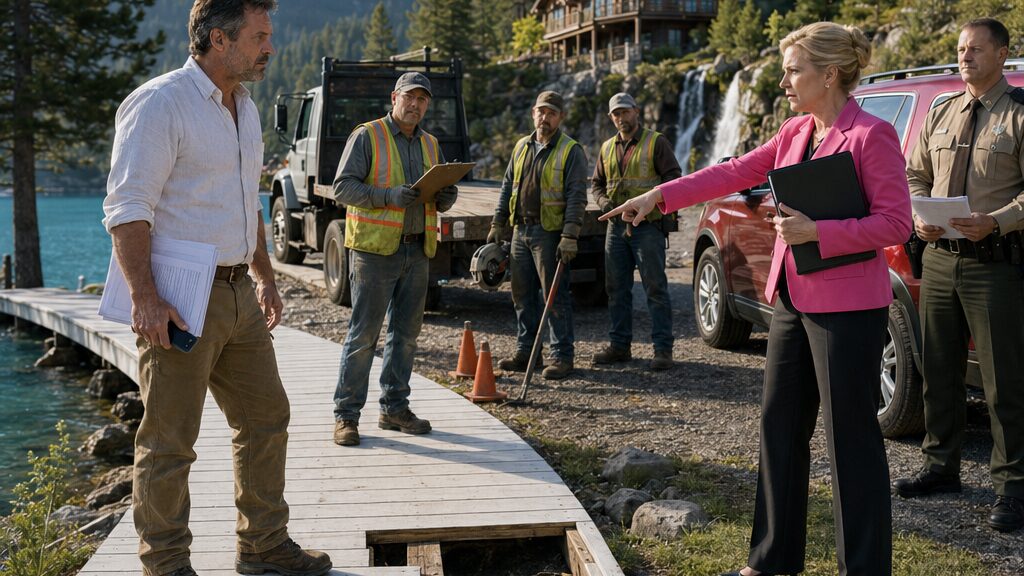
Through the back window, past the pale stone patio and the sloping grass still wet from lake mist, he saw two men in orange vests standing on his curved white boardwalk. One was bent over with a circular saw. The other had a pry bar wedged under the second plank from the railing.
A third man was carrying the first removed board toward a flatbed truck.
Jack moved before he thought.
He crossed the kitchen, grabbed his phone from the counter, and stepped out through the back door without closing it behind him. The lake below the chalet was calm enough to hold the mountains upside down. The waterfall beyond the pines murmured like it belonged to a peaceful morning. Sheep grazed on the far slope. Everything looked too clean, too still, for what was happening in the middle of his property.
The saw started again.
“Stop,” Jack called.
The worker with the saw glanced up but did not turn it off.
Jack quickened his pace down the stone path. The boardwalk curved from the house toward the dock in a gentle white arc, floating above damp ground where the slope turned uneven near the shore. The old boards had bowed there first. One had split beneath Patricia’s chair wheel two weeks ago, dropping just enough to trap the wheel and leave her gripping both armrests, white-knuckled, while Jack lifted the front end free.
He had heard the crack in his sleep for three nights after.
“Stop the saw,” he said again, closer now.
The worker finally let the blade spin down. The sudden quiet felt worse.
A crew supervisor stepped away from the flatbed with a clipboard in one hand. “Mr. Mitchell?”
“You’re standing on my boardwalk.”
“We’re here under order of the Lakeside Ridge Homeowners Association.”
“That doesn’t answer why you’re cutting it apart.”
The supervisor looked past Jack toward the driveway above the slope, and Jack knew before he turned what he would see.
A red SUV sat at the top of the gravel turnout, glossy as a warning sign. White letters on the door read HOA MANAGEMENT. The driver’s door opened, and Stephanie Hall stepped out in a bright pink blazer, dark slacks, low heels that had no business on wet grass, and the expression of a person who had rehearsed being reasonable in a mirror.
She carried a folder under one arm.
“Mr. Mitchell,” she called, walking down the path. “Please step away from the work area.”
Jack lifted his phone and started recording.
Stephanie saw the gesture. Her mouth tightened.
“I am asking you to move for your own safety,” she said.
“I am asking why a crew is dismantling a repair on my property.”
“You were served a violation notice.”
“No,” Jack said. “I received a request for clarification.”
Stephanie reached him and held out a paper as if presenting a receipt at a store. “This is the formal enforcement notice. Unauthorized shoreline structure. Failure to obtain architectural approval. Failure to maintain visual uniformity with community standards. Work order for removal.”
Jack did not take it.
Behind him, the worker with the pry bar shifted his weight. The lifted plank gave a low groan.
“Put that down,” Jack said without looking away from Stephanie.
“Crew,” Stephanie said, raising her voice, “continue with removal of the noncompliant section.”
Jack stepped onto the boardwalk and placed himself between the men and the next plank. He did not shove anyone. He did not raise his hands. He simply stood where the saw would have to reach through him first.
The supervisor looked uncomfortable. “Ma’am?”
Stephanie’s face remained controlled. “Mr. Mitchell, you are interfering with authorized enforcement.”
“Authorized by whom?”
“The board.”
“The board is not a court.”
“The board has authority over exterior improvements.”
“This is not an improvement. It’s a repair.”
“It altered the shoreline approach.”
“It stabilized rotten boards.”
“You widened the transition curve.”
“To make it safe.”
Stephanie’s eyes moved for one second toward the house. The back door stood open. From here, the chalet looked like a picture from a vacation brochure—wide windows, cedar beams, gray stone chimney, flower boxes Patricia insisted on filling every spring. It did not show the thresholds Jack had lowered, the rugs he had removed, the marks on the wall where a handrail had been moved twice until it met Patricia’s reach.
Stephanie looked back at the boardwalk. “You submitted an application. That application was not approved.”
“I submitted emergency repair paperwork four weeks ago.”
“Submission is not approval.”
“The old boards failed.”
“Emergency work must still be reviewed.”
Jack almost laughed, but there was no humor in his chest. “How long should someone wait at the door while a committee reviews whether the floor can hold?”
Stephanie’s expression shifted, not into sympathy, but into a colder kind of caution. She had heard the word someone. She had chosen not to ask.
“Mr. Mitchell, I understand you may feel strongly about your project.”
“It is not a project.”
“It is classified as an unauthorized structure until the board says otherwise.”
The supervisor cleared his throat. “We’ve already removed one plank.”
Jack looked past Stephanie.
The first board lay on the flatbed, pale underside exposed, screw holes dark from the bolts Eric had driven in. That board had been beneath Patricia’s left wheel when she crossed to the dock on Monday evening to watch the sun turn the lake copper. She had pretended she did not notice Jack watching every inch of the path. He had pretended he believed her.
Now it lay like scrap.
Jack lowered his voice. “Those are my materials. Put the board back.”
“We are not required to restore unapproved work,” Stephanie said.
“You came onto my property and started cutting before I was notified.”
“A notice was placed at your front door this morning.”
“This morning?” Jack turned his phone slightly to catch the flatbed, the tools, the missing plank. “The crew was already here this morning.”
Stephanie glanced at the phone again. “You can record if you want. It does not change the enforcement authority.”
“It changes who gets to say later what happened.”
For the first time, something behind Stephanie’s polished composure flickered. Not fear. Irritation sharpened by calculation.
The supervisor took a step toward Jack. “Sir, I don’t want anybody getting hurt.”
“Then don’t cut another board.”
“We’re just doing the job.”
“I know,” Jack said. “That’s why I’m speaking to the person who sent you.”
Stephanie opened her folder and slid out a second sheet. “The HOA has the right to remedy violations at the owner’s expense after written notice. The cost of today’s removal will be assessed to your account.”
“You haven’t proved the HOA has authority over this section.”
“The boardwalk connects to your residence.”
“It crosses my lower parcel.”
“It is visible from community water frontage.”
“That is not the same thing.”
Stephanie’s smile was small and practiced. “If you believe the board has acted improperly, you may appeal at the emergency hearing.”
“When?”
“After removal.”
Jack looked down through the gap where the first board had been. Mud and lake grass showed below. A person on foot could step over it. Patricia could not. The chair could not. Even Jack, carrying her if he had to, would have to turn sideways where the curve narrowed, and she hated being carried. Hated it with a silent, burning dignity he understood because it came from the same family.
The worker with the saw shifted again.
Jack turned to him. “If that blade touches another board while I’m standing here, you’re doing it knowing I told you this is a safety access repair.”
The man looked at the supervisor. The supervisor looked at Stephanie.
Stephanie’s voice went flat. “Mr. Mitchell, unless you can produce a court order stopping this work, the crew will continue.”
Jack held her gaze. The lake moved softly beneath the dock behind him, tapping the posts like a clock.
“I don’t have a court order,” he said.
Stephanie nodded once, as if the matter were finished.
Then Jack opened the camera app wider, stepped more squarely into the gap, and said, “Then you’ll have to decide whether your order is worth cutting through the only safe way someone in that house can reach the water.”
For a moment no one moved.
Stephanie looked toward the open back door again, and Jack saw the question forming behind her eyes.
Then she closed the folder.
“Continue,” she told the crew.
Chapter 2: The Repair Request Nobody Admitted Seeing
Patricia’s mobility chair waited just inside the back door, angled toward the missing board as if it had stopped there on its own and decided the rest of the world had been canceled.
Jack saw it before he saw his sister.
The chair was not in its usual place near the breakfast table. Its front wheels rested on the stone threshold, aimed down the slope toward the boardwalk. One wheel still held a thin crescent of dried mud from Monday’s trip to the dock. Patricia had not cleaned it off because she liked the proof that she had gone all the way down and back without asking Jack for help.
Now the chair faced a white boardwalk with a dark rectangular gap cut into it.
Patricia stood behind the kitchen counter, both hands braced on the edge, her weight balanced carefully. Her cane leaned against the cabinet. She wore the blue sweater she used on mornings when the lake air made her joints stiff, and her expression told Jack she had already heard enough.
“They took part of it?” she asked.
“One board,” Jack said.
“And left?”
“For now.”
Her eyes narrowed. “That is not an answer.”
Jack closed the back door. The house felt too quiet after the saw. He set his phone on the counter and opened the recording, scrubbing back to make sure it had captured Stephanie’s order, the crew, the missing plank. His hands were steady. That surprised him less than it should have. He had been steady during emergencies for years. Steady when Patricia fell. Steady when their mother’s house had to be sold. Steady when he signed the closing papers on this chalet and promised his sister there would be room enough for her life, not just her equipment.
“I stopped them before they got the second one,” he said.
Patricia looked past him to the lake. “Did she ask?”
“No.”
“About me.”
“No.”
Patricia gave a short nod, like that was better and worse at the same time.
Jack pulled the folder from the drawer beneath the counter. It was already thick with receipts, drawings, county forms, emails, Eric’s measurements, photos of cracked boards, photos of the old sagging curve, photos of the wheel stuck at an angle that still made Jack’s stomach twist.
He spread them across the kitchen island.
“The emergency repair request went in on the fourth,” he said. “Confirmation email came back the same day. County shoreline receipt on the sixth. Eric started after the temporary safety hold expired.”
“Stephanie knows that?”
“She says submission isn’t approval.”
Patricia reached for the printed email but stopped before her fingers touched it. Her hands were aching today. Jack could tell by the way she kept her knuckles slightly bent.
“She will say you were impatient,” Patricia said.
“She can say what she wants.”
“That has never stopped her.”
Jack said nothing.
Outside, the flatbed still sat by the lower path, though the crew had moved back toward the truck after Jack refused to leave the gap. Stephanie had driven off first, red SUV flashing between pines like a retreat that was not really a retreat. The supervisor had said they would “pause pending clarification,” which sounded official until Jack asked for it in writing. Then he had only shrugged.
Jack took photographs from the porch. Missing plank from the house angle. Missing plank from the lower slope. Screw heads in the dirt. Boot prints near the support post. Tire marks in the grass where the crew had backed closer than the gravel allowed.
His phone buzzed as he was photographing the flatbed.
Eric Ramirez’s name appeared.
Jack answered. “Tell me you didn’t know they were coming.”
“I didn’t,” Eric said. His voice was low, strained by wind or guilt. “I just got a call from the crew supervisor. He asked if I wanted to come get any tools I left before they removed the rest.”
“The rest?”
“That’s what he said.”
Jack looked toward the missing board. “Stephanie told them to continue.”
“Jack, she called me yesterday.”
Jack went still. “And?”
“She said if I touched that boardwalk again without written HOA approval, the association could report me for unauthorized work inside a managed community.”
“You had the county receipt.”
“I told her that.”
“What did she say?”
“She said county receipt doesn’t override private covenants.”
Jack pressed his thumb against the phone until the case creaked. “Why didn’t you call me?”
Eric was quiet for a beat. “Because I thought it was a warning. Contractors get them. People throw paper around. I didn’t think she was sending a crew.”
“You should have told me.”
“I know.”
The anger came fast enough that Jack had to turn away from Patricia’s view through the window. It would have been easy to pour it all into Eric, to make one man carry the weight of a board already cut out of place. But Eric had worked late to finish the curve before the rain. He had knelt on wet boards with a headlamp strapped over his cap because Patricia wanted to try it before the weekend.
Jack swallowed the first answer.
“Send me everything,” he said. “Time of her call. What she said. Any message.”
“I’ll forward the voicemail.”
“She left one?”
“After I didn’t pick up the second time.”
Jack shut his eyes. There it was: not proof of everything, but proof of pressure.
“Send it now.”
When he returned to the kitchen, Patricia had moved to the chair and was sitting with one hand on the wheel rim. She had pulled herself into it without calling him. The effort had left color high in her cheeks.
“Don’t look like that,” she said.
“Like what?”
“Like you’re counting bruises I don’t have yet.”
Jack picked up the county receipt and folded it along its existing crease. “I’m counting boards they can’t take.”
Patricia looked at the papers. “You are not going to walk into that hearing and explain my body to a room of people who pretend not to stare at ramps.”
“I don’t have to explain your body.”
“You will if you say medical access.”
“It’s the truth.”
“It is my truth.”
The words landed harder because she did not raise her voice.
Jack leaned both palms on the island. The papers shifted under his hands. “They’re calling it a dock expansion.”
“Then prove it isn’t.”
“That may not be enough.”
“It should be.”
He almost smiled at the echo of his own stubbornness, except it hurt too much to hear it from her.
Patricia turned the chair slightly, testing the space between the counter and the table. “I moved here because you said the house could work. Not because I wanted the neighborhood to hold meetings about what I can and can’t do.”
“I know.”
“And not because I wanted Stephanie Hall saying my name like a waiver.”
“I know.”
“Promise me.”
Jack looked at the open door, the lake shining beyond glass, the missing board like a black mark across the path.
“Promise what?”
“That you won’t make me the argument.”
His first instinct was to refuse. Not aloud, maybe, but somewhere inside. Because she was the argument. Her safety. Her access. Her right to move from kitchen to porch to dock without being reduced to a request pending review.
But she was also Patricia, who had once hiked the ridge trail above the waterfall faster than Jack could follow. Patricia, who remembered every neighbor’s dog but forgot every neighbor’s gossip. Patricia, who would rather sit facing a blocked path than be carried through pity.
“I won’t make you a spectacle,” he said.
“That is not the same promise.”
“It’s the one I can keep.”
Her face softened for half a second, then closed again. “Jack.”
“I’ll use the repair records first. The old boards. The emergency request. Eric’s voicemail. The county receipt.”
“And if they ask why it was urgent?”
He looked at the chair, then at the mud crescent on the wheel.
“I’ll say access.”
“No diagnosis.”
“No diagnosis.”
“No story about the fall.”
His jaw tightened. “It wasn’t a fall.”
“No story about the almost-fall, then.”
He nodded.
A new email arrived while they were still looking at each other.
The subject line filled the laptop screen from where it sat open at the far end of the island.
EMERGENCY HEARING NOTICE AND DAILY FINE ASSESSMENT — MITCHELL PROPERTY
Jack opened it.
Patricia rolled closer, slowly, the chair wheels whispering against the kitchen floor.
The message was short. The hearing would take place in two days at the HOA clubhouse. The violation was classified as ongoing. Daily fines would begin immediately. If the remaining boardwalk connection was not removed voluntarily, further enforcement action could be taken at the owner’s expense.
At the bottom, under Stephanie Hall’s typed name, was a sentence that made Jack read it twice.
Owner failed to provide approved hardship documentation prior to commencing exterior alteration.
Patricia stared at the line.
Jack reached for the folder, flipping through papers until he found the page he had not wanted to use first: the emergency access statement he had attached with the original request. It did not include her diagnosis. It did not include the almost-fall. It only said that a resident required stable, continuous mobility access between the residence and shoreline platform.
He checked the sent email.
The attachment was there.
Chapter 3: The Pink Suit at the Shoreline Hearing
The first thing Jack saw inside the HOA clubhouse was a blown-up photograph of his boardwalk with red text stamped across it: UNAUTHORIZED DOCK EXPANSION.
The photo stood on an easel beside the folding table where the board sat. It had been taken from the waterline, low enough to make the repaired curve look wider than it was, low enough to hide the slope between the house and the shore. The missing plank was not visible. Neither was the wet ground beneath it, the uneven drop, or the place where Patricia’s wheel had caught.
Just the lake, the white boards, and a caption that turned a repair into a choice.
Jack stopped inside the doorway.
Behind him, two neighbors lowered their voices too late.
Stephanie Hall sat at the center of the table in her pink blazer, hands folded over a stack of violation packets. Michelle Thompson sat two chairs to her left, reading glasses low on her nose, flipping through pages with the uneasy focus of someone trying to be fair without being noticed doing it.
“Mr. Mitchell,” Stephanie said. “You may sit.”
Jack did not sit immediately. He looked at the easel, then at the packets laid out for the board. Every cover page showed the same photograph.
“Who wrote the caption?” he asked.
Stephanie’s smile did not change. “This is not a trial. It is a compliance hearing.”
“Then why does your evidence have a verdict printed on it?”
A small rustle moved through the room. Not support exactly. Interest. The kind that made people glad a conflict was not theirs.
Stephanie tapped her pen once against the table. “Please sit so we can proceed.”
Jack sat in the chair facing the board. He placed his folder on his lap, not on the table. He had learned that morning that if he spread everything out too soon, Stephanie treated it like clutter. If he kept it closed, people watched it.
Stephanie began with the covenants. Section 7.4, shoreline visual consistency. Section 9.1, exterior alterations requiring prior architectural review. Section 11.3, board authority to remedy violations at owner expense after notice. Her voice stayed calm, clean, procedural. She did not mention the crew cutting before the notice. She did not mention Eric’s voicemail. She did not mention the word access.
“The owner replaced and widened a section of elevated boardwalk connecting the residence to the dock without receiving approval,” she said. “The alteration changes the shoreline appearance visible from common water frontage and creates potential insurance exposure for the association if left unreviewed.”
Jack watched the board members nod at familiar words. Insurance exposure. Common frontage. Prior approval. Phrases built to make worry sound like responsibility.
Stephanie turned to him. “Mr. Mitchell, do you dispute that work began before written approval was issued?”
“No.”
A neighbor in the back whispered, “There it is.”
Jack kept his eyes on Stephanie. “I dispute that written approval was required before emergency stabilization.”
Stephanie looked satisfied. “The covenants contain no emergency exception for exterior changes of this nature.”
“The county does.”
“The county is not the HOA.”
“The HOA is not the county either.”
Michelle’s eyes flicked up from her packet.
Stephanie leaned back. “No one disputes that property owners must maintain safe conditions. But safety does not give an owner permission to redesign exterior structures without review.”
“I didn’t redesign it.”
“You widened the curve.”
“I stabilized the approach.”
“You changed its footprint.”
“Because the old footprint trapped a wheel.”
The room stilled.
Jack heard Patricia’s warning as clearly as if she sat beside him: Do not make me the argument.
Stephanie heard the opening too. “A wheel?”
Jack opened his folder, slowly enough to make himself choose. He removed three photographs of the old boardwalk: warped planks, rusted screws, the separated seam at the curve. He slid them across the table.
“A mobility wheel,” he said. “The old boards failed here.”
Stephanie did not pick up the photos. Michelle did.
“Whose mobility wheel?” Stephanie asked.
“The resident’s.”
“What resident?”
Jack’s thumb pressed into the edge of the folder. “A resident of the house.”
“For hardship accommodation purposes, the board requires documentation.”
“It was provided.”
Stephanie turned a page in her packet. “The board received an emergency repair request for deteriorated planking, not an approved accommodation request.”
Jack removed the printed email confirmation and held it up. “Submitted on the fourth. Emergency repair request. Photos. County receipt. Access statement attached.”
“You submitted materials,” Stephanie said. “They were incomplete.”
“Four weeks ago.”
“Mr. Mitchell—”
“Four weeks,” Jack repeated. “No denial. No request for more information. No site visit. No written decision. Then a crew came before breakfast and cut into it.”
Michelle lowered the photographs. “Stephanie, was there any response sent to the owner?”
Stephanie did not look at her. “The architectural committee was still reviewing.”
“After four weeks?”
“The committee has thirty business days.”
Jack reached into the folder again. “Your own emergency procedure says temporary safety stabilization may proceed if immediate hazard exists and documentation is submitted within seventy-two hours.”
Stephanie’s jaw tightened. “Temporary stabilization. Not permanent alteration.”
“The old boards were removed. The supports were replaced. You cannot temporarily stabilize rot.”
One of the board members shifted. The neighbor in the back stopped whispering.
Michelle held out her hand. “May I see that procedure?”
Stephanie passed her a packet page without enthusiasm.
Jack watched Michelle read. He wanted her to find something clean, something impossible to argue with. But he knew better. Rules were built with seams. Stephanie knew every one.
Michelle looked at Jack. “Why didn’t you wait for written approval before widening the curve?”
It was not hostile, but it was the question the room wanted answered.
Jack looked toward the clubhouse windows. From there, the lake was visible between pines, bright and indifferent. Across the water, his own dock was a thin white line. Too far away to show the missing plank.
“Because the person using that path could not wait for the committee to decide whether a safer turning radius looked acceptable from a kayak.”
The sentence came out sharper than he intended.
Stephanie seized on it. “So you admit the turning radius was changed for personal convenience.”
“For safety.”
“Yet you declined to provide proper accommodation documentation before altering the structure.”
“I provided an access statement.”
“Not a medical certification.”
“I wasn’t required to attach private medical details to an emergency board repair.”
“For an accommodation, you were required to establish need.”
“For a repair, I was required to establish hazard.”
“And yet you are now arguing accommodation.”
Jack stopped.
There it was. Stephanie had narrowed the path until either answer hurt him. If he argued repair, she called the widened curve unauthorized. If he argued accommodation, she said he had not provided enough private proof before building.
He opened his folder and removed the email printout with the timestamp. “This is what I submitted.”
Stephanie accepted it this time. She glanced at the first page and passed it to Michelle.
Michelle read the timestamp. “Received by management office, 8:14 a.m., four weeks ago.”
Jack said, “The access statement is listed in the attachments.”
Michelle flipped to the back of her packet.
Then she flipped again.
Stephanie began speaking before Michelle asked anything. “The packet contains the documents relevant to the violation.”
Michelle’s fingers paused on the final page. “I don’t have an access statement.”
“It was not part of the review materials,” Stephanie said.
Jack felt something cold move through him. Not surprise exactly. Confirmation with teeth.
Michelle looked at Stephanie. “Was it omitted because it was incomplete?”
Stephanie’s face remained composed, but her hand closed around her pen. “It was not sufficient to change the classification of the work.”
“That isn’t what I asked.”
The room changed then. Just slightly. Chairs creaked. Someone coughed. The bright photo on the easel still said UNAUTHORIZED DOCK EXPANSION, but now the words looked less certain.
Jack watched Michelle turn the email toward the light.
At the bottom of the printed page, beneath the list of attachments, one line was highlighted by the old office printer’s gray banding.
Emergency_Access_Statement_Mitchell.pdf
Michelle touched the line with one finger.
“Then where is it?” she asked.
Chapter 4: The Survey Line Below the Waterfall
“The HOA map is not the recorded parcel map,” the county shoreline clerk said, and turned Jack’s violation packet upside down as if it might make more sense from the other direction.
Jack stood at the counter with both hands flat on the worn laminate, watching her compare Stephanie’s printed diagram to the county’s old survey scan on her monitor. Behind him, a copier thumped and whined. Somewhere in the records office, someone laughed softly at a joke that did not belong in the same world as a half-torn boardwalk and an emergency hearing.
The clerk tapped Stephanie’s map with the end of her pen.
“This line here,” she said, “is the association’s maintenance boundary. Not your property boundary.”
Jack leaned closer. “Say that again.”
“The HOA appears to be using the community maintenance map. It shows the areas the association may inspect for shoreline appearance. It does not show ownership.”
“They used it to justify removing boards.”
The clerk looked up at him over her glasses. Her expression changed just enough to tell him she had heard versions of this before. “Associations do that sometimes. Doesn’t mean they’re right. Doesn’t mean they’re wrong either. It means you need the recorded plat.”
Jack opened his folder, pulled out the photos of the missing plank, then stopped himself. The clerk was already turning back to the screen. He was learning how much paper to show and when. Too much too soon made people sort him into the stack of angry owners who wanted the county to fix private disputes.
“I need the recorded plat,” he said.
“And any easements.” She clicked through a menu. “Your house sits in Lakeside Ridge Phase Two. But the lower shoreline parcel looks older.”
“Older how?”
“Pre-association.”
Jack felt the room tighten around that word.
The clerk printed three pages. The machine behind her groaned, warmed, and released them one at a time. She stamped the corner of each copy, then slid them under the glass partition.
“Here. Recorded plat. Shoreline maintenance easement. Original lake-access parcel description.”
Jack picked up the first sheet. The paper was warm.
On Stephanie’s violation map, the boardwalk had been drawn as if the entire curve belonged inside HOA-controlled exterior space. On the county plat, the line broke differently. The house and upper path sat within the subdivision boundary. The lower strip near the waterfall and dock was marked by an older survey line, running crookedly along the slope before cutting toward the water.
Jack traced it with one finger.
The line passed under the lower half of the boardwalk.
Under the missing plank.
Under the place where Stephanie’s crew had stood with the saw.
The clerk watched him find it. “You’ll want someone qualified to interpret that if this becomes a dispute.”
“It already is.”
“Then you’ll want it interpreted carefully.”
Jack folded the copies along their edges, not the way he usually folded papers to fit a back pocket. These deserved clean creases. “Does the HOA have authority there?”
The clerk’s mouth pressed into a line. “I can’t give legal advice.”
“I’m not asking for legal advice.”
“You are.”
He looked at the map again.
The clerk’s tone softened. “What I can tell you is this: if an association order describes one parcel and its crew removes material from another, that is not a small difference.”
Jack stared at the black survey line until it seemed to darken on the page.
Outside the records office, he sat in his truck for almost ten minutes with the folded papers on the passenger seat. He should have felt relief. Instead, his first thought was that he had wasted two days letting Stephanie call the boardwalk an expansion when he should have gone straight to the county. His second was worse: if the lower half was outside HOA authority but the upper connection was not, Patricia could still be trapped by the part nearest the house.
He called Eric from the parking lot.
“You remember where the old posts changed?” Jack asked.
“By the bend?”
“Below the waterfall side.”
“Yeah. Old concrete footings there. Different spacing.”
“Why didn’t you mention that?”
Eric sighed. “Because old lake properties are weird. Half of them have three generations of repairs buried under the next one. I didn’t know it mattered.”
“It matters.”
“Good or bad?”
“Both.”
Jack drove back along the lake road with the survey on the seat beside him and the violation packet jammed between the console and the cup holder. The red letters on Stephanie’s photo peeked out each time he turned: UNAUTHORIZED DOCK EXPANSION. The words looked cheaper now. Not harmless, but cheaper. Like a label printed before anyone bothered to walk the line.
At home, the crew’s tire marks still cut through the damp grass. The boardwalk gap had been covered with plywood Jack screwed down himself before leaving that morning, temporary and ugly but strong enough that Patricia could cross it if she had to. He had not told her he was going to the county. She would have asked what he expected to find, and he would have had no answer that did not sound like hope.
He took the survey down to the lower path.
The waterfall was narrow but constant, spilling over dark rock where the property dipped before opening to the lake. Spray cooled the air. Jack followed the old line by sight first, then by the measurements printed on the plat. He found the first iron marker near a root-tangled pine, half buried under moss. He brushed dirt away with his fingers until metal showed through.
The marker sat below the association boundary.
He walked to the missing board and looked back uphill toward the house.
The boardwalk no longer felt like one object. It was two arguments bolted together. The lower section, near the dock and waterfall, might be his without HOA control. The upper transition, where Eric had widened the curve so Patricia’s chair could turn safely from the stone path onto the boards, still touched the exterior approach Stephanie could claim to regulate.
Jack pulled out his phone and took photographs of the marker, the survey, the boardwalk supports, the angle toward the house. The more he documented, the less simple the victory became.
His phone rang.
Patricia.
“You found something,” she said when he answered.
He looked up at the chalet windows. “How do you know?”
“You didn’t come in swearing.”
“I don’t swear that much.”
“You swear silently. It changes your shoulders.”
He almost smiled. “The county map is different from the HOA map.”
“Different enough?”
“Enough for the lower boardwalk. Maybe not the house connection.”
Silence. Then: “The part I need to reach the lower boardwalk.”
“Yes.”
The word hung there with the mist.
Patricia said, “So they can’t take the dock, but they can still block the door.”
Jack looked at the widened curve near the top of the slope. It was the least beautiful part of the repair, the part Stephanie hated most, the part that mattered most. A little wider. A little flatter. A small change to anyone walking. A door, if wheels were involved.
“I’m not letting them block it,” he said.
“You thought the papers would be enough last time.”
The sentence found the bruise.
Jack folded the survey one-handed against his thigh. “They weren’t the right papers.”
“Or you didn’t say the right thing.”
He had no answer.
That afternoon, he spread the county plat across the kitchen island. Patricia rolled beside him and studied it without asking for help. Her hand hovered above the line, then touched the lower strip lightly.
“That’s ours?”
“Looks like it.”
“And this?” She pointed near the upper curve.
“HOA will argue that part is theirs to regulate.”
“Because it touches the house.”
“Because they can.”
Patricia leaned back. “Stephanie will not like being wrong on half of it.”
“No.”
“She will punish the other half.”
Jack looked at her.
She did not flinch from the thought. “People like that do not retreat in a straight line. They move sideways.”
An email arrived at 4:37 p.m.
Jack saw Stephanie Hall’s name and opened it before Patricia could tell him not to.
NOTICE OF CONTINUED VIOLATION — REMAINING NONCOMPLIANT CONNECTION SECTION
The lower shoreline component would be reviewed pending clarification of parcel boundaries. The upper transition and widened connection between residence and boardwalk remained noncompliant. Jack was ordered to remove or restore the connection to its prior footprint by Friday at 9:00 a.m. Failure to comply would authorize further association action.
Patricia read over his arm.
“At least she admits the lower part is unclear,” Jack said.
Patricia’s eyes stayed on the deadline.
“Friday morning,” she said. “That’s not a review. That’s a countdown.”
Jack looked through the window at the boardwalk, at the plywood patch, at the curve that allowed his sister to leave the house without asking to be lifted over a bad angle.
For the first time since the saw started, he understood the shape of Stephanie’s next move. She did not need to win the dock to win the door.
Chapter 5: The Board Member Who Read the Missing Page
The folded page appeared under Jack’s back door just after dusk, pushed in far enough that the lake breeze could not take it back.
At first he thought it was another notice.
He had been tightening the temporary plywood patch by porch light, driving each screw until it sat flush, when he saw the white corner inside the threshold. His name was not typed across it. There was no HOA letterhead visible. Just one crease, two smudges, and a faint mark where a staple had been pulled free.
Patricia was in the living room, pretending not to watch him through the glass.
Jack picked up the page and turned it over.
Emergency_Access_Statement_Mitchell.pdf
His own words stared back at him.
A resident of the property requires stable, continuous mobility access between the residence and shoreline platform. Existing boardwalk planking has warped and separated at the transition curve, creating a risk of wheel entrapment and fall. Temporary stabilization is required pending full review.
No diagnosis. No name. No dramatic plea.
Enough to prove he had told them.
Not enough, apparently, to survive the packet.
Jack opened the door and stepped onto the porch. The road above the house was empty. Across the slope, lights glowed in a few lakeside windows. At the edge of his drive, near the pines, someone moved.
“Michelle?” he called.
The figure stopped.
Michelle Thompson stepped into the porch light wearing a rain jacket over office clothes, her hands tucked into her pockets as if she regretted already having used them.
“I shouldn’t have left it like that,” she said.
“You shouldn’t have had to.”
She looked past him toward the boardwalk. “May I come up?”
Jack hesitated only long enough to hate himself for hesitating. Then he stepped aside.
Michelle did not enter the house. She stood on the covered porch, close enough for privacy, far enough not to presume. Her eyes went to the plywood patch and the dark gap beneath it.
“I found it in the management office copy,” she said. “Not in the board packet. Not in the digital hearing folder. In the office copy.”
“Who removed it?”
“I don’t know.”
Jack held up the page. “That answer does not help me much.”
“No,” she said quietly. “It doesn’t.”
He waited.
Michelle rubbed her thumb against her coat seam. “After the hearing, I asked Stephanie why the attachment was missing. She said it was irrelevant because it didn’t contain medical certification. I asked why the board wasn’t allowed to decide relevance. She said I was confusing compassion with governance.”
That sounded so much like Stephanie that Jack believed it.
“Did she see it before the crew came?” he asked.
Michelle’s face changed.
There was the answer.
Jack folded the page slowly. “She saw it.”
“She saw enough to know it was not just a dock expansion.”
“Michelle.”
“She told me the association could not start making exceptions based on vague hardship language.” Michelle swallowed. “She said if we let one owner widen a shoreline structure without approval, three more would claim safety by the end of summer.”
Jack looked down toward the water. The lake reflected the first stars in broken pieces.
“That’s why she kept calling it a structure,” he said. “Not a repair. Not access.”
Michelle nodded once.
Inside, Patricia’s chair wheels made a soft sound against the floor, then stopped. She was near the door now. Listening.
Jack lowered his voice. “Why are you telling me this?”
“Because I voted to continue enforcement.”
He looked at her then.
Michelle did not look away. “I thought you were trying to force approval after the fact. People do that. They build first, then come in with a hardship story once they’re caught. Stephanie said the board had to hold the line because of insurance. Because of the last shoreline warning. Because if we looked weak, the renewal could get worse.”
“And now?”
“Now I think we were given a packet designed to make one conclusion easy.”
Jack let the sentence sit between them.
It was not an apology. Not yet. Maybe it should not be. Michelle had not ordered the saw. But she had sat in the room while the photograph called his boardwalk an expansion, and she had let Stephanie decide which pages mattered.
“What do you want?” he asked.
Michelle reached into her coat and removed a small stack of copies. “The management office log shows your original email was opened the day it arrived. The attachment was downloaded. There’s no board note attached to it. No request for more documentation. No denial.”
Jack took the pages.
His anger did not rise this time. It settled lower, heavier. He had been careless in a different way than he thought. He had believed that sending the truth into a system meant the system had to carry it forward. But truth could sit in a folder. Truth could be renamed incomplete. Truth could be left out of a packet and still technically exist.
Michelle said, “Stephanie plans to argue tomorrow that you are raising accommodation only now because the parcel issue weakened the shoreline violation.”
Jack looked toward the door. Patricia’s silhouette was visible through the curtain.
“She knows I raised it four weeks ago.”
“Yes.”
“And she’ll say I didn’t raise it properly.”
“Yes.”
The porch light hummed above them.
Michelle’s voice dropped. “She is not doing this because she hates your sister. I don’t even know if she knows who the resident is. But she thinks one unclear exception will hurt everyone. Insurance, property values, legal exposure. That is how she justifies it.”
“By cutting first.”
Michelle looked at the plywood patch. “Yes.”
Jack opened the door. Patricia was there, one hand on the wheel rim, chin lifted in the way that meant she had heard everything and would not accept anyone pretending otherwise.
Michelle’s eyes moved to the chair, then to Patricia’s face, and stayed there. Not at the wheels. Jack gave her credit for that.
Patricia said, “You left my page under the door.”
Michelle’s face colored. “I did.”
“Because you were ashamed?”
“Because I was unsure who else would see it if I emailed it.”
Patricia considered her. “That is almost a good answer.”
For the first time all day, Jack nearly laughed.
Michelle did not. “I’m sorry. I should have asked harder questions before voting.”
“Yes,” Patricia said.
Jack expected Michelle to defend herself. Instead, she nodded.
“I can ask them tomorrow,” Michelle said. “But Stephanie will say the board cannot accept private medical claims without proper documentation. She will say your statement proves nothing.”
“It proves I told you,” Jack said.
“It proves that,” Michelle agreed. “It may not prove enough.”
Patricia backed her chair slightly from the doorway. “Jack.”
He turned.
She held out her hand, not for help, but for the page.
He gave it to her.
Patricia read the words she had refused to let him make larger. Stable, continuous mobility access. Wheel entrapment. Fall. Her mouth tightened at that last word even though it was risk, not history. She hated how paper made the body sound like a problem to be managed.
“You kept my name off,” she said.
“I promised.”
“And they used that.”
Jack said nothing.
Patricia rolled to the kitchen island and opened the drawer where she kept medical folders she did not like Jack touching unless she asked. She removed one sealed envelope, then another. Her hands trembled slightly, but when Jack stepped forward, she looked at him once and he stopped.
“I will not give them everything,” she said.
“You don’t have to.”
“I will not sit in that room while they discuss symptoms.”
“No.”
“I will not have Stephanie Hall saying I need a dock.”
Jack’s throat tightened. “It was never about the dock.”
“I know.” She pulled one page from the envelope. “That is why you may give them this.”
Jack took it.
It was a letter from her physician, short and clinical. It did not name the diagnosis. It did not list medications. It stated that a resident of the property required a stable, continuous, low-slope mobility route between primary living areas and exterior access points to reduce risk of injury. It recommended immediate maintenance of the existing accessible route and avoidance of abrupt grade or width changes.
Patricia watched him read it.
“This is enough?” she asked Michelle.
Michelle exhaled slowly. “It should have been more than enough with the first statement.”
“That was not my question.”
Michelle looked at the letter again. “It may be enough to force the board to slow down. It may not stop Stephanie from arguing process.”
Patricia nodded. “Then Jack will argue process better.”
Jack looked at his sister. “Patty—”
“No.” Her voice cut softly, but completely. “I am letting you use the letter. I am not letting you use me.”
He folded the letter with the same care he had given the county plat.
“What do you want me to say?”
Patricia looked toward the dark glass where the porch light reflected the kitchen back at them: Jack standing with papers in his hand, Michelle damp from the evening air, Patricia in her chair beside the island, all of them caught inside the house that worked only if the path outside did.
“Say the rule was supposed to keep people safe,” Patricia said. “Then ask them why they used it to take safety apart.”
Chapter 6: The Officer Looked Down at the Papers
The crew returned with the engine already running and orange cones already placed along the boardwalk curve.
Jack saw them from the porch at 8:41 Friday morning, nineteen minutes before Stephanie’s deadline. The flatbed was backed into the same tire marks it had left before. The crew supervisor stood near the lower gap with his clipboard tucked under one arm. One worker carried a drill. Another unloaded a stack of temporary barriers, the kind used to block sidewalks during construction.
Stephanie Hall stood beside the red HOA SUV, pink blazer bright against the dark pines.
Jack picked up his folder from the table.
Patricia watched from the kitchen, her chair turned toward the glass. She had not asked to come outside. He had not asked her to stay in. That was the new line between them, fragile and necessary.
“Do not yell,” she said.
“I wasn’t planning to.”
“You plan not to. Then people talk.”
He almost smiled. “I will not yell.”
“And don’t let her make you explain me.”
Jack looked down at the folder: county plat, maintenance easement, physician letter, missing attachment, Eric’s voicemail transcript, timestamped request, photos. It felt too thin for what it had to hold.
“I’ll explain the route,” he said.
Patricia nodded. “The route is allowed.”
Jack went outside.
The engine noise grew louder as he walked down the stone path. The lake was brighter than it should have been, sun flashing off the water as if the morning had no decency. The plywood patch held under his boots when he stepped onto it. The temporary screws creaked.
The crew supervisor raised one hand. “Mr. Mitchell, we’re here for the remaining connection.”
“You’re early.”
“We were told to stage before nine.”
“Staging includes cones on my boardwalk?”
Stephanie approached with the enforcement notice in hand. “The violation remains unresolved. The association is proceeding with removal of the noncompliant connection section.”
Jack turned on his phone camera. “Show me the order that lists the parcel you’re entering.”
Stephanie held out the notice.
“I’ve seen your notice,” Jack said. “Show me the authority.”
“This is association authority.”
“Then read the property description into the recording.”
Her eyes narrowed. “I am not performing for your phone.”
“Then don’t perform. Read.”
The supervisor shifted backward half a step, suddenly very interested in the cones.
Stephanie looked toward the workers. “Begin with the upper transition.”
Jack moved to the widened curve near the house connection, not blocking anyone with force, simply occupying the space where the drill would go. “No one removes anything until the authority is clear.”
“You were told to restore the connection voluntarily.”
“And you were told this route is medically necessary.”
“You provided a letter last night after weeks of noncompliance.”
“I provided an access statement four weeks ago. Your office removed it from the board packet.”
Stephanie’s face hardened. “That is a serious accusation.”
“It is a serious page to leave out.”
A county deputy’s vehicle turned into the gravel turnout before Stephanie could answer.
Jack had called before sunrise. Not to ask the deputy to decide HOA law. The dispatcher had made clear they would not. Jack had asked for a civil standby because a crew was coming onto a disputed parcel after already removing materials without notice. That, apparently, was enough.
The deputy stepped out, took in the red SUV, the cones, the workers, the missing board, and Jack standing with the folder against his chest.
“Who called?” the deputy asked.
“I did,” Jack said.
Stephanie answered at the same time. “This is a private association enforcement matter.”
The deputy looked from one to the other. “Then everybody can slow down while I understand why I’m here.”
Stephanie’s tone became polished again. “The owner has an ongoing exterior violation. The association is exercising remedy rights under its covenants.”
Jack opened the folder. “The crew already removed material from a parcel not listed in their order. They’re here to remove the rest of the access route before the board hears the accommodation record tonight.”
The deputy held out a hand. “One at a time. Paper first.”
Stephanie gave him the notice. Jack gave him the county plat and the HOA map.
The deputy spread them across the hood of his vehicle. Stephanie stood on one side. Jack stood on the other. The engine of the flatbed idled behind them, vibrating through the boards beneath Jack’s feet.
The deputy looked at Stephanie’s map first. Then the county plat. Then back again.
“This line is different,” he said.
“The association maintains shoreline standards within the community,” Stephanie said.
“I didn’t ask that.” The deputy pointed at the lower boardwalk. “Your work order references the Lakeside Ridge exterior improvement boundary. This recorded plat shows a lower parcel line that doesn’t match it.”
Stephanie’s smile tightened. “That is precisely why the lower section is under review. Today’s action concerns the upper connection.”
Jack slid the second page forward. “They removed the first board from here.”
He pointed to the gap.
The deputy walked down, crouched, and compared the location to the survey. He was careful, not hurried, which made Stephanie more restless by the second.
“I can’t decide your HOA dispute,” the deputy said finally.
Stephanie lifted her chin slightly, as if that settled it.
“But,” he continued, “I can tell a crew not to continue work on land when the authority to be there is disputed and the paper they’re using does not clearly include the spot they already touched.”
The supervisor looked relieved and worried at the same time.
Stephanie’s voice sharpened. “Deputy, the owner is attempting to confuse a straightforward compliance matter.”
Jack removed Patricia’s physician letter but did not open it toward the deputy yet. He kept his thumb over the top, as if privacy could be protected by pressure.
“The board has an accommodation letter and a missing access statement to review tonight,” he said. “This route cannot be torn apart before then.”
Stephanie turned on him. “The route existed before you altered it.”
“It failed before I repaired it.”
“You expanded it.”
“I made it usable.”
“For whom, Mr. Mitchell?”
The question came like a hook.
Jack felt the old reflex rise: close the folder, close the door, make the paper speak so Patricia did not have to. But paper had already been silenced once.
He opened the physician letter only enough to show the deputy the relevant paragraph. “For a resident who requires stable, continuous, low-slope mobility access. The board has the formal letter. They also had the original access statement before removal began.”
The deputy read the paragraph. His eyes did not move toward the house. Jack appreciated that more than he expected.
“Ma’am,” the deputy said to Stephanie, “does your order address this accommodation issue?”
“The letter was submitted after enforcement began.”
“The original statement?”
Stephanie’s mouth stayed closed for half a second too long.
Jack handed over the missing page copy. “Submitted with the repair request.”
The deputy read it, then looked at the notice Stephanie had brought. “This order doesn’t mention it.”
“It was insufficient,” Stephanie said.
“Maybe,” the deputy said. “Not my call. But if there’s an accommodation claim under review and a parcel dispute on the same work area, I’m advising no physical removal until your board or counsel clarifies authority.”
Stephanie stared at him. “Advising?”
“If the crew crosses onto a disputed parcel after being warned, that becomes a different kind of call.”
The flatbed engine rattled in the silence.
Jack looked at the first board still lying in the truck bed, the one they had taken two days earlier. It had not solved anything. But for the first time, the same documents Stephanie had stepped around had stopped the next cut.
The supervisor turned off the engine.
The sudden quiet spread across the lake.
Stephanie’s face did not break. She gathered her notice, tapped its edge once against her folder, and looked at Jack as if the deputy had not spoken at all.
“The hearing tonight,” she said, “decides the remaining connection. The fines continue until the board votes otherwise.”
Jack folded the survey back along its clean crease. “Then bring the full packet this time.”
Michelle’s name never came up. Patricia’s diagnosis never came up. No one cheered. The crew loaded its barriers back onto the flatbed with the embarrassed efficiency of men who had been told to stop halfway through a job.
Stephanie walked to the red SUV, opened the door, and paused with one hand on the frame.
“You may have confused the lower parcel,” she said. “You have not won approval for the alteration attached to your house.”
Jack stood beside the torn gap, folder under his arm, the lake bright behind him.
“No,” he said. “But now you have to explain why you tried to remove it before reading what it was for.”
Stephanie got into the SUV.
The vehicle backed slowly up the gravel turnout, its red paint flashing between the pines until it disappeared toward the clubhouse.
Jack’s phone buzzed before the sound of the engine had fully faded. A new email from the HOA appeared on the screen.
Emergency hearing remains scheduled for 7:00 p.m. All unresolved enforcement remedies reserved.
Chapter 7: The Rule That Became a Door Again
Stephanie opened the meeting by calling the deputy’s pause temporary, and Michelle Thompson raised her hand before the first sentence had finished settling.
“I move that the missing access statement be entered into the record before any vote,” Michelle said.
The clubhouse went still.
Stephanie sat at the center of the folding table, the same pink blazer buttoned cleanly, the same violation packet stacked in front of her. But the packet was thicker now. Jack noticed that first. More pages had been added after Michelle’s questions, after the deputy stood over the survey, after the crew turned off its engine with the cones still unused.
Jack sat facing the board with his folder closed on his lap.
Patricia was not beside him. She was at home, by her own choice, with the porch lights on and the repaired gap still covered in temporary plywood. Before he left, she had adjusted his collar like he was a boy going to court for throwing a stone through a window.
“Remember,” she had said. “The route. Not the tragedy.”
Now Michelle kept her hand raised.
Stephanie looked at the other board members before answering. “The access statement has been circulated.”
“Circulated after the first hearing,” Michelle said. “Not entered before the first enforcement vote. I move that it be entered now, along with the physician letter and the recorded plat.”
A board member near the end of the table shifted. “Second.”
Stephanie’s eyes moved to him, quick and sharp, then returned to the room. “Motion noted.”
“Noted or accepted?” Michelle asked.
A few neighbors looked down at their packets. Someone coughed.
Stephanie pressed her lips together. “Accepted.”
Jack opened his folder then, not to search for anything, only to feel the clean edges of the documents under his hand. He had spent the afternoon arranging them in the order he wished he had understood from the beginning: hazard, request, access statement, county receipt, contractor record, survey, physician letter, deputy incident number. Not a plea. A path.
Stephanie began again. “The association acknowledges a parcel-boundary question regarding the lower shoreline component. That matter will be deferred pending counsel review. Tonight’s issue is the altered upper connection attached to the residence. The owner widened the transition without prior approval.”
Jack let her finish.
He had learned something in the past four days. Interrupting Stephanie gave her the room she wanted: procedure versus emotion, order versus disturbance. Silence, used badly, had hurt him. Silence, used carefully, could make people hear the shape of what was missing.
When she looked at him, he stood.
“I am not asking the board to discuss anyone’s diagnosis,” he said.
Stephanie’s brows tightened. She had expected either apology or anger. He gave her neither.
“I am asking the board to read its own emergency repair procedure, the recorded plat, and the accommodation standard now entered into the record.”
He slid copies across the table, one set for each board member. Michelle took hers without looking away from him.
“The old transition curve failed,” Jack said. “The boards separated. A mobility wheel caught in the gap. I submitted photographs, an emergency repair request, a county shoreline receipt, and an access statement four weeks before your crew came.”
Stephanie leaned toward her microphone though the room was small enough not to need one. “The statement did not include proper certification.”
“It included enough to require a question before removal.” Jack kept his voice level. “No one asked one.”
A board member near Michelle looked down at the physician letter. “This says continuous low-slope mobility route.”
“Yes.”
“Not necessarily shoreline access.”
Jack felt the old flare rise and let it pass. “The boardwalk is the continuous route from the residence to the existing exterior platform. That route existed before the repair. The repair kept it usable.”
Stephanie turned a page. “You still changed the width.”
“I changed the turning radius at the failed transition because restoring the exact unsafe angle would recreate the hazard.”
“That interpretation should have been submitted for approval.”
“It was submitted for emergency review.”
“Not approved.”
“No,” Jack said. “Not read.”
The room went quiet enough that the lake could be heard through the clubhouse windows, small waves tapping the docks below.
Michelle spoke into that quiet. “The management log shows the attachment was downloaded the day it arrived.”
Stephanie looked at her. “Downloaded by office staff does not mean accepted by the board.”
“It means it existed before enforcement.”
“It was incomplete.”
“Then the owner should have been asked to complete it before a removal crew was sent.”
Stephanie’s face held steady, but Jack saw the strain beneath it now. Not shame. Not yet. Fear, perhaps. Fear that one exception would open every old shoreline complaint, every owner with a deck, a dock box, a railing, a widened step. Fear that the insurance letter in her file would become her fault if the board seemed loose.
He understood fear. Understanding did not make it harmless.
Stephanie turned back to Jack. “The association has obligations beyond one property.”
Jack nodded. “So do I.”
He opened the folder and removed one photograph. Not Patricia. Not her chair. The old board. Split down the seam, the screw rusted through, the edge lifted where the wheel had caught.
He placed it on the table.
“This is what your rule was supposed to prevent,” he said. “A dangerous condition. I fixed it. Your crew removed part of the fix.”
No one spoke.
Then Michelle closed her packet.
“I move that the violation for the lower shoreline boardwalk be withdrawn pending counsel confirmation of parcel authority,” she said. “I further move that the upper transition repair be approved as an accommodation-related safety modification, subject to a railing adjustment reviewed by the architectural committee within seven days, with no fines assessed during that review.”
Stephanie’s head turned. “Michelle.”
Michelle did not look at her. “The board can protect standards without pretending we did not miss the page that changed the question.”
A second board member said, “Second.”
The vote did not feel dramatic. No one clapped. One neighbor sighed as if disappointed there would be no larger fight. Stephanie voted no. Michelle voted yes. Two others followed Michelle. The last hesitated, looked at the old-board photograph, and voted yes.
Jack did not smile.
He wrote down the motion exactly as it passed.
After the meeting, Stephanie gathered her folders with careful movements. Jack expected her to leave without speaking, but she stopped beside him near the door.
“The railing adjustment must match the approved finish,” she said.
“I can do that.”
“And the association will still review the lower parcel.”
“I expect it to.”
Her jaw flexed. “You made this harder by withholding information.”
Jack looked at her then, fully. “No. I made it harder by trusting you to read what I sent.”
For the first time, Stephanie had no ready answer.
One week later, Eric Ramirez returned with the removed board in the back of his truck.
He carried it down the slope himself, set it across two sawhorses, and ran his hand over the screw holes. “They didn’t even damage it much.”
“Put it back anyway,” Jack said.
Eric did.
The new railing was simple, white, and slightly higher at the transition curve. The screw marks from the removal still showed if a person knew where to look. Jack did not sand them away. Patricia noticed that immediately when she rolled to the back door.
“You left the scars,” she said.
“For traction.”
“Liar.”
“For memory, then.”
She considered that, then pushed herself forward.
Jack walked beside her but did not touch the chair. The front wheels crossed the threshold, then the widened curve, then the board that had been taken and returned. The boardwalk held steady beneath her. The lake opened ahead, bright and blue, the dock waiting at the end like it had not been turned into evidence.
Halfway down, the red HOA SUV passed along the upper road.
It slowed near the gravel turnout.
Patricia stopped rolling.
Jack looked toward the pines, toward the flash of red between trunks. For one second he felt the old tightening in his shoulders, the expectation of another notice, another folder, another person deciding the path was too visible from the water.
The SUV continued on without turning in.
Patricia watched it disappear.
Then she placed both hands on the rims and rolled herself the rest of the way to the dock.
The story has ended.