He Took Eleven Inches of My Garden, but the Survey Exposed More Than His Deck
Chapter 1: The Saw Blade Beside the Fig Tree
The circular saw started before Thomas Hall had finished tying his shoes.
Its blade screamed through lumber on the other side of the fence, then stopped so abruptly that the silence felt struck rather than restored. A second later came the dull percussion of a hammer and a man calling for another joist.
Thomas stood in his kitchen doorway with one hand still on the knot of his right shoe. Beyond the screen, the fig tree shook though there was no wind.
He stepped outside.
Sunday mornings had belonged to the garden for almost twenty years. He checked the tomato leaves for hornworms, pinched dead blooms from the marigolds, and ran two fingers over the soil in the raised beds to judge whether they needed water. He did it before breakfast, before the neighborhood’s garage doors began rattling open, while dew still silvered the grass.
That morning, fresh boards rose above the cedar fence.
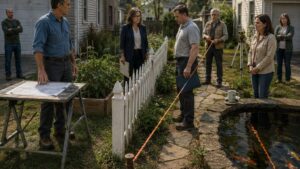
Thomas crossed the yard slowly. Three raised planters ran along the rear wall, their corners weathered smooth. Beside them, the fig tree leaned toward the narrow side passage between his house and the property next door. Its lower branches had always spread freely there.
Now one branch was trapped against a square deck post.
The post stood so close to Thomas’s siding that he could have reached from his window and laid a palm against it. A concrete footing beneath it had swallowed part of the narrow garden strip where he grew thyme and kept the drainage channel clear.
Thomas stared at the footing.
For twenty-two years, he had maintained that strip. He knew its width from habit: two mower passes near the fence, a narrower hand-trim beside the foundation. In his years working municipal maintenance, he had learned how quickly people forgot boundaries that were not painted bright yellow. But memory was not proof, and he knew that too.
A worker appeared above him on the unfinished frame.
“Morning,” the man said.
“Morning.” Thomas pointed to the post. “Who set that footing?”
The worker glanced toward Jason Carter’s back door. “Boss says the line’s good.”
“Which boss?”
Before the worker could answer, the door opened. Jason stepped out carrying a stainless-steel coffee mug. He wore work boots, clean jeans, and the expression of a man interrupted during something he had already decided was settled.
“Thomas,” he said. “You’re up early.”
“I’m always up early.”
Jason looked at the fig branch pressed under the post. “We’ll trim that back.”
“You won’t need to if the post isn’t on my land.”
The workers went quiet one by one. A drill spun down.
Jason descended the temporary stairs. He was forty-something, broad through the shoulders, with the permanent squint of someone accustomed to looking into bright job sites. When he had moved in fourteen months earlier, he had brought Thomas’s trash cans in during a storm. They had exchanged tomatoes over the fence twice. Nothing in those moments had suggested friendship, but nothing had suggested this either.
Jason stopped a few feet away.
“My contractor checked it.”
“With what?”
“A site plan. The HOA approved the whole thing.”
“HOA approval doesn’t decide a property line.”
Jason exhaled through his nose. “We went over this when I submitted the plans.”
“No one went over it with me.”
“The board did.”
Thomas looked again at the footing. Wet concrete had hardened around pale wood, and a crust of displaced soil lay over the thyme. He crouched and brushed the loose dirt aside. Beneath it, the ground sloped toward the shallow channel running along his foundation.
The post was not merely close. It was beyond where the old marker should have been.
His heart began to beat harder, not with doubt but with recognition.
Years earlier, when he and his wife had replaced the back fence, the surveyor had marked the corner with a small capped pin. Thomas remembered kneeling in almost that exact place while she held the rolled drawing under one arm and complained about mosquitoes. The pin had sat several inches beyond the edge of the thyme bed.
The new footing covered ground on Thomas’s side of that remembered point.
He rose.
“Stop work until the line is confirmed.”
Jason gave a short laugh. “You can’t order my crew around.”
“I’m asking you not to build on disputed ground.”
“There’s no dispute. There’s you standing in your yard remembering something from twenty years ago.”
The words landed harder than Thomas expected. He felt the workers watching him, measuring his age against Jason’s certainty.
Thomas kept his voice level. “Show me the survey.”
“I don’t owe you my paperwork.”
“You owe me enough care not to pour concrete on my property.”
Jason stepped closer. The coffee mug hung at his side.
“You know what I think?” he said. “I think you saw the plans go up and decided you didn’t like looking at a deck. That doesn’t make it yours to stop.”
Thomas could have told him about runoff. About setback rules. About every buried utility corridor he had seen blocked by somebody certain that six inches did not matter. He could have said the fig tree was not decoration and the garden strip was not empty ground.
Instead, he said, “Give me until tomorrow to check the records.”
Jason looked past him toward the raised beds. “The crew’s booked. Materials are paid for. I’m not losing a day because you feel crowded.”
Thomas felt heat climb behind his collar. He had spent most of his life learning not to answer contempt with more of it. Silence had served him in city meetings, contract disputes, and hospital corridors. It had allowed other people to reveal how little they knew.
But silence could also be mistaken for surrender.
He turned toward the house.
Behind him, Jason called, “Thomas.”
Thomas stopped.
“If you call the HOA, they’ll tell you the same thing. This was approved.”
Thomas looked back once. “Then they should have no trouble showing me what they approved.”
Inside, he went to the hall closet and pulled down a flat cardboard document box. Dust marked the shelf where it had rested. He carried it to the kitchen table and opened it.
Insurance policies. Appliance manuals. Closing documents. A faded landscape sketch. He moved carefully, refusing to rush and tear something important. Near the bottom lay a large envelope with soil-darkened corners.
He did not open it.
Not yet.
Through the window came the renewed shriek of the saw.
Thomas stood with both hands on the table. The envelope contained the old survey, he was almost certain. It also contained papers from the year the garden had been rebuilt, papers bearing his wife’s handwriting in the margins. He had not looked at them since her funeral.
Outside, a hammer struck three quick blows.
Thomas closed the box, took his phone from the counter, and called the number printed on the HOA notice board near the community entrance. No one answered. He left a brief message asking for the approved plans and the date of review.
Then he called the county’s general information line. The recording told him the building counter would open at eight Monday morning.
When he returned outside, the frame had grown another six feet.
Jason stood on the deck with the contractor, both of them looking down toward the disputed post. Thomas heard only the end of their conversation.
“—before anybody can tie us up,” Jason said.
The contractor nodded and raised his voice to the crew.
“You heard him. Finish the outside line today.”
Chapter 2: An Approval Letter That Proved Too Little
The county permit clerk searched Jason Carter’s address three times.
She tried the street number alone, then the full address, then the parcel identification Thomas had copied from his tax statement. Each attempt produced the same white screen with a gray line across the center.
“No active building permit,” she said.
Thomas remained at the counter. “Could it be listed under the contractor?”
“It would still connect to the parcel.”
She turned the monitor slightly so he could see. A permit for a water heater from six years earlier appeared in the history, along with a roof replacement filed by the previous owner. There was nothing for a deck.
“Maybe the application hasn’t posted yet,” Thomas said.
The clerk shook her head. “If work has started, the permit should already be issued and visible. HOA approval isn’t a substitute.”
He had known that. Hearing it stated plainly should have settled something inside him.
Instead, uncertainty moved into a new place.
He thanked her and asked how to request an inspection. She handed him a form and wrote a number in the upper corner. Before he left, she advised him not to enter the construction area or touch the materials.
“Photograph what you can from your own property,” she said. “And find your survey.”
Back home, Thomas set the county form beside the envelope from the document box. A smear of dark soil crossed one corner where his fingers had touched it after clearing the footing.
He stared at the stain.
The answering machine blinked. Nancy Miller had returned his call.
Thomas dialed the number she left.
Nancy answered on the fourth ring. Her voice was warm in the formal way of someone who had already chosen her position.
“Thomas, I understand you have concerns about the Carter deck.”
“It appears to cross my property line.”
“The architectural committee reviewed the application.”
“I asked for the plans.”
“Yes, and I can arrange that. But I want to be clear that the board approved the design as submitted.”
“Was there a survey?”
There was a pause, brief but distinct.
“There was a site drawing.”
“Prepared by whom?”
“The contractor included it.”
“That wasn’t my question.”
Nancy’s warmth thinned. “Thomas, the board is made up of volunteers. We review for appearance, materials, and community standards. We do not adjudicate boundary disputes.”
“Then why are you telling me the approval settles one?”
“I’m telling you the Carters acted in reliance on written approval.”
“The county has no permit.”
Another pause.
“County permitting is the homeowner’s responsibility.”
“So the HOA approved a deck without confirming whether it could legally be built?”
“We approved its architectural character.”
Thomas looked through the kitchen window. The outer deck beam now ran parallel to his wall. One worker crouched close enough to the siding that his shoulder nearly brushed it.
“Nancy, there’s a support in my garden.”
“If you interfere with the crew and the project is delayed without cause, Jason may claim additional costs.”
Thomas tightened his grip on the phone. “Are you advising him as his attorney?”
“No. I’m advising both homeowners to avoid escalating.”
“The construction is the escalation.”
“I’ll schedule an on-site review tomorrow morning. You, Jason, and two committee members can look at the approved drawing together.”
“The county inspector is coming tomorrow afternoon.”
Nancy went quiet.
“An inspector?” she asked.
“Yes.”
“That seems premature.”
“The post is already in concrete.”
Her answer came more quickly now. “Then please do not make statements to the inspector about HOA authorization until we have reviewed the file. The board’s approval has a limited scope.”
Thomas nearly laughed, though nothing about it was funny. Five minutes earlier, the approval had been the reason he should stop objecting. Now it had a limited scope.
“I’ll state what happened,” he said.
“Thomas, I am trying to keep this from becoming expensive for everyone.”
“It’s already expensive for somebody.”
He ended the call before anger made him careless.
The envelope on the table seemed heavier than paper. He slid a finger under the flap, then stopped when he saw blue ink through the opening. His wife had labeled the survey in her small, upright handwriting.
BACK BOUNDARY—KEEP WITH HOUSE PAPERS.
Thomas pressed the flap closed.
He told himself he did not need the original yet. The county had GIS records. The inspector would locate the pins. Producing the envelope now would mean unfolding the plan, seeing her notes, perhaps finding the receipt for the fig tree she had insisted was too large for the car.
Procedure should be enough.
By late afternoon, the HOA emailed him a scan of Jason’s approval letter. It authorized a cedar-toned elevated deck, subject to county permits, drainage requirements, and all recorded property restrictions. Attached was a single-page drawing with rectangles representing the two houses and a broad shaded deck behind Jason’s.
The property line was a thin dotted mark.
No measurements appeared beside it.
No surveyor’s seal appeared anywhere.
Thomas printed the page and placed it beside the county search result. The contrast was almost absurd: one document looked official but proved only that the board liked the design; the other looked nearly blank but established that no lawful construction authorization existed.
At seven the next morning, Nancy arrived with two board members. Jason met them in his driveway carrying a blue folder.
The contractor had already begun work.
Nancy did not enter Thomas’s house. She stood at the edge of his lawn and held the approved drawing at chest height.
“As you can see,” she said, “the deck remains within the footprint represented here.”
Thomas pointed at the dotted line. “What establishes where that line is on the ground?”
“The contractor’s dimensions.”
“Where are they?”
Jason opened the folder and produced an estimate, a materials list, and the HOA approval. No sealed survey appeared.
“My contractor measured from the fence,” he said.
“The fence was never certified as the boundary.”
Jason’s jaw shifted. “Now the fence is wrong too?”
“I didn’t say that. I said it isn’t proof.”
One board member studied the drawing. The other avoided Thomas’s eyes.
Nancy lowered her voice. “The sensible approach is to let the county confirm the location. Until then, no one should inflame the situation.”
Thomas looked toward the yard. “Then stop the crew until this afternoon.”
Jason answered before Nancy could.
“No.”
“The inspector will be here in a few hours.”
“And when she says it’s fine, I’ll have lost half a day.”
“You may lose more than that if it isn’t.”
Jason closed the folder sharply. “You keep talking like you want me to lose it.”
Thomas felt the opening—the chance to explain that he wanted only the strip kept clear, that water had to move beside the foundation, that the fig roots spread under that soil. He might even have said there were reasons he cared about that garden which Jason could not see.
But Nancy and the board members were watching, and the words stayed where they always stayed.
“It’s my land,” Thomas said.
Jason’s expression changed as if Thomas had confirmed something ugly.
By noon, the railing posts were in place.
At one thirty, Thomas heard a drill against the outer beam. He went into the side passage and found a worker fastening blocking inches from his siding. The new frame cast a hard shadow over the thyme bed.
Thomas looked toward the street for the county vehicle.
There was none.
Then a board snapped into position with a heavy wooden knock, and the deck reached all the way to his wall.
Chapter 3: Eleven Inches in Front of Everyone
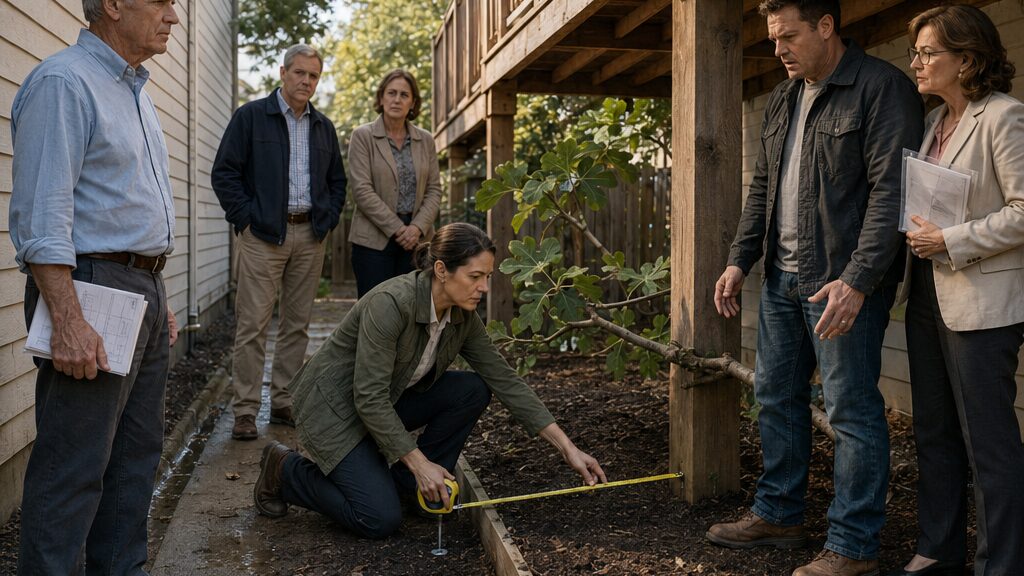
“Everyone step back,” Elizabeth Nelson said. “The marker is under the mulch.”
She knelt beside the fig tree with one knee on a square foam pad, working the point of a narrow probe through damp soil. Her tablet lay on the grass. A bright metal tape measure rested beside it, its housing scratched from use.
Thomas stood near the raised beds. Jason remained on the unfinished deck with his arms folded. Nancy and the two board members had arranged themselves closer to Jason’s side, as though position could signal neutrality.
The contractor watched from the driveway gate.
Elizabeth pressed the probe again. Metal clicked against metal.
“There,” she said.
She cleared the soil with a gloved hand until the round cap of the survey pin appeared. It sat where Thomas remembered, beyond the old thyme bed and well inside the line now occupied by Jason’s outer support.
Jason leaned forward. “That could be an old landscaping stake.”
Elizabeth wiped the cap clean. “It’s marked.”
“My contractor measured from the fence.”
“I’ll measure from the monument.”
Nancy stepped around a planter. “Before this goes further, I think everyone should understand that the board approved the project in good faith.”
Elizabeth did not look up. “I’m here for county code compliance.”
“Of course. I’m only providing context.”
Thomas saw the approved site drawing tucked under Nancy’s arm. She had brought the same page, now inside a clear plastic sleeve.
Elizabeth entered a number into her tablet, checked the county parcel map, and asked Thomas whether another pin existed near the front corner.
“Yes.”
“Visible?”
“It should be.”
Jason climbed down from the deck. “We’re really doing the whole property over a few inches?”
Thomas said nothing.
Nancy turned toward him. “Thomas, assuming there is a small discrepancy, is it worth destroying a neighbor’s investment over eleven inches?”
The number had not yet been measured. Her use of it startled him.
“Why eleven?” he asked.
Nancy blinked. “It was an example.”
Jason gave a frustrated laugh. “This is exactly what I’ve been saying. He doesn’t like the deck, so now every technicality is a crisis.”
The fig branch scraped faintly against the post when someone shifted the frame above it.
Thomas looked at the branch, then at Elizabeth.
“I have an older survey,” he said.
Every face turned toward him.
Jason’s arms dropped. “You have a survey?”
“At the house.”
“And you waited until now?”
Thomas felt the accusation land because it contained a piece of truth. He had wanted the county records to speak without requiring him to open the envelope. He had told himself that was prudence.
It had also been avoidance.
“I’ll get it,” he said.
In the kitchen, the document box sat where he had left it. Thomas opened the survey envelope fully for the first time.
The plan unfolded in stiff panels across the table. His wife’s blue notes appeared in three places. Near the side boundary she had written: CLEAR FOR DRAINAGE AND LADDER ACCESS. Beside the fig tree location: SIX FEET FROM LINE—ASK THOMAS.
He stood over the paper until Elizabeth called from outside.
Thomas folded it along the old creases and returned.
Elizabeth checked the surveyor’s seal, date, legal description, and corner references. “This is consistent with the plat on file,” she said.
Jason looked at Nancy. “You told me the drawing was enough.”
“I told you the committee approved the design you submitted.”
“You approved the location.”
“We approved the representation of the location.”
“That’s the same thing.”
“No,” Thomas said quietly. “It isn’t.”
Jason turned on him. “You could’ve shown this before I poured concrete.”
“You could’ve stopped when I told you the line was disputed.”
Elizabeth stood. “We’re going to measure.”
She anchored the tape at the uncovered survey pin and extended it toward the deck support. The blade flashed in the afternoon sun, passing beneath the trapped fig branch and across the narrow strip of thyme.
The metal edge touched the inner face of the post.
Elizabeth bent to read it.
For a moment, no one spoke.
“Eleven inches,” she said.
Jason stared down at the tape. “From which side of the pin?”
“The center point, as specified.”
“That footing’s wider than the post.”
“Yes.”
“So the post itself could be closer.”
“The structural support is what encroaches. The footing extends farther.”
The contractor stepped forward. “The fence line angles.”
Elizabeth looked at him. “The monument line does not follow the fence.”
“I used the HOA plan.”
“Did you obtain a boundary survey?”
“No. The homeowner said the plan was approved.”
Jason’s face tightened. “You said you checked it.”
“I checked the dimensions you gave me.”
“You measured.”
“From the fence.”
Their words fell over each other, each man trying to place the error into the other’s hands.
Elizabeth retracted several feet of tape, then extended it toward Thomas’s foundation. She measured the clearance between the deck and the house, checked the grade below, and followed the shallow drainage channel until it disappeared beneath the new frame.
“This access must remain unobstructed,” she said.
Jason rubbed both hands over his face. “For what?”
“Foundation maintenance, drainage, and emergency access. Even if the property line were not an issue, this configuration would not meet the required clearance.”
Nancy looked at the board members. “The architectural committee does not review county setbacks.”
Elizabeth picked up her tablet. “The permit office has no application or issued permit for this address.”
Jason’s head snapped toward the contractor again.
The contractor lifted both hands. “Permits were listed as owner responsibility in the contract.”
“You knew I thought you were handling them.”
“I told you the price didn’t include fees.”
“That isn’t the same thing.”
Thomas heard the panic beneath Jason’s anger now. It did not erase the insult from Sunday or the decision to keep building. But it changed the sound of the moment. Jason was no longer a man certain of his rights. He was a man watching several expensive assumptions collapse at once.
Elizabeth typed for nearly a minute.
“What happens now?” Jason asked.
“I’m issuing a stop-work order today. Because the structure crosses onto an adjoining parcel and blocks required access, the encroaching section must be removed. The notice will state the compliance deadline.”
“How long?”
“Seventy-two hours from service unless the building official modifies it.”
Jason looked at the nearly finished frame. “You expect me to tear this apart in three days?”
“I expect work to stop now. You may submit documentation, but you cannot continue construction.”
“What about a variance?”
“Not for building on property you do not own.”
Nancy stepped closer to Elizabeth. “Could the parties enter a temporary license agreement?”
Thomas answered before Elizabeth could.
“No.”
Jason looked at him. “You didn’t even think about it.”
“I thought about the water under that deck. I thought about needing access to my own wall. I thought about asking you to stop before the frame went up.”
“You want the whole thing gone.”
“I want it off my property.”
Elizabeth printed two pages from a portable unit in her vehicle. She attached one notice to the temporary stairs and handed the other to Jason.
A red band across the top read STOP WORK.
Thomas had imagined this moment since Sunday. In that private version, proof brought relief. Jason would be corrected, the crew would leave, and the garden would become quiet again.
Instead, Jason read the notice twice and sat on the lowest unfinished step.
“How much?” he asked the contractor.
The contractor did not answer immediately.
“How much to take back the outside line and rebuild it?”
“I’d have to price it.”
“Give me a number.”
“Not standing here.”
Jason laughed once, bitterly. “Of course not.”
The crew began packing tools. One worker lifted the saw that had broken Thomas’s Sunday morning and carried it through the gate. The sudden absence of noise made the yard feel exposed.
Nancy spread the approved site drawing on Thomas’s potting table.
Elizabeth compared it with the survey. “This dotted boundary doesn’t match the parcel geometry.”
“It was submitted by the owner,” Nancy said.
“Where did the base image come from?”
Nancy’s fingers tightened on the plastic sleeve. “I would have to review the file.”
Thomas leaned closer. The rectangles on the drawing were familiar, though he could not place why. The shape of his raised beds appeared as three pale blocks. The fig tree was shown as a small circle. The disputed strip had no label and no measurement.
Elizabeth tapped the page. “This is not a survey.”
“We never represented it as one.”
Jason stood. “You represented it as enough.”
Nancy gathered the drawing. “We need to continue this discussion through the proper process.”
She moved toward the gate while Elizabeth spoke with the contractor about safe removal.
Thomas watched Nancy slide the approved plan out of its clear sleeve. She folded it once, then again, covering the lower corner where a faint date and file reference had been printed.
When she reached the driveway, she glanced back.
Then she slipped the plan into her handbag instead of returning it to the HOA folder.
Chapter 4: The Map the Board Should Never Have Used
The approved drawing had no surveyor’s seal.
Thomas noticed it before Nancy Miller finished telling him why the architectural file could not be released without a formal records request. The page lay on the HOA conference table beneath a clear plastic cover, and in the lower right corner—where a licensed surveyor’s name, registration number, and embossed mark should have appeared—there was only a faint date and the words LANDSCAPE CONCEPT.
“This isn’t a site survey,” Thomas said.
Nancy kept one hand on the file. “No one said it was.”
“Yesterday you called it the approved site plan.”
“It is the plan the committee reviewed.”
“That doesn’t make the property line accurate.”
One of the two board members sat at the far end of the table, turning a pen between his fingers. The other had not attended. The records room was little more than a converted storage office behind the community clubhouse, with metal cabinets along one wall and boxes of holiday decorations stacked above them.
Nancy had agreed to meet only after Thomas submitted a written request that morning.
Jason sat beside her.
The stop-work notice had been stapled to the outside of his deck for less than twenty-four hours, but he looked as if he had not slept. He had brought a legal pad filled with numbers. At the top, in dark ink, he had written MATERIALS, LABOR, REMOVAL.
“You had this survey the whole time,” he said to Thomas.
“I had an older survey of my property.”
“And you didn’t show it until the concrete was set.”
Thomas looked at him. “I told you to stop before the concrete cured.”
“You told me you remembered the line.”
“I told you it was disputed.”
Nancy slid a request form toward Thomas. “We are not going to resolve personal blame in the records room.”
“No,” Thomas said. “We’re going to determine what the board approved.”
Her expression tightened.
The file contained Jason’s application, photographs of cedar samples, railing specifications, the contractor estimate, and several email messages discussing stain color. The disputed drawing appeared twice. One copy carried red committee initials. The other had been reduced and attached to the approval letter.
Thomas examined the line separating the properties.
It bent slightly near the back corner, though the recorded parcel boundary did not. The drawing showed Thomas’s three raised beds, the fig tree, and the side strip as loose landscaping features rather than surveyed improvements. The deck rectangle stopped just short of the dotted line.
On paper, it fit.
On the ground, it crossed by eleven inches.
“Where did this base image come from?” Thomas asked.
Nancy opened another folder. “It appears to have been in the association’s landscaping records.”
“What year?”
“We’re checking.”
The board member stopped turning his pen.
Thomas looked at the faint file reference Nancy had tried to hide by folding the page after the inspection. “It has a number.”
Nancy did not answer.
He read it aloud.
The board member rose and went to one of the cabinets. Nancy started to object, then seemed to decide that stopping him would look worse. He searched several hanging folders and withdrew a larger sheet yellowed at the edges.
When he spread it across the table, Thomas recognized it.
The drawing had been prepared seventeen years earlier during a neighborhood drainage project. It showed planting beds, fences, downspout locations, and access corridors. It was not intended to define ownership. A note along the bottom said, in small capital letters, BOUNDARIES APPROXIMATE—FOR LANDSCAPE COORDINATION ONLY.
Jason read the sentence twice.
“You approved my deck from this?”
Nancy sat straighter. “The committee reviewed the materials submitted.”
“You already had this in your records.”
“The applicant is responsible for accuracy.”
“You stamped it approved.”
“Subject to county permits and recorded restrictions.”
Jason pushed back from the table. “You knew I was building.”
“I knew you had architectural approval.”
“And nobody told me I needed a separate survey.”
Thomas almost spoke, then stopped. Jason had been warned. Not by the board, perhaps, but by him.
Nancy looked at Thomas. “May we see the full survey packet you brought yesterday?”
He had carried it in under his arm. The envelope rested on the chair beside him.
For a moment, his hand did not move.
The sealed survey would prove the monument locations and the side boundary. He had already shown that portion to Elizabeth. But beneath it lay older association correspondence, maintenance notes, and the document his wife had insisted they file after the drainage work.
Thomas took out the survey and placed it on the table.
Several pages slid free.
One bore his signature.
Jason reached it first.
“What is this?”
Thomas knew before he read the heading.
TEMPORARY SHARED MAINTENANCE ACCESS ACKNOWLEDGMENT.
The form dated from the drainage project. It allowed association contractors and the adjoining owner temporary access across the narrow strip to repair a swale and replace a section of fence. Thomas had signed because the work needed to be done and because he had not wanted a fight with the family who lived next door at the time.
Jason read the middle paragraph.
“It says shared access.”
“For maintenance,” Thomas said.
“It says the adjoining owner may enter the strip.”
“To maintain drainage and fencing. Not to build on it.”
Nancy leaned over the page. “This may explain why the strip was treated as common access in later files.”
“It was never common property.”
“No one said it was.”
“You represented it that way.”
Nancy’s voice sharpened. “The board used the records available. This document was signed by you.”
Thomas felt the room turn.
The form did not transfer ownership. It did not authorize permanent construction. Yet he could see how its loose wording, separated from the survey and copied into the association file, had helped blur what should have remained exact.
Years earlier, he had noticed that the landscaping diagram left the strip unlabeled. He remembered asking the property manager whether it should be corrected. The manager had said everyone understood the arrangement and that changing the plan would require another committee review.
Thomas had let it go.
At the time, his wife’s treatments had begun. He had chosen one less meeting, one less argument, one less folder of paperwork on the kitchen table.
That decision had waited seventeen years to become expensive.
Jason tapped the signature. “You knew the HOA considered this shared.”
“I knew workers could cross it to clear the drain.”
“That isn’t what I was told.”
“Who told you?”
Jason looked at Nancy.
Nancy closed the file.
“We are not going to speculate about private conversations.”
“That means you did,” Jason said.
“I explained the records as they existed.”
“You told me Thomas had signed off on shared use.”
Thomas looked from Jason to Nancy.
She had not merely approved a careless drawing. She had interpreted his old maintenance form as permission, then allowed Jason to rely on that interpretation without asking Thomas or checking the survey.
Nancy gathered the papers into a neat stack.
“The association’s counsel will review this. Until then, no one should make accusations about negligence or liability.”
Jason laughed without humor. “Now you want everyone careful.”
Thomas folded the maintenance form along its original crease. His wife’s initials appeared in the margin beside one sentence. She had added two words in blue ink: KEEP CLEAR.
He had seen the ambiguity years ago. He had chosen quiet because quiet had seemed cheaper.
Now the deck stood against his wall, Jason faced a removal bill, and the HOA was preparing to defend itself with Thomas’s own silence.
He slipped the form back into the envelope.
For the first time since the saw started, he could no longer tell himself that every mistake belonged to the people across the property line.
Chapter 5: The Reason Jason Built So Fast
The walker arrived before breakfast.
A delivery driver unfolded it on Jason’s porch, checked the brakes, and left it standing beside the front door with a plastic instruction packet looped over one handle. The aluminum frame shone beneath the porch light.
Thomas saw it while retrieving his newspaper.
Jason came outside in sweatpants and signed the delivery form. When he noticed Thomas watching, he turned the walker sideways as if its presence required explanation.
“My mother’s coming Friday,” he said.
Thomas looked toward the backyard, where the red stop-work notice moved faintly against the unfinished stairs.
“I thought she lived two states over.”
“She did.”
Jason rolled the walker inside. “The hospital won’t discharge her back to her place unless somebody can stay with her. I’m bringing her here.”
The door closed.
An hour later, Jason knocked on Thomas’s kitchen door.
He did not ask to come in. He held a copy of Elizabeth’s violation notice and a sheet from the contractor showing the preliminary removal estimate.
“I need five more days,” he said.
“The notice gives you seventy-two hours.”
“I know what it says.”
“The drainage channel is blocked.”
“The deck has been there less than a week.”
“And there’s rain forecast tomorrow night.”
Jason looked toward the fig tree. “I can open part of the channel without tearing down the frame.”
“The support is on my land.”
“I’m not arguing that now.”
The admission was so quiet Thomas almost missed it.
Jason unfolded the estimate. “The contractor wants twelve thousand to remove and rebuild the outside section. That’s before new permits, before engineering, before whatever the county adds. If I make him start today, he says he can’t guarantee the house will be ready for my mother.”
“Ready how?”
Jason’s jaw tightened, and for a moment Thomas thought he would retreat into anger.
Instead, he said, “She fell in her kitchen six weeks ago. Broke her hip. The doctors say she’ll recover, but stairs are going to be hard. She hates being inside. The deck was supposed to give her a level way out from the kitchen.”
Thomas pictured the frame differently then: not as an elevated platform for parties, but as a wide door opening to a place where an older woman could sit without descending the back steps.
It did not move the post.
“Why didn’t you say that?” Thomas asked.
“Why should I have to explain my family to get permission to build on my property?”
“You weren’t building on your property.”
“I know that now.”
The words came through clenched teeth.
Jason looked down at the estimate. “I thought I had done this right. I submitted the HOA forms. I hired somebody licensed. I asked Nancy whether the side access was shared. She showed me your signed form.”
“And when I warned you?”
Jason did not answer.
“You kept building,” Thomas said.
“I thought you were trying to stop it because you didn’t like it.”
“You didn’t ask.”
“You didn’t explain.”
There it was again: the space Thomas had left empty, filled by someone else’s worst assumption.
He opened his mouth to tell Jason that explanation should not have been necessary. Property lines did not depend on personal stories. A man should not have to display grief before being believed about his own land.
All of that was true.
It was also not the whole truth.
“I won’t authorize the deck to remain over the line,” Thomas said. “Not for five days.”
Jason folded the estimate. “Then what am I supposed to tell her?”
“That the house isn’t ready.”
Jason stared at him, hurt flashing beneath anger. “Easy for you to say.”
“No,” Thomas said. “It isn’t.”
But Jason had already turned away.
Near noon, a sedan stopped in front of Jason’s house. A woman with short silver hair sat in the passenger seat while Jason came around to help her out. She wore a brace beneath one pant leg and held the door frame until he brought the walker close.
Susan Carter moved slowly but with irritation at being watched.
“I can stand,” she told him.
“I know.”
“You’re holding me like I’m glass.”
“I’m not.”
“You are.”
Thomas looked away before they noticed him.
Later, from his garden, he heard their voices through Jason’s open kitchen door. Susan wanted to see the deck. Jason told her it was not safe. She insisted she could manage the threshold.
When she appeared in the doorway, she saw Thomas beside the fig tree.
“So you’re Mr. Hall,” she said.
Thomas rested his hand on the handle of his garden fork. “Thomas is fine.”
Jason came behind her. “Mom, let’s go inside.”
Susan ignored him. “Jason says you’re making him tear the deck down.”
“The county issued the order.”
“Because you complained.”
“Because it crosses the boundary and blocks drainage.”
She looked at the unfinished frame. From the doorway, the deck seemed almost complete. Broad boards covered most of the surface, and the missing railing sections were the only obvious sign of interruption.
“I was supposed to sit out there,” she said. “He told me I’d be able to get outside without asking him to help me down the stairs.”
Thomas looked at Jason.
Jason’s face had gone still.
Susan followed Thomas’s gaze toward the fig tree. One low branch was bent beneath the outer beam, its leaves turned sideways to find light.
“That tree yours?” she asked.
“Yes.”
“It looks trapped.”
Jason said, “Mom.”
She touched the walker brakes. “I can see both things at once.”
For the first time, Thomas understood that Jason’s urgency had not come only from money or pride. He had promised his mother something concrete: independence, sunlight, a place outside his kitchen where she would not feel supervised.
He had built too fast because he feared failing her.
That fear did not excuse what he had done. It did explain why every warning had sounded to him like a threat.
Susan shifted her weight.
“Can it be rebuilt smaller?” she asked.
“If it’s surveyed and permitted,” Thomas said.
Jason’s expression hardened. “Not before she gets here.”
“She’s already here,” Susan said.
The three of them stood with the unfinished deck between them.
Thomas could have offered temporary access through his yard. He could have suggested a chair beneath the fig tree. The thoughts rose and stopped at the same barrier that had held back every personal explanation.
Instead, he said, “The forecast says heavy rain tomorrow.”
Jason looked toward the sky. “The contractor says the water will drain.”
“The channel runs under that frame.”
“He can open it.”
“He should have left it open.”
Susan studied Thomas’s face, perhaps hearing more in his tone than he intended.
Jason wheeled her back inside.
By late afternoon, clouds had thickened. The contractor returned to inspect the deck but did not begin removal. He and Jason argued in the driveway about responsibility, deposits, and scheduling. Thomas heard the contractor say that no crew would be available until Monday unless Jason authorized emergency rates.
The seventy-two-hour deadline would expire Sunday afternoon.
At dusk, the first rain began as scattered drops, darkening the deck boards one circle at a time.
Thomas went outside with a flashlight. Water already ran down the narrow strip toward the outer footing. The concrete base divided the shallow channel like a dam. Leaves and loose soil collected against it.
He crouched and tried to clear a path with the garden fork, but the deck frame left no room to angle the tool.
A stronger burst of rain struck the boards overhead.
Water backed toward his foundation.
Thomas aimed the flashlight beneath the deck. A shallow pool had formed against the lowest course of siding, reflecting the red stop-work notice in broken pieces.
Chapter 6: Seventy-Two Hours Before the Water Rose
By midnight, the water had reached the bottom edge of Thomas’s siding.
He stood beneath the eave in a rain jacket, watching the narrow garden strip disappear under muddy runoff. The fig tree’s leaves snapped in the wind. Water pressed against the deck footing, split around it, and gathered in the blocked space between the frame and his house.
Thomas drove the blade of a flat shovel into the mud.
The handle struck a joist overhead.
There was no room to lift.
Across the fence, Jason’s back door opened. He came out carrying a flashlight and wearing boots without socks.
“How bad?”
“Bad enough.”
Jason stepped onto the unfinished deck, then stopped when the boards shifted under his weight. “The contractor said the channel would still drain.”
“Look.”
Thomas shone the light against the siding.
Jason descended carefully and crouched at the edge of the frame. Rain ran off his hair.
“We can pull one board.”
“The footing is the obstruction.”
“I can cut around it.”
“You’ll undermine fresh concrete in saturated soil.”
Jason swore under his breath. “So what do you want me to do?”
Thomas nearly answered, Tear it down. The county notice gave him every reason. The water gave him another.
But a panicked demolition in darkness could damage the fig roots, the siding, or the buried drainage pipe. Justice performed badly would still leave Thomas with the repair.
“Call the contractor,” he said.
“He won’t answer.”
“Call again.”
Jason did. The call went to voicemail.
Thomas went inside and retrieved a portable pump he had used years earlier when a storm drain backed up. Together, without discussing the strangeness of it, they lowered the intake hose into the deepest part of the pool and ran the discharge toward the street.
The pump began with a cough, then a steady mechanical hum.
For two hours, they cleared leaves and watched the water level. Susan appeared once in the kitchen window, a robe around her shoulders. Jason raised one hand to tell her they were all right.
Near three in the morning, the rain weakened.
The siding remained wet, but the water receded below it.
Jason sat on the lowest unfinished step.
“I’ll start removal tomorrow,” he said.
Thomas looked at him. “Today.”
Jason glanced at his phone. “Right.”
At eight, Elizabeth returned Thomas’s emergency message. He described the flooding and sent photographs. She told him the stop-work order permitted only work necessary to remove the violation or protect the property. Any partial dismantling had to be done safely.
At nine, Nancy called an emergency HOA meeting.
She proposed it as a practical solution: a temporary association waiver allowing the deck to remain for thirty days while Jason submitted revised plans and sought county review.
Thomas listened from his kitchen table on speakerphone. Jason sat across from him, still wearing the same rain-stained sweatshirt. Susan rested in the next room.
“You can’t waive county code,” Thomas said.
“We can temporarily recognize shared access while the legal issues are reviewed,” Nancy replied.
“The strip isn’t shared property.”
“The maintenance form creates ambiguity.”
“It creates maintenance access.”
“Which counsel may interpret more broadly.”
Jason rubbed his forehead. “Nancy, the inspector measured it. The water backed against his house.”
“I understand there was unusual rainfall.”
Thomas looked at the mud drying on his floor where their boots had tracked it in.
“The drain worked for seventeen years,” he said. “It stopped working when the footing went in.”
One board member asked whether the HOA could assume liability for any foundation damage during the proposed thirty days.
Nancy did not answer directly.
Thomas folded his hands. He could force the cleanest possible outcome: reject every delay, let the county fines begin, and watch Jason argue with the contractor while the deadline ran out.
It would be lawful.
It would not necessarily protect the house.
“I won’t sign a waiver,” Thomas said.
Jason closed his eyes.
“But I’ll provide a dismantling sequence.”
Nancy’s voice sharpened. “A what?”
“A written order of work. Remove the outer decking first. Brace the remaining frame. Cut back the beam. Lift the post without dragging the footing through the fig roots. Open the drainage channel before anything else.”
Jason looked up.
Thomas continued. “The contractor can review it. Elizabeth can tell us whether it complies with the stop-work order.”
“You’re not an engineer,” Nancy said.
“I supervised municipal repair crews for thirty-one years. I know how to remove an obstruction without creating another one.”
Silence followed.
It was the first time Thomas had offered something other than refusal.
Jason leaned toward the phone. “If we do it his way, will the HOA document that the original approval relied on the wrong map?”
Nancy answered carefully. “The board will document that questions have arisen regarding the source drawing.”
“That isn’t what I asked.”
“We should not assign fault before counsel reviews the matter.”
Jason gave a small, exhausted laugh. “You assigned Thomas plenty of fault before anybody reviewed anything.”
The meeting ended without a waiver.
Thomas drew the dismantling sequence on clean paper. He marked the order of cuts, brace locations, and access path. When he finished, Jason studied the page.
“You could’ve just let the county fine me,” he said.
“I still might if you don’t start.”
“That isn’t why.”
Thomas placed the pencil down. “Water doesn’t care who was right.”
Jason looked toward the doorway where Susan’s walker stood folded against the wall.
“I skipped the permit because the contractor said the county was running six weeks behind,” he said. “My mother’s discharge date kept moving up. Every time I called her, she asked whether the room was ready, whether the bathroom bars were in, whether she could get outside.”
Thomas said nothing.
“I had already told her yes,” Jason continued. “I couldn’t stand calling back and saying I’d failed another thing.”
“So you decided anyone slowing you down was the enemy.”
“I decided you were.”
“Because I was old?”
Jason’s face tightened. “Because you looked at me like I didn’t know what I was doing.”
“You didn’t.”
“I know.”
The admission sat between them.
Jason picked up the drawing. “When you came over Sunday, I thought if I stopped, everybody would know I’d messed up. The crew. Nancy. My mother. You.”
“So you made it bigger.”
“Yes.”
A truck door slammed outside.
The contractor entered through Jason’s gate with the estimate folder under one arm. He read Thomas’s dismantling sequence, then shook his head.
“I’m not touching it under the original contract.”
“You put it in the wrong place,” Jason said.
“I built from the dimensions you approved.”
“You said you checked them.”
“I checked from the fence. Your contract says owner responsible for boundary verification and permits.”
Jason stepped closer. “You knew there was no permit.”
“I knew you wanted to start before one was issued.”
“You told me it happened all the time.”
“That doesn’t make me responsible for your property line.”
The contractor placed a formal notice on the deck rail. If Jason withheld the remaining payment, the company would pursue a mechanic’s lien.
Susan had come to the doorway. She heard enough to understand.
“How much?” she asked.
Jason did not turn around.
“Jason.”
He gave her the estimate.
She read the number, gripping the walker with one hand. “You spent this much before the permit?”
“I was trying to get it done.”
“For me?”
He nodded.
Susan folded the paper once. “Then stop saying you did it for me as though that makes every decision mine.”
Jason looked at her.
“I asked for a chair outside,” she said. “I did not ask you to gamble your house.”
The contractor left after agreeing to return only if Jason signed a new removal contract at emergency rates.
Jason did not sign.
Instead, he carried Thomas’s circular saw from the garage to the deck. Thomas checked the blade, placed two temporary braces beneath the outer beam, and marked the first cut with a carpenter’s pencil.
The rain had stopped. Mud covered the eleven-inch strip, and the fig branch remained pinned beneath the lumber.
Jason stood over the mark.
For several seconds, he held the silent saw with both hands.
Then he squeezed the trigger and lowered the spinning blade into the deck he had refused
Chapter 7: What We Rebuilt Along the Boundary
The crushed roots were visible only after the last section of deck came down.
They lay flattened beneath the removed footing, pale and fibrous against the dark soil, some no thicker than string, others as broad as Thomas’s thumb. The fig tree leaned slightly toward the open space as though relieved of pressure but uncertain what to do with its freedom.
Jason stood beside the dismantled frame with sawdust clinging to his sleeves.
“Will it live?” he asked.
Thomas crouched and touched one exposed root. The bark had split where the concrete had pressed against it.
“I don’t know.”
Jason looked toward the pile of lumber stacked in his yard. The county deadline had passed without daily fines because Elizabeth confirmed that the encroaching structure had been removed in time. The remaining frame was braced and unusable. Red tape still crossed the stairs.
The immediate violation was gone.
Nothing else had been settled.
Three days later, Thomas sat at the HOA conference table with his survey packet open in front of him. Jason and Susan sat together across the room. Nancy occupied her usual chair at the center, though the association’s insurance representative had taken the seat beside her.
The contractor had submitted a demand for the remaining payment and threatened a lien. Jason had submitted receipts for materials, emergency removal equipment, and damaged lumber. Thomas had submitted photographs of the flooded foundation, the crushed fig roots, and the strip of garden destroyed beneath the footing.
Nancy began with a prepared statement.
“The board recognizes that the architectural review process did not adequately distinguish between association approval and county authorization.”
Thomas listened until she finished.
“That isn’t enough,” he said.
Nancy folded her hands. “The official minutes will reflect the board’s findings.”
“What findings?”
“That the application was approved subject to permits and property restrictions.”
“That says the same thing as the original letter.”
The insurance representative glanced at Nancy.
Thomas slid the old landscape diagram across the table. “The board used this as though it showed a legal boundary. It does not. It says so at the bottom.”
Nancy’s mouth tightened. “The homeowner submitted that image.”
“You provided it to him.”
Jason spoke without raising his voice. “You told me it showed the shared side access.”
Nancy turned toward him. “I explained the association records.”
“You explained them wrong.”
One board member cleared his throat. “We have reviewed the email chain.”
Nancy looked at him sharply.
He continued. “The chair did advise Mr. Carter that the maintenance strip appeared to be available for shared use. The message did not tell him to obtain Thomas’s written consent.”
For a moment, Nancy said nothing.
Then she removed her glasses.
“I believed the maintenance acknowledgment supported that interpretation,” she said.
Thomas waited.
Nancy looked down at the table. “It did not.”
No one applauded. No one smiled. The room simply became quieter, as though the truth required more space than denial had.
The board agreed to enter a formal correction in the minutes. The association would amend its property-maintenance files, attach the sealed surveys to both lots, and reimburse a portion of Jason’s removal costs through its insurer. It would also pay for restoration of Thomas’s drainage strip and an inspection of his foundation.
The insurance representative slid a proposed settlement toward Thomas.
It included money for the garden damage.
The amount was more than the nursery estimate and less than what an attorney might have demanded. Thomas read it once, then pushed it back.
Nancy looked surprised. “You’re declining?”
“I’m declining this version.”
“What do you want changed?”
Thomas took out a single sheet he had written the night before.
The room waited.
He had spent years assuming that people should understand what mattered without being told. He had treated explanation as a kind of surrender, as though naming grief gave someone permission to measure it.
Now the strip of soil outside his house had been measured more carefully than he had ever measured his own silence.
“My wife planted the fig tree,” he said.
Susan looked toward him.
Thomas kept his eyes on the paper.
“She designed the raised beds during her final year. She could no longer kneel, so she sat in a folding chair and told me where to put each board. The strip beside the tree was the last part we finished together.”
Jason lowered his gaze.
“I should have explained that before,” Thomas continued. “Not because anyone needed an emotional reason to respect the property line. The line was enough. But because I let people think I cared only about winning.”
He slid his proposal across the table.
“I want the boundary recorded correctly. I want the drainage access marked in every HOA file. I want the damaged soil and roots restored by someone who knows fruit trees. And if Jason rebuilds, I want the new plan surveyed, permitted, and far enough back that nobody has to argue about eleven inches again.”
Nancy scanned the page.
“There is no demand for full replacement value of the garden,” she said.
“I don’t want replacement value. I want the garden repaired.”
Jason leaned forward. “And the deck?”
“That depends on whether you can build one without taking what isn’t yours.”
Susan nudged the walker brakes with her thumb. “Smaller would be fine.”
Jason looked at her. “You haven’t seen the new estimate.”
“I’ve seen enough estimates.”
He gave a tired smile that disappeared quickly.
The association’s reimbursement would not cover all of Jason’s losses. The contractor’s claim remained disputed, and the replacement design would have to be smaller, lower, and properly set back. For several minutes, the conversation became numbers—insurance limits, survey costs, drainage work, engineering fees.
At last Jason said, “I can’t pay for the full garden restoration and rebuild at the same time.”
Thomas looked at the crushed-root photographs.
“Then restore the garden first.”
Jason nodded slowly.
The agreement took two more weeks.
The association paid for a licensed surveyor, who set a new capped marker beside the fig tree and recorded the boundary correction. The drainage strip was rebuilt with a shallow stone-lined swale. An arborist trimmed the damaged roots cleanly, packed the soil with compost, and braced the fig tree against wind.
Jason worked beside the crew without being asked.
He carried ruined soil out in buckets and returned with clean loam. Susan sat under a temporary shade canopy near the kitchen door, correcting his technique whenever he tried to rush.
“Lift with your legs,” she told him.
“I am.”
“You’re lifting with your bad decisions.”
Thomas heard Jason laugh.
By early autumn, a smaller deck stood behind the Carter house. Its nearest support sat well inside the surveyed line. The county permit card remained visible in the kitchen window until final inspection, and Elizabeth signed off only after checking the setback, stairs, drainage, and accessible threshold.
The deck had room for two chairs, a small table, and Susan’s walker.
No part of it touched Thomas’s garden.
The fig tree survived.
Its late leaves were thinner that year, but new growth appeared near the cut roots. Thomas found the first small green bud on a Sunday morning while checking the soil.
He heard Jason’s gate open.
Jason approached the boundary carrying a bag of mulch. He stopped at the new survey marker rather than stepping across.
“I brought the kind the arborist recommended,” he said.
Thomas looked at the bag, then at the narrow strip between them.
The new marker caught the morning light. Eleven inches of restored soil ran beside it, open from the fig tree to the front corner of the house. It was not much land when viewed from above.
It was enough room for water to pass.
Enough room for roots to spread.
Enough room for one person to stop and wait for permission.
Thomas set down his garden fork.
“You can bring it through,” he said.
Jason stepped carefully across the line.