She Called The Cops On His Orchard Repair Before Learning Who Protected Her HOA
Chapter 1: The Machine Was Already Running By The Orchard Sign
The mini-excavator was already running when Edward Clark reached the orchard road.
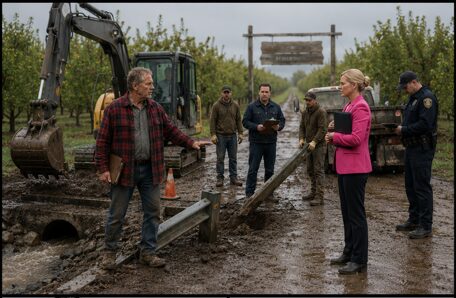
Its metal bucket hung over the new gravel approach like a jaw. One worker had both hands around a safety rail post, rocking it back and forth in the wet ground until the concrete collar cracked. Another man stood near the truck bed with a pry bar across his shoulder. Orange cones cut a crooked line across the entrance beneath the old wooden sign that read Calloway Orchard.
Edward stopped ten feet from the machine.
“Put that down,” he said.
The worker holding the post looked toward the road instead of answering. A white pickup sat there with the hazard lights blinking. On its door, a magnetic sign said Property Compliance Services. Behind the pickup, a woman in a bright pink blazer stepped out with a folder held flat against her chest as if it were armor.
Michelle Baker did not look at the rail first. She looked at Edward.
“Mr. Clark,” she said, “you were warned this would happen.”
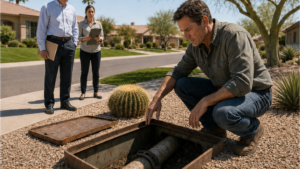
The excavator engine shuddered in the morning air. The rain had stopped, but water still moved under the culvert in a brown rush, carrying leaves and small broken twigs toward the ditch. Two days earlier, that water had backed up across the road and cut a channel through the old packed dirt. Edward had spent yesterday with a contractor placing gravel mats, temporary rail posts, and a narrow edge barrier where the washed-out shoulder dropped toward the ditch.
He had done it before breakfast because Mary had a physical therapy appointment the next morning.
He looked at the worker again. “I said put it down.”
The man stopped rocking the post but did not let go of it.
Michelle walked closer, her shoes sinking slightly at the edge of the wet road. She moved carefully around the mud, but her voice stayed polished.
“This structure is unauthorized,” she said. “It violates the Calloway Ridge appearance standards and common frontage rules. The board issued a removal order.”
“That road goes to my house.”
“It also borders HOA-maintained frontage.”
“It has bordered my orchard longer than your HOA has existed.”
Michelle’s mouth tightened. “That is exactly the kind of statement that makes this difficult.”
Edward took his phone from his shirt pocket and began recording. He kept the screen low, not in anyone’s face.
Michelle saw it. “You can record whatever you like. The order is valid.”
“Then read it into the camera.”
Her eyes shifted once toward the crew supervisor, a square-shouldered man with a clipboard tucked under one arm.
The supervisor cleared his throat. “Sir, we’re just here to remove the non-compliant installation.”
“What’s your name?”
“Christopher Johnson.”
“Christopher, did anyone tell you this is the only safe access to the farmhouse?”
Christopher glanced at Michelle. “I was told it was an unapproved rail and gravel build-out.”
“It keeps the edge from washing out. It keeps a person from falling into that ditch.”
Michelle stepped forward. “Mr. Clark, emergency work still requires approval. You submitted no approved plan, no material sample, no engineering statement, no board authorization.”
“I submitted a repair request.”
“It was incomplete.”
“No one told me that before you sent a machine.”
Michelle opened her folder. The pages inside were clipped, tabbed, and arranged with a neatness that belonged indoors. “A notice was issued.”
“When?”
“It was delivered.”
“When?”
She closed the folder halfway. “The board is not obligated to debate procedure on-site while a violation remains in place.”
The excavator engine revved once as the operator adjusted his hand on the controls. Edward moved then, not fast, not dramatic. He stepped between the bucket and the half-loosened rail post. Mud pressed around his boots. The machine’s metal arm froze.
Christopher lifted one hand toward the operator. “Hold.”
Michelle’s expression sharpened. “Mr. Clark, do not obstruct the crew.”
Edward kept his eyes on Christopher, not her. “Do you have a court order?”
Christopher said nothing.
Edward turned to Michelle. “Do you?”
“We have an HOA enforcement order.”
“That is not the same thing.”
“It is sufficient for removal of unauthorized structures from association-controlled frontage.”
“This is not association-controlled frontage.”
Michelle gave a short breath through her nose, almost a laugh but not quite. “You don’t get to decide that because you remember what this land used to be.”
Edward felt that one settle under his ribs. He remembered his father standing under the orchard sign with a rolled survey in his hand, telling him that roads mattered more than fences because roads decided who could get home. He remembered signing papers years later when the outer fields became houses and cul-de-sacs, while the farmhouse stayed at the heart of the old orchard like a stone in fruit.
He did not say any of that.
He only said, “Turn off the machine.”
Michelle took out her phone. “I already called the police.”
The operator killed the engine, but the sudden silence made the scene feel larger. Birds moved somewhere in the wet rows of trees. Water kept ticking through the culvert. A neighbor’s SUV slowed at the far bend, then kept going.
“You called the police,” Edward said, “because I repaired my own road.”
“I called because you are interfering with authorized removal and creating a safety hazard.”
“The hazard is the hole your crew is reopening.”
Michelle looked toward the loosened rail post. “The hazard is unapproved work done without oversight.”
Christopher shifted his weight. He was close enough now to see the washed-out shoulder, the water-cut scar along the ditch, and the fresh gravel packed over the soft edge. He looked down once, then away.
Michelle noticed.
“Christopher,” she said, “please wait by the truck until the officer arrives.”
The word officer seemed to settle the crew. The men backed toward their equipment. Edward remained where he was, one hand holding the phone, the other hanging at his side. He could feel the old brown property folder tucked beneath his arm, wrapped in a plastic grocery bag because the corners were worn soft and the morning still smelled like rain.
Michelle’s gaze dropped to it.
“More handwritten history?” she asked.
“Not handwritten.”
“You’ve had three weeks to provide proper documentation.”
“I provided what your form asked for.”
“You provided a sketch.”
“A sketch of a repair to a road that washed out.”
“You installed before approval.”
“The road failed before approval.”
Her face flushed, but she kept her voice measured. That made it worse somehow, the way she could stand beside a running machine and sound as if she were correcting minutes from a meeting.
A sheriff’s cruiser came into view between the orchard rows.
Michelle straightened immediately. She set her shoulders, smoothed the front of her blazer, and walked toward the cruiser before it had fully stopped. Edward stayed by the rail. The first post leaned now at an angle, its base cracked, the bright new wood streaked with mud where the worker’s gloves had twisted it.
The police officer stepped out, looked at the machine, the cones, the crew, then Edward.
“Morning,” the officer said. “Who called?”
“I did.” Michelle lifted her folder. “I’m Michelle Baker, HOA president for Calloway Ridge. We have a property owner obstructing an authorized compliance removal.”
Edward watched the officer absorb the words.
“Authorized by whom?” the officer asked.
“The HOA board.”
The officer turned to Edward. “Sir?”
“Edward Clark. This road serves my farmhouse. The repair keeps the edge from washing into the culvert. They started pulling it out before any appeal hearing.”
Michelle cut in. “He failed to obtain approval.”
Edward looked at her then. “You failed to stop your crew from making the road unsafe.”
The officer raised a hand, not sharply. “One at a time.”
Michelle handed over her folder first. Edward saw the clean packet: violation notice, site photos, highlighted rule sections, a removal authorization on letterhead. It looked official. It looked current. It looked like the kind of paper that made people step aside.
The officer read for a moment. His face showed nothing.
Then he looked at Edward. “Do you have paperwork too?”
Edward wiped mud from his fingers onto his jeans, though it did no good. He crouched beside the gravel, set his phone faceup on the rail, and pulled the old brown folder from the plastic bag.
Michelle folded her arms.
Edward opened the folder slowly, the way his father had taught him never to rush old paper in damp air.
Chapter 2: The Notice On The Door Was Dated That Morning
The notice was taped to Edward’s front door while the crew was still standing on his road.
He found it because the police officer asked whether he had received formal warning. Edward had started toward the farmhouse to get his stamped repair request, and there it was, sealed in a plastic sleeve, fluttering against the white paint below the brass knocker. The paper inside was dry. The tape edges were fresh and clean.
Edward stared at the date.
That morning.
He looked back down the orchard road. From the porch, he could see the orange cones near the sign, the white pickup, Michelle’s pink blazer bright against the wet trees. The half-pulled rail leaned like a broken rib.
The officer came up the slope behind him. “That the notice?”
Edward peeled the sleeve from the door and handed it over. “Apparently.”
The officer read the top line, then checked his watch. “This says delivery at eight-ten.”
“It’s not eight-thirty.”
Michelle had followed them halfway to the porch but stopped at the bottom step, as if the farmhouse itself were outside her jurisdiction. “The notice was posted before removal continued.”
“Continued,” Edward said. “Not before removal started.”
Her jaw tightened. “The board authorized removal last night.”
“But you posted notice this morning.”
“Mr. Clark, the violation itself is not new.”
Edward pointed down the road. “The missing rail post is.”
The officer kept reading. The paper made a soft snapping sound in the breeze. Mud from the crew’s boots marked the path from the road to Edward’s porch and back. One print crossed the edge of the ramp board Edward had laid temporarily over the washout.
He took a picture of the notice. Then another of the boot prints. Then one of the porch, the road, the cones, all in one frame. He had learned over the years that people argued with memory more easily than photographs.
Michelle noticed him documenting and sighed. “This is unnecessary.”
“So was sending men before breakfast.”
“The association has the right to protect common standards.”
“This is my front access.”
“It is visible from common frontage.”
The officer lowered the notice. “Ms. Baker, is there an appeal hearing scheduled?”
Michelle hesitated half a second too long. “An emergency compliance session can be scheduled.”
“Was one scheduled before the crew arrived?”
“The removal order was based on failure to cure.”
Edward felt his fingers close harder around the phone. “Failure to cure what nobody answered.”
Michelle looked at the officer. “He submitted an informal sketch without proper measurements.”
Edward turned and opened the door. “Stay there,” he said.
It came out sharper than he intended. The officer’s eyebrows lifted slightly. Michelle’s did too.
Edward stepped inside before either of them could answer.
The farmhouse smelled of coffee, damp wool, and the faint lemon cleaner Mary used on the kitchen table when she wanted to prove she did not need help. The hallway was narrow, and the floorboards creaked under Edward’s boots. He paused just inside long enough to lower his voice.
“Mary?”
“In the kitchen,” she called.
“Stay there a minute.”
“I heard machines.”
“I know.”
He took the stamped repair request from the sideboard drawer where he kept current trouble. Not history, not deeds, not sentimental paper. Current trouble. The packet had his original submission, a dated receipt from the HOA office, two photos of the washed-out road, a note from the repair contractor, and a short letter asking for emergency approval to stabilize the culvert edge.
The stamp on the first page was three weeks old.
When he came back out, Michelle was speaking quietly to the officer.
“—cannot have every owner deciding what counts as urgent. That is how associations lose insurance protection. There are procedures for a reason.”
Edward handed the packet to the officer. “This is what I filed.”
The officer compared the stamped date to the notice date. Then he looked toward Michelle. “Do you have a written response to this?”
Michelle opened her folder again, too quickly. “The application was deemed incomplete.”
“Do you have that notice?”
“It would have been sent by email.”
“I don’t use email for HOA notices,” Edward said. “I checked the box for mail and paper posting. Same as always.”
Michelle’s eyes flicked to him. “That may be part of the communication problem.”
“No. That’s part of your form.”
Christopher Johnson came up from the road then, holding his clipboard awkwardly against his hip. He had taken off his work gloves. Without them, his hands looked younger than the rest of him.
“Officer?” he said.
Michelle turned. “Christopher, please wait by the truck.”
He did not move. “I just need to say something about the order.”
Her face hardened. “Not now.”
The officer looked at him. “Go ahead.”
Christopher swallowed. “The job packet we got said removal authorized at seven this morning. We loaded before seven-thirty. I didn’t see any appeal paperwork. Just the photos and the order.”
Edward watched Michelle.
Her expression did not collapse. It rearranged. That was different. She drew herself tighter, as if the facts were not wrong but merely inconveniently placed.
“The board voted last night to authorize action,” she said. “The administrative packet was prepared this morning.”
“Before notice was posted,” Edward said.
Michelle looked at him. “You keep making this about timing. The structure remains unapproved.”
Edward nearly laughed, but there was no humor in him. The road behind her was still torn open. The rail was still leaning. Mary still had to leave by that path.
The officer handed Edward’s packet back. “I’m not here to decide HOA procedure. But I’m not comfortable with removal continuing while notice timing and property authority are disputed.”
Michelle’s eyes sharpened. “Officer, with respect, this is a civil association matter.”
“Then keep it civil.” He glanced down the road toward the excavator. “Crew pauses today.”
Christopher let out a breath he probably did not mean anyone to hear.
Michelle closed her folder. “A pause is not approval.”
“No one said it was,” the officer replied.
She turned to Edward. The confidence had not left her, but now it had a deadline inside it.
“There will be an emergency violation hearing tomorrow evening,” she said. “Seven o’clock. Clubhouse. Bring whatever documents you believe are relevant.”
“I already did.”
“Bring better ones.”
Edward held her stare. “And if Mary needs to leave before then?”
For the first time, Michelle seemed not to know who Mary was. The pause was brief, but Edward saw it.
“Any resident with a medical emergency should call emergency services,” she said.
“That road is how emergency services get in.”
The officer looked toward the washed-out approach again.
Michelle said nothing.
Edward took another photo: the notice in the officer’s hand, Michelle at the steps, the mud tracks leading back toward the half-removed repair. It was not a clean picture. It was not flattering to anyone. But it was true.
The officer walked back down with Christopher to make sure the machine stayed off. Michelle followed, already speaking into her phone in a low voice.
Edward stayed on the porch.
Behind him, the door opened with a soft scrape.
Mary stood in the doorway with one hand on the frame and the other on her walker. She had put on her blue cardigan, the one she wore when she wanted people to know she was dressed for the day and not to fuss.
Her eyes went past him to the road. To the cones. To the gap where the first rail post had stood straight the night before.
“They took part of it down,” she said.
“Not all of it.”
“That wasn’t what I asked.”
Edward folded the notice and repair request together, too carefully, lining up the corners while mud dried on his hands.
Mary’s fingers tightened on the walker handle. “Edward,” she said quietly, “are they doing this because of me?”
Chapter 3: The Farmhouse Door Mary Could Not Cross Alone
Mary’s right foot slipped where the porch board met the temporary ramp, and Edward caught her elbow before her weight went sideways.
She made a small sound, not quite fear and not quite anger. The walker jumped against the threshold. Its rubber foot struck the wood, slid, then held. For one second, both of them froze there in the doorway, bodies leaning toward the gap where the missing rail should have guided her hand.
“I told you to wait,” Edward said.
Mary pulled her elbow back. “I did wait. I waited until you stopped treating me like furniture.”
The words hit harder because she did not raise her voice.
Edward stepped down first, then turned, offering his arm without offering it too obviously. Mary hated being presented with help like a chair being pushed under her. She looked at his hand, then at the washed-out edge beyond the porch path, where one removed post had left a dark round hole in the mud.
“I can get to the kitchen,” she said.
“You can get to the kitchen because the kitchen doesn’t have a ditch.”
“That ditch has been there sixty years.”
“And you haven’t needed a walker for sixty years.”
Her face changed.
Edward regretted it immediately.
Mary looked down at the metal frame in front of her, then out toward the orchard road. The crew had left, but the road looked worse empty. Machines made damage look temporary. Silence made it look decided. The leaning rail post remained by the culvert, and the gravel mats were scarred where the bucket had scraped them.
Mary turned the walker carefully and backed into the hallway. “Close the door.”
“Mary—”
“Close it.”
He closed it.
Inside, the farmhouse narrowed the world. Rainwater dripped from Edward’s jacket onto the mat. On the wall by the stairs hung an old black-and-white photograph of their father standing beside the original orchard sign, one boot on a shovel, one hand resting on a rolled survey. Edward had passed it a hundred times without seeing it. Today it looked like a witness.
Mary moved slowly to the kitchen table and sat. She did not ask for help. Edward did not offer it. That was part of their peace, or what passed for peace now.
“You should have told me they were coming,” she said.
“I didn’t know.”
“You knew they were upset.”
“HOAs are always upset.”
“That is not an answer.”
He went to the sideboard and opened the drawer with the repair documents. He needed something to do with his hands. The stamped packet lay on top now, damp at one corner from being carried outside. Beneath it were hardware receipts, the contractor’s note, the physical therapist’s recommendation he had not submitted, and Mary’s medical paperwork sealed in an envelope she had told him not to use.
He did not touch the envelope.
Mary saw him not touching it.
“No,” she said.
“I didn’t say anything.”
“You were thinking it.”
“That rail is for you.”
“That rail is for the house.”
“Mary.”
“No. If they hear it is for me, then every person in that clubhouse will look at me like a problem to solve.”
Edward leaned both hands on the sideboard. His knuckles still had mud in the cracks. “They are already treating the road like a problem to remove.”
She looked toward the window over the sink. From there, the orchard rows were visible in narrow strips. “Then show them the road.”
“I tried.”
“Show them the washout.”
“I did.”
“Show them the contractor letter.”
“I did.”
“Then show them better.”
He turned. “Better means you.”
Mary’s mouth pressed into a thin line. She was older by three years, and he had spent most of his life forgetting that until she used that look on him. It was their mother’s look, sharpened by pain and pride.
“You do not get to carry me into a meeting like a tool,” she said.
Edward said nothing.
The kitchen clock ticked above the stove. Somewhere under the sink, an old pipe gave its usual knock. Mary’s walker stood beside her chair, one handle wrapped with gray tape because she said the original grip felt too slick.
“I know what people do,” she said more softly. “They lower their voices. They say brave. They say inspiring. Then they talk over you.”
Edward looked down at the repair packet. “I’m trying to keep you out of it.”
“You are trying to keep yourself out of it.”
That made him look up.
Mary’s face had softened, but not enough to let him hide. “You think if you hand them enough old paper, nobody has to know why this matters now.”
“The paper matters.”
“Yes,” she said. “But paper cannot tell them I stood at that door this morning and wondered whether leaving my own house was worth the risk.”
He picked up the stamped repair request, then set it back down. “You told me not to use the medical letter.”
“I told you not to make me an exhibit.”
“There may not be much difference to them.”
“Then make there be a difference.”
He had no answer for that.
Later, while Mary rested in the front room, Edward spread every document across the kitchen table. He worked the way he pruned trees: slowly, by section, removing what did not belong until the shape appeared. Repair request. Date stamp. Contractor estimate. Photos before and after the storm. Notice from the door. Police officer’s card. HOA rule sections Michelle had highlighted.
Then he found the response.
It had been folded inside the association newsletter, probably delivered two weeks earlier with the usual reminders about trash bins and mailbox colors. He had missed it because he no longer read newsletters that began with community standards in bold letters.
The letter was only four lines.
Application incomplete. Exterior alteration requires parcel verification, full material specifications, and board review before installation. No work approved at this time.
No explanation. No deadline. No acknowledgment of the word emergency.
Edward read it twice, then a third time.
He took out the old brown folder.
The deed was not in the repair drawer. It lived where old things lived, in the lower cabinet beneath maps, tax records, and orchard plans drawn by men who believed pencil lines could outlast arguments. Edward unwrapped it from wax paper and carried it to the table.
Mary watched him from the front room doorway. “That is Dad’s folder.”
“It’s mine now.”
“You sound just like him when you say things like that.”
Edward did not know whether she meant it kindly.
He opened the folder and found the original subdivision plat, the easement agreement, and a yellowed copy of the retained-access clause. He had looked at them before, but mostly when taxes changed or when a neighbor complained about tractors during harvest. This time he compared numbers.
Parcel 14-B. Parcel 14-D. Common frontage line C-2.
The HOA response referenced parcel 14-D.
The orchard road repair sat on retained access strip 14-B.
Edward brought the papers closer. He checked the contractor sketch. He checked the county stamp. He checked Michelle’s violation notice.
Wrong parcel.
Not a typo. Not harmless. The entire violation had been written as if the repair belonged to a strip the HOA controlled outright, not the old access road carved out before the houses were built.
Mary came closer, one careful step at a time. “What is it?”
Edward did not answer until he had laid the deed beside the violation notice.
Then he tapped the two parcel numbers with one finger.
“They’re using the wrong land,” he said.
Chapter 4: Michelle Baker Read The Rules Like A Fence
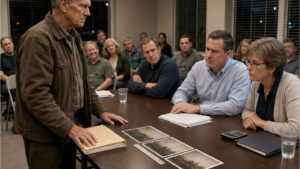
Michelle Baker opened the meeting with a photograph of Edward standing in front of the mini-excavator.
The image filled the clubhouse wall, too large and too bright: Edward in muddy boots, one hand low with his phone, the half-loosened rail behind him, the orange cones making the orchard road look like a work zone he had invaded. Someone in the back row murmured. Someone else shifted a folding chair against the tile.
Michelle stood beside the projection screen with a remote in one hand.
“This is what happened this morning,” she said. “An owner blocked authorized removal of an unapproved exterior structure.”
Edward sat in the second row with the old brown folder on his lap and mud still dried in the seams of his boots. He had changed his shirt but not his boots. He had meant to. Then Mary had taken too long getting from the kitchen to her chair, and he had forgotten everything except the sound of her walker catching on the threshold.
He looked at the photograph again.
It did not show the washed-out ditch. It did not show the water under the culvert. It did not show the notice dated that same morning. It did not show Mary looking at the missing rail and asking if the fight was because of her.
It showed him as an obstacle.
Michelle clicked to the next slide. A close-up of the rail posts appeared, the new lumber pale against dark mud.
“The installation includes non-standard materials, unapproved gravel expansion, exposed post anchors, and an altered roadside profile visible from association frontage.”
Edward lifted his hand.
Michelle did not call on him. “We will allow the owner to speak after the compliance summary.”
“I am the owner,” Edward said.
Several faces turned.
Michelle’s smile stayed fixed. “And you will be heard in order.”
The clubhouse smelled of burnt coffee and cleaning spray. Along the side wall, residents sat in rows, some curious, some annoyed, most wearing the guarded expression of people who had come to watch someone else’s problem become a rule. At the board table, Jonathan White sat with a calculator-sized stack of papers before him. He wore reading glasses low on his nose and had not looked at Edward once since the meeting began.
Michelle clicked again. The next slide showed a highlighted section of the community standards.
“No owner may alter common frontage, visible road edges, drainage features, approaches, rails, posts, barriers, structures, or exterior access elements without prior written approval.”
Edward felt the words arrange themselves into a fence around the room.
Michelle continued. “This is not about whether Mr. Clark believes he had a reason. It is about whether one owner can bypass the process and expose the association to risk.”
Edward’s fingers tightened around the folder.
A resident near the aisle raised a hand. “What kind of risk?”
Michelle turned toward the room, ready for the question. “Insurance risk. Drainage liability. Injury exposure. Once the HOA allows unapproved structures, we become responsible for what those structures do.”
Jonathan White finally looked up.
Michelle clicked to another slide. This one showed an old claim file number and a short summary: common-area fall, settlement, premium increase.
Edward watched her face as she spoke. Something in it changed. The polished edge remained, but underneath it was a tiredness he had not seen on the orchard road.
“Three years ago,” Michelle said, “this association paid for a claim because a board ignored a non-compliant modification near a shared walkway. The owner said it was temporary. The board looked the other way. Someone fell. Every household here paid for that mistake.”
A few residents nodded.
Edward did not. But he understood, suddenly, why Michelle read rules as if they were load-bearing beams.
Jonathan cleared his throat. “Michelle, do we have confirmation that Mr. Clark’s emergency repair request was reviewed before the removal order?”
Michelle turned to him. “The request was incomplete.”
“That is not what I asked.”
The room quieted by one degree.
Michelle’s eyes narrowed slightly. “It could not be approved as submitted.”
“Was he notified that it was incomplete before removal was scheduled?”
“He was notified of the violation.”
“The violation notice on the door was dated this morning,” Edward said.
Michelle looked at him then. “Mr. Clark, this is not your speaking period.”
Edward opened the old folder but did not take anything out. “The crew was already pulling posts before that notice touched my door.”
A man in the back row whispered, “Is that true?”
Michelle put both hands on the board table. “The owner installed without approval. That fact has not changed.”
Jonathan leaned back. “But process matters if we’re claiming process is the reason.”
The comment landed poorly. Michelle’s face hardened, not with surprise, but with betrayal.
Edward saw it and almost spoke again. He stopped himself. The wrong kind of truth, said too early, could make him look like he was enjoying the crack between them. He was not. He needed the road fixed, not the board broken.
Michelle clicked off the projector. The screen went blank, leaving a pale rectangle on the wall.
“Mr. Clark,” she said. “You may speak.”
Edward stood with the folder in one hand. Every chair seemed too close. He had spent his life speaking to workers, buyers, repairmen, county assessors, people who needed facts and gave them back. This room wanted a story, and he had not brought one Mary would allow him to tell.
He laid three photographs on the board table. The washed-out road after the storm. The culvert clogged with debris. The same road after the repair, with the temporary rail standing straight.
“This is the access to the original farmhouse,” he said. “The storm cut the shoulder. Water undermined the edge. The repair stabilizes the approach until permanent work is approved.”
Michelle folded her arms. “You installed first.”
“The road failed first.”
“That does not exempt you from approval.”
“It should have exempted me from demolition.”
Jonathan picked up the photo of the washout. “Who uses this access besides you?”
Edward felt Mary’s name rise in his throat and stop there.
“My household,” he said.
Michelle noticed the pause. So did Jonathan.
“Your household,” Michelle repeated. “Can you be more specific?”
“No.”
The answer sounded worse aloud than it had in his head.
A resident in the second row shifted. Michelle’s expression softened almost imperceptibly, not with kindness but with opportunity.
“So we are being asked,” she said, “to accept an unverified private need as justification for unauthorized work on frontage the association maintains.”
Edward looked at the folder. The deed was there. The parcel discrepancy was there. But he had only found it that afternoon, and the old language was dense enough that reading it wrong in public could bury him. He had planned to show the repair request first, then the notice timing, then ask for postponement.
Michelle reached into her packet and withdrew a glossy map.
She unfolded it across the board table.
“This is the Calloway Ridge common frontage map,” she said. “The marked road edge falls within association-controlled parcel 14-D.”
Edward leaned over the table.
The map was clean, recent, and wrong in the way clean recent things often were. The orchard road was drawn as if it were simply a boundary line beside common frontage. No retained access strip. No old Calloway easement. No shaded exception where the culvert crossed toward the farmhouse.
Jonathan looked at the map, then at Edward. “Is that your understanding of the parcel?”
Edward did not answer quickly enough.
Michelle let the silence work.
“The board’s duty,” she said, “is to rely on recorded association maps, not personal memory.”
The phrase struck him harder than it should have. Personal memory. As if the orchard road existed only because he remembered it.
Edward slid the photographs back into his folder. “That map is missing something.”
Michelle’s hand stayed on the glossy page. “Then bring proof.”
“I will.”
“We cannot suspend enforcement indefinitely because you believe older paperwork may exist.”
“I said I will bring proof.”
The board voted to keep the violation active pending legal review. Jonathan voted with the majority, though he did it slowly and would not meet Michelle’s eyes afterward. The removal remained paused for the moment, but the violation stayed alive, breathing fines and consequences into the room.
As people stood and folded chairs, Michelle gathered the glossy map with careful hands.
Edward remained by the table until only Jonathan was near enough to hear.
“Mr. Clark,” Jonathan said quietly, “if you have an older map, do not bring a memory. Bring the recorded document.”
Edward looked at him. “I intend to.”
Michelle turned from the doorway, the rolled map in her hand.
“This is the document the HOA recognizes,” she said, and held it up just high enough for the room to see. “Until Mr. Clark proves otherwise, the repair sits on common frontage.”
Edward watched the map disappear under her arm, and for the first time since the excavator started, he wondered if the land beneath his boots might not be enough.
Chapter 5: The Map Left Out The Old Orchard Road
The county clerk found the words before Edward did.
She had the plat book open on a low table behind the records counter, one gloved finger moving down a column of narrow print. Edward stood across from her with his hat in both hands, the old brown folder tucked under his elbow, and a fine notice from the HOA folded in his shirt pocket like a hot coal.
“There,” the clerk said. “Calloway Orchard retained access.”
Edward leaned closer.
The ink was faded to a tired gray, but the phrase was there, boxed beside a survey mark that did not appear on Michelle’s glossy map. Retained access. Original agricultural and residential entry. Maintenance rights reserved.
For a moment, Edward heard nothing but the hum of the fluorescent light above the counter.
The clerk adjusted her glasses. “You said the association map shows this as parcel 14-D?”
“Yes.”
“This plat separates the old access strip before the association frontage begins. See here? Fourteen-B.”
Edward touched the edge of the page, then stopped before his finger reached the paper. “Can I get a certified copy?”
“That’s why I pulled it.”
She gave him a look that was not unkind. People who worked around old records developed a certain patience with those who came in believing paper had betrayed them, only to learn they had stopped reading it closely enough.
While she prepared the copy, Edward stood by the counter and unfolded the fine notice.
Violation remains active. Continued non-compliance may result in owner-billed removal, daily fines, administrative costs, and legal review fees.
Michelle had sent it that morning.
The amount listed at the bottom was not ruinous. That bothered him more than if it had been. It was calibrated. Enough to warn, not enough to seem cruel. Enough to make a person tired.
The clerk returned with the first certified page. “There’s another document tied to this. Easement agreement. Older than the HOA bylaws.”
“Pull it.”
“It may take a minute.”
“I have one.”
She looked at the brown folder. “Is it certified?”
“No.”
“Then let’s get you one that is.”
Edward waited while she disappeared between shelves. Through the records office window, he could see the courthouse lawn and the flag moving in a mild wind. Everything outside looked orderly, trimmed and marked. Nothing about it suggested how much harm could fit inside one wrong parcel number.
His phone vibrated.
A message from the repair contractor: Can’t resume until HOA clears access. My insurance won’t cover work under active dispute.
Edward stared at it, then put the phone facedown.
He had thought the officer’s pause had bought him time. Instead, it had frozen the worst possible version of the road in place: rail damaged, gravel torn, edge exposed, contractor unwilling, HOA unyielding. Mary had canceled her physical therapy appointment that morning. She had said the therapist would understand. Edward had said nothing because he did not trust the sound his voice would make.
The clerk came back with a thinner book and a careful expression.
“This one has the emergency maintenance language,” she said.
Edward straightened.
She opened to a page marked by a strip of paper. The clause was longer than the plat note, written in legal language that belonged to another generation of typewriters and handshakes.
The owner of the retained Calloway access strip, and successors thereof, shall maintain reasonable right to repair, stabilize, drain, clear, reinforce, and preserve said access for residential entry, emergency ingress, agricultural use, and prevention of water damage, irrespective of later association frontage maintenance, provided such repair does not materially obstruct shared roads.
Edward read it once. Then again.
The words did not make the problem vanish. They made it heavier. If he had shown this years ago, if he had made the board keep it in their records, if he had not assumed everyone knew the orchard road was different because it had always been different, Michelle might not have stood beside a machine pretending the road was hers to unwrap.
The clerk stamped the copy.
“You should still have someone review this,” she said. “Old clauses can be argued.”
“I know.”
“But it is not nothing.”
Edward took the copy. “No. It is not nothing.”
He drove back by way of the lower county road, passing the newer entrances to Calloway Ridge. The houses sat where peach trees had once stood. Brick mailboxes, trimmed lawns, matching lanterns. He did not resent them, not exactly. The land had paid for Mary’s surgeries, their mother’s care, property taxes that never stopped climbing. But he remembered the day his father signed the first sale papers and then drove home without speaking until they reached the orchard sign.
“They can build houses,” his father had said then. “They cannot close the road.”
Edward had been younger, impatient, thinking mostly of equipment loans and harvest costs. He had nodded without understanding the weight being handed to him.
Now the road waited at the entrance, wounded in plain sight.
The leaning rail had been braced with a temporary rope Edward had tied between two remaining posts. It was ugly and probably another violation. The exposed anchor hole had filled with brown water. Tire tracks from the crew still marked the mud near the ditch.
Mary was not on the porch when he arrived. That relieved him and ashamed him.
Inside, he spread the certified copies beside the HOA map Michelle had emailed after the meeting. He had printed it at the library because his home printer jammed whenever paper mattered. The difference was obvious now: her map treated the orchard road edge like common frontage; the old plat carved it out like a scar the newer drawing had smoothed over.
He took a red pencil and marked the missing strip.
Then he stopped.
Red pencil made it look like anger. He used a blue one instead.
His phone rang as he was photographing the documents.
Unknown number.
He let it ring twice, then answered. “Edward Clark.”
A man’s voice lowered itself before speaking. “Mr. Clark, this is Jonathan White.”
Edward looked at the papers. “Board business?”
“Not officially.”
“That sounds dangerous for a treasurer.”
“It might be, if I were giving advice.”
“And are you?”
A pause. “I am telling you what is already on the agenda.”
Edward waited.
“Michelle is calling for a final vote tomorrow evening,” Jonathan said. “If the violation is upheld, she’ll have authority to finish removal and assess costs.”
Edward looked through the kitchen window toward the road. “The officer paused the work.”
“The officer paused the crew that day. He did not stay the association process.”
“I have the plat.”
“Certified?”
“Yes.”
Another pause, shorter this time. “And the easement?”
“Yes.”
Jonathan exhaled slowly. “Then bring it.”
“Why are you calling me?”
“Because if that map is real, we may have been enforcing on land we do not control the way we claimed.”
“We?”
“I voted with the board.”
“Yes, you did.”
“I also carry the budget,” Jonathan said, and there was strain in his voice now. “If we get this wrong, everyone pays for it.”
Edward almost smiled, but did not. “So you are protecting the board.”
“I’m protecting the association from pretending a clean map is better than a correct one.”
“That sounds like the same thing from where I’m standing.”
“It may be.” Jonathan’s voice dropped further. “But if that map is real, bring it before Michelle locks the vote.”
The line went dead.
Edward set the phone beside the old folder. For a long moment he stood over the certified copies, the fine notice, the blue pencil marks, and the medical envelope Mary still had not allowed him to open.
Then he placed the easement clause on top of everything else.
He had proof now.
But proof, he was beginning to understand, could still arrive too late.
Chapter 6: The Second Crew Came With A Bigger Truck
The second truck already had Edward’s rail sections in its bed when he reached the orchard sign.
Three pale wooden lengths lay stacked against the sidewall, mud on their ends, bolts still hanging from two brackets where workers had cut instead of unscrewed. The first truck was gone. The mini-excavator was back. Behind it sat a larger flatbed with chains coiled near the tailgate and a generator strapped beside a toolbox.
Christopher Johnson stood near the open bed with his clipboard pressed to his chest.
Edward did not look for Michelle first. He looked at the road.
The rope he had tied between the remaining posts lay in the mud, sliced cleanly at one end.
“Who cut that?” he asked.
One of the workers turned away.
Christopher stepped forward. “Mr. Clark—”
“Who cut it?”
“I did,” Christopher said.
Edward looked at him then.
The supervisor’s face was tight with something that was not defiance. “It was attached to material listed for removal.”
“It was keeping people away from the drop.”
“I know.”
“Then you know better.”
Christopher swallowed. “I was ordered to finish by noon.”
“By Michelle.”
He did not answer quickly enough.
Edward glanced toward the far side of the pickup, and there she was: Michelle Baker in a dark coat over another bright blazer, phone in one hand, folder in the other. She was speaking to someone on speaker, her voice clipped.
“—already documented owner interference. We cannot have selective enforcement because he refuses to comply.”
She ended the call when she saw Edward.
“You were told further unauthorized materials would be removed,” she said.
“You were told the parcel number was wrong.”
“You claimed that. The board has not accepted it.”
“The board has not met.”
“It will.”
“After you finish taking the road apart.”
Michelle moved closer, stopping just outside the muddiest section. Her shoes were more practical today. That small change bothered Edward. It meant she had planned for the ground.
“The remaining material is part of the violation,” she said. “Removal is proceeding under the active order.”
Edward pulled the certified plat from the folder. “This road is retained access strip 14-B.”
Michelle did not take the paper. “Documents can be submitted at the hearing.”
“You are standing on the document.”
Her eyes flashed. “That kind of theatrics is not helpful.”
Behind her, Christopher looked toward the farmhouse. Edward followed his glance.
Mary was not outside. Not yet.
A neighbor’s car had stopped near the bend. Then another. Word moved faster than official notice. People wanted to see whether the orchard man would be arrested, whether Michelle would win, whether the machine would finally tear out what was left.
Edward raised his phone and began recording again.
Michelle’s face changed the moment she saw the screen. “You have been asked not to interfere.”
“I’m documenting removal of material from a disputed access road before a hearing.”
“You are documenting enforcement.”
“I’m documenting you trying to finish before anyone can read.”
Christopher looked down.
That was the first crack in the morning.
Edward turned to him. “What exactly does your work order say?”
Christopher shifted the clipboard under his arm. “Remove unapproved rail, gravel mats, temporary barriers, and associated materials from frontage area.”
“Does it say repair culvert damage?”
“No.”
“Does it say maintain safe access?”
“No.”
“Does it say what happens if someone needs to leave the farmhouse while you’re pulling it apart?”
Michelle stepped between them. “Do not interrogate the contractor.”
“He’s on my road.”
“He is operating under association authority.”
Edward held out the certified plat. “Then let him see the authority you are claiming.”
Michelle did not move.
Christopher did.
He took one step, then stopped when Michelle looked at him. The supervisor’s jaw worked once.
“I don’t decide land disputes,” he said, but his voice was quieter. “I follow written orders.”
Edward looked at the rail sections in the truck. “Those written orders have already done damage.”
A sound came from behind him: the scrape of metal walker feet on the porch board.
Edward turned so fast his boot slid in the mud.
Mary stood at the farmhouse door.
She wore her blue cardigan again, but this time she had put on her good shoes, the black ones with the wide straps. The walker was in front of her. One rubber foot rested at the start of the temporary ramp; the other hovered, searching for a place that no longer existed cleanly because the rail was gone and the edge had been cut open by tires.
“Mary,” Edward said.
She lifted one hand, not enough to wave him off, just enough to tell him not to run to her.
The neighbors saw her. So did Michelle. So did Christopher.
The machine idled behind them, its engine low and impatient.
Mary took one careful step. The walker tilted slightly toward the ditch side. Edward moved before he thought. He crossed the mud, took the frame, steadied it, and felt her hand close around his sleeve.
“I told you not to come out,” he said under his breath.
“You were losing alone.”
“I was not losing.”
She looked past him at the rail sections in the truck. “Edward.”
The way she said his name ended the argument.
Michelle approached, but more slowly now. Her voice changed into the careful tone people used around injury. Mary heard it before Michelle spoke and stiffened.
“Mrs. Clark, this area is unsafe,” Michelle said.
Mary looked at her. “Yes. I noticed when you removed the rail.”
A neighbor near the bend made a small sound and covered it with a cough.
Michelle’s face colored. “The rail was unapproved.”
Mary’s grip tightened on Edward’s sleeve. “So is falling.”
Edward felt the old private agreement between them shift. For weeks, Mary had drawn a hard line around her condition, her therapy, the slow betrayal of steps and thresholds. He had respected it because it was hers. He had also hidden behind it because it spared him from asking anyone for understanding.
Now she stood in the open with neighbors watching.
He hated it.
He needed it.
The police cruiser arrived before anyone spoke again. The same officer stepped out, and his eyes went first to the truck bed.
“I thought we had a pause,” he said.
Michelle answered immediately. “The association’s civil process remains active. We are not asking you to adjudicate the dispute.”
“No,” Edward said. “You’re asking him to stand here while you make the dispute irreversible.”
The officer looked at Mary, then the missing rail, then Christopher.
Christopher’s voice came low. “We were told to finish before noon.”
Michelle turned. “Christopher.”
He held up both hands, clipboard and all. “That is what the order says.”
Edward opened the folder. The certified plat, the easement clause, the fine notice, the photos, the police card, the dated door notice—everything was there. The medical envelope was not. Mary had not given him that. But Mary herself had stepped into the doorway the HOA had made dangerous.
He looked at his sister.
Her eyes were wet, but her chin was steady. “Tell them enough,” she said.
It was not permission to expose everything. It was worse than that. It was trust.
Edward turned back to Michelle, the officer, Christopher, and the neighbors gathered at the edge of the orchard road.
“This repair is for access to that farmhouse,” he said. “My sister lives there. She uses a walker. The storm cut the edge out from under the approach. I filed for emergency repair three weeks ago. Your office marked it incomplete without telling me what was missing, then sent a crew before the notice was on my door.”
Michelle’s lips parted, but Edward did not stop.
“And this road is not the parcel your violation says it is.”
He held up the certified plat.
The officer stepped closer. Michelle did too, but only one step.
Edward’s voice stayed even. He had spent the morning angry. Now the anger had narrowed into something cleaner.
“You are not removing another piece,” he said, “until the board reads the deed your HOA was built on.”
Chapter 7: The Hearing Where The Road Changed Owners
Michelle Baker tried to begin the hearing before Edward had even reached the board table.
“Tonight’s item,” she said, tapping a pen against the folder in front of her, “is the continued enforcement of an unauthorized construction violation on association-controlled frontage.”
Edward stopped in the aisle with the old brown folder under one arm and the certified plat in his hand.
The room turned toward him.
Mary was not with him. She had insisted she was done being watched for one day, and Edward had not argued. He had helped her back inside after the second crew left, then stood in the kitchen while she sat at the table with both hands folded over the medical envelope. She had not given it to him. She had only said, Tell them enough.
Now the clubhouse lights made every paper in Edward’s hand look thin.
Michelle stood at the front, composed again. Her pink blazer was gone, replaced by a navy one, but the confidence was the same. A large photograph of the truck bed appeared on the wall: rail sections stacked like discarded lumber.
“The owner has continued to obstruct removal,” Michelle said, “and has introduced last-minute documents that have not been reviewed by association counsel.”
Edward walked to the board table and placed the certified plat flat in front of Jonathan White.
“Then review them,” he said.
Michelle’s eyes cut to the paper but did not settle there. “Mr. Clark, you will be given time.”
“You already took time from the road.”
A murmur went through the room.
Jonathan reached for the plat. Michelle’s hand moved as if to stop him, then paused. Everyone saw the pause.
Jonathan adjusted his glasses and lowered his head.
Edward placed the easement clause beside the plat. “Certified copies from the county records office.”
Michelle said, “Certification does not settle interpretation.”
“No,” Edward said. “But it means the words exist.”
Jonathan read silently at first. Edward watched his face for any sign of recognition. Nothing. Then Jonathan’s brow tightened. He pulled the page closer.
Michelle tried to continue. “The association map clearly shows—”
“Wait,” Jonathan said.
The word was quiet, but the room obeyed it.
Michelle turned. “Jonathan.”
He did not look up. He ran one finger under a line of text and began reading aloud.
“The owner of the retained Calloway access strip, and successors thereof, shall maintain reasonable right to repair, stabilize, drain, clear, reinforce, and preserve said access for residential entry, emergency ingress, agricultural use, and prevention of water damage—”
He stopped.
No one moved.
Edward heard the air conditioner kick on. He heard someone’s chair creak. He heard, in the silence after Jonathan stopped reading, the machine from that morning as if it were still idling outside.
Michelle stepped closer to the board table. “Continue reading.”
Jonathan did, but more slowly.
“—irrespective of later association frontage maintenance, provided such repair does not materially obstruct shared roads.”
A woman in the back row whispered, “So he can repair it?”
Michelle held out her hand. “Let me see it.”
Jonathan gave her the page.
She read fast, then slower, then fast again as if speed might change the words.
“This is an easement,” she said. “It is not blanket permission for any structure he chooses.”
Edward nodded. “Correct.”
That seemed to irritate her more than if he had argued.
He took out the photograph of the washout and placed it beside the deed. Then the photograph of Mary’s walker marks in the mud from that morning. He hesitated before setting it down. The image showed only the walker’s rubber impressions near the threshold, not Mary herself. It was enough. He hoped it was enough.
“This repair did not block the shared road,” he said. “It kept the access from failing into the ditch. The rail marked the edge. The gravel stabilized the approach. Your crew removed the part that kept someone from stepping into a washout.”
Michelle looked at the walker marks and then away.
A board member near the end of the table asked, “Who is the someone?”
Edward felt the old instinct rise: close the folder, say household, refuse the room.
He looked at the brown cardboard corners under his fingers. For years, that folder had been a shield. His father’s deeds. His father’s handwriting. His father’s promise that the road was protected if you kept the papers dry and close.
But Mary had stood in the doorway that morning because his shield had not been enough.
“My sister,” Edward said. “Mary. She lives in the farmhouse with me. She uses a walker now. She does not want to be discussed by a room full of neighbors. I respected that. Maybe too much.”
The room changed again, not with a gasp or a sudden wave of sympathy. People simply grew still in a different way.
Edward kept his voice level. “The storm cut the shoulder. I submitted an emergency repair request three weeks ago. The response said incomplete, but no one told me what was missing before the crew arrived. The removal notice was taped to my door while the crew was already pulling posts. The violation used the wrong parcel number. And this document says the road was never ordinary HOA frontage.”
Michelle put the easement down. “Mr. Clark, the association still has a responsibility to ensure any repair is safe.”
“Yes.”
“We cannot allow owners to build structures without standards.”
“Yes.”
“You admit that?”
“I never said otherwise.”
She blinked once.
Edward picked up the contractor’s note. “I asked for emergency stabilization, not a permanent build-out. I asked because the road was unsafe. If your office needed material specs, it should have said so before sending a crew.”
Jonathan leaned back, the certified plat still in front of him. “Michelle, where is the incomplete notice?”
“In the file.”
“Not the violation. The notice explaining deficiencies.”
Michelle’s jaw tightened. “The administrative assistant marked the application incomplete based on missing specifications.”
“Was that sent?”
“It should have been.”
“That is not what I asked.”
The same phrase from the prior meeting returned, sharper now. Michelle looked at him, and for the first time Edward saw the cost of her control. It was not only pride. It was fear with nowhere to go.
“There was a claim,” Michelle said, her voice lower. “Before most of you cared enough to show up at meetings. A board waved through a temporary structure. Someone fell. The insurer threatened us. We had residents who could barely pay the assessment. I promised this community that would not happen again.”
No one interrupted.
She turned toward Edward. “You think I do not understand risk. I understand it too well.”
Edward looked at the picture of the removed rail. “Then you understand this one.”
Her face stiffened.
He did not press with anger. He pressed with fact. “The risk was at my front access. The repair reduced it. Your crew increased it.”
Michelle drew a breath. “If the board recognizes the easement, we still need an approved standard. Materials. Dimensions. Liability waiver. Contractor verification.”
“Then approve emergency stabilization tonight and set the permanent requirements in writing.”
“You do not dictate board procedure.”
“No,” Edward said. “But I will not let procedure pretend there was no harm.”
The door at the back opened.
Edward turned.
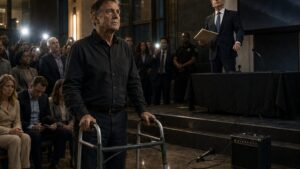
Mary stood there with her walker, breathing hard from the effort of the short distance from the parking lot. The police officer from the orchard road stood behind her, one hand on the door, not guiding her, only making sure it did not close too fast. Mary’s blue cardigan was buttoned wrong at the top. In one hand, she held a muddy metal bracket from the removed rail.
Edward took one step toward her.
She shook her head.
The room watched her cross the threshold inch by inch. No one spoke. Even Michelle stayed still.
Mary reached the aisle, lifted the bracket, and set it on the nearest empty chair. It made a heavy, ordinary sound.
“I am not here to be brave,” she said. Her voice was thin but clear. “I am here because that piece was beside the road yesterday, and today it was in a truck.”
Edward’s throat tightened.
Mary looked at the board table, then at Michelle. “I heard you say safety. I believe you care about it. So I need to ask who you were protecting when you took it down.”
The bracket sat between them, muddy and bent, and no rule in the room seemed large enough to cover it.
Chapter 8: The Rail Went Back Where The Rule Had Failed
Christopher Johnson returned with the same truck one week later, but this time the rail sections came off the bed instead of going on.
Edward stood beside the Calloway Orchard sign while two workers carried the first post to the new anchor hole. The mini-excavator was gone. No orange cones blocked the whole road now, only three placed carefully near the culvert edge. The gravel approach had been regraded, the ditch cleared, and a temporary steel plate covered the softest patch until the contractor could pour the final footing.
The truck’s reverse alarm chirped once, then stopped.
Mary watched from the farmhouse porch with both hands on her walker. She had refused a chair.
“Don’t hover,” she called.
Edward moved two steps away from the road edge.
“I was standing here first,” he called back.
“Then stand somewhere else first.”
Christopher heard and smiled down at the post hole. Edward saw it but did not comment. A week earlier, the same man had stood with a clipboard while rail sections lay in his truck like evidence of a quiet defeat. Now he checked the measurement twice and called for the worker to hold the post plumb.
Michelle Baker arrived before noon with Jonathan White and a folder that looked thinner than usual.
She parked near the entrance but did not block the road. Edward noticed that first. Then he noticed her shoes: plain, low, meant for mud.
Jonathan carried a rolled plan. Michelle carried a single page.
She walked to Edward, stopped near the orchard sign, and looked at the repaired culvert before she spoke.
“The board voted to withdraw the violation,” she said.
Edward held out his hand for the paper.
She gave it to him.
The language was formal. Violation withdrawn. Emergency stabilization approved. Permanent repair authorized subject to contractor specifications already submitted. Removal costs not assessed to owner. Administrative review pending.
Edward read it twice, not because he doubted it, but because he wanted to remember the shape of corrected paper.
“Administrative review,” he said.
Jonathan answered. “Internal. Not against you.”
Michelle’s jaw moved slightly. “The board also voted to amend the emergency access procedure. Any resident with a documented access or safety issue can request temporary stabilization before full aesthetic review, provided the work is inspected within a reasonable period.”
Edward looked toward Mary. “Documented.”
Michelle followed his glance. “Documentation can be submitted privately to the board secretary or a designated reviewer. Not discussed in open session unless the resident requests it.”
Mary lifted one hand from the porch. Not quite a wave. Not quite forgiveness. Enough.
Edward folded the withdrawal notice and slipped it into the old brown folder.
Michelle watched the folder disappear under his arm. “I should have verified the parcel before authorizing removal.”
He said nothing.
She continued, each word placed carefully. “I should have confirmed whether the incomplete notice had actually been sent. And I should not have allowed the second crew to proceed before the hearing.”
Christopher looked over from the rail post but quickly returned to his work.
Edward studied Michelle’s face. She was not performing for a room now. There was no projector, no residents in folding chairs, no rule section highlighted behind her. Just the orchard road, the ditch, the sign, and the rebuilt rail rising in the place where her order had torn it down.
“Why did you?” Edward asked.
The question did not seem to surprise her.
Michelle looked toward the houses beyond the trees, where Calloway Ridge began. “The last claim nearly broke the association. People blamed the board. Some of them were right. I told myself if I enforced everything exactly, no one could accuse me of letting danger slide again.”
“But you let danger slide here.”
“Yes,” she said.
It was the first answer she had given him without a rule attached.
Edward looked down at the withdrawal notice. The easier thing would have been to keep pushing. Demand removal from office. Demand public apology. Demand she stand in front of the same residents and name every mistake, line by line. A part of him wanted it, not because it would fix the road, but because he had stood in mud while people watched him look like the problem.
Then Mary’s walker scraped lightly against the porch board.
He looked back.
She was moving forward.
Not far. Just from the porch to the start of the repaired approach. The new rail was not fully set yet, but the temporary guide rail stood beside it, braced and inspected. Christopher stepped away to give her room. Edward started toward her, then stopped when she looked at him.
Mary set the walker down on the gravel.
It held.
She shifted her weight. One step. Then another. The walker did not tilt toward the ditch. The plate did not slip. Her hand touched the temporary rail, not because she was falling, but because it was there to be touched.
No one said anything.
That silence did more than applause could have done.
Mary reached the place where the first rail post had been pulled loose a week before. The new post stood beside the filled anchor hole. The old scar in the mud was covered, but Edward knew where it had been.
She looked at Michelle. “This is what I needed.”
Michelle nodded once. “I understand that now.”
Mary’s face remained calm. “Understanding sooner would have been better.”
“Yes.”
Then Mary turned back toward the porch, satisfied with the distance she had claimed. Edward walked near her but not close enough to insult her. When she reached the door, she paused.
“Edward,” she said.
He looked up.
“You can keep the map in the drawer now.”
He touched the folder under his arm. “Not yet.”
“Soon, then.”
He did not answer, but he knew she was right.
By late afternoon, the permanent rail stood straight along the culvert approach. The contractor had marked where the final footing would go. Christopher loaded unused boards into the truck, then came to Edward with the muddy bracket Mary had carried into the hearing.
“Figured you might want this,” he said.
Edward took it. The metal was bent at one corner.
“Or throw it away,” Christopher added.
Edward looked at the rebuilt rail, then at the bracket. “No. I’ll keep it in the barn.”
“As a reminder?”
“As hardware.”
Christopher smiled faintly. “Fair enough.”
When the truck pulled away, Michelle and Jonathan were already gone. The orchard road was quiet again, but not the same quiet. The road had been argued over, measured, misunderstood, nearly undone, and put back with more people knowing what it was for.
Edward walked to the sign and stood beneath it.
Calloway Orchard.
The letters were weathered, darkened by years of rain and sun. His father had repainted them twice and complained both times that paint never lasted as long as people promised. Edward opened the old brown folder on the hood of his truck. He placed the certified plat inside, then the easement clause, then the withdrawn violation.
For years, he had treated the folder like something that proved the past.
Now it held something else: proof that the present had to be spoken for.
Mary came out once more near evening, slower now but stubborn as ever. Edward stayed where he was while she crossed the repaired approach. She used the rail. Not heavily. Not theatrically. Just enough.
At the far side, she looked back at him. “You coming?”
Edward slid the old map into the folder, closed the cover, and held it for a moment against his palm.
Then he set it on the truck seat instead of under his arm.
The story has ended.