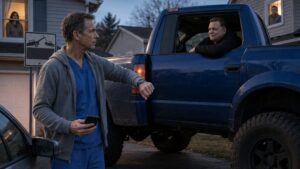
She Got Her SUV Stuck on His Private Mud Road, Then Handed Him the Repair Bill
Chapter 1: The SUV Was Already Sinking Past the Warning Sign
The tire was screaming before John Walker saw the woman.
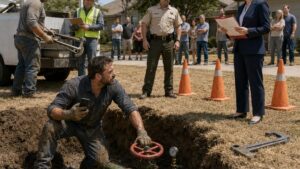
It spun in place at the low bend of his farm road, throwing sheets of brown water against the side of a white SUV that had no business being that far past the gate. Mud slapped the passenger door, the wheel well, the rocker panel. The engine rose and fell in sharp, angry bursts, like the driver believed the road would surrender if she pressed the pedal harder.
John stood at the edge of the pasture with a coil of wire in one hand and watched the SUV sink another inch.
“Stop,” he called.
The engine only screamed louder.
The back tire dug into the rut, spraying mud across the old wooden post where his sign hung crooked but readable.
PRIVATE ROAD
NO TRESPASSING
John set the wire down against the fence. He did not run. Running in mud only made a man fall, and yelling over an engine only made him look like he had lost control of land he had owned for forty-one years.
The SUV lurched forward half a foot, then dropped hard into the rut. A woman’s voice cut through the engine from inside the vehicle, sharp enough to carry across the pasture.
“Oh, come on!”
John knew the vehicle before he knew the driver. The white SUV belonged to Rachel Moore from the subdivision on the other side of the lower meadow, where the new houses sat too clean and too close to the drainage ditch everyone pretended was not a problem. He had seen that SUV at the mailboxes and at the HOA entrance sign, polished so often it usually looked like it had never touched gravel.
Today it looked like a hog had rolled it down the road.
The driver’s door opened. A boot came out first and disappeared into mud over the ankle. Rachel grabbed the door frame, tried to pull herself upright, and nearly slipped. She wore a bright pink hoodie, too clean for the road until the wind snapped the door back and splattered mud across the front of it.
John took three slow steps toward the road.
“You need to stop spinning those tires,” he said.
Rachel turned on him as if he were the one who had pushed the SUV into the rut. Mud streaked one side of her face, and her hair had come loose from a clip. She looked frightened for half a second. Then embarrassment hardened into anger.
“This road ruined my car,” she said.
John looked from her to the tire, then to the sign behind her. “That road is closed after hard rain.”
“It isn’t closed. It’s just a mess.”
“It’s private.”
“I know whose road it is.” She kicked at the mud and lost her balance again, catching herself on the side mirror. “And now look at what it did.”
John stopped several yards from her. The mud between them held the shape of her tires, deep and shining. Beyond the SUV, the road narrowed between two low ditches and disappeared toward the back edge of the subdivision. The route saved maybe four minutes if a person wanted to avoid the county road. It cost more than that every time someone treated it like a shortcut.
“You came past the sign,” John said.
Rachel glanced at it too quickly. That told him enough.
“It’s faded,” she said. “And it’s been here forever. People use this road all the time.”
“Not in this weather.”
“I had no choice. The entrance off Miller Creek is flooded.”
John heard the sentence settle into the mud between them. Not lost. Not confused. She had chosen his road because another way was inconvenient.
“You should have turned around,” he said.
She laughed once, but there was no humor in it. “In what? That ditch? You people put up signs and leave roads like this and then act shocked when somebody gets hurt.”
“You’re not hurt.”
“My car is.”
The engine ticked under the hood. Mud slid down the driver’s door in slow ropes. Rachel’s eyes moved to the pasture, the fence, the sign, the house uphill from the road. John could almost see her weighing the shape of things, searching for the version of the story that put her back above him.
He had seen it before in smaller ways. A neighbor cutting across the meadow because the grass “wasn’t planted yet.” A delivery driver bending a gate and leaving no note. HOA residents walking dogs along the fence line, waving as if a wave turned trespass into permission. John had always spoken once, maybe twice, then let it go. A man could spend his whole remaining life guarding edges if he wanted to become nothing but edges.
Rachel pulled out her phone with muddy fingers.
“I’m calling a tow.”
“That’s wise.”
“And my insurance.”
John’s hands went still at his sides.
Rachel saw the change, small as it was, and pressed into it. “They’ll want to know why a private road you maintain is unsafe.”
“I don’t maintain it for you.”
“You maintain it enough to leave it open.”
“It isn’t open.”
She pointed at the sign. “That? Half the neighborhood thinks that’s from the old owners.”
“There weren’t old owners.”
“Then maybe you should have made it clearer.”
John looked back at the post. The sign was weathered, yes. The bottom corner had curled from summer heat. But the black letters could still be read from a truck cab, from a tractor, from anywhere except a mind determined not to see them.
The tow truck would leave tracks. Insurance would ask questions. Rachel would tell the story first, and the first story often got comfortable in people’s minds before the truth found its boots.
“Rachel,” he said, keeping her name level, “you drove past a posted sign onto a private farm road after a hard rain.”
Her eyes flashed. “Don’t talk to me like I’m stupid.”
“I didn’t.”
“You’re standing there like this is my fault.”
John let the silence answer.
A gust moved over the pasture. Water dripped from the SUV’s undercarriage, tapping into the rut. Somewhere behind the fence, one of the cows gave a low, irritated sound.
Rachel wiped mud from her cheek and looked at her palm as if the land itself had insulted her. “Do you know what undercarriage repairs cost?”
“No.”
“You’re going to.”
That was when John understood the tow was not the end of this. The stuck SUV was only the first thing buried.
He took off his work gloves and folded them once. “I’ll wait by the gate until the tow truck gets here. They’ll need the firmer ground.”
“I don’t need you managing this.”
“It’s my road.”
“Then take responsibility for it.”
He almost answered too quickly. The old answer rose in him: calm, polite, meant to end trouble before it became something with teeth. He could say they would talk later. He could say he was sorry she was stuck. He could offer to pull her out with the tractor, though he had already seen the angle and knew it might tear the bumper clean off.
Instead he looked again at where her SUV sat, fully past the sign, angled toward the subdivision end of the lane.
“You came in from the meadow gate,” he said.
She looked away.
The lower meadow gate had been chained two weeks earlier after the last rain, when deep water washed across the gravel near the culvert. John had looped the chain but not locked it, because Ronald Brown sometimes used that gate to check the shared fence. Rachel would not have known that unless someone had told her, or unless she had been watching.
“I came through where the road was,” she said.
“That gate was closed.”
“It wasn’t locked.”
“It was closed.”
Her mouth tightened. For the first time, she looked less angry than caught. The expression lasted only a moment before she lifted her phone again.
“I’m documenting everything.”
“So am I,” John said.
It was not true yet. His phone was in the house, sitting on the kitchen counter beside a mug of cold coffee. He had come out to fix fence wire, not defend himself from a claim. The lie tasted bad, but the fear beneath it tasted worse.
Rachel stepped back from the SUV, mud sucking at her boot. “You better hope your farm insurance is current.”
The tow truck arrived forty minutes later, its driver stopping at the high ground where John motioned him in. Rachel spoke to the driver first. She pointed at the rut, at the SUV, at John. John heard only pieces from where he stood near the sign.
“Unmarked hazard.”
“Private property owner.”
“Damage underneath.”
The driver glanced at the sign, then at John, but said nothing.
When the winch finally pulled the SUV free, mud gave way with a wet, stubborn sound. The front bumper hung lower than it should have. Rachel stood with her arms crossed, pink hoodie darkened by mud, watching as if each scrape were being charged directly to John’s name.
The driver handed her a form on a clipboard. She signed without looking at John.
After the SUV was loaded, Rachel walked back to the sign. She touched the bottom corner, the curled metal edge, and gave it a small flick.
“You think this protects you?” she said.
John did not answer.
Rachel leaned closer, mud on her cheek, phone in one hand, tow receipt in the other. “That won’t save you when the bill comes.”
Chapter 2: The Mud-Stained Estimate on the Porch Table
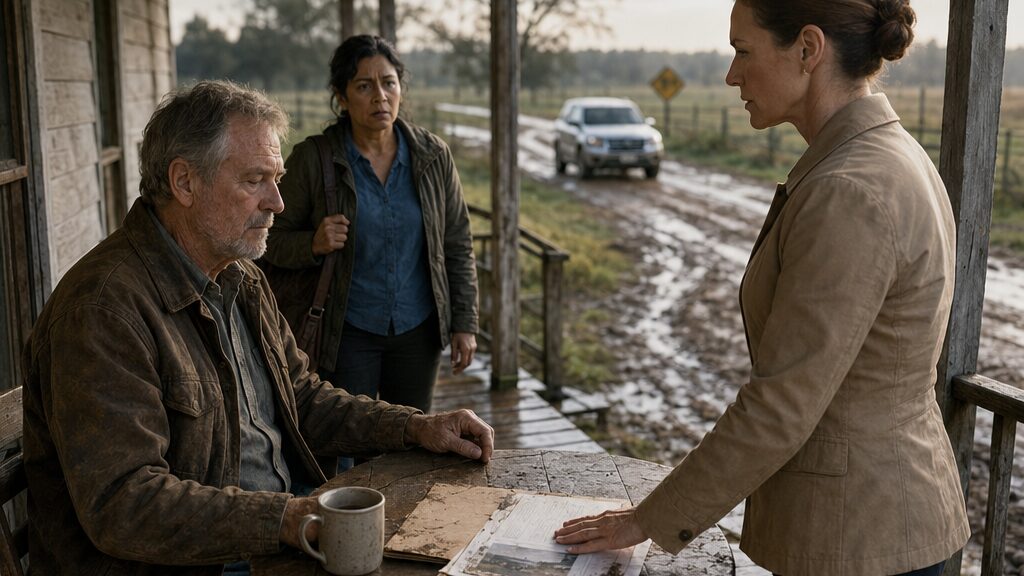
Rachel Moore put the bill on John’s porch table before she said good morning.
It landed beside his coffee with a soft, damp slap. Mud had dried along one edge of the papers in a brown crust, and the top sheet carried a color photograph of her white SUV sunk low on his farm road, the front tire buried halfway into the rut. Someone had circled the tire in red marker. Someone had also printed the total in bold near the bottom.
$6,840.00
John looked at the number, then at Rachel.
She had changed out of the pink hoodie. This morning she wore a tan jacket and clean boots that had never touched the road where her SUV had sat. Her hair was smooth again, her face washed, her mouth set in the calm expression people used when they had decided anger should look professional.
“I need this covered,” she said.
John did not pick up the papers. “You came early.”
“I didn’t sleep much.”
“Neither did I.”
“That’s unfortunate.” She tapped the top page with one finger. “Undercarriage inspection, tow, front alignment, lower bumper damage, cleaning, and diagnostic labor. Brian Lee says there may be more once they get it lifted.”
John knew Brian. Everybody with a gravel lane or a drainage problem knew Brian. He did honest work most of the time, and careful work when someone was watching. But he also liked contracts from people who paid quickly.
“Brian looked at it?”
“His shop did. I had it dropped there last night.”
John reached for his glasses in his shirt pocket and put them on. The porch boards were still damp from the night air. From where he sat, he could see the top of the private-road sign below the slope, its black letters facing the lane.
Rachel pushed the papers closer.
“There’s a liability acknowledgment on the last page,” she said. “It doesn’t mean you’re admitting malice or anything dramatic. It just starts the process.”
John finally lifted the packet. It smelled faintly of wet paper and mud. The first page listed parts and labor. The second described the vehicle as having entered “a hazardous private farm access route under poor surface conditions.” The wording was tidy. Too tidy for something written less than twenty-four hours after a tow.
He turned to the last page.
There was a blank line for his signature.
“Why would I sign this?” he asked.
“So insurance can process the repair without making this ugly.”
“This is already ugly.”
Rachel’s jaw tightened. “John, I’m trying to handle this neighbor to neighbor.”
“You brought me a bill.”
“I brought you documentation.”
“You brought me a bill with a place for my name.”
She took a breath, and when she spoke again, her voice softened just enough to sound rehearsed. “You own the road. You knew it was unsafe. You knew people sometimes use it when the subdivision entrance floods. You left it accessible anyway.”
John looked at her over the top of his glasses. “People sometimes use things they shouldn’t.”
“And property owners sometimes create hazards.”
He turned back to the photograph on the estimate. The SUV filled most of the frame. Mud covered the tire, the lower panels, and part of the license plate. But in the left background, beyond the spray on the passenger door, a narrow rectangle leaned against the post.
Only half of it showed.
PRIVATE ROAD
The rest disappeared behind the SUV’s raised hood line, but the words that remained were enough to make John’s thumb pause against the page.
Rachel saw him looking. “That picture shows the road condition.”
“It shows more than that.”
“It shows your road.”
“It shows my sign.”
Her hand moved quickly, almost as if she wanted to cover the photograph. She stopped herself before she touched it.
“That sign doesn’t change the condition of the road.”
“It changes why you were on it.”
“You keep acting like this is about trespassing.” Her voice sharpened again. “My car was damaged because your road collapsed under normal use.”
“That wasn’t normal use.”
“It’s been used that way for years.”
“Not with my permission.”
Rachel gave him a small, tired smile. “You never stopped anyone.”
The words found the place under his ribs where he had stored too many small avoidances. He thought of the subdivision children cutting across his pasture one summer until he waved them back. The delivery trucks that missed the paved entrance and used his lane because maps had not caught up with the new development. The neighbors who said “just this once” and then forgot there had ever been a first time.
He had stopped some. He had let others go. He had believed a quiet correction carried more peace than a locked gate.
Rachel was counting on that belief.
John laid the estimate flat and placed one finger on the photograph, directly over the visible words on the sign.
“I won’t sign anything that calls trespassing my fault.”
For a few seconds, Rachel did not move.
Then she laughed under her breath, once. “That’s how you want to play it?”
“This isn’t playing.”
“No, it’s money.” She leaned forward. “And if my insurance decides you created an unsafe condition, your carrier will hear from them. If the HOA gets dragged in because that road connects to our drainage access, they’ll want your explanation too.”
“The HOA doesn’t own my road.”
“No. But the people affected by your road live in it.”
John heard a vehicle turn into his gravel drive. Both of them looked toward the sound.
Maria Ramirez stepped out of her car with a folder tucked under one arm and her work bag sliding off her shoulder. She looked first at Rachel, then at the papers on the porch table, then at John’s face. Her expression changed before anyone spoke.
“What is that?” Maria asked.
“A repair estimate,” Rachel said. “For damage caused on your father’s property.”
Maria came up the porch steps slowly. She was dressed for work, dark slacks and a blue blouse, but she had the guarded look she wore when she had already started calculating consequences.
“Dad?”
John slid the packet toward her. “Rachel wants me to sign for her SUV damage.”
Maria did not touch the pen clipped to the top page. She read the total and exhaled. “Six thousand eight hundred forty dollars?”
“That may not include supplemental damage,” Rachel said.
Maria looked at John. “Did something happen yesterday?”
“She got stuck on the back road.”
Rachel’s head snapped toward him. “I got stuck because the road wasn’t maintained.”
“You were past the sign,” John said.
Maria turned a page. Her eyes moved across the estimate, then stopped on the photograph. She saw what John had seen.
“Is that the sign behind the car?” she asked.
Rachel’s cheeks colored. “It’s partially visible, yes. That doesn’t settle liability.”
“No,” Maria said carefully. “But it raises a question.”
“It raises several,” Rachel said. She took a folded sheet from inside her jacket. “Which is why I also filed a preliminary report with my insurance. They may contact you. I’d rather avoid that becoming formal, but I need cooperation.”
Maria’s face tightened. “You already filed?”
“I notified them. There’s a difference.”
John heard the difference and did not like it. Rachel had come with the estimate in the morning because the machinery was already moving. The signature was not the beginning. It was the shortcut.
“Rachel,” he said, “I’m not signing.”
Her professional calm cracked. “Then you’re choosing the harder way.”
“I’m choosing the true way.”
“That sounds nice until paperwork starts arriving.”
Maria picked up the packet and held it by the cleanest corner. “We’ll make copies.”
Rachel’s eyes narrowed. “That’s my estimate.”
“You brought it here demanding my father’s signature,” Maria said. “He’s allowed to keep what you gave him.”
For a moment, Rachel looked as if she might snatch the packet back. Then she released a breath through her nose and pulled another copy from a folder under her arm.
“I expected resistance,” she said.
John almost smiled at that. Not because it was funny, but because she had mistaken slowness for surprise.
Rachel stepped off the porch. At the bottom stair, she turned. “You should ask your father how many people have used that road without him objecting. Ask him whether he ever put anything in writing. Insurance will.”
After she left, Maria stood at the table reading the top page again. The morning seemed quieter without Rachel’s voice, but not safer.
“Dad,” she said, “this can hit your farm policy?”
“I suppose it can try.”
“That isn’t an answer.”
“It’s the one I’ve got.”
Maria sat across from him and rubbed her forehead. “You can’t just out-calm this.”
John looked at the mud dried along the paper’s edge. It had flaked onto his porch table in small brown crumbs.
“I know.”
His phone buzzed inside the house. Maria went to get it before he could rise. When she returned, she held it carefully, as if the screen itself might cut him.
“It’s an email,” she said.
John took the phone.
The subject line was plain, official, and worse than Rachel’s anger.
Preliminary Property Liability Inquiry: Moore Vehicle Damage Claim
In the first paragraph, his name appeared beside the phrase potentially liable property owner.
Chapter 3: The Old Folder Proved Less Than He Hoped
“What happens if they believe her first?” Maria asked, reading from John’s phone at the kitchen table.
John had not sat down yet. He stood by the sink with the insurance email printed in his hand, because Maria had insisted paper made things easier to mark and harder to ignore. The email looked harmless in black ink. That was the trouble with official things. They rarely looked as dangerous as they were.
“They ask questions,” John said.
“And if they don’t like the answers?”
“Then they ask more.”
Maria looked up. “Dad.”
He folded the email once, then unfolded it. The crease cut through his name.
“They can send it to my carrier,” he said. “They can decide there’s shared liability. They can raise a fuss until someone pays to end it.”
“Someone meaning you.”
“Maybe.”
Maria dropped the phone on the table, not hard, but hard enough. “You have proof she wasn’t supposed to be there.”
“I have a sign.”
“You have more than a sign, right?”
John did not answer quickly enough.
The kitchen held the silence for him. It had been his wife’s kitchen once, bright with jars, notes, and the steady music she used to play while making supper. After she died, John had kept the table clear and the counters plain. He had told himself it was order. Some days it was only absence.
“I have things,” he said.
Maria stood. “Show me.”
The storage room off the back hall smelled of dust, cardboard, and old feed sacks. John pulled the chain for the overhead bulb. It swung slightly, throwing light across shelves of paint cans, jars of screws, and boxes marked in his late wife’s handwriting. Near the bottom, under a folded tarp, sat the green metal file box he had not opened in years.
Maria crouched before he could.
“Careful,” he said. “The latch sticks.”
“Everything in this house sticks.”
“That’s how you know it’s paid for.”
She glanced back at him, almost smiling, then lifted the lid.
Inside were folders with soft edges: tax papers, seed receipts, pasture maps, equipment manuals, and one marked ROAD / GATE / SIGNS in John’s handwriting. Maria pulled it free and carried it back to the kitchen like something that might either save him or disappoint them both.
The first photographs were old. Actual photographs, not phone prints. One showed the road in spring, dry and pale, with the sign newly bolted to the post. John stood beside it, younger by at least fifteen years, one hand resting on a shovel. His wife’s shadow appeared at the bottom edge, long and thin across the gravel.
Maria turned it over.
No date.
John looked away.
“Dad.”
“She knew when it was taken.”
“Mom?”
He nodded. “She took it the day we put the sign up.”
“Do you have the receipt for the sign?”
“Maybe.”
They found a receipt from a hardware store, but the ink had faded until the date was a gray ghost. They found a county letter about access classification, but it referred to a parcel number Maria had to search online to understand. They found a hand-drawn map of the road, the lower meadow gate, and the drainage ditch, but it had no official stamp.
Every item proved something. None proved enough by itself.
Maria made three piles: useful, maybe useful, and “Dad, why did you keep this but not the important thing?” John did not object to the last pile. It included a broken tape measure, two blank envelopes, and a note reminding him to buy tractor oil in 2018.
By noon, the mud-stained estimate lay beside the old folder, its glossy photograph brighter and sharper than anything John had kept. Rachel’s accusation looked modern. His defense looked like it had been waiting too long in a damp room.
Maria opened his laptop and searched for photos. John stood behind her while she clicked through years of files named by dates he had never learned to change. Cows, fence repairs, storm limbs, a Christmas dinner, a washed-out culvert, Maria holding a pie on the porch. Then, finally, the lower road.
“There,” she said.
The photo showed the private-road sign five years earlier after a summer storm. The letters were clear. The post was the same. Mud lay in the same low curve where Rachel’s SUV had sunk.
“That helps,” Maria said.
“It’s five years old.”
“It shows the sign existed.”
“It doesn’t show yesterday.”
She turned in the chair. “Stop arguing against yourself.”
“I’m saying what they’ll say.”
“No,” she said. “You’re saying it before they can, so it hurts less.”
The words landed harder than he expected.
John pulled out the chair across from her and sat. On the table, the photograph of his younger self beside the sign faced upward. He remembered that day. His wife had said the sign looked unfriendly. He had told her it only had to look clear. She had laughed and said, “Clear is not the same as cruel.”
He had lived by that too long, maybe.
Maria scrolled through his messages next, searching Rachel’s name. John nearly told her not to. It felt like letting his daughter rummage through drawers he had not cleaned. But she was faster than him, and more frightened, and fear had given her permission.
“Here,” she said suddenly.
The message was from Rachel, eight months earlier.
John, this is Rachel Moore from the board. The front entrance is backed up after the storm. Can I use the back road just this once to get to the drainage access? I know it’s private but we’re in a bind.
Maria read it twice. “She knew.”
John leaned closer. The message sat there, clean and exact, a small bright hook in all the mess.
“Did you answer?” Maria asked.
John already knew he had not, but he let her look.
There was no reply.
Maria slowly set the phone down. “Why didn’t you answer?”
“I meant to call Ronald first. The lower gate was soft that week.”
“But you didn’t.”
“No.”
“Did she use it?”
“I don’t know.”
Maria closed her eyes for a second. “She’s going to say you didn’t object.”
“She asked because she knew she needed permission.”
“And you gave her silence.”
John pushed his chair back. It scraped against the floor.
“I was burying a calf that day,” he said, too sharply.
Maria’s face changed. “I didn’t know.”
“No reason you should.”
“That doesn’t make the message go away.”
“I know that.”
He walked to the sink and looked out toward the slope where the road dipped below the pasture. The sign was visible from the kitchen window, small but present. He had thought presence was enough. A sign, a closed gate, a quiet word when needed. He had not wanted to become the kind of old man who locked every chain and documented every slight.
Now Rachel was building a case inside the spaces he had left open.
Maria’s voice softened behind him. “I’m not blaming you.”
“You should blame me some.”
“I’m worried.”
“That too.”
She came to stand beside him. For a while they watched the road without speaking. A crow dropped from the fence post, pecked at something in the mud, and flew off.
“We need copies of everything,” Maria said. “The old photos, the county letter, the message, the estimate. We need to write down what happened before memories get bent.”
John nodded.
“And you need to call your insurance.”
“I will.”
“Not tomorrow.”
“I said I will.”
She touched his arm. “Dad.”
He heard what she did not say. You are not younger than this. You are not richer than this. You are not alone unless you insist on being.
John took the mud-stained estimate and slid it into a clean folder. Then he took it back out and laid it beside Rachel’s old text message, open on the phone screen.
The bill said one thing. The message said another. Neither one settled the matter.
His phone rang before he could reach for the insurance number.
The screen showed Brian Lee.
John answered and said nothing.
On the other end, Brian cleared his throat. “John, I’m calling because Rachel Moore asked me to confirm something in writing.”
John looked at Maria. She had gone very still.
“What something?” John asked.
Brian hesitated.
“She wants me to say your road was unsafe before she drove on it.”
Chapter 4: The HOA Read His Name Out Loud
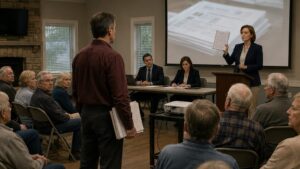
“Property damage liability involving John Walker’s private access road,” the HOA treasurer read, and every head in the community room turned toward the folding chair where John had just sat down.
He had not even taken off his hat.
The room smelled of coffee, floor cleaner, and new carpet glue. A row of subdivision residents sat along the wall beneath framed prints of houses that all looked cleaner than any house ever stayed. Rachel Moore stood near the front table with a folder against her chest, dressed in a navy blazer now, no trace of mud on her. The only mud in the room was printed on paper, copied into packets, and passed from hand to hand like evidence of something settled.
Maria sat beside John. Her shoulder touched his for one brief second, then pulled back. She wanted him to know she was there. She also wanted him not to speak too soon.
The treasurer looked up from the agenda. “Mr. Walker, thank you for coming.”
“You sent a notice with my name in it,” John said. “Figured I ought to hear it said.”
A few people shifted. Rachel’s mouth tightened.
The treasurer cleared his throat. “This is not a hearing in the legal sense. We’re here to discuss the impact of the incident on neighborhood access and potential insurance exposure.”
John looked at the packet on his lap. The first page was Rachel’s estimate. Same photo. Same red circle around the tire. Same $6,840 total. But the copy had made the mud darker and the sign behind the SUV blurrier, as if the machine itself preferred Rachel’s version.
Rachel stepped forward. “I want to be clear. I did not ask for this to become public.”
Maria’s hand moved slightly on the arm of her chair.
Rachel continued, “But when private property connects physically to community infrastructure, and when residents have used that road during flooding, safety becomes a shared concern.”
John let the sentence pass. He had learned that some people built fences with words, then accused you of blocking the path when you noticed them.
An older resident near the aisle raised his hand. “So is that road part of our emergency access or not?”
“No,” John said.
Rachel spoke at the same time. “It has functioned that way informally.”
The treasurer tapped the table. “One at a time, please.”
John turned a page in the packet. There was a short written statement from Rachel. She claimed the Miller Creek entrance had been flooded, that the lower meadow access appeared open, and that John had “historically permitted practical use of the route during drainage events.”
Historically permitted. Practical use. Drainage events.
He could almost admire the polish of it, if it had not been aimed at his name.
“I never permitted the HOA to use my road,” John said.
Rachel faced him. “You never consistently prohibited it either.”
“There’s a sign.”
“The sign is old and partially obscured from the lower approach.”
John looked at the photo in the packet. “Not from where your SUV sat.”
A murmur moved through the room.
Rachel’s eyes flicked to the packet in her own hand. “That photo was taken after the vehicle was immobilized. It doesn’t show what was visible while entering.”
Maria leaned toward John and whispered, “Don’t give her more yet.”
He did not answer. He had brought the old folder, but it stayed closed under his palm. The temptation to lay every page out and make them see was strong, and that was exactly why he kept still. He had learned from fixing fence that yanking too hard on a tangled wire only buried the barb deeper.
The treasurer adjusted his glasses. “Ms. Moore, you stated that Mr. Walker’s road was commonly used during storm conditions. Do you have documentation of that?”
Rachel hesitated less than John expected. “Not formal documentation. It’s neighborhood practice. Several residents can confirm they believed it was acceptable when the main entrance flooded.”
A woman in the second row raised her hand. “My husband used it once last spring. Nobody stopped him.”
John looked at her. “Did he ask?”
The woman dropped her eyes to her packet. “I don’t know.”
Another resident said, “We’re not trying to take your land, Mr. Walker. But if the road’s there and people use it, maybe it needs to be safe.”
“It is safe when used as a farm road in the right conditions,” John said. “It is not a paved street. It is not a subdivision exit. It is posted private.”
Rachel’s voice softened. “No one is attacking you, John.”
The softness bothered him more than the anger had. It made him sound fragile before he had broken.
“I’m being asked to pay.”
“You’re being asked to participate in resolving damage caused by a hazardous access condition.”
Maria spoke then, calm but edged. “He’s being asked to sign a liability acknowledgment for a road you entered after seeing a private sign.”
Rachel looked past her, back to John. “Your father has allowed ambiguity for years. I’m sorry, but that matters.”
There it was again. Not that John had caused the damage. That he had not prevented every possible misuse of what belonged to him. The room seemed to accept the shape of that argument because it was cheaper than angering the person who organized their meetings, filed their forms, and knew which drainage work had been delayed.
The treasurer lifted the packet. “The concern is that if this becomes a claim involving shared infrastructure or emergency access, it may affect premiums or require an assessment.”
That woke the room.
“Assessment?” someone said.
“For one SUV?”
“If the insurance company says the access was unsafe—”
“That road isn’t even ours.”
“It connects, though.”
The whispers grew into overlapping fragments. John heard his name twice, his age once, and the word stubborn from somewhere behind him.
He felt Maria stiffen.
Rachel did not ask for quiet immediately. She let the room fill with the thing she needed: people imagining money leaving their own pockets. Only after that did she raise one hand.
“I don’t want any resident paying for this,” she said. “I have given Mr. Walker every chance to handle it directly.”
John looked down at the copied estimate again. In the photo, the SUV was angled so the front tire sat low and the passenger side leaned toward the ditch. The private-road sign was cut in half by the edge of the image, but not erased. In every packet in the room, Rachel had handed out the one thing that would not go away.
The small payoff came quietly enough that no one else felt it. John did.
Public copies spread faster than private lies.
The treasurer said, “Mr. Walker, are you willing to discuss a settlement before the claim escalates?”
Maria whispered, “Careful.”
John closed the packet. “I’m willing to discuss facts.”
Rachel gave a thin smile. “That would be a nice change.”
He let that pass too, though it cost him.
“What I won’t do,” John said, “is pay for someone driving past my sign onto a mud road after rain.”
A man in the front row shook his head. “But you knew people used it.”
“I knew people sometimes did things they shouldn’t.”
“That’s not the same as stopping them,” Rachel said.
John’s fingers rested on the old folder. He thought of the unanswered text. Rachel knew about his silence. Maybe she knew he carried a habit of letting things go until they turned into habits for other people too. It angered him because it was not entirely false.
The treasurer looked between them. “The board’s position is that this needs resolution quickly. Ms. Moore’s insurer has requested preliminary information. If we cannot resolve it informally, the board will forward the claim materials and note that the access issue affects the subdivision.”
Maria sat forward. “You’re going to make a private property owner responsible for your residents using a road he posted?”
“We’re going to protect the association,” the treasurer said.
Rachel placed her folder on the table. “John, I’m asking one more time. Sign the acknowledgment, let your insurance and mine sort out reimbursement, and we all avoid a larger issue.”
He looked at the signature line copied into every packet. It had multiplied overnight. One blank line had become twenty.
“No,” he said.
The word did not echo. It simply landed.
The treasurer’s face closed. “Then the board will give you until Friday at five to provide documentation or sign a settlement statement. After that, we forward the claim with what we have.”
Rachel gathered her papers with careful hands. At the door, residents avoided John’s eyes or held them too long. Maria stood beside him, angry in a way that made her quiet.
John stayed seated until the room had nearly emptied.
On the table near the front, one abandoned packet lay open to the SUV photograph. The red circle around Rachel’s sunken tire looked almost childish now. Behind it, blurred but present, were the words Rachel had carried into the room herself.
PRIVATE ROAD.
John picked up the packet and slid it into his folder.
Rachel stopped at the doorway and looked back. “Friday, John. After that, it won’t just be between neighbors.”
Chapter 5: The Ruts Did Not Belong to Her SUV
“That wasn’t made by her SUV,” Ronald Brown said, crouched in the mud with one hand braced on his knee.
John stood above him at the bend in the road where Rachel’s tire had dug deepest. The morning was cold enough to stiffen the mud on top while leaving it soft underneath. Ronald pressed two fingers into one of the older ruts running beneath the fresh tire marks, then pointed toward the lower meadow gate.
“See the width?” Ronald said. “Dual rear wheels. Heavy load. Came through before she did, not after.”
Maria, who had followed them down with her phone and a notepad, stepped closer. “How can you tell before?”
Ronald scraped at the edge of the rut. “Her tire cut across this edge and collapsed it. But the deep track was already there. See how the mud folded over? Little SUV didn’t make the first wound.”
John looked along the road. Once Ronald named it, he could see the pattern: two parallel grooves, wider than Rachel’s tires, pressed deep into the softest section. Rachel’s SUV had not created the rut so much as fallen into what something heavier had already made.
“Truck,” John said.
“Loaded truck,” Ronald corrected.
Ronald did not like being involved in other people’s disputes. He had said so twice when John called him and once more when he arrived. But once he saw a road surface, his old county habits returned. He read mud like some men read print.
Maria took photos from several angles.
Ronald glanced at her. “Put something next to it for scale.”
She pulled a pen from her coat.
“Bigger,” Ronald said.
John walked to the fence and brought back a broken piece of board. Maria laid it across the rut and photographed the width.
The private-road sign stood behind them, newly wiped clean by John that morning. He had done it without thinking, then felt foolish. A clean sign now did not prove a clean sign then. But it made him feel less like the land had been allowed to speak through a dirty mouth.
At the lower meadow gate, the mud told a second story. The chain hung loose over the post, exactly as John had left it, but the gate had been pushed wide enough for a vehicle. Deep tracks curved in from the subdivision side, swung too wide, and clipped the grass before joining the farm road.
Rachel had not simply drifted in by mistake. Someone had opened the way.
Maria photographed the chain. “Can Rachel say this was open?”
“It wasn’t latched tight,” John said.
She stopped photographing and looked at him. “Dad.”
“I know.”
“You keep saying that.”
“Because I keep knowing it.”
Ronald stood, wiping his fingers on a rag. “There’s knowing and there’s fixing.”
John did not answer.
They drove to the county records office before noon. The clerk behind the counter did not care who Rachel Moore was, what the HOA thought, or whether John’s road had been used by anyone. That made John like her immediately. She cared about dates, parcel numbers, and whether he filled out the request form in black ink.
Maria handled the search terminal while John stood beside her. They found rainfall totals first: three days of heavy rain before Rachel’s SUV got stuck. Then a county maintenance notice showing Miller Creek Road had water over the shoulder that same afternoon, though not officially closed. Finally, a drainage complaint from the subdivision filed two weeks earlier.
Maria tapped the screen. “Look at the complaint date.”
John leaned in.
The HOA had reported repeated flooding at the main entrance before Rachel used his road. The complaint listed “delayed gravel and drainage access work” near the back side of the subdivision.
“Print that,” John said.
The clerk printed it without interest.
Outside, Maria spread the pages across the hood of her car. Rain totals. Drainage complaint. Parcel map showing John’s road as private agricultural access. Photos of the ruts. Rachel’s old text asking permission. The mud-stained estimate.
For the first time, the pile looked less like scraps and more like direction.
“It helps,” Maria said.
“It doesn’t finish it.”
“No,” she said. “But it changes the question.”
The question was no longer only whether Rachel should have been on the road. It was why she had been there that day, in that hurry, with the lower gate unlatched and the HOA entrance already under complaint.
John’s phone rang as they were getting into the car.
Brian Lee again.
John answered on speaker without asking Maria. “Brian.”
There was noise behind him, metal clanking, a compressor kicking on. “I’ve been thinking about what you asked.”
“I didn’t ask much.”
“You asked whether I was going to say the road was unsafe.”
“I asked what Rachel wanted you to write.”
A pause. “She wanted the estimate worded so it didn’t look like simple off-road damage.”
Maria’s eyes snapped to John’s.
Brian continued, lower now. “Her insurance might deny parts of it if she knowingly drove off a maintained public or association road. She asked if I could describe it as a farm-road hazard connected to community access.”
John watched a pickup pass on the county road. “And you did.”
“I described what I saw.”
“You wrote what she needed.”
“That’s not fair.”
“Is it wrong?”
Brian said nothing for too long.
John closed his eyes briefly. Brian had worked on his culvert once after a spring washout. He had eaten a sandwich on John’s tailgate and said he liked jobs where the owner did not hover. John had trusted that memory more than he should have.
Brian exhaled. “I didn’t say you were liable. I didn’t say she had permission.”
“You left room for it.”
“She’s on the board, John. That HOA gives me half my small jobs now. Grading, drains, gravel touch-ups. I can’t afford to make an enemy for no reason.”
“There is a reason.”
“I know that now.”
Maria leaned toward the phone. “What changed?”
Another pause. “One of my guys mentioned something. There was a gravel delivery scheduled for the subdivision that morning. Back access. Lower side.”
John’s hand tightened around the phone.
“What back access?” he asked.
Brian’s voice came quieter. “I’m not saying it was approved. I’m saying a delivery truck may have come through your lower gate before Rachel did. Heavy load. Dual rear wheels.”
Ronald’s muddy fingers pressing into the rut flashed through John’s mind.
“Who sent it?” John asked.
“I don’t know.”
“Brian.”
“I don’t know officially,” Brian said. “And I’m not putting my name on guesses.”
Maria shook her head in disbelief.
Brian spoke quickly now, as if afraid he would lose the nerve. “Ask for the delivery log. Or ask the HOA why their drainage access was blocked that morning. But don’t say I told you unless you have to.”
John looked across the county parking lot toward the fields beyond town. He had spent days defending himself from Rachel’s mistake. Now the road beneath that mistake had another set of tracks.
“Brian,” John said, “did Rachel know about that truck?”
“I think,” Brian said carefully, “Rachel knew more than she wanted in the estimate.”
The call ended.
Maria stood very still beside the car, the printed county complaint lifting in the wind against her hand.
John took the page before it blew away. At the top, the HOA’s name sat above the drainage complaint. At the bottom, a note referenced pending gravel work near the rear access.
He folded it once and placed it in the folder with the photographs.
The mud had not started with Rachel’s SUV.
And if an HOA truck had opened his gate before she got stuck, then Rachel was not only blaming him for her damage.
She was trying to bury the road they had damaged first.
Chapter 6: He Would Not Sign the Shortcut Into Truth
“Would you be willing to accept shared responsibility?” the insurance adjuster asked, standing beside the rut as if the mud were a conference table.
John looked at the clipboard in the adjuster’s hands, then at Rachel Moore on the other side of the road, then at Maria, who had not stopped watching his face since the question was asked.
Shared responsibility sounded gentle. It sounded like a bridge. It also sounded like paying for a lie in installments.
“No,” John said.
The adjuster made a note. “I understand your position. I’m asking because a partial settlement can prevent escalation.”
Rachel folded her arms. “That’s what I’ve been trying to explain for a week.”
Brian Lee stood near his truck, silent, hands in his jacket pockets. He had come because the adjuster requested the person who prepared the estimate. He had not looked directly at Rachel since he arrived.
The meeting had been set for Friday at two, three hours before the HOA’s deadline. The road still held every mark: Rachel’s tire cuts, the deeper dual-wheel tracks beneath them, the churned mud near the lower gate. John had placed orange flags beside the widest ruts. Maria had printed photos and clipped them in order. The old folder sat on the tailgate of John’s pickup beside the mud-stained estimate.
Rachel looked at the flags with irritation. “This is excessive.”
“So was the bill,” Maria said.
The adjuster lifted one hand. “Let’s stay focused.”
He was younger than John expected and more polite than Rachel wanted. He had begun by saying he could not determine liability in the field, only collect facts. Then he had said the road was muddy. Then he had said the gate appeared accessible. Then he had asked about shared responsibility, and John felt the old trap open: the world offering him a smaller wrong as if it were peace.
The adjuster turned to him. “Mr. Walker, can you explain why the lower gate was not locked?”
John heard Maria take a breath.
Because Ronald sometimes checked the fence. Because delivery drivers had bent the upper gate years ago and he hated replacing hardware. Because after his wife died, locking and unlocking every small thing had seemed like admitting the world had turned hostile. Because he had believed a closed gate and a sign should be enough among adults.
He said, “I left it chained but not locked.”
“Had residents used the road before?”
“Some had.”
“With permission?”
“Sometimes they asked. Sometimes they didn’t.”
Rachel stepped in. “That’s the ambiguity I’ve been talking about.”
John looked at her. “Ambiguity is not permission.”
“No, but neither is a habit of looking the other way.”
The words stung because they found truth inside the wrong argument.
John looked toward the sign. He remembered his wife’s voice: Clear is not the same as cruel. He had made the sign clear once. Then he had let weather, politeness, and wear do what they always did. So the sign stayed, but the boundary softened in everyone else’s mind.
The adjuster asked, “Mr. Walker?”
John swallowed. “I didn’t want to be the bitter old man at the fence.”
Maria turned toward him.
He kept his eyes on the road. “People used it once in a while. I told myself if I made too much of it, I’d spend whatever time I’ve got left fighting neighbors instead of living on my land. So I let small things go.”
Rachel’s face changed, almost triumph before she could hide it.
John continued, “That was my mistake. It doesn’t make her driving past a posted sign after three days of rain my responsibility.”
Maria’s expression softened in a way he could not look at for long.
The adjuster wrote something down.
Rachel reached into her folder. “I have a statement that addresses prior permission.”
Maria stiffened. “What statement?”
Rachel handed over a printed page. “A summary of neighborhood use. It includes Mr. Walker’s lack of objection to prior access requests.”
John saw the old text message printed in the middle of the page. Rachel’s request from eight months earlier. Under it, in Rachel’s typed note, were the words: No objection received from property owner.
Maria’s voice sharpened. “That is not permission.”
“It is relevant context,” Rachel said.
“You asked because you knew it was private.”
“And he didn’t say no.”
John took the page when the adjuster handed it to him. Rachel had not altered the text itself. That would have been easier to fight. She had surrounded it with interpretation, made his silence into a doorway, made his failure to answer look like a nod.
He felt ashamed, then angry at being ashamed in front of her.
Brian finally spoke. “That text doesn’t say he allowed access.”
Rachel turned on him. “You’re here to discuss the estimate.”
“I am discussing what the estimate was based on.”
“The estimate was based on damage.”
“And wording you asked for,” Brian said.
The road went quiet.
Rachel’s eyes narrowed. “Careful.”
Brian looked down at the mud, then back up. “You asked whether I could describe it as a farm-road hazard connected to community access. You said your insurer might have questions if it looked like you entered posted private property for convenience.”
“I asked for accurate language.”
“You asked for useful language.”
The adjuster made another note.
Rachel’s face flushed, but she held her ground. “Because the access situation was unclear.”
John walked to his truck and took the mud-stained estimate from the folder. He had marked it with small notes in the margin: sign visible; angle past post; tire direction; tow time unknown; deeper ruts beneath. The paper had dried stiff from the mud along its edge.
He handed it to the adjuster.
“This is the copy she brought to my porch,” John said. “That is her SUV. That is my sign. These are the ruts underneath her tire marks. That county record shows the subdivision had drainage trouble before she drove through. That photo shows the lower gate tracks were made by something heavier.”
The adjuster looked through the pages. “Do you have confirmation of the heavier vehicle?”
“Not yet.”
Rachel seized on it. “So speculation.”
John nodded once. “Some of it. Not all.”
Maria looked at him, surprised by the admission.
John pointed to the printed text. “That old message proves she knew the road was private. My silence may have been careless. It was not consent. The sign was there. The gate was closed. The rain records were public. And I did not tell a board member to use my farm road because her entrance had water on it.”
The adjuster looked at Rachel. “Was the main subdivision entrance impassable?”
Rachel hesitated. “It was heavily flooded.”
“Closed?”
“Not officially.”
“Was there scheduled drainage or gravel work that day?”
Rachel’s lips parted, then pressed together. “There was maintenance pending.”
Brian shifted near his truck.
“Was a delivery routed through Mr. Walker’s lower gate?” the adjuster asked.
“I don’t manage every vendor movement,” Rachel said.
Maria gave a short, humorless laugh. Rachel looked at her sharply.
The adjuster said, “I’ll need the HOA work order and any delivery logs.”
Rachel’s calm thinned. “Those are association documents.”
“They’re relevant if the road condition existed before your vehicle entered.”
Rachel looked past him toward the lower gate, and for the first time that day John saw fear without anger covering it. Not fear of him. Fear of what the documents might say. Fear of a special assessment, a failed drainage project, residents realizing the shortcut she had taken was not a brave solution but an attempt to move around a problem she had helped postpone.
The surprise did not make her innocent. It made her human in the worst possible way: cornered, proud, and willing to put the corner on someone else’s land.
The adjuster closed the folder. “Until I have the tow documentation and delivery information, I can’t recommend settlement.”
Rachel’s hand snapped to her purse. “I have the tow receipt.”
“Not the receipt,” the adjuster said. “The driver’s incident form.”
Rachel went still.
John noticed.
Maria noticed too.
Brian looked away.
The adjuster continued, “Most tow companies record vehicle position, access notes, and surface condition. I requested it this morning.”
“You requested it without telling me?” Rachel asked.
“It’s standard.”
Her voice went tight. “The tow driver wasn’t there when I entered.”
“No. But he documented where he recovered the vehicle.”
The adjuster’s phone buzzed. He looked at the screen, then stepped toward his car for better reception. No one spoke while he read.
John could hear water moving slowly in the ditch. He could hear a crow somewhere behind the pasture. He could hear Maria breathing beside him.
The adjuster returned with a single page open on his phone.
“I’ll need a printed copy,” he said, “but the tow company just sent the form.”
Rachel’s face had lost color.
John did not move.
The adjuster read silently for a moment, then looked up.
“Recovery notes say: vehicle entered posted private road without authorization and became immobilized approximately sixty yards past warning sign.”
He turned the phone so the first line was visible.
The phrase sat there in plain black letters, smaller than Rachel’s bill, smaller than the red circle around her tire, but heavier than both.
Entered posted private road without authorization.
Chapter 7: The Bill Came Back Marked No Payment Due
The envelope in John’s mailbox held the same repair estimate Rachel had placed on his porch, except now a black stamp crossed the first page where the total used to look so final.
UNSUPPORTED PROPERTY LIABILITY CLAIM
NO PAYMENT DUE FROM JOHN WALKER
John stood at the end of his drive with the mailbox door still hanging open.
For a moment, he did not move. The morning traffic on the county road passed behind him in soft bursts, tires hissing over damp pavement. The paper in his hand was not dramatic. It did not shout. It did not apologize. It simply corrected what Rachel had tried to make true.
Maria’s car turned in before he reached the porch.
She stepped out quickly, saw the envelope, and stopped. “Is that it?”
John handed it to her without a word.
She read the first page. Then the second. Her mouth pressed together, not quite smiling, not quite angry enough to speak. “They closed it?”
“Against me.”
She turned another page. “Rachel’s vehicle damage remains subject to her own coverage review. No liability supported against property owner due to posted private access, unauthorized entry, and conflicting access timeline.” She looked up. “Dad.”
“I saw.”
“You owe nothing.”
The words should have made him feel lighter all at once. Instead, relief came slowly, like water draining from a field after a flood. The fear had sat in him for too many days to stand up and leave just because a company stamp told it to.
Maria kept reading. “They got the tow form. Brian’s amended statement. County rainfall. HOA delivery log.” Her eyes paused. “There was a gravel truck.”
John nodded.
The HOA had not sent him the log willingly. The adjuster requested it after the tow form surfaced, and by Monday evening Rachel’s careful language had begun losing pieces. The delivery had been routed through the lower access that morning after the subdivision’s main drainage path backed up. The driver had written “rear farm gate open by board contact” on his own receipt. It did not say Rachel’s name. It did not need to. It showed enough: the road had been cut before her SUV entered it, and the shortcut she defended had not been harmless.
Maria folded the papers neatly. “What happens to her?”
“I don’t know.”
“You don’t want to know?”
John looked down the slope toward the road. The mud had dried into hard ridges under the sun. The ruts still showed, but they had lost their shine. “I want it over.”
Maria studied him. “That isn’t the same thing.”
“No.”
That afternoon, John drove to the HOA office because the withdrawal form required acknowledgment. Maria offered to come. He told her no, then saw the worry on her face and added, “Not because I’m trying to be alone. Because I need to be the one sitting there.”
The HOA office was smaller than the community room, tucked beside the mail center with a copier humming behind a half wall. Rachel was already inside when he arrived, seated at the end of a narrow table. She wore a gray sweater and no makeup that he could notice. The treasurer sat beside her with a folder open and a pen laid squarely across the paper.
Rachel did not look at John when he entered.
The treasurer cleared his throat. “Mr. Walker. Thank you for coming.”
John sat across from Rachel. He placed the stamped estimate on the table between them.
No one touched it.
“The association has reviewed the insurer’s determination,” the treasurer said. “We’re withdrawing any request for settlement from you regarding Ms. Moore’s vehicle damage.”
“Put plainly,” John said.
The treasurer blinked. “You are not responsible for payment.”
John nodded once.
Rachel’s hand moved toward the pen, then stopped. Her nails were clean. He remembered them muddy around her phone, gripping it like anger could make better evidence than truth.
“I didn’t know the truck had gone through that way,” she said.
John looked at her.
“I knew there was scheduled work,” she added. “I knew the entrance was a mess. I didn’t know the driver used your gate before I did.”
The treasurer looked uncomfortable, as if every word might create another form.
John said, “You knew my road was private.”
Rachel’s eyes lifted then. There was anger left in them, but less of it. Under it sat exhaustion, and something like shame that had not yet decided whether to become honesty.
“I knew it wasn’t ours,” she said.
“That’s not the same as what I said.”
“No.” She looked at the stamped estimate. “It isn’t.”
The apology did not come. John had not expected one. People who built a story in public rarely took it apart where anyone could see. They only removed the nails quietly and hoped the wood fell inward.
Rachel signed the withdrawal. The pen scratched once, twice, then stopped.
The treasurer slid the paper toward John. “This closes the association’s demand.”
John read the line before signing acknowledgment. He was careful now. He read every word. He made them wait while he did it.
Rachel watched him. “You’re going to lock the gate now, aren’t you?”
“Yes.”
“That will upset people.”
“It already did.”
“The main entrance still floods.”
“That’s your road to fix.”
Her mouth tightened, but she did not argue.
John signed.
Outside, he sat in his truck for a minute before starting it. Across the parking lot, Rachel came out of the office alone. She paused near her repaired SUV. The front bumper looked new enough to make the rest of the vehicle seem older. She saw him watching and looked away first.
It was not victory the way people imagined it. No one clapped. No one gathered to say they had doubted him unfairly. The residents would still wave stiffly at the mailboxes. Rachel would still live beyond the meadow. The subdivision would still flood when the drainage failed, and some of them would still think John had made life harder by refusing to make their problem his.
But the bill was dead.
That evening, John carried a new sign down to the road. Maria walked beside him with a drill, a box of bolts, and the green folder under her arm. The old sign leaned on the post, letters still readable but tired. John removed it slowly, one rusted screw at a time.
Maria held the new sign up.
PRIVATE ROAD
NO TRESPASSING
NO HOA OR SUBDIVISION ACCESS
“That last line feels pointed,” she said.
“It is.”
She almost smiled. “Good.”
They bolted it into place. Then John looped a new chain through the lower gate and clicked a lock shut. The sound was small, clean, and final.
At the porch table, he opened the green folder. The mud-stained estimate went into a plastic sleeve. Behind it he placed the stamped denial, the tow form, the county rainfall record, the delivery log, Rachel’s old text, and photographs of the new sign.
Maria watched him write the date on the folder tab.
“You okay?” she asked.
John looked toward the darkening road. For years, he had thought peace meant leaving a gate loose enough that no one could accuse him of being hard. Now he understood that some people treated looseness as permission and silence as space to write their own version.
“I’m okay,” he said.
He closed the folder and laid his palm on top of it, not as a shield, not anymore, but as a record.
Down by the road, the new sign faced the last light cleanly.
The story has ended.