The HOA Called 911 Over a WiFi Password Before Tearing Down His Mother’s Ramp
Chapter 1: The Password Changed Before the Saw Stopped
The saw hit the left rail before Stephen Taylor made it across the living room.
The sound tore through the front of the house, a sharp metallic scream that made the golden retriever spring up from beside Linda’s chair. Stephen had been kneeling by the router cabinet, checking the new password on his phone, when the first grind came through the window. He looked up and saw the router light blinking steadily, green and private, while beyond the glass a man in a yellow vest leaned into the handrail of his mother’s ramp.
“Hey!” Stephen shouted.
He was out the door before the man could make the second cut.
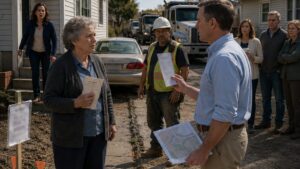
The morning looked too clean for what was happening. Fresh lawns, trimmed hedges, identical white porch columns. Two townhomes down, a neighbor stood frozen with a coffee mug in one hand. A white work truck blocked half of Stephen’s driveway. Orange cones had been placed along the walkway as if his front door had become a construction zone.
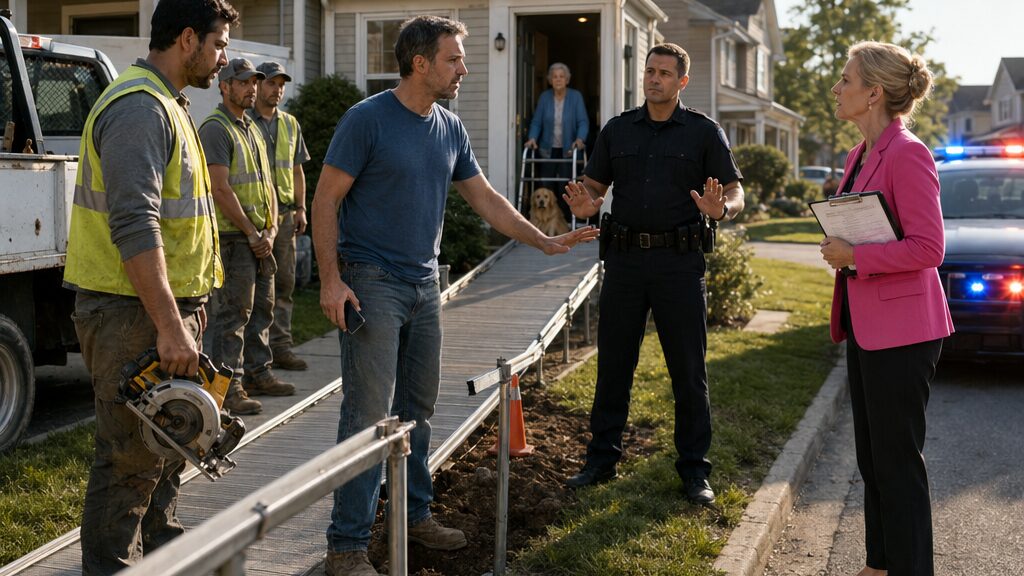
A crew worker held the ramp rail steady. Another had a cordless saw in both hands. The rail was already notched.
Stephen stepped between them and the ramp.
“Stop cutting.”
The man with the saw pulled it back, not all the way down, just enough to show he could start again if someone told him to. He looked over Stephen’s shoulder.
Patricia Moore stood near the curb in a bright pink blazer, her phone in one hand, a clipboard tucked under her other arm. Her expression had the stiff brightness of someone who had decided anger was the same thing as authority.
“Mr. Taylor,” she said, “you were notified.”
“No,” Stephen said. “I wasn’t.”
A stocky man near the truck closed a toolbox and came forward. “I’m the supervisor,” he said. “Tyler Sanchez. We have a work order.”
“You have a work order to cut an access ramp off my front door?”
“It says remove non-compliant exterior structure.”
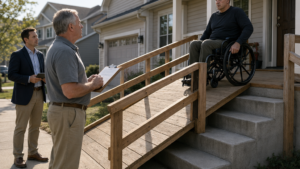
Stephen turned just enough to look at the ramp without giving up his place. Three weeks ago, it had been a pile of aluminum sections and treated lumber. Temporary, plain, sturdy. It sloped from the porch to the walkway at a gentle angle, with a rail Linda could grip when her knees locked. It was not pretty. It was not meant to be. It was the difference between his mother entering her house and being carried into it.
Patricia lifted her chin. “That structure was installed without final approval.”
“It was submitted.”
“It was not approved.”
“My mother needs it.”
“You don’t get to bypass community standards because you feel strongly about something.”
The word something landed worse than yelling would have. Stephen glanced back at the front window. Inside, he could see the pale reflection of the router light in the cabinet and the dark shape of the retriever pacing near Linda’s chair.
“Put the saw down,” he told Tyler.
Tyler lowered it. The other worker shifted uncomfortably.
Patricia’s phone hand rose. “I already called the police.”
Stephen stared at her. “For a ramp?”
“For interference with community safety access.” She pointed toward the eave above the porch, where a small neighborhood camera faced the shared sidewalk. “And for disabling a safety feed.”
The first police car rolled into the street before Stephen could answer. Then a second. Blue and red light flashed over the green lawns, over the white truck, over the half-cut rail. A neighbor across the street lifted a phone.
The officer who approached did not come with a hand on his holster. He came with his palms half-raised, reading the scene as he walked.
“Who called?”
Patricia stepped forward quickly. “I did. I’m Patricia Moore, HOA president for this section. This homeowner shut down neighborhood security access this morning and is obstructing an authorized removal.”
Stephen kept his voice even. “I changed my private WiFi password. They’re cutting down my mother’s ramp.”
The officer looked from Stephen to the ramp, then to Tyler’s saw. “Is anyone hurt?”
“No,” Patricia said. “But—”
“Is there a threat?”
“He disabled security.”
Stephen took his phone from his pocket. “My router is inside my house. My account. My password. The ramp is for my mother. I’m asking them to stop until they show me legal authority.”
Patricia’s face tightened. “This is not about his mother. This is about compliance. He was told no exterior modifications without approval. He also cut off the camera feed covering this walkway.”
The officer turned to Tyler. “You have a court order?”
Tyler looked at Patricia.
The pause was small, but everyone heard it.
Patricia tapped the clipboard. “We have an HOA enforcement order.”
“That’s not what I asked,” the officer said.
Stephen felt something in his chest loosen, but only slightly. The saw had already touched the rail. The cut was there, bright and raw. It would not hold weight the same way until repaired.
Patricia stepped closer to the officer. “Our governing documents allow us to remove unauthorized structures after notice. This homeowner has been uncooperative, and now he’s interfered with community safety equipment.”
“My WiFi is not community equipment,” Stephen said.
“It became part of the temporary security network when you agreed to let the installer connect the relay.”
“I let an installer use it for one afternoon while the HOA fixed its own service. Months ago.”
“You never withdrew that access.”
“I changed my password.”
“Exactly.”
The officer looked at Stephen. “You gave them access before?”
“For a temporary setup,” Stephen said. “Not forever. Not for them to treat my home internet like a utility they own.”
Patricia turned toward the gathered porches and raised her voice, not quite shouting, but making sure it carried. “This is what happens when residents decide rules don’t apply to them.”
Stephen saw Anna Martinez two doors down, standing with a folder pressed to her chest. She looked away when his eyes met hers.
A fine tremor began in Stephen’s right hand. He closed it around his phone. His first instinct was to explain everything: Linda’s fall, the doctor’s warning, the nights he slept on the couch because she could not manage the steps alone. But Linda had made him promise not to make her medical life neighborhood property. Not at the mailbox. Not in an HOA meeting. Not in front of Patricia Moore.
So he said only, “That ramp is a medical accommodation.”
Patricia gave a short, disbelieving breath. “Then you should have completed the proper paperwork.”
The officer shifted toward the crew. “Nobody cuts anything else while I’m here.”
Tyler nodded immediately. One of the workers unplugged a battery pack and set it on the truck bed.
Patricia’s jaw moved as if she were biting down on a different argument. “Fine. But the violation stands. If the crew is prevented from completing authorized work today, the association will assess daily fines beginning immediately.”
Stephen looked at the rail. One cut. One gap in what had been safe yesterday.
“Put that in writing,” he said.
“It already is.”
“Then hand me the order.”
Patricia slid a sheet from her clipboard but did not give it to him. “The notice was posted.”
“When?”
Her eyes flicked to the door.
Stephen followed her glance. There, half-hidden behind the storm door handle, a folded white paper had been taped flat against the glass. It had not been there when he fed the dog at seven. It had not been there when Linda asked whether the ramp felt slick from overnight dew.
The officer noticed the direction of his stare.
Stephen stepped backward just enough to reach the door, but he did not turn his back on the crew. The retriever pressed his nose to the glass from inside. Behind him, Linda’s voice came thin and strained from the living room.
“Stephen?”
He opened the door a few inches.
The dog pushed his muzzle through the gap, whining. From the chair by the front window, Linda called again, more clearly this time.
“Is the ramp gone?”
Chapter 2: The Notice Was Left Too Late
The notice had a timestamp from 8:42 that morning, and the first cut in the ramp had been made before 8:50.
Stephen stood on the porch with the paper in one hand and his phone in the other, photographing the tape, the door glass, the cut rail, the cones, the truck, and Patricia’s shoes at the curb. He took each picture twice. Wide shot, close shot. Then he filmed the rail slowly, letting the camera catch the fresh metal edge and the saw dust scattered across the top board.
“Stephen,” Linda called from inside, “don’t let the dog out.”
The retriever had one paw against the threshold, tail low, confused by the voices and flashing lights. Stephen nudged him back with his knee and kept the door open only wide enough to speak.
“I won’t.”
Linda sat in her high-backed chair with her hands curled around the armrests. Her walker was beside her. She was dressed, which made the whole thing worse. She had put on her blue cardigan and soft shoes because this was the morning she intended to go to the mailbox herself.
“Is it still usable?” she asked.
Stephen looked over his shoulder at the cut rail. “Not safely.”
Her mouth tightened. “Then don’t say yes to make me feel better.”
He folded the notice carefully, because crumpling it would have felt good for half a second and helped nothing.
Outside, Tyler was speaking quietly to his crew. Patricia had moved to the sidewalk, where she was typing fast on her phone. The police officer stood near the first cone, taking notes.
Stephen stepped back out and shut the door gently.
“Mr. Sanchez,” he said.
Tyler looked tired now, not aggressive. “Yeah.”
“What time did you arrive?”
“I’d have to check.”
“Check.”
Tyler hesitated, then pulled his phone from his vest pocket. “Truck got here at 8:36. We started setting cones at 8:39.”
Stephen held up the notice. “This says 8:42.”
Tyler looked at the paper, then away. “I don’t handle notices.”
“But you were told to remove the ramp before I was notified.”
“I was told the owner had been difficult and not to engage beyond the work order.”
Stephen let that sit between them.
The officer looked up. “Who told you that?”
Tyler’s eyes went toward Patricia.
Patricia stopped typing. “The association has a documented compliance process.”
“That wasn’t his question,” Stephen said.
She walked back to the driveway, expression sharpened. “Mr. Taylor, you keep trying to turn a simple violation into a drama. The board is not required to debate every resident who ignores procedure.”
“You left this after your crew arrived.”
“I left it when I arrived to supervise.”
“Your crew was already here.”
“The notice was posted before removal began.”
Tyler did not say anything. That silence became its own answer.
Stephen photographed the timestamp again. He took a picture of the truck with its back door open and the cut rail behind it. He emailed the photos to himself before Patricia could say anything else.
The officer asked, “Do you have a permit for this removal?”
Patricia blinked. “A permit? For removal of an unauthorized structure?”
Tyler answered carefully. “We don’t have a city permit. Work order only.”
“Any court order?”
“No.”
“Any signed consent from the homeowner?”
Tyler shook his head.
The officer wrote that down.
Patricia’s voice cooled. “This is association property frontage.”
“It’s my front walkway,” Stephen said.
“It is a regulated exterior area.”
“My mother’s front door is not your display case.”
For the first time, Patricia’s composure cracked into something more personal. She angled her phone toward the ramp and began taking photos, moving from one side to the other like she was documenting a crime scene.
Stephen stepped in front of the door window, blocking her view inside.
She lowered the phone. “If the medical need is real, you should have no problem producing documentation.”
“Don’t photograph my mother.”
“I’m photographing the violation.”
“You were aiming through my door.”
“I was documenting the condition of the property.”
“You were documenting a woman in her own living room.”
A neighbor murmured from across the street. Patricia heard it and flushed.
Then she said, quieter but sharper, “You cannot use your mother as an excuse to build whatever you want.”
Stephen felt the sentence pass through him like a wire pulled tight. He could have told her about the night Linda had slipped at the threshold and spent twenty minutes on the floor refusing to let him call anyone because she did not want the neighbors to see an ambulance. He could have told her about the occupational therapist who had said, very plainly, that the front entry needed a ramp now, not after a committee calendar opened.
Instead he said, “You’re done here for today.”
Patricia looked at the officer. “Are you hearing this?”
“I’m hearing a homeowner ask people not to continue work without clearer authority,” the officer said. “That sounds like a civil matter.”
Patricia’s lips pressed together. She turned to Tyler. “Pack up until further instruction.”
Tyler nodded, almost relieved.
The crew moved slowly, lifting tools, collecting batteries, pulling the cones back one by one. Nobody touched the rail. Nobody repaired it either.
Stephen stood on the porch until the truck door shut. Only then did he turn toward the living room window. The router light blinked steadily inside the cabinet, indifferent and green. Above the porch, the small camera that had once fed the HOA’s temporary relay sat dark.
Inside, the retriever pushed his head under Linda’s hand. She stroked his ears without looking at Stephen.
“They saw me?” she asked.
“No.”
“You’re lying badly.”
“I stopped her.”
Linda’s eyes moved toward the door. “Can I get out?”
“Not this way. Not until I brace the rail.”
Her hand stilled on the dog’s head.
Stephen went to the hall closet and pulled out the folder he had labeled RAMP REQUEST. He had made copies of everything: contractor estimate, material specs, photos, a basic note from the clinic saying mobility accommodation recommended. Not the full letter. Not the diagnosis details. Not the fall history.
Linda had asked him not to send those.
He had agreed too quickly because he wanted to be the kind of son who could protect both her safety and her pride.
Now the folder felt thinner than it had the day he mailed the application.
He set it on the kitchen table beside his laptop and opened the HOA portal. The application status line loaded slowly.
Temporary Exterior Access Modification: Pending Review.
Below it, a red note had appeared sometime that morning.
Medical documentation: pending.
Stephen stared at the word until it stopped looking bureaucratic and started looking like a door he had left unlocked for Patricia to walk through.
Chapter 3: The Board Calls It Community Safety
“You don’t get to cut off community safety because you’re angry,” Patricia said.
Stephen had not even stepped fully into the HOA office. He stood just inside the glass door, holding a folder under one arm and a printout of his router logs in the other. Patricia was behind the small reception counter, still wearing the pink blazer, though now it looked less like clothing and more like a uniform she had chosen for battle.
Anna Martinez sat at a side desk with a laptop open. Her fingers rested above the keyboard without moving.
“I changed my private password,” Stephen said. “That’s not anger. That’s basic security.”
Patricia reached for a form on the counter. “The camera covering your walkway went offline at 7:18 this morning.”
“My router password changed at 7:15.”
“So you admit the connection.”
“I admit my router works.”
Anna looked down at her laptop, but Stephen saw her mouth tighten.
Patricia slid the form toward him. At the top, in bold letters, it read Emergency Exterior Compliance and Safety Interference Report. Someone had already filled in his address.
Stephen did not pick it up. “You’re combining the ramp and the WiFi?”
“They are connected incidents.”
“No. One is a temporary access ramp. The other is my internet.”
“The camera feed exists to monitor common walkway safety.”
“Through my router?”
“It was a temporary solution.”
“For how long?”
Patricia’s eyes narrowed. “Until permanent service could be restored.”
“It’s been four months.”
Anna’s fingers moved suddenly, a quiet tap on the keyboard.
Stephen placed the router logs on the counter. “My network shows a device named HOA-Relay-03 connected every day. Overnight. Weekends. After the installer told me he needed it for one afternoon.”
Patricia glanced at the pages but did not touch them. “You gave consent.”
“I gave a password to an installer standing on my porch while he checked a camera. I didn’t sign anything.”
“You knew the device remained connected.”
“I didn’t. Not until my mother’s alert system lagged twice this week and I checked the device list.”
That made Anna look up.
Patricia caught the movement and spoke before Anna could. “Your personal technical issues do not justify disabling association security.”
“My mother’s emergency alert runs through that network. Her front door camera runs through it. Her medical reminder hub runs through it. I changed the password because there were devices on my network I did not authorize.”
The words came out more specific than he had intended. He felt Linda’s privacy in them like a bruise he had pressed by accident.
Patricia’s face changed, but not toward sympathy. It moved toward opportunity.
“So there is medical equipment involved,” she said. “All the more reason you should have completed the accommodation packet.”
Stephen folded the router logs back into a neat stack. “Don’t twist this.”
“I’m trying to establish facts.”
“You sent a crew before notice.”
“I supervised enforcement after repeated noncompliance.”
The office door opened behind him. The same police officer stepped in, removing his sunglasses. “I was asked to stop by for a copy of the report.”
Patricia straightened. “Yes. I’m preparing it now.”
The officer looked at Stephen, then at the form. “This the WiFi issue?”
“This is an emergency interference report,” Patricia said.
The officer read the title upside down from across the counter. “Does the HOA own the router?”
“No,” Stephen said.
“Does the HOA have a written agreement to use it?”
Patricia said, “It was a temporary community safety arrangement.”
“That wasn’t my question.”
The room went still except for Anna’s typing.
Patricia opened a file drawer and pulled out a thin folder. “The installer’s service note reflects resident cooperation.”
She set the page on the counter. Stephen recognized the date. Four months earlier, before Linda’s second fall, before the ramp, before he had started sleeping with his bedroom door open in case she called.
The service note said: Resident permitted temporary connection for camera test.
Stephen pointed to the last two words. “Camera test.”
Patricia’s jaw tightened.
The officer leaned in, read the line, and then stepped back. “This does not look like a criminal matter.”
Patricia’s voice lowered. “Officer, with respect, when a resident disables a safety system—”
“A device using his private internet without a current written agreement is not something I can force him to reconnect.”
“I am not asking you to force him. I am asking you to document interference.”
“I can document that there’s a dispute.”
Stephen almost laughed, but it would have come out wrong.
Patricia took the report form back and began writing faster. “Then we will proceed through the association.”
“You already did,” Stephen said. “With a saw.”
Anna stopped typing.
Patricia looked up. “Mr. Taylor, I understand this feels personal to you. But when residents make unilateral changes, whether to exterior structures or connected safety systems, the board has obligations. Insurance carriers ask questions. Property values are affected. Other residents are watching. If we let one owner decide what rules apply, we lose the ability to enforce any of them.”
For the first time that day, Stephen heard the fear underneath her certainty. It did not soften the cut in the ramp. It did not excuse the police cars outside his house. But it made her sound less like someone enjoying power and more like someone terrified of losing it.
He set his palm flat on the counter. “And if your process keeps my mother from leaving her own house?”
Patricia’s expression closed again. “Then complete the paperwork.”
Stephen gathered his pages. “I’ll do that. And I’ll be requesting every record about my property, the camera relay, and the removal order.”
“That requires a formal records request.”
“Then give me the form.”
Anna reached for a drawer before Patricia moved. She pulled out a blank request sheet and slid it across the desk.
Patricia turned toward her. “Anna.”
Anna’s hand withdrew slowly. “It’s the correct form.”
Stephen took it. Their eyes met for half a second. Anna looked away first.
He filled out the request in the office lobby, writing carefully: all board discussions, enforcement notes, work orders, notices, camera relay records, and communications concerning his address from the past thirty days. He signed it, dated it, photographed it, and handed it back.
Patricia accepted it with two fingers. “The board has ten business days.”
“My ramp has one cut rail today.”
“The emergency violation will be reviewed sooner.”
He left before he answered.
Outside, the sidewalk camera above the shared entry remained dark. The little black lens pointed toward his house like an eye that had lost its nerve.
Anna came out while he was halfway down the walkway. She carried no folder now, only her phone, held low.
“Stephen,” she said quietly.
He stopped.
She glanced back at the office window. Patricia was visible inside, already on a call.
“I shouldn’t be talking to you outside the process.”
“Then don’t.”
Anna swallowed. “The board discussed your property two weeks ago.”
Stephen looked at her.
“The ramp?” he asked.
Anna’s eyes moved to the dark camera over his walkway.
“Not just the ramp,” she said.
Chapter 4: The Form That Proved Too Little
“This isn’t a city problem,” the clerk said. “This is your association.”
Stephen stood at the permit counter with the ramp drawings spread under both hands, the same way he had held down loose paper in a storm. Behind the clerk, a printer clicked and paused, clicked and paused, feeding out someone else’s approval. The clerk had a ruler in one hand and a pen tucked behind one ear. She had measured the slope twice, checked the landing dimensions, and circled the handrail height without frowning.
Then she slid the drawings back to him.
“So the ramp is illegal?” Stephen asked.
“I didn’t say that.”
“Unsafe?”
“I didn’t say that either.”
Stephen waited.
The clerk tapped the page. “For a temporary residential accessibility ramp like this, the city doesn’t require a full construction permit if it meets basic safety standards and doesn’t block public right-of-way. Based on what you brought me, your issue is private covenant enforcement. HOA, not city.”
He looked down at the drawing. The slope lines, the measured landing, the treated supports. Everything had seemed excessive when he first assembled the packet. Now it felt like not enough.
“Can you put that in writing?”
The clerk studied him. “I can print a general code guidance sheet. I can’t tell your HOA what to do.”
“I’m not asking you to.”
She gave him the look of someone who had heard that sentence from desperate homeowners before and knew it was never true. Still, she printed the sheet. It came out warm, thin, and official-looking enough to matter until someone decided it did not.
On the drive home, Stephen stopped twice at red lights and reread Anna’s words from the night before in his head.
Not just the ramp.
She had not said more. Patricia had come out of the office before Anna could finish, and Anna had stepped back into the safe shape of procedure. But the words had followed Stephen into the night, into the hours he spent checking device logs, into the short sleep he took on the couch while Linda’s walker stood folded beside the hallway.
At the kitchen table, he laid the city guidance sheet beside the router logs. The router blinked from the cabinet across the room, green, steady, his. The golden retriever lay near the front door with his chin on his paws, facing the ramp as if waiting for it to fix itself.
Stephen opened the HOA portal again.
The records request showed as received.
The ramp application still showed pending.
A new document had appeared beneath it.
Draft Denial: Exterior Modification — Administrative Review.
Stephen clicked before he could decide whether he wanted to know.
The document opened with a date stamp from two weeks earlier.
Before the cut rail. Before the notice. Before Patricia called 911. Before Stephen changed the WiFi password.
Before his response period had even closed.
He sat back slowly.
The denial was not final, at least not in the file name, but it read like a decision already made. Exterior appearance inconsistent with community standards. Temporary installation lacking completed medical support. Potential liability if structure remains beyond emergency use period. Resident to remove or submit revised request pending board review.
Stephen checked the upload details. Created fourteen days ago. Modified that morning.
He took screenshots. Then he printed it. The printer on the sideboard whirred, and Linda called from the living room, “Is that more paper?”
“Yes.”
“Helpful paper?”
“I don’t know yet.”
“That means no.”
He smiled despite himself, but it lasted only a second.
His email chimed.
Emergency Board Hearing Notice.
The subject line had Patricia’s neat violence in it. The hearing was scheduled for the next evening at the clubhouse. Agenda items: unauthorized exterior structure, interference with community safety system, emergency fines, enforcement continuation.
Stephen read the phrase enforcement continuation twice.
The crew had stopped, but the removal had not ended. It had simply moved into cleaner language.
Linda appeared in the kitchen doorway, one hand on the walker, the other on the frame. She had moved more quietly than he liked. Her cardigan sleeve had slipped down over her wrist, and her expression was too composed.
“You should have called me,” he said.
“I crossed twelve feet, not the Rockies.”
“You shouldn’t be standing there alone.”
“Then don’t make me wait while you read emails about my door.”
He closed the laptop halfway.
She looked at the spread of papers. “What did they say?”
“They scheduled a hearing.”
“About the ramp.”
“And the WiFi.”
Her eyebrows lifted. “The WiFi?”
“Apparently I endangered the neighborhood.”
“That must have been difficult for the neighborhood.”
The dry edge in her voice almost covered the tremor underneath it.
Stephen picked up the city guidance sheet. “The city doesn’t have a problem with the ramp if it meets safety standards. The HOA does.”
“Of course they do. The city doesn’t have to look at it from the mailbox.”
He paused. “Mom.”
“What?”
“Did Patricia talk to you?”
Linda’s hand tightened on the walker.
“When?” she asked.
“You tell me.”
She looked past him, toward the front window, toward the porch she had not crossed since morning. “A few weeks ago. She was walking by. I was sitting outside.”
“Before I submitted the request?”
“After you started measuring.”
“What did she ask?”
Linda moved slowly to the chair by the table. Stephen did not help her, because she hated when he moved before she asked, but he stayed close enough to catch her if her knee shifted.
“She asked if the ramp was going to be permanent.”
“And you said?”
“I said I hoped not.”
Stephen closed his eyes.
“I did hope not,” Linda said.
“That’s not what they heard.”
“No. They heard what they wanted.”
“They’re using missing medical documentation against us.”
Her mouth tightened. “Against you.”
“Against the ramp.”
“Same thing, apparently.”
Stephen sat across from her. “The form asked for more medical support. You asked me not to send the full letter.”
“I asked you not to send my entire life to a committee.”
“I know.”
“Do you?”
The question landed softly, which made it worse.
He pushed the denial draft toward her but stopped before it crossed the table. “They had a draft denial before the deadline. This was never just about your letter.”
Linda looked at the paper without touching it. “But the missing letter made it easier.”
He had no answer that would not sound like blame.
A message notification appeared on his laptop screen. Patricia again. Attached: Hearing packet preliminary materials.
Stephen opened it.
The first page was a photo of the ramp from the sidewalk, the cut rail visible, the angle making it look larger than it was. The second page was the emergency report. The third page listed the camera outage at 7:18 a.m., three minutes after his password change.
The fourth page was his accommodation form.
Under medical documentation, Patricia had highlighted one word.
Pending.
Linda leaned forward, read it, and sat back. Her face did not change, but one hand moved to the edge of the table as if she needed to confirm it was there.
Stephen said, “I’ll fix it.”
“You can’t fix what I refused to give you.”
“You were trying to protect yourself.”
“So were you.”
They sat with the papers between them: code sheet, router logs, draft denial, hearing notice. Proof of several things, none of them enough by themselves.
Linda looked toward the front door. “Patricia asked me one more thing that day.”
Stephen went still.
“She asked if I really needed the ramp,” Linda said, “or if you were just making changes because you were scared.”
Chapter 5: Linda Refuses to Stay Hidden
Linda made it to the threshold before the missing rail stopped her.
Stephen was in the hallway with his phone pressed to his ear, waiting for the clinic’s automated system to move him from hold to a human being, when he heard the front door open. The golden retriever slipped past him first, not out onto the porch, but to the edge of the doorway, where he planted himself sideways as if he understood there was no safe path anymore.
“Mom,” Stephen said.
Linda stood with one hand on the doorframe and the other clamped around the walker grip. The cut rail was on her left, bright raw metal where the saw had bitten. The ramp surface was still there, but without that rail it looked less like access and more like a dare.
“I wanted the mail,” she said.
“I would’ve gotten it.”
“I know.”
“That’s why you tried?”
She did not answer. She looked down at the drop from the threshold to the start of the ramp, where the angle required her to turn before stepping forward. With both rails, she could do it slowly. With one rail cut and taped loose, she had no way to steady herself if her knee failed.
The phone in Stephen’s hand clicked and a recorded voice told him his call was important.
He ended it.
Linda shifted her weight. The dog whined.
“Back up,” Stephen said, softer than before.
“I’m not going to fall because you say it politely.”
“You might fall because the rail is cut.”
Her jaw tightened, but she let him guide the walker backward. Not touching her arm. Not pulling. Just moving the dog, clearing the rug, giving her space to retreat without admitting she had to.
When she was back in the living room, she lowered herself into the chair with a controlled breath that became pain only at the very end.
Stephen closed the door.
“I’ll get the mail.”
“I don’t care about the mail.”
He turned.
Linda’s eyes were on the ramp through the front window. “I wanted to know if I could still leave.”
The words were plain. That made them harder to bear than fear.
Stephen set his phone on the table. “The clinic is supposed to send a shorter letter. Functional need only. No diagnosis details.”
“My diagnosis is not a scandal.”
“I didn’t say it was.”
“You act like it’s a break-in.”
“I’m trying to keep them from using it.”
“They’re already using the absence of it.”
He looked at the folder on the table, at the space where her full letter should have been. “You told me you didn’t want to be a file.”
“I don’t.”
“Then I was respecting that.”
Linda gave a quiet laugh with no humor in it. “Stephen, you promised not to make me a file. You did not promise to make me invisible.”
He had been moving toward the kitchen. He stopped.
The dog came back to her chair and laid his head against her knee. She touched him automatically, fingers smoothing the fur between his ears.
“I heard Patricia yesterday,” Linda said. “Through the door. She said you were using me as an excuse.”
“She shouldn’t have said that.”
“No. But you know what bothered me most?”
Stephen waited.
“That for half a second, I understood how she got there.”
He frowned. “What?”
“I told her I hoped the ramp wasn’t permanent. I told her I was doing better than I was. I smiled from that chair on the porch and said I’d be walking the block again by fall.”
“You were embarrassed.”
“I was proud.”
“That’s not a crime.”
“No. But it became convenient for her.”
The clinic number appeared on Stephen’s phone. He let it ring once, twice, then picked up.
The nurse on the line sounded rushed but kind. Stephen asked for a letter stating exterior access accommodation was medically necessary. The nurse asked how much detail to include. Stephen looked at Linda.
Linda held out her hand for the phone.
He hesitated. That hesitation was small, but Linda saw it. Her eyes hardened.
Stephen gave it to her.
“This is Linda Taylor,” she said. Her voice changed, not stronger exactly, but more exact. “You may state that I have a mobility limitation affecting stairs and thresholds. You may state that I require a ramp with handrails for safe entry and exit. You may state that delay creates fall risk. You do not need to list every appointment I’ve ever had.”
She listened.
“Yes,” she said. “That is enough.”
When she handed the phone back, Stephen felt ashamed of how relieved he was.
The letter arrived by email twenty minutes later. Three paragraphs. Direct. Clinical. It named the need without undressing her life.
Stephen printed two copies. Linda signed a release for that limited document only. Her hand shook slightly when she wrote, and Stephen looked away until she finished.
At 6:14 p.m., another email arrived from Patricia.
Final Notice of Daily Fine Assessment.
Stephen opened it while Linda watched his face.
The notice stated that unless the unauthorized exterior structure was fully removed by midnight, fines would begin at two hundred dollars per day, with additional costs assessed for crew delay and emergency response documentation.
Linda said, “How much?”
“Enough to be ugly.”
“How much?”
He told her.
She looked at the ramp again. “They know I can’t remove it.”
“They know I won’t.”
“That’s not the same thing.”
He sat down, suddenly tired in a way that felt physical. “I should have sent the full packet the first time.”
“You should have let me decide what full meant.”
He nodded once.
That was the closest thing to an apology he could manage without turning it into a speech about himself.
Linda reached across the table and tapped the medical letter. “Bring this tomorrow.”
“I will.”
“And bring the city paper.”
“Yes.”
“And the thing about the WiFi.”
“The router logs.”
“Yes. The thing that shows they were in your house without being in your house.”
Stephen looked at her.
She shrugged. “I understand more than you think.”
His laptop chimed again before he could answer.
This email was not just to him. It had gone to the board, management, and the general compliance address. Patricia’s name sat at the top.
Attached was the hearing packet.
The cover memo read: Resident Stephen Taylor has engaged in intentional interference with emergency systems following unauthorized exterior construction.
Stephen felt Linda reading over his shoulder before she spoke.
“Emergency systems,” she said.
He opened the packet. The first image was his ramp, photographed from below. The second was the camera outage report. The third was a timeline that began with his password change, not with the denied ramp request, not with the crew, not with the notice.
Linda’s medical letter sat printed beside the computer, not yet part of the story Patricia was telling.
Stephen reached for it.
Linda put her hand over his before he could slide it into the folder.
“Tomorrow,” she said, “I speak first if they start by talking about me.”
Chapter 6: The Meeting Where Access Became Evidence
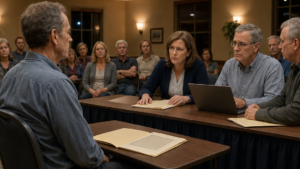
Patricia opened the hearing with a photograph of the ramp blown so large on the clubhouse wall that the cut rail looked like a weapon.
Stephen sat in the front row with his folder balanced on his knees, Linda’s medical letter clipped to the city guidance sheet, the router logs behind them, and the printed denial draft at the back. Linda had chosen not to come. Not because she was hiding, she had told him, but because she refused to sit under fluorescent lights while strangers discussed whether her doorway was attractive enough.
If they start by talking about me, she had said.
Stephen had promised. Then he had stood in the hallway after she went to bed, wondering how a promise could feel like both protection and theft.
Patricia stood beside the projector screen. The pink blazer was back. So was the clipboard.
“This emergency hearing concerns two connected violations,” she said. “First, an unauthorized exterior structure installed without completed approval. Second, intentional interference with a community safety system after the resident changed a WiFi password, disabling the camera feed for the shared walkway.”
A board member shifted in his chair. Anna sat at the end of the table with her laptop open, hands folded instead of typing.
Stephen waited until Patricia turned toward him.
“You may respond,” she said.
He stood. “The structure is an access ramp for my mother. The city has no objection to it as a temporary residential accommodation if safety standards are met. The WiFi is my private account. The HOA has no written agreement to use it.”
Patricia’s smile was small. “We will address each claim. Please keep emotion out of the record.”
Stephen looked at the photograph on the wall. The ramp was shown without the living room window, without the walker, without the dog who waited at the threshold. Just metal and boards. A thing easy to condemn if nobody asked what it connected.
“I’ll keep it factual,” he said.
He handed the medical letter to Anna first, not Patricia. Anna looked startled, then accepted it and scanned the first lines. Something in her face changed.
Patricia held out her hand. “All documents should come through the chair.”
Anna passed it to her.
Patricia read quickly. “This is dated today.”
“Yesterday,” Stephen said. “Issued yesterday. The need existed before your crew arrived.”
“It was not included in the original submission.”
“No. A shorter clinic note was.”
“A note that did not establish need with enough specificity.”
Stephen did not argue. That was the part Patricia could use because it was true.
“My mother wanted privacy,” he said. “I honored that badly. This letter states what the board needs to know and no more.”
Anna looked at him again, and this time she did not look away.
A board member leaned forward. “Does the city guidance say the ramp is compliant?”
“It says the city does not require a full permit for this temporary ramp if basic standards are met and it doesn’t block public access.” Stephen held up the sheet. “Your concern is appearance and association approval, not city safety.”
Patricia clicked to the next slide. A screenshot of the camera outage log filled the wall.
“At 7:18 yesterday morning, the shared walkway camera went offline,” she said. “This occurred immediately after Mr. Taylor changed his WiFi credentials.”
Stephen placed the router logs on the table. “A device named HOA-Relay-03 had been connected to my private network continuously. I never signed an agreement for that.”
“You verbally allowed access.”
“For a temporary camera test.”
Patricia clicked again. A service note appeared.
Resident permitted temporary connection for camera test.
The board member read it aloud, slower than Patricia would have liked.
“For camera test,” he repeated.
Patricia’s voice tightened. “The test configuration remained in place while permanent service was pending. Residents benefit from walkway coverage.”
“Residents also benefit from not having their private routers used without written permission,” Stephen said.
Another board member asked, “Was there a written agreement?”
Patricia looked at the management representative seated near the wall. The representative opened a folder, searched, and found nothing quickly enough.
Anna finally spoke. “I have not located one in the records.”
Patricia turned toward her. “The records request is still pending.”
“This is the hearing record,” Anna said. “If we’re calling it intentional interference, we should note whether we had documented authorization.”
The room changed then. Not dramatically. No gasps. Just chairs shifting, pens pausing, Patricia’s fingers tightening around the remote.
Stephen saw the opening and resisted the urge to push too hard. He did not want revenge to become easier than repair.
“The password was changed because unknown devices were using bandwidth on the same network as my mother’s alert system and door camera,” he said. “I am not reconnecting HOA equipment to my private account.”
Patricia set down the remote. “Then the board must consider whether your actions created a safety gap.”
“The safety gap at my home was created when your crew cut the ramp rail.”
Anna’s screen made a soft notification sound. She glanced down, then clicked something. Her eyebrows drew together.
Patricia moved back to the ramp photo. “Regardless of the network issue, the ramp remains unapproved. The association cannot allow residents to install structures first and justify them later. If we do, every future violation becomes an exception.”
There it was, Stephen thought. Her real fear. Not his ramp. Not the password. The crack in the wall she believed she was holding up.
“The board can require a compliant finish,” Stephen said. “It can require paint color, edge trim, inspection by a qualified installer. But it cannot remove the only safe entrance while reviewing paperwork.”
Patricia’s eyes flashed. “No one is preventing access. There are other doors.”
“My mother cannot use the back steps.”
“Has that been documented?”
Stephen tapped the medical letter. “Yes.”
“After enforcement began.”
“Because enforcement began.”
Anna’s fingers were moving now, not in the brisk rhythm of someone hiding behind minutes, but in the slower rhythm of someone choosing words carefully.
Stephen pulled the denial draft from the back of his folder. “I also want to ask why a draft denial was created two weeks before my response deadline.”
Patricia looked sharply at the page.
A board member reached for it. Stephen handed over a copy.
“This was from the portal,” Stephen said. “Created before I was told the medical documentation was insufficient. Modified yesterday morning.”
Patricia’s voice became formal. “Drafts are internal. They do not represent final decisions.”
“But a removal crew arrived before a final decision was served.”
“The association had authority to address an unauthorized structure.”
Anna looked up from her laptop. “The minutes from the last executive session should be clarified.”
Patricia turned slowly. “Anna.”
Anna’s face had gone pale, but she kept her hands on the keyboard. “The board discussed removal scheduling before the notice window closed. The minutes currently say ‘enforcement options reviewed.’ That is incomplete.”
A long silence followed.
Stephen heard the hum of the projector. Outside the clubhouse window, the neighborhood looked calm, porch lights coming on one by one.
Patricia said, “This is not the appropriate time to revise minutes.”
“It is if the hearing relies on them,” Anna said.
The door opened at the back of the room.
Tyler Sanchez stepped in wearing the same work pants from the day before, though without the yellow vest. He held a folded work order in one hand and looked like he regretted every step that had brought him there.
Patricia’s expression hardened. “This is a closed board proceeding.”
Tyler looked at Stephen, then at Anna, then at the board table. “I was told to bring the original if there were questions about timing.”
“By whom?” Patricia asked.
He did not answer her. He unfolded the paper and held it out.
Anna stood and took it.
Stephen watched her read the top line, then the scheduled date, then the authorization note.
Her voice was quiet when she spoke.
“This work order scheduled removal before the final notice was posted.”
Chapter 7: The Second Order Comes in Writing
The second crew truck parked in front of Stephen’s house before breakfast.
He saw it through the living room window while pouring Linda’s coffee, the white hood easing toward the curb with no flashing lights, no siren, no officer yet. Just a clean truck, a folded ladder, two workers in plain shirts, and Tyler Sanchez climbing out with a clipboard he did not want to hold.
The golden retriever rose from the rug and went straight to the door.
“No,” Stephen said quietly.
Linda, seated at the table with both hands around her mug, looked toward the window. “They came back.”
Stephen set the coffee down. “Stay inside.”
She did not argue, which told him exactly how much the cut rail still frightened her.
By the time Stephen opened the door, Patricia Moore was already on the walkway. No pink blazer this time. She wore a gray coat over a pale blouse, as if she had decided not to make herself the easiest thing in the scene to remember. In one hand she carried a sealed envelope. In the other, a fresh order clipped to a board.
Tyler stood beside the truck with the posture of a man waiting to be told whether he was about to make the same mistake twice.
Patricia held out the envelope. “Mr. Taylor, this is a revised enforcement order.”
Stephen did not take it immediately. He looked at the ramp first. The left rail remained taped where the saw had cut into it. The exposed metal caught the morning light. Beside the base, two anchor bolts showed where the crew had loosened a support before the officer stopped them.
“What does it authorize?”
“Removal of the remaining noncompliant exterior structure pending approval of a replacement.”
“Pending approval,” Stephen repeated.
“The board has not denied that an accommodation may be appropriate,” Patricia said. “But the existing structure was installed without final approval and does not meet association appearance standards.”
“My mother needs this structure today.”
“A properly submitted replacement can be reviewed.”
“Can she use the review to leave the house?”
Patricia’s mouth tightened. “Do not make this theatrical.”
Stephen took the envelope, opened it, and read the order standing there with the door half-open behind him. It was narrower than the first one. Cleaner. Smarter. It did not mention WiFi. It did not say emergency systems. It did not accuse him of intentional interference. It simply ordered removal of an unauthorized exterior structure and invited submission of a compliant replacement plan.
He almost admired how quickly Patricia had learned what to cut out.
Almost.
Tyler came a few steps closer. “I need to know whether we’re proceeding.”
“You’re not touching the ramp,” Stephen said.
Patricia turned to him. “You are now refusing a written order.”
“I’m refusing unsafe removal.”
“The association cannot permit residents to self-install structures indefinitely.”
“Then approve the safe one or provide a safe temporary alternative.”
“That is not how the process works.”
Stephen folded the order once, slowly, and held it over the exposed anchor holes. “Then put the process in writing. Right here. Sign that if this ramp is removed today, Linda Taylor will have no safe front-door access while the association reviews a replacement.”
Patricia stared at him.
Tyler looked down at the clipboard.
From inside, the dog whined once, low and uncertain.
Patricia recovered first. “I’m not signing your language.”
“It’s not language. It’s the consequence.”
“The consequence is that an unapproved structure will be removed.”
“The consequence is that my mother won’t be able to leave through her own front door.”
“There are other doors.”
“She cannot use the back steps. You have the medical letter.”
“The board has received a letter. The board has not completed review.”
Stephen pulled a pen from his pocket. He had placed it there before opening the door, though he had not known until that moment exactly what he meant to do with it.
“Then write your own version,” he said. “Write that you considered the medical accommodation and determined removal today will not create an access gap.”
Patricia’s eyes flicked to the front window.
Linda was visible behind the glass now. She had moved from the kitchen table to her chair, walker beside her, chin lifted. She was not hiding. She was not waving either. She simply sat where the consequences could see her.
A police car turned the corner.
Stephen heard Patricia’s breath catch before she controlled it. The same officer from the first call stepped out and approached without hurry, looking from the truck to the ramp to Stephen’s face.
“Morning,” he said. “I was asked to keep the peace.”
Patricia said quickly, “The association is proceeding under a revised written order.”
The officer accepted the copy she offered and read the first page. “Does this account for the medical accommodation status?”
Patricia’s fingers tightened around the clipboard. “The accommodation is pending.”
“So removal happens before the review?”
“It is an unauthorized structure.”
The officer looked at the ramp. “Is there a temporary alternative for the resident?”
“That’s not a police matter,” Patricia said.
“No,” the officer agreed. “But it does explain why this may not be as simple as removing boards.”
Stephen held the pen out again. “I asked her to sign that removal today leaves no safe access gap.”
The officer did not smile, but something in his expression shifted. “That seems like a reasonable thing to clarify.”
Patricia looked at him as if he had stepped over a line. “Officer, with respect, I am not here to draft statements for litigation.”
“Then maybe don’t create one with a saw,” Stephen said.
The words came out sharper than he intended. For one second, the anger he had kept folded inside him showed. Patricia saw it. Tyler saw it. The officer saw it.
Stephen breathed once and lowered his voice. “I’m asking for the harm to be named before it is done.”
Patricia did not answer.
Tyler cleared his throat. “I can wait fifteen minutes.”
Patricia turned on him. “You were contracted to complete the job.”
“I was contracted to follow the work order,” Tyler said. “Not decide whether a lady can get out of her house.”
The street had begun to watch again. Curtains shifted. A neighbor paused beside a parked car. Anna Martinez came quickly down the sidewalk from the direction of the clubhouse, phone in one hand and laptop bag over her shoulder.
“Patricia,” Anna called.
Patricia closed her eyes for half a second, then opened them. “Not now.”
“Yes, now.”
Anna stopped beside the first cone. Her hair was slightly loose, as if she had left in a hurry. “I received two board member requests for an emergency vote.”
“I am the chair.”
“The bylaws allow a vote when an enforcement action creates immediate risk and two board members request review.”
“This is an exterior compliance matter.”
“It became an access matter when the medical letter entered the record.”
Patricia’s face went still.
Stephen looked from Anna to the order. “Is the removal paused?”
Anna looked at Patricia, not Stephen. “It should be.”
Patricia’s voice was low. “You are setting a precedent that any resident can claim urgency after ignoring procedure.”
Anna’s answer came just as quietly. “No. We are setting a precedent that we read the full file before sending a crew.”
For the first time since the saw touched the rail, nobody moved.
Then Linda’s voice came from inside, clear through the screen door.
“Stephen.”
He turned.
She had stood. One hand on the walker, one hand on the chair back. The dog stood pressed against her leg.
“Don’t argue about me without me,” she said.
Stephen opened the door wider, ready to step toward her, but she lifted one finger and stopped him where he was.
Patricia looked uncomfortable now, not softened, not sorry, but aware that the shape of the scene had changed. Linda was no longer a line in a letter. She was standing behind the doorway the order would make unusable.
Anna looked at the clipboard in Patricia’s hand. “I’m calling the vote.”
Patricia did not give permission.
Anna did not ask again. She opened her laptop on the hood of Tyler’s truck and began sending the notice while the crew, the officer, Patricia, Stephen, and Linda waited in front of the half-removed ramp.
Chapter 8: The Ramp Goes Back Under New Rules
The same truck returned one week later, but this time Tyler unloaded new handrail sections before he touched the old ones.
Stephen watched from the porch with a mug of coffee in his hand and the final approval letter folded in his back pocket. The cones were back, but they no longer looked like a warning. They made a clean work area around the ramp while Tyler’s crew replaced the cut rail, tightened the loose anchors, and added the trim strip the board had decided would make the ramp “visually consistent” with the community.
Linda had chosen the handrail finish herself.
“Soft gray,” she had said, after the board offered three approved colors. “If they need to feel useful, give them a color.”
The vote had not been dramatic. No one applauded. No one made a speech that fixed what had already been done. Two board members voted to pause removal and approve the temporary accommodation with conditions. Anna entered the corrected minutes. Patricia abstained first, then, after the management representative advised that abstention would not erase her role, voted yes on the revised procedure.
The violation was withdrawn the next morning.
The fines disappeared from the account by noon.
The camera above Stephen’s walkway stayed dark for four days, then a new installer came and moved the relay to an HOA-paid service mounted near the clubhouse connection box. He asked Stephen no questions about passwords. Stephen gave him none.
Now Patricia stood near the curb with a folder in hand, watching Tyler’s crew work. She wore a navy jacket today, plain and unremarkable. When Stephen came down the ramp to meet her, he held the rail lightly. It was not fully finished yet, but it held.
Patricia opened the folder and removed one page. “Withdrawal of violation.”
Stephen took it.
Her signature was already at the bottom.
For a moment, he expected something else. An apology, maybe. A defense. A sentence about misunderstandings or difficult circumstances. Patricia gave him none of that. Her face was controlled, tired around the eyes.
“The board has adopted an interim emergency accommodation process,” she said. “If a resident requires temporary safety access, management can approve a limited installation pending full review.”
“That should have existed before.”
“Yes,” she said.
The answer was so plain that Stephen looked at her again.
Patricia glanced toward the ramp. “The insurance review flagged several informal practices. Including the camera arrangement.”
“Informal,” Stephen said.
Her mouth tightened faintly. “Improper.”
He folded the withdrawal letter. “My WiFi stays private.”
“The association will not request access to your network again.”
Behind him, Tyler called to one of the workers to pass a socket wrench. The sound was ordinary. Metal on metal. A tool used to build instead of undo.
Patricia looked toward the front window, where Linda sat just beyond the glass with the dog at her feet. “I believed residents were starting to treat rules as suggestions,” she said. “Some were. That does not excuse what happened here.”
Stephen did not help her more than that.
“No,” he said. “It doesn’t.”
She nodded once, accepting the limit of the conversation. Then she walked back toward the clubhouse without looking at the neighbors who had come outside to watch the repair.
Anna arrived just before Tyler finished the second rail. She carried a folder against her chest the same way she had the morning of the police call, but she held it differently now, not like a shield.
“I corrected the minutes,” she said.
Stephen nodded. “Thank you.”
“I should have done it sooner.”
“Yes.”
She absorbed that too.
Then she said, “Linda’s letter is sealed in the accommodation file. Restricted access. The board record only states functional need.”
Stephen looked toward the window. Linda was watching the worker smooth the final trim, her expression unreadable.
“She’ll appreciate that,” he said.
Anna glanced at the ramp. “She picked a good color.”
“She said you all needed something harmless to approve.”
Anna laughed once, quietly, then pressed her lips together as if laughing near this house still required permission.
When the crew finished, Tyler walked the length of the ramp slowly, pressing his weight against each rail. Then he waved Stephen over.
“Try it.”
Stephen set his hand on the new rail. It was cool, solid, clean under his palm. The cut was gone, but he knew exactly where it had been. That knowledge did not disappear because a new piece covered the mark.
Tyler stood beside him. “I’m sorry I started cutting.”
Stephen looked at him.
Tyler shrugged, uncomfortable. “I should’ve asked more questions.”
Stephen thought about making it easy for him. He thought about saying it was fine. Instead he said, “Next time, ask before the saw starts.”
Tyler nodded. “I will.”
Inside, Linda called, “Are you two finished inspecting my exit?”
Stephen turned. She was already standing with the walker.
“Wait,” he said.
She looked at him through the open door.
He stopped himself.
Then he stepped aside.
The dog came first, trotting to the top of the ramp and looking back as if to guide her. Linda followed, one hand on the walker, one hand on the soft gray rail she had chosen. Her first step onto the ramp was slow. The second was steadier. Halfway down, she paused.
Nobody spoke.
No police lights flashed over the lawns. No one held up a phone openly. Patricia was gone. Anna stood back near the sidewalk. Tyler’s crew loaded tools quietly into the truck.
Linda reached the bottom and turned her face toward the street.
The mailbox was only thirty yards away.
Stephen moved beside her, close enough to help, not close enough to take over.
She glanced at him. “You’re hovering.”
“I’m learning.”
“That sounded expensive.”
“It was.”
She smiled, but only a little.
They went together to the mailbox. Linda opened it herself. Inside were two envelopes, a grocery flyer, and a postcard from a clinic reminding her of an appointment she had no intention of discussing with any committee.
On the way back, the dog walked ahead and waited at the threshold.
Stephen looked through the front window as they approached. In the router cabinet, the green light blinked steadily. No unknown devices. No shared relay. No invisible claim on his house.
Linda reached the door, turned, and looked once down the ramp behind her.
“Leave it open,” she said.
Stephen held the door while she crossed into her own home under her own power.
The story has ended.