They Built a Gated Entrance Across His Driveway, but the Missing Survey Mark Changed Everything
Chapter 1: The Gate Was Already Coming Down
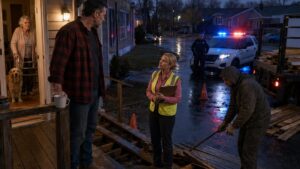
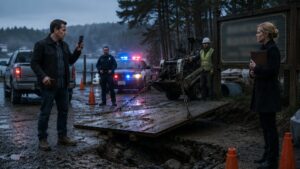
The cutting torch struck the wrought iron with a white flare, and the gate that had locked Gary Carter out of his own driveway began to sag.
He stood beyond the safety cones with his phone raised, recording the orange sparks as they fell across the gravel. Seven months earlier, the same iron had arrived wrapped in moving blankets, polished black and expensive enough to make the old farm road look ashamed of itself. Now two workers in face shields were cutting through the hinge brackets while a third steadied the first section with a chain from the boom truck.
The contractor walked toward Gary carrying a rolled site plan.
“We need your approval before we fill the footing holes,” he said. “Court order says restore the drive, but it doesn’t give us the exact shoulder line.”
Gary lowered his phone. On the far side of the gate, one stone pillar had already been stripped of its brass community plaque. Four pale rectangles remained where the bolts had been.
“The line is marked,” Gary said.
The contractor looked toward the disturbed soil. “We found fresh paint. Nothing permanent.”
Gary knew what he meant. Orange paint faded. Wooden stakes moved. Gravel swallowed evidence with every winter.
He crossed to his work shed and unlocked a metal cabinet beneath the pegboard. Behind old road maps and a rusted level sat a coffee tin sealed with gray tape. He carried it outside, peeled the tape back, and removed a short length of iron rod with a flattened cap.
The cap was scratched and colorless except for a faint smear of red survey paint.
“This is the original corner stake,” Gary said.
The contractor turned it in his gloved hand. “You kept it?”
“I had reason.”
A truck door closed behind them.
Richard Roberts had arrived in a charcoal SUV that seemed untouched by the dust settling over everything else. He stepped out with the folded court order tucked beneath one arm. His silver hair was combed neatly, his coat buttoned despite the heat rising from the torch.
He did not look at Gary.
Instead, Richard addressed the contractor. “The association expects the restoration to meet the terms exactly. No unnecessary widening, no additional grading.”
The contractor glanced from Richard to Gary. “Property owner approves the line.”
Richard’s jaw tightened almost invisibly.
Gary had imagined this moment often during the months of filings, photographs, invoices, and hearings. In those private rehearsals, Richard always said something that sounded like surrender. Sometimes he apologized. Sometimes he admitted the gate should never have been built. Once, in the version Gary hated most, the residents gathered nearby and watched Richard acknowledge the truth.
None of that happened.
Richard unfolded the order and studied a page he had likely read dozens of times.
“The removal is being completed,” he said. “That is what the court required.”
Not what the court found. Not what he had done. Only what had been required.
The chain tightened. The first iron panel lifted free and swung above the driveway, casting a barred shadow across the gravel before the workers lowered it beside the ditch. When it touched the ground, the lock assembly gave one final metallic click.
The sound carried more sharply than Gary expected.
For months that lock had announced itself every time he entered or left: a mechanical snap controlled by an association he had never joined. Now, lying sideways in the weeds, it clicked at nothing.
The contractor unrolled his plan across the hood of a work truck. Gary placed the old stake at one corner to hold the paper flat.
“Was this road ever shared?” the contractor asked.
Richard looked up at last.
Gary kept his eyes on the drawing. “It was used.”
“That isn’t what I asked.”
The contractor’s tone held no accusation. He needed to know whether he was restoring a private lane or a historic access road, whether the shoulder should remain narrow or accommodate two-way traffic.
Gary saw Richard waiting.
“Years ago,” Gary said, “I let some of the residents use it temporarily.”
The contractor tapped the paper. “Temporarily as in written agreement?”
“There was an email.”
Richard folded the court order again. A small movement, but Gary recognized the satisfaction in it. Even after losing the gate, Richard still had that fact.
Gary approved the restoration line. The contractor drove the old stake back into the earth at the edge of the original gravel bed, leaving its cap just visible above the soil. The boom truck lifted the second gate panel. Workers began breaking the concrete around the eastern footing.
Gary photographed each stage, though the court no longer required him to prove anything. Habit had settled into his hands. Time, angle, plate number, position of equipment. He had spent his working life documenting damaged culverts and washed-out roads for the county. Evidence had always felt cleaner than argument.
By noon, the opening stood empty between two half-demolished pillars.
Richard returned to his SUV without speaking to Gary. Before he left, he paused beside the iron survey stake.
For an instant, Gary thought he might say the stake had been overlooked, or moved, or misunderstood.
Richard only brushed dust from his sleeve.
That evening, Gary sat at the kitchen table while the empty gateway darkened beyond the window. The temporary folder from the lawsuit lay beside his laptop. He opened it, passed the photographs of construction and court exhibits, and found a printed message dated five years earlier.
The subject line read: Temporary Access During Washout.
His own words waited beneath it.
Residents may use my driveway until the community road is repaired.
Gary read the sentence twice.
Then he searched the thread for the message in which he had told them the repair was finished and the permission had ended.
There was no such message.
Chapter 2: The Road That Was Never Theirs
Seven months earlier, Gary found three orange lines painted across his gravel driveway.
They began near the ditch, crossed the wheel tracks, and ended beside a patch of waist-high weeds. A small wooden flag marked each line. Another flag stood twenty feet farther up, close enough to Gary’s mailbox that the county snowplow would have torn it out on the first winter pass.
Gary parked his truck sideways and got out.
The paint was fresh. He could smell it.
At the edge of the weeds, partly buried beneath dead grass, a metal cap showed through the soil. He nudged it with his boot, recognized the old survey stake, and stopped himself from pulling it free.
A white utility vehicle sat near the entrance to Cedar Ridge, the planned community adjoining his eastern boundary. Two men in reflective vests were measuring from the asphalt road toward his drive.
Gary walked over.
“What are you laying out?”
One of the men checked a clipboard. “Entrance improvements.”
“This isn’t the entrance.”
The man looked toward Cedar Ridge’s existing road, then back at Gary’s gravel lane. “You’ll need to speak with the association.”
By the time Richard Roberts arrived that afternoon, the orange markings had multiplied.
Richard stepped from his SUV holding a leather portfolio. He had served as Cedar Ridge’s board president for nearly six years and spoke with the practiced calm of someone who believed a controlled voice made a decision reasonable.
“I would have preferred to meet before the preliminary marking,” he said.
“So would I.”
Richard opened the portfolio on Gary’s truck hood. Inside was a glossy rendering of stone pillars, ornamental iron, low landscaping, and a brass plate bearing the Cedar Ridge name. The gate stood precisely where Gary’s driveway met the county road.
Gary stared at the picture. The artist had replaced his gravel with clean paving stones. His mailbox was gone.
“What is this?”
“A secure secondary entrance.”
“Secondary to what?”
“The main entrance has become a bottleneck. Delivery traffic, contractor access, residents on the western loop. You know the situation.”
Gary did know. Cedar Ridge had expanded in phases, each new row of houses bending closer to his property. For years, drivers who missed the main turn had used his driveway to reverse direction. Landscapers occasionally cut through when the association road was blocked. Gary had complained only when someone left ruts.
Richard pointed to the rendering. “The board approved the project after the thefts last fall. Residents want controlled access.”
“You approved a gate on my land?”
“The drive has served community traffic for a long time.”
“It has served my house since before Cedar Ridge existed.”
Richard’s expression did not change. “No one is disputing your ownership of the parcel.”
“You’re drawing pillars on it.”
“We believe there is an established access interest.”
“Recorded where?”
Richard closed the portfolio halfway. “Our attorney is reviewing that.”
Gary nearly laughed, but the feeling never reached his face. “Then review it before you mark my driveway.”
He walked Richard to the weeds and bent to expose the faded metal cap.
“That is the boundary stake.”
Richard looked down without crouching. “Possibly an old marker. Survey points are not always where owners think they are.”
Gary had spent twenty-seven years with the county road department. He knew what happened when people treated a line as approximate because the exact answer was inconvenient.
He went inside, opened the fireproof box in his office, and removed the deed and plat map. His parcel had been divided from a farm decades before Cedar Ridge’s first foundation was poured. The western access lane belonged entirely to the parcel. No HOA covenant appeared in the chain of title. No recorded easement crossed the drive.
By evening, copies covered his desk.
He called the county zoning office. The clerk confirmed that Cedar Ridge had submitted a conceptual gate plan but no final permit had been issued. When Gary gave the parcel number, the clerk paused.
“That entrance point isn’t within the association boundary,” she said.
“That’s what I’m telling them.”
“You should put your objection in writing.”
Gary drafted a letter. He used plain language: private parcel, no consent, no recorded easement, no authorization for entry or construction. He attached the deed page and sent the packet by certified mail the following morning.
He expected the orange flags to disappear.
Instead, two days later, Richard returned with Angela Mitchell, the HOA treasurer. Angela wore practical shoes and carried a binder thick with budget tabs.
“We’re not here to pressure you,” she said.
Gary looked at the flags.
Angela followed his eyes. “The project is already part of the security assessment. People have paid for it.”
“That doesn’t purchase my driveway.”
“No one said it did.”
Richard’s glance toward her was quick.
Angela explained the break-ins: tools stolen from garages, a vehicle entered overnight, packages disappearing from porches. The board believed a controlled western gate would limit untracked traffic. Her concern sounded genuine, which made Gary’s refusal feel less clean than it had when Richard stood alone.
“I understand why you want security,” Gary said. “But the answer can’t be to control my access.”
Richard opened the portfolio again, this time to an aerial map. A shaded line ran from the county road across Gary’s entrance and into Cedar Ridge.
“This route has been used by residents, service vehicles, and emergency crews for years.”
“Used with permission isn’t owned.”
Richard looked directly at him. “Then there was permission.”
The words landed harder than Gary expected.
He remembered the washout five years earlier, when heavy rain collapsed a section of Cedar Ridge’s road near the culvert. Residents on the western loop had been unable to reach the main entrance. Gary had moved his pickup, cut back brush, and allowed them to use his drive. It had seemed temporary and obvious.
Richard saw the memory in his face.
“We’re not inventing history,” he said.
After they left, Gary returned to his office. He searched old messages by the words washout, access, and road repair. At first he found only photographs of the collapsed shoulder and a note from the county engineer.
Then an email appeared from his own account.
Residents may use my driveway until the community road is repaired. Please keep speeds low and avoid the soft shoulder.
Gary scrolled through the replies. Thank-you messages. A notice about gravel reimbursement. A message from Richard, then only a board member, promising the arrangement would be respected.
Gary searched for the end of the thread.
The road had reopened twelve days later. He remembered moving the temporary cones. He remembered telling a contractor that regular traffic should return to Cedar Ridge.
But memory was not a letter.
No message revoked the permission. No sign had been posted. No locked chain had gone back across the lane.
Outside, the orange paint glowed against the gravel in the setting sun, leading from the county road directly to the faded stake.
Chapter 3: Concrete Poured Beyond the Boundary
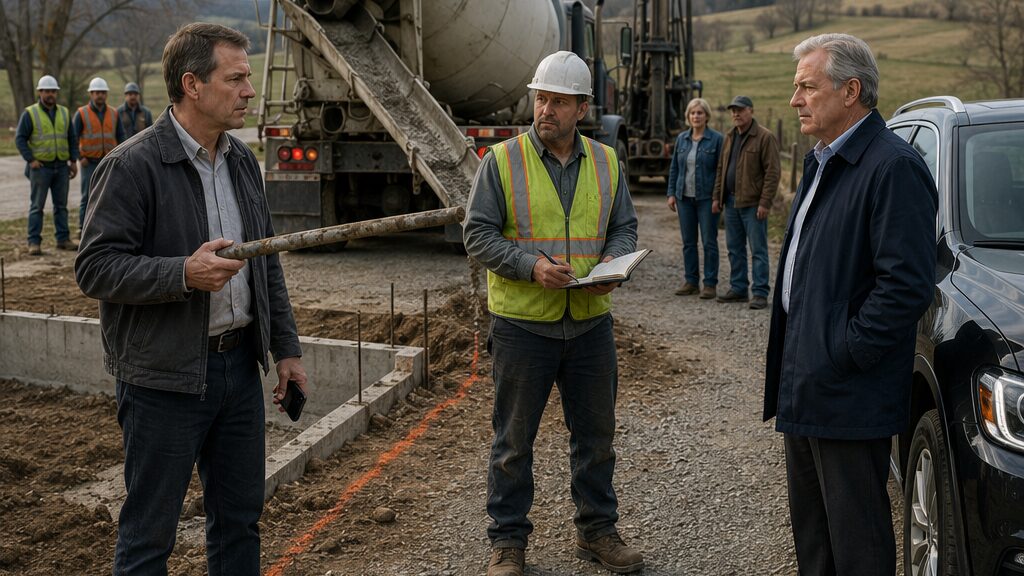
The concrete truck was parked across Gary’s driveway before seven in the morning.
Its rotating drum groaned while a worker guided the chute toward a square excavation beside the gravel. A second truck occupied the shoulder. Gary’s pickup sat trapped between the equipment and his house.
He stepped outside with his phone, the certified-mail receipt, and the preliminary survey Daniel Harris had delivered the previous afternoon.
“Stop the pour,” Gary called.
The foreman raised one hand. The worker at the chute hesitated, but the drum kept turning.
“Property issue?” the foreman asked.
“You’re standing on one.”
Gary showed him the survey. The boundary line ran through the excavation. According to Daniel’s measurements, most of the eastern footing sat inside Gary’s parcel.
The foreman read the first page, then looked toward a black SUV parked near Cedar Ridge.
Richard stood beside it speaking on his phone.
“We have authorization from the association,” the foreman said.
“The association doesn’t own this ground.”
“I need to call my office.”
“Call them before you pour.”
Richard ended his call and approached. His shirt sleeves were rolled neatly to the forearms. He looked less like a board president than a project manager arriving to correct a delay.
“We received your letter,” he said.
“Then why are they here?”
“The board’s attorney believes the historical access supports proceeding while the issue is clarified.”
Gary held up the survey. “Daniel sent your office the same line yesterday.”
“A preliminary line.”
“It puts your footing four feet onto my land.”
Richard turned to the foreman. “The permit and construction authorization are in your packet.”
Gary stepped between them, not blocking the chute, only forcing Richard to acknowledge him.
“There is no final county permit for work on my parcel.”
“The permit notice is posted.”
On a temporary board beside the truck hung a laminated sheet bearing a county stamp. Gary photographed it, zoomed in, and saw the project description: private entrance improvements. The parcel number listed belonged to Cedar Ridge’s common land, not his.
“You used the wrong parcel number.”
Richard’s patience thinned. “Gary, interfering with the contractor could expose you to delay charges. This is a community safety project.”
“You marked the wrong land, filed under the wrong parcel, and ignored written refusal.”
“You permitted access for years.”
“I permitted it during a road washout.”
“You never withdrew it.”
The foreman shifted his weight. Two workers watched from beside the mixer. Across the road, several residents had gathered near Cedar Ridge’s sidewalk. Gary recognized the shape of their assumption before anyone spoke: he was the difficult neighbor stopping a security improvement everyone else had paid for.
A woman near the curb called, “We’ve had three thefts.”
Gary looked at her. “I’m not arguing about the thefts.”
“Then what are you arguing about?”
“My driveway.”
Richard lowered his voice. “You are making this harder than it needs to be.”
Gary felt the old impulse to step back. It was the same instinct that had kept him from posting a sign after the washout, the same one that had made him tolerate delivery vans turning around near his barn. His father had spent years shouting over fence posts and drainage ditches until neighbors crossed the street to avoid him. Gary had promised himself he would never become that man.
But silence had not made him generous in Richard’s eyes. It had made him available.
He walked to the edge of the excavation. Loose soil covered the faded survey stake. The backhoe had bent the grass around it, and one tire had pressed mud across the cap.
Gary crouched, dug his fingers beneath the rod, and pulled it free.
A worker started to protest.
Gary wiped the cap on his jacket until the old red paint showed. He photographed the stake in his hand, the open footing, the survey page, the permit notice, both truck plates, and the time displayed on his watch.
Then he crossed to Richard’s SUV and placed the stake carefully on the polished hood.
Every conversation stopped.
“This marker predates your association,” Gary said. “Your surveyor was warned. Your board received my refusal. Your contractor is now being warned in person.”
Richard stared at the dirt beneath the stake.
“You have documented your position,” he said.
“No. I’ve documented yours.”
The foreman removed a pen from his vest and opened the work log. “State your full name.”
“Gary Carter.”
“Claiming ownership of the excavation area?”
“Not claiming. Recorded owner.”
The foreman wrote for several seconds, then turned the book toward Gary. The entry noted that work had been challenged before placement of concrete and that the owner had produced a survey indicating an encroachment.
Gary signed beneath it.
For one moment, he believed that would stop them.
Then Richard said, “Proceed under the association’s authorization.”
The foreman looked uncomfortable. “Our office confirmed the contract.”
“What contract?” Gary asked.
A man among the watching residents answered before Richard could. “The board said it’s nonrefundable. If construction stops, we lose the assessment.”
Richard turned sharply toward him.
The resident lifted both hands. “That’s what we were told at the meeting.”
Gary understood then that the gate was no longer only about security. Money had been collected. Deposits had been paid. Richard had promised an improvement, and every day of delay made that promise more expensive.
The foreman signaled to the chute operator.
Wet concrete slid into the excavation.
Gary stood beside the truck and photographed the pour from beginning to end.
He did not touch the equipment. He did not shout. When the sheriff’s deputy arrived after the contractor reported a property dispute, Gary showed the deed, the survey, and the certified receipt. The deputy examined them and said the conflict was civil unless someone trespassed after being ordered off or damaged property.
“They’re pouring on my property now,” Gary said.
“I can document the complaint,” the deputy replied. “I can’t decide the boundary from the roadside.”
Richard remained twenty feet away, speaking quietly to the contractor.
By noon, both footings were full.
Over the next four days, stone masons built pillars around steel cores. Electricians installed floodlights and a control box. A brass Cedar Ridge plaque appeared on the eastern pillar, facing the county road as though the land behind it had always belonged to the development.
Gary photographed every delivery.
He also called Jennifer Davis, a property attorney recommended by Daniel. Her assistant asked whether any structure had already been installed.
“Not the gate,” Gary said, watching workers unload the first iron panel. “Not yet.”
Jennifer called back within twenty minutes.
“Do not physically interfere,” she said. “Preserve everything. I’ll need the deed, the full survey, every communication, and any prior permission you gave them.”
Gary looked toward the office window where his old laptop sat.
“What kind of prior permission?”
“Any kind.”
He did not answer quickly enough.
“Mr. Carter,” Jennifer said, “I need the inconvenient facts before their lawyer gives them to a judge.”
That afternoon, the first iron panel rose between the pillars. Chains rattled. Workers guided the hinge pins into place while Richard watched from the shoulder.
By dusk, the second panel had been mounted. The electrical installer tested the mechanism from a handheld controller.
The two sides moved inward with a smooth mechanical hum.
Gary stood on the house side of the entrance as the gap narrowed.
The panels met in the center of his driveway.
The lock engaged with a clean, expensive click.
Chapter 4: The Permission Gary Never Withdrew
Jennifer Davis did not look at the deed when Gary placed it on her desk.
She looked at him.
“Have you told me everything?”
The question came before he had taken off his jacket. Behind her, shelves held binders labeled by township and parcel number. On the wall, a framed survey map showed property lines in precise black strokes, every uncertainty reduced to a notation.
Gary set the rest of his folder beside the deed. Photographs. Certified-mail receipts. Daniel’s preliminary survey. A copy of the permit notice with Cedar Ridge’s parcel number circled.
“I told your assistant there had been temporary access.”
“You said people used the driveway during a road closure.”
“That’s what happened.”
Jennifer folded her hands. “Did you give permission in writing?”
Gary reached into the inner pocket of his jacket and removed the printed email.
She read it without expression.
Residents may use my driveway until the community road is repaired.
“When was the road repaired?” she asked.
“Twelve days later.”
“And when did you tell them access had ended?”
“I told a contractor.”
“In writing?”
“No.”
“Did you put up a sign?”
“No.”
“A chain?”
“No.”
“Did residents continue using the driveway?”
“Not regularly.”
“That wasn’t my question.”
Gary felt heat rise under his collar. “Sometimes.”
Jennifer leaned back. “How often?”
“Landscapers. Delivery trucks. A few residents when the main road was blocked.”
“And you objected?”
“Not every time.”
“Any time?”
“I told people not to speed.”
She pushed the email back across the desk.
“This is the kind of fact that changes what I can ask a judge to do.”
“They built on my land.”
“I know.”
“They had my certified refusal before the concrete arrived.”
“I know that too.”
“Then what changes?”
“The difference between clear trespass and a dispute involving historical permission.”
Gary looked toward the window. Across the street, a delivery van idled at the curb while the driver searched for an address. He could still hear the gate’s lock engaging the evening before.
Jennifer opened Daniel’s survey and traced the boundary with one finger.
“The structure is almost certainly an encroachment,” she said. “But the association will argue that the driveway became an access route through continued use, reliance, or some implied right. I’m not saying they’ll win. I’m saying a judge may hesitate to order immediate removal until the history is clear.”
“They’re controlling whether I can enter my own property.”
“Do you have a code?”
“They gave me one.”
“Did you ask for it?”
“No.”
“Has it failed?”
“Not yet.”
Jennifer held his gaze. “Then we need the strongest record possible before it does.”
She assigned him a list: county road-repair logs, the original washout notices, every email with Cedar Ridge, photographs showing the driveway before the temporary access, and any evidence that the association’s road had reopened.
By noon, Gary was in the county records room beneath lights that flattened every page to the same institutional gray.
The clerk brought him a box marked with the year of the washout. Inside were inspection sheets, contractor invoices, culvert measurements, and daily work notes written in three different hands. Gary recognized the format immediately. He had filled out hundreds like them when he worked for the road department.
He found the first closure notice.
WESTERN LOOP ACCESS RESTRICTED DUE TO CULVERT FAILURE.
Three folders later, he found the completion record.
ROADWAY REOPENED TO NORMAL TRAFFIC.
The date was twelve days after his email.
Gary copied the document and asked whether any notice had been sent to nearby property owners.
The clerk searched the file. “There’s a distribution list.”
His name was not on it.
Cedar Ridge’s property manager was.
Gary stared at the entry.
“So they knew the road reopened.”
“The manager’s office received the notice,” the clerk said. “Whether the board saw it, I couldn’t tell you.”
He photographed the distribution sheet, then checked older plat records. In a survey photograph taken before the flood, the faded iron stake stood clearly beside an unbroken strip of grass. Gary’s driveway remained narrow, with no worn secondary lane toward Cedar Ridge.
The image should have comforted him.
Instead, it showed how obvious the boundary had once been.
He had watched it blur.
Back at Jennifer’s office, she arranged the documents in chronological order: permission, road repair, continued occasional use, formal refusal, survey warning, construction.
“This helps,” she said. “The temporary condition ended.”
“But I never said it ended.”
“No.”
“You keep coming back to that.”
“Because their attorney will.”
Her phone rang before Gary could respond. She answered, listened, and wrote something on a yellow pad.
“When was that filed?” she asked.
Her pen stopped.
“All right. Send it.”
She hung up and turned her computer monitor toward Gary.
“The HOA filed its opposition to emergency removal.”
An attachment appeared in her inbox. The first exhibit was Gary’s email. The sentence allowing temporary access had been enlarged and highlighted.
“They’re calling it evidence of established community passage,” Jennifer said.
“The email says until the road is repaired.”
“They argue the permission continued because you never withdrew it and because use continued.”
“That turns a favor into ownership.”
“It turns a favor into an argument.”
Gary read the filing. Cedar Ridge claimed residents had relied on the route for years. The gate, according to the document, merely regulated an existing access point for safety. Removing it immediately would waste association funds and expose residents to renewed security risks.
The filing did not mention his certified refusal.
Jennifer scrolled farther.
“They attached resident statements.”
Gary recognized the descriptions even without names. A delivery route. A landscaper’s shortcut. A resident who had used the drive during snow removal.
None of them said Gary had granted permanent permission.
None of them admitted asking.
Jennifer closed the document.
“I can still seek an injunction,” she said. “But I need you prepared for the possibility that the judge leaves the gate in place temporarily.”
Gary looked down at his hands. Dirt from the survey stake remained beneath one thumbnail.
“My father would have chained the road the first day.”
“Was he usually right?”
“Sometimes.”
“Was he usually alone?”
Gary did not answer.
Jennifer’s voice softened, but only slightly. “Avoiding his mistakes does not require making the opposite ones.”
She drafted an affidavit while Gary sat across from her. When she reached the history of access, she asked him to describe it in his own words.
He tried to say Cedar Ridge had taken advantage.
She stopped typing.
“Start with what you did.”
Gary stared at the blank line on her screen.
“I allowed residents to use the driveway after the flood,” he said. “I believed the permission ended when their road reopened. I did not state that clearly in writing.”
Jennifer typed every word.
When she finished, she printed the affidavit and placed it before him.
At the bottom, beneath the signature line, the hearing request asked the judge to order immediate removal or disable the gate until the property claim could be resolved.
Gary signed.
Jennifer gathered the pages into a filing envelope.
“I need you to understand something,” she said. “The court may believe the HOA behaved badly and still refuse immediate removal. Those are separate questions.”
“How long?”
“Weeks. Possibly longer.”
Gary pictured the black panels closing each night, the association’s control box fixed to the stone pillar, the code they could change without asking him.
Jennifer sealed the envelope.
“The judge may deny immediate removal,” she said.
Chapter 5: The Board Meeting Behind Closed Doors
Angela Mitchell discovered the missing attachment eleven minutes before the Cedar Ridge board meeting began.
She was reviewing the electronic packet on her tablet when she noticed the numbering jumped from Exhibit Four to Exhibit Six. At first she assumed a clerical mistake. Then she opened the email chain beneath Exhibit Four and saw the paperclip icon beside Richard’s forwarded message.
The attachment was still embedded in the original.
She downloaded it.
The document came from the survey consultant the board had contacted before construction. It contained three short paragraphs and one marked aerial image.
The proposed eastern footing appears to extend beyond Cedar Ridge common property. No permanent gate should be installed at this location without confirmation of a recorded access right or written authorization from the adjoining owner.
Angela read the sentence again.
In the board packet, Richard’s summary of the same consultation said only:
Boundary conditions remain under review; historical access may support the project.
Residents were already gathering in the clubhouse meeting room. Their voices carried through the folding partition—questions about gate codes, contractor delays, and the special assessment charged to every household.
Angela printed the missing email in the office.
Richard entered while the printer was still running.
“What is that?” he asked.
She held up the first page. “The attachment that wasn’t in the packet.”
His face changed only around the eyes.
“It was preliminary.”
“It said not to install without a recorded right.”
“Our attorney reviewed the access history.”
“Before or after you signed the contract?”
Richard placed his portfolio on the table. “This meeting starts in five minutes.”
“That is not an answer.”
He closed the office door.
“The security committee had been working on the gate for nine months. Residents approved the assessment. The contractor’s price was locked. We had three reported thefts and a dozen complaints about uncontrolled traffic.”
Angela kept the paper raised between them. “Did the board see this?”
“They saw my summary.”
“Did the attorney see the full email?”
Richard did not answer immediately.
Outside, someone tapped on the partition and asked whether the meeting would begin on time.
Angela lowered her voice. “How much of the assessment can we recover if the gate is removed?”
“The materials were custom fabricated.”
“How much?”
“Very little.”
The answer settled between them.
Angela had supported the gate. She had presented the assessment figures, defended the cost at two crowded meetings, and told skeptical residents that the board had completed its legal review. She had believed that because Richard had said it.
“You knew we might not own the site,” she said.
“We knew there was uncertainty.”
“No. The surveyor gave a warning.”
“And Gary gave years of access.”
“Temporary access.”
“Access he never withdrew.”
Richard’s voice remained controlled, but the strain beneath it was visible now. “If we had stopped after collecting the assessment, the board would have been accused of wasting money. If we canceled the contract, we would have lost the deposit and still had no security solution. I made the decision that protected the largest number of residents.”
“You made the decision that protected the project.”
He looked past her toward the meeting room.
“Those are not always different.”
The meeting began with routine approvals. Minutes. Landscaping expenditure. Insurance renewal. Richard moved through each item smoothly, giving no sign that the board’s legal position had shifted beneath them.
When the gate litigation appeared on the agenda, he asked the HOA attorney to summarize.
The attorney described Gary’s claim, the deed line, and the association’s reliance on historical use. He referred to “an established pattern of access” and “reasonable expectations created over time.”
Angela watched the other board members nod.
One asked, “Do we have an easement?”
“We have an argument for implied access,” the attorney said.
“That wasn’t the question,” Angela said.
The room quieted.
Richard turned toward her. “The legal issues are still being evaluated.”
Angela placed the missing email on the table.
“This evaluation was completed before construction.”
She slid copies toward the other members.
The first board member read the warning and frowned. Another looked directly at Richard.
“I never saw this.”
“It was preliminary guidance,” Richard said. “The later legal analysis considered the full history.”
“Did the lawyer have this before the contract was signed?” Angela asked.
The attorney adjusted his glasses. “I received a summary of the boundary concern.”
“Not the attachment?”
“No.”
A low murmur moved through the residents seated behind them.
Richard’s hand tightened around his pen.
“The board authorized the project,” he said. “No single communication changes that.”
“It changes what the board knew when it voted,” Angela replied.
A resident near the back stood. “Can we get the assessment back?”
Richard looked at Angela, not the resident.
“No,” he said. “The contract is substantially nonrefundable.”
The room sharpened at once. Questions overlapped. How much had been spent? Who approved the final location? Why had construction continued after Gary’s objection?
Angela felt no satisfaction. Every answer threatened the budget she had spent years stabilizing.
The attorney raised his voice enough to restore order.
“The immediate issue is the hearing. The association must decide whether to maintain its current position.”
One board member asked, “What is the alternative?”
“Seek a negotiated removal or relocation.”
“And absorb the loss?”
“Potentially.”
Richard leaned forward. “Or we defend the access history and allow the court to determine the scope of the association’s rights.”
Angela heard what he did not say: if the court accepted even part of the argument, the money would not appear wasted.
The board voted.
Two members wanted negotiations. Three, including Richard, voted to proceed. Angela abstained, unable to support the claim but unwilling to commit Cedar Ridge to immediate removal without knowing the cost.
Richard instructed the attorney to argue implied access at the hearing.
After the room cleared, Angela remained at the table with the survey warning in front of her. Through the clubhouse windows, the new gate’s floodlights illuminated the western road. From a distance, the entrance looked finished, secure, and entirely natural.
That was what troubled her most.
She opened her email and forwarded the missing attachment to every board member.
Then she added the attorney.
Chapter 6: What the Judge Asked Them to Produce
The judge looked over the top of her glasses at the HOA attorney.
“Show me the recorded document that authorizes a permanent gate on Mr. Carter’s parcel.”
The courtroom went still.
Gary sat beside Jennifer at the petitioner’s table. Across the aisle, Richard remained upright, his hands folded over a legal pad. Angela sat two rows behind him with the other board members.
The HOA attorney opened a binder.
“Your Honor, the association’s position is not limited to a recorded easement.”
“That was not my question.”
“No recorded easement has been located.”
“A deeded interest?”
“No.”
“Written authorization for permanent construction?”
The attorney paused. “Not for permanent construction, specifically.”
The judge made a note.
Jennifer did not move. Before the hearing, she had warned Gary not to mistake a hard question for a ruling. Judges tested both sides. A weak answer now did not erase the email he had written five years earlier.
The HOA attorney began with the history.
He described the washout, the temporary closure, Gary’s permission, and the continued use of the driveway by residents, contractors, delivery vehicles, and service crews. He argued that Gary had allowed Cedar Ridge to rely on the route and had objected only when the association formalized and secured it.
“Formalized?” the judge asked.
“With controlled entry.”
“By installing pillars and a locked gate?”
“Yes.”
“On land your client does not claim to own?”
The attorney shifted. “On an access point the association contends it had a right to use.”
Jennifer rose when invited and handed the clerk the deed, Daniel’s survey, the certified refusal, and photographs of the construction.
“The association was informed before concrete was poured,” she said. “It had no ownership document, no recorded easement, and no written consent for a permanent structure. Whatever limited permission existed years ago did not authorize exclusive control of my client’s entrance.”
The judge studied the first photograph.
It showed the open footing, the faded survey stake in Gary’s hand, and Richard’s SUV in the background. The next photograph showed the stake resting on the hood. A timestamp appeared in the lower corner.
The judge looked at Richard.
“You were present?”
Richard’s attorney answered. “Mr. Roberts was supervising the association’s project.”
“I asked whether he was present when the owner produced the marker.”
Richard leaned toward his attorney, then spoke.
“Yes, Your Honor.”
“And construction continued?”
“Yes.”
The answer produced no dramatic reaction. No one gasped. Yet Gary felt the balance of the room change by a degree.
Then the HOA attorney opened another folder.
“We have an exhibit relevant to the owner’s claim that access was never permitted.”
Jennifer’s shoulders tightened.
The clerk handed the judge Gary’s flood-era email.
The highlighted sentence looked larger on the courtroom monitor than it had on Jennifer’s desk.
Residents may use my driveway until the community road is repaired.
The attorney turned toward Gary.
“You wrote that?”
“Yes.”
“You placed no numerical limit on the number of residents?”
“No.”
“No restriction against service vehicles?”
“Only speed and the soft shoulder.”
“You did not send a written revocation?”
“No.”
“You did not install a barrier after the road reopened?”
“No.”
“And Cedar Ridge-related traffic continued to use the driveway?”
“Sometimes.”
“For nearly five years?”
“Sometimes,” Gary repeated.
The attorney stepped closer.
“Mr. Carter, isn’t it true that you accepted gravel reimbursement from the association?”
“For damage during the washout.”
“Isn’t it true that you allowed landscapers to pass?”
“When their road was blocked.”
“And delivery vehicles?”
“Some turned around.”
“You saw this use and did not stop it.”
Gary could feel Jennifer waiting beside him. Not for the perfect answer. For the honest one.
He looked toward the judge.
“I should have told them plainly when the permission ended,” he said.
The HOA attorney paused.
Gary continued before he could be redirected.
“I thought the condition in the email was enough. The road was repaired. I assumed everybody understood. When people used the drive after that, I usually let it go because I didn’t want a fight with the whole neighborhood.”
“Then you acknowledge the association relied on your silence.”
“I acknowledge I was silent.”
“And that silence created an expectation.”
“It may have created one. It did not create ownership.”
The attorney objected to the conclusion.
The judge raised one hand. “I understand the distinction he is attempting to make.”
Jennifer presented the county repair record next. The date of reopening appeared beneath the engineer’s signature. The distribution list showed delivery to Cedar Ridge’s property manager.
“The temporary condition ended,” Jennifer said. “The association knew, through its management office, that normal access had been restored.”
The HOA attorney argued that knowledge by a property manager did not automatically revoke later use. Jennifer agreed that the historical pattern required examination.
“But no pattern of occasional passage,” she said, “authorized the association to build a locked structure and retain sole administrative control over Mr. Carter’s entrance after his express refusal.”
She displayed the certified-mail receipt.
Then the permit notice with Cedar Ridge’s parcel number.
Then Daniel’s preliminary survey warning.
The judge read the warning twice.
“When did the board receive this?”
The HOA attorney consulted Richard.
“Before construction began.”
“Did the full board receive it?”
Angela stood before anyone called her name.
“Not the full email, Your Honor.”
Richard turned in his seat.
The judge looked toward Angela. “You are?”
“Angela Mitchell, board treasurer.”
Jennifer glanced at Gary, then at the judge. “We were not aware Ms. Mitchell intended to address the court.”
“I’m not taking testimony from the gallery,” the judge said. “Counsel may call her if appropriate.”
The HOA attorney requested a brief recess.
In the hallway, Richard spoke to Angela in a voice too low for Gary to hear. She listened without interrupting, then shook her head once.
When court resumed, neither side called her. Instead, the attorneys stipulated that Richard had received the full survey warning and that the board packet contained only a summary.
The judge wrote another note.
Jennifer’s final exhibit was an enlarged construction photograph. The faded stake stood beside the fresh concrete footing. The orange paint line ran across the gravel. The image no longer looked like a technical detail. It looked like a choice.
The judge addressed Gary directly.
“You permitted access.”
“Yes.”
“You failed to revoke it clearly.”
“Yes.”
“You later objected in writing to permanent construction.”
“Yes.”
“And you did not physically obstruct the work.”
“No.”
“Why not?”
Gary considered telling her about the sheriff’s deputy, the workers, the contract, or his father.
Instead he said, “Because I wanted the line decided without turning the driveway into a fight.”
The judge studied him.
“A fight occurred anyway.”
“Yes, Your Honor.”
The hearing moved to remedies. Jennifer asked for immediate removal or, at minimum, suspension of the gate’s locking mechanism. The HOA attorney argued that removal before a full evidentiary hearing would impose unrecoverable costs and undermine community security.
The judge did not rule from the bench.
“The plaintiff has shown serious questions regarding ownership, notice, and the scope of any permission,” she said. “The association has shown a history of use that the court will not disregard merely because its paperwork is incomplete.”
Gary felt Jennifer’s pen stop.
The judge continued.
“I am not prepared today to order demolition of a substantial structure without inspecting the access point and understanding its practical operation.”
Richard exhaled quietly.
Gary heard it.
“However,” the judge said, “the association is prohibited from denying Mr. Carter reasonable access pending further order. No alteration to access controls may be made without notice to counsel.”
She scheduled a site inspection.
The HOA attorney asked whether the gate could remain operational.
“For the moment,” the judge said. “Subject to what I observe.”
Outside the courthouse, Richard descended the steps ahead of them. Angela followed several paces behind, carrying a folder against her chest. She did not speak to Gary.
Jennifer waited until they reached the sidewalk.
“That was not a loss,” she said.
“The gate stays.”
“For now.”
“They get to keep controlling it while the court decides whether they had a right to build it.”
Jennifer closed her briefcase. “The judge believed your email mattered. She also believed their conduct after notice mattered. The inspection is where those two facts meet.”
Gary looked back toward the courthouse doors.
“What is she looking for?”
“Whether this is truly shared access,” Jennifer said, “or whether they took your permission and turned it into control.”
That afternoon, the court issued the inspection notice.
It required Richard, Gary, both attorneys, Daniel, and an HOA representative familiar with the gate system to attend.
At the bottom, one handwritten instruction had been added beneath the judge’s signature:
The court will walk the entire driveway.
Chapter 7: The Lock Failed Before the Gate Did
The keypad flashed red when Gary entered his code.
He tried again, slower this time.
Red.
Behind him, the judge stood beside Jennifer and the two attorneys near the county road. Daniel waited by the ditch with his survey equipment. Richard had arrived early with an HOA maintenance representative and a printed sheet of access instructions.
Gary pressed the call button on the control box.
Nothing happened.
The delivery truck idling on the road tapped its horn once. It carried a replacement water heater Gary had ordered before the hearing, and the driver had already called twice to ask whether the address was correct.
Richard stepped toward the keypad.
“You may have entered it incorrectly.”
Gary moved aside. “Go ahead.”
Richard typed a code. The screen turned green. The lock clicked, but the iron panels did not move.
The delivery driver leaned from his window. “I can’t sit out here much longer.”
The judge looked at Richard. “Who controls this system?”
“The association administers the codes,” he said. “Mr. Carter has permanent access.”
Gary looked at the red light still glowing beneath the keypad.
“Apparently not today.”
The HOA maintenance representative opened an application on his phone. He tapped through several screens, then frowned.
“The motor isn’t responding.”
“Operator error?” Richard asked.
“Could be the sequence.”
Richard looked toward the judge as if the phrase settled the matter. “The system is new. Mr. Carter has occasionally had difficulty using it.”
Gary felt the accusation trying to pull him into an argument. He had spent years around failing equipment—salt spreaders that jammed in February, culvert gates that froze shut, hydraulic arms that obeyed on the third attempt and then failed when someone important was watching.
Machines failed. What mattered was who could restore them and who had the authority to prevent the next failure.
He walked to the eastern pillar and crouched beside the control housing.
The survey stake stood a few feet away, its cap visible above the grass where Daniel had temporarily reset it for the inspection. The concrete footing extended past it.
Gary removed a small cover plate near the base of the pillar.
Richard’s attorney stepped forward. “Should he be manipulating association property?”
“It is blocking access to his property,” Jennifer said.
Gary ignored them both. Inside the housing, a narrow steel lever sat behind a sealed latch. He studied the mechanism, then looked at the maintenance representative.
“Manual release?”
The man hesitated before nodding.
“You have the key?”
Richard answered. “The association keeps emergency controls secured.”
“Where?”
“With authorized personnel.”
The judge’s voice sharpened. “Is the authorized person present?”
The maintenance representative held up a ring of keys.
He unlocked the latch. Gary pulled the release lever downward until the chain slackened. Then he braced one hand against the gate and pushed.
The panel moved six inches.
The driver climbed down from the truck and helped from the road side. Together they rolled the heavy gate far enough for the vehicle to pass.
Gary stepped back without looking at Richard.
The truck crawled up the gravel lane. Its tires passed within a foot of the concrete footing, leaving a narrow corridor between the pillar and the ditch.
The judge watched the clearance.
“This is the only practical entrance to your residence?” she asked.
“Yes.”
“And the association controls the electronic system?”
“Yes.”
“Do you have administrative access?”
“No.”
The judge turned to Richard. “Can Mr. Carter add a user, change his code, review access history, or override the lock?”
“No. Those functions are restricted for security.”
“Restricted to whom?”
“The board and management.”
Gary heard Daniel’s tripod click into place beside the stake.
The inspection continued on foot. They walked from the county road past the pillars, up the gravel lane, and toward the point where the drive curved away from Cedar Ridge. Daniel explained the recorded line, the old plat, and the position of the original iron marker.
The HOA attorney emphasized the worn tire tracks branching toward the development.
Daniel examined them. “They show use. They do not establish ownership.”
“Could they indicate longstanding access?”
“They could indicate vehicles passed here.”
The judge glanced at Gary.
He understood the invitation.
“I allowed passage during the washout,” he said. “After that, I didn’t stop every driver. That was my mistake.”
Richard folded his arms. “The use was continuous.”
“It was tolerated,” Gary said. “Not granted permanently.”
The judge walked back toward the gate.
Near the pillar, she stopped beside the manual release housing. The cover remained open, the lever exposed. The delivery truck had disappeared near Gary’s house, but its tire marks showed how tightly it had passed.
Richard spoke before the judge could ask another question.
“The malfunction is unfortunate, but it does not prove the system is inherently restrictive. Any controlled entrance can experience a temporary failure.”
“You blamed Mr. Carter,” the judge said.
“I said he may have entered the code incorrectly.”
“The system also failed for you.”
Richard’s mouth tightened.
The maintenance representative looked down at his phone again. “There’s something else.”
Richard turned toward him.
The man held the screen where the attorneys could see it.
“Mr. Carter’s credential was placed in limited status.”
“When?” Jennifer asked.
The representative scrolled.
“Three days after the lawsuit was filed.”
Gary looked at Richard.
Richard’s attorney moved quickly. “There may be a routine explanation.”
The judge held out her hand for the phone. “What does limited status mean?”
The maintenance representative swallowed. “It can restrict hours or require remote approval.”
“Was Mr. Carter notified?”
“Not by me.”
Richard stepped closer. “The settings were adjusted after concerns about unauthorized contractor access.”
“On his driveway?” the judge asked.
“The association had to preserve security while litigation was pending.”
Gary felt something settle inside him. Not anger exactly. The last uncertainty leaving.
The gate had not merely been built across his land. After he objected, the association had tightened its control.
Angela had remained silent near the second pillar throughout the inspection. Now she stepped forward with a folder tucked beneath her arm.
“I need to clarify that,” she said.
Richard looked at her. “Angela.”
She did not look back.
The judge waited.
Angela opened the folder.
“The board did not vote to change Mr. Carter’s access status. I learned about the change when I reviewed the system report yesterday.”
Richard’s attorney objected that the statement was outside the planned inspection.
The judge said, “I am observing the operation and administration of the gate. This is directly relevant.”
Angela removed a printed log.
“The administrator account used for the change was assigned to the board president.”
The wind lifted one corner of the paper. She pressed it flat with her thumb.
Richard’s face remained composed, but the practiced calm had gone out of it.
The judge looked from the access log to the locked gate, then to the survey stake beside the concrete footing.
“Mr. Roberts,” she said, “did you change Mr. Carter’s access after he filed suit?”
Richard took a breath.
“I authorized additional restrictions to protect the community.”
Chapter 8: Where the Boundary Had Always Been
“Generosity cannot be converted into ownership merely because the recipient found it convenient,” the judge said.
Gary sat beside Jennifer while the words settled across the courtroom.
The written ruling lay open before her. She had found that Gary’s flood-era email created temporary permission, not a permanent easement. His failure to revoke that permission clearly had contributed to confusion about later use, but it did not authorize Cedar Ridge to build permanent structures, control the driveway, or restrict his access after receiving an express refusal.
The court ordered the gate, pillars, electrical equipment, and signage removed. The association was required to restore the gravel lane under Daniel’s supervision.
The judge also found that construction had continued after notice of the disputed boundary and that Richard’s later access restriction was inconsistent with the association’s claim that the gate merely secured a shared route.
Gary listened without smiling.
Then came the part Jennifer had warned him about.
The court reserved the final allocation of legal fees. Gary’s years of tolerated use and his failure to issue a clear revocation had created a legitimate factual dispute, even though they had not given the HOA the right to occupy his land. He might recover some costs, but not all of them.
Quiet justice, Gary thought, still sent invoices.
Outside the courtroom, Richard approached with his attorney. Angela stood farther down the hall, speaking with two board members.
Richard held a proposed compliance agreement.
“The association will remove the structure within thirty days,” he said. “In exchange, we would like the parties to avoid further claims beyond the pending fee issue.”
Jennifer read the first page.
“No admission of wrongdoing,” she said.
Richard’s expression did not change. “The court has already issued its findings.”
“That was not my observation.”
Gary took the document from her.
Richard looked tired for the first time since the orange paint had appeared on the gravel. Not defeated. Not remorseful. Only tired.
“The gate was meant to protect people,” he said.
Gary believed that Richard believed it.
“You could have protected them somewhere you had the right to build.”
“The western entrance was the practical location.”
“For Cedar Ridge.”
Richard glanced toward Angela and the board members.
“We had residents demanding action. Money had been collected. The contract was signed.”
“And that made my land easier than admitting a mistake.”
Richard did not answer.
Jennifer asked Gary whether he wanted time to consider the agreement.
He looked at the clause reserving fees, then at the removal deadline.
He could continue. He could seek broader damages, challenge every dollar, and force Richard to answer more questions under oath. Part of him wanted the record to contain a sentence Richard could not reduce to “compliance.”
But the deepest thing he had wanted was not punishment.
It was an open driveway.
“Add restoration to Daniel’s marked line,” Gary said. “And written notice that no future access right exists without my signed consent.”
Richard’s attorney made a note.
“The board can consider that.”
“No,” Gary said. “The board can accept it or keep litigating.”
Richard finally met his eyes.
Gary did not raise his voice. He did not explain. The boundary stood between them without apology.
Two weeks later, Angela called.
The board had approved the agreement. It had also adopted a policy requiring recorded ownership, a valid easement, or written authorization before Cedar Ridge could fund construction outside common property.
“We should have required that already,” she said.
“Yes.”
“I voted for the gate.”
“I know.”
“I thought you were refusing because you didn’t want the neighborhood near you.”
Gary looked through the kitchen window at the black iron panels.
“I didn’t make it easy to know what I meant.”
“No,” Angela said. “But Richard knew more than the rest of us.”
She did not ask to be forgiven. Gary respected her more for that.
On removal morning, the cutting torch bit through the first hinge bracket.
Gary photographed the work as the gate sections came down. Richard arrived carrying the court order and stayed until the contractor asked Gary where to restore the shoulder.
Gary brought out the old survey stake from the taped coffee tin.
Daniel measured from the recorded corner, checked the line twice, and drove the stake into the earth beside the original gravel bed. Its faded cap remained just above the soil.
The stone pillars came apart more slowly than the gate. Workers removed the brass plaque, disconnected the floodlights, and broke the concrete footings into manageable pieces. Beneath the eastern footing, the gravel had been compressed and stained.
By late afternoon, the opening was clear.
The contractor graded the lane, spread fresh stone, and rolled it until the surface matched the older drive. There were differences if a person knew where to look—the gravel was lighter, the ditch newly shaped, the weeds cut back—but nothing controlled the entrance.
Richard stood beside his SUV before leaving.
“The residents will still need another security plan,” he said.
Gary nodded. “Then build one on Cedar Ridge.”
Richard looked toward the reset stake.
“I did not believe the permission was meaningless.”
“It wasn’t meaningless.”
That answer seemed to surprise him.
Gary continued. “I helped when the road washed out. That meant something. It just didn’t mean what you needed it to mean five years later.”
Richard pressed his lips together.
“I suppose the court agreed.”
“The court had to say it because neither of us did soon enough.”
Richard left without apologizing.
Gary watched the SUV turn onto the county road, then disappear toward Cedar Ridge’s main entrance.
The following morning, he installed a small marker beside the survey stake. It was plain, waist-high, and visible from the road.
PRIVATE DRIVE
No warning beneath it. No threat. No chain across the gravel.
A delivery van slowed at the entrance. The driver checked the address, then continued toward Cedar Ridge instead of turning onto Gary’s land.
Gary rested one hand on the top of the marker.
For years, he had believed a boundary spoken aloud was the beginning of a feud. His father had taught him that by turning every disagreement into one. Richard had taught him the opposite danger: a boundary left unspoken could be rewritten by whoever had the stronger reason to ignore it.
The driveway remained open.
The faded survey stake stood beside it, no longer hidden by weeds or buried beneath concrete.
It marked where the boundary had always been.
This time, Gary did too.
The story has ended.