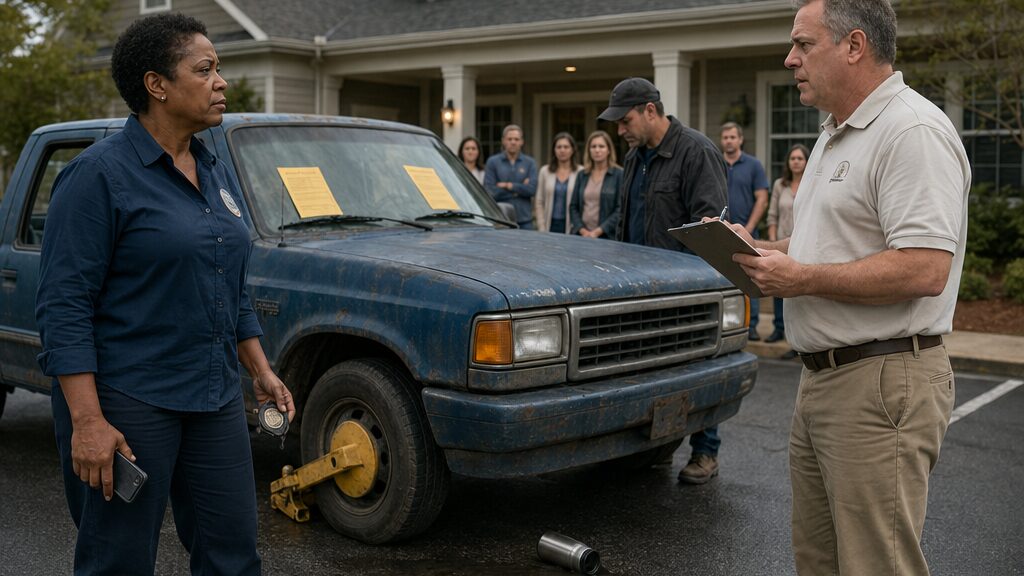
The HOA Clamped Her Old Blue Truck, Then She Found What They Had Buried Beneath the New Parking Lot
Chapter 1: The Yellow Clamp Beneath the Blue Truck
The clamp snapped shut beneath Laura Green’s truck with the hard metallic sound of a door locking from the other side.
She stopped halfway across the clubhouse parking lot, her travel mug in one hand and her county badge clipped to the pocket of her navy work shirt. A tow-truck operator rose from his crouch beside the front wheel of her old blue pickup. The clamp he had fastened was bright yellow against the faded paint and rust-darkened rim.
Ryan Miller stood over him with a clipboard.
“You’ll need to move it before six,” Ryan said.
Laura looked at the clamp, then at him. “That would be difficult now.”
A few homeowners had gathered near the clubhouse entrance for the association’s open property inspection. They watched with the careful stillness of people pretending not to. One woman lowered her phone but did not put it away.
Ryan straightened his polo shirt. The embroidered HOA logo sat over his chest like a small badge of office.
“You’ve had warnings,” he said. “The truck is in violation of community appearance standards, and it’s been parked overnight in an unauthorized visitor space.”
“I parked here at seven this morning.”
“It was documented yesterday.”
Laura turned toward the windshield. A yellow notice had been taped beneath the wiper. Another sheet rested against the glass on the driver’s side, printed on heavier paper with the association seal at the top.
She did not touch either one yet.
“What violation number?” she asked.
Ryan tapped the clipboard. “Inoperable or unsightly vehicle. Improper parking. Failure to comply after notice.”
“The truck is registered, insured, and operational.”
“That doesn’t change its condition.”
The words landed more precisely than an insult. Laura had heard variations of them since her husband died two years earlier. The paint was oxidized. The tailgate wore a pale rectangle where a repair panel had once been. One side mirror came from a newer model and did not quite match.
Her husband had kept the engine clean enough to eat from. Laura had kept it running.
Ryan stepped closer to the open driver’s window and pointed toward the dashboard. “This kind of thing affects everybody’s property value. We can’t have vehicles that make the neighborhood look neglected.”
Behind him, the tow operator glanced at Laura, then away.
Laura set her travel mug on the hood. “Show me the section that authorizes a wheel clamp.”
“It’s part of enforcement.”
“That isn’t a section.”
A small shift passed through the watching group. Ryan’s face tightened.
“You work for the county,” he said. “You know how rules work.”
“I do.”
“Then you should know better than to use that position to argue special treatment.”
Laura felt heat rise beneath her collar. She reached for the notice on the windshield, but Ryan pulled the clipboard across her path.
“Don’t remove association documentation until I’ve photographed it.”
His wrist struck her travel mug.
The stainless-steel bottle hit the pavement and rolled beneath the truck, spilling water across the white parking stripe. Laura stepped back. Her badge caught against the clipboard’s metal clip, tore loose, and dropped into the spreading water.
Nobody spoke.
She bent, picked up the badge, and wiped it once against her sleeve. Ryan opened his mouth, perhaps to apologize, but whatever he saw in her face made him stop.
Laura took out her phone.
She photographed the clamp first. Then the wet badge. Then the yellow notice beneath the wiper.
The notice stated that the vehicle would incur a ninety-dollar daily fine unless removed within forty-eight hours.
The heavier page stated that the vehicle was subject to immediate towing after six that evening.
She read both again.
“Which deadline applies?”
Ryan’s answer came too quickly. “The board has discretion.”
“Under which covenant?”
“The enforcement policy.”
“Section?”
He looked toward the homeowners by the clubhouse. “Laura, I’m not holding a hearing in the parking lot.”
“You’re conducting enforcement in one.”
Donna Davis stood near the door with her arms crossed. She had lived beside Laura for eight years, though lately their conversations rarely passed beyond trash schedules and misplaced packages. Donna watched the water creep toward the storm drain.
Ryan tore a sheet from his clipboard and placed it against the truck’s hood.
“The tow operator returns at six. If the truck is still here, it goes. You can appeal through the normal process.”
Laura studied the page. “This says the board approved the action.”
“It did.”
“At what meeting?”
Ryan’s jaw shifted.
Laura held out a pen. “Write the covenant section, the authorization date, and the deadline you’re enforcing. Then sign it.”
A man near the clubhouse whispered something. Ryan looked toward him, then took the pen.
His handwriting pressed deeply into the paper.
Article Seven. Vehicle Standards. Board authorization dated last Thursday. Removal by 6:00 p.m.
He signed beneath it with an impatient stroke.
Laura photographed the page before folding it.
The tow operator cleared his throat. “I’ve got another call.”
Ryan nodded. “Be back at six.”
The truck left without him, the clamp remaining on Laura’s wheel.
Ryan turned to the group. “Inspection resumes in five minutes.”
Laura crouched near the front tire and retrieved her mug. Muddy water had collected around the yellow steel. She could feel the neighbors looking at the worn knees of her work pants and the rust along the truck’s rocker panel.
She stood without hurrying.
At home, she spread the notices across her kitchen table. The association handbook lay open beside them, its pages crowded with adhesive flags from years of ordinary disputes: fence colors, roof replacements, rental restrictions.
Article Seven allowed fines after written notice and an opportunity for a hearing.
It said nothing about clamps.
Nothing about immediate towing.
Laura opened the folder where she kept her closing documents. Beneath the deed and insurance papers was a reduced copy of the recorded subdivision plat. She unfolded it carefully.
Her townhouse row appeared along the eastern edge. The clubhouse sat near the entrance. Behind it, where the new blacktop curved into six visitor spaces, the recorded drawing showed a long strip marked with diagonal lines.
DRAINAGE AND OVERFLOW EASEMENT.
Laura brought the paper closer.
There were no parking spaces.
There was no pavement.
On the official map, the place where her truck had been clamped was grass.
Chapter 2: The Parking Space Missing From Every Map
By twelve forty-seven, Laura had searched every public permit index connected to the subdivision and found no authorization for the paved extension.
She sat at her county desk beneath fluorescent lights, the truck key resting beside an old blue parcel binder she had pulled from the public reference shelf. The key looked smaller without the truck attached to it.
Around her, printers clicked and file drawers opened and shut. The ordinary sounds made her careful. She had worked in property records for eleven years. She knew exactly how easily a personal dispute could become an ethics complaint if someone decided she had used restricted information.
So she stayed inside the public system.
She searched by parcel number, association name, street address, and contractor license. She opened scanned meeting packets, recorded plats, site plans, easement amendments, and permit summaries available to any resident willing to ask.
The paved visitor spaces did not exist in any current approval.
Laura printed the association’s enforcement policy from its own website. The policy required a first written warning, ten days to request a hearing, and board action recorded in meeting minutes before any fine could begin.
Ryan’s signed notice claimed authorization from the previous Thursday.
The public agenda from that meeting listed landscaping, pool repairs, and delinquent dues.
No vehicle action.
No closed-session notation.
No vote.
Laura placed the pages side by side. The ninety-dollar notice was not merely aggressive. It had skipped the association’s own procedure.
That should have satisfied her. It gave her enough to challenge the clamp and demand the truck’s release.
Instead, she looked again at the plat.
The diagonal easement lines ran beneath the visitor spaces and continued behind Donna’s garage.
Laura opened the archived index.
A reference number appeared beside an entry from nearly four years earlier: TEMPORARY ACCESS AND STAGING VARIANCE.
The document itself had not been scanned. The index listed a blue archive volume stored in the basement records room.
Laura signed the binder request log and waited while a clerk retrieved it.
Her supervisor stopped beside the desk before the binder arrived.
“You working a subdivision case?” she asked.
“A personal records request.”
The supervisor’s eyes moved to the association notice. “Your subdivision?”
“Yes.”
“Then keep your employee credentials out of it.”
“I am.”
“Public terminals. Public request forms. No internal notes, no draft inspection records, no calls from this desk implying county involvement.”
Laura held her gaze. “Understood.”
The supervisor softened slightly. “I’m not saying you can’t defend yourself. I’m saying make sure the file shows you did it like anyone else.”
That was the problem with Laura’s profession. People assumed access was the same as power. Most days, access meant knowing which form to submit and how long to wait.
The blue binder arrived twenty minutes later.
Its spine was cracked and the pages smelled faintly of dust and toner. Laura found the variance behind a divider marked SITE MODIFICATIONS.
The approval allowed temporary gravel access across part of the drainage easement during clubhouse roof repairs. It permitted contractor vehicles and material staging for ninety days, conditioned on restoration of the ground afterward.
A handwritten note in the margin read: NO PERMANENT SURFACE. MAINTAIN OVERFLOW CAPACITY.
Laura checked the expiration date.
Three years and ten months earlier.
She searched the contractor permits next. The clubhouse roof project had closed on schedule. Restoration had been marked incomplete, then later corrected after the association submitted photographs showing seeded ground.
The images were grainy but clear enough. At the time of closure, there had been no asphalt.
Laura found a later invoice referenced in an HOA reserve-study attachment. “Parking expansion and surface improvement,” completed eleven months after the variance expired.
She did the calculation twice.
The pavement had been installed thirty-four months after the temporary approval ceased to have any force.
Her fingers tightened around the truck key.
She could already hear Ryan’s likely answer. The work was maintenance. The board had relied on the contractor. The old gravel staging area had simply been improved. No one understood the paperwork.
Laura knew enough to distrust certainty before she had the full file.
She completed a formal public-records request for the original survey, variance correspondence, inspection photographs, and any code-enforcement history tied to the parcel. She used her home email address.
Then she opened the HOA handbook again.
The appeal procedure gave her ten days. The towing notice gave her until six.
She called the number at the bottom of Ryan’s form.
He answered after four rings.
“This is Laura Green.”
“I know.”
“I’m requesting immediate removal of the clamp pending the hearing required under your enforcement policy.”
“The board’s decision stands.”
“There is no recorded decision.”
A pause.
“You’ve been digging through county files already.”
“I reviewed public records.”
“That’s exactly what I meant this morning. Most homeowners don’t have the ability to do that during work hours.”
“Most homeowners are still entitled to the records.”
His breath came through the phone. “Move the truck once the clamp is released, and we can discuss the fine later.”
“Release it now.”
“I’ll speak to counsel.”
The line went dead.
Laura sat still, listening to the dial tone. He had not denied the missing vote. He had not asked what she had found. He had focused on her access.
She returned to the blue binder and read the temporary variance from the beginning.
The approval language identified the strip as more than a drainage easement. It was part of the subdivision’s emergency overflow route, designed to carry stormwater away from the townhouse foundations when the main inlet exceeded capacity.
Laura traced the route with one finger.
It passed beneath the new parking spaces, curved along Donna’s property line, and emptied into a shallow basin behind the community fence.
She remembered Donna standing in her driveway months earlier, pointing toward dark water inside her garage.
Laura had said she could not advise on a private matter through her county job.
She had not looked at the map.
Now the margin note seemed less like an old bureaucratic warning and more like a sentence someone had chosen to ignore.
NO PERMANENT SURFACE.
Laura checked the dates one final time.
The variance expired.
Thirty-four months later, the HOA paved directly over the designated overflow route.
Chapter 3: The Neighbor Who Had Asked Before
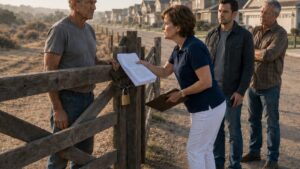
Donna was waiting between their driveways when Laura returned Tuesday morning.
The clamp had been removed sometime before dawn, though no one had called to tell her. Laura had driven the truck home with the yellow notice still clinging to the windshield. Mud streaked the tires where she had crossed the soft shoulder beside the clubhouse.
Donna looked at the truck, then at Laura.
“So drainage matters now?”
Laura stopped with one hand on the door.
Donna wore hospital scrubs beneath a gray coat, her hair pulled back as if she had just finished a night shift. Fatigue sharpened her voice.
“I’m asking,” Donna said, “because when water came into my garage last spring, you told me you couldn’t get involved.”
“I told you I couldn’t use county resources for a neighborhood disagreement.”
“You didn’t even come look.”
“That wasn’t my role.”
Donna gave a short laugh. “But the minute they touch your truck, suddenly you know where every map is.”
The accusation was loud enough for a man across the street to glance over while carrying recycling bins.
Laura lowered her voice. “The board skipped its enforcement procedure. The space isn’t shown on the recorded plat. Those are separate issues.”
“They’re separate because one happened to you.”
Laura felt the first clean edge of anger. “You supported them clamping my vehicle.”
“I said the truck had been sitting there.”
“For one morning.”
“You park it in different places whenever somebody complains.”
“It runs.”
“That wasn’t my point.”
“What was your point, Donna?”
Donna stepped closer. “My point was that Ryan listens when people complain about paint, trash cans, and trucks. He didn’t listen when I showed him water under my door. And neither did you.”
Laura opened the truck’s back door and lifted out a cardboard document tube. “I am looking now.”
“Because he embarrassed you.”
The sentence landed because it was true enough to hurt.
Laura shut the door harder than she intended. “What exactly do you want from me?”
Donna studied her, and some of the anger went out of her face. What remained looked older.
“I wanted you to believe me before I had proof that cost thousands of dollars.”
She walked toward her garage and raised the door.
Inside, the lower drywall had been cut away in a ragged line. Plastic storage bins sat on shelving above the floor. A water stain crossed the concrete from the back wall to the drain.
Donna took an envelope from a workbench.
“I documented every time it happened,” she said. “Because the board kept saying it was runoff from my downspout.”
She handed Laura a stack of photographs.
The first showed shallow water near the garage threshold. The date printed in the corner was eight months earlier. In the next, water covered half the floor. Another showed soaked cardboard boxes and a warped cabinet door.
Laura moved through the images slowly.
“You changed the downspout?”
“Twice. I paid for grading. I paid for a new seal. Ryan said the association couldn’t investigate every homeowner’s maintenance problem.”
A photograph from early spring showed brown water collecting along the curb behind the clubhouse. The same concrete edge appeared in the temporary variance plan Laura had copied.
She pulled the rolled map from the document tube and spread it across Donna’s workbench.
“This line,” Laura said. “That’s the original overflow route.”
Donna leaned over it.
Laura placed the photograph beside the survey. The curb, the fence corner, and the slope aligned.
The water in Donna’s picture was not moving randomly toward her garage. It was following the old route until the pavement redirected it.
Donna tapped the blacktop area. “Those spaces weren’t always there.”
“No.”
“They put them in after the clubhouse roof.”
Laura looked at her. “Do you remember when?”
“Almost three years ago. Maybe more.”
“Who approved it?”
“The board. Ryan said we needed visitor parking to meet resale expectations.”
Laura kept her eyes on the map. “The only approval I found allowed temporary gravel access. It prohibited a permanent surface.”
Donna’s expression changed, but not into relief.
“You already suspected that last year.”
“No.”
“I showed you the water. You said there were old easements all through the development and that I should file a maintenance request.”
“That’s true.”
“You also said those records could be complicated.”
Laura remembered the conversation now. Donna had caught her carrying groceries inside after work. Rainwater had been draining along the gutter. Donna had asked whether an easement could affect the garages.
Laura had been tired. She had imagined the questions that would follow if she offered an opinion: Can you pull the file? Can you tell us whether the board violated something? Can you use your office to fix it?
She had said, “You’ll need to go through the association.”
Then she had gone inside.
“I should have looked at the public plat,” Laura said.
Donna folded her arms. “Yes.”
The single word stripped away every defense Laura had prepared.
“I couldn’t act as a county employee.”
“You could have acted as my neighbor.”
Laura rolled the map slowly, careful not to crease it.
“Will you come to the board hearing?” she asked.
“No.”
“Donna—”
“I’m not standing up there so everybody can decide I’m helping you get revenge over a truck.”
“This affects your house.”
“It affected my house when nobody wanted to hear it.”
Laura slipped the photographs back into the envelope. “May I copy these?”
Donna hesitated, then removed one photograph from the stack.
“You can copy the rest.”
“Why not that one?”
Donna looked down at it before handing it over anyway.
The image showed the flooded curb behind the clubhouse. Ryan stood near the edge of the water in a rain jacket, one hand resting on a survey stake. Daniel Ramirez was several feet behind him beside a maintenance cart.
The date stamp was seven months old.
Laura looked closer.
Ryan was not merely passing by. He was studying the exact place where the water disappeared beneath the new pavement.
Donna’s voice lowered.
“He told us the next week there was no drainage defect.”
Laura held the photograph beside the recorded map.
Ryan had stood over the buried overflow route months before he ordered her truck clamped on top of it.
Chapter 4: What the Board Called Temporary
The handwritten warning on the survey was darker than the rest of the page, as if someone had pressed the pen hard enough to make the paper remember.
NO PERMANENT SURFACE. MAINTAIN OVERFLOW CAPACITY.
Laura stood at the public-records counter Wednesday morning with the original survey beneath a protective sheet. The municipal records clerk had found it in a box of oversized plans, folded behind an abandoned utility easement application.
“This is the only version with the note,” the clerk said. “The scan was made from a cleaner copy.”
“Who wrote it?”
“No initials.”
Laura examined the surrounding marks. A drainage contour had been circled in blue pencil. Beside it, a faint arrow pointed from the clubhouse lot toward the basin behind the fence.
The same route shown in Donna’s photographs.
Laura requested certified copies of the survey, the temporary variance, and the closure photographs. While the clerk prepared them, she reviewed the paving invoice again. The contractor had described the work as resurfacing and parking improvement, not new construction. That wording could explain why the county permit index showed nothing.
It did not explain who had decided a drainage easement was a parking lot.
Her phone vibrated.
A message from Daniel Ramirez contained only six words.
Maintenance shed. Noon. Come alone, please.
Daniel was waiting beside the open shed when Laura arrived. He wore a work jacket over a button-down shirt, and sawdust clung to one sleeve. Inside, shelves held bags of ice melt, pool chemicals, sprinkler heads, and faded paint cans labeled by townhouse row.
Her truck was parked nearby, its bed loaded with rolled plans, a measuring wheel, and two wooden stakes.
Daniel looked at the documents before he looked at her.
“You filed a records request,” he said.
“Yes.”
“Ryan knows.”
“I assumed he would.”
“He thinks you’re building a case against the association.”
“I’m trying to understand what was built.”
Daniel shut the shed door halfway, leaving enough space for light.
“The visitor spaces were supposed to solve a problem,” he said. “People complained there wasn’t enough parking for open houses and family visits. The reserve consultant said limited guest parking hurt resale appeal.”
“That doesn’t authorize paving an easement.”
“We thought the temporary access had already established a usable surface.”
“It authorized gravel for ninety days, followed by restoration.”
Daniel rubbed the bridge of his nose. “The contractor said porous asphalt would still let water through.”
“Was that in the proposal?”
“There was a conversation.”
“With whom?”
“Ryan. Me. The contractor.”
“Was drainage testing required?”
Daniel did not answer immediately.
Laura unrolled the survey across a workbench and anchored the corners with paint cans.
“Show me where the water was supposed to go.”
He studied the map. “Across here. Then behind the garages.”
“And after paving?”
“We added an inlet.”
Laura pointed toward the curb shown in Donna’s photograph. “That inlet sits higher than the overflow line.”
“It wasn’t supposed to.”
“Was it tested?”
Daniel’s hand flattened against the workbench.
“The contractor said the county inspection wasn’t necessary because it was maintenance.”
“That wasn’t my question.”
“No,” he said. “The test was never completed.”
The answer changed the weight of the room.
Laura had expected carelessness. A misunderstood approval. A board relying too heavily on a contractor.
Skipping a test after altering a known drainage route was something else.
“Who signed off?”
Daniel glanced toward the clubhouse. “I signed the maintenance completion sheet.”
“Did you inspect the grade?”
“I walked it.”
“During rain?”
“No.”
“Did Ryan know?”
“He knew the test hadn’t happened.”
Laura took out Donna’s photograph and placed it beside the plan. Ryan’s figure stood over the flooded curb.
Daniel’s expression tightened.
“Where did you get that?”
“Donna.”
“She’s been sending pictures to the board for months.”
“And the board told her it was her downspout.”
“That was the contractor’s opinion.”
“After seeing this?”
Daniel lowered his voice. “You think there’s one clean moment where everyone decided to lie. There wasn’t. There were complaints. Then excuses. Then money problems. Every time we delayed, admitting the problem got more expensive.”
“What money problems?”
“The reserve is short. The roofs cost more than projected. Insurance premiums doubled. If the pavement has to come out and the drainage corridor has to be rebuilt, the association may need a special assessment.”
“That doesn’t make the water disappear.”
“No. But it explains why Ryan keeps trying to manage what people see.”
Laura thought of the clamp and the yellow notice. The truck had been easier to correct than the ground beneath it.
She retrieved the measuring wheel from the truck bed. Daniel followed her to the curb.
Starting at the basin fence, Laura measured the route shown on the survey. The wheel clicked across grass, concrete, and blacktop. At the first visitor space, the pavement rose slightly. The change was almost invisible until she knelt and sighted along the curb.
Water traveling from the clubhouse would strike the raised asphalt and turn toward Donna’s row.
The original overflow path had not merely been covered. It had been blocked.
Daniel crouched beside her. “That wasn’t shown on the contractor drawing.”
“Where is that drawing?”
“In the board files.”
“I requested all related plans.”
“They may call it a maintenance sketch.”
“Who has it?”
“Ryan.”
Laura stood. “And the emails approving the work?”
Daniel’s eyes shifted away.
“There weren’t formal emails.”
“You just said Ryan discussed the surface with the contractor.”
“Mostly by phone.”
“Mostly?”
“I don’t know of anything useful in writing.”
The phrasing was careful enough to announce the lie without exposing it.
Laura rolled the survey and returned the measuring wheel to the truck.
“You signed the completion sheet,” she said. “If someone gets hurt or a home becomes uninhabitable, silence won’t protect you.”
Daniel stared at the pavement. “Neither will turning the whole neighborhood against us before we know how to pay for it.”
Her phone vibrated again.
This time the message came from the HOA’s automated management account.
VEHICLE REMOVAL COMPLETED. OUTSTANDING TOWING, STORAGE, AND ENFORCEMENT CHARGES REMAIN DUE.
Laura looked toward the space where she had left the truck less than an hour earlier.
It was empty.
Two fresh black marks crossed the pavement where the tires had dragged before turning.
The certified records were still in the truck bed.
So were Donna’s photographs, the measuring tools, and the only clean copy of the survey she had been allowed to carry out.
Daniel read the message over her shoulder.
“I thought Ryan had suspended the tow.”
Laura called the management number. It went to voicemail.
She called the towing company.
A dispatcher confirmed the truck had been removed at 12:41 p.m. under standing HOA authorization.
“Who renewed the order?” Laura asked.
“The association president.”
Laura turned toward the clubhouse.
Ryan had known she was at the records office. He had known she was measuring the easement. And while Daniel kept her talking inside the maintenance shed, the tow truck had taken the evidence with the vehicle.
Chapter 5: The Fine Was Smaller Than the Flood
The tow-yard attendant would not let Laura photograph the clamp damage until she paid.
“The vehicle is on private property,” he said through the scratched plexiglass window. “No access beyond the gate without release.”
“I’m not asking to remove it. I’m asking to document its condition.”
“Same rule.”
Laura could see the blue roof of the truck above a line of impounded vehicles. The sight of it behind chain-link fencing made something tighten beneath her ribs.
“How much?”
The attendant slid a printed invoice beneath the glass.
Tow charge. Administrative fee. Overnight storage. Wheel-clamp removal. Association enforcement referral.
The total was already more than six hundred dollars.
Laura read the final line twice. “The association charged for removing its own clamp?”
“You’ll have to take that up with them.”
Her first impulse was to pay, recover the truck, and fight afterward. She had enough in savings, though using it would mean postponing a furnace repair before winter.
Then she pictured the raised asphalt above Donna’s garage and the handwritten warning on the survey.
If she spent the day arguing about the tow, the larger complaint would remain what Ryan wanted it to be: one homeowner angry over one vehicle.
Laura folded the invoice and stepped away from the window.
At the county inspection office, she signed in as a resident.
The drainage engineer met her in a conference room with no windows. Laura placed the certified survey, temporary variance, paving invoice, Donna’s photographs, and her measurements across the table.
She did not mention where she worked until the engineer recognized her county badge in one of the parking-lot photographs.
“You’re in records.”
“Yes. I’m here personally.”
The engineer nodded once and continued reading.
He traced the original overflow route, then compared it with the photographs.
“This pavement sits above the design grade,” he said.
“That was my observation.”
“It also appears they narrowed the conveyance area by adding the curb.”
“What happens during a major storm?”
He did not answer immediately. He opened a county drainage model on his laptop, entered the parcel number, and reviewed the original development assumptions.
“The main inlet handles ordinary rainfall,” he said. “The easement is the relief path when it doesn’t.”
“And now?”
“Water seeks another route.”
“Toward the garages?”
“Possibly several units. I’d need a site inspection to say more.”
Laura showed him Donna’s interior photographs.
His mouth tightened.
“If these dates are accurate, the system may already be failing under moderate events.”
“What would correction involve?”
“At minimum, removal of the unauthorized surface, regrading, inlet review, and restoration of the overflow corridor. If foundations or retaining structures have been affected, more.”
“How much?”
“I don’t estimate without inspection.”
“Could it exceed the association reserve?”
He looked at her over the laptop screen. “Easily.”
The answer was quieter than a number and worse because of it.
Laura filed a formal code and drainage complaint. The engineer stamped the intake copy, assigned a case number, and scheduled an initial site visit for the following week.
It was the first official action taken that Ryan could not cancel with a phone call.
By the time Laura left, three messages waited on her phone.
The first was from the towing company, warning that storage charges increased daily.
The second was from Ryan.
You have escalated a private association matter to county enforcement. The board will address resulting costs at an emergency meeting.
The third came from Donna.
Water came in again. Not much. Come see.
Donna’s garage smelled of damp concrete and bleach. A thin tide mark crossed the floor below the newly cut drywall. Two other homeowners stood near the doorway, both looking uncomfortable to be there.
One had water staining the baseboard in a rear room. The other said his sump pump had begun cycling during storms that once caused no trouble.
Laura photographed the damage with permission and gave them the county complaint number.
“Does filing this mean the county fines us?” one homeowner asked.
“It means they inspect.”
“And if it’s wrong?”
“Then correction will be required.”
“Paid by who?”
“That depends on responsibility, insurance, contracts, and the association documents.”
The homeowner looked toward Donna. “So, us.”
Laura did not offer reassurance she could not support.
That evening, an email from the HOA arrived under the subject line EMERGENCY FINANCIAL NOTICE.
Ryan wrote that a homeowner complaint had triggered county review of community infrastructure. If the association faced mandatory reconstruction, legal expenses, or engineering costs, an emergency assessment might be imposed on every property.
He did not name Laura.
He did not need to.
By morning, yellow copies of the notice had been taped inside the community mail kiosks. The same color as the paper once fixed to her windshield now warned families about payments that could reach thousands of dollars.
Laura found two handwritten notes beneath her front-door mat.
One said, THANKS FOR MAKING EVERYONE PAY FOR YOUR TRUCK.
The other asked whether she understood that some residents lived on fixed incomes.
Her driveway looked too wide without the blue pickup. The oil stain beneath where it normally sat resembled an absence someone had outlined.
Laura paid the tow charges before noon.
At the yard, she photographed the scraped rim, the bent clamp bracket, and a fresh gouge along the lower door. The attendant handed over her keys without comment.
When the engine started, its familiar rough idle filled the cab. Laura rested both hands on the steering wheel until the shaking in them stopped.
Her husband used to tap the dashboard twice before long drives. Superstition, he had called it, though he never skipped it.
Laura tapped it once.
Then she drove directly to the clubhouse for the county site inspection.
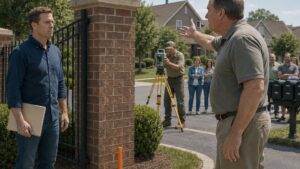
The drainage engineer arrived with a survey rod and camera. Ryan met them near the visitor spaces, accompanied by the HOA attorney.
“This inspection is premature,” the attorney said. “The association disputes the complaint’s characterization.”
The engineer pointed toward the stamped case file. “The complaint alleges obstruction of a recorded drainage easement. We have authority to inspect.”
Ryan looked at Laura rather than the engineer.
“You understand what this could cost people.”
“I understand what water has already cost them.”
“You could have brought this to the board.”
“Donna did.”
His eyes flicked toward Donna’s townhouse.
The engineer measured the pavement elevation and photographed the curb. At the low point near the clubhouse, he pushed a thin probe into a clogged inlet. Mud and decomposed leaves came up around it.
“This system isn’t functioning as approved,” he said.
Ryan’s face lost color.
The attorney asked whether that was a formal determination.
“Not yet. But I recommend immediate temporary protection for the affected units.”
“What kind?”
“Sandbags. Clearing the inlet. Emergency routing if heavy rain is expected.”
As if summoned by the words, every phone in the small group sounded at once.
A weather alert filled Laura’s screen.
SEVERE STORM WATCH: SATURDAY AFTERNOON THROUGH EARLY SUNDAY. FLASH FLOODING POSSIBLE.
The engineer looked from the alert to the paved easement.
“If the forecast holds,” he said, “you may find out how serious this is before our report is finished.”
Chapter 6: The Night the Water Chose Its Old Path
Water reached the first garage before the emergency alert sounded.
Donna called Laura at 8:17 Saturday night, her voice almost lost beneath the rain.
“It’s under the door.”
Laura was already pulling on boots.
Outside, water raced along the gutters in silver sheets. The blue pickup sat beneath the driveway light with yellow adhesive still smeared across the lower windshield. Its bed held sandbags Laura had collected that afternoon after the HOA distributed only a limited supply.
She backed into the street.
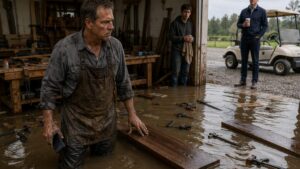
At Donna’s garage, water had risen over the threshold and spread beneath the shelving. Donna and her teenage son were lifting plastic bins onto a workbench.
Laura carried in the first two sandbags.
“Put them outside, not here,” she said. “We need to slow it before it crosses the door.”
Donna did not argue.
Across the row, another garage door opened. A homeowner shouted that his drain was backing up. Farther downhill, headlights glowed through water gathering over the roadway.
Laura drove toward the clubhouse.
The visitor spaces had disappeared beneath a shallow brown pool. Rain struck the surface so hard it looked as if the pavement were boiling. The main inlet gurgled but could not swallow fast enough.
Ryan stood beneath a golf umbrella near the clubhouse steps, shouting directions into his phone. Daniel was dragging bags of mulch away from the curb.
Laura parked at the edge of the water.
“You need to open the overflow route,” she called.
Ryan lowered the phone. “Nobody goes onto that pavement.”
“The water is turning toward the garages.”
“The county told us not to disturb the area.”
“They told you to provide emergency routing.”
“The attorney said any alteration could be treated as admission of liability.”
A surge of water crossed the curb and ran toward Donna’s row.
Laura pointed. “There’s your liability.”
Ryan stepped closer. “Move the truck. If it stalls there, you’ll block access.”
The old pickup’s engine idled steadily.
Daniel came through the rain. “The maintenance cart’s dead. Water got into the battery housing.”
Laura looked toward the lower units. One homeowner stood beside a stalled sedan with water above his ankles. Another was trying to carry boxes from a rear room while holding a flashlight between his teeth.
She opened the truck bed.
“Load the remaining sandbags.”
Ryan caught her arm. “Laura, I’m telling you not to drive through there.”
She looked at his hand until he released her.
“You told Donna there was no defect. You told the county this was routine maintenance. Right now, people need a route out.”
“If you damage property—”
“The property is already failing.”
Daniel lifted the first bag into the bed.
That was enough.
Two other homeowners joined him.
Laura drove slowly into the flooded lane. Water pushed against the tires but stayed below the axle. The headlights illuminated the old flow line from the survey: away from the clubhouse, across the visitor spaces, then turning toward the townhouse garages.
The water had remembered the route even after the board buried it.
At the lower row, Laura stopped beside the stalled sedan. The homeowner climbed into the passenger seat, soaked and shaking. She carried him to higher ground, then returned for the boxes from the rear room.
On the third trip, Donna stood in the truck bed with a tarp over a stack of family photographs and school records. The yellow notice residue on the windshield flashed each time they passed beneath a streetlamp.
Neighbors who had called the truck unsightly now waved it forward.
Laura felt no satisfaction in that. Only urgency.
Near midnight, Daniel arrived with shovels and said the clogged inlet could not be cleared without lifting part of the metal grate.
Ryan blocked him.
“If someone gets hurt, the association is exposed.”
Daniel stared at him. “Someone’s already losing a garage.”
“The county has to authorize excavation.”
“We’re not excavating. We’re clearing debris.”
Ryan looked toward Laura. “This is what happens when people turn maintenance into an enforcement case. Every move becomes evidence.”
Laura wiped rain from her face. “Then make the right move while people are watching.”
For a moment, the only sound between them was water striking the umbrella fabric.
Ryan moved aside.
Daniel and two homeowners lifted the grate. Laura used a shovel to pull out packed leaves, mud, and plastic landscaping mesh. The inlet began taking water, slowly at first, then with a deep sucking sound.
The level across the pavement dropped by less than an inch.
It was enough to slow the flow toward the garages.
They worked until nearly two in the morning. Donna’s garage still flooded, but the water stopped below the electrical outlets. The other affected units suffered wet floors and damaged belongings, not the deeper
Chapter 7: The Email No One Wanted Read Aloud
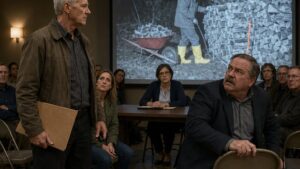
Ryan opened the emergency meeting by proposing legal action against Laura.
The clubhouse was packed beyond its folding chairs. Homeowners stood along the walls, damp coats draped over their arms, while box fans hummed in two garages across the street. A strip of yellow tape still blocked the lowest visitor spaces.
Ryan sat at the center of the board table with the HOA attorney on his right. Daniel occupied the far end, looking down at his hands. Donna stood near the back beside two neighbors whose homes had taken water.
Laura placed her documents on the front table.
On top of them, she set the damaged yellow clamp bracket from her truck.
The room noticed.
Ryan adjusted the microphone. “Before we begin, the board must address actions taken by a homeowner who used association documents and county processes to create significant financial exposure for this community.”
A murmur moved through the room.
Laura remained standing.
Ryan continued. “Counsel has advised us to consider recovery of costs resulting from unauthorized interference, reputational harm, and escalation of a maintenance issue before the board could complete its review.”
The attorney leaned toward him. “The board has not made a legal determination.”
“Noted,” Ryan said.
Laura looked at the faces around her. Some were angry. Some frightened. Several would not meet her eyes.
A homeowner in the second row raised his hand without waiting to be recognized. “Are we getting assessed or not?”
“We don’t know yet,” Ryan said.
“How much?”
“We don’t know.”
“Then why are we talking about suing her?”
Another voice answered from the wall. “Because none of this happened until she complained.”
Donna turned toward the speaker. “The flooding happened.”
The room quieted.
Ryan looked down at his agenda. “We’ll maintain order.”
Laura had planned to begin with the variance dates. She had rehearsed a narrow presentation: notice procedure, survey language, contractor scope, drainage obstruction.
Facts first. Personal matters omitted.
Then she saw Donna’s hands. The knuckles were split from carrying wet boxes.
Laura closed the folder she had opened.
“My complaint did not create the drainage problem,” she said. “But I need to say something before I show you the records.”
Ryan leaned back.
Laura looked at Donna.
“Months ago, Donna asked me whether an easement could be affecting her garage. I told her to go through the association. That was professionally cautious and personally inadequate.”
No one moved.
“I could have helped her find the public plat. I could have attended a meeting with her. I could have listened longer than thirty seconds in a driveway.”
Donna’s expression did not soften, but she gave one slow nod.
Laura faced the room again. “I waited until the board came after something of mine. That was wrong.”
A woman near the door whispered, “At least she admits it.”
Ryan tapped the microphone. “This is not relevant to whether you acted improperly afterward.”
“It is relevant,” Donna said.
Ryan looked toward her. “You’ll have a chance during homeowner comment.”
“I’m commenting now.”
She stepped away from the wall.
“Laura didn’t help me when I first asked. I’m still angry about that. But she did not cause the water. She did not pave the easement. And she did not write the emails telling the board to keep quiet.”
The room shifted all at once.
Ryan’s face remained still, but the attorney turned toward him.
Laura opened Daniel’s forwarded email chain.
“I received these Saturday night.”
Daniel raised his head. “I sent them.”
The board secretary stared at him. “You told us the contractor discussions were verbal.”
“I lied.”
The word landed without decoration.
Daniel continued. “I was afraid the board would blame me because I signed the completion sheet. I was also afraid residents would sue before we had insurance involved.”
Ryan spoke sharply. “You forwarded privileged association communications without authority.”
The attorney held up one hand. “Not all internal board communications are privileged.”
Laura read the first contractor warning aloud. She kept her voice level.
The temporary variance had expired. Permanent paving required drainage review. Proceeding without it could obstruct the recorded overflow route.
She then read Ryan’s reply.
A new review will trigger redesign and assessment discussions. Proceed under maintenance scope. Keep board distribution limited until we have final cost exposure.
Several homeowners began talking at once.
Ryan struck the table with his palm. “You’re hearing one email without context.”
Laura waited.
The room settled only when the attorney asked Ryan to explain.
He stood.
For the first time, he looked tired rather than angry.
“The reserve study showed we were already underfunded,” he said. “The roof project ran over. Insurance increased. We had owners behind on dues and people threatening to sell because guest parking was inadequate.”
“So you paved a drainage route?” someone asked.
“We relied on a contractor who said porous asphalt would work.”
“The email says he recommended another review.”
“He recommended the option that protected his company.”
Donna’s voice came from the back. “And after my garage flooded?”
Ryan’s eyes moved to her.
He did not deny knowing.
“We were waiting for insurance guidance,” he said.
“You told me it was my downspout.”
“I told you what the contractor told us.”
Laura opened the later email.
Do not characterize this as drainage failure in resident communications. We cannot establish association responsibility before insurance review.
Ryan looked at the tabletop.
A man near the aisle said, “You knew enough to hide the words.”
Ryan’s reply was quiet. “I knew what those words could cost.”
He looked around the room.
“Some of you can write a five-thousand-dollar check. Some cannot. We have retirees here. Single parents. Owners whose mortgage payments increased with taxes. If I had announced that the association might need to remove the lot and rebuild drainage, people would have panicked before we knew whether the threat was real.”
“It was real in my garage,” Donna said.
“Yes.”
The admission took more air from the room than another denial would have.
Ryan gripped the back of his chair. “I kept thinking we could fix the inlet, negotiate with the contractor, and avoid an assessment. Then every delay made disclosure worse.”
Laura understood the fear. That did not excuse what he had done with it.
“You chose visible control,” she said. “You fined trucks. You threatened owners. You made the neighborhood look managed while the actual risk stayed buried.”
Ryan looked at the yellow clamp bracket. “Your vehicle had complaints.”
“And my enforcement notice had no valid hearing.”
The HOA attorney spoke before Ryan could answer.
“The towing and fines should be suspended pending review. Based on what we’ve heard, selective enforcement exposure is a serious concern.”
The board secretary asked, “What happens now?”
Laura had expected that question. She slid a one-page proposal across the table.
“Immediate engineering assessment. Emergency drainage protection. Formal notice to the insurer and paving contractor. Independent review of the board’s decisions. Cancellation of the disputed vehicle penalties. No destruction of records.”
“And the assessment?” a homeowner asked.
“Only after insurance, contractor recovery, and reserve options are documented.”
Ryan picked up the paper. “And me?”
Laura met his eyes.
“Resign as president. Stay available for the investigation. Don’t shift personal liability onto the neighborhood unless counsel determines you acted outside coverage.”
A few people objected immediately. Some wanted him removed from the association entirely. Others said resignation would solve nothing.
Laura raised her voice only enough to be heard.
“This cannot become another performance where we punish the easiest person and leave the system untouched.”
The room gradually quieted.
Ryan read the proposal again.
“You’re asking them not to pursue me personally.”
“I’m asking them to find out what responsibility belongs where.”
“After I towed your truck.”
“This is bigger than my truck.”
Donna moved to the front and stood beside Laura, not close enough to suggest reconciliation, but no longer across the room.
The board secretary called for a motion.
Daniel made it.
His voice shook once, then steadied as he read Laura’s resolution into the record, including Ryan’s resignation.
When the vote was called, homeowners raised paper ballots one by one.
Chapter 8: What the Neighborhood Decided to Keep
The excavator’s first strike split the unauthorized pavement along the line where Laura’s truck had once been clamped.
Three months had passed, but the scrape of steel against asphalt still brought back the yellow bracket, the wet badge, and Ryan’s pen cutting into the enforcement notice.
Laura stood beside her blue pickup while workers broke the visitor spaces into dark slabs. Beneath the asphalt, the soil was compacted nearly solid. The drainage engineer had marked the old overflow route with orange flags leading toward the restored basin.
The final assessment was smaller than the first estimates and larger than anyone wanted.
The association’s insurer covered part of the water damage and legal review. The paving contractor agreed to fund much of the removal and regrading rather than face a claim over the untested work. The reserve paid for emergency measures.
Every homeowner still owed something.
Some thanked Laura.
Others stopped speaking when she approached the mail kiosk.
One note appeared beneath her windshield wiper after the assessment notices went out.
YOU COULD HAVE LEFT IT ALONE.
Laura kept it with the original yellow violation papers.
Not as a threat. As a reminder that practical justice rarely felt fair from every doorway.
Ryan returned to the clubhouse that afternoon to collect the last boxes from the board office. He had resigned the night of the meeting after the resolution passed by a narrow margin.
He carried one box to his car, then noticed Laura unloading trays of native grasses from the truck bed.
The plants would stabilize the restored drainage strip once the soil work was finished.
Ryan stopped several feet away.
“They approved the new enforcement policy,” he said.
“I saw.”
Written notice. Documented vote. Hearing before fines. No clamps or towing without an immediate safety obstruction and legal review.
The rules had become longer and harder to misuse.
Ryan looked toward the excavator. “I thought if I could keep the association looking stable, it would become stable.”
Laura lifted another tray.
“My husband used to say fresh paint doesn’t repair wood rot.”
Ryan almost smiled. “He never liked the board.”
“He didn’t like meetings.”
“That too.”
A worker signaled, and the excavator bucket lifted another section of pavement. Water left by the morning’s rain moved through the exposed soil toward the basin instead of turning toward the garages.
Ryan watched it.
“I was afraid people would lose their homes over the assessment,” he said. “Then I made decisions that increased the cost.”
Laura waited.
He did not apologize. He did not ask her to absolve him.
“I should have told them,” he said.
“Yes.”
He nodded, accepting the answer as it was.
When he drove away, Laura returned to the plants.
Donna arrived carrying two pairs of work gloves. Her garage had new drywall along the lower wall, paid for partly through the insurance settlement. A faint stain remained on one cabinet where the water had reached.
“My son says these look like weeds,” Donna said.
“They’re sedges.”
“He’ll be relieved by the distinction.”
They began setting trays beside the orange flags.
Across the street, two homeowners argued about whether the new drainage strip would reduce parking too much. The maintenance committee had already scheduled another meeting. Daniel had resigned from it but agreed to provide records to the independent reviewer.
Nothing had become simple.
That was how Laura knew the change was real.
Donna pressed one plant into the loosened soil. “The board secretary wants volunteers to review the reserve plan.”
Laura kept working. “That sounds unpleasant.”
“She said you understand documents.”
“So do other people.”
“She asked me to ask you.”
Laura sat back on her heels.
Three months earlier, she would have heard the request as a trap. More unpaid responsibility. More neighbors expecting her county experience to become their private service.
Now she understood that refusing every request had also been a choice.
“I’ll review the public sections,” she said. “Not as a county employee. And I’m not running the committee.”
Donna nodded. “Those are reasonable conditions.”
“And you attend the meetings.”
Donna gave her a sideways look. “That sounds like a condition designed for me.”
“It is.”
For the first time in months, they laughed without needing to decide what had been forgiven.
Near sunset, the workers finished grading the corridor. The restored ground formed a shallow, deliberate slope behind the clubhouse.
Laura loaded the empty plant trays into the pickup. Mud marked the tires and dried in brown fans along the doors. The paint remained faded. The mirror still did not match.
A child passing with a bicycle pointed toward it.
“That’s the truck from the flood.”
His father guided him around a puddle. “It is.”
Laura climbed into the driver’s seat and placed the key in the ignition.
Before starting the engine, she tapped the dashboard twice.
Then she looked through the windshield at the open strip of earth where the parking lot had been. Water from a sprinkler test ran through the new grasses, followed the old route, and disappeared safely into the basin.
The neighborhood had lost six polished parking spaces.
It had kept its homes, its imperfect trucks, and a set of rules that could finally be questioned before they became weapons.
Donna knocked once on the passenger window.
“The reserve meeting is Thursday.”
Laura lowered the glass.
“What time?”
The story has ended.