The Ranch Gate They Tried to Open Was Protecting More Than Private Land
Chapter 1: The Clipboard at the Closed Ranch Gate
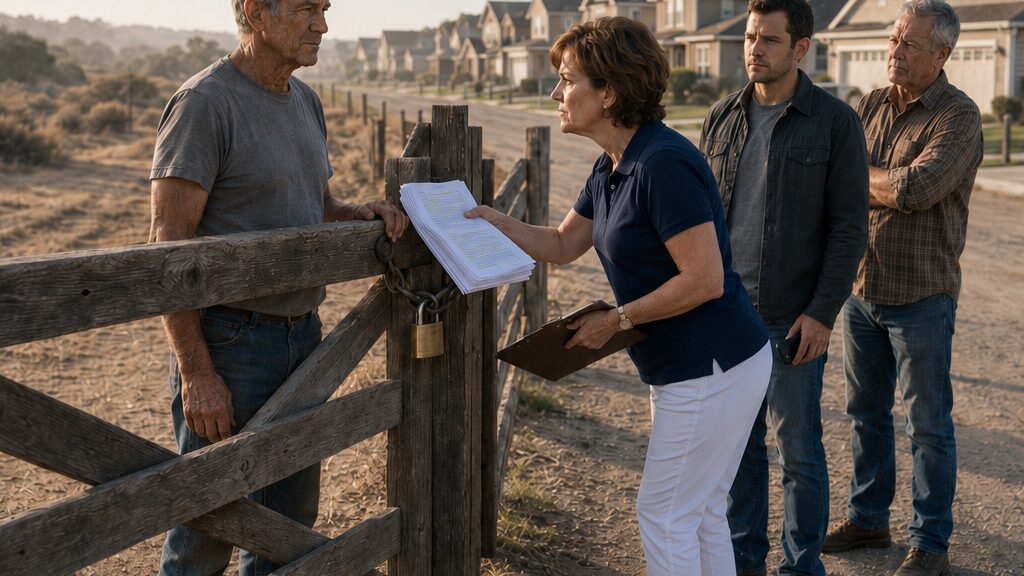
Barbara Carter came up the dirt road with her clipboard held out in front of her like it was a court order.
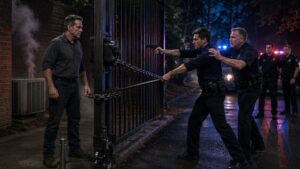
Thomas Rivera saw her before she reached the cattle guard. He had been standing inside the ranch gate, one boot on the bottom rail, checking the chain he had run through the latch that morning. The lock was new, its brass still bright against weathered oak. Behind him, the old trail dipped between scrub oak and mesquite, then disappeared toward the creek line. On the other side of the road, the houses of Cedar Ridge sat in a neat row, each one painted in approved tones of beige, sage, and gray.
Barbara did not slow when her sneakers hit the gravel shoulder. She wore a navy polo with the Cedar Ridge Homeowners Association logo stitched over the pocket, white capris, and sunglasses pushed up into carefully sprayed hair. Her mouth was already tight before she spoke.
“You can’t keep this trail closed, Mr. Rivera.”
Thomas let his hand rest on the chain. “Afternoon to you, too.”
She stopped three feet from the gate. The clipboard came up between them. “We’ve received complaints.”
He looked at the houses beyond her instead of the clipboard. A delivery truck rolled slowly past the subdivision entrance. Two children on bikes paused near the sidewalk, watching as if this were a show starting at the edge of their neighborhood.
“Complaints don’t open private gates,” Thomas said.
Barbara’s eyes narrowed. “This trail has been used by Cedar Ridge residents for years.”
“That’s true.”
“Then you understand the issue.”
“I understand people got used to something they were allowed to use.”
She tapped the clipboard with her pen. “Allowed? That’s not how the neighborhood sees it.”
Thomas gave a small nod, not agreement, just acknowledgment that he had heard her. That habit had served him well in courtrooms and county meetings for decades. Let a person finish. Let their strongest argument stand in the open. Most of the time, it told you more than interruption ever could.
But Barbara seemed to take his silence as weakness.
“This is not just about you,” she said. “Families walk here. Kids use this path after school. People bought homes here with the understanding that the trail connected to the creek.”
Thomas’s jaw moved once. He did not look toward the creek. “The trail is on my land.”
“It connects to our common area.”
“It touches it.”
“That sounds like a distinction without a difference.”
“To you, maybe.”
The two children had rolled closer. One of them whispered something, and the other laughed behind a hand. Thomas looked past Barbara again and saw a man in running clothes standing at the subdivision mailbox kiosk. Jason Miller, he thought. Young father. Two kids. Had waved often enough when passing through the trail before the lock went on.
Jason did not wave now.
Barbara followed Thomas’s glance and raised her voice a little, enough for the watchers. “The board has a duty to maintain community access.”
Thomas felt the old familiar pull: explain enough to end it, or say only what was necessary. He could tell her about the boundary survey. He could tell her about the old permission note. He could tell her about the broken trail marker he had found by the creek three days ago, and the tire tracks too close to the equipment shed, and the crushed wildflowers beneath the cottonwood.
He could tell her Linda’s name.
Instead, he slid the lock once to make sure it had caught.
Barbara’s pen stopped tapping.
“You’re really going to stand there and ignore an entire neighborhood?”
“I’m going to stand on my side of my gate.”
“That trail has always been open.”
“No,” Thomas said. “It has often been open. That isn’t the same thing.”
For the first time, uncertainty crossed her face. Not much. Just a flicker beneath the polished certainty. Then she straightened, the way people did when they felt watched.
“Mr. Rivera, with respect, you can’t just wake up one morning and block something the community relies on.”
“I didn’t wake up this morning and decide anything.”
“When did you decide, then?”
His fingers tightened around the chain before he could stop them. The brass lock tapped against the gate, a small hard sound in the dry air.
Barbara noticed. Of course she noticed. People with clipboards always noticed the wrong things.
“That’s what I thought,” she said, misreading it entirely. “You don’t have an answer.”
Thomas looked at her then. “I have several. You won’t like any of them.”
Her cheeks colored. “The board meets Thursday, but I can call an emergency session if you force this.”
“I’m not forcing anything.”
“You put a lock on the gate.”
“Yes.”
“Then you forced it.”
He almost smiled, but there was no humor in him. “Barbara, forcing a thing and refusing a thing are different.”
She lowered the clipboard and stepped closer to the gate, close enough that the toe of one clean sneaker touched the dirt drifted against the bottom rail. “Do not make this into some rancher-versus-neighborhood drama. We are trying to handle this properly.”
“Then start with the property line.”
“The property line is not the only issue.”
“It is the first one.”
Her lips pressed together. Behind her, Jason Miller had taken out his phone. He was not filming, at least not yet, but he was reading something. Maybe the neighborhood message thread had already started. Thomas could almost see the words forming before anyone sent them: old man locked the trail, HOA confronting him, kids blocked, what are our rights?
Rights. People liked that word best when it cost them nothing.
Barbara turned slightly, as if to include the street in her answer. “The association will review the governing documents and any easement maps attached to this subdivision. If we find what I believe we’ll find, we’ll expect immediate compliance.”
Thomas took his boot off the rail. The gate creaked as his weight left it. That creak had been there since the year he and Linda replaced the hinge post. He could still see her standing in the truck bed, laughing because he had brought the wrong size wrench and refused to admit it until sunset.
Barbara mistook his quiet again.
“Good,” she said. “I’m glad you’re beginning to understand.”
“I understand you’re planning to look for paperwork.”
“We will.”
“You should.”
That gave her pause.
Thomas reached through the bars and lifted the loose end of the chain so it would not scrape the wood. “And while you’re doing that, the gate stays closed.”
Barbara’s expression hardened. “You may find the neighborhood is less patient than I am.”
He looked past her to the line of houses. Sprinklers clicked in a synchronized rhythm over small green lawns. A dog barked behind a vinyl fence. Jason still stood at the mailboxes, watching. The children on bikes had gone still, their handlebars turned toward the ranch as if the closed trail had become more interesting than it ever was when open.
Thomas had spent most of his life helping people understand that land remembered what people forgot. Old fences. Bad deeds. Handshake permissions. A road used as a favor until someone’s grandson called it a right. He should have known better than to let Cedar Ridge use the trail without renewing the paper, without posting signs, without reminding them each spring that kindness was not surrender.
But Linda had wanted the gate open then.
Barbara pulled her phone from the clipboard clip.
“What are you doing?” Thomas asked.
“Documenting the obstruction.”
“The gate is not an obstruction.”
“It is today.”
She lifted the phone and angled it so the lock, the gate, and Thomas’s weathered hand on the chain all fit into the frame. He stepped back, not because he was afraid of the picture, but because he did not want his face beside that lock in whatever story she planned to tell.
The shutter clicked.
Barbara looked down at the image, satisfied. “The newsletter goes out tonight. People deserve to know why they can’t use their trail.”
Their trail.
Thomas opened his mouth then, and for one second Linda’s name rose so sharply in his throat that it hurt. He could have stopped the whole thing with a few careful sentences. Maybe not stopped Barbara, but slowed the damage. He could have said the grove was not a shortcut. He could have said a child had nearly run a bike into the feed truck last week. He could have said the trail crossed active ranch land and no one had listened when he asked them to stay on the marked path.
But the children were watching. Jason was watching. Barbara was waiting for him to defend himself in the public road.
Thomas stepped back from the gate.
“Use the picture you want,” he said.
Barbara’s face sharpened with victory. She tucked the phone back against the clipboard. “I intend to.”
Then she turned and walked back toward Cedar Ridge, her clean shoes leaving shallow prints in the dust. Jason glanced once at Thomas before looking away. The children pushed off on their bikes and rode toward the subdivision, already carrying the story faster than any newsletter.
Thomas stood inside the locked gate until the road emptied.
Only then did he turn toward the trail. The evening light lay low across the path, touching every bend with gold. It looked peaceful from here. Harmless. Like a thing no decent man would close.
At the far end, beyond the first stand of scrub oak, the creek cottonwoods moved in the wind.
Thomas slipped the key into his shirt pocket and went back toward the house, leaving the new lock bright on the gate behind him.
Chapter 2: The Rules That Stopped at the Fence Line
Barbara came back the next morning with highlighted pages, two neighbors, and the kind of smile people wore when they had already decided the conversation was over.
Thomas saw them from the porch before they reached the gate. He had coffee in one hand and a fence invoice in the other. The invoice had been sitting unpaid for a week, not because he lacked the money, but because every time he looked at it he thought about replacing more than wire. Signs. Posts. Maybe cameras. All the ugly things people forced onto land when trust failed.
Barbara stopped outside the gate and lifted a thick packet.
“Mr. Rivera,” she called, “we need to settle this.”
Thomas set the invoice on the porch rail and came down the steps. He wore an old gray T-shirt and jeans, no hat. The morning had not yet warmed, and the subdivision lawns still glittered with sprinkler water behind Barbara’s shoulders.
Jason Miller stood a few paces back with his arms folded. Beside him was an older neighbor Thomas recognized by sight but not name. Both looked uncomfortable enough to pretend they were only witnesses.
Barbara held up the packet as Thomas approached. “The association’s rules are very clear about obstruction of shared-use paths.”
“Are they?”
“Yes.” She pushed the packet through the gate bars. “I highlighted the relevant sections.”
Thomas looked at the pages but did not take them yet. The top sheet had a Cedar Ridge HOA header, a paragraph marked in yellow, and Barbara’s pen marks in the margin. She had written ACCESS in capital letters beside one section and MAINTENANCE RESPONSIBILITY beside another.
“You want me to read this standing at the gate?” he asked.
“I want you to acknowledge it.”
“Those are different things.”
Jason shifted his weight. Barbara heard it and pressed the packet flatter against the wood.
“Fine,” she said. “Read it.”
Thomas took the papers and unlatched the pedestrian gate beside the main one, opening it only enough to step through. He did not invite them onto the porch. Instead, he walked to the outside of the gate, leaned one shoulder against the post, and began reading.
Barbara’s smile tightened. She had expected resistance, not patience.
The first page was a cover letter, unsigned except for her typed name at the bottom. The second cited common areas, walking paths, drainage easements, and resident access. The third included a map printed so small the parcel lines blurred together.
Thomas turned the pages slowly.
“Mr. Rivera,” Barbara said after less than a minute, “the highlighted part is on page two.”
“I saw it.”
“Then you see the issue.”
“I see several.”
Jason glanced at Barbara.
She stepped forward and tapped the second page. “Section 7.4. Residents shall not obstruct or interfere with designated common paths, trails, sidewalks, drainage corridors, or association-maintained access routes.”
Thomas nodded. “That is what it says.”
“And your locked gate obstructs the trail.”
“Where does Section 7 apply?”
Barbara blinked. “To the association.”
“To property subject to the association,” Thomas said.
“That trail serves the association.”
“That’s not what I asked.”
The older neighbor made a small sound, half cough, half warning. Barbara ignored it.
Thomas folded down the corner of the first page, not sharply enough to damage it, just enough to mark the spot. “Would you read the first paragraph aloud?”
Barbara’s eyes flicked to the page. “I don’t see why that’s necessary.”
“You brought the document. I’m asking you to read the part that tells us where it applies.”
Jason’s arms loosened.
Barbara took the papers back through the gate bars. The stack rattled once against the latch. The sound was dry and thin, paper against iron, but it seemed to make everyone listen. She read silently first, lips barely moving.
Thomas waited.
Her eyes stopped halfway down the paragraph.
“Out loud,” Thomas said gently.
She looked up. “This is not a courtroom.”
“No,” he said. “But words still mean things.”
Color rose under her foundation. She read, clipped and fast. “These covenants, conditions, restrictions, rules, and enforcement provisions shall apply to all lots, common areas, association facilities, and properties legally annexed into Cedar Ridge Homeowners Association.”
Thomas let the silence sit.
The older neighbor looked toward the fence line. Jason looked down at the dirt.
Barbara lowered the page. “The trail connects to Cedar Ridge.”
“Doesn’t make it part of Cedar Ridge.”
“It has been used as part of Cedar Ridge.”
“Used,” Thomas said, “is not annexed.”
Barbara’s grip tightened on the packet. “You’re parsing.”
“I practiced property law for thirty years. Parsing is what keeps people from stealing from each other politely.”
Jason’s head came up. Barbara’s mouth opened, then closed.
Thomas did not smile. He had not meant to embarrass her in front of them, though a less honest part of him knew he could have avoided it by taking the packet inside and calling later. But she had brought witnesses to the gate. She had made the latch a stage.
He handed the papers back.
“Your rules may govern your sidewalks, your clubhouse, your retention pond, and whatever walking paths lie inside your recorded plat. They do not govern my ranch because your residents enjoy the view.”
Barbara stared at him, and for a moment he saw the fear beneath the anger. Not fear of him. Fear of having misjudged this in public. Fear of returning to a neighborhood that had expected her to fix it by breakfast.
Then she stiffened. “This packet is not the only documentation.”
Thomas waited.
“There are old maps,” she said. “When Cedar Ridge was developed, buyers were shown a trail connection. Some of us still have copies.”
“Sales brochures?”
“Maps.”
“Recorded maps?”
Her chin lifted. “That’s what the board will determine.”
Jason finally spoke. “I remember seeing something when we bought. It showed a dotted line to the creek.”
Thomas looked at him. “A dotted line can mean a lot of things.”
“To a family buying a house,” Jason said, not harshly but not softly either, “it meant we could walk there.”
Thomas absorbed that. He knew that tone. Not entitlement exactly. Disappointment wearing the clothes of fairness.
Barbara seized on it. “Exactly. People relied on that access.”
“Then ask who promised it to them.”
“We’re asking you to honor it.”
“I didn’t sell those houses.”
“No,” she said. “You just benefited from being the charming ranch next door until you decided to lock everyone out.”
That one landed harder than he expected. Not because it was true, but because part of it was close enough to sting. He had liked seeing families walk the trail in the early years. Linda had liked it more. She said a path unused became a scar. She said children should know the smell of creek mud and cottonwood leaves.
Thomas looked at the gate, at the new lock.
Barbara noticed the pause and mistook it for retreat. “The board is meeting tonight. We will review the easement history and vote on enforcement options.”
“Don’t do that before you pull the county records.”
“We have enough to proceed.”
“You may have enough to talk. That is not the same as enough to enforce.”
She slid the packet under one arm. “You really do think you can lecture everyone into giving up.”
“No. I think you’re about to turn a misunderstanding into a liability.”
Jason looked from Thomas to Barbara. The older neighbor took one step back, as if distance might keep his name out of whatever came next.
Barbara’s face had gone flat now, all embarrassment sealed behind procedure. “If there is an easement, Mr. Rivera, your lock comes off.”
“If there is an easement,” Thomas said, “we’ll talk about the terms of it.”
“And if the board votes tonight?”
“Then I’ll read what you send.”
She gave a short laugh. “That calm act might work in court, but this is a neighborhood. People talk.”
“Yes,” Thomas said. “They do.”
Barbara turned away first. Jason hesitated before following.
“Mr. Rivera,” he said, “I’m not trying to cause trouble. My kids used that path. It mattered to them.”
Thomas looked at him, and the answer he should have given rose again: then help me keep them safe. Instead, he said, “I know.”
Jason waited for more. When none came, his expression closed.
Barbara was already halfway to the sidewalk. “Tonight,” she called back. “You’ll hear from us after the vote.”
Thomas stood by the gate with her highlighted rules in his mind and the old dotted-line question now awake between them. The legal part was simple enough. Too simple. That worried him. Simple legal answers had a way of making people ignore complicated human mistakes.
He turned toward the house, then stopped.
The wind had pushed a sheet of Barbara’s packet loose from where it had brushed the latch. It lay in the dirt at his feet, a copy of the tiny blurred map. He picked it up carefully.
At the edge of the subdivision, a dotted line ran toward his creek.
It stopped just short of a little square marking the old gate.
Chapter 3: The Map Everyone Remembered Differently
Ruth Sanchez slid the plat map across the county records counter and said, “You’re not going to like how faded this one is.”
Thomas looked down at the wide sheet between them. The paper was thin from age, its corners softened by years of hands and folders. Cedar Ridge appeared in careful blocks and lot numbers, all clean geometry until the western edge, where the subdivision ended against the irregular boundary of his ranch. Near that edge, someone had drawn a dotted line toward the creek.
Near the end of the dotted line sat a tiny square.
The gate.
Thomas did not touch the map at first. “Is this the recorded plat?”
“This is a copy of the recorded plat.” Ruth adjusted her glasses and glanced toward the public tables behind him. “The original image is in the archive scan, but the scan is worse. I pulled the developer’s supplemental file too.”
“Is there a recorded easement?”
Ruth gave him the careful look county clerks developed after years of standing between angry citizens and disappointing paperwork. “Not in the index under Cedar Ridge. Not under your parcel number. Not under the developer’s name. But there is this.”
She opened a folder and removed a half-page document clipped to a yellow routing slip. Thomas recognized the shape of it before he read a word. His chest tightened.
Ruth set it beside the plat.
“Temporary permissive access agreement,” she said. “Unsigned by the association, but initialed here. Looks like it was attached to correspondence during the flood repair year.”
Thomas saw the initials before she pointed.
L.R.
Linda Roberts.
His wife had always written her L with a long lower sweep, like she did not want the letter to end too quickly.
Ruth’s voice softened without becoming personal. “That’s her?”
Thomas nodded.
She waited, but he did not explain.
Instead, he leaned closer and read the short paragraph beneath the heading. Permission for Cedar Ridge residents to use the west ranch footpath during repair of the subdivision drainage walkway. Permission revocable by landowner. No public dedication intended. No permanent easement created.
He remembered the flood year. The subdivision’s own walking path had washed out after three days of rain, leaving children to walk along the shoulder near the county road. Linda had stood at the kitchen window watching them. By the next afternoon she had told Thomas to open the gate.
“It’s temporary,” he had said.
“Then write temporary,” she had answered.
And he had. Or thought he had. But Linda had handled the neighbor side of it. Linda had smiled at people. Linda had told them to stay to the marked path and close the gate behind them. Linda had made temporary feel like welcome.
“Was it ever cancelled?” Ruth asked.
Thomas looked up.
“I don’t see a revocation letter,” she said. “That doesn’t mean you didn’t send one. It just means I don’t have one in this file.”
“I didn’t send one.”
Ruth’s silence was not judgmental, which somehow made it heavier.
“The flood repairs were completed,” Thomas said. “The subdivision rebuilt their walkway.”
“But the ranch path stayed open.”
“Yes.”
Ruth tapped the plat gently with one fingernail. “Then you know how this looks from their side.”
“I know how they’re making it look.”
“That’s not what I said.”
He let out a breath through his nose. Ruth had been behind this counter long enough to have earned the right to speak plainly. She had filed deeds for him when Linda was still alive. She had notarized the transfer after the hospital months, saying nothing about his shaking hand except, “Take your time.”
Thomas looked back at the dotted line.
“What I need,” he said, “is confirmation that this was never converted into an easement.”
“I can give you copies of what exists. I can’t give you an opinion.”
“I’m not asking for one.”
Her eyebrow lifted. “Thomas.”
He looked away first.
Ruth turned to her computer and typed. The old keyboard clacked loudly in the quiet records room. At the public tables, a man in work boots flipped through permit folders. A woman near the wall photographed a deed book page with her phone. Outside, through the glass doors, afternoon light hit the courthouse steps.
Ruth printed three pages, stamped them, and slid them to him. “No recorded trail easement appears in the index search I ran today. The only access document in the supplemental file is the temporary permission note. That’s as far as I can go.”
“That’s enough.”
“For court, maybe. For neighbors, maybe not.”
He gathered the copies. “Neighbors don’t get to vote away a boundary.”
“No,” she said. “But they can make living beside one miserable.”
His phone buzzed in his pocket before he could answer.
Then again.
And again.
Thomas pulled it out. The screen showed a string of neighborhood messages forwarded by a ranch hand who lived near the subdivision entrance. A photograph of his gate filled the top of the first message. Barbara’s caption sat beneath it.
Cedar Ridge residents deserve answers. Longstanding trail access has been blocked without notice. Board review tonight.
Another message followed from someone else.
He knew this was coming. He locked it because he wants to sell access back to us.
Then another.
If there’s a map, he’s lying.
Then one with Jason Miller’s name beside it.
We were told that trail was part of the community when we bought. Need the board to clarify.
Thomas stood very still.
Ruth saw his face. “What happened?”
He turned the phone so she could see without handing it over. She read quickly, then pressed her lips together.
“That’s already moving fast,” she said.
“It always does.”
“You could attend the meeting tonight.”
“I wasn’t invited.”
“That ever stopped you before?”
He almost smiled. “I retired from arguing in rooms where people had already chosen sides.”
“Maybe that’s the problem.”
He folded the county copies once, then stopped himself and put them flat inside the folder instead. Linda hated folded records. Said if something mattered enough to keep, it mattered enough to keep clean.
Ruth glanced at the temporary agreement again. “Do you want a certified copy of her note?”
The question hit differently than the others.
Her note.
Not the document. Not the access agreement. Her note.
Thomas looked at Linda’s initials. He could hear her in the kitchen, practical and warm, saying, It doesn’t hurt us to let them through until their path is fixed. He could hear himself answering, People forget the difference between kindness and rights. He could hear her laugh: Then don’t let them forget.
But he had.
“Two copies,” he said.
Ruth prepared them without more questions. When she handed them over, she kept her palm on the folder for one extra second. “If you bring this tonight, bring all of it. Not just the part that helps you.”
Thomas met her eyes.
She did not know about the grove. Not all of it. No one did, not really.
“I’m not putting Linda on display,” he said.
“I didn’t ask you to.”
“You almost did.”
“No,” Ruth said quietly. “I asked you not to let someone else write the only story people hear.”
His phone buzzed again. This time the message came with a screenshot of comments under Barbara’s newsletter photo. The words blurred together at first, then sharpened.
Old lawyer tricks. He knows exactly what he’s doing.
Another:
Imagine blocking kids from a trail your wife opened for them.
Thomas’s fingers closed around the phone.
Ruth saw enough of the screen to understand something had changed. “Thomas?”
He put the phone away and tucked the certified copies under his arm.
“Thank you, Ruth.”
Outside, the courthouse steps were bright and hard under the sun. Thomas walked down them slowly, carrying proof that the HOA never owned the trail and a sharper truth he had not meant to carry into public at all.
By the time he reached his truck, his phone had filled with messages from people who had never asked him one question.
One of them had only three words.
Your wife knew.
Chapter 4: The Board Meeting Turned Private Grief Public
Thomas knew he had walked into the wrong kind of room the moment the conversation stopped.
The Cedar Ridge clubhouse smelled of coffee, floor polish, and too many people trying to sound reasonable. Folding chairs had been pulled into rows facing a long table where Barbara Carter sat with two board members and a stack of printed handouts. Every handout had the same photograph at the top: his locked ranch gate, the brass lock bright as a warning, the chain looped through weathered wood.
People turned when he entered.
Not all at once. That would have been easier. Instead, the quiet moved in pieces: a whisper stopped near the coffee urn, a chair scraped, someone at the back lowered a paper cup. Jason Miller stood against the side wall with his arms folded, not hostile, but not friendly either.
Barbara looked up from the table. Her surprise lasted only a second before she arranged it into a public smile.
“Mr. Rivera,” she said. “I didn’t realize you’d be joining us.”
“I heard you were discussing my gate.”
A woman in the second row muttered, “Our trail.”
Thomas heard it. So did Barbara. She did not correct it.
He took an empty seat near the aisle rather than the front. The county folder lay across his knees, clean and flat. He had brought the certified copies Ruth gave him, but the folder felt heavier because of the page he had not meant to bring at all: Linda’s temporary permission note, her initials standing quietly in blue ink.
Barbara tapped her pen against the meeting agenda. “We were just reviewing community concerns.”
“You printed my property on the agenda.”
“We printed an access issue affecting Cedar Ridge residents.”
The board member beside her cleared his throat. “Let’s keep the tone constructive.”
Thomas looked at him. “That would be welcome.”
A few people shifted. Barbara’s pen stopped.
She lifted the handout. “For those who haven’t seen the update, the west trail connection has been blocked by a locked gate. Residents have used that route for years to reach the creek path, the school walking loop, and the lower common area.”
“It is not a connection,” Thomas said. “It is a private ranch trail that touches your boundary.”
A man near the back gave a dry laugh. “Convenient distinction.”
Thomas turned just enough to see him. “Accurate one.”
Barbara raised her hand slightly, claiming the room back. “This is precisely why we’re here. Mr. Rivera has taken a very narrow position.”
Thomas felt the old courtroom part of him wake up. Narrow position. Emotional framing disguised as procedure. He could respond with the plat. He could let the legal truth do its work. But the faces in the room were not jurors; they were neighbors who had already watched their children walk that trail under cottonwoods.
He opened the folder.
Before he could speak, Jason pushed off the wall. “Can I say something?”
Barbara hesitated. “Briefly.”
Jason faced the room, not Thomas. “My family moved here six years ago. The trail was shown to us during the open house. Not by Mr. Rivera,” he added, glancing toward Thomas. “By the sales agent. We were told the creek walk was one of the reasons Cedar Ridge was special.”
Several people nodded.
“My kids learned to ride bikes on that path,” Jason continued. “We used it Saturday mornings. We picked up trash sometimes. We weren’t out there causing trouble. So when it got locked with no notice, yeah, it felt personal.”
Thomas looked down at the folder.
No notice.
That part was true.
A woman in the front row said, “Exactly. Nobody even told us why.”
Barbara leaned forward. “Because there was no proper process. That’s the concern.”
Thomas lifted his head. “I asked people twice this spring not to leave the marked path.”
The woman frowned. “I never saw that.”
“I posted signs.”
“Where?”
“On the ranch side.”
A ripple moved through the room. Someone whispered, “How would we see signs on the side he locked?”
Thomas realized too late how it sounded. He had posted signs for people already on his land, not for the neighborhood that believed it belonged there. It had seemed enough at the time. It had been legally enough. But legally enough had become morally thin in this room.
Barbara noticed the stumble. “Mr. Rivera, did you provide written notice to the association before locking the gate?”
“No.”
“Did you contact the board?”
“No.”
“Did you offer any alternate access plan?”
“It is not my job to provide access across my ranch.”
Jason’s face tightened.
Barbara’s expression softened into something almost sympathetic, which made Thomas trust it less. “You see the problem. A decision affecting dozens of families was made by one person, without communication.”
“A decision about my land.”
“A decision about a route residents reasonably believed they could use.”
Thomas opened the folder and removed the plat map copy. “Belief does not create ownership.”
The room stirred again. Barbara held out her hand. “May I?”
He stood and brought it to the table. He did not hand over Linda’s note. Not yet.
Barbara studied the map quickly, then turned it toward the board. “This shows the dotted trail.”
“It shows a dotted line reaching toward the ranch boundary,” Thomas said. “It does not show an easement across my land.”
One of the board members leaned closer. “Where’s the recorded easement document?”
“There isn’t one.”
Barbara’s jaw tightened. “That is your interpretation.”
“It is the county index.”
Thomas placed the certified search page beside the plat.
For the first time that evening, the board members looked uncertain. The room felt it. Barbara felt it more.
Then Jason spoke again, quieter. “But you let people use it.”
Thomas turned toward him. “Yes.”
“For years.”
“Yes.”
“So what changed?”
The question landed exactly where Thomas had tried to keep the room from going. He could hear Linda’s voice in the word years. He could see her hand on the old gate, waving a mother and two small boys through after the flood. He could see the creek grove beyond, green and private and full of things he had no intention of placing beneath fluorescent lights and HOA minutes.
Barbara leaned back, watching him. “That is what people want to know.”
Thomas closed the folder halfway. “Permission changed.”
“That’s not an answer,” someone said.
“It is the only one required.”
The room chilled around him.
Jason stared at him, disappointment clear now. “Mr. Rivera, I’m trying to be fair. But if all you’re saying is you could close it, not why you closed it, people are going to think the worst.”
Thomas looked at the gate photo on the handout in Jason’s hand. The image made the gate look meaner than it was. A barrier without history. A no without a before.
“People usually do,” Thomas said.
That was the wrong answer. He knew it as soon as the words left his mouth.
Barbara sat forward. “Then the board has to act on behalf of the residents. I move that Cedar Ridge issue a formal violation and demand for removal of the obstruction pending review of access rights.”
One board member whispered, “Can we issue a violation outside the association boundary?”
Barbara answered without looking away from Thomas. “We can issue notice regarding interference with association access.”
“That isn’t the same,” the board member said.
“It puts our position on record.”
Thomas almost admired the shift. She had lost certainty, so she moved to position. People did that when pride and pressure met in public.
A hand rose in the third row. “What about that little grove by the creek?”
Thomas stopped breathing for half a second.
The speaker was an older resident he knew only by sight, a woman who walked early mornings with trekking poles. She pointed toward the handout map. “The trail bends near those cottonwoods. I saw some kids down there last week, off the path. There’s a little sign or marker or something. Is that part of this?”
Jason looked confused. “What grove?”
Barbara’s eyes moved to Thomas.
The room waited.
Thomas could feel the folder under his hand, the certified copies, the note with Linda’s initials, the paper shield he had trusted too much. Behind all of it was the grove: cottonwoods, creek stones, the simple wooden marker Linda had asked for instead of a cemetery plot because she did not want people visiting her under cut grass and plastic flowers.
He did not answer fast enough.
Barbara spoke into the silence. “If there has been damage, that should have been reported to the association instead of being used as a reason to block access.”
Thomas looked at her. “You do not know what you are talking about.”
It came out low, but the room heard it.
Barbara’s face flushed. “Then explain it.”
He held her gaze. The whole room leaned toward the gap he had made.
He could have ended the misunderstanding there. He could have said Linda’s name, not as evidence but as truth. He could have told Jason that children were not the enemy, that bikes near the equipment road had frightened him more than any lawsuit. He could have told Barbara that her newsletter had turned a private wound into neighborhood gossip.
Instead, Thomas put the plat back in his folder.
“The trail was allowed by permission,” he said. “Not by right.”
Barbara’s pen moved across her agenda with controlled force. “The motion stands.”
The board did not vote unanimously. One member hesitated. Another asked for legal review. But Barbara got enough agreement to send a notice, and the room got enough of a show to leave believing Thomas had hidden something ugly.
As chairs folded and people rose, Jason approached him.
“Was there damage?” he asked.
Thomas looked toward the handout in Jason’s hand. The gate stared back from the paper, stripped of every reason it existed.
“Good night, Jason.”
Jason’s face closed again, harder this time. “That’s an answer too, I guess.”
Thomas walked out before the room emptied. Behind him, Barbara’s voice resumed, calm and official, telling residents the board would proceed carefully.
At the clubhouse door, Thomas heard the older walker speaking to another neighbor.
“I’m telling you, something happened at that grove.”
Thomas stepped into the parking lot with Linda’s note still hidden in his folder and the word grove moving through the building behind him.
Chapter 5: The Grove Behind the Trail Sign
The broken trail marker was leaning against Linda’s tree like someone had propped it there to make sure he would see it.
Thomas found it just after sunrise.
The marker had once been a simple cedar post with a small arrow burned into the wood, pointing walkers away from the creek bend and back toward the safe trail. Now the post was split near the base. The arrow board hung from one screw. A muddy bike tread crossed the soft ground beneath it, then curved between two cottonwoods toward the clearing where Linda’s memorial stone sat half hidden in grass.
Thomas stood with the hammer in his hand and did not move.
He had come down to repair a fence clip near the wash, telling himself that was all. He had not meant to visit the grove. Not after the meeting. Not after hearing strangers say it like a rumor.
That little grove.
As if grief were a feature on a subdivision map.
He stepped closer and crouched beside the marker. The cedar had not broken from weather. Someone had hit it low, maybe with a bike pedal, maybe with a boot, maybe by accident. A strip of blue plastic caught on a splinter fluttered in the morning air.
Thomas pulled it free and rubbed it between his fingers.
A bike reflector.
He looked toward the equipment road beyond the trees. The feed truck was parked near the shed, and the tractor sat under a metal roof with its brush forks lowered. Last week he had come around that bend and found two children racing down the ranch track, heads low over handlebars, laughing until the truck horn scared them sideways. One had gone into the weeds. No one had been hurt. That was the part everyone would have held up if he had tried to explain.
No one got hurt, so why are you making such a big thing of it?
The grove answered with silence.
Linda’s memorial stone was small because she had wanted it that way. No dates on the front, only her name and a line she had chosen before the last hospital stay: Let the quiet things remain. At the time Thomas had argued that it was too plain. She had smiled at him from the bed, thinner than anger should ever be allowed to make a person, and said, “Plain lasts longer.”
He brushed dirt from the stone with his thumb.
“I made a mess of it,” he said.
The creek moved beyond the bank, low and brown from last week’s rain. In the early years, Linda used to bring neighborhood children here to show them how to spot minnows in the shallows. She had not minded voices on the trail then. She had minded carelessness. There was a difference she trusted people to learn.
Thomas had trusted a locked gate to teach it for him.
A branch snapped behind him.
He stood too quickly for his knees and turned with the hammer still in his hand.
Jason Miller froze at the edge of the grove. He held both palms slightly out, not surrender exactly, but apology before words.
“I didn’t mean to sneak up,” Jason said. “The side fence near the drainage path is open. I saw your truck.”
Thomas lowered the hammer. “You’re trespassing.”
“I know.” Jason looked past him and saw the broken marker, then the stone. His face changed. “I’m sorry. I didn’t know.”
Thomas almost told him to leave. The words were ready, sharp and clean. But Jason’s eyes had moved from the stone to the bike tracks, and something like understanding began to work through his expression.
“This is your wife?” Jason asked.
Thomas turned the hammer handle in his palm. “Linda.”
Jason nodded once, carefully. “My wife saw her name in some comments last night. People were saying she opened the trail.”
“She did.”
“For us?”
“After your subdivision path washed out. Years ago.”
Jason took that in. “Temporary.”
Thomas looked at him.
“Barbara didn’t say that,” Jason added. “She said there were documents showing access.”
“There are documents showing permission.”
“That’s different.”
“Yes.”
Jason stepped closer, then stopped when Thomas glanced down at the stone. “I won’t come nearer.”
For a moment the only sound was the creek and a distant mower starting somewhere in Cedar Ridge.
Jason pointed toward the equipment road. “Are those bike tracks from kids?”
“Likely.”
“My kids?”
“I don’t know.”
The answer did not comfort him. Jason looked toward the shed where the tractor sat. “They come this far?”
“Some do. Some leave the path. Some think an open ranch is a park.”
Jason swallowed. “Nobody told us there was equipment back here.”
“There are signs.”
“Not on our side.”
Thomas looked away.
Jason did not press, but the quiet did. It filled the space between the broken sign and Linda’s stone.
“I handled it badly,” Thomas said at last.
Jason seemed surprised by the admission. “So did we.”
Thomas gave a dry breath that was not quite a laugh. “You’re one man, not we.”
“I signed the comment about the open-house map. I didn’t call you names, but I let people run with it.” He looked at the marker again. “I thought you were just tired of neighbors.”
“I am tired of neighbors.”
Jason’s mouth twitched despite himself.
Thomas set the hammer on the ground and picked up the broken cedar post. “But that isn’t why I locked the gate.”
“Then why not tell people?”
The question was gentle, which made it harder.
Thomas ran his thumb along the split in the wood. “Because the minute I say her name in that room, they get to discuss her. They get to decide whether this is enough grief to justify inconvenience.”
Jason flinched a little. Not at the words, but at their accuracy.
“My kids used to bring home leaves from this trail,” he said. “They’d press them in books. I thought of it as ours because it was part of our life. I didn’t think about what it was part of for you.”
Thomas looked at Linda’s stone. “That’s how boundaries disappear. Not always with bad intentions.”
Jason crouched by the bike track without touching it. “Barbara said the safety issue was just an excuse after the fact.”
Thomas turned. “She knew about the near miss?”
Jason’s face tightened. “There was an email, wasn’t there?”
“I sent one to the board three weeks ago.”
“She told people you complained about wandering off trail. She didn’t mention a truck or kids.”
Thomas felt heat rise through his chest, slow and controlled. “I wrote that two children nearly collided with ranch equipment.”
Jason stood. “I never saw that.”
“You weren’t on the board.”
“No, but parents should have heard it.”
Thomas picked up the blue reflector piece and held it out. Jason stared at it, then took it as if it were evidence from his own house.
“I’ll ask my kids,” he said.
“Don’t make them afraid of me.”
Jason looked up. “I won’t.”
Thomas believed him, and that complicated things.
They carried the broken marker back toward the path together, not speaking much. At the bend, Jason stopped and looked toward the subdivision boundary. From this angle, Cedar Ridge was invisible. No roofs, no fences, no clubhouse. Just trees, dust, and the old gate far off through the brush.
“It feels different from this side,” Jason said.
“It is different from this side.”
Thomas knelt to set the marker beside the trail. He would need a new post, a deeper hole, maybe a sign facing both directions. All the things he should have done before anger made everyone stupid.
Jason’s phone buzzed. He glanced at it, and his face drained.
“What?” Thomas asked.
Jason turned the screen.
Barbara had posted a new notice in the Cedar Ridge residents’ group. The board, acting to preserve community access, had issued a formal violation demand. A PDF was attached. The language was measured. The effect was not.
At the bottom was a deadline.
Remove obstruction within seven days or face fines and further enforcement action.
Thomas read it once. Then again.
“She posted this before the county review,” Jason said. “Before checking the records.”
Thomas handed the phone back and looked toward the gate.
All his silence had done was give Barbara room to speak first, louder, and officially. He had wanted to keep Linda out of their mouths. Now her grove was a rumor, his gate was an accusation, and a broken trail marker lay at his feet like a bill coming due.
Jason said, “What are you going to do?”
Thomas picked up the hammer.
“This time,” he said, “I’m going to answer in writing.”
Chapter 6: The Notice Nailed Beside the Wrong Boundary
The HOA notice was nailed to the ranch gate when Thomas came back from the feed store two days later.
Not taped. Not tucked through the chain. Nailed.
A clean white page in a plastic sleeve hung from the left post, just below the iron hinge Linda had painted green fifteen years ago because she said black made every gate look angry. The nail had been driven straight into the old oak, deep enough that the paper would not move in the wind.
Thomas stopped the truck in the road and sat with both hands on the wheel.
The lock had not made him angry. The newsletter had angered him. The meeting had angered him. But the nail did something quieter and worse. It turned the gate from his boundary into their bulletin board.
He got out slowly.
The notice bore the Cedar Ridge HOA letterhead and Barbara Carter’s typed name at the bottom. DEMAND FOR REMOVAL OF OBSTRUCTION. FAILURE TO COMPLY MAY RESULT IN DAILY FINES AND ADDITIONAL REMEDIES. The language claimed the gate interfered with association access to a designated trail corridor.
Thomas read the parcel number.
Then he read it again.
A sound left him, short and disbelieving.
They had cited the wrong land.
He took out his pocketknife, slid the blade beneath the nail head, and stopped. If he pried it loose, Barbara could say he destroyed notice. If he left it, the old post would carry their mistake like a brand.
A truck slowed behind him. The delivery driver leaned out. “Everything okay, Mr. Rivera?”
Thomas folded the knife closed. “Fine.”
The driver looked at the notice, then at Thomas, then wisely drove on.
Thomas photographed the page, the nail, the gate, and the hinge. Then he called Ruth Sanchez from the shoulder of the road.
She answered on the fourth ring. “County records.”
“It’s Thomas.”
Her voice changed. “What did they do now?”
He looked at the parcel number again. “Issued a notice against a parcel that isn’t mine.”
A pause. “Read it to me.”
He did.
Ruth exhaled through her nose. “That’s Cedar Ridge common land. Drainage parcel, I think. Hold on.”
He heard typing. Cars passed behind him. Across the road, two neighbors stood near the subdivision entrance pretending not to stare.
Ruth came back. “Confirmed. That parcel belongs to the association. It stops at the fence line.”
Thomas looked at the notice nailed to his gate. “Their enforcement demand cites their own land.”
“It appears so.”
“They nailed it to my post.”
Another pause, longer this time. “Document that.”
“I did.”
“Do you want to file a complaint?”
“I want a boundary clarification.”
“You can request a county site review. Surveyor comes out, marks the recorded line, notes any discrepancies. It won’t decide private civil claims, but it will make the public record harder to misquote.”
“Set it up.”
“You’ll need to submit the form.”
“I’ll be there in thirty minutes.”
“Thomas,” Ruth said, before he could hang up. “If you do this publicly, it won’t stay just about the parcel number.”
“I know.”
“Do you?”
He looked through the gate toward the trail. From here the path curved out of sight before it reached the grove. That had always been the trouble. People saw the beginning and imagined they understood the end.
“No,” he said. “But I’m learning.”
At the county office, Ruth had the form waiting before he reached the counter. She did not smile. She slid it toward him with a pen and a sticky note marking the section for public site review.
“You’ll want to attach photographs,” she said. “The notice, the gate, the parcel map, and the temporary permission document if you intend to bring it into the record.”
Thomas looked at the last line.
“If I attach Linda’s note,” he said, “it becomes part of the file.”
“Yes.”
“Anyone can request it.”
“Yes.”
He set the pen down.
Ruth lowered her voice. “You don’t have to attach it now. The parcel error is enough to get the review moving.”
“But not enough to explain the trail.”
“No.”
The clerk at the next window called a number. Someone laughed softly near the permit shelves. Ordinary county sounds continued around him, indifferent to the fact that a private promise was being measured against public process.
Thomas picked up the pen and filled out the form.
Applicant: Thomas Rivera.
Reason for request: Boundary clarification concerning disputed trail access and HOA enforcement notice.
He attached the photographs. He attached the certified parcel search. He did not attach Linda’s note.
Ruth watched him place the folder on the counter.
“You’re still holding part of it back,” she said.
“I’m keeping one thing mine.”
“That’s your right.”
“It hasn’t helped much so far.”
“No,” she said. “But rights and help aren’t always the same thing.”
He almost laughed because that sounded like something he would have said to a client thirty years ago, back when other people’s boundaries were easier than his own.
Ruth stamped the form. “The county surveyor has an opening Saturday morning. Public site review notices go to affected parties. That means you, the association, and adjacent residents who request updates.”
“Barbara will use it.”
“Probably.”
“Good.”
Ruth looked up.
Thomas took the stamped copy. “She can’t claim she wasn’t invited to the right line.”
By the time he returned to the ranch, someone had posted a photo of the nailed notice online. Not Barbara this time; one of the neighbors across the road had taken it from the subdivision entrance. The caption read: HOA finally takes action.
Thomas stood by the gate and read the comments without opening them fully. He did not need to. The first lines showed enough.
Good. He ignored everyone until he got fined.
About time.
Can he be forced to remove it?
Then Jason’s name appeared.
Does anyone know why the notice cites Cedar Ridge’s own parcel number?
Thomas stared at that line.
It was not a defense. Not exactly. But it was the first public crack in the story Barbara had built.
The front door of the nearest house opened, and Barbara Carter stepped onto her porch across the road. She saw him by the gate. Even from that distance, he could tell she knew he had found the mistake.
She crossed the street without her clipboard this time.
“I assume you’ve seen the notice,” she said.
“I’ve photographed it.”
Her eyes moved to the nail. “It was posted properly.”
“It was posted on my gate.”
“It concerns your gate.”
“It cites your parcel.”
Barbara’s expression held, but only because she forced it to. “The legal description can be amended.”
“After enforcement?”
“The substance remains.”
“The substance,” Thomas said, “is that you are threatening fines under HOA authority for land your own paperwork admits is not mine.”
She lowered her voice. “You could have prevented this by speaking with the board before locking the gate.”
“I sent a safety warning.”
“You sent a complaint.”
“I said children nearly collided with ranch equipment.”
Her mouth tightened. “And I said the board needed more specifics.”
“You didn’t tell the parents.”
“I was trying to avoid panic.”
“You were trying to avoid slowing down your access argument.”
That struck. He saw it in her eyes before she looked away.
For the first time, Barbara seemed less like a woman marching with a clipboard and more like someone holding a cracked plate together in front of guests. “Do you know how many calls I’ve gotten? People bought homes here because of that trail. They want answers. They expect me to get them.”
“Then get true ones.”
She looked back at him sharply. “And what truth are you offering, Mr. Rivera? You wave records around, but you won’t say why it changed. You let people fill in the blanks and then blame them for writing the wrong thing.”
He had no clean answer for that.
Barbara noticed. Her voice softened, but the edge stayed. “If there’s a reason beyond property lines, say it.”
Thomas looked at the nailed notice, the plastic sleeve flashing in the sun. The wrong parcel number sat there in black ink, official and foolish. He could humiliate her with it. He could send a letter that would make the board retreat before Saturday. He could win the way people expected old lawyers to win.
Instead, he touched the gate post just below the nail.
“The county surveyor is coming Saturday,” he said. “Public boundary clarification.”
Barbara’s face changed. “You filed?”
“Yes.”
“With what documents?”
“Enough.”
She glanced toward the subdivision, calculating. “You’re turning this into a spectacle.”
“No,” Thomas said. “You did that when you nailed paper to my gate.”
For once, she had no ready reply.
He opened his truck door, then stopped. “Barbara.”
She looked back.
“Bring the board. Bring Jason. Bring anyone who thinks the dotted line tells the whole story.”
Her eyes narrowed. “And will you tell it?”
Thomas thought of Linda’s note still locked in the glove box, not yet public, not yet surrendered. He thought of the broken marker and Jason holding the blue reflector like it might belong to his own child’s bike.
“I’ll tell what needs telling,” he said.
Barbara stood in the road as he drove through the side entrance and closed it behind him.
By evening, the official county notice went out.
Saturday morning. Boundary clarification. Rivera ranch gate. Adjacent access dispute.
Thomas printed it, folded it once, and placed it beside Linda’s temporary permission note on the kitchen table. For a long while, he looked at the two pages together: the county’s clean public language and Linda’s small blue initials holding the private reason he had avoided.
Then he took a fresh envelope from the drawer and wrote one word across the front.
Saturday.
Chapter 7: The Walk No One Had the Right to Demand
Thomas unlocked the gate while half the neighborhood watched him do it.
The key turned stiffly, metal scraping metal in the morning quiet. Nobody spoke. Even Barbara Carter, standing near the subdivision entrance with the board members behind her, kept her clipboard lowered against her thigh. Jason Miller stood apart from the group, his hands in his jacket pockets, his face set in the cautious expression of a man who had come to hear an answer and was afraid of what it might cost.
The county surveyor waited by the fence with a tripod, a case of marking flags, and the patient boredom of someone who had seen property disputes turn polite people mean.
Thomas removed the lock and held the gate shut with one hand.
“This is a boundary review,” the surveyor said, looking over the gathered residents. “Not a public hearing. Not a vote. I’ll mark the recorded line and note the visible improvements. Keep to the route Mr. Rivera allows today.”
A woman near the back murmured, “Allows.”
Thomas heard it. So did Jason. This time Jason turned his head and said quietly, “It is his land.”
The woman looked away.
Barbara’s jaw tightened, but she said nothing.
Thomas opened the gate.
The old hinges complained. The sound moved through him more sharply than any accusation had. For a second, he was not standing in front of residents and county equipment. He was standing beside Linda, years younger, watching her hold that same gate open while children filed through after the flood with backpacks bouncing and sneakers muddy from the washed-out sidewalk.
She had whispered then, “See? No harm done.”
Thomas had answered, “That is how trouble usually introduces itself.”
She had swatted his arm and smiled.
Now he stepped aside. “Stay on the ranch trail. Do not go ahead of the surveyor.”
The group passed through carefully, suddenly subdued by the fact that the gate had opened without surrendering. Barbara came last among the residents. She paused beside Thomas.
“You know this could have been handled without making people walk out here,” she said.
Thomas looked at the clipboard. “You nailed a notice to my gate.”
Her mouth closed.
They followed the trail into the ranch. The first stretch was ordinary enough: packed dirt, scrub oak, wire fence, pale grass along the edges. People relaxed as they walked. The place became familiar again to them, and Thomas saw the danger in that. Familiarity had done more damage than malice.
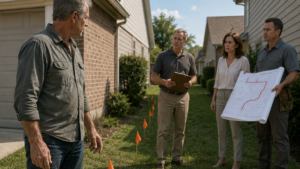
The surveyor stopped near the first bend and unfolded the tripod. He checked his device, then walked several yards toward the subdivision side and placed a pink flag in the ground.
“This is the Cedar Ridge common parcel boundary,” he said.
Barbara stepped closer. “The trail continues beyond that.”
“Yes, ma’am.”
“So the access corridor—”
“The recorded common parcel stops here.”
She glanced at the board members.
The surveyor checked his screen again and placed another flag farther out. “Rivera parcel begins beyond this line. The ranch trail is inside the Rivera parcel from here to the creek.”
A low movement passed through the group. Not surprise exactly. More like a roomful of people feeling a floorboard give under them.
Jason looked down at the flagged line. “So the dotted trail on the sales map…”
“Sales materials are not what I’m marking,” the surveyor said. “I’m marking recorded boundaries.”
Thomas watched Barbara absorb that. She did not collapse into embarrassment. She adjusted. Her shoulders squared. Her eyes moved from the flags to the people, measuring the new shape of the problem.
“The association still has the temporary access document,” she said.
Thomas reached into the envelope tucked under his arm. “Yes.”
The word made several heads turn.
He did not take the paper out yet. “Before we get to that, we walk.”
They continued.
The trail narrowed after the bend. A cedar post stood newly planted where the broken marker had been. Thomas had replaced it the day before, setting it deep and packing the soil himself. The arrow pointed away from the equipment road. Beneath it was a new plain sign: Ranch Trail Ends at Creek Bend. Stay on Marked Path.
Jason stopped when he saw it.
“That’s where the tracks were?” he asked.
Thomas nodded.
Jason looked toward the equipment shed visible through the trees. The tractor sat under the metal roof. The feed truck was parked nearby, its front bumper square with the turn in the road.
“My youngest has a blue bike,” Jason said softly.
Thomas did not answer.
Jason pressed his thumb and forefinger against his eyes, then dropped his hand. “I asked them. They said they rode down here twice. They thought it was part of the trail.”
A woman behind him whispered, “Kids wander.”
Jason turned. “Then adults mark the line before they do.”
The words hung there, and Thomas felt their fairness cut both ways.
He said, “I should have put signs on your side.”
Jason looked at him, surprised.
Thomas kept walking before the admission could become a scene.
At the creek bend, the grove opened quietly around them. Cottonwoods rose from the bank, their leaves moving silver-green in the morning air. Linda’s stone sat beneath the largest tree, plain and low, with fresh dirt still visible where Thomas had repaired the ground around it. Several residents stopped at the edge without being told.
Barbara saw the stone and looked away first.
Thomas stepped beside it. His fingers brushed the envelope.
“This is why the trail changed,” he said.
No one moved.
He hated the silence. Not because it was hostile, but because it was careful. Careful silence made grief feel breakable, and grief was not breakable. It was old iron. It held its shape whether people touched it or not.
“My wife, Linda Roberts, allowed temporary access across this path after the flood damaged your subdivision walkway,” he said. “She did it because children were walking too close to the county road. I wrote the permission note. She initialed the neighbor copy because she was the one people knew.”
Barbara’s eyes came back to him then, wary.
Thomas opened the envelope and removed the certified copy. “It was not an easement. It was not a gift of land. It was permission.”
He could have stopped there. The legal line was clear enough now. The surveyor’s flags were behind them. The county record was in his hand. The gate was his.
But Linda’s stone was at his feet, and Jason’s face was tight with the knowledge of a blue bike.
Thomas made himself continue.
“When the flood repairs were done, I should have closed the trail or renewed the permission properly. Linda wanted to leave it open. She liked hearing families out here.” He looked toward the creek. “After she died, I left it as it was because changing it felt like changing something she had touched.”
The group stayed still.
“Then people began leaving the path. Some came down to the creek bank. Some cut toward the equipment road. Three weeks ago, two children came around that bend on bikes while my feed truck was moving through. Nobody was hurt.”
Jason lowered his head.
“But almost is not nothing,” Thomas said. “And last week I found damage near this grove.”
Barbara’s voice came quiet, but defensive. “You could have told the board all of that.”
“I tried to tell the board about the safety issue.”
“You did not tell us about this.” She gestured toward the stone, then seemed to regret the motion and lowered her hand.
“No,” Thomas said. “I didn’t.”
“Why?”
He looked at her then. “Because I did not want my wife’s resting place debated in your clubhouse.”
Barbara’s face changed. The answer had reached past the rulebook and found the person underneath, if only for a moment.
One of the board members shifted uncomfortably. “Mr. Rivera, I’m sorry. We didn’t know.”
“No,” Thomas said. “You didn’t.”
Barbara seized on the opening, not cruelly but instinctively. “And unclear records contributed to that. The access arrangement was informal, and residents had reason to misunderstand.”
Thomas held out the paper. “Read the last paragraph.”
She did not move.
He stepped closer, the paper between them. “Barbara, you asked people to trust your documents. Read this one.”
The group turned toward her. The clipboard under her arm looked smaller now.
Barbara took the page. Her eyes moved across it, and Thomas saw the moment she reached Linda’s initials. Her throat worked once.
Out loud, he thought. Not to punish her. Not exactly. Because words still meant things when the room was a trail and the minutes were cottonwood leaves.
Barbara read, her voice controlled. “Permission for Cedar Ridge residents to use the west ranch footpath during repair of the subdivision drainage walkway. Permission revocable by landowner. No public dedication intended. No permanent easement created.”
No one spoke.
Jason looked at Thomas. “We turned a favor into a right.”
Thomas folded the envelope against his palm. “Some did. Some were sold a promise by people who did not own it.”
Jason nodded, accepting both the blame and the difference.
Barbara handed the note back. “The association relied on incomplete information.”
Thomas took the paper. “The association ignored complete warnings.”
Her face tightened. For a second, the old Barbara returned: the board president, the rule-holder, the woman trying to stand upright under too many watching eyes. “I was trying to keep order.”
“You were trying to keep authority.”
The words were not loud, but they landed.
Barbara looked toward the residents. Some were embarrassed. Some were still angry. Some simply looked tired of discovering that a pleasant shortcut had been built out of assumption, grief, and bad paperwork.
The surveyor cleared his throat. “I’ll file the boundary notation Monday. The marked flags will remain through the review period.”
Thomas nodded.
The group began to move back toward the gate. No one tried to approach the creek. No one touched the stone.
Jason stayed behind a moment. “I owe you an apology.”
“You gave me one when you told the truth about the bike.”
“That isn’t enough.”
“It’s a start.”
Jason looked toward the grove. “Can I tell my kids whose place this is?”
Thomas looked at Linda’s stone. “Tell them it’s private. Tell them it matters. That will do.”
On the walk back, Barbara kept a few paces ahead of him. At the gate, the residents gathered on the road side, unsettled and quiet. The surveyor packed his equipment. The pink flags behind them shivered in the breeze like small corrections.
Thomas closed the gate but did not lock it yet.
“Barbara,” he said.
She stopped.
He held out Linda’s temporary permission note, not giving it to her, only placing it where she could see the initials at the bottom. “At the meeting, you said records were unclear. You said my silence caused confusion. Some of that is true.”
Her eyes stayed on the paper.
“But this part was clear,” Thomas said. “Read it to the board the same way you read it here.”
Barbara looked at the residents, then at the gate, then back at the note in his hand.
For the first time since she had come up the dirt road with her clipboard, she did not seem to know which rule could save her.
Chapter 8: The Gate Stayed Closed, But Not for Spite
Barbara Carter stood before the Cedar Ridge board with the corrected boundary letter in both hands, and this time she did not bring a clipboard.
Thomas sat in the last row of the clubhouse, the same seat near the aisle, with the county folder resting unopened across his knees. He had not planned to come until Ruth called and said the boundary notation had been filed. Then Jason texted only five words.
She put it on agenda.
So Thomas came.
The room was smaller than it had felt the week before. Fewer residents had shown up, though the ones who did kept glancing toward him with the embarrassed caution people used after discovering they had repeated a story too quickly. Jason sat with his wife near the side wall. The older walker was in the second row, hands folded over the handle of her trekking poles.
Barbara read from the county letter first. Her voice was even, but Thomas could hear the effort inside it.
“The county site review confirms the recorded Cedar Ridge common parcel ends at the western fence line. The trail beyond that point lies within the Rivera ranch parcel. No recorded public trail easement was found in the county index.”
A board member shifted a stack of papers and did not look up.
Barbara continued. “The previously issued enforcement notice cited an incorrect parcel number and was not properly applicable to Mr. Rivera’s property.”
The sentence moved through the room like a door closing.
Someone in the back whispered, “So that’s it?”
Barbara looked up. “The board will withdraw the violation notice.”
She did not say sorry yet. Thomas noticed. He also noticed that she did not blame a clerk, the map, the developer, or residents’ expectations. For Barbara, that was not nothing.
A man near the coffee urn raised his hand. “What about the trail? Are we just losing it?”
The question carried irritation, but less certainty than before.
Barbara set the letter down. “The ranch trail is private. The board cannot compel access across it.”
“But we were told—”
“I know,” she said, and for once the interruption did not sound like control. It sounded tired. “Some sales materials may have created expectations the association cannot legally enforce. The board will review options for improving the existing common-area walkway and exploring an alternate path entirely within association property.”
The older walker lifted her chin. “And the notice nailed to his gate?”
Barbara’s fingers pressed together on the table.
“That was inappropriate,” she said.
The room waited.
Barbara turned toward Thomas.
He did not help her. He had spent too many days helping silence look like peace.
“It was my decision,” she said. “I believed quick action would reassure residents. I also believed Mr. Rivera was withholding information to avoid responsibility. I was wrong about the association’s authority, and I acted beyond what the documents supported.”
Jason looked at Thomas, but Thomas kept his eyes on Barbara.
She swallowed. “Mr. Rivera, the board withdraws the demand. I apologize for posting the notice on your gate.”
It was not a dramatic apology. No tears. No collapse. No sudden warmth. Just words spoken in a room where wrong words had done damage.
Thomas accepted it with a nod.
A board member cleared his throat. “We also need to address resident conduct near the ranch boundary. There should be communication about respecting private property.”
Barbara nodded. “A notice will go out.”
Jason stood before she could continue. “May I?”
Barbara hesitated, then nodded.
Jason faced the room. “My family used that trail for years. I thought because it was part of our routine, it was part of our rights. That was wrong.” His voice caught slightly, but he kept going. “My kids rode off the marked path. I don’t think they meant harm, but that doesn’t erase the danger. I should have asked more questions before I backed the complaint.”
A woman behind him murmured, “Nobody knew.”
Jason turned. “We knew enough to slow down. We didn’t.”
Thomas looked at the gate photo still printed on some of the old handouts near the front table. In the picture, the lock looked final and cold. He wondered how many people had looked at that image and felt only inconvenience. He wondered how many times he had looked at their houses and seen only trespassers.
Barbara folded the county letter. “Mr. Rivera has also offered something for the board to consider.”
Every head turned.
Thomas stood, reluctantly. His knees complained after the long sit, and the folder slid slightly in his hand.
“I’m not reopening the trail,” he said.
A few faces hardened immediately.
He let them.
“The gate will stay closed. The ranch is private land. There is equipment, livestock movement, creek hazards, and a memorial place that is not a neighborhood feature.”
The room stayed quiet.
“But Linda opened that gate once because children needed a safer way around a washed-out path. She believed a neighbor could be generous without losing the right to say when the generosity had ended.”
He looked at Jason, then at Barbara.
“So once a year, by invitation and with clear limits, I’ll open the gate for a short memorial walk. Not as access. Not as an easement. Not as something anyone can demand. As a reminder of what the permission was.”
The older walker wiped at one eye with the back of her finger.
A man near the coffee urn crossed his arms. “That doesn’t help people who used it every weekend.”
“No,” Thomas said. “It doesn’t.”
The bluntness surprised the room.
He continued, “Some losses are inconvenient. Some boundaries disappoint people. That doesn’t make them unjust.”
Barbara looked down at the table, then back up. “The board will include language making clear that any memorial walk is by private invitation only and creates no continuing access right.”
Thomas almost smiled. “That sounds like language I would have written.”
A faint ripple of uneasy laughter moved through the room. It did not fix anything. It helped the air move.
After the meeting, people did not crowd him. A few nodded. The older walker touched his sleeve and said, “I’m sorry about the grove.” Jason shook his hand and promised to bring his children by the road sign, not through the gate, so they could understand where the boundary began.
Barbara approached last.
“I should have read the county records before I acted,” she said.
“Yes.”
She absorbed the answer. “And you should have answered before people filled the silence.”
“Yes,” Thomas said.
That seemed to surprise her more than any argument could have.
She looked older without the clipboard. Not weak. Just less armored. “I was afraid if I slowed down, residents would think I couldn’t handle it.”
“People often mistake speed for strength.”
“Lawyers say things like that when they’ve already won.”
“Widowers say it after they’ve made things harder than they had to be.”
Barbara looked away first. “For what it’s worth, I am sorry about Linda.”
Thomas nodded. This time the words reached him cleanly enough.
One week later, he fastened the new sign to the ranch gate himself.
PRIVATE RANCH LAND. NO PUBLIC TRAIL ACCESS. FOR SAFETY AND RESPECT, PLEASE REMAIN OUTSIDE THE GATE UNLESS INVITED.
He had argued with himself over every word. Private sounded harsh. Respect sounded too soft. Safety carried the part parents needed to hear. Invited carried the part lawyers needed to see.
Jason stood on the road side with his children, keeping them back without making a performance of it. The younger one had a blue bike. Thomas noticed but said nothing. The child looked at the sign, then at the gate.
“Is that where the creek is?” the child asked.
Thomas rested one hand on the top rail. “Past there, yes.”
“Can we go?”
Jason answered before Thomas had to. “Not unless Mr. Rivera invites us.”
The child considered that with the seriousness children sometimes gave rules when adults finally stated them plainly. “Okay.”
Thomas felt something in his chest ease, not much, but enough.
Later, after the road emptied, he carried Linda’s original permission note to the kitchen table. The certified copy was in the county file now. The original still held the blue sweep of her initials. He placed it in a small metal lockbox with the ranch deed, the survey, and the photograph of her standing by the gate during the flood year, one hand lifted toward children passing through.
For a long while, he kept the box open.
Then he closed it.
At sunset, Thomas walked down to the gate. The new sign held steady against the wood. Beyond it, the trail curved toward the cottonwoods, quiet and whole for the first time in weeks.
He slid the chain through the latch, set the lock, and paused with the key still in his hand.
The gate no longer looked like an argument to him. It looked like what it had always been meant to be: a place where someone had to choose when to open, when to close, and what was worth protecting on the other side.
Thomas locked it gently.
The story has ended.