The Board on Michael Ramirez’s Fence That Proved Who Really Knew the Neighborhood
Chapter 1: The Whiteboard Sandra Said Nobody Wanted
“Why is there a giant whiteboard on your fence?”
Sandra Taylor’s voice carried cleanly over the trimmed strip of grass between Michael Ramirez’s backyard fence and the shared sidewalk. It was the kind of voice that did not shout because it expected to be obeyed before shouting became necessary.
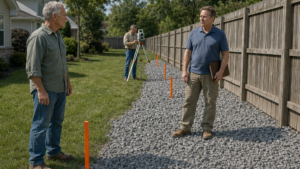
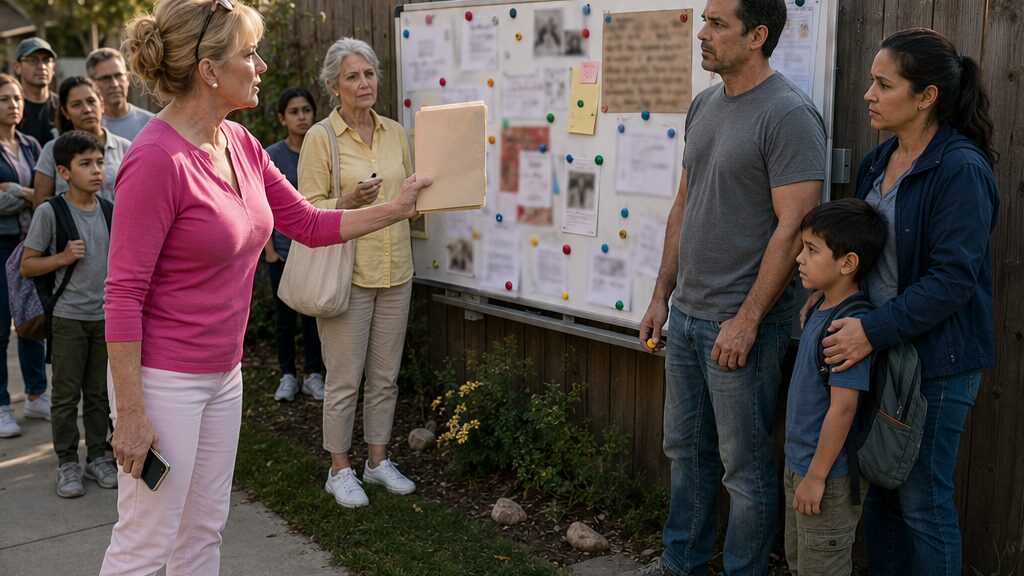
Michael had one hand on the gate latch and the other around a rag damp with cleaner. The board behind him, newly mounted against the cedar fence, caught the afternoon light so sharply it looked even larger than it was. Four feet tall. Six feet wide. White surface, aluminum frame, a narrow tray beneath it, and a row of colorful magnets clipped to the side in a neat column.
He had measured twice before drilling. He had leveled it with a carpenter’s patience. He had sanded the backing frame so no screw point came through the fence. He had done everything carefully, which somehow made Sandra’s expression worse.
She stood on the sidewalk in a bright pink top, white visor pushed above her forehead, sunglasses hanging from a cord at her chest. Her phone was already in her hand.
Michael wiped his fingers on the rag. “Afternoon, Sandra.”
She did not return the greeting. Her eyes stayed on the board.
“This isn’t a classroom,” she said.
A delivery truck rolled slowly past the corner and disappeared behind the line of garages. Somewhere across the green, a mower cut off mid-stripe. Michael could feel the small attention of the street, the way curtains did not move but people still saw.
“It’s for the neighborhood,” he said.
Sandra turned her head toward him with a short, disbelieving blink. “For the neighborhood.”
“That’s right.”
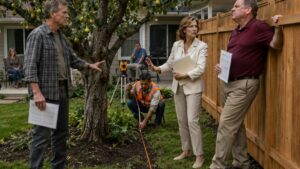
She stepped off the sidewalk and onto the narrow common strip as if approaching evidence. “Michael, you can’t just install whatever you want facing shared property.”
“It’s on my fence.”
“It faces the sidewalk.”
“It’s not blocking the sidewalk.”
“That is not the only standard.” She lifted her phone a little, not taking a picture yet, just reminding him that she could. “The Covenants and Design Guidelines are very clear about exterior displays, signage, and visual clutter.”
Michael looked back at the board. At the moment, it was blank except for one sentence written in blue marker near the top: Wednesday Riddle Coming Soon. Under it, held by a yellow magnet, was a small card that said: Please keep posts kind, local, and dated.
He had thought the rules made it harmless. He had thought the blankness would help. Nothing political, nothing commercial, nothing taped to mailboxes or stapled to trees. Just a place for small neighborhood things to have somewhere to go.
Sandra looked at the blue line. “Wednesday riddle?”
He said nothing.
Her mouth tightened. “Nobody asked for this.”
Michael folded the damp rag in half. He had a strange urge to hide the marker tray, as though the markers were contraband. “A few people mentioned they missed having somewhere to post things.”
“People say things.” Sandra gave a small laugh without amusement. “That does not mean you mount a giant whiteboard on a fence.”
“It’s removable.”
“So is a lawn flamingo. That doesn’t mean it belongs in Silver Meadows.”
He glanced toward the green, where the subdivision sign stood at the entrance with its stone base and seasonal plantings. Silver Meadows had thirty-seven houses, two retention ponds, one common green, and a quarterly newsletter nobody read unless it contained a warning. The sidewalks curved in polite loops. Garages stayed closed. Trash bins vanished by sunset on collection day.
The board looked too visible against all that careful quiet. Michael knew that. He had known it the moment he tightened the last screw.
Sandra looked down the sidewalk as if searching for a jury. “I’m going to be honest with you. Nobody wants that.”
The sentence landed harder than it should have.
Michael’s thumb pressed into the rag until cleaner wet his skin. He saw, absurdly, the magnets lined in order: red, blue, green, yellow. He had bought them because the cheap ones slid down the board. The stronger ones clicked sharply into place.
“You don’t know that,” he said.
Sandra’s eyebrows rose. “Excuse me?”
He kept his voice even. “You don’t know nobody wants it.”
A garage door halfway down the block began to rise. Michael did not look. Sandra did.
“Michael,” she said, lowering her voice now that the street might be listening more openly, “this is exactly how neighborhoods start to look messy. One person puts up a board. Another person thinks a banner is fine. Then someone leaves flyers everywhere. Then we have complaints. Then people say the HOA never enforces anything until it affects them.”
He recognized the rhythm. She had probably used it at meetings, in emails, on porches. Give one inch and the neighborhood becomes a warning.
“I’m not putting up a banner,” he said.
“You’re missing the point.”
“Maybe.”
Sandra paused at that. For the first time, annoyance gave way to something sharper. “You received the same handbook everyone did when you bought here.”
“I did.”
“And you agreed to it.”
“I did.”
“Then you understand why this can’t stay.”
Michael looked at the board again. It reflected part of the sidewalk, part of Sandra’s pink shirt, and a faint blur of his own gray T-shirt. In the white glare he could almost see it before it was a board: a folding card table under the maple tree, a plastic cup of markers, three kids arguing over whether a shadow had weight, a woman laughing quietly as if she had tricked the day into being lighter than it was.
He closed his fist around the rag.
“It’s for notices,” he said. “Lost pets. Babysitting. Yard sales. That kind of thing. No permanent signs. I’ll clean it. I’ll keep it decent.”
Sandra’s gaze flicked to him, then to the board, then to the small printed rules card. “That’s not how this works.”
“How does it work?”
“You submit a request before installation.”
He had known that too. Not exactly, but close enough.
“I didn’t think it counted as an architectural change,” he said.
“You drilled into a fence.”
“My fence.”
“Facing common view.”
The phrase came out prepared, polished by use. Common view. Michael almost smiled, but it would have come out wrong. Everything painful in a neighborhood became easier to say when it had a phrase attached to it.
Sandra stepped back and lifted the phone chest-high.
Michael moved half a step without meaning to. “What are you doing?”
“Documenting it.”
“You don’t have to do that.”
“Yes, I do.” She centered the board in her screen. “Because if I don’t, I get accused of picking and choosing what I enforce.”
“I’m not trying to make trouble.”
“I don’t think you are.” Her tone softened for a second, but only for a second. “But intention doesn’t change the rule.”
A woman walking a small dog slowed near the corner. The dog sniffed at the grass while the woman’s eyes moved from Sandra’s phone to Michael’s face. Michael gave her a short nod. She looked away quickly and tugged the leash.
Sandra took the picture. The phone made a tiny artificial click.
Something in Michael tightened, not from anger exactly. From exposure. The board had been a thing he built with screws and measurements and a private promise. Now it was an item in a file.
Sandra lowered the phone. “I’m asking you neighbor to neighbor. Take it down before this becomes official.”
Neighbor to neighbor. He wished she had started there.
“I’ll think about what you said,” he replied.
“That’s not an answer.”
“It’s the answer I have right now.”
Sandra stared at him. For a moment he thought she might ask a real question. Why this? Why now? Why the careful little card about kindness? Why did his voice go flat whenever she said nobody?
Instead, she tucked her phone against her palm and stepped back onto the sidewalk.
“You have forty-eight hours before I send it to compliance,” she said. “I’d rather not, but I will.”
Michael nodded once.
She walked away shaking her head, her white visor bright against the row of brown fences. At the corner she stopped, turned slightly, and looked back at the board as if it had personally offended her.
Michael waited until she was gone before he touched the frame. The board did not move. He had mounted it too well.
The blue words still sat at the top, cheerful and stupid-looking under the circumstances.
Wednesday Riddle Coming Soon.
He picked up the eraser from the tray. For a second, he held it against the first letter. One clean swipe and the sentence would vanish. Another five minutes with a drill and the whole thing could come down. Sandra would have her common view back. The file would close before it opened.
A bicycle bell rang faintly near the green.
Michael lowered the eraser.
From the side yard, a small voice called, “Mister Ramirez?”
He turned.
A child stood on the sidewalk with a backpack hanging off one shoulder, looking from him to the board. Michael had seen the boy before in the after-school drift of children that passed the green before parents got home.
“Is the riddle really Wednesday?” the child asked.
Michael swallowed once. “That’s the plan.”
The boy smiled like the matter was settled and pedaled away, backpack bouncing.
Michael stood beside the board until the street went quiet again. Then he capped the blue marker, clipped it carefully to the tray, and looked at the place where Sandra had stood with her phone.
By dinner, the photo would be in an email. By tomorrow, maybe in a packet. By the end of the week, the board could be a violation number.
He folded the rag over the marker stains on his palm and went inside without taking the board down.
Chapter 2: The Notices That Appeared Before Breakfast
By six-thirty the next Monday morning, there were three notes on the board that Michael had not put there.
He noticed them from his kitchen window while the coffee maker coughed through its last bitter inch. The sky was still pale. Sprinklers ticked two houses down. The fence board stood damp with early light, no longer blank, no longer just his problem.
For a moment he did not move.
Then he left the coffee untouched and walked outside in socks and old sneakers, the back door clicking softly behind him.
The first note was written on lined notebook paper and held by two blue magnets.
Lost gray cat, answers to Milo. Last seen near Pond Two. Please text number below.
The second was a clean index card.
Teen available for mowing, weekends only. Ask at 214 Maple Bend.
The third was in purple marker directly on the board, slanted in careful block letters:
What has keys but cannot open doors?
Under it, someone had drawn a tiny piano.
Michael stood close enough to see where the marker had hesitated on the curve of the question mark. Not his handwriting. A child’s, probably. Maybe an adult trying to write like one. It didn’t matter.
He touched the edge of the cat notice to flatten it.
“Okay,” he murmured.
The word came out before he meant it to. Not happy. Not relieved. Just braced.
He checked the little rules card. Still there. Please keep posts kind, local, and dated. Someone had added a smiley face in the corner with green marker.
Michael almost erased it, then didn’t.
He went back inside for coffee, but the house felt different now. The kitchen window framed the board like a live thing. He watched a delivery driver slow at the sidewalk, read the cat notice, then glance toward the houses before continuing up the street with a package tucked under one arm.
At seven-fifteen, he stepped out again with a dry cloth and a black marker. He wrote the date under the mowing card. He added a small line beneath the cat notice: Posted Monday. Then he erased a faint streak left from yesterday’s test marks, careful not to touch the purple riddle.
The answer was obvious. Piano. But he left that alone too.
At eight, the first school bus hissed at the far end of the subdivision. Parents moved in half-awake clusters. A retired man in a zip-up jacket paused to read the board. Two children stopped beside him, whispering over the riddle. One guessed “janitor.” The other said, “No, keys, like piano keys,” with the impatience of someone discovering adulthood was slow.
Michael pretended to tighten the gate latch so he would not have to look too pleased.
He had told Sandra it was for the neighborhood. That had been true in the safest possible way. It left out who had first put riddles on scrap paper and taped them to a folding table. It left out the summer when three kids had nowhere to go after camp was canceled. It left out how a person could be gone and still leave instructions everywhere.
A minivan stopped at the curb a little before nine. Nicole Perez climbed out in navy scrubs with a travel mug in one hand and a plastic grocery bag in the other. Her hair was pulled into a hurried knot, and she looked like she had already been late twice that morning.
“Michael,” she called quietly.
He looked up from rinsing the cloth with the hose. “Morning.”
Nicole came to the board and scanned the notices. “Is this okay? I mean, are people allowed to post?”
“That’s what it’s for.”
She held up the grocery bag. Inside was a stack of folded paper flyers. “I didn’t want to just put these up without asking.”
“What are they?”
“After-school homework help. Just Tuesdays and Thursdays. I work double shifts sometimes, and one of the high school kids said she could sit with the younger ones at the clubhouse patio for an hour. Not official. Not a daycare. Just…” She stopped, embarrassed by how much she was explaining. “I thought parents might want to know.”
Michael took one flyer and read it. No names except a phone number. No charge. Bring your own snack. Parent must text first.
“Seems useful,” he said.
Nicole gave a short laugh. “That’s dangerous around here.”
He looked at her.
“I just mean, useful doesn’t always matter if somebody complains.”
The words were not accusing. They were tired. Michael knew she rented the small place on Alder Court from an owner who lived out of state. Renters in Silver Meadows learned to keep a lower profile than owners. They used the pool carefully. They parked exactly straight. They apologized before asking questions.
He took two green magnets from the side rail. “Pick a spot.”
Nicole hesitated, then placed the flyer beneath the riddle. Her hand shook a little as she adjusted it.
From the sidewalk, a child’s voice said, “It’s piano.”
Nicole turned. Her son stood there with a backpack nearly as wide as his shoulders. He pointed at the riddle. “Keys but no doors. Piano.”
Michael smiled before he could stop himself. “You sure?”
The child gave him a look of deep disappointment. “Yes.”
Nicole’s face softened. “Don’t be rude.”
“I’m not.”
“You’re doing your math face.”
The child grinned at the board. “Can I write the answer?”
Michael held out the black marker, then pulled it back. “Small. Under the question.”
The boy printed PIANO in careful letters, each one darker than the last. When he capped the marker, he looked at the board as though he had signed a treaty.
Nicole watched him. “He told me about this all weekend.”
“He did?”
“He said there was going to be a riddle wall.” She glanced at Michael with a cautious smile. “That sounded nicer than most things he brings home from the sidewalk.”
Before Michael could answer, a white envelope slid under the gate from the front walkway and landed near his feet.
For a second, none of them moved.
The envelope had the Silver Meadows HOA return address printed in the corner.
Nicole’s smile vanished. “Is that about this?”
Michael bent, picked it up, and wiped a damp grass blade from the back. His name and address were printed in a neat block. No stamp. Hand-delivered.
“It might be,” he said.
Nicole reached for her son’s shoulder. “We should go.”
“You don’t have to take down the flyer,” Michael said.
She looked toward the street, then back at the envelope. “I don’t want to make it worse for you.”
“It’s already worse.”
He meant it lightly. It did not come out that way.
Nicole left the flyer where it was.
After she and her son walked off toward the bus stop, Michael stood alone beside the board. The cat notice fluttered. The homework flyer shivered against its magnets. The word PIANO sat at the bottom of the purple riddle in a child’s bold hand.
He opened the envelope with his thumb.
NOTICE OF POTENTIAL COVENANT VIOLATION.
The language was formal and bloodless. Unauthorized exterior display. Possible signage violation. Modification visible from common areas. Request for correction within seven days. Failure to comply may result in fines following compliance review.
At the bottom, in a smaller paragraph, was a line about contacting the treasurer with questions about procedure.
Michael read it twice, then folded it along the crease. He did not feel angry yet. Anger would have been clean. This was something messier: the sense that an ordinary good thing had been asked to justify its existence in a language it did not speak.
A car door closed behind him.
“Michael?”
Brian Johnson stood near the sidewalk, holding a stainless travel mug and wearing a navy fleece vest over his work shirt. He had the careful posture of a man who preferred spreadsheets to conflict.
Michael slipped the notice back into the envelope. “You making deliveries now?”
Brian looked uncomfortable. “Sandra asked me to make sure you received it.”
“I received it.”
“I figured.” Brian glanced at the board. His eyes lingered on the cat notice, then the homework flyer, then the answer to the riddle. “It’s already getting some use.”
“That’s one way to put it.”
Brian rubbed his thumb along the seam of his mug. “Listen, I’m not here to lecture. But once a notice is logged, there’s a process.”
“There’s always a process.”
“I know how that sounds.”
“Do you?”
Brian accepted that with a small nod. “Fines don’t start today. But if the board is still up at the end of the correction period, Sandra can request formal review. After that, it’s twenty-five a day unless the board votes otherwise.”
Michael looked past him to the sidewalk where Nicole’s flyer now faced the morning.
“Twenty-five dollars a day for a piano riddle,” he said.
Brian’s mouth tightened, almost a smile, almost not. “For an unapproved exterior display.”
“That sounds better.”
“It sounds enforceable.”
Michael folded the envelope once more and tapped it against his palm. “Is there a form?”
“For removal?”
“For permission.”
Brian inhaled, then looked toward Sandra’s house at the far end of the curve, though she was nowhere visible. “You can submit an architectural request.”
“And?”
“And the guidelines don’t really have a category for a community board on a private fence.”
“Then make one.”
“That’s not how fast this works.”
Michael nodded slowly. The board creaked faintly in the morning air, or maybe the fence did. A yellow magnet slipped half an inch down the surface and stopped.
Brian noticed. “You should know something before this goes any further.”
Michael waited.
“I’m not saying take it down.” Brian shifted his mug from one hand to the other. “I’m saying if you leave it up without approval, Sandra will push for fines. And once fines start, people stop talking about whether something is good. They talk about whether you complied.”
The school bus groaned away from the corner. The sound faded, leaving the neighborhood neat and quiet again.
Michael looked at the board, at the purple riddle, at the careful flyer Nicole had almost been afraid to post.
Then he looked at Brian. “Maybe they should talk about both.”
Brian did not answer. He only gave Michael the tired, apologetic look of a man who had come to warn someone and had made nothing easier.
Chapter 3: People Actually Stopped to Read It
Sandra Taylor came back on Friday just as six children were arguing over whether a cloud could be counted as “something you can hold.”
Michael saw her before she saw him. She crossed the common green in white capri pants and a pale cardigan, phone in one hand, a folder tucked under her arm. Her pace had purpose in it. Not hurry. Hurry could look uncertain. Sandra did not like looking uncertain.
The board was no longer blank enough to dismiss.
A lost-cat notice had been moved to the lower corner with a handwritten update: Milo found under the Nelsons’ deck, thank you! Nicole’s homework flyer had two phone-number tabs torn off. Someone had posted a reminder about bulk trash pickup. A retiree had added a note offering extra tomato plants. In the top right corner, held with red magnets, was the day’s riddle.
What can travel around the world while staying in one corner?
A stamp, one child insisted.
A map, said another.
“A grandma,” said the smallest child, for reasons no one understood.
Michael stood near the gate with a dry eraser in his back pocket, pretending to sort markers. He had learned over the week that if he hovered too much, people stopped using the board naturally. If he stayed too far away, someone would use permanent marker. So he kept to the edge of things, close enough to be useful, far enough not to own every moment.
Sandra stopped three feet from the group.
The children quieted in stages. One looked at Sandra’s phone and stepped back. Another reached for the sleeve of a friend.
Sandra’s eyes moved over the papers, the magnets, the neat heading Michael had added after the second day: Silver Meadows Community Board. Under that, in smaller letters: Local notices. Kind words. Daily riddle.
“I can’t believe it’s still here,” she said.
Michael capped a green marker. “Good afternoon.”
She ignored that. “You received the notice.”
“I did.”
“And yet you’ve expanded it.”
“I haven’t expanded the board.”
“You know what I mean.” She gestured at the papers. “Now it’s a bulletin board.”
From behind the children, Linda Green stepped forward with a canvas tote bag on her shoulder. She wore a yellow shirt and had reading glasses hanging from a chain. Her silver hair was pinned back in a way that made her look both gentle and prepared.
“It is a bulletin board,” Linda said. “That seems to be the point.”
Sandra gave her a tight smile. “Linda, I don’t think this concerns—”
“I live two houses down. I believe the word is community.”
Michael looked at Linda. She did not look back. Her gaze stayed on Sandra with the calm of a retired teacher waiting for a student to notice the obvious.
Sandra’s jaw worked once. “I’m not against community. I am against unapproved displays on fences facing common areas.”
A boy in a red backpack raised his hand.
No one knew what to do with that.
Sandra looked at him. “Yes?”
“It’s a stamp,” he said.
“What?”
“The answer.” He pointed to the board. “It can travel around the world while staying in one corner. It’s a stamp.”
A few of the children groaned because he had gotten there first. The smallest child said, “A grandma still works.”
Michael bit the inside of his cheek.
Linda smiled and took a black marker from the tray. “Would you like to write it?”
The boy looked at Michael for permission. Michael nodded.
The boy stepped up and printed STAMP beneath the riddle, pressing so hard the marker squeaked. When he finished, two adults who had stopped on the sidewalk gave soft little laughs. Not applause. Nothing dramatic. Just the sound of people recognizing a harmless pleasure at the same time.
Sandra stared at the word as if it had been written to spite her.
Michael felt the moment turn. He could feel Sandra feeling it too. The board was no longer an object she and Michael could define alone. It had witnesses now, and not the kind who wanted a fight. Parents with keys in their hands. A retiree holding tomato seedlings. A delivery driver paused with a padded envelope under his arm. Nicole in scrubs, just off shift or just going on one, watching from the edge with her son beside her.
Sandra lifted her folder. “This gathering is exactly part of the concern.”
Nicole’s head came up. “Gathering?”
Sandra turned. “Children clustering beside a sidewalk around an unapproved installation creates liability questions.”
“They’re reading a riddle,” Nicole said.
“They’re standing in a common walkway.”
Michael looked down. The sidewalk was clear. The children were on the grass strip and his side of the fence line, because he had put a row of flat stones there after the second day so they would not trample the lawn.
“They’re not blocking anything,” he said.
“That is not the only issue.”
“It never is.”
Sandra’s eyes snapped to him.
Michael regretted the line as soon as he said it. Not because it was wrong. Because it gave Sandra something easier to fight than the board.
She straightened. “You seem to think this is personal.”
“I think it’s a board.”
“No, Michael. A board is something you put in your garage. This is a public-facing message center that you installed without approval, invited residents to use, and refused to remove after notice.”
He looked at the folder under her arm. “Did you come here to talk or to hand me something?”
The question made the air change again. A parent near the curb stopped pretending not to listen.
Sandra took a breath, careful and visible. “I came to see whether the violation had been corrected.”
“It hasn’t.”
“I can see that.”
“Then why ask?”
Linda’s eyes flicked toward him, a warning. Michael knew it. He had spent years being praised for patience he had not always felt. Now, with the children watching and the word STAMP drying on the board, he could feel the old private thing behind his ribs pressing forward. He wanted to say too much. He wanted to say her name. He wanted to ask Sandra what kind of neighborhood she thought she was preserving if a child’s answer to a riddle counted as evidence of decline.
Instead, he picked up a fallen yellow magnet from the grass and placed it back on the side rail.
Sandra watched the small motion. Something in her face hardened further, as though his quietness insulted her more than anger would have.
A delivery driver cleared his throat. “Sorry, is this where the lost-cat note was?”
Michael turned. “Milo was found.”
“Oh, good.” The driver nodded toward the lower corner. “I saw that Monday. Been checking when I pass.”
Sandra looked at him. “You don’t live here.”
“No, ma’am.” He shifted the package. “Just deliver here.”
“Then this board is attracting nonresidents.”
The driver’s face closed. “I was just glad about the cat.”
He walked on quickly, shoulders lifted.
Nicole stepped closer. “Sandra, come on.”
Sandra held up one palm. “I understand everyone thinks this is charming.”
“People actually enjoy this,” Nicole said.
The sentence landed in the exact place Sandra did not want it to. Michael saw it hit her. Not because Nicole was loud. Because she said it plainly, with the tired authority of someone who had no extra energy for neighborhood theater.
Sandra looked around. The children. The tomato plants. The found cat update. The homework flyer. The answer written in a boy’s block letters. Evidence, all of it, but not evidence in her format.
“No one is saying it has no use,” Sandra said.
“You said nobody wanted it,” Michael replied.
The words escaped before he could soften them.
Sandra’s cheeks colored. “I said nobody wanted a giant whiteboard on a fence.”
“That’s not what it felt like you meant.”
A silence followed, small but complete.
Linda finally turned to him. Her expression was gentle, but there was worry in it. Michael looked away.
The children began drifting back toward the green, sensing adult trouble. Nicole’s son lingered longest, staring at Michael as if trying to understand why a solved riddle had made everybody sadder.
Sandra opened her folder.
“I am issuing a formal violation referral,” she said. Her voice had gone procedural, which was worse than anger. “The compliance committee will review the matter next week. If the board remains in place, daily fines may be recommended.”
Nicole made a sound under her breath. Linda’s hand tightened on the strap of her tote.
Michael took the paper Sandra held out. He did not read it immediately. The HOA seal sat at the top in dark blue ink, official enough to make the board behind him look suddenly fragile.
Sandra lowered her voice. “Popularity does not make a violation legal.”
Michael looked at the children crossing the green, at the boy who had written STAMP turning once to check whether his answer was still there.
Then he looked back at Sandra. “No,” he said. “But it ought to make you curious.”
For a second, something uncertain moved across her face. It was gone almost immediately.
She closed the folder. “You’ll receive the meeting notice by email.”
She turned and walked away, past the clear sidewalk, past the common green, past the people who had stopped pretending not to care.
Michael stood with the formal referral in his hand while Linda quietly removed the cap from the marker and wrote the next day’s heading at the top of the board.
Saturday Riddle.
Her letters were steady.
Michael watched them appear and felt no triumph at all.
Chapter 4: The Rule Sandra Thought Would End It
The first page of the violation packet showed Michael’s board in color, printed large enough that the purple riddle looked like an accusation.
He stood in the small office corner of the community clubhouse with the packet open on the folding table, his thumb pressed along the bottom edge of the paper. Someone had taken the photo from an angle that made the board seem to lean over the sidewalk, swallowing the fence behind it. The children were not in the frame. Neither was Nicole’s flyer, or the found-cat update, or the tomato plant note. Just the board, the white glare, and the heading Sandra had circled in blue ink.
Unauthorized Exterior Display.
“That’s not even the best picture of it,” Michael said.
Brian Johnson, seated across from him with a laptop open and a stack of HOA binders at his elbow, gave him a cautious look. “I wouldn’t lead with that at the meeting.”
“I wasn’t planning to.”
The clubhouse office was not really an office. It was a carpeted corner behind a half wall, next to the room where residents reserved folding chairs for birthdays and graduation parties. A corkboard displayed pool rules, lawn-service notices, and a faded flyer reminding people that glass containers were not allowed near the deck. Somehow those papers were acceptable. They belonged because they had been there long enough.
Brian turned the packet toward himself. “Sandra prepared this for the compliance review.”
“I gathered.”
“She copied me because fines would run through the treasurer report.”
Michael looked at the photo again. The board seemed colder on paper. Less human. Paper knew how to flatten things.
“Did she include the cat notice?”
Brian did not answer immediately.
Michael looked up.
Brian adjusted his glasses. “The packet focuses on the installation itself.”
“Right.”
“Michael—”
“No, I get it. If you show what people use it for, it gets harder to call it clutter.”
Brian closed the folder halfway, then opened it again as if the motion might buy him neutrality. “I asked you to come because I wanted you to see the language before next week. Not because I agree with every word.”
“That’s generous of you.”
“I’m serious.”
“So am I.”
Brian leaned back in the folding chair. The metal legs gave a small complaint. “Look, I know Sandra can come across hard.”
Michael almost laughed. “Come across.”
“She’s been under pressure.” Brian’s voice lowered, though no one else was in the clubhouse except a custodian moving trash bags near the kitchen. “Last year, she let three things slide because they seemed harmless. A basketball hoop left at the curb. A contractor sign that stayed up too long. Holiday lights into February. Then two homeowners accused her of favoritism at a meeting. One said the board only enforces rules when it’s someone they don’t like.”
“So now a riddle board is where she makes her stand.”
“I’m not defending everything.”
“You’re explaining.”
“Yes.” Brian tapped the packet. “Because at the meeting, Sandra will not sound like someone angry about riddles. She’ll sound like someone trying to prevent selective enforcement.”
Michael looked around the clubhouse. The carpet had a dark track from the entrance to the meeting room. On the far wall, the framed Silver Meadows site plan showed cul-de-sacs, ponds, common paths, and the green beside his fence. Everything outlined, numbered, owned by someone or managed by someone else.
“What are my options?” he asked.
Brian seemed relieved by the practical question. He pulled one binder closer and opened to a tab marked Design Guidelines. “You can remove it before review. That ends the matter.”
“No.”
“You can request a variance.”
“Good.”
“Maybe good.” Brian slid the binder around. “The problem is there’s no explicit category for something like this. Section 8 covers signage. Section 11 covers exterior alterations. Section 14 covers temporary community notices.”
Michael put one finger on the page. “Temporary community notices.”
“Posted by the association,” Brian said. “On approved surfaces.”
“Where are the approved surfaces?”
“The clubhouse corkboard. The pool gate. Sometimes email.”
Michael looked toward the faded pool flyer. “So if a neighbor loses a cat, they should hope Milo checks his email.”
Brian’s mouth twitched despite himself. “I said sometimes.”
Michael read the section. Temporary notices concerning community safety, services, lost property, or association events may be displayed for reasonable periods on common notice surfaces or by written approval of the Board.
“Written approval,” Michael said.
“Yes.”
“So the board can approve a surface.”
“In theory.”
“In theory matters.”
“Not as much as you think.”
Michael kept reading. The language was thin but not empty. Common notice surfaces. Reasonable periods. Written approval. Someone had thought, at least once, that a neighborhood needed places for small information to land.
Brian tapped another page. “Sandra’s argument is that your board is permanent signage, privately controlled, installed on a fence, and visible from a common area.”
“Privately maintained.”
“Privately controlled.”
“I let people post.”
“You decide what stays.”
“Somebody has to.”
“That’s exactly the concern she’ll use.”
Michael sat back. “So if I don’t maintain it, it’s clutter. If I do maintain it, it’s control.”
Brian rubbed the bridge of his nose. “That’s HOA life in one sentence.”
For the first time that morning, Michael smiled. It did not last.
Through the clubhouse window, he could see the curve of the sidewalk beyond the parking lot. The same sidewalk passed his fence, the green, the stop where the school bus sighed open every morning. He pictured the board without the papers, the fence bare again. The neighborhood would not collapse. Children would still walk home. Cats would still be found or not found. People would still text, complain, pass each other, forget names.
That was what made it hard to defend. The board was not necessary in the way a fire hydrant was necessary. It was just one of the small things that made a place less sealed shut.
Brian turned to a printed email in the packet. “There’s one more thing.”
Michael knew from his tone that it would not be good.
“Sandra added a supplemental concern this morning.”
Michael reached across and took the page.
Supplemental Concern: Unapproved Gathering Point Adjacent to Common Walkway.
He read the title twice.
Brian said, “She says residents are congregating along the sidewalk in a way that may interfere with pedestrian use and create liability if a child steps into the street.”
“The sidewalk is clear.”
“I know.”
“There are stepping stones.”
“I saw them.”
“Then why is this in here?”
Brian did not look away. “Because it gives the board another reason to say no.”
Michael let the paper fall flat on the table. A sharp, clean anger finally arrived.
“It’s not enough to call the board ugly?”
“Michael.”
“She has to make children reading into a safety hazard?”
Brian lowered his voice. “Do not say it that way in the meeting.”
“Why not? It’s accurate.”
“Because she’ll say you’re minimizing liability.”
Michael stood and walked to the corkboard on the wall. A sign about pool access had curled at one corner. Under it, a notice about a missing package had been pinned crookedly, three weeks old. Nobody had removed it because nobody cared enough to be bothered.
He looked back at Brian. “How do I get written approval?”
“You submit a proposal before the meeting. Keep it narrow. Community notices only. Time limits. Maintenance schedule. No commercial advertising beyond local services. No political signs. No permanent messages. Maybe a clear cover so papers don’t blow.”
Michael listened despite himself. The anger did not leave, but it found edges.
“And the riddle?” he asked.
Brian blinked.
“The daily riddle. Is that illegal too?”
“I don’t think the guidelines anticipated riddles.”
“Seems like an oversight.”
Brian sighed. “I think a daily prompt could be considered community engagement if the board approves the surface.”
Michael nodded slowly. “Community engagement.”
“It sounds better than riddle wall.”
“Everything sounds better in a packet.”
Brian closed the binder. “I’m not promising support.”
“I didn’t ask you to.”
“But if you want any chance, don’t make it about Sandra being wrong. Make it about the board having limits.”
Michael looked at the packet. Sandra’s photo stared back from the top page, flat and bright, proof of only one kind of truth.
He gathered the pages and slid them into the envelope.
At the clubhouse door, Brian called after him. “Michael.”
He stopped.
“If there’s some other reason this matters, you should think about whether hiding it helps.”
Michael’s hand tightened on the packet.
Outside, the parking lot smelled faintly of cut grass and warm pavement. He had almost reached his truck when Linda Green stepped out from under the clubhouse awning, a grocery bag hooked over one arm. She must have been waiting; her face had that quiet, decided look she got before saying something he would not like.
“You saw the packet?” she asked.
He held it up. “Full color.”
Linda took it from him without asking and opened the top flap. Her eyes moved over the photo, the circled heading, the supplemental concern. She said nothing until she reached the page about the gathering point.
Then her lips pressed together.
“She would have hated this,” Linda said.
Michael felt the words before he understood which woman she meant.
He took the packet back too quickly. “Linda.”
“She would have.”
“Don’t.”
“She started that riddle table because the children were being told to move along everywhere else.”
“That was different.”
“No, Michael. It was smaller. That isn’t the same as different.”
He looked toward the road. A car passed without slowing. The normal world refused to pause for what Linda had just put in the air.
“She’s not part of this,” he said.
Linda’s face softened, but she did not retreat. “That’s the trouble. She is. And you’re the only one pretending she isn’t.”
Michael folded the packet against his side, hard enough to bend the corner of Sandra’s photo.
Linda looked at the crease and then at him. “If this goes to that meeting without the truth, Sandra gets to decide what the board means.”
He wanted to answer. He wanted to tell her she had no right. He wanted to tell her that saying his wife would have hated something did not give Linda permission to bring her into a room full of folding chairs and procedural motions.
Instead, he opened his truck door.
Linda did not stop him. She only said, quietly, “You can protect a memory so tightly that nobody else can help carry it.”
Michael got in, shut the door, and set the packet on the passenger seat.
On top, the photo of the board faced upward, the white surface bright, the fence cropped close, his own hand barely visible at the edge of the frame as if he had already been removed from the story.
Chapter 5: The Riddle His Wife Left Behind
The riddle card Linda placed on Michael’s kitchen table was yellowed at the corners and soft from being handled too many times.
He knew it before he touched it.
He had been standing at the sink, rinsing a coffee mug he did not remember using, when she came through the back door without knocking. That was an old habit from before. She had tried to break it after the funeral. Sometimes she forgot. Tonight, with the HOA meeting two evenings away and the violation packet spread across his counter, Michael did not have the energy to remind her.
Linda set the card between the packet and his folded proposal.
“Read it,” she said.
“I know what it says.”
“Read it anyway.”
Michael dried his hands slowly. The kitchen was too quiet around them. The refrigerator hummed. Outside, faint voices passed by the board and faded toward the green.
He looked down.
What gets bigger the more you take away?
The handwriting leaned slightly right, cheerful but impatient, the way it always had when she wrote standing up. Under the question, in smaller letters, was the answer: a hole.
Michael turned away from the table. “That’s a terrible one.”
Linda pulled out a chair and sat. “She thought it was funny.”
“She thought groaners counted as humor.”
“They do when children groan loudly enough.”
He leaned both hands on the counter. The cabinet edge pressed into his palms. “Why did you bring that?”
“Because you’re about to stand in front of the HOA and argue about Section Fourteen like this started with a hardware store receipt.”
“That’s what they’ll care about.”
“That’s what Sandra wants them to care about.”
Michael laughed once, without warmth. “Sandra doesn’t know anything about her.”
“No. Because you won’t let anyone say her name.”
He turned then.
Linda’s expression did not flinch. She looked older in the kitchen light than she did by the board, the lines around her mouth deeper, her hands resting flat beside the card.
Michael lowered his voice. “This neighborhood already did the casserole thing. The sympathy cards. The awkward porch pauses. I’m not doing another round.”
“That isn’t what I’m asking.”
“It sounds like what you’re asking.”
“I’m asking you not to let Sandra reduce the board to clutter when you and I both know it was never clutter.”
Michael looked at the card again.
The first summer had come back in pieces since the board went up. Not memories, exactly. More like tools left where he could trip over them. A blue marker in the junk drawer. A child’s laugh outside the fence. The phrase Wednesday Riddle, bright and ordinary, as if ordinary things were not the ones that hurt most.
His wife had started with a folding table under the maple tree near the common green. Nothing formal. Just a pitcher of lemonade, a stack of scrap paper, and a riddle written in marker after she noticed three children wandering the sidewalk every afternoon, too old for babysitters, too young to be invisible safely. Then other children came. Then parents paused. Then Linda started bringing extra markers. For six weeks, the riddle table had made the long afternoons less empty for everybody.
Then school started. Then treatment started again. Then the folding table stayed in the garage.
Before she died, she had asked him to keep it going when he could.
Not in a dramatic whisper. Not as a final scene anyone would believe in a movie. She had said it while he was changing the batteries in the bedroom remote because the volume button had stopped working.
Don’t let them forget how to stop for each other, okay?
He had said okay because he would have agreed to anything.
And then he had done nothing for nearly two years.
Linda touched the edge of the card. “She gave me this one because she said you hated it.”
“I did.”
“She said that meant it worked.”
Michael sat across from her. The chair made a harsh scrape on the tile.
“I didn’t build the board for her,” he said.
Linda waited.
He rubbed both hands over his face. “I mean, not just for her. That’s what I don’t want people doing. Making that face. Saying it’s beautiful. Saying she would be proud. Using her name to make Sandra feel bad.”
“Would that be so terrible?”
“Yes.”
Linda’s eyes searched his.
Michael lowered his hands. “Because then it becomes a memorial. And people act careful around memorials for about three weeks. Then they avoid them. Or they decorate them. Or they argue over them. The board works because it’s useful. Because Nicole can post homework help and somebody can find a cat and a kid can write STAMP too hard with a black marker. That’s what she wanted. Not a shrine.”
Linda was quiet long enough that he regretted the force of it.
Then she nodded. “All right.”
“All right?”
“You’re not wrong.”
He looked at her, suspicious of relief.
“But you’re not completely right either,” she said. “You’re using usefulness to hide from the part that still hurts.”
Michael pushed the riddle card away a few inches. “I’m allowed to have one thing I don’t explain.”
“You are. Until not explaining it lets someone else destroy it.”
The words found the same place Brian’s had. Michael hated that. He hated more that they were both right in different ways.
A knock came at the back door.
Linda turned.
Michael stood, grateful for the interruption until he saw Nicole Perez through the glass, her work jacket zipped to her chin, phone in one hand. Her son waited on the patio behind her, looking embarrassed to be out after dinner.
Michael opened the door. “Everything okay?”
Nicole looked from him to Linda, then to the papers on the table. “Sorry. I saw the kitchen light. I can come back.”
“What is it?”
She glanced back at her son. “He wanted to know if the board was going away.”
The boy stared at his shoes.
Michael’s throat tightened unexpectedly. “I don’t know yet.”
Nicole nodded as if she had expected that. “I got the meeting notice. Renters can attend, right?”
Linda answered before Michael could. “Residents can attend.”
“I don’t want to make it worse.” Nicole’s fingers tightened around her phone. “But I was wondering if I could say something.”
Michael looked at her. “About the homework flyer?”
“That. And other things.” She swallowed. “My son doesn’t like going straight home when I’m on late shift. He’s old enough to walk, not old enough to feel good about an empty house. Since the board went up, he checks the riddle and waits by the green until the high school helper gets there. It’s ten minutes. Maybe fifteen. But it changed the week for us.”
Her son shifted. “Mom.”
“I know,” she said softly, not looking away from Michael. “I’m not trying to make him sound helpless.”
Michael leaned one hand against the doorframe. “You don’t have to explain.”
“Yes, I do.” Nicole gave a small, strained smile. “That’s kind of the problem, right? People who need things have to explain them better than people who complain.”
Linda looked down at the table.
Michael stepped back. “Come in.”
Nicole hesitated, then entered with her son. The kitchen seemed smaller with all of them inside. The violation packet lay open beside the proposal Michael had been trying to draft. Bullet points, time limits, maintenance rules. Safe language. Clean language.
Nicole’s son drifted toward the table and looked at the old riddle card.
“What gets bigger the more you take away?” he read.
Michael’s voice came out rougher than he wanted. “Don’t answer that one.”
The boy looked up, startled.
Linda said gently, “It’s an old one.”
Nicole saw something pass between them and did not ask. That restraint made Michael like her more.
“I can speak at the meeting,” she said. “But I rent. If that makes it awkward, I get it.”
“It shouldn’t,” Michael said.
“But it does.”
No one contradicted her.
Michael picked up his draft statement. The first paragraph began: I am requesting approval for a temporary community notice surface under Section 14.
It was true. It was bloodless.
Beneath that, he had written: The board is maintained daily and limited to local notices.
Also true.
Now, with the old riddle card on the table and Nicole standing in his kitchen trying not to ask too much, the statement looked like a fence around a fence around a wound.
Linda stood. “I won’t say anything about her unless you ask me to.”
Michael kept his eyes on the paper.
Nicole’s son said, very quietly, “Is it a hole?”
Michael looked at him.
“The answer,” the boy said. “It’s a hole, right?”
For a moment the kitchen blurred in a way Michael did not permit. He blinked once and nodded.
“Yeah,” he said. “That’s the answer.”
The boy smiled a little, then seemed to understand from the adults’ faces that solving it was not the same as fixing it.
After Nicole left, Linda stayed only long enough to put the riddle card near Michael’s draft instead of back in her purse.
“You can decide how much to tell,” she said. “But decide. Don’t just let fear decide for you.”
When she was gone, Michael sat alone at the table.
He took a pen and began again.
I am requesting approval for a community board on my fence.
He paused.
This began as a way to keep a small neighborhood habit alive.
He stared at the next blank line for a long time. Then he wrote his wife’s first initial, stopped, and drew a hard line through it until the paper nearly tore.
Chapter 6: The Meeting Where Order Met Usefulness
Sandra Taylor opened the meeting by sliding a motion across the table before anyone had finished unfolding their chairs.
“I move that the board installed on Michael Ramirez’s rear fence be removed within forty-eight hours,” she said, “and that fines begin thereafter if the violation remains unresolved.”
The community clubhouse meeting room went still except for the hum of the soda machine near the kitchen. Michael sat in the second row with his proposal folder on his knees and the old riddle card tucked inside it. He had not planned to bring the card. At the last minute, he had slipped it behind the printed policy draft as if paper could steady paper.
Sandra sat at the front table with two other board members, Brian Johnson, and a stack of documents aligned squarely in front of her. She wore a white blouse and a pale blue cardigan, and her hair was pinned back so tightly that every expression looked deliberate.
Brian looked at the motion, then at the residents seated in the folding chairs. More had come than Michael expected. Nicole sat near the aisle with her son beside her. Linda sat at the back, hands folded over her canvas tote. A few parents stood along the wall. Two retirees occupied the front row with the serious posture of people prepared to discuss garbage pickup and democracy with equal weight.
One board member cleared his throat. “We should allow homeowner comment.”
“Of course,” Sandra said. “After the violation summary.”
She had a packet for everyone. Michael watched the photo of his board travel from hand to hand, each copy flattening it again. Unauthorized Exterior Display. Permanent Signage Concern. Unapproved Gathering Point.
When one copy reached Nicole, she frowned at it and passed it to the parent behind her without comment.
Sandra began with the rules. She was good at it. Michael had to give her that. Her voice was even. She did not insult him. She did not say “eyesore” or “riddle wall” or “nobody wants that.” She said exterior modification, common view, precedent, liability, maintenance burden. Each phrase landed with the weight of something reasonable.
“If the board wants to create a new common notice surface,” Sandra said, “that should be discussed separately, planned properly, and placed on common property under association control. What we cannot have is an individual homeowner creating an unofficial gathering point and message system from a private fence.”
Michael looked down at his folder. His hands had tightened on the edges.
Sandra continued. “This is not about whether a few people enjoy the current use. I’m sure they do. The question is whether one resident may unilaterally change the visual and functional character of a common walkway.”
A few people shifted. The phrase had done its work. A riddle became a unilateral change. Children stopping after school became a functional character issue.
Brian spoke next, reluctantly. “For clarity, Section Fourteen does allow temporary community notices on approved surfaces or by written board approval. The current guidelines do not define whether the board can designate a privately maintained surface for that purpose.”
Sandra turned slightly. “The lack of a prohibition does not create permission.”
“No,” Brian said. “But it does leave room for board discretion.”
Sandra’s eyes held on him for half a second longer than polite.
The first small shift moved through the room.
Michael felt it and hated that he felt it as hope.
The board member at the end of the table said, “Mr. Ramirez, would you like to respond?”
Michael stood too quickly. The folder almost slid from his hands. He caught it, and a few papers shifted loose. The old riddle card flashed yellow before he pressed it back.
Sandra saw it. So did Linda.
Michael stepped to the front. From there, the room looked both too full and not full enough. People he had waved to for years watched him with varying degrees of sympathy, curiosity, discomfort, and caution. He had thought speaking would be like fixing something: identify the problem, choose the tool, apply pressure. Instead, his mouth felt dry before he began.
“I put up the board,” he said, “without submitting a request first. That was my mistake.”
Sandra lowered her eyes to her notes, but Michael saw the small satisfaction in the motion.
He made himself continue. “I thought because it was removable and on my fence, it didn’t count as an exterior alteration. I should have checked.”
That cost him less than he expected. Maybe because it was true.
He opened the folder. “I’m not asking the HOA to ignore the rules. I’m asking the board to approve a narrow community-board policy under Section Fourteen.”
He handed copies forward. Brian took one. Sandra did not.
Michael went through the points before courage could drain. Posts dated and removed after ten days. No political or commercial advertising except small local services by residents. No anonymous complaints. No postings after dusk. Michael responsible for cleaning and repairs. Stepping stones to keep the sidewalk clear. Clear cover installed within two weeks. Board review after ninety days.
As he spoke, the room changed. Not dramatically. There was no sudden swell of agreement. But people leaned in because limits were something they understood. A board with rules was less frightening than a board defended by emotion.
When he finished, Sandra lifted her copy at last. “And who determines what counts as kind or local?”
Michael had expected that. “A resident committee of three. One board member, one homeowner near the path, one rotating volunteer.”
“So now we need a committee for your fence?”
A few people looked down.
Michael felt heat climb his neck. “No. You need one if you don’t trust me.”
Sandra’s expression sharpened.
He regretted the edge in his voice, but not the sentence.
Nicole stood before Sandra could answer. “Can residents speak?”
The board member at the end nodded. “Briefly.”
Nicole moved into the aisle but did not go to the front. Her son stared straight ahead, mortified and proud at once.
“I’m Nicole Perez. I live on Alder Court.” A tiny pause followed the word live, as if she had decided not to say rent. “My son uses the board after school. Not because it’s entertainment. Because he checks the riddle, waits near other kids, and knows where the homework help note is. I work shifts. I can’t always be home at three-thirty.”
Sandra’s face softened in a careful, public way. “Nicole, no one is questioning your schedule.”
“That’s good,” Nicole said. “Because I wasn’t asking for approval of it.”
A few people breathed out in quiet surprise.
Michael looked at Nicole. She kept her eyes on the front table.
“I’m saying the board does something the email list doesn’t. It catches people when they’re actually passing each other. My son found the homework group there. Someone found a cat. A neighbor gave away tomato plants. None of that is chaos.”
Sandra folded her hands. “And if tomorrow someone posts something inappropriate?”
“Then remove it,” Nicole said. “That’s why Michael wrote rules.”
The room shifted again.
A retiree stood next, holding his copy of the packet. “The sidewalk isn’t blocked. I walk it twice a day.”
A parent said, “My kid reads the riddle out loud on the way home.”
Another resident said she had checked the bulk trash reminder after missing the email. None of them spoke long. That helped. Small facts built faster than speeches.
Then Linda rose from the back.
Michael’s pulse kicked.
She did not look at him. “I’m Linda Green. I taught elementary school for thirty-two years, and I know the difference between a nuisance and a gathering point that’s doing some good.”
Sandra’s lips pressed together. “No one disputes your experience, Linda.”
Linda smiled faintly. “That’s new.”
A few people smiled despite themselves.
Linda did not mention Michael’s wife. She did not mention the folding table. She only said, “Children don’t need much to feel seen. Sometimes one question on a board is enough to make them stop, think, and talk to each other instead of drifting past every adult on the block.”
Michael looked down. His hand had found the old riddle card inside the folder.
Sandra waited until Linda sat. Then she spoke with visible restraint.
“I appreciate the sentiment. Truly. But the board has to consider long-term governance, not only current goodwill. Every unauthorized installation begins with someone saying it helps. A cooler by the sidewalk. A lending shelf. A toy bin. A prayer box. A political table. A business flyer wall. Once we approve one private fence as a community surface, we invite every other resident to argue that their project has community value.”
Her voice did not shake, but something beneath it had changed. Michael heard, for the first time, not just control but fear. Not fear of the board. Fear of losing the ability to draw a line and have anyone respect it.
She looked directly at him. “I am not trying to erase kindness. I am trying to prevent disorder before it becomes personal.”
Personal.
The word opened the door he had been holding shut.
Michael looked at the packet, the proposal, the residents, the old yellow card half hidden under his thumb. He could still stop. He could let the policy stand on its own. He could protect the board as a practical tool and keep the rest where it belonged, in drawers and quiet rooms and moments nobody else had earned.
Then he looked at Nicole’s son, who was watching him the way children watched adults when they sensed a rule larger than the posted ones.
Michael lifted the card from the folder.
“This was one of the first riddles,” he said.
Linda closed her eyes briefly.
Michael held the card low, not displaying it like evidence, just keeping it visible enough to be real. “Before the board, there was a folding table by the green. My wife started it a few summers ago. Some kids needed somewhere to stop after school and during break. Nothing official. Just a riddle, some markers, a place to be noticed for a minute.”
The room had gone very quiet.
He kept his eyes on the table, not on faces. “When she got sick again, the table stopped. Before she died, she asked me not to let people forget how to stop for each other.”
The last words thinned but did not break.
“I didn’t build the board because I wanted a memorial,” he said. “I don’t want one. I built it because for two years I didn’t do what I said I would do, and then I realized the neighborhood still needed the same small thing. A place for lost cats, and homework help, and extra tomatoes, and riddles that are sometimes terrible.”
A soft sound moved through the room. Not applause. Not pity exactly. Michael could not look at it.
He placed the card back in the folder. “That history is why I care. It is not why you should approve it.”
Sandra looked up sharply.
Michael turned toward her. “You should approve it only if the policy is clear enough to protect the neighborhood and useful enough to justify the exception. If it isn’t, vote no. But don’t pretend the only thing at stake is how the fence looks in a photo.”
Sandra’s face had lost color. For a second, Michael saw something unguarded there. Then she lowered her eyes to the proposal.
Brian spoke quietly. “I’d support a ninety-day trial with review.”
Sandra turned to him. “Brian.”
“I would,” he said, still quiet. “With the clear cover, time limits, and board authority to revoke.”
The board member at the end tapped the policy draft. “That seems more practical than fines.”
Sandra sat very still.
Michael thought the vote might happen then. Instead, Sandra stood, gathered her papers, and walked to the side counter where the coffee urns sat unplugged. For a moment, no one knew whether the meeting had paused or broken.
Michael stepped away from the front table. His knees felt strange.
Sandra spoke without turning around. “When I moved here, I tried to start a newsletter.”
The room remained silent.
She looked down at the counter. “Printed copies. A welcome column. Birthdays if people wanted them. Reminders. Local recommendations. I put a box at the clubhouse for submissions.” Her laugh was small and hard. “Three months. No one submitted anything except a complaint about dog waste bags.”
No one moved.
Sandra turned then, not toward the room but toward Michael. “So you’ll forgive me if I am cautious when an unofficial board on a fence becomes beloved in a week.”
There it was. Not an apology. Not enough. But real enough to change the shape of her.
Michael nodded once. “I don’t think cautious is wrong.”
Sandra held his gaze. “I think unmanaged is wrong.”
“Then help manage it.”
The words surprised him as much as her.
Brian looked between them.
Sandra returned to the table slowly. She picked up Michael’s proposal and marked something in the margin with her pen. “No daily commercial services. Resident youth services only with parent contact. Lost pet and safety notices maximum fourteen days. Riddles permitted if no one turns the board into a joke wall.”
“That can work,” Michael said.
“And if the sidewalk blocks, it comes down.”
“If the sidewalk blocks, I’ll clear it.”
“If you don’t, the board can revoke approval.”
“Yes.”
Sandra looked at the other board members, then at Brian. “Ninety-day trial. Clear cover. Written policy. Revocation clause.”
Brian exhaled. “I’ll second that.”
The vote did not feel like victory. It was too procedural for that. Hands rose. One board member hesitated, asked about insurance, then raised his hand too. Sandra’s own hand went up last, stiff and unhappy.
Approved for trial.
People began talking at once in low, relieved voices. Nicole’s son smiled at Michael, then quickly looked away. Linda stayed seated, one hand over her mouth.
Michael gathered his folder. The old riddle card was still inside. He had not meant to show that much of it, but now it was shown, and the room had not collapsed around him.
Sandra approached while residents filed toward the door.
“This does not mean the board is permanent,” she said.
“I know.”
“And I expect the clear cover installed.”
“I’ll install it.”
“And the policy posted.”
“I’ll post it.”
Her eyes dropped to the folder. “Your wife had better handwriting than you.”
Michael stared at her.
Sandra looked immediately as though she wished she had chosen any other sentence. But she did not take it back.
“She did,” he said.
Sandra nodded, once, briskly, as if that settled all she could safely settle. Then she handed him the marked-up policy draft.
At the bottom, beneath her edits, she had written one line in blue ink:
Community Board Trial — Approved Pending Final Rules.
Michael stood with the paper in his hand while chairs scraped and residents left the clubhouse. The board had survived the night, but only as something shared, limited, watched.
For the first time since he mounted it, that felt less like losing control and more like keeping the promise correctly.
Chapter 7: The First Riddle Under the New Rule
The new clear cover stuck halfway the first time Michael tried to unlock it.
A small line of neighbors stood along the sidewalk pretending not to watch too closely while he jiggled the key in the corner latch. The Saturday morning was already warm, and the board, freshly cleaned, reflected the green behind them in a softened blur. A laminated policy sheet hung in the lower right corner, square and official, held behind the cover with two silver clips.
Michael could feel every eye on his hands.
“Need help?” Brian asked from the grass strip.
“No.”
The answer came too fast.
Brian lifted both palms and stepped back.
Michael tried the key again, slower this time. The latch gave with a small click. The cover swung open three inches, then six. Nothing fell. No papers blew loose. No child stepped into the street. No property value visibly collapsed.
A few people laughed under their breath.
Michael looked over his shoulder. “That’s the official opening ceremony, I guess.”
Nicole’s son grinned. “It needs music.”
“It absolutely does not,” Sandra Taylor said.
She had appeared at the edge of the sidewalk with a folder under one arm and a rolled laminated sheet in the other hand. She wore a white polo and pale slacks, and her sunglasses were pushed up on her head. If she had come to ruin the morning, she had chosen practical shoes for it.
The laughter faded into a careful silence.
Michael held the board cover open. “Morning, Sandra.”
“Good morning.” She walked closer and handed him the laminated sheet. “Final copy. The one on the board is missing the revocation clause.”
Brian looked at Michael, then at the sheet. “I thought we agreed to post the summary.”
“The summary is fine for residents,” Sandra said. “The full policy should also be available.”
Michael unrolled it. Community Board Trial Policy. Ninety days. Approved uses. Prohibited uses. Maintenance schedule. Complaint process. Revocation clause. Sandra’s edits were everywhere, precise and unsentimental, but nothing in them killed the board.
He took two spare clips from the tray. “We can fit it behind the cover.”
Sandra watched him place the policy beside the summary. “It should be readable.”
“It is.”
“Without covering the riddle area.”
“I know where the riddle area is.”
Her eyes moved to his face. For one sharp second the old argument almost returned, comfortable in its grooves. Then she looked away first.
Linda Green stood near the fence with a folded card in one hand. She wore a yellow blouse again, not the same one from the first week but close enough that Michael noticed. The children had noticed too. They hovered near her as if she were holding a secret answer.
Michael closed the clear cover once to test it, then opened it again. “All right.”
Nicole stepped forward with a sign-up sheet. “I made a rotation for checking old posts. Just volunteers. Nobody has to.”
Sandra’s eyebrows rose. “A rotation?”
“Three minutes every other day,” Nicole said. “Remove expired notices. Text Michael if anything looks off. That seemed better than making one person do everything.”
Michael had not known she was bringing it. He looked at the names already written down: Nicole Perez, Linda Green, Brian Johnson. Then two role-only notes: parent near Pond Two, retired neighbor on Maple Bend.
He felt the old instinct to refuse help. To say he had it covered. To make the board his burden because the promise had been his.
Instead, he took the sheet and clipped it behind the cover beside the policy.
“Thank you,” he said.
Nicole nodded as if she understood the size of the answer.
Sandra leaned closer to read the sign-up sheet. “Volunteers should initial when they check it.”
Nicole gave Michael a quick look, half amusement, half warning.
Michael reached for the marker and wrote at the top: Volunteer Check-In. Initials welcome.
Sandra said, “Required would be cleaner.”
“Welcome is friendlier.”
“It is less enforceable.”
“It’s a sign-up sheet, Sandra.”
Her mouth tightened, but not all the way. “Fine.”
Linda stepped forward then and placed the folded card on the marker tray. “First approved riddle.”
The children moved in at once. Nicole’s son stood near the front, trying to look as if he had not been waiting all week.
Michael picked up the card. His fingers knew before his eyes did.
The handwriting was not Linda’s.
For a second, the sidewalk, the fence, the green, and the low murmur of neighbors all drew back. The letters leaned slightly right, cheerful and impatient. Linda had copied many things over the years, but she had not copied this. She had saved another original.
Michael did not open it.
Linda’s voice was quiet. “She gave me two.”
He looked at her.
“One for a terrible joke,” Linda said. “One for when the table came back.”
The cover shifted in Michael’s hand. He steadied it.
Sandra saw enough to step back without asking. Brian suddenly found something to inspect on the policy sheet. Nicole placed a hand on her son’s shoulder before he could ask the question forming on his face.
Michael opened the card.
What can you keep after giving it away?
Under the question, in small letters faint from age, was the answer.
A promise.
Michael stood very still.
The children waited, restless but sensing the adults had entered one of those silences that had rules of its own. A bird made a sharp sound from the maple near the green. Somewhere, a garage door rolled open and stopped.
Linda said, “You don’t have to use it.”
Michael looked at the board. The white surface was clean except for the policy sheets and the blank riddle space. For weeks, he had fought to keep the board from becoming a memorial. Now the first approved riddle sat in his hand, asking him whether sharing a promise meant losing it.
He uncapped the blue marker.
His handwriting looked plain and heavy compared to hers.
Saturday Riddle:
What can you keep after giving it away?
He paused with the marker tip against the board. Then, in smaller letters beneath the question, he wrote:
First asked years ago by Mrs. Ramirez.
The name on the board did not behave the way he had feared. It did not turn the sidewalk into a shrine. It did not summon pity out of everyone. It simply sat there, part of the morning, part of the white space, part of the same board that held policy language and volunteer initials and enough room for next week’s lost cat or yard sale or homework note.
Nicole’s son read the riddle out loud. “What can you keep after giving it away?”
A smaller child said, “A secret?”
“That’s the opposite,” another child said.
“A cold,” Brian offered.
Linda looked at him. “That is deeply unpleasant.”
Sandra, still near the sidewalk, looked at the riddle longer than Michael expected. Her folder was tucked tightly against her side, but her posture had lost some of its edge.
Nicole’s son raised his hand, then seemed to remember this was not school and lowered it. “Is it a promise?”
Michael capped the marker. “That’s right.”
The child smiled, pleased but careful. Then he looked at the smaller line. “Who was Mrs. Ramirez?”
The question arrived gently and still found the place it was going.
Michael rested the marker in the tray. He could feel Linda watching him, not pushing now. Nicole’s hand stayed on her son’s shoulder. Sandra lowered her gaze to the policy sheet, giving him the small mercy of not staring.
“She was my wife,” Michael said.
The child nodded with the solemnity children used when adults gave them a simple truth. “Did she make the riddles?”
“A lot of them.”
“Was she good at it?”
Michael looked at the question on the board.
“No,” he said. “She was mostly terrible.”
Linda laughed first. It came out startled and wet. Then Nicole laughed, and Brian, and finally a few of the children who did not understand the whole thing but understood enough to join. The sound moved across the sidewalk without swelling into anything embarrassing.
Michael smiled, and it hurt, but not in the same way.
Sandra stepped beside him after the others drifted toward the board to guess the answer anyway, even though it had already been given. She held out a small stack of blank index cards.
“For future riddles,” she said. “They were left from the newsletter box.”
Michael took them.
The cards were clean, squared, unused. For a moment, he pictured Sandra months earlier placing a box in the clubhouse, waiting for submissions that never came. Birthdays. Recommendations. Reminders. A version of the same desire, wearing a different shape and failing in public.
“Thank you,” he said.
Sandra nodded. “They should be dated if used.”
“Of course.”
“And rotated.”
“Of course.”
She looked at him sideways. “You don’t have to say it like that.”
“I’m trying not to enjoy myself.”
“That would be wise.”
The corner of her mouth moved, not quite a smile.
Then she looked at the board, at the policy, the volunteer sheet, the riddle, the small line with his wife’s name. “For the record, I still think this needed rules.”
“I know.”
“And approval.”
“I know.”
“And a clear cover.”
Michael lifted the cover and let it fall gently into place. The latch clicked.
Sandra watched the click, satisfied despite herself. “There.”
Behind the cover, the riddle waited safely. Not sealed away. Just protected enough to last the week.
The children began to move toward the green. Nicole stayed behind to add initials to the volunteer sheet even though the cover had to be opened again, which made Sandra sigh and Michael laugh under his breath. Brian offered to bring smaller clips. Linda began discussing next week’s riddle with a seriousness usually reserved for curriculum planning.
Michael stood back from the fence.
For the first time, the board did not feel like something he had to guard alone. It had rules now, which he had feared. It had other hands on it, which he had feared more. It had his wife’s name in one small line, not as a demand for sympathy, but as a beginning someone could ask about without breaking him.
Nicole’s son returned from the green and looked once more at the riddle through the clear cover.
“So if you give away a promise,” he said, thinking hard, “you still keep it?”
Michael followed his gaze to the blue letters.
“That’s the idea.”
The child nodded, accepting this as both answer and instruction. Then he ran after the others, his backpack bouncing even though it was Saturday and he had nowhere official to be.
Michael stayed by the fence a little longer, watching neighbors stop, read, initial, adjust, and move on. Sandra stood at the edge of the sidewalk with her folder under her arm, not joining them exactly, not leaving either.
The board held the morning in pieces: policy, riddle, blank space, shared responsibility, one name written small enough to live with.
Michael touched the latch once, then let his hand fall.
The