The Night They Stole Jason Hall’s Handicap Space and Accidentally Destroyed Their Own Empire
Chapter 1: The Emergency Meeting Nobody Could Refuse
The first thing Jason Hall noticed was that the lobby doors were no longer behaving like lobby doors.
Two private security guards stood beside the main entrance with folded arms. Another watched the side exit near the elevators. Residents entering the grand marble lobby slowed when they saw them, glancing at one another before continuing inside.
No one asked why security was there.
That was the problem.
People had stopped asking questions years ago.
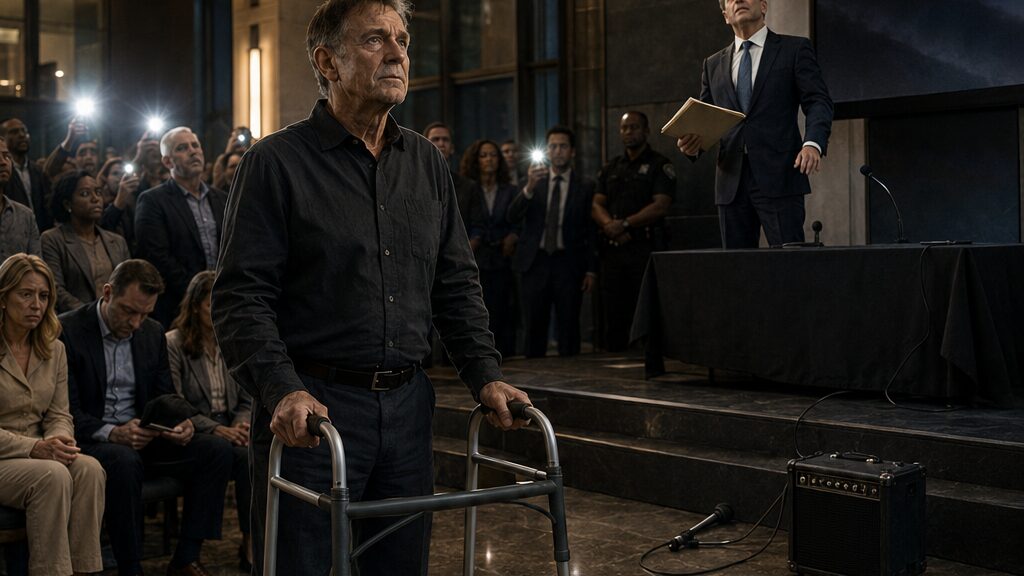
Jason tightened his grip on the handles of his walker and moved carefully through the crowd. The emergency assembly notice had arrived only six hours earlier.
MANDATORY ATTENDANCE.
The phrase had been printed in bold red letters.
As though the board could command attendance.
As though the building belonged to them.
Above the lobby’s central staircase, temporary spotlights had been installed. Bright white beams illuminated a raised platform where a long table waited beneath a banner displaying the condominium association’s logo.
The setup looked less like a neighborhood meeting and more like a courtroom.
Or a stage.
Jason recognized several neighbors standing near the back wall.
Most avoided eye contact.
A few offered nervous nods.
Nobody smiled.
At the front sat Michelle Wilson.
The board president wore a dark suit and an expression of practiced concern. She shuffled papers while speaking quietly with Patrick Nelson.
Patrick looked exhausted.
He kept checking his phone.
Jason noticed details because he had spent years watching people who assumed he wasn’t paying attention.
Then he saw Paul Carter.
The lawyer stepped onto the platform carrying a thick binder.
The room immediately quieted.
Paul seemed pleased by that.
He adjusted the microphone and waited.
The silence stretched until every conversation disappeared.
Only then did he begin.
“Thank you all for attending tonight’s emergency assembly.”
His amplified voice echoed through the lobby.
“Several important compliance matters require immediate action.”
Compliance.
Another favorite word.
Jason had heard it used to justify everything from landscaping fees to visitor restrictions.
Around him, residents took seats.
The spotlights remained aimed toward the audience instead of the stage.
Jason squinted against the glare.
People couldn’t see one another clearly.
But they could see the board.
That felt intentional.
Paul spent twenty minutes discussing budgets, parking enforcement, architectural standards, and procedural updates.
The language was dense.
The details were exhausting.
Most residents stopped paying attention.
That was intentional too.
Jason knew the strategy.
Bury important decisions beneath enough legal jargon and eventually people surrendered.
A security guard approached his row.
“For you.”
The man handed Jason a sealed envelope.
Jason frowned.
The envelope bore the association’s official seal.
Several nearby residents glanced toward him.
Paul continued speaking as though nothing had happened.
Jason opened it.
Inside was a legal packet nearly twenty pages thick.
His eyes moved quickly across the first page.
NOTICE OF ACCESS PERMIT REVIEW.
His stomach tightened.
Not because he was surprised.
Because it was happening now.
For years the board had pushed boundaries.
Small things at first.
Warnings.
Inspections.
Letters.
Fines that somehow appeared and disappeared.
The pressure always stopped just short of provoking a major fight.
This was different.
Jason slid the packet into a folder already resting beside him.
The folder contained copies of emails, maintenance requests, meeting minutes, invoices, and photographs.
Thousands of pages collected over six years.
Evidence.
Or what he hoped would someday become evidence.
Nobody knew how much he had gathered.
Not even his neighbors.
Especially not his neighbors.
The meeting continued.
Then Paul closed his binder.
“One final matter.”
The room became still.
Michelle leaned forward.
Patrick stopped checking his phone.
Jason already knew.
Paul’s gaze found him instantly.
“Following review by legal counsel and association leadership, the board has determined that resident parking allocations require restructuring.”
A screen behind the stage lit up.
A parking map appeared.
Jason’s assigned handicap space glowed red.
Murmurs spread through the audience.
Paul continued.
“Effective immediately, the accessibility permit assigned to Unit 407 has been revoked.”
The room froze.
Jason felt dozens of eyes turn toward him.
For a moment he simply sat there.
Not because he lacked words.
Because the words sounded absurd.
Revoked.
The space had existed for years.
Medical documentation had been approved repeatedly.
Nothing had changed.
Except the board.
Paul looked down at a document.
“The location will be reassigned under the association’s new VIP access program.”
A few residents exchanged confused looks.
VIP?
Someone near the back laughed nervously.
Jason slowly rose using his walker.
“On what grounds?”
Paul ignored him.
“The decision is final.”
Jason spoke louder.
“On what grounds?”
The lawyer finally looked up.
His smile never reached his eyes.
“You have no standing to challenge board discretion in this matter.”
Several residents lowered their heads.
Others stared at the floor.
No one spoke.
Not one person.
Years ago that silence would have surprised him.
Now it simply hurt.
Paul resumed reading.
“As outlined in the attached notice—”
“You’re taking a handicap space.”
The interruption echoed across the lobby.
Jason rarely raised his voice.
That alone drew attention.
Paul adjusted his glasses.
“The board has acted within its authority.”
Authority.
Another favorite word.
Jason looked around the room.
Faces avoided his.
People who had complained privately about the board.
People who had received fines.
People who had spent years muttering frustrations in elevators and parking garages.
Silent.
Every one of them.
Michelle folded her hands.
Patrick stared at the table.
The security guards watched Jason carefully.
For the first time all evening, the performance became visible.
The lights.
The stage.
The guards.
The legal packet.
Everything designed to create one message.
Resistance was pointless.
Jason sat back down.
A few residents appeared relieved.
Paul nodded as though order had been restored.
Then he delivered the final line.
“The board considers this matter closed.”
His gavel struck the table.
The sharp crack echoed through the lobby.
And for a brief moment, Jason noticed something strange.
Patrick Nelson looked terrified.
Not triumphant.
Not confident.
Terrified.
As though he feared something far larger than an angry resident.
Chapter 2: The Space That Never Belonged to Them
The parking map had been changed overnight.
Jason stood in the garage staring at the laminated diagram mounted beside the elevator.
His handicap space still existed.
His unit number did not.
In its place was a small gold symbol.
VIP.
Someone had physically removed his designation and replaced it.
The adhesive marks remained visible.
A rushed alteration.
Not an official update.
A cover-up.
Jason photographed everything.
The map.
The symbols.
The scratches.
The dates printed at the bottom.
Then he photographed his former parking space.
A luxury SUV occupied it.
The vehicle belonged to Patrick Nelson.
Jason recognized it immediately.
For several seconds he simply stared.
The issue was never parking.
The issue was entitlement.
Back in his apartment, he spread documents across his dining table.
The legal packet.
Association bylaws.
Accessibility regulations.
Meeting minutes.
The dining room had slowly transformed into an archive over the years.
Most people would have thrown everything away.
Jason kept everything.
Every letter.
Every notice.
Every threat.
His phone rang.
Unknown number.
He answered.
No response.
Only breathing.
Then the call ended.
He wasn’t surprised.
The board preferred pressure over confrontation.
Pressure left fewer fingerprints.
By afternoon he had submitted a formal complaint.
The response arrived three hours later.
Denied.
Not reviewed.
Not discussed.
Denied.
The speed alone made the answer meaningless.
Jason reread the email.
Then again.
One phrase caught his attention.
VIP ACCESS PROGRAM.
No explanation.
No policy attachment.
No vote record.
Nothing.
The program apparently existed.
Yet nobody had ever heard of it.
That evening he visited the community office.
The receptionist looked uncomfortable when he requested records.
“We don’t have those available.”
“Then who does?”
“I don’t know.”
“You work here.”
She lowered her voice.
“Mr. Hall, please don’t make this difficult.”
Jason almost laughed.
The difficulty had arrived long before he did.
As he turned away, someone slipped a folded piece of paper into his hand.
A resident he recognized only vaguely.
The man didn’t stop walking.
Didn’t speak.
Didn’t even look at him.
He simply disappeared around the corner.
Jason unfolded the paper later.
Inside was a list of parking assignments.
One column was highlighted.
VIP.
Seven names.
Three board members.
Two business owners.
One contractor.
And Patrick Nelson.
No accessibility needs.
No qualifying criteria.
Nothing.
The parking program wasn’t community policy.
It was a privilege club.
For the first time since the meeting, Jason felt something close to satisfaction.
Not victory.
But confirmation.
He wasn’t imagining it.
He wasn’t overreacting.
The space had been taken because someone wanted it.
Simple.
Ugly.
Human.
The next morning he knocked on a resident’s door.
The owner had complained publicly about parking shortages months earlier.
A potential witness.
The woman opened the door only halfway.
When Jason explained the situation, she glanced nervously down the hallway.
“I can’t get involved.”
“Why?”
“You know why.”
“No.”
“Because they never forget.”
She closed the door.
Not angrily.
Fearfully.
That was worse.
By afternoon Jason had collected enough information to establish favoritism.
Enough to embarrass the board.
Not enough to defeat them.
Then he found something strange.
A reference inside old meeting minutes.
Parking restructuring tied to a budget adjustment.
Budget adjustment.
Why would parking assignments require budget transfers?
The notation referenced supporting documents.
Those documents were missing.
Not redacted.
Missing.
Entirely absent from association records.
Jason searched again.
Nothing.
A second reference appeared months later.
Again tied to expenditures.
Again missing.
He leaned back in his chair.
Parking spaces.
Budget adjustments.
Missing records.
The pieces didn’t fit.
Yet.
But for the first time the question changed.
The board had not stolen his parking space merely because they could.
The space was connected to something larger.
Something hidden inside the numbers.
Jason opened a fresh notebook.
At the top of the page he wrote a single sentence.
Find where the money went.
Chapter 3: What the Financial Records Suggest
The payment entry appeared ordinary at first.
That was what made it dangerous.
Jason sat in front of a public records terminal inside the community archive room, scrolling through financial reports available to residents.
Most people never read them.
The documents were hundreds of pages long.
Dense.
Boring.
Designed to be ignored.
Then one line caught his eye.
Special Facilities Improvement.
Forty-two thousand dollars.
No project description.
No contractor information.
No completion report.
Nothing.
Jason checked maintenance logs.
No matching project existed.
He searched landscaping records.
Nothing.
Security contracts.
Nothing.
The money had gone somewhere.
The question was where.
Hours passed.
By late afternoon he had identified four additional expenditures with similar characteristics.
Different names.
Same pattern.
Money moving into shadows.
As he copied figures into his notebook, someone approached.
Katherine Thomas.
She hesitated before sitting across from him.
“I figured I’d find you here.”
Jason closed the folder halfway.
Not completely.
Old habits.
“What do you need?”
Her expression tightened.
“You should stop.”
“That’s an unusual greeting.”
“I’m serious.”
She glanced toward the doorway.
“People are talking.”
“About me?”
“About what you’re doing.”
Jason leaned back.
“Then people finally noticed something.”
Katherine didn’t smile.
“They know you’re asking questions.”
“They?”
“The board.”
The room felt smaller.
Jason studied her carefully.
“You seem worried.”
“I am worried.”
“For me?”
“For everyone.”
That answer surprised him.
Katherine folded her arms.
“Years ago I filed a complaint.”
Jason blinked.
“You never mentioned that.”
“Because nothing happened.”
She laughed softly.
A humorless sound.
“Actually, something did happen. Suddenly my parking fines doubled. Maintenance requests disappeared. Security started watching my guests.”
Jason said nothing.
He had seen the pattern before.
Pressure.
Never enough to prove retaliation.
Always enough to create fear.
“They don’t need to win,” Katherine said quietly. “They just need people to decide fighting isn’t worth it.”
The words lingered after she left.
For a while Jason stared at the spreadsheets without seeing them.
Then he returned to work.
Because stopping now felt worse.
Near closing time he discovered the first real connection.
Several payments routed through vendors linked to association contracts.
One vendor shared an address with another.
A third listed a mailbox service instead of an office.
The transactions looped through the same handful of entities.
Not proof.
But a pattern.
A pattern was how investigations began.
By evening he carried copies home.
For the first time in years, excitement competed with caution.
The pieces were aligning.
Parking.
Budgets.
Contracts.
Privileges.
The board’s behavior suddenly made more sense.
People protecting secrets often became reckless.
A week later confirmation arrived.
Not from documents.
From the board itself.
An email appeared in every resident’s inbox.
The association announced a new policy.
Unauthorized review or duplication of internal records would result in penalties.
Jason read it twice.
Then a third time.
The message never mentioned him.
It didn’t need to.
Someone knew.
The realization settled heavily over him.
He wasn’t studying the board anymore.
The board was studying him.
That night he reviewed everything again.
The folders covered nearly his entire dining table.
Invoices.
Emails.
Budgets.
Meeting minutes.
Photographs.
Years of collected fragments.
Near midnight he opened one final file.
A vendor payment report.
His eyes moved across the page.
Then stopped.
A name appeared beside a reimbursement authorization.
Patrick Nelson.
Not as a board member.
As a direct recipient.
Jason felt a chill.
He searched further.
Michelle Wilson.
Another payment.
Different category.
Same destination.
Not association business.
Personal reimbursement.
The evidence wasn’t complete.
But the wall had cracked.
And behind it, something much larger was waiting.
He stared at the documents long into the night.
The parking space was never the real prize.
It was bait.
Or perhaps a desperate move by people already afraid.
For the first time, Jason wondered whether the board’s greatest danger wasn’t exposure.
It was panic.
And if panic had already started, the next move wouldn’t belong to him.
It would belong to them.
Chapter 4: The Residents Who Chose Silence
The door closed before Jason finished his sentence.
He stood in the hallway staring at the polished wood panel where another resident had just refused to help him.
The man had filed complaints for years. Jason knew because he had copies of them.
Noise violations.
Maintenance failures.
Selective enforcement.
The same pattern repeated throughout the building.
Yet the moment Jason asked whether he would speak publicly, the answer became immediate.
No.
Not because the man disagreed.
Because he was afraid.
Jason moved away from the apartment and slowly made his way down the corridor with his walker.
The realization followed him all afternoon.
The board had not built power through rules.
They had built power through examples.
Every resident had watched someone challenge them and suffer for it.
A fine.
An inspection.
A denied request.
A legal letter.
Nothing dramatic.
Just enough to make everyone else stay quiet.
By evening Jason had visited six different residents.
Five refused outright.
One promised to think about it.
None agreed to stand beside him.
Back in the courtyard, children played near a fountain while adults watched from benches.
The scene looked peaceful.
Normal.
Jason wondered how many of those people carried their own stories.
How many had surrendered because they believed they were alone.
A voice interrupted his thoughts.
“You’re making yourself a target.”
Katherine Thomas stood near the fountain.
Jason almost smiled.
“That ship sailed months ago.”
“Years ago, actually.”
He couldn’t argue with that.
Katherine sat beside him.
For a while neither spoke.
Then she said, “You know why nobody will help.”
“They should.”
“That’s not the same thing.”
Jason looked toward the condominium tower rising above them.
Hundreds of windows.
Hundreds of lives.
Most hidden from one another.
“People complain constantly,” he said.
“They complain privately.”
“And that’s enough?”
“No.”
Katherine shook her head.
“But it’s safer.”
The word lingered.
Safe.
The board had spent years selling safety.
Follow procedures.
Trust the process.
Leave difficult decisions to leadership.
The message sounded reasonable until someone became the target.
Then safety became obedience.
Katherine reached into her bag.
She removed a thin folder.
Jason stared.
“What is that?”
“My complaint.”
He looked at her.
“The one you mentioned?”
She nodded.
“I kept it.”
Jason accepted the folder carefully.
The papers were old.
Five years old.
Maintenance records.
Emails.
Board responses.
Every page showed the same pattern.
Delay.
Deflection.
Punishment.
Near the back sat a notice assessing fines against Katherine for unrelated violations shortly after her complaint.
Nothing directly connected.
Everything obviously connected.
“You never appealed?”
“I tried.”
“What happened?”
Katherine laughed softly.
“Three inspections in one month.”
Jason turned another page.
More warnings.
More fees.
More pressure.
Eventually the complaints stopped.
Not because the problem disappeared.
Because she had surrendered.
For the first time Jason understood something important.
The silence in the building wasn’t apathy.
It was injury.
People weren’t refusing to help because they didn’t care.
They were refusing because they remembered what happened the last time they tried.
That realization changed the shape of the fight.
Late that night Jason spread Katherine’s documents across his dining table beside his own records.
The similarities were impossible to ignore.
Different years.
Different issues.
Same methods.
The board’s behavior wasn’t random.
It was systematic.
His phone buzzed.
A community email.
EMERGENCY ASSOCIATION ASSEMBLY.
Mandatory attendance.
The meeting would occur three days later.
Jason read the announcement twice.
Then a third time.
Special governance matters.
Legal review.
Compliance updates.
The language sounded familiar.
Too familiar.
This wasn’t routine.
They were preparing something.
Perhaps they believed they could finish what they started during the previous assembly.
Perhaps they wanted to make an example of him.
His eyes moved across the dining table.
Thousands of pages.
Years of evidence.
Years of waiting.
Years of hoping facts would eventually speak for themselves.
That had been his mistake.
Evidence alone never frightened people.
Exposure did.
For years he had acted like a collector.
A recorder.
An observer.
The board counted on that.
They expected him to keep gathering documents forever.
Expected him to remain quiet.
Expected him to defend himself.
The realization arrived with surprising clarity.
At the next meeting he would stop defending himself.
He would put them on trial instead.
Jason opened a new folder.
Not for collecting evidence.
For organizing it.
And for the first time since the parking space was taken, he stopped wondering whether he had enough courage.
The question became whether he had enough proof.
Chapter 5: The Night the Lights Went Out
The lobby looked like a television studio.
Temporary spotlights lined the walls.
Security guards stood at every entrance.
Rows of chairs faced the raised platform where Michelle Wilson and the board waited beneath bright white lights.
The display was more elaborate than the previous assembly.
Which meant they were nervous.
Jason arrived carrying a thick black folder.
Several residents noticed.
A few whispered.
Others quickly looked away.
The atmosphere felt different.
Not brave.
Not yet.
But less certain.
People were watching the stage more critically now.
The performance had cracks.
Paul Carter stepped to the microphone precisely at seven o’clock.
“Thank you for attending.”
His voice echoed through the room.
He launched immediately into legal language.
Governance.
Compliance.
Community standards.
The familiar arsenal of words designed to sound authoritative without saying much.
Jason listened quietly.
He had spent years listening.
Tonight would be different.
Twenty minutes later Paul addressed him directly.
“As many of you know, Mr. Hall has continued making unsupported allegations regarding board activities.”
Several heads turned.
Paul smiled politely.
“The association remains committed to transparency despite these disruptions.”
Disruptions.
The word generated a few uncomfortable chuckles.
Jason remained seated.
Paul continued.
“Unfortunately, some residents confuse disagreement with misconduct.”
Michelle nodded.
Patrick stared at the table.
Jason noticed perspiration along Patrick’s forehead despite the cold air-conditioning.
Interesting.
Paul raised a document.
“We have reviewed every complaint submitted by Mr. Hall.”
A stack of papers appeared on the screen behind him.
The visual was meant to communicate excess.
Obsession.
A troublesome resident wasting everyone’s time.
“Each allegation lacks credible evidence.”
Several board members relaxed.
The script was proceeding exactly as planned.
Then Jason raised his hand.
Paul ignored him.
Jason stood.
“I’d like to respond.”
“No.”
The answer came instantly.
Paul smiled again.
“This is not an open discussion period.”
A murmur moved through the audience.
Jason remained standing.
“I was accused publicly.”
“The board has concluded—”
“I wasn’t asking the board.”
The room became still.
Paul’s expression hardened.
“Sit down, Mr. Hall.”
“No.”
Security shifted.
Jason could feel eyes turning toward him from every direction.
Years earlier the attention would have unsettled him.
Tonight it felt overdue.
“I want three minutes.”
“You are out of order.”
“I want three minutes.”
Paul moved closer to the microphone.
“You have no authority here.”
The sentence echoed through the lobby.
No authority.
The phrase landed differently this time.
Not because of what Paul meant.
Because people were finally hearing it.
Authority.
Authority.
Authority.
Always authority.
Never explanation.
Never accountability.
Only authority.
Several residents exchanged looks.
One shook his head.
Another frowned.
Small reactions.
But visible.
The performance was weakening.
Paul resumed reading from prepared notes.
Jason looked toward the amplifier rack positioned near the side wall.
A cluster of cables disappeared behind it.
The entire spectacle depended on electricity.
Spotlights.
Microphones.
Screens.
Amplification.
All the machinery of manufactured importance.
Without it, the board became people sitting behind a table.
Nothing more.
Paul continued talking.
Nobody listened.
Not really.
Jason felt the decision settle inside him.
Calm.
Certain.
He moved.
At first few people noticed.
Then security started forward.
Too late.
Jason reached the amplifier rack.
A guard shouted.
Paul stopped speaking.
Jason grabbed the main power cable.
For one brief second the entire room seemed suspended.
Then he pulled.
A violent crack exploded through the lobby.
Sparks burst from the connection.
The spotlights died instantly.
The microphones vanished into silence.
The giant screen disappeared.
Darkness swallowed the stage.
Gasps erupted across the room.
Then came the most powerful sound Jason had heard in years.
Nothing.
No microphone.
No amplified voice.
No legal performance.
Just silence.
Phone flashlights appeared one by one.
Tiny lights across the audience.
Residents illuminating the room themselves.
The symbolism struck him immediately.
For years they had stared into artificial light.
Now they were creating their own.
Paul stood frozen.
Michelle looked stunned.
Patrick appeared ready to run.
Jason returned slowly to the center aisle.
His folder remained tucked beneath his arm.
No stage.
No spotlight.
No microphone.
Just people.
Exactly as it should have been.
He opened the folder.
Paper rustled through the silence.
Then he looked directly at the board.
“Would anyone like to discuss where community money actually went?”
Nobody answered.
For the first time, nobody on the stage seemed interested in speaking.
Chapter 6: The Trial Nobody Planned
The first flashlight beam settled on Jason’s face.
Then another.
Then twenty more.
Within moments the darkened lobby glowed with scattered white circles.
Residents held their phones high.
The board sat beneath those lights like witnesses instead of rulers.
No one bothered repairing the sound system.
No one wanted the microphones back.
Jason removed several documents from his folder.
His hands were steady.
That surprised him.
For years he had imagined this moment.
In those imagined versions he always felt angry.
Instead he felt tired.
Tired of letters.
Tired of warnings.
Tired of people pretending not to notice what stood directly in front of them.
Paul finally found his voice.
“This meeting is suspended.”
Nobody moved.
Michelle rose from her chair.
“I think everyone should leave.”
Again, nobody moved.
The room had changed.
Not dramatically.
Not all at once.
But enough.
The board had spent years speaking while everyone else listened.
Tonight residents were choosing not to obey.
Jason held up a document.
“Special Facilities Improvement.”
The title meant nothing to most people.
“Forty-two thousand dollars.”
A few residents exchanged glances.
Jason looked toward Michelle.
“Can you explain where it went?”
Michelle folded her arms.
“The association maintains numerous projects.”
“Which one?”
She said nothing.
Jason lifted another page.
“How about this one?”
A second expenditure.
Then a third.
Then a fourth.
Different labels.
Same pattern.
No completed projects.
No supporting reports.
No visible work.
Just money disappearing.
Paul stepped forward.
“These records are being presented without context.”
“Then provide context.”
The lawyer opened his mouth.
Nothing came out.
Because context required facts.
And facts were exactly what everyone suddenly wanted.
A resident near the back spoke.
“Answer him.”
The voice was shaky.
But it existed.
Another followed.
“Yeah.”
Then another.
Not a crowd.
Not yet.
Just people.
Speaking.
Jason felt something loosen inside the room.
The silence was breaking.
Paul tried again.
“Financial records can be misunderstood.”
“Then explain the reimbursements.”
Jason held up another document.
Patrick Nelson visibly flinched.
Several residents noticed.
Jason noticed them noticing.
That mattered.
He read directly from the page.
“A reimbursement payment issued to Patrick Nelson.”
Patrick stood abruptly.
“It was authorized.”
“For what?”
Patrick looked toward Michelle.
Michelle looked toward Paul.
Neither answered.
The exchange spoke louder than any explanation.
Jason revealed another record.
Michelle’s reimbursement.
Another unexplained payment.
Then another.
And another.
Nothing dramatic.
No single document destroyed them.
That was the truth.
Corruption rarely collapsed because of one piece of evidence.
It collapsed when too many pieces began fitting together.
Katherine Thomas stood.
The movement drew attention.
Jason turned toward her.
For a moment she looked terrified.
Then she spoke.
“I filed a complaint years ago.”
The room quieted.
Katherine swallowed.
“They retaliated.”
Michelle immediately shook her head.
“That’s not true.”
“It is.”
Katherine’s voice strengthened.
“I have the notices. The inspections. The fines.”
Jason wasn’t expecting this.
Neither was the board.
The surprise traveled visibly through the room.
Someone else stood.
Then another resident.
And another.
Stories emerged.
Denied requests.
Selective enforcement.
Strange penalties.
Mysterious inspections.
None devastating alone.
Together they formed a pattern.
The board’s greatest protection had always been isolation.
People believed their experiences were individual.
Now they were discovering they shared them.
Paul realized it too.
His confidence disappeared.
“This is becoming inappropriate.”
A resident laughed.
Not nervously.
Genuinely.
The sound spread.
Not because anything was funny.
Because the statement felt absurd.
The room no longer belonged to the board.
It belonged to everyone else.
A security guard approached Michelle and quietly whispered something.
Her face changed.
Fear.
Real fear.
Not embarrassment.
Fear.
“What?” Patrick asked.
The guard repeated himself.
Several residents overheard.
The words spread rapidly through the room.
Authorities had been contacted.
Someone had submitted financial documentation.
Investigators would be reviewing association records.
Jason hadn’t made that call.
Apparently someone else had.
Maybe more than one person.
For years everyone waited for someone to act.
Now multiple people were acting at once.
That was the difference.
Michelle slowly sat down.
Patrick looked defeated.
Paul stared at the dead microphone as though wishing it would come back to life.
But the illusion was gone.
No spotlight could restore it.
No legal language could repair it.
Residents moved toward the stage.
Not aggressively.
Purposefully.
They wanted records.
Votes.
Documents.
Answers.
Jason watched them.
For the first time in years, he wasn’t standing alone.
And as the board members looked out across the crowd, they finally seemed to understand the truth.
The thing they feared was never evidence.
It was people believing evidence mattered.
Chapter 7: The Lawn Where Fear Used to Live
The smell of grilled burgers drifted across the common lawn where warning signs used to stand.
Children chased one another between folding tables.
Neighbors carried trays of food through clusters of lawn chairs.
Music played from a portable speaker someone had placed near the fountain.
A month earlier the gathering would have violated at least three association rules.
Nobody seemed concerned.
Jason stood behind a grill turning burgers with a metal spatula.
The work gave him something simple to focus on.
That was useful.
People had spent weeks thanking him.
Congratulating him.
Shaking his hand.
The attention still felt uncomfortable.
He preferred the grill.
The heat.
The routine.
The ordinary nature of it.
Across the lawn, a group of residents laughed while assembling a volleyball net.
Nearby, several families occupied picnic tables that had rarely been used before.
The common space looked larger somehow.
Not physically.
Emotionally.
Like a room after someone finally opened the windows.
A shadow crossed beside him.
Katherine Thomas held out a plate.
“You’re burning those.”
Jason glanced down.
“They’re perfectly fine.”
“They’re charcoal.”
“They’re flavor.”
She laughed.
The sound came easily now.
That alone felt like a victory.
Jason placed several burgers onto her plate.
Katherine looked around the lawn.
“Hard to believe, isn’t it?”
A few months ago she would have lowered her voice before discussing the board.
Now she didn’t bother.
Most people didn’t.
Investigators had spent weeks reviewing records.
Michelle Wilson had resigned.
Patrick Nelson had resigned shortly afterward.
Paul Carter no longer represented the association.
The old board was gone.
Interim elections had followed.
Committees had been formed.
Financial audits were underway.
The process wasn’t clean.
Or quick.
But it was real.
For the first time residents could see how decisions were made.
Jason watched a child run past carrying a paper airplane.
The sight triggered an unexpected memory.
Years spent avoiding meetings.
Years spent collecting documents alone.
Years spent believing the only way to fight corruption was to gather enough proof.
Evidence mattered.
He still believed that.
But evidence alone hadn’t changed anything.
People had.
A woman approached the grill.
Then another.
Soon a small line formed.
Not for food.
For conversation.
One resident wanted to thank him for refusing to back down.
Another wanted advice about reviewing association budgets.
A third asked whether he would attend the next governance meeting.
Jason answered politely.
Then returned to cooking.
Eventually the crowd dispersed.
Katherine remained.
“You know they’re going to ask.”
Jason sighed.
“Ask what?”
“You know what.”
He did.
The new governance committee had approached him twice already.
Several residents believed he should take a leadership role.
Join the board.
Chair a committee.
Oversee financial transparency.
Something.
Anything.
The idea made him uneasy.
Not because he lacked opinions.
Because he understood what power could become.
Across the lawn a resident raised a glass.
“Jason!”
Several others echoed the greeting.
He lifted a hand in acknowledgment.
Nothing more.
Katherine watched him.
“You’re thinking about saying no.”
“Maybe.”
“Why?”
Jason turned another burger.
The answer seemed obvious.
“Because I spent years fighting people who thought they should run everyone else’s lives.”
“That’s not the same thing.”
“It starts the same way.”
Katherine considered that.
Then shook her head.
“No.”
She pointed across the lawn.
“Look at them.”
Jason followed her gaze.
Families.
Neighbors.
Children.
Conversations.
The community looked different now.
Not perfect.
Just awake.
“You think they’re asking because they want another ruler?” Katherine asked.
“No.”
“They’re asking because they trust you.”
The words landed harder than expected.
Trust.
For years Jason hadn’t trusted anyone.
Not completely.
The evidence remained hidden because he assumed nobody would stand beside him.
That assumption had protected him.
It had also isolated him.
He watched residents talking near the fountain.
Many of them had spoken publicly during the investigation.
Many had shared records of their own.
Many had risked something.
The community he thought was silent had been frightened.
There was a difference.
A significant one.
The music shifted to another song.
Someone started dancing.
Several children immediately joined.
Laughter spread across the lawn.
Jason looked toward the parking garage entrance visible beyond the trees.
His old handicap space had been restored weeks earlier.
A small thing.
An important thing.
Not because of convenience.
Because it represented belonging.
The space had never been about parking.
It had been about whether someone could be pushed aside because they were considered easy to ignore.
That answer had changed.
A committee member approached carrying a clipboard.
Jason recognized the expression immediately.
Hopeful.
Nervous.
Determined.
“Can I ask you something?”
Katherine smirked.
“Here we go.”
The committee member smiled.
“We’d like you to help review governance proposals.”
Jason almost declined automatically.
The old habit remained.
Work alone.
Trust yourself.
Keep distance.
Safer that way.
Then he looked around the lawn again.
The gathering existed because people had finally chosen one another over fear.
Walking away now felt strangely similar to the mistake he had made before.
Believing everything depended on him.
Or only on him.
The truth was different.
Communities survived together or not at all.
The committee member waited.
Jason glanced at Katherine.
She said nothing.
She didn’t need to.
For once the choice wasn’t about exposing corruption.
It was about participating after the fight ended.
A harder challenge than he expected.
Finally he nodded.
“I’ll help.”
The committee member smiled with visible relief.
“Thank you.”
After they left, Katherine handed him another plate.
“See?”
Jason laughed softly.
“Don’t make a big deal out of it.”
“Too late.”
Across the lawn, someone called his name again.
Others joined in.
Not as applause.
Not as celebration.
Simply recognition.
The kind that comes when people stop seeing a symbol and start seeing a neighbor.
Jason returned to the grill.
Children ran through the grass.
Families shared food.
The fountain sparkled in the afternoon light.
No security guards watched the exits.
No spotlights blinded the crowd.
No microphones told people who mattered.
The lawn belonged to everyone.
And for the first time in years, that seemed completely normal.
The story has ended.