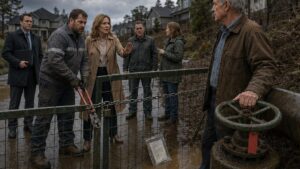
The Day a Fake Neighborhood Commander Tried to Destroy a Federal Energy Node and Lost Everything
Chapter 1: The Badge Nobody Asked For
“Those machines are broadcasting into our homes!”
The shout cut across the street so sharply that Samuel Hall looked up from the open panel beside his solar battery bank.
Across the road, Heather Adams stood on a folding chair with a bright yellow sash across her chest. The words NEIGHBORHOOD WATCH COMMANDER had been printed in crooked black letters.
Three residents stood nearby listening.
Heather pointed directly at Samuel’s property.
“People are getting headaches. Pets are acting strange. And nobody wants to ask why.”
Samuel slowly closed the access panel.
The battery bank hummed quietly beside the patio. Sunlight reflected off the rows of solar panels mounted along the side of the property.
Nothing about the system was unusual.
Nothing except the attention it had started attracting.
One of the neighbors glanced toward Samuel.
“Are those government machines?”
Samuel walked across his driveway.
“They monitor energy output and storage efficiency,” he said. “They’re legal. They’re inspected. They’re documented.”
Heather laughed loudly.
“That’s exactly what someone would say if they were hiding something.”
A few uncomfortable smiles appeared.
Samuel had heard versions of this for weeks.
Normally he ignored them.
Ignoring people was easier than arguing.
Unfortunately, Heather seemed to treat silence as proof.
By evening, her speech had become the main topic of conversation in the neighborhood.
The next morning Samuel discovered the first flyer.
It was tucked beneath his mailbox flag.
WARNING: MIND-CONTROL FREQUENCIES IN OUR COMMUNITY.
A blurry photograph of his battery installation appeared underneath.
Someone had circled parts of the image with red marker.
Samuel sighed.
Then he found three more flyers.
Then seven.
Then an entire stack at the community entrance.
By lunchtime the neighborhood social-media page was full of screenshots.
Questions became accusations.
Accusations became certainty.
One resident claimed their garage door opener had stopped working.
Another blamed insomnia.
Someone blamed a missing cat.
Every discussion somehow ended with Samuel’s property.
The facts never changed.
The story did.
That evening he organized a folder containing permits, inspection reports, installation certifications, utility approvals, and operating records.
He considered posting them publicly.
Instead he put the folder back into a cabinet.
People who wanted answers could ask.
Nobody asked.
Three days later he noticed a different change.
Neighbors stopped waving.
Conversations ended when he approached.
Children who normally rode bicycles past his driveway began taking another route.
The isolation arrived so gradually that it almost felt accidental.
Until it wasn’t.
Samuel was checking battery output data one afternoon when a voice called from the sidewalk.
“Can I ask you something?”
It was William Davis.
The community association representative.
William shifted awkwardly.
“People are concerned.”
“About what specifically?”
William hesitated.
“The frequencies.”
Samuel stared at him.
“You don’t actually believe that.”
“I don’t know what I believe.”
“That system has been inspected multiple times.”
“I know.”
“Then why are we having this conversation?”
William rubbed the back of his neck.
“Because everyone keeps asking.”
The answer annoyed Samuel more than if William had openly agreed with Heather.
Nobody wanted facts.
They wanted reassurance.
And reassurance could never satisfy fear.
William looked toward the solar installation.
“Maybe explain it publicly.”
“I already have.”
“Not lately.”
Samuel watched him leave.
The conversation lingered longer than he expected.
Maybe he should push back.
Maybe he should attend meetings.
Maybe he should stop assuming truth would eventually win on its own.
Instead he returned to work.
The next Saturday morning a loudspeaker crackled outside.
Samuel stepped onto his porch.
Heather stood beside a small folding table covered with forms.
The fake sash had been replaced by a plastic badge hanging from her neck.
“Neighborhood Safety Inspection Registration,” the sign read.
Residents gathered around her.
She handed out clipboards.
“Every responsible homeowner should participate.”
Samuel walked closer.
“Who authorized this?”
“I did.”
“You can’t inspect private property.”
Heather smiled.
“That’s exactly what someone with dangerous equipment would say.”
A few people laughed.
The sound bothered Samuel more than the accusation.
Because the laughter meant the performance was working.
Heather lifted a clipboard.
“Next Saturday we begin inspections. Any homeowner refusing cooperation will be publicly listed.”
Samuel stared at her.
“On what authority?”
She tapped the fake badge.
“Community protection.”
For the first time, Samuel felt something stronger than irritation.
Concern.
Because Heather wasn’t calming down.
She was escalating.
And judging by the crowd around her, people were starting to enjoy the show.
Chapter 2: The Sound Behind the Rumors
“Why won’t you just admit what those machines do?”
The question came before Samuel finished unloading groceries.
A resident stood at the edge of his driveway.
Another neighbor lingered nearby.
Both looked nervous.
Neither looked hostile.
That somehow made it worse.
“What exactly do you think they do?” Samuel asked.
The first neighbor exchanged glances with the second.
“People say they’re connected to surveillance.”
“People say they’re transmitting signals.”
“People say a lot of things.”
The neighbors shifted awkwardly.
Samuel opened the rear door of his vehicle.
“Have either of you actually looked at the installation documents?”
Neither answered.
That was answer enough.
Over the following week the rumors multiplied.
Heather seemed to have endless energy.
Every morning another theory appeared online.
Every afternoon another story circulated through the neighborhood.
Some were absurd.
Others sounded almost believable.
The dangerous ones were never completely ridiculous.
They contained just enough technical language to sound informed.
One evening Samuel finally discovered where it was coming from.
A screenshot appeared on the community page.
The image showed a discussion forum filled with posts about hidden frequencies, behavioral manipulation, energy networks, and government monitoring programs.
Heather had highlighted entire sections.
“SEE?” she wrote.
“THEY ADMIT THIS TECHNOLOGY EXISTS.”
The posts came from anonymous strangers.
None cited evidence.
Hundreds of comments treated speculation as fact.
Samuel stared at the screen.
For the first time he understood something important.
Heather wasn’t inventing everything herself.
She had found a community that rewarded her fears.
Every new rumor came with approval.
Every accusation earned attention.
The neighborhood had become an audience.
That realization made the situation feel less ridiculous and more dangerous.
Two days later Heather held a meeting at a nearby common area.
Nearly twenty residents attended.
Samuel arrived carrying a thick binder.
Conversation stopped when he approached.
Heather smiled.
“Well. The operator has arrived.”
Samuel ignored the comment.
He set the binder on a table.
“Everything is here.”
Permits.
Inspections.
Engineering certifications.
Compliance reports.
Utility approvals.
Operating records.
Heather folded her arms.
“Documents can be faked.”
“By whom?”
“The same people running the program.”
Several residents nodded.
Samuel felt frustration building behind his calm expression.
“This is exactly the problem.”
“What problem?”
“You decide the answer before looking at the evidence.”
Heather pointed toward him.
“See? He’s getting defensive.”
The crowd shifted.
The discussion slipped away again.
Not because Samuel lacked proof.
Because proof required willingness.
And willingness had become rare.
After the meeting a woman quietly approached him near the parking area.
“Can I ask something?”
Samuel recognized her as one of Heather’s most vocal supporters.
“Sure.”
She lowered her voice.
“I don’t think the mind-control part is real.”
Samuel blinked.
“That makes one of us.”
She almost smiled.
“But something feels off.”
“What?”
“I don’t know.”
The uncertainty in her voice felt genuine.
For a moment Samuel thought he might finally break through.
Then she glanced toward Heather.
The moment vanished.
“Anyway,” she said quickly. “Just be careful.”
She walked away.
The interaction stayed with him.
Not because it solved anything.
Because it revealed how confusion worked.
Most people weren’t certain.
They were simply uncomfortable.
And discomfort often followed the loudest voice available.
Three days later an envelope appeared in Samuel’s mailbox.
Official letterhead.
Local authority seal.
Complaint received.
Inspection requested.
Review scheduled.
Samuel read the notice twice.
Then a third time.
Across the street Heather stood in her yard.
Watching.
When she saw him holding the letter, she smiled.
Not a victorious smile.
A relieved one.
As if someone important had finally listened.
Samuel looked down at the document.
The conflict had moved beyond gossip.
Official scrutiny was coming.
And for the first time, the neighborhood would learn whether reality favored evidence or fear.
Chapter 3: The Inspection That Solved Nothing
The inspectors arrived at exactly nine o’clock.
Two vehicles rolled into Samuel’s driveway while curious neighbors gathered at a distance.
Heather was already waiting.
Phone in hand.
Recording.
Samuel stepped outside carrying his documentation binder.
The lead inspector introduced himself and immediately began reviewing permits.
Within minutes the process became routine.
Measurements.
Serial numbers.
Compliance checks.
System logs.
Equipment verification.
The solar installation sat quietly in the morning sunlight while inspectors moved from one component to another.
Nothing dramatic happened.
Nothing suspicious appeared.
Everything worked exactly as designed.
Yet Heather followed every step as if she expected a confession.
At one point she interrupted.
“Are you checking for frequency emissions?”
The inspector looked confused.
“We’re reviewing energy infrastructure.”
“But are you checking?”
“No.”
Heather immediately turned toward her camera.
“Notice that,” she announced. “They aren’t checking.”
Samuel closed his eyes briefly.
The inspection continued.
Hours passed.
The battery bank.
The monitoring node.
The control systems.
Every section passed.
Eventually the lead inspector signed the final paperwork.
“All systems comply with applicable requirements.”
Samuel accepted the document.
A wave of relief washed through him.
Not because he had doubted the outcome.
Because he hoped the outcome might finally matter.
The inspector departed.
The second vehicle followed.
Neighbors slowly dispersed.
For a brief moment silence returned.
Then Heather stepped forward.
“Interesting.”
Samuel stared at her.
“What now?”
“You passed awfully quickly.”
“Because everything is compliant.”
“Or because somebody wanted that result.”
The relief disappeared instantly.
“You can’t be serious.”
Heather raised her phone.
“Everyone deserves transparency.”
Samuel looked around.
Several residents remained nearby.
Watching.
Listening.
Waiting.
And once again facts seemed less important than suspicion.
By evening social media exploded.
The inspection that should have ended everything became a new accusation.
Claims of corruption appeared.
Claims of hidden influence.
Claims of government involvement.
The evidence had not weakened the rumors.
It had adapted them.
For the first time Samuel felt genuinely tired.
Not physically.
Emotionally.
He sat alone on his patio after sunset listening to the quiet hum of the battery bank.
Years earlier he would have argued.
Presented data.
Debated every claim.
Now he mostly wanted peace.
Maybe that was why Heather kept gaining ground.
She treated every day like a campaign.
Samuel treated every day like something to survive.
A week later he drove past a commercial supply store on the edge of town.
A familiar figure emerged from the entrance.
Heather.
She was pushing a cart.
At first Samuel paid little attention.
Then he noticed what was inside.
Heavy-duty industrial cable loppers.
Large enough to cut thick wiring.
Not gardening tools.
Not household equipment.
Industrial tools.
Heather loaded them into her vehicle.
For a moment she glanced across the parking lot.
Their eyes met.
Neither waved.
Neither smiled.
Heather closed the rear hatch.
Then she drove away.
Samuel remained parked for several seconds.
Something cold settled in his stomach.
The inspection had changed nothing.
If anything, it had made Heather more determined.
And now she was buying tools.
The question was no longer whether she believed the rumors.
The question was what she intended to do about them.
Chapter 4: The Reason She Cannot Stop
“You were right at first. Now you’re just looking for reasons to stay angry.”
Heather stared at the woman standing on her porch.
The words hit harder than she expected.
“You don’t understand what I’m trying to do,” Heather said.
“I understand perfectly.”
The woman folded her arms.
“You keep finding new explanations every time you’re proven wrong.”
Heather felt heat rise into her face.
“This is about safety.”
“No,” the woman replied quietly. “I don’t think it is anymore.”
Then she walked away.
Heather stood frozen on the porch long after the conversation ended.
The loss bothered her more than she wanted to admit.
Months earlier people had listened.
People had asked her opinion.
People had thanked her for noticing things.
Now support was slipping.
Not disappearing.
Just slipping.
And every person who drifted away seemed to drift toward Samuel Hall instead.
That irritated her more than any inspection report.
Everywhere she looked, Samuel was treated like the reasonable one.
The expert.
The responsible homeowner.
The person with answers.
Meanwhile she became the neighborhood nuisance.
The thought settled heavily inside her.
Later that afternoon she drove slowly past Samuel’s property.
The solar installation sat where it always had.
Silent.
Orderly.
Confident.
She hated how confident it looked.
Heather parked across the street and watched.
Workers had once visited the property.
Inspectors had visited.
Officials had visited.
People always seemed interested in Samuel’s equipment.
Nobody visited her.
Nobody asked her opinion anymore unless she forced the conversation.
Her gaze drifted toward a metal placard attached to one section of the installation.
She had noticed it before.
This time she walked closer.
Not onto the property.
Just close enough to read.
Federal Energy Monitoring Program.
Additional identification numbers appeared below.
Heather frowned.
Federal.
The word should have reassured her.
Instead it created a different reaction.
A cold pulse of suspicion.
Federal involvement meant money.
Monitoring.
Networks.
Data.
Exactly the sort of thing conspiracy forums constantly discussed.
She returned home and spent hours online.
The deeper she searched, the worse it became.
Forum posts.
Videos.
Anonymous warnings.
Claims about surveillance disguised as environmental programs.
Claims about hidden control systems.
Claims about experimental technologies.
Most of it lacked evidence.
But evidence mattered less than repetition.
By midnight she no longer felt uncertain.
She felt vindicated.
The federal markings weren’t proof against her fears.
They were proof of them.
The next morning she carried printed screenshots into the community meeting room.
Only a handful of residents showed up.
Far fewer than before.
William Davis sat near the back.
Looking tired.
Heather launched into her presentation.
“People need to understand what we’re dealing with.”
She handed out papers.
A few residents accepted them politely.
Others barely glanced down.
When she finished speaking, the silence felt uncomfortable.
William cleared his throat.
“Do any of these sources have verified documentation?”
Heather frowned.
“Why does everyone suddenly care about documentation?”
“Because accusations matter.”
“They matter because nobody listens until it’s too late.”
William rubbed his forehead.
“You keep saying that.”
“Because it’s true.”
“Or because you’re afraid it isn’t.”
The room became very still.
Heather stared at him.
For a moment she almost admitted something.
Not about the technology.
About herself.
About how invisible she had begun feeling.
About how frustrating it was to watch people dismiss her.
About how satisfying it felt when they paid attention.
But the moment passed.
Pride closed around it.
She gathered her papers.
“Fine,” she said.
“When something happens, don’t say I didn’t warn you.”
She left before anyone could respond.
Outside, she sat inside her vehicle gripping the steering wheel.
Her reflection looked exhausted.
Not righteous.
Not heroic.
Exhausted.
The realization angered her.
By evening she had transformed that anger into purpose.
If nobody would act, she would.
The idea felt dangerous.
That was exactly why it felt powerful.
Three days later she returned to the supply store.
The industrial cable loppers remained in the rear of her vehicle.
This time she purchased additional equipment.
Heavy work gloves.
Protective eyewear.
A utility hose attachment.
The clerk asked no questions.
Heather appreciated that.
At home she organized everything carefully.
Preparation calmed her.
Preparation made the situation feel rational.
Necessary.
Across the street, Samuel worked quietly beside the battery bank.
Heather watched from her window.
He looked relaxed.
Unconcerned.
Protected.
The sight irritated her beyond reason.
Because no matter how many arguments she lost, Samuel never seemed affected.
She couldn’t see the isolation.
The frustration.
The exhaustion.
She saw only composure.
And composure looked like superiority.
The next several days passed quietly.
Too quietly.
Heather interpreted the silence as proof she was running out of time.
Soon everyone would stop listening completely.
Soon nobody would care.
Soon Samuel would win.
The thought became unbearable.
Before dawn on a Saturday morning she loaded the cable loppers into her vehicle.
The metal jaws gleamed beneath the garage light.
She placed work gloves beside them.
Then she drove away.
The streets were empty.
The neighborhood slept.
When she turned onto Samuel’s street, she felt her heart pounding.
Not from fear.
From anticipation.
Ahead, Samuel’s property emerged from the darkness.
Heather parked near the curb.
Opened the rear hatch.
And lifted the cable loppers into her hands.
Chapter 5: The Line Between Harassment and Sabotage
A sharp notification sound pulled Samuel awake.
His security system rarely triggered before sunrise.
He reached for his phone.
Motion detected.
Patio perimeter.
Samuel sat upright immediately.
The live camera feed appeared.
A figure moved across the edge of the property.
Large object in hand.
For a split second he thought it might be a thief.
Then the camera angle shifted.
Heather Adams stepped into view.
Carrying industrial cable loppers.
Samuel was already moving before he fully processed what he was seeing.
He threw on a jacket and headed downstairs.
Outside, the air felt cool and still.
Heather stood near the battery installation.
The metal jaws of the loppers hung at her side.
“What are you doing?” Samuel called.
Heather turned.
Neither looked surprised to see the other.
“I knew you’d come out.”
“You’re trespassing.”
“I’m protecting people.”
Samuel stopped several yards away.
The security cameras quietly tracked the movement.
Red indicator lights blinked above the patio.
“Go home, Heather.”
“Not until this thing is gone.”
Samuel glanced toward the equipment.
Toward the loppers.
Then back toward Heather.
“Do you actually think you can cut through this?”
“If I have to.”
“You realize that’s destruction of property.”
“I realize somebody has to stop you.”
The certainty in her voice unsettled him.
Not because she sounded dangerous.
Because she sounded sincere.
That sincerity made reasoning almost impossible.
Samuel took a slow breath.
“Everything you’ve claimed has been investigated.”
“By people involved in it.”
“There is no conspiracy.”
Heather laughed sharply.
“That’s what every conspiracy says.”
The conversation had reached the familiar dead end.
Facts entered.
Certainty exited.
Nothing changed.
Samuel stepped forward.
“Leave.”
“No.”
For several seconds neither moved.
Then Heather unexpectedly lowered the loppers.
Samuel felt a brief surge of relief.
It vanished instantly.
Heather walked toward the side of the house.
Toward a storage area.
Toward a coiled garden hose.
“What are you doing now?”
She ignored him.
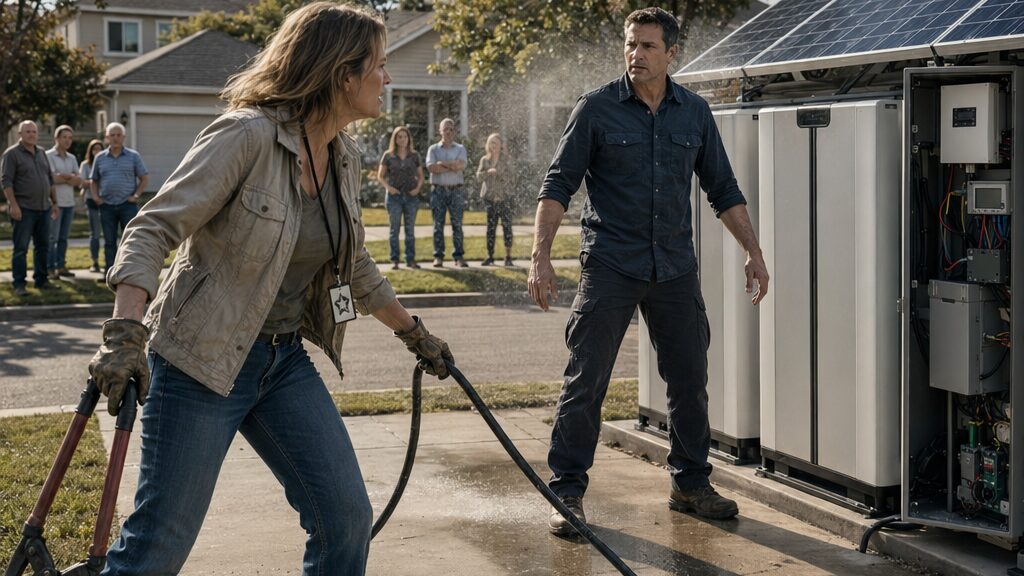
Within moments she had dragged the heavy hose across the patio.
The metal coupling rattled against the concrete.
Samuel’s stomach tightened.
The battery bank sat only yards away.
“You can’t be serious.”
“Those things catch fire.”
“They don’t.”
“Everyone knows they do.”
“No. People online say they do.”
Heather continued pulling the hose.
“Same difference.”
“It isn’t.”
But she no longer seemed interested in arguing.
That frightened Samuel more than the accusations.
Because arguments at least involved words.
Now she wanted action.
Several nearby lights switched on inside neighboring homes.
Movement appeared behind curtains.
People were waking.
Watching.
The conflict was no longer private.
Heather connected the hose to an outdoor spigot.
Water surged through the line.
The hose stiffened.
Samuel stepped closer.
“Stop.”
“Back away.”
“You don’t understand what you’re doing.”
“No,” Heather snapped. “You don’t understand what happens when people stay silent.”
The statement caught him off guard.
For the first time he heard something beneath the paranoia.
Fear.
Not fear of the equipment.
Fear of being ignored.
But understanding the emotion didn’t solve the situation.
The nozzle attachment clicked into place.
Water pressure increased.
Samuel looked toward the monitoring equipment mounted near the battery array.
Most people saw solar panels.
They didn’t see the federal monitoring systems attached to them.
Didn’t see the data collection hardware.
Didn’t see the reporting infrastructure.
The installation wasn’t merely private equipment.
It was part of a broader monitoring network.
And suddenly that fact mattered.
A lot.
“You need to listen carefully,” Samuel said.
“This equipment has federal protection.”
Heather hesitated.
Only briefly.
Then she shook her head.
“Nice try.”
“I’m serious.”
“You’re always serious.”
Samuel realized she genuinely believed he was bluffing.
That realization made the situation worse.
Not better.
Because now he understood how completely reality had lost its influence over her decisions.
The water hissed through the hose.
Pressure building.
Heather aimed the nozzle toward the battery bank.
Neighbors were emerging from their homes.
Watching from sidewalks.
Watching from porches.
Watching from windows.
The audience she had always wanted.
The audience Samuel had always avoided.
Heather tightened her grip.
And squeezed the handle.
Water erupted from the nozzle.
Chapter 6: The Hose That Burst in Front of Everyone
The stream shot toward the battery bank.
Samuel moved before he consciously decided to.
Years of avoiding confrontation vanished in a single instant.
He crossed the distance between them just as water splashed across the concrete near the installation.
“Stop!”
Heather tried to pull the hose away.
Samuel grabbed it instead.
The force of the pressure jerked both of them sideways.
Neighbors gasped.
Someone shouted from across the street.
The confrontation had become public.
Exactly the kind of scene Samuel normally spent his life avoiding.
But there was no avoiding it now.
Heather yanked harder.
“You can’t stop me!”
“Yes, I can.”
“You don’t own the neighborhood!”
“No,” Samuel said. “But I own this property.”
The hose twisted violently between them.
Water sprayed across the patio.
Across the driveway.
Across both of them.
Heather stumbled but refused to release her grip.
For a brief moment Samuel considered letting go.
Stepping back.
Calling authorities.
Waiting.
The familiar instinct to avoid conflict surfaced again.
Then he looked toward the battery installation.
Toward the monitoring equipment.
Toward the cameras recording everything.
And understood that waiting was no longer an option.
He ripped the hose free.
Heather nearly lost her balance.
Before she could recover, Samuel seized the brass nozzle with both hands.
“What are you doing?” Heather shouted.
“Ending this.”
The metal groaned.
Samuel twisted hard.
The nozzle crumpled inward.
Pressure surged through the damaged fitting.
A loud crack echoed across the street.
Then the hose exploded.
A violent burst of water erupted several feet behind Heather.
The line whipped wildly across the driveway.
Water sprayed in every direction.
Heather screamed and jumped backward.
Several neighbors scattered.
The broken hose lashed across the pavement like a living thing.
Within seconds Heather was drenched.
Her fake badge hung crookedly from her neck.
Water streamed down her face.
The absurdity of the image collided with the seriousness of the situation.
No one laughed.
Not yet.
Because nobody fully understood what they were watching.
Samuel dropped the ruined nozzle.
The shattered brass fitting clattered across the concrete.
Silence followed.
Not complete silence.
Just the strange silence that arrives after chaos.
Heather stared at him.
Breathing hard.
“You assaulted me.”
“No,” Samuel said evenly. “I stopped you.”
“You attacked me.”
“You trespassed.”
Neighbors exchanged nervous glances.
The power dynamic had shifted.
For months Heather had controlled the narrative.
Now everyone had witnessed something impossible to explain away.
The cameras had seen it.
The neighbors had seen it.
Reality had seen it.
Heather pointed toward the installation.
“You still won’t tell them what that thing really is.”
Samuel followed her gaze.
For a moment he considered remaining silent.
The old version of himself would have.
The version that hoped facts could wait patiently until people were ready.
That version had helped create this situation.
So he made a different choice.
He walked directly to the monitoring node.
Opened a secured panel.
And exposed the identification placards.
Several residents stepped closer.
Federal program markings.
Identification numbers.
Government contact information.
Operational notices.
No mystery.
No hidden symbols.
No secret language.
Just documentation.
“What is that?” a neighbor asked quietly.
“A Department of Energy monitoring node,” Samuel replied.
The words landed heavily.
Confusion spread through the crowd.
Heather looked stunned.
“No.”
“Yes.”
“You made that up.”
Samuel pointed at the placard.
“Read it.”
Nobody moved.
Nobody needed to.
The cameras had already recorded everything.
The permits existed.
The inspections existed.
The documentation existed.
For the first time, the facts were standing in the center of the street instead of hidden inside a binder.
Heather looked around desperately.
Searching for support.
Finding less and less of it.
Then the distant sound of sirens reached the neighborhood.
Someone had called authorities.
Several people, apparently.
The sound grew louder.
Closer.
Inevitable.
Heather’s expression changed.
For the first time since the conflict began, uncertainty appeared.
The approaching vehicles turned onto the street.
And every camera on Samuel’s property continued recording.
Chapter 7: Lessons Required by Law
“I think they’ll understand why I did it.”
Heather said the words quietly to her attorney.
The attorney did not answer immediately.
Instead, he looked down at a tablet screen displaying paused security footage.
Heather standing on private property.
Heather dragging a hose.
Heather ignoring warnings.
Heather aiming water toward protected equipment.
The silence lasted long enough to become uncomfortable.
Finally he sighed.
“They’ll understand why you thought you were doing it.”
“That matters.”
“It matters less than what you actually did.”
Heather looked away.
For weeks she had imagined this moment differently.
She had imagined recognition.
Validation.
Proof.
Instead she sat in a conference room reviewing evidence that seemed worse every time she watched it.
Outside the building, reporters waited.
The incident had grown far beyond the neighborhood.
Far beyond Samuel.
Far beyond her.
Meanwhile Samuel sat in another room reviewing documents with investigators.
The atmosphere felt surprisingly calm.
No dramatic accusations.
No secret revelations.
Just records.
Timelines.
Statements.
Evidence.
One investigator slid a file across the table.
“Your security system captured everything.”
Samuel nodded.
“I figured it did.”
“Honestly, that footage probably prevented this from becoming a much bigger dispute.”
Samuel almost laughed.
The cameras had been installed to monitor equipment.
Instead they had documented human behavior.
Months of accusations.
Weeks of escalation.
One morning of terrible decisions.
The investigator tapped the file.
“Most cases aren’t this clear.”
Samuel looked through the pages.
Still photographs.
Timestamps.
Property maps.
Inspection records.
The same documents nobody had wanted to read earlier.
Now everyone wanted them.
The irony wasn’t lost on him.
After the meeting ended, he stepped outside.
A crowd of reporters lingered near the entrance.
One of them immediately approached.
Elizabeth Wright.
Local news.
Though “local” no longer felt accurate.
National outlets had started calling.
“Mr. Hall.”
Samuel stopped.
“Just a few questions.”
“I don’t really want to become part of a story.”
Elizabeth smiled faintly.
“You already are.”
She wasn’t wrong.
“Did you ever think it would go this far?”
“No.”
“What do you think caused all this?”
Samuel considered the question.
Months earlier he would have answered differently.
He would have focused on misinformation.
Technology.
Facts.
Now he saw something else underneath.
Loneliness.
Attention.
Fear.
Pride.
Human things.
Not technical things.
“I think people can convince themselves of almost anything if enough other people repeat it,” he said.
Elizabeth lowered her notebook slightly.
“That sounds less angry than I expected.”
Samuel looked toward the courthouse.
“I’ve spent months being angry.”
“Not anymore?”
“Not in the same way.”
Elizabeth wrote something down.
Then asked one final question.
“What outcome do you want?”
The answer came more slowly.
“I want it to stop.”
A few days later, it didn’t stop.
It exploded.
The security footage became public through official proceedings.
Within hours clips appeared online.
Within days they were everywhere.
The images proved irresistible.
Heather’s homemade badge.
The conspiracy accusations.
The hose whipping wildly through the driveway.
The moment she learned the installation had federal protection.
People edited the footage.
Added captions.
Added music.
Added jokes.
The internet transformed the incident into entertainment.
Samuel disliked watching it happen.
Heather had caused enormous problems.
But public humiliation operated differently than justice.
It spread endlessly.
One evening William Davis knocked on Samuel’s door.
Samuel opened it cautiously.
William looked uncomfortable.
“Can I come in?”
A few minutes later they sat at the kitchen table.
Neither spoke immediately.
Eventually William cleared his throat.
“I owe you an apology.”
Samuel leaned back.
“For what?”
“I should’ve stopped this earlier.”
William stared at his hands.
“I kept telling myself it wasn’t my responsibility.”
Samuel understood that feeling better than anyone.
“It wasn’t entirely yours.”
“I know.”
William looked up.
“But I kept treating facts and rumors like equal opinions.”
The admission carried more weight than an apology.
Because it was true.
Not just for William.
For much of the neighborhood.
Samuel nodded.
“Most people did.”
The conversation continued for nearly an hour.
Not about technology.
Not about investigations.
About responsibility.
About what happens when nobody wants conflict.
Sometimes conflict grows anyway.
A week later the formal hearing concluded.
Heather sat quietly as findings were read.
The evidence was overwhelming.
Not because of a single dramatic moment.
Because of accumulation.
Complaint after complaint.
Warning after warning.
Inspection after inspection.
Every opportunity to stop.
Every decision to continue.
When the consequences were announced, the room remained silent.
Probation.
Mandatory educational coursework.
Five hundred hours focused on basic science, technology, and critical reasoning programs approved by the court.
The penalty sounded almost absurd.
Until one considered the circumstances that had created it.
Heather’s shoulders slumped.
Not dramatically.
Just enough to suggest exhaustion.
For the first time since the conflict began, she looked less like a crusader and more like a tired person who had followed a terrible path too far.
Afterward she crossed paths with Samuel in a courthouse hallway.
Neither expected the encounter.
Both stopped.
For a moment neither spoke.
Then Heather surprised him.
“You could’ve pushed for worse.”
Samuel considered that.
He could have.
Many people expected him to.
Some had encouraged it.
“I know.”
Heather looked away.
“You think I’m crazy.”
“No.”
The answer seemed to catch her off guard.
“No?”
“I think you stopped questioning yourself.”
The hallway grew quiet.
Heather stared at the floor.
For once she had no response.
No accusation.
No theory.
No explanation.
Eventually she walked away.
Months later the neighborhood looked ordinary again.
Children rode bicycles past Samuel’s property.
Neighbors waved.
The battery bank continued humming quietly beside the patio.
The same equipment.
The same house.
The same documents.
Nothing about the technology had changed.
People had.
One evening Samuel sat outside reviewing system data.
A notification appeared on his phone.
A news article.
The incident had made another list of memorable viral stories.
The thumbnail image showed Heather standing in her soaked uniform while water sprayed across the driveway.
He closed the article without opening it.
Across the street a moving truck was parked outside Heather’s house.
Several workers carried boxes toward the vehicle.
Life continued.
Consequences continued.
Education continued.
Samuel watched the sunset reflect across the solar panels.
Months ago he would have ignored everything.
Stayed silent.
Waited for facts to defend themselves.
Now he understood something different.
Truth needed evidence.
But evidence needed people willing to stand behind it.
The cameras had recorded the story.
The documents had supported it.
The law had resolved it.
Yet none of that would have mattered if he had continued stepping back every time conflict appeared.
The battery bank hummed steadily beside him.
Not mysterious.
Not dangerous.
Just real.
And for the first time in a long while, reality felt sufficient.
The story has ended.