She Closed the Clubhouse Parking Lot, but the Truth Cost More Than Revenge
Chapter 1: The Photograph Across the Association Counter
Virginia Hall slid the rejection notice across the counter until its lower edge touched the frame around Betty Walker’s photograph.
For one second, Christine looked only at the collision: white paper against dark walnut, Virginia’s manicured finger resting beside her mother’s smiling face.
“The board’s decision is final,” Virginia said.
Christine did not pick up the notice. “The board met this morning?”
“The executive committee reviewed it.”
“There are only two members on the executive committee.”
“Three, including me.”
Christine kept both hands around the frame. She had brought the photograph because the clubhouse application required a picture for the memorial display. Betty stood in her front yard wearing a blue cardigan, one palm lifted against the sun, as though she had been caught halfway through telling someone to come inside.
Four days earlier, Christine had found her mother’s reading glasses folded on the kitchen table beside an unpaid electric bill. Now she stood under fluorescent lights while Virginia arranged grief into categories.
“You accepted the deposit,” Christine said.
“The deposit reserved the review period. It did not guarantee approval.”
“The form calls it a facility deposit.”
“It is non-refundable.”
Christine finally drew the paper toward her. The reason for denial appeared in a box near the bottom.
INCOMPATIBLE WITH SCHEDULED COMMUNITY PROGRAMMING.
She read it twice.
“What programming?”
Virginia’s expression did not change. Her tan blazer looked freshly pressed, and a small gold badge identified her as BOARD PRESIDENT, as if anyone entering the office might mistake her for an ordinary neighbor.
“The clubhouse calendar has changed.”
“The room was available when I paid.”
“It is no longer available.”
“For what?”
Virginia adjusted the folder in front of her. “The Community Excellence Fundraiser.”
Christine knew the name. A banner had appeared near the subdivision entrance two weeks earlier, announcing a charity gala scheduled for the following month. The clubhouse committee had begun using smaller events to impress sponsors.
“That gala is not this Saturday.”
“No, but the decorating team requested early access.”
“For four weeks?”
“They have equipment to store.”
Christine looked through the glass wall behind Virginia. Beyond it stood the clubhouse lobby with its polished tile, stacked banquet chairs, and a fireplace no one used except in brochure photographs. Betty had attended holiday potlucks there, blood drives, a retirement reception, and three wedding showers. She had helped raise money for the replacement roof.
Now her wake was incompatible with programming.
“I need the room for three hours,” Christine said. “We’ll clean it ourselves.”
Virginia’s mouth tightened, not quite annoyance and not quite sympathy. “Memorial events present special concerns.”
“What concerns?”
“Emotional atmosphere. Attendance unpredictability. Food handling. Parking.”
Christine waited.
Virginia lowered her voice. “The clubhouse is intended for activities that promote community well-being.”
“My mother lived here forty-one years.”
“That isn’t in dispute.”
“She welcomed half the people on this street when they moved in.”
“I understand that you’re grieving.”
The sentence was delivered gently enough to be used later as evidence of compassion.
Christine set the photograph upright on the counter. “Then refund the deposit.”
“I can’t override the policy.”
“You are the policy.”
Virginia’s eyes sharpened. “That is precisely the kind of assumption that causes difficulty. We have rules so personal feelings do not determine outcomes.”
Christine heard what was beneath it: your feelings are the problem.
She folded the rejection notice once, making the crease exact.
“When was the fundraiser storage request submitted?”
Virginia looked at her for a moment too long. “You may request meeting minutes through the standard process.”
“So after I applied.”
“I didn’t say that.”
“You didn’t need to.”
The office door opened behind Christine. Jessica Adams stepped in carrying a reusable grocery bag. She stopped when she saw the photograph on the counter.
“Oh, honey,” Jessica said.
Christine had known her since childhood, though not well enough to accept the embrace Jessica seemed ready to offer. Jessica had lived three houses down from Betty for twenty-six years. Her silver-streaked hair was tied back, and flour marked one sleeve of her sweatshirt.
“I brought the card box,” she said. “People keep dropping things off.”
She set the bag beside Christine. Inside were envelopes, recipe cards, and folded notes secured with rubber bands.
Virginia glanced at them. “The office counter needs to remain clear.”
Jessica stared at her. “Those are for Betty.”
“I’m sorry for the loss.”
“You knew her.”
“Of course.”
“Then you know she baked banana bread for every family who moved into this place.”
Virginia’s face softened by a measured degree. “Betty was very generous.”
Jessica lifted one bundle. “These are thank-you notes people kept. Some are twenty years old.”
Christine took the bundle. On top was a faded card written in purple ink.
Mrs. Walker, thank you for making our first night here feel less lonely.
She recognized Betty’s handwriting on the envelope, where her mother had written the recipient’s address despite walking the card across the street herself.
Jessica turned toward the lobby. “She should be remembered in that room.”
Virginia straightened. “The decision has been made.”
“No,” Jessica said. “A decision was made.”
The distinction hung there.
Christine placed the notes beside the photograph, then gathered both against her chest. “We’ll use the garage.”
Jessica looked at her. “You don’t have to—”
“I’m not canceling her memorial.”
Virginia picked up her folder. “Please remember the residential gathering limit.”
Christine paused at the door. “What limit?”
“Twelve non-household guests.”
“That rule is for recurring social events.”
“It applies when street parking may be affected.”
“My mother’s friends are not a traffic pattern.”
Virginia’s professional smile returned. “Rules are easier when they are applied consistently.”
Outside, the afternoon light was too bright. Christine crossed the parking lot without speaking. Jessica followed, the card box pressed against her hip.
At Betty’s house, the kitchen still smelled faintly of cinnamon and the lemon cleaner her mother used on the counters. Christine placed the photograph beside the telephone. Jessica began sorting cards into piles without asking permission.
“You’re doing the thing you do,” Jessica said.
“What thing?”
“Turning your face into a locked door.”
“I have chairs to rent.”
“I can get chairs.”
“I can handle it.”
“I know. That’s not the same as letting people help.”
Christine opened her laptop at the table. She had three days to move the memorial, notify guests, arrange food, clear the garage, and contact the funeral home about the display easel.
Jessica put a receipt beside the computer. “Virginia gave you this?”
Christine looked down.
The HOA receipt showed her three-hundred-dollar payment, the date, and the clubhouse reservation reference. But the account designation at the bottom did not say FACILITY DEPOSIT.
It said MISCELLANEOUS FORFEITURE INCOME.
Christine enlarged the line on the screen.
The payment had been classified as forfeited two days before Virginia claimed the board had reviewed the request.
Chapter 2: The Garage Filled With Folding Chairs
The patrol car slowed beside Betty’s driveway before the first mourner arrived.
Christine stood inside the open garage holding a stack of paper programs. The officer looked toward the rows of folding chairs, the flower arrangements, and the white sheet Jessica had hung as a projection screen. Then the car rolled on without stopping.
“Did you call the police?” Jessica asked from behind the food table.
“No.”
“Someone did.”
Christine set the programs down. “Maybe it was routine.”
Jessica gave her a look that said neither of them believed that.
By eleven, the garage had changed. Betty’s gardening tools were hidden behind curtains. Folding chairs filled the concrete floor in uneven rows. Her framed photograph stood on a table between two arrangements of lilies, and the card box sat open beside it.
People came carrying casseroles, flowers, and stories Christine had never heard.
A retired schoolteacher described how Betty had watched her children during a winter power outage. A young father brought a stained recipe card in a plastic sleeve. Betty had written instructions for banana bread on one side and the words You’ll know it’s ready when the whole kitchen smells kind on the other.
Christine had seen her mother bake hundreds of loaves. She had never seen that sentence.
More chairs appeared. Neighbors stood along the driveway and near the workbench. Someone moved a fan toward the older guests. The garage door framed a clear Ohio sky, and for a while the space did not feel like a substitute.
It felt like Betty’s.
Christine stayed near the photograph, thanking people with the same three phrases. She accepted condolences without allowing any of them to remain in her hands for long.
Jessica touched her elbow. “There are almost forty people.”
“I can count.”
“I didn’t mean—”
“I know.”
Across the street, a tan SUV turned the corner.
Virginia drove slowly past the house.
She did not wave.
Christine watched the vehicle continue toward the clubhouse.
“She’s checking parking,” Jessica said.
“There are no blocked driveways.”
“She’s checking something.”
Christine returned to the photograph. A reflection moved across the glass, briefly covering Betty’s smile.
At noon, the funeral-home representative started the slideshow. Images crossed the white sheet: Betty beside her tomato plants, Betty in a paper crown at a birthday lunch, Betty standing beneath the clubhouse awning with a tray of bread wrapped in foil.
Several guests laughed softly at a picture of her holding a garden hose like a microphone.
Then the SUV passed again.
This time Virginia’s passenger window was lowered.
The room shifted. Conversation thinned near the driveway. A man in the back row turned to watch her.
Christine walked to the garage opening and stood there until the SUV disappeared.
Jessica joined her. “Say the word, and I’ll go ask what she wants.”
“No.”
“She’s trying to make everyone feel watched.”
“Then don’t give her a scene.”
“You think silence means she wins less?”
“I think my mother’s memorial is not going to become an argument with Virginia Hall.”
Jessica studied Christine’s face. “Betty argued when it mattered.”
“She also knew when to leave people alone.”
“That is not what she did with you.”
The words landed harder than Jessica intended. Christine looked back at the slideshow. A photograph showed Betty at the kitchen table, holding up a phone while laughing.
The final voicemail was still saved on Christine’s device.
Call when you can, sweetheart. Nothing urgent.
Christine had been preparing an audit presentation in Chicago. She had listened to the message, marked it unread so she would remember, and called two days later from the airport.
By then Betty was in the hospital, unable to speak clearly.
Christine walked away from Jessica and began straightening programs that did not need straightening.
During the open remembrance, Jessica carried the card box to the front.
“Betty wrote to people,” she said. “But people wrote back.”
She read from the cards without naming the writers. One thanked Betty for sitting with a new widow through Christmas dinner. Another remembered a loaf of bread left after a job loss. Another mentioned that Betty had insisted the clubhouse kitchen remain available during a water-main break.
Christine listened from beside the workbench. The stories described a woman who did not wait for permission to be useful.
The tan SUV passed for the third time.
This time it stopped at the corner.
Virginia remained behind the wheel for nearly a minute, looking toward the cars parked along the curb. Then she lifted her phone.
A murmur moved through the guests.
Christine stepped into the driveway.
Virginia drove away before she reached the sidewalk.
The memorial ended without confrontation. People folded chairs, packed leftovers, and carried flowers inside before dusk. Someone left a wreath on Betty’s front door. Jessica placed two arrangements near the porch steps because the kitchen had no room.
The garage floor was bare again by nine, except for a few crushed petals and strips of tape from the projection screen.
“You should come stay with me tonight,” Jessica said.
“I have work to do.”
“You always have work to do.”
Christine closed the card box. “Thank you for helping.”
Jessica recognized the dismissal. She put on her coat but did not leave immediately.
“Your mother did not think needing people was a bookkeeping error,” she said.
Christine looked at the programs stacked on the table. “Good night, Jessica.”
At seven the next morning, a hard knock struck the front door.
No one was there when Christine opened it.
A yellow violation notice had been fastened beneath the wreath.
UNAPPROVED EXTERIOR DECORATION.
Fine: four hundred dollars.
A second notice stood on a plastic stake beside the funeral flowers.
UNAUTHORIZED LANDSCAPE DISPLAY.
Fine: two hundred dollars.
The third had been taped to the garage door.
EXCESSIVE RESIDENTIAL GATHERING AND PARKING IMPACT.
Fine: seven hundred dollars.
Christine removed each notice carefully. She did not tear them. She carried them to the kitchen, laid them in a row, and photographed every page.
At eight twelve, she called the HOA office.
Virginia answered.
“I received three citations,” Christine said.
“They were issued after documented violations.”
“Who documented them?”
“Our compliance process does not identify individual complainants.”
“The gathering ended yesterday.”
“Notices are processed the next business morning.”
“There was no blocked access, no noise complaint, and no property damage.”
“The number of attendees exceeded the residential limit.”
“That limit does not apply to one-time memorials.”
Virginia paused. “The board adopted a clarification.”
“When?”
“Last month.”
“Send me the meeting minutes.”
“You may submit a records request.”
Christine looked at the garage citation. Beneath the bylaw number was a second reference: COMMUNITY PRESERVATION POLICY 8.14.
She opened the digital copy of Maple Hollow’s governing documents and searched the number.
No result.
She searched the phrase.
No result.
“Virginia,” she said, “Policy 8.14 does not exist in the current bylaws.”
“It is a board policy, not a covenant provision.”
“Then it still requires adoption.”
“It was adopted.”
“By whom?”
“The board.”
“At which meeting?”
“You are grieving, Christine. I suggest you wait before turning this into something larger.”
Christine lowered her gaze to the three yellow pages. “You already made it larger.”
She ended the call.
For the first time since Betty died, the tightness in Christine’s chest did not feel like grief. It felt colder and more familiar.
She opened a blank spreadsheet, entered the citation numbers, dates, amounts, and claimed authorities, then added a final column.
AUTHORIZATION SOURCE.
All three cells remained empty.
Chapter 3: The Numbers That Refused to Balance
Christine found her mother’s three-hundred-dollar deposit in a ledger labeled MISCELLANEOUS FORFEITURES.
It appeared on line 317, between a pool-key replacement charge and a late fee imposed on a resident who had since moved away. The posting date was Wednesday—two days before Virginia handed Christine the rejection notice.
Christine checked the clubhouse reservation log again.
Her request still showed PENDING REVIEW on Thursday afternoon.
She sat back from the laptop. Betty’s photograph stood near the far end of the dining table, reflected faintly in the black edge of the screen. In the glass, her mother’s face seemed divided by spreadsheet columns.
The HOA had ten business days to respond to a member records request. Daniel Moore waited until the tenth day at four forty-three in the afternoon.
His email contained three attachments and a sentence asking Christine to acknowledge that preliminary reports could be misunderstood outside their operational context.
She replied with a request for the underlying bank statements.
Daniel called within six minutes.
“Those contain confidential information,” he said.
“Account numbers can be redacted.”
“There are vendor details.”
“Those are association records.”
“You know what I mean.”
“I know what the statute means.”
Silence collected on the line.
Daniel lived near the west pond and had served as volunteer treasurer for four years. Christine remembered him as a cautious man who brought his own calculator to annual meetings and apologized before correcting anyone.
“These books aren’t a public-company audit,” he said. “There are timing differences. Volunteer errors.”
“Then the statements will explain them.”
“I’m asking you not to draw conclusions before you understand how we operate.”
“I’m asking for records I’m entitled to inspect.”
He exhaled. “Virginia says this is retaliation over the memorial.”
“Virginia classified my deposit as forfeited before she denied the reservation.”
“That may be an automatic code.”
“Then send the coding policy.”
Another silence.
“I’ll arrange access,” he said.
The records room occupied a narrow office behind the clubhouse kitchen. Three metal cabinets stood against one wall, and boxes of gala decorations crowded the other. Daniel had placed six binders on the table.
“No photographs of homeowner information,” he said.
“I’m not interested in homeowner balances.”
He remained by the door while she worked.
Christine began with clubhouse revenue. Rental forms were numbered. Deposits appeared on monthly bank statements. Annual reports summarized income under broader categories.
The first year balanced within a few hundred dollars.
The second did not.
She marked every rental deposit, excluding security holds later returned. She repeated the process for three years, then compared the totals with the association’s annual reports.
Reported clubhouse rental income: eighteen thousand one hundred twenty dollars.
Deposits linked to clubhouse reservations: forty-one thousand three hundred eighty dollars.
Difference: twenty-three thousand two hundred sixty dollars.
She checked her formulas twice.
Daniel shifted near the door. “You’re combining restricted deposits with revenue.”
“Some are damage deposits.”
“Exactly.”
“Returned damage deposits appear as withdrawals. I netted them.”
“There were transfers.”
“To where?”
“The operating account.”
“These are already operating-account statements.”
He came closer. “Let me see.”
Christine rotated the laptop.
Daniel read the figures. A small muscle moved near his jaw.
“This report was amended,” he said.
“The version provided to homeowners was not.”
“There were emergency expenses.”
“Expenses do not reduce reported gross rental income.”
“It depends how they were posted.”
“No, it depends whether anyone wanted the number to remain visible.”
His face tightened. “Be careful.”
“Is that advice or a warning?”
“It’s frustration. You walk in here with twenty years of professional experience and treat volunteer bookkeeping like evidence of a scheme.”
“Twenty-two years.”
“That proves my point.”
Christine closed one binder and opened another. “My mother’s deposit was recognized as forfeiture income before the board’s stated decision date.”
Daniel lowered his voice. “I did not enter that transaction.”
“Who did?”
“The management software imports payments.”
“Who changes the code?”
He looked toward the closed door.
Christine followed his glance. “Virginia?”
“I didn’t say that.”
“You keep not saying things.”
Daniel pulled out a chair but did not sit. “The board began reviewing enforcement policies months ago. Homeowners complained that exceptions were being given based on who knew whom.”
“So Virginia chose my mother’s wake to demonstrate consistency.”
“That is not how I would phrase it.”
“How would you phrase it?”
“She believed approving an event after the new standards were drafted would undermine enforcement.”
“The standards were not adopted.”
“They were going to be.”
Christine stared at him. “You fined people under rules that did not yet exist.”
“I didn’t issue the fines.”
“You signed the financial reports that recorded them.”
Color rose along his collar. “You think signatures mean one person controls everything?”
“In accounting, they mean someone accepted responsibility.”
He stood abruptly. “This inspection is over for today.”
Christine did not argue. She had learned more from his anger than she expected.
At home, she spread copies across Betty’s dining table. Jessica arrived with soup and received no answer when she knocked, so she used the old spare key Betty had never asked her to return.
“This looks like a tax office exploded,” Jessica said.
Christine highlighted transfers.
“Did you eat?”
“No.”
“That wasn’t an invitation to lie.”
Jessica placed a bowl beside the keyboard, then noticed the $23,260 figure.
“Did Virginia steal that?”
“I don’t know.”
“You look like you know.”
“I know the reporting is wrong. Wrong is not the same as stolen.”
Jessica studied her. “You sound disappointed.”
Christine looked up.
“You wanted her to be exactly as bad as you thought,” Jessica said.
“I want the records to be accurate.”
“You want something clean enough to punish.”
Christine turned back to the screen. “This is not about punishment.”
Jessica’s gaze moved to the yellow citations pinned beneath a magnet on the refrigerator.
“Of course not.”
After she left, Christine worked past midnight.
The missing income had not vanished into one account. Portions had been posted against emergency drainage work, clubhouse plumbing, and landscaping. The entries were irregular but not uniformly concealed. Some looked incompetent. Others looked deliberately compressed.
One vendor appeared again and again.
Nelson Grounds and Property Care.
The invoices described crews of five or six, equipment rentals, storm cleanup, irrigation repair, and seasonal maintenance. The annual total was larger than the next three vendors combined.
Christine searched the state business registry.
The company existed.
Its mailing address was a house on Hawthorn Court.
She opened the HOA directory and typed the address.
Patrick Nelson.
Virginia Hall’s son.
Christine leaned back as Betty’s photograph appeared in the darkened window beyond the laptop. For a moment, her mother’s reflected face hovered over the vendor totals.
The company was not imaginary.
That made the question worse.
Either Patrick had built the busiest landscaping operation in the county without a commercial address, or Maple Hollow had been paying for a workforce that existed mostly on paper.
Chapter 4: The Contractor With No Working Crew
At seven fifteen the next morning, one man in a gray sweatshirt was trimming the clubhouse hedge with a rented electric trimmer.
Christine parked across from the pool and watched him work alone.
The latest invoice from Nelson Grounds and Property Care billed Maple Hollow for six workers, two commercial mowers, a debris trailer, and eight hours of seasonal cleanup. The man had arrived in a rusted pickup with one trimmer, a rake, and three paper yard bags.
Christine photographed only the equipment and the public landscaping, keeping residents out of frame. Then she walked the perimeter.
The rear beds were choked with crabgrass. Two sprinkler heads leaked into the mulch. Near the clubhouse wall, a downspout emptied into a shallow depression where the soil had collapsed around a drainage grate.
The invoice described all three areas as completed.
The worker noticed her near the shrubs. He shut off the trimmer.
“Can I help you?”
“I’m looking for Patrick Nelson.”
“He’s picking up parts.”
“Are the rest of the crew coming later?”
The man glanced at the parking lot. “It’s just me today.”
“The invoice lists six.”
“I don’t see invoices.”
Christine looked at the pickup. No company name appeared on the doors.
“Is this Nelson Grounds’ truck?”
“It’s mine.”
“How long have you worked for him?”
The man’s expression closed. “You need to talk to Patrick.”
Christine thanked him and stepped away.
Something white lay crushed beneath the overgrown hydrangeas. She bent and pulled it free.
It was one of Betty’s welcome cards, softened by rain and marked with the tread of a work boot. Someone had placed it among the flowers after the memorial, perhaps intending it for the card box. Only part of the message remained legible.
You made this place feel like—
The rest had torn away.
Christine slipped the card into the back of her notebook.
Patrick’s business address led to a split-level house on Hawthorn Court. A trailer sat in the side yard with one flat tire. Two push mowers leaned beneath a blue tarp. The garage door stood open, revealing shelves of fertilizer and a snow blower with its engine housing removed.
Patrick stepped outside before Christine reached the porch.
“You’re taking pictures of my house now?”
“I took a photograph of the equipment visible from the street.”
“My employee called.”
“Your invoice says you sent six employees to the clubhouse.”
Patrick was in his early forties, broad through the shoulders but worn around the eyes. Grease darkened two fingers of his right hand.
“That invoice covers the month.”
“It lists today’s date as the service date.”
“My mother said you were digging through records because she denied your event.”
“Your mother authorized payments to a company registered at your home.”
“That’s not illegal.”
“Neither is asking whether the work was performed.”
His jaw tightened. “You accountants always think labor fits into boxes.”
“It usually fits into hours.”
Patrick stepped down from the porch. “You want to know why the clubhouse looks bad? Because they put off drainage repairs for four years. Then a storm tore half the slope out. I handled it.”
“With one employee?”
“I hired day labor.”
“Where are the payroll records?”
“I’m not giving you private records.”
“Then give them to the board.”
He laughed once without humor. “The board knows.”
“Does the membership?”
Patrick looked toward the neighboring house, where a curtain moved behind a window.
“You don’t understand what happened,” he said.
“Then explain it.”
For several seconds he said nothing. Then he rubbed the grease from his fingers with a rag pulled from his back pocket.
“My company had eight people two years ago. Two trucks. Contracts in three subdivisions. Then a developer stopped paying. I carried payroll for six weeks and lost almost everything.”
“And Virginia rewrote your contract.”
His eyes flicked toward her. That was enough.
“She didn’t invent the work,” he said. “Maple Hollow needed drainage, tree removal, winter cleanup. She combined it.”
“At rates based on a six-person crew.”
“The rates were already approved.”
“Before your crew disappeared.”
Patrick looked down the street. “She said if the contract collapsed, the board would need a special assessment. People here lose their minds over fifty dollars.”
“So residents paid your old capacity after you no longer had it.”
“I did the work.”
“Some of it.”
His face reddened. “You think I wanted my mother saving me?”
Christine did not answer.
“She changed the agreement after the bank took my second truck,” he continued. “Said the neighborhood needed continuity. Said I could rebuild. Every month I told her we should reduce the scope.”
“Did you return the excess?”
His silence answered.
“You signed the invoices,” Christine said.
“I signed what she sent.”
“That is still a choice.”
Patrick’s shoulders lowered. For the first time he looked less defensive than tired.
“She believed she was protecting everybody,” he said. “Me. The board. Homeowners who couldn’t afford another assessment.”
“She protected herself from telling them the truth.”
“That too.”
Christine left without threatening him. The clean explanation she had wanted—false company, stolen money, simple fraud—had broken apart. Patrick’s business existed. Work had been done. The contract was still conflicted, inflated, and concealed, but the motive was not only greed.
That afternoon, the board held a workshop in the clubhouse meeting room. Christine sat in the back with copies of the invoices.
Virginia opened with routine updates, speaking briskly about pool inspections and gala security. Daniel avoided looking toward Christine.
When public comment began, Christine stood.
“Nelson Grounds billed the association for labor and equipment it could not consistently provide.”
Virginia folded her hands. “That is an accusation.”
“It is a comparison between invoices, observed staffing, and available equipment.”
“Your observation of one morning does not establish annual performance.”
“No. Patrick established it.”
A small movement passed through the room.
Virginia’s face remained composed. “You approached my son at his private residence?”
“I asked about an association contract.”
“You are allowing grief to become harassment.”
Christine placed copies of three invoices on the table. “Did you disclose your relationship to the membership before renewing this agreement?”
“The board was aware.”
Daniel stared at the papers.
Christine turned to him. “Was the relationship recorded in the minutes?”
He swallowed. “Not in the minutes distributed to homeowners.”
Virginia’s chair scraped softly as she shifted. “The contractor was selected because emergency work had to begin immediately.”
“Two years of emergency work?”
“The drainage system was failing. The retaining slope required stabilization. We had roof damage, plumbing damage, and increased insurance costs.”
A homeowner near the front raised a hand. “Why weren’t we told?”
Virginia looked at him. “Because announcing every operational concern creates panic before solutions are available.”
Christine heard sincerity in the answer, and that made it worse.
“You decided residents could not be trusted with the cost of their own property,” she said.
“I decided they should not receive a special assessment until every alternative was exhausted.”
Daniel finally looked at Christine. “It would have been nearly twenty-eight hundred dollars per home.”
The room went quiet.
One of the skeptical homeowners whispered something to the other.
Virginia continued. “Patrick accepted deferred payments. He provided emergency coverage when larger firms wanted deposits we could not make. Was the contract perfect? No. Did it prevent immediate financial damage? Yes.”
Christine looked toward Daniel. “And the missing rental income?”
His fingers tightened around his pen. “Some revenue was posted directly against emergency repairs.”
“Without appearing as gross income.”
“Yes.”
“Why?”
Daniel’s voice became smaller. “To keep the operating deficit from triggering the assessment formula.”
Christine stared at him. “You changed reports after board approval.”
“I corrected classifications.”
“You concealed the deficit.”
“I delayed it.”
Virginia cut in. “We kept this community solvent.”
“You kept yourselves in control.”
The board secretary called for order, though no one had raised a voice.
Christine gathered her papers. The evidence remained serious, but it no longer formed the clean case she had imagined. There were false reports, undisclosed conflicts, and selective enforcement. There were also broken drains, unpaid bills, frightened volunteers, and residents who might truly have struggled to pay.
As she turned to leave, Daniel said, “Christine.”
He held up an old maintenance file.
“I found this while reviewing the drainage records. Your mother’s name is on it.”
Inside was a survey map dated 1983. A narrow strip beside the clubhouse was shaded in red, extending beneath most of the parking spaces.
At the bottom, in faded type, appeared a line Christine read twice.
Grantor: Betty Walker.
Chapter 5: The Clause Betty Never Explained
The county recorder placed one finger on the parcel map and said, “As of today, Maple Hollow has no active legal right to use that parking area.”
Christine thought she had misunderstood.
“The association has used it for forty years.”
“Use and right are not the same thing.”
The recorder turned the original easement document toward her. The paper had been scanned from microfilm, its edges gray and uneven. Betty’s signature appeared on the final page, younger and firmer than the handwriting Christine knew from grocery lists.
The agreement granted the association access to a strip of Walker property for parking and emergency vehicles. It renewed every ten years upon written acceptance of several conditions.
The latest renewal deadline had passed fourteen months earlier.
“No one filed it?” Christine asked.
“Nothing was recorded.”
“Could it have renewed automatically?”
“Not under this language.”
The recorder tapped a paragraph. “This is an express reversion clause. If the association fails to renew and demonstrate continued community use, the right terminates.”
Christine read the words again.
COMMUNITY USE.
“What does that mean?”
“It means what the document says, though a court could interpret disputed language. The easement was granted to support resident activities, public safety access, and shared neighborhood functions.”
“Not private events?”
“That would be a legal argument.”
“The association is holding a charity gala there in three days.”
The recorder removed her glasses. “I cannot tell you what action to take.”
“But the parcel belongs to the estate.”
“According to the probate transfer and this deed, yes. Once the estate documents are recorded, control passes to you.”
Christine’s pulse remained steady. That steadiness felt like permission.
“What would be required to stop access?”
The recorder’s expression became cautious. “You should speak with an attorney. At minimum, notice. Possibly a declaratory filing if they contest the termination. You should not create a safety hazard or block emergency access.”
Christine closed the file. “But they cannot claim a right that expired.”
“No. They can claim reliance, dispute interpretation, or seek temporary relief. That is different.”
Outside the recorder’s office, Christine sat in her car with the copied deed on the passenger seat. For weeks, Virginia had spoken as though the rules descended from somewhere beyond human choice. Now one missed deadline had turned the clubhouse’s largest asset into inherited leverage.
Christine called an association-law attorney in Columbus. By late afternoon, she had a list of precautions: record the probate transfer, serve formal notice, preserve emergency access, mark only the disputed boundaries, and avoid physical confrontation.
The attorney did not tell her to close the lot.
He also did not tell her she could not.
At Betty’s kitchen table, Christine spread the deed beneath the framed photograph. The image showed her mother smiling in the yard that had once extended farther toward the clubhouse. Back then, before the subdivision completed its second phase, Betty and Christine’s father had owned the narrow field where residents parked during community events.
Christine remembered being nine years old and watching bulldozers flatten the grass. Betty had called the clubhouse “the neighborhood’s living room.”
She had never mentioned retaining ownership beneath the asphalt.
Jessica arrived without knocking. Her eyes moved from the deed to Christine’s face.
“What did you find?”
Christine explained.
Jessica sat slowly. “So the parking lot is yours?”
“The underlying parcel is part of the estate. The HOA’s access right expired.”
“And Virginia doesn’t know?”
“She may know.”
“What are you going to do?”
Christine aligned the pages. “Give notice.”
“When?”
“The gala begins Friday at seven.”
Jessica stared at her. “That isn’t what I asked.”
“I’m considering the most effective time.”
“You’re considering the most embarrassing time.”
“The board ignored renewal requirements, concealed financial problems, and fined my mother’s memorial under a policy that wasn’t adopted.”
“I know what they did.”
“Then why are you defending them?”
“I’m not defending them. I’m asking whether you’re defending Betty.”
Christine’s fingers stopped on the page.
Jessica glanced at the photograph. “Your mother gave that land so people could gather.”
“She made the agreement conditional.”
“Then find out why.”
“The clause is clear.”
“The wording is clear. Betty wasn’t.”
Christine stood. “I have spent my career reading what people actually signed, not what someone later wishes they meant.”
“And that’s why you think documents are safer than people.”
Christine looked toward the sink. Betty’s yellow ceramic bowl still sat on the drying rack because Christine had not decided whether to pack it.
Jessica opened the old maintenance file. Several papers slipped loose. One was a photocopy of the original survey. Another was a handwritten list on Betty’s stationery.
Roof fundraiser.
Blood drive.
Winter shelter.
No board-only use.
Renew if still for everyone.
At the bottom, in darker ink, Betty had written:
A common place stays common only if someone watches it.
Christine read the sentence twice.
The words did not weaken her position. They strengthened it. Betty had not given the land away carelessly. She had preserved a condition because she understood how easily a shared room could become a controlled one.
Jessica touched the final line. “This isn’t a weapon.”
“It is leverage.”
“That depends on what you do with it.”
Christine folded the note and placed it beside the deed.
Her phone showed a voicemail from three months earlier. Betty’s last clear message.
Call when you can, sweetheart. Nothing urgent.
Nothing urgent had become the sentence Christine could not escape. Betty had always softened her needs so other people would not feel trapped by them. Christine had treated that softness as proof that delay caused no harm.
Now she imagined her mother trying to explain the easement, perhaps deciding there would be a better time.
Christine closed the voicemail without playing it.
“The gala is using the clubhouse to impress donors,” she said. “Virginia denied residents access, then turned the same property into a stage for herself.”
Jessica rose. “Then confront her before Friday.”
“She has had weeks to tell the truth.”
“Give the residents a choice.”
“They had a choice when they elected her.”
“Most of them don’t know any of this.”
“They will.”
Jessica’s face changed. “You want them to see her fail.”
“I want the board to understand consequence.”
“No. You want one moment that feels equal to what she did to you.”
Christine’s voice remained level. “She made my mother’s friends stand in a garage.”
“And you’re going to make three hundred people stand in the road?”
“They are gala guests, not mourners.”
“Some of them came to Betty’s memorial.”
Christine looked away.
Jessica picked up her coat. “You keep saying accuracy is fairness. It isn’t. Accuracy tells you where the line is. Fairness tells you whether to close the gate.”
After she left, Christine sat alone until the kitchen went dark around the papers.
At ten, she emailed formal notice to Virginia, Daniel, the board secretary, and the association attorney. The notice stated that the recorded easement had terminated and that unauthorized use would cease Friday evening.
She scheduled personal service for six thirty, before the first guests arrived.
Then she ordered twenty-four orange traffic cones, two removable chains, reflective boundary markers, and four signs reading PRIVATE PROPERTY—NO VEHICLE ACCESS.
The delivery confirmation arrived at eleven twelve.
Christine opened Betty’s handwritten note one more time.
A common place stays common only if someone watches it.
She placed the note beneath the photograph, then added the gala start time to her calendar.
6:58 P.M.—CLOSE ACCESS.
Chapter 6: At Six Fifty-Eight the Valets Stopped
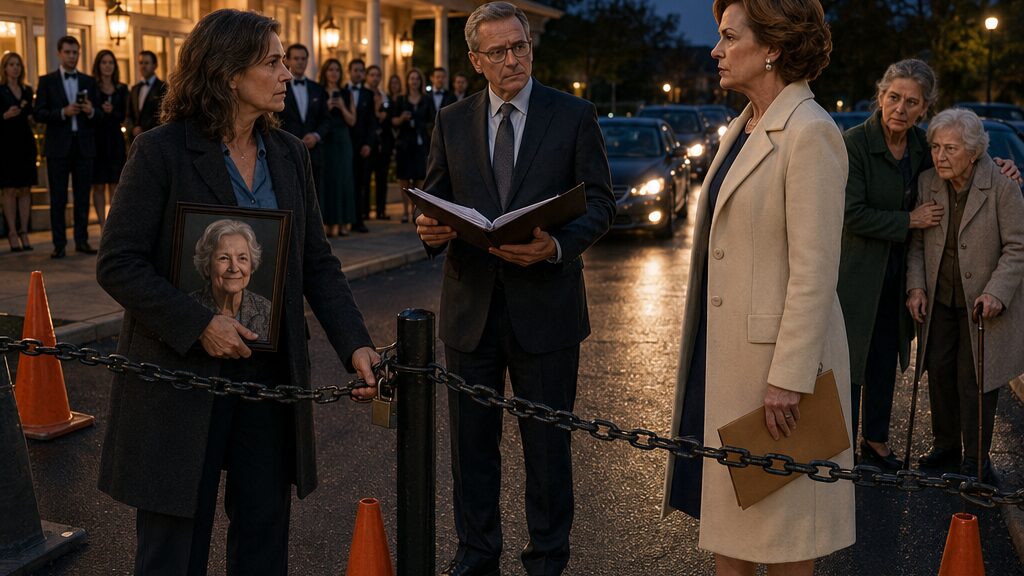
Christine pulled the chain across the entrance as the first valet reached for the latch.
“Ma’am, you can’t do that.”
She fastened the padlock through the steel post and checked the time on her phone.
6:58.
Behind the valet, headlights curved along Birchwood Lane. The first gala guests had begun arriving in a line of dark sedans and polished SUVs.
Christine stepped back from the chain.
Orange cones marked the disputed parcel from the entrance to the rear edge of the clubhouse. Reflective tape caught the headlights. A notarized notice was fixed to the center post in a clear plastic sleeve.
Betty’s framed photograph rested against the first cone.
The valet supervisor hurried from the porte cochere, his radio clipped to one shoulder.
“This entrance has to remain open.”
“Emergency access is available through the east service lane,” Christine said.
“This is the guest lot.”
“Not tonight.”
He looked at the photograph, then at the notice. “Is this some kind of protest?”
“It is a property restriction.”
Virginia appeared before he could answer.
She crossed the drive in a cream-colored coat over her formal dress, moving quickly but without running. Behind her, clubhouse windows glowed gold. Catering staff passed through the lobby carrying trays.
“What have you done?” she asked.
Christine handed her a copy of the recorded filing.
Virginia did not take it.
“Remove the chain.”
“The easement expired fourteen months ago.”
“That is not your decision.”
“It is the county record.”
A vehicle stopped behind the cones. Its driver lowered the window.
“Is the lot full?”
The valet supervisor raised one hand. “Please hold.”
More cars turned onto the street.
Virginia stepped closer to Christine. “You are grieving. I have tried to give you latitude, but this is irrational.”
The word traveled farther than she intended. Two board members approaching from the clubhouse heard it. So did the gala coordinator standing near the entrance.
Christine looked at her. “You fined a funeral wreath.”
“You violated exterior-display rules.”
“You used a policy that had not been adopted.”
“That matter is under review.”
“You kept the deposit before denying the application.”
“Accounting classifications are not my responsibility.”
“Your approval code is attached to the entry.”
Virginia’s face tightened. “This is not the time.”
“That is why it is effective.”
The first horn sounded.
Then another.
The association attorney arrived carrying a leather folder, his tie unfinished beneath his collar. Daniel followed several steps behind, pale and breathing hard.
The attorney read the notice at the post, then the stamped filing Christine handed him.
Virginia watched his face.
“Well?” she said.
He turned to Christine. “You recorded the probate transfer this morning?”
“At nine fourteen.”
“And served notice?”
“Email at ten last night. Personal service at six thirty. The board secretary signed.”
The attorney looked toward the boundary markers. “You preserved emergency access?”
“The service lane remains open.”
He read the easement language again.
Virginia’s voice lowered. “Tell her to open the lot.”
The attorney did not answer immediately.
A silence formed around them despite the growing noise of traffic.
“The recorded easement appears to have terminated,” he said at last.
Virginia stared at him.
“Appears?”
“The renewal was not filed. The reversion clause is explicit.”
“You knew about this.”
His mouth flattened. “I sent renewal reminders to the board office.”
“When?”
“Twice last year.”
Daniel looked down.
Virginia turned toward him. “Did you receive them?”
Daniel’s face had gone gray. “They were in the legal correspondence packet.”
“You told me there was nothing urgent.”
“I said the packet included routine renewals.”
“This was not routine.”
“You signed the cover sheet.”
The words struck with the force of a door closing.
A third horn sounded. The valet supervisor’s radio crackled with questions from staff stationed down the street.
Virginia faced Christine again. “Whatever grievance you have, you cannot sabotage a charity event.”
“I am restricting unauthorized use of my property.”
“There are three hundred guests coming.”
“My mother needed forty chairs.”
Virginia flinched, almost imperceptibly.
Christine had imagined this moment during every hour of preparation. She had expected relief when Virginia encountered a rule she could not bend. Instead, the scene felt strangely mechanical. The cones stood where she had placed them. The filing was valid. The attorney had confirmed it. Every part worked.
That should have been enough.
Then Jessica appeared beside the line of cars.
She was helping an elderly resident from the passenger seat of a sedan. The woman leaned heavily on a cane. Christine recognized her from Betty’s memorial. She had read the card thanking Betty for Christmas dinner.
“We were told valet parking was included,” the woman said. “I can’t walk from the overflow lot.”
A second vehicle held two residents who had brought flowers to the garage. Behind them sat a family with a child asleep against the window.
The gala was not composed only of sponsors, politicians, and Virginia’s invited donors. It included neighbors, memorial guests, volunteers, and people who had bought modest tickets because the fundraiser supported a regional food pantry.
Jessica looked across the chain at Christine.
She did not say I told you so.
That was worse.
The gala coordinator approached Virginia. “The caterer needs an unloading route. The service lane is blocked by the refrigerated truck.”
“Move it,” Virginia said.
“It can’t clear the turn without entering this parcel.”
Christine looked toward the truck. The service lane technically remained open, but the building’s design made it nearly useless while deliveries were underway.
The attorney spoke quietly. “A court might view continued closure differently if it creates an access or safety problem.”
“There is no emergency,” Christine said.
“Not yet.”
Virginia heard him. “You see? She has no right to endanger people.”
Christine turned on her. “Do not pretend this is concern. You knew the easement had lapsed.”
Virginia’s expression shifted.
Not surprise. Calculation.
Christine saw it before Virginia answered.
“You received the reminders,” Christine said.
Virginia glanced toward the waiting guests. “We intended to renew after the fiscal review.”
“You concealed it.”
“I postponed a filing.”
“Because the community-use condition would force disclosure of the clubhouse restrictions.”
“Because the board could not certify compliance while financial questions were unresolved.”
Daniel stared at her. “You told us legal had extended the deadline.”
“I told you we had time.”
“We didn’t.”
Virginia’s composure cracked at the edges. “If I had announced an expired easement, a deficit, deferred maintenance, and a contractor dispute at the same time, property values would have suffered. The special assessment would have passed. Patrick’s company would have collapsed. Half this board would have resigned.”
“And so you buried all of it.”
“I kept the association functioning.”
“You kept yourself in charge.”
The horns had stopped. Drivers were leaving their cars to see what had happened. Phones appeared. A small crowd gathered behind the cones.
Christine looked at Betty’s photograph beside the chain.
Her mother’s smile now faced a line of stranded neighbors.
The image did not look like vindication. It looked like an accusation.
Jessica helped the elderly woman toward the curb. “She needs somewhere to sit.”
Christine unlocked one end of the chain and opened a pedestrian gap.
Virginia said, “Open the entire lot.”
“No.”
“You have made your point.”
“That was never the purpose.”
But Christine heard the weakness in her own answer.
The association attorney stepped between them. “We need an emergency board session. Now. Before this becomes a public-safety issue or litigation.”
Virginia gestured toward the clubhouse. “I have a gala to run.”
Daniel spoke for the first time with something harder than caution. “No. You have a board to answer.”
Virginia looked at him as though he had changed languages.
Christine lifted Betty’s photograph from the ground. The glass was cold against her palm.
She allowed vehicles carrying mobility-impaired residents to enter one marked section under temporary written permission. The rest remained outside. Valets redirected cars toward a school lot six blocks away. The delayed guests entered in clusters, some angry, some curious, several recording the cones and notice.
The public reversal Christine had designed happened exactly as planned.
It gave her no peace.
Twenty minutes later, she entered the small board room behind the clubhouse kitchen. Music from the gala pressed faintly through the wall. Virginia sat at the head of the table. Daniel took a chair near the door. The association attorney opened his folder.
Christine placed Betty’s photograph on the table.
Then she set down two documents.
The first was her preliminary audit summary: inaccurate revenue reporting, unauthorized enforcement income, conflicted contracting, and undisclosed liabilities.
The second was a proposed easement agreement.
Virginia looked from one to the other.
“What do you want?” she asked.
Christine rested her hand on the new agreement.
For the first time that evening, the answer was no longer as simple as closing the gate.
Chapter 7: The Clubhouse Doors Opened for Betty
“I am withdrawing my demand to close the parking lot permanently.”
The words unsettled the hearing more than the demand itself had.
Six weeks after the gala, every folding chair in the clubhouse was occupied. Residents lined the rear wall beneath framed photographs of past board presidents. The same room Virginia had declared unsuitable for Betty’s wake now held an association hearing about the future of Betty’s land.
Christine stood at the front table with the new easement agreement closed beneath her hand. Betty’s photograph rested beside it, facing the room instead of the board.
Virginia sat three chairs away. She no longer wore the gold president’s badge. Her tan folder lay unopened in front of her.
One of the skeptical homeowners leaned toward the microphone. “So the lot stays open?”
“Under conditions,” Christine said.
A murmur passed through the room.
The interim board secretary asked her to continue.
Christine opened the agreement.
“The association receives a renewable ten-year easement. It cannot be transferred, pledged, or expanded without written consent from the property owner. Emergency access remains permanent. Ordinary resident use remains protected.”
Virginia folded her arms.
Christine read the next section.
“The association will submit to an independent financial review covering the previous six fiscal years. Future annual statements must report gross revenue before transfers or expense offsets. Contracts involving board members or their immediate families require disclosure, competitive bids, and approval by members not involved in the transaction.”
Patrick sat near the back. He kept his eyes on the floor.
“The wrongful memorial citations will be voided,” Christine continued. “The deposit will be refunded, along with every fine collected under policies that were not formally adopted.”
A woman near the aisle whispered, “Good.”
There was no applause. Christine was grateful for that. Applause would have made the room feel like another gala.
Virginia leaned toward her microphone. “You are using inherited property to rewrite association governance.”
Christine met her gaze. “I am setting terms for continued use of inherited property.”
“That distinction is convenient.”
“It is recorded.”
The association attorney shifted in his chair but said nothing.
Christine had spent the weeks since the gala revising the agreement. Her first draft had given her personal approval over clubhouse events. The second allowed her to suspend parking access for any violation. By the third draft, she had recognized Virginia’s methods appearing in her own language.
She deleted every clause that made Christine Walker the permanent judge of community worth.
In their place she required public procedures.
Jessica sat in the front row holding Betty’s box of welcome cards. When Christine glanced at her, Jessica gave one small nod.
Daniel rose from the treasurer’s table.
“I need to correct the record,” he said.
His voice shook enough that he steadied the microphone with both hands.
“The inaccurate reports were not created by Virginia alone. I signed them. I moved rental income into expense categories and approved revised statements after board votes.”
Several residents turned toward him.
Daniel looked at Christine, then away.
“I told myself I was delaying a special assessment until we could repair the deficit. I believed residents would panic if they saw the full numbers. No one threatened me. I chose not to explain what I had done.”
Virginia stared at him.
Daniel continued. “The missing twenty-three thousand dollars was not all stolen. Most of it paid documented repairs. But it was concealed from the membership, and some vendor payments lacked support. That was wrong.”
One homeowner called from the back, “Why didn’t you say something sooner?”
Daniel’s hands tightened around the microphone.
“Because every month I waited made admitting it more expensive.”
The room fell quiet.
Christine had expected his confession to feel like confirmation. Instead, it sounded painfully ordinary. No secret threat. No dramatic coercion. Only fear, delay, and the hope that a problem might become less shameful if hidden long enough.
The independent accountant’s preliminary findings lay in front of the interim board. They confirmed unsupported landscaping charges, improper revenue classification, and failures to disclose Patrick’s relationship to Virginia. They did not establish that every dollar had been diverted.
Patrick had agreed to repay the unsupported portion through a settlement and surrender the contract. His company would likely survive, though smaller than before.
Virginia requested the microphone.
“I accept responsibility for failing to renew the easement,” she said. “I accept that the contracting process should have been disclosed differently. I also accept removal from financial authority.”
She spoke as though reading terms from a document she disliked but understood.
Christine waited.
Virginia looked toward Betty’s photograph.
“What I will not accept is the claim that every decision I made was cruel.”
A few residents shifted in their chairs.
Virginia’s voice remained controlled. “The association faced drainage failure, insurance increases, and a deficit that would have forced some homeowners to sell. I made decisions to keep this place stable. Some were wrong. Some were necessary.”
“You fined funeral flowers,” Jessica said.
The board secretary reminded her to wait for recognition, but Virginia answered.
“I enforced restrictions that had been drafted for consistent application.”
“They had not been adopted,” Christine said.
“No. They had not.”
“Then why use them?”
Virginia’s eyes moved from Christine to the residents behind her.
“Because I believed an exception would make every future denial impossible.”
There it was—the explanation Christine had pursued since the day the rejection notice touched Betty’s photograph.
Not hatred. Not even indifference.
Fear of losing control.
Virginia continued. “People ask for exceptions when they are hurting. Their reasons are often real. But someone must decide where compassion ends and obligation begins.”
Christine thought of the chain across the parking entrance. Of the elderly woman leaning on her cane. Of the temporary access she had granted only after seeing consequences she could have predicted.
“Yes,” Christine said. “And whoever decides must be answerable to the people affected.”
Virginia’s mouth tightened.
“I regret the process,” she said. “I do not agree that protecting the association was cruelty.”
The apology would go no further.
Christine had once imagined forcing Virginia to say the exact words. She had drafted them privately: I used your mother’s death to prove my authority. I was cruel.
Now she understood that compelled language would not restore the garage, erase the fines, or give Betty back the room she should have had.
Christine turned to the interim board.
“The easement offer remains open for ten days. It requires the financial review, the refunds, conflict disclosures, an appeals process for enforcement actions, and guaranteed resident access to the clubhouse for memorials, support meetings, and emergency community needs.”
The skeptical homeowner near the microphone frowned. “Who decides whether an event qualifies?”
“A resident committee selected annually by lottery, subject to published standards and board appeal.”
“And you?”
“I retain only the property rights any owner would retain. I will not review event applications.”
That answer surprised several people.
It surprised Christine less than it would have six weeks earlier.
The interim board voted in public. Five members approved the agreement. One abstained. None opposed it.
The wrongful fines were canceled before the meeting ended. Refund checks had already been prepared: four hundred dollars for the wreath, two hundred for the flowers, seven hundred for the gathering, and three hundred for the deposit.
The board secretary handed Christine the envelopes.
She looked at the amounts.
For weeks, those numbers had felt like measurements of insult. Now they were only checks.
The money could be returned. The Saturday could not.
After the hearing, residents helped rearrange the room. The official table was folded and rolled into storage. The rows of chairs turned inward. The gala banners had been removed weeks earlier, leaving faint marks where tape had pulled at the paint.
Christine carried Betty’s photograph to the clubhouse entrance.
During the gala, it had rested against an orange cone outside a locked chain. Now she placed it on a small table just inside the open doors.
Jessica set the welcome-card box beside it.
“You sure about here?” she asked.
Christine adjusted the frame so Betty faced both the room and the parking lot beyond the glass.
“She should see who comes in.”
Jessica smiled. “She always did.”
Food arrived without a caterer. Neighbors carried crockpots, sandwich trays, paper plates, and three loaves of banana bread. The same elderly woman who had been stranded at the gala entered through the front doors with her cane and touched two fingers to Betty’s photograph.
Patrick came in last.
He paused beside Christine.
“I’m sorry about the flowers,” he said.
“You didn’t issue the citation.”
“No. But I let my mother keep fixing things for me until she thought fixing and deciding were the same.”
Christine looked at him. “You signed the invoices.”
“I know.”
It was not absolution. It was not nothing.
Daniel arrived with no folders and sat near the back. Virginia did not come.
The memorial began without a program. Jessica stood beside the food table and opened the card box.
Before reading, she placed a loaf of banana bread on a cutting board. Its crust had split down the center, just as Betty’s always had.
Christine reached into her pocket and unfolded the rain-damaged welcome card she had found beneath the clubhouse shrubs.
Only the first half remained.
You made this place feel like—
She set it beside Betty’s photograph.
For the first time since the hospital, Christine played her mother’s final voicemail all the way through.
Betty’s voice filled the small space near the entrance, soft and slightly breathless.
“Call when you can, sweetheart. Nothing urgent. I found those old property papers you asked about years ago. We should go through them. And don’t work through dinner again.”
A pause followed, then a quiet laugh.
“I made too much bread.”
The message ended.
Christine did not reach for her phone immediately. She stood with one hand resting on the table while the room continued around her—the scrape of chairs, low conversation, a knife moving through warm bread.
Jessica placed the first slice on a paper plate and held it out.
Christine took it.
The clubhouse doors remained open behind Betty’s photograph. Outside, cars crossed the parking lot without chains, valets, or permission from Christine. Inside, neighbors began telling stories that no report could classify and no rule could make orderly.
Christine sat among them before anyone had to ask.
The story has ended.