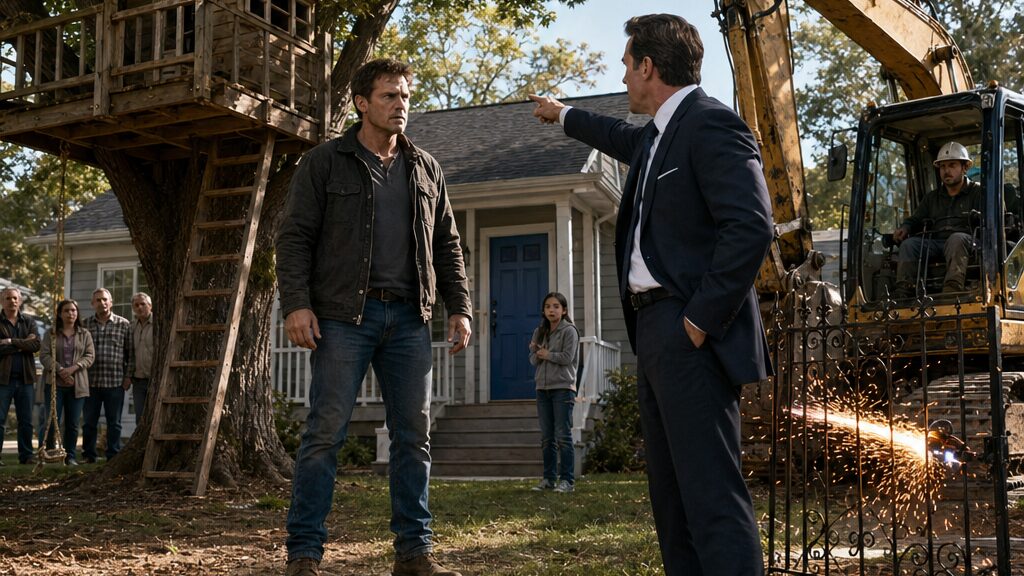
The Day They Came To Destroy My Son’s Treehouse Over Paint And Lost Everything
Chapter 1: The Door That Was One Shade Wrong
The notice was taped so neatly to the front door that it almost looked polite.
Andrew Harris spotted it the moment he stepped onto the porch with his coffee. Bright white paper against fresh blue paint.
He frowned.
The door had been painted two weeks earlier. He’d spent an entire Saturday sanding, priming, and painting it while Nicole sat in the treehouse behind the house, shouting color suggestions down from above.
He unfolded the notice.
VIOLATION OF COMMUNITY APPEARANCE STANDARDS.
His eyes moved lower.
PAINT COLOR DOES NOT MATCH APPROVED HOA PALETTE.
CORRECT WITHIN SEVEN DAYS.
He looked at the door.
Then at the color sample attached to the notice.
Then back at the door.
The difference was barely visible.
“You’ve got to be kidding.”
Behind him, a window opened.
Nicole leaned out.
“Dad?”
“Nothing.”
“What is it?”
He held up the paper.
Nicole groaned dramatically.
“The door thing again?”
Andrew laughed despite himself.
“Apparently.”
She disappeared from the window.
A moment later she burst through the front door.
She grabbed the notice and squinted at it.
“It looks exactly the same.”
“Not exactly.”
She stared.
Then stared harder.
Then looked up.
“I literally can’t tell.”
Andrew smiled.
“Neither can I.”
Nicole folded the paper.
“Throw it away.”
“If only it worked like that.”
Nicole rolled her eyes.
The treehouse stood behind them, rising from a large oak tree that shaded half the backyard.
Most people called it a treehouse.
Andrew never did.
To him it was something else.
A promise.
Three years earlier things had nearly fallen apart.
Long work hours.
Missed birthdays.
Too many promises postponed.
Too many moments delayed.
The treehouse had been the first thing he built after realizing he couldn’t keep saying “later.”
Nicole had helped paint every board.
Every crooked section had a memory attached to it.
Every scratch meant something.
That was why he never rushed repairs.
The structure mattered.
Not because it was expensive.
Because it wasn’t.
Because they had built it together.
Nicole handed the notice back.
“You’ll fix it?”
Andrew shrugged.
“Probably.”
That answer bothered him more than he expected.
Because it was always the answer.
Fix it.
Comply.
Move on.
For years the HOA had operated that way.
A complaint here.
A warning there.
Nothing major.
Nothing worth fighting.
Lately something had changed.
The notices arrived faster.
The language sounded harsher.
The board seemed eager to prove authority.
He just didn’t know why.
Three days later another envelope arrived.
This one wasn’t taped to the door.
It was certified mail.
Andrew opened it at the kitchen table.
His expression darkened.
Nicole noticed immediately.
“What happened?”
He read the letter again.
Then a third time.
“This doesn’t make sense.”
“What?”
“They scheduled a hearing.”
“A hearing?”
“About the paint.”
Nicole stared.
“An actual hearing?”
Andrew nodded.
“Apparently.”
That evening he walked through the neighborhood.
The streets were clean.
Lawns trimmed.
Flowers organized in perfect rows.
Everything looked normal.
Yet something felt different.
People waved less.
Conversations ended when certain topics appeared.
A neighbor who usually chatted for twenty minutes suddenly became busy when Andrew mentioned the HOA.
Another neighbor quietly advised him not to challenge anything.
“Just repaint the door.”
“It’s one shade.”
“I know.”
“Then why should I repaint it?”
The man looked around before answering.
“Because lately they don’t let things go.”
That answer lingered.
They.
Not the board.
Not specific people.
They.
As though the HOA had become something larger.
Something residents avoided discussing directly.
When Andrew returned home after dark, he found Nicole sitting in the treehouse.
The lights inside glowed softly.
A string of small battery lamps outlined the railings.
She had decorated the place herself.
Andrew climbed the ladder.
Nicole moved aside to make room.
Neither spoke for a minute.
The neighborhood looked peaceful from above.
Quiet.
Orderly.
Safe.
“Do you think they’ll make you repaint it?” Nicole asked.
“Maybe.”
She kicked one foot against the floorboards.
“That’s stupid.”
Andrew smiled.
“Probably.”
“What if they don’t stop?”
The question caught him off guard.
He looked at her.
“What do you mean?”
“First the door. Then something else.”
Andrew opened his mouth.
Closed it.
Because he didn’t have an answer.
Nicole looked toward the house.
Toward the blue door.
Then toward the yard.
Then finally at the treehouse.
“They won’t try to take this, right?”
The question settled heavily between them.
“No.”
His answer came immediately.
Too immediately.
Nicole seemed reassured.
Andrew wasn’t.
Two days later he received another certified envelope.
This one was thicker.
Much thicker.
He opened it standing at the mailbox.
His stomach tightened.
The letter referenced the hearing.
The paint violation.
Property compliance.
Architectural review.
Then he saw a sentence highlighted in yellow.
His eyes stopped.
The treehouse located on the property appears to lack documented HOA construction approval.
Subject structure may be subject to removal.
For a moment he simply stared.
The words felt absurd.
Then dangerous.
Then absurd again.
Nicole’s laughter drifted from the backyard.
Andrew looked toward the oak tree.
Toward the structure they had built together.
Toward the promise hanging between its branches.
When he looked back at the letter, his hands were no longer steady.
At the bottom was a date.
The hearing was scheduled for the following week.
And beneath that was a final line.
Failure to comply may result in enforcement action.
Chapter 2: The Hearing Nobody Expected
The meeting room was already full when Andrew arrived.
That alone felt wrong.
Nobody packed HOA hearings.
Most residents avoided them whenever possible.
Yet every chair was occupied.
People lined the walls.
Some pretended to check their phones.
Others stared at paperwork.
Almost nobody made eye contact.
Andrew took a seat near the center.
The atmosphere reminded him less of a neighborhood meeting and more of a courtroom.
Margaret Johnson sat at the front table.
Beside her were several board members.
And next to them sat a man Andrew had never seen before.
Dark suit.
Perfect haircut.
Expensive briefcase.
The man appeared entirely comfortable.
Margaret tapped a microphone.
“We’ll begin.”
Routine business came first.
Budget items.
Landscaping discussions.
Fence approvals.
Then Andrew’s name appeared on the agenda screen.
The room became noticeably quieter.
Margaret folded her hands.
“Mr. Harris, thank you for attending.”
Andrew stood.
“Of course.”
She smiled professionally.
“The board has concerns regarding multiple violations.”
“Multiple?”
Margaret nodded.
“The front door color.”
Andrew almost laughed.
Then she continued.
“And an undocumented elevated structure.”
The room shifted.
People knew exactly what she meant.
The treehouse.
Andrew glanced around.
Nobody looked surprised.
That bothered him.
Margaret gestured toward the man beside her.
“We’ve retained legal counsel to assist us.”
The stranger stood.
“Edward Baker.”
His voice carried easily.
“I represent the association.”
Andrew immediately disliked him.
Not because of anything specific.
Because Edward looked like someone who enjoyed being obeyed.
Edward opened a folder.
“The door color fails approved standards.”
He flipped a page.
“The treehouse lacks documented approval.”
“It was built years ago.”
“Without approval.”
“No one said approval was required.”
Edward smiled.
“A misunderstanding doesn’t create compliance.”
Several people lowered their eyes.
Andrew noticed.
Edward continued.
“Structures constructed outside regulations may be removed.”
Nicole’s face flashed through Andrew’s mind.
The lights.
The drawings.
The afternoons spent building.
“It’s a child’s treehouse.”
“It’s a structure.”
The answer arrived instantly.
Practiced.
Cold.
Andrew looked toward Margaret.
“You actually support this?”
Margaret hesitated.
Only briefly.
“Rules apply equally.”
Something about her tone sounded defensive.
As though she already knew how unreasonable this looked.
Andrew took a breath.
“I’m willing to discuss the paint.”
Edward interrupted.
“The structure must also be addressed.”
The room grew quieter.
A woman near the back shifted uncomfortably.
An older man stared at the floor.
Nobody spoke.
Nobody challenged anything.
And suddenly Andrew understood something.
This wasn’t the first time.
Maybe not the first hundredth.
The silence wasn’t agreement.
It was habit.
People expected resistance to fail.
That realization landed harder than any official warning.
Edward noticed Andrew looking around.
“Do you have something to add?”
Andrew met his gaze.
“Why is nobody talking?”
No one answered.
Edward smiled slightly.
“The matter concerns your property.”
“No. It concerns everybody.”
Margaret cleared her throat.
“Let’s remain focused.”
Andrew sat down.
But the question stayed in the room.
Half an hour later the hearing concluded.
Andrew expected a warning.
A deadline.
Something reasonable.
Instead Edward handed him a document.
Andrew scanned it.
His jaw tightened.
Thirty days.
Mandatory compliance.
Treehouse removal.
Potential enforcement action.
“What exactly does enforcement action mean?”
Edward’s expression never changed.
“The association reserves multiple remedies.”
“What remedies?”
“We’ll notify you when necessary.”
The answer felt intentionally vague.
As though uncertainty itself was part of the strategy.
Outside the building people scattered quickly.
Nobody lingered.
Nobody wanted conversations.
Andrew walked toward his truck.
A voice stopped him.
“Don’t take it personally.”
Margaret stood several feet away.
Andrew turned.
“You want me to take this professionally?”
She looked tired.
Not cruel.
Tired.
“The neighborhood has standards.”
“It’s a treehouse.”
“It’s about consistency.”
“No.”
Andrew shook his head.
“It’s about power.”
Margaret’s expression hardened.
“Be careful, Andrew.”
“Why?”
“Because once things start moving, they’re difficult to stop.”
She walked away before he could respond.
The warning felt strangely genuine.
That worried him even more.
Three days later another envelope arrived.
Andrew opened it immediately.
The document inside contained a revised timeline.
His stomach dropped.
The thirty-day compliance period had vanished.
Enforcement had been accelerated.
The treehouse was now scheduled for removal.
A specific date.
A specific time.
At the bottom sat a company name.
Heavy equipment contractor.
Andrew stared at the page.
Then at the oak tree outside.
Then back at the page.
Nicole entered the room.
One look at his face told her enough.
“What happened?”
Andrew handed her the notice.
She read silently.
By the time she reached the bottom, her eyes had widened.
“They can’t.”
“I know.”
“They really can’t.”
Andrew wished he shared her certainty.
Because for the first time, he wasn’t sure what they might do.
Outside, beyond the kitchen window, the treehouse stood quietly among the branches.
Waiting.
Chapter 3: Stories Nobody Wanted To Tell
Dennis Rivera appeared at Andrew’s driveway before sunrise.
That alone was unusual.
Dennis avoided conflict with almost professional dedication.
If a disagreement started at a neighborhood barbecue, Dennis somehow found a reason to refill his drink elsewhere.
Yet here he was.
Standing beside his truck.
Looking nervous.
Andrew stepped outside.
“Everything okay?”
Dennis glanced around before speaking.
“No.”
That answer surprised him.
Dennis held up a manila folder.
“I think you should see this.”
They sat at the picnic table beneath the oak tree.
Nicole remained inside.
School had started an hour earlier.
Dennis placed the folder between them.
His hands lingered on it for a second.
As if letting go carried consequences.
“What is it?”
“Old notices.”
Andrew opened it.
Letters.
Violation reports.
Warnings.
Fines.
Some were years old.
Different addresses.
Different residents.
Different complaints.
But the language looked familiar.
Threatening.
Certain.
Final.
Andrew flipped through page after page.
“Why do you have these?”
Dennis looked embarrassed.
“I kept everything.”
“Everything?”
“I was one of them.”
Andrew stopped.
Dennis stared toward the street.
“They came after me six years ago.”
“For what?”
“A workshop.”
Andrew blinked.
“A workshop?”
“I built a small woodworking shed.”
Dennis laughed bitterly.
“Nothing fancy.”
“What happened?”
“They said it violated appearance standards.”
Andrew continued reading.
The file contained photographs.
Measurements.
Letters.
Threats.
“So what did you do?”
Dennis rubbed his forehead.
“I tore it down.”
The answer came quietly.
Almost ashamed.
Andrew looked up.
“You could have fought it.”
Dennis gave him a tired smile.
“That’s what I thought at first.”
He reached into the folder.
Pulled out another notice.
Then another.
Then another.
Different residents.
Different years.
Same result.
“They always win.”
Andrew examined the papers.
Some notices referenced legal action.
Others referenced fines.
One referenced property seizure procedures.
Most ended with compliance.
Not because residents agreed.
Because they surrendered.
Something cold settled in Andrew’s stomach.
The HOA’s real weapon wasn’t authority.
It was exhaustion.
Dennis pointed toward a specific letter.
“I want you to read that one.”
Andrew unfolded it.
Halfway through, he frowned.
The wording sounded oddly familiar.
Not similar.
Identical.
Entire paragraphs repeated from notices he had received.
Dates changed.
Names changed.
Everything else remained the same.
Almost like templates.
“That’s strange.”
Dennis nodded.
“It gets stranger.”
He produced another file.
Older.
Thicker.
Inside were complaints submitted by residents.
Appeals.
Requests.
Questions.
Many received no response.
Others were denied immediately.
Andrew flipped through dozens of pages.
A pattern emerged.
The HOA rarely explained itself.
It simply declared.
And residents obeyed.
A vehicle slowed near the curb.
Dennis immediately lowered his voice.
That reaction told Andrew everything.
People were afraid.
Not terrified.
Not panicked.
Just conditioned.
Like employees around an unpredictable manager.
The realization angered him more than any letter.
Because he suddenly saw himself inside the pattern.
Years of quiet compliance.
Years of repainting fences.
Adjusting flower beds.
Replacing mailbox numbers.
Not because he agreed.
Because arguing seemed pointless.
Dennis watched him carefully.
“I almost didn’t come.”
“Why did you?”
Dennis looked up at the treehouse.
“My grandson loves that thing.”
Andrew followed his gaze.
The structure sat high above them.
Bright paint.
Handmade railings.
A small flag Nicole had attached last summer.
Dennis smiled slightly.
“My grandson says it’s the coolest thing in the neighborhood.”
For the first time that morning, Andrew smiled.
Then Dennis reached into the folder again.
His expression changed.
“This is the part that bothered me.”
He handed over several documents.
Recent ones.
Very recent.
Andrew read.
His eyes narrowed.
Violation activity had increased dramatically during the past year.
Three times higher than previous periods.
Dozens of complaints.
Accelerated enforcement.
New legal notices.
A different tone.
A different strategy.
“What changed?”
Dennis shrugged.
“I don’t know.”
But Andrew suspected someone did.
That afternoon another certified envelope arrived.
He didn’t even feel surprised anymore.
He opened it at the kitchen counter.
Additional penalties.
Additional fees.
Additional deadlines.
The amount had nearly doubled.
Nicole watched from across the room.
“Are they trying to make you quit?”
The question sounded childish.
And completely accurate.
Andrew folded the notice.
Maybe that was exactly the goal.
Not victory.
Submission.
A few hours later he returned to Dennis’s folder.
Reading more carefully.
Cross-checking dates.
Names.
Signatures.
One signature appeared repeatedly.
Edward Baker.
Not on every document.
Only the recent ones.
The aggressive ones.
The accelerated ones.
Andrew studied the name.
Something felt off.
Not wrong.
Just familiar in a way he couldn’t place.
His phone buzzed.
A message from Dennis.
Found something else. Check page 43.
Andrew flipped quickly.
Page 43 contained a photocopy of a letter.
At the bottom sat a legal identification number.
A professional registration reference.
Andrew stared at it.
Then looked again.
Something about it seemed incomplete.
Missing.
Not formatted correctly.
He opened a browser.
Typed the number.
Nothing appeared.
No result.
No listing.
No record.
The screen remained blank.
Andrew slowly sat back in his chair.
Outside, the treehouse stood against the evening sky.
Inside, a new question had replaced every other one.
Who exactly was Edward Baker?
Chapter 4: The Man Calling Himself A Lawyer
The search result remained blank.
Andrew refreshed the page.
Still nothing.
He entered the identification number again, carefully checking every digit.
Nothing.
The legal registration number attached to Edward Baker’s documents simply did not exist.
For a long moment Andrew sat motionless at the kitchen table.
The house was quiet except for the faint hum of the refrigerator.
Outside, Nicole’s treehouse rose above the fence line.
The sight usually calmed him.
Tonight it did the opposite.
If Edward wasn’t who he claimed to be, then the entire situation had changed.
The problem was proving it.
The next morning Andrew drove to the county records office.
He almost turned around twice.
That was what he always did when conflict became complicated.
He found reasons to wait.
Reasons to postpone.
Reasons to avoid.
But every time he pictured the demolition notice, he kept driving.
The clerk behind the counter listened patiently while he explained.
“I’m trying to verify an attorney registration.”
The clerk nodded.
“Name?”
“Edward Baker.”
She typed.
Waited.
Typed again.
Then frowned.
“Can you spell it?”
Andrew did.
The clerk searched a second database.
Then a third.
The frown deepened.
“That’s strange.”
Andrew felt his pulse quicken.
“What is?”
“I’m not finding an active license.”
His stomach tightened.
“Maybe it’s under another office?”
The clerk checked.
“No.”
She looked at him carefully.
“Are you sure he’s practicing law?”
“He says he is.”
The clerk hesitated.
“I can’t tell you more than that.”
Andrew nodded.
He understood.
But he didn’t need more.
The absence itself meant something.
Outside the building he called Dennis.
Dennis answered immediately.
“You find anything?”
“Maybe.”
“What kind of maybe?”
“The kind that gets interesting.”
An hour later they sat inside Dennis’s garage surrounded by old files.
Dennis listened while Andrew explained.
When he finished, Dennis let out a slow whistle.
“So the guy threatening everybody might not even be a lawyer.”
“Looks that way.”
Dennis rubbed his jaw.
“That would explain a lot.”
“Like what?”
“He never talks specifics.”
Andrew realized Dennis was right.
Edward constantly referenced authority.
Rules.
Consequences.
Liability.
But he rarely cited anything concrete.
The language always sounded legal.
Never specific.
A knock interrupted them.
Both men turned.
A neighbor stood at the open garage door.
The woman looked nervous.
“I heard you two were asking questions.”
Dennis exchanged a glance with Andrew.
The neighbor stepped inside.
Then another person appeared behind her.
Then another.
Not many.
Just three residents.
But it felt significant.
Because people were finally talking.
The first neighbor produced a stack of notices.
“I kept mine.”
Another brought photographs.
The third brought emails.
For nearly two hours they compared documents.
Patterns emerged everywhere.
Identical language.
Repeated threats.
Accelerated deadlines.
Residents pressured into expensive compliance projects.
And Edward’s name appeared constantly.
The more evidence Andrew saw, the less this felt like a dispute about paint.
It felt like a system.
One built on intimidation.
Late that afternoon his phone rang.
Edward.
Andrew answered.
“Hello.”
“Mr. Harris.”
Edward sounded perfectly calm.
“Am I interrupting?”
“No.”
“I wanted to discuss your continued noncompliance.”
Andrew leaned back in his chair.
“Funny. I wanted to discuss your credentials.”
Silence.
Only a second.
But enough.
Then Edward laughed lightly.
“I don’t know what that means.”
“Really?”
Another pause.
This one longer.
When Edward spoke again, his voice had cooled.
“The association remains prepared to enforce its rights.”
“Your rights or theirs?”
“I suggest you focus on your own situation.”
The call ended.
Andrew stared at the phone.
For the first time since this began, Edward sounded rattled.
It wasn’t proof.
But it mattered.
That evening Andrew walked through the backyard.
The oak tree cast long shadows across the grass.
Nicole sat in the treehouse reading.
She looked down.
“You okay?”
“Working on it.”
She studied him.
“You look different.”
Andrew smiled.
“How?”
“Like you’re mad.”
The answer surprised him.
Because she was right.
Not furious.
Not reckless.
Just done.
Done pretending everything would solve itself.
Done believing compliance would earn fairness.
For years he’d tried to avoid conflict.
All it had earned him was more conflict.
His phone buzzed.
A new email.
He opened it immediately.
The message came from the HOA.
Attached was an updated enforcement schedule.
Andrew’s expression darkened.
The demolition date had changed.
Moved forward.
Three days sooner.
Heavy equipment was scheduled to arrive the next morning.
Chapter 5: The Cameras Nobody Noticed
Andrew was on a ladder before sunrise.
Nicole opened the back door and blinked at him.
“Dad?”
He tightened a mounting bracket.
“Morning.”
“What are you doing?”
“Preparing.”
She stepped into the yard.
Only then did she notice the small camera fixed beneath the eaves.
Then another near the garage.
Then another overlooking the gate.
“You had cameras this whole time?”
“Most of them.”
The system had been installed years earlier after a string of neighborhood thefts.
The cameras were legal, documented, and properly positioned.
Andrew simply hadn’t paid much attention to them recently.
Now they mattered.
Every angle of the property appeared on his phone.
The front gate.
The driveway.
The yard.
The treehouse.
Everything.
Nicole looked toward the street.
“You think they’ll really come?”
Andrew didn’t answer immediately.
Because he no longer doubted it.
“They might.”
Nicole swallowed.
Then nodded.
No argument.
No denial.
The reality had finally reached her.
By midmorning Andrew sat at the kitchen table reviewing camera feeds.
Dennis arrived carrying coffee and concern.
“You look like you haven’t slept.”
“Close enough.”
Dennis placed a folder on the table.
“More complaints.”
Andrew almost laughed.
“There are still more?”
“Apparently.”
The stack contained recent enforcement notices.
Several residents had received warnings within the last month.
Most never challenged them.
Some paid immediately.
Others complied without protest.
The pattern remained the same.
Fear first.
Questions later.
If any questions came at all.
A truck rolled slowly past the house.
Andrew watched through the window.
The driver stared toward the property.
Then continued.
Minutes later another vehicle passed.
Then another.
Word was spreading.
People were watching.
The situation no longer belonged entirely to Andrew.
That realization gave him an idea.
By noon he had connected the security system to a public livestream.
Nothing dramatic.
Just a continuous feed documenting events if enforcement crews arrived.
Dennis looked skeptical.
“You think people will watch?”
“Probably not.”
An hour later more than a hundred viewers were connected.
By late afternoon the number passed five hundred.
Comments began appearing.
People shared the link.
Others recognized similar HOA stories.
The audience kept growing.
Andrew stared at the screen.
He hadn’t expected this.
Neither had Dennis.
“Maybe people are tired of being pushed around.”
Andrew nodded.
Maybe they were.
The first real sign of trouble arrived shortly before sunset.
A contractor’s truck stopped outside the property.
Two men stepped out.
Neither entered the yard.
Neither spoke.
They simply examined the treehouse.
Measured distances.
Photographed the gate.
Then left.
The visit lasted less than ten minutes.
Yet it felt like a countdown.
That night Nicole climbed into the treehouse one last time before bed.
Andrew watched from below.
The small lights glowed softly.
Eventually she climbed down.
“Do you remember building it?”
She asked the question quietly.
Andrew smiled.
“Every piece.”
“You got the ladder wrong.”
“I did.”
“You put a board backward.”
“I did that too.”
Nicole laughed.
“And I spilled paint.”
“A lot of paint.”
The laughter faded.
She looked up.
“What if they win?”
Andrew followed her gaze.
For a moment he saw not the treehouse.
But the years inside it.
The repairs.
The conversations.
The promises kept.
Then he looked at his daughter.
“They don’t get to decide everything.”
Nicole nodded slowly.
The answer seemed to help.
Even if neither of them knew exactly what came next.
Near midnight Andrew checked the livestream.
The audience remained active.
Thousands of views now.
Far more than expected.
The story was spreading.
His phone vibrated.
A new message appeared from an unknown number.
Tomorrow.
8:00 a.m.
Full enforcement crew.
Andrew stared at the screen.
No signature.
No explanation.
Just the warning.
At dawn the next morning the first engine noise echoed down the street.
Andrew stepped outside.
Nicole appeared beside him.
The camera feeds were already running.
The livestream audience was growing by the minute.
At the end of the road, heavy equipment turned the corner.
And behind it came a truck carrying a plasma cutter.
Its bright metal housing gleamed in the morning light as it rolled steadily toward Andrew’s artistic gate.
Chapter 6: The Crowbar In The Gears
The first sparks appeared before anyone knocked on the door.
Andrew watched them through the camera feed on his phone.
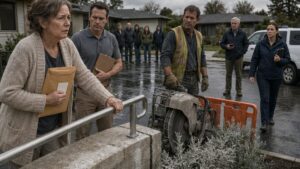
Orange bursts flashed from the testing arc of the plasma cutter as workers prepared equipment near the curb.
Viewers on the livestream surged into the thousands.
Comments scrolled so quickly they became unreadable.
Nicole stood beside him on the porch.
Neither spoke.
The machinery itself said enough.
An excavator rumbled into position.
A contractor’s truck backed toward the property line.
Workers unloaded barriers.
Cables.
Tools.
Everything looked organized.
Prepared.
Planned.
Then Edward Baker stepped out of a black luxury sedan.
Perfect suit.
Perfect confidence.
As though he were arriving for a business meeting.
Not a confrontation.
Dennis emerged from across the street.
Several neighbors appeared near their driveways.
Others watched from windows.
Nobody looked comfortable.
But unlike before, they were watching openly.
Edward approached the gate.
“Mr. Harris.”
Andrew remained where he was.
“You brought an excavator.”
“You left us no alternative.”
The statement sounded rehearsed.
Andrew held up his phone.
“The whole thing is being recorded.”
Edward glanced briefly at the screen.
“If you’re attempting intimidation, it won’t work.”
Andrew almost laughed.
The irony was impossible to miss.
Workers rolled the plasma cutter closer.
The machine emitted a sharp electrical hiss.
Nicole instinctively stepped backward.
Andrew felt anger rise.
Not sudden anger.
Accumulated anger.
Months.
Years.
Every small surrender.
Every quiet compromise.
Every time he had convinced himself avoiding conflict would keep the peace.
Edward produced paperwork.
“The association is proceeding with enforcement.”
Andrew didn’t take it.
“You’ve already moved the deadline twice.”
“Compliance remained incomplete.”
“And your authority?”
Edward’s expression barely changed.
“Excuse me?”
“The attorney license you don’t have.”
For the first time all morning, something flickered across Edward’s face.
Not panic.
Recognition.
Several neighbors exchanged glances.
The workers paused.
Only briefly.
Then Edward recovered.
“This isn’t relevant.”
“It becomes relevant when you pretend to be something you’re not.”
Margaret Johnson arrived moments later.
She looked far less confident than Edward.
The board president moved quickly toward him.
“What is he talking about?”
Edward lowered his voice.
Andrew couldn’t hear the words.
But he saw Margaret’s reaction.
Confusion.
Then concern.
Then irritation.
The livestream comments exploded.
More viewers joined.
More screenshots circulated.
The situation was slipping beyond anyone’s control.
Edward noticed.
His voice sharpened.
“Proceed.”
The order went to the crew.
The plasma cutter operator moved toward the artistic metal gate.
The machine crackled.
Bright sparks sprayed across the air.
Nicole grabbed Andrew’s arm.
“Dad.”
The decorative gate wasn’t expensive.
But Andrew had built it himself.
Hand-forged sections.
Custom designs.
Weekend after weekend of work.
The same hands that built the treehouse had built the gate.
The sparks landed against metal.
The livestream audience surged higher.
Then something unexpected happened.
Dennis stepped forward.
“Stop.”
Everyone turned.
Dennis looked terrified.
But he kept walking.
“You threatened me too.”
Edward stared.
“What?”
“You threatened half the neighborhood.”
More residents emerged.
One by one.
The woman who had brought violation notices.
The older man from the hearings.
Others.
Not cheering.
Not dramatic.
Just standing there.
Visible.
Edward suddenly looked smaller.
Not physically.
Socially.
His authority depended on isolation.
The crowd was removing it.
Margaret stepped toward him.
“Edward, do you have documentation for this?”
“Of course.”
“Then show me.”
Edward hesitated.
Only a moment.
But everyone saw it.
The pause spread through the crowd like a crack through glass.
Andrew looked at the treehouse.
At Nicole.
At the cameras.
At the machine.
And suddenly understood what he was really protecting.
Not lumber.
Not property.
A promise.
Years ago he had nearly lost his daughter’s trust.
The treehouse wasn’t proof he had fixed everything.
It was proof he had tried.
That mattered.
The excavator engine roared.
The operator had apparently received new instructions.
The machine rolled forward.
Its tracks crossed the edge of Andrew’s property.
The crowd shouted.
Someone yelled for it to stop.
It didn’t.
Fear hit Andrew first.
Then clarity.
He saw the heavy steel crowbar lying near the workshop.
One motion.
One decision.
No more waiting.
No more hoping someone else would solve it.
Andrew ran.
He grabbed the crowbar.
The excavator continued advancing.
The treehouse stood directly behind it.
The operator looked uncertain.
Edward shouted something.
The machine kept moving.
Andrew hurled the crowbar with everything he had.
Metal slammed into the track assembly.
For one strange second nothing happened.
Then the excavator screamed.
A violent grinding shriek erupted from beneath the machine.
Tracks locked.
Gears jammed.
Black smoke exploded upward.
The operator killed the throttle.
Too late.
The machine lurched sideways and died.
The entire street fell silent.
Even the livestream comments seemed irrelevant for a moment.
Andrew stood breathing hard.
The excavator sat motionless.
The treehouse remained untouched.
Then phones began ringing.
One worker answered first.
Then another.
Then Margaret.
Her face drained of color.
She turned toward Edward.
“What did you do?”
Edward didn’t answer.
His own phone was ringing now.
And ringing.
And ringing.
Finally he answered.
Andrew couldn’t hear the voice.
But he could hear enough.
City officials.
Emergency review.
Immediate suspension discussions.
Questions.
Lots of questions.
The livestream viewer count climbed higher still.
Then Andrew’s phone vibrated.
A new incoming call.
The caller identification read:
Mayor’s Office.
Chapter 7: What Remained Standing
Edward Baker answered one call after another.
Each conversation seemed worse than the last.
The confidence that had carried him through hearings, notices, and threats was disappearing in real time.
Andrew watched from a distance.
The mayor’s office remained on his own phone.
A staff member spoke calmly.
They had been alerted by the livestream.
The city had received complaints.
Officials were reviewing the situation immediately.
Andrew answered questions.
Property boundaries.
Demolition authority.
The timeline of events.
Nothing dramatic.
Just facts.
When the call ended, he lowered the phone and looked around.
The street felt different.
Not because the conflict was over.
Because people had stopped pretending they couldn’t see it.
Residents stood openly in their driveways.
Some were still watching the stalled excavator.
Others were speaking to reporters who had begun arriving after the livestream exploded across social media.
Margaret Johnson looked exhausted.
She approached Andrew carefully.
For the first time since this began, she seemed less like a board president and more like a neighbor who had made a terrible mistake.
“Andrew.”
He turned toward her.
She glanced at the treehouse.
Then at the damaged excavator.
Then at Edward.
“I didn’t know.”
The words were quiet.
Andrew believed she meant them.
Not entirely.
But enough.
“You approved this.”
Margaret nodded slowly.
“I approved enforcement.”
She swallowed.
“I didn’t approve this.”
Andrew looked toward the machinery.
The crew.
The plasma cutter.
The threat that had arrived at his property before sunrise.
“What exactly did you think would happen?”
Margaret had no answer.
That silence told him more than any explanation could.
Across the street Dennis was speaking with several residents.
The small cluster kept growing.
One neighbor produced old notices.
Another carried a folder.
Someone else brought photographs.
Years of quiet compliance were suddenly being discussed in public.
The fear that had kept people isolated was breaking apart.
Edward ended another phone call.
His face had gone pale.
Margaret walked directly toward him.
The argument that followed wasn’t loud.
But everyone could see it.
Edward gestured repeatedly.
Margaret shook her head.
Several board members who had arrived during the chaos stood nearby.
None appeared eager to defend him.
A reporter approached Andrew.
“Did you expect this much attention?”
Andrew looked toward the treehouse.
“No.”
“Why didn’t you remove it when ordered?”
The question lingered.
Andrew glanced at Nicole.
She sat halfway up the ladder, listening.
Then he answered.
“Because some things matter more than convenience.”
The reporter waited for more.
Andrew didn’t elaborate.
He didn’t need to.
The treehouse explained itself.
By afternoon the official announcements began arriving.
First came notification of an emergency review.
Then suspension of all pending enforcement actions.
Then confirmation that the HOA board’s authority had been temporarily frozen pending investigation.
The crowd reacted with surprise.
Dennis laughed aloud.
A sound Andrew wasn’t sure he had ever heard from him before.
“You seeing this?”
Andrew nodded.
Dennis held up his phone.
“The comments are insane.”
The livestream numbers were still climbing.
Millions of views now.
Yet strangely, Andrew cared less about that than he had earlier.
The attention wasn’t the victory.
The treehouse was still standing.
That was.
Late in the afternoon a tow truck arrived for the disabled excavator.
The operator examined the damaged track assembly and shook his head.
The recovery process took time.
Confusion followed.
Orders changed repeatedly.
Workers rushed.
Vehicles moved.
Nobody seemed coordinated anymore.
Then came the final piece of chaos.
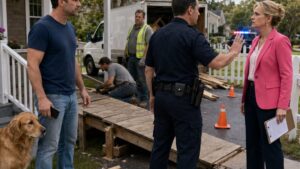
Edward’s luxury sedan sat near the curb while crews prepared to leave.
The excavator operator, attempting to reposition another vehicle during the disorganized retreat, misjudged the distance.
Someone shouted.
Too late.
Metal collided with metal.
The sound echoed down the street.
Edward spun around.
His expression transformed instantly.
The heavy machine had backed directly into the side of his car.
Glass shattered.
The door crumpled inward.
A second impact crushed the front quarter panel.
The entire street froze.
For one surreal second nobody spoke.
Then a few gasps escaped the crowd.
Dennis stared.
“You’re kidding.”
Edward wasn’t speaking.
He simply looked at the wreck.
The expensive car that had arrived polished and immaculate now resembled twisted scrap.
The irony was impossible to miss.
His own operation had destroyed it.
No one laughed.
Not openly.
The moment didn’t need commentary.
The image said enough.
By sunset the machinery was gone.
The crews were gone.
The reporters were leaving.
Only neighbors remained.
People who had lived beside one another for years without really speaking.
Now conversations stretched across driveways.
Residents compared stories.
Violation notices.
Threats.
Warnings.
Experiences they had once kept private.
Nicole climbed fully into the treehouse.
She sat on the platform with her legs hanging over the edge.
Andrew joined her a few minutes later.
The ladder creaked beneath his weight.
The view looked exactly as it always had.
The same streets.
The same roofs.
The same neighborhood.
Yet something had changed.
Nicole leaned against the railing.
“They didn’t get it.”
“No.”
“They really didn’t.”
Andrew smiled.
“No.”
For a while they sat quietly.
The small battery lights flickered on as evening settled.
The same lights Nicole had installed herself.
The same lights that had glowed through countless nights.
Three years earlier Andrew had built the treehouse because he was afraid.
Afraid he was becoming the kind of father who always promised later.
Afraid opportunities would disappear while he worked.
Afraid trust once lost might never return.
The structure had never solved those fears.
But it reminded him every day to keep trying.
That was why he couldn’t let it go.
Not because it was wood and nails.
Because it represented a choice.
One he intended to keep making.
Nicole rested her chin on her knees.
“Dad?”
“Yeah?”
“You were scared today.”
Andrew laughed softly.
“A little.”
“A lot.”
“Maybe.”
She smiled.
“I was too.”
The honesty felt important.
Neither pretending.
Neither hiding.
Just telling the truth.
Andrew looked out over the neighborhood.
The front door remained exactly the same shade it had been when all this started.
One shade outside approval.
One shade that had somehow exposed an entire system.
He thought about how long he had spent avoiding conflict.
How many notices he had accepted.
How many times he had convinced himself that peace required surrender.
The lesson felt obvious now.
Peace built on fear wasn’t peace.
It was permission.
And every time someone granted it, the demands grew larger.
Below them, neighbors continued talking.
The conversations sounded lighter now.
Freer.
Dennis waved from across the yard.
Andrew waved back.
For the first time since the first notice appeared on his door, he felt no pressure waiting around the corner.
No hearing.
No deadline.
No threat.
Just evening.
Just family.
Just a treehouse standing exactly where it belonged.
Long after darkness settled over the neighborhood, the structure remained visible against the sky.
Untouched.
Unmoved.
Standing.
The story has ended.