They Moved My Property Line by Two Feet, but the Orange Stakes Remembered Everything
Chapter 1: The Backhoe Was Already Beside My Mailbox
The first sound was not an engine.
It was steel striking stone.
I was standing at the kitchen counter with one hand around a coffee mug when the impact came through the front windows—a hard metallic crack followed by the grind of something heavy dragging across gravel.
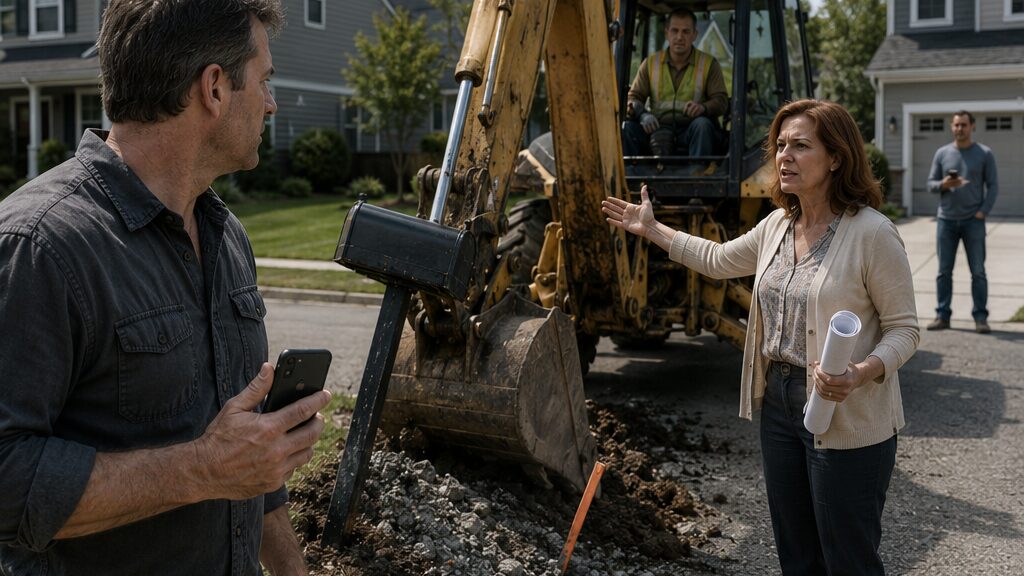
By the time I reached the porch, a yellow backhoe had its bucket lowered beside my mailbox.
For one second I simply stared.
The black mailbox leaned toward the street at an angle it had not held ten minutes earlier. A crescent of fresh dirt had been peeled away beside the curb. White landscaping stone lay mixed with darker soil, and one of the orange survey stakes that had stood near the edge of the strip for years was bent almost flat beneath the machine’s front tire.
Sharon Williams stood beside the bucket with a rolled site plan in one hand.
“Take the rest of it,” she called to the operator. “All the gravel to the new line.”
I was halfway across the lawn before I realized I had left the front door open.
“Stop.”
The operator looked at me first. Sharon did not.
“Stop the machine.”
This time he lifted his hands from the controls.
Sharon turned slowly.
She lived next door. I had known her for nine years, long enough to recognize the expression she used when she had already decided disagreement was a procedural defect.
“David,” she said, “you were notified.”
“About landscaping.”
“About the frontage project.”
“That bucket is on my property.”
A neighbor across the cul-de-sac had come outside barefoot. Another stood near a garage with a phone held at chest level. I could feel their attention gathering before anyone spoke.
Sharon unrolled the paper against her hip.
“The board approved a continuous maintenance line along the street.”
“The board doesn’t move my property line.”
“No one moved your property line.”
I pointed at the bent orange stake.
Her eyes flicked toward it and away.
“That marker is old.”
“That marker is a survey stake.”
“It’s spray-painted wood.”
“It has been there six years.”
The operator shifted in his seat. “Ma’am, you want me to—”
“No,” I said.
Sharon’s head snapped toward me.
I took out my phone.
That small movement changed the scene more than shouting would have. I photographed the bucket. Then the mailbox. Then the tire over the bent stake. I stepped sideways until the curb, the machine, and the orange marker were all visible in one frame.
Sharon folded her arms.
“You’re making this unnecessarily dramatic.”
“You have been told the boundary is disputed.”
“It isn’t disputed.”
“It is now.”
She gave a short laugh. “The HOA already settled it.”
The words landed strangely.
I lowered the phone.
“How?”
“At the June meeting. The board voted to standardize the maintenance strip from the entrance through the cul-de-sac. Same gravel. Same drainage edge. Same setbacks.”
“That is not an answer.”
“It is the answer.”
“A maintenance vote does not transfer title.”
Her jaw tightened.
For years Sharon had been the kind of board member who arrived with extra copies of everything. When the previous president resigned after a reserve-fund fight, she stepped into the role with the energy of someone cleaning up after careless people. Some neighbors appreciated it. Some mocked her. I had mostly stayed out of her way.
That morning she looked less like a neighbor than someone standing behind an office counter.
“The association has maintained this frontage for years,” she said. “You know that.”
“I know what my deed says.”
“Do you?”
The question was quiet enough that I almost missed the challenge inside it.
I moved toward the road.
The operator lowered one boot onto the step of the machine, uncertain whether he was leaving or waiting. I stopped near the bucket—not under it, not touching it, just close enough to make continuing impossible without a conscious decision.
“Sir,” I said to him, “I am telling you directly that ownership of this strip is disputed. I am also telling you I have a recorded boundary survey. If you continue excavation after that notice, document that I objected.”
He looked at Sharon.
“Is that true?”
She answered too quickly.
“He’s had months to raise concerns.”
“That isn’t what I asked.”
Her face reddened.
I held my phone up, still recording.
The operator killed the engine.
The sudden quiet was enormous.
A lawn sprinkler clicked somewhere down the street.
Sharon walked toward me until only a few feet separated us.
“You think this makes you look reasonable?”
“I’m not trying to look reasonable.”
“That part is obvious.”
I felt the old heat rise into my throat. I wanted to tell her exactly what I thought of a board that confused matching gravel with ownership. I wanted the neighbors to hear it. I wanted, for reasons I did not examine, to make her feel small.
Instead I took another photograph.
Her mouth tightened.
“Court date is Thursday,” she said.
I stared at her.
The hearing had begun as a narrow request over access for the frontage project. I had filed an objection weeks earlier, after noticing the HOA map did not match my closing survey. It had seemed almost routine then, the kind of thing a judge might send back for clarification.
“You’re proceeding before the hearing?”
“We have contractor scheduling obligations.”
“You could have waited three days.”
“We already voted.”
There it was again.
Not ownership. Not certainty.
A vote.
Sharon turned to the operator. “You can continue on the association side.”
He did not restart the engine.
“I’m going to need somebody to mark that side,” he said.
Her face changed.
Only slightly, but I saw it.
For the first time that morning, she looked uncertain.
I walked back toward the house. Every step felt wrong. Leaving the machine there felt like surrender; staying felt like giving my anger exactly the audience it wanted.
At the porch I turned.
“Do not touch the mailbox,” I said.
Sharon gave me a tired smile.
“Bring your survey Thursday.”
“I will.”
“And bring a lawyer.”
I looked at the torn strip, the wheel tracks, the bright orange stake crushed into gravel.
“No,” I said. “I think I’ll bring photographs.”
Inside, I set the coffee mug down hard enough to spill it.
I spent the next twenty minutes photographing every mark from the curb to the hedge. The bucket gouge. The tire track. The mailbox post. The distance between the remaining stakes.
There should have been three orange stakes along that frontage.
I found only two.
I went back to the gravel pile and began moving stones by hand.
Near the bottom, beneath a scoop of fresh gray rock, I found the missing stake.
It had not fallen.
It had been pulled from the ground and thrown into the pile.
Chapter 2: Two Feet Beyond the Line She Claimed
The tire tracks crossed the line before they reached the mailbox.
I saw it at 11:43 that night.
My dining table was buried under paper: the closing survey from when my wife and I bought the house, a copy of the deed, printed photographs from that morning, two rulers, a yellow legal pad, and a cold plate of food I had stopped noticing hours earlier.
I had drawn the same measurement three times.
Each time it ended in the same place.
Two feet beyond the line Sharon had used.
I sat back and looked toward the dark front window.
From the table I could not see the mailbox, but I could picture the bent post and the gravel pile. I could also picture Sharon saying, The HOA already settled it.
I pulled the survey closer.
The document was old enough for the folds to be soft. Along the frontage, the legal boundary ran between recorded monument points, not along the landscaping edge the HOA had treated as convenient. The orange stakes had been placed during a later survey update, but they aligned with those same reference points.
At least they appeared to.
That word bothered me.
Appeared.
I worked in utility construction. I spent my days telling crews not to trust a line because it looked right. Paint faded. Stakes moved. Maps contained errors. The ground did not care what anyone remembered.
By midnight I had enough evidence to be angry.
Not enough to be certain.
I slept badly and was waiting outside the county records office when it opened Tuesday morning.
The clerk behind the counter listened without expression as I gave her the parcel number.
“I need the recorded plat and any survey references tied to the current deed.”
“Court?”
“Thursday.”
That earned the smallest nod.
She disappeared into a back room and returned with a printout, then directed me to a public terminal for older scans. I found the subdivision plat first. Then the recorded deed reference. Then a monument note that matched a notation on my closing survey.
My pulse quickened.
I printed everything.
At a side table, I laid the county copy beside mine.
Same monument reference.
Same bearing.
Same frontage dimension.
I checked again.
Then a third time.
The discrepancy was not a matter of inches.
The line Sharon’s crew had followed sat roughly two feet inside my recorded boundary for most of the disputed stretch.
Two feet.
Small enough to sound ridiculous at dinner.
Large enough for a backhoe bucket.
On the drive home I felt something close to relief, and I disliked myself for how quickly relief became triumph.
By the time I turned into the subdivision, I had already imagined Sharon’s face in court.
I hated that I had imagined it.
Still, I parked near the frontage and began taking measurements.
The backhoe was gone. Fresh gravel covered part of the disturbed strip. One remaining orange stake stood near the hedge. The second was farther down by the curb. I used the survey dimensions only as a comparison—not pretending I was a surveyor, not moving anything—and photographed the relationship between the recorded line, visible markers, and machine tracks.
The tracks crossed inward before reaching the mailbox.
Exactly as I had seen at the dining table.
A mail truck rolled up while I was crouched near the post. The mail carrier looked at the disturbed ground.
“Rough morning yesterday?”
“You saw it?”
“Saw enough to take the other side of the loop.”
I stood.
“Did the mailbox move?”
The carrier considered it.
“Post looks shifted. Box was straighter last week.”
It was not proof of ownership, and I knew better than to pretend otherwise. But it was one more piece of a timeline.
I photographed the post from the same angle as an older picture on my phone.
Then my email chimed.
The subject line read:
CLARIFICATION REGARDING FRONTAGE PROJECT.
Sharon had sent it to the entire neighborhood.
I opened it standing beside the mailbox.
The message was polished, restrained, and worse than an insult because of it.
It stated that a resident had “interrupted authorized association work based on an unverified private claim.” It said the HOA had maintained the roadside corridor for years, that the board had acted after reviewing existing records, and that residents should avoid interfering with contractors.
My name was not used.
It did not need to be.
Across the cul-de-sac, the barefoot neighbor from the day before was reading something on his phone.
I felt the anger return with almost physical force.
My thumb hovered over Reply All.
I could attach the survey.
The county plat.
The photographs.
I could write two sentences and make Sharon regret sending the message.
Instead I called the licensed surveyor whose stamp appeared on my older copy.
The office confirmed the survey was genuine but cautioned that conditions on the ground could change and that only a current field check could establish the monuments with confidence.
“How soon?” I asked.
“Not before Friday.”
“My hearing is Thursday.”
“Then take the recorded documents and be precise about what they do and do not prove.”
It was not the answer I wanted.
I returned to the dining table and opened Sharon’s email again.
Unverified private claim.
I created a reply.
Then deleted it.
Created another.
Deleted that too.
At three in the afternoon, Paul Young called.
My father-in-law did not waste time with greetings.
“I saw Sharon’s email.”
“Everybody did.”
“You went to the county?”
I looked at the records spread across the table.
“How did you know?”
Silence.
Not surprise. Not confusion.
Silence.
“Paul.”
“You found the two feet, didn’t you?”
My chair scraped the floor as I stood.
“What did you just say?”
He exhaled slowly.
“I think you should come over.”
“Why do you know about the two feet?”
“Because this started before Sharon was president.”
A cold pressure settled behind my ribs.
“You knew?”
“I knew there was a difference between the paper line and the way people treated the landscaping.”
“That is not the same thing.”
“No.”
“Then what is it?”
He was quiet again.
I looked through the front window toward the orange stake by the hedge.
“Paul.”
His voice changed when he finally spoke. Less guarded. More tired.
“Before you file anything,” he said, “you need to hear what your wife agreed to.”
Chapter 3: The Agreement Nobody Ever Put in Writing
Paul recognized the missing stake before I finished pulling it from the trunk.
“That one,” he said.
I stood in his driveway holding the splintered piece of wood.
Fresh gray dust still clung to one side. The orange paint had faded across the top, but lower down—where the stake had spent years protected by soil—the color was almost painfully bright.
Paul did not touch it.
“How do you know?”
He looked past me toward the street.
“Because I helped put it back once.”
The words stopped me.
“Back?”
“Come inside.”
“No.”
His shoulders lowered.
Paul was sixty-eight, broad through the chest even after retirement had softened him. Since my wife died, our relationship had settled into a careful rhythm: coffee every other Sunday, repairs neither of us asked help with directly, birthdays handled without speeches.
He knew I hated being managed.
I knew he hated conflict.
That afternoon neither habit helped us.
“Tell me here.”
A mower droned somewhere behind the neighboring fence.
Paul glanced at the stake again.
“Your survey is probably right.”
“Probably?”
“The deed line, David. I’m talking about the deed line.”
“Then what did she agree to?”
His face tightened at the pronoun.
My wife had been gone four years, and I still sometimes spoke of her as though she were in the next room.
Paul opened the garage.
“Come look.”
Against the back wall sat plastic bins, old tools, and a narrow filing cabinet I remembered from his previous house. He pulled the bottom drawer and removed a folder held shut by a cracked rubber band.
Inside were photographs.
Not legal records. Family photographs.
My wife kneeling beside the roadside strip with gardening gloves on. Paul unloading bags of gravel. A younger Sharon standing near the mailbox with two other residents. The hedges shorter. The orange stakes brighter.
I took the top photo.
“What year?”
“Six years ago.”
The same year the stakes had been placed.
Paul leaned against the workbench.
“There was a drainage fight.”
I said nothing.
“The old board wanted the frontage cleaned up. Water was cutting channels beside the curb. Some owners wanted concrete edging. Some didn’t. Nobody agreed who maintained what.”
“That still doesn’t transfer ownership.”
“I know.”
“Did she?”
“Your wife knew the property line was not the same as the maintenance edge.”
I stared at him.
Paul continued carefully.
“She was tired of the meetings. Tired of letters. Tired of being told the stones near your mailbox looked unfinished. Sharon wasn’t president then, but she was on the landscape committee.”
I remembered more than I wanted to.
My wife coming home from an HOA meeting with a red folder pressed against her chest.
Me asking, “How bad?”
Her saying, “Not worth discussing.”
And me accepting that answer because I had worked thirteen hours and wanted silence more than truth.
Paul pulled out another photograph.
The orange stake stood clearly near the hedge. Gravel crossed around it in a shallow curve.
“They made a compromise,” he said. “No deed change. No easement paperwork. Nothing formal. Your side would let the landscaping read as one continuous strip. The association would maintain the curb edge. You two would handle the hedge side.”
“For how long?”
“There wasn’t a term.”
“Who signed?”
“Nobody.”
I laughed once, without humor.
“So Sharon is using a gardening handshake to move a legal boundary.”
Paul flinched.
“That isn’t what I said.”
“It is exactly what you said.”
“No. I said there was a reason people remember that strip differently.”
I put the photograph down.
For two days I had needed Sharon to be lying.
Not mistaken. Not defensive. Lying.
The survey had given me something clean to hold.
Paul was putting fingerprints on it.
“Did my wife ever say the HOA owned the land?”
“No.”
“Did she authorize excavation?”
“No.”
“Did she agree the board could relocate markers?”
“No.”
“Then we’re done.”
I turned toward the driveway.
“David.”
I stopped.
Paul’s voice had sharpened.
“You knew some of this.”
I looked back.
“No.”
“You knew there had been an arrangement.”
“I knew they spread gravel.”
“She told you more than that.”
The garage seemed suddenly smaller.
“You don’t know what she told me.”
“I was there when she came home from the meeting.”
“So?”
“So I heard you argue.”
I said nothing.
Paul looked down at the folder.
“She told you the board wanted the whole strip treated as common maintenance. You told her not to sign anything. She said she hadn’t. You told her then it wasn’t worth another fight.”
The memory arrived not as a scene but as a voice.
Mine.
If you didn’t sign anything, let them rake the rocks. I’m not spending my life arguing over two feet.
I gripped the stake harder.
Paul saw my face.
“That’s what I thought.”
“I did not know Sharon would claim ownership.”
“No.”
“I did not know they would bring machinery.”
“No.”
“I did not know—”
“I know.”
His softness made me angrier.
I set the stake against the workbench before I broke it further.
“You should have told me yesterday.”
“I should have told you years ago.”
“Why didn’t you?”
Paul looked at the photographs.
“Because after she died, every disagreement involving that house became proof to you that somebody had failed her.”
The sentence hit harder than I expected.
I stepped away.
“That’s not fair.”
“No.”
He nodded.
“It isn’t.”
For a moment neither of us spoke.
Then he said, “But it’s true.”
I left with copies of the photographs.
On the drive home I kept hearing the old argument in fragments. My wife at the kitchen sink. Me behind her. Her saying the board kept pushing because nobody corrected the minutes. Me saying we had a deed and that was enough.
A deed was enough for ownership.
Maybe not for memory.
When I reached the cul-de-sac, Sharon was standing near her driveway talking to Emily Baker. Both women looked toward my truck.
Emily looked away first.
Sharon did not.
I carried the folder inside and put Paul’s photographs beside the county records.
For the first time, the evidence on my table contradicted itself without any document being false.
The survey showed ownership.
The photographs showed shared use.
My own memory showed something worse: I had known there was ambiguity and chosen not to care while it was convenient.
At 5:17 p.m., someone knocked.
A process server stood on the porch.
He handed me a court filing.
Sharon had expanded her response.
I read it once standing there, then again at the dining table.
The filing alleged that I had misrepresented the history of the disputed strip by presenting the HOA’s maintenance activity as recent trespass. It referenced a longstanding neighborhood arrangement. It mentioned photographs. It claimed I had personal knowledge that the association had maintained portions of the area with homeowner consent.
Near the bottom, one sentence had been underlined in the copy.
The claimant’s omission of this prior arrangement raises substantial questions regarding credibility and equitable relief.
I sat very still.
Sharon had not merely found the weak point in my case.
She had found the part of it I had been refusing to name.
Chapter 4: The Minutes Made Her Look Right at First
Emily Baker placed the photograph on the table without turning it toward me.
I recognized my truck anyway.
The dent above the rear wheel gave it away.
For several seconds, nobody in the HOA meeting room spoke. The fluorescent lights hummed overhead. A stack of old binders sat between us, their plastic covers clouded with age and fingerprints.
Emily finally rotated the page.
The photograph showed my truck parked beside the disputed strip three years earlier. Fresh gravel covered the curb edge. Two volunteers stood near the mailbox with rakes. One of them was Sharon.
The orange stakes were nowhere in sight.
“This was attached to the October maintenance minutes,” Emily said.
I looked at the date.
Three years before the backhoe.
The caption beneath the photograph read: COMMUNITY FRONTAGE MAINTENANCE — CUL-DE-SAC COMPLETED.
Sharon had circled the words in her court filing.
I felt the weakness in my position immediately.
Not ownership.
Appearance.
The picture made the strip look communal because everyone in it behaved as if it were.
Emily folded her hands.
“You asked to inspect the historical records.”
“I did.”
“I’m showing you all of them.”
Her tone was careful, almost defensive.
I opened the binder.
The first set of minutes described drainage work along the street. The next referred to “association-maintained frontage.” Another approved replacement stone “within the community maintenance zone.” Year after year, the phrase changed slightly while the assumption hardened.
Maintenance corridor.
Frontage zone.
Association strip.
Not one entry cited a deed.
Not one cited a survey.
But if someone read only the minutes, Sharon’s position did not look invented.
It looked inherited.
“Who wrote these?” I asked.
“Different secretaries.”
“And nobody checked title?”
Emily glanced at me.
“Did you?”
The question stung because it was fair.
I turned another page.
There was my house number beside a notation about hedge trimming. Another entry recorded that residents had “accepted continued HOA maintenance for visual consistency.”
My wife’s name was not there.
Neither was mine.
But I had let the work happen.
I had parked beside it.
I had watched crews spread stone.
A judge could understand the distinction between use and title. A judge could also wonder why I was presenting the history as though strangers had appeared with a backhoe out of nowhere.
Emily pushed a second binder toward me.
“Sharon says the agreement was longstanding.”
“It was informal.”
“She says your family accepted it.”
“We accepted maintenance.”
“She says that is not how the board understood it.”
“That doesn’t make the board owner.”
“No.”
The answer came quickly.
I looked at her.
Emily held my gaze for the first time.
“No,” she repeated. “It doesn’t.”
The room shifted.
Not in my favor exactly.
Just away from certainty.
I returned to the minutes.
“Then why are you helping her?”
Emily’s mouth tightened.
“I’m secretary.”
“That isn’t what I asked.”
She looked toward the closed door.
“The board is not a courtroom, David.”
“Apparently it thinks it is a land office.”
“That kind of comment is why people stop listening to you.”
I leaned back.
There it was.
Not hostility.
Fatigue.
Emily had been at enough meetings to know how quickly every dispute became a referendum on character.
She tapped the photograph of my truck.
“You want the truth? This is why I didn’t question it. I saw pictures like this. I saw years of invoices. I saw homeowners thanking volunteers for keeping the entrance uniform.”
“Uniformity isn’t ownership.”
“I know that now.”
“Now?”
She did not answer.
I went back through the binder more slowly.
The photographs bothered me.
Not what they showed.
What they did not.
Six years of supposed maintenance history, and the orange stakes vanished from every official image.
I pulled out my phone and opened Paul’s old photographs. There they were beside the hedge, bright and obvious.
I compared dates.
“Who chose these pictures?”
Emily frowned.
“What do you mean?”
“The meeting packets. Who decided which photos to attach?”
“Usually the committee chair.”
“Sharon?”
“Sometimes.”
I held up Paul’s photograph.
“The stakes existed.”
“Yes.”
“But they never appear in the official record.”
“That could be angle.”
“Every time?”
She took the phone from me.
Her face changed as she moved between images.
Not guilt.
Concentration.
Then she stood and pulled another binder from the shelf.
“What?”
“Wait.”
She opened it on the table and flipped through a packet from the previous spring.
Agenda.
Treasurer’s report.
Contractor estimate.
Site photographs.
Then an index page.
Emily stopped.
Item seven read:
BOUNDARY REVIEW — SURVEY RECONCILIATION RECOMMENDATION.
The next page should have been an attachment.
It was missing.
Emily checked the binder rings as though a page might be caught underneath.
Nothing.
“Where is it?”
“I don’t know.”
“Who had the packet?”
“The board.”
“All of them?”
“Digital copies should exist.”
“Should?”
She ignored that.
I took a photograph of the index.
“What does survey reconciliation mean?”
“I’m not sure.”
“You’re secretary.”
“I was appointed in January. That packet predates me.”
I looked again at the line.
Boundary review.
Not beautification.
Not maintenance.
Someone had raised the exact issue Sharon claimed was settled.
Emily closed the binder.
“I need to check the archive.”
“I’ll come with you.”
“No.”
“Why?”
“Because you are already in active litigation with the association.”
“So now procedure matters?”
Her expression hardened.
“Yes. It does. Especially now.”
I almost laughed.
Instead I gathered my copies.
At the door, Emily spoke.
“David.”
I turned.
She was still looking at the index page.
“I don’t think Sharon fabricated the maintenance history.”
“Neither do I.”
That surprised both of us.
I continued.
“I think she decided history was enough.”
Emily said nothing.
I went home with more evidence than I had started with and less confidence than the night before.
At my desk, I sorted the records into two piles.
Documents that helped me.
Documents that hurt me.
For the first time, I did not hide the second pile.
At 8:36 p.m., Emily sent a message.
No greeting.
No explanation.
Just a photograph of the digital archive index.
The missing attachment had a file name.
SURVEY_WARNING_FINAL.
The recipient field showed one name.
Sharon Williams.
Chapter 5: She Knew the Boundary Was Still Disputed
Emily found the attachment at 10:12 that night.
I knew because my phone rang once and stopped.
Then an email arrived.
The subject line contained only three words:
You need this.
I opened the file at my dining table.
The first page was not dramatic.
No accusation. No legal threat. No bold red warning.
It was a short email from a licensed surveyor who had reviewed the HOA’s proposed frontage map months earlier. He wrote that the maintenance edge did not consistently correspond with recorded parcel boundaries and recommended field reconciliation before any excavation or permanent improvements.
One sentence had been highlighted in the original message:
No ground-disturbing work should proceed within disputed frontage areas until boundary references are confirmed.
The message was addressed to Sharon.
Copied to the former treasurer.
Dated four months before the backhoe appeared beside my mailbox.
I read it three times.
Then I opened the attachment beneath it.
A photograph.
My frontage.
The mailbox.
The orange stake.
Not hidden.
Not ambiguous.
Bent slightly even then, but visible.
I sat back.
For two days I had been afraid Sharon’s case was stronger than I understood.
Now I had proof she knew it was weaker than she claimed.
My first thought was not repair.
It was punishment.
I imagined attaching the email to a neighborhood-wide message. I imagined the same people who had read her “unverified private claim” seeing the warning she had withheld.
My hand moved toward the keyboard.
Then stopped.
The room was silent except for the refrigerator cycling on.
I could hear Paul’s voice.
You knew some of this.
Not the warning.
Not the authorization.
But the ambiguity.
I closed the draft.
At seven the next morning, Emily met me outside the HOA office.
She looked as though she had not slept.
“You cannot say I gave you unauthorized access.”
“I won’t.”
“I found it in the archive I’m responsible for.”
“I understand.”
“No, you don’t.”
Her voice sharpened.
“If this becomes a fight over who leaked what, Sharon will make the document secondary.”
I studied her.
“You’re scared.”
“Yes.”
The honesty surprised me.
Emily looked toward the locked office door.
“I have to keep living here too.”
“So do I.”
“I know.”
She handed me a printed copy.
“I should have asked more questions.”
I took it.
“Why didn’t you?”
“Same reason everybody doesn’t.”
She gave a tired shrug.
“Because one person sounds certain, the binder is thick, and there are twelve other things on the agenda.”
That answer stayed with me.
No conspiracy.
No secret cabal.
A thick binder and a confident voice.
By nine, I was at the courthouse for a prehearing conference.
Sharon stood alone in the corridor outside the civil division, holding a leather folder against her side.
When she saw the paper in my hand, she knew.
Her face did not collapse.
It hardened.
“Emily,” she said.
“I didn’t say that.”
“She gave it to you.”
“The archive gave it to me.”
“That’s clever.”
“No. Clever was calling my claim unverified after receiving this.”
I held up the warning.
People passed behind us. A clerk pushed a cart of files through the corridor.
Sharon lowered her voice.
“You think you understand what that email meant?”
“It meant don’t excavate.”
“It was a recommendation.”
“It said no ground-disturbing work.”
“It said disputed areas.”
“Mine was disputed.”
“By you.”
I almost smiled.
Then I saw something in her expression that stopped me.
Not fear of losing the strip.
Something larger.
“What happens if you admit the line was unresolved?” I asked.
She said nothing.
“Sharon.”
“You have no idea what I inherited.”
“Then tell me.”
She looked toward the courtroom doors.
“The previous board approved drainage adjustments on half the street using the same maintenance map.”
I stared at her.
She continued, each word controlled.
“Stone walls. Curb cuts. Planting beds. Two fence approvals. If I halted this project and said the map might not match recorded parcels, every homeowner who disliked a prior decision would demand review.”
“So?”
“So the association has twelve thousand dollars in unrestricted reserves.”
That silenced me.
She gave a small, bitter laugh.
“There it is. The part nobody cares about while shouting ‘HOA overreach.’”
“You had a warning.”
“I had a surveyor protecting his liability.”
“You had uncertainty.”
“I had a neighborhood already accusing the board of selective enforcement. I had contractors scheduled. I had residents demanding we fix the drainage before another storm season.”
“And you chose my property.”
“I chose the line everyone had used for years.”
“You knew it might be wrong.”
Her face tightened.
“Yes.”
The word was almost inaudible.
For a moment I forgot the courthouse around us.
“Then why didn’t you stop?”
“Because I thought the review would confirm the maintenance line.”
“And when it didn’t?”
“It wasn’t finished.”
“You brought the backhoe anyway.”
She looked away.
There was the choice.
Not the original confusion.
Not the old photographs.
The moment uncertainty became inconvenience and she pushed through it.
I should have felt only triumph.
Instead I saw how easily a person could convince herself that delay was more dangerous than being wrong.
I knew something about that.
Sharon opened her folder.
“You should also know what I’m filing.”
She removed a copy of Paul’s old photograph.
My wife beside the strip.
Orange stakes in view.
Fresh gravel crossing the apparent line.
My stomach tightened.
“You have that?”
“Several versions.”
“From where?”
“Old committee records.”
She slid another page forward.
A meeting note.
Not signed, but specific enough to hurt.
Homeowners at Anderson property agree to continued shared frontage maintenance pending no change to title.
I read it twice.
Sharon watched me.
“You knew there was an arrangement.”
“I knew there had been maintenance.”
“You told the court this was unauthorized intrusion.”
“The excavation was.”
“You left out the history.”
I looked up.
She had me there.
Not legally.
Personally.
“You plan to use this tomorrow?”
“Yes.”
“To argue you owned the land?”
“To argue you are not credible.”
The corridor seemed colder.
Sharon put the papers away.
“I did wrong by proceeding after that email.”
The admission came so quietly I almost doubted it.
Then she added, “But you don’t get to turn yourself into a man who never knew why anyone was confused.”
She walked toward the courtroom doors.
I remained where I was.
The warning email in one hand.
The old arrangement in the other.
By evening, I had prepared two versions of my testimony.
The first was stronger.
Cleaner.
It began with the survey and skipped directly to the machine tracks.
The second began six years earlier.
It included the maintenance compromise.
My wife.
My own knowledge.
My silence.
I read both versions at the dining table.
Then I tore the first one in half.
The next morning, before Sharon could expose the omission, I would put it on the record myself.
Chapter 6: The Survey Was Stronger After I Admitted the Truth
Sharon’s attorney used my wife’s photograph before I was allowed to say a word.
He placed it on the courtroom display and let the image remain there.
My truck.
My wife.
Sharon.
The orange stake near the hedge.
Fresh gravel flowing across the disputed strip.
“Mr. Anderson,” he said, though I was not yet on the witness stand, “has characterized the association’s conduct as if it began Monday morning.”
I felt every head turn toward me.
He lifted a copy of my filing.
“He did not disclose years of shared maintenance. He did not disclose homeowner participation. He did not disclose his own family’s agreement.”
The judge looked over her glasses.
“Mr. Anderson, you will have an opportunity to respond.”
I nodded.
The first version of my testimony would have died right there.
I knew it.
Sharon sat at the opposite table, hands folded.
She did not smile.
The hearing moved quickly through the preliminary issues. The HOA’s attorney argued historical use. I argued recorded ownership and unauthorized excavation. The judge asked short questions and interrupted anyone who wandered.
Then I was called.
I carried three folders to the stand.
Before my photographs were introduced, before the survey, before the warning email, I said, “Your Honor, there is something I left incomplete in my original filing.”
Sharon’s attorney looked up.
The judge leaned back.
“Go ahead.”
“Six years ago, my late wife agreed that the HOA could maintain part of the roadside landscaping so the frontage looked continuous. There was also an informal understanding between households about who would rake stone and trim near the curb.”
The room became very still.
I continued before I could lose the nerve.
“I knew some arrangement existed. I did not know every detail. But I knew enough that I should not have described the history as though the association had never touched that area before Monday.”
The judge studied me.
“Why didn’t you disclose it?”
There were several answers available.
Confusion.
Grief.
Irrelevance.
None were complete.
“Because I was angry,” I said. “And because the clean version made me look better.”
Sharon moved slightly in her chair.
The judge wrote something down.
Her face gave me nothing.
The HOA attorney stood.
“So you admit the association maintained the strip with your household’s consent?”
“Yes.”
“And you admit you knew that before filing?”
“I knew maintenance occurred.”
“Yet you called Monday’s work unauthorized.”
“Yes.”
“Those positions are inconsistent.”
“No.”
He paused.
I looked at the judge rather than him.
“Permission to explain?”
The judge nodded.
“Maintenance is not title. Raking gravel is not permission to excavate. My wife agreed to shared appearance. She did not transfer ownership. She did not authorize moving markers. And the association itself was warned the legal line did not match the maintenance edge.”
The attorney’s expression changed.
Only then did we reach the survey.
The licensed survey copy was entered with the county plat and monument references. I did not claim I had personally established the boundary. I said exactly what the records showed and exactly what they did not.
The recorded frontage dimension.
The matching monument references.
The approximate two-foot discrepancy.
Then the photographs.
The backhoe bucket.
The mailbox.
The tire track.
The bent orange stake.
The judge compared them one by one.
“Who took this image?”
“I did.”
“When?”
“Monday morning, after I warned the operator the boundary was disputed.”
“And this stake?”
“It had been in place for years.”
The HOA attorney stood.
“Objection to characterization. Stakes can move.”
“Agreed,” I said before the judge ruled.
Everyone looked at me.
I continued.
“That is why I am not asking the court to treat the stake alone as proof.”
The judge’s pen stopped.
I opened the third folder.
“This is the recorded survey. This is the county copy. This is the photograph of the machine position. And this is the earlier image showing the same orange marker before excavation.”
The images were aligned on the display.
For the first time, the opening scene made sense without anger.
A bucket.
A stake.
A line on paper.
Not one perfect piece of evidence.
A timeline.
Midway through the hearing, Sharon testified.
Her attorney guided her through the HOA’s financial condition, the drainage complaints, the years of shared maintenance, and the board’s concern about inconsistent frontage work.
She sounded reasonable.
Because parts of her reasoning were reasonable.
Then I asked about the email.
“Did you receive a survey warning four months before excavation?”
Her attorney objected to my wording.
The judge allowed me to rephrase.
“Did you receive this email?”
“Yes.”
“Did it recommend field reconciliation before ground-disturbing work in disputed frontage areas?”
“Yes.”
“Was my frontage disputed?”
“By you.”
The judge looked up.
“Ms. Williams. That is not responsive.”
Sharon swallowed.
“Yes.”
“Then why proceed?”
Her attorney started to rise.
The judge lifted one hand.
“I would like the answer.”
Sharon looked toward the gallery, then back at the bench.
“Because I believed stopping the project would create broader problems.”
“What problems?”
“Prior board decisions based on the same maintenance map.”
The judge was silent.
Sharon’s voice became quieter.
“We had limited reserves. Existing contractor obligations. Drainage complaints. If we announced that the map might not correspond with recorded parcels, I believed we would trigger multiple disputes.”
“So you proceeded because review was inconvenient?”
“No.”
A pause.
Then Sharon corrected herself.
“Yes. Partly.”
There was no gasp.
No courtroom drama.
Just a woman hearing her own answer after months of avoiding it.
The judge separated the issues before closing argument.
Historical maintenance.
Legal boundary.
Authorization to excavate.
Property damage.
Credibility.
“Those are not the same question,” she said.
The sentence cut through the entire case.
The old arrangement did not erase my deed.
My deed did not erase my omission.
Sharon’s budget pressure did not erase the warning.
The warning did not automatically prove every claimed dollar of damage.
By the time the judge returned after a brief recess, I no longer felt triumphant.
I felt exposed.
She ruled first on the boundary.
The recorded survey and supporting parcel records established the line for purposes of the dispute. The HOA had not produced a competing survey sufficient to move it.
The two feet were mine.
I closed my eyes once.
Only once.
The judge continued.
Historical maintenance did not transfer title.
The informal arrangement explained the confusion but did not authorize excavation.
My incomplete initial description would be considered in evaluating equitable relief.
Sharon’s decision to proceed after receiving the survey warning would be considered separately in determining responsibility for damages.
No one had won everything.
That made the ruling feel more real.
Then the judge lifted the warning email.
“One issue remains.”
Sharon looked up.
The judge turned toward the HOA table.
“This authorization appears to have been issued after direct notice that boundary reconciliation was pending.”
She looked at Sharon.
“Ms. Williams, I need a complete answer before I determine damages.”
Sharon’s hands tightened together.
“Did you authorize the contractor in your individual capacity as president, or did the board knowingly approve proceeding after this warning?”
The room went silent.
For the first time since the backhoe struck stone beside my mailbox, the question was no longer only where the line stood.
It was who had chosen to cross it.
Chapter 7: We Put the Orange Stakes Back in Plain Sight
The settlement offer was larger than the repair estimate.
That was the first thing that made me suspicious.
Three weeks after the hearing, I sat at my dining table with the same folders that had once covered it edge to edge. Most were closed now. The county plat was back in its sleeve. The photographs were clipped together. The court order sat beneath a yellow note from the clerk confirming the damages conference had been resolved.
On top of everything was a proposed settlement from the HOA’s insurer.
The number was enough to replace the mailbox, regrade the strip, restore the gravel, repair the torn edge near the hedge, and still leave several thousand dollars.
The catch was on page four.
Confidentiality.
Not just the amount.
The dispute.
The warning email.
The excavation.
The board’s internal handling of disputed boundaries.
I read the clause twice before calling the attorney who had reviewed the final paperwork for me.
“Is this normal?”
“For settlement agreements?”
“For asking me to pretend none of it happened.”
A pause.
“It’s broad.”
“That means yes?”
“That means broader than necessary.”
I looked through the front window.
The damaged strip remained unfinished. The mailbox had been temporarily braced upright. Fresh dirt had settled into the tire grooves, and one orange stake stood near the hedge where the licensed surveyor had replaced it after the hearing.
The other marker was still missing.
The surveyor had offered to place both permanent markers below grade and provide coordinates.
I had asked for visible stakes.
At the time, I had not fully understood why.
Now I did.
“I’m not signing this,” I said.
The attorney exhaled.
“You may be leaving money on the table.”
“I know.”
“You also need to be careful not to confuse accountability with public punishment.”
“I know that too.”
That answer came harder.
The court had ruled the boundary established in my favor. It had also found that the old shared-maintenance arrangement explained part of the history without changing title. The HOA was responsible for restoration costs tied to the project.
Sharon’s responsibility was narrower and more personal.
The board had not knowingly voted to excavate after the warning email.
She had authorized the contractor under the general frontage approval.
The old board vote gave her room to act.
It did not give her permission to ignore the warning.
The judge apportioned the consequences accordingly. The HOA would fund limited restoration because the project had been association work. Sharon would reimburse a portion of costs associated with proceeding after notice and cover part of the added legal expense created by her authorization.
No one lost a house.
No one went to jail.
The neighborhood did not erupt into applause.
It was less cinematic than revenge and more difficult to live with.
I crossed out the confidentiality clause.
Then I reduced the requested payment to the documented repair amount.
In its place, I added three conditions.
No ground-disturbing HOA work within a disputed parcel boundary without current survey review.
Written notice to affected owners before excavation.
And preservation of all boundary-related attachments in official meeting records.
The insurer accepted the money change first.
The HOA resisted the policy terms for four days.
Emily called on the fifth.
“The board will vote tonight.”
“On all three?”
“Yes.”
“What does Sharon say?”
Silence.
“Emily.”
“She says the policy is redundant.”
I almost laughed.
“Of course she does.”
“She also says she’ll vote for it.”
That stopped me.
“Why?”
“You can ask her.”
“I don’t think she wants me to.”
“No,” Emily said. “She doesn’t.”
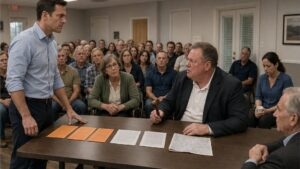
The meeting room was full that evening.
Not packed, exactly, but fuller than usual. Residents sat in folding chairs with copies of the proposed policy. The neighbor across the cul-de-sac avoided looking at me until I sat down, then gave a small nod.
Sharon occupied the center seat at the board table.
For the first time since I had known her, she looked tired without trying to hide it.
Emily read the proposed rule changes aloud.
No speeches followed.
The treasurer asked about survey costs.
One board member worried that homeowners would use “disputed” as a magic word to stop every project.
I raised my hand.
Sharon saw it and hesitated before recognizing me.
“The rule should require a good-faith basis,” I said. “A deed conflict. Existing marker. Prior survey. Something concrete.”
The board member nodded.
Sharon looked at me.
“You’re suggesting a limitation?”
“Yes.”
“On your own proposal?”
“It shouldn’t become another weapon.”
The words stayed between us.
Her expression changed slightly.
Not gratitude.
Recognition, perhaps.
The final policy passed unanimously.
When Sharon raised her hand, she did it without looking at me.
The restoration began the following Monday.
A small crew came this time.
No backhoe.
They reset the mailbox post, repaired the grade, and removed the excess gravel that had crossed the recorded line. The licensed surveyor returned near noon.
He carried two bright orange stakes.
“Still want them visible?” he asked.
“Yes.”
“Most homeowners hate these things.”
“I know.”
He drove the first beside the hedge.
The second went near the mailbox, close to where the original had been thrown into the gravel pile.
Orange against gray stone.
Not pretty.
Accurate.
Paul came by in the afternoon.
He stood at the curb looking at the markers.
“Your wife would have hated that color.”
I smiled before I could stop myself.
“She did.”
“She always said it looked like a construction site.”
“She wasn’t wrong.”
Paul put his hands in his jacket pockets.
“You all right?”
The old version of me would have said yes.
I looked at the mailbox.
“No.”
He waited.
“But I think I’m getting there.”
Paul nodded once.
That was enough.
Sharon did not speak to me for the next nine days.
We saw each other.
Of course we did.
Our driveways were too close for avoidance to become complete. She collected her mail while I watered the hedge. I pulled trash bins in while she backed out for work. Once, both of us reached the cul-de-sac stop sign at the same time and sat there longer than necessary.
No apology came.
I stopped expecting one.
The strangest change was not Sharon.
It was me.
People asked questions.
Before, I would have answered with documents or not at all. Now I explained what the court had actually decided.
Yes, the land was mine.
Yes, the HOA had maintained part of it for years.
No, maintenance had not transferred title.
Yes, Sharon had ignored a warning.
No, the entire board had not secretly plotted to steal property.
Some neighbors looked disappointed by the complexity.
I understood.
Simple stories were easier to carry.
One evening, I found the old splintered stake in my garage.
The one I had pulled from the gravel pile.
I turned it in my hands.
Bright orange beneath the dirt line.
Faded above.
For years it had marked a boundary while everyone around it practiced forgetting what the line meant.
I considered throwing it away.
Instead I placed it on a shelf.
Not evidence anymore.
Memory.
Near sunset, I walked to the mailbox with a stack of envelopes.
The repaired strip looked almost ordinary. New gravel. Straight post. Freshly graded soil.
The orange stakes made it impossible to mistake.
I opened the mailbox.
Behind me, footsteps slowed.
Sharon.
She carried a grocery bag in one hand.
We stood several feet apart.
Neither of us spoke.
Her hair had grown darker at the roots since the hearing. She looked toward the restored strip, then at the marker beside the mailbox.
“You left them up,” she said.
“Yes.”
“They’re ugly.”
“Yes.”
For the first time in months, something almost like humor passed across her face.
It disappeared quickly.
She shifted the grocery bag.
“The board records policy takes effect next month.”
“I heard.”
“Emily is rewriting the archive procedure.”
“Good.”
Another silence.
There were a dozen things she could have said.
I’m sorry.
You were right.
You embarrassed me.
You left things out too.
None came.
I realized then that I did not need the sentence I had spent weeks imagining.
Sharon stepped toward her driveway.
Her shoe nudged a loose piece of gray stone near the border.
The rock had rolled across the line.
She stopped.
Looked down.
Then, with the side of her shoe, she pushed it back onto her own side.
One small stone.
Two feet of history.
She walked away without speaking.
I stood beside the mailbox until she reached her door.
Then I looked at the orange stakes in the last light.
For years I had believed silence kept things from becoming worse.
Sometimes it did.
Sometimes it only left room for the wrong story to harden.
The stakes stood where everyone could see them now.
I left them there.
The story has ended.