The HOA Took Water From His Family Well—Then George Closed the Only Valve They Could Not Legally Control
Chapter 1: The Morning Forty Homes Lost Their Water
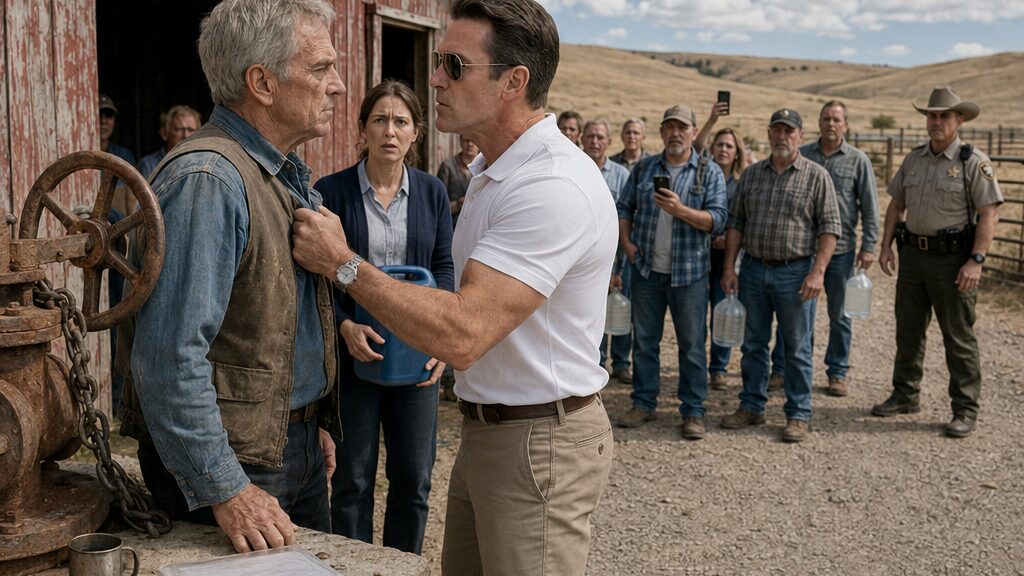
Richard Nelson caught George Walker by the front of his work shirt and shoved him against the steel housing of the master valve.
“Open it.”
Behind Richard, more than twenty residents crowded the gravel drive. Some held empty water jugs. Others held phones. A child was crying inside a parked SUV, and someone near the cattle gate shouted that forty homes had been without water since breakfast.
George felt Richard’s knuckles press against his collarbone. At seventy, he was still strong enough to remove the hand. He did it slowly, one finger at a time.
“Don’t touch me again.”
Richard stepped forward as if the warning had been an insult. His white polo was dark with sweat beneath the arms, and the lenses of his sunglasses reflected the red barn, the gathered homeowners, and the rusted valve wheel secured with a chain.
“You shut down a residential water system,” he said. “There are children down there. Elderly people. One family has a newborn.”
George looked past him toward the development below the ridge. The roofs were too new to have faded, row after row of gray shingles where pasture had stood two years earlier.
The valve beside George had belonged to the ranch long before any of those houses existed. So had the deep well beneath it.
Patrick’s dented metal coffee mug rested on the concrete pad. George had set it there before dawn, when he closed the valve.
A woman near the front raised her phone higher. “Are you admitting you did it?”
“I closed my own valve.”
A murmur moved through the residents.
Richard seized on it. “You hear that? He admits it.”
George opened the metal toolbox at his feet and removed a clear plastic folder. The certified notice lay inside, its delivery receipt stapled to the top. Beneath it was a county parcel map marked with the well, barn, fence line, and every recorded easement crossing the Walker property.
He placed the folder on the valve housing.
“Your board received that thirty days ago.”
Richard barely glanced at it. “A letter doesn’t give you the right to cut water to families.”
“The deed does.”
“You think this is some fence-line argument?” Richard snapped. “This is community infrastructure.”
George tapped the map. “Show me where.”
Richard’s jaw tightened.
“The easement,” George said. “Show these people where your water line is recorded across my land.”
The crowd quieted enough for George to hear the dry grass moving along the ditch. Richard looked toward two HOA board members standing behind him. Neither stepped forward.
One resident called, “You said the association had permanent access.”
“We do,” Richard replied.
“Then show it,” George said.
Richard pulled off his sunglasses. His eyes were bloodshot from anger or lack of sleep. “This is not the county records office.”
“No. It’s the property you crossed without permission.”
The woman with the phone lowered it slightly.
George took out another sheet: a photograph of the trench cut through his back pasture. In the picture, his fence wire lay rolled beside orange construction mesh. A black utility pipe ran toward the well pad.
“You cut my fence,” George said. “Moved my cattle. Bolted a junction box to my well. You were told to remove it.”
Richard turned toward the residents. “He’s leaving out the only part that matters. The connection was authorized.”
“By whom?” someone asked.
“His father.”
The words struck harder than Richard’s hand had.
George’s eyes moved involuntarily to the metal mug. One side was flattened from the time Patrick had backed over it with a tractor and hammered it roughly back into shape. George had found it beside the kitchen sink after the funeral, washed but still carrying a brown stain around the rim.
Richard saw the movement.
“Patrick Walker gave us access,” he said. “He understood that the development needed water while the permanent system was being arranged.”
George kept his voice level. “My father is dead.”
“That doesn’t erase what he agreed to.”
“It doesn’t turn a temporary favor into an easement.”
A man holding two empty gallon jugs pushed forward. “Temporary or permanent, our taps are dry now. What are we supposed to do?”
George had no answer that would sound humane in front of the locked valve.
Richard did.
“You’re supposed to understand that Mr. Walker has decided a property dispute matters more than your families.”
The crowd stirred again. The accusation worked because it contained a visible truth: George had turned the wheel. George had heard the pump straining before sunrise, fitted Patrick’s old wrench over the stem, and closed the supply himself.
He could have explained the grinding sound. The falling pressure. The contractor’s warning that continued pumping might destroy the well.
Instead he said, “You were given thirty days.”
Richard laughed once without humor. “You hide behind paperwork because you know exactly what you’re doing.”
A sheriff’s deputy stood near the cattle gate, watching both men. He had not intervened because no one had struck anyone. Not yet.
Richard moved closer, lowering his voice.
“Open it before the county forces you to.”
George looked at the residents. Fear had hardened several faces. Others appeared uncertain now, their eyes shifting between the county map and Richard.
Amy Green stood near the back, still wearing office clothes, one hand gripping a blue water container. George recognized her from the petition left at his house. She was not filming. She was studying the documents on the valve housing.
Richard followed George’s gaze and raised his voice again.
“You want proof? Fine. I have it. Patrick put his permission in writing.”
For the first time that morning, George’s control slipped. Not enough for anyone else to notice, but enough that his hand tightened around the edge of the toolbox.
Richard smiled when he saw it.
“I’ll bring the note,” he said. “Then everyone here will know you shut off water you knew we had permission to use.”
George looked down at Patrick’s mug.
The note existed.
What Richard did not know was that George had already seen more of it than anyone else.
Chapter 2: The Trench George Found After the Funeral
Three weeks earlier, George stopped his truck so abruptly that the cattle trailer behind him lurched sideways on the ranch road.
A trench split the back pasture from the western fence almost to the barn.
He sat behind the wheel with both hands fixed at ten and two, staring across ground that had been unbroken when he left for his father’s funeral four days before. Dark soil lay piled in ridges. Orange mesh sagged between temporary stakes. Two cows stood crowded against it, bawling toward the herd on the other side.
George got out without shutting the driver’s door.
His boots sank into loose earth where grass roots had been torn free. At the fence line, three strands of barbed wire had been clipped and rolled into neat coils. Whoever had done it had worked efficiently. That made it worse.
There had been no accident, no misunderstanding by a lost equipment operator. Someone had entered with tools, plans, and enough confidence to believe permission was unnecessary.
George freed the cows first.
He cut the orange mesh, walked them through, then repaired the fence with spare wire from the truck. The repetitive work steadied his hands. Twist, pull, staple. Patrick had taught him that when George was eleven and impatient with everything that could not be fixed quickly.
“Wire remembers carelessness,” Patrick used to say. “Leave it loose once, and you’ll mend it twice.”
George finished the last splice and followed the trench.
White survey stakes marked its path toward the barn. Some carried numbers in black marker. Others bore the logo of the development below the ridge. Near the eastern pasture, the trench narrowed around a section that had already been backfilled.
George knelt and brushed loose dirt aside until he saw a strip of black pipe.
It pointed directly toward the well pad.
His pace quickened.
The well sat behind the red barn beneath a corrugated metal shelter. Patrick had poured the concrete pad in 1978, when the old wind-driven pump finally failed. The master valve stood waist high beside the pressure tank, its wheel orange with rust but sound beneath the surface.
A new galvanized junction box had been bolted to the pad.
Four fresh anchors pierced Patrick’s concrete. Conduit ran from the box to a black pipe rising out of the disturbed ground. A small meter on the side ticked steadily.
George placed two fingers against the pipe.
It vibrated.
He stepped into the pump shelter. The pressure gauge trembled below its usual mark. Hanging from the valve stem was an old aluminum maintenance tag stamped with the date of the last overhaul and the initials P.W.
Patrick Walker.
George had not noticed the tag in years.
He reached for the valve wheel, then stopped.
Closing it without knowing where the line went could damage equipment or leave livestock without water. The ranch troughs, house, barn hydrants, and eastern field line all drew from the same well.
He took photographs instead.
The trench. The cut fence. The junction box. The meter reading. The bootprints hardened in mud beside the pad.
Then he called the well contractor who had serviced the ranch for nearly twenty years.
The contractor arrived after sunset in a dusty service truck. He removed the junction-box cover, traced the pipe, and crouched beside the meter with a flashlight between his teeth.
“This isn’t feeding your stock line,” he said.
“I know.”
“It’s headed downhill.”
“To the development?”
“That would be my guess.”
George stood with his hands in his jacket pockets. “Can you tell how much they’re pulling?”
The contractor read the meter twice, waited, and did a calculation on the back of an invoice.
“Enough for more than construction trailers.”
“How much more?”
“At this rate?” The contractor looked toward the glow of streetlights below the ridge. “A lot of occupied houses.”
George stared downhill.
The development had grown while he spent his days caring for Patrick. First came roads, then foundations, then clean-sided houses with identical mailboxes. George had objected when runoff from the graded lots flooded a corner of his pasture, but Patrick had told him not every problem required a fight.
“They’re trying to build homes,” his father had said. “We already have ours.”
George had mistaken that patience for approval of the whole project.
“Can they do this without an easement?” he asked.
“Not legally, as far as I know.” The contractor stood. “But I’m not a lawyer.”
“Can you disconnect it?”
“I can. But if it serves occupied homes, you’d better know exactly what you’re shutting off first.”
The meter continued ticking.
Each small movement sounded louder than the cattle in the dark pasture.
George walked around the pad, inspecting the fresh pipe from every angle. Near the back of the junction box, half buried under gravel, he found a brass fitting attached to an older section of narrow hose.
Unlike the new work, that piece had weathered. Its clamp was rusted, and a rectangular aluminum tag hung from it on twisted wire.
George wiped away dirt with his thumb.
TEMP. TAP—CONSTRUCTION ONLY.
Below those words were Patrick’s initials.
P.W.
A date had been stamped beside them from the previous summer, during the worst drought the county had seen in a decade.
George remembered water trucks passing along the ridge then. He remembered Patrick complaining that the development’s temporary tanks had run dry. He also remembered his father spending an afternoon near the well with a construction foreman while George was in town buying feed.
Patrick had said only, “Helped them solve a problem.”
George had not asked which problem.
The contractor leaned over his shoulder. “Looks like your father allowed a temporary hookup.”
“This isn’t temporary.”
“No.”
George followed the thin old hose with his eyes until it disappeared beneath the new junction box. The development had not created its connection from nothing. Someone had taken a narrow emergency tap and built a permanent system around it.
He felt anger return, but it no longer had a clean edge.
“Leave it running tonight,” he said.
The contractor gave him a questioning look.
“I need to know what my father agreed to before I close anything.”
After the service truck left, George remained beside the well. The pump cycled on beneath the shelter, carrying water downhill through a line he had never approved.
Patrick’s maintenance tag clicked softly against the valve stem.
George reached out and turned it over.
On the reverse side, scratched by hand, were three more words.
Ask before changing.
Chapter 3: The Permission Richard Refused to Explain
Richard arrived at the ranch two mornings later holding a photocopy in a clear presentation sleeve.
He did not come alone. A construction foreman followed in a pickup, and an HOA board member parked near the cattle gate. Richard stepped out wearing pressed khakis and shoes unsuited to gravel, as though the setting itself were expected to adjust to him.
“Found what you were looking for,” he said.
George stood beside the barn with Patrick’s mug in one hand. He had spent the previous day searching the house, the farm office, and every drawer where his father kept receipts. He had found warranty cards from machines sold twenty years ago, tax assessments, livestock records, and a stack of envelopes tied with baling twine.
He had not found the original note.
Richard held out the copy.
The handwriting was Patrick’s.
To construction crew—You may draw from the west well tap during drought restrictions so long as ranch use comes first. Temporary use while your own source is completed.
There was no signature, only the initials P.W. and a date matching the tag.
George read it twice.
“You knew about this,” Richard said.
“I knew there had been a small tap.”
“You knew your father gave permission.”
“For construction use.”
Richard pointed to the first sentence. “You may draw from the west well tap.”
“Read the last one.”
“We did. The development’s permanent source is still being completed.”
George looked toward the ridge. “You’ve got forty occupied houses.”
“Thirty-eight.”
“And you connected all of them to a temporary construction tap.”
Richard’s expression tightened. “We upgraded the line because water trucks were costing the association thousands every week. Your father understood that.”
“Then why didn’t he write it?”
“He was a practical man.”
The comment landed with deliberate familiarity, as though Richard knew Patrick better than George did.
George handed the copy back. “A practical man would have put a permanent easement on the deed.”
“Maybe he trusted people.”
The board member glanced down.
George set the mug on the fence post. “Remove the line from my well.”
Richard exhaled, not surprised but disappointed in a way that felt rehearsed. “That isn’t possible.”
“It was possible to put it in.”
“We have homeowners now. Mortgages. Families who bought based on guaranteed water service.”
“Guaranteed by whom?”
“The development company and the HOA.”
“Using my well.”
“Using an existing connection your father approved.”
“Temporarily.”
Richard took off his sunglasses. “You keep repeating that word as though it changes what happens if you shut us down.”
George said nothing.
Richard stepped nearer. His voice softened.
“Look, I understand why you’re angry. The crew should have notified you before widening the trench. They believed the access had already been settled with Patrick.”
“They cut my fence.”
“I’ll have it replaced.”
“They moved my cattle.”
“No animals were injured.”
“They bolted equipment into my concrete and doubled the pipe without asking.”
“We can compensate you.”
“There’s the misunderstanding.” George picked up the mug. “You think everything you did becomes legitimate once you offer money.”
Richard’s face changed, not into rage but strain.
“You think I enjoy this?” he asked. “The developer left the association with an unfinished municipal connection and invoices no one warned us about. If we lose temporary service now, property values collapse. People can’t sell. The county could suspend occupancy. Families who put everything into those homes take the loss.”
George heard the truth inside the argument. Richard was protecting more than his pride, though pride had shaped how he did it.
“That still doesn’t make the well yours,” George said.
“No. It makes the situation bigger than your anger.”
“My anger didn’t dig the trench.”
Richard looked toward the pump shelter. “What do you want?”
“The line removed. The concrete repaired. The pasture restored.”
“And during the year it takes to finish the municipal connection?”
“That’s your board’s problem.”
“It becomes your problem the moment you knowingly deprive occupied homes of water.”
George felt his grip tighten around the mug.
Richard noticed.
“You could help us write a temporary agreement,” he said. “Metered use. Monthly payment. We protect the ranch supply, and no one gets hurt.”
For one brief moment, the offer sounded reasonable.
Then George remembered the cut fence and the active line hidden beneath fresh dirt. Richard had come to discuss terms only after being discovered.
“You should have proposed that before you took it.”
Richard’s patience broke.
“We did not take anything. Patrick gave access.”
“For a construction emergency.”
“And now there’s a larger emergency.”
“One you built houses on top of.”
The construction foreman shifted beside the truck. Richard glanced at him, then lowered his voice again.
“Those homes were approved because water service was represented as available.”
“By my father?”
“By the project.”
“Then the project lied.”
Richard’s eyes hardened. “Be careful.”
“About what?”
“About making accusations you can’t afford to defend.”
George stepped off the barn’s shadow into the sun. “Is that a threat?”
“It’s reality. You file suit, we answer. We seek an injunction. We argue reliance, prior consent, necessity, equitable access—whatever counsel advises. The association has insurance and attorneys.”
“And I have a deed.”
“Then take your deed to court.”
Richard leaned close enough that George could smell coffee on his breath.
“You’re seventy years old. Cases like this drag on for years. You may not live long enough to see the end.”
The foreman looked away.
George felt something inside him go still.
Not grief. Grief moved. It rose and fell, sharpened and softened. This was colder.
Richard put his sunglasses back on. “Think about the agreement.”
He turned toward his vehicle.
“Richard.”
The HOA president stopped.
“Bring me the original note.”
Richard looked back. “The copy is sufficient.”
“Not to me.”
“It’s in the project files.”
“Then bring it.”
Richard smiled faintly. “You’re hoping the paper saves you.”
“No,” George said. “I’m wondering what else is written on it.”
The smile disappeared.
That was the first sign Richard might not have shown him everything.
After the vehicles left, George went into the farmhouse and opened Patrick’s rolltop desk again. He removed every drawer, checking beneath and behind each one. In the narrow space under the bottom rail, his fingers touched folded paper.
He drew out a yellowed sheet torn from a legal pad.
The first paragraph matched Richard’s copy word for word.
But Patrick had written a second paragraph below it.
George read the lines once, then sat heavily in his father’s chair.
The note did not grant permanent access.
It also asked George to do something he was not ready to do.
Chapter 4: The County Map With Nothing Drawn Across It
The county records clerk traced the eastern boundary of George’s property with one blunt fingernail, stopped where the trench should have crossed, and looked up.
“There’s nothing here.”
George leaned over the counter. The survey map lay beneath a sheet of clear plastic, its ink faded brown along the fold lines. The Walker parcel was outlined in red pencil. Two recorded easements crossed the northern edge—one for power, one for the county road—but the ground between the western fence and the well was blank.
“No utility easement?” George asked.
“Not on this map.”
“What about a water-service agreement?”
The clerk turned to the computer and searched again. The keyboard clicks echoed through the quiet records room. George stood beneath fluorescent lights with Patrick’s original note folded inside his jacket pocket.
The second paragraph seemed heavier than the deed book beside him.
The clerk printed a list of recorded instruments and placed it on the counter.
“No water easement. No sewer easement. No access grant to the development company or the homeowners’ association.”
George read the page line by line.
“What about permits for the line?”
“That would be planning and land use.”
She pointed him toward an office across the hall.
Kimberly Martinez met him there twenty minutes later. She wore a dark suit jacket over a plain blue blouse and had three open files arranged across her desk. One contained photographs George had emailed that morning: the cut fence, the trench, the new junction box, and the temporary tap tag marked with Patrick’s initials.
Kimberly studied the copy of Patrick’s first paragraph.
“This is permission of some kind,” she said.
“For temporary construction use.”
“That appears to be what it says.”
“It isn’t an easement.”
“No. It also isn’t nothing.”
George sat back.
Kimberly tapped the photograph of the expanded pipe. “Did your father authorize this installation?”
“Not that I know of.”
“Did he accept payment?”
“Not that I found.”
“Did he ever object?”
“He was sick most of the last year.”
She looked at him carefully. “That wasn’t my question.”
George glanced toward the window. The courthouse lawn was being watered by rotating sprinklers, each pulse striking the glass faintly.
“He didn’t tell me about the tap,” George said.
Kimberly closed one file and opened another. “The county issued grading and occupancy permits for the development based on documents stating that water service was available. The file refers to a temporary private source during the municipal extension.”
“My well.”
“It doesn’t identify the parcel.”
“Convenient.”
“Possibly negligent. Possibly misleading. But the county did not issue a permit authorizing a permanent line across your land.”
That was the answer George had wanted. It did not feel as clean as he expected.
“So I close the valve.”
Kimberly’s expression sharpened. “Not yet.”
“It’s my valve.”
“And occupied homes are connected to it. If you shut them down without notice, the HOA could seek an emergency order. The county health department could intervene. A judge may temporarily restore service while everyone argues about rights.”
“They entered without permission.”
“I believe you.”
“They’re draining a private well.”
“I understand.”
“You’re telling me ownership matters only until somebody steals enough to depend on it.”
“I’m telling you dependency changes what happens next, not who owns the well.”
George folded his arms.
Kimberly pulled a yellow legal pad toward her. “Send a certified notice. Demand removal of the unauthorized equipment. State the risks to the ranch supply. Give a specific deadline. Allow inspection. Document the meter daily.”
“How long?”
“Thirty days is defensible.”
“A month of pumping.”
“A month in which you build a record instead of giving Richard Nelson a public emergency he can use against you.”
George thought of Richard standing by the barn, saying a lawsuit might outlive him.
“What if the pump fails before then?”
“Get a licensed contractor’s assessment. If there’s an immediate threat to the well, we address that separately.”
Kimberly held out her hand for Patrick’s note. “Is this the only version you found?”
George’s fingers touched the paper inside his jacket.
The original contained the first paragraph Richard had copied. Below it, Patrick had written:
If families are living there before their line is finished, don’t leave them dry without warning. Help in an emergency, but make them put their own system in. This well stays with the ranch. George will know where the limit is.
George could have placed it on Kimberly’s desk.
Instead, he withdrew the photocopy Richard had provided.
“That’s what they showed me.”
Kimberly watched him for a second longer than necessary.
“All right,” she said. “We proceed with what we can prove.”
By the end of the afternoon, she had helped him draft a notice without promising an outcome. It demanded removal of the expanded line and junction box, restoration of the pasture and fence, and written confirmation that no further water would be drawn after the deadline. It also offered inspection access by appointment.
George mailed copies by certified post to the HOA, the development company, and Richard personally.
At home that evening, he set Patrick’s original note on the kitchen table.
The house remained much as Patrick had left it. His coat hung beside the back door. A chipped bowl held loose bolts and two cattle tags. The chair opposite George was pushed back at the angle Patrick preferred because his right knee had stopped bending fully.
George read the second paragraph again.
George will know where the limit is.
It felt less like trust than a burden his father had left without explanation.
A truck turned into the driveway.
George folded the note and slipped it beneath the county map just before someone knocked.
The woman on the porch introduced herself as Amy Green. She held a clipboard against her chest and a blue folder under one arm. Her expression was controlled, but her voice carried the strain of someone who had practiced being polite all the way up the road.
“I’m the HOA treasurer.”
George waited.
“We’ve been told you intend to terminate our water service.”
“I sent notice to the board.”
“The residents didn’t receive it.”
“That’s a board problem.”
Her mouth tightened. “It becomes a resident problem when our homes lose water.”
She opened the blue folder and handed him a petition. Thirty-two signatures filled two pages beneath a statement accusing George of threatening essential services to pressure the HOA in a private land dispute.
He read the first line and handed it back.
“You should ask your board why they ran forty homes through a temporary construction tap.”
“We were told the connection was authorized.”
“Ask for the easement.”
“Richard says your father approved it.”
George looked past her toward the ridge, where porch lights were appearing one by one.
Amy lowered the clipboard. “Did he?”
George could feel the folded note beneath the map behind him.
“My father allowed temporary construction water.”
Her eyes changed. “So there was permission.”
“Not for what you have now.”
“Why didn’t you say that in your notice?”
“The board already knows.”
“We don’t.”
George heard the difference but did not answer it.
Amy studied him, frustration overtaking caution. “You could have come to a meeting. You could have spoken to us before sending legal threats.”
“They could have spoken to me before cutting my fence.”
“Most of us didn’t know there was a fence involved.”
“That doesn’t put it back.”
“No,” she said. “But silence doesn’t tell us who is lying.”
She left the petition on his porch rail and walked back to her vehicle.
George watched her reverse down the drive. Then he returned to the kitchen and unfolded Patrick’s note.
For the first time, he understood that concealing it did not only weaken Richard.
It also kept every homeowner from seeing the limit Patrick had actually set.
Chapter 5: The Warning Buried Inside the HOA Files
Amy’s kitchen faucet coughed air into her coffee cup six days before George’s deadline expired.
The water came back in a brownish burst, then weakened to a thin stream. She turned the handle off and stared at the basin.
Her daughter called from the hallway that the upstairs shower had stopped again.
Amy checked the time. Six forty-three.
The valve was still open. George had not shut anything down.
She filled a glass and watched sediment settle near the bottom.
At eight, she called Richard.
“It’s construction fluctuation,” he said.
“There’s no construction on our block.”
“System adjustment, then. We’ve had pressure variations before.”
“Not like this.”
Richard sighed. “Amy, I’m dealing with counsel, the county, and a landowner threatening forty families. I need you helping keep people calm.”
“I’m the treasurer. I need to know what we’re paying for.”
“The water expenses are in the monthly reports.”
“I mean the permanent connection.”
A pause followed.
“The extension is being negotiated.”
“You told us it was scheduled.”
“It is.”
“When?”
“I’ll update the board at the meeting.”
Amy looked at the glass on the counter. “Did you receive an engineering warning about the Walker well?”
“Who told you that?”
“No one. I’m asking.”
“Then don’t manufacture problems when we already have one.”
He ended the call.
Amy stood still with the phone in her hand. Richard’s defensiveness answered more than his words had.
At the clubhouse that afternoon, she unlocked the records cabinet behind the meeting room. As treasurer, she had access to invoices, insurance documents, reserve studies, and vendor contracts. Richard had encouraged her to take the role because she was organized and rarely challenged him in public.
She opened the water-services folder.
The recent invoices showed payments to a contractor for “temporary distribution maintenance.” There were also emergency water-truck charges from the previous summer and legal fees billed under a general development-transition account.
No contract with George appeared.
No easement payment appeared.
At the back of the cabinet, beneath landscaping bids, she found a gray engineering envelope marked PRELIMINARY WATER CAPACITY REVIEW.
The report was eleven months old.
Amy read the summary standing beside the cabinet.
The private ranch well could support temporary construction demand under restricted conditions. It was not designed or tested for sustained residential consumption. Full occupancy risked pressure failure, pump damage, and depletion during dry periods. The report recommended that no additional homes be connected after the first twelve occupied units.
A handwritten notation appeared beside the recommendation.
Municipal extension delayed. Maintain interim source. Do not circulate pending financing.
The initials were R.N.
Amy sat at the nearest table.
Thirty-eight houses were occupied now.
She copied the report and placed the original exactly where she had found it.
That evening, she drove to George’s ranch without calling first. A county inspector and the well contractor were already at the pump shelter. The metal gauge beside the pressure tank trembled with each cycle, dropping lower before recovering.
George stood with Patrick’s mug in his hand.
Amy approached the edge of the concrete pad. “Is it supposed to move like that?”
“No,” the contractor said.
George looked at the folder under her arm. “Another petition?”
“No.”
The county inspector wrote down the gauge reading. “Run the system again.”
The contractor opened a ranch hydrant. Water struck the dirt with force for three seconds, then weakened.
The pump engaged beneath them. A rough vibration traveled through the concrete.
Amy felt it through the soles of her shoes.
“How long has it sounded like that?” she asked.
“Getting worse all week,” George said.
“And you haven’t reduced our supply?”
“I haven’t touched the valve.”
She opened the folder and gave him the copied report.
George read the summary. His face remained still until he reached Richard’s handwritten notation.
“You knew?” Amy asked.
“I knew the well was under strain. Not that your board had been warned before most of the homes were connected.”
“My board wasn’t warned. Richard was.”
George returned the report.
The contractor shut the hydrant. The gauge climbed slowly.
“Can you separate the development line from the ranch system?” the inspector asked.
“Not without shutting the master feed first,” the contractor said. “The new junction was tied in ahead of the ranch branches.”
George looked at him. “They put themselves first in line?”
“Hydraulically, yes.”
Amy pictured the pipe beneath the development streets, feeding rows of kitchens and bathrooms before the pressure reached George’s cattle troughs.
“Why would anyone design it that way?”
“Fastest connection,” the contractor said. “Least excavation on their side.”
George’s mouth tightened.
Amy took a breath. “Richard called an emergency board meeting for Friday. He wants authorization to sue you and seek an injunction.”
“He can seek whatever he wants.”
“He’ll tell everyone you’re causing the pressure problems.”
George tapped the engineering report. “You going to let him?”
“I haven’t decided what I’m doing.”
The answer angered him. She saw it immediately.
“You found proof he concealed a safety warning.”
“I found a report with his initials. I also found out your father gave permission, which you didn’t tell us.”
“For temporary use.”
“You keep saying that as if the rest of us saw the note.”
George looked toward the barn.
Amy followed his gaze. “There is more, isn’t there?”
He did not answer.
The silence confirmed it.
“You have the original.”
George set the mug on the pad. “What I have doesn’t authorize your system.”
“That isn’t what I asked.”
“The board crossed my property without permission.”
“And Richard hid this report. Both things can be true.”
“The difference is I didn’t put your homes at risk.”
“You plan to shut off their water.”
“After thirty days’ notice.”
“Notice sent to people who didn’t tell us.”
George’s eyes hardened. “You elected them.”
“I voted based on what they told me.”
“And I buried my father while your contractors dug through my pasture. We all missed something.”
The contractor stepped between them before Amy could respond.
“Listen.”
The pump had stopped.
For a moment, only wind moved through the shelter.
Then a metallic knock came from deep below, followed by a scraping vibration. The gauge needle dropped and did not recover.
The contractor killed the power at the control box.
“What was that?” Amy asked.
He opened the panel and checked the readings.
“Pump’s drawing too much current.”
“How bad?”
He looked at George rather than Amy.
“If it keeps cycling at this load, it could burn out. Maybe a week. Maybe tomorrow.”
The cattle began bawling from the eastern pasture where their trough had slowed to a trickle.
George stared at the master valve.
Amy understood then that the deadline was no longer the only clock running.
That night, the HOA clubhouse filled beyond its seating capacity. Residents stood along the walls while Richard presented a motion authorizing emergency legal action against George. He spoke about property values, sanitation, and the association’s obligation to defend essential services.
Amy sat at the board table with the engineering report inside her folder.
She could have exposed him then.
But she wanted the original document, not a copy he could dismiss as incomplete. She wanted the invoices showing who ordered the expansion. She wanted enough that the board could not retreat into uncertainty.
When the vote was called, she abstained.
Richard looked at her with open surprise.
The motion still passed.
Afterward, he caught her near the door.
“What are you doing?”
“My job.”
“Your job is protecting the association.”
“My job is knowing what it agreed to.”
His face became careful. “Be very sure before you create panic.”
Amy looked at him. “Were you sure when you connected the thirteenth house?”
Richard said nothing.
Across the ridge, unseen in the darkness, George stood beside the silent pump while the contractor prepared to restart it.
The machine caught after two attempts.
Its first sound was a low hum.
Its second was the same grinding noise, louder than before.
Chapter 6: George Turned the Wheel Before Dawn
The grinding woke George at 4:17 in the morning.
He heard it through the open bedroom window—a harsh metal drag beneath the steady hum of the pump. By the time he reached the well shelter, the pressure gauge was shaking so violently that the needle blurred.
The contractor’s warning returned exactly as spoken.
Maybe a week. Maybe tomorrow.
George cut power to the pump.
The silence lasted three seconds.
Then the pressure tank groaned.
He opened the control box and read the meter. Demand during the night should have been low, but the flow register showed more water moving downhill than the previous afternoon.
Richard had not reduced consumption after the county inspection.
Someone had increased it.
George called the contractor, then Kimberly. Neither answered immediately. It was still dark.
The eastern cattle trough was nearly empty. The farmhouse line produced only a weak stream. If the pump failed completely, the ranch would lose water along with the development, and replacing a deep-well pump could take days.
George went to the barn workshop and removed Patrick’s long-handled valve wrench from its hooks.
The steel was smooth where his father’s hands had held it.
Back at the pad, he fitted it over the master stem.
Patrick’s mug sat on the concrete beside his boot. George had carried it there without remembering picking it up.
He looked toward the development. Porch lights dotted the slope. Most residents were asleep, unaware that the system beneath their homes had been built around a borrowed connection and a pump already failing.
George took out his phone and photographed the gauge, meter, and time.
Then he turned the wheel.
Rust cracked from the stem. The valve resisted for half a rotation, then moved. George worked slowly, pausing as the pressure changed. Each turn reduced the vibration traveling through the pipe.
When the wheel reached the stop, the line downhill went still.
George restored power to the ranch branches.
The pump started without the grinding load.
By sunrise, the cattle trough was filling.
At 7:12, the first call came from Richard.
George let it ring.
At 7:19, Kimberly called.
“I saw your message,” she said. “Tell me exactly what happened.”
George described the readings and the contractor’s warning.
“Did you close all service?”
“I isolated the development line through the master valve. Ranch pressure is recovering.”
“You need the contractor’s written emergency assessment today.”
“He’s coming.”
“The HOA will seek an order.”
“They can bring the judge to hear the pump.”
Kimberly exhaled. “Do not say that to anyone else. Document everything. And George—if there is a medical emergency, call me before refusing temporary access.”
By nine, vehicles had begun gathering at the ranch entrance.
By ten, the road was lined with them.
The confrontation unfolded as George had feared and Richard had needed. Empty jugs. Raised phones. Frightened residents. Richard’s hand gripping George’s shirt. The county map placed on the valve housing. The challenge to show an easement.
Then Richard invoked Patrick’s note.
George said nothing about the second paragraph.
The crowd remained near the drive after Richard stepped away. Some argued with him. Others demanded to see the notice. Amy stood beside the valve reading the contractor’s emergency statement, which had arrived by email and been printed in the barn office.
“This says the pump could have failed under continued demand,” she said.
“It was already failing.”
“Why didn’t you tell the residents last night?”
“The board had the inspection results.”
“We didn’t.”
George looked at her. “You were at the meeting.”
“I didn’t have the contractor’s conclusion.”
“And I didn’t know Richard had increased the draw.”
Amy turned. “Increased it?”
George showed her the overnight meter photographs. “Consumption jumped after the inspection.”
Richard heard him and came back.
“We filled the community storage tank,” he said. “As a precaution.”
“Without telling me,” George replied.
“We expected you to do exactly this.”
“So you pulled harder from a pump you knew was failing.”
“We were protecting residents.”
“You nearly destroyed the only source connected to them.”
Richard pointed toward the development. “And now there is no source at all.”
A woman pushed through the crowd holding a phone against her chest.
“My father’s oxygen concentrator uses a humidifier reservoir,” she said. “We can buy bottled water for that, but he also has limited mobility. We need water for sanitation. The delivery company says the earliest truck is this evening.”
Richard turned toward George. “There. That’s what your property rights look like.”
George looked at the woman, not Richard.
“How much water do you need until the truck arrives?”
“I don’t know. Enough for two people.”
George nodded toward the barn. “There’s a clean tank on the utility trailer. I can fill it from the ranch branch.”
Richard gave a short, incredulous laugh. “You’ll hand out buckets while an entire neighborhood sits dry?”
“I’ll deal with an immediate need.”
“You will reopen the valve.”
“No.”
Richard stepped close again, but the deputy moved between them this time.
“Keep your distance,” the deputy said.
The contractor arrived shortly before noon and inspected the system while residents waited. He confirmed that the pump’s current draw had returned to a safer range after the development line was closed. Reopening unrestricted flow, he said, could cause permanent failure.
Richard challenged every sentence.
“Can you guarantee failure?”
“No.”
“Can you guarantee it won’t operate?”
“No.”
“Then this is speculation.”
“It’s professional judgment based on the measurements.”
Richard turned to the crowd. “A contractor paid by George.”
“I’ve serviced this well for nineteen years,” the contractor said. “Including when Patrick was alive.”
Patrick’s name quieted George more effectively than the shouting had.
By early afternoon, the development’s elevated storage tank had drained. Amy received messages as faucet after faucet stopped producing even air. The small reserve Richard had filled overnight was gone.
Kimberly arrived with a county inspector and an emergency proposal drafted on county letterhead. It allowed limited, metered flow for essential household use only, capped at a level the contractor believed the well could sustain. No lawn irrigation, construction use, vehicle washing, or storage-tank filling would be permitted.
Richard read the first page and shook his head.
“This is unacceptable.”
“It’s temporary,” Kimberly said.
“It gives him control over every gallon.”
“The valve is on his property.”
“The association cannot operate under the whim of one man.”
George spoke from beside the well shelter. “Then stop using one man’s well.”
Richard crumpled the corner of the document in his fist. “Open it fully, and we’ll negotiate after service is restored.”
“No.”
“You’re enjoying this.”
George looked toward the utility trailer. The woman’s water tank was full now, secured with straps. Other residents had begun lining up with containers near the barn hydrant. What had felt like vindication before sunrise had become a row of people asking for what their board had promised them.
“No,” George said. “I’m not.”
He lifted the chain from the valve wheel and unlocked it.
Richard stepped forward as though he had won.
George fitted Patrick’s wrench over the stem and opened the valve one measured turn. The meter clicked. The contractor watched the pressure gauge and raised one hand when the flow reached the temporary limit.
George stopped.
“That’s all,” he said.
Richard stared at the barely opened valve. “You can’t ration a neighborhood.”
“I can protect the well.”
“We’ll have a court order by morning.”
“Bring it.”
Kimberly placed the emergency agreement on the valve housing between them.
George looked at Amy.
“Your board can sign this tonight. Metered essential use. Daily readings. The storage tank stays disconnected. You begin arranging a lawful source immediately.”
Amy read the conditions.
Richard did not.
“I won’t allow the HOA to accept terms dictated under duress,” he said.
George removed Patrick’s wrench but left the valve at the restricted setting.
“Then decide how long you want that one turn to last.”
Chapter 7: The Part of Patrick’s Note George Hid
George placed Patrick’s original note in the center of the HOA board table before anyone could accuse him of bringing another demand.
“I withheld part of this.”
The emergency meeting room went silent.
Residents filled every chair and stood along the walls. Plastic water containers rested beside their feet. Richard sat at the head of the table with the temporary agreement unopened before him. Amy occupied the treasurer’s seat, a thick folder pressed flat beneath both hands.
George remained standing.
Richard was the first to speak. “You concealed evidence while threatening our water supply?”
“Yes.”
The blunt answer unsettled the room more than a denial would have.
George unfolded the note. The crease through Patrick’s handwriting had weakened from being opened and closed too many times.
“The copy Richard showed me contained the first paragraph,” George said. “It allowed the construction crew to draw water during drought restrictions while they completed their own source.”
A board member leaned forward. “We know that part.”
“There was another paragraph.”
George read it aloud.
“If families are living there before their line is finished, don’t leave them dry without warning. Help in an emergency, but make them put their own system in. This well stays with the ranch. George will know where the limit is.”
No one moved when he finished.
Richard looked at the paper, then at George. “That supports continued service.”
“It supports emergency help,” George said. “It also says you were supposed to build your own system.”
“It doesn’t define emergency.”
“It defines ownership.”
Richard turned to the residents. “He found this weeks ago. He could have prevented everything that happened today.”
George did not defend himself immediately.
That was the habit he had relied on for years: let another person fill the silence, let anger reveal more than questions could. But now the silence carried waterless kitchens and people lined up at his barn hydrant.
“I found it after Richard brought me the partial copy,” George said. “I should have given it to the county attorney. I didn’t.”
Amy watched him without softness.
“Why?” she asked.
“Because I thought the first paragraph would be used to claim the whole well. I thought if I showed the rest, every promise my father made would become a weapon against the ranch.”
“And instead,” Amy said, “you let us believe there was no permission at all.”
“I said there was temporary permission.”
“After we confronted you.”
George accepted the distinction with a nod.
Richard pushed back his chair. “This admission changes the entire legal position.”
Kimberly Martinez stood near the rear wall beside the county inspector. “It changes the factual record. It does not create an easement or authorize the expanded system.”
Richard ignored her.
“Patrick intended the homes to receive water.”
“Until a lawful source was built,” George said.
“You’re interpreting a dead man’s note to suit yourself.”
George looked at the handwriting. “So did you.”
The room tightened around the exchange.
Amy opened her folder.
“There’s another record the board needs to see.”
Richard turned toward her. “This is not on the agenda.”
“It became the agenda when you asked us to authorize litigation without disclosing the system’s condition.”
She distributed copies of the engineering report. Pages moved from hand to hand. Residents began reading the highlighted summary and the warning against connecting more than twelve occupied homes.
Richard’s face lost color.
“This was preliminary.”
“You initialed the instruction not to circulate it,” Amy said.
“Because it contained projections that had not been verified.”
“Were they verified before you connected the thirteenth house?”
Richard looked around the table. “The municipal extension was expected within months. Delays occurred. We had purchasers under contract and families prepared to move. Walking away from the temporary source would have bankrupted the project and left unfinished homes across the ridge.”
For the first time, his voice carried no theatrical outrage. Only exhaustion.
“We were trying to keep the development alive.”
Amy tapped the report. “By hiding the risk.”
“By buying time.”
“You filled the storage tank last night after the well contractor warned about the pump.”
“To protect residents in case George shut us off.”
“You increased the load that forced him to do it.”
Richard’s control cracked. “What was I supposed to do? Tell every homeowner their water depended on the goodwill of a rancher who would not return a phone call?”
“You were supposed to finish the municipal connection,” George said.
“With what money? The developer transferred control with reserves below projections. Construction costs rose. The county delayed the road crossing. If we had disclosed the full problem, lenders would have frozen sales and every existing homeowner would have absorbed the loss.”
Several residents shifted uneasily. Richard’s argument did not excuse him, but it touched the thing they feared: assessments, falling values, homes they could not sell.
A board member asked, “How much will the municipal connection cost now?”
Amy named the preliminary estimate.
The room erupted.
Richard let the number work for him. “That is what Mr. Walker’s demand means. Not a repaired fence. Not a trench. Thousands of dollars from every household.”
George looked at the faces around the room. Some were angry at Richard. Others looked at George as though the cost had come from his mouth.
Kimberly stepped forward.
“The cost exists because the development lacks a lawful permanent source. Delaying it does not remove it.”
A resident near the wall asked, “What happens tonight?”
The question pulled the meeting away from blame.
Kimberly placed copies of the temporary agreement on the table. “George has permitted limited essential flow. The contractor will monitor the well daily. The HOA must prohibit outdoor use and storage filling. Water trucks will supplement demand.”
“And after tonight?” another resident asked.
“That depends on whether the board signs and begins the permanent-connection process.”
Richard folded his arms. “I will not sign an agreement that gives George unilateral control.”
George looked at Patrick’s note.
His father had written that George would know the limit. For weeks, George had treated that sentence as permission to decide alone. Perhaps Patrick had meant something harder: that George would know when holding a boundary became an excuse not to speak.
“The limit won’t be mine alone,” George said.
Everyone turned toward him.
“The meter readings go to the county, the contractor, and the HOA treasurer each day. If the well reaches the danger threshold, flow drops. If the association violates the restrictions, flow stops. Those terms go in writing.”
Amy asked, “How long?”
“Ninety days, if the board signs a municipal construction contract within two weeks.”
“That connection cannot be finished in ninety days,” Richard said.
“Then water trucks cover the gap.”
“You know what that costs.”
“Yes.”
“You’re punishing them for decisions they didn’t make.”
George met his eyes. “No. I’m refusing to let their dependence destroy the ranch. I should have told them sooner. You should never have created the dependence.”
The board went into closed discussion without Richard. He paced the hallway while residents waited. George stood outside near an open window, listening to the low murmur of argument inside.
Amy emerged forty minutes later.
“The board voted to sign the emergency agreement.”
“And Richard?”
“We also voted to remove him as president pending an audit.”
Richard stood at the far end of the hall. For a moment, he looked less like a man defeated than one who had finally run out of places to move the same problem.
“You think this saves them?” he asked George.
“No.”
“Then what did you win?”
George folded Patrick’s note and put it in his pocket.
“My well.”
Richard gave a bitter laugh. “And they inherit the bill.”
“They inherit the truth.”
Before sunrise the next morning, George and the contractor adjusted the valve to the metered emergency setting. Amy recorded the first reading while the county inspector sealed the storage-tank branch.
Water began moving downhill again, not freely, but enough.
George rested Patrick’s wrench against the housing.
Amy looked at the valve, then toward the development.
“Ninety days won’t be enough.”
“I know.”
“Will you extend it if the work is underway?”
George looked at the dented mug on the concrete pad.
He had set a legal limit.
The harder decision was whether he could offer anything beyond it without surrendering the ranch again.
Chapter 8: The Valve Stayed in George’s Hands
The crane lifted the unauthorized junction box from Patrick’s concrete pad six months later.
Its anchor bolts came free one at a time, shrieking against the steel frame. When the box rose, a pale rectangle remained beneath it where years of dust and weather had not touched the concrete.
George stood outside the well shelter with his hands in his coat pockets.
The old trench had been reopened for removal, then filled properly and seeded. New fence posts followed the original boundary. Beyond the ridge, a municipal water line now crossed beneath the county road toward the development’s pumping station.
The work had taken longer than ninety days.
George had extended emergency service twice.
Both extensions had been written, metered, and signed.
The first came after spring flooding delayed the road crossing. The second came when a shipment of control equipment arrived damaged. Each time, the HOA paid for inspections, supplementary water trucks, and increased maintenance on the ranch pump.
No one called the arrangement permanent.
That mattered.
Amy approached carrying a clipboard and two insulated cups. She handed one to George.
“Coffee,” she said. “Not an amendment.”
George took it. “Good. Amendments take longer.”
She smiled, but only briefly. The past months had added tired lines beside her eyes. As acting HOA president, she had overseen the audit, negotiated the municipal contract, and explained a special assessment to residents who had already stretched their budgets to buy their homes.
Some blamed Richard.
Some blamed the developer.
Some still blamed George.
The board’s audit had found that Richard had not stolen money or secretly enriched himself. He had hidden reports, redirected reserves, and authorized unauthorized work because he believed every delay would make the development harder to save. His decisions had been reckless, but not simple.
The association’s insurer refused to cover part of the correction. The developer entered mediation. Homeowners paid the first assessment while the claims continued.
There had been no clean victory.
The crane lowered the junction box onto a flatbed.
The well contractor inspected the exposed pipe opening, then sealed it with a permanent cap. “Development branch is disconnected.”
The county inspector photographed the work.
George listened as the pump cycled. Its hum was even now. The pressure needle rose and held steady.
For the first time since the funeral, the well served only the ranch.
Amy looked at the pale rectangle on the concrete. “We’ll pay to resurface that.”
“Leave it.”
“You want the mark?”
“I want to know where they drilled.”
She nodded as though she understood.
The workers moved toward the pasture to collect the final lengths of pipe. George walked to the valve and set Patrick’s mug on the housing. The dented side caught the morning light.
Amy opened her clipboard.
“There is one more proposal.”
George glanced at her. “You said the coffee wasn’t an amendment.”
“The coffee isn’t.”
She handed him a three-page document bearing the county seal.
The proposal concerned a hydrant near the ranch entrance, separate from the master development line that no longer existed. It would remain disconnected under normal conditions. During a county-declared emergency—wildfire, municipal outage, contamination order—it could provide limited water to an approved tanker.
Activation required George’s consent unless he was incapacitated, in which case a county official could request access from a designated representative. Every use would be metered. The HOA would pay half the annual inspection and maintenance costs.
George read it twice.
“You wrote this?”
“Kimberly did. The board negotiated it.”
“Why does the development need my well after building its own system?”
“It may never need it.”
“That isn’t an answer.”
Amy rested the clipboard against her side. “Because last summer’s drought was real. Because municipal lines fail. Because your father was not wrong to help people.”
George looked at her.
“He was wrong not to define the terms,” she added. “We were wrong to turn help into entitlement.”
The workers’ truck passed behind them carrying the old junction box. Mud shook from its tires onto the gravel.
George returned to the document.
The hydrant would not supply lawns, houses, or construction. It could not be connected to the development network. It existed for emergencies only, visible aboveground and governed by conditions no one could mistake.
“You left out one thing,” he said.
Amy waited.
“Ranch use comes first.”
“That is in the capacity schedule.”
“I want it in the main paragraph.”
She took out a pen and wrote the words in the margin.
George continued reading. “And the association doesn’t just pay half the annual inspection.”
“What else?”
“One representative attends it.”
“Why?”
“So someone besides me understands what the gauge means before it starts shaking.”
Amy considered that, then added another note.
The arrangement would cost the HOA money. Not much compared with the municipal connection, but enough that future boards would remember the hydrant was a responsibility, not a gift waiting to be expanded.
George took the pen.
His hand paused above the signature line.
For years, Patrick had made agreements with handshakes, notes on feed receipts, and the assumption that a neighbor would understand where decency ended and taking began. George had responded by trusting only locks, deeds, and silence.
Neither approach had protected the well by itself.
He signed.
Amy added her signature beneath his.
The county inspector witnessed both.
The well contractor installed the emergency hydrant later that afternoon. It stood near the entrance inside the ranch fence, painted plain red and capped with a numbered seal. A metal plate listed the restrictions in letters large enough to read without bending close.
When the work was done, Amy’s daughter arrived from school and waited beside her mother’s car. She looked toward the cattle, then at George.
“Is that where our water used to come from?”
George nodded.
“All of it?”
“More than should have.”
She considered the hydrant. “Will we use that one now?”
“Not unless something goes wrong.”
“What kind of thing?”
“Something neither side planned.”
The child accepted this more easily than most adults had.
Amy gathered her papers. “The first municipal bill goes out next week. People will complain.”
“People complain about water even when it works.”
“That may be the first HOA principle we agree on.”
She drove down the hill toward the development.
George remained beside the well as evening settled across the pasture. The new grass over the trench was thinner than the ground around it, but it had taken root. The repaired fence held straight.
He picked up Patrick’s mug and filled it from the ranch hydrant.
The water ran cold and clear.
On the valve housing, the chain remained coiled but unlocked. George no longer needed it as proof that the well belonged to him. The county records said that. The repaired concrete said it. The separate municipal line said it.
The valve stayed in his hands because responsibility did.
He drank from the dented mug, then closed the hydrant firmly enough that not one drop escaped after him.
The story has ended.