When the HOA Sealed the Lake Bridge, the Repair They Blocked Became Their Own Trap
Chapter 1: The Crew Was Already Pulling Up the Bridge Plates
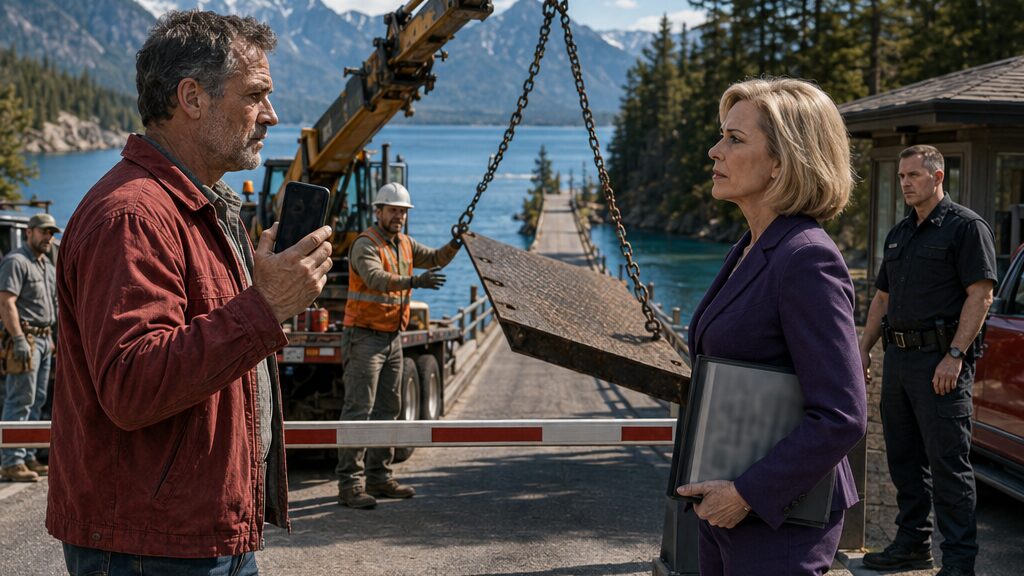
The loader chain snapped tight with a metallic shriek, and the first steel plate jumped off the bridge approach like something being ripped out of bone.
Mark Lewis stopped his truck so hard the seat belt cut across his chest. For half a second he only stared through the windshield at the plate swinging from the chain, its lower edge dripping grit and road dust over the narrow asphalt that led to his home. Beyond it, the lake flashed blue on both sides of the private bridge. Red security vehicles blocked the gatehouse entrance, their hazard lights pulsing against the glass booth. A crewman in an orange vest guided the suspended plate toward a flatbed.
Mark shoved the truck into park and got out before the engine settled.
“Put it down,” he called.
The crewman looked toward the woman standing beside the lowered red gate arm.
Deborah Adams did not turn immediately. She stood in a purple suit too polished for a work zone, one hand holding a folder against her side, the other resting near a phone as if this were a meeting she had already won. When she finally faced Mark, her expression was controlled, almost disappointed.
“Mr. Lewis,” she said. “You were notified this morning.”
“The crew was here this morning.”
“You were notified.”
Mark walked toward the plate, careful not to step under the chain. “That plate is temporary load support. You don’t remove it while the bridge is still open.”
“The bridge is not open.” Deborah nodded toward the gate arm. “The association has sealed the island access road until all unauthorized materials are removed.”
Behind her, Jeffrey Wilson, the security supervisor, shifted beside one of the red vehicles. He had the uncomfortable look of a man following instructions he hoped were written clearly somewhere else.
Mark took out his phone and started recording.
Deborah’s eyes flicked to it. “You may document whatever you like.”
“I intend to.” Mark turned the camera toward the hanging plate, the crew truck, the gatehouse, the lowered arm. “Who ordered this removal?”
“The board authorized enforcement.”
“That isn’t what I asked.”
Her jaw tightened. “I did, as president, under the emergency enforcement clause.”
Mark looked past her to the bridge. The second plate was still bolted over the expansion joint where the asphalt had cracked after the last storm. Timothy Baker had installed both plates before dawn two days ago, after Richard Rivera sent the load-limit warning. Temporary, visible, ugly if someone cared more about clean lines than a road staying usable. Necessary if anyone had to cross without the tires dropping hard at the joint.
His phone buzzed. Timothy’s name flashed across the screen.
Mark answered without lowering the camera. “Where are you?”
“Mainland side,” Timothy said, voice sharp over engine noise. “Security won’t let me through. They’ve got my extra bolts and rail sections sitting right there, and they’re telling me I’m not authorized to retrieve my own equipment.”
Mark turned toward Jeffrey. “My contractor is being blocked from his materials?”
Jeffrey looked at Deborah first. “The work order says no contractor access until the violation is cleared.”
“It’s not a violation,” Mark said.
Deborah stepped closer, lowering her voice as if offering him a chance to become reasonable. “You installed exposed industrial plates and a temporary railing on a community bridge without final architectural approval. You know the rules. The board cannot allow individual owners to alter common access structures whenever they feel anxious.”
Mark almost laughed, but there was nothing in him that could carry it. “Anxious?”
“The engineer’s letter you referenced was not a permit.”
“It was an emergency warning.”
“It was a recommendation.”
“It said vehicle access should be stabilized before continued use.”
“And you chose to install visible metal plates without approval.”
The loader beeped as it reversed toward the flatbed. The plate swung wider than the worker expected, and Mark saw the empty rectangular scar it left behind: four exposed bolt holes, dust, dark scraped asphalt, the uneven lip of the joint. The bridge looked suddenly unfinished, vulnerable.
He moved toward the work zone.
Jeffrey stepped in front of him. “Sir, I can’t let you interfere with the crew.”
Mark stopped just short of him. “I’m not interfering. I’m asking for the court order.”
Deborah blinked once. “Excuse me?”
“The court order allowing you to remove safety equipment from the only road to occupied homes.”
“We have an HOA enforcement order.”
“That’s not a court order.”
“It is binding under the covenants.”
“Then show me the section that lets you create a safety hazard to cure an appearance violation.”
The crew supervisor had gone still beside the flatbed. The loader idled, engine knocking. A couple of neighbors stood by the far shoulder, pretending not to watch while watching everything.
Deborah opened her folder. “Section nine permits the association to remove unauthorized exterior alterations affecting community property.”
“Read the next sentence.”
She looked up.
“Read the part about emergency conditions,” Mark said.
Her fingers tightened on the page. “Do not lecture me on documents you chose to ignore.”
“I submitted the emergency packet Monday night.”
“There is no approved emergency packet.”
“There is a submitted packet.”
“That distinction is exactly why this removal is happening.”
Mark held the phone steady, though his hand wanted to shake. He could see the mainland road beyond the gatehouse, the way out, the way ambulances came in, the way groceries came in, the way Carolyn’s medical transport came when the appointment was too far and the stairs inside the house had already taken enough from her for one year.
He did not say Carolyn’s name.
Deborah watched his silence and seemed to take it as weakness.
“We are not debating this beside a machine,” she said. “You may appeal tomorrow morning at the emergency violation hearing. Until then, the gate remains sealed, the contractor remains barred, and every unauthorized piece comes off the bridge.”
Mark turned the camera toward her. “Say that again.”
“I said the gate remains sealed.”
“Until what?”
“Until all unauthorized materials are removed and the board determines whether further action is necessary.”
“Even though those materials were installed for safe access?”
“Your opinion of safety does not override the association’s process.”
From the far side of the gate, Timothy appeared on foot, stopped by a security guard near his parked truck. He lifted both hands, furious but careful.
“Mark!” he shouted. “They’re loading the rail sections too.”
Mark looked toward the flatbed. Two workers were carrying the temporary handrail Timothy had bolted along the worst edge of the approach. It was not elegant. It was galvanized and braced with plain clamps. Carolyn had gripped it yesterday morning, chin high, pretending she did not need it as much as she did.
Mark stepped toward the workers. “Those are mine. Put them down.”
The crew supervisor hesitated.
Deborah’s voice cut through the idling engine. “Continue removal.”
Mark turned back to her slowly. “You’re making a record of every part of this.”
“That is your choice.”
“No,” he said. “That’s yours.”
For the first time, something uncertain crossed Deborah’s face. Not regret. Calculation.
Jeffrey touched the radio at his shoulder. “Do you want me to close it fully?”
Deborah did not look away from Mark. “Yes.”
The red gate arm, already lowered across the bridge lane, gave a mechanical hum. A second barrier post extended from the gatehouse side, locking into place with a hard metal click. The sound carried across the water.
Jeffrey spoke into his radio. “Island access sealed. Resident Mark Lewis noncompliant at gatehouse. Contractor access denied.”
Mark lowered his phone only after the words were recorded. Across the bridge, the empty bolt holes stared back at him from the road home.
Chapter 2: The Gate Arm Drops Across the Only Road Home
The medical transport driver called while Mark was still standing close enough to the gatehouse to hear the loader idling behind him.
“I’m at the mainland entrance,” the driver said. “Security says I’m not cleared to cross. I’ve got Mrs. Lewis scheduled for a two o’clock pickup, but I can’t even get past the booth.”
Mark turned away from Deborah so she would not see his face change. Across the gate, one of the red vehicles had shifted sideways, blocking the narrow service lane beside the arm. Timothy stood beside his truck with his phone pressed to his ear, still arguing with someone who would not answer to him.
“Stay there,” Mark told the driver. “Don’t cancel yet.”
“I’ve got fifteen minutes before dispatch makes me move on.”
“I said don’t cancel.”
He hung up and walked toward the house instead of toward Deborah. It took more restraint than stepping in front of the loader. The island road curved through pines before climbing to the cluster of homes facing the lake. Mark’s driveway was close enough to the bridge that he could still see the red gate arm from the kitchen window when he got inside.
Carolyn was sitting at the table with her cane hooked over the chair beside her. She had put on the blue cardigan she wore to appointments, the one with sleeves loose enough not to catch when she moved. A folder lay open in front of her, but she was not reading it.
“They didn’t let the van through,” she said.
Mark stopped by the sink. “Not yet.”
“That means no.”
“It means not yet.”
“Mark.”
He took off his jacket and hung it too carefully on the chair. The movement betrayed him. Carolyn watched his hands, not his face.
“How much did they take?” she asked.
“One plate. Some rail sections.”
Her eyes closed for a moment.
“The second plate is still on,” he said quickly. “The bridge isn’t open to vehicles, but it hasn’t failed. Timothy’s on the mainland side. I’m documenting all of it.”
“Did you tell Deborah why the rail was there?”
“I told her it was for safe access.”
Carolyn’s mouth tightened. “That is not what I asked.”
He looked toward the window. From the kitchen, the gate was a red line at the bottom of the road. Small, almost harmless from a distance.
“I submitted the medical note with the packet,” he said.
“To the portal.”
“Yes.”
“To a system Deborah says has no packet.”
Mark rubbed both hands over his face. “I wasn’t going to stand at the bridge and say your appointment schedule into my phone while half the island watched.”
“I didn’t ask you to announce my life.”
“I know.”
“I asked if they understood what they were removing.”
He did not answer, because the answer was no, and because he had helped make that possible.
Carolyn reached for the cane and stood with a slow, practiced motion. Her left hand hovered above the table before settling. She hated being helped before she asked. Mark stayed where he was.
“Privacy is not the same as pretending,” she said.
“I’m not pretending.”
“You are when you let them call it ugly metal instead of a way for me to leave the house.”
The words landed without being raised. That was worse.
Mark’s phone buzzed again. Timothy had sent three photos: the removed plate on the flatbed, the handrail sections stacked beside it, and a close-up of the bridge joint where the plate had been. A fourth message followed.
They barred me before I could torque the second side. Don’t drive anything heavy over it.
Mark forwarded the photos to himself, then opened the folder on the kitchen counter. Richard Rivera’s engineer letter was on top, printed and highlighted. The date was Monday. The warning was plain: temporary stabilization recommended before routine vehicle use continues.
Below it was Mark’s email confirmation to the HOA portal. He had uploaded Richard’s letter, Timothy’s repair estimate, photos of the cracked joint, and Carolyn’s medical transport letter in a sealed attachment marked private medical information. He had done everything the form allowed. He had even called the board secretary afterward, leaving a message because no one had answered.
Carolyn came beside him, leaning just enough on the counter to hide that she was leaning. “Show me the timestamp.”
He turned the page.
“There,” he said. “Monday, 8:42 p.m. Emergency bridge access repair request submitted.”
“Where is the receipt number?”
“At the bottom.”
But when he looked, the line beneath the timestamp was blank.
He frowned and opened the laptop. The HOA portal took too long to load. His password failed once because his fingers hit the wrong key. Carolyn stayed quiet beside him.
The dashboard opened.
No active architectural requests.
Mark clicked archived submissions. Nothing. He clicked maintenance inquiries. One message appeared from Monday night: “Owner concern regarding bridge appearance and repair materials.” No attachments.
“That’s not what I submitted,” he said.
Carolyn leaned closer. “Open it.”
The message was three lines long, stripped of documents, stripped of urgency.
Requesting review of temporary visible material near lake bridge approach. Please advise regarding compliance.
No Richard letter. No photos. No medical attachment. No emergency tag.
Mark’s throat went dry. “I didn’t write it like that.”
“Print it.”
He did.
As the printer started, an email from Deborah arrived with the formal calm of a door being shut.
Emergency Violation Hearing — Tomorrow, 9:00 a.m. Attendance Required.
Mark opened it.
Carolyn read over his shoulder. Unauthorized alteration to common access structure. Contractor access suspended. Gate seal to remain in effect pending board review. Failure to comply may result in fines, repair costs, and additional enforcement.
At the bottom, in bold, was a line that made Mark’s hands still.
No emergency repair request is currently on file for this property.
Carolyn reached past him and touched the printed Richard letter. “Then tomorrow you tell them.”
“I’ll tell them enough.”
“No.” Her voice did not rise, but it cut cleaner than Deborah’s. “Tomorrow you tell them what the bridge is for. Not just what it’s made of.”
Mark looked from the letter to the red gate arm outside. A security guard stood beside it, small in the window frame, his shoulders turned against the wind off the lake.
He opened his email archive and searched the portal receipt again. Monday. Emergency. Bridge. Richard. Carolyn.
A confirmation message appeared, but the receipt field was blank there too, as if the system had swallowed the only number that proved it had ever existed.
Chapter 3: The Form That Was Never Logged
The board secretary printed Mark’s file at 9:03 the next morning, and the page where his emergency repair request should have been was completely blank.
Not incomplete. Not pending. Blank.
She stood at the HOA office printer with one hand on the stack, her eyes moving between the paper and Mark as if paper could embarrass a room. Behind her, the office window looked down the hill toward the lake bridge. The red gate arm was still locked across the access road, bright against the gray pavement. A security vehicle sat beside it with its engine running.
Deborah Adams waited at the conference table, already seated. Laura Green sat two chairs away, a pen in her hand, jacket still buttoned as though she had come prepared to leave quickly. Jeffrey Wilson stood near the back wall, not quite part of the meeting and not free of it either.
The board secretary placed the file in front of Deborah. “This is the architectural and maintenance record for the Lewis property.”
Mark remained standing. “Then it’s missing documents.”
Deborah opened the file without looking at him. “That is what we are here to determine.”
“No,” Mark said. “That is what you determined before you sent a crew.”
Laura looked up.
Deborah folded her hands on the file. “Mr. Lewis, the emergency hearing concerns unauthorized structural alterations to the lake bridge approach. You may present relevant information, but you will not control the meeting.”
“The bridge is the only road to my house.”
“It is a common access structure governed by association rules.”
“It is also the only route for emergency vehicles.”
“And that is why unapproved modifications are taken seriously.”
Mark set his own folder on the table. He had arranged it before dawn while Carolyn sat across from him, silent except for the times she made him replace words like “my wife’s condition” with “access need.” Not shame. Not spectacle. Need.
He slid Richard Rivera’s letter forward. “This was uploaded Monday night.”
Deborah did not touch it.
Laura did. She drew it closer and scanned the first page. “This says temporary stabilization recommended before continued vehicle use.”
“Correct,” Mark said.
Deborah’s eyes moved to Laura, then back to Mark. “Recommended by your privately hired engineer.”
“A licensed structural engineer.”
“Not the county. Not the association’s retained consultant.”
“He was the only one who answered before the joint got worse.”
Deborah opened the printed file. “The record shows one owner message received Monday night regarding visible materials near the bridge. It does not include an emergency request.”
“Because the record changed.”
“That is an accusation.”
“It’s a fact. What I submitted and what the portal shows are not the same.”
The board secretary shifted. “Sometimes attachments fail if the file size is too large.”
Mark turned to her. “Then why did the subject line change?”
The room went quiet enough for the printer to be heard cooling behind them.
Laura leaned toward the secretary. “Can we see the original notification email?”
Deborah’s voice hardened. “The official file is in front of us.”
“I understand,” Laura said. “But if the owner has an email showing a different submission—”
“The owner has a personal copy of what he claims he sent.”
Mark pulled out his phone and opened the archive. He had printed everything, but he wanted them to see the timestamp glow on the screen. “Monday, 8:42 p.m. Emergency bridge access repair request. Attachments listed: Rivera letter, bridge joint photos, Baker estimate, private medical access letter.”
He placed the phone on the table.
Laura read it before Deborah could stop her. “The attachment names are listed here.”
“They are names in an email,” Deborah said. “They are not proof the files uploaded into the association system.”
“No,” Mark said. “But they prove I didn’t send a three-line complaint about appearance.”
Jeffrey cleared his throat from the wall. “The work order I got said no emergency filing was present.”
Mark looked at him. “When did you get it?”
Jeffrey hesitated. “Yesterday morning.”
“What time?”
Deborah cut in. “Security scheduling is not the issue.”
“It is if the crew was sent before anyone reviewed the packet.”
Jeffrey’s eyes moved to Deborah. “Six forty-five.”
Laura’s pen stopped.
Mark held Deborah’s gaze. “The notice on my door was after ten.”
Deborah closed the file. “The association is permitted to act immediately when unapproved structures create a liability risk.”
“The liability risk was the bridge joint.”
“The risk was also your unilateral installation.”
“It was temporary stabilization.”
“It was unauthorized metal bolted to a shared roadway.”
“Because the shared roadway was cracking.”
Laura looked again at Richard’s letter. “Deborah, did you see this before yesterday?”
Deborah did not answer immediately.
Mark noticed. So did Laura.
“I saw references to an engineer,” Deborah said.
“That wasn’t my question,” Laura replied.
Deborah’s expression chilled. “I was made aware that Mr. Lewis intended to justify work already performed.”
Mark leaned forward, both palms on the table. “Work performed because no one answered the emergency line.”
“The emergency line is for active damage, not owner preference.”
“My contractor found widening at the joint.”
“And chose to install visible plates before approval.”
Mark almost said Carolyn’s name. It rose in him, heavy and hot, but he stopped it behind his teeth. He could hear her in the kitchen: You tell them what the bridge is for. Not just what it’s made of.
Instead he opened the folder to the medical access letter, still sealed in its inner envelope. His thumb rested on the flap.
Deborah saw it. “If that is private medical material, it can be submitted to the board in executive session after proper logging.”
“It was already submitted.”
“There is no record of that.”
“Then log it now.”
“We are not changing the nature of the hearing because you failed to follow process.”
Laura set down Richard’s letter. “He may not have failed.”
Deborah turned sharply. “Laura.”
“No. If attachments were referenced in a confirmation email, we need to know why they aren’t in the file.”
The board secretary swallowed. “There may be an attachment audit trail. It isn’t in the printed file.”
“Pull it,” Laura said.
Deborah stood. “We are not conducting an IT review in the middle of an enforcement hearing.”
Mark felt the shape of the room change. Not enough to win. Enough to show where the wall had been built.
Deborah gathered the pages into a neat stack. “The violation stands pending full board review. The gate remains sealed. Contractor access remains suspended. Mr. Lewis may submit a complete emergency packet through the proper channel.”
“I already did.”
“Then do it again.”
“And while we wait?”
Deborah’s face did not move. “You should not have created a condition that required waiting.”
Mark looked through the office window toward the bridge. The red gate arm was a line drawn across the morning.
The meeting broke with no vote. Deborah left first, carrying the official file. Jeffrey followed after a moment, radio murmuring against his shoulder. The board secretary returned to the printer though nothing was printing.
Laura stayed behind.
Mark closed his folder slowly. “You saw the attachment names.”
“I saw them.”
“Will that matter?”
Laura glanced toward the hallway Deborah had taken. “It might.”
“That isn’t an answer.”
“No,” she said. “It’s the only honest one I have.”
He picked up Carolyn’s unopened envelope. Laura’s eyes dropped to it, then away.
At the door, she spoke so quietly he almost missed it.
“Mark, Richard’s letter was mentioned before Deborah says she knew about it. I heard it in a board call Monday night.”
He turned back.
Laura’s fingers tightened around her pen. “She didn’t sound surprised then.”
Chapter 4: Deborah Crosses the Bridge to Prove a Point
Deborah drove across the bridge before anyone could stop her, her dark SUV rolling over the remaining steel plate with a hollow clank that made every worker on the mainland side look up.
Mark stood at the gatehouse window with Laura’s words still lodged in his head. She didn’t sound surprised then. He had come down to check whether Timothy had been allowed to collect his tools. Instead, he found Deborah behind the wheel, passing the red gate arm after Jeffrey lifted it just long enough for her vehicle to slide through.
“Why is she crossing?” Mark asked.
Jeffrey lowered the arm again too quickly. “She said she needed to inspect the island side.”
“With the bridge half stripped?”
Jeffrey’s hand stayed on the gate controls. “She said it was passable.”
Mark looked at the bridge. One temporary plate remained across the worst of the expansion joint, but the first plate’s absence had exposed a dark, uneven bite in the approach. The loader was parked near the flatbed. The crew supervisor was speaking into his phone. Timothy stood beyond the security vehicle, watching the SUV with the rigid stillness of a man seeing a bad decision made in real time.
The SUV reached the island side and stopped near the far shoulder. Deborah stepped out, phone in hand, folder under one arm. From across the bridge, even at a distance, Mark could read the confidence in her posture. She pointed toward the remaining plate.
The crew supervisor turned to Jeffrey. “She wants the second one off.”
“No,” Mark said.
Jeffrey did not meet his eyes.
Mark stepped toward the barrier. “Jeffrey, listen to me. That second plate is carrying the transition. If they pull it before temporary shoring goes in, no vehicle should cross.”
“That’s your contractor’s opinion.”
“That’s the engineer’s opinion.”
The gatehouse radio crackled. Deborah’s voice came through clipped and clear. “Proceed with removal. No further delay.”
The crew supervisor gave a small helpless shrug toward Timothy, then signaled the loader operator.
Timothy pushed against the security guard’s outstretched arm. “You can’t pull that without blocking the joint first. I haven’t torqued the replacement brackets. You’re leaving a drop edge.”
“Stay behind the vehicle, sir,” the guard said.
Mark raised his phone and began recording again. The loader rolled forward. Its chain lowered toward the last plate.
“Deborah!” he shouted across the water.
She turned, one hand shading her eyes.
“Stop the work until Richard or the county sees it.”
She lifted her phone instead of answering, as if recording him back made the situation equal.
The chain hooked. The engine strained. The second plate scraped against the bolts with a scream that traveled up through Mark’s teeth. One worker knelt to loosen the final fasteners. Another guided the chain. The plate came up an inch, then three, revealing the dark seam beneath.
A white county vehicle turned off the mainland road and slowed near the gatehouse.
Mark lowered his phone just enough to see the seal on the door. The county inspector got out with a hard hat in one hand and a tablet in the other. He looked first at the red security vehicles, then at the suspended plate, then at Mark.
“Who is supervising this access work?” the inspector asked.
Deborah began walking back from the island side, heels careful on the bridge surface.
Mark pointed across the gate. “The HOA president ordered removal. My contractor is being blocked from stabilizing the joint.”
The inspector’s eyes narrowed at the exposed seam. “That plate was over that joint?”
“Yes.”
“Why is it being removed?”
Deborah reached the far side of the gate arm, still separated from Mark and the inspector by the lowered barrier. “Because it was installed without association approval.”
The inspector looked at her. “Is there a county removal permit for work on this access route?”
Deborah’s face changed only slightly. “This is private association property.”
“It is also the emergency access route for occupied residences.”
Mark felt the words land harder than anything he had said himself.
The inspector walked to the exposed section on the mainland side. He crouched, photographed the missing plate area, then motioned toward the remaining suspended plate. “Set that down. Do not load it.”
The loader operator looked to the crew supervisor.
The crew supervisor looked to Deborah.
The inspector’s voice sharpened. “Now.”
The plate came down with a heavy clang, not back into position, but flat on the asphalt beside the scarred joint. The sound made Deborah flinch.
Richard Rivera’s truck pulled up behind Timothy’s a minute later. Mark had called him after leaving the HOA office, not knowing whether he would make it in time. Richard got out with a rolled plan tube and a measuring level, face already grim as he took in the exposed approach.
“You pulled the first plate?” he asked Mark.
“They did.”
Richard went straight to the joint. He did not argue. He measured. He knelt. He placed one hand at the edge where the first plate had been and pressed lightly, then looked at the inspector.
“No vehicle crossing,” Richard said. “Not until temporary support is restored and fastened.”
Deborah spoke from behind the gate arm. “My SUV crossed ten minutes ago.”
Richard looked at her vehicle parked on the island side. “Then it stays there.”
A few seconds passed before Deborah understood.
“That is not practical,” she said.
“No,” Richard replied. “It is structural.”
The inspector tapped notes into his tablet. “I’m placing a temporary vehicle restriction on this crossing. Pedestrian use only, and only outside the work zone, until temporary support is restored or I inspect an alternate stabilization.”
Deborah stepped closer to the gate arm. “You can’t close the road.”
“You closed it,” Mark said.
Her eyes moved to him then, sharp with warning.
The inspector looked between them. “The association sealed the gate?”
Deborah straightened. “Pending enforcement review.”
“And removed temporary stabilization from the emergency access route?”
“We removed unapproved materials.”
“Noted,” the inspector said.
That one word did more to disturb her than Mark’s anger had.
Jeffrey stood inside the gatehouse, radio silent in his hand. The red gate arm remained locked between the mainland and the island. Deborah was on the island side now. Her SUV was on the island side. The crew was on the mainland side. The plates were half removed, half useless. Timothy’s tools were still in his truck, barred behind security.
The trap was not dramatic. There was no snap of a cage, no shout from the watching neighbors. It was quieter than that. A rule had folded back on itself.
Deborah came to the gate arm. “Jeffrey, open it for pedestrian access.”
Jeffrey glanced at the inspector.
“Pedestrians may cross outside the work zone,” the inspector said. “No vehicles.”
Deborah’s mouth tightened. “I need my vehicle.”
“Then the support has to be restored.”
She looked at Mark. “Mr. Lewis, you have an emergency override for the gatehouse.”
“I do.”
“Use it.”
Mark heard Carolyn’s voice in his head. Not just what it’s made of.
He could have opened the gate. He could have let Deborah walk back and pretend the mistake was inconvenience, not consequence. He could have stepped aside, fixed the plates, absorbed the violation, and watched the same file disappear twice.
Instead, he took Richard’s letter from his folder and held it against the gatehouse glass.
“You want the override?” he said.
Deborah’s polished control cracked at the edges. “This is not the time for games.”
“No,” Mark said. “It’s the first time everyone’s been honest about what this bridge is.”
The inspector looked at him, waiting.
Mark kept his voice low enough that she had to listen. “Put the repair approval in writing first.”
Chapter 5: The Inspection Finds the Wrong Violation
The county inspector photographed the empty bolt holes where Mark’s first steel plate had been, not the plate itself.
Deborah noticed. So did Mark.
The inspector crouched at the bridge approach, his tablet angled away from the glare, and took close shots of the scraped asphalt, the exposed expansion joint, the gouged edges where the fasteners had been pulled. Every flash of the camera seemed to reverse the morning’s accusation. The violation was no longer the metal Mark had installed. It was the space left after the HOA removed it.
Deborah stood on the island side of the lowered gate with her folder tucked under one arm, watching the inspection become something she had not ordered.
“This is excessive,” she said.
The inspector did not look up. “The bridge is the only vehicular route to those homes?”
“Yes,” Mark said.
Deborah answered at the same time. “It is a private association bridge.”
The inspector finally looked at her. “Those are not mutually exclusive.”
Richard was marking measurements near the exposed seam. Timothy had been allowed closer after the inspector told security that the contractor’s equipment might be needed to make the route safe. Jeffrey still hovered near the gatehouse, quieter now, his radio clipped but unused.
The inspector walked to the gatehouse. “Who placed the notice on Mr. Lewis’s door?”
Jeffrey’s shoulders tightened.
Deborah answered for him. “Security delivered notice pursuant to enforcement procedure.”
“What time?”
Jeffrey looked at Mark before speaking. “After ten.”
The inspector entered something into the tablet. “Work began when?”
Jeffrey shifted. “Crew arrived at eight.”
Mark stared at him.
Jeffrey swallowed. “Removal started around eight-thirty.”
Deborah turned sharply. “Jeffrey.”
He did not look at her. “That’s the log.”
Mark felt the small payoff without satisfaction. The order had not just moved faster than review. It had moved ahead of notice.
The inspector asked, “Was the resident given opportunity to secure the site before removal began?”
Deborah’s voice cooled. “The resident had already created the violation.”
Richard stood. “The site was secured before removal.”
The inspector turned to him.
Richard held out his marked copy of the Monday letter. “Temporary stabilization was recommended because the joint deterioration changed after the storm. I have no opinion on HOA aesthetics. Structurally, removing one plate and leaving the other unsecured is worse than leaving both in place until a permanent repair is scheduled.”
Deborah looked at Mark. “Your engineer would say that.”
“My engineer said it Monday,” Mark replied. “Before you sent the loader.”
The inspector’s tablet made a soft chime as he saved another note. “Until temporary support is restored, I will not clear vehicle traffic. Emergency services should be advised access is restricted.”
That sentence stripped the color from the afternoon.
Mark thought of Carolyn’s appointment, already missed once. Her rescheduled transport at seven the next morning. The driver’s careful voice. Fifteen minutes before dispatch moves me on.
He stepped closer to the inspector. “What is required to restore temporary access tonight?”
Richard answered before the inspector did. “Reinstall both plates with proper torque, replace the handrail section, and limit heavy vehicles until permanent repair. I can certify temporary support after inspection.”
Timothy looked at the flatbed. “My bolts and rail sections are still there. I can do it before dark if security lets me work.”
Deborah’s expression hardened again, but not with the same confidence. “The association has not authorized reinstallation.”
The inspector looked at her. “Then the bridge remains restricted.”
A long silence followed. Down the road, a neighbor stood near a mailbox, arms folded. Another car slowed on the island side and stopped when the driver saw the gate.
Mark did not enjoy watching Deborah trapped. That surprised him. He had imagined, in the heat of the first removal, that seeing her caught by her own order would feel like justice. Instead it felt like standing in the middle of a problem that had grown larger than the person who caused it.
Carolyn was still behind that gate too.
He turned to Timothy. “Don’t touch anything until it’s written.”
Timothy gave a short nod, though worry flickered across his face. “Daylight’s going.”
“I know.”
Mark’s phone buzzed. Carolyn.
He stepped away from the group and answered.
“Is the bridge open?” she asked.
“Not for vehicles.”
“How long?”
“If they approve the temporary reinstall, tonight.”
“And if they don’t?”
He looked back at Deborah, who was speaking quietly to Jeffrey through the gate arm, her folder pressed tight against her ribs. “Then your morning transport may not get through.”
Carolyn was silent for a moment. When she spoke again, her voice had lost its softness. “Don’t trade everything away just to make them comfortable.”
“I’m not trying to win.”
“I know. That’s what worries me. You’ll fix the bridge and let them keep the story.”
The call ended with no goodbye, only the sound of her setting the phone down.
By early evening, the lake had gone dark blue under the bridge. The inspector had issued a temporary restriction notice and emailed copies to the HOA office, the county access desk, Mark, and Deborah. Timothy stood by his truck with his work gloves in one hand, waiting for permission no one wanted to put on paper. Richard had packed his tools but stayed, leaning against his tailgate, because leaving would have felt like surrender.
Deborah finally crossed on foot through the pedestrian gap, stepping carefully around the exposed joint. Her purple suit looked less like armor in the fading light.
She stopped near Mark, away from the others. “I can call an emergency board meeting in the morning.”
“Morning may be too late.”
“It is the earliest formal option.”
“You formally authorized removal in one morning.”
Her eyes flashed. “Under enforcement authority.”
“But not repair authority.”
She looked toward the bridge, where the bolt holes were small black marks in the asphalt. “Approval of common-structure work requires board vote.”
“Removal didn’t?”
“It falls under a different clause.”
Mark let that sit between them.
For the first time all day, Deborah lowered her voice without using it as a weapon. “You think I did this because I wanted to hurt you.”
“I think you knew enough to stop.”
Her face changed. Not an admission. Not denial either.
“There was a lawsuit three years ago,” she said. “Different bridge issue. Different board. One owner made an alteration, another owner claimed the association allowed unsafe work, and our insurance nearly doubled. Half the island still blames the board for not acting fast enough.”
“So you acted fast enough to create the unsafe condition yourself.”
She looked at him then, and he saw what lived under the polish: fear dressed as certainty.
“I cannot authorize your repair alone,” she said.
Mark glanced at the red gate arm, then at the plates on the truck. “But you could stop it alone.”
Deborah had no answer. Not one she was willing to say.
Chapter 6: The Board Calls Safety an Aesthetic Exception
Deborah opened the emergency board meeting by placing a photograph of Mark’s steel plates on the table and calling them “an unapproved exterior alteration to a shared community feature.”
Mark sat across from her with Carolyn’s sealed medical envelope in his folder and the taste of cold coffee still in his mouth. Through the HOA office window, the lake bridge was visible in the distance, thin and bright in the morning sun. The red gate arm remained down. Timothy’s truck was parked on the mainland side. His materials were still stacked where the crew had left them.
Laura Green stared at the photograph Deborah had chosen. It had been taken before removal, when both plates were bolted flat and the temporary handrail stood straight along the approach.
“That looks stable,” Laura said.
Deborah’s eyes moved to her. “The question is not whether it looks stable. The question is whether an owner may modify a common access structure without approval.”
“The question might also be why removal was approved faster than review,” Laura said.
No one spoke for a few seconds.
The HOA treasurer shifted in his chair. The board secretary lowered her eyes to the meeting notes. Jeffrey stood near the wall again, called in to answer timing questions if needed. Mark had the sense everyone had arrived wanting the same thing: make the bridge usable without saying Deborah had been wrong.
Deborah clicked her pen. “We are here because Mr. Lewis bypassed process.”
Mark slid Richard’s letter across the table. “No. We are here because process ignored the emergency.”
Deborah did not pick it up. “Your submission was incomplete.”
“My email confirmation listed the attachments.”
“Attachment names are not attachments.”
Laura leaned forward. “The audit trail shows something was uploaded.”
Mark turned to her.
Deborah’s head snapped slightly. “You accessed the audit trail?”
Laura held her pen still. “The board secretary pulled it this morning at my request. There were four file attempts attached to Mark’s Monday submission. The system generated a temporary upload token, then the record converted into a maintenance inquiry.”
The board secretary spoke quietly. “That sometimes happens if the wrong category is selected.”
“I selected emergency access repair,” Mark said.
The secretary flushed. “I’m not saying you didn’t.”
Deborah’s voice became very even. “Even if the files failed to attach properly, the owner began work before approval.”
Timothy, sitting near the wall with his cap in his hands, looked up. “I started after I saw the engineer letter.”
“You are not a board member,” Deborah said.
“No. I’m the person who found the joint moving.”
The treasurer spoke for the first time. “Deborah, the county restriction is the immediate problem. If emergency vehicles can’t cross—”
“Which is why we need an orderly resolution,” Deborah said. “Not a precedent where any homeowner with a contractor can bolt materials to shared infrastructure and call it urgent.”
Mark opened his folder. He had arranged the papers so the medical envelope sat beneath Richard’s letter, not on top. Even now, some stubborn part of him wanted to keep it there. Carolyn had joined by video but had not turned on her camera yet. Her name appeared in a small black rectangle on the screen at the end of the table: Carolyn Lewis.
He looked at that rectangle and felt the weight of what he had done by trying not to expose her.
Laura tapped the photograph. “Why did we remove it before confirming whether the emergency claim had support?”
Deborah pulled a binder from beside her chair and opened it to a tabbed page. “Covenant section nine, paragraph four. The association may immediately remove unsafe unapproved structures affecting common areas.”
She pushed the binder toward Laura.
Laura read the line. Her face tightened because it was there. Not enough to make Deborah right. Enough to make the board nervous.
Deborah looked around the table. “This clause exists for a reason. We have lived through the cost of hesitation. If the association knowingly permits unapproved structural alterations, we risk liability, insurance penalties, and special assessments. I will not apologize for protecting the community.”
There it was, Mark thought. Not cruelty. Not even dislike. A fear large enough to make one home disappear inside the word community.
He took out his phone and placed it on the table. “This was recorded yesterday.”
Deborah’s gaze sharpened.
Mark played the clip. The room filled with the sound of the loader, the chain, his own voice asking for a court order, Deborah saying the gate would remain sealed until all unauthorized materials were removed.
Then Jeffrey’s radio voice: Island access sealed. Resident Mark Lewis noncompliant at gatehouse. Contractor access denied.
Mark stopped the video before it reached his silence about Carolyn.
He slid the phone toward the center. “The notice was placed on my door after the crew arrived. Jeffrey confirmed that for the inspector.”
Jeffrey looked down.
Deborah closed the binder. “Improper notice timing, if established, can be corrected. It does not retroactively approve the alteration.”
“No,” Mark said. “But it shows enforcement came before review.”
He placed Richard’s letter beside the covenant binder. Then the email confirmation. Then the printed portal page showing the stripped-down inquiry.
One by one. No speech. No begging.
Laura looked at the documents, then at the black rectangle on the screen. “Mark, is there another reason this had to be done before full review?”
His hand went to the medical envelope.
The room waited.
He saw Carolyn at the kitchen counter, telling him privacy was not pretending. He saw her hand hovering above the table before she let it settle. He saw the temporary rail being lifted away by workers who thought it was ugly metal.
He lifted the envelope but did not open it.
“This contains private medical access information,” he said. “It was included in the original submission. Carolyn has a transport appointment that has already been missed once because the gate was sealed.”
Deborah leaned back slightly. “The board cannot evaluate undisclosed medical claims after the fact.”
The black rectangle at the end of the table flickered.
Carolyn’s camera turned on.
She was seated at their kitchen table in the blue cardigan, cane visible against the chair beside her. Her face was pale, but her eyes were steady.
“Deborah,” she said, “I did not ask my husband to use me as a shield.”
The room froze.
Mark turned toward the screen. “Carolyn—”
“No,” she said, not unkindly. “You don’t get to protect my dignity by letting them erase the reason.”
His throat closed.
Carolyn looked from Mark to the board, then back to Deborah. “That rail you removed is not decoration. Those plates are not Mark making a point. They are how I leave my home without wondering whether the vehicle under me will drop at the bridge joint.”
Deborah’s face held its shape, but the hand near her binder was still.
Carolyn’s voice softened without weakening. “You may decide what your rules say. But Mark is not allowed to make me invisible to protect my pride.”
Chapter 7: Mark Opens the Gate Only After the Order Changes
Deborah offered Mark a verbal exception while the gate arm was still down, the bridge still restricted, and Timothy’s steel plates still lying beside the flatbed like evidence no one wanted to touch.
“You open the gate now,” she said, “and I will allow the temporary supports to be reinstalled pending review.”
Mark stood beside the gatehouse control panel with the emergency override key in his palm. The key was small, brass, and worn smooth at the edges from years of drills and maintenance checks. It had never felt heavy before.
Laura was on the phone with the county inspector. The board secretary had the meeting laptop balanced on the hood of Jeffrey’s red security vehicle. Deborah stood near the barrier with her folder open, trying to keep her voice low enough that the neighbors gathering at a distance could not hear every word.
Mark did not move toward the lock.
“Put it in writing,” he said.
Deborah’s expression tightened. “The board has not completed formal language.”
“Then the gate stays closed.”
Jeffrey looked from Mark to Deborah. Timothy, standing near his truck with his gloves tucked under one arm, went still. The bridge behind them was quiet, the exposed joint marked by cones Richard had placed before leaving to prepare a temporary certification form.
Deborah stepped closer. “Mr. Lewis, your wife has a medical transport issue. You know that.”
“Yes,” Mark said.
“And you are choosing to delay repair over wording?”
He closed his fingers around the key until the teeth pressed into his skin. “Verbal permission is how the repair became a violation in the first place.”
That stopped her.
Laura lowered the phone from her ear. “The inspector says if the plates are reinstalled under Richard’s written temporary plan, he can clear limited vehicle access after photos and torque confirmation.”
“Good,” Deborah said quickly. “Then we proceed.”
“With what authorization?” Mark asked.
She turned to him. “I just gave it.”
“No. You gave a sentence.”
The board secretary looked uncomfortable but began typing. Deborah saw it and stiffened. “Do not draft anything yet.”
Laura’s voice sharpened. “Deborah.”
“We cannot withdraw an enforcement action on the roadside.”
“You started one on the roadside,” Mark said.
The words landed in the small space between the red gate arm and the exposed bridge.
For a moment, Deborah looked less angry than cornered. Her gaze moved toward the island side, where her SUV still sat uselessly beyond the restricted span. Then toward the security vehicles. Then toward the neighbors who were not close enough to intervene but close enough to remember.
“This community cannot operate if every emergency claim bypasses review,” she said.
Mark looked at the bridge instead of her. “This community cannot operate if the only road home gets treated like trim color.”
Carolyn’s video call remained open on Mark’s phone, propped against the gatehouse window. She had not spoken since the board moved outside, but he could see her face on the screen. Tired. Watching. Not hiding.
He lifted the phone. “Carolyn, what do you want disclosed?”
Deborah’s eyes flicked toward the screen.
Carolyn held Mark’s gaze through the glass reflection. “Enough.”
He nodded once. “Tell me where to stop.”
She gave the smallest smile, almost pained. “I will.”
Mark turned to Laura and the board secretary. “The medical letter states Carolyn has mobility limitations that require reliable vehicle access for scheduled transport and emergency care. It does not ask the HOA for sympathy. It asks the HOA not to remove temporary safety support from the only access route before review.”
The board secretary stopped typing for a second, then resumed.
Deborah stared at the laptop screen as if the words themselves were a loss.
Laura faced her. “We have the audit trail. We have the county restriction. We have Jeffrey’s timing log. We have Richard’s letter. The question is not whether Mark’s installation was perfect. It wasn’t. The question is whether removal was the safe response.”
Deborah’s jaw worked once. “The covenant clause—”
“Doesn’t require us to be careless,” Laura said.
The HOA treasurer, who had come down from the office after the meeting broke open, wiped his forehead and spoke reluctantly. “If emergency services can’t cross and we refuse documented temporary repair, that is a bigger liability than the plates.”
Deborah looked at him with disbelief. “Now you’re worried about liability?”
“I was always worried about liability. I’m now worried about the correct one.”
Mark looked down at the override key. The temptation was still there: turn it, get Timothy working, get Carolyn’s transport cleared, and fight the paperwork later. It would be easier. It would also leave Deborah free to say she had granted permission out of goodwill, that Mark had overreacted, that the violation remained pending.
Carolyn’s voice came through the phone. “Mark.”
He looked at her.
“Don’t make another private agreement for my sake.”
The sentence hit harder than accusation. It named the thing he had done for days: private submissions, private explanations, private fear. He had tried to protect her from being reduced to a case number, but in the silence, other people had reduced the bridge to an aesthetic problem.
He set the key on the gatehouse counter, away from the lock.
Laura turned to the board secretary. “Read back what you have.”
The secretary swallowed. “Emergency resolution. The board acknowledges receipt of owner-submitted engineering documentation and medical access information related to the lake bridge approach. The board withdraws the current violation notice pending full review—”
“Not pending,” Mark said.
Deborah’s eyes flashed. “You don’t dictate board language.”
“I don’t accept a withdrawn violation that can be revived as soon as the gate opens.”
Laura nodded slowly. “Withdraws the current violation notice. Period.”
The secretary deleted, retyped.
She continued. “The board authorizes immediate temporary reinstallation of steel support plates and handrail sections under Richard Rivera’s written stabilization plan, subject to county inspection. Contractor access for Timothy Baker is restored for this limited emergency work. Permanent repair review to be scheduled within seven days.”
Mark waited.
Laura looked at him. “What else?”
“The removal costs are not billed to me.”
Deborah gave a short, humorless breath. “That has not been determined.”
“The crew removed safety materials before notice. I’m not paying for that mistake.”
The treasurer rubbed his face. “Add: cost allocation reserved for board review, no owner charge pending determination.”
Mark did not love it. He accepted it because Carolyn’s morning transport had a clock on it.
Laura looked to Deborah. “We need a motion.”
Deborah’s lips parted, then closed. Her authority had narrowed from command to procedure, and for once procedure did not belong only to her.
Laura made the motion herself. The treasurer seconded it. The board secretary recorded the vote. Deborah hesitated long enough for everyone to see the hesitation, then said, “I abstain.”
Laura looked at her. “You can’t abstain from your own enforcement emergency.”
Deborah’s face flushed.
The secretary stared at the keyboard.
The treasurer said, “Deborah.”
A gust came off the lake, rattling the cones near the exposed joint. Mark thought of the loader chain snapping tight, the plate rising, the hollow place it had left in the road. He thought of Carolyn on the screen saying enough.
Deborah took the pen from the secretary’s hand and signed the printed resolution when it came out of the portable printer in Jeffrey’s vehicle.
Her signature was crisp. Angry. Legible.
Laura signed beneath it. The treasurer signed after her.
Only then did Mark pick up the emergency override key.
He inserted it into the gatehouse panel and turned it one notch. The mechanism hummed, but he held his hand there, not completing the cycle until Timothy had the signed paper in his hand and the county inspector had confirmed by phone that he would accept the restoration photographs.
Deborah watched him. “You made your point.”
Mark looked at Carolyn’s face on the phone. “No. I stopped hiding it.”
He turned the key the rest of the way.
The red gate arm rose slowly over the bridge, not like a victory, not like forgiveness. Just a machine obeying a better order than the one it had been given before.
Timothy moved first. He carried the steel plate with the crew this time, not against them. Jeffrey opened the security lane and said nothing as the contractor’s truck crossed into position. The loader stayed parked. The chain hung loose.
At the exposed joint, Timothy knelt with his impact wrench and set the first bolt. The sound cracked across the water.
Deborah stood beside the flatbed and signed the violation withdrawal notice on the hood of Jeffrey’s red vehicle while Timothy bolted the first steel plate back into place.
Chapter 8: The Road Reopens With Marks Still in the Asphalt
Carolyn crossed the bridge one week later in full daylight, one hand resting on the new temporary handrail, the other wrapped around Mark’s arm only because she chose it.
The steel plates were back in place, cleaner now, torqued and edged with reflective strips until no one could pretend they were decorative. The permanent repair was scheduled for the following month, with county review, an engineering plan, and a written access accommodation attached to the approval. The bridge still clanked under careful tires, but it no longer sounded like a warning being ignored.
Halfway across, Carolyn stopped.
Mark stopped with her.
Below them, the lake moved softly against the bridge supports. On the mainland side, the gatehouse windows reflected the sky. No red security vehicles blocked the lane. No crew truck idled with Mark’s materials stacked in the back. The red gate arm stood upright.
Carolyn looked down at the plate seams. “I thought I would hate them.”
“The plates?”
“The sound.” She tapped her cane lightly against one. “Turns out I like knowing what is holding.”
Mark looked at the place where the bolts had been torn out. The old marks were still visible in the asphalt around the new fasteners, black half-moons and scraped scars that no reflective strip could hide.
“I should have told them sooner,” he said.
Carolyn did not answer quickly. She took three more steps, then leaned on the rail. “You should have asked me sooner.”
He nodded.
“That is not the same as saying you caused this,” she added.
“I know.”
“Do you?”
He looked toward the island homes, quiet beyond the trees. “I’m trying to.”
On the far side of the bridge, Timothy was packing tools into his truck. He had come back to inspect the plates after the first week of use, though Richard had already sent the temporary certification. Timothy lifted two fingers in greeting and kept working, giving them the courtesy of not turning the moment into anything larger than it was.
At the gatehouse, Jeffrey stood outside with a clipboard. He no longer wore the radio high on his shoulder like a badge. When Mark and Carolyn reached him, he stepped back from the pedestrian path.
“Morning,” he said.
Carolyn nodded. “Morning.”
Jeffrey looked at Mark. “No access restrictions today. Just logging the inspection.”
“Good.”
He hesitated. “For what it’s worth, the timing log went to the board exactly as written.”
Mark studied him. “I know.”
Jeffrey looked relieved and ashamed at once. “I should have questioned it sooner.”
“Maybe,” Mark said. “But you wrote it down.”
It was not forgiveness. It was not punishment. It was a fact left where both of them could see it.
At home, an envelope from the HOA waited in the mailbox. Mark recognized the formal stationery before he opened it. Inside were three documents: the written withdrawal of the violation, the approved temporary access accommodation, and the permanent bridge repair schedule. Tucked behind them was a fourth page, folded separately.
Carolyn saw Deborah’s signature at the bottom and did not reach for it.
“You can read it,” Mark said.
“I know.”
She sat at the kitchen table, cane against the chair, blue cardigan over her shoulders though the room was warm. The apology letter lay between them. It was not long. Deborah wrote that the board had acted under an incorrect understanding of the emergency submission, that removal should have been paused pending review, and that future enforcement involving access routes would require documented safety review before physical action.
There was one sentence near the end that sounded less like policy and more like Deborah herself.
I mistook speed for responsibility.
Carolyn read that line twice. Then she folded the letter and placed it back under the official papers.
“Not today,” she said.
Mark did not ask what that meant. Not today for accepting it. Not today for rejecting it. Not today for carrying Deborah’s feelings in addition to her own.
That evening, the HOA held a short meeting in the gatehouse office because no one wanted to sit in the conference room where Carolyn’s video call had changed the air. Laura introduced the emergency access policy revision. No physical removal could happen on the bridge, gate road, ramp, rail, or any sole-access structure without documented notice, safety review, and at least two board signatures, except under direct county order.
Deborah sat at the end of the table, no purple suit this time, only a gray jacket and a folder she barely opened. She did not argue against the revision. She voted yes when Laura called the question.
Afterward, the treasurer approached Mark near the door. “The board agreed to cover the removal and reinstallation costs. Permanent repair will come from the bridge reserve.”
Mark looked through the window at the road. “And if the reserve isn’t enough?”
“Then we discuss assessments like adults.”
That answer was not easy, but it was honest enough to stand on.
Deborah came last. She stopped a few feet from Mark and Carolyn, hands folded around her folder.
“I cannot undo the delay,” she said.
Carolyn’s posture stayed straight. “No.”
Deborah accepted the single word without defense. “I also know a policy revision does not repair trust.”
“No,” Carolyn said again.
Mark expected Deborah to look away. She did not.
“The bridge should have been reviewed as access first,” Deborah said. “Appearance second.”
Mark thought of the first day: the loader chain, the plate in the air, Deborah’s certainty sharpened by fear. He could still be angry. He was. But anger did not need to be the only thing left.
“Then keep it that way,” he said.
Deborah nodded once and walked out.
A few minutes later, Mark and Carolyn crossed the bridge home as the last light flattened across the lake. The tires passed over the steel plates with a steady double sound. Clank, hold. Clank, hold.
At the gatehouse, the red arm rose before they reached it. No security vehicle blocked the lane. No one stepped out with a notice. The road opened because it was supposed to open.
Mark drove slowly over the repaired approach. He could still see the old bolt scars in the asphalt, dark around the new fasteners, permanent enough to remember and small enough to drive over.
The story has ended.