They Put a $46,800 Repair Bill in His Hand, Then Saw the Deed He Kept
Chapter 1: The Bill on the Pickup Hood
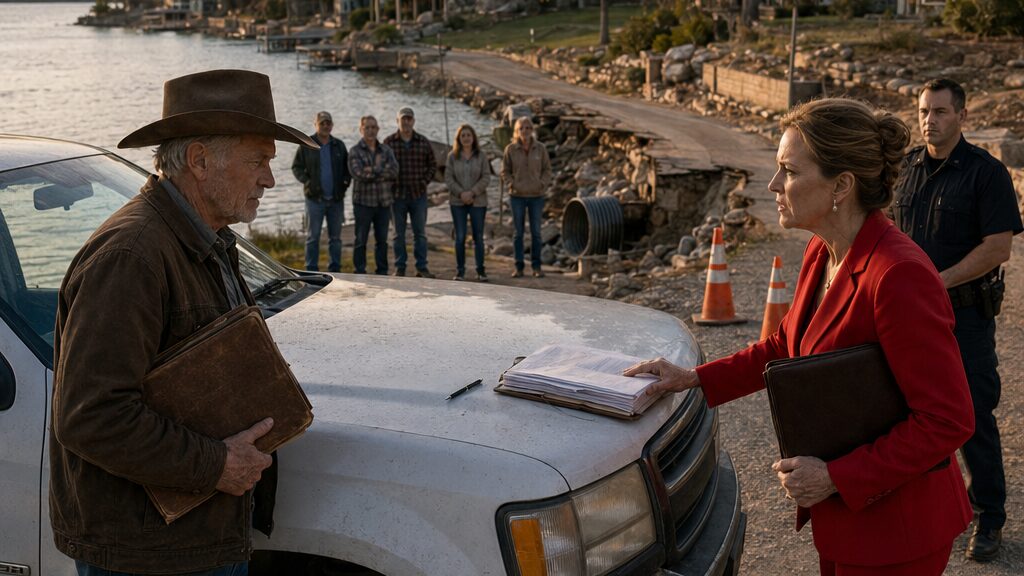
The repair estimate hit the hood of Gregory Carter’s white pickup hard enough to make the windshield wipers jump.
“Forty-six thousand eight hundred dollars,” Cynthia Moore said. “That is what your neglect is going to cost this community.”
Gregory kept one hand on the brown folder tucked under his arm and looked down at the papers sliding against the dust on his truck. The top page was clipped to a contractor’s form. A yellow signature flag stuck out near the bottom, bright as a warning. Behind Cynthia, the lake spread wide and blue below the rocky overlook, cut into glittering strips by the late sun. The private road that curved down toward the water was blocked by orange cones, two sawhorses, and a torn strip of caution tape snapping in the wind.
A uniformed officer stood beside the cones with his thumbs hooked into his belt. He did not look eager to be there.
Cynthia did. She wore a red suit so sharp it looked out of place against the gravel and pine dust. Her hair was pinned back, her phone in one hand, her chin lifted as if the lake itself had elected her to speak for it.
Gregory did not touch the estimate right away.
That bothered her.
“You understand what this is, don’t you?” she asked.
“I can read.”
“Then read it.”
A few neighbors had gathered near the bend, pretending to look at the washed-out retaining wall while watching him. Gregory knew some of their faces. Seasonal people, most of them. Lake houses with decks pointed toward sunsets. Boat covers pulled tight. Names painted on mailboxes that belonged to families who arrived on Fridays and left before Monday trash pickup.
He had watched that road exist before most of the houses had gutters.
He picked up the estimate.
The first line said SHORELINE ACCESS ROAD AND RETAINING WALL REPAIR. Beneath it, in clean print, was Larry Davis Contracting. The total was boxed at the bottom.
$46,800.00.
Under “Responsible Party,” someone had typed his name.
Gregory Carter.
His thumb stopped there.
Cynthia stepped closer. “Your truck was seen on the access road before the collapse. Your side of the hill has been washing gravel into the drainage channel for months. Larry inspected it. The damage starts on your side.”
Gregory looked past her to the road. The asphalt at the lower bend had buckled, one edge peeled up like a torn lip. Below it, a section of stone retaining wall had spilled toward the lake, exposing damp earth and a cracked concrete drainage collar. The damage was ugly, but not new in the way Cynthia wanted it to be new. He had seen that collar sweating water before the last storm. He had mentioned it once, quietly, to a maintenance worker who had nodded and kept driving.
“You had Larry inspect it?” Gregory asked.
“Of course I did. I’m the lake association president.”
“And he says I caused it.”
“He says the failure came from runoff originating above the access road.” Cynthia tapped the form with one red nail. “That is your land.”
The officer cleared his throat. “Mr. Carter, I’m not here to decide civil liability. Ms. Moore requested a presence because tempers have been high around the road closure.”
“Tempers?” Gregory said.
Cynthia’s mouth tightened. “Because people can’t get to their docks, Gregory. Because families have rentals booked. Because an ambulance would have to turn around if someone down there had an emergency. This isn’t just about you.”
That was the trick of it, Gregory thought. She had brought the whole lake with her in the way she spoke. Not a bill from Cynthia. Not a contractor’s guess. A community in danger, and his name placed neatly at the bottom.
He folded the estimate once, then unfolded it, slower than he needed to.
The date near the top caught his eye.
Prepared: Tuesday, May 14.
He looked at the broken wall again. Cynthia had been telling people the collapse happened in the storm on Friday night. She had said it loudly enough at the feed store that two men stopped talking when Gregory walked in Saturday morning.
Tuesday was three days before the storm.
“You had this prepared Tuesday?” he asked.
Cynthia blinked once. “Larry did a preliminary assessment.”
“Before the collapse?”
“Before the major collapse,” she said quickly. “You know how these things go. Damage begins, then worsens.”
Gregory lifted his eyes to her.
For the first time since she had arrived, Cynthia looked away.
The officer shifted his weight. “There’s also an acknowledgment form?”
Cynthia brightened as if grateful for the cue. She pulled another page from the leather folio under her arm. “Yes. It doesn’t require immediate payment. It only acknowledges that Mr. Carter has been notified and accepts responsibility pending insurance review.”
Gregory gave a small, humorless breath. “That’s a long way to say sign first, argue later.”
“It says what it says.”
“You want my signature on a thing I didn’t do.”
“I want the process to move forward.”
“The process already has my name typed into it.”
Cynthia’s face hardened again. “Because your land is above the failure point. Your truck was there. Your gravel washed down. And if you refuse to cooperate, the association will have no choice but to list you as the responsible party when we file.”
A neighbor at the bend whispered something. Someone else answered under their breath. Gregory could feel their eyes moving over his hat, his old jacket, his boots, the folder beneath his arm. He knew what he looked like to them. A stubborn old man on land they treated as scenery. A man who showed up in a white pickup and did not explain himself fast enough.
His fingers tightened around the folder.
The officer glanced at him. “Mr. Carter, are you willing to sign that you received the notice?”
“Received, yes,” Gregory said.
Cynthia pushed the signature page toward him. “Then sign here.”
He looked at the line. It did not say received. It said acknowledgment of responsibility.
“No.”
Cynthia’s smile vanished. “Excuse me?”
“I’ll sign a receipt saying you handed me papers. I won’t sign that.”
“You’re making this harder than it has to be.”
“No,” Gregory said. “You are.”
The officer’s eyebrows lifted slightly, but he said nothing.
Cynthia took the form back as if he had dirtied it. “You have ten days. After that, the claim goes forward with your name on it. If the insurance company decides you refused cooperation, that will be part of the record.”
Gregory looked once more at the Tuesday date, at Larry’s neat company logo, at his own name typed under responsibility. Then he slid the estimate back onto his hood and weighted it with his palm so the wind would not take it.
For years, he had believed that silence kept neighbors from becoming enemies. Now Cynthia was using his silence as a place to write a debt.
She turned toward the officer. “We’re done here.”
Gregory stayed beside the truck while she walked back toward the cones, red jacket bright against the dust. The officer followed at a slower pace.
Before Cynthia reached the bend, she called over her shoulder, “Ten days, Gregory. Don’t make the whole lake pay because you’re too proud to admit what happened.”
Gregory looked down at the estimate again.
Tuesday.
Not Friday. Not after the storm.
Tuesday.
And for the first time that afternoon, the paper in front of him no longer felt like a bill.
It felt like a trap.
Chapter 2: The Deed She Did Not Expect
“He shouldn’t even be on this road,” Cynthia said, pointing at Gregory as if the officer had not heard enough the first time. “That’s the part everyone keeps avoiding.”
Gregory had followed them down from the overlook because Cynthia had taken the repair estimate with her and left the acknowledgment form on his hood like bait. The lower access road smelled of wet soil and broken stone. Lake water lapped below the damaged retaining wall, soft and steady, as if nothing above it mattered.
The officer held up one hand. “Ms. Moore, we’ve already established this is a civil issue.”
“It is also a trespass issue if he’s using association property without permission.”
Gregory stopped beside the cracked drainage collar. Up close, the concrete showed two kinds of damage: a fresh break along one edge, pale and sharp, and an older hairline split stained dark with moss. The older split bothered him more. It had been there long enough to grow color.
Cynthia saw him looking. “Don’t touch anything.”
Gregory kept his hands still.
Two neighbors stood near a golf cart at the top of the bend. One held a phone low against his chest, not quite filming, not quite hiding it. Another woman stood with her arms folded, staring at Gregory like she had already received a version of the story that made him smaller.
Cynthia opened her folio again. “The association maintains this road for members and guests. You are neither.”
Gregory looked at the lake houses lined below them. Their decks faced west. Their windows caught the sun. Their owners liked to say they lived on the lake. Gregory had never corrected them. He had never told them that the old survey lines ran under their assumptions like roots under pavement.
He shifted the brown folder from under his arm.
Cynthia noticed.
“What is that?”
“Paper.”
“We’ve seen your papers.”
“No,” Gregory said. “You’ve seen yours.”
The officer stepped closer, not threatening, just attentive. Gregory laid the brown folder on the hood of a parked maintenance cart and untied the worn string around it. The folder had gone soft at the corners from years of being opened at kitchen tables, county counters, and tailgates. He had not planned to open it in front of Cynthia. He had not planned to open it in front of anyone.
That had been his mistake.
He removed the top sheet carefully, then another. Old lease copies. Easement notes. A folded survey map with creases worn white. Finally, he took out the deed.
Cynthia made a small impatient sound. “If this is some old family paper—”
“It is.”
“Then it doesn’t change the association road.”
Gregory unfolded the deed and held it where the officer could see. He did not push it toward Cynthia first. He did not want her hands on it.
The officer leaned in. His eyes moved over the page, then slowed.
Cynthia’s expression shifted. “What?”
The officer said, “This says one thousand three hundred acres.”
Gregory watched the words travel through the small crowd before Cynthia could stop them.
One thousand three hundred acres.
The neighbor with the phone raised it slightly. Cynthia shot him a look, and he lowered it again.
“That can’t include this road,” Cynthia said.
Gregory unfolded the survey map and tapped a line with one rough finger. “The road crosses this parcel. The association has access by easement. Not ownership.”
Cynthia’s face changed in a way she could not control quickly enough. The hard confidence stayed at the edges, but something underneath it slipped. Not fear exactly. Calculation.
The officer looked at her. “Ms. Moore, do you have association documents showing ownership of the road?”
“The association has maintained it for years.”
“That wasn’t my question.”
“It’s common access.”
“Under easement,” Gregory said.
Cynthia turned on him. “Then you just proved my point.”
He had expected many things. A denial. A demand to see more pages. A claim that the deed was outdated. He had not expected her to recover so fast.
“You own the land under the road,” she said, voice sharper now. “Your hillside drains into it. Your truck was seen there. Your family parcel is not some innocent bystander. If anything, this makes your responsibility clearer.”
The officer looked uncomfortable. “Ownership and causation aren’t the same thing.”
“But liability follows control,” Cynthia said. “And now he has admitted control.”
Gregory folded the deed once, slowly.
There it was. The shift. When she thought he was trespassing, she used the road against him. When she learned he owned the land, she used the land against him. The accusation did not care what shape the truth took. It only needed his name at the bottom.
“I didn’t admit what you’re saying,” Gregory said.
“You stood here with your deed like it absolved you.”
“I stood here because you said I had no right to stand here.”
Cynthia stepped closer, lowering her voice so the neighbors could still hear but the officer would have to choose whether to call it shouting. “People down there are scared. Do you understand that? There are elderly residents who can’t drive around the long way. There are families whose rental income depends on that road. You can play old-king-of-the-hill with your map all you want, but someone has to pay for the repair.”
“And you picked me.”
“The facts picked you.”
“The Tuesday estimate picked me before the Friday storm.”
Her eyes flashed.
The officer looked from Gregory to Cynthia. “What Tuesday estimate?”
Cynthia held the folio tighter against her red jacket. “Preliminary assessments are normal.”
“Before the collapse?”
She turned toward the officer with polished patience. “The road had visible stress. We were already monitoring it. The storm made it urgent.”
Gregory looked at Larry’s orange paint marks on the cracked collar. Some of them were fresh. One mark, half washed by mud, ran under the edge of fallen stone. It had been painted before the wall shifted.
He crouched slightly, not touching the damage, just looking.
Cynthia snapped, “I said don’t touch anything.”
“I heard you.”
“Then stop trying to interfere with evidence.”
He stood. “Evidence of what?”
She did not answer.
The officer sighed. “Mr. Carter, I can’t tell either of you who owes what. But I can tell you this doesn’t become criminal trespass if there’s a deed and an easement dispute. You both need documentation.”
Cynthia’s lips pressed flat. For one moment, her face showed the anger of someone who had expected authority to arrive already agreeing with her.
Then she took out her phone.
“What are you doing?” the officer asked.
“Filing the incident report with the association and forwarding the packet to insurance,” she said. “With Mr. Carter’s refusal noted.”
Gregory slid the deed back into the brown folder.
The folder felt heavier now, not because it had protected him, but because it had not protected him enough. The land proved he belonged there. It did not prove he had not broken the road. Cynthia had understood that before he did.
The phone camera clicked as she photographed the damaged wall, the drainage collar, the access road, his pickup, and finally Gregory himself standing beside the folder.
“Cynthia,” the officer said, warning in his tone.
“It’s documentation,” she replied.
Gregory did not turn away from the camera.
Let her take the picture, he thought. Let her keep a record of the moment she decided the truth could be bent around whatever paper came next.
Cynthia lowered the phone and typed quickly with both thumbs.
A minute later, Gregory’s own phone buzzed in his jacket pocket.
He did not need to look. He already knew.
The incident report had gone forward anyway.
Chapter 3: The Folder His Wife Kept
“Dad, this could wipe you out.”
Michael Adams stood at Gregory’s kitchen table with the repair estimate in both hands, reading the total for the third time as if the number might soften if he looked at it long enough. The yellow signature flag trembled slightly between his fingers. Outside the window, the lake was black except for a few porch lights scattered along the shore below.
Gregory set the brown folder on the table but did not open it.
Michael noticed. “Is that everything?”
“No.”
“Then show me everything.”
Gregory took off his hat and hung it on the back of a chair. The kitchen felt smaller with Michael in it. His son filled the doorway the way he had as a teenager, all restless shoulders and worry he disguised as irritation. He had driven over after Cynthia’s incident report reached three different neighbors and one of them called him “just in case your father needs help understanding what he signed.”
Gregory had not signed anything.
That had not stopped the story from growing.
Michael tossed the estimate down. “They already think you did it.”
“Some do.”
“Most will by morning. That’s how these things work now.” Michael tapped the paper. “Association email, insurance notice, group texts. You know what people hear? Old man, old truck, old road, big damage.”
Gregory pulled out a chair.
Michael stayed standing. “You need to get ahead of it.”
“I showed the deed.”
“That proves you own land. It doesn’t prove you didn’t cause damage.”
Gregory looked at him, surprised despite himself.
Michael’s face tightened. “I’m not saying you did. I’m saying Cynthia knows how this sounds. You don’t.”
The words landed harder because they were true. Gregory knew fence lines, culverts, storm paths, which pines leaned too far after wet winters. He knew where the old roadbed lay beneath the asphalt. He knew which promises had been made before the lake houses grew decks and boat lifts.
He did not know how to fight a story once it left his mouth and entered everyone else’s phone.
Michael sat across from him at last, rubbing both hands over his face. “What are they asking?”
“Ten days. Then they list me on the insurance claim.”
“Could you settle?”
“No.”
“Could you pay part and make it go away?”
“No.”
“Dad.”
Gregory’s jaw tightened. “I didn’t break that road.”
“I know that.”
“Then don’t ask me to pay for it.”
“I’m asking you not to lose the land proving a point.”
Gregory looked toward the dark window. For a second, he saw not Michael’s reflection but his wife at that table years earlier, sleeves rolled, glasses low on her nose, sorting papers into careful stacks. She had believed records were a form of respect. Not suspicion. Not fear. Respect for memory, for agreements, for the plain fact that people forgot what was inconvenient.
The brown folder had been hers before it became his.
Michael softened his voice. “Mom would tell you to be practical.”
Gregory looked back at him. “Your mother would tell me to read the date.”
Michael stopped.
Gregory opened the folder.
The smell came first: paper, dust, faint cedar from the old chest where he had kept it too long after she died. Inside were the deed and survey, but beneath them lay thinner things. Receipts. Letters. Printed emails. Notes written in his wife’s neat, narrow hand. Photographs tucked into envelopes labeled by season.
Michael reached for one, then paused as if asking permission.
Gregory nodded.
The first photo showed the lower access road in winter, bare trees on one side, frozen mud on the other. Michael turned it over. Nothing written on the back.
“Mom took these?”
“Most of them.”
“Why?”
“She said the lake association remembered repairs differently depending on who was paying.”
Michael looked at him.
Gregory took the photo gently and set it aside. “She wasn’t wrong.”
They went through the folder in silence for a few minutes. A culvert invoice from years ago. A letter about dock access. A faded map with his wife’s pencil arrows along the drainage path. Then Michael pulled out a photograph that made Gregory’s hand move before he could stop himself.
It showed the cracked drainage collar.
Not collapsed. Not surrounded by cones. But split along the same dark seam Gregory had seen that afternoon. Moss had already gathered in it. A small branch lay across the opening. In the corner of the photo, part of the retaining wall was visible, still standing but stained below the joint.
Michael leaned closer. “That’s it.”
Gregory took the picture.
“That’s the same collar,” Michael said. “That proves it was cracked before the storm.”
“Maybe.”
“What do you mean, maybe?”
Gregory turned the photo over.
Blank.
Michael’s hope dimmed. “No date.”
“Not on this copy.”
“Was it printed from a phone? A camera? Maybe the file has a date.”
Gregory shook his head. “Your mother printed most things at the library. She didn’t trust computers to keep what mattered.”
Michael almost smiled, then did not.
Gregory searched the envelope. More photos slid out: the access road after a spring rain, a muddy tire rut near the shoulder, a close-up of standing water along the retaining wall. None had dates on the back.
Michael pushed his chair back. “We can still use them.”
“Cynthia will say they’re old but not old enough, or new but not clear enough, or from some other spot.”
“Then we need something else.”
Gregory kept turning papers.
Near the bottom of the folder was a small notepad page folded twice. It was softer than the rest, worn at the crease from being handled. Gregory recognized the handwriting before he opened it, and for a moment his thumb would not move.
Michael saw. “Dad?”
Gregory unfolded the note.
Ask about temporary diverter before storm season.
Beneath that, his wife had written three words and underlined them twice.
Not our repair.
Michael read it upside down, then slowly turned the note toward himself. “Temporary diverter?”
Gregory did not answer.
He remembered her saying something from the passenger seat one afternoon near the lower bend. Something about fresh gravel where there should have been riprap. Something about a pipe sleeve sticking out too far. He had been half listening, thinking about feed prices, about a gate hinge, about all the small things that seemed urgent until the person beside you was gone and the unimportant details became the only map back to them.
“Who installed it?” Michael asked.
Gregory looked at the repair estimate on the table.
Larry Davis Contracting.
The same name on Cynthia’s form. The same company that had prepared a bill before the storm and typed Gregory’s name under responsibility.
Gregory folded his wife’s note along its old crease and placed it on top of the estimate.
For the first time that night, Michael did not tell him to settle.
He only looked at the note and said, “Then we find out what Larry did.”
Chapter 4: The Claim That Looked Official
Angela Wright arrived with a clipboard, a tablet, and Gregory’s name already printed in the wrong box.
“Mr. Carter,” she said, standing beside the broken stretch of lakeside road, “as of this morning, the claim lists you as the responsible party pending review.”
Gregory looked at the page she had turned toward him. His name sat beneath the words alleged source of damage, clean and official, as if a machine had decided what Cynthia had only accused him of saying. The lake association’s logo appeared at the top. Larry Davis Contracting was attached as the repair source. Cynthia Moore’s signature was at the bottom in blue ink.
The brown folder under Gregory’s arm suddenly felt too small for the thing forming around him.
Cynthia stood a few feet behind Angela, red jacket buttoned, sunglasses pushed into her hair. She had not come alone. Two board members lingered near the cones, and a neighbor in deck shoes stood by a mailbox with his arms folded. Larry Davis had not come at all. His estimate had.
Angela’s voice stayed professional. “I’m not here to accuse anyone. I’m here to understand sequence, access, maintenance, and cause.”
“Then the first thing you should understand,” Gregory said, “is that I didn’t cause this.”
Cynthia made a soft sound. “Everyone says that when a claim starts.”
Angela glanced at her. “Ms. Moore, I’ll need to hear from each person separately.”
Cynthia lifted both hands, but she did not step back.
Gregory crouched near the cracked drainage collar without touching it. The older seam was still there, dark under moss, running beneath the brighter fracture. He pointed with two fingers held in the air. “That split was there before the storm.”
“Do you have dated proof?” Angela asked.
“I have a photograph. Not dated on the print.”
Angela wrote something. Gregory did not like the smallness of the motion. A photograph without a date became a note, not a shield.
Cynthia saw it too. “The association has documentation.”
She opened her folio and removed a receipt, smoothing it with the side of her hand before offering it to Angela. “This was submitted by a resident who saw Mr. Carter’s truck near the access road the day before the storm. Gravel purchase. Same afternoon.”
Angela took the receipt. “From the feed and supply yard?”
Gregory recognized the paper before Angela turned it fully toward him. One load of crushed gravel. Thursday, 3:18 p.m. His name. His truck plate written by the yard clerk in block letters.
Cynthia’s eyes fixed on him. “You were bringing gravel to the hill above the road right before the collapse.”
Gregory felt the trap tighten—not because the receipt was false, but because it was true in exactly the wrong way.
“I brought it to my north gate,” he said.
“Your north gate connects to the same slope.”
“It’s a quarter mile above this road.”
“Water runs downhill, Gregory.”
“So do accusations, apparently.”
Angela’s pen paused, but she did not smile. “Can you show me where the gravel was placed?”
Gregory looked toward the upper track. “Yes.”
Cynthia stepped in immediately. “The point is he was altering surface conditions right before a storm.”
“The point,” Gregory said, “is I patched a gate rut that has nothing to do with that collar.”
Angela turned to Cynthia. “Did the original claim include this receipt?”
“It was added this morning.”
“By whom?”
“A concerned resident forwarded it to the board.”
Gregory looked at the board members near the cones. Neither met his eyes.
Angela tucked the receipt behind the claim packet. “I’ll need to inspect the gate.”
They walked up the service track, past scrub pine and exposed rock. Gregory moved slower than he wanted to, not because of his knees, though they complained, but because every step gave Cynthia another chance to narrate him into guilt. She spoke to Angela about runoff patterns, association burdens, emergency access, and members who paid dues expecting safe roads. She sounded reasonable. That was worse than shouting.
At the north gate, Gregory pointed to the fresh gravel tamped into a shallow rut where the metal gate dragged when opened. The repair was small, contained between two fence posts. A child could have stepped across it.
Angela photographed it. “This is all?”
“That’s all.”
Cynthia looked down as if disappointed by the modesty of it. “Water still travels.”
“Not from here to that collar,” Gregory said. “Not unless it climbs first.”
One of the board members coughed behind them.
Angela knelt, took a few more pictures, then checked a slope map on her tablet. “The drainage from this gate appears to shed north before it turns east. I’ll need to verify.”
Cynthia’s jaw tightened. “The road damage didn’t come from nowhere.”
“No,” Angela said. “It didn’t.”
For a moment, Gregory thought she had seen it—the thing he had seen in the estimate date, in the old split, in his wife’s note. Then Angela turned the tablet back toward him.
“Mr. Carter, I need dated documentation. Photos with metadata, county reports, maintenance notices, contractor records, anything that establishes the condition of the wall or drainage collar before last Friday. Without that, I have an official claim from the association, a repair estimate, witness statements placing your truck nearby, and proof of recent gravel work.”
Gregory looked at the folder beneath his arm. It held years of memory, but memory did not always arrive in the format official people required.
“I have the deed,” he said, hearing how weak it sounded.
Angela’s expression softened a fraction. “The deed establishes ownership. It doesn’t establish cause.”
Cynthia did not hide her satisfaction quickly enough.
Gregory looked past them, down through the pines to the lake road. His wife had seen the temporary diverter. She had written the note. But the note was not enough either. Not to people who needed boxes checked and dates stamped.
“How long?” he asked.
Angela closed the claim packet. “Forty-eight hours before I submit my preliminary liability recommendation.”
Michael’s truck came up the track before Gregory could answer. He parked hard enough to throw dust, then stepped out with a folder of photocopies under one arm. His eyes went first to Cynthia, then to Angela, then to his father.
“Did they show you the receipt?” Michael asked.
Gregory nodded once.
Michael’s mouth thinned. “Of course they did.”
Cynthia folded her arms. “If you have something relevant, provide it through the proper process.”
Michael looked ready to answer, but Gregory shook his head. The last thing they needed was anger that made Cynthia look calm.
Angela handed Gregory a card. “Send everything here. If you have a dated record, now is the time.”
Gregory took it. The card was heavier than it looked.
Cynthia began walking back toward the road, already speaking to one of the board members in a low voice. Gregory watched the red of her jacket move between the trees until it disappeared behind the curve.
Michael stepped beside him. “We can go to the county office. Storm reports, road complaints, permits. There has to be something.”
Gregory looked down at the old brown folder, then at Angela’s card.
For years, he had let his wife’s papers sit in drawers because opening them hurt. Now the lake wanted proof on a deadline, and grief had become an obstacle with a clock on it.
Angela’s SUV started below them.
“Forty-eight hours,” Michael said.
Gregory slid the card into the folder beside his wife’s note.
“Then we stop looking for what I remember,” he said, “and start looking for what they can’t ignore.”
Chapter 5: The Date Hidden in the Estimate
The county records clerk slid the storm inspection report across the counter and tapped the date with a fingernail.
“Three days before the washout,” the clerk said. “That’s the complaint you asked about.”
Gregory did not pick up the paper right away. He leaned over it, reading the line twice.
Reported standing water at lower lake access bend. Drainage obstruction suspected. Inspection recommended before next heavy rainfall.
The date was Tuesday, May 14.
The same day Larry Davis had prepared the estimate. Three days before Cynthia told the lake the storm had created the whole problem. Three days before Gregory’s gravel receipt became useful to her.
Michael let out a low breath beside him. “There it is.”
Gregory kept reading. The complaint had not come from him. It had not come from the county inspector either. It had come from the lake association.
“Can we get a certified copy?” Michael asked.
The clerk nodded. “There’s a fee.”
Michael reached for his wallet, but Gregory was faster. He laid the cash down himself. It was a small thing, but he needed to do it. His name was on the claim. His wife’s folder was on the counter. His refusal had to be his own, not something his son purchased for him because he was too slow to move.
While the clerk stamped the report, Gregory opened the brown folder. His wife’s note sat on top of the estimate now, the words temporary diverter catching his eye every time he turned a page.
Michael noticed. “After this, Larry?”
Gregory nodded.
“Think he’ll talk?”
“He’ll talk.”
“Will he tell the truth?”
Gregory looked toward the clerk’s stamp coming down hard on the paper. “That’s different.”
Larry Davis’s work yard sat behind a chain-link fence off the county road, between a storage shed and a row of culvert pipes stacked like dark mouths. A dump trailer was backed near the gate. Orange cones, broken forms, and muddy shovels lay in the bed of a flatbed truck.
Larry came out of the shed wiping his hands on a rag before Gregory reached the office door. He was broad through the shoulders, with sunburned forearms and the wary look of a man who already knew why someone had come.
“If this is about the lake road,” Larry said, “I gave my estimate to the association.”
Gregory stopped beside the flatbed. “I saw.”
“Then you know what it says.”
“I know what it says on the front.”
Larry’s eyes flicked to Michael, then to the brown folder. “I’m not getting in the middle of a board fight.”
“You’re already in it,” Michael said.
Gregory held up one hand, not to silence his son harshly, but to keep the moment from turning into exactly the kind of argument Larry could walk away from.
“I’m not here to make trouble for you,” Gregory said.
Larry gave a humorless laugh. “That’s usually what folks say right before trouble.”
Gregory pulled out the estimate copy and unfolded it on the hood of Larry’s flatbed. “This was prepared Tuesday.”
Larry’s rag stopped moving.
“The association says the collapse happened Friday,” Gregory said.
“Major collapse did.”
“And Tuesday?”
Larry looked toward the shed. “Road was showing stress.”
“From what?”
“I’m not an engineer.”
“But you wrote temporary diverter removal in the line items.”
Larry’s face closed.
Michael stepped closer. “Where was the temporary diverter?”
Larry pointed the rag at him. “I said I’m not getting dragged into this.”
Gregory opened the folder and took out his wife’s note. He did not hand it to Larry. He laid it beside the estimate.
Ask about temporary diverter before storm season.
Larry stared at the handwriting longer than Gregory expected.
“Who wrote that?” Larry asked.
“My wife.”
“When?”
“Before she died.”
Larry’s discomfort shifted into something less guarded, more human, and then he pushed it away. “I’m sorry. But that doesn’t change my contract.”
“Who ordered the diverter?”
Larry looked toward the gate. A pickup slowed on the road outside, then moved on.
Gregory waited.
The waiting worked better than Michael’s anger would have. Larry finally threw the rag into the flatbed.
“Cynthia called me in April,” he said. “Said the lower bend was holding water and the board didn’t want to vote on a full drainage job before summer bookings. I put in a temporary diverter to move water off the shoulder until they approved proper work.”
“Where?”
Larry looked at the estimate. “Above the collar.”
Michael’s voice sharpened. “Above the collar that failed.”
“It was temporary,” Larry said. “It was supposed to come out before heavy rains. I told her that.”
“Did you put that in writing?” Gregory asked.
Larry’s mouth tightened.
Gregory already knew.
“Text?” Michael asked.
Larry shook his head. “Phone call. Then a work order. Basic.”
“Show us.”
“I can’t hand over client paperwork.”
Gregory folded his wife’s note and slipped it back into the folder. “Can you tell Angela Wright?”
Larry looked away. “I’ve got jobs with half that lake. If Cynthia says I’m the reason this blew up, I lose more than one repair.”
“So you let them put my father’s name on it?” Michael said.
Larry’s eyes flashed. “I didn’t put his name on anything. Cynthia sent the responsibility form. I sent an estimate for repair.”
“With language she could use.”
“I wrote what she asked me to assess.”
Gregory heard it then—not innocence, not guilt, but fear. Larry was not protecting a grand lie. He was protecting his business from the person who controlled a list of lake jobs he needed to survive. Cynthia had not only pressured Gregory. She had built a room where everyone had a reason to let the wrong name stay on the page.
“Larry,” Gregory said quietly, “did my truck cause that damage?”
Larry’s jaw worked once.
“No.”
The word was barely louder than the traffic beyond the fence.
Michael stepped forward. “Then write that down.”
“I can’t.”
“You just said it.”
“I said it here.”
Gregory studied him. Larry’s boots were caked with the same clay that lined the lower road. His estimate had become a weapon, but not all weapons were held by the person whose name was printed on them.
“You told Cynthia the diverter needed to come out before storm season,” Gregory said.
Larry swallowed. “Yes.”
“And it didn’t.”
“No.”
“Because she didn’t approve the work?”
“She said the board would take it up after the holiday rentals started. Said a special assessment would start a fight she didn’t need before a pending sale closed.”
Michael stared. “Her sale?”
Larry immediately looked like he wished he had bitten through his tongue.
Gregory folded the estimate. “What pending sale?”
“I don’t know details.”
“But you know it mattered.”
Larry said nothing.
Gregory placed the certified storm report on the flatbed beside the estimate. Tuesday beside Tuesday. Complaint beside repair. The timeline was beginning to show itself, but it still needed someone besides him to say where the water had been sent.
Larry looked at the stamped report. His face changed.
“Keep that away from me,” he said.
“It’s public record.”
“I said keep it away.”
Gregory picked it back up. “You don’t have to fight Cynthia for me.”
“Good.”
“But don’t lie for her.”
Larry’s shoulders sank slightly.
Before Gregory could press him again, Michael’s phone buzzed. He checked it, and his expression hardened.
“What?” Gregory asked.
Michael turned the screen.
An email from the lake association had gone out to members. Emergency Meeting: Road Repair Liability Vote. Friday, 6:00 p.m. The body stated that due to noncooperation by the responsible landowner, the board would consider direct billing and claim escalation.
Gregory read it once. Then again.
Cynthia had stopped waiting for the insurance process.
Larry looked at the phone, then at Gregory. “I didn’t know she was doing that.”
Gregory slipped the storm report into the brown folder beside his wife’s note.
“No,” he said. “But now everybody will.”
Chapter 6: The Meeting Beneath the Lake Map
Cynthia read Gregory’s name aloud before he had even taken a seat.
“Item three,” she said from the front of the lake association hall, standing beneath a framed map of the shoreline. “Consideration of direct repair billing to Gregory Carter for damages related to the lower access road failure.”
The room shifted at the sound of his name. Folding chairs creaked. A few people turned. Someone near the coffee urn whispered, then stopped when Michael looked over.
Gregory stood in the back with the brown folder under one arm and his hat in his hand. He had planned to sit quietly until called. That had been his old habit. Wait for the proper turn. Let other people finish. Trust that facts carried their own weight.
Cynthia had counted on that.
Angela Wright sat at a side table with her tablet open, not part of the board but present because the claim had dragged her into the room. Larry Davis stood near the exit in a work shirt, arms crossed, eyes fixed on the floor. He looked like a man who wanted to be mistaken for furniture.
Cynthia’s red suit was brighter under the fluorescent lights than it had been on the road. “As many of you know,” she continued, “the association has made every reasonable attempt to resolve this without burdening members. Unfortunately, Mr. Carter has refused to accept responsibility despite ownership and access factors linking his property to the damage.”
Michael leaned toward Gregory. “Say something.”
“Not yet.”
“If you wait too long, she’ll frame the whole vote.”
Gregory kept his eyes on the lake map. The lower access road was drawn as a thin black line curling through green. The map showed docks, lots, common areas, boat slips. It did not show grief. It did not show promises made at kitchen tables. It did not show his wife walking that road with a camera because she trusted paper more than memory.
A board member asked Cynthia, “Is the insurance company requiring us to vote tonight?”
“No,” Angela said before Cynthia could answer.
The room turned toward her.
Cynthia smiled tightly. “Angela is here in an advisory capacity.”
Angela’s tone did not change. “The claim is still under review. A liability vote may be premature.”
Cynthia’s smile thinned. “The board has to protect its finances.”
There it was again, Gregory thought. Protect. Every accusation wore that word when it wanted to look clean.
Cynthia lifted Larry’s estimate. “We have a professional assessment.”
Larry’s head came up.
“We have witness documentation of Mr. Carter’s truck and gravel activity near the affected area,” Cynthia continued. “We have deed confirmation that the road lies across his land.”
A low murmur moved through the hall. Gregory heard the shape of it. Owns the land. Truck was there. Refused to sign. To people who had only caught pieces, the pieces fit badly enough to seem complete.
Michael stepped forward. “This is ridiculous.”
Gregory caught his sleeve.
Michael turned on him in a whisper. “Dad.”
Gregory looked at him, and whatever Michael saw made him stop. Not agreement. Not patience. Something steadier.
Cynthia looked pleased by the interruption. “Family members will have a chance to speak after board discussion.”
“No,” Gregory said.
The room quieted.
His own voice sounded strange to him in that hall. Not loud. Not polished. But it carried.
“No,” he repeated. “If my name is the item, I’ll speak before you vote on it.”
Cynthia’s eyes hardened. “You were notified of the meeting like everyone else.”
“And now I’m here.”
Angela watched him over the top of her tablet.
Cynthia hesitated, then gestured with false generosity. “Briefly.”
Gregory walked to the front. The folder seemed louder than his boots when he set it on the table. He opened it slowly enough that no one could mistake the action for panic.
“I didn’t break your road,” he said.
Cynthia gave a short breath. “Gregory—”
He placed the repair estimate on the table.
“You had this prepared Tuesday. Before the Friday storm you’ve been telling people caused the collapse.”
Cynthia’s face did not move, but the room did.
“That was preliminary,” she said.
Gregory placed the certified storm inspection report beside it. “The county received a standing-water complaint that same Tuesday. From the association.”
A board member leaned forward. “We filed that?”
Cynthia turned. “Routine maintenance concern.”
“About the same bend?” the board member asked.
Gregory placed his wife’s old photograph on the table next. The print had no date on the back, and he knew Cynthia would attack that. So he did not let it stand alone.
“This photo shows the collar cracked before the collapse. My wife took it because she had been tracking drainage problems along this road for years.”
Michael had moved closer, but not to interrupt now. His eyes were on the folded note Gregory had not yet opened.
Cynthia looked at the photo. “That could have been taken any time.”
“Yes,” Gregory said. “That’s why it is not enough.”
The admission surprised the room more than an argument would have. Cynthia had prepared herself for denial, not restraint.
Gregory unfolded the handwritten note.
Ask about temporary diverter before storm season.
He laid it beneath the photo.
Michael’s face changed when he saw the handwriting fully, not just as a clue on a kitchen table but exposed under meeting lights. His mother’s hand, small and careful, brought into a room that had been using his father’s silence against him.
Gregory felt it too, sharp enough that he had to press one palm flat on the table.
“My wife wrote that before she died,” he said. “I ignored it longer than I should have. That was my mistake.”
The room was still now.
He turned toward Larry. “Mr. Davis, did you install a temporary drainage diverter above the lower bend before the storm?”
Larry’s eyes dropped.
Cynthia snapped, “Larry is not under oath.”
“No,” Angela said quietly. “But his estimate is part of a claim file.”
Larry looked at Angela, then at Cynthia. For one second Gregory saw exactly what held him: future jobs, invoices, truck payments, the fear of becoming the next name on someone else’s agenda.
Cynthia softened her voice. “Larry, just answer what is relevant.”
That was the wrong thing to say. Larry’s mouth twisted, not in anger at Gregory, but at the narrow doorway Cynthia had left him.
“I installed a temporary diverter in April,” Larry said.
The hall rustled.
Cynthia’s voice sharpened. “As a short-term mitigation measure.”
Larry looked at the table. “It was supposed to be removed before heavy rain. Or replaced with a proper drainage fix.”
A board member said, “Who approved waiting?”
No one answered.
Gregory did not look at Cynthia yet. He placed the estimate under the hall’s small document camera. The projector flickered, and Larry’s line item appeared on the wall beside the lake map.
Temporary diverter removal and drainage correction.
The phrase glowed above Cynthia’s shoulder.
Gregory pointed to it. “That line was already in the repair estimate Tuesday. Before my truck was seen near my gate. Before the Friday storm. Before the association told you I caused the failure.”
Angela leaned forward. “Ms. Moore, was the temporary diverter disclosed in the initial claim submission?”
Cynthia’s lips parted. For the first time all evening, no ready sentence came out.
One of the board members shifted papers. “Cynthia?”
She recovered, but not fully. “We were dealing with an emergency. The road was failing. Members were angry. Rentals were scheduled. The board had already delayed one assessment discussion, and I was trying to avoid unnecessary panic.”
“By putting my father’s name on it?” Michael asked.
Cynthia turned toward him. “By identifying the landowner connected to the site.”
Gregory looked at her then. “You were selling your house.”
The words were quiet, but they landed hard.
Cynthia’s face went pale in a way anger could not hide. “That has nothing to do with this.”
Larry closed his eyes briefly.
A board member stared at her. “You have a pending sale?”
“It is not pending. It is being discussed.”
“Were you trying to avoid a special assessment before closing?” Michael asked.
Cynthia’s hands tightened on the podium. “I was trying to keep this community from turning on itself over a repair we could still assign properly.”
“No,” Gregory said. “You were trying to assign it quickly.”
She looked at him, and behind the polished anger was something smaller: fear of losing face, fear of losing money, fear of being seen not as the woman who fixed the lake’s problems but as the one who delayed the repair that made one worse.
For a moment, Gregory almost let that be enough. The room had heard the timeline. Angela had heard it. Larry had spoken. Cynthia’s certainty was cracked.
Then Cynthia picked up a new paper.
“There may be shared responsibility,” she said. “Given Mr. Carter’s land ownership and access rights, the association could consider a partial settlement. Gregory, if you agree to shared responsibility tonight, we can avoid further escalation.”
Michael said, “You have got to be kidding.”
Cynthia ignored him. Her eyes stayed on Gregory. “No admission beyond shared maintenance impact. No direct accusation. The association pays part, you pay part, and we move forward.”
It was clever. Softer than the bill. Easier for the board to swallow. Easier for Gregory, too, if all he wanted was to make the room stop looking at him.
He looked at the brown folder. His wife’s note lay open. Not our repair.
For years, he had mistaken quiet for peace. But peace that required a false signature was only silence with a price.
“No,” Gregory said.
Cynthia’s expression hardened. “Think carefully.”
“I have.”
“This offer may not come again.”
“It shouldn’t have come once.”
He gathered the deed, the photo, the note, the certified report, and the estimate into one straight stack. Then he faced the board.
“I will pay what I owe. I have done that my whole life. I will maintain what is mine. I will honor the easement. I will not sign a paper that says your delayed repair was my damage.”
No one spoke.
Angela stood, tablet in hand. “Based on what has been presented tonight, I cannot submit the claim as currently filed. The temporary diverter and prior drainage complaint are material facts. Ms. Moore, if the association intends to continue, I’ll need a corrected statement signed by you and the board acknowledging the April work, the Tuesday complaint, and the incomplete disclosure.”
Cynthia looked at Angela as if the sentence itself had betrayed her.
“And if we don’t?” a board member asked.
Angela closed her tablet. “Then the claim cannot proceed as filed.”
The room erupted—not loudly, but in fragments. Chairs scraping. Whispers breaking open. Someone asking who authorized the diverter. Someone else asking whether the road fund had enough money. Larry moved toward the exit, then stopped when Gregory looked at him.
Cynthia remained at the podium, the red of her suit suddenly too bright beneath the lake map.
Gregory slid the papers back into the brown folder and tied the worn string around it.
The vote had not happened. The bill had not vanished. But for the first time since Cynthia slapped the estimate onto his pickup, his name was no longer the easiest place to put the damage.
Angela set a corrected statement form on the table in front of Cynthia.
Cynthia stared at the blank signature line as if it were a cliff edge.
Chapter 7: The Claim They Could Not Keep
Cynthia came back to the overlook without the officer, without the board, and without the red suit jacket.
Gregory saw her car before he saw her. It eased up the gravel road slower than usual, tires crunching over the same bend where she had stood a week earlier with the repair estimate held like a verdict. This time, she parked behind his white pickup and stayed inside for a moment with both hands on the steering wheel.
Below the cliff, the lower access road was still closed, but the cones had been moved. Larry’s crew had cut a clean trench along the shoulder, and new drainage pipe lay stacked near the broken wall. No one was pretending anymore that the damage had come from Gregory’s gate gravel. The temporary diverter had been removed. The proper repair had begun.
Cynthia stepped out carrying a folder.
Not leather this time. Plain manila.
Gregory stood beside the hood of his truck with the brown lake folder under his arm. He did not walk toward her. He did not make her cross the distance alone out of cruelty. He simply let the road between them be what it was.
She stopped a few feet away. The wind worried a loose strand of hair across her cheek, and she brushed it back with an impatient motion that had lost some of its old sharpness.
“Angela sent the final correction this morning,” Cynthia said.
Gregory waited.
Cynthia held out the manila folder. “The association has withdrawn your name from the liability claim. The road repair will be handled through association funds and the maintenance reserve, with disclosure of the April drainage work.”
Gregory took the folder but did not open it immediately.
Cynthia’s eyes moved to the brown folder under his arm. “You’ll want to check every line, I’m sure.”
“I will.”
Her mouth tightened, not quite anger, not quite shame. “I didn’t come here to argue.”
“That’s new.”
The words came out quieter than he expected. Cynthia flinched anyway.
He opened the manila folder. The corrected statement was on top, signed by Cynthia Moore and two board members. Angela’s cover note was clipped behind it. Gregory read the main line twice.
No evidence supports direct repair liability against Gregory Carter for the lower access road failure.
It was not an apology. It was not warmth. It was a sentence that could stand up in a file.
For now, that was enough.
Cynthia looked toward the lake. “The board voted to approve the repair assessment.”
“How much?”
“Less than it would have been if we had waited another month.” She gave a short, bitter breath. “More than it would have been if we had done it properly in April.”
Gregory closed the folder.
For a moment, neither of them spoke. Below them, a worker guided a small excavator near the damaged shoulder. Its backup alarm carried faintly up the hill, thin and regular. The sound made the silence between them feel measured.
Cynthia finally said, “Some members are worried about the easement terms.”
“There it is.”
She looked back at him. “You can’t blame them.”
“I don’t.”
“They think after what happened, you may restrict access. Raise fees. Change the road agreement. Make the lake pay for embarrassing you.”
Gregory studied her. The old Cynthia had placed accusation first and concern second. This version had learned to put concern first, but the fear beneath it was still there. Not only fear of him. Fear of what people would say if Gregory became what she had told them he was: a man waiting to use ownership like a weapon.
“Is that what you think?” he asked.
Cynthia’s eyes dropped to the corrected claim. “I don’t know what I would do, if I were you.”
“That might be the truest thing you’ve said to me.”
Color rose in her face. She looked ready to answer, then did not.
Gregory walked to the hood of his truck and set both folders down. The brown one looked old and worn beside the manila file. He opened it and removed the deed, the corrected claim, and a fresh page he had typed at Michael’s kitchen table the night before.
Cynthia watched cautiously.
“This goes to the board tomorrow,” Gregory said.
“What is it?”
“Updated maintenance notice for the access road easement. Clear inspection dates. Written approval for drainage changes. Emergency repair process. No work near the collar or retaining wall without notice to me and the association record.”
Cynthia blinked. “You’re not changing fees?”
“No.”
“You’re not limiting access?”
“No.”
She looked almost confused by the absence of punishment.
Gregory placed the notice on top of the corrected claim. “But the old way ends. No more handshakes remembered differently. No more temporary work nobody wants to own. No more using my land when it’s convenient and blaming me when it costs money.”
Cynthia’s expression shifted. For one second, she looked like she might defend herself out of habit. Then her eyes moved to the repaired road below, to the workers, to the place where her urgency had become visible in stone and mud.
“I thought if we named you early, insurance would move faster,” she said.
Gregory did not answer.
She swallowed. “I told myself it was temporary. That the facts could be adjusted later if needed.”
“That’s what a false paper is,” Gregory said. “A thing people promise to fix later.”
Her face tightened. “I was trying to avoid a special assessment before summer. People were already angry about dues. My sale was—” She stopped, jaw set. “It mattered. I let it matter too much.”
That was as close as she had come to saying it plainly.
Gregory slid the corrected claim behind the deed in his folder. The motion felt different from the way he had handled the papers a week before. Then, the folder had been a shield. Now it felt like a door he could close.
“Your apology is missing a word,” he said.
Cynthia looked at him.
“Not sorry this became difficult. Not sorry the process moved too fast. Not sorry people misunderstood. Just the word.”
Her hands folded around the empty manila folder. She looked older than she had on the day she slapped the bill onto his pickup hood.
“I’m sorry,” she said. “I should not have put your name on that claim.”
Gregory nodded once.
He did not tell her it was all right. It wasn’t. He did not tell her they could go back. They couldn’t. Some roads reopened, but the ground beneath them remembered where it had cracked.
A truck door shut behind them. Michael walked up from the road, dust on his boots and two coffees in his hands. He slowed when he saw Cynthia.
“Everything signed?” he asked.
Gregory held up the manila folder.
Michael looked at Cynthia. His face was not forgiving, but it was no longer hot with anger. “The crew says the new pipe should hold.”
“If they maintain it,” Gregory said.
Michael glanced at the typed notice on the hood and read enough to understand. “Mom would’ve liked that.”
Gregory looked down at the brown folder.
For years, he had treated his wife’s records as proof of what had been lost. The photos, notes, maps, and letters had stayed in the dark because opening them meant hearing her practical voice in rooms where she no longer sat. But the folder had never been only grief. It had been her way of keeping people honest without hating them.
He touched the worn string.
“She wasn’t keeping score,” he said. “She was remembering what people promised.”
Michael’s eyes softened. He handed Gregory one of the coffees without speaking.
Cynthia turned toward her car, then paused. “The board will expect you tomorrow?”
“I’ll be there.”
She nodded. “So will I.”
After she drove away, Gregory stood with Michael at the overlook. Below them, the excavator moved carefully along the torn shoulder. A worker in an orange vest guided a new pipe into place. The lake caught the afternoon light beyond the damaged wall, steady and indifferent.
Michael leaned against the pickup. “You could have made them pay more.”
Gregory closed the manila folder and slipped it into the brown one behind the deed.
“I made them pay attention.”
The access road below was not open yet, but for the first time in a week, the cones marked a repair instead of an accusation. Gregory tied the folder’s old string, set it on the passenger seat of his truck, and watched as the crew cleared the first strip of pavement back into view.
The story has ended.