The Orange Stakes Through His Koi Pond Revealed What Our HOA Had Buried for Years
Chapter 1: The Morning They Cut the Wrong Trees
The chainsaw bit through the pear tree before Raymond Hill reached the fence.
He heard the trunk split—a slow, fibrous crack beneath the engine’s whine—and saw the crown tilt toward Alexander Wilson’s new stone terrace. White blossoms shuddered loose as the tree came down. For one suspended second, branches floated against the morning sky. Then the pear struck the ground hard enough to send dust and petals across the clipped lawn.
Raymond stopped with one hand wrapped around his dented metal coffee cup.
He and his wife had planted that tree on their twenty-fifth wedding anniversary.
The landscaping foreman raised an arm, signaling the operator toward the next trunk.
“Shut it down,” Raymond called.
No one heard him over the saw.
He crossed the orchard faster than his knees preferred, ducked through the open section of wire fence, and slapped the emergency switch on the portable saw. The engine coughed into silence. Three workers turned toward him. Beyond them, a compact excavator sat beside a pile of uprooted shrubs.
The foreman pulled down his hearing protection. “Sir, you can’t be in the work area.”
“You’re in my orchard.”
“We’re clearing the approved boundary.”
Raymond looked past him. Two pear trees were already down. The old iron pin that had stood near the fence corner for as long as Raymond could remember was gone. Only a dark hole remained where it had been.
“Who removed that marker?”
The foreman glanced at the ground. “I don’t know anything about a marker.”
A sliding glass door opened across the lawn. Alexander Wilson stepped onto the terrace wearing white pants and a salmon-colored polo, dressed as if he had come outside to inspect a delivery rather than watch trees fall.
“What’s the problem?” he asked.
Raymond pointed to the cut trunks. “Those trees are the problem.”
Alexander descended the terrace steps without hurrying. Behind him, clear water moved through the narrow channel of his koi pond. The garden curved around it in deliberate layers—stone, flowers, ornamental grasses, then the orchard beyond. The pond had appeared during the summer, followed by the patio, retaining wall, palms, and low landscape lights.
“The fence is over the line,” Alexander said. “We gave you notice.”
“You gave me a letter saying you thought it was over.”
“The board approved the correction.”
“You’re the board president.”
“I didn’t vote.”
“You hired the crew.”
Alexander’s jaw tightened. “The association hired the crew after you ignored three requests.”
Raymond set his coffee cup on the fresh stump. A pale ring of wood showed where the tree had been healthy all the way through.
“You don’t correct a boundary with a chainsaw.”
“You refused mediation.”
“I refused a meeting based on a sketch nobody would explain.”
Alexander motioned to the foreman. “Show him.”
The foreman opened a plastic tube and withdrew a rolled site plan. He flattened it across the hood of a utility cart. The drawing showed Alexander’s house, the patio, the pond, and a thick line labeled as the rear property boundary. Raymond’s orchard fence appeared several feet beyond it, inside Alexander’s lot.
A rectangular approval stamp sat near the bottom.
Patricia Nelson’s signature ran across it.
Raymond studied the dimensions. The plan was clean, modern, and professionally printed. It was also missing the old bearing that had appeared on every county plat Raymond had seen since buying the nursery from his father.
“Where did this line come from?” he asked.
“The architectural review file,” Alexander said.
“That isn’t an answer.”
“It was reviewed by management and approved by the board. Your fence is encroaching, and these trees were planted beyond your parcel.”
Raymond looked toward the remaining row. The next tree bore a scar low on its trunk where his wife had once backed a mower into it. She had painted the wound with pruning compound while he told her the tree would never recover. It had outlived her by four years.
“Nothing else gets cut,” he said.
Alexander stepped closer. “You don’t get to stop authorized work because you remember the line differently.”
“I remember the iron pin you just removed.”
“No one removed a legal marker.”
“There was a pin in that hole yesterday.”
“Then prove it was legal.”
The workers watched them without moving. A neighbor had stopped on the walking path beyond the hedge. Raymond could feel the attention gathering, the familiar transformation of a disagreement into a community spectacle.
Alexander lowered his voice.
“This is what happens when people treat common standards like personal suggestions. You’ve had months to cooperate.”
People.
Not you. People like you.
Raymond picked up his cup. Coffee had spilled down one side and collected sawdust along the rim.
“I’m calling the county,” he said.
“You do that.”
“And until somebody with a license tells me otherwise, this crew stays off the next tree.”
Alexander gave a short laugh. “You don’t have authority over my contractor.”
Raymond took out his phone and called the sheriff’s non-emergency line. He described an active property dispute, removed markers, and trees being cut. He did not accuse anyone of theft or trespass. He simply stated that ownership was contested and further work could destroy evidence.
The foreman listened, then looked at Alexander. “We should pause until this is documented.”
“You have the plan,” Alexander said.
“I have a plan. I don’t have a survey.”
That distinction changed the air.
Alexander’s confidence did not disappear, but it narrowed. “Fine. One hour.”
“No,” the foreman said. “Until we get written direction.”
Patricia arrived twenty minutes later in a gray sedan with the HOA logo on the door. She wore a navy blazer and carried a red folder against her ribs.
She did not look at the fallen trees first. She looked at Raymond standing inside the disputed strip.
“You were instructed not to interfere with association contractors,” she said.
“They cut two trees before verifying the boundary.”
“The board relied on the approved site plan.”
“Who prepared it?”
“The applicant’s design firm.”
“Who verified the property line?”
“The documents were reviewed through the normal process.”
“That means nobody.”
Patricia’s mouth tightened. “It means your objection was considered and rejected.”
She opened the red folder and handed him a notice. The first line identified his wire fence as an unapproved encroachment. The second gave him ten days to remove it. Below that, a daily fine schedule began in bold type.
Raymond read the page twice.
“You’re citing me while his crew stands beside my trees?”
“Ownership is precisely what the approved plan establishes.”
“A plan doesn’t establish ownership.”
“The association’s attorney disagrees.”
“Then the association’s attorney can show me the recorded deed.”
Patricia glanced briefly toward Alexander. It was a small movement, but Raymond saw it.
She knew the plan was not the deed.
He folded the notice and placed it in his shirt pocket. “No more cutting today.”
Patricia turned to the foreman. “The association expects the contracted work to proceed.”
The foreman shook his head. “Not without a survey or a release covering the dispute.”
For the first time that morning, Raymond had won something. Not the boundary. Not the trees already down. Only time.
Alexander walked toward the patio, phone already in his hand.
Patricia remained by the stump. “You could have avoided this by attending mediation.”
“You could have avoided it by finding the pin.”
Her expression changed—not guilt exactly, but recognition.
Then it was gone.
Raymond drove to the county records office with the violation notice beside him and the taste of cold coffee in his mouth. The building had moved since his last visit, but the records room smelled the same: paper, dust, and machine heat.
The clerk listened while Raymond explained the parcel numbers. She searched the digital index, then disappeared into a rear room.
When she returned, she carried a narrow archival folder.
“This is the earliest deed we have tied to the subdivision tract,” she said. “Recorded in 1962.”
She laid the document beneath a protective sheet and traced the legal description with one finger. Halfway down the page, she stopped.
“That’s odd.”
“What?”
“The bearing here doesn’t match the one on the association sketch you brought.”
Raymond leaned closer.
The difference was only a line of faded type and a set of numbers.
On the ground, the clerk said, it could amount to several feet.
Possibly more.
Chapter 2: The Map Beneath the Board’s Approval
The clerk’s first calculation placed Raymond’s fence eleven feet away from the boundary shown on the HOA plan.
She wrote the number on a yellow note, stared at it, then calculated again.
“Don’t treat this as a survey,” she warned. “I’m comparing descriptions, not locating monuments.”
“But the descriptions conflict.”
“Yes.”
“Which one is recorded?”
She tapped the 1962 deed.
Raymond looked through the records Patricia had sent with the violation notice. The association sketch used clean horizontal measurements from Alexander’s house. The deed used bearings from an old concrete monument near the county road, then ran along the original agricultural tract.
The modern plan looked easier to understand. That did not make it right.
The clerk found the subdivision plat next. Its linen-textured scan showed Raymond’s parcel before the surrounding farmland had been divided into estate lots. Near the eastern boundary, a notation referred to an existing iron pin. Raymond pointed to it.
“That’s the marker they pulled.”
“Possibly,” she said. “The plat proves a marker was called for. It doesn’t prove the object you saw was the same one.”
Every answer came with a locked door behind it.
He purchased certified copies of the deed and plat, paid for an enlarged map, and drove home with the documents laid flat across the passenger seat.
Catherine’s car was in his driveway.
She sat at his kitchen table when he entered, the HOA notice in front of her. Patricia must have emailed it. Catherine had tied her hair back and brought groceries, which meant she intended to stay long enough to argue.
“I saw the trees,” she said.
Raymond placed the archival copies beside his coffee cup.
“Then you saw what they did.”
“I saw what’s left. I also saw Alexander.”
“What did he say?”
“That he’s willing to pay for the trees and discuss buying the strip.”
Raymond unrolled the plat.
“He doesn’t know it’s his to buy.”
“He knows there’s a dispute. That’s why he wants to settle before both of you spend twenty thousand dollars proving where a line sits.”
“It won’t cost twenty thousand.”
“How much will it cost?”
Raymond did not answer.
Catherine looked at the certified documents. “You already spent money.”
“Seventy-six dollars.”
“And a survey?”
“I haven’t hired one.”
“Dad.”
He flattened the plat with the coffee cup on one corner and a saltshaker on another. Using a pencil, he extended the recorded bearing toward the back of Alexander’s property. The line crossed the retaining wall, then disappeared beneath the sketched edge of the koi pond.
Catherine watched him.
“That can’t be right.”
“Maybe it isn’t.”
“You just said—”
“I said the board’s plan isn’t the deed.”
She leaned back. “Then let him pay for a survey.”
“He’ll hire someone who answers his question.”
“A licensed surveyor answers the measurements.”
“A client decides what records get supplied.”
Catherine pushed the violation notice toward him. “This is what I’m worried about. Daily fines. Attorneys. You getting so angry you stop sleeping.”
“I’m not angry.”
“You keep saying that like it proves something.”
Raymond folded his arms.
She softened her voice. “Selling a narrow strip would not erase Mom.”
He looked toward the window.
Beyond it, the remaining pear trees stood in a row that no longer looked whole.
“This isn’t about that.”
Catherine studied him for a moment. “Then what is it about?”
“The line.”
She gathered her keys. The groceries remained on the counter.
“You always make people guess which part hurts,” she said. “Then you blame them for guessing wrong.”
After she left, Raymond called three surveying firms. The first could not come for six weeks. The second declined after hearing the HOA was involved. The third put him through to Ashley Davis.
Her voice was brisk and almost impatient.
“I need both parcel descriptions, the subdivision plat, any prior surveys, and the site plan being disputed.”
“I have all but the prior survey.”
“Then I’ll search the index.”
“How soon can you inspect?”
“Fieldwork depends on what the records say.”
“They cut two trees this morning.”
There was a pause.
“Send me photographs of the disturbed area,” she said. “Especially any holes, concrete, rebar, capped pipe, or displaced metal.”
Raymond photographed the dark opening where the iron pin had stood, the fresh stumps, the fence corner, and Alexander’s retaining wall. He scanned the documents and emailed everything.
Ashley called back shortly before dusk.
“The discrepancy is real enough to justify work,” she said. “That doesn’t mean your interpretation is correct.”
“I didn’t ask you to agree with me.”
“Good. Because I won’t be your advocate.”
“I need you to find the line.”
“That I can do.”
Her fee was more than Raymond had expected. It would come from the account he used for property taxes and orchard repairs. He looked at the number while Ashley explained retainers, field crews, monument recovery, and a written boundary report.
“If the original monument is gone, this gets more complicated,” she said.
“It was there yesterday.”
“Can you prove that?”
“No.”
“Then don’t tell anyone it was deliberately removed unless you can.”
Raymond gripped the phone more tightly.
“You think I’m exaggerating.”
“I think both property owners have reasons to see what they expect. My equipment does not.”
He signed the agreement.
The following morning, an email from Patricia announced a special on-site inspection. The board would meet at Alexander’s property in two days to review Raymond’s fence violation and confirm the approved boundary. Homeowners directly affected by the decision could attend.
Alexander had copied several neighbors.
The message described the event as a transparent effort to resolve misinformation.
Raymond printed it and set it beside Ashley’s preliminary overlay. Her thin red line followed the deed bearing from the county monument, passed through the missing pin location, and continued across Alexander’s yard.
The line did not merely touch the pond.
It entered at one stone edge, crossed the shallow shelf where the koi gathered, and emerged beneath the terrace.
Ashley had added one sentence beneath the image:
If recovered control points support the deed call, substantial improvements may lie within the Hill parcel.
Chapter 3: Orange Stakes Across the Water
Ashley drove the first orange stake into the soil behind Alexander’s retaining wall.
The hammer blow rang across the yard.
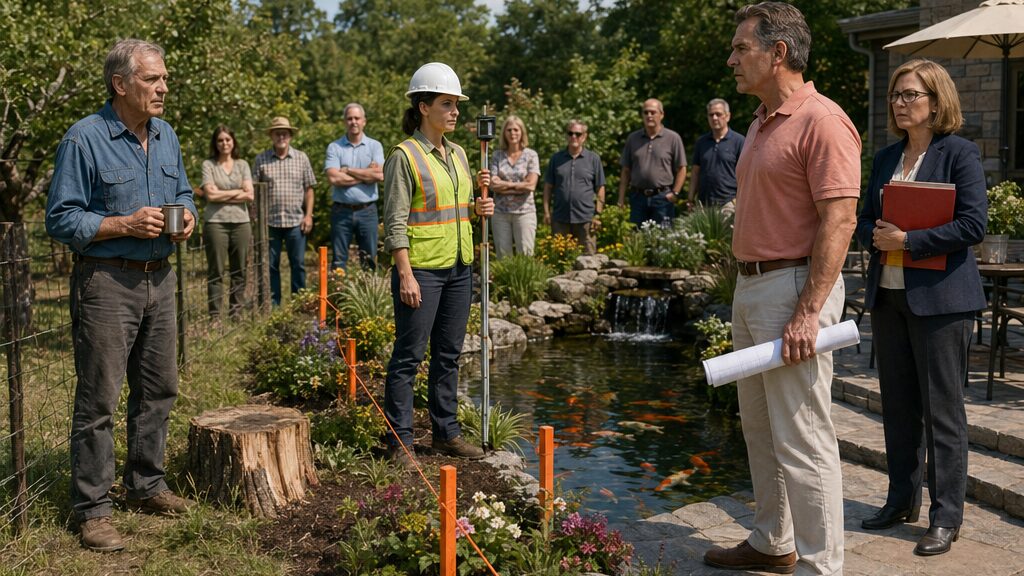
Alexander stood with Patricia and two board members near the patio, all three holding copies of the approved site plan. Several neighbors watched from the walking path. The landscaping foreman had brought two workers, though no machinery was running.
Raymond remained beside the orchard fence with his dented cup.
Ashley’s assistant held a prism pole near the county road while she checked the instrument screen. She had already recovered two control points and found the disturbed hole where Raymond remembered the iron pin. Twenty minutes of searching with a magnetic locator had produced the missing marker ten feet away, tossed beneath a hedge with soil still packed around its base.
Ashley had photographed it before touching it.
Alexander insisted a worker could have moved it accidentally.
Raymond said nothing.
Ashley measured the pin, compared its elevation, then drove the orange stake.
“That is not the line,” Alexander said.
“It is one located point,” Ashley replied. “I have not completed the boundary.”
“You placed it inside my landscaping.”
“I placed it where the evidence supports placing it.”
Patricia stepped forward. “The association’s approved plan shows the rear line at the existing fence.”
“No,” Ashley said. “It shows a line at the existing fence. I haven’t seen documentation establishing how the designer located it.”
Patricia’s expression hardened. “The plan passed architectural review.”
“Architectural review does not create a property boundary.”
One of the board members lowered his copy.
Ashley moved thirty feet south and checked another measurement. Her assistant adjusted the pole. She drove a second stake through a bed of white flowers, narrowly missing an irrigation tube.
The orange markers formed a direction no one had expected—or at least no one had wanted to see.
They ran parallel to Raymond’s fence but well inside Alexander’s yard.
Alexander walked toward the second stake. “Your angle is wrong.”
Ashley did not look up. “Which control point do you dispute?”
“I dispute the entire conclusion.”
“I haven’t given one.”
“You’re making a show of this.”
“You scheduled a public inspection.”
A murmur moved through the watching neighbors.
Raymond wished they would leave. He had imagined the survey as a quiet correction: measurements taken, a report issued, work stopped. Instead, every bright stake seemed to accuse someone. Alexander’s face had gone red. Patricia held her folder against her chest. Even the board members looked trapped by their own attendance.
Ashley approached the stone terrace.
The next calculated point landed inside a low retaining curb.
She marked the curb with removable chalk, measured again, and asked her assistant to reset the instrument. Then she read the distance aloud.
“Ten point eight feet from the approved-plan line.”
The landscaping foreman exhaled slowly.
Alexander turned toward Raymond. “You knew this was going to happen.”
“I knew the deed was different.”
“You brought her here to embarrass me.”
“You invited the neighborhood.”
“That pond cost more than your whole row of trees.”
Raymond looked at the water. Several koi moved beneath the surface, pale shapes turning through reflected sky.
“That doesn’t move the county monument.”
Ashley requested access to the patio. Alexander hesitated, then stepped aside.
She stretched a thin line between the second stake and a temporary mark near the terrace. It crossed a corner of the flower bed, passed over two stone pavers, and reached the pond’s edge.
For a moment, nobody spoke.
Ashley’s assistant waded onto the shallow shelf in rubber boots and held the prism pole upright in the water. The koi scattered.
The instrument beeped.
Ashley checked the screen, entered a correction, then pointed.
“The boundary passes through here.”
“Through the pond?” one board member asked.
“Near the center edge, based on the recovered monuments and recorded bearing.”
Alexander laughed once, but there was no humor in it. “That is impossible.”
Ashley looked toward the patio. “It continues beneath that section as well.”
She marked the pond edge with orange flagging. Its reflection trembled across the water, dividing the clear surface into two unequal halves.
Raymond had wanted proof.
Standing there, he discovered proof could feel like damage before anything had been moved.
Patricia opened her folder and removed Raymond’s violation notice. “Pending review of the survey, enforcement is suspended.”
“Suspended?” Raymond asked.
“The board cannot withdraw it until we receive a sealed report.”
“You were ready to cut the entire row without one.”
“The association relied on approved documents.”
Alexander turned on her. “Approved by whom, Patricia?”
“The architectural committee.”
“You managed the review.”
“You submitted the plan.”
“My engineer used the boundary your office provided.”
Patricia’s gaze flicked toward the neighbors. “This is not the appropriate setting for assigning responsibility.”
Alexander held up his stamped copy. “You signed this.”
“And you certified that all dimensions were accurate.”
The conflict shifted between them so quickly that Raymond almost missed its meaning. Alexander was not merely denying the survey. He was reaching for someone else to share the fall.
He crossed the patio and returned with a thicker roll of drawings. He spread them across an outdoor table, pinning the corners with decorative stones.
“These are the final plans,” he said. “They were approved before construction. The pond, the wall, everything.”
Ashley examined the title block.
“Is there a boundary survey attached?”
“There’s a site plan.”
“That isn’t what I asked.”
Alexander pointed to a note near the edge. “Property line per HOA records.”
Ashley looked at Patricia.
One of the board members did the same.
Patricia’s face remained composed, but her fingers tightened around the red folder.
Raymond stepped closer to the drawings. The plan contained the same clean line as the violation notice. No monument references. No deed bearing. No surveyor’s seal.
“How much of this was built after anyone questioned the boundary?” he asked.
Alexander stared at him. “No one questioned it until you started complaining about drainage.”
“That was six months ago.”
“You complained about everything—lights, trucks, grading, runoff.”
“I asked where the line was.”
“You refused mediation.”
“And you kept building.”
Alexander gathered the plans with sharp, uneven movements. “Because I had approval.”
Ashley removed her measuring rod from the pond. “My fieldwork supports the recorded deed. I’ll complete the calculations before issuing anything final, but no one should alter this area.”
The landscaping foreman nodded. “We’re done until written direction.”
Patricia announced that the board would reconvene privately. The watching neighbors began to disperse, talking quietly among themselves.
Raymond remained near the water.
An orange ribbon floated against the pond’s stone edge. His reflection appeared beside Alexander’s in the surface, both men divided by the marked line.
Alexander spoke without looking at him.
“If this holds, you understand what you’re demanding.”
“I’m demanding that nobody cut another tree.”
“You’re standing there like this is simple.”
“It was simple before you built on it.”
Alexander finally faced him. The anger was still present, but fear had entered beneath it.
“I followed every rule they gave me.”
“Not the one that said find your boundary.”
Patricia called Alexander from the table. As he walked away, she set several folders beside the approved plans. One was older than the others, its corners softened and its label faded.
Raymond could not read the full wording from where he stood.
He saw only three words:
Boundary Review Required.
Patricia noticed him looking.
Without pausing, she slid the old folder beneath her red one, lifted both from the table, and carried them into the house.
Chapter 4: The Approval That Should Never Have Passed
The settlement offer was larger than Raymond’s annual pension.
Patricia placed it faceup on the mediation table, as though the number itself could settle the question before anyone spoke.
The HOA office occupied the converted sales center at the entrance to the development. Through the glass wall behind Patricia, Raymond could see the bronze neighborhood sign, trimmed hedges, and the landscaped traffic circle the board photographed for every annual report. Nothing inside the room suggested trees had been cut or a boundary line now ran through a pond.
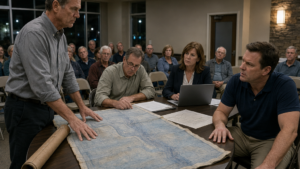
The HOA attorney sat beside Patricia. Alexander occupied the chair across from Raymond, his approved plans stacked near one elbow. Catherine had come at Raymond’s request, though she had barely looked at him since entering.
Patricia folded her hands.
“The association is prepared to facilitate a permanent resolution. Mr. Wilson would purchase the disputed strip at fair market value, reimburse the appraised value of the removed trees, and cover the recording costs for a boundary adjustment.”
Raymond read the figure again.
It was enough to replace the orchard fence, repair his tractor, and leave money untouched.
“What about the pond?” he asked.
“The pond would remain,” the attorney said. “You would grant a temporary construction easement while the adjusted boundary is recorded.”
“And the patio?”
“Also retained.”
“And the violation against me?”
“Withdrawn without admission of error.”
Raymond slid the paper back.
“No.”
Catherine turned sharply. “You haven’t even asked how they calculated it.”
“I know what they calculated.”
Alexander leaned forward. He looked tired rather than polished now. “It’s more than the land is worth.”
“That depends on who owns it.”
“We’re agreeing that you do.”
“You’re agreeing to buy it after cutting it.”
The attorney intervened. “No one benefits from framing this as punishment. The current proposal avoids litigation and substantial physical waste.”
Raymond glanced at Alexander. “Physical waste meaning his pond.”
“Meaning mature landscaping, masonry, utilities, and grading,” Alexander said. “Yes.”
Patricia opened another folder. Not the faded one Raymond had seen at the inspection. This folder was new, with indexed tabs and copied correspondence.
“The board relied on the plan submitted with Mr. Wilson’s application,” she said. “The architectural committee reviewed it in good faith.”
Ashley’s sealed preliminary report lay in front of Raymond. He touched the corner.
“Her report says the plan did not use the recorded bearing.”
“The report says further title review is recommended.”
“It also says the improvements encroach.”
“Preliminarily.”
Alexander pushed his approved plans toward the center of the table. “I did not draw these lines. I hired a design firm. I submitted what the HOA required. Patricia’s office approved every stage.”
For the first time since the trees fell, he was not speaking as the man with the larger house. He sounded like someone trying to hold a wall upright with both hands.
Raymond looked at the signature block.
Patricia Nelson. Community Manager.
“You never got a survey,” Raymond said.
“The design firm told me the HOA had the controlling subdivision records.”
“And when I raised the drainage issue six months ago?”
“You complained about runoff.”
“I asked whether the retaining wall was on your property.”
“You sent a handwritten note with no survey attached.”
Raymond remembered the note. Three sentences on the back of an irrigation invoice. He had left it at the HOA office after finding muddy water in the orchard row.
He had expected someone to recognize the problem because he recognized it.
That expectation had cost him two trees.
The attorney placed a second document beside the offer. “If settlement fails, the association will defend the validity of its enforcement process. That could take months. Possibly longer. Costs may be assessed according to the governing documents.”
Catherine read the first page. “Assessed against whom?”
“Responsibility would be determined.”
“Meaning my father could spend thousands proving what the survey already shows.”
“The survey is not final.”
Raymond heard the trap in the careful language. Nothing was certain enough to stop the board, but everything was uncertain enough to exhaust him.
He reached for his cup, then remembered he had left it in the truck.
Patricia turned a page in her folder.
A photocopied memorandum appeared beneath her hand. Raymond saw an engineering firm’s letterhead and the words boundary discrepancy before she covered it with another sheet.
“What is that?” he asked.
Patricia looked down. “A drainage review.”
“Let me see it.”
“It is not relevant to this mediation.”
Alexander stared at the exposed corner. “What date?”
Patricia did not answer.
The attorney placed one hand over the page. “We are here to discuss settlement terms.”
Catherine spoke before Raymond could.
“If it mentions a boundary discrepancy, it is relevant.”
Patricia removed her hand slowly. The memorandum was dated fourteen months earlier, before Alexander’s pond excavation. Its final paragraph recommended that no permanent improvement be approved near the Hill parcel until a licensed boundary survey reconciled the deed call with the association’s base map.
Alexander read the paragraph standing up.
“You had this before my approval.”
“It was attached to a drainage inquiry,” Patricia said. “It did not constitute a survey.”
“It said not to approve permanent improvements.”
“It recommended verification.”
“And you approved them.”
“The board faced contractual deadlines. Your application had already been delayed twice, and your designer certified the dimensions.”
Alexander looked at the board members, then back at Patricia. “You told me the line had been confirmed.”
“I told you the application met submission requirements.”
“No. You said the old agricultural records had been superseded.”
Patricia’s face tightened. “I do not recall using those words.”
Raymond watched Alexander sit down again.
The man had ordered the cutting. He had ignored Raymond’s objections and used the board’s authority as a weapon. But the plan in front of him had carried a signature he had believed meant safety.
The clean division between wronged man and entitled neighbor began to blur.
Outside, a lawn crew moved past the glass wall. A blower pushed leaves into a precise line.
The mediation ended without agreement.
In the parking lot, Alexander caught up with Raymond.
“I relied on them,” he said.
“You also kept building after I objected.”
“You never showed me a deed.”
“You never asked.”
“I asked you to mediate.”
“You asked me to sit in this office while Patricia explained why her map beat my fence.”
Alexander rubbed both hands across his face. “What do you want?”
“My land put back.”
“That could destroy half the yard.”
“It already destroyed part of mine.”
Catherine waited by Raymond’s truck until Alexander walked away.
When Raymond reached her, she held the rejected offer.
“You should have told me you refused mediation before the cutting.”
“They knew my position.”
“That isn’t the same as showing up.”
“It would not have changed the deed.”
“It might have changed what happened.”
Raymond opened the truck door.
Catherine did not move.
“You could accept enough money to protect the rest of the orchard,” she said. “You could put the settlement in trust. You could make them admit the mistake.”
“I’m not selling.”
“Why?”
“Because it’s mine.”
“That answer is too small for what you’re doing.”
He looked past her toward the distant row of trees. The orange stakes were visible even from the road, bright wounds in the green.
Catherine’s voice softened.
“What was under the first tree they cut, Dad?”
Raymond’s hand stopped on the door handle.
She had remembered the old ledger box buried near the root line.
Or perhaps she had remembered more than he wanted her to.
Chapter 5: What Raymond Never Told His Daughter
Catherine found her mother’s handwriting before Raymond could stop her.
The planting ledger lay open on the kitchen table, its cloth cover softened by years of soil and handling. Raymond had taken it from the metal box after returning from mediation, intending only to check the dates. Catherine arrived the next evening and read the exposed page before he could close it.
Twenty-five years. Two Bartlett pears. East row. Keep this line together.
The final sentence curved upward in the way her mother’s handwriting always had.
Catherine touched the ink with one finger.
“She wrote this?”
Raymond sat across from her. His coffee cup rested beside the ledger, empty.
“She kept most of the nursery records.”
“This isn’t a nursery record.”
“No.”
Below the note was a rough sketch of the orchard row. Small circles marked each tree. Beside the first two, her mother had drawn a pair of uneven stars.
Catherine looked toward the dark window over the sink.
“The tree they cut was one of these.”
“Yes.”
“And the second one?”
“Yes.”
She closed her eyes briefly. “Why didn’t you tell me?”
“It wouldn’t change where the boundary sits.”
“That is not what I asked.”
Raymond turned the cup between his hands. The dent near the rim caught against his thumb.
His wife had dropped it on the packing-house floor during their first year running the nursery. He had offered to replace it. She had said a cup that still held coffee did not need replacing.
He had been carrying it ever since the funeral.
“We planted that row on our anniversary,” he said. “Not all at once. Those first two, then the others over the next few years. When she got sick, we walked there most evenings.”
Catherine’s eyes remained on the ledger.
“She asked me to keep the row.”
“Exactly as it was?”
“She said keep it intact.”
“Those are not always the same thing.”
Raymond felt irritation rise, quick and familiar. “You weren’t there.”
“No. You made sure I wasn’t.”
The words landed cleanly.
Catherine had visited during the illness, but Raymond had controlled the difficult hours. He sent her home when her mother became confused. He handled the medication chart. He answered questions with practical facts. After the funeral, he gave Catherine boxes of clothing and kept the orchard records.
He had called it protecting her.
Now it looked like another form of silence.
“I thought you had enough,” he said.
“You decided what I could carry.”
Raymond stood and walked to the sink. Outside, a security light illuminated the surviving trees. One orange stake stood close to the third trunk, its plastic ribbon moving in the night breeze.
Catherine joined him at the window.
“Alexander offered to buy the strip before the trees were cut, didn’t he?”
“Not formally.”
“But he offered.”
“He mentioned a boundary adjustment at the first mediation request.”
“The meeting you refused.”
Raymond said nothing.
“What were the terms?”
“He would buy six feet based on the HOA line and move the fence.”
“Before Ashley found eleven?”
“Yes.”
“So it would not have solved the whole problem.”
“No.”
“But it might have stopped construction while the line was checked.”
Raymond stared at the orange ribbon.
“I thought agreeing to discuss a sale would weaken my claim.”
“Did anyone tell you that?”
“No.”
“You assumed it.”
“He assumed the board was right.”
“And you assumed speaking would cost you something.”
“It usually does.”
Catherine turned from the window. “Then stop pretending this happened only because Alexander is arrogant.”
Raymond faced her.
“He ordered my trees cut.”
“Yes. He is responsible for that. Patricia hid a warning. She is responsible too. But you had a chance to put the real issue on the table, and you chose not to go.”
He wanted to tell her that men like Alexander did not hear explanations from men like him. They heard weakness, sentiment, an opening price. He wanted to say a promise did not become more valid because it was translated into meeting minutes.
Instead, he looked at the ledger.
“I was afraid they’d call it emotional,” he said.
Catherine’s expression changed.
“And if they did?”
“I didn’t want your mother reduced to a reason on a form.”
“So you reduced her to a secret.”
The room went still.
The next morning, the county grading inspector called. Ashley’s sealed survey had been submitted with Raymond’s complaint. The county could not adjudicate title, but it could review structures built across recorded parcel lines and determine whether grading permits had relied on inaccurate plans.
“There are two possible paths,” the inspector explained. “Removal and restoration, or a negotiated redesign supported by both owners and corrected documents.”
“What kind of redesign?”
“Partial pond removal, retaining-wall relocation, revised drainage, and an easement where necessary. It depends on your agreement.”
“And if I don’t agree?”
“The county may require removal of improvements inconsistent with the permitted plan.”
Raymond looked at the surviving tree beside the stake.
“Would regrading damage the roots?”
“Possibly. We’d need an arborist’s assessment.”
The legal answer he had wanted now carried the possibility of killing the last tree his wife had planted.
After the call, Catherine found him outside with the ledger tucked beneath his arm.
“I understand why you won’t sell it,” she said.
Raymond waited.
“I still don’t understand why keeping the promise means nobody else gets a choice.”
He looked toward Alexander’s house. The pond pump hummed beyond the retaining wall.
“Would you accept the redesign?” she asked.
“I don’t know.”
“That’s different from no.”
Raymond returned to the kitchen and took out a sheet of paper. He wrote only one sentence.
Meet me at the pond tomorrow at eight. No lawyers. No board.
He carried it next door himself.
Alexander opened the door but did not invite him in.
Raymond handed him the note.
“What is this?” Alexander asked.
“A chance to decide what we remove before the county decides for us.”
Chapter 6: The Offer Made Beside the Drained Pond
Water was already pouring from the koi pond when Raymond arrived.
A temporary hose ran from the lower basin across Alexander’s lawn toward a storm-safe holding tank. Two large blue tubs stood beside the patio, each fitted with an aerator. Orange survey stakes rose between them like narrow warning signs.
Alexander was knee-deep in the shallow shelf, guiding a net beneath a white-and-gold koi.
“You started without an order,” Raymond said.
Alexander lifted the fish carefully. “The pump contractor said the pond has to be lowered before anyone can inspect the buried wall.”
“That isn’t what I asked.”
“No. You asked me to meet without lawyers.”
He carried the koi to one of the blue tubs and released it. The fish disappeared beneath the rippling surface.
Alexander climbed out, water darkening his trousers to the knee. He had no polo shirt, no polished shoes, no board papers. Only a faded work shirt and a towel over one shoulder.
“I’m making you another offer,” he said.
Raymond glanced toward the house. “I said no lawyers.”
“They didn’t write this.”
Alexander handed him a single sheet. The number at the top exceeded the HOA proposal. It included the entire surveyed strip, tree replacement, legal costs, and a separate payment for a conservation restriction along the remaining orchard edge.
Raymond read the last line.
“You would personally guarantee it.”
“I already personally guaranteed the landscaping loan.”
Raymond looked up.
Alexander nodded toward the half-drained pond. “The house construction was financed. The yard was not supposed to be. Costs rose. I borrowed against the business and signed for the difference.”
“You spent that much before confirming the line.”
“I confirmed it through the process I was told to use.”
“Not through a surveyor.”
“No.”
The answer came without defense.
Alexander picked up the net again. “If the county orders full removal, I lose the pond, part of the patio, the retaining wall, and probably the refinancing. If the HOA’s insurer denies coverage, I may lose more than the yard.”
Raymond folded the offer.
“You expect that to change the deed?”
“I expect it to explain why I’m trying to buy the land.”
“It explains the price.”
Alexander stared into the lowered water. Stones that had been invisible the day before now broke the surface.
“I thought you were using the line to punish me.”
“Some days I was.”
Alexander looked at him then.
Raymond had not intended to say it aloud. Once spoken, it left less room for righteousness.
“The first two trees were planted with my wife,” he continued. “The surviving row mattered before your house was here.”
“You could have told me.”
“I could have.”
“I might have stopped the crew.”
“You might have called it sentiment.”
“I might have.” Alexander lowered his eyes. “I called it debris.”
One of the koi surfaced in the tub with a soft splash.
Alexander leaned the net against the wall.
“Patricia warned me after construction started,” he said.
Raymond remained still. “About the boundary?”
“Not directly. She said an old engineering memo had raised a technical issue, but the board considered it resolved. She told me not to pause because delay could invalidate contractor pricing.”
“When?”
“After the retaining wall was poured. Before the pond was lined.”
“You kept going.”
“Yes.”
“Why?”
“Because I had already spent more than I could explain to my wife, the bank, or anyone else. Because Patricia said the board would stand behind the approval. Because I wanted the house finished before the development tour.”
The annual tour had brought buyers, local agents, and photographs for the HOA website. Alexander’s yard had been its centerpiece.
“So you chose the answer that protected you,” Raymond said.
Alexander met his gaze. “So did you when you skipped mediation.”
The words were not kind, but they were not false.
A truck entered the driveway. The landscaping foreman stepped out with two workers and portable tanks.
Alexander gestured toward the pond. “They can move every fish safely today. The palms can be transplanted. Some stone can be reused. None of that affects your claim.”
Raymond looked at the men waiting for permission.
He could insist that nothing move until the county hearing. That would preserve evidence and increase pressure. It might also kill the fish if the pond system had already been disrupted.
“Move the koi,” he said. “Photograph each stage. No excavation. No wall work.”
Alexander nodded.
“And the palms?” the foreman asked.
“Only the ones Ashley confirms are inside the line,” Raymond said. “Root balls intact.”
The foreman glanced at Alexander, who said, “Do it his way.”
By noon, the tubs held the pond’s living color. Workers wrapped two palms for transplanting. The orange stakes remained untouched among the hoses and equipment.
Patricia arrived while Raymond was checking the third tree’s exposed roots.
She stepped from her sedan carrying a folder and stopped when she saw the drained pond.
“Who authorized this?”
“I did,” Alexander said.
“You cannot alter the site before the hearing.”
“We’re protecting the fish.”
“You are changing evidence.”
“The survey points are documented.”
Patricia looked at Raymond. “You agreed to this?”
“I agreed to keep living things from becoming leverage.”
Her expression hardened. “The association has not admitted that the older memorandum was withheld or material.”
Alexander laughed quietly. “You handed it to us in mediation.”
“It was produced as part of a privileged settlement discussion.”
“You told me the issue had been resolved.”
“I told you the application was approved.”
“You told me to keep building.”
“I deny that.”
The foreman stopped working.
Patricia seemed to realize how many people were listening. She lowered her voice. “Any allegation regarding document handling should be addressed through counsel.”
Raymond pointed toward the orange stakes. “The line was addressed without counsel.”
She turned away, already making a call.
The county hearing was held three days later in a narrow room with fluorescent lights and a digital recorder on the table. Raymond sat beside Catherine. Alexander sat alone. Patricia and the HOA attorney occupied the opposite side.
The grading inspector asked Patricia whether the association had received any warning before approving permanent improvements near the Hill parcel.
“No definitive warning,” she said. “There was a preliminary drainage memorandum that did not establish a boundary.”
“Did you advise the applicant to proceed?”
“No.”
The inspector opened the evidence packet.
On top lay a printed email from Patricia to Alexander, timestamped two weeks before the pond lining was installed.
The final sentence had been highlighted:
Proceed as approved. Do not delay the showcase schedule over an archival boundary note we consider administratively resolved.
Chapter 7: Six Days to Restore Eleven Feet
Patricia’s email remained on the table while she denied what it said.
The county grading inspector read the highlighted sentence aloud, then looked across the room.
“Ms. Nelson, did you consider the boundary issue resolved when you instructed Mr. Wilson to proceed?”
Patricia kept both hands flat on the table. “Administratively resolved is not the same as legally resolved.”
“Then why was construction allowed to continue?”
“The association had an approved application, contractor schedules, and no competing sealed survey at that time.”
Ashley sat behind Raymond with her field notes arranged in a narrow stack. She did not react. Alexander looked down at the copy in front of him.
The inspector turned to the HOA attorney. “Was the engineering memorandum disclosed to the applicant?”
The attorney requested a moment to confer.
Patricia leaned toward him, whispering with one hand shielding her mouth. Raymond watched the same controlled movements he had seen beside the fallen trees. Everything organized. Everything managed until it could no longer be managed.
Alexander spoke before the attorney finished.
“She mentioned it after the wall was poured.”
Patricia turned toward him. “That is not an accurate characterization.”
“You told me it was an archival note and not to delay the tour.”
“I told you the board had not ordered a stop.”
“You knew I heard that as permission.”
“What you inferred is not the same as what I said.”
The inspector raised a hand. “One at a time.”
Alexander pushed his copy of the email forward. “I kept building because she told me the board would stand behind the approval.”
Raymond could hear the strain in his voice. It was not absolution. Alexander had known enough to pause and had chosen debt, schedule, and appearances instead. But the choice had not been made alone.
The inspector reviewed the permits, Ashley’s sealed survey, the old engineering memorandum, and the grading plans. The hearing lasted nearly three hours.
When the decision came, it was narrower than revenge and more severe than settlement.
The county ordered removal of all permanent improvements crossing the surveyed line, restoration of the original drainage grade, and independent inspection before closure. The pond could be redesigned entirely within Alexander’s parcel. Reusable stone and viable plantings could be salvaged. The parties could agree on work methods, but not on relocating the legal boundary without a separate recorded transaction.
The HOA attorney asked that Raymond bear part of the restoration cost because his fence placement had contributed to the confusion.
Raymond stared at him.
Ashley answered before he could.
“The fence is within the Hill parcel.”
The attorney shifted. “Its irregular condition may have encouraged reliance on the visible occupation line.”
“A fence is not a warranty,” Ashley said.
The inspector assigned primary cost to Alexander as property owner, with the HOA’s share to be resolved through its insurer and internal claims process. Patricia’s conduct would be referred to the board and management company.
Alexander did not argue.
Patricia did.
“This decision exposes the association to substantial liability based on a historical discrepancy no volunteer board could reasonably interpret.”
Raymond looked at the orange stakes visible through the hearing room window in a photograph attached to the file.
“You did interpret it,” he said. “You just chose the interpretation that kept the schedule.”
The room went quiet.
The first patio slab came up nine days later.
A small excavator fitted with lifting clamps eased the stone from its bed beside the orange line. Dust rose around the stake nearest the terrace, but the operator never touched it. Ashley had marked every protected point and required the crew to measure from them each morning.
Raymond watched from his side of the fence with his metal cup.
On the first day, the workers removed the pond liner and salvaged the stone edging. On the second, they dismantled the retaining wall in sections. The third was spent lifting irrigation lines and relocating the remaining palms. By the fourth, the luxury garden had become raw soil, exposed pipe, and stacked masonry.
Alexander worked beside the crew when he could. He carried stone, labeled salvaged plants, and spoke little.
Patricia never came.
The HOA board sent a notice announcing that its management contract was under review. The letter did not mention her by name. It referred instead to “procedural failures involving incomplete historical records.”
Raymond read the phrase twice and put the notice beneath his cup so the wind would not take it.
On the fifth morning, the grading inspector and an arborist examined the surviving memorial tree. Its roots extended beneath the former retaining wall. Several had been cut during the original construction; others had grown into compacted fill that now needed removal.
The arborist pressed a probe into the soil and frowned.
“If we restore the grade exactly, we may destabilize it.”
Raymond looked at the tree. The scar from the mower remained low on the trunk, half closed beneath rough bark.
“What if you leave the fill?”
“Drainage will continue toward the orchard. The roots are already stressed.”
“Can it be braced?”
“For a while.”
“That is not what I asked.”
The arborist met his eyes. “It may survive. I would not promise it.”
Alexander stood a few feet away, holding his gloves.
“We can redesign the slope around it,” he said.
The grading inspector shook his head. “Not without leaving part of the unpermitted grade.”
“Then bring in better soil.”
“It is not only soil.”
Raymond felt the old instinct rise: demand the exact restoration, preserve every inch, make the tree remain because the promise required it.
Then he saw Catherine at the fence.
She had come without announcing herself. She looked from him to the tree and waited.
“What causes the least additional damage?” Raymond asked.
The arborist outlined a gentler cut, hand excavation near the roots, temporary bracing, and a shallower swale. It would satisfy drainage requirements, though the tree would remain at risk.
“Do that,” Raymond said.
The inspector made a note.
Alexander picked up his gloves. “I’ll cover the arborist’s monitoring.”
Raymond nodded once.
On the sixth day, the crew finished the swale and spread clean topsoil across the restored strip. The pond had been reduced and rebuilt several feet away, entirely inside Alexander’s parcel. The patio ended at a plain edge instead of curving into Raymond’s land.
Nothing looked as it had before.
That evening, Ashley walked the boundary alone, checking every point. She removed the temporary ribbons one by one but left the final orange stake beside the surviving pear tree.
Her instrument gave a last confirming beep.
“The restoration is within tolerance,” she said.
Raymond looked at the stake.
“You can take that one.”
Ashley folded the tripod legs. “I can.”
She paused.
“But I think you should.”
Chapter 8: The Last Stake Did Not Mark a Victory
The restored strip looked emptier than the damaged yard ever had.
Fresh soil ran between the orchard and Alexander’s shortened patio. No pond crossed it. No stone wall claimed it. Even the surviving pear tree seemed smaller without the other trunks beside it.
The final orange stake remained at its base.
Catherine arrived carrying two young trees in the bed of her truck.
Raymond studied them. “Those aren’t Bartlett pears.”
“No.”
“What are they?”
“Disease-resistant hybrids. The nursery said they’ll handle the soil better.”
“That row was Bartlett.”
“That row is gone.”
He looked at her.
She did not apologize for saying it.
Before they unloaded the trees, Alexander came through the side gate holding the old planting ledger in both hands. Its cover had been cleaned, though dirt remained pressed into the cloth.
“We found it beneath the removed stone,” he said. “The metal box had split.”
Raymond took the ledger and opened to the anniversary page. His wife’s handwriting was still there, blurred at one corner but readable.
Alexander looked toward the surviving tree.
“I resigned from the board.”
Raymond closed the book.
“I heard.”
“The HOA adopted a rule requiring an independent survey before any permanent project within twenty feet of an uncertain boundary.”
“That should have been the rule already.”
“Yes.”
They stood without offering each other forgiveness.
Alexander finally nodded toward the young trees. “Do you need help?”
Catherine answered before Raymond could. “You can hold one straight.”
They planted the first tree several feet from the old row, where the restored grade gave its roots room. Alexander steadied the trunk while Raymond packed soil around it. Catherine checked the angle, then stepped back.
The second tree went closer to the surviving pear, but not close enough to imitate what had been lost.
When they finished, Alexander returned to his side without ceremony.
Raymond carried the ledger to the porch and set it beside his dented cup. Later that afternoon, the arborist called. The old pear had declined further. The damaged roots were not recovering.
It would have to come down before winter.
Raymond listened without arguing.
At sunset, he walked back to the boundary with Catherine. The orange stake cast a thin shadow across the new soil.
He gripped it near the top and pulled.
It resisted at first. Then the earth released it with a soft sound.
For months, the stake had meant proof. It had divided water, exposed false records, and forced people to answer for what they preferred not to see.
Now it was only painted wood in his hand.
Raymond passed it to Catherine.
“What should I do with this?” she asked.
“Keep it until we don’t need to.”
He filled his metal cup from the garden spigot and poured the water slowly around the nearest young tree.
The soil darkened at its base.
Behind them, the old pear moved in the evening air. Ahead of them, the new leaves held steady.
The story has ended.