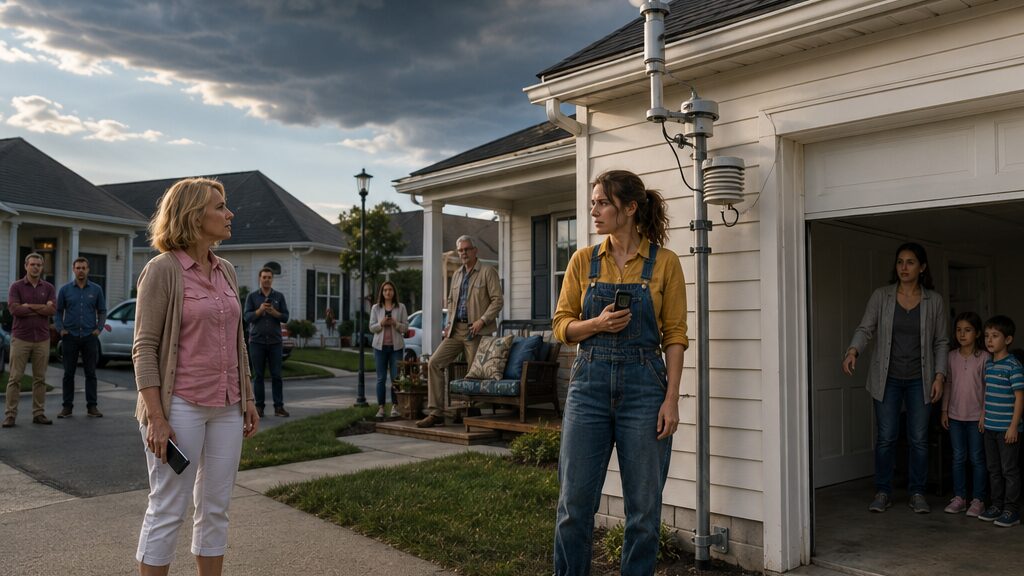
When the HOA Called Her Weather Station an Eyesore, the First Storm Proved What Everyone Refused to See
Chapter 1: The Spinning Thing Beside the Garage
“That spinning thing is an eyesore.”
Emily Taylor had one hand wrapped around a socket wrench and the other braced against the aluminum pole when the voice cut across her driveway.
She froze halfway through tightening the final bolt.
The weather cups above her garage turned lazily in the mild Saturday breeze, three small white bowls circling against a clean blue sky. The whole station stood taller than she did, mounted beside the side wall of her garage, its slim sensor arm angled toward the open street like a finger testing the air.
At the end of the driveway, Karen White stood in a pink button-up shirt, white capris, and sandals too clean for walking through anyone’s grass. She had one hand on her hip and the other pointed toward the weather station as if Emily had installed a broken carnival ride.
“Good morning,” Emily said, because it was the only sentence she could get out without sounding like her first thought.
Karen stepped closer, not quite onto the driveway, not quite staying off it. That was Karen’s way. She had lived on Briar Glen Court long enough to know exactly where a property line ended and social pressure began.
“I’m going to assume this is temporary,” Karen said.
Emily glanced up. The cups spun, stopped, spun again. The sensor’s small screen blinked inside the garage window where she had mounted the receiver the night before.
“It’s not temporary.”
Karen’s mouth tightened. “Emily.”
That was how Karen said names when she meant rules.
Emily climbed down from the small step ladder. She wiped one palm against the thigh of her jeans, leaving a gray smudge. Across the cul-de-sac, a garage door was halfway open. Someone inside paused a leaf blower, then did not restart it. Two houses down, Robert Martin stood by his porch rail with a coffee mug, pretending to examine his hanging fern.
Emily felt the neighborhood listening before she saw all of it.
“It’s a weather station,” she said.
“I can see it has something to do with weather.” Karen tilted her head, eyes traveling from the wall bracket to the cups. “What I can’t see is why it needs to be visible from the street.”
“It needs clean airflow.”
“Clean airflow,” Karen repeated.
“To read correctly.”
“Read what?”
“Wind speed, direction, rainfall rate, barometric pressure, humidity.” Emily heard herself becoming more technical and knew it was a mistake. Karen’s expression always hardened around specifics she had not asked for.
Karen folded her arms. “We have phones for that.”
Emily looked toward Robert’s porch. He lowered his mug.
“Phone apps pull from regional stations,” Emily said. “Sometimes they’re miles away. This gives local readings.”
“Local readings for what purpose?”
Emily rested the wrench on the ladder tray. Behind her, the garage smelled faintly of machine oil and the cardboard boxes she still had not unpacked from moving in. Her father’s old workbench sat against the back wall under a faded pegboard, its drawers swollen from years in a damp basement. She had told herself she would sort it last. She had told herself a lot of things.
“It helps the whole neighborhood,” she said.
Karen gave a small laugh that was almost polite. “It helps the whole neighborhood by looking like an airport instrument?”
“It helps by warning when conditions change fast.”
“Emily, this is a residential community. We have appearance standards.”
The phrase landed exactly as intended. Not a law. Not a request. A soft wall.
A delivery truck slowed at the corner, the driver watching long enough to miss the first mailbox. Emily forced her shoulders loose.
“I checked the guidelines,” she said. “It doesn’t say weather stations are prohibited.”
“It says exterior mechanical devices visible from the street require approval.”
“It’s not mechanical in that sense.”
“It spins.”
Emily looked up again. The cups were turning steadily now, as if making Karen’s point for her.
Karen stepped onto the driveway at last. “You’re new here, and I understand that maybe no one explained how the HOA works. We try to keep things consistent. Curb appeal matters. Resale value matters. If everyone starts bolting whatever they want to the outside of their garage, we lose the look people paid for.”
Emily had heard versions of that at the first welcome meeting, at the mailbox cluster, in the neat email with the subject line WELCOME TO BRIAR GLEN. The look people paid for. Trim lawns. Matching mailboxes. No sheds above fence height. No flags except approved sizes. Trash bins hidden by 8 p.m. on pickup day.
“I’m not trying to change the look,” Emily said.
“But you have.”
The words were not loud. They did not need to be.
Melissa Garcia came out onto her porch with one child’s sneaker in her hand and a phone tucked between her shoulder and ear. She saw Karen, saw Emily, saw the weather station, and stopped just inside her doorway.
Emily felt heat rising along her neck. She hated that more than the accusation itself, the way her body made embarrassment visible before she had agreed to be embarrassed.
Karen softened her voice. “Take it down, submit the architectural request, and we’ll discuss options.”
“I already mounted it.”
“Then unmount it.”
“I need it running.”
“For what, exactly?”
Emily looked at the cups. The small white bowls spun and spun, innocent and stubborn.
For the dip in the street that held water longer than any map admitted. For the storms that dropped rain on Briar Glen while the county alert said light showers north of town. For the night, years ago, when her father had come home soaked to the skin and angry in a quiet way that had scared her more than shouting. For the sentence he had said at the kitchen table: They won’t listen until they can see water for themselves.
But Karen was watching. Robert was watching. Melissa was watching from the gap in her front door. Emily had learned young that grief sounded dramatic when explained to people who had not asked to hear it.
“For weather,” Emily said.
Karen’s face changed just enough to show disappointment. “That’s not an answer.”
“It’s the answer I have.”
A lawn mower started somewhere behind the houses, then stopped again.
Karen took a slow breath. “I’m trying to handle this neighbor to neighbor.”
“No,” Emily said before she could stop herself. “You’re handling it like an enforcement warning without the letterhead.”
Karen’s eyebrows lifted.
Emily regretted it immediately. Not because it was wrong, but because it was too clear.
“I’m sorry,” Emily said. “I just mean I don’t want to take it down before anyone understands what it does.”
“I understand what it does to the exterior of your home.”
“It’s mounted cleanly.”
“It’s visible.”
“It’s safe.”
“It’s unapproved.”
The conversation had narrowed into a hallway with no doors. Emily picked up the wrench, then set it down again so Karen would not think she was dismissing her. She wanted to be reasonable. She also wanted, very badly, to go back twenty minutes to when the pole was crooked, the street was quiet, and the station belonged only to her.
Karen turned slightly, allowing the neighbors to see her profile. “I will bring this to the board if I need to. I’d rather not.”
“Then don’t.”
“Emily.”
“I’m not taking it down today.”
The cups above them caught a stronger breeze and spun faster, a soft plastic rattle ticking through the space between them.
Karen’s eyes flicked up. “That sound alone is going to bother people.”
“It won’t be loud from inside.”
“People should not have to close their windows because of your equipment.”
“They won’t.”
“You don’t know that.”
Emily almost laughed, then caught herself. She knew wind. She knew gust fronts and low pressure and how air moved strangely along this row of houses because the street dipped behind the storm drains. She knew the back corner of Briar Glen Court acted like a shallow bowl when rain came hard from the west. But she did not know people. Not here. Not yet.
Karen pulled her phone from her pocket.
“What are you doing?” Emily asked.
“Documenting it.”
“For the file?”
Karen did not answer. She stepped off the driveway and lifted the phone with both hands. The camera faced the garage, the pole, the turning cups, and Emily standing below them with a wrench in her hand and a smudge on her jeans.
Emily looked away just as Karen took the picture.
The shutter sound was small, artificial, and final.
Chapter 2: The Forecast Everyone Trusted Was Wrong
The alarm chirped while the sun was still shining.
Emily was in the kitchen rinsing a coffee cup when the receiver on the counter gave three sharp beeps. Not the low-battery chirp. Not the connection warning. The pressure-drop alert.
She turned so fast water splashed over her wrist.
Outside the window, the weather cups had changed from lazy circles to a tight, nervous spin. The maple leaves across the street showed their pale undersides, fluttering all at once as if someone had run a hand beneath them. Beyond the rooftops, the sky was still blue enough that anyone glancing up would call the afternoon clear.
Emily tapped the receiver. The numbers did not soften for her.
Pressure falling fast. Wind shifting. Humidity climbing. Rain rate blank, waiting.
She reached for her phone, opened the regular weather app, and stared at the bright yellow sun icon.
Sunny. Chance of rain: 8%.
“Of course,” she muttered.
For half a minute she did nothing. The cup in the sink tipped under the running faucet and filled until water spilled over its rim. Across the street, Melissa Garcia’s kids were dragging sidewalk chalk and a scooter down the driveway. Robert Martin had taken cushions from his screened porch and stacked them neatly on a wicker chair, probably for cleaning. Farther down, Karen White’s white SUV sat in the driveway, shining and motionless.
Emily shut off the faucet.
She had not planned to warn anyone. Not yet. Not after yesterday’s picture, not after the way the neighbors had gone quiet, not after seeing two people in the mailbox area glance at the station and then at her like she had installed a personal argument.
The receiver beeped again.
She wiped her hands on a towel, stepped onto the front porch, and looked west.
There it was.
Not a wall of storm clouds. Not dramatic enough for a movie. Just a bruise-colored line low behind the houses, moving quicker than it should have been. The kind of small, mean cell that could dump rain on three streets and leave the main road dry.
Melissa’s younger child sat at the curb, drawing a sun in yellow chalk.
Emily walked down her steps.
“Melissa?”
Melissa came out with a laundry basket balanced on her hip. “Hey. Is everything okay?”
Emily felt the strange embarrassment of warning someone on a sunny day. “You might want to bring the kids in soon.”
Melissa glanced up at the sky. “Why?”
“I’m getting a pressure drop.”
“A what?”
“Rain. Probably heavy. Five minutes, maybe less.”
Melissa blinked. Then, because she was not unkind, she gave Emily the smallest possible smile. “My phone says sunshine until dinner.”
“I know.”
Robert turned from his porch. “Mine says clear too.”
“Mine doesn’t,” Emily said.
He looked at her empty hands, then toward the station. “That thing tells you rain?”
“It tells me conditions.”
“Conditions,” Melissa repeated, not mockingly exactly, but with the careful tone people used when they were trying not to embarrass someone.
A gust pushed through the cul-de-sac and lifted the chalk dust from the driveway. The weather cups spun faster, ticking above Emily’s garage.
Emily swallowed. “Robert, if those cushions matter, I’d move them inside.”
Robert looked at the cushions. Looked at the sky. Looked at Emily.
From the next porch over, a neighbor laughed under his breath. “Five minutes? No chance.”
Emily did not turn toward him. “Okay.”
That was her flaw, and she knew it even while doing it. She gave people the truth and then stepped back as if the truth could finish the conversation for her.
Melissa’s older child rolled the scooter in a circle. “Mom, is it gonna storm?”
“No, honey,” Melissa said automatically. Then she looked at Emily again. “Is it?”
Emily wanted to say yes with enough certainty to make Melissa move. She wanted to show the pressure graph, the dew point jump, the wind shift. Instead she looked at the child at the curb.
“I’d go in,” she said.
Robert set down his mug and picked up the first cushion.
Karen’s front door opened.
Emily saw her before she spoke: pink shirt again, this time with a thin beige cardigan over it, phone in hand. Karen walked down her front steps slowly, like someone arriving late to a situation that already annoyed her.
“What’s going on?” Karen asked.
“Nothing,” Melissa said too quickly.
Emily hated the quickness. It made the warning sound like gossip.
Karen’s eyes moved to Emily. “Are you now alarming the neighborhood?”
“No.”
“She said it’s going to rain,” the neighbor from the porch called out, amused. “In five minutes.”
Karen glanced at the sky, then at her phone. “The weather service says sunny.”
“The station is showing a local pressure drop,” Emily said.
Karen’s expression sharpened around the word station. “Emily, this is exactly the kind of issue I was concerned about. You can’t use an unapproved device to create panic.”
“Nobody’s panicking.”
“People are moving furniture.”
Robert had three cushions under one arm. He paused on his porch steps. “I was going to bring them in anyway.”
“No, you weren’t,” said the amused neighbor.
Robert looked at the sky again. “Well, now I am.”
The first drop hit Emily’s forearm.
Small. Cool. Almost deniable.
Then another struck the driveway, making a dark coin on the concrete beside the child’s chalk sun.
Melissa looked down.
The clouds moved over the sun as if someone had pulled a shade. The temperature seemed to fall in one breath. The weather cups above the garage blurred into a white circle.
“Kids,” Melissa said, no longer polite. “Inside. Now.”
The rain arrived not as a sprinkle but as a sudden sheet. One second the cul-de-sac was dry and ordinary; the next, water hammered the roofs, bounced from the pavement, and erased the chalk sun into yellow streams. The neighbor who had laughed snatched a folded chair and ran backward into his garage. Robert shoved the cushions through his porch door and stood there blinking at the rain with one damp sleeve.
Emily stepped back under her own porch roof, heart beating too hard for something she had expected.
Karen stood in the rain for three seconds before she moved. It flattened her cardigan to her shoulders and dotted her phone screen. She hurried under Robert’s maple tree, which was useless as cover.
Melissa’s children pressed their faces to the front window, laughing now that they were dry inside.
Robert looked across the street at Emily. He did not smile. He lifted one hand slightly, the cushions safe behind him.
“Good thing,” he called over the rain.
Emily nodded once.
It should have felt like victory. It did, for a second. A small clean click of proof sliding into place.
Then she saw Karen staring at the station.
Not amazed. Not grateful. Calculating.
The rain softened after ten minutes, leaving the street shining and the gutters rushing. Water collected along the low curb near the end of the cul-de-sac, exactly where Emily expected it to collect. Not dangerous today. Not yet. Just enough to remind her why the station mattered.
Karen crossed the street when the rain eased. Her hair had loosened at the temples. Her shoes made wet marks on Emily’s driveway.
“I suppose you think that settles it,” Karen said.
Emily wiped rain from the receiver she had brought out under the porch. “It should settle whether the station works.”
“One lucky rain shower doesn’t cancel the rules.”
“It wasn’t lucky.”
Karen glanced toward the neighbors, who were now pretending not to listen again. “Then bring your data to the board.”
“I can.”
“You should.” Karen’s voice was quiet now, and somehow worse for it. “Because as of today, this is no longer just about appearance. If you’re going to position yourself as the neighborhood’s weather authority, there are liability questions.”
Emily stared at her. “I warned people to bring cushions in.”
“And if next time you’re wrong?”
The question hung between them, sharper than the rain.
Karen turned and walked back toward her house, leaving wet footprints that slowly vanished from Emily’s driveway.
Above the garage, the weather cups kept spinning.
Chapter 3: A Violation Letter After the Rain
The envelope was too clean.
Emily found it three days later tucked perfectly into her mailbox, white and flat and centered against the stack of grocery flyers. No stamp. No postmark. Hand-delivered.
Briar Glen Homeowners Association was printed in the upper left corner.
Her name and address were typed in a font that looked chosen to avoid personality.
Emily stood at the mailbox cluster with her keys in one hand and the envelope in the other while a car rolled slowly past, then sped up once the driver had seen what she was holding. By then, everyone knew there had been rain after Emily said rain was coming. Everyone also knew Karen had gone to the board.
The weather station turned above Emily’s garage as she walked back up the driveway. Its cups made a soft steady rhythm in the damp air. Not loud. Not ugly. Just present.
Inside, she dropped the grocery flyers on the kitchen table and opened the envelope with a butter knife because she did not want to tear it.
The letter began politely.
Dear Ms. Taylor,
The Board has received a report regarding an unapproved exterior installation visible from the street.
Emily skipped down the page.
Exterior mechanical devices, visible instrumentation, antennas, poles, or similar structures attached to any home exterior must receive prior written approval from the Architectural Review Committee.
She read the sentence three times, each time hearing Karen’s voice more clearly.
Corrective action required within fourteen days.
Failure to comply may result in daily fines.
The amount was printed in bold.
Emily set the letter down carefully, then pressed both palms flat to the table. The kitchen was quiet except for the refrigerator motor and the faint spin outside the window. The station’s shadow moved across the side yard in slow pieces.
Fourteen days. Daily fines. Prior written approval.
She could afford a fine for a little while if she had to. She could not afford to become the neighbor everyone talked about before she had even unpacked her books.
Her phone buzzed.
A message from the neighborhood group chat appeared on screen.
Does anyone know if the HOA is making rules about weather equipment now? Just curious.
Another message came five seconds later.
I think anything bolted to the outside needs approval. Keeps the neighborhood consistent.
Then Melissa’s name appeared and disappeared, typing, not typing, typing again. No message came.
Emily placed the phone face down.
At the community college weather lab, data had rules. If the sensor was calibrated, if the time stamp was accurate, if the reading could be verified, then the data stood whether people liked it or not. In Briar Glen, a thing could be accurate and still be offensive.
She drove to the HOA office that afternoon because answering by email felt like surrendering the shape of the conversation. The office was a small room attached to the clubhouse, smelling of carpet cleaner and old paper. A bulletin board displayed approved fence stains, pool hours, and a flyer reminding residents that trash bins must not be visible from the street.
Patrick Johnson sat behind a desk with an open laptop and a stack of folders. He wore a light blue polo with the HOA logo stitched small over the chest, and he looked like a man who had prepared for a difficult conversation by deciding not to have one.
“Ms. Taylor,” he said. “I figured we’d hear from you.”
“I got the letter.”
“I assumed.”
“I’d like to request a temporary exception while the architectural committee reviews the station.”
Patrick folded his hands. “The issue is that there was no request before installation.”
“I understand that. I’m filing one now.”
“That doesn’t pause enforcement automatically.”
“It’s a weather station, not a deck.”
His face tightened, but not angrily. More like she had handed him the wrong form. “From the board’s perspective, it’s an exterior visible structure. Also, after Sunday, there are some liability concerns.”
Emily sat back. “Liability for warning people it was about to rain?”
“For creating reliance,” Patrick said. “If residents begin acting on your statements and something goes wrong, people may assume the association endorsed your equipment.”
“The association is trying to remove it.”
“Exactly. Which is why clarity matters.”
Emily stared at him. “That doesn’t make sense.”
“It does if you’ve sat through insurance renewals.”
There it was. Not beauty. Not even rules. Money with a polite cover.
Patrick sighed and shifted one folder aside. “Look, I’m not saying your device didn’t read something Sunday. Robert told me about the cushions. Melissa mentioned the kids. But the board has to think beyond one afternoon.”
“So do I.”
“Then submit the request, include manufacturer details, mounting specs, proof it won’t cause damage, proof it’s not a nuisance, and any reason it can’t be placed in the backyard.”
“The backyard airflow is blocked by the privacy fences.”
“Put that in writing.”
“I did.”
“Then the committee will review it.”
“And the fines?”
“They start if it’s still up after the correction period.”
Emily gripped the edge of the chair. “So I’m allowed to ask permission, but punished if I don’t remove the thing I’m asking permission to keep.”
Patrick’s eyes flicked to the door as if hoping another board member might appear and take over. “Rules apply to everyone.”
“That sentence doesn’t fix bad judgment.”
His face went still.
Emily stood before she said more. “I’ll submit the documents.”
“Good,” Patrick said, but it did not sound like approval.
Back home, she opened the garage because the kitchen felt too small for her anger. The station’s receiver sat on the workbench now, plugged into a temporary extension cord. Her father’s old tools were still in the lower drawers, each handle worn darker where his hands had held them. Emily had avoided the last two boxes since moving in. They were not labeled. They did not need to be.
She crouched beside the workbench and pulled open the bottom drawer. It stuck halfway. She tugged harder, and something inside slid forward with a dry scrape.
Not tools.
Not exactly.
A stack of spiral notebooks. A plastic folder browned at the edges. A small rain gauge cracked along one side. Her father’s handwriting on blue painter’s tape.
Briar Glen drainage / west cells / keep.
Emily sat on the garage floor.
For a moment, the whole room seemed to tilt around that strip of tape. She had known he kept notes. Of course he kept notes. He had been the kind of man who wrote down oil changes, rainfall totals, neighbor birthdays, and which grocery store sold the better peaches. But she had not known he had labeled Briar Glen by name.
She opened the first notebook.
Dates. Times. Rainfall estimates. Street observations. Photos printed on cheap paper and tucked between pages. Curb line covered. Water past Martin driveway. Storm drain slow after leaf buildup. Official forecast missed cell by four miles.
Her throat tightened at the casual precision of him. No drama. No accusation. Just the patient record of someone trying to make the visible undeniable.
Near the back of the notebook, a page had been folded down. Emily opened it carefully.
At the top, he had written: Board meeting notes—no action.
Below it, in darker pen, one sentence slanted harder than the rest.
They won’t listen until water reaches the doors.
Emily looked through the garage opening toward the street, where the low curb curved gently past Robert’s house and down toward Melissa’s driveway.
The weather cups spun above her, quiet and steady, as if they had been waiting for her to understand.
Chapter 4: The Meeting Where Data Sounded Like Defiance
Karen White’s face changed the moment Emily said her last name at the sign-in table.
It was quick—less than a second—but Emily saw it. The pen in Karen’s hand paused over the attendance sheet. Her eyes lifted from Taylor to Emily’s face with a recognition that was not friendly enough to be welcome and not surprised enough to be innocent.
“Taylor,” Karen said.
Emily kept her hand on the folder she had brought, the one stuffed with printed graphs, installation specs, and photos of the station bracket. “Yes.”
Karen recovered first. “You’re on the agenda after landscape maintenance.”
“I know.”
The HOA clubhouse meeting room smelled like brewed coffee and copier toner. Folding chairs had been arranged in rows, though only a dozen residents had come. A long table sat at the front for the board. Behind it, a framed print of Briar Glen’s entrance sign hung slightly crooked, the painted flowers brighter than anything outside.
Emily took a seat in the second row, not close enough to look confrontational, not far enough to look nervous. The folder rested on her lap. Inside, the first page showed a line graph of Sunday’s pressure drop. The second showed wind shift. The third showed rainfall beginning six minutes after the alert.
She had not brought the notebooks.
They sat at home in the bottom drawer of her father’s workbench, where she had put them back after reading until midnight with her fingertips smudged by old graphite. She told herself they were not necessary. The data was enough. The present was enough.
The meeting began with mulch replacement, pool gate repairs, and a reminder about basketball hoops left overnight in driveways. Emily listened to residents talk about faded shutters and pet waste stations while her own heartbeat moved in time with the weather cups she could no longer hear.
When Patrick Johnson finally said, “Next item, exterior installation at the Taylor property,” several people shifted in their chairs.
Karen folded her hands. “Ms. Taylor, you asked to address the board.”
Emily stood. The folder made a soft crackle when she opened it.
“I installed a residential weather station on the side of my garage,” she said. “It’s mounted securely, it doesn’t extend past the roofline, and it provides local weather readings for Briar Glen Court. On Sunday, it detected a pressure drop and wind shift before the regional forecast updated. The rain arrived within minutes.”
She passed copies to the board. Karen took hers without looking down. Patrick looked immediately, his eyes scanning for a flaw.
Emily continued. “I’m requesting approval to keep it in place because moving it to the backyard would make the wind data unreliable. The privacy fences and roofline block airflow. The current placement is the only useful one.”
Patrick raised a hand slightly. “Useful for whom?”
“For me. For the street, if people want the alerts.”
Karen’s gaze sharpened. “So you are offering weather alerts to residents?”
“I warned neighbors once because the reading was clear.”
“But is that your intention going forward?”
Emily hesitated.
There it was again: the trap hidden inside a reasonable question. If she said no, the station became personal clutter. If she said yes, they would call it liability.
“I’m willing to share readings informally,” she said.
Patrick leaned back. “Informally is where this gets concerning.”
A few residents murmured. Melissa Garcia sat near the aisle with her arms crossed over a cardigan, her purse tucked against one foot. Robert Martin sat behind her, silent, his reading glasses hanging from a cord around his neck.
Emily turned a page. “The station is not a service. It’s equipment. It gives local readings. People can decide what to do with information.”
“That sounds like monitoring,” Patrick said.
“It is monitoring weather.”
“Unauthorized monitoring equipment attached to an exterior structure,” he said, and tapped one of her printed pages. “That’s how I have to look at it.”
Emily felt the words close around her. “It’s not surveillance. It’s wind and rain.”
“I didn’t say surveillance.”
“You implied something more serious than weather.”
“I’m asking what precedent we set.”
Karen finally looked down at the graph. Her eyes moved over the lines without seeming to read them. “Emily, nobody is saying the Sunday shower didn’t happen.”
“It wasn’t just a shower.”
“It was rain. It passed.”
“It passed this time.”
The room quieted in a way that made Emily aware of how hard her voice had become.
Karen looked up. “This time?”
Emily’s fingers tightened around the edge of the folder. She saw the old notebook page in her mind, the folded corner, her father’s writing pressed darker than the rest.
They won’t listen until water reaches the doors.
She did not say it.
She said, “Briar Glen Court sits lower than the surrounding streets. Rain cells from the west can build quickly and drain slowly here. A regional forecast can miss that.”
Patrick gave a small, patient sigh. “Do you have professional certification to issue neighborhood warnings?”
“I work in the weather lab at the community college.”
“That’s not what I asked.”
“No.”
Karen’s shoulders settled, as if Emily had finally given her something solid. “Then I think the board has to be careful.”
From the aisle, Melissa raised her hand.
Karen blinked. “Melissa?”
“I just want to say,” Melissa began, then stopped and glanced at Emily. “Sunday helped. My kids were outside. I know it was just rain, but it came fast. I wouldn’t have brought them in if Emily hadn’t said something.”
Emily stared at the folder because gratitude, when unexpected, was harder to receive than criticism.
Robert cleared his throat. “I brought my porch cushions in. Saved me some trouble.”
The neighbor beside him muttered, “Cushions aren’t a safety issue.”
“No,” Robert said evenly. “But wet cushions tell you whether the timing was right.”
Patrick made a note. “No one disputes timing. The question is governance.”
“Governance doesn’t stop rain,” Emily said.
It came out too sharp. Patrick’s pen stopped. Karen’s lips pressed together. Emily knew at once she had done what they expected: made herself sound like a difficult young homeowner who believed expertise gave her permission to ignore process.
She lowered her voice. “I mean, the rule should account for function.”
Karen looked at the other board members. “We have an architectural standard. The device is visible from the street. It was installed without approval. The documents submitted today don’t answer liability, nuisance, or precedent concerns.”
“It answers why it has to be there,” Emily said.
“It answers why you prefer it there.”
“No. It answers why it works there.”
Karen held her gaze. “The board will vote on whether to allow it to remain during review.”
Emily stood still as the board members conferred in low voices. Patrick spoke first, then another member, then Karen. It took less than two minutes. Less time than it had taken Emily to level the mounting bracket.
Karen looked back at her. “The temporary exception is denied. The correction deadline remains in place. You may appeal after removal or submit a revised proposal for a less visible placement.”
Melissa looked down. Robert’s jaw shifted.
Emily gathered her papers slowly. She did not trust her hands to move faster.
After the meeting ended, residents filed past her with the careful sympathy of people relieved not to be involved. Melissa touched Emily’s sleeve near the door.
“I’m sorry,” she said. “I should’ve said more.”
Emily forced a small smile. “You said enough.”
But she knew that wasn’t true. Enough would have been the notebooks. Enough would have been her father’s name said out loud. Enough would have been the part she kept protecting as if silence could keep grief clean.
She was pushing the clubhouse door open when Karen’s voice came from behind her.
“Emily.”
Emily stopped in the small hallway near the bulletin board.
Karen stood a few feet away, holding the meeting folder against her chest. Without the table in front of her, she looked less official and more tired. The hallway light showed fine lines around her mouth that Emily had not noticed outside.
“Your father brought this up once,” Karen said.
Everything in Emily went still.
“What?”
Karen glanced toward the meeting room, where Patrick was stacking papers. “Years ago. Drainage. Stormwater. Something about the low end of the street.”
Emily turned fully. “You remember that?”
“I remember a lot of residents bringing concerns.”
“He wasn’t just bringing a concern.”
Karen’s expression closed again. “It didn’t belong here then either.”
Emily stared at her.
Karen lowered her voice. “This board cannot become responsible for every resident’s weather theory.”
“My father had records.”
“And now you do too.” Karen’s tone softened, but the softness had edges. “That doesn’t mean the HOA is the proper place for it.”
Emily’s hand tightened around the folder until the papers bent.
“What did he give you?” she asked.
Karen looked past her toward the glass door, toward the parking lot, toward anywhere but Emily’s face.
“Good night, Emily,” she said.
Then she walked back into the meeting room, leaving Emily in the hallway with a folder full of facts that suddenly felt like the least important papers she had brought.
Chapter 5: The Old Notes Under the Workbench
The toolbox scraped across the garage floor like something being dragged awake.
Emily had shoved it beneath the workbench after her father died because the sight of it had made every room feel too occupied. Now she pulled it into the center of the garage, sat cross-legged on the concrete, and flipped open the rusted latch with the edge of a screwdriver.
The smell came first: old metal, dust, pencil shavings, damp paper. Then the contents shifted into view.
Not just notebooks this time. Folders. Folded maps. Envelopes with dates written across the front. A cheap disposable camera still wrapped in rubber bands. Receipts for rain gauges and drain-cleaning tools. A row of blue pens held together with a cracked binder clip.
Emily touched the top folder.
Briar Glen Court — west storm pattern.
She almost closed the lid.
Karen’s voice kept playing behind her teeth. Your father brought this up once. It didn’t belong here then either.
Emily opened the folder.
The first pages were ordinary enough: rainfall totals, street sketches, hand-drawn arrows showing runoff from the neighboring road. Her father’s handwriting was neat when he was measuring and cramped when he was angry. He had marked the low curb near Robert’s property, the storm drain behind Melissa’s house before Melissa had lived there, the shallow grade along the common grass strip.
Then came the photos.
Water across driveways. Leaves matted against a storm drain. A soaked cardboard box floating against a curb. Robert’s porch in the background, cushions stacked high, one corner dark with rain. The dates were printed on the back.
Emily found a copy of a letter addressed to Briar Glen Homeowners Association.
To the Board,
I am writing to request that the association review stormwater drainage conditions along Briar Glen Court, particularly after fast-moving storms from the west…
She read until the words blurred.
He had not sounded dramatic. He had sounded respectful. Almost apologetic. He had offered to share logs. He had asked for a maintenance inspection. He had suggested adding neighborhood-level rainfall tracking because “regional weather reports are not capturing the actual volume landing in this pocket.”
Emily pressed the page flat.
Pocket.
He had used the same word she used in the lab.
A knock sounded against the open garage frame.
She looked up so quickly her knee hit the toolbox.
Robert Martin stood just outside, holding a manila envelope. “I’m not trying to intrude.”
Emily wiped her face with the back of her wrist before she knew whether she was crying. “It’s fine.”
Robert looked at the papers spread around her. His eyes moved from the folders to the old photographs, then to the weather station receiver blinking on the workbench. Outside, the cups turned in the night breeze, throwing a faint revolving shadow through the garage light.
“I saw your garage open,” he said. “And I thought maybe you could use this.”
He held out the envelope.
Emily stood and took it. Inside was a photocopy of an old insurance claim summary. The name and address were Robert’s. The date matched one of her father’s photos.
“I had water come up to the porch that year,” Robert said. “Not inside, thank God. But close enough. Your dad came over the next morning and asked if he could take pictures.”
Emily looked up. “You knew him?”
“A little. He wasn’t living here, was he?”
“No. He helped maintain rental properties for a company that used to manage two houses on this street.” Emily looked back down at the paper. “He noticed things.”
Robert gave a faint smile. “That he did.”
“Why didn’t anyone listen?”
Robert rubbed one thumb along the envelope edge. “Some people listened. Listening and doing are different.”
“That sounds like an excuse.”
“It is,” he said. “Not a good one.”
Emily was not ready for honesty. It made anger harder to hold cleanly.
Robert stepped closer to the workbench and pointed at the claim summary. “See this number?”
Emily followed his finger.
“That was my claim. Minor, but still a claim. Your father wrote it down because he thought if there were enough small claims, the board might push for a drainage review.”
“Did they?”
“No.”
“Why?”
Robert’s mouth tightened. “Common area versus county road versus individual property. Everybody had a reason it was somebody else’s responsibility.”
Emily laughed once, without humor. “Governance.”
Robert looked at her. “That word came up, did it?”
“Several times.”
He nodded toward the toolbox. “There’s more in there?”
“A lot more.”
“You going to bring it to the board?”
Emily did not answer.
The question sat in the garage among the old papers and the tools with worn handles. If she brought the notes, she would be using her father as evidence. If she did not, Karen could keep treating the station like a decoration with moving parts.
“He’s not here to explain it,” Emily said.
Robert’s voice softened. “Maybe he already did.”
She looked down at the letter again. The pages were careful. Numbered. Dated. Signed.
Her father had explained. He had explained so well that the neatness felt like restraint.
The next morning, Emily carried a stack of copied notes to Robert’s porch. The weather felt wrong before anything looked wrong. Heavy air. Still leaves. A brightness that made the street seem sealed under glass.
Robert sat at his porch table with reading glasses low on his nose. Emily spread the papers between two mugs of coffee he had poured without asking whether she wanted one.
He moved slowly through the old records, pausing at dates, claim numbers, rainfall totals. When he reached one page, he tapped it.
“This one,” he said. “That was the storm where the county alert came late. I remember because my app said drizzle while water was halfway over the curb.”
Emily pulled the page closer.
Her father had written: Official station underreported local rainfall by estimated 0.7 inches. West cell stalled over Briar Glen Court. Recommend on-site gauge.
Below it: HOA secretary said no authority to maintain private resident equipment.
Emily stared at the line. “Secretary?”
“Karen was secretary before compliance chair,” Robert said.
Emily looked up.
Robert seemed to regret saying it, but he did not take it back.
“She knew,” Emily said.
“I don’t know what she knew.”
“She remembered him.”
“That doesn’t mean she understood him.”
Emily looked toward Karen’s house across the street. The blinds were open. The white SUV was gone.
Robert folded his hands over the claim copy. “Emily, I’m not defending her. But boards hate anything that sounds like accepting responsibility. The minute they say there’s a drainage issue, someone asks who pays.”
“So everyone pretends water doesn’t run downhill?”
“Sometimes.”
A low chime sounded from Emily’s phone.
She picked it up, expecting a lab message. Instead, it was an email from the HOA.
Subject: Scheduled Corrective Action — Taylor Property
Her mouth went dry as she read.
The association had scheduled removal of the unapproved exterior installation for the following Thursday morning if she had not corrected it voluntarily by then. Any cost of removal would be charged to her account.
She read it twice before Robert asked, “Bad?”
Emily turned the phone toward him.
His expression shifted from concern to something harder. “They’re sending a crew?”
“Thursday morning.”
Robert looked at the sky beyond the porch. “That may be a problem.”
Emily followed his gaze.
The horizon was still clear, but her phone showed a regional forecast update now: scattered storms possible Thursday afternoon.
Possible. Afternoon.
Emily checked her station dashboard.
Pressure trend unstable. Moisture rising. Wind pattern matching one of her father’s marked storm setups.
She thought of the notebook page, the darker sentence, the water reaching doors.
Robert watched her face. “What does your station say?”
Emily closed the email and opened the live data.
The little graph bent downward like a warning finger.
“It says Thursday morning may not wait for afternoon,” she said.
Chapter 6: The Morning They Came to Take It Down
The crew truck parked directly beneath the weather station at 8:07 Thursday morning.
Emily saw it from the kitchen window before the doorbell rang: a white pickup with no markings, two workers in gray shirts, a ladder strapped to the rack, and Karen White standing beside the curb with a clipboard pressed to her chest. Patrick Johnson had come too. He stayed near Karen’s SUV, checking his phone as if distance made him less responsible.
Above them, the weather cups spun so fast they looked blurred.
The receiver on Emily’s counter had been chirping for twenty minutes.
She picked it up, read the numbers again, and felt the old familiar cold move through her. Fast pressure drop. Wind gusts increasing. Rain rate still zero, but the air outside had gone green-gray at the edges, the color of a storm deciding whether to become dangerous.
The doorbell rang.
Emily took the folder from the table—current readings, old notes, claim copy, HOA email—and opened the front door.
The lawn crew supervisor stood on the porch with his cap in both hands. He looked uncomfortable enough to be kind if he had been allowed to be.
“Morning, ma’am,” he said. “We’re here about the exterior device.”
“No,” Emily said.
He blinked. “I’m sorry?”
“You’re not removing it.”
Karen stepped into view behind him. “Emily, the correction period has expired.”
“It expires at midnight.”
“The notice states action may be scheduled on the final day.”
“During a storm setup?”
Karen glanced at the sky. “There is no storm.”
The receiver in Emily’s hand chirped again, thin and urgent.
Patrick approached now, phone tucked away. “Let’s keep this calm.”
Emily laughed, once. “You brought a crew to take down weather equipment while it’s warning of heavy rain, and you want calm?”
Karen’s eyes dropped to the receiver. “This is exactly the problem. You’re treating your personal device as authoritative.”
“It is reading conditions right now.”
“The county has not issued an alert.”
“The county station isn’t in this pocket.”
Patrick held up a hand. “Emily, if severe weather becomes an official concern, obviously we can pause.”
“It is a concern now.”
“According to you.”
A gust came hard enough to slap the maple leaves sideways. The ladder on the crew truck rattled. One of the workers looked up at the station, then toward the western sky.
Emily stepped off the porch and planted herself between the truck and the garage wall.
The lawn crew supervisor shifted. “Ma’am, I don’t want any trouble.”
“Then don’t touch it.”
Karen’s voice hardened. “You are obstructing association enforcement.”
Emily felt neighbors gathering before she looked. Robert was at the edge of his porch, rain jacket already on. Melissa stood in her doorway with her children behind her, backpacks on, school bus due in ten minutes. A delivery driver slowed at the corner, saw the scene, and kept rolling.
Emily raised her voice just enough to carry.
“Melissa, bring them inside.”
Melissa froze. “What?”
“Bring the kids inside. Now.”
Karen made a frustrated sound. “Emily—”
“Robert, if your back drain is covered, clear it now. The first band is going to hit hard.”
Patrick looked at Robert. “Please don’t encourage this.”
Robert did not answer. He walked off his porch and headed toward the side of his house.
Melissa stepped onto her porch, phone in hand. “My app says the storm is after lunch.”
“So did mine on Sunday,” Emily said.
The younger child looked up at Melissa. “Mom?”
Melissa stared at the sky. Then she grabbed both backpacks. “Inside.”
Karen’s face flushed. “You cannot issue emergency instructions in the street.”
Emily turned to her. “Then you do it.”
“What?”
“Tell them. Tell them there may be heavy rain in minutes and they should take basic precautions.”
“That is not my role.”
“But removing the station is?”
The words struck. For the first time that morning, Karen looked away.
The first drop hit the clipboard in her hands, leaving a dark spot on the top page.
Patrick looked up.
Rain did not fall all at once. It started with scattered heavy drops that smacked the concrete far apart, each one making a dark mark. The air went still for one strange second. Then the wind arrived low and hard, pushing leaves, grit, and the smell of wet asphalt through the cul-de-sac.
The weather cups screamed into motion.
Emily’s receiver beeped continuously now.
“Get the truck back,” she told the crew supervisor.
He looked at Karen.
Karen looked at Patrick.
Emily stepped closer to the supervisor. “Move it away from the pole. Please.”
That word did what the argument had not. He turned and signaled the driver. The truck backed slowly from the driveway just as rain came down in a dense slanting sheet.
The street disappeared behind water.
Melissa’s door slammed shut with the children inside. Robert reappeared near his side yard, dragging a mat of leaves away from a drain with a rake. Rain ran off his hood and down his sleeves. The amused neighbor from Sunday sprinted barefoot across his lawn to pull a plastic bin away from the curb.
Within minutes, water began to gather at the low end of Briar Glen Court.
Emily ran to the garage, grabbed the orange cones she used when calibrating equipment in the college lot, and set them near the deepest curb line. Her jeans soaked through almost instantly. The water was cold around her shoes.
“Don’t drive through that,” she called when a car edged toward the bend.
The driver stopped.
Patrick stood under a small umbrella that had turned inside out once and never fully recovered. “The county alert just came through,” he shouted, looking at his phone. “Heavy rainfall advisory.”
Emily looked at him through rain running into her eyes. “Now?”
He did not answer.
Karen had moved to the curb near Melissa’s driveway. She stood without an umbrella, the clipboard limp at her side, watching water push leaves against the storm drain. It rose over the gutter lip and spread across the asphalt in a thin, moving sheet.
Emily knew the shape of it from her father’s photos.
Robert knew too. He stopped raking and looked at Emily across the rain.
The lawn crew waited in the truck, wipers beating uselessly fast.
Emily ran back to her porch and grabbed the folder she had left just inside the door. The top pages had stayed dry. She pulled out the folded copy of her father’s marked map and held it under the porch roof, staring between paper and street.
There: low curb, Martin driveway, Garcia approach, drain backup zone.
The water was following his arrows.
Karen turned slowly from the curb and saw the map in Emily’s hands. For one moment, her expression was not angry, not official, not controlled.
It was recognition.
Emily walked to the edge of the porch, rain blowing across her face, and held the map where Karen could see it.
“He drew this years ago,” she said.
Karen did not move.
Water lapped over the curb at the exact spot marked in her father’s pencil.
Chapter 7: What the Board Left Out of the Minutes
“Please read the minutes from the March meeting,” Emily said.
The HOA clubhouse went still.
Two days after the storm, the same long table sat under the same crooked framed print, but nothing else felt the same. A faint damp smell clung to the room from towels residents had used to mop the entryway after people tracked water in. On the table in front of the board lay Emily’s folder, Robert’s insurance copy, printed rainfall graphs, and her father’s old map, now flattened under four coffee mugs to keep the creases from rising.
Karen White sat at the center of the table with no pink shirt, no cardigan, no clipboard held like a shield. She wore a navy blouse and looked as if she had slept badly. Patrick Johnson sat to her right, papers arranged in careful stacks that made him look prepared for anything except the thing Emily had just asked.
“Which March meeting?” Patrick said.
Emily did not sit. “The one from seven years ago. March eighteenth.”
A board member shuffled through a binder. Karen looked down at the map.
Robert stood near the back wall, arms crossed. Melissa sat in the first row with her phone in her lap, silent but present. Several neighbors had come because the storm had made indifference harder. The low end of Briar Glen Court had not flooded into homes, but water had reached garage thresholds on two houses and covered the street deep enough that one car had stalled near the bend. A county crew had cleared the drain that afternoon and found a packed mat of leaves, mulch, and construction gravel.
The weather station had recorded the pressure drop before anyone official had said a word.
Patrick cleared his throat. “Before we go digging into archival records, I want to state that the association is not admitting—”
“I didn’t ask for a legal statement,” Emily said. “I asked for the minutes.”
Her voice stayed level, but only because she had practiced in the garage. She had practiced while the weather cups outside sat strangely still after the storm, their silence more accusing than their motion had ever been.
Karen looked up. “Emily.”
“No.” Emily touched the folder with two fingers. “You told me my father brought this up once. You said it didn’t belong here then either. I want everyone to hear what was recorded.”
The board member with the binder found the page. “March eighteenth,” she said softly.
Patrick leaned toward her. “Just the relevant portion.”
Emily watched Karen’s face.
The board member read, “‘Resident maintenance contractor raised concern regarding drainage conditions at west end of Briar Glen Court. Board advised matter may involve county infrastructure and private property grading. No action taken.’”
The words were so thin they seemed to disappear as soon as they entered the air.
Emily waited.
“That’s it?” Melissa said.
The board member looked uncomfortable. “That’s what it says.”
Emily opened one of her father’s folders and pulled out a copy of his letter. “He wasn’t a resident. He was maintaining two homes on this street after their owners rented them out. He brought rainfall logs, photos, and a written request for a drainage review.”
Patrick pressed his lips together. “The minutes are summaries, not transcripts.”
“Then summarize this.” Emily slid the letter across the table. “He wrote that fast-moving storms from the west were being underreported by regional stations. He wrote that the low end of the street was holding water. He suggested on-site rainfall tracking.”
Karen stared at the paper but did not touch it.
Robert stepped forward. “And he photographed my porch after a claim. That claim number is in his notes and mine.”
Patrick looked over his glasses. “Robert, no one is denying water has accumulated.”
“You denied it enough to send people to take down the one device warning us it was coming.”
“That’s not fair,” Patrick said.
“It’s accurate,” Emily said.
The room tightened again.
Karen finally picked up the letter. She read the first page slowly. Emily watched her eyes move. At the bottom, where her father’s signature sat in blue ink, Karen stopped.
“I remember him,” Karen said.
Nobody moved.
Emily had expected denial. She had expected Patrick to talk about jurisdiction, or another board member to suggest a committee. She had not expected Karen to say it like that, quietly, as if she had been holding the sentence in her mouth since the storm.
“He was polite,” Karen continued. “Persistent. He came twice, maybe three times. I was secretary then. I didn’t have a vote.”
“But you had the records,” Emily said.
Karen’s jaw tightened. “I had what he submitted.”
“And the board left it out.”
“The board summarized it.”
“They erased it.”
Patrick shifted. “That is an emotional characterization.”
Emily turned to him. “Yes.”
The single word seemed to unsettle him more than an argument would have.
Karen set the letter down. “The association was dealing with insurance renewal that year. There were concerns that if we formally documented a drainage defect in the common area, it could trigger costs we weren’t prepared for.”
Melissa’s head lifted. “So you knew?”
Karen looked at her. “We knew there were complaints. We did not have an engineering report.”
“Because you didn’t order one,” Robert said.
Karen’s hands folded together. “Because jurisdiction was unclear.”
Emily had heard enough versions of that sentence to know it would live forever if no one made it stop.
“My father didn’t ask you to admit fault,” she said. “He asked you to look.”
Karen’s face flushed.
For the first time since Emily had met her, Karen looked less like a woman defending rules and more like someone who had built a room around one old choice and was now watching rain come through the ceiling.
“He was not dismissed because he was wrong,” Emily said. “He was dismissed because he was inconvenient.”
Patrick straightened. “We need to be very careful here. Admitting prior knowledge could expose the association to claims from residents affected by the storm.”
Melissa gave a disbelieving laugh. “That’s what you’re worried about?”
“That is one of the things the board must consider.”
“My kids were standing outside when Emily warned me,” Melissa said. “Your letter told her to remove the station the same morning water reached my driveway. So maybe consider that too.”
The board member with the binder looked down at her hands.
Emily opened the last page in her folder. It was not one of her father’s notes. She had written it herself that morning before dawn, after hours of moving sentences around until they sounded less like accusation and more like something people could vote on.
“I’m not asking for anyone to resign tonight,” she said.
Karen looked up sharply.
“I’m not asking for damages. I’m not asking for an apology written by a lawyer. I’m asking for three things. A safety exception for residential weather stations that meet height and mounting limits. A storm-readiness policy for Briar Glen Court. And a rule that compliance enforcement can be paused when removal of equipment may create a safety issue.”
Patrick stared at her. “You drafted policy language?”
“Yes.”
Karen’s eyes moved to the page Emily slid forward.
Emily kept her hand on it for one extra second before letting go. It felt like handing over something more vulnerable than anger. Anger would have protected her. This did not.
“My father tried to make you see the problem,” she said. “I’m trying to make sure the next person doesn’t have to fight this hard to help.”
Robert looked away, jaw working.
Karen did not touch the draft at first. Then, slowly, she pulled it toward her.
Patrick shook his head. “This can’t be voted on tonight.”
“I know,” Emily said. “But it can be placed on the agenda.”
“And reviewed by counsel.”
“Fine.”
“And revised.”
“Fine.”
Karen read the first paragraph. Her face gave nothing away.
Emily’s phone buzzed in her pocket, but she ignored it. The room seemed to hold its breath around the table, the old map, the copied letter, the policy draft that was not revenge and therefore demanded more courage from everyone.
At last Karen lifted her eyes.
“We can put it on next month’s agenda,” she said.
Patrick turned toward her. “Karen—”
Karen did not look at him. “Next month.”
Emily let out a breath so small no one else could hear it.
Then Karen added, “And until then, the station stays.”
The words should have been enough to feel like victory. Instead they landed with weight. Temporary, conditional, fragile.
Emily nodded.
As residents began to stand, Karen remained seated with Emily’s father’s letter in front of her and the policy draft beneath her hand. Emily gathered the rest of the documents, but left the copy of the map on the table.
Karen noticed.
Emily met her eyes. “You should keep that one.”
Karen looked down at the pencil arrows her father had drawn years before, all of them pointing toward the low curb that had filled exactly as he said it would.
She did not say thank you.
She only folded the map carefully, as if it had become evidence of something larger than water.
Chapter 8: The Station That Stayed for Everyone
Emily’s policy draft sat in the center of the board table one month later, marked in three different colors of ink.
Patrick Johnson had written the most notes. Karen White had written the fewest. That was the first thing Emily saw when she walked into the clubhouse and found copies already laid out for residents, each stapled packet titled Storm Readiness and Limited Safety Equipment Exception.
Her name was not on the first page.
Her father’s name was not there either.
For a moment, that bothered her more than she expected.
Then Melissa Garcia waved from the front row, and Robert Martin lifted his chin from his usual place near the wall, and Emily realized the point had never been whose name sat at the top. The point was whether people would know what to do before water reached the doors.
She took a seat with her folder on her lap. She had brought fewer papers this time. The old notebooks stayed at home in the toolbox, not hidden anymore but no longer needed for every room she entered. The weather station data from the past month sat on three clean pages. The installation diagram sat behind them. The photo Karen had taken on the first morning was in the packet too, though cropped differently now: not as a violation, but as an example of a permitted mounting location.
Karen called the meeting to order.
Her voice was steady, but Emily could hear strain beneath it. The month had not been easy for her. People in the neighborhood had not attacked her exactly; Briar Glen did not do open attacks when raised eyebrows and careful silences could do the work. But the group chat had changed. Residents who once complained about curb appeal now asked when the drain behind Melissa’s house would be cleaned again. Someone had posted a screenshot of the county advisory that arrived after Emily’s warning. Someone else had written, without naming Karen, that maybe “community standards” should include not ignoring obvious risks.
Karen had continued to answer with procedure.
Tonight, procedure had brought them here.
“The board has reviewed the proposed safety exception,” Karen said, “with revisions from counsel and input from residents along Briar Glen Court.”
Patrick tapped his pen once against the packet. “We should be clear that this exception does not authorize unlimited exterior equipment.”
A few residents shifted. Emily kept her eyes on the page.
Patrick continued, “It applies only to small-scale weather instruments, mounted within specified height and setback requirements, maintained in good repair, and registered with the Architectural Review Committee. The association does not certify the accuracy of privately owned devices and does not assume liability for resident decisions based on shared readings.”
There was the Patrick language. Careful, protective, terrified of open doors.
Emily had expected it. She had even suggested some of it after realizing the policy would fail if it sounded like a confession instead of a guardrail.
Melissa raised her hand. “Does that mean Emily can send alerts or not?”
Patrick opened his mouth.
Karen answered first. “Residents may opt into informal neighbor alerts, provided the message states that residents should also follow official county guidance.”
Melissa nodded. “So yes.”
“So carefully,” Patrick said.
Robert spoke from the back. “Carefully is better than blindly.”
A low murmur moved through the room, not quite laughter, not quite agreement. Emily felt it pass around her without landing heavily.
Karen looked down at her packet. “The second item is the storm-readiness policy. Seasonal drain checks, pre-storm reminders for low-lying driveways, emergency contact updates, and a procedure to pause enforcement actions when active weather conditions make them unsafe or counterproductive.”
The lawn crew supervisor sat in the back row, cap in his hands again. Emily had not expected him. When she glanced back, he gave her a brief apologetic look. She returned it with a nod. He had moved the truck when she asked. That counted.
Patrick turned a page. “There is one additional governance change under discussion.”
Karen’s shoulders tightened almost imperceptibly.
Emily looked from Patrick to Karen.
Patrick cleared his throat. “Compliance enforcement involving resident-installed equipment under a safety claim will require review by at least two board officers before outside removal is scheduled. No single compliance chair will have unilateral authority in those cases.”
The room went quiet enough for Emily to hear the air conditioner click on.
Karen stared at the packet in front of her. Her hands were folded neatly, but her thumb pressed hard against one knuckle.
There it was. Not a public shaming. Not removal from the board. A limit. A practical correction with her name nowhere in it, and her mistake everywhere.
A month earlier, Emily might have wanted more. She might have wanted Karen made to say every part aloud: that she remembered the letter, that she had hidden behind minutes, that she had protected the appearance of order until the street itself contradicted her.
Now Emily watched Karen sit with the consequence and felt no triumph.
Karen lifted her head. “I support that revision.”
Patrick looked at her, surprised despite himself.
Karen did not look at him. “Rules work better when they prevent harm instead of just assigning it after the fact.”
Emily felt the sentence move through the room. Not an apology. Not quite. But not nothing.
The vote came after twenty more minutes of resident comments and two small arguments over height limits. Patrick insisted on annual equipment inspection photos. Robert argued that residents should not be forced to buy expensive models. Melissa asked whether alerts could include reminders to bring children and pets inside during fast storms. A board member suggested a shared email list instead of group chat chaos.
Emily spoke only when asked.
“Yes, the station can export readings.”
“No, the cups are not loud enough to violate nuisance rules.”
“Yes, she could share a basic explanation of pressure drops without making it sound like official emergency guidance.”
“No, she would not charge anyone.”
When the motion finally came, Karen read it in full.
The board voted.
One by one, hands rose.
Patrick’s went up last.
The motion passed.
Emily looked at the packet on her lap and found that she was gripping the corner hard enough to crease it.
Melissa turned around and smiled. “I want on the alert list.”
A neighbor behind her said, “Me too.”
“Same,” Robert said.
Then three more voices, then a fourth. Not applause. Not a scene anyone would cut into a clean little ending. Just people deciding, one by one, that the thing they had stared at from their porches might belong to them too.
Karen waited until the room settled. “Emily,” she said. “Would you be willing to coordinate the first list?”
Emily knew everyone was looking at her.
A month ago, she would have answered with a fact. She would have said the receiver could handle it, or the app had an export function, or alerts should be opt-in with disclaimers. She would have made the answer useful and kept herself out of it.
Instead she took a breath.
“Yes,” she said. “But I want it clear that this is not just my station doing everyone a favor. If the drain is blocked, somebody reports it. If a storm warning comes through, somebody checks on the neighbors who might not see it. If I’m out of town, someone else watches the alerts. This can’t be one person standing in the driveway trying to convince everyone water is coming.”
Robert nodded first.
Melissa said, “That’s fair.”
Karen held Emily’s gaze for a moment. “Agreed.”
After the meeting, residents crowded around the sign-up sheet near the coffee urn. Email addresses, phone numbers, house numbers, checkboxes for text alerts. The page filled in uneven handwriting. Emily stood beside it, answering practical questions until the room thinned.
Karen approached when most people had gone.
She held the folded copy of Emily’s father’s map.
“I made a scan,” Karen said. “For the file.”
Emily looked at the map. “The official file?”
“Yes.”
The word should have been small. It was not.
Karen offered the paper back. “I should have entered more than a sentence.”
Emily took it carefully.
Karen’s face remained composed, but her eyes did not. “I thought keeping the minutes brief protected the association. Maybe it did, on paper.”
Emily waited.
Karen looked toward the empty chairs. “It didn’t protect the street.”
There it was. Still not everything. But enough to open a door.
“My father wasn’t trying to make trouble,” Emily said.
“I know that now.”
“He wasn’t trying then either.”
Karen absorbed the correction. “I know.”
Emily folded the map along the old creases. “Thank you for voting for the policy.”
Karen gave a faint, tired smile. “It was a good policy.”
“That’s not what I said.”
For a second, Karen looked like she might defend herself by habit. Then she let the habit pass.
“You’re welcome,” she said.
Outside, the evening had cooled. The storm drains were clear. The curb at the low end of the street held only dry leaves and one crushed acorn. Emily walked home with the sign-up sheet in one hand and her father’s map in the other.
The weather station came into view before her house did.
It stood beside the garage, slim and pale against the soft darkening sky. The cups turned slowly, not frantic now, not proving anything. Just reading the air.
Emily stopped in the driveway and looked up at it.
For weeks, she had seen the station as defense. A thing she had to justify. A thing other people misunderstood. A thing her father would have understood before anyone else did.
Now, from across the street, Melissa called, “Did you send the test yet?”
Emily looked over. Melissa stood on her porch with one child under each arm, both of them pretending not to be interested.
“Give me a minute,” Emily called.
Robert stepped out onto his porch with his phone already in hand. “Make it simple. Some of us are retired.”
Emily smiled despite herself.
Inside, she placed her father’s map on the workbench, not in the drawer but under the clear plastic mat where she could see the arrows. She opened the weather app connected to the station and created the first group alert.
Briar Glen Weather Note: test message only. Local station is active. Official alerts still come first. Neighbors will share drain issues, fast changes, and safety reminders here.
She read it twice.
Then she added one more line.
Thanks for helping watch the street.
Emily pressed send.
Across the cul-de-sac, phones chimed one after another, not loudly, not dramatically, just enough to travel through open windows and porch screens.
Above the garage, the weather cups spun quietly in the evening air, no longer an eyesore, no longer only a warning, but something the whole street had finally agreed to see.
The story has ended.