When the National Data Center Had Eighteen Seconds Left, the Man They Called Obsolete Was the Only One Who Understood the System
Chapter 1: The Alarm Nobody Wanted Explained
The first alarm hit before sunrise finished reflecting off the mirrored walls of the National Data Center.
A sharp electronic pulse cut through the building.
Then another.
Then ten more.
Red warning lights began flashing across the operations floor.
Engineers looked up from their consoles.
Technicians abandoned coffee cups.
Across three levels of server infrastructure, status screens shifted from green to amber.
Robert Miller stopped halfway through tightening a maintenance panel.
He didn’t react to the alarm.
He reacted to the pattern.
His eyes moved from one monitor to another.
Voltage fluctuation.
Cooling imbalance.
Power-transfer instability.
Three separate warnings.
Three systems that should not have been failing together.
That was the problem.
His grease-stained hand remained on the wrench.
For a few seconds he simply listened.
Most people heard alarms.
Robert heard machinery.
A faint vibration moved through the floor beneath his boots.
Not loud.
Not dramatic.
Wrong.
Very wrong.
He closed the panel and headed toward the operations center.
People were already running.
“Power-transfer anomaly in Sector Four!”
“Cooling response delayed!”
“Who authorized the load redistribution?”
Nobody answered.
Nobody knew.
The data center stretched across a vast complex of reinforced rooms and secure corridors. Most employees only understood the sections directly connected to their jobs.
Robert knew the entire place.
Not because it was documented.
Because he had spent thirty-four years crawling through it.
He had installed parts of it.
Repaired parts of it.
Modified parts of it.
Babied failing systems through emergencies no one else even remembered.
That knowledge did not appear on any organizational chart.
As he entered the operations floor, he saw Heather Allen standing near a row of monitoring stations.
The junior engineer was staring at a rapidly changing diagnostic display.
“What are you seeing?” Robert asked.
She looked surprised.
“Temperature spikes.”
“Where?”
“Multiple locations.”
Robert frowned.
“Not possible.”
Heather pointed.
The numbers were real.
The locations weren’t.
At least not according to the official system design.
Robert stepped closer.
The spikes formed a line.
Not random.
Connected.
Like a fuse burning toward something larger.
A chill crawled up his spine.
“Who’s coordinating response?”
Heather glanced toward the conference room overlooking the operations floor.
“They called emergency leadership.”
Robert followed her gaze.
The conference room doors opened.
Executives entered.
Government representatives entered.
Operations management entered.
And finally Kevin Thompson entered.
The room changed immediately.
People straightened.
Conversations stopped.
Kevin carried himself like someone accustomed to being obeyed.
Expensive suit.
Perfect posture.
Perfect confidence.
His credentials were famous throughout the infrastructure sector.
Government advisor.
Policy architect.
National systems consultant.
His face appeared on industry magazines.
Robert had met him twice.
That was enough.
Kevin noticed nobody below him.
He only noticed positions.
Titles.
Influence.
Never people.
The conference room doors closed.
Heather watched through the glass.
“They say he designed the national emergency framework.”
Robert grunted.
“They say a lot of things.”
The floor vibration returned.
Stronger this time.
Robert’s eyes narrowed.
Something inside the facility was heating faster than expected.
A technician hurried past.
“Emergency briefing in five minutes.”
Robert headed toward the conference room.
Nobody stopped him.
Not yet.
Inside, giant screens displayed infrastructure maps.
Executives filled seats.
Operations Director Janet Wright stood near the center table.
Kevin was already speaking.
“…current data indicates a cascading systems imbalance.”
His laser pointer moved confidently across diagrams.
“Fortunately, response procedures are clear.”
People nodded.
Robert looked at the diagrams.
Then looked again.
His jaw tightened.
The maps were wrong.
Not completely wrong.
Worse.
Incomplete.
Old modifications weren’t shown.
Several infrastructure changes made over the years had never been incorporated properly.
The diagrams showed theory.
The building itself showed reality.
Kevin continued.
“The event appears isolated to power redistribution architecture.”
Robert raised a hand.
Nobody acknowledged him.
Kevin moved to the next slide.
“The automated neutralization protocol remains available if conditions escalate.”
Robert spoke anyway.
“The failure isn’t isolated.”
Silence spread across the room.
Several heads turned.
Kevin finally looked at him.
Not with curiosity.
With irritation.
Robert pointed at the screen.
“The temperature spikes are traveling.”
Kevin smiled faintly.
“They are not.”
“They are.”
“The analysis says otherwise.”
“The analysis is wrong.”
A few executives exchanged uncomfortable glances.
Kevin folded his arms.
“And your basis for that conclusion?”
Robert looked at the map.
“Because that diagram doesn’t match the facility anymore.”
A small pause.
Then Kevin shook his head.
“It matches certified documentation.”
Robert felt frustration rising.
Documentation.
Always documentation.
Never reality.
He pointed again.
“Sector Four was modified years ago.”
Janet frowned.
“What modification?”
Robert hesitated.
The answer irritated him.
Because it exposed the real problem.
Nobody remembered.
The people who approved the work had retired.
The people who installed it had moved on.
The records existed somewhere.
Maybe.
“Emergency cooling bypasses,” Robert said.
Kevin immediately responded.
“Not according to system records.”
Robert stared at him.
“Because nobody updated them.”
Several people looked uncertain.
Kevin remained calm.
“The facility operates on verified documentation, Mr. Miller.”
The title sounded deliberate.
Not engineer.
Not specialist.
Just a maintenance worker.
The room moved on.
Robert felt himself withdrawing.
The old instinct.
The familiar one.
Speak.
Get dismissed.
Stop speaking.
For years that had been easier.
Less exhausting.
Less humiliating.
Kevin resumed command.
“The priority is procedural stability.”
A new warning appeared on the screens.
Power-transfer load exceeded safe parameters.
Several executives shifted nervously.
For the first time Kevin’s expression tightened.
Only slightly.
But Robert noticed.
The numbers were getting worse.
Fast.
Then another alert appeared.
Cooling response failure.
Heather stared at her monitor.
“That’s impossible.”
Nobody heard her.
Inside the conference room, Kevin clicked to another diagram.
A bright schematic appeared.
Robert’s blood ran cold.
He knew that schematic.
The emergency response sequence attached to it had been discussed years ago.
Theoretically.
Never implemented in a live crisis.
Because doing so would trigger load transfer through systems that no longer existed in their original configuration.
He looked around the room.
Nobody else seemed concerned.
Kevin pointed directly at the diagram.
“If escalation continues, we’ll activate the neutralization sequence.”
Robert felt the vibration beneath the floor again.
Harder.
Closer.
And suddenly he understood exactly what Kevin was preparing to do.
Chapter 2: Credentials Over Experience
Robert stood up so abruptly that his chair rolled backward into the wall.
“Don’t activate that sequence.”
Every eye in the room turned toward him.
Kevin remained motionless.
The giant schematic glowed behind him.
Its clean lines looked authoritative.
Precise.
Safe.
To everyone except the man who knew what existed underneath those lines.
Kevin folded his hands.
“And why not?”
“Because the system you’re looking at doesn’t exist anymore.”
A few executives exchanged confused looks.
Janet glanced between them.
“Robert—”
“No,” Robert said. “Listen to me.”
The room went quiet.
That almost never happened when Robert spoke.
For a brief moment he thought they might actually hear him.
He stepped toward the display.
“The emergency neutralization sequence routes thermal load through infrastructure that was modified years ago.”
Kevin’s expression never changed.
“That statement is unsupported.”
“It’s supported by reality.”
Several people shifted uncomfortably.
Kevin approached the screen.
“This facility underwent full documentation review.”
“No facility like this ever undergoes full documentation review.”
The words escaped before Robert could soften them.
A few people frowned.
Kevin smiled.
Not warmly.
Patiently.
The way someone smiled before correcting a child.
“You believe maintenance changes outweigh national engineering standards?”
“I believe electricity doesn’t care about standards.”
A couple engineers looked down.
Robert noticed.
They knew enough to understand the point.
Kevin noticed too.
And immediately moved to reclaim control.
“The issue here is not expertise.”
Robert almost laughed.
Of course it was expertise.
It was nothing but expertise.
Kevin continued.
“The issue is discipline.”
There it was.
The room relaxed.
Discipline sounded safe.
Orderly.
Professional.
Robert felt the familiar wall closing around him.
Kevin turned toward the executives.
“During emergencies, individual speculation becomes dangerous.”
Speculation.
Thirty-four years of experience reduced to speculation.
Robert opened his mouth.
Kevin cut him off.
“The documented system architecture has been verified repeatedly.”
“It doesn’t match the building.”
Kevin’s eyes hardened.
“It matches the approved design.”
Those weren’t the same thing.
Robert knew that.
But most people in the room didn’t.
Heather sat near the rear of the conference table, watching silently.
She had entered the meeting with complete confidence in Kevin.
Now uncertainty appeared in her face.
Only a little.
But it was there.
The alarms outside continued pulsing.
A technician hurried into the room.
“Power-transfer instability is spreading.”
Kevin nodded.
“As expected.”
Robert immediately shook his head.
“No. Not as expected.”
The technician looked between them.
Kevin answered first.
“Continue monitoring.”
The technician left.
The room’s attention returned to Kevin.
Authority always won the first round.
Robert had learned that years ago.
Janet sighed.
“We need solutions.”
Kevin nodded.
“Which is exactly why we must avoid distractions.”
His eyes settled on Robert.
Everyone understood the message.
Robert clenched his jaw.
The old bitterness returned.
He remembered when his opinions had mattered.
Not because of status.
Because people asked.
Years ago, before restructurings and policy reforms and endless credential requirements, he had attended planning meetings.
His recommendations appeared in reports.
Then gradually those invitations stopped.
New leadership preferred experts with advanced degrees.
Consultants.
Analysts.
Advisors.
People who studied infrastructure.
Not people who lived inside it.
Robert had accepted it.
Or at least pretended to.
That silence sat heavily inside him now.
Kevin advanced another slide.
“The activation protocol remains our safest option.”
Robert stared at the diagram.
Then something caught his attention.
A notation in the corner.
An outdated infrastructure reference.
His stomach tightened.
The schematic was older than he thought.
Far older.
Before he could speak, Heather suddenly stood.
“Excuse me.”
The room turned toward her.
She looked uncomfortable.
Kevin smiled politely.
“Yes?”
Heather held a tablet.
“I found a maintenance archive.”
Robert looked at her.
Heather continued.
“There was a note attached to one of the cooling revisions.”
Kevin’s expression barely shifted.
“What note?”
Heather read from the screen.
“‘Emergency routing no longer follows original architecture. Future documentation updates required.'”
The room became quiet.
Robert recognized the wording immediately.
He had written it.
Nearly fifteen years earlier.
Nobody had ever responded.
Janet frowned.
“Why wasn’t this incorporated?”
Nobody answered.
Heather looked confused.
“It appears the revision request remained open.”
Kevin recovered first.
“An isolated maintenance note does not override system certification.”
Robert felt anger rise.
Not because Kevin dismissed him.
Because Kevin dismissed evidence.
Heather looked uncertain again.
The room’s gravity pulled her back toward authority.
Kevin stepped forward.
“This illustrates the danger of fragmented records.”
He pointed to the official diagrams.
“Which is why we rely on validated models.”
Several executives nodded.
The moment was slipping away.
Again.
Robert realized he was losing.
Not because he was wrong.
Because Kevin understood institutions better than he did.
Kevin knew how people decided whom to trust.
Then a new alarm erupted.
Louder.
Sharper.
Several screens flashed red.
The room froze.
A countdown appeared on the main display.
EMERGENCY RESPONSE WINDOW INITIATED.
Robert stared.
His heart dropped.
The system itself had reached the threshold.
Kevin immediately seized the moment.
“As anticipated.”
He entered authorization credentials.
Janet looked alarmed.
“You’re proceeding?”
“We don’t have a choice.”
“We do,” Robert said.
Kevin ignored him.
The authorization screen expanded.
Security personnel entered the room.
Scott Jones among them.
Not aggressive.
Prepared.
Robert suddenly understood why they were there.
Not to stop the emergency.
To stop resistance.
Kevin finished entering the final authorization.
“Protocol activation pending.”
Robert stepped forward.
Scott intercepted him.
“Robert.”
“Move.”
“I can’t.”
Robert looked at him.
Scott looked genuinely uncomfortable.
That somehow made it worse.
Kevin never even turned around.
“Escort him out.”
The words landed harder than the insult.
Scott hesitated.
Then duty won.
He took Robert’s arm.
Not roughly.
Firmly.
Robert looked around the room.
Nobody met his eyes.
Not Janet.
Not the executives.
Not even Heather.
The countdown continued.
Thirty minutes until activation sequence.
As Scott guided him toward the door, Robert looked one final time at the glowing schematic.
Then he noticed something that made his blood run cold.
The sequence wasn’t targeting the cooling network.
It was targeting the power-transfer assembly.
And hidden behind that assembly was something Kevin didn’t know existed.
Something buried beneath decades of modifications.
Something the diagrams had never shown.
Chapter 3: The Missing Pieces on the Map
The moment Scott released him outside the conference room, Robert headed in the opposite direction from everyone else.
Not toward the exits.
Not toward the operations floor.
Toward the maintenance corridors.
The countdown clock followed him on wall monitors.
Twenty-eight minutes.
The facility hummed around him.
Beneath the noise, he felt the vibration again.
Stronger now.
The building was warning anyone capable of listening.
Most people couldn’t.
Robert could.
He moved quickly through a secured access door and descended a metal stairwell.
The lower infrastructure levels were almost empty.
Executives rarely came here.
Consultants never did.
This was where reality lived.
Pipes.
Conduits.
Cooling trunks.
Power-transfer channels.
The parts of the system that did not fit neatly into presentations.
Robert passed rows of aging equipment and stopped beside a heavy access panel.
He unlocked it using a worn key attached to his belt.
The compartment opened.
Inside sat a cluster of routing assemblies installed years earlier during an emergency modernization effort.
Most employees didn’t know they existed.
Officially, they didn’t.
Robert shined a flashlight inside.
There it was.
A heat scar running along one conduit housing.
Fresh.
Recent.
His stomach tightened.
The overload was already moving.
He pulled out a notebook.
Years old.
Grease-stained.
Filled with sketches.
Not official documents.
Working maps.
The kind created by people who actually fixed problems.
Robert compared the sketches to the conduit layout.
The failure path matched.
Exactly.
“Damn it.”
He wasn’t guessing anymore.
He was certain.
If Kevin activated the neutralization sequence, thermal load would surge into the hybrid routing assembly.
The assembly would redirect power.
The redirected power would overload equipment that the official diagrams didn’t even acknowledge.
And once that happened—
The facility wouldn’t stabilize.
It would cascade.
A voice echoed behind him.
“You’re not supposed to be down here.”
Robert turned.
Heather stood in the corridor.
Breathing hard.
Holding a tablet.
“You followed me?”
“I followed the maintenance note.”
Robert stared at her.
She looked embarrassed.
“And I wanted to know if you were wrong.”
“Fair enough.”
Heather stepped closer.
“What am I looking at?”
Robert handed her the notebook.
She studied the drawings.
At first she seemed confused.
Then slowly her expression changed.
“These aren’t on the official maps.”
“No.”
“Why?”
“Because reality updates faster than paperwork.”
Heather looked back at the assembly.
For the first time she seemed genuinely unsettled.
“You built this?”
“I helped keep it alive.”
She examined the equipment.
The physical connections.
The modifications.
The improvised solutions accumulated across decades.
Suddenly the clean diagrams upstairs seemed very far away.
Her tablet beeped.
A new alert appeared.
Power instability accelerating.
Heather swallowed.
“Kevin says the system was fully modeled.”
Robert gave a humorless smile.
“Kevin’s never crawled through this corridor.”
Before she could answer, another alert appeared.
This one worse.
Critical temperature increase.
The number made Robert’s pulse quicken.
The transfer assembly was heating faster than expected.
Heather looked up.
“What do we do?”
The question surprised him.
Because she was asking him.
Not Kevin.
Him.
For a moment he almost answered automatically.
Then his old instinct returned.
What’s the point?
Nobody listens.
The thought appeared before he could stop it.
Years of disappointment.
Years of being ignored.
Years of letting others make bad decisions because fighting them felt useless.
Heather interrupted the silence.
“Robert?”
He looked at her.
The facility trembled faintly beneath their feet.
No.
Not this time.
He grabbed the notebook.
“We prove it.”
Heather nodded.
They headed back toward the upper levels.
Halfway there her tablet chimed again.
A facility-wide notification.
Kevin Thompson had shortened the activation timeline.
Emergency response sequence would begin sooner than planned.
Robert stopped walking.
The remaining time flashed across the screen.
Much less than before.
Kevin wasn’t waiting anymore.
He was accelerating.
Heather stared at the display.
“Why would he do that?”
Robert already knew.
Because once people commit publicly, they double down.
Especially people whose reputations depend on certainty.
He looked toward the upper floors.
Toward the conference room.
Toward the man steering the entire facility toward disaster.
Then he looked at the failure calculations running across Heather’s screen.
The numbers aligned perfectly with his fears.
The activation sequence would not stop the crisis.
It would complete it.
And for the first time since the alarms began, Robert understood something even worse.
There might no longer be enough time to convince anyone.
Chapter 4: The Authority Trap
The first thing Robert saw when he returned to the operations floor was fear.
Not panic.
Fear.
The kind that spread quietly through trained professionals when the numbers stopped behaving the way they were supposed to.
Every major display showed red.
Temperature warnings stacked over one another.
Load instability alerts multiplied across the network.
The countdown clock glowed from the center screen.
14:22
And falling.
Heather hurried beside him.
“We need Janet.”
Robert nodded.
They pushed through clusters of engineers and reached the command center entrance.
Security immediately blocked their path.
Scott stood there.
His expression tightened when he saw Robert.
“You’re not authorized.”
“Then authorize me.”
“I can’t.”
“You can.”
Scott glanced through the glass wall.
Kevin was still briefing executives.
Still talking.
Still pointing at diagrams.
The sight made Robert’s jaw clench.
The building was heating itself toward catastrophe while Kevin delivered presentations.
Heather stepped forward.
“I found undocumented infrastructure.”
Scott looked at her.
Then at Robert.
Then back toward the conference room.
For a moment uncertainty appeared.
A rare crack.
But only for a moment.
“Orders are orders.”
Robert felt anger rise.
Not explosive anger.
Tired anger.
The kind built from years of watching systems fail because nobody wanted to challenge procedures.
A new alarm erupted overhead.
Several engineers turned toward the nearest monitor.
One muttered something under his breath.
Another began making frantic calculations.
Scott noticed.
Everyone noticed.
The situation was getting worse.
Inside the command room, Janet finally looked through the glass wall and saw them.
Heather immediately waved.
Janet frowned.
A few seconds later the door opened.
“What is it?”
Robert didn’t waste time.
“Your maps are wrong.”
Janet closed her eyes briefly.
“Not this again.”
Heather handed over the tablet.
“And this isn’t.”
Janet looked down.
Maintenance records.
Infrastructure revisions.
Archived requests.
Unresolved documentation updates.
Dozens of them.
Her expression shifted.
Only slightly.
But Robert saw it.
For the first time she wasn’t dismissing the information outright.
“What exactly are you saying?” she asked.
Robert pointed toward the facility map.
“The transfer assembly isn’t isolated anymore.”
Janet frowned.
“It should be.”
“It isn’t.”
“According to every review—”
“I know.”
Robert kept his voice steady.
“That’s the problem.”
Janet studied him.
He could almost see the conflict happening behind her eyes.
Operations directors survived by trusting procedures.
Ignoring procedures got people fired.
Sometimes worse.
But the alarms kept sounding.
And the numbers kept worsening.
Finally she looked toward the command room.
Then back to Robert.
“Come with me.”
Inside, conversations stopped.
Kevin immediately looked annoyed.
Janet walked to the front.
“Robert has additional concerns.”
Kevin’s smile returned.
Polite.
Controlled.
Dangerous.
“I’m sure he does.”
Robert stepped forward.
The countdown showed thirteen minutes.
He pointed at the schematic.
“Where does the neutralization load exit?”
Kevin answered instantly.
“Sector Four redistribution channels.”
“No.”
Several people looked confused.
Kevin remained calm.
“That’s what the model shows.”
Robert nodded.
“Exactly.”
Then he pointed to another section.
“What’s connected behind it?”
Kevin glanced at the diagram.
“Backup thermal exchange infrastructure.”
Robert waited.
Kevin said nothing more.
Because there was nothing more on the map.
Robert looked around the room.
“What’s physically behind it?”
Silence.
Kevin answered carefully.
“The model doesn’t indicate any additional systems.”
“That’s because the model is incomplete.”
Kevin’s expression hardened.
“There is no evidence of that.”
Robert turned toward Heather.
She handed him the maintenance notebook.
The grease-stained pages looked absurd beside the polished digital displays.
Kevin almost laughed.
“That’s your source?”
Robert ignored him.
He opened the notebook.
Hand-drawn routing sketches.
Modification notes.
Repair references.
Dates stretching back decades.
The room grew quiet.
Not because the notebook looked authoritative.
Because it looked real.
Janet took it.
Turned pages.
Read.
Her eyes narrowed.
Kevin spoke before she could.
“Informal records cannot override certified architecture.”
Robert looked directly at him.
“Can you explain why temperatures are rising in locations your model says aren’t connected?”
Kevin hesitated.
The pause lasted less than a second.
But everyone noticed.
Then he answered.
“Secondary effects.”
“What secondary effects?”
Kevin’s jaw tightened.
Another pause.
A longer one.
The room shifted.
Tiny changes.
Tiny doubts.
Heather saw them too.
For the first time Kevin wasn’t answering immediately.
For the first time his confidence seemed slightly rehearsed.
Janet noticed.
Robert noticed.
Kevin noticed that they noticed.
And suddenly the pressure in the room changed.
Not much.
Just enough.
Kevin immediately redirected.
“We are wasting valuable time.”
The countdown flashed.
11:07
He pointed toward the screen.
“The facility requires action.”
Robert looked at the data.
Then back at Kevin.
“Do you know where the hybrid transfer assembly is?”
Kevin’s silence answered before he did.
A few engineers exchanged looks.
The room grew still.
Kevin finally spoke.
“I don’t need to know every physical component.”
There it was.
The sentence hung in the air.
Not absurd.
Not obviously wrong.
But revealing.
Because Robert knew every physical component.
The difference suddenly felt enormous.
A vibration rolled through the floor.
Hard enough this time that several people felt it.
Conversations stopped.
An engineer looked up.
“What was that?”
Nobody answered.
Robert knew.
The transfer assembly was beginning to strain.
And it was happening faster than his estimates predicted.
Janet looked toward the displays.
The color drained from her face.
“Kevin…”
The uncertainty in her voice was impossible to miss.
Kevin reacted immediately.
Authority was slipping.
He could feel it.
So he did the only thing he knew.
He tightened control.
“Activate the sequence.”
The room froze.
Janet stared at him.
“Now?”
“Now.”
“We still have time to evaluate—”
“No.”
His voice sharpened.
“We proceed.”
The decision hit Robert like a physical blow.
Not because Kevin was certain.
Because Kevin was afraid.
For the first time Robert saw it clearly.
The man wasn’t protecting the facility anymore.
He was protecting the version of himself that couldn’t afford to be wrong.
The countdown changed.
Authorization accepted.
Final activation phase initiated.
Robert looked up.
Ten minutes had become less than one.
The emergency protocol had accelerated automatically.
The giant screen flashed a new number.
00:58
And suddenly everyone understood there was no longer time for another meeting.
Chapter 5: Eighteen Seconds Left
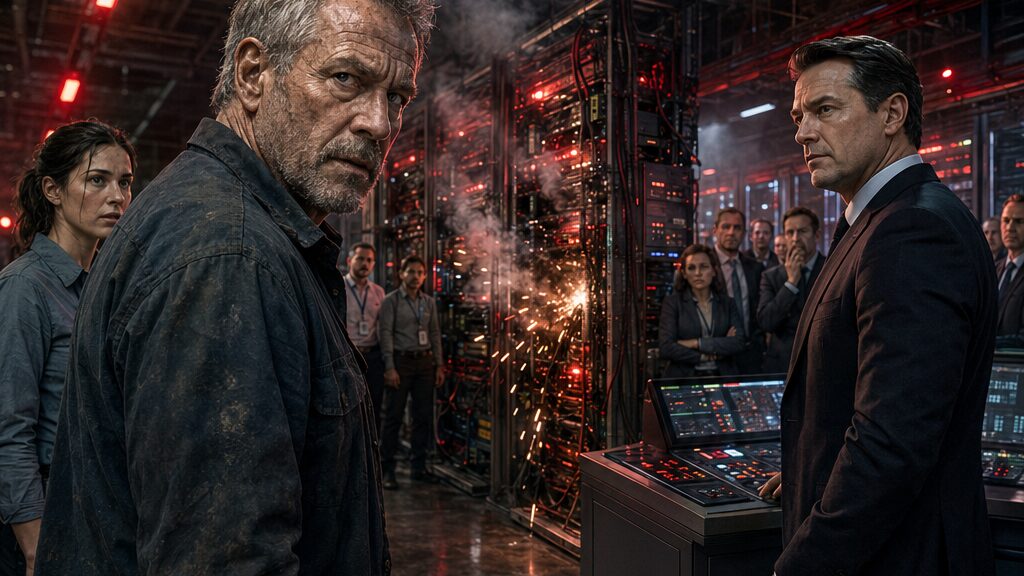
The countdown reached eighteen seconds as Robert burst through the doors of the core server room.
The heat hit him immediately.
Not fire.
Not yet.
But something close.
Rows of server racks stretched beneath flashing red emergency lights.
Electrical arcs snapped across overloaded transfer conduits.
Smoke drifted near the ceiling.
Engineers scrambled between consoles.
Alarm tones overlapped into a single continuous scream.
18
17
16
Kevin stood at the central control station.
His hand hovered over the activation interface.
Janet was arguing with him.
Heather was shouting something Robert couldn’t hear.
Nobody noticed Robert enter.
At first.
Then Heather saw him.
“Robert!”
Heads turned.
Kevin looked over his shoulder.
The irritation on his face became disbelief.
“You shouldn’t be here.”
Robert didn’t slow down.
“Get away from that console.”
Kevin straightened.
The room was watching now.
Engineers.
Technicians.
Security.
Everyone.
And Kevin couldn’t retreat.
Not in front of witnesses.
Not after building his authority around certainty.
“If we don’t activate this sequence,” Kevin said, “we lose the facility.”
Robert pointed toward the transfer assembly beyond the server rows.
“You activate it, and you lose everything.”
12
11
10
The numbers flashed overhead.
Kevin stepped toward the controls.
Robert moved closer.
Scott appeared between them.
“Robert.”
The warning in his voice sounded almost apologetic.
Robert looked at him.
Then looked at the countdown.
Nine seconds.
No more meetings.
No more arguments.
No more chances.
The old instinct tried to return.
The familiar surrender.
Let authority decide.
Walk away.
You’ve already warned them.
You’ve done your part.
But that instinct had nearly gotten everyone here burned alive.
Not today.
Kevin reached for the control panel.
Robert saw it happen.
The movement.
The decision.
The point of no return.
“Don’t touch it!”
Kevin ignored him.
Eight seconds.
Robert moved.
Scott reacted instantly.
So did another security officer.
Hands grabbed Robert’s arm.
His shoulder.
Trying to stop him.
Trying to stop the one person who actually understood what was happening.
Robert tore free.
Not gracefully.
Not heroically.
Like an exhausted man refusing to watch a preventable disaster.
Seven seconds.
Kevin’s hand descended toward the activation control.
Robert reached him first.
The collision happened so fast that nobody processed it immediately.
Kevin stumbled backward.
Then completely off balance.
Then airborne.
He crashed into a side console.
The impact echoed through the room.
Shock froze everyone.
Even Robert.
For half a second.
Then he ran.
Six seconds.
Five.
Toward the transfer assembly.
Toward the machinery hidden behind layers of assumptions and documentation failures.
The emergency mechanical lock sat exactly where he remembered.
Buried beside the assembly housing.
Ignored for years.
Never shown on modern diagrams.
Because it wasn’t supposed to matter anymore.
Robert grabbed the chain wrench hanging beside the maintenance station.
Heavy.
Familiar.
Real.
Not a model.
Not a presentation.
Not a theory.
A tool.
The assembly screamed.
Metal groaned.
Heat rolled outward.
Four seconds.
Robert slammed the wrench into the lock mechanism.
Nothing.
The assembly resisted.
Three seconds.
He hit it again.
Harder.
The impact sent pain through his arms.
Still nothing.
The room seemed to narrow around him.
All he could hear was machinery.
And memory.
Years of repairs.
Years of maintenance.
Years spent learning things nobody thought mattered.
Two seconds.
Robert adjusted the angle.
One final strike.
The wrench crashed into the locking collar.
Metal shifted.
Then snapped into place.
The emergency lock engaged.
Instantly.
Violently.
The assembly shuddered.
Power flow changed direction.
A deafening surge raced through the infrastructure.
Then—
Silence.
Not complete silence.
But the absence of catastrophe.
The electrical arcs vanished.
Temperature warnings stopped climbing.
Several red displays shifted to amber.
Then green.
One by one.
Smoke continued drifting through the room.
But the escalation had stopped.
The facility was alive.
Nobody moved.
Nobody spoke.
Everyone stared at the displays.
Then at the assembly.
Then at Robert.
The old maintenance specialist stood gripping the chain wrench.
His hands black with grease.
His shirt soaked with sweat.
His chest rising and falling.
Heather slowly looked toward the diagnostics.
Her eyes widened.
“The overload stopped.”
No one answered.
An engineer rushed to another station.
Then another.
More numbers appeared.
More confirmations.
A technician shook his head.
“I don’t understand.”
Robert did.
The lock had forced thermal isolation.
Crude.
Old-fashioned.
Physical.
But effective.
The room filled with quiet voices.
Confused voices.
Relieved voices.
Then Heather spoke again.
This time louder.
“He just saved the facility.”
The words spread through the room.
Kevin pushed himself off the floor.
His face was pale.
Humiliation and anger fought for control.
Finally anger won.
“He broke protocol!”
The room looked at him.
Then looked back at the displays.
Green indicators continued appearing.
Kevin pointed at Robert.
“He assaulted an advisor. He interfered with an authorized response.”
Nobody moved.
Nobody rushed to arrest Robert.
Not because they were choosing sides.
Because reality was choosing for them.
A senior engineer stepped toward the system diagrams.
Another joined him.
Heather pulled archived infrastructure files onto a display.
More people gathered.
Questions began forming.
The dangerous kind.
The kind that didn’t disappear.
Kevin saw it happening.
His confidence wavered.
Only slightly.
But enough.
Heather zoomed into one section of the architecture.
Then another.
Her face changed.
The engineer beside her suddenly stopped speaking.
Robert recognized the expression.
Recognition.
The uncomfortable kind.
The kind that arrived when a belief started collapsing.
Heather looked toward Kevin.
Then back at the diagrams.
Then at the actual infrastructure feeds.
“They don’t match.”
The room grew quiet again.
This silence felt different.
Much colder.
Several security personnel entered the server room.
Behind them came government investigators and emergency oversight staff.
Someone had already triggered a formal review.
The facility was safe.
The crisis was over.
The consequences were just beginning.
Chapter 6: What the Blueprints Could Not Show
“Robert Miller ignored direct orders and compromised emergency response operations.”
Kevin’s voice carried across the investigation room less than an hour later.
The accusation sounded strong.
Professional.
Reasonable.
That was the problem.
The room contained investigators, government oversight personnel, operations management, engineers, and security staff.
Nobody looked comfortable.
Blueprints covered one side of the conference table.
Maintenance records covered the other.
The contrast was impossible to miss.
Polished documents versus stained working notes.
Theory versus reality.
Kevin stood beside the official diagrams.
Robert sat across from him.
Exhaustion settled into his bones.
The adrenaline was gone.
Only consequences remained.
Kevin pointed toward a report.
“The fact that the facility stabilized afterward does not justify unauthorized intervention.”
Several investigators took notes.
Robert remained silent.
Not because he lacked answers.
Because he knew how these meetings worked.
Evidence mattered.
Timing mattered.
Emotion never helped.
Janet sat near the end of the table.
Her expression was tense.
Heather sat beside a stack of archived files.
She looked nothing like the uncertain engineer from earlier.
She looked determined.
One investigator turned toward Robert.
“Did you physically prevent protocol activation?”
“Yes.”
“Did you remove Mr. Thompson from the control station?”
Robert nodded.
“Yes.”
The investigator wrote something down.
Kevin looked satisfied.
For a moment.
Then Heather stood.
“I need to show something.”
The room turned toward her.
She connected her tablet to the display system.
Multiple infrastructure diagrams appeared.
Official versions.
Archived versions.
Maintenance revisions.
Modification records.
Layer after layer.
The investigator frowned.
“What are we looking at?”
Heather enlarged one section.
“The problem.”
She highlighted a routing path.
“This is the certified architecture.”
Then she highlighted another.
“This is the physical architecture.”
The difference was obvious.
Even to non-engineers.
The systems diverged years earlier.
Entire pathways existed outside official documentation.
Janet slowly leaned forward.
The investigators exchanged glances.
Kevin’s expression tightened.
Heather continued.
“The emergency activation sequence assumes these modifications don’t exist.”
Silence.
She opened another file.
Then another.
Maintenance requests.
Inspection notes.
Infrastructure warnings.
Years of them.
Many carried the same name.
Robert Miller.
The room became very still.
An investigator picked up one document.
“This warning is fifteen years old.”
“Yes,” Heather said.
Another.
“Twelve years.”
“Yes.”
Another.
“Nine years.”
Heather nodded.
Every one of them described the same problem.
Documentation drift.
Reality moving faster than paperwork.
Kevin immediately stepped forward.
“Maintenance observations do not constitute engineering validation.”
Heather looked at him.
For the first time there was no hesitation.
“They did when they were right.”
The sentence landed harder than she intended.
Kevin visibly stiffened.
The investigator turned toward him.
“When were these discrepancies reviewed?”
Kevin opened his mouth.
Closed it.
Then answered carefully.
“They fell outside the scope of my office.”
A technically safe answer.
But not a satisfying one.
The room felt it.
Janet felt it too.
She reached for another file.
Her face slowly changed.
Confusion.
Recognition.
Then embarrassment.
“I approved some of these revision requests.”
Nobody spoke.
Janet turned pages.
More requests.
More delays.
More administrative deferrals.
Her shoulders lowered.
The truth wasn’t pointing at one person anymore.
It was pointing at a system.
That somehow felt worse.
A senior investigator stood.
“I want physical verification.”
The room shifted immediately.
That request changed everything.
No more presentations.
No more interpretations.
Reality would decide.
Within the hour, teams entered the infrastructure levels.
Robert walked beside them.
Nobody ordered him away this time.
Nobody questioned whether he belonged there.
Engineers compared diagrams against actual equipment.
Again.
And again.
And again.
Every discovery pushed the same conclusion forward.
The facility was not what the official maps claimed.
It hadn’t been for years.
By evening, the investigators returned to the conference room.
The atmosphere had transformed.
One investigator placed a report on the table.
“The emergency activation sequence would likely have intensified the overload event.”
No one spoke.
The sentence spoke for itself.
Kevin looked down.
Just briefly.
But Robert noticed.
The certainty was gone now.
Not because someone embarrassed him.
Because reality had finally reached him.
The investigator continued.
“Mr. Miller’s intervention appears to have prevented escalation.”
Heather exhaled slowly.
Janet closed her eyes.
Across the room Kevin sat in silence.
The room wasn’t celebrating.
Nobody applauded.
Too much had nearly gone wrong for that.
Instead people looked tired.
Thoughtful.
Uneasy.
As if they had discovered something larger than a technical failure.
The meeting began to break apart.
Investigators gathered files.
Engineers collected reports.
Janet remained seated.
She looked toward Robert.
For several seconds neither spoke.
Then she asked quietly,
“Why didn’t you fight harder before today?”
The room seemed to pause.
Robert looked at the documents spread across the table.
Years of warnings.
Years of silence afterward.
Years of watching.
Years of giving up.
And for the first time all day, he didn’t have an immediate answer.
Chapter 7: The Weight of Staying Silent
The question lingered in the room long after Janet asked it.
Why didn’t you fight harder before today?
People continued gathering reports.
Investigators continued sorting documents.
But several of them slowed down.
Listening.
Waiting.
Robert looked at the papers spread across the conference table.
Maintenance requests.
Inspection notes.
Warnings.
Recommendations.
Years of them.
His name appeared over and over.
Not because he wanted recognition.
Because he had tried.
More times than anyone realized.
For a while he said nothing.
Then he reached for one of the oldest reports.
The paper was worn from age.
A crease ran through the center.
“I did fight.”
The room grew quiet.
Robert turned the report around.
A maintenance warning from fifteen years earlier.
A recommendation for documentation updates.
A request for infrastructure review.
The investigator scanned it.
“It was closed.”
Robert nodded.
“Without action.”
He picked up another.
“Then I submitted another.”
And another.
And another.
The stack slowly grew.
Janet stared at it.
Her expression changed with every page.
Not shock.
Recognition.
The painful kind.
The kind that arrived when a person discovered they had been part of a problem they never intended to create.
Robert leaned back in his chair.
“I used to think if I explained things well enough, somebody would listen.”
No one interrupted.
“Then departments changed.”
He tapped one report.
“Management changed.”
Another.
“Review committees changed.”
Another.
“Priorities changed.”
The room remained silent.
Robert wasn’t angry anymore.
That surprised him.
For years he had imagined this conversation differently.
More dramatic.
More satisfying.
Instead it felt tired.
Like lifting a weight he should have put down long ago.
“I’d submit something.”
He shrugged.
“It disappeared.”
Heather looked at the reports.
Every one carried dates stretching across years.
Evidence of persistence.
Evidence of neglect.
Evidence that silence had not been the beginning of the problem.
It had been the result.
Robert glanced toward the conference room windows overlooking the facility floor.
The data center beyond them glowed green again.
Stable.
Alive.
“I stopped believing it mattered.”
The words settled heavily.
Not because they were dramatic.
Because they were honest.
Janet lowered her eyes.
The investigator quietly closed one of the files.
Across the table Kevin remained seated.
For the first time since the crisis began, he looked smaller.
Not defeated.
Not broken.
Just stripped of certainty.
He finally spoke.
“I never saw those reports.”
Nobody reacted.
The statement might have been true.
It probably was.
Kevin looked at the documents.
Then at Robert.
“You should have escalated.”
Robert almost laughed.
Not mockingly.
Just tiredly.
“I thought the experts were handling it.”
The words landed harder than any accusation.
Kevin looked away.
For several seconds nobody spoke.
Then Janet reached for one of the maintenance requests.
Her signature sat at the bottom.
Approval deferred.
Administrative review required.
She stared at it.
“I remember this.”
Robert said nothing.
Janet looked up.
“There were budget concerns.”
She shook her head.
“It always felt reasonable at the time.”
No one argued.
Because everyone in the room understood how organizations worked.
Nobody woke up intending to create disaster.
People postponed.
Prioritized.
Delegated.
Assumed.
And eventually those small decisions accumulated into something dangerous.
Heather leaned forward.
“The facility didn’t fail because one person made a mistake.”
The investigator nodded slowly.
“It failed because reality and documentation separated.”
The sentence hung in the air.
Simple.
Accurate.
Uncomfortable.
Robert looked at the stack of reports.
For years he had viewed them as proof that speaking up was useless.
Now they looked different.
They were proof that he had been right to keep trying.
His mistake wasn’t submitting them.
His mistake was eventually deciding they no longer mattered.
The meeting continued for another hour.
Recommendations were discussed.
Review procedures.
Infrastructure audits.
Documentation reforms.
Most of it blurred together.
Robert listened without speaking much.
For once he wasn’t interested in winning an argument.
The important part had already happened.
People finally understood the building they were responsible for.
Eventually the room emptied.
Investigators left.
Engineers returned to work.
Even Kevin departed quietly with oversight officials.
No dramatic confrontation.
No final outburst.
Just consequences moving forward.
Only a handful of people remained.
Janet stood near the door.
She looked toward Robert.
“I owe you an apology.”
Robert considered that.
Then shook his head.
“No.”
Janet frowned.
“No?”
“You owe the facility better decisions.”
The answer surprised both of them.
After a moment Janet nodded.
“Fair enough.”
Heather smiled faintly.
The first genuine smile Robert had seen all day.
Later that evening, Robert returned to the core server room.
Most of the emergency equipment had been cleared away.
The flashing alarms were gone.
The smoke smell had mostly faded.
Rows of servers hummed steadily.
Green status indicators stretched into the distance.
He walked toward the transfer assembly.
The chain wrench still rested beside the emergency lock.
Waiting exactly where he had left it.
Robert picked it up.
The metal felt cool now.
Ordinary.
A maintenance tool.
Nothing special.
Yet somehow it had become the most honest thing in the entire building.
A quiet sound made him turn.
Heather stood near the entrance.
“You thinking about retiring?”
Robert snorted.
“Everybody keeps asking that.”
“Well?”
He looked at the wrench.
Then at the stable system displays.
For years he had imagined walking away.
Leaving the frustrations behind.
Leaving the bureaucracy behind.
Leaving the endless cycle of warnings behind.
But the crisis had changed something.
Not in the institution.
In him.
He finally understood that staying silent hadn’t protected him from disappointment.
It had only guaranteed that disappointment continued.
“I don’t know,” he said.
Heather smiled.
“That’s not a no.”
“No.”
“It isn’t.”
She looked around the room.
“People are already talking about rebuilding the infrastructure review process.”
Robert raised an eyebrow.
“That sounds dangerous.”
Heather laughed softly.
The sound echoed through the quiet facility.
Then she glanced at the wrench.
“You keeping that?”
Robert looked down at his grease-stained hands wrapped around the handle.
The same hands that executives ignored.
The same hands that understood the system better than any presentation ever could.
The same hands that had stopped eighteen seconds from becoming a national disaster.
“Probably.”
Heather nodded.
“Good.”
She left him there.
Alone with the machinery.
Alone with the quiet.
For a long time Robert stood beside the transfer assembly.
Green status lights reflected across the polished floor.
The system continued humming steadily.
No alarms.
No countdowns.
No presentations.
Just reality.
At last he set the chain wrench beside the locked assembly.
His hands remained resting on it for a moment.
Grease-stained.
Scarred.
Unimpressive.
Indispensable.
Then he looked across the room toward the future work waiting to be done.
And for the first time in many years, he did not look away.
The story has ended.