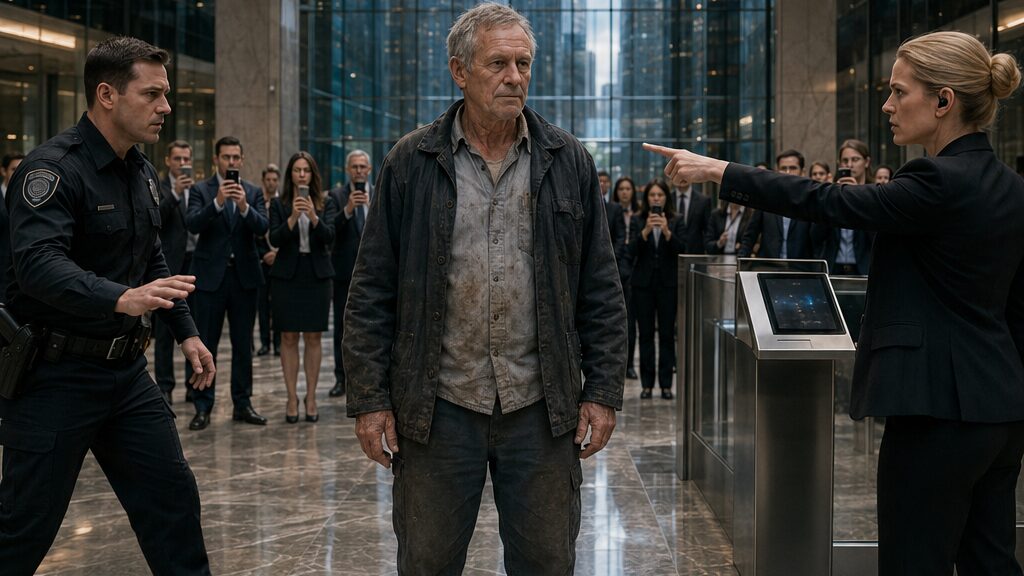
The Man They Slammed Against the Glass Owned Everything Beneath Their Feet
Chapter 1: The Man Outside the Glass
The first thing Joseph Harris noticed was not the glass.
It was the way people looked through him.
The headquarters tower rose above the city like a monument to certainty. Sunlight bounced off the enormous glass walls surrounding the ground-floor lobby, turning the entrance into a shining mirror.
Executives in tailored suits moved through revolving doors without slowing down.
Delivery workers used a side entrance.
Maintenance staff disappeared into service corridors.
Everyone had a place.
Everyone knew the rules.
Joseph walked toward the main entrance carrying an old canvas tool bag with frayed handles.
The guard beside the doors glanced at him once and immediately looked away.
Not because Joseph belonged.
Because he didn’t.
That distinction mattered.
Joseph had spent years studying people. Long before he had become one of the largest property owners in the country, he had learned that respect often vanished when status disappeared.
That lesson had built his career.
Now it haunted it.
A banner hung above the lobby.
WELCOME GLOBAL LEADERSHIP SUMMIT
Employees rushed in and out carrying folders, floral arrangements, and electronic equipment.
Everything looked polished.
Everything looked successful.
Joseph had learned not to trust appearances.
He entered the building.
Cold air met him immediately.
The lobby stretched upward through three stories of glass and steel.
At its center stood a decorative fountain surrounded by expensive stone flooring.
Touchscreen kiosks lined one wall.
Security checkpoints stood between visitors and the elevator banks.
The entire space felt designed to remind people where they stood.
Joseph watched.
A young woman carrying cleaning supplies approached the checkpoint.
She wore a faded uniform.
The guard barely looked at her badge before waving her through.
Not kindness.
Routine.
A wealthy investor arrived moments later.
Three employees rushed forward to greet him.
Smiles appeared instantly.
Doors opened.
Hands were shaken.
The difference took less than five seconds.
Joseph continued deeper into the lobby.
His clothes were intentionally stained.
His boots looked worn.
The disguise was simple because it did not need to be complicated.
People saw what they expected to see.
Near the elevators, two employees stood whispering.
One glanced toward Joseph.
“He shouldn’t be in here.”
The other shrugged.
“Probably maintenance.”
“Maintenance doesn’t use the front entrance.”
Joseph kept walking.
The comments followed him.
Small.
Casual.
Invisible.
Exactly the kind that mattered.
A digital screen displayed highlights from the corporation’s achievements.
Growth.
Innovation.
Integrity.
Joseph studied the last word for a moment.
Then he smiled without humor.
Integrity was always easier to print than practice.
A young employee carrying a tablet nearly collided with him.
The man stopped.
“Sorry.”
For a brief second, he looked directly at Joseph instead of through him.
Then something flickered in his expression.
Recognition.
Not certainty.
Just recognition.
Joseph had seen it before.
Photographs from annual reports.
Corporate newsletters.
Old interviews.
The employee frowned.
Joseph adjusted his cap.
The moment passed.
The man continued walking.
Interesting.
Closer than usual.
Joseph moved toward one of the information displays.
He pretended to examine a maintenance schedule posted nearby.
In reality, he was listening.
A pair of supervisors discussed staffing problems.
One complained about appearance standards.
The other laughed.
“If they don’t look professional, clients think the whole company is cheap.”
“What about performance?”
“Performance doesn’t walk through the front door.”
The answer came too quickly.
Too naturally.
Joseph wrote the exchange into memory.
Another mark against the culture.
Another warning sign.
For nearly six months he had conducted visits to properties connected to the corporation.
Restaurants.
Office buildings.
Conference facilities.
Everywhere he found the same thing.
Status first.
Humanity second.
He had hoped this headquarters would be different.
It was not starting well.
Near the fountain, an older maintenance worker pushed a cart loaded with supplies.
The worker glanced at Joseph.
Then nodded.
Nothing dramatic.
Nothing meaningful.
Except it was.
One worker recognizing another.
No questions asked.
No judgment delivered.
Simple respect.
Joseph returned the nod.
The small gesture felt more genuine than anything he had seen inside the building all morning.
Then the atmosphere changed.
Conversation slowed.
Heads turned.
A woman emerged from a nearby security office.
Dark suit.
Perfect posture.
Sharp eyes.
Every movement suggested someone accustomed to giving orders.
Karen Walker.
Joseph recognized her immediately from internal reports.
Security coordinator.
Excellent performance metrics.
Aggressive enforcement history.
Multiple complaints.
No formal discipline.
She scanned the lobby once.
Then her gaze settled on him.
Joseph saw the calculation happen.
The clothes.
The boots.
The bag.
The lack of a visible badge.
Her expression hardened.
She walked directly toward him.
Employees noticed.
Several stepped aside.
Karen stopped three feet away.
“Can I help you?”
The question sounded polite.
The tone wasn’t.
Joseph looked at her calmly.
“I’m looking around.”
“This area isn’t open to the public.”
“Is that so?”
“It is.”
Joseph nodded slightly.
Karen’s eyes moved to the canvas bag.
“What department are you with?”
“I don’t believe we’ve met.”
“That’s not what I asked.”
The edge in her voice sharpened.
Nearby employees pretended not to watch.
Every one of them watched.
Joseph remained silent for a moment.
A test.
One more opportunity.
Karen crossed her arms.
“Do you have identification?”
“No.”
“Access badge?”
“No.”
The answer landed exactly as expected.
Karen’s jaw tightened.
A security guard looked over from the checkpoint.
Then another.
Joseph noticed both responding before she even signaled.
Well-trained.
Perhaps too well-trained.
Karen looked him up and down.
Every second increased her certainty.
Not because she knew who he was.
Because she believed she already did.
Joseph recognized that confidence.
It had infected organizations before they collapsed.
People stopped observing.
Started assuming.
And eventually stopped seeing others entirely.
Karen pointed toward the entrance.
“I need you to leave.”
Joseph looked past her.
At the towering glass wall.
At the employees.
At the checkpoint.
At the institution operating inside a building resting on land he owned.
Then he looked back at her.
“What if I don’t?”
The question was calm.
Karen did not hear curiosity.
She heard defiance.
Her expression changed instantly.
She turned toward the security station.
“Stop him.”
The guards began moving.
Chapter 2: People Like You
Security reached Joseph before anyone else could speak.
One guard approached from the left.
Another from the right.
The movement happened quickly enough to draw attention across the lobby.
Conversations stopped.
People watched.
Some openly.
Others through reflections in the towering glass walls.
Karen remained exactly where she stood.
Confident.
Certain.
In control.
“Sir,” one guard said. “We’re going to need you to leave the premises.”
Joseph shifted his gaze toward him.
The guard looked young.
Younger than Karen.
Nervous beneath the professionalism.
This was Nicholas Hall.
Joseph had reviewed his employment file months earlier.
Strong evaluations.
No complaints.
New enough to still believe rules were the same thing as justice.
Joseph answered quietly.
“I’m not causing trouble.”
“You’re refusing instructions.”
“That’s not the same thing.”
Nicholas hesitated.
Karen stepped forward.
“It is when you’re trespassing.”
Several people lifted phones.
Not because anything extraordinary had happened.
Because everyone sensed something approaching.
Joseph noticed the cameras immediately.
Interesting.
Modern crowds rarely intervened.
They documented.
A receptionist whispered something to a colleague.
The colleague glanced toward Joseph.
Then looked away.
Nobody wanted involvement.
Joseph understood.
Institutions taught caution.
Karen folded her arms.
“What exactly are you doing here?”
“Observing.”
The answer irritated her.
“Observing what?”
“People.”
A few nearby employees exchanged confused looks.
Karen’s patience vanished another degree.
“You don’t belong in this building.”
Joseph looked around the lobby.
The fountain.
The glass walls.
The polished floors.
The checkpoints.
“I see.”
Karen mistook his calmness for stubbornness.
In reality, Joseph was taking inventory.
Not of the building.
Of the culture.
Each reaction revealed something.
Each silence revealed more.
A voice suddenly spoke from behind the crowd.
“Wait.”
Everyone turned.
The young employee carrying the tablet stepped forward.
The same one who had nearly recognized Joseph earlier.
His expression was uncertain.
“I think I’ve seen him before.”
Karen frowned.
“Where?”
“I don’t know.”
The employee stared at Joseph.
Something about the eyes.
The posture.
The confidence.
Recognition hovered just out of reach.
Joseph met his gaze without helping.
The employee shook his head.
“Maybe not.”
Karen immediately dismissed the concern.
“You’ve mistaken him for someone else.”
The employee stepped back.
Embarrassed.
The opportunity disappeared.
But Joseph filed the moment away.
One person had looked beyond the clothes.
One.
Not many.
But one.
Karen resumed control.
“Search the bag.”
Nicholas hesitated.
“Ma’am, we don’t actually have—”
“Search it.”
The order came sharp enough to silence him.
Joseph slowly set the canvas bag on the floor.
Nicholas opened it.
Inside were basic maintenance tools.
Nothing valuable.
Nothing suspicious.
A wrench.
A flashlight.
Work gloves.
A notebook.
The notebook caught Nicholas’s attention.
He opened it.
Pages filled with observations.
Dates.
Locations.
Employee interactions.
Notes about treatment of visitors.
Comments about workplace behavior.
Nicholas frowned.
“What is this?”
Joseph answered honestly.
“Records.”
Karen took the notebook.
Her eyes moved across several pages.
Her expression hardened further.
“So you’ve been spying.”
Joseph almost laughed.
The conclusion revealed more about her than the notebook.
“No.”
“Then explain it.”
“I prefer observation to assumptions.”
That answer only angered her.
Karen snapped the notebook shut.
Around them, more employees gathered.
The crowd had doubled.
Phones remained raised.
The event was becoming entertainment.
Joseph looked around the lobby.
The reflections in the glass walls showed dozens of faces.
Most seemed uncomfortable.
A few looked amused.
Some appeared eager for confrontation.
The building itself seemed to watch.
A monument to status reflecting status back at itself.
A maintenance worker passed nearby.
The older man from earlier.
Their eyes met briefly.
The worker recognized trouble immediately.
Then something unexpected happened.
He stopped.
Just for a second.
“He’s never bothered anybody.”
The statement hung in the air.
Karen turned sharply.
“Keep moving.”
The worker hesitated.
Then obeyed.
Fear won.
Joseph felt disappointment settle deeper inside him.
Not because of Karen.
Because nobody seemed surprised.
That mattered.
A toxic culture survived only when people accepted it as normal.
Karen stepped closer.
“You’ve been wandering a secured building taking notes.”
“I’ve been walking through a lobby.”
“Without authorization.”
“Without respect,” Joseph corrected.
The words landed harder than he intended.
Karen’s face tightened.
For the first time, emotion slipped through her professional mask.
Not anger.
Insecurity.
Brief.
Almost invisible.
But Joseph saw it.
She wasn’t protecting the building.
She was protecting her position inside it.
The realization answered an important question.
Then another phone appeared.
And another.
The crowd sensed escalation.
Karen sensed it too.
Which meant backing down now felt impossible.
Her authority depended on certainty.
The moment she doubted herself publicly, she lost ground.
Joseph understood the trap.
He had seen leaders create it for themselves countless times.
Karen pointed toward him.
“People like you always think rules don’t apply.”
The words echoed louder than she intended.
Several employees exchanged looks.
People like you.
The phrase changed everything.
No longer about security.
No longer about procedure.
About class.
Appearance.
Belonging.
Joseph felt something inside him grow cold.
Not anger.
Recognition.
He had heard the phrase before.
In different forms.
Different industries.
Different decades.
Always the same meaning.
Karen took a step forward.
“Frisk him.”
Nicholas froze.
The entire lobby seemed to hold its breath.
And Joseph finally understood exactly how far she was willing to go.
Chapter 3: The Cost of Looking Poor
Nicholas did not move.
For one strained second, the entire lobby balanced on hesitation.
Karen noticed it immediately.
“Did you hear me?” she asked.
Nicholas swallowed.
“Ma’am, I don’t think—”
“Frisk him.”
Her voice cracked like a whip.
The guard looked at Joseph.
Joseph looked back calmly.
No challenge.
No fear.
Just a quiet steadiness that somehow made the situation feel worse.
Nicholas made the mistake of glancing toward the crowd.
Dozens of phones were pointed at them now.
If he refused, everyone would see.
If he obeyed, everyone would see that too.
Karen understood exactly what he was thinking.
“Either do your job,” she said quietly, “or I’ll find someone who will.”
The threat landed.
Nicholas stepped forward.
Joseph could have stopped it.
He could have revealed himself.
He could have ended everything with a single phone call.
Instead he remained silent.
That silence had become a habit.
Observe.
Collect evidence.
Judge later.
The method had worked for years.
But standing inside that lobby, Joseph felt the weight of every time he had chosen observation over intervention.
Nicholas reached for him.
“Sir, please cooperate.”
Joseph lifted his hands slightly.
“Go ahead.”
Karen smiled faintly.
The search began.
The guard checked pockets.
Looked inside the worn jacket.
Examined the canvas bag again.
Found nothing.
Not a weapon.
Not stolen property.
Not anything that justified Karen’s certainty.
Yet she did not retreat.
Because retreat required admitting error.
And error was dangerous when authority depended on appearing right.
Karen pointed toward Joseph’s chest.
“Search again.”
Nicholas frowned.
“We already checked.”
“Then check better.”
Several employees exchanged uncomfortable looks.
The young employee with the tablet lowered his phone.
For the first time, uncertainty spread through the crowd.
Not because Joseph looked guilty.
Because he didn’t.
Karen was pushing beyond what the situation required.
A woman near the reception desk whispered to another employee.
“I’ve seen her do this before.”
Joseph heard it.
So did Nicholas.
Karen did not.
Or pretended not to.
The whisper lingered.
I’ve seen her do this before.
Joseph filed the words away.
Not the first complaint.
Not the first humiliation.
Not the first person judged by appearance.
His disappointment deepened.
The problem was larger than one bad morning.
A buzzing sound interrupted the tension.
Someone’s phone.
Then another.
Messages spreading.
Videos uploading.
The incident was escaping the lobby.
Karen seemed unaware.
Her focus remained locked on Joseph.
“Who sent you?” she demanded.
“No one.”
“You’re lying.”
Joseph shook his head.
“No.”
“You’ve been taking notes in multiple facilities.”
“You read the notebook.”
“I read enough.”
“You read what you wanted to read.”
Karen stepped closer.
For a moment Joseph saw genuine fear beneath her anger.
Not fear of him.
Fear of failure.
Fear of looking weak.
Fear of losing the position she had fought to reach.
The realization complicated things.
Karen was not acting from confidence.
She was acting from insecurity.
That made her more dangerous.
Because insecure people rarely stopped once they started digging.
They needed proof that justified the damage.
A voice rose from the back of the crowd.
“My brother worked here.”
Everyone turned.
An older employee stood near the fountain.
He looked immediately uncomfortable after speaking.
Karen’s eyes narrowed.
“What does that have to do with this?”
The employee hesitated.
Then looked away.
“Nothing.”
But the damage was done.
Questions had entered the room.
Joseph noticed several people exchanging glances.
Not surprise.
Recognition.
The kind that came from shared experiences.
A pattern.
Not an incident.
A pattern.
Karen sensed control slipping.
So she tightened her grip.
“Escort him out.”
Nicholas reached for Joseph’s arm.
Joseph allowed it.
The young guard’s hand trembled slightly.
“I’m sorry,” Nicholas muttered.
The words were so quiet that only Joseph heard them.
Interesting.
Not cruelty.
Compliance.
A different kind of problem.
Joseph nodded once.
Then Karen made a mistake.
A fatal one.
She pointed toward the enormous glass wall separating the lobby from the fountain area.
“Move him now.”
Nicholas guided Joseph forward.
Another guard moved behind them.
The crowd parted.
Phones followed.
The glass reflected everything.
The guards.
Karen.
The gathering audience.
Joseph’s worn clothes.
For a brief moment, he saw the entire culture reflected in a single surface.
Status above dignity.
Appearance above character.
Image above truth.
Then Karen raised her voice.
“Louder.”
Nicholas looked confused.
“What?”
“Tell him he doesn’t belong here.”
Several employees stared at her.
Karen wasn’t trying to remove Joseph anymore.
She was performing.
Trying to reclaim authority through public humiliation.
The realization spread through the room.
People began recording more aggressively.
Nicholas hesitated.
Karen stepped forward herself.
“People like you don’t belong here.”
The words echoed across the lobby.
Silence followed.
Then she shoved Joseph’s shoulder.
Not hard.
Not enough to hurt.
Enough to degrade.
Enough to establish dominance.
The crowd reacted.
A few gasps.
Several shocked expressions.
Someone cursed under their breath.
Karen had crossed a line.
And she still didn’t realize it.
Joseph slowly turned his head toward her.
For the first time all morning, disappointment outweighed patience.
He looked tired.
Not physically.
Spiritually.
As if something he hoped to find had finally disappeared.
Karen misread the expression completely.
She saw weakness.
She nodded toward Nicholas.
“Finish it.”
The young guard obeyed.
He grabbed Joseph’s arm.
Twisted.
Too hard.
A sharp burst of pain shot through Joseph’s shoulder.
Then momentum carried them toward the glass wall.
Nicholas lost control.
Or perhaps panic made him overreact.
Either way, Joseph’s face struck the glass.
A loud crack echoed through the lobby.
Not the glass.
The impact.
The entire room froze.
Joseph’s cheek pressed against the cold surface.
The glass reflected his face inches away.
A man who owned everything beneath the building.
Reduced to a suspect.
Reduced to a nuisance.
Reduced to an appearance.
For several seconds nobody moved.
Then a red line appeared near the corner of his mouth.
Blood.
Tiny.
But unmistakable.
The reflection stared back at him.
And in that reflection Joseph finally found certainty.
Not about Karen.
Not about Nicholas.
About the institution itself.
This was no longer an isolated failure.
The culture was rotten.
Around him, phones continued recording.
Somewhere in the crowd, someone quietly sent a message.
Not to security.
Not to management.
To a number that had been used only once before.
A private emergency contact connected directly to Alexander Garcia.
The message contained only seven words.
You need to come here immediately.
Joseph remained against the glass for one more moment.
Then slowly lifted his head.
Behind him, nobody spoke.
Ahead of him, his own reflection stared back.
And beside that reflection, a thin streak of blood remained on the glass.
Chapter 4: What the Building Revealed
“Call the police.”
Karen’s voice shattered the silence.
The order seemed absurd even before it finished leaving her mouth.
Blood remained on the glass.
Employees remained frozen.
Phones remained raised.
Yet Karen acted as if she had won.
As if doubling down could somehow reverse what everyone had just seen.
One guard exchanged a glance with another.
Neither moved.
Karen noticed.
“Now.”
The second command carried less confidence than the first.
Joseph slowly straightened.
Pain spread through his shoulder.
His cheek stung where it had struck the glass.
The lobby watched.
No one cared about appearances anymore.
The situation had become real.
Nicholas stepped backward.
His face had gone pale.
“I didn’t mean—”
Karen cut him off.
“You followed instructions.”
The statement was intended as reassurance.
Instead it sounded like self-protection.
Nicholas heard it too.
Joseph saw something shift inside the young man.
The first crack in loyalty.
Not rebellion.
Recognition.
Recognition that following orders did not erase responsibility.
Karen pointed toward Joseph.
“He’s trespassing. He’s disruptive. He’s damaging company operations.”
“Damaging?” someone whispered.
The crowd was no longer fully on her side.
That seemed to disturb her more than anything else.
Joseph removed a handkerchief from his pocket and touched the blood at the corner of his mouth.
No anger.
No threats.
No dramatic confrontation.
Just a quiet gesture.
The calmness unsettled Karen.
People who were afraid usually argued.
Joseph didn’t.
That silence had bothered her from the beginning.
It felt like judgment.
Near the reception area, the young employee with the tablet stared openly now.
Then his eyes widened.
Recognition flashed again.
Stronger this time.
Joseph noticed.
The employee noticed Joseph noticing.
And suddenly looked away.
Not because he wasn’t sure anymore.
Because he was becoming sure.
Interesting.
Karen continued speaking.
Trying to fill the room.
Trying to reclaim authority.
“He was taking notes. He admitted it.”
Joseph folded the handkerchief.
“Yes.”
“So you admit it.”
“I never denied it.”
“What kind of person walks through private facilities collecting information?”
Several employees looked toward Joseph.
The answer mattered now.
Joseph considered remaining silent.
That had always been his instinct.
Observe longer.
Reveal less.
Gather more.
The flaw had served him well in business.
It had served him poorly in leadership.
“You’d be surprised,” he said quietly, “how much people reveal when they think someone doesn’t matter.”
The lobby became silent again.
The statement landed differently than Karen expected.
Not defensive.
Observational.
Several employees lowered their eyes.
Because they knew it was true.
Karen’s expression tightened.
“Enough.”
She pulled out her phone.
“I’m calling law enforcement myself.”
Joseph nodded.
“If that’s what you think is best.”
Something about the answer sounded dangerous.
Not threatening.
Certain.
Karen felt it.
For the first time, doubt touched her.
Only briefly.
Then pride pushed it away.
She pressed the call button.
Across the city, another phone was already ringing.
Alexander Garcia answered on the second ring.
The message had reached him twelve minutes earlier.
He was already in a car.
Already moving.
Already trying to understand why the emergency contact attached to Joseph Harris had been activated.
Back in the lobby, Karen paced.
The situation no longer followed normal procedures.
The crowd refused to disperse.
Employees whispered.
Security guards looked uncertain.
Nicholas remained near the glass wall, staring at the small stain Joseph’s blood had left behind.
Joseph noticed.
“How long have you worked here?” he asked.
Nicholas looked surprised.
“A year.”
“Do you like it?”
Karen snapped around.
“Don’t answer that.”
The interruption answered the question better than words could.
Several employees laughed nervously.
The sound irritated Karen.
Control was slipping.
And everyone could feel it.
The young employee with the tablet suddenly stepped forward.
His voice shook.
“Ma’am…”
Karen turned.
“What?”
“I know who he is.”
The room froze.
Joseph closed his eyes briefly.
Too soon.
The employee swallowed.
“I think he’s—”
Joseph looked directly at him.
Not a warning.
A request.
The employee stopped.
Confusion crossed his face.
Why would someone hide something like that?
Karen saw hesitation and immediately attacked it.
“You think he’s what?”
The employee looked from Joseph to Karen.
Then back again.
Finally he shook his head.
“Nothing.”
The opportunity vanished.
But not completely.
Now others were wondering too.
Who was this man?
Why wasn’t he afraid?
Why had he asked questions instead of making excuses?
Why did he seem more disappointed than threatened?
Karen sensed the shift.
She hated it.
Questions created uncertainty.
Uncertainty weakened authority.
“Everyone back to work.”
Nobody moved.
That frightened her.
Not visibly.
Internally.
Joseph saw it.
For the first time, he understood something important.
Karen had built her identity around control.
Not power.
Control.
Control of appearances.
Control of access.
Control of who belonged.
Without it, she had nothing solid underneath.
A sharp buzzing sound interrupted the tension.
Several phones vibrated simultaneously.
People checked screens.
A clip from the lobby had already appeared online.
The first videos were spreading.
Joseph saw Karen notice.
Panic flashed across her face.
Only for a second.
But it was there.
The situation was no longer confined to the building.
The glass walls that once separated the lobby from the outside world had failed.
Everything was leaking through.
Every mistake.
Every assumption.
Every choice.
Karen pointed toward the entrance.
“Leave.”
Joseph remained where he was.
“No.”
The answer was calm.
Absolute.
Karen stared at him.
“You don’t have a choice.”
Joseph looked around the lobby.
At the guards.
The employees.
The glass.
The fountain.
The institution he had spent years trusting from a distance.
Then he looked back at her.
“I think I do.”
Karen stepped closer.
“What exactly are you waiting for?”
Joseph held her gaze.
For the first time all morning, there was no patience left in his expression.
Only certainty.
A certainty that made several people take involuntary steps backward.
Then he asked a simple question.
“Are you finished?”
Chapter 5: The Sound of Breaking Illusions
Karen opened her mouth to answer.
She never got the chance.
A notification tone sounded from somewhere in the crowd.
Then another.
And another.
Videos were spreading faster than anyone could control.
The lobby no longer belonged to security.
It belonged to witnesses.
Karen stared at Joseph.
“You’re finished when I say you’re finished.”
The words came out harsher than she intended.
Even she seemed to hear the desperation in them.
Joseph looked at the blood-stained handkerchief in his hand.
Then at the red mark still visible on the glass wall.
For months he had visited properties connected to the corporation.
He had taken notes.
Recorded observations.
Waited for evidence.
Each time he found problems, he told himself he needed more proof.
More context.
More certainty.
Now he stood inside the headquarters itself.
His own silence had allowed him to arrive here.
His own preference for observation had led to this moment.
Enough.
Karen pointed toward the entrance again.
“Get him out.”
No one moved.
Not Nicholas.
Not the other guards.
Not the employees.
The refusal was silent but unmistakable.
For the first time all morning, Karen stood alone.
The realization hit her visibly.
Her authority had never existed by itself.
It depended on other people agreeing to it.
Joseph saw fear enter her eyes.
Not fear of violence.
Fear of losing control.
Then one of the guards reached toward Joseph again.
Not aggressively.
Uncertainly.
Trying to finish what had already gone too far.
Joseph caught the guard’s wrist.
The movement was quick enough to shock the room.
The guard carried a security baton.
Joseph pulled it free.
Gasps erupted across the lobby.
Karen stepped backward.
The guard froze.
Joseph looked at the baton for a brief second.
An object that represented authority.
Not real authority.
Borrowed authority.
Authority granted by a uniform and a title.
Then he gripped it with both hands.
Crack.
The sound echoed across the marble floor.
The baton snapped cleanly in half.
Nobody moved.
Nobody breathed.
The broken pieces fell into Joseph’s hands.
The noise seemed impossible.
A symbol had just broken in front of everyone.
Karen stared at the shattered baton as if reality itself had malfunctioned.
“What are you doing?” she whispered.
Joseph turned.
The nearest touchscreen kiosk stood beside the security checkpoint.
Visitors used it to register.
Request access.
Ask permission.
The screen reflected the entire lobby.
Employees.
Guards.
Executives.
Witnesses.
Joseph walked toward it.
No one tried to stop him.
Not because they couldn’t.
Because they didn’t know how.
The room had shifted.
The old rules no longer applied.
With one motion, Joseph swung the broken baton handle.
The screen exploded into sparks and shattered glass.
A loud crack filled the lobby.
Fragments scattered across the polished floor.
A second strike destroyed the remaining display.
Silence followed.
The fountain continued running.
Water splashed softly.
Everything else stopped.
Karen looked horrified.
Not by the damage.
By what it represented.
She had spent the entire morning projecting certainty.
Now an elderly man in worn clothes had destroyed the illusion in seconds.
“Call the police!” she shouted.
Her voice broke.
No one moved.
Joseph dropped the broken handle.
It clattered across the floor.
The sound felt final.
Around the lobby, phones remained raised.
Yet something had changed.
People were no longer recording humiliation.
They were recording a reversal.
The young employee with the tablet stared openly now.
Recognition finally settled into certainty.
He knew exactly who Joseph was.
Others were beginning to realize it too.
Not because of documents.
Because of confidence.
No ordinary trespasser stood that way.
No frightened intruder acted that way.
No guilty man remained that calm.
Karen saw the realization spreading.
And panic followed.
“You think this changes anything?” she demanded.
Joseph said nothing.
Her voice rose.
“You’re still trespassing.”
Silence.
“You still damaged company property.”
Silence.
“You still—”
The lobby doors opened.
Every head turned.
A man in a dark suit entered at a pace just short of running.
Alexander Garcia.
Two assistants followed behind him carrying document cases.
The moment Alexander saw Joseph, he stopped.
Relief flashed across his face.
Then anger.
Not at Joseph.
At what he was seeing.
The blood.
The broken kiosk.
The crowd.
The shattered certainty hanging over the room.
Karen immediately moved toward him.
Finally.
Someone important.
Someone she could use.
“Thank goodness you’re here,” she said quickly.
“We have a security situation.”
Alexander did not look at her.
His eyes remained fixed on Joseph.
Karen continued talking.
“This man assaulted our staff and destroyed property.”
Still no response.
Only then did Alexander slowly turn toward her.
“What happened here?”
Karen straightened.
Confidence returned.
At least partially.
“He entered without authorization. Refused removal. Threatened security personnel.”
Alexander’s expression did not change.
Karen interpreted that as agreement.
A mistake.
“He has no identification,” she continued.
“He was taking notes.”
“He refused instructions.”
“He damaged company assets.”
Alexander listened.
Then looked at Nicholas.
The young guard lowered his eyes.
Then at the employees.
Then at the blood on the glass wall.
Finally, he looked back at Joseph.
For several seconds neither man spoke.
The silence carried years of professional history.
Karen noticed it.
Confusion appeared.
A terrible confusion.
Joseph nodded once.
Alexander’s jaw tightened.
He opened one of the document cases.
The crowd leaned forward.
Karen frowned.
“What is that?”
Alexander removed a thick folder.
Official seals marked the cover.
Legal certifications.
Ownership records.
Lease agreements.
The kind of documents that changed lives.
Karen suddenly felt cold.
She didn’t know why.
Not yet.
But something inside her had begun to understand.
Chapter 6: The Owner Beneath Their Feet
Alexander lifted the folder.
The lobby fell silent.
Even the employees who had spent the last hour whispering now stood motionless.
Karen looked from the documents to Joseph and back again.
“What is this?” she asked.
Alexander ignored the question.
Instead, he addressed the room.
His voice carried the calm precision of a man accustomed to courtrooms.
“Before another word is spoken, the facts need to be established.”
Karen laughed nervously.
“Facts?”
“Yes.”
She pointed toward Joseph.
“The facts are standing right there.”
Alexander finally looked directly at her.
“No.”
The single word hit harder than a shout.
“The facts have been standing here all morning.”
A ripple moved through the crowd.
Karen’s confidence weakened another step.
She folded her arms.
Trying to appear composed.
Trying to remain the authority figure she had been only minutes earlier.
Alexander opened the folder.
Several pages appeared.
Signed documents.
Property maps.
Legal records.
The crowd watched.
Joseph remained silent.
Not because he enjoyed the moment.
Because he hated that it had become necessary.
Alexander raised the first page.
“The man you physically removed, searched, restrained, and assaulted today is Joseph Harris.”
The name spread through the room like a shockwave.
The young employee with the tablet closed his eyes.
Confirmation.
Several executives near the elevators suddenly looked ill.
Karen stared blankly.
The name meant nothing at first.
Then recognition struck.
Corporate newsletters.
Industry articles.
Annual reports.
A face she had seen dozens of times.
A face she had never expected to encounter dressed in work clothes.
Her eyes widened.
“No.”
Alexander continued.
“Joseph Harris is the sole owner of the land beneath this building.”
Silence.
“The sole owner of the building itself.”
More silence.
“The individual whose signature authorized this corporation’s occupancy agreement.”
Karen looked at Joseph.
Then at the glass wall.
Then at the floor beneath her feet.
The certainty she’d built all morning collapsed piece by piece.
“No,” she repeated.
But now it sounded like pleading.
Alexander raised another document.
“The lease agreement is held through entities directly controlled by Mr. Harris.”
Someone in the crowd whispered a curse.
Others simply stared.
Everything suddenly looked different.
The checkpoints.
The security desk.
The expensive fountain.
The polished lobby.
All of it existed because Joseph had allowed it to.
Karen took a step backward.
“This is impossible.”
“It is documented.”
“You can’t just walk in dressed like that.”
Joseph finally spoke.
“Why not?”
The question hit harder than the ownership reveal.
Because nobody had a good answer.
Karen opened her mouth.
Nothing came out.
Around her, employees avoided eye contact.
The problem was no longer legal.
It was moral.
Everyone understood it.
Alexander turned another page.
His expression remained controlled.
But anger sat just beneath it.
“There is one additional matter.”
Karen’s head snapped up.
“What matter?”
Alexander looked directly at her.
“The corporation’s lease includes behavioral provisions.”
The room became still again.
Karen’s face drained of color.
Alexander continued.
“Those provisions include protections against discriminatory conduct, abuse of authority, and reputational damage resulting from employee actions.”
Every word landed like a hammer.
Karen shook her head.
“You can’t—”
“I can.”
Alexander held up the final document.
A signed authorization.
Fresh.
Current.
Valid.
“The man you just assaulted has instructed me to terminate the lease immediately.”
The crowd erupted.
Gasps.
Shouts.
Questions.
Phone screens rose higher.
Somebody dropped a coffee cup.
Karen looked as if she might collapse.
“No.”
Her voice barely existed.
“You can’t terminate an entire headquarters because of one incident.”
Joseph met her eyes.
“One incident?”
The question stopped her cold.
Because she remembered the whispers.
The complaints.
The moments she’d dismissed.
The people she’d judged.
The assumptions she’d made.
One incident had become impossible to argue.
Nicholas stared at the floor.
The older maintenance worker watched from near the fountain.
Employees exchanged glances.
Suddenly everyone was reviewing memories.
Reinterpreting them.
Joseph looked around the lobby.
The building had revealed itself.
Not through reports.
Not through audits.
Not through observation alone.
Through choices.
Human choices.
Alexander handed documents to corporate representatives who had rushed downstairs during the announcement.
Panic spread among them.
Lawyers were called.
Executives demanded explanations.
None of it changed the reality already standing in front of them.
Karen remained motionless.
The crowd no longer looked at her with respect.
Only disbelief.
One employee quietly said, “She really did it.”
Another replied, “And everyone saw.”
That was the worst part.
Everyone had seen.
Phones vibrated continuously.
Videos spread.
News accounts picked them up.
Commentators reposted them.
The footage escaped the building entirely.
The glass walls that once controlled what entered and exited the lobby had failed completely.
Truth had gone through.
Karen looked at Joseph.
For a brief second she seemed ready to apologize.
Then pride stopped her.
The same pride that had brought her here.
The same pride that had prevented retreat when retreat was still possible.
Joseph saw it.
And understood.
Some people lost because they made mistakes.
Others lost because they refused to admit them.
Karen belonged to the second group.
Alexander closed the folder.
The legal work had begun.
The consequences would follow.
But Joseph barely noticed.
His attention remained fixed on the building itself.
On what it had revealed.
And on what he would have to do next.
Across the lobby, another phone chimed.
Then another.
Then dozens more.
The video was spreading everywhere.
And there was no stopping it.
Chapter 7: What Cannot Be Hidden Again
By sunrise the next morning, the video had been viewed millions of times.
Joseph watched none of it.
Instead, he stood across the street from the headquarters and looked at the glass.
Workers were already replacing damaged panels near the entrance.
Yellow barriers surrounded the shattered kiosk area inside.
The building looked the same from a distance.
That bothered him.
Because it wasn’t the same.
Neither was he.
A black vehicle stopped beside the curb.
Alexander stepped out carrying a folder.
“You should be sleeping.”
Joseph smiled faintly.
“You should be too.”
Alexander joined him on the sidewalk.
For a moment neither man spoke.
Across the street, employees entered the building more quietly than usual.
Many glanced toward the damaged lobby.
Others looked away.
The video had ensured everyone knew what happened.
The building could not hide it.
The corporation could not bury it.
The glass had finally become transparent.
Alexander handed over the folder.
“You need to see these.”
Joseph opened it.
Inside were statements.
Emails.
Complaints.
Exit interviews.
Pages and pages of them.
His expression hardened.
“How many?”
“More than we thought.”
Joseph turned another page.
Then another.
Stories repeated themselves.
Applicants treated differently because of appearance.
Contract workers ignored.
Maintenance staff denied access to facilities used by executives.
Visitors judged before they spoke.
Not identical incidents.
A pattern.
A culture.
The same word appeared repeatedly.
Humiliation.
Joseph closed the folder.
The weight of it settled heavily in his chest.
Not because Karen existed.
Organizations always had difficult people.
Because the pattern had lasted long enough to become normal.
And he had missed it.
Alexander studied him.
“You couldn’t have known everything.”
Joseph looked toward the building.
“That’s exactly the problem.”
The answer came quietly.
For years he had relied on reports.
Numbers.
Performance reviews.
Quarterly summaries.
Distance.
He had convinced himself observation was leadership.
Now he saw the flaw.
Distance made it easier to miss people.
The same flaw that kept him silent in the lobby for too long.
The same flaw that had allowed the culture to drift.
Across the street, workers carried broken pieces of glass toward a disposal truck.
Sunlight struck the fragments.
Each piece reflected something different.
The image stayed with him.
A building could shatter long before anyone noticed.
Alexander opened the folder again.
“There are more statements coming in.”
“Because of the video.”
“Yes.”
Employees finally felt safe enough to speak.
Former employees too.
People who had remained silent for years.
People who assumed nobody cared.
Joseph looked at one letter in particular.
A former receptionist described being instructed to judge visitors before they reached security.
Another described contractors eating lunch in storage rooms because executive dining areas were considered inappropriate for them.
Small things.
None dramatic.
Together they revealed something ugly.
A culture built on separation.
On invisible walls.
The glass had been symbolic all along.
Not just architecture.
A way of seeing people.
Or refusing to see them.
Alexander watched Joseph reading.
“What are you going to do?”
The question had waited since yesterday.
Now it demanded an answer.
Joseph looked at the headquarters.
His first instinct was replacement.
Remove leadership.
Terminate agreements.
Start over.
Simple.
Clean.
Satisfying.
But not enough.
Because replacing people without changing culture merely moved the problem.
It did not solve it.
A maintenance worker emerged from the building carrying supplies.
Joseph recognized him immediately.
The older man who had defended him in the lobby.
The worker recognized Joseph too.
He hesitated.
Then crossed the street.
Alexander stepped aside.
The worker looked nervous.
“Mr. Harris.”
Joseph extended a hand.
The man’s surprise was immediate.
He shook it.
Awkwardly.
Carefully.
As if still uncertain this was real.
“Thank you,” Joseph said.
The worker blinked.
“For what?”
“For speaking.”
The man laughed once.
Not happily.
“Didn’t do much.”
“It mattered.”
Silence followed.
Then the worker glanced toward the headquarters.
“People knew.”
Joseph waited.
“Knew what?”
“How things worked.”
The answer arrived without hesitation.
“Most people just kept their heads down.”
Joseph nodded.
That sounded familiar.
The worker looked embarrassed.
“We all did.”
Not accusation.
Admission.
The honesty mattered.
The problem had never belonged entirely to Karen.
Fear protected it.
Silence protected it.
Convenience protected it.
The worker shifted uncomfortably.
“I should get back.”
Joseph shook his hand again.
Then watched him leave.
The conversation stayed with him long after it ended.
Not because it revealed something new.
Because it confirmed something he already feared.
Cultures survived through participation.
Even reluctant participation.
Alexander broke the silence.
“You’ve made your decision.”
It wasn’t a question.
Joseph nodded.
“Yes.”
Later that morning, executives gathered inside a temporary conference room.
The damaged lobby remained partially closed.
Pieces of broken glass still waited for removal.
No one ignored them.
That was the point.
Joseph stood at the front of the room.
No disguise.
No distance.
No observation from the shadows.
The room felt different already.
Executives who once spoke confidently now listened carefully.
Not because they feared losing their jobs.
Because reality had finally entered the conversation.
Joseph looked around the table.
“I spent months inspecting properties connected to this corporation.”
Nobody interrupted.
“I thought I was testing procedures.”
He paused.
“I wasn’t.”
The room remained silent.
“I was testing people.”
Several executives lowered their eyes.
Joseph continued.
“And I failed my own test.”
That surprised them.
A few looked up immediately.
He let the words settle.
“I found problems repeatedly. I documented them. I observed them.”
He placed a folder on the table.
“And then I waited.”
The admission felt important.
Because responsibility flowed upward as well as downward.
Leadership meant owning failures.
Not merely exposing them.
“We’re going to rebuild this culture.”
No speech followed.
No dramatic promises.
Only concrete decisions.
Independent reporting systems.
Policy reviews.
Direct employee access to leadership.
Mandatory restructuring of security procedures.
Real accountability.
Practical changes.
The work would be difficult.
Good.
Easy solutions had created this problem.
Hours later, Joseph returned to the lobby one final time.
Workers continued replacing damaged glass.
The fountain still flowed.
Employees still crossed the marble floor.
Life moved forward.
But something had changed.
Near the entrance, he stopped.
A section of damaged glass remained temporarily uncovered.
For the first time since the building opened, there was no barrier there.
People walked through freely while repairs continued.
Joseph watched them.
Executives.
Assistants.
Maintenance workers.
Security personnel.
All using the same opening.
No separation.
No invisible line.
Just people.
The image stayed with him.
Not because it solved everything.
Because it pointed toward something better.
The previous day had begun with a man standing outside a glass wall.
Now the wall was gone.
And what could no longer be hidden mattered more than anything built from glass.
The story has ended.