They Put Paul Wright’s Name on the Debtors List Until One Meeting Destroyed the HOA Forever
Chapter 1: The Name at the Top of the Screen
The first thing Paul Wright saw when he stepped into the neighborhood clubhouse was his own name.
It filled the projector screen at the front of the room.
PAUL WRIGHT
DELINQUENT ACCOUNT REVIEW
The red letters were larger than everyone else’s.
Conversations quieted as residents noticed him standing in the doorway.
Someone coughed.
Someone else looked away.
The projector hummed softly overhead.
Paul remained still for a moment.
Not because he was shocked.
Because he was counting.
The names below his.
The houses.
The amounts.
The patterns.
His eyes moved across the screen.
Every person listed had opposed a board decision in the past year.
Every single one.
Interesting.
Very interesting.
A woman near the coffee table shook her head.
“That’s cruel.”
Her friend answered quietly.
“They’ve never done this before.”
Paul walked forward without changing expression.
The screen reflected against his glasses.
A few residents watched him closely, waiting for anger.
Waiting for embarrassment.
Waiting for something.
He gave them nothing.
At the front of the room, Gary King stood beside the projector remote.
Expensive suit.
Perfect smile.
The kind of smile designed to remind people who was in charge.
“Paul.”
Gary’s voice carried easily.
“Glad you could make it.”
Paul nodded.
“Looks like I made the presentation.”
A few nervous laughs drifted through the room.
Gary smiled wider.
“The board believes transparency is important.”
“Funny word.”
“What is?”
“Transparency.”
Gary’s smile tightened.
Before he could answer, more residents entered.
The room filled quickly.
People had heard rumors all week.
Special meeting.
Major announcement.
Emergency assessment.
Nobody knew details.
Everyone feared them.
The HOA president took the microphone.
The projector changed slides.
Architect renderings appeared.
A massive stone fountain.
Decorative lighting.
Landscaping.
Benches.
Imported stone.
The kind of project that belonged in a luxury resort.
Not a middle-class neighborhood.
The president cleared his throat.
“The board has approved a community enhancement initiative.”
A low murmur spread.
The next slide appeared.
$20,000 SPECIAL ASSESSMENT PER HOUSEHOLD
Silence.
Then chaos.
“What?”
“You can’t be serious.”
“Twenty thousand?”
“We don’t have that kind of money.”
The president raised a hand.
Gary stepped forward.
“The assessment is necessary to protect long-term property values.”
The room grew louder.
Residents stood.
Arguments erupted.
Questions flew.
The microphone squealed.
Gary waited patiently.
Then smiled.
Because this part always happened.
People complained.
People panicked.
Then eventually they obeyed.
That was how the system worked.
Paul remained seated.
Watching.
Listening.
Collecting.
The projector changed again.
Maps appeared.
Construction plans.
Budget charts.
Most residents barely looked.
They were staring at the number.
Twenty thousand.
A retired couple near Paul looked sick.
A young father rubbed his forehead.
An older woman quietly began crying.
Gary watched all of them.
Calculating.
Paul noticed that too.
He wasn’t seeing neighbors.
He was seeing revenue.
The meeting dragged on.
Questions received vague answers.
Costs remained unexplained.
Contractors were unnamed.
Timelines shifted.
Nothing made sense.
Yet every challenge was brushed aside.
Eventually the crowd thinned.
People left angry.
Defeated.
Scared.
Paul lingered.
The projector screen still glowed at the front.
His name had returned to it.
Like a warning.
Like a target.
As he turned toward the exit, someone stepped beside him.
Rebecca Nelson.
Resident representative.
Sharp-eyed.
Direct.
Usually not afraid to speak.
She glanced toward Gary.
Then lowered her voice.
“You need to be careful.”
Paul looked at her.
“About what?”
“About him.”
She nodded toward Gary.
Paul said nothing.
Rebecca continued.
“I’ve watched him for months.”
“So have I.”
“No. Not like this.”
She hesitated.
“He’s obsessed with you.”
Paul studied her face.
She wasn’t exaggerating.
She genuinely believed it.
“Why?”
“Because you don’t react.”
Rebecca folded her arms.
“Everyone else gets angry. You don’t.”
“Maybe I’m boring.”
“You aren’t.”
Her voice dropped lower.
“I heard him talking after the last board meeting.”
Paul waited.
“He said you’re the only resident he hasn’t broken.”
For the first time all evening, Paul felt something move beneath the surface.
Not fear.
Recognition.
Because Gary wasn’t entirely wrong.
The game had become personal.
Rebecca watched him carefully.
“You know something, don’t you?”
Paul looked toward the projector screen.
His own name stared back.
“I know enough.”
“What does that mean?”
“It means being right isn’t the same thing as proving it.”
Rebecca frowned.
Before she could ask another question, Paul started walking.
He reached the parking lot as dusk settled over the neighborhood.
The clubhouse lights glowed behind him.
The projector screen was still visible through the windows.
A giant rectangle of artificial authority.
He unlocked his truck.
His phone vibrated.
Unknown number.
One message.
Five words.
It’s almost time.
Paul stared at the screen.
Then slowly locked the phone.
For the first time in weeks, his pulse quickened.
Because only one person knew exactly how much time remained.
And if that person was sending messages now, something had changed.
Chapter 2: The Cost of Staying Silent
“You owe us an explanation.”
Rebecca’s voice echoed across the HOA lobby before Paul even reached the front desk.
Several residents turned immediately.
Some looked relieved.
Others looked curious.
A few simply looked angry.
Paul stopped walking.
Rebecca stood near the community bulletin board with a folder tucked beneath her arm.
She looked exhausted.
Three days had passed since the assessment announcement.
The neighborhood had become a pressure cooker.
“An explanation for what?” Paul asked.
“For why you’re acting like none of this matters.”
People moved closer.
Not enough to appear involved.
Enough to listen.
Rebecca stepped forward.
“Everyone’s panicking.”
“I noticed.”
“And you’re not.”
Paul glanced toward the front office.
The door remained closed.
No sign of Gary.
Unfortunately.
Rebecca followed his gaze.
“See? That’s exactly what I mean.”
“What do you want me to say?”
“The truth.”
Paul almost laughed.
If only she knew how dangerous that request was.
Rebecca opened her folder.
Inside were copies of assessment notices.
Past HOA expenditures.
Meeting records.
Pages marked with notes.
“You’ve been collecting documents too.”
Paul raised an eyebrow.
“You’ve been spying on me?”
“I’ve been paying attention.”
Fair answer.
Rebecca lowered her voice.
“You keep asking questions nobody else asks.”
“And?”
“And people who do that usually have a reason.”
Paul looked around.
Residents were pretending not to listen.
Badly.
“I don’t have proof of anything.”
Rebecca stared at him.
The answer surprised her.
Because it wasn’t a denial.
That realization lingered between them.
Then she asked the question that mattered.
“Is something wrong here?”
Paul took a breath.
Careful.
Very careful.
“Something doesn’t add up.”
Rebecca waited.
He said nothing else.
Frustration flashed across her face.
“There it is again.”
“What?”
“You give people enough hope to keep digging and then stop talking.”
“Sometimes that’s safer.”
“For who?”
Paul didn’t answer.
Because the honest response was everyone.
And she wouldn’t believe it.
Not yet.
Later that afternoon he returned home.
A large envelope waited in his mailbox.
No return address.
Inside was a copy of an invoice.
Paul immediately sat down.
The document looked legitimate.
Professional formatting.
Contract numbers.
Vendor information.
Project estimates.
Yet something felt wrong.
He studied the numbers.
Then studied them again.
The company listed on the invoice supposedly specialized in commercial water features.
But the address belonged to a tiny office suite in another state.
Paul checked public records.
The company existed.
Barely.
No employees.
Minimal activity.
No completed projects.
A shell.
Maybe.
Maybe not.
He spent hours digging.
By evening his kitchen table was buried beneath paperwork.
Invoices.
Meeting minutes.
Vendor contracts.
Budget projections.
The deeper he looked, the stranger it became.
Nothing directly proved fraud.
Everything felt engineered to avoid proof.
His phone vibrated.
Rebecca.
He ignored it.
Then it rang again.
And again.
Finally he answered.
“What?”
“You found something.”
Paul rubbed his eyes.
“Why would you think that?”
“Because you only sound irritated when you’re working.”
Despite himself, he smiled.
A little.
“That’s a terrible observation.”
“It’s accurate.”
Paul stared at the invoice.
“I found a company.”
“And?”
“I found reasons not to trust it.”
Rebecca’s excitement was immediate.
“So we can expose them.”
“No.”
Silence.
Then frustration.
“No?”
“No.”
“Why?”
“Because suspicion isn’t evidence.”
Rebecca exhaled sharply.
“You drive me insane.”
“I’ve heard that before.”
Before she could continue, another document caught his eye.
A payment ledger.
Three vendor names.
Three different states.
Three nearly identical payment amounts.
Paul’s attention sharpened.
He opened another file.
Then another.
Then another.
The pattern emerged slowly.
Hidden beneath hundreds of ordinary transactions.
Money moving in circles.
Not enough to prove a crime.
Enough to suggest one.
His stomach tightened.
Rebecca was still on the phone.
“Paul?”
He barely heard her.
Because the names on the ledger kept repeating.
Different companies.
Same payment structure.
Same routing paths.
Same accounting tricks.
Shell vendors.
Multiple shell vendors.
Not one suspicious company.
Several.
Connected.
Deliberately.
Paul sat back slowly.
The room suddenly felt smaller.
“Rebecca.”
“What?”
“I have to go.”
“Wait.”
But he had already ended the call.
The documents remained spread across the table.
Under the kitchen light they looked harmless.
Boring.
Administrative.
Ordinary.
Exactly the way someone would want them to look.
Paul stared at the names.
Then reached for his phone.
Because one question had suddenly become much larger than the fountain.
Who was taking the money?
And how many people were involved?
Chapter 3: The Fountain Nobody Wanted
The bills arrived on a Monday morning.
White envelopes.
Official HOA letterhead.
Bright red payment deadline stamped across the front.
Residents opened them on porches, in kitchens, beside mailboxes.
Within an hour the neighborhood looked different.
People weren’t waving at one another.
They were gathering in small clusters.
Comparing notices.
Calculating impossible numbers.
Arguing.
By noon, every conversation led back to the same question.
How were ordinary families supposed to find twenty thousand dollars?
Paul watched from across the street as neighbors stood in driveways holding paperwork like eviction notices.
In a way, they were.
A few houses away, Rebecca was speaking with three residents at once.
She noticed him and walked over immediately.
“Have you seen this?”
She shoved a bill toward him.
“As a matter of fact, yes.”
“This is insane.”
Paul looked at the total.
The amount wasn’t new.
The deadline was.
Thirty days.
Not ninety.
Not sixty.
Thirty.
Another pressure tactic.
Another sign of urgency.
And urgency usually meant someone needed money quickly.
“What are they afraid of?” Rebecca asked.
Paul folded the notice.
“Good question.”
That afternoon the HOA hosted a property presentation beside the proposed fountain site.
Residents gathered reluctantly.
The location sat directly across from a row of executive-style homes.
The largest home belonged to the HOA president.
The fountain would face his front windows.
The decorative lighting would illuminate his property every night.
The landscaping improvements would increase the value of the surrounding lots.
Rebecca stared at the plans.
Then stared at the houses.
Then stared at the plans again.
“No.”
Paul glanced at her.
“No?”
“They’re not even hiding it anymore.”
For once, he agreed completely.
As the presentation continued, a contractor answered questions from residents.
At first everything sounded rehearsed.
Then someone asked about projected maintenance costs.
The contractor hesitated.
Only for a second.
But Paul noticed.
The answer didn’t match previous estimates.
A second resident questioned construction timelines.
Again, the answer conflicted with official projections.
Tiny contradictions.
Easy to miss.
Impossible to ignore once seen.
Paul waited until the crowd thinned.
Then approached the contractor privately.
“You’ve worked on projects like this before?”
“Sure.”
“How much should it cost?”
The contractor glanced around.
Then named a figure.
It was less than half the HOA estimate.
Paul said nothing.
The contractor realized his mistake immediately.
“You didn’t hear that from me.”
“Of course not.”
The man walked away.
Rebecca had heard enough.
“So we’re right.”
“No.”
She stared at him.
Paul pointed toward the documents.
“We’re suspicious.”
“That’s basically the same thing.”
“No. It’s really not.”
For a moment she looked ready to argue.
Then she stopped.
Because she was beginning to understand something.
Paul wasn’t protecting the board.
He was protecting the difference between belief and proof.
The distinction frustrated her.
But she understood it.
Which made it harder to dismiss.
Late that evening, Paul returned home and found a new email waiting.
Mandatory emergency assembly.
Final assessment authorization vote.
Attendance strongly encouraged.
Date: one week away.
Paul read it twice.
Then a third time.
His expression darkened.
Because the timing made no sense.
The board had spent months promoting the project.
Now suddenly they wanted immediate approval.
Immediate payment.
Immediate commitment.
As if delay itself had become dangerous.
His phone rang.
Unknown number.
He answered.
A familiar voice spoke quietly.
“Things are moving faster than expected.”
Paul looked toward the dark window.
“Steven.”
“You got the notice?”
“Just did.”
A pause.
Then:
“Be careful.”
Paul’s grip tightened around the phone.
For the first time, he felt genuine concern in the investigator’s voice.
“What’s changed?”
Another pause.
Too long.
“We’ll talk soon.”
The line disconnected.
Paul remained motionless.
The emergency vote.
The rushed timeline.
The shell vendors.
The warning.
All of it pointed toward one conclusion.
Someone wanted the money collected immediately.
And whatever reason was driving that urgency was big enough to make careful people nervous.
For the first time since this began, Paul wasn’t wondering whether something illegal was happening.
He was wondering how close it was to exploding.
Chapter 4: The Trap Behind the Assessment
The parking lot behind the shopping center was nearly empty when Paul arrived.
A single sedan waited beneath a broken light.
Steven Hall sat inside.
The investigator didn’t get out.
Neither did Paul.
For several seconds they remained in separate vehicles, engines off, darkness pressing against the windows.
Finally Steven stepped out.
“You’re late.”
“You sound disappointed.”
“I sound nervous.”
That caught Paul’s attention.
Steven wasn’t a nervous man.
The investigator glanced around before speaking again.
“The board moved up the vote.”
“I noticed.”
“They weren’t supposed to.”
Paul folded his arms.
“What changed?”
Steven hesitated.
Not because he didn’t know.
Because he was deciding how much to reveal.
“We’ve been tracking financial transfers connected to three vendors.”
Paul nodded.
“I found them.”
“I know.”
That surprised him.
Steven saw the reaction.
“You aren’t the only one doing research.”
For the first time all week, a faint smile appeared on Paul’s face.
It vanished quickly.
“What are we dealing with?”
Steven opened a folder.
Inside were copies of documents Paul had never seen.
Wire transfers.
Corporate registrations.
Bank records.
The deeper pages carried federal seals.
Paul studied them in silence.
A pattern emerged.
Money left the HOA.
Passed through contractors.
Passed through consulting firms.
Passed through additional companies.
Then vanished.
Not into construction.
Not into maintenance.
Into private accounts.
The numbers made Paul’s stomach tighten.
This wasn’t inflated pricing.
This wasn’t corruption around the edges.
This was organized theft.
“How much?”
Steven named a figure.
Paul looked up immediately.
“That’s impossible.”
“I wish it was.”
The amount exceeded years of HOA operating budgets.
Years.
The fountain wasn’t the scheme.
The fountain was the next step.
A larger step.
A desperate step.
Steven pointed to several highlighted pages.
“The assessment would accelerate everything.”
“Why rush now?”
“We think someone higher up wants out.”
Paul stared at him.
“Higher up?”
Steven didn’t answer directly.
Instead he closed the folder.
“Need-to-know.”
Paul hated those words.
Steven knew it.
“I gave you months.”
“You gave us cooperation.”
“I gave you evidence.”
“And we used it.”
Frustration rose.
Months of meetings.
Months of public humiliation.
Months of watching neighbors suffer.
For what?
Steven seemed to read the question.
“The case isn’t complete.”
“There it is.”
“The truth?”
“The excuse.”
Steven’s jaw tightened.
For the first time, irritation surfaced.
“You think I enjoy waiting?”
Neither man spoke.
Cars moved along the distant road.
A shopping cart rattled somewhere in the darkness.
Finally Steven exhaled.
“The assembly matters.”
Paul looked at him carefully.
“What happens there?”
“We need them acting openly.”
“The board?”
“Everyone involved.”
A chill moved through him.
Not because he understood.
Because he almost did.
The meeting wasn’t merely another meeting.
It was part of the investigation.
One final stage.
One final opportunity.
Steven handed him a sealed envelope.
“Read it when you’re home.”
“What’s inside?”
“Information you’re finally allowed to have.”
Paul took the envelope.
Its weight felt strangely significant.
“Steven.”
The investigator paused.
“If things go wrong?”
“They won’t.”
“If they do.”
Steven studied him for a long moment.
Then answered honestly.
“If they do, none of this was worth what it cost you.”
The words lingered long after the investigator left.
At home Paul opened the envelope.
Inside were photographs.
Financial diagrams.
Corporate ownership records.
The laundering pattern unfolded across multiple pages.
The same names appeared repeatedly.
Different companies.
Different states.
Different services.
The money always returned to the same small network.
For nearly an hour Paul sat motionless.
Every suspicion he had carried was real.
Worse than real.
The fountain project wasn’t designed to improve the neighborhood.
It was designed to move money.
Residents weren’t homeowners to them.
They were funding sources.
Revenue streams.
Targets.
A knock interrupted his thoughts.
Rebecca stood on the porch.
She looked angry.
Again.
Lately it seemed to be her default expression around him.
“You ignored six calls.”
“I was busy.”
“Doing what?”
Paul considered lying.
Didn’t.
“Working.”
Rebecca crossed her arms.
“On what?”
“Things I can’t discuss.”
Her eyes narrowed.
“There you go again.”
Paul said nothing.
She stepped closer.
“People are losing sleep.”
“I know.”
“Some are talking about selling.”
“I know.”
“Others think you’re hiding something.”
That one landed.
Because it was true.
Not the way they imagined.
But true.
Rebecca watched his silence.
“See?”
Paul looked away.
The flaw that had followed him his entire life tightened around him once more.
Handle it yourself.
Carry it yourself.
Trust nobody.
The habit had protected him more than once.
Now it was poisoning every relationship around him.
“I can’t explain,” he said quietly.
“You won’t explain.”
There was a difference.
Rebecca heard it.
The anger softened slightly.
Not enough.
But slightly.
“What happens if you’re wrong?”
Paul looked at the stack of documents on his kitchen table.
“What happens if I’m right?”
Rebecca followed his gaze.
For a second she seemed tempted to push further.
Instead she shook her head.
“You’re impossible.”
Then she left.
Paul watched her walk away.
A potential ally.
One he kept pushing farther from himself.
Not because he wanted to.
Because secrecy had become easier than trust.
The next morning every resident received another email.
Mandatory Community Debt Review Presentation.
Attendance required.
Large-screen display of delinquent accounts.
Public compliance update.
Paul read it once.
Then again.
The projector.
The debtors list.
The public humiliation.
Gary wasn’t satisfied with collecting money.
He wanted submission.
Visible submission.
Paul imagined the gymnasium.
The crowd.
The screen.
His name.
And suddenly he understood something.
The assembly wasn’t only a trap for the residents.
It was a trap for Gary too.
The difference was that Gary had no idea.
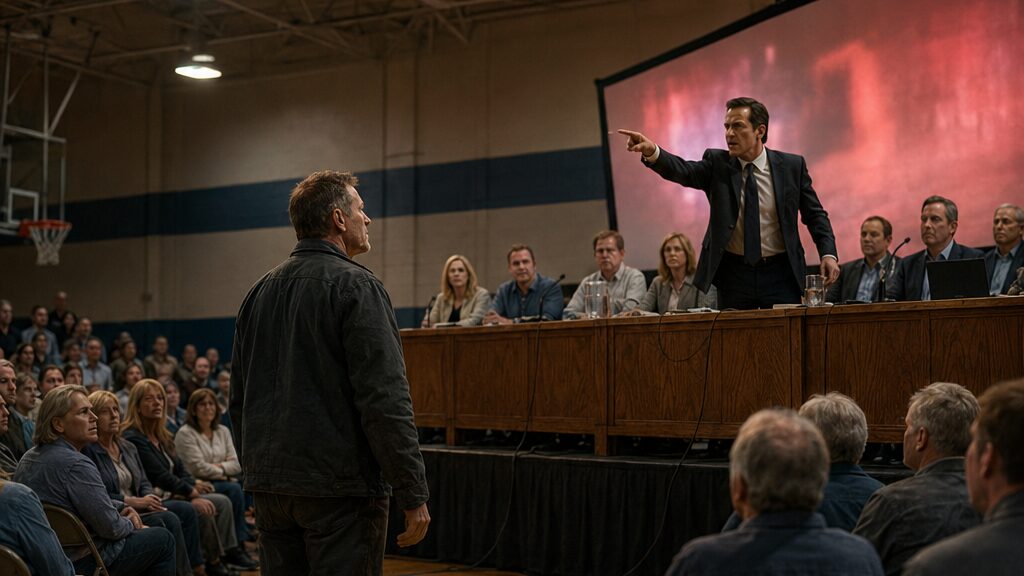
Chapter 5: The Meeting Everyone Feared
Paul’s name appeared first.
The projector screen filled half the gymnasium wall.
Bright red letters.
Impossible to ignore.
Hundreds of eyes lifted toward it.
The room fell quiet.
Not completely.
Just enough.
Enough for humiliation to settle over the crowd like dust.
The school gym smelled faintly of varnished wood and old basketballs.
Metal folding chairs stretched across the floor.
Every seat was occupied.
Residents lined the walls.
Some stood near exits.
As though escape remained an option.
At the front sat the HOA board behind a heavy oak table.
Laptops.
Pitchers of water.
Stacks of documents.
Microphones.
Authority arranged like furniture.
Gary King stood at the center.
Comfortable.
Confident.
Smiling.
The projector light painted his suit in pale blue.
“Good evening, everyone.”
Nobody answered.
Gary continued anyway.
“The purpose of tonight’s meeting is accountability.”
The word earned several bitter laughs.
He ignored them.
The debtors list remained displayed behind him.
Paul’s name still at the top.
The largest amount highlighted in red.
Gary clicked a remote.
Additional names appeared.
Residents shifted uneasily.
Some lowered their heads.
Others stared straight ahead.
The display wasn’t about finances.
It was about fear.
And everyone knew it.
Gary began reading.
House by house.
Name by name.
Balance by balance.
Each announcement felt deliberate.
Measured.
Designed to embarrass.
When he reached Paul’s entry, he paused.
Of course he did.
“Paul Wright.”
The microphone carried his voice through the entire gym.
“Long history of non-compliance.”
A few board members smiled.
Gary glanced toward Paul.
“Repeated obstruction of community improvement initiatives.”
The projector changed.
Paul’s name expanded larger.
The crowd stirred.
Rebecca sat three rows away.
Her expression darkened.
This wasn’t financial administration anymore.
It was personal.
She wasn’t the only one noticing.
The room had changed.
The crowd’s silence felt different now.
Not agreement.
Discomfort.
Gary failed to recognize the distinction.
That was becoming a habit.
“Mr. Wright has consistently resisted progress.”
Paul remained seated.
Still.
Calm.
Gary seemed irritated by that.
Good.
The property manager stepped closer to the microphone.
“You know, some people complain about every investment.”
A few board members chuckled.
Nobody else did.
The sound echoed awkwardly.
Gary noticed.
For the first time, a small crack appeared.
Not fear.
Confusion.
Why wasn’t the room responding?
He pushed harder.
“Sometimes communities move forward only after a few stubborn people are left behind.”
Silence.
Longer this time.
Rebecca glanced around.
People weren’t smiling.
They weren’t laughing.
They were watching.
Watching Gary.
Evaluating him.
The shift was subtle.
But real.
Gary either didn’t see it or refused to.
The presentation continued.
Slides.
Charts.
Budget forecasts.
Promises.
Numbers.
The projector screen dominated everything.
A giant illuminated symbol of authority.
And increasingly, a symbol nobody trusted.
Halfway through the meeting, Rebecca stood.
Questions immediately followed.
“Where did these estimates come from?”
Gary answered smoothly.
“Professional consultants.”
“Which ones?”
“Qualified vendors.”
“Names?”
A pause.
Brief.
But visible.
The crowd noticed.
Gary recovered quickly.
“Documentation is available through proper channels.”
The answer satisfied no one.
Murmurs spread.
Another resident stood.
Then another.
Questions multiplied.
Specific questions.
Difficult questions.
For the first time all evening, Gary looked annoyed.
The room was slipping.
Not dramatically.
Just enough.
Paul watched carefully.
The residents weren’t suddenly brave.
They were simply becoming tired of being afraid.
That mattered.
Gary eventually pointed toward Paul.
“Perhaps Mr. Wright would like to explain why he opposes every improvement project.”
Heads turned.
The invitation wasn’t genuine.
It was bait.
Paul stood slowly.
A microphone waited near the aisle.
He walked toward it.
For a brief moment the room seemed to hold its breath.
Paul reached the microphone.
Opened his mouth.
Gary pressed a button.
The microphone died.
Silence.
A few residents blinked.
Others frowned.
Paul stared at the dead microphone.
Then at Gary.
The property manager smiled.
“Sit down.”
The words echoed through the gym.
“You don’t get a vote on facts.”
Several board members laughed.
This time the reaction was different.
No one joined them.
Not one person.
The laughter sounded ugly.
Small.
Embarrassing.
Rebecca looked toward Gary as though seeing him clearly for the first time.
Not a strict manager.
Not a protector of property values.
A bully.
The realization spread.
Row by row.
Chair by chair.
The room changed.
Gary didn’t understand why.
He only knew control felt harder.
Paul returned his gaze.
Months of insults.
Months of silence.
Months of swallowing anger.
Months of watching neighbors suffer.
The projector continued displaying his name.
The symbol of everything.
Humiliation.
Power.
Control.
The microphone remained dead.
Permission denied.
Voice denied.
Dignity denied.
Something settled inside him.
Not rage.
Decision.
Paul stepped away from the microphone.
Then toward the front of the room.
The board members exchanged confused looks.
Gary frowned.
“Mr. Wright.”
Paul kept walking.
The heavy oak table waited ahead.
Gary’s smile finally disappeared.
Chapter 6: The Sound That Stopped the Room
Paul reached the table before anyone understood what he intended to do.
Gary stood.
“Stop right there.”
Paul ignored him.
One hand gripped the edge of the oak table.
Then the other.
The room froze.
Every resident.
Every board member.
Every observer.
Waiting.
Watching.
And for the first time all night, Gary looked uncertain.
Not afraid.
Not yet.
But close.
Paul tightened his grip.
The muscles in his arms strained.
The table was heavy.
Solid.
Built to project permanence.
Authority.
Control.
Paul looked directly at Gary.
Then he roared.
And lifted.
The table flipped completely upside down.
Laptops launched into the air.
Pitchers exploded across the floor.
Microphones crashed.
Papers erupted like a storm of white birds.
The sound slammed through the gymnasium.
Wood.
Metal.
Glass.
Shouts.
Gasps.
A deafening collision that seemed to shake the walls themselves.
The projector image trembled.
Then vanished.
Silence followed.
A strange silence.
The kind that arrives after something irreversible.
No one moved.
The overturned table rested between the board and the crowd like a fallen monument.
Water dripped from shattered pitchers.
Documents drifted toward the floor.
Gary stared.
His mouth slightly open.
For the first time since Paul had known him, he had absolutely nothing to say.
Then Paul spoke.
No microphone.
No permission.
No amplification.
He didn’t need any.
“Listen without it.”
The words carried through the silence.
And somehow sounded louder than every speech Gary had ever given.
The room remained motionless.
Residents looked at Paul.
Then at Gary.
Then back again.
Power had changed hands.
Not legally.
Not officially.
But visibly.
And everyone could feel it.
Gary finally found his voice.
“You’ve lost your mind.”
The accusation sounded weak.
Even he seemed to hear it.
Paul took one step forward.
Gary took one step back.
That was when the crowd noticed.
Fear.
Not Paul’s.
Gary’s.
A murmur moved through the gym.
The first crack had become impossible to ignore.
Then came the sound of doors opening.
Hard.
Fast.
Violent enough to pull every eye toward the entrance.
Men and women in jackets flooded inside.
Purposeful.
Focused.
Unstoppable.
FBI.
IRS.
The letters were impossible to miss.
The room erupted with confusion.
Residents stood.
Board members looked around desperately.
One attempted to gather documents.
An agent stopped him immediately.
“No.”
The single word ended the attempt.
Steven Hall entered near the center of the group.
His expression revealed nothing.
He walked directly toward the overturned table.
Toward Gary.
Toward Paul.
Nobody stood in his way.
Nobody could.
Steven produced identification.
Then looked at the room.
“Nobody leaves.”
Silence returned.
Different this time.
Not shock.
Fear.
Real fear.
For the wrong people.
Gary blinked rapidly.
“What is this?”
Steven faced him.
“A federal investigation.”
Gary laughed once.
A short nervous sound.
“This is ridiculous.”
No one joined him.
Not even the board members.
Steven handed documents to another agent.
Then looked directly at Gary.
“The Homeowners Association and associated vendors are under investigation for financial crimes including money laundering and fraud.”
The words landed like falling concrete.
Residents stared.
Board members paled.
Gary looked toward Paul.
And suddenly understood.
The realization hit him visibly.
Paul had never been the victim.
He had never been powerless.
Never been broken.
Every humiliation.
Every meeting.
Every insult.
Paul had endured them.
Watched them.
Recorded them.
Waited.
Gary’s face drained of color.
Around them, agents collected laptops.
Documents.
Phones.
Boxes of records.
The projector screen flickered once more.
Then detached from its mount and crashed sideways against the floor.
The enormous white surface folded awkwardly upon itself.
A symbol collapsing.
No one missed the image.
Paul certainly didn’t.
Months ago that screen had seemed untouchable.
Now it lay broken among scattered paperwork.
Just another piece of debris.
Steven approached him.
“You picked an interesting moment.”
Paul looked at the overturned table.
“It felt right.”
A brief smile touched the investigator’s face.
Then disappeared.
The work wasn’t finished.
Not yet.
Across the room Gary had stopped arguing.
Stopped pretending.
Stopped performing.
He stood alone now.
Separated from the authority that once protected him.
Separated from the board.
Separated from the crowd.
Separated from certainty.
An agent placed a hand on his shoulder.
And for the first time, Gary didn’t know what would happen next.
The story has ended.