The HOA Sent A Crew To Tear Out His Mother’s Ramp Before The Notice Was Even Dry
Chapter 1: The Crew Came Before The Notice
The saw started before sunrise.
Michael Carter woke to the sound of metal teeth biting through wood, not out by the tree line where limbs sometimes came down, but directly beneath his mother’s front window. For half a second he lay still, listening for the shape of the noise. Then came the hollow crack of a board being pried loose from its joist.
His boots were not laced when he reached the front door.
The golden retriever was already there, stiff-legged and silent, nose pressed to the gap under the door. Michael pulled it open and cold air rushed into the cabin, carrying the smell of wet leaves, exhaust, and fresh-cut cedar.
Two men in orange vests were on his ramp.
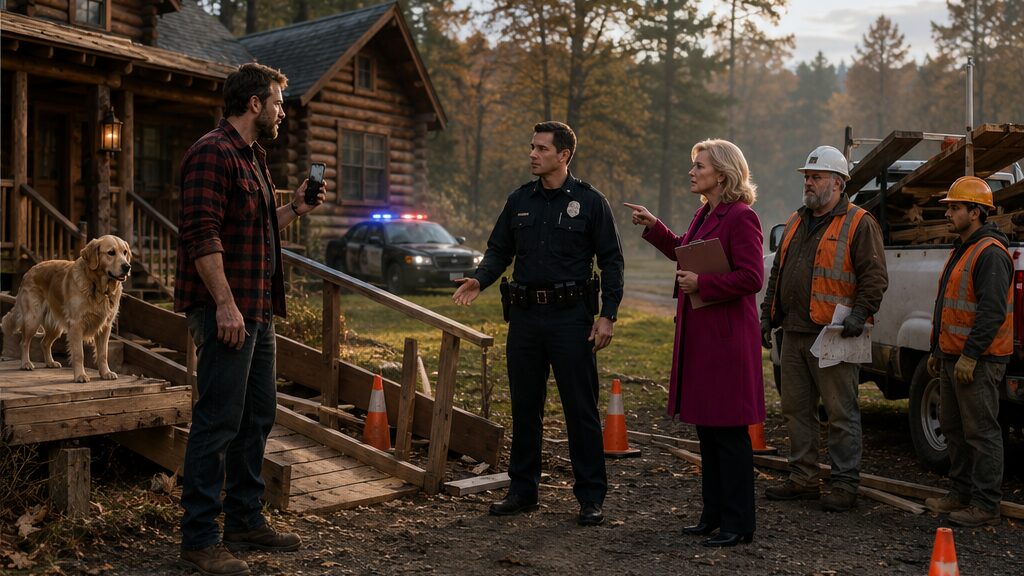
One had a reciprocating saw braced against the lower post. The other was stacking boards into the bed of a white crew truck parked halfway across the gravel. Orange cones marked off the bottom of the ramp like a road hazard. The handrail on the right side sagged from one remaining bracket.
For a moment Michael could not move. His brain caught on the wrong detail: the screws he had countersunk by hand, the cedar he had sanded smooth because Nancy’s palms bruised easily now, the landing he had measured twice so her walker would not catch at the threshold.
Then the lower post snapped.
“Stop!” Michael stepped onto the porch. “Stop cutting.”
The worker with the saw lifted his head, startled but not guilty. The other man looked toward the driveway, not at Michael.
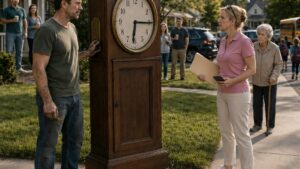
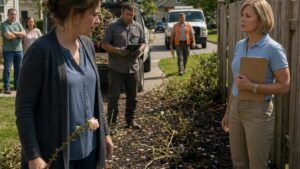
A woman in a bright magenta coat walked from behind the crew truck with a clipboard tucked against her ribs. Janet Brown did not hurry. Her pale hair was smooth despite the wind, and the gold HOA badge on her lapel caught the flashing red-blue light before Michael saw the patrol car.
A police cruiser was parked near the maple trees.
Michael’s stomach tightened.
“Mr. Carter,” Janet said, as if he had arrived late to her appointment. “You need to step away from the work area.”
“My work area?” Michael came down one porch step, then stopped because the ramp was no longer whole. “That’s my ramp.”
“That is an unauthorized exterior structure.”
“That is my mother’s access ramp.”
The retriever slipped out behind him and moved to the torn edge of the porch, looking down at the missing section as if the ground had opened.
The man with the saw lowered the blade but did not unplug it. The crew supervisor, a broad-shouldered man with a gray beard and a hard hat pushed back from his forehead, approached with a folded paper in one gloved hand.
“Sir,” he said, “we’re just here on a removal order.”
“From who?”
The man glanced at Janet.
“From the association,” Janet answered. “You were informed of the violation.”
Michael held out his hand. “Show me the order.”
Janet tapped the clipboard. “You’ll receive the notice.”
“You’re removing it before I receive it?”
A car rolled slowly past the cabin, then another. Neighbors never drove that slowly unless they wanted to see something without admitting it. The cruiser door opened. An officer stepped out and adjusted his belt before walking toward the porch.
Michael pulled his phone from his back pocket and started recording.
Janet’s eyes flicked to it. “That won’t change the fact that you’re obstructing authorized enforcement.”
“It will show when you started cutting.”
The officer came between them, not quite blocking Michael, not quite facing Janet. His nameplate read Perez.
“Mr. Carter?” the officer asked.
“Yes.”
“I’m Officer Ryan Perez. We got a call about a trespass issue and possible interference with a lawful removal.”
“Trespass?” Michael looked past him at Janet. “On my own porch?”
Janet’s jaw tightened, but her voice stayed formal. “The ramp extends into the common access easement. He was told not to build there. He proceeded anyway. Now he is interfering with removal from association-controlled property.”
Michael felt heat rise into his face. The phone in his hand trembled once before he tightened his grip.
“That ramp is attached to my house,” he said. “My mother lives inside this house.”
“Mr. Carter,” Ryan said, “I need you to keep your voice down.”
“My mother can’t use the stairs.”
Janet raised one arm and pointed directly at him. “Officer, he is trespassing in the marked removal zone. I want him removed from the area.”
Michael stared at her finger. The gesture looked rehearsed, the kind of motion meant for rooms where people sat quietly while one person decided what the facts were.
“You called police on me because I told your crew not to cut up my mother’s ramp?”
Janet turned slightly toward Ryan. “I am asking you to enforce the boundary, Officer. I’m a judge, remember? I know what an enforceable order looks like.”
Ryan’s expression changed, just enough for Michael to see the effect. The title landed before the facts did.
“Are you currently serving in that capacity?” Michael asked.
Janet looked back at him. “Don’t play games with legal language.”
“Then don’t use it to scare people.”
The saw worker shifted his weight. The supervisor cleared his throat. The retriever stood with his front paws at the porch edge, whining softly now, unable to understand why the path he used every morning had ended in open air.
Ryan held up a hand. “Mr. Carter, you need to step away from the crew and let this get sorted through the HOA process.”
“I submitted through the process four weeks ago.”
Janet’s clipboard snapped shut. “Your application was incomplete.”
“You never answered it.”
“It was not approved.”
“Not approved is not the same as denied.”
“Mr. Carter,” Ryan said, sharper this time, “if you keep interfering, you may be cited.”
Michael looked from the officer to the ramp, then to the front window. Behind the curtain, he saw movement: Nancy’s hand gripping the side of her walker, her shoulders angled carefully as she tried to see without stepping too close to the threshold.
He lowered his voice.
“That ramp is a medical accommodation,” he said. “It is the only way my mother gets safely out of this house.”
For the first time, the crew supervisor looked directly at the porch window.
Janet did not. “If there is medical documentation, it should have been provided before construction.”
“It was.”
“Not in a form the board could approve.”
Michael almost laughed, but there was no air for it. “A form the board could approve?”
Janet stepped closer, stopping just outside the orange cone line. “You had options, Mr. Carter. Temporary portable ramps exist. Interior modifications exist. Instead you built an exterior structure that changes the front elevation, crosses into a protected access area, and exposes the association to liability.”
“My mother broke her hip on those stairs.”
“That does not exempt you from rules.”
The words were not shouted. That made them worse.
Ryan looked toward the porch. “Is she able to come out now?”
Michael turned on him. “Not without the ramp you’re letting them remove.”
The officer blinked, and in that small pause Michael saw something uncertain pass across his face. But Janet moved into it before he could speak.
“We are not removing access,” she said. “We are removing an unapproved structure. He will be fined for each day the violation continues, including any reconstruction.”
“How much?” Michael asked.
Janet looked at him as though that was the first sensible question he had asked. “Five hundred dollars per day for unauthorized rebuilding. Additional penalties may apply for interfering with association enforcement.”
The worker at the truck slid another cedar board into the bed. It landed with a flat wooden slap.
Michael stepped toward the cones.
Ryan moved with him. “Mr. Carter.”
Michael stopped. He looked at the phone screen, at Janet framed behind the officer, at the crew truck with half the ramp already loaded in it. He had the strange thought that anyone watching later would not hear the first saw. They would only see him angry, unshaven, standing in boots he had not tied, with police lights pulsing on his cabin wall.
“An HOA order is not a court order,” Michael said, each word measured now. “If you touch one more board before you show me written authority, I’m documenting every second of it.”
Janet’s lips thinned. “Document whatever you like.”
She nodded to the supervisor.
The saw started again.
Michael did not move toward it. He did not give Ryan a reason to put a hand on him. He stood there, phone raised, while the blade screamed through cedar and the retriever whined at the broken edge of the porch.
By the time the crew paused, the lower half of the ramp was gone. Janet walked to the front door with a sheet of paper and pressed it flat against the wood beside the handle. She smoothed the tape with two fingers.
Only after the truck pulled back and the police cruiser rolled down the drive did Michael climb carefully around the jagged landing and tear the paper from the door.
The violation notice was dated that morning.
The ink was still damp where Janet’s thumb had pressed it down.
Chapter 2: The Application Nobody Answered
“Michael?”
Nancy’s voice came from the hallway, thin with effort.
He shoved the violation notice into the back pocket of his jeans and turned so she would not see his face before he fixed it. The retriever was already beside her, his body pressed gently against her walker, as if he could replace the ramp by standing still enough.
Nancy had dressed herself in the blue cardigan she wore for appointments, though there was no appointment that morning. Her white hair was pinned unevenly. One foot was in a house slipper. The other was still bare.
“Don’t come closer,” Michael said.
She stopped two feet from the threshold. “Is it gone?”
He looked over his shoulder. The porch landing remained, but the ramp dropped into nothing after the first few boards. Beyond it, torn posts leaned at angles in the cold dirt.
“Most of it.”
Nancy shut her eyes. Not dramatically. Not like someone fainting. Just for one quiet second, as if she had to set something down inside herself before speaking.
“I told you the temporary one would have been enough.”
“No,” Michael said too fast. “It wouldn’t.”
She gave him the look she had used when he was twelve and lying badly. “It would have been less trouble.”
“It would have been dangerous.”
“Trouble is dangerous too.”
He hated that she said it gently.
At the kitchen table, Michael spread out everything he had saved: the ramp sketch on graph paper, receipts from the lumberyard, photographs of the old steps, the contractor’s estimate, printed emails, the HOA architectural request form, and the medical note from Nancy’s clinic. The note was brief because he had asked for brief. At the time, it had felt respectful.
Patient requires reduced stair use during recovery period.
No diagnosis line. No fall details. No mention of the walker. No photograph of the bruise that had spread along Nancy’s hip after the first fall. No explanation of how the cabin’s original stairs were too narrow for him to walk beside her.
He had thought less information meant more dignity.
Now, on paper, it looked like preference.
Nancy sat across from him with her coffee untouched. The retriever lay beneath the table, chin on Michael’s boot.
“You sent them all that?” she asked.
“Four weeks ago.” He sorted the emails by date with fingers that wanted to crumple them. “Request submitted October third. Confirmation received October third. I followed up on October twelfth, October twentieth, and October twenty-sixth.”
“And they never answered?”
“They said it was under review.”
Nancy watched his hands. “You built it on the twenty-eighth.”
“After you couldn’t get down the stairs for therapy.”
“I missed one appointment.”
“You missed two.”
Her mouth closed.
Michael hated himself for saying it that way, like a charge. He softened his voice. “You didn’t tell me about the second one until after.”
“I didn’t want you taking another day off work.”
“I work from the shop. I can move things.”
“You already moved your whole life.”
He looked away first.
There were things they did not say because saying them made them both responsible for the silence afterward. Nancy had lived alone in the cabin after his father died. She had known every loose floorboard, every draft, every pipe that knocked in winter. Then came the fall at the porch steps while Michael was forty minutes away picking up parts, and suddenly all her independence had to fit inside his schedule.
He had moved into the downstairs room and told her it was temporary. She had pretended to believe him.
The ramp had been the one thing that made the lie gentler.
Michael opened his laptop. The HOA portal still showed his application as Pending Review. He took a screenshot. Then another with the date visible. Then he opened the PDF he had submitted and read it carefully for the first time not as a son trying to protect his mother’s privacy, but as someone looking for the weakness Janet had found.
Temporary access repair to front entrance.
Cedar construction to match porch.
Removal planned after recovery period.
Medical note attached.
He stared at the phrase access repair.
Not wheelchair ramp. Not accommodation. Not medically necessary exterior access.
Nancy leaned forward. “What is it?”
“I made it too neat.”
“What does that mean?”
“It means I wrote it like I was asking permission to fix a porch.”
“You were.”
“No.” He touched the medical note. “I was asking them not to trap you inside your house.”
Her eyes sharpened. “Michael.”
“I should have said it plainly.”
“I asked you not to make my hip the whole neighborhood’s business.”
“I know.”
“And I meant it.”
“I know that too.”
For a moment the only sound was the old refrigerator motor clicking on and the retriever’s tail thumping once in his sleep.
Michael pulled the violation notice from his pocket and flattened it on the table. Nancy reached for her reading glasses. He almost took the paper back, but she looked at him over the frames.
“Don’t you dare decide what I can read.”
He let go.
She read slowly. Her face changed at unauthorized structure, then again at common access easement, and finally at daily penalties.
“How much?” she asked.
“Five hundred a day if I rebuild.”
Her hand rested on the page. The veins stood blue under thin skin. “That’s not a fine. That’s a threat.”
A knock came at the front door.
Michael rose so quickly the chair legs scraped. Through the side window he saw no police cruiser, no Janet. Only a courier walking back down the steps, leaving an envelope tucked under the door knocker because the porch had no safe path to reach.
Michael opened the door and had to lean across the broken landing to grab it. The envelope bore the HOA seal.
Nancy had followed him as far as the hall. “Another notice?”
He opened it with his thumb.
The first line made his jaw lock.
Emergency Compliance Hearing: 6:30 p.m. tonight.
The letter stated that the board would review unauthorized exterior construction, interference with enforcement, and continued violation risk. Michael scanned downward, past formal sentences and numbered sections, until he found the paragraph in bold.
Failure to comply with board determination may result in continuing fines, recovery of removal costs, suspension of association privileges, and lien action against the property.
He read it twice, hoping the words would become less clear.
Nancy was watching him.
“What did they say?”
Michael folded the letter along its original crease, but the line about the lien stayed visible at the edge.
“They want me at the clubhouse tonight,” he said.
“And if you don’t go?”
He looked through the open door at the torn porch, the missing ramp, the screw holes dark in the cedar.
“They start making the house pay for it.”
Chapter 3: The Board Called It A View Problem
The first thing Michael saw inside the clubhouse was a photograph of his broken ramp projected ten feet wide on the wall.
Someone had taken it from the road that morning, after the crew removed the lower section but before Michael cleared the splintered boards. In the photo, the ramp looked less like a lifeline than a half-built platform abandoned in front of the cabin. A red caption sat beneath it.
UNAUTHORIZED STRUCTURE — CARTER PROPERTY
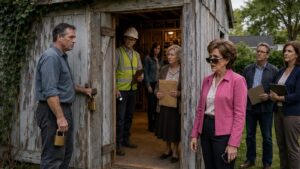
Three board members sat behind folding tables arranged like a courtroom without admitting it. Janet Brown occupied the center chair. Kimberly Lee sat to her right with a binder open and a pen resting between her fingers. The other members avoided looking at Michael when he entered.
Neighbors filled two rows of chairs. Not many, but enough. People who waved from trucks now studied their phones. One of them glanced at Michael, then quickly away, as if eye contact might count as taking a side.
Michael carried a folder under one arm. He had not brought Nancy. She had asked once, and he had said no too sharply. Then he had apologized. Then she had not asked again.
Janet tapped the microphone. It gave a small pop.
“This emergency hearing concerns unapproved construction, interference with enforcement, and encroachment into a protected common access easement,” she said.
Michael remained standing. “It concerns a medical access ramp you removed before giving notice.”
Janet looked over her glasses. “Mr. Carter, you’ll have an opportunity to speak.”
“I’m speaking before the story hardens.”
A few heads lifted.
Kimberly’s pen paused above her binder.
Janet’s expression did not change, but her fingers tightened around the agenda. “Sit down, please.”
Michael sat in the front row because the back would have made him feel like a defendant hiding from a judge.
Janet began with procedure. She described the architectural standards for the cabin row: natural materials, consistent frontage, unobstructed sightlines, no unapproved exterior additions visible from the shared lane. She did not mention Nancy. She did not mention the application sitting unanswered in the portal. She did not mention the saw starting before sunrise.
On the wall, the ramp photo remained.
“Exterior uniformity is not cosmetic,” Janet said. “It protects property values, emergency access, and association liability.”
Michael opened his folder.
Janet continued, “The structure in question extends beyond the approved porch footprint and into an area designated for common access and emergency clearance.”
“That’s not accurate,” Michael said.
Janet looked at him. “You are out of order.”
“So was the crew.”
Murmurs moved through the room. Janet let them rise just long enough to make Michael feel their weight, then tapped the microphone again.
“I understand this is emotional for you, Mr. Carter. But association governance cannot be conducted by impulse.”
He almost answered with the first thing that came to mind. Instead he looked down at his folder until the words passed.
“My mother cannot safely use the front stairs,” he said. “I submitted an application four weeks ago. I followed up three times. No one answered. I built a temporary ramp because waiting became unsafe.”
Janet’s face softened in shape but not in meaning. “The board received an incomplete request for a temporary access repair. It did not receive sufficient plans, engineering confirmation, or a complete medical accommodation packet.”
Kimberly looked up. “Was it routed as an accommodation request?”
Janet turned slightly. “It was routed as an architectural request because that is how it was submitted.”
Michael pulled out the confirmation email. “The form only gave me one category for exterior work.”
“That doesn’t authorize construction.”
“It confirms you had it.”
Kimberly leaned toward her binder. “Was there a deficiency notice sent?”
Janet’s pause was small, but Michael caught it.
“The review was pending,” Janet said. “Mr. Carter chose not to wait.”
Michael held the medical note in his hand. He hated how thin it felt. He hated that Janet could wave it away without even touching it.
“My mother had already missed therapy because of those steps.”
“Then you should have requested emergency review.”
“I asked three times for an update.”
“An update is not an emergency request.”
He looked at the board table and understood the trap. Every word he had not used was now being used against him. Emergency. Accommodation. Encroachment. Compliance. He had sent the truth in ordinary language, and ordinary language had not been enough.
Janet changed the slide.
A second photograph appeared: the ramp from an angle that made it seem to jut far into the lawn.
“This is the view issue,” she said. “The cabin row was designed to preserve natural frontage. If one owner extends a structure into the shared visual corridor, the board must act consistently.”
Michael stared at the phrase view issue until it blurred.
“A view issue,” he repeated.
Janet folded her hands. “Among other issues.”
“My mother’s walker is not a view issue.”
“No one said it was.”
“You projected her access route on a wall and called it one.”
Kimberly lowered her eyes, but not before Michael saw discomfort pass across her face.
Janet’s voice sharpened. “Mr. Carter, I’m going to remind you that this board is not questioning your mother’s condition. We are questioning your decision to construct first and seek approval later.”
“I sought approval first.”
“You did not receive it.”
“Because you did not answer.”
Another murmur moved through the room. This time Janet did not wait it out.
“I know there is confusion here,” she said, turning slightly toward the room rather than Michael. “But I served as a municipal judge for twelve years. I know what enforceable authority looks like. The association has a duty to enforce its governing documents.”
There it was again. The title set down like a weight on the table.
Michael leaned forward. “Were you acting as a judge when you sent a crew to my house?”
Janet’s eyes flashed. “Careful.”
“No. That’s the question. Were you acting as HOA president, or were you letting a police officer think this was something more than an HOA dispute?”
The room went very still.
Kimberly looked at Janet now.
Janet removed her glasses. “Officer Perez responded to a trespass and disturbance call.”
“Who made the call?”
“I did.”
“And you told him I was trespassing where?”
“In the protected common access easement.”
Michael opened his folder to the rough copy of the property map he had printed from the closing documents. It was not enough; he knew that. The old survey was somewhere in the storage shed if he still had it. But the map showed the porch, the drive, the front access strip.
“This is attached to my deed,” he said. “The access to the front entrance is not the same as the shared lane.”
Janet barely glanced at it. “That is not a certified survey.”
“No. But it is enough to show you shouldn’t be calling police before checking.”
One of the board members whispered to Janet. She shook her head.
Kimberly turned a page. “Janet, do we have the current easement map in the packet?”
“It isn’t necessary for tonight’s determination.”
“It may be,” Kimberly said quietly, “if trespass is part of the violation.”
Janet’s jaw worked once.
For the first time that evening, Michael felt the room tilt slightly away from her. Not toward him, not yet. Just away from certainty.
Then Janet recovered.
“The immediate question before the board is whether Mr. Carter may reconstruct or maintain any portion of the unapproved ramp pending further review.” She looked down the table. “Given the safety, access, and liability concerns created by unauthorized construction, I move that the violation be sustained, that reconstruction be prohibited pending full review, and that any rebuilding or obstruction of enforcement trigger a fine of five hundred dollars per day.”
Michael stood. “You removed the thing that made the house safe and now you’re calling rebuilding it the danger.”
Janet did not look at him. “Do I have a second?”
The room held its breath.
A board member raised his hand.
Kimberly did not.
But the vote passed anyway.
Janet tapped the papers into a neat stack and finally looked directly at Michael.
“If any part of that ramp is restored before approval,” she said, “the fines begin tomo
Chapter 4: The Survey Line Under The Leaves
The old survey tube fell from the shelf and hit Michael’s boot with a metallic crack.
He had been reaching for a box of winter pipe insulation in the storage shed, one eye still on the cabin window, when the gray cylinder rolled out from behind a stack of paint cans. For a second he only stared at it. The label was faded, the tape brittle, but his father’s blocky handwriting still crossed the side.
FRONT ACCESS — DO NOT TOSS
Michael crouched and picked it up.
The shed smelled of dust, motor oil, and old lumber. Outside, the lower lawn was still scarred where the crew truck had backed over wet leaves. The ramp was gone except for the short porch landing, the sawed-off posts, and the dark bolt holes along the front steps. The retriever sat near the cabin door, watching Michael through the trees as if he had been assigned to keep him from disappearing too long.
Michael carried the tube to the workbench and twisted the cap. It resisted, then broke loose with a dry squeal. Inside was a rolled survey, yellowed at the edges, and a folded copy of an access agreement from years before the HOA changed management companies.
He spread the survey across the bench and held down the corners with a wrench, a box of screws, a rusted hinge, and his phone. The lines were hard to follow at first. The cabin parcel. The shared lane. The utility easement. Then, near the front porch, a narrow strip marked in small print:
Recorded residential access apron, appurtenant to Lot 14.
Michael read it again.
The access strip did not belong to the HOA in the way Janet had said it did. At least not clearly. It ran from the shared lane to the front entrance, drawn like a tongue of land connecting the cabin to the gravel. The ramp had not been built into open common area. It had been built along the path the house was already entitled to use.
His first feeling was relief.
His second was anger at how little relief helped Nancy get down the steps.
He photographed the survey from above, then close, then with the measuring tape laid across the scale. He checked the date, the recording number, the surveyor seal, every mark that might matter. Documentation, he told himself. Not shouting. Not proving Janet wrong for pleasure. Just making the record too solid to ignore.
A truck door slammed outside.
Michael looked up.
The same white crew truck was parked near the porch.
He left the survey on the bench and ran.
Larry Thompson stood at the bottom of the damaged porch with two crew workers behind him. He was holding a clipboard this time, not a saw. The remaining ramp boards, the short section Michael had thought he could at least use to brace a temporary landing, were marked with orange paint.
“What are you doing?” Michael called.
Larry turned. He looked tired in daylight, older than he had seemed under police lights.
“Morning,” he said. “We’re here to clear the remaining material.”
“No.”
Larry’s mouth tightened. “Mr. Carter, I don’t want another scene.”
“Then don’t create one.”
The retriever came down the porch as far as the broken landing allowed and barked once, uncertain. From inside the house, Michael heard Nancy’s walker scrape the floor.
Larry looked past Michael toward the window. “Association said the materials were abandoned after removal.”
“Abandoned?” Michael stepped closer. “They cut them off my house yesterday.”
“I’m telling you what the work order says.”
“Show me.”
Larry hesitated, then handed over the clipboard.
The work order was brief, printed, and unsigned except for a line at the bottom that read Authorized by Board President. Remove remaining noncompliant structure and abandoned materials from common access easement.
Michael photographed it before Larry could take it back.
“These are my materials,” Michael said. “I paid for them. I installed them. You don’t get to call them abandoned because your client cut them loose.”
Larry glanced at the remaining boards. “Look, I don’t know the whole story.”
“That’s been the problem all week.”
One of the workers shifted uncomfortably. Larry rubbed the bridge of his nose.
“They told me you were notified last week,” he said.
Michael stared at him. “Who told you that?”
“The office. The board. I don’t know. We got the removal packet yesterday morning, and I was told notice had been handled.”
“Yesterday morning, I found the notice after you’d already started cutting.”
Larry’s eyes moved to the porch door. “That’s not what they said.”
“No,” Michael said. “It wouldn’t be.”
He saw the change in Larry then. Not loyalty. Not apology. Something smaller and more useful: uncertainty.
A thump sounded from inside.
Michael turned.
“Nancy?”
No answer came, only the scrape of the walker again, too close to the door.
He climbed onto the damaged porch. “Mom, stay back.”
“I can do one step,” she said from the other side of the screen door.
“No, you can’t.”
“I need to see what’s left.”
Before he reached her, she had opened the inside door and edged one wheel of the walker over the threshold. The front leg caught in the uneven lip where the ramp landing had been cut. Her body pitched forward.
Michael got one hand under her elbow and the other around the walker frame. The retriever pressed against her knees, whining. For one terrible second all of them leaned toward the gap where the ramp should have been.
Then Michael pulled her back.
Nancy’s face had gone gray.
“I’m all right,” she said immediately.
“You’re not.”
“I said I’m all right.”
Larry stood frozen at the bottom of the porch, clipboard lowered. The two workers looked away, as if witnessing the cost made the job harder to finish.
Michael helped Nancy into the nearest chair. Her hand was shaking on the walker grip. She noticed him noticing and tucked it into her lap.
“Don’t start,” she murmured.
He knelt in front of her. “I’m not starting. I’m stopping this.”
She looked past him at Larry. “You’re the man who took my ramp?”
Larry swallowed. “Ma’am, I was hired to remove an unapproved structure.”
Her eyes moved to the empty porch. “It was approved by my legs.”
No one answered.
Michael stood. He went back down the steps carefully and faced Larry.
“You’re not taking another board today.”
Larry glanced at the work order, then at Nancy visible through the door. “I need to call this in.”
“Do that.”
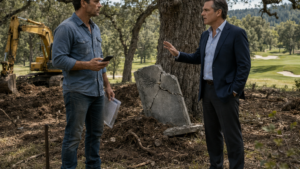
While Larry stepped aside with his phone, Michael went to the edge of the lawn with the survey in one hand and his phone in the other. He brushed away wet leaves near the old stone border his father had always told him not to move. Beneath a mat of brown oak leaves, half-hidden by moss, was a rusted metal survey stake with a faded orange cap.
He crouched and cleaned it with his sleeve.
The stake sat exactly where the old survey showed the residential access apron began.
Exactly where Janet had stood at the meeting and called it common property.
Michael placed the survey beside it, lined up the paper with the cabin behind it, and took a photograph.
Then he took another with the missing ramp gap in the background.
Chapter 5: The Fine Turned Into A Lien
The certified letter arrived folded around a threat.
Michael signed for it at the end of the gravel drive because the delivery carrier would not come closer to the broken porch. The envelope was stiff, white, and too clean against his work gloves. He did not open it until he was back inside, standing beside the kitchen table where the survey now lay under a sheet of clear plastic.
Nancy watched from her chair with the retriever’s head resting on her slipper.
“Read it out loud,” she said.
Michael did not want to. He slid a finger under the flap and pulled out three pages.
The first page announced that the association had sustained the violation. The second page listed removal costs, administrative fees, and continuing penalties. The third page said unpaid amounts could become an assessment against the property and, if unresolved, may proceed to lien action.
Nancy’s fingers tightened on the arm of the chair. “How much?”
Michael looked at the total. It had already passed what the lumber cost him.
“Enough to be insulting.”
“That is not an answer.”
He set the pages down. “They added removal costs.”
“They charged you for tearing it out?”
“Yes.”
Nancy gave a small sound, not quite a laugh. “That takes talent.”
Michael tried to smile. He couldn’t hold it.
His phone buzzed before he could decide whether to call the HOA office, the contractor, or every board member whose email address appeared on the association website. The bank’s name lit up the screen. For a moment he thought it was coincidence. Then he remembered the home equity line he had used years ago when he replaced the roof.
He stepped into the hallway to answer.
The bank representative was polite. That made it worse. She explained that an association assessment notice did not automatically affect his account, but if a lien was recorded, it could complicate renewal, refinancing, or any future property transaction. She used words like “monitor,” “resolve promptly,” and “documentation.”
Michael stood facing the wall where his father’s old coat hook still held a canvas jacket nobody wore anymore.
“So they can damage the house, charge me for it, and make the bank nervous before anyone hears the appeal?” he asked.
“I can’t speak to the association process, sir.”
No. Nobody could speak to the part that mattered.
After the call, Michael went outside before Nancy could ask what had been said. He needed air that did not have paper in it.
At the porch, the retriever stood at the edge of the missing ramp and looked down, then back at Michael. Every time the dog did that, it felt like being asked a question by something innocent enough to deserve an answer.
A pickup slowed on the lane.
The neighbor behind the wheel leaned across the passenger seat and lowered the window. He was a man Michael recognized from mailboxes and winter plowing, not from conversation.
“You seen this?” the neighbor asked.
He held out a phone.
Michael walked to the road.
The video started in the middle, as all bad videos did. Michael was already on the lawn, face tight, phone in his hand. Janet’s voice was clear: “Officer, he is trespassing in the marked removal zone.” Then the clip jumped. Michael’s own voice rose: “That ramp is attached to my house.” Another jump. Ryan stepping forward. Police lights flashing. The retriever barked once. The caption over the clip read:
CABIN OWNER LOSES IT OVER HOA REMOVAL
Michael watched himself become a stranger.
The neighbor shifted. “People are saying you built across the common lane.”
“People?”
“Community page.”
Michael handed the phone back. “Did the video show the saw starting before I came outside?”
“No.”
“Did it show my mother in the doorway?”
“No.”
“Did it show the notice being taped up after the crew started?”
The neighbor’s expression changed. “No.”
“Then it showed what someone wanted it to show.”
The man looked down at the phone again, thumb hovering near the screen. “I didn’t post it. Just thought you should know.”
“Why?”
The neighbor shrugged, uncomfortable. “Because my wife said if it was us, she’d want to know before everyone at the grocery store did.”
That was the first kindness Michael had received from the lane, and it came wrapped in embarrassment.
“Thanks,” he said.
The pickup rolled away slowly.
By noon, the contractor who had helped him frame the ramp called back.
“I can’t come out while there’s an active violation,” the contractor said. “I’m sorry. My insurance won’t touch it if the HOA has a stop order.”
“It’s not a stop order.”
“It’s enough to look like one.”
“My mother can’t use the stairs.”
A pause.
“I’m sorry,” the contractor said again, and this time he sounded like he meant it. “Clear the violation and I’ll help you rebuild.”
Michael ended the call with his thumb and stood in the yard, looking at the screw holes in the porch, the stacked photographs on his phone, the survey stake under the leaves, the certified letter folded in his pocket. He had believed facts would behave like tools. Pick up the right one, apply pressure in the right place, and the thing would move.
Instead, every fact needed permission to matter.
That afternoon he drove to the HOA office and parked outside without going in. The office sat in a converted ranger cabin near the entrance road. The porch railings were stained the approved shade of brown. The flower boxes matched the sign. Even the notice board looked disciplined.
Michael photographed the posted office hours, the locked drop box, the blank space where meeting minutes were supposed to be posted.
A woman came out carrying a binder against her chest.
Kimberly Lee stopped when she saw him.
For a second neither of them spoke. She looked back toward the office door, then toward his truck.
“You shouldn’t be here alone with that expression,” she said quietly.
“I’m not here to make a scene.”
“I know. That’s why I’m talking to you.”
Michael waited.
Kimberly came down one step. “The board minutes from the emergency removal vote are not in the packet.”
“Meaning?”
“Meaning I can’t find a vote authorizing removal before the crew was dispatched.”
His pulse changed. “Janet said the board authorized it.”
“She may have used president’s emergency authority.”
“May have?”
Kimberly lowered her voice. “There was a discussion by email about liability. There was not a formal vote that I can find.”
Michael looked at the office window. The blinds were half closed.
“Why are you telling me?”
“Because I should have asked last night before the vote.” She shifted the binder in her arms. “And because if this was handled wrong, pretending it wasn’t will make it worse.”
“For who?”
Her eyes met his. “For everyone. Including your mother.”
It was not an apology. It was not yet help. But it was the first crack that had opened from inside the board.
Kimberly walked toward the parking lot, then stopped.
“Request the removal packet,” she said. “All of it. Work order, timestamps, notices, emails. In writing.”
“I already have the work order.”
“Get the version they don’t think you have.”
Before Michael could ask what she meant, she got into her car and left.
He stood outside the HOA office until the porch light clicked on, holding the certified letter in one hand and his phone in the other, while the question settled into something sharper than anger.
Janet had not just moved fast.
She may have moved alone.
Chapter 6: The Dog Waited At The Empty Porch
Nancy made it as far as the top step before her face emptied.
She had dressed for physical therapy in the pale green blouse Michael knew she saved for leaving the house. Her walker was squared in front of her, both hands firm on the grips. The retriever stood below on the dirt where the ramp used to meet the ground, tail still, eyes fixed on her like he could will a path back into place.
“I’m fine,” Nancy said.
Michael was already beside her. “You haven’t moved.”
“I’m considering my options.”
“There are no good options.”
“That has never stopped me before.”
She tried to make it light, but her right knee trembled. The porch steps were only three risers. He had grown up taking them two at a time. Now each one looked like a separate decision with a cost.
The physical therapy clinic had called twice that morning to confirm. Michael had not told them why he might cancel. Nancy had insisted she would go. She had put on earrings with hands that shook only when she thought he wasn’t looking.
“Let me help you,” he said.
“You always say that like helping doesn’t include dropping me.”
The words hit before she could catch them.
Michael went still.
Nancy closed her eyes. “I didn’t mean that.”
“Yes, you did.”
“No. I meant—”
“You meant the fall.”
Her mouth tightened. The retriever whined softly below them.
Michael saw again the day he had come home with a truck bed full of pipe fittings and found her sitting on the second step, rain on her shoulders, one slipper in the mud. She had smiled when she saw him. Smiled. As if the blood on her sleeve was an inconvenience and not the moment that rearranged the rest of his life.
“I wasn’t here,” he said.
“You were working.”
“I should have been here.”
“You cannot stand beside me every minute of the day.”
“I can build a ramp.”
“And now they’ve made that about you too.”
He looked at her.
Nancy’s eyes were wet, but her voice was steady. “Every paper, every phone call, every person slowing down by the road. It is all about what you did, what you built, what you said to that officer. I know you’re trying to protect me. But I can feel myself turning into the reason you’re in trouble.”
“You’re not the reason.”
“I don’t want to be evidence, Michael.”
The clinic called again. His phone vibrated in his pocket until it stopped.
Nancy looked down at the retriever, waiting in the cold dirt where the ramp should have been. “Cancel it.”
He did.
Inside, she sat in the chair by the front window without taking off her earrings. Michael stood in the kitchen with the laptop open, the HOA portal on one side of the screen and a blank document on the other. He had requested the full removal packet in writing the night before, using Kimberly’s exact phrase. No response yet.
Now he clicked record on his phone and set it beside the keyboard.
“My name is Michael Carter,” he began. “I am submitting a formal request for reasonable accommodation related to exterior access at—”
Nancy’s chair creaked in the next room.
He stopped.
After a moment she said, “Are you recording me?”
“No. I’m recording the request.”
“With my condition in it.”
“With only what they need.”
She appeared in the doorway, moving slowly with the walker. “Who decides what they need?”
He took his hands off the keyboard.
That was the question he had avoided by deciding for her. He had told himself privacy was a gift. But he had also used it as a shield against the humiliation of asking strangers to care.
“You do,” he said.
Nancy studied him, wary of easy surrender.
He turned the laptop slightly so she could see the screen. “I wrote that you require step-free entry during recovery. No diagnosis. No details you don’t want shared. We attach the clinic note, the therapy schedule, and a photo of the missing ramp. That’s it unless you want more.”
She moved closer and read. The retriever came with her, shoulder brushing the walker.
“Delete ‘limited mobility,’” she said.
Michael did.
“Write ‘temporary reduced stair tolerance.’”
He glanced at her. “That sounds like you swallowed a brochure.”
“It sounds like me keeping one piece of myself.”
He typed it exactly.
They worked for twenty minutes like that, not smoothly, not tenderly in any way that would look good from the outside. She rejected words. He pushed back on anything too vague. She let him include the missed therapy appointment only after he wrote that the missed appointment resulted from the removal of safe access, not from incapacity. He did not include the fall at first. She noticed.
“You can write that there was a prior fall on the front stairs,” she said.
He looked at her hands.
“Are you sure?”
“No,” she said. “But write it.”
The phone rang while he was attaching the revised request to an email addressed to the HOA board.
Unknown number.
He answered on speaker.
“Mr. Carter, this is Janet Brown.”
Nancy’s eyes lifted.
Michael touched record on his phone before speaking. “I’m listening.”
“I received your message about temporary reinstatement,” Janet said. Her tone was crisp, businesslike, almost bored. “The board will not authorize reconstruction pending the formal review.”
“My mother missed therapy today because the ramp is gone.”
“I’m sorry to hear that. However, rebuilding without approval would compound the violation.”
“It would restore access.”
“It would create additional liability.”
“The liability was created when you removed it.”
A small silence followed.
“Mr. Carter,” Janet said, cooler now, “I understand you are frustrated. But you cannot convert an unapproved structure into an approved accommodation by repeating the word medical.”
Nancy’s face changed, not with anger first. With shame.
Michael saw it and felt something in him settle into place.
“My mother is in the room,” he said. “You will not speak about her need like it’s a tactic.”
“I did not name your mother.”
“You removed her way out of the house.”
Janet exhaled. “Submit your complete packet. It will be reviewed at the next formal hearing.”
“When?”
“Next week.”
“She needs access now.”
“Then use a compliant temporary device.”
“Name one that fits the porch safely.”
“That is not the association’s responsibility.”
Michael looked at Nancy. She held his gaze, then nodded once.
He ended the call before his voice could become the thing Janet wanted on record.
The email went out five minutes later with the revised accommodation request, the clinic note, the therapy schedule, photographs of the missing ramp, the old survey, and the work order Larry had shown him.
At 8:42 that night, a new message arrived from Kimberly Lee.
It contained no greeting. No apology. Just a screenshot of the HOA policy manual, one paragraph highlighted in yellow.
Accommodation requests involving access or medically necessary use of a residence shall receive written response within ten business days of receipt. Failure to respond shall not be used as grounds for enforcement action without board review.
Michael read it once.
Then he read it aloud to Nancy.
The retriever lifted his head from the floor as if the words had made a sound only he could hear.
Chapter 7: The Hearing Where The Ramp Was Evidence
“The ramp has already been removed,” Janet Brown said before Michael had even taken his seat, “so tonight’s purpose is not to relitigate a completed enforcement action.”
Michael stopped in the aisle with one scarred cedar board under his arm.
The board was three feet long, cut ragged at one end where the saw had bitten through it. He had sanded that board himself two weeks earlier, rounding the top edge of what had been the left-hand rail. Now it carried a black streak from the crew truck bed and a strip of orange paint from the removal mark.
He set it on the table in front of the board members.
“It isn’t completed,” he said. “It’s sitting right there.”
The clubhouse was fuller than it had been at the emergency hearing. The clipped video had done what the notices could not. Neighbors had come because they had seen police lights and a man shouting, because the story had turned into something they could hold an opinion about before knowing it. Some stood along the wall. A few looked embarrassed when Michael turned toward them.
Kimberly Lee sat beside Janet with a thick folder open. She did not look comfortable. That mattered less to Michael than the fact that she had brought the folder.
The HOA attorney sat at the end of the table with a legal pad and a face arranged to reveal nothing.
Janet tapped her pen once. “Mr. Carter, you were given time to submit supplemental material. The board has received it.”
“Not supplemental,” Michael said. “Complete.”
Janet’s smile was thin. “That characterization is disputed.”
“Then let’s put the timeline on the record.”
The attorney looked up. Janet’s eyes flicked toward him.
Michael opened his folder. This time the papers were not loose. Every page had a tab. Application. Portal confirmation. Follow-ups. Medical note. Therapy schedule. Survey. Removal notice. Work order. Police report request. Policy section.
He had spent two nights ordering the facts because the facts had failed when they arrived like grief, all at once.
“My application was submitted on October third,” he said. “The association’s own policy requires written response to accommodation requests involving access within ten business days. I followed up three times. No deficiency notice was sent. No denial was sent. No hearing was scheduled until after demolition began.”
Janet leaned toward her microphone. “The request was not identified as a formal accommodation.”
Michael slid a copy across the table. “Because the portal doesn’t have an accommodation category for exterior access. It has architectural review. I attached a medical note.”
“A brief note.”
“Yes,” Michael said. “Because my mother is a person, not an exhibit.”
The room shifted quietly.
Nancy was not there. That had been her choice, and for once Michael had not argued. He had told her he would not use more of her than she wanted used. She had handed him the therapy schedule and said, “Then use the part that gets me out the door.”
Janet folded her hands. “No one is asking for private details beyond what procedure requires.”
“You removed the ramp before asking for any.”
Kimberly looked down at her folder.
Michael placed the work order beside the board. “Your crew started before the notice was on my door. Larry Thompson’s work order says he was told notice had already been handled. The notice was dated that morning.”
The attorney picked up the copy. “Mr. Carter, do you have confirmation of the start time?”
“Photos. Phone video. And Officer Perez’s body camera will show he arrived after the crew had already cut through the lower post.”
The back door opened.
Ryan Perez stepped in, still in uniform, cap in one hand. He had not come with flashing lights this time. He looked like a man who had been asked to stand in a room where every side wanted something from his badge.
Janet’s expression hardened. “Officer Perez is not a party to this hearing.”
“No,” Kimberly said, quiet but clear. “But his report was included in the enforcement file. If the board relied on the police response, we should understand what it says.”
Janet turned to her. “The board did not rely on—”
“The violation includes interference with enforcement,” Kimberly said. “That allegation came from the incident.”
The attorney leaned toward Janet and murmured something Michael could not hear.
Ryan came forward only as far as the first row. “I’m not here to advise the board,” he said. “I can clarify my report.”
Janet’s face settled back into control. “Briefly.”
Ryan opened a small notebook. “I responded to a call regarding a trespass complaint and disturbance during HOA removal activity. Upon arrival, I observed removal already in progress, Mr. Carter recording, and a partially dismantled wooden ramp attached to the front porch.”
Michael kept his eyes on Janet.
Ryan continued, “I did not have, and was not presented with, a court order authorizing removal or requiring Mr. Carter to leave his property.”
The room went very still.
Janet lifted her chin. “No one represented that there was a court order.”
Michael looked at Ryan.
Ryan paused. “The language used on scene suggested the association believed it had enforceable authority over the area. My report notes there was uncertainty about the boundary and that the dispute appeared civil in nature.”
Janet’s pen stopped moving.
Michael remembered standing on the lawn, saying, “An HOA order is not a court order,” while his hand shook around the phone. At the time, it had felt like a sentence too small to stand against a saw. Now it sat in the middle of the room and did not move.
Kimberly turned a page. “Thank you, Officer.”
Ryan nodded once and stepped back.
Janet’s voice was cooler when she spoke. “Even if removal timing requires review, the structure itself remained unapproved.”
Michael placed the survey on the table. “It was also not built across the common access lane.”
He showed the recorded access apron, the old survey stake, the photograph from the yard with the cabin behind it. The attorney studied that one longer than the others.
“This document is old,” Janet said.
“It was recorded.”
“Recorded does not automatically resolve current association control.”
“No,” Michael said. “But it means you shouldn’t have called it trespass before legal review.”
Kimberly slid a page from her folder. “The governing documents reference legacy access strips for the original cabin lots.”
Janet looked at her. “That interpretation is not settled.”
“Then neither was removal,” Kimberly said.
A murmur went through the room, sharper this time. The attorney raised one hand slightly, not to silence them, but to slow the collapse of order.
“There is a practical issue,” he said. “The association may have exposure if an accommodation request involving residential access was pending and enforcement proceeded before the required response period was satisfied.”
Janet’s head turned toward him with visible restraint. “May have.”
“Yes,” he said. “May.”
It was not victory. Michael could feel that. It was a door opening only wide enough for the association to protect itself.
The attorney continued, “A possible resolution would be to waive future fines while the board reviews a revised ramp plan, provided Mr. Carter agrees not to reconstruct until approval is issued and agrees to resolve the current dispute confidentially.”
A paper appeared from his folder.
Michael looked at it but did not touch it.
“Resolve confidentially,” he said.
“It is a standard release,” the attorney replied. “No admission of fault by either party. The association would suspend additional daily fines pending review.”
“Current fines?”
The attorney glanced at Janet.
Janet answered. “The fine for interference with enforcement remains.”
Michael felt the room recede for half a second. The board was not offering to correct the thing. It was offering to stop making it worse if he agreed not to say how it had happened.
Kimberly looked at Janet. “That is not what we discussed.”
“It is what is before us,” Janet said.
Michael picked up the release. The paper was warm from the printer. Confidentiality. Non-disparagement. No admission. No claims related to removal. No reconstruction pending approval. He read enough to understand the shape of the cage.
Then he looked at the scarred board on the table.
He had almost come prepared to win by being reasonable. To show the policy, the survey, the medical note, and let the room find its conscience without making anyone bleed. But the paper in his hand asked for something different. It asked him to trade the truth for permission to ask again.
He set the release down unsigned.
“My mother missed therapy because the ramp was removed,” he said. “The crew began before notice. The policy required a timely written response. The boundary was not settled. The officer had no court order. And now you want me to sign a paper saying none of that can be spoken out loud.”
Janet leaned into the microphone. “You are free not to sign. But the association is also free to enforce.”
“No,” Michael said. “You are free to vote. On the record.”
The room seemed to inhale.
Janet’s eyes narrowed. “Be careful, Mr. Carter.”
He slid the release back across the table.
“I was careful,” he said. “That’s how you got this far.”
The attorney lowered his gaze. Kimberly’s pen moved once, then stopped.
Janet gathered the papers into a neat stack, but her voice had lost the smoothness it carried when she controlled the order of things.
“Then let the record reflect,” she said, “that unless Mr. Carter signs the proposed agreement, the existing fine for interfering with enforcement remains in effect.”
Chapter 8: The Board Had To Vote In Public
Michael placed the unsigned waiver on the board table before Janet could call the meeting to order.
It lay there between the microphone and the scarred cedar board, clean white paper beside cut wood. No one in the clubhouse spoke at first. Even the neighbors standing along the back wall seemed to understand that the night would not begin with Janet’s agenda unless Michael allowed it.
He did not sit.
“My answer is no,” he said.
Janet looked at the waiver, then at him. “You are refusing a settlement offer.”
“I’m refusing to make the truth private.”
The HOA attorney shifted in his chair. Kimberly Lee already had her folder open, several pages marked with blue tabs. Janet noticed. So did Michael.
“This meeting has a limited purpose,” Janet said.
“Yes,” Kimberly said. “To decide whether the violation and fine should stand.”
Janet turned toward her. “The chair has not recognized a motion.”
Kimberly’s face colored, but her voice held. “Then I ask to be recognized.”
For a moment Michael saw the old shape of the board reassert itself: Janet at the center, procedure in her hands, everyone waiting to see whether permission would be granted. Then the attorney leaned toward Janet and murmured. She looked at him for several seconds.
“Proceed,” she said.
Kimberly rose. She was not a natural speaker. She held her notes with both hands, and the first page trembled once before she pressed it flat.
“I move that the board withdraw the current violation related to the Carter ramp, rescind the interference fine, suspend removal cost recovery, and reopen the accommodation request under the access provisions of the governing policy.”
The room broke into whispers.
Janet’s mouth tightened. “On what grounds?”
Kimberly looked down, then up. “On the grounds that the association did not issue a written response within the required ten-business-day period, did not document a formal board vote before removal, proceeded while the property boundary question was unresolved, and removed a structure attached to a pending residential access request.”
Each clause landed like a board set back into place.
One of the other board members leaned toward his microphone. “Are we admitting fault?”
The attorney answered before Janet could. “The motion does not use that language.”
“But it means we made a mistake.”
The attorney paused. “It means continued enforcement may create more risk than correction.”
Janet’s eyes flashed. There it was, Michael thought: the word she cared about. Risk. Not Nancy at the stairs. Not the dog waiting at a gap. Not the first saw before sunrise. Risk.
But he also saw something else in Janet’s face, something more worn than anger. She believed disorder always grew from exceptions. One unapproved deck. One injury. One lawsuit whispered about at annual meetings until every board member learned to fear the sentence, “Why didn’t you enforce the rules?” Janet had built herself into the answer. Hard rules. Fast action. No visible weakness.
Then she had used that hardness on the wrong house.
Michael stepped forward. “I have a revised plan.”
Janet looked at him sharply. “This is not your presentation period.”
“It should be,” Kimberly said. “If we are reopening the request, we need to know what is being requested.”
Michael opened his folder and removed a single page. Not a stack this time. One drawing. He had stayed up late with the contractor on the phone, measuring by flashlight and memory. The revised ramp followed the recorded access apron, narrowed at the lower curve to avoid the lane, used cedar rails stained to match the porch, and included removable winter traction panels. It was not the ramp he had built in panic and guilt. It was better.
He slid it across the table.
“This keeps Nancy’s access on the old residential strip,” he said. “The contractor will sign off on load and slope. I’ll pay for the upgraded rail caps if the association pays to restore the portion removed before proper review.”
A board member frowned. “You want the association to pay?”
“I want the association to put back what it took before it had the right process.”
Janet spoke carefully. “The original ramp was constructed without approval.”
“And the removal was done without a completed review,” Michael said. “I’m not asking you to approve my mistake. I’m asking you not to hide yours behind it.”
Kimberly looked at the drawing, then at the attorney. “Can we approve subject to inspection and minor finish conditions?”
The attorney nodded. “That would be cleaner than continuing the dispute.”
Cleaner. Michael almost smiled at the word. It was not justice. It was not apology. But it was a path.
Janet sat very still.
For the first time since the saw began, Michael did not need her to understand everything. He needed her power to stop standing in the doorway.
Kimberly repeated her motion with the added conditions: revised cedar ramp approved subject to inspection, violation withdrawn, fines rescinded, removal costs not assessed to Michael, association contribution toward restoration limited to the removed materials and labor already documented, and future emergency removals involving access accommodations requiring full board review unless immediate danger was certified in writing.
The attorney wrote quickly.
The vote was not unanimous.
Janet voted no.
But she was the only one.
No one applauded. No one cheered. The neighbors in the back shifted with the awkwardness of people who had come to watch a fight and instead witnessed paperwork become a mirror. Michael preferred it that way.
Janet gathered her papers after the vote. She did not look at the scarred board.
“This approval is conditional,” she said.
“I heard the motion.”
“You will still need inspection.”
“I asked for inspection.”
“And the finish must match.”
“I bought the stain this afternoon.”
Her eyes met his then. For one second, the judge, the president, the woman who had pointed at him on his own lawn, seemed less certain what to do with someone who no longer needed to shout.
“This could have been avoided,” she said.
Michael picked up the waiver and folded it once. “Yes.”
He left it at that.
The contractor came the next morning with two workers and a copy of the revised approval taped inside his truck window. Larry Thompson arrived later, not with a crew order, but with the remaining boards he had refused to haul away after Nancy nearly fell. He helped unload them without saying much.
One salvaged cedar board was too scarred to use structurally, but Michael kept it.
He cut away the ragged end, sanded the orange paint until only a faint line remained, and fitted it across the top of the right-hand rail as a cap. The contractor raised an eyebrow.
“You sure?”
Michael ran his hand along the smoothed surface. “I want to remember where not to be silent.”
By late afternoon, the ramp reached the gravel again.
It looked different from the first one. Cleaner. Narrower. More deliberate. The rails matched the cabin porch, and the turn at the bottom respected the old survey line under the leaves. To anyone driving by, it might have looked like a modest improvement that had always belonged there.
To Michael, every screw sounded like an answer.
Nancy waited until the contractor packed up. She made Michael bring her coat, then sent him back for her earrings. He did not argue. The retriever circled three times at the top landing, excited and confused by the return of a path.
“Slow,” Michael said.
Nancy gave him a look. “That is my line.”
He stepped back.
Not far. But back.
She placed both hands on the walker and rolled onto the ramp. The wheels moved smoothly over the cedar. At the turn, she paused and touched the right-hand rail. Her fingers found the salvaged board, the faint line of orange paint still buried in the grain.
She knew. Of course she knew.
The retriever walked beside her, shoulder even with her knee, solemn as an escort.
At the bottom, Nancy stopped on the gravel and looked toward the car. The distance was small. It had always been small. That was what made losing it so cruel.
Michael stood on the porch with his hands empty.
Nancy looked back at him, smiling only a little because too much would have broken them both.
“I can get to the car without asking,” she said.
The story has ended.